Introduction
Quotations are an important source of intertextuality in general and in music in particular. While many quotations convey respect for the quoted sources, in the tradition of homage, as ‘reverent imitation’ (Plasketes Reference Plasketes2005, p. 142) or even unabashed nostalgia, estranged quotations place emphasis on the difference between the quoted artefact and the embracing – and usually less sentimental – environment, serving ‘as a mode of critique’ (Middleton Reference Middleton1990, p. 16), often expressing gaps in artistic values, and occasionally satirising the original songs.Footnote 1 Although homage quotations and estranged quotations arguably exist on a spectrum rather than in dichotomic contrast, the archetypes are clear.Footnote 2
In concert music, estranged quotations can be found at least as far back as Berlioz's use of the ‘Dies Irae’ melody in the finale of his Symphonie Fantastique. In the 20th century, Charles Ives made ubiquitous use of estranged quotations, e.g. by means of the chromatisation of diatonic tunes (Johnson Reference Johnson1996) and, in Israeli modernistic concert music, Mark Kopytman interpolated a collage based on fragmentation of the festive nursery song ‘The Almond Tree Blossoms’ in his song cycle ‘Shemesh October’ [‘October Sun’] (Shelleg, Reference Shellegforthcoming).Footnote 3
Popular music makes especially massive use of quotations and in a variety of manners: cover versions, samplings, contrafacta (new texts to old melodies), new melodies to familiar texts, quotations of text segments and even the mere citation of familiar song titles or, occasionally, other objects (such as political slogans). Estranged or mostly estranged quotations form a significant portion, and are probably the chief type of quotation in popular music.
The use of quotations in Israeli popular music reflects global norms to a large extent, but it also bears unique features that diverge from the Anglo-American scene. As I shall maintain below, the solid culture against which the counterculture was demonstrating was very different in Israel from in the United States. The organisation of this essay involves both a chronological approach (with specific discussion of the pre-rock era, the influence of rockisation and the current state of quotations in Israeli popular music) and a thematic approach (with special discussion of aspects of adolescence and of politics).
Pre-rock estranged quotations in Israeli popular music
Once they danced the hora in Israel.Footnote 4 It was in the time of the famous pioneers who had dried the swamps, struggled against malaria, paved the Tiberias–Tsemaḥ road and fought Arab gangs. Should we believe their stories today and the propagandistic films of the National Fund, in which, every evening, after they returned from their hard labour, they would start to dance the hora, continuing on all night until returning to work in the morning? How did they have the strength to work if they had been dancing all night? Well, pioneers …
Then came the underground period. The hora and krakoviak still counted as national dances, but, in the ‘underground’ people had already started to dance the tango and the waltz. In the kibbutzim and youth movements, they spoke against ballroom dancing and invented Israeli original dances, performed in biblical-style clothes, with shepherds' crooks and ‘Ho! Ho!’ exclamations, but these ‘original’ folk dances are even more difficult to perform than the rumba or cha-cha-cha. Today they dance the hora only in the National Fund's cinema diaries,Footnote 5 and it is only ten-year-old children who still dance them in circles on Independence Day; but even in the kibbutzim of ‘Ha-Shomer ha-Tsa'ir’ [‘The Young Guard’] Movement the tango and waltz count as accepted Israeli dances, and, in the underground, kibbutz members are trying the calypso, samba and even … swing. Who knows, perhaps tomorrow in Mishmar ha-'Emeq we shall even see a bit of … rock 'n' roll?Footnote 6 (Back cover of Yaffa Yarkoni record, ‘Hava Nirqoda’ [‘Let's Dance’] (LP), Hed-Arzi, AN 42-47, 1959 [my translation])
The earliest estranged quotations found in Israeli songs were purely Zionistic, regarding the Zionist aspect as fresh opposition to yet earlier cultural environments from the diaspora.Footnote 7 For example, the 1928 song collection by Kadish Yehuda Silman ‘Lekhu Neranena’ [‘Come Sing’] includes many parodies on Yiddish songs, such as ‘To the Zionist Executive’, based on the Yiddish ‘Two Letters’, whose original addressee was the rabbi. Despite the updated details, the bemoaning spirit of the original lyrics remains. This is in no way trivial, since Zionist ideology (and from the late 1920s, also song melodies) often tried to oppose the poverty of the diaspora with the powerful spirit of the ‘new Jew’ (Almog Reference Almog and Watzman[1997]2000). This specific text bravely addresses the actual difficulties of life in the early Zionist settlements themselves. The recitative-like tune that was preserved from the original Yiddish indeed fits the bemoaning text.Footnote 8
In the more typical estranged quotations, it is the distanced and outmoded side that the Zionist establishment takes. The earliest specimens date from the late 1950s, long before the outburst of rock music in Israel from circa 1970. For example, in 1959, the Naḥal Troupe (the most famous army ensemble) mocked ‘God will Build the Galilee’, a traditional song that had become a quasi-anthem of early Zionism. This was done with the suffix added to a hit, then considered fashionable – ‘A Girl's Weakness’ – a Hebrew version of the Frères Jacques's chanson by Jean Constantin ‘Shah, Shah, Persan’.Footnote 9 Mockery is presented here by an exaggerated parody of a loud, unprofessional style of singing. The host song is typically foreign in origin (at that time, still French rather than American).
The same year saw the release of the album Let's Dance, the cover of which included the extended quotation found at the start of this section (‘Once they danced the hora in Israel …’). Although this quotation may suggest that the album is removed from Israeli iconic culture, some songs in fact typify Israeliness. For example, the song presented as an ‘English Waltz’ is no other than ‘The Finjan’ (Arab coffee pot), a song from the 1948 Israeli War of Independence set to the Armenian tune ‘Hingalla’.Footnote 10 It seems as though the desire to get away from Israeli culture at that period was stronger than its actual realisation.
In many songs that embrace quotations, even prior to the rockisation of Israeli popular music, ‘Western’ influences are foregrounded. A case in point is the jazz-influenced melody (and arrangement) of ‘A Night in Tel Aviv’ (1964). The song portrays a high-society party with the recurring motto ‘Oh, what a night’. The final verse ends with the text ‘What a miracle it is that nights like these exist’, a quotation from a mid-1930s hora folk song by Natan Alterman. The quotation is exact, but the reference of the relative pronoun ‘these’ has changed (a favoured device used by Alterman himself). The kind of nights praised by ‘A Night in Tel Aviv’ is the absolute opposite of those admired in the original song, where pioneers dance together after a hard day of labour. The praise of hedonism could not have been stronger.
Another proto-rock music specimen appears in the 1965 song ‘Discotheque’, to the tune of ‘J'ai ma camera’ from the movie Dragées au Poivre. The entire text, by well-established lyricist Haim Hefer, describes how everybody now goes to the dance club, including the most traditional figures of the Palmach (fighting force of the Jewish settlement in Palestine during the period of the British mandate), with even classical composers Bach, Beethoven, Schubert and Chopin attending! The song ends with an imitation of the first Israeli Prime Minister David Ben-Gurion saying the words ‘at the discotheque’. The unique voice of Ben-Gurion has been impersonated in several other songs, but in the other cases the quotation has been emphatic. The context alone is responsible for the difference in meaning and not any of the specificities in the manner in which the imitation has been produced.Footnote 11 In this song the names of classical composers are pronounced with a German accent, probably representing the entire German-born audience of classical music in Israel (Bohlman Reference Bohlman1989), indicating an awareness of the differences between the various types of unexpected visitors to dance clubs. As in many countries, globalisation (and later rockisation) in popular music and other fields diminishes distinctions between various groups that have undergone the same process.Footnote 12
Estranged quotations in the age of rockisation
Despite precedents such as those dealt with above, it is the rockisation of Israeli popular music that established the proper context for hosting older materials as estranged quotations. Since its inception in the 1950s, rock music has been conceived in Israel as the absolute antithesis of local culture. In 1961 the song satire ‘The Singing Teacher’ contrasted the teacher trying to teach a lyrical, gloomy Israeli song (‘On the Shore of the Sea of Galilee’) with a class singing a Hebrew variant of Bill Haley's ‘Rock around the Clock’. The group, ‘Ḥavurat Shiru Shir’ [‘Sing a Song Group’], performs the Haley song in a very ‘square’ manner, apparently an unintentional reflection of the extreme foreignness of the rock idiom for this group. In this song, it is the foreign element that receives the estranged quotation. This local, old-fashioned viewpoint is to remain well into the rock music age in some songs. For example, the 1981 song ‘Our Little Country’, sung by Yigal Bashan to lyrics by Yoram Taharlev (b. 1936), begins with a direct quotation of both the lyrics and tune of the 1947 song of the same title,Footnote 13 only to surprise listeners by moving into the relative major key in a country music style of song, telling of the material influences of Americanisation and the omnipresence of commercial businesses with foreign names (such as ‘boutique’, ‘centre’ and ‘drugstore’). The text seems to express a typically ‘elitist cultural position [common] outside of the United States where “Americanisation” is so often a synonym for cultural decline’ (Parker Reference Parker, Alfano, Caputo and Wynyard1998, p. 8); yet, as a popular song, it hardly manifests the deeper values of decline; rather, it merely contrasts icons of current mass culture with those of Israeli traditional popular culture, such as the hora folk dance. In this song, country music serves not as a solid style that represents the ‘good old times’, but rather as a symbol of condemned Western influences, as undistinguished from rock music.
In the 1970s, as rock music was rapidly invading the mainstream of Israeli popular music, the gaps of old versus new and local versus foreign became acute issues. These two gaps were not always congruent. For example, in the 1974 cover version by Shlomo Artzi (then a successful pop singer, later a rock mega-star) of the 1963 folk-like ‘Just Like That’, originally performed by Ha-Tarnegolim [The Roosters], he introduces an extra twist at the very end of the song with a quotation from the Beatles' ‘She Loves You’ from the same year. Specifically, he takes pleasure in combining the Roosters' ‘Yah Va-Yei’, a call apparently of Arab origin already present in Hebrew in the 1940s, with the Beatles' ‘Yeah-yeah-yeah’. Similar incongruence between the old/new and local/foreign gaps is also evident in the 1980 musical movie ‘Ḥamesh-Ḥamesh’ [‘Five-Five’] and in the trailer to that movie. The movie is a modern setting of an old play set in a kibbutz, a play that had already been performed in 1955 and in the mid-1960s, using different songs each time. The 1980 songs were in a foreign style, most notably ‘Village Disco’, which combines paradigmatic rural lyrics with a disco hit tune. The lyrics of the chorus comment explicitly on this combination in ‘Let's introduce a foreign rhythm’. Yet, the trailer to the movie speaks of ‘the return of the musical movie’ as a foreign – yet past – practice of a bygone era.
Nevertheless, the generation gap was felt more strongly in the 1970s than it is today. The ‘youth rebellion’ was new in Israel in the 1970s, and just about none of the older people liked rock music then. Today, in an age when, even in Israel, there are reunions of rock bands from 40 years back, such as Aḥarit ha-Yamim [Apocalypse], it is not easy to comprehend the extreme abruptness of the 1970 turning point.
While the gap between local and foreign was a central issue in popular culture in Israeli music in the 1970s in general, in a few songs it actually became the central issue. The gap became the explicit subject in Yonatan Geffen's and Dani Litani's 1974 ‘Great Dreams’, from their shared concert and album ‘Mikhtavim La-Ma'arekhet’ [‘Letters to the Editor’]. In this song, Dani Litani fantasises about how he is performing a concert at Hyde Park, supported by Pink Floyd and Bob Dylan. When his voice eventually enters, he starts to sing a wordless Hassidic song, ‘Hei-ti-di-di-dai’. This song had been included in a 1968 show based on Hassidic songs (‘Ish Ḥasid haya’ [‘There Was a Hassid’]), in which he had actually participated. Hassidic songs have their own special place in Israeli culture, usually imposing a clearly religious flavour. It is no coincidence that a full programme based on such songs was a smash hit following the 1967 Six Day War. Nevertheless, when contrasted with rock music, the differences between Hassidic and pioneer songs seem strongly de-emphasised. Tellingly, in another version of ‘Great Dreams’ (a version that did not appear on the album based on that programme, at least not on its CD release), Dani Litani imagines he is also singing the pioneer song ‘God will Build the Galilee’ (already mentioned above).Footnote 14
Many estranged quotations seem to simply enjoy the clash of the contrasting styles. Occasionally, however, some more serious concerns might be detected. Let us examine the meaning of one line inserted into the 1987 ‘The Dance Floor’, a song composed and sung by female rock star Yehudit Ravitz. The author of the lyrics is, as often in Israeli solo rock music, a professional songwriter, in this case Yaakov Rothblit (b. 1945). Describing two youngsters falling in love on the dance floor, the text quotes the line ‘she at him, he at her, two eyes of flame’. The syntax is also incomplete in Hebrew, and most listeners would certainly perceive it as an archaic style, unfitting to rock lyrics. What many listeners would probably not recognise is that this line is a quotation from ‘Shepherd and Shepherdess’ by Matityahu Shelem, a true folk composer from Kibbutz Ramat Yoḥanan, who had indeed worked as a shepherd for many years. The quoted line was typical of the original text. Substituting the dance floor for the pastoral scenery of the original song claims to depict an environment where youngsters really do fall in love. This attitude towards the original is critical, presenting it as outmoded, if not insincere in the first place.
Estranged quotations as an agent of adolescence
The striving towards true experience is a strong motivation behind many estranged quotations. This might be evident in small details. Another song that quotes a single line of lyrics is the 1972 ‘Snail’ by Arik Einstein. Arguably intended for children, the lyrics were set to a wordless tune from the successful 1970 adult rock album ‘Shablul’ [‘Snail’] (often considered the first mainstream Israeli rock album). The quoted line, probably identified by most listeners, is ‘and great joy will be in the garden’. Taken with slight and non-consequential modification from the song setting of Leah Goldberg's 1940 famous children's poem ‘Song for the Hyacinth’, the situation has been altered: small kindergarten children (as ‘garden’ is understood in the new context) enjoy seeing a snail showing its head, rather than viewing a hyacinth flower. Both my childhood reminiscences and parental experiences can confirm that snails do indeed excite young children, while hyacinths may not. This quotation, which modifies an older poetic phrase, suggests an experience of life that is more sincere. It is exceptional in that (at least on the explicit level) it remains in the world of early childhood.
More often, quotations bring elements from children's songs into the adult world or view them through the prism of the adult eye. Even Naomi Shemer (1930–2004), the ultimately conservative songwriter, quotes the old text by Yitzhak Katzenelson, ‘Five years passed for Michael or Dan’ [two versions were known] (but now the child has to go to school) and asks ‘what is so happy about that?’ (‘on September 1st’ [= beginning of school year]).
The paramount topic taking elements from children's or other ‘naïve’ songs is eroticisation. The choice of a specific subject of quotation might be text inspired, as in the hip hop version by Shabak S. of ‘Banana Bender’ since, as a pun, it also means ‘girls bender’ (bananot is slang [banot means girls]). Less often, the choice has musical motivation, as in Tzvika Pick's 1978 cover version of the 1959 hit ‘Locomotive 70414’. Towards the end of this cover version, sexual sounds replace the locomotive whistle [Woo-oo] that already exists in the original.
Nursery rhymes constitute a part of everybody's shared background, and they are used in songs that express the wish for maturity. The effect might be comical, as in ‘Children's Disco’, winner of Children's Song Festival No. 9 (1978),Footnote 15 where a young kindergarten-aged girl expresses her wish to dance as adults do, rather than hear the nursery rhyme ‘(The Train Flies) Between Mountains and Rocks’. When teenagers are involved, the effect is more rebellious. In the 1993 TV show ‘Lo Kolel Sherut’ [‘Tips Not Included’], Dana Devorin, soloist of Tse'irei Tel Aviv [Tel Aviv Youngsters] performed the song ‘Dana Qama’. The title, quoting a short sentence used at the beginning of children's reading studies in the first grade (Dana [a girl's name] Wakes Up also means ‘Dana Rebels’). The instrumental introduction opens with an amplified saxophone performance of the opening line of the timeless nursery song ‘Little Yonatan’ (the Hebrew version of the German ‘Hänschen klein’). The song quoted demonstrates what she is rebelling against; the new instrumentation is sufficient in order to convey distance from the quoted song.Footnote 16
Estranged quotations in service of political critique
Quotation as a means of political protest is well known in various genres. Although quotations may show great respect for the quoted sources as ‘a means of creating lineage’ with earlier protest (Demers Reference Demers2003, p. 41), protest is served more easily by estranged quotations. A frequently discussed model is Jimi Hendrix's distorted version of the American National Anthem at the 1969 Woodstock Festival, ‘undermining the sentiments behind the national anthem’ (Whiteley Reference Whiteley and Whiteley1997, p. 275) and exploiting ‘ways that play off of the original meaning of the signs’ (Turino Reference Turino1999, p. 242, further discussed in Chang Reference Chang2009, p. 148), especially in the context of resistance to American involvement in the Vietnam War (Clarke Reference Clarke2005, pp. 48–61).Footnote 17
In Israel, the national anthem ‘The Hope’ received a trance version in the propaganda for ‘Green Leaf’ (for the first time, in 1999), a political party that endorsed the legalisation of drugs, and a recent distorted violin version by Michael Greilsammer. While general parallelism with the American model of distorting the national anthem is clear, the deep meaning of that act is not necessarily identical. The difference does not owe so much to the anomalous character of the Israeli national anthem itself; whereas ‘The Star-Spangled Banner’ is a typical hymn tune starting with stable arpeggiation of the major tonic triad, the Israeli national anthem is a gloomy melody in a minor key, usually performed slowly and with legato articulation, despite the origin of the tune being a Romanian coachmen's song. Nor are the details of the distortions decisive.Footnote 18 What matters most is the political context: in a suitable context, a heavy metal performance of the Israeli anthem can even function as a tribute to Israel. This happens when foreign rock artists include their version of the Israeli anthem in Israeli tours, as did the Jewish ex-Megadeth guitarist Marty Friedman in 2007, and most recently Axl Rose on 3 July 2012 in Tel Aviv.
Israeli distortions of ‘The Hope’ do indeed intend to resist national values, but those national values differ from American ones. In America, counterculture was based on anti-capitalist sentiments and the Woodstock Festival ‘was experienced as participatory, communitarian, and non-commercial’ (Garofalo Reference Garofalo and Garofalo1992, p. 15). In Israel, the principal values of the founding fathers (mostly of the Labour Party, in government until 1977) were strongly opposed to individualism. Against these values, the meaning of Western popular music, including both pop and rock music as part of one larger phenomenon, was conceivably hedonistic, and lacking in any claim to problematisation. In Israel as in America it is the new left that is commonly associated with estranged quotations, but in Israel these are directed primarily against the old left. In this sense, the Israeli social context for rock culture in general is a mild version of the Eastern European anti-Communist rebellion where rock music expressed ‘strong antiauthoritarian sentiment’ (Ramet Reference Ramet and Ramet1994, p. 1).
In a political context, the lack of truth in cited material might be condemned as purposeful indoctrination. For example, critic Dan Miron (Reference Miron[1984]1987, pp. 201–2) was accusatory towards right-wing songwriter Naomi Shemer, claiming that ‘many of her statements, findings, desires and declarations are not trustworthy’, and leftist author Amos Oz (Reference Oz and Golberg-Bartura[1987]1991, pp. 11–12) blamed Israeli radio stations for broadcasting beautiful Israeli songs during the 1982 Lebanon WarFootnote 19: ‘The car radio showered us with nostalgic Hebrew melodies, not the marching songs other nations play on the eve of war, but soul-melodies full of charm and longing. … To what tribal codes did those melodies address themselves? … Perhaps this: that we are beautiful, gentle people, righteous, pure, and sensitive, completely out of touch with our actions’. In that publication (Oz [1987]1991, p. 2), Oz strongly rejected the idea that the Zionist movement was already shameful before the 1982 war. Elsewhere, he was said to have blamed Naomi Shemer for lines such as ‘the market square [of the old city of Jerusalem] was empty [before the Six Day War]’ in her 1967 quasi-anthem ‘Jerusalem of Gold’.Footnote 20 Rock musician Hemi Rodner quotes this critique: ‘the market square was not empty’, in the third line of his ‘Through a Gun Sight’. The first line quotes a much earlier Zionist slogan – ‘A country without a nation in need of a nation without a country’ – and simply observes that, whereas ‘the slogan is nice, reality is different’.Footnote 21 The song, however, avoids any post-Zionist consequences (or, to the other extreme, any call to transfer Arabs), rather concluding with a general wish for peace.
The most frequently quoted Zionist slogan is the sharp-worded sentence ‘Tov Lamut be'ad Artsenu’ (‘[Never mind,] It is good to die for our country’), attributed to Yosef Trumpeldor, the defender of Tel Ḥai in 1920 as his last words.Footnote 22 Songwriter Ehud Manor wrote ‘It is good to live and not to die’ (in ‘It is Good to Live for Our Country’), and later ‘It is Good to Die for the Carnival’ for the Hebrew version of the Chilean song ‘El Borrachito’; satirist and songwriter Yonatan Geffen created the show ‘Tov Nabut be'ad Artsenu’ [‘A Cudgel is Good for Our Country’] criticising the Israeli army's behaviour during the first Intifada (Uprising)Footnote 23; his son, the then young star Aviv Geffen, appeared with the slogan ‘it is good to die for ourselves’ on his naked body in a photo on the cover of the entertainment supplement of the most widely read newspaper in Israel, Yedi'ot Aḥaronot (accompanied by an interview; see Niv Reference Niv1992); the 2006 album Aviv Geffen produced for Ninet Tayev (winner of the first season of ‘Kokhav Nolad’ [‘Star Born’], the Israeli version of American Idol), includes the non-rebellious ballad ‘It is Good to Die for Love’. More explicitly, the hip hop group ‘Ha-Dag-Naḥash’ [‘The Eel’] (2003) misquoted the phrase along with Theodor Herzl's ‘If you will it, it is not a legend’ in ‘Gabi and Debbie’. The refrain of the song self-observes that ‘The Eel makes Zionist hip-hop’, which is of course a deliberate miscategorisation, as the approach in the song is not really Zionist.Footnote 24
Acknowledgement of the presence of Arabs in the land of Israel is, no doubt, the topic most painfully dealt with by Zionism. Indeed, Meir Ariel's 1978 ‘Song of Pain’ is atypically direct (especially for its time) in its engagement with the topic. One text line says: ‘In every sentence you say in Hebrew an Arab is there with a nargila [water pipe], even if it starts in Siberia or New York with Hava Nagila’. ‘Hava Nagila’ [‘Let's be Happy’] is an iconic Zionist song, set to a Hassidic tune, written following the Balfour declaration of 1917 endorsing ‘a national home for the Jewish people’. Almost never performed, yet known to anybody who has grown up in Israel, the evoked title of the song is sufficient in order to raise a complex context of early Zionist beliefs.
Pain is indeed a crucial aspect in those estranged quotations that engage themselves with the common ground of society. According to Miron ([1984]1987, p. 205) the task of legitimate entertainment is ‘to discover [uneasy aspects of reality] to an extent that is not too painful’. Elsewhere, Miron (Reference Miron1992, p. 237) argues that popular songs of the 1948 War of Independence played a two-fold task: not only did they provide collective acknowledgment of painful emotions (as common wisdom has it), but they also blocked these emotions, removing their anarchistic elements. Miron also emphasises that the ‘Song of Camaraderie’ (in retrospect, the most famous Israeli song of the 1948 War of Independence) by poet Haim Gouri is a popular artefact, excluded from the volumes of the author's poetry.
Classification of the ‘Song of Camaraderie’ as a popular artefact might come as a blow to many Israelis, since this song counts in Israeli culture as a paradigm for solidity (Regev and Seroussi Reference Regev and Seroussi2004, pp. 49–50). In fact, the vast majority of quoted material from solid culture constitutes popular items rather than products of high art. There is a more general issue here: popular music in ‘solid styles’, as represented in Israel by the genre known as ‘songs of the land in Israel’ (henceforth SLI), shares an elitist social milieu with ‘high art’, and uses high linguistic register and traditional musical features derived from Classical music; nevertheless, it stands apart from so-called ‘high art’. On the contrary, for some critics, it is rock music (bearing anti-sentimentality) that has affinities with high quality poetry in that it has ‘a message that is obligated to authenticity’ (Calderon Reference Calderon2009, p. 25).
Adolescence and political critique are, in principle, unrelated topics that are involved in estranged quotations. For example, Tsvika Pick, a member of the right-wing Likud party, held a central place in the early rockisation of Israel. His eroticisation of an old naïve train song (mentioned above) was free of any direct political meanings. Of course, the act of eroticisation is anti-Puritan, but this, by the 1970s, had arguably no relevance concerning the Arab–Israeli conflict.Footnote 25
The separation of issues is not quite complete, however, as is evident, for example, in the 1975 ‘Homeland Lesson’. This is an exceptionally quiet song of the ‘Kaveret’ band, a melancholic Slavic-like melody created by Ephraim Shamir before he immigrated to Israel, serving as a fitting platform for a serious observation, as Eli Mohar's text says:
Then we imagined many wonders,
Hammers played, ploughs sing [sic!],
There are husbandmen and vine-growers, a land of shepherds,
This is how we had conceived it in our innocent childhood.
This excerpt quotes from two old songs. The first is the highly indoctrinated 1943 ‘Labour Song’, which says ‘Song, rise up, play in the hammers, sing in the ploughs’.Footnote 26 ‘Husbandmen and vine-growers’, a phrase of biblical origins, is the title of a happy shepherd song by Matityahu Shelem.
‘Homeland Lesson’ addresses the innocence of children in the early classes of primary school, but instead of raising sexual or other subjects unsuitable for children, it focuses on the uncritical indoctrination of Zionist values.Footnote 27 The context of the quotation in ‘Homeland Lesson’ is tricky: unlike more standard estranged quotations introduced into Western popular contexts, this gloomy song, typical of 1970s SLI, cites two earlier songs, which by then had already become outmoded, even for SLI themselves: a march and a playful song written by a genuine shepherd. The position the song as a whole takes towards its quoted material is hardly negative, and is replete with empathy, despite its expression of remoteness.
The latter message resembles another anti-innocent, but definitely not post-Zionist, song of the same period: ‘Perhaps It's Over’, but with more consciousness that ‘it’ [the former, good times of Zionism] probably never occurred in as unequivocal manner as we were taught at school.Footnote 28
Right-wing challenges to leftist beliefs are very common in Israeli politics and culture, but not specifically in Israeli popular music. A rare critique did appear, not in a popular song itself but rather in its association with a news item. In the first days of the Second Intifada in September 2000, a Hebrew song with the Arabic name ‘Salam’ [‘Peace’] accompanied a succession of photos following an especially violent week that had included the lynching of two Israeli reserve soldiers in Ramallah; the images could not have been more challenging to the understanding of the ultra-optimistic lyrics, suited to the expectations of the Israeli–Palestinian Oslo Accords.Footnote 29 Tellingly, the means for achieving the effect was an editing job that left the audial product itself untouched. Clearly, the new visuals commented upon the familiar song rather than vice versa.Footnote 30
Exceptional contexts for estranged quotations
As we have seen, the most common type of estranged quotation takes songs of the pre-rock era and puts them into contexts created by the Westernisation and rockisation of Israeli popular music. Some exceptions do occur, however. We shall examine three cases that are different from each other.
(1) Calderon (Reference Calderon2009, pp. 26–7) claims that since pre-rock Israeli popular music was only about the beautiful or sad but not about the ugly and unsolved, Israeli rock music could not easily take elements from its predecessors, as did its counterparts in the West (where pre-rock popular music included songs of cowboys, sailors or drunkards). Nevertheless, these topics did exist in Israel to a limited extent. Choosing them as the subject for quotation or cover versions modifies the standard case of taking very official songs and rendering them ‘groovy’.
A case in point is the 1990 cover version (and video clip) of rock group ‘Ha-Shafan ha-Nakhon’ [‘The True Rabbit’] of Benny Berman's 1960 ‘In a Little Inn’, a song about a captain with a wooden leg, a theme definitely removed from Zionist agendas yet also from real life and contemporary popular music. The music, too, is remote from both Israeli and rock idioms and mainly manifests a French influence. The cover version is faster and louder than the original, and is accompanied by a violent clip. On the one hand, it seems to realise the potential qualities of the song rather than distorting its original nature. On the other hand, the original song serves as a surprising object for comment, as derived from a bygone tradition. This procedure is imminently different from Rockfour's 1996 album tribute to Arik Einstein and Shalom Hanoch's 1970 Snail, a clear homage to a pioneer of Israeli rock music.Footnote 31
(2) A very different case is represented by ‘Nobody’ by the previously mentioned hip hop group Ha-Dag-Naḥash. The text quotes the most famous, albeit not the most extreme, chauvinist line from a 1960s Hebrew song: ‘What do you mean when you say no?’ [‘When You Say No’].Footnote 32 In the midst of a hip-hop song, this quotation might have a clear subtext; something like:
Conservative people, are you really longing for the old times when sex was not so extroverted in our society? In fact, oppression existed then to the same extent, and the fact that it was kept out of public sight only supported it; Do you fear violent hip-hop? In fact, it is we who strongly fight sexual abuse.
One could further claim that, in a conservative society, where girls are made to feel uncomfortable in expressing openly any desire they might have for a man, social habits force them to feign refusal to sexual offers, resulting in the message, indeed, being unclear when they say no. Thus, the hip-hop song criticises puritanical society not for its lack of sexual freedom, but rather for its creation of an atmosphere that eventually permits oppression. All of this is not said explicitly in ‘Nobody’, but it is implicit in the reversal of tasks between the incorporating song and the embraced quotation.Footnote 33
(3) Finally, let us consider ‘Tipex’'s (later spelled ‘Tea-Packs’] ‘Like a Boat on the Water’. This song demonstrates a very creative association based on a pun, but also brings to light an entire cultural complex. The lyrics describe a drunken girl at a trance party shortly before she removes her clothes, and makes reference to the 1940s lyrics of Nathan Yonathan's ‘Little Boat’. The original says ‘A little boat sails … and all its sailors have fallen asleep. If they do not wake up, how shall the boat reach the shore?’, and the new text describes how the girl ‘sways like a boat on the water, all the sailors of which have been lost at sea’. The penultimate word [‘nitrefu’] is a pun as it also means ‘went mad’ (this is stated explicitly in the last line), and this pun is no doubt the specific motivation for the quotation. However, more still lies beyond this pun. Although the song portrays a wild (probably trance) party, its musical style is rather conservative, the melody itself resembling SLI (with a special affinity or perhaps even quotation from the tune of the famous ‘What Are Your Eyes Saying?’ at the beginning of the chorus). Participants in these trance parties are probably not familiar with the cited sources, and people accustomed to singing the quoted songs have probably never attended a trance party. However, ‘Tipex’ and its leader Kobi Oz, in much of their output, attempt to be not only multi-stylistic (old and new, oriental and occidental, religious and secular) but also to produce crossovers, such as the performance of an especially violent song in the Eurovision Song Contest. This practice of theirs straddles the borderline between homage and estranged quotation.
The current state of estranged quotations in Israeli popular music
Most of the estranged quotations I have presented are themselves not very new today. Despite newer quotation techniques (such as sampling), estranged quotations now seem to be in decline for most types of Israeli popular music. Their main role of emphasising the turning point of rockisation in the 1970s is becoming fainter as time passes. When estranged quotations have occurred in recent years, the subjects of quotation most often remain from the same earlier repertoire of the SLI. For example, the 2011 satire show ‘Shirat ha-’Atsabim' [‘Song of the Nerves’], (pun on ‘Shirat ha-’Asavim' [‘Song of the Herbs’]), is based on the reworking of mostly pre-1948 songs. Most of the show replaces the texts of the old songs with new ones; one exception is ‘Our Storehouses are Full of Grain’, which is performed with the original text in a performance that deliberately avoids any reworking, instead exaggerating the ceremonious manner of performance of holidays in the kibbutzim (hardly practised any more today). Presenting this material before a song on the subject of hungry children certainly makes its point.
Some of the quoted songs are SLI of a later period; these were anachronistic when they first appeared in the 1970s or 1980s. For example, ‘Sixty Years Old’, originally written for the 60th anniversary day of Kibbutz Geva in 1982, was renewed with the addition of rap sections for the 60th Independence Day of the State of Israel in 2008. Interestingly enough, the new text was rather conformist, both in its lyrics and in its conservative, regular and predictable rhythm.Footnote 34 This approach suits not only the festive circumstances, but also the strong patriotic views of the rapper (see below).
Within the genre of Israeli rock music, it is more in recent years that quotations have been fulfilling the task they have usually done in Anglo-American culture, i.e. pointing out problematic aspects of issues in society. Erez (Reference Erez2011) discusses in detail some interesting cases that in my view express a political critique sharper than that common among members of the previous generation.
Back in the 1970s, quotations served mainly to bring solid SLI into the hedonistic pole shared by pop and rock, but today one can also encounter quotations that deconstruct optimistic songs. For example, gloomy rock musician Ivri Lider has a song whose opening is almost identical (in lyrics and tune) to the chorus of Naomi Shemer's 1975 children's song ‘On New Year's Day’, but it eventually turns out to be a very sad song. Ivri Lider makes a similar statement in his unplugged cover version (in English) for Aqua's Euro-pop hit ‘Barbie Girl’, pointing to how unhappy he finds insufficiently emotional relationships. Thus, pop and SLI materials are treated similarly. This was not possible a generation ago.
Significantly less rock-oriented areas of Israeli popular music, on the other hand, rarely include estranged quotations. Oriental pop, now a huge part of Israeli popular music, is almost entirely lacking of quotations. Although that genre was traditionally related in the media to some sort of protest (especially concerning discrimination towards it), it seems strongly resistant to taking a critical position. An exceptional recent song is ‘What a Nerd’, a parody on Justin Bieber's ‘One Time’, labelling him as a nerd and calling on him to become ‘oriental’. This is a complete reversal of the consistent view of Western influence! In one sense, the preference of local culture resembles the earlier estranged quotation of a rock hit as encountered above in ‘The Singing Teacher’, but current oriental popular music views itself not only as better but also as ‘cooler’. It approaches Justin Bieber with the same mockery and criticism that would normally be directed towards Israeli Ashkenazis (Jews of European origin). Thus, simultaneously, it achieves a reaction against Western influence as well as estrangement from people of the former elite.
This reactionary refusal to view local identity as inferior to Western standards occasionally takes the form of protest against the need to protest; as Naomi Shemer expressed it, ‘My joy is my protest’.Footnote 35 This is most prominent in the patriotic-nationalistic approach of the Jewish rapper Subliminal (as well as in that of Palestinian rapper Tamer Nafar), as shown in the 2003 documentary film ‘Arutsim shel Za'am’ [‘Channels of Rage’]. A major genre of such protest that only strengthens self-beliefs is Jewish religious popular music. Until recently, religious songs were settings of solely traditional sacred texts. Currently, however, parody has become common of secular hit songs, both oriental (‘Rabbi, Save Me’ instead of ‘Doctor, Save Me’) and Western oriented. Anti-secular as it is, the very act of producing quotations acknowledges acquaintance with the quoted songs, and this, at times, is not at all trivial. For example, the dance song ‘Wants Girls’ to the tune of Basshunter's ‘Boten Anna’ (mentioning God as the creator of the right hand – in the sexual context, there is no need to explicitly state for what) has thus become ‘Wants Commands’.Footnote 36 This phenomenon is distinct from Hassidic performances of certain SLI to whose content religious people feel close, usually due to religious sentiment expressed in the original, i.e. Avraham Fried's version of ‘Let the Sun Be Over Me’. Although the very wide and ever-growing market of Hassidic pop has its own idiom, mostly derived from traditional Hassidic music, cover versions of secular songs use the original arrangement and playback, and lack any artistic pretensions besides their religious propaganda. This phenomenon has Christian equivalents, such as ‘Mrs Protestant’, the Apologetix's cover for Simon and Garfunkel's ‘Mrs Robinson’.
As oriental pop and Hassidic music occupy larger parts of Israeli popular music, the very identification of rock music as the new phenomenon that is in contrast to traditional Israelism is becoming less relevant and, indeed, Jewish oriental ultra-orthodox missionary Amnon Yitzhak often mentions both rock music and Zionist icons interchangeably as objects of the secular world.
Conclusions and areas for further research
This study contributes both to the understanding of Israeliness in popular music and beyond, and to the study of global cultural meanings in popular music. The centrality of quotations in Israeli popular music in general and Israeli rock in particular indicates constant engagement with issues of national identity, as part of what Regev (Reference Regev1992) has described as ‘local authenticity’. Yet, the estranged aspect of the quotations clearly expresses dissatisfaction with the national culture in its innocent form. In the terms of Regev and Seroussi (Reference Regev and Seroussi2004, pp. 15–25), it is ‘globalised Israeliness’ that is mostly engaged with constant examination of the relations between its ‘globalised’ aspects and their relations with ‘traditional Israeliness’. By contrast, ‘ethnic [oriental] Israeliness’ and ‘religious Israeliness’, despite their own criticism of ‘traditional Israeliness’, share with it a strong resistance to the critical mode of ‘globalised Israeliness’. Since proportions among the various branches of Israeli society and popular music change rapidly, the validity of this general description should constantly be re-examined.
While some of the observations concerning the Israeli scene also apply to Anglo-American popular music, it seems probable that the Israeli scene shares more with other non-Western societies facing globalisation (in the Eastern European countries discussed briefly in this article, but also in other cultures more removed from Western culture). As Regev (Reference Regev, Beck, Sznaider and Winter2003) observes, the invasion of rock music and the arrival of the rock aesthetic onto the local scene in various countries takes similar forms as part of one transnational phenomenon. The global context of estranged quotation must await further research, supported through multinational collaboration.
While I would argue that the most interesting observations concern specific cases of individual songs, the larger picture should, of course, be better clarified, if only in order to map individual cases in relation to norms. The rich information provided here, and the international rich information to be gathered in a future database, should serve cultural theorists in observing how popular music collaborates with other aspects of popular culture in combining the local and the global, the traditional and the critical.
Last but not least, the musical devices active in the quotations discussed also deserve a purely musical study. This issue is de-emphasised in the present essay since, as my findings show, there is little correlation between the means of creating the quotation and its cultural meaning. Yet, questions arise concerning the challenge of coherence posed by the inclusion of quotations. It turns out that most quoting songs circumvent that challenge. Musical quotations often apply to entire songs (cover versions, usually employing ‘genre bends’ in the term of Plasketes Reference Plasketes2005, p. 151), or appear either at the beginning or the end. Opening quotations may function either as instrumental introductions, or – in ‘Our Little Country’ and ‘On New Year's Day’ – as ‘deceptive cover versions’, where listeners are initially misled into believing they are going to hear familiar songs. In the course of the songs, the usual procedure is a mere citation of segments of the lyrics or song titles. This procedure guarantees musical coherence, and is sufficient in order to evoke cultural connotations. Songs with direct musical quotations within them tend towards being theatrical, usually deliberately avoiding coherence. This way of looking into the act of quoting might illuminate the absorption of non-organic elements in music in general.
Acknowledgements
An earlier version of this paper was presented at the conference ‘Popular Music in Israel: New Practices of Production and Consumption’ (The Hebrew University of Jerusalem, 2011).
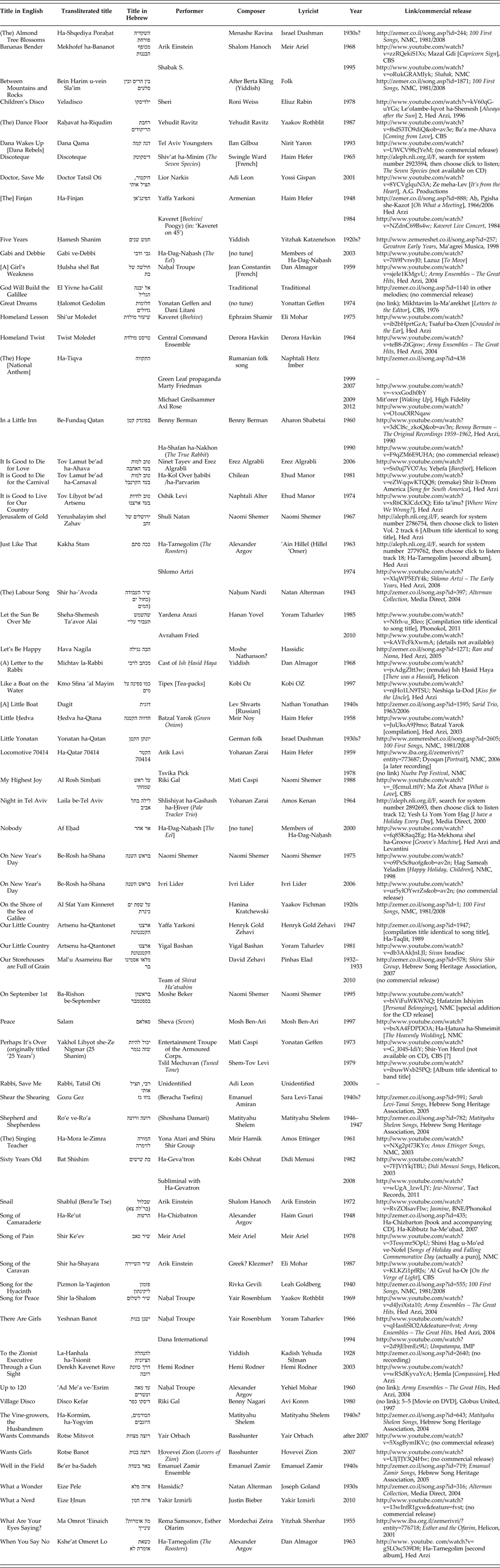
Table A1
Table A1 contains the list of songs cited, with Hebrew titles in transliteration and in Hebrew script, songwriters, composers, performers, year, links and details on commercial release. Links are provided, since the songs are usually available through search in Hebrew only. Direct links to official websites are included when available. Links to the Zemereshet site (http://zemer.co.il) provide direct access to pages with Hebrew text (and information) and (with one exception) recordings. Other links enable access to recordings at the National Sound Archive at the National Library of Israel, some of them via the website of Israel Broadcasting Authority. Links to YouTube are only given when other links are unavailable. All links included here were accessed on 7 June 2013. Album titles (usually in transliteration and English translation) and labels are provided for CD releases. Compilations that are not identical to the original vinyl albums are indicated by the most recent release year. The category of commercial release is irrelevant for some older songs.