Thou shalt not defraud an hired servant that is needy and poor […]. Give him his hire the same day, and let not the sun go down thereon. For he is needy and therewith sustaineth his life.
Deuteronomy 24: 14–15In the scholarly debate about the increasingly flexible, informal, and precarious nature of employment relations, it is often suggested that these trends are new. This is especially true for the advanced capitalist countries. “Previously,” employees had permanent jobs, with good social benefits and a vast array of rights, whereas “nowadays” they are losing these forms of security and are more vulnerable to market whims. These observations do not take into account that standard employment relationships in fact came about relatively recently. In the past, insecurity and absence of rights were at least as prevalent as they are today. Standard employment appears to have been generalized rather briefly in a small part of the world. The crucial question is not why the old lack of security is returning, but why it was possible to reduce such insecurity for a small share of the world population for a few decades. While the answer to this crucial question remains unclear; studies reconstructing the course of events over several centuries will clearly be necessary to solve this problem.
The first to attempt this, to my knowledge, was not an historian but a sociologist: Robert Castel (1933–2013). After devoting the first half of his active life mainly to examining which mechanisms were used for excluding “deviant” groups, such as psychiatric patients, and how they could regain their agency,Footnote 1 he shifted his attention to the social question during his later years. Castel concentrated mainly on France, with occasional digressions to England. He did not consider broader geographic contexts, let alone global ones. Still, his observations could also be relevant for other parts of the world, if only as a basis for comparison.
Castel published his magnum opus in 1995: Les métamorphoses de la question sociale. A good, though at some points overly free, English translation by Richard Boyd appeared in 2003.Footnote 2 The book relates in some measure to a different work: Les métamorphoses de la société salariale by Michel Aglietta and Anton Brender (1984).Footnote 3 Like Castel's study, this earlier book also assumed that institutionalized social assistance and economic constellation in France had been undergoing sweeping changes since the 1970s. And like Castel, Aglietta and Brender rejected both liberalism and Marxist “messianism.” They focused not on the capital-labor antagonism but on the emergence and features of the salariat, the wage-earning class, which, in their view, has internalized society's main contradictions. Castel does not follow Aglietta and Brender in all respects, but his central focus relates to theirs.
Castel formulated his perspective based on the increasingly pronounced presence in the 1980s and 90s of “individuals who virtually drift about within the social structure, and who populate these interstices of society without, however, finding any established position within it.”Footnote 4 To what extent, he wondered, are these people, whom we might nowadays perhaps describe as a “precariat,” a new phenomenon, and what has brought about their existence?
Castel traces the answer to this question very far back in time. His book is a long but also fascinating account of workers who first emancipated and then lost some of their benefits. He starts in the High Middle Ages, when people unable to work obviously existed as well. Some of these people were physically incapable of working: small children, the elderly, the blind, cripples, mentally disabled, and so forth. Others might be physically capable of working but were unable to earn enough to cover their cost of living. Basing himself on Alain Caillé,Footnote 5 Castel postulates that most of these people have traditionally been supported mainly via socialité primaire—that is, social relations in their immediate surroundings: kinship networks, village communities, and the like. Of course, there have always been marginal individuals who do not receive support via socialité primaire: itinerant knights, charcoal burners, brigantes, and others who were not part of a community and were therefore completely isolated. Within communities, however, matters were different.
Only when the socialité primaire can no longer support all those in need (because their number has become disproportionately high in relation to the available resources) does institutionalized social assistance manifest as a separate intervention level. At first, social assistance is constituted entirely analogous to the socialité primaire and is territorialized: Support is arranged at the place where the individual lives. Generally, only those unable to work receive assistance. This immediately led to a dichotomy between those who do and do not merit relief. To determine inclusion criteria for this group, a handicapology has been devised: an adjustable doctrine of occupational disability that has been pivotal in all social relief during the previous centuries. Those who are capable of working but do not—usually because no work is available—are not covered and have to manage on their own. They are the disaffiliated and experience the double duress of needing to work but not having work options available.
Since the late thirteenth century, the “worthy poor” have been covered by a type of local social services, involving an exchange between the indigent and the wealthy: the former received aid, while the latter pursued spiritual salvation by loving their neighbor. Over time this aid became more systematic. Between 1522 and approximately 1550, about sixty European cities took measures to support the poor. “These municipal policies rested on a few simple principles: exclusion of strangers, strict prohibitions against begging, the enumeration of requirements and classification of distinct categories of beneficiaries.”Footnote 6 In the seventeenth century this tendency became more rigid, and beggars were placed in detention. Benefit recipients ordinarily had to meet two criteria: proximity and occupational disability. Of course, there were also subversive tendencies by poor who did not meet the criteria and, for example, tried to obtain benefits by feigning invalidity.
The “unworthy poor”—the disaffiliated, or what Richard H. Tawney has termed the “residual population”—became more numerous from the early fourteenth century. This relatively small but nonetheless significant group did not fit into the traditional integrative framework and therefore experienced freedom in a negative sense. These people were not a “reserve army” in the Marxian sense because their labor was never needed. Their pauperism manifested because of the absence of a labor market, the impossibility of obtaining a place in the highly regulated system—in contrast to modern pauperism, which is the consequence of a “savage liberalization” of the labor market. Those who are excluded often become vagabonds, who roam around aimlessly (sans aveu) and whose problems are reduced to run-ins with the law. Institutionalized social assistance devised several techniques for dealing with the unregulated occupationally able poor (an urban and rural subproletariat): exile, execution, forced labor, deportation, and imprisonment with forced labor.
Both the worthy and the unworthy poor were relatively marginal in number between the fourteenth and the eighteenth centuries. The great majority of the population consisted of working people, either performing regulated labor in guilds and similar organizations or forced labor (corvée). Very few opportunities were available for “free” wage workers. They had to start by establishing their place between the two dominant main groups. They consisted of journeymen, dabblers, ruined artisanal masters, peasant-workers, and office boys and remained fairly peripheral, even when they became more numerous. Castel suspects that wage labor arose historically when corvée was converted to a money rent: “from an obligatory payment in labor, it becomes an obligatory payment in money.” The tenant is now “free” to put a part of his time at the disposal of the lord or another wealthy neighbor.Footnote 7
The early wage workers were beyond dignity and were second from the bottom on the social scale.
The birth of a new status of wage-labor, beginning with the commodification of work, must therefore be seen as an absolute ground zero in terms of the condition of wage-labor, at least if one understands by this the acknowledgement of a status to which rights and guarantees are attached. Deprived of these tutelary supports, the condition of wage-labor is not only one of vulnerability. Indeed it will rapidly become altogether unliveable. [Just below them is] an even more despised class of people, who live by their wits and crimes alone, but the line separating them is difficult to draw.Footnote 8
Around the late seventeenth and early eighteenth centuries, two major changes occurred. First, people started to become aware that the two peripheral groups, especially those “refusing to work,” were becoming a mass phenomenon. Labor started to be perceived differently as well: It was no longer regarded as a religious or moral duty but counted increasingly as a source of wealth and prosperity—which was why it needed to be reorganized according to the principles of the new political economy. This reorganization led to an awareness that “free” contract between employer and employee does not guarantee a stable social order. As Turgot wrote in the 1760s
The common worker who has only his arms and his industry has nothing other than what he manages to sell his sorrows for others. He sells it more or less dearly; but this more or less high price does not depend on him: it is the result of the agreement that is made with the one who pays his labor. This latter pays him as cheaply as he can: for as he has a choice between a great number of workers, he prefers the one who works for the lowest price. Workers are thus obliged to lower their prices at each other's expense. In all lines of work, it must come to pass, and indeed it does come to pass, that the price of the labor of the worker descends to that minimal level which is necessary in order to maintain his existence.Footnote 9
Soon afterward, as is known, similar observations were made by Thomas Malthus and Edmund Burke. In 1815 Jean-Baptiste Say noted, “In England, a worker, according to the family he has and despite all his most estimable efforts, cannot make three quarters and sometimes only half of his expenses.”Footnote 10 With the rise of industrialization, the social question underwent a qualitative change. The mass poverty of the nineteenth century arose directly from the reorganization of labor relations—that is, the rise of “liberated” labor. “Precariousness of labor, a lack of skills, alternations between periods of work and non-work, unemployment—all these characterize the overall condition of the nascent working classes.”Footnote 11 Eugène Buret already used the term précaire to describe the circumstances of these workers in 1842.Footnote 12
The onset of mass pauperism coincided with an awareness among some of the elite—a trend that culminated in the emergence of social sciences, in impressive studies by Alex de Tocqueville and others, and in novels (e.g., by Victor Hugo), but also in “class racism,” in an intense revulsion for the immoral and contaminated “asocials.”Footnote 13 The fear among entrepreneurs of the new proletarian masses resembled the fear among plantation owners of their slaves. After the uprising of the silk workers in Lyon in 1831, Le Journal des Debats wrote,
Each resident lives in his workshop like planters living in colonies amidst their slaves; the sedition in Lyon is of a similar kind to the insurrection of Santo Domingo […] Barbarians threatening society are not all to be found in Caucasus, nor in the steppes of Tartary. Rather, they are in the suburbs of our manufacturing cities.Footnote 14
Driven by fear and compassion, the elites responded with paternalistic charity. Members of the inferior classes were regarded as children, as people unable to take care of themselves. Social assistance came to encompass a series of practices intended both to alleviate material suffering and to provide the underclass with moral enhancement. Various techniques were devised to achieve these objectives, ranging from visitors of the poor to setting up savings funds and mutual aid societies. In large factories patronage systems were introduced, including labor booklets and regulations.
These paternalism and the patronage techniques, however, affected only a small share of the wage workers and consistently failed to take into account the specific requirements of the rising labor movement. The revolution of 1848, in which the “right to work” was demanded, convinced the elites that new answers were necessary; the state should no longer regard itself merely as a gendarme suppressing protests but should safeguard social peace as well. After 1848, signs of the incipient welfare state became visible: the state became a third party alongside those “who recommended the moralization of the people” and those “who advocated class struggle.”Footnote 15 The welfare state, which Castel prefers to call the “social state,”Footnote 16 “began its trajectory when the notables ceased to dominate without sharing their wealth and when the people failed to resolve the social question on their own terms.”Footnote 17 In this sense the rise of the social state augured the defeat of the young labor movement. The growth of the social state was propelled by social conflicts, explaining the “tardiness of its expansion, marked by timid advances and much footdragging.”Footnote 18
The social state “sublimates” class antagonisms. The social insurance industry, an entirely new social technique that many regarded with suspicion at first, was a central innovation. Insurances made for a new type of ownership in addition to private property: social property, which allows citizens “to remain outside the order of private property without losing the safety of it.”Footnote 19 The social state became “the guarantor of the transfer of property. The state thereby accommodates itself to a new and completely original role.”Footnote 20 August Comte previously noted that social insurance reintegrated the marginalized in occidental society. The social state: “solidifies a newfound association between security and mobility. The nomadic character that made the vagabond such a negative exemplar of liberty is overcome at the same time as insecurity. … De-territorialization is no longer the same as disaffiliation.”Footnote 21 This rationalized the national labor market and made it more flexible at the same time.
In the past century and a half, wage labor has become increasingly widespread. In 1974 in France eighty-two percent of the active population was wage dependent. France had become a Fordist “wage-earning society.” Five factors defined this situation: (1) the clear distinction of wage workers from other groups in society; (2) the ties that wage workers had with their workplace; (3) participation by wage workers in mass consumption; (4) participation by wage workers in social property; and (5) the firm establishment of collective labor law. These developments transformed the class society into a society of wage workers. Even though wage workers were growing progressively more numerous, they were also integrated in society.
In the 1950's and 1960's, the labor contract for an undetermined length of time became the norm, and then served as a virtual guarantee of employment. But this stemmed only from the fact that in times of full employment, one often hires, and only rarely lays off employees. As this growth [of the long boom] vanishes, however, security too disappears, and the ‘indefinite’ aspect of the contract reveals itself to be a simple consequence of empirical realities and not a legal guarantee. In summary, a contract of indeterminate length is a contract that lasts […] only so long as it is not interrupted […]. This did not prevent most wage earners, during the years of growth, from experiencing their relationship to employment with the certitude of controlling the future and of making choices that take into account this future, such as investing in durable goods, taking out mortgages for construction, and so on.Footnote 22
This development also led to “the refusal to conform to the logic of deferred gratification and the programmatic existence implied by the deal level of security,”Footnote 23 manifesting as hedonism and the celebration of the moment. As the philosopher and historian Marcel Gauchet observed, “[I]f there is Social Security I have no need of my next door neighbor to help me.”Footnote 24
This lasted until about 1975. In the meantime, the social question seemed to vanish into thin air. The class of wage workers became more heterogeneous. A growing share of the working class no longer performed productive tasks but “infraproductive” duties (maintenance, delivery, packaging, security) or was responsible for overseeing machines, quality control, testing, personnel management, and so forth. Increasing numbers of nonworkers became wage-dependent. By the late 1950s, sociologists such as Michel Crozier and Serge Mallet were identifying these new trends. The “salarial society might be imagined as beginning from the coexistence of a certain number of blocks at once separated and unified by this logic of distinction that is at play within the heart of each group just as much as between the different groups.”Footnote 25
From the 1970s the labor market became progressively divided between protected hubs on the one hand and precarious workers on the other hand. This gap between the two groups became visible in 1970, when the introduction of monthly pay in many places started to obscure the difference between blue and white collar workers. Temporary, seasonal, or intermittent workers were not covered by this arrangement. These vulnerable groups consisted mainly of migrants, women, and youth; their condition “resembles the proletariat of an earlier age.”Footnote 26 They were the core of what later became the precariat.
In recent decades the social question has clearly resurfaced as a result of “the crumbling of the wage earning condition.”Footnote 27 Labor contracts with an indeterminate duration are becoming less commonplace. While in 1975 about eighty percent of the active population had such a contract, only sixty-five percent did twenty years later. In this seemingly irreversible process, stable jobs are being replaced by discontinuous employment. “It begins to become clear that the precariousness of work, and unemployment, are inscribed in the actual dynamic of modernization itself.”Footnote 28 “Just as the pauperism of the nineteenth century arose out of the heart of the dynamic of early industrialization, so too does the precariousness of labor arise from a central process, driven by the new technological-economic imperatives at the very heart of modern capitalism.”Footnote 29
“The new ‘atypical’ forms of employment have more in common with these older forms of hiring, when the status of the worker was erased in the face of the constraints of labor. Flexibility is one name to explain the obligation of modern workers to adjust to their tasks.”Footnote 30 So we are seeing a “resurgence of mass vulnerability.”Footnote 31 Growing numbers of people are becoming supernumeraries, whom the social structure does not accommodate: “they have missed the train of modernization, and remain on the platform with little baggage.”Footnote 32 These people, in some measure the reincarnation of the earlier vagabonds, have a choice between resignation and sporadic violence.
Castel recommends reallocating labor as a solution to the present predicament: “[T]o make it such that each person finds, keeps or recovers a place in the continuum of socially recognized positions associated, on the basis of effective labor, with decent living conditions and social rights.”Footnote 33 Such action will enable social cohesion to be preserved and will allow “an effective redistribution of the attributes of social citizenship” to be accomplished.Footnote 34 Those who say this is impossible because of the constraints of the world market embrace an economic logic, while a social logic that prevents the social fabric from unravelling is preferable.
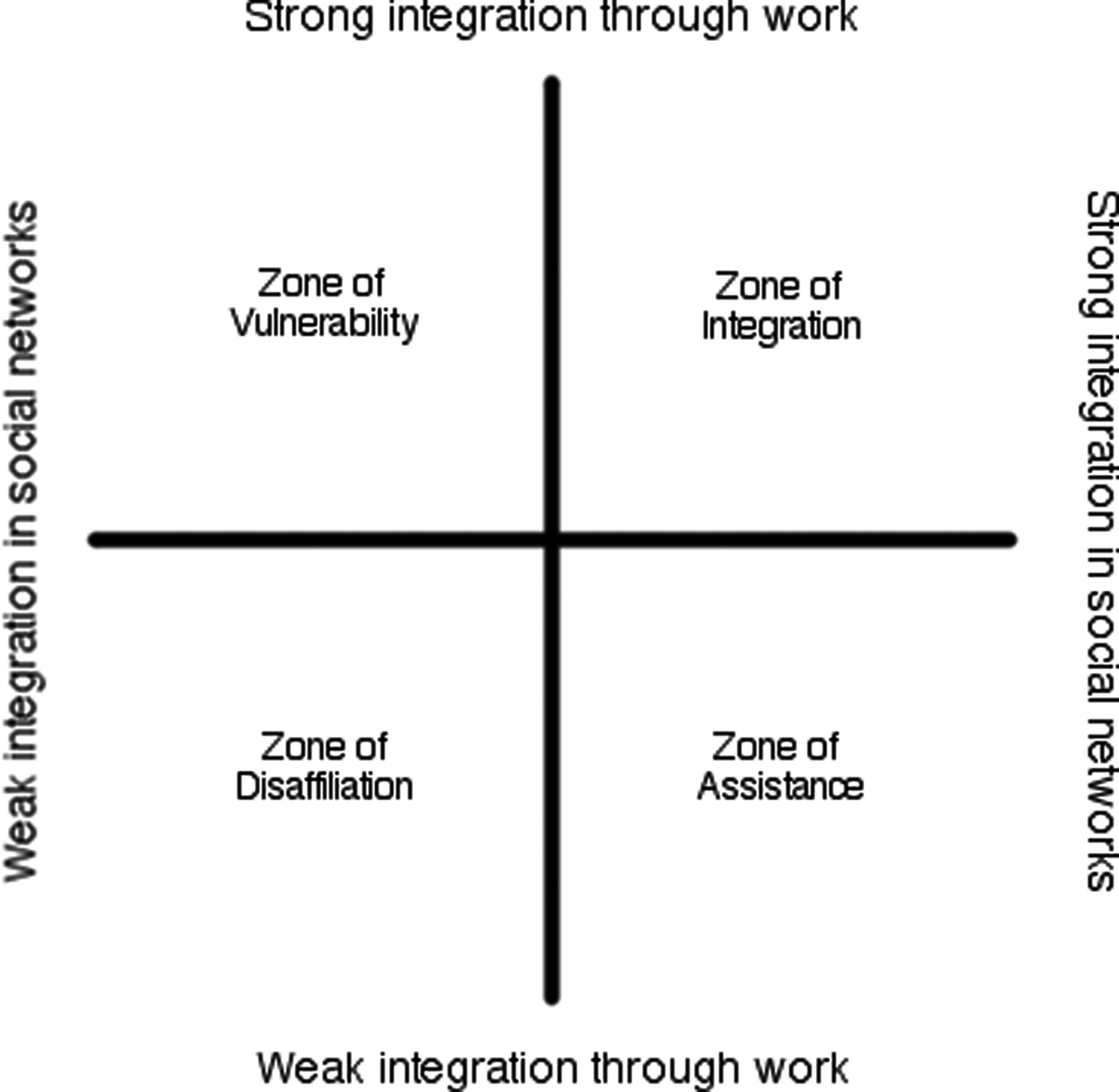
Reflecting on the past six centuries, Castel notes recurrent patterns. He describes the distinction on two axes: “the axis of integration by labor—stable employment, precarious employment, expulsion from employment” and the axis of “relational embeddedness in familial networks of sociability—strong sense of belonging, tenuous relationships, social isolation.”Footnote 35 These two axes yield four zones of social density: the zones of integration, vulnerability, assistance, and disaffiliation
Printed with permission. Image courtesy of author.

The partitions between these zones are porous: Vulnerability may turn into disaffiliation. Moreover, a low score on one axis may be compensated by a high score on the other axis. In a later publication, Castel noted that this subdivision may be conducive to interpreting contemporary social circumstances. “The industrial and political revolutions at the end of the eighteenth century profoundly disturbed the configuration of these zones. But social history shows that they were preserved and transformed, so that by the beginning of the 1970s they had reached a state of equilibrium, which we are probably now in the process of leaving.”Footnote 36
When it first appeared in 1995, Les métamorphoses received considerable and largely favorable reviews in French academic circles.Footnote 37 Any criticism targeted mainly the lack of a gender perspective and the concept of the “wage-earning society” (société salariale) that Castel appears to distinguish from a more fundamental analysis of capitalism overall.
In later publications Castel has elaborated on aspects of Les métamorphoses. The growing social insecurity deeply concerned him, as did the negative discrimination of migrant youth in the suburbs of Paris.Footnote 38 He has consistently advocated sociological and historical study of the social question, thereby paving the way for all those willing to acknowledge the long-term connection between precarious work and capitalism.