





1. Introduction
In close binaries, theoretical studies suggest that tidal interactions enhance chemical mixing (e.g., de Mink et al. Reference de Mink, Cantiello and Langer2009). However, observations show no clear correlation between orbital period and nitrogen surface enrichment, challenging these predictions (e.g., Martins et al. Reference Martins, Mahy and Hervé2017; Abdul-Masih et al. Reference Abdul-Masih, Sana and Hawcroft2021; Pavlovski et al. Reference Pavlovski, Southworth and Tkachenko2023). So far, the impact of AMT assumptions on such theoretical predictions has received little attention.
2. Single and binary star physics
We used genec to compute detailed stellar evolution 1D models. The adopted stellar physics is generally the same as in Ekström et al. (Reference Ekström, Georgy and Eggenberger2012). The tides treatment is described in details in Sciarini et al. (Reference Sciarini, Ekström and Eggenberger2024) and Sciarini et al. (Reference Sciarini, Rosu and Ekström2026). The main components are described below.
2.1. Stellar physics ingredients
The models account for AMT and RM. Two categories of models are compared. Hydro models account for mixing by shear instabilities (following Maeder Reference Maeder1997) and meridional circulation (following Zahn Reference Zahn1992 and Maeder & Zahn Reference Maeder and Zahn1998). Magnetic models in addition account for magnetic instabilities following the asteroseismic-calibrated version of the Tayler-Spruit dynamo as formulated by Eggenberger et al. (Reference Eggenberger, Moyano and den Hartogh2022).
2.2. Tides treatment
The models account for dynamical tides following Song et al. (Reference Song, Maeder and Meynet2013); Sciarini et al. (Reference Sciarini, Ekström and Eggenberger2024) and equilibrium tides acting on small sub-surface convective zones, adapted from Fragos (2023). The equilibrium tides prescription can be written as:
 \begin{equation} \left(\frac{k_2}{T}\right)_{\rm conv}\rightarrow \frac{k_2}{\tau_{\rm conv}}f_{\rm conv}\frac{I_{\rm conv.reg.}}{I}, \end{equation}
which we insert in the Hut (Reference Hut1981) treatment of equilibrium tides, as done by Hurley et al. (Reference Hurley, Tout and Pols2002). In Eq. (1),
 $k_2$
is the apsidal motion constant,
 $\tau_{\rm conv}$
the convective turnover timescale (which we compute consistently with the mixing-length-theory),
 $f_{\rm conv}$
accounts for the regime of fast tides,
 $I_{\rm conv.reg.}$
is the moment of inertia of the convective region, and I that of the star.
3. Grids of binary models with tidal mixing
We computed 358 genec models, using nitrogen (N) and helium (Y) as chemical mixing tracers. To assess whether tides enhance or suppress mixing, we computed binary and single-star models with identical initial conditions and evaluated the quantities:
 \begin{equation}\begin{aligned} \Delta \widetilde{\text{N}}_{\rm surf}&=\frac{[\text{N}/\text{H}]_{\rm binary}-[\text{N}/\text{H}]_{\rm single}}{X_{0}-X_{\rm c,final}};\\ \Delta \widetilde{Y}_{\rm surf}&=\frac{Y_{\rm surf,binary}-Y_{\rm surf, single}}{X_{0}-X_{\rm c,final}}.\end{aligned}\end{equation}
The signs of
 $\Delta\widetilde{\text{N}}_{\rm surf}$
and
 $\Delta \widetilde{Y}_{\rm surf}$
indicate whether the star experiences more chemical mixing when found in a binary system (positive) or single (negative). Normalization by the amount of hydrogen burned in the core (
 $X_0-X_{\rm c,final}$
) allows for a more accurate quantification of mixing efficiency. Two initial velocities were tested: stars initialized at synchronization (Grid I), or at
 $\upsilon_{\rm ini}/\upsilon_{\rm crit}=0.4$
, i.e., super-synchronous (Grid II).
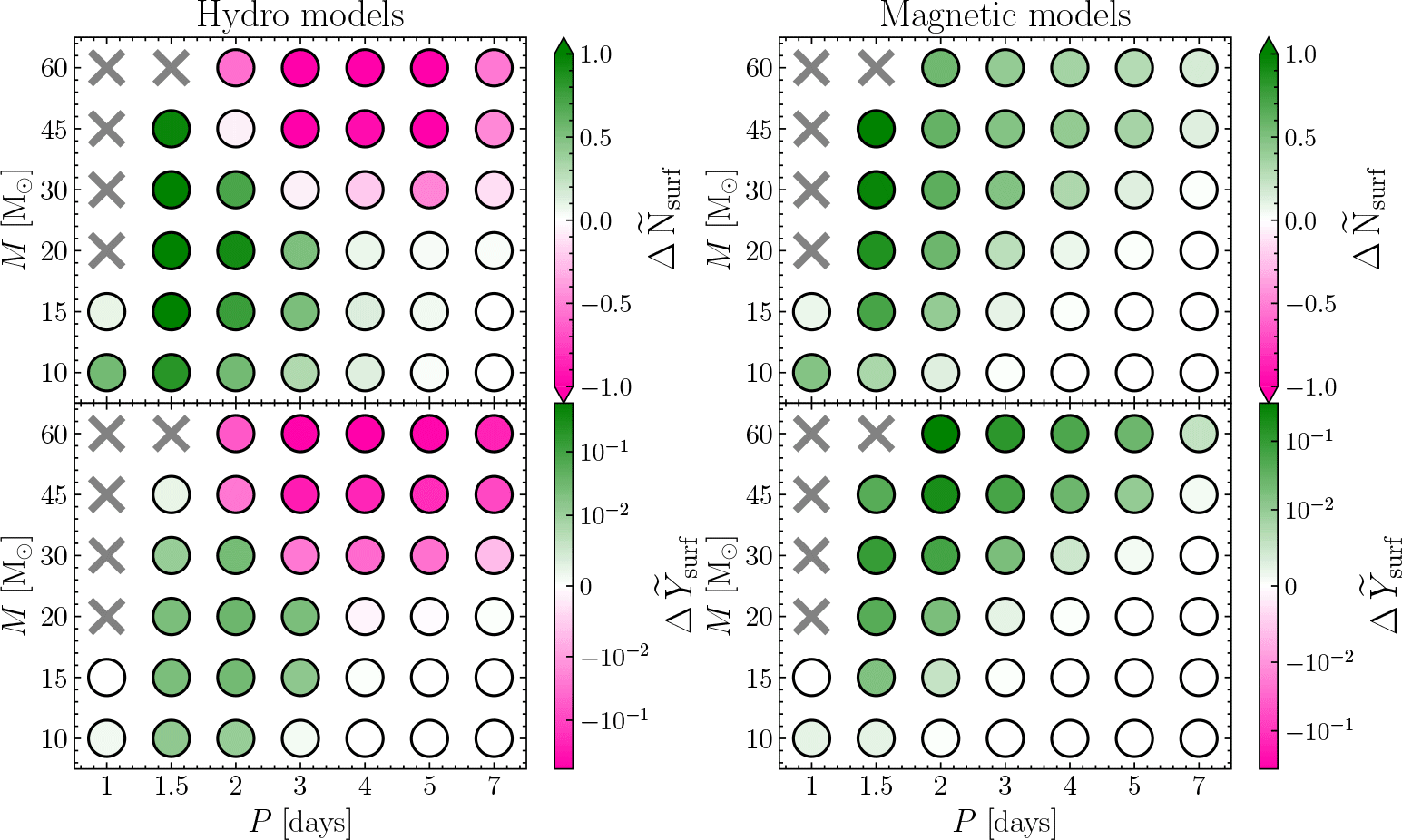
When stars are initialized at synchronization, hydro models predict that spin-up by tides suppresses rotational mixing in some regions of the parameter space (high mass / long period; Fig. 1). In contrast, in magnetic models, spin-up by tides systematically boosts mixing. These opposite reactions of the models are due to different processes dominating chemical mixing: shear mixing – related to the degree of differential rotation – in hydro models, and meridional circulation in magnetic models (in this case the efficient AMT suppresses shear mixing).
Difference in enrichment between binary and single-star models in the period-mass diagram (Grid I). Green:
 $\Delta \gt 0$
, tides boost mixing; magenta:
 $\Delta \lt 0$
tides suppress mixing. Left panels: hydro models. Right panels: magnetic models. Upper panels: nitrogen. Lower panels: helium. Grey cross: Roche Lobe overflow at zero-age main sequence.

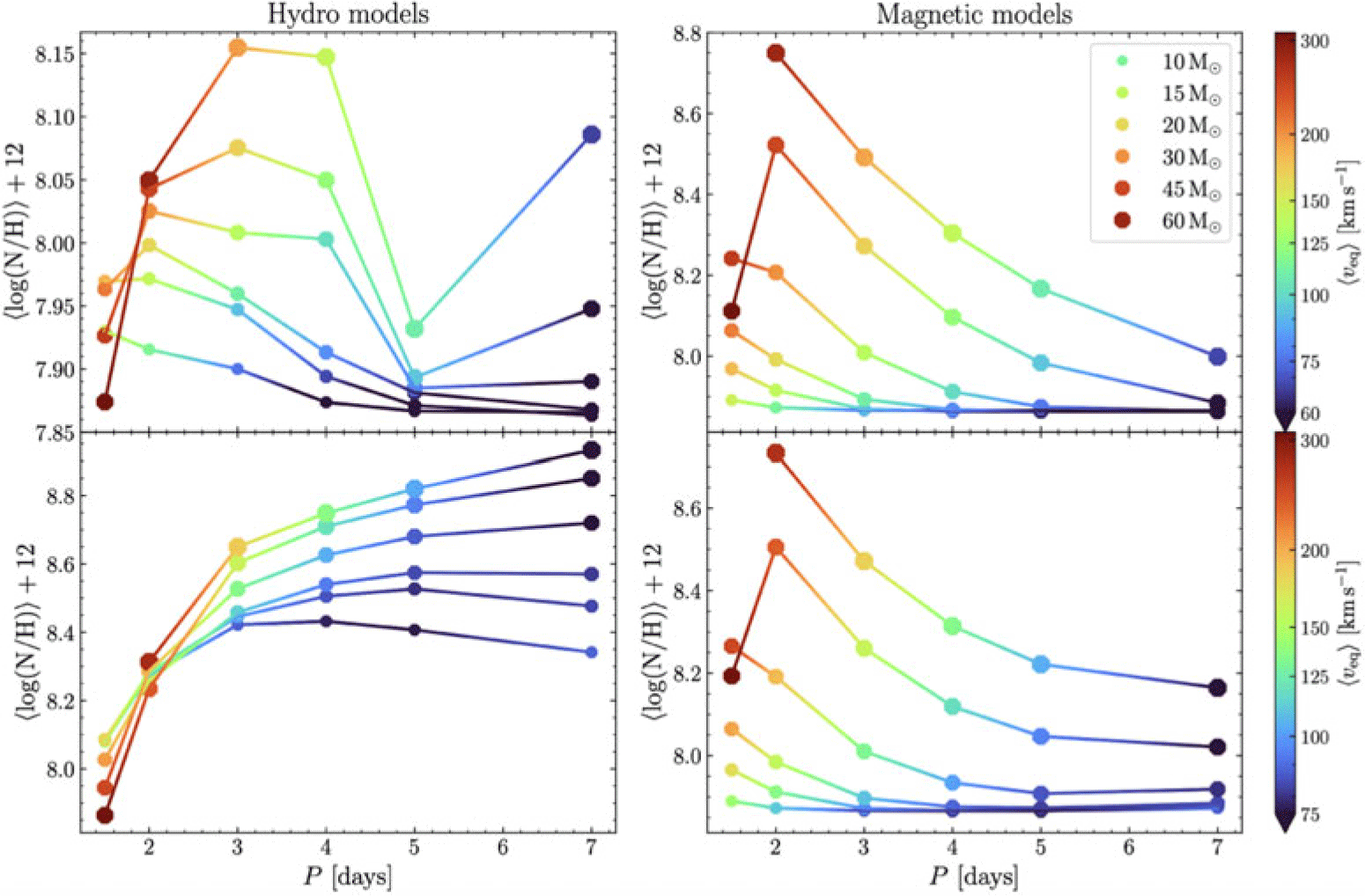
The period-nitrogen enrichment diagrams strongly differ depending on the AMT (Fig. 2). Magnetic models predict a period-nitrogen enrichment anti-correlation, in agreement with previous theoretical studies (e.g., de Mink et al. Reference de Mink, Cantiello and Langer2009), regardless of the initial velocity (consistent results for Grids I and II). In contrast, in hydro models the trend is more complex and depends on the initial velocity. When the stars are initialized at
 $\upsilon_{\rm ini}/\upsilon_{\rm crit}=0.4$
, models even predict a period-enrichment correlation, i.e., higher enrichment at lower rotational velocities.
Period-nitrogen enrichment diagrams (binary models). Left panels: hydro models. Right panels: magnetic models. Upper panels: Grid I. Lower panels: Grid II. Color-code: average velocities.

4. Discussion & Conclusion
These results highlight that in certain configurations, tidal interactions may suppress mixing, and model predictions depend on the AMT treatment. Hydro model predictions are sensitive to initial velocities and the degree of differential rotation. Due to the greater versatility of their predictions, these models can reproduce peculiar observed systems, namely mild enrichment at short periods/high enrichment at long periods.
 Δ>0
 Δ<0

 Open access

