Introduction
Bathophilus Giglioli, 1882 is a stomiid genus that had received little attention since Barnett & Gibbs (Reference Barnett and Gibbs1968); the genus presently comprises 19 valid species (Barnett & Gibbs, Reference Barnett and Gibbs1968) occurring mainly in the mesopelagic zones of all the major oceans. Bathophilus can be recognized easily by its mid-laterally placed pelvic fins, which are well separated from each other. The members of the genus lack gill rakers or raker teeth, lack vomerine teeth and have a laterally compressed body (Morrow & Gibbs, Reference Morrow, Gibbs, Biglow, Cohen, Dick, Gibbs, Grey, Morrow, Schultz and Walters1964). They also have a grooved isthmus and a long chin barbel without any modifications, however these two characters are not synapomorphic, as Bathophilus abarbatus Barnett & Gibbs, Reference Barnett and Gibbs1968 lacks a chin barbel and a grooved isthmus.
Bathophilus belongs to Stomiidae, a family known for its light-emitting photophores and also as a family where photophore counts are crucial in species discrimination and identification. However, Bathophilus is an exemption, and its taxonomy has mainly evolved along the number of rays in pectoral and pelvic fins rather than the serial photophore counts. Pectoral and pelvic fins are long, fine and thread-like without any connecting membranes (Morrow & Gibbs, Reference Morrow, Gibbs, Biglow, Cohen, Dick, Gibbs, Grey, Morrow, Schultz and Walters1964), however, the last character needs further study, as in our examinations, we were able to see few fishes with some kind of partial membranous attachment. Bathophilus species show considerable variation in the number of pectoral rays, which can vary between 1–56 (Barnett & Gibbs, Reference Barnett and Gibbs1968). Many of the species have wide geographic distributions and can be found in the Indian, Atlantic and Pacific oceans.
Previously, 10 species of Bathophilus were reported from the Indian Ocean, but only one species, Bathophilus novicki Barnett & Gibbs, Reference Barnett and Gibbs1968 was known from the Arabian Sea (Barnett & Gibbs, Reference Barnett and Gibbs1968; Gibbs, Reference Gibbs, Smith and Heemstra1986; Prokofiev, Reference Prokofiev2014). Our study presents first records of Bathophilus proximus Regan & Trewavas, Reference Regan and Trewavas1930, Bathophilus altipinnis Beebe, Reference Beebe1933, Bathophilus cwyanorum Barnett & Gibbs, Reference Barnett and Gibbs1968 and Bathophilus digitatus (Welsh, 1923) from the Arabian Sea. All the studied species showed considerable differences in the counts of pectoral and pelvic fin rays with the last revision (Barnett & Gibbs, Reference Barnett and Gibbs1968). However, such differences in meristic counts have led the species identification to be doubtful and has exposed new problems in the taxonomy of Bathophilus, especially when pectoral and pelvic ray counts are one of the most important character in species discrimination. It appears to us that some of the species among the valid species could be synonyms and the paper tries to highlight these problems.
Materials and methods
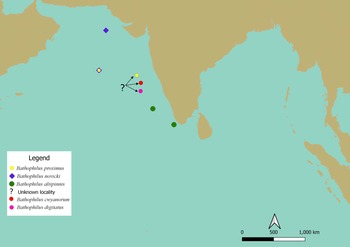
Fishes were collected by the mesopelagic surveys of Fisheries Oceanographic Research Vessel ‘Sagar Sampada’ in the Northern Indian Ocean during August 2013 (Cr 320 using a 49.5 m cosmos trawl with 10 mm cod end mesh size) and February 2016 (Cr 347 using a 45 m midwater trawl with 25 mm cod end mesh size). Catch localities for some of our specimens collected from trawl sites are unavailable, and the location is assumed to be between 21°45.445N–10°58.036N in the Arabian Sea, based on the cruise track. In these specimens catch locality is given as ‘unknown locality’. Sampling locations are shown in Figure 1.
Collection localities of specimens of Bathophilus.

Terminology for photophores follows Morrow (Reference Morrow, Gibbs, Biglow, Cohen, Dick, Gibbs, Grey, Morrow, Schultz and Walters1964) and Weitzman (Reference Weitzman, Smith and Heemstra1986). In some cases two values were given for a photophore count separated by ‘/’. This indicates that an approximate count was taken due to the poor condition of a particular portion or whole specimen, exact count could be either one of the two values. Counts were given in ranges whenever the specimen count was more than two, whenever there were only 1–2 specimens the counts of single or both the specimens were given in the order as that of material examined. Here, the term ‘Fin rays’ refer to pelvic and pectoral fin unless stated otherwise.
All the specimens were stored in 7–8% formalin and deposited in CMLRE Referral Center under the accession series ‘IO/SS/FIS/00xxx’. Number of specimens under a single accession number is given in parenthesis whenever more than 1 specimen was stored under the same number. Standard length and capture details follow accession number. Apart from photophore counts the following meristic counts were abbreviated; D, dorsal fin rays; A, anal fin rays; P, pectoral fin rays; V, ventral fin rays; PO, postorbital organ; SL, standard length.
Results
Systematics
Order Stomiiformes
Family Stomiidae Bleeker, 1859
Genus Bathophilus Giglioli, 1882
Bathophilus proximus Regan & Trewavas, Reference Regan and Trewavas1930
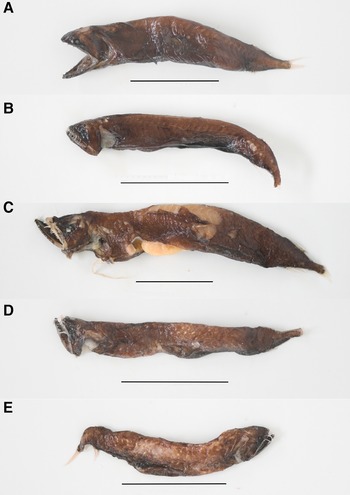
(Figures 2B and 3C)
IO/SS/FIS/00703, 6.5 cm, 15.97N, 65.5E, 100 m, 10/2/2016, 19.20 h; IO/SS/FIS/00704 (2), 5.5 cm, 7.8 cm, unknown locality.
(A) Bathophilus novicki, IO/SS/FIS/00701, 7.8 cm SL; (B) Bathophilus proximus, IO/SS/FIS/00703, 6.5 cm SL; (C) Bathophilus altipinnis, IO/SS/FIS/00708, 10.8 cm SL; (D) Bathophilus digitatus, IO/SS/FIS/00706, 6.8 cm SL; (E) Bathophilus cwyanorum, IO/SS/FIS/00705, 7.5 cm SL. Scale bar: 3 cm.

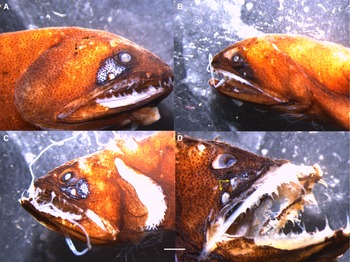
Pores, postorbital organ (PO) and its associated luminous tissues in Bathophilus: (A and B) variation associated with luminous tissue surrounding PO in two individuals of Bathophilus novicki; (A) 7 cm SL, black arrows point at the pores in head; (B) 5.2 cm SL; (C) PO and surrounding luminous tissue in Bathophilus proximus; (D) yellow arrows point at bipartite PO of Bathophilus altipinnis, a small amount of luminous tissue can be seen above the PO. Scale bar: 2 mm.

Description
BR 6; IP 5; PV 13; VAV 12–13; AC 5–6; OV 12; VAL 10; D 12–15; A 10–13; P 15–17; V 15–16; premaxilla up to 9 teeth; mandible up to 13 teeth; palatine teeth 2–3 pairs; basibranchial teeth 2–3 + 2–3; maxillary and vomerine teeth absent. PO single, oval (Figure 3C), surrounded by an aggregation of luminous tissue (only visible in IO/SS/FIS/00703 as respective areas, badly damaged in others).
Remarks
Finding of B. proximus in Indian Ocean is important as the holotype collected from the Atlantic is the sole specimen to be known. The species can be distinguished from all other species in the genus by the presence of 16–19 rays in pectoral fin and 16 rays in pelvic fin (Morrow & Gibbs, Reference Morrow, Gibbs, Biglow, Cohen, Dick, Gibbs, Grey, Morrow, Schultz and Walters1964; Barnett & Gibbs, Reference Barnett and Gibbs1968). There were not any significant differences for Indian Ocean specimens to the holotype, however, two small variations we observed are the following. The OV count of Indian Ocean specimens was 12 compared with 10 in holotype and in one of the specimens (IO/SS/FIS/00704–5.5 cm) both pectoral and pelvic ray count was 15 which is one fewer than what is known from the holotype (Regan & Trevaves, 1930; Morrow & Gibbs, Reference Morrow, Gibbs, Biglow, Cohen, Dick, Gibbs, Grey, Morrow, Schultz and Walters1964; Barnett & Gibbs, Reference Barnett and Gibbs1968). Presence of luminous tissue around PO is new information related to the species. Prokofiev (Reference Prokofiev2014) raised some doubts on the validity of B. proximus, as the species was known only from the holotype and had some affinities to B. altipinnis. However, B. proximus should continue as a separate species as the diagnostic features of Indian Ocean specimens were in consensus with that of B. proximus (Regan & Trevaves, 1930; Morrow & Gibbs, Reference Morrow, Gibbs, Biglow, Cohen, Dick, Gibbs, Grey, Morrow, Schultz and Walters1964).
Bathophilus altipinnis Beebe, Reference Beebe1933
(Figures 2C and 3D)
IO/SS/FIS/00707 (2), 9 cm, 7 cm, 8.09N, 76.36E, 350 m, 7/10/2013, 18.55 h; IO/SS/FIS/00708, 10.8 cm, 10.4N, 73.3E, 480 m, 12/10/2013, 15.17 h.
Description
BR damaged; IP 5; PV 11; VAV 11; AC indistinguishable in our fishes; OV 12–13; VAL 9; D 12–13; A 13–15; P 25–26; V 17–18; premaxillary teeth 9–11; mandibular teeth 12–13; palatine teeth damaged; basibranchial teeth 2 + 2; maxillary and vomerine teeth absent. PO bipartite (IO/SS/FIS/00708, others damaged), luminous tissues seem to be present in a lesser extent around PO but not very clear.
Remarks
Bathophilus altipinnis can be easily distinguished from all its congeners by the presence of 23–25 rays in pectoral fin (Beebe, Reference Beebe1933; Barnett & Gibbs, Reference Barnett and Gibbs1968; Prokofiev, Reference Prokofiev2014). Even though one of our specimens had 26 rays, it should be considered as a slight variation as the specimen lacked any other differences. Only Bathophilus nigerrimus Giglioli, 1882 surpasses B. altipinnis in pectoral fin counts; the former species has a wide range of 31–57 rays in pectoral fin. A bipartite PO is also a characteristic of B. altipinnis (Beebe, Reference Beebe1933; Prokofiev, Reference Prokofiev2014). Any short filaments arising from barbel tip as reported in holotype (Beebe, Reference Beebe1933) were absent in our specimens. This is the first report of B. altipinnis from Arabian Sea, but the species has been reported from the Indian Ocean (Prokofiev, Reference Prokofiev2014).
Bathophilus novicki Barnett & Gibbs, Reference Barnett and Gibbs1968
(Figures 2A, 3A–B)
IO/SS/FIS/00701 (10), 5.5–7.8 cm, 15.97N, 65.5E, 100 m, 10/2/2016, 19.20 h; IO/SS/FIS/00702, 4.3 cm, 21.76N, 66.5E, 100 m, 25/1/2016, 19.15 h.
Description
BR 5–7; IP 5; PV 10–13; VAV 11–13; AC 4–5; OV 10–12; VAL 8–12; D 12–15; A 11–16; P 12–14; V 13–17; premaxillary teeth 8–11; mandibular teeth 10–14; palatine teeth 2–3 pair; basibranchial teeth 2–3 + 2; maxillary and vomerine teeth absent. PO single, encircled by an aggregation of luminous tissue, whose size varied among individuals (Figure 3A and B). Muscles on lower and upper jaws and palatine have minute photophores. Two small pores visible at posterior dorsal area of operculum, one in line with dorsal border of eye, another in line with dorsal margin of operculum (Figure 3A).
Remarks
Bathophilus novicki was originally described as a species of Bathophilus with 10–12 pectoral fin rays and 13–17 pelvic fin rays (Barnett & Gibbs, Reference Barnett and Gibbs1968), a recent study (Prokofiev, Reference Prokofiev2014) and our study confirm this species can have up to 10–14 pectoral fin rays.
Bathophilus cwyanorum Barnett & Gibbs, Reference Barnett and Gibbs1968
(Figure 2E)
IO/SS/FIS/00705 (2), 5.9 cm, 7.5 cm, unknown locality
Description
All photophore counts are from the smaller specimen as photophores were damaged in the larger specimen; IP 5; PV 12/ 13; VAV 12/ 13, OV 11, VAL 9/ 10, AC and BR damaged; D 11, 15; A 12, 14; P 15; V 11, 12; premaxillary teeth 8, 10; mandibular teeth 11, 10; palatine teeth 2 pairs; basibranchial with 2 + 2 teeth; maxillary and vomerine teeth absent. PO single, presence of luminous tissue unknown, area damaged.
Remarks
The fishes were identified based on their counts of pectoral and pelvic fin rays. Even though B. cwyanorum is known from western central Indian Ocean (Barnett & Gibbs, Reference Barnett and Gibbs1968), the Arabian Sea specimens differed by having a reduced number of PV and OV photophores compared with 15–16 PV and 15 OV reported in B. cwyanorum (Barnett & Gibbs, Reference Barnett and Gibbs1968). Present specimens match the description of B. cwyanorum as it is the only species with 15–17 pectoral fin rays and 8–11 pelvic fin rays, (Barnett & Gibbs, Reference Barnett and Gibbs1968; Parin et al., Reference Parin, Becker, Borodulina, Karmovskaya, Fedorykyako, Shcherbachev, Pokhilskaya and Tchuvasov1977) even though one of our specimens had 12 ventral rays.
Bathophilus cf. digitatus (Welsh, 1923)
(Figure 2D)
IO/SS/FIS/00706, 6.8 cm, unknown locality
Description
IP 5; OV 12/ 13, all other photophore rows are in a poor condition, D 13; A 13; P 13; V 11; premaxillary teeth 8; mandibular teeth 9; palatine teeth in 2 pairs; basibranchial teeth damaged; maxillary and vomerine teeth absent. PO single, presence of luminous tissue unknown as the area was damaged.
Remarks
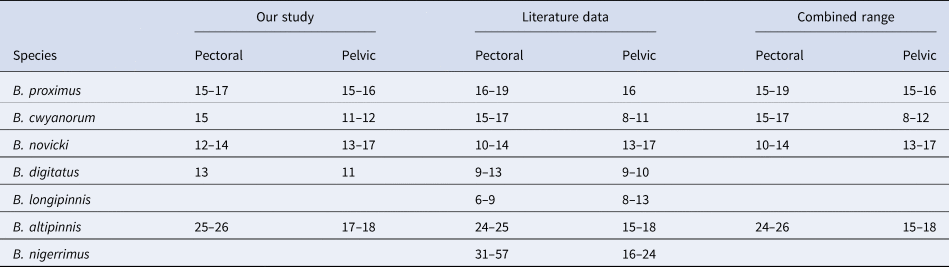
The fin ray ranges of this fish were in between B. digitatus and B. longipinnis (Pappenheim, 1914) (Table 1), therefore not exactly matching with either of those species. The fishes could be identified either as B. longipinnis or as B. digitatus as the ventral fin ray count of our specimen matches with that of B. longipinnis but the pectoral fin ray count matches that of B. digitatus (Barnett & Gibbs, Reference Barnett and Gibbs1968; Gibbs, Reference Gibbs, Smith and Heemstra1986). The differences in fin ray counts between these two species are narrow and both the species are known from the Indian Ocean (Gibbs, Reference Gibbs, Smith and Heemstra1986).
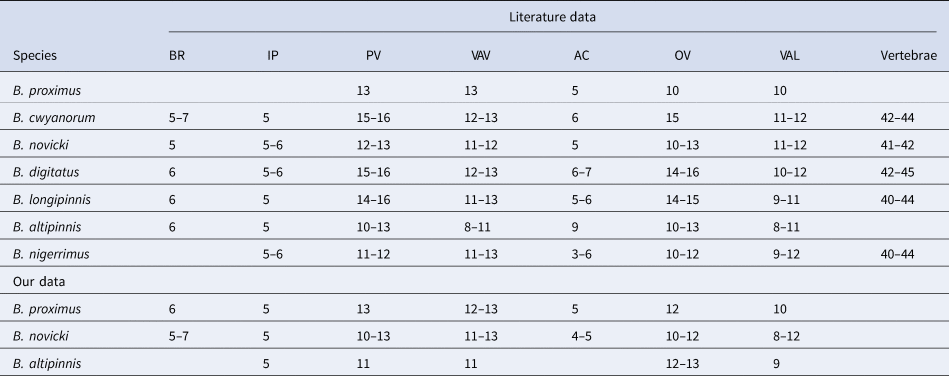
The pectoral and pelvic fin ray counts of Bathophilus mentioned in this paper compared with available literature data (Barnett & Gibbs, Reference Barnett and Gibbs1968; Parin & Sokolovsky, Reference Parin and Sokolovsky1976; Parin et al., Reference Parin, Becker, Borodulina, Karmovskaya, Fedorykyako, Shcherbachev, Pokhilskaya and Tchuvasov1977; Gibbs, Reference Gibbs, Smith and Heemstra1986; Prokofiev, Reference Prokofiev2014; Teramura et al., Reference Teramura, Koeda, Suzuki, Hirase and Senou2020). A combined range is provided (our count + existing counts)

Discussion
The differences in number of rays in pectoral fin or pelvic fin or both, number of serial photophores on body and vertebrae counts are the major characters used to distinguish the species in Bathophilus (Barnett & Gibbs, Reference Barnett and Gibbs1968). Since vertebrae counts were already showing an overlap between the species (Table 2), photophore and fin ray counts are the reliable identification characters for the species mentioned in the study. Present B. cf. digitatus and B. cwyanorum showed some discrepancies in some serial photophore counts but they were fitting more or less in to respective species in terms of fin ray counts (Tables 1 and 2). All the studied species showed slightly broader variation in pectoral and pelvic fin ray counts compared with the previously described ranges, so some of the species that were more clearly distinguished based on pectoral and pelvic fin ray counts are now noticeably closer or similar (Table 1).
Photophore counts of B. proximus, B. novicki and B. altipinnis compared with existing literature data (Barnett & Gibbs, Reference Barnett and Gibbs1968; Parin & Sokolovsky, Reference Parin and Sokolovsky1976; Parin et al., Reference Parin, Becker, Borodulina, Karmovskaya, Fedorykyako, Shcherbachev, Pokhilskaya and Tchuvasov1977; Gibbs, Reference Gibbs, Smith and Heemstra1986; Prokofiev, Reference Prokofiev2014; Teramura et al., Reference Teramura, Koeda, Suzuki, Hirase and Senou2020)

Available vertebrae counts from previous studies are also provided.
It is already known that three of the species (Bathophilus digitatus, B. longipinnis and B. cwyanorum) have a similar pelvic ray, vertebrae, PV and OV counts (Tables 1 and 2), and these three species show differences only in the number of pectoral fin rays. However, there are not any considerable differences in fins ray counts between these species (Table 1). Therefore there is a possibility that B. digitatus is a synonym of either B. longipinnis or B. cwyanorum. Parin & Sokolovsky (Reference Parin and Sokolovsky1976) had reported B. digitatus with 9 pectoral rays and 10–11 pelvic rays which could imply it is conspecific with B. longipinnis. The pectoral ray count of B. digitatus is only 2 rays less than that of B. cwyanorum (Table 1). Without doubt, these three species need further revisionary studies, including genetic studies, for a proper taxonomic validation. Bathophilus novicki can be excluded from this cluster as the species has lower PV and OV counts compared with the clustered three species even though it shares the same fin ray counts.
Bathophilus proximus reported herein represents a new record from the Indian Ocean. Prokofiev (Reference Prokofiev2014) speculated B. proximus to be synonymous with B. altipinnis. However, in our opinion B. altipinnis has more affinity to B. nigerrimus, as both the species have a bipartite postorbital organ (Beebe, Reference Beebe1933; Prokofiev, Reference Prokofiev2014) and a higher pectoral fin ray count compared with the rest of the species. Postorbital organ in B. proximus was entire without any partitioning. Bathophilus proximus can also be thought similar to B. novicki, which is now known for 14 pectoral rays, which is 1 ray fewer from that of B. proximus and further both the species showed aggregations of luminous tissues around PO.
From our study with five species of Bathophilus, the BR photophores are less developed in this genus. They are small and only visible as black dots. There were B. novicki with up to 7 BR against 5 (Barnett & Gibbs, Reference Barnett and Gibbs1968), and the BR photophores seem to be loosely attached in this genus. The apparent absence of BR reported in Bathophilus cf. novicki (Prokofiev, Reference Prokofiev2014) could have been due to a tendency to lose BR photophores. Because we were able to find specimens with 1–4 BR, the aberrant counts of 1–4 or 5 could have been due to loss of photophores on capture or due to other reasons.
We are not alone in finding variations in fin ray counts, with several studies subsequent to Barnett & Gibbs (Reference Barnett and Gibbs1968) reporting variations in the number of pectoral and pelvic fin rays (Parin & Sokolovsky, Reference Parin and Sokolovsky1976; Moore et al., Reference Moore, Hartel, Craddock and Galbraith2003; Prokofiev, Reference Prokofiev2014). This requires special attention as the above-mentioned meristic counts are a key diagnostic character in Bathophilus taxonomy. Some species in the genus, such as B. nigerrimus, can show a wide range in pectoral fin ray counts, about 31–56. Therefore, it is reasonable to think that other species in this genus can show such a trend to the same or a lesser extent.
The present scenario demands to look for additional characters that supplement the number of pelvic and pectoral fin rays, for at least the species mentioned in this study. Photophore counts seems to be a more relevant feature in taxonomy of Bathophilus species than previously thought. Some variations in photophore counts were visible in all the studied species except B. altipinnis (Table 2). However, as B. cwyanorum and B. cf. digitatus PV and OV counts were rather different from previously reported values (Morrow & Gibbs, Reference Morrow, Gibbs, Biglow, Cohen, Dick, Gibbs, Grey, Morrow, Schultz and Walters1964; Barnett & Gibbs, Reference Barnett and Gibbs1968; Gibbs, Reference Gibbs, Smith and Heemstra1986) availability of additional specimens can only tell whether these are normal variations or not. Serial photophores are inconspicuous in Bathophilus and can be confused with other smaller photophores in the body, hence they have to be counted carefully. The posterior photophores of VAL and VAV rows and the entire AC row can easily be confused with secondary photophores scattered throughout the body. Therefore counting of photophores in specimens, which are in bad condition or ones with ruptured belly, can be unreliable, especially in smaller individuals. Similarly, the postorbital organ could be useful in taxonomy, as some species are known to have a bipartite postorbital organ. Luminous tissues surrounding PO (Figure 3) was observed in B. novicki, B. proximus and might be present in B. altipinnis to a lesser extent, but its presence in other species is not well known and has to be studied properly and could be important in species diagnosis. A detailed study with more numbers of intact individuals collected from different areas is required to confirm the range of variation associated with all the above-mentioned features.
Many Bathophilus species have wide distributions in multiple oceans (Barnett & Gibbs, Reference Barnett and Gibbs1968; Parin & Sokolovsky, Reference Parin and Sokolovsky1976; Gibbs, Reference Gibbs, Smith and Heemstra1986; Prokofiev, Reference Prokofiev2014; Teramura et al., Reference Teramura, Koeda, Suzuki, Hirase and Senou2020). When multiple species of Bathophilus have a similar distributional range and in light of new meristic ranges, we believe that at least some of the species could be synonyms. There is also a possibility of cryptic speciation in Bathophilus, as the photophore counts of Arabian Sea B. digitatus and B. cwyanorum were somewhat different. In general, the relationships between B. digitatus, B. longipinnis, B. cwyanorum and B. novicki are poorly known. Similarly, another cluster of B. novicki, B. proximus and B. cwyanorum needs further clarification. We conclude that taken alone the number of rays in pelvic and pectoral fin is not sufficient in warranting species discrimination in Bathophilus, at least for the species mentioned in this study. We are not suggesting to neglect fin ray counts, as these are indeed a significant diagnostic feature, but the significance of other characters of these fishes has to be assessed for their importance for taxonomic discrimination and field identification.
Acknowledgements
From the first author: At this moment I am gratefully remembering Artem Prokofiev (Severtsov Institute of Ecology and Evolution, Russian Academy of Sciences, Russia) the conversations I had with him on general stomiiformes has influenced me in while conducting this study. I wish to thank Keita Koeda (Kuroshio Biological Research Foundation, Japan) and Mary Sears (Ernst Mayr Library of the Museum of Comparative Zoology) for helping me with some much-needed literature. We wish to thank chief scientists M.P. Remesan (CIFT) and Hashim Manjebrayath (CMLRE) of Sagar Sampada cruise 320 and 347, respectively.
Financial support
This study was part of the ongoing Resources Exploration and Inventorization System (REIS) Project of CMLRE funded by Ministry of Earth Sciences.
Conflict of interest
The authors declare no conflict of interests.
Ethical standards
Not applicable to this study.