Introduction
Given the extended life expectancy worldwide, a global problem for healthcare providers is how to maintain QoL for the elderly (≥ 65 years). The concept of QoL was established in the 1990s (The WHOQOL Group, 1998), and instruments for measuring QoL have been developed. Two primary characteristics of QoL instruments are patient-reported outcome (PRO) and multidimensional questionnaires. A PRO instrument, which has been suggested to be a primary outcome (FDA, 2009), is helpful for healthcare professionals making clinical decisions based on their clients’ feelings (Chang et al., Reference Chang, Wang, Tang, Cheng and Lin2014). Multidimensional instruments help healthcare professionals comprehensively assess the elderly who have multiple declines in health.
One of the most frequently used generic QoL instruments, the brief version of the World Health Organization QoL questionnaire (WHOQOL-BREF), was developed by the WHO (The WHOQOL Group, 1998). Previous psychometric studies indicate a four-domain construct (physical, emotional, social, and environmental), satisfactory reliability (test–retest reliability = 0.81 to 0.88; internal consistency = 0.71 to 0.91), and good validity (CFI for construct validity = 0.966 to 0.967; Pearson correlation for criterion-related validity = 0.31 to 0.64) for the WHOQOL-BREF across countries and populations (e.g. Krägeloh et al., Reference Krägeloh2013; Su et al., Reference Su, Ng, Yang and Lin2014). The WHOQOL has also been widely used in many research projects on elderly populations (Guallar-Castillón et al., Reference Guallar-Castillón, Redondo Sendino, Banegas, López-García and Rodríguez-Artalejo2005; Bodur and Dayanir Cingil, Reference Bodur and Dayanir Cingil2009; Johnson et al., Reference Johnson, Louhivuori, Stewart, Tolvanen, Ross and Era2013).
Although measuring QoL is crucial for the elderly, it has been well-documented that the heterogeneous characteristics of the elderly should be considered in studies on their QoL (Daatland and Biggs, Reference Daatland and Biggs2006). Specifically, the elderly may interpret the questionnaire differently with different backgrounds. For example, the elderly performed differently on language tests when their backgrounds diverged (e.g. gender and educational level) (Snitz et al., Reference Snitz2009). Even though the reliability and validity of WHOQOL-BREF for the elderly have been confirmed (Hwang et al., Reference Hwang, Liang, Chiu and Lin2003; Naumann and Byrne, Reference Naumann and Byrne2004) and, the psychometric properties of the WHOQOL-BREF are still under development in terms of ME/I for the elderly. Before applying an instrument for practical use, it is important to clarify whether the difference of measurement scores reflect the true group differences or is contaminated by personal attributes (Gregorich, Reference Gregorich2006).
A statistical technique called MGCFA has been developed to test the ME/I for different groups (Vandenberg and Lance, Reference Vandenberg and Lance2000). If the ME/I is supported across different groups, the researchers can assume that people with different characteristics interpret the concept of measurement in the same way, and that they perceive the items with the same weight (Limbers et al., Reference Limbers, Newman and Varni2008; Lin et al., Reference Lin, Luh, Cheng, Yang, Su and Ma2013). Comparing the underlying concept (Vandenberg and Lance, Reference Vandenberg and Lance2000) is related to ME/I. Most studies compare the QoL between groups using observed QoL scores (e.g. Bodur and Dayanir Cingil, Reference Bodur and Dayanir Cingil2009; Su et al., Reference Su, Wang and Lin2013; Su et al., Reference Su, Ng, Yang and Lin2014), which do not consider measurement errors or measurement weights in the comparisons. Therefore, the results of comparing observed QoL scores might be biased. In other words, the latent scores, but not the observed scores, ensure that the set of common factors are entirely responsible for all observed differences in the means of the measured variables (Chen et al., Reference Chen, Sousa and West2005). Nevertheless, the above problems can be solved by using MGCFAs to estimate the latent scores (Vandenberg and Lance, Reference Vandenberg and Lance2000; Merkle and Zeileis, Reference Merkle and Zeileis2013).
Comparing the differences between subgroups is common in health research because it can provide useful information for healthcare professionals when they have to make clinical decisions. Because gender and educational level are the most common personal attributes which have been both combined and compared in studies of the elderly (Lucas-Carrasco et al., Reference Lucas-Carrasco, Laidlaw and Power2011; Johnson et al., Reference Johnson, Louhivuori, Stewart, Tolvanen, Ross and Era2013), the primary purpose of this study was to respectively test the ME/I across educational levels and across gender. The questions and hypotheses of this study were as follows: First, do the elderly with different educational levels give QoL domains and items the same weight? We hypothesized that the factor structure of the WHOQOL-BREF is interpreted similarly by the elderly regardless of their gender and educational level. Second, do elderly men and women interpret the QoL structure and concept in the same ways? Other studies using observed QoL scores report that QoL is interpreted differently based on educational level (Lucas-Carrasco et al., Reference Lucas-Carrasco, Laidlaw and Power2011) and gender (Su et al., Reference Su, Wang and Lin2013). Our secondary purposes were to compare underlying QoL scores between participants with different educational levels and between genders. Accordingly, we hypothesized that the underlying QoL scores, like the observed QoL scores, are interpreted differently between participants with different educational levels and gender.
Methods
Data
The study was approved by the Institutional Review Board of National Cheng Kung University Hospital before the study began. The data were derived from a cross-sectional study with a convenience sampling design described elsewhere (Li et al., Reference Li, Lin and Chen2011). In brief, 256 community-dwelling elderly Taiwanese participated between October 2007 and May 2008. Each completed questionnaires with the assistance of a trained interviewer. In the current study, we excluded those with a psychiatric disorder (n = 5) and those who did not answer all of the questions on the WHOQOL-BREF (n = 7); thus, we finally enrolled 244 participants for analysis.
Measurements: The brief version of world health organization quality of life questionnaire
The WHOQOL-BREF is a generic QoL questionnaire that contains 26 items and uses a five-point Likert scale to record responses. The first 2 items assess general QoL and health, and the other 24 items are embedded in four domains: physical health, psychological health, social relationships, and environment (The WHOQOL Group, 1998). The WHOQOL-BREF Taiwan version was developed in compliance with WHO guidelines (Yao et al., Reference Yao, Chung, Yu and Wang2002). In addition to the original 26 items, two items were added for Taiwanese cultural adaptations (the item of being respected/accepted among people is in the social relationships domain and that of eating what one loves to eat is in the environment domain). Linguistic validity was established for the Taiwan version (Hwang et al., Reference Hwang, Liang, Chiu and Lin2003), and the scoring method is the same as in the original version: a higher score means a better QoL. The internal consistency (α = 0.73–0.81), test–retest reliability (r = 0.59–0.94), and construct validity (CFI = 0.85) of the WHOQOL-BREF Taiwan version seem adequate for community-dwelling elderly people (Hwang et al., Reference Hwang, Liang, Chiu and Lin2003).
Data analysis
The correlation between gender and educational level was examined using the φ correlation coefficient. Several confirmatory factor analyses (CFAs) were done to test the construct validity of the WHOQOL-BREF for four different groups: (1) males, (2) females, (3) educational level ≤ primary school, and (4) educational level ≥ junior high school. Moreover, MGCFAs were used to examine the ME/I of the QoL construct across gender and educational level. In the MGCFAs, five models were used: Model 1 was the configural model; Model 2 constrained all first-order factor loadings equal across groups; Model 3 constrained all item intercepts equal across groups; Model 4 constrained all second-order factor loadings equal across groups; Model 5 constrained all item uniqueness equal across groups (Byrne et al., Reference Byrne, Schavelson and Muthen1989; Vandenberg and Lance, Reference Vandenberg and Lance2000). In addition, the underlying QoL scores (physical health, psychological health, social relationships, and environment domains, and the total QoL) were compared between male and female participants, and between participants with an educational level ≤ primary school and those with an educational level ≥ junior high school. The Wald tests and effect size (ES) were used for the comparisons. A p value of the Wald test < 0.05 suggests a significant difference. ES = 0.2, 0.5, and 0.8 suggest a small, moderate, and large difference, respectively (Merkle and Zeileis, Reference Merkle and Zeileis2013; Su et al., Reference Su, Wang and Lin2013).
Several GFI indices were used to determine whether the CFAs are acceptable. For CFAs, a non-significant χ2 value suggests that the data fit well with the model. However, because a χ2 test can easily be significant in a large sample, SRMR, RMSEA, CFI, Tucker-Lewis index (TLI), and incremental fit index (IFI) are suggested to be considered instead of a χ2 test. The acceptable criteria are: SRMR and RMSEA < 0.08, and CFI, TLI, and IFI > 0.9 (Hoyle and Panter, Reference Hoyle, Panter and Hoyle1995; Lin et al., Reference Lin, Luh, Cheng, Yang, Su and Ma2013).
For MGCFAs, differences of fit indices between models were computed. A non-significant χ2 suggests ME/I between models; however, it is easily influenced by sample size. Therefore, ΔSRMR, ΔRMSEA, and ΔCFI are suitable fit indices to decide whether the ME/I is supported. The ME/I is supported for factor loadings when ΔSRMR < 0.025, ΔRMSEA < 0.01, and ΔCFI > −0.005, for item intercepts and item uniqueness when ΔSRMR < 0.005, ΔRMSEA < 0.01, and ΔCFI > −0.005 (Chen, Reference Chen2007).
Results
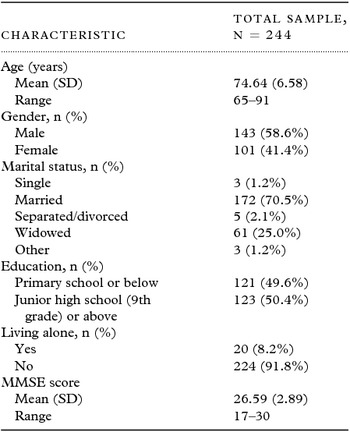
The age of the participants was (mean ± SD) 74.64 ± 6.58 years. More than half of the participants were men (n = 143; 58.6%), and most of the participants were married (n = 172; 70.5%). Almost half of the participants had completed a primary school education or below (n = 121; 49.6%), and 20 participants (8.2%) lived alone. Except for one participant who scored 17 on the Mini-Mental State Examination (MMSE), all other participants scored > 18 (mean: 26.59 ± 2.89) (Table 1). Moreover, 49 of the men (34.3%) and 72 of the women (71.3%) had completed primary school or below, and there was a significant correlation (φ = −0.365, p < 0.001) between educational level and gender.
Demographic characteristics of participants

MMSE = Mini-Mental State Examination.
Women had lower scores than did men on the physical health domain but higher scores on the psychological health, social relationships, and environment domains, and on the total QoL (Table 2). However, the insignificant differences between women and men were marginal and trivial. Participants with an educational level ≥ junior high school reported lower scores on all QoL domains and total QoL than did their counterparts with less formal education. In addition, significant differences were found in social relationships, environment domains, and total QoL.
WHOQOL-BREF scores by gender and educational level

QoL = quality of life.
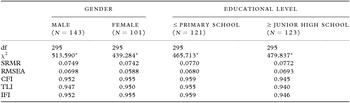
The CFAs of the WHOQOL-BREF were respectively examined for the men (n = 143), the women (n = 101), those with ≥ a junior high school education (n = 123), and those with ≤ a primary school education (n = 121). The goodness-of-fit indices were all satisfactory for CFAs in the 4 groups (Table 3).
Goodness-of-fit indices for different genders and educational levels

df = degree of freedom; SRMR = standardized root mean square residual; RMSEA = root mean square error of approximation; CFI = comparative fit index; TLI = Tucker-Lewis index; IFI = incremental fit index.
* p < 0.05.
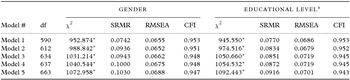
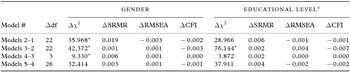
MGCFAs show that ME/I was supported across gender and across different educational levels (Table 4). For gender, Model 1 (configural model) was acceptable in all fit indices (SRMR = 0.0742, RMSEA = 0.0655, CFI = 0.953), except for the χ2 test (χ2 = 952.874, p < 0.05) (Table 4). In addition, the indices of Models 2−1, 3−2, 4−3, and 5−4 suggest that the first-order factor loadings, item intercepts, second-order factor loadings, and item uniqueness were invariant across gender, respectively (Table 5). Moreover, the social relationships domain of the underlying QoL score for women was significantly higher than for men (Mean difference = 0.222, Z = 2.7, p < 0.05, ES = 0.32). The underlying physical health (Difference = 0.000, Z = 0.1, p = 0.99, ES = 0.0000), psychological health (Difference = −0.0005, Z = 0.5, p = 0.96, ES = −0.008), and environment domains (Difference = 0.150, Z = 1.23, p = 0.22, ES = 0.19), and the total QoL scores (Difference = 0.000, Z = 0.0, p = 1.0, ES = 0.0000) were not significantly different between the two groups.
Measurement equivalence across gender and educational level: fit indices for models

a Junior high school or above versus primary school or below; * p < 0.05.
Model 1: Configural model; Model 2: Constrained all first-order factor loadings; Model 3: Constrained all item intercepts; Model 4: Constrained all second-order factor loadings; Model 5: Constrained all item uniqueness.
[See previous table footnotes for abbreviations].
Measurement invariance across gender and educational level: models comparisons

a Junior high school or above versus primary school or below; *p < 0.05.
Model 1: Configural model; Model 2: Constrained all first-order factor loadings; Model 3: Constrained all item intercepts; Model 4: Constrained all second-order factor loadings; Model 5: Constrained all item uniqueness.
[See previous table footnotes for abbreviations].
For different educational levels, all the fit indices (SRMR = 0.0770, RMSEA = 0.0686, CFI = 0.953), except for the χ2 test (χ2 = 945.550, p < 0.05), were acceptable for Model 1 (configural model) (Table 4). Furthermore, the indices of Models 2−1, 3−2, 4−3, and 5−4 suggest that the first-order factor loadings, item intercepts, second-order factor loadings, and item uniqueness were invariant across educational level, respectively (Table 5). Participants with an educational level ≥ junior high school had significantly lower underlying QoL scores in the social relationships (Difference = −0.345, Z = 3.28, p < 0.05, ES = −0.50) and environment domains (Difference = −0.235, Z = 1.99, p < 0.05, ES = −0.29) than did those with an educational level ≤ primary school. The underlying physical health (Difference = −0.095, Z = 1.30, p = 0.19, ES = −0.18) and psychological health domains (Difference = −0.143, Z = 1.53, p = 0.12, ES = −0.22), and the total QoL scores (Difference = −0.170, Z = 1.31, p = 0.19, ES = −0.21) were not significantly different between the two groups.
Discussion
This primary aim of this study was to provide the first confirmation of the ME/I for the WHOQOL-BREF Taiwan version across gender and educational level for a sample of community-dwelling elderly Taiwanese. The fit indices showed that, except for the χ2 test, the loadings and intercepts of items on the WHOQOL-BREF Taiwan version were equivalent between genders and educational levels for elderly Taiwanese. The results of the χ2 test might not be reliable because, as others (e.g. Chen, Reference Chen2007; Lin et al., Reference Lin, Luh, Cheng, Yang, Su and Ma2013) have reported, the χ2 test is too sensitive when the sample size is large. Based on the results from the other three indicators (ΔSRMR, ΔRMSER, and ΔCFI) that ME/I was supported; the hypothesis of the similar factor structure off WHOQOL-BREF was then supported. That is, the factor structure of the WHOQOL-BREF was interpreted similarly by the elderly between gender and educational level. Accordingly, our second hypothesis was only partly supported by our results. Some underlying QoL domain scores were significantly different between genders (social relationships) or different educational levels (social relationships and environment); others were not.
In contrast to the Short Form Survey (SF-36) results showing that women's QoL scores are consistently lower than are men's scores (Guallar-Castillón et al., Reference Guallar-Castillón, Redondo Sendino, Banegas, López-García and Rodríguez-Artalejo2005; Pappa et al., Reference Pappa, Kontodimopoulos, Papadopoulos and Niakas2009; Lix et al., Reference Lix2012), WHOQOL-BREF scores are diverse across genders. For example, Johnson et al. (Reference Johnson, Louhivuori, Stewart, Tolvanen, Ross and Era2013) used the WHOQOL-BREF to explore the QoL of 117 community choral singers ≥ 55 years old in Finland and found no significant correlations between gender and any QoL domain score. In contrast, Naumann and Byrne (Reference Naumann and Byrne2004) and Lucas-Carrasco et al. (Reference Lucas-Carrasco, Laidlaw and Power2011) found that elderly women reported higher WHOQOL-BREF scores than did elderly men only in the social relationships domain. However, these scores do not account for ME/I, and they might be biased because of different interpretations between genders. Although our study showed the ME/I between genders, an additional problem is that observed scores do not take item weights and intercepts into account. Hence, our study also compared the latent scores between gender groups, and our findings corroborated the claims of Naumann and Byrne (Reference Naumann and Byrne2004) and Lucas-Carrasco et al. (Reference Lucas-Carrasco, Laidlaw and Power2011) that elderly women had significantly higher social relationships domain scores than did elderly men. The differences in social relationships between men and women might explain this finding. Women have relationships that are more intimate than do men, and they are given more social support by friends and family than are men (Umberson et al., Reference Umberson, Chen, House, Hopkins and Slaten1996). It is thus not surprising that men have lower scores on the social relationships domain. In addition, Tseng et al. (Reference Tseng, Tseng, Teng, Lin, Wu and Li2004), in a qualitative study, explored the aging experience in elderly Taiwanese and found that elderly women began to participate in social activities and easily transferred their focus from family life to social relationships. Contrarily, elderly men felt that having a spouse or girlfriend to care for them was more important than having friends in later life. We suspected that, because of the change of social participation and social relationships, elderly women will normally have a higher QoL in the social relationships domain than do elderly men. Although our findings in part support this suspicion, it needs to be confirmed by additional studies.
In contrast to findings that higher education was positively associated with observed WHOQOL-BREF scores in the elderly population (Bodur and Dayanir Cingil, Reference Bodur and Dayanir Cingil2009; Zaninotto et al., Reference Zaninotto, Falaschetti and Sacker2009; Lucas-Carrasco et al., Reference Lucas-Carrasco, Laidlaw and Power2011), we found that participants with a higher educational level had significantly lower latent QoL scores in the social relationships and environment domains. We suggest that the primary reason is the differences in age and gender between the two groups with different educational levels. The demographic characteristics of our participants show that most of those with a higher educational level were men (p < 0.001) and older (p < 0.001; results not shown). The literature reports that QoL is influenced by age and gender, and that aging is especially associated with a lower QoL because of age-related health declines (Zainotto et al., Reference Zaninotto, Falaschetti and Sacker2009); therefore, we reasoned that our findings related to educational level were probably confounded by age. Our female study participants also had a lower educational level than did our male participants, and they had higher QoL social relationships scores; thus, it is possible that the QoL differences between participants with different educational levels were partly caused by gender. Therefore, it is recommended that healthcare providers should account for the demographic properties when judging QoL scores, especially for the older population.
This study has some limitations, and the findings should be interpreted with caution. A relatively small sample of participants was selected based on a convenience sample consisting primarily of healthy community-dwelling elderly Taiwanese. The representativeness of the study sample, therefore, is limited. For example, our sample included more men (58.6%) than women (41.4%), and this is different from the 2007 census for the older population (men 49% vs. women 51%) in Taiwan (Taiwan Ministry of the Interior, Department of Statistics, Taiwan, 2007; http://www.moi.gov.tw/stat/english/life.asp). This may partly explain why our WHOQOL-BREF scores were higher than those in other studies on elderly Taiwanese (e.g. Hwang et al., Reference Hwang, Liang, Chiu and Lin2003). Moreover, many personal characteristics other than gender and educational level (e.g. age and socioeconomic status) (Pappa et al., Reference Pappa, Kontodimopoulos, Papadopoulos and Niakas2009) are also important for the QoL scores of elderly people; further ME/I examinations on these factors are warranted. Unfortunately, due to our small sample size and limited information in our data, we could not conduct additional ME/I tests. Specifically, a rule of thumb to conduct the ME/I is >100 participants in each group (Su et al., Reference Su, Ng, Yang and Lin2014), and we were unlikely to have a sufficient sample size for each group if we group our sample into different ages (say, every 10 years for a group; group into 65–74, 75–84, and above 85 years old). In addition, the original data did not collect financial information because the elders viewed this as their highest privacy and intended not to provide. As a result, it is impossible for us to test the ME/I across different socioeconomic status although our ME/I results based on educational level shed some light in the issue. Nevertheless, the importance of age and socioeconomic status cannot be ignored, and we encourage future researchers to work hard on this issue and provide more evidence.
In conclusion, assessing QoL for the elderly is important for professionals providing comprehensive healthcare. This study provides important evidence to support researchers who combine QoL instruments or compare the scores of the WHOQOL-BREF and other QoL instruments (or both) of elderly groups with different genders and educational levels. The current study also shows a difference in QoL between elderly Taiwanese in different gender and educational-level groups and this may help guide healthcare providers make clinical decisions that are more beneficial for the elderly. However, additional studies with larger samples are needed to corroborate our findings.
Conflict of interest
None.
Description of authors’ roles
Lin, C. Y. formulated the research questions, analyzed the data, and drafted the manuscript. Li, Y. P. designed the study, supervised data collection, and drafted the manuscript. Lin, S. I., and Chen, C. H. supervised data collection and critically revised the manuscript.