The history of the revival of Claudio Monteverdi's Vespro della beata vergine (the ‘1610 Vespers’) is virtually a model for the process by means of which significant music from the past could become a ‘masterwork’ in the twentieth century. It was known to certain music historians in the nineteenth century, was revived and published by the middle of the twentieth, and became a major object of concert performance and recording thereafter. The fact that it can draw large audiences, appeal to performers beyond the period specialists and engender considerable scholarly debate puts it into a category that is shared by virtually no earlier work (with the obvious exception of the composer's first opera, Orfeo, of 1607). While there is plentiful and enduring public interest in all forms of ‘early music’, one of the things that may single out Monteverdi's Vespers is the fact that it conveniently fills the time of a complete modern concert. Whatever solutions are found to the issues of its precise contents, ordering, pitch and performance practice, it seems to sustain sufficient interest and consistency to work as a whole, rather as if it were a short oratorio in the Handelian mould.Footnote 1
Of course, much of the structuring and consistency that seem to belong to the 1610 Vespers come from its original function in constituting the major part of the Roman Office of Vespers, something that brings its own shape and trajectory in real time.Footnote 2 Nevertheless, most attempts to relate the work to an actual liturgy have generally been unsatisfactory, at least in terms of preserving the trajectory and accumulation implied by the original print order.Footnote 3 Uwe Wolf suggests instead that Monteverdi's ordering is ‘expedient, exemplary, and programmatic – independent of any general liturgical context’.Footnote 4 It would be more accurate to suggest that the work might be independent of a specific liturgical context. The Vespers liturgy is itself a ‘general liturgical context’ after all, and Monteverdi clearly hoped for some type of future use, given that he provided ad libitum instrumental ritornellos in the first psalm and an alternative Magnificat without instruments. Nevertheless, while Monteverdi could hardly have had a modern concert in mind, there is clearly a sense in which he was creating what was a potential liturgy out of pre-existing and/or newly composed material. A further level of identity is afforded by Monteverdi's customizing of the liturgy towards Marian devotion, thus giving a theme – with its obvious emotional and spiritual resonances – to a well-worn structure. The work as a whole could obviously double as a portfolio to demonstrate the composer's skill and also to provide a resource for potential Vespers performances.
Viewing the 1610 Vespers as coming in the composer's career between the publication of the Fifth and Sixth Books of Madrigals (1605 and 1614 respectively), each of which shows a concern with structuring the collection as a whole, we might deduce that Monteverdi thought along similar lines in terms of his overall shaping of the 1610 collection. In all these cases, the structuring of the collection may be to some extent independent of the ways in which the individual components could have been presented in performance. As Mauro Calcagno has shown, composers of madrigal collections in the generation immediately before Monteverdi were already developing narrative designs that paralleled those of the poetry collections concerned (and thus conforming to the expectations and experiences of cultivated listeners and readers).Footnote 5 Such designs were closely related to rhetorical principles by means of which a general framework (happy or tragic ending, for example) was outlined by the opening and closing sections, and the more flexible centre could be articulated through multiple departures and returns. The individual pieces could then be connected through key words or musical elements. Calcagno employs the useful notion of the ‘palimpsest’, which allows a musical ordering to be inscribed on top of that of the poetry, a layering that could further be elaborated in performance and that would add to the delight of a cognizant audience.Footnote 6 If this approach were applied to the 1610 Vespers it could suggest that Monteverdi's settings create another sort of palimpsest: the music of diverse styles is inscribed over a pre-existing but flexible liturgical model.
Tim Carter's study of the Sixth Book of Madrigals shows the composer devising a bipartite structure, with laments opening each half, and each followed by a Petrarch setting.Footnote 7 One might likewise see the 1610 publication as falling into two obvious halves, comprising a Mass (Missa in illo tempore) as the first half and the Vespers as the second. But, further to this, the Vespers itself falls into two obvious divisions in which the five regular psalms and four ‘modern’ sacred concertos of the first half are balanced by the Sonata sopra ‘Sancta Maria’, the hymn and the Magnificat (the last in alternative versions for seven and six voices) in the second, each underpinned by a regular cantus firmus (similar to the psalms) or Gregorian melody, and combined with many of the sorts of expressive and ornamental gestures first heard in the sacred concertos. The predominantly instrumental texture of the Sonata is the first use of upper instruments since the first psalm (at least according to Monteverdi's original parts – colla parte doubling elsewhere is not necessarily to be excluded), and with its independent instrumental parts it recalls something of the sonority of the opening response. Moreover, the closing ‘Sicut erat’ of the seven-part Magnificat, with its specification of all the instruments doubling the full choral texture, also recalls the sumptuous sonority of the opening.
Giambattista Marino's influence on the Gonzaga court began precisely in the years leading up to Monteverdi's 1610 publication,Footnote 8 and it may well have had an effect on the composer's general outlook in setting collections of texts that somehow formed a whole, but which required an alternative sense of sequencing and narrative voicing to that of opera. Monteverdi may thus have seen particular opportunities in adapting something of the approach he was developing within the madrigal tradition towards his setting of traditional texts appropriate for the Vespers liturgy. While the trajectory of a madrigal collection is harder to follow for a modern audience, at least without something equivalent to the background and elite education of the original listeners, perhaps the integration of similar principles within a more obvious ritual sequence might partly account for the modern success of the 1610 Vespers as a work to be heard in one sitting.
One of the points that makes this setting so recognizable as a ritual is the ubiquity of the traditional chant, which is heard more or less continuously in a large number of the movements; this distinguishes the collection quite strongly from the majority of Monteverdi's later church music, published in the Selva morale e spirituale of 1640–1. Indeed, Monteverdi seems to have gone beyond virtually any contemporary in maintaining an almost constant reference to the psalm tones throughout the psalm settings and Magnificat.Footnote 9 While this might imply a work that would be overly regular and repetitive in comparison with later concert pieces, it has been suggested that this may actually play a part in its success. Jeffrey Kurtzman sees it as part of a productive tension between old and new:
Monteverdi's psalms doubtless make a stronger impression on the listener than those of his contemporaries. Although many factors contribute to this, there can be little question that among the most important are the dynamic tensions between cohesion and diversity and between conservatism and modernity.Footnote 10
What Kurtzman is intuiting may be one of the essential aspects of the Vespers from the point of view of later generations, a sort of dialectic or charge that bridges several historical styles. Indeed, this might reflect Monteverdi's own awareness of historical change and stylistic plurality, made clear by the notorious Artusi dispute in which the composer defended his music in the most up-to-date style (seconda pratica) by claiming that it was being inappropriately judged by the standards of the earlier style (prima pratica).Footnote 11 The publication of 1610 seems to make a special point by prefacing the Vespers with a prima pratica Mass (based on points of imitation taken from a canonical composer in the earlier style, Nicolas Gombert) in order to demonstrate Monteverdi's mastery of both styles.Footnote 12 But it would be wrong to assume that the Vespers is entirely in the seconda pratica: while the sacred concertos (with the exception of the choral conclusion of ‘Audi coelum’) can be ascribed to this style, the psalms and Magnificat present an astonishing mixture of traditional multi-voiced music, madrigalian gestures and more modern monodies and duets. Monteverdi here seems to be developing something of the range of voicing that he was to exploit so strikingly in his later books of madrigals. The very recognition of more than one compositional method seems to have led to the possibility of unexpected hybrids, as if each style could act as an enzyme capable of digesting the other and thus producing something new.Footnote 13
It is the Vespers collection, with its richly mixed styles, that has garnered such enthusiasm in later reception, and not the much more purely styled Mass (which was given a more prominent billing in the original print). It may well be that richness of stylistic blend is one of the things that characterizes much of the music that was later to become ‘canonical’ (in the sense of the canon of ‘musical works’ that developed in the nineteenth and twentieth centuries, and something that is obviously to be distinguished from the traditional pre-modern canon of exemplary musical techniques, as demonstrated in the Mass). This might also include a sort of reflexivity that involves an element of stylistic dialogue and exchange built into the music as notated. Another way of putting this might be to suggest that Monteverdi's Vespers music is not as ‘innocent’ as most of that which went before it; it is as if the composer had somehow eaten some forbidden fruit of musical knowledge that gave him a degree of critical distance from both the music of his time and that of its recent past, in order to create a new sense of immediacy and dialogic vitality. While the various styles, idioms and allusions in the Vespers music can be identified and analysed individually, there may well be for the informed listener a critical charge set up by their interaction and mutual inflection.
The notion of an ancient–modern alloy that I borrow from Kurtzman is not to be confused with some of the more obvious ways in which Monteverdi's music could be considered ‘progressive’. These latter might include the superb examples of the seconda pratica approach in the sacred concertos, which seem to engender the most direct expression possible of the words and their emotions within the monodic language of the day. Particularly subtle is Monteverdi's developing approach to narrative (perhaps specifically under the influence of Marino), which extends the range of complexity and nuance in terms of the voices we might hear. For instance, Carter notes that several madrigals in the Seventh Book (1619) share a single lover's voice between two singers, and this is exactly what Monteverdi had done with the second sacred concerto, ‘Pulchra es’, in the Vespers back in 1610.Footnote 14 Another obviously ‘modern’ element is the extensive use of instruments, particularly in the eight-part Sonata sopra ‘Sancta Maria’, which is perhaps the largest and most brilliantly developed instrumental piece of its time. Such features are obviously striking for their comparative novelty and scale for the time at which they were written – but such innovations would not have been so immediately significant for later generations. Much the same goes for the general trend towards co-opting secular elements for sacred purposes (and right from the outset with the ‘Toccata’ from Orfeo, reworked for the opening ‘Domine ad adiuvandum’), an interesting challenge for composers of Catholic church music in the wake of the Council of Trent, but common enough at various points throughout the broader history of church music.Footnote 15 All these features are obviously significant, but they do not alone account for the particular quality that I am attempting to isolate. This music is perhaps ‘ahead of its time’, but not merely in the sense of stylistic and narrative innovation, novelty or expressive power.
Another clue to the special quality of the Vespers might lie in John Whenham's observations about the first psalm setting, ‘Dixit dominus’. In verse 1,
Monteverdi parodies the idea of cantors initiating the psalm and the choir responding by presenting the first half of the psalm tone in imitation, together with a counter-subject; the second half of the verse – the point at which the choir would normally enter – is set for the full ensemble and, incidentally, matches the passage of direct speech.Footnote 16
Key to Whenham's insight here is the notion of ‘parody’, but this is probably not meant in the traditional sense of borrowing music from one context and using it in another, nor in the sense of poking fun at something. Monteverdi could hardly be accused of mocking something of the ‘old order’ in the way his contemporary Cervantes did in Don Quixote. If this psalm setting were used liturgically (as Monteverdi himself possibly did, either earlier in Mantua or later in Venice), it would obviously be replacing the ‘standard’ Vespers setting, in which the entire psalm would have been chanted (with or without multi-voiced chanting in chords, the falsobordone). Monteverdi's setting would doubtless have been heard in its own time as an elaborated version of this simpler performance practice. But Kurtzman's ancient–modern alloy and Whenham's notion of parody together imply something rather more complex than mere elaboration. They might suggest that this setting is, in some subtle sense, detached from its purely functional role. On the one hand, it is a sort of commentary on standard liturgical practice, while still using strong liturgical signifiers; on the other, it is a sort of memory of various occasions and practices, somehow superimposed within the one piece.
As soon as I suggest a role of memory I immediately imply some degree of human, subjective presence. I am not proposing that each psalm setting is like a sort of thinking organism in its own right (although such a metaphor may well be appropriate for certain works in the later mainstream of classical music); rather that it somehow mirrors or models the sort of experience that a human subject might have, conflating several experiences of Vespers into a single representation. After all, Monteverdi and his peers would have experienced countless Tridentine Offices and Masses by the time they reached adulthood (and the fact that Monteverdi was relatively isolated in Mantua and might not necessarily have had enormous experience of all the latest elaborate settings might mean that he was all the more forced to draw together his memories of the chanted liturgy). I am not implying that each setting is simply a form of musical autobiography, but that Monteverdi may have co-opted his own cumulative experiences to reflect something which others, too, might have recognized and which might have encouraged them to reflect on the way they heard a liturgy. Indeed, the effect might be to render us more aware of the temporal process of music in general. Therefore, a piece of this kind could function as a sort of model for listening and persisting in time, as well as a bundle of recollections. Now the concept of ‘parody’ takes on a deeper resonance; it suggests that some sort of doubling is happening, by means of which the psalm setting fulfils its liturgical function more or less perfectly but simultaneously mimics the occasion, setting up its own ‘Office’ within the Office, as it were. To adapt Mikhail Bakhtin's comments on the sonnets in Don Quixote, written by Cervantes at almost exactly the same time as Monteverdi's 1610 Vespers settings, the chant (sonnet) is no longer a genre in its own right but an object of representation, an image of the chant (sonnet).Footnote 17 But, as I will try to show, chant does not remain merely an object of representation; it also inflects the entire musical setting, turning this into a sort of ritual of its own.
At this stage it is worth distinguishing this phenomenon from another form of ‘doubling’ in Monteverdi's (and others’) outputs in the early seventeenth century, namely a tendency to render in simultaneous sound the implications of texts about the efficacy of music. This is after all an overriding topic in Orfeo, where the music obligingly mimics the sorts of sounds to which the text refers. A later, but especially striking, example is ‘Mentre vaga Angioletta’ from the Eighth Book of Madrigals (1638). Here Giovanni Battista Guarini's text refers to how the lover's heart not only responds to the ‘angel's’ singing but also somehow adopts both the spirit and the very physicality of the singer's performance, following every twist and turn of emotion, tone, breathing and movement. While this is an extremely significant and perhaps pioneering example of how music relates to our sense of physical embodiment (in this case, almost alluding to the popular modern concept of ‘mirror neurones’), it is different from the phenomenon I am trying to isolate in the 1610 Vespers. Rather than doubling the direct implications of the text in almost instantaneous mimesis, the doubling of the liturgy is, through its very parodic excess, more autonomous and therefore distanced from the ‘normal’ chanting of the Office of Vespers.
Moreover, the music for the psalms and Magnificat is – through the traditional reciting function of the chant that it excessively imitates – already far more distanced from the sense and imagery of the texts than anything Monteverdi wrote in the madrigalian or the operatic field. One obvious index of Monteverdi's ‘overuse’ of chant is that he sometimes repeats the opening intonation of the psalm tone beyond the opening of the setting (after the first verse, the psalm tone would customarily begin on the reciting note, thus omitting the intonation); this happens throughout ‘Nisi dominus’ and in parts of ‘Laetatus sum’, for instance. In all, the music goes beyond the normal function of reciting the liturgy (what might be considered as essentially a diegetic function) and becomes a form of declaration in its own right, a form of mimetic presentation.Footnote 18 But the mimesis is more of the act of recitation than of the meaning and imagery of the texts recited.
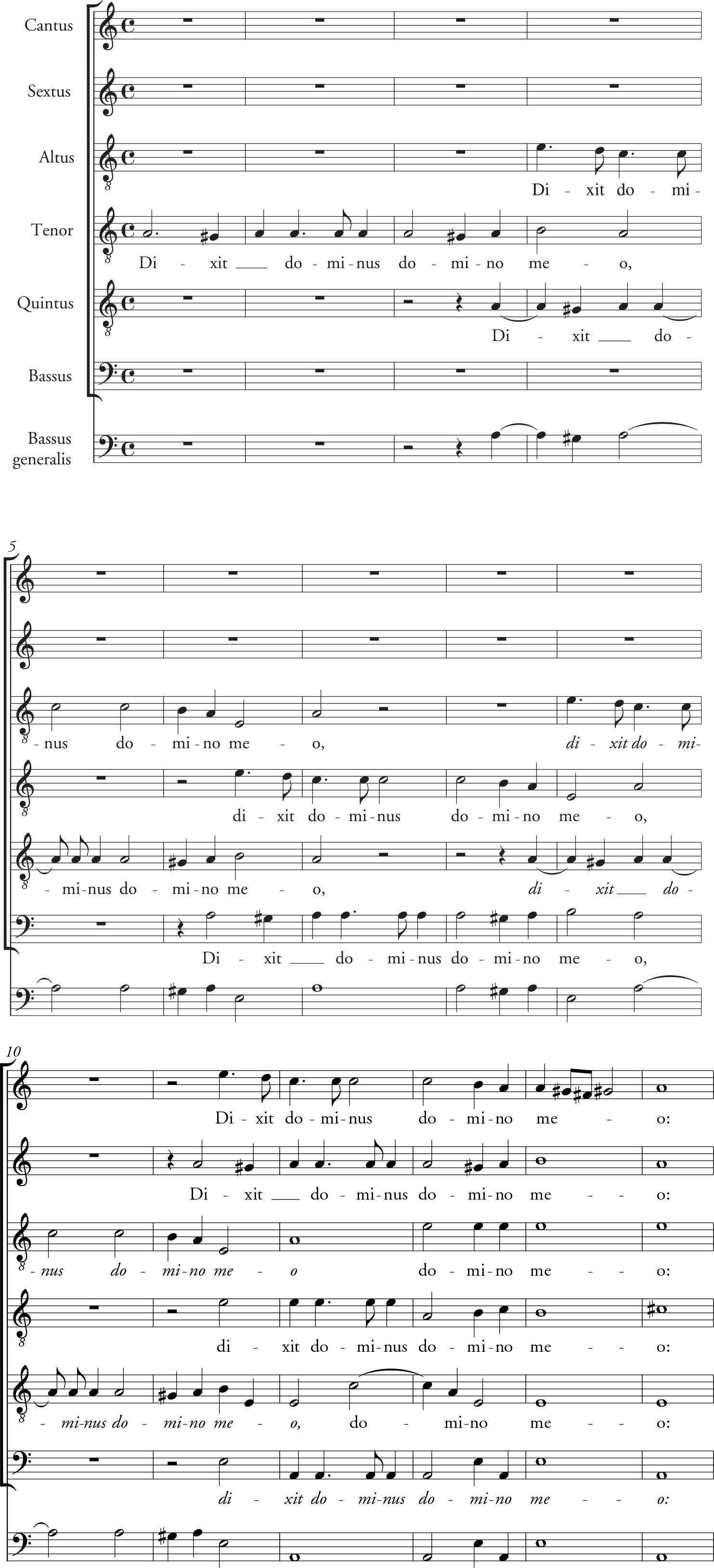
One obvious way of making this imitation of recitation evident is through distortion. The ‘cantor's’ intonation at the opening of ‘Dixit dominus’ is immediately distorted by syncopation – it is the countersubject in the altus that establishes the tactus – and, with successive entries at the same pitch (five in all, the last, in the sextus, an octave higher), there is an aural illusion almost the equivalent of multiple vision. The repetitions of both intonation and countersubject are at once more static than traditional polyphony (as if the first point of imitation is somehow stuck in a rut) and more rhetorical in their sense of accumulation. But this is not merely a sort of textual emphasis (as if the text were still overseer of the music, in proper seconda pratica fashion), but also a play on the traditional repetitiveness of psalm chanting in a large building, as if several cantors turned up at once or the building had an unhelpful echo. Whatever effect was intended or is experienced, this passage seems to distort both customary church practice and the rhetorical accumulation used in newer styles. There is indeed a sense of intensification, but it is coupled with the obvious stasis of the note polarities of the psalm tone, as if the cyclic rhythm of traditional chanting has somehow subverted the more modern rhetorical elaboration of a text through music (see Example 1).Footnote 19
Opening of ‘Dixit dominus’ from Monteverdi, Vespro della beata vergine.

This example is not technically much different from the standard ways in which composers might have used imitative fragments to give the impression of a mood shared between a group of people. In Giovanni Gabrieli's eight-part ‘Cantate domino’ (Symphoniae sacrae II, 1615), the triadic figure setting the opening word is imitated in close succession by the highest and lowest voices, creating the mood of joyful singing. This is obviously a form of representation that involves an element of doubling (that is to say, the music is ‘about’ singing to the Lord, while depicting how this might sound in the very act of doing it). This is essentially the integration of a madrigalian device to stir a joyful affect for devotional purposes. But Monteverdi's ‘Dixit dominus’ goes further than this in impersonating the actual tone used in a service (a chanting that would normally be affectively neutral). No longer is it simply putting us in the correct mood for understanding the psalm, using secular devices for a sacred purpose; it is more an elaboration and creative distortion of the sort of experience we might actually have in witnessing the Office of Vespers.
As Whenham observes (see above, p. 26), the second half of the verse is a more standard polyphonic realization, following more or less the stresses of the words. After this point the psalm settles into two consistent patterns for the alternate verses. The even-numbered ones are fuller in scoring, involving falsobordone and largely departing from the chant, while the odd-numbered ones are for smaller forces, tethered to the chant, which is held in long notes as a cantus firmus. Again, this procedure mimics standard service practice in which verses with the chant can alternate with verses of falsobordone.Footnote 20 Monteverdi's decision to adopt the slow cantus firmus for the odd-numbered verses means that much of the vocal material is directly repeated as a duet (an increasingly popular texture at the time in both sacred and secular fields). The first of these, ‘Virgam virtutis tuae’, involves one of the two high voices introducing each of the two halves of the verse, both of which are then repeated by the two singers in direct imitation at the unison (exactly the same procedure is followed in the next odd-numbered verse, ‘Iuravit dominus’, now for voices in the tenor range). Whether this is heard from the viewpoint of Renaissance polyphony or the more recent expressive styles, it is curiously static. If the chanting of Offices regularly slows down one's experience of time (an effect surely shared across the history of chant), Monteverdi seems to have taken this a stage further. Indeed, there are many places in the 1610 Vespers where we might imagine hearing a liturgical performance in slow motion: in the opening of ‘Nisi dominus’ the bass line and the psalm tone (in canon) move very slowly underneath multiple imitations between the voices. There is almost the illusion here of a large double-choir texture that has been framed in a new type of time, with the quick and often syncopated interchanges between the upper voices taking place against an overall sense of glacial progress. Exactly the same effect is achieved in the opening and closing verses of the hymn ‘Ave maris stella’ and in the ‘Sicut erat in principio’ that closes the seven-part Magnificat and therefore the entire musical setting of Vespers.
In many settings the ‘modern’ vocal lines are themselves imbued with a sense of chant-like repetition. Again, following Kurtzman's alloy model, it is not just a matter of the modern idioms inflecting the chant, but also vice versa. This gives some of the spectacular vocal idioms and expressive gestures, many derived from madrigalian devices, a sort of mechanical quality that contrasts quite strongly with their habitual effect of free, spontaneous textual expression. Cadences often sound as though they have been engineered to provide automatic closure to each range of gestures. For instance, what is particularly striking, and initially unexpected, in ‘Dixit dominus’ is the chord beginning the second half of each of the even-numbered verses, which is on G (major) rather than A (minor – the tonality that most satisfactorily accommodates the fourth psalm tone, which gives strong prominence to its fourth degree, A). In each of these verses Monteverdi engineers the closing melismatic section to return to the A through two kinds of bass movement: in the first and fourth instances he writes a sequence that descends a third then rises a second (what would later be called a circle of fifths, with every other chord in first inversion); in the second and third, the bass line sequence is a descending fourth followed by a rising third. These sorts of sequence are facilitated by the emerging tonal system and the increasing concentration on the bass as the generator of the harmony. They are readily found in settings by Monteverdi's contemporaries, such as Gabrieli's ‘Hodie completi sunt’ (Symphoniae sacrae II), which repeatedly features the descending-third/rising-second pattern. In the context of Monteverdi's ‘Dixit dominus’, the sequences contrast quite strikingly with the passages of falsobordone, which in their very stasis provide a sort of damming up of the chordal movement. The sequences are patently mechanical: once Monteverdi has decided on the mechanism, the remainder of the passage is more or less inevitable up to the closing cadence. While it is possible to describe many Renaissance musical devices – particularly canon – as equally mechanical and geared to musical rather than verbal processes, a canon cannot continue ‘on its own’; it requires constant compositional attention and anticipation for dux and comes to work together. But the mechanism that sequential chordal processes can generate requires compositional intervention only in order to bring it to a conclusion.
An even more ingenious sort of mechanism is employed for the ‘Gloria patri’, as Whenham notes,Footnote 21 where the chant is unexpectedly transposed down a tone to begin in G minor. This generates a final on D instead of E, after which the chant is repeated beginning on that D (for ‘Sicut erat’), and this in turn satisfyingly generates a final on A (minor), the ‘home’ tonality (now in the cantus part). After this, the ‘Amen’ concludes the setting with a plagal cadence on E, thus fulfilling modal propriety. Here, then, Monteverdi had to engage what Whenham terms ‘reverse planning’ in order to start on the tonality that allows the music to finish correctly without further intervention. The effect of this exercise in early tonal engineering is to break out of the regularity of the psalm, with the rhetorically arresting entry of the ‘Gloria patri’ a note too low, but still to create a sense of ordered return for the final ‘Amen’.
The second psalm setting, ‘Laudate pueri’, presents more contrasts based on the progress of the text, but follows many of the same sorts of principles as ‘Dixit dominus’. Again the cantor's opening intonation is taken up by other voices, together with a repeating countersubject: the chant is often used to accompany duets, which have frequent canonic material (but now interspersed with other relationships, such as sensual passages in thirds); and it is sometimes transposed (but now in verses 2–4 rather than in the ‘Gloria patri’). There is the same sort of verse-by-verse pacing as in the first setting, but now with a greater variety of events along the way. Most brilliant of all is perhaps the pacing of the third psalm, ‘Laetatus sum’, which imitates to the greatest degree the liturgical practice of alternating ways of presenting the successive verses. All the odd-numbered verses (before the ‘Gloria patri’) are set to a repeating walking-bass pattern, and the even-numbered ones to two further bass patterns, which themselves alternate. Another pattern is superimposed on these, namely the alternating absence and presence of the psalm tone. This setting has been well analysed in the literature,Footnote 22 so it suffices here to suggest that this is a composition that builds on the amalgamation of two different sound worlds: that of liturgical practice and that of strophic variation. The result is a piece that belongs to both genres yet which is somehow also sui generis. While all the psalm settings contain some elements of word-painting (such as the imploring passages in descending thirds for ‘Rogate quae ad pacem sunt Ierusalem’ – ‘Pray for the peace of Jerusalem’ – in ‘Laetatus sum’), together with an overall affective stance consonant with the text, they each come with their own individual character, defined more through musical regularities than any specific aspect of the text or psalm tone. This is particularly evident in ‘Laetatus sum’, which is strongly inflected by the walking bass heard at the outset. By analogy with the walking bass accompanying Orfeo's song as he leads Euridice out of the underworld (‘Qual honor di te fia degno mia cetra onnipotente’), this could be read as a general emblem of joy, compatible with the psalm. But the operatic context also suggests purposeful movement and joyful steps, connotations that do not immediately match the psalm text. In other words, the character of ‘Laetatus sum’ is not explained solely by its text; the musical character (also involving the history of standard dance patterns) is capable of fitting several affects or senses, but at the same time it has an independent existence, parallel but not reducible to the text. The irony is that, given that chant represents a tradition in which music functions as a form of recitation rather than as an interpretation or imitation of the text, the elements of the setting derived from more modern, text-expressive music are themselves turned into a form of recitation, ritualized by the interjections of chant.
While these observations are hardly revelations in themselves, what they together suggest is a composer who is clearly aware of the organizational imperatives of traditional psalm tones, but who creates a form of organization partly independent of these, as if working in parallel to the chant. A more usual procedure might have been either to tether the musical setting more tightly to the chant or to deviate from it entirely in a form of free composition. Monteverdi's settings of the same psalms in his later Selva morale collection are typical of this latter practice, in which the full resources of the composer's later vocabulary are engaged in a rhetorically charged presentation of the text, with only very sporadic references (if any) to the psalm tone.Footnote 23 In the 1610 settings, Monteverdi frequently submits to various imperatives of his own making, as if these were mimicking the authority that the church tone (and by extension, the church itself) would traditionally have wielded.
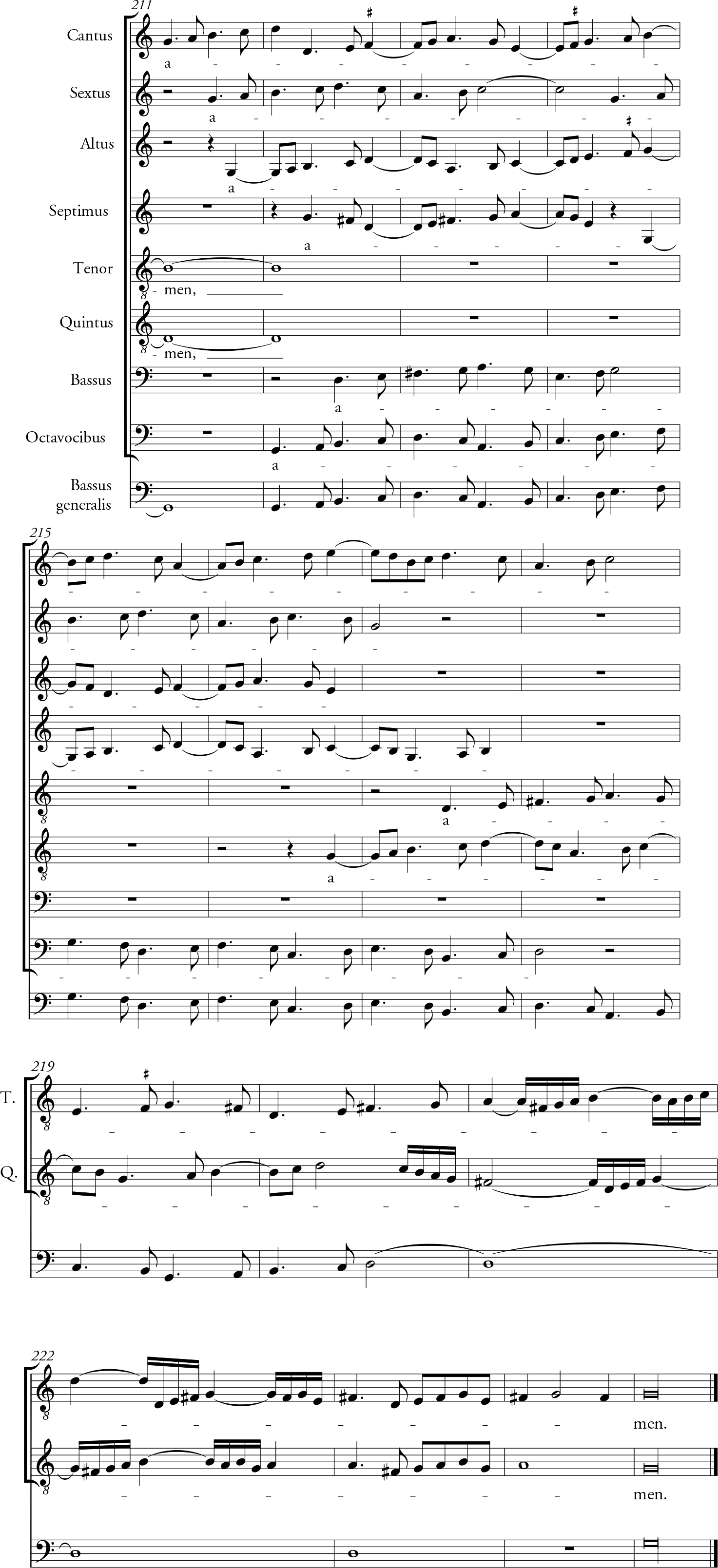
One of the most obvious features at the end of ‘Laudate pueri’ is Monteverdi's reuse of the opening music for the second half of the ‘Gloria patri’, thus making the common pun on the words ‘sicut erat in principio’ (‘as it was in the beginning’; he uses exactly the same pun at the end of ‘Nisi dominus’, the fourth psalm setting). In retrospect, this also gives the psalm the sense of a frame for a listener with a reasonable memory, by means of which everything that was heard in between is potentially recalled as cohering as a whole. But any sense of roundedness, of the psalm coming to completion, is subverted by the ‘Amen’. This begins predictably enough, with six of the voices singing in interlocking dotted figures in a closely imitative texture. The tenors who earlier sang the virtuoso ‘Excelsus super omnes gentes dominus’ enter as if joining the overall texture, but very soon the other voices drop out and the tenors are left singing their own imitative duet, bringing back some of their earlier coloratura figures and eventually resolving onto a single pitch. Monteverdi may have got this idea from a passage with similar figuration and resolution in Gabrieli's ‘Quem vidistis pastores’ (Symphoniae sacrae II), which was published posthumously but was probably composed much earlier.Footnote 24 Another source might be the end of ‘Ma se con la pieta’ from Monteverdi's own Fifth Book of Madrigals, where the number of voices steadily diminishes and the two sopranos are left alone on a concluding unison. What is entirely radical about Monteverdi's 1610 setting, though, is the way the other voices preceding the duet fade out, without any independent cadences or even the final syllable of ‘Amen’. What they are doing is presenting the illusion of a full polyphonic texture, perhaps the aural equivalent of trompe l'oeil, tricking our ears with what is ultimately a sort of sham. It may well be that Monteverdi was inspired by similar tricks of perspective and appearance in visual art; but the effect in music, as played out in the real time of a liturgy, is striking, almost subversive, in putting aural effect before allegiance to text (and an ‘Amen’, at that; see Example 2).
Ending of ‘Laudate pueri’ from Monteverdi, Vespro della beata vergine (from bar 211). (Bar numbers in Examples 2–4 follow Kurtzman's for ease of reference.)

Of course, there is a much more obvious instance of textual trickery in the Vespers, in the ‘Audi coelum’, where the echo voice seems to repeat the last syllables of each of the tenor's lines, but subtly changes them to draw out some sort of spiritual point or action (for example, ‘et perfusa gaudio – Audio’, ‘and suffused with joy – I hear’; ‘ut benedicam? – Dicam’, ‘that I may bless her – I shall tell you’). But this is an illusion dictated by the text itself, and is indeed part of a long tradition of spiritual echoes.Footnote 25 In other words, this has a specific spiritual purpose, capitalizing on the experience of listening as a creative form of mishearing. But it does not necessarily sensitize us to the experience itself, as might the ‘Amen’ of ‘Laudate pueri’.
Following the analogy with visual art, we might hear this ‘Amen’ as coming outside the frame of the piece proper (as defined by the reuse of the opening for ‘Sicut erat in principio’); the virtuoso tenors seem to step outside the frame as figures might do in frescoes. But there is also another spatial analogy here: that of the singers receding into the distance (or, conversely, of the listener walking away). This effect would be heard whether or not the piece were performed in an actual liturgy. If outside the liturgy, we are reminded of exactly the way the ends of church pieces can fade away in large buildings; if within the liturgy, there is another ‘doubling’ sort of experience, the music impersonating its own ending in real time. Whatever the details of the experience, this unusual ending surely reminds us of the passing of time within the psalm as a whole, the fadeout sharpening our retrospective awareness of the experience we have just had, as if the entire setting had been a procession that was passing us by.
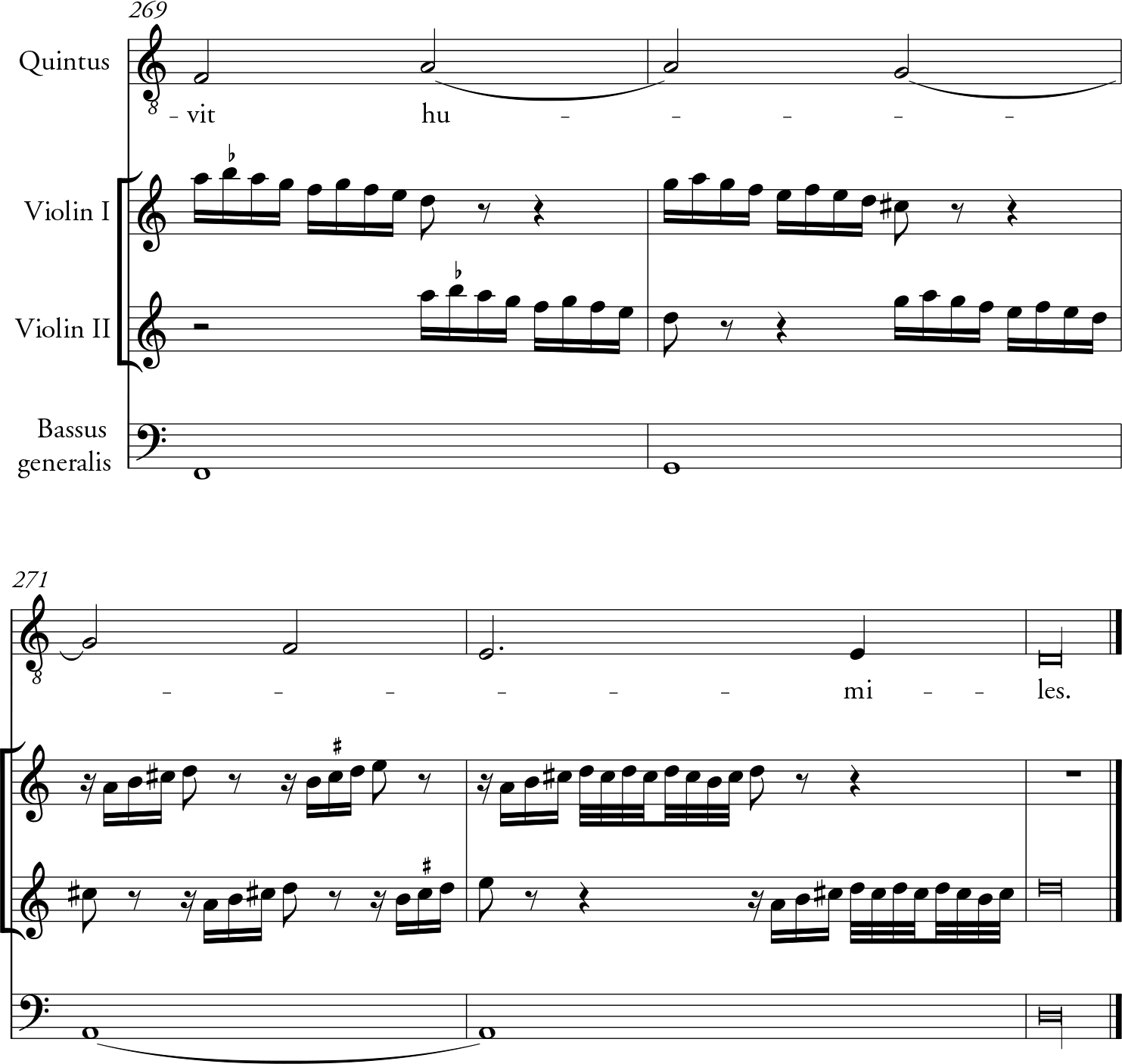
There are several other instances in the Vespers where the writing draws attention to the temporality of a performance. In the larger, seven-voice Magnificat, the pairs of cornetti and violins in section 7, ‘Deposuit’, present their coloratura figures in close imitation to give the effect of echoes, which means that at cadence points the leading instrument arrives on the final note before the bass resolves – something that happens only when the second instrument reaches the final note (for instance, at bars 15–16, 26–7, 30–1; see also Example 3).
Ending of ‘Deposuit potentes’ from Monteverdi, Vespro della beata vergine (from bar 269).

In the equivalent setting in Monteverdi's simpler six-part Magnificat, also provided in the 1610 collection, these two virtuoso lines (almost entirely reworked in the seven-part Magnificat, which was most likely written later)Footnote 26 are apportioned to two sopranos, where the antecedents to each echo set up even more clashes with the bass (to the text ‘et exaltavit humiles’). Exactly the same effect is achieved by two tenors in the ‘Gloria patri’ (bars 34–7) of the larger Magnificat, where the continuo does not resolve to the final tonic until the second tenor, as echo, has reached the end of the cadence. Monteverdi presumably drew this idea directly out of his operatic practice in Orfeo, from just three years before (although some of the Vespers music was surely composed before 1610, so the order of composition is not certain). The paired violins have a similar sort of teasing cadence in the first verse of ‘Possente spirto’ (bars 108, 111), and the cornetti have something similar in the second verse. But in both of these cases the continuo is constantly on the tonic concerned, so there is much less sense of the two melodic parts being out of phase. In the case of the Vespers, then, the effect is more striking than in the opera, and it is as much disorientating as it is sumptuous. The echoes seemingly mimic the sort of acoustical illusion one might experience in a large building. Thus, regardless of where it is performed, we are immediately reminded of a church acoustic, the music doubling the experience of us experiencing the performance.Footnote 27 The device might also create the effect of existing in two time zones simultaneously, a couple of seconds apart, thus bringing a renewed sense of groundedness when the resolution is reached. Bars 8–11 of the ‘Suscepit Israel’ create something similar, with a sense of the psalm tone being out of phase with the two duetting voices. Sometimes Monteverdi achieves a similar effect through rhythmic means, such as in the verse ‘De torrente in via bibet’ at the end of ‘Dixit dominus’. Here most of the voices have sequential passages in triple time cutting across the duple metre and creating an effect of disorientation that suddenly resolves with the cadence. Although one could make a case that this effect could function as word-painting for bubbling jets of water (‘He shall drink of the brook of the way’), the crucial effect is one of disorientation. Again, the process of listening and the notion of an attentive listener's presence is evoked by the very way the music is written; it surely reminds us of the sort of aural disorientation we can experience in a resonant building. It might also recall the way one's attention can wander during passive participation in a ritual, our hearing and mind coming back into focus after a period of inattention. In a more rarefied way, these effects also have the potential to exercise our sense of punctual awareness, stretching our momentary consciousness over a couple of seconds.
From a harmonic point of view there is nothing particularly remarkable about these sorts of blurring devices within the liberalized harmonic language that Monteverdi and others were developing as part of the seconda pratica. In the sacred concerto ‘Nigra sum’, for instance, Monteverdi breaks contrapuntal decorum by having the singer reach the next note too early for the bass in bar 40, on the word ‘veni’ (as part of the text ‘Rise my friend and come, for the winter is past’). This is something that is entirely in keeping with the meaning of the text (anticipation) and also the emotion of the amorous singer, impetuously exhorting the lover to come.Footnote 28 Thus the melodic anticipation makes perfect and immediate sense. But what renders the instances above so rich and complex is the fact that they do not tie in to the representation of a specific emotion or sense. By forcing Monteverdi's implied listener to wait for resolution, the experience is not one like the standard seconda pratica representation of an emotion in the very moment of listening, but rather suggests the possibility of an increased awareness of the hearing process itself over a specific span of time. In other words, there is the potential for the listener to gain an immediate awareness of self beyond the standard modes of mimetic representation (by means of which music might paint a text or create a particular type of character).
One further point to draw from the ‘Laudate pueri’ is the way the psalm tone is itself occasionally broken up. At the point it is first transposed (up a fifth), there is a momentary break in the second half of the tone, between ‘laudabile’ and ‘nomen domini’ (altus, bar 51). This may possibly have been done to prevent the tone from making a momentary seventh with the bass (as if this were too expressive for a cantus firmus?). Whatever the reason, an even longer break is made in the second half of the next reiteration of the tone, between ‘gloria’ and ‘eius’ (bars 60–4). With the next verse, where the tone is again in its untransposed form, it is even more fragmented, with the first three syllables separated by a beat. Here, the three separated reiterations of the note C (to the words ‘qui’, ‘in’ and ‘altis’, bars 68–71) coincide with the C in a bass pattern that shuttles between a G and a C. In other words, they are used to colour a repetitive cadence pattern led by the bass, and are therefore secondary to the harmonic progress of the music and not its primary generator.
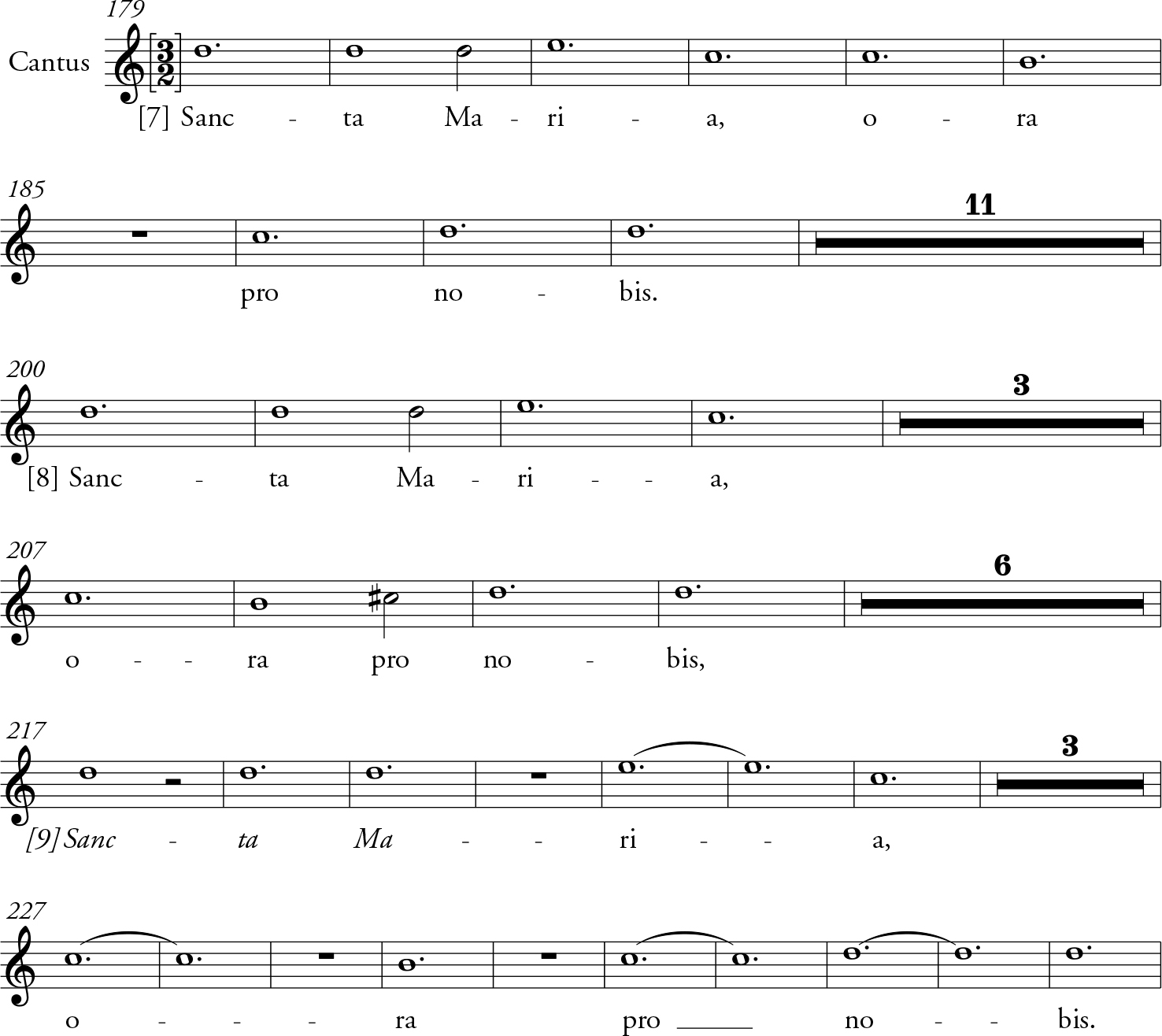
While this instance of fragmentation seems to function as a way of enhancing the texture, a similar example in the Sonata sopra ‘Sancta Maria’ is much more noticeable. Again, the chant (from the Litany of the Saints), set repeatedly to the text ‘Sancta Maria ora pro nobis’, is very much secondary to the rest of the music, something fitted into a highly developed sonata for a large number of instruments. Indeed, the Sonata could just as easily be performed without the litany and still be heard as a complete piece of instrumental music. Much of the piece is generated by setting sequential passages into motion, rather like the figured passages in the even-numbered verses of ‘Dixit dominus’, as if Monteverdi together with his instrumentalists were experimenting with the sequential possibilities of the emerging tonal system. There is almost a sense of permutational variation of both the chordal possibilities and the ornamental figuration that the instruments adopt. A similar permutational flavour inhabits the litany chant, in which there are minor variations verse by verse. We first hear the two halves in one single melodic strain, then split into two for the second verse, ‘Sancta Maria’ then ‘ora pro nobis’. Verse 3 splits it into three: ‘Sancta Maria’, ‘ora pro’ and ‘nobis’. Verses 4 and 5 seem to complete the symmetry by returning to the twofold split and then the continuous version. Verses 6–8 seem to form a triptych with the outer repetitions split in the middle, in the traditional way, but with the central one (verse 7) split in a way that has not yet occurred, ‘Sancta Maria ora’ and ‘pro nobis’. The most striking verse of all is verse 9, in which the chant becomes progressively fragmented.Footnote 29 In the second half of the verse there are two rests, dotted semibreves, between ‘o’, ‘ra’ and ‘pro’; now all syllables are double length, with the exception of the standard dotted semibreve on ‘ra’ and ‘bis’ (see Example 4).
Sonata sopra ‘Sancta Maria’ from Monteverdi, Vespro della beata vergine (bars 179–236).

Whenham describes this process as one in which ‘the cantus firmus is broken into short, sobbing phrases’,Footnote 30 and this indeed captures the sense of a curiously emotional colouring of the litany, cutting across the technical brilliance of the instrumental writing. The unevenness of both the note lengths and the intrusive rests in verse 9 mean that we cannot fail to notice the chant, its disintegration perhaps bringing an element of pathos, as if it were struggling to be heard through the relentless cheerfulness of the instrumental dance. Again, this could also be heard as replicating something of our actual experience of listening: our attention to the litany here is likely to be intermittent, as if this were a necessary but secondary element of the piece that we barely notice after its first few appearances; the different ways of dividing the syllables, up to the extreme version of verse 9, mirrors something of our experience of varying attention. There may again be something of the acoustical tricks that large buildings can play on any listener, permitting something that was delivered as a whole to seem broken up when heard from certain positions.
The final verses, 10–11, each present the chant as a whole without a break, and these coincide with an instrumental recapitulation of some of the opening music (which, interestingly, was heard without the chant before). So the Sonata concludes with a sense both of returning to the opening order (thus framing our experience as a whole) and of combining the elements in further ways. One possible result of the whole experience is that we hear the litany as somehow having survived against all odds, thus strengthening its spiritual resolve; but this enhancing of the religious purpose of the piece also opens up the possibility of our hearing the litany as dominated by everything around it, as all but succumbing to a variety of generative musical processes and literally disintegrating before our ears. It is noticeable that Monteverdi's later use of this litany chant, in a setting of ‘Sancta Maria, succurre miseris’ (1618/27) sounds far more orthodox, even though the chant is eventually absorbed into the free imitative texture shared by the duetting sopranos.Footnote 31 In the 1610 setting, the use of the chant is more insistent and it is doggedly independent of any form of musical absorption or development. Yet it is this more literal setting that seems to set up a radical dichotomy between the world of liturgical chant and that of modern instrumental music.
This sense of alienation between liturgical and musical practice recedes in much of Monteverdi's later church music, largely published in the Selva morale and the posthumous Messa a quattro voci et salmi (1650). Within the tremendous richness and variety that these collections offer there is an obvious development of the parameters that tonality affords, particularly the strong sequential patterns that were typical in the 1610 ‘Dixit dominus’ setting. There is also a much more directed, rhetorical delivery of each segment of text, involving much repetition and dialogue (sometimes with instruments). The large, first ‘Dixit dominus’ setting of the Selva morale contains several echoes of the 1610 psalm, such as the repetition of the opening line for all the singers in a form of metrical falsobordone, which later returns as a sort of refrain. The psalm tone makes a brief cameo appearance at the text ‘emittet dominus ex Sion’, but it is otherwise not used in the literal and repetitive manner of 1610. In many ways, the later setting is more ‘finished’ as a piece of music, more formally structured. Yet it serves its liturgical function effortlessly, by providing a clear presentation of the text and detailed musical elaboration that parallels the sort of exegesis a commentary on the psalms might provide. The most up-to-date musical ‘technology’ is co-opted in the service of a traditional liturgy.
The one tendency from the earlier music that is taken noticeably further is the ‘mechanized’ nature of the harmonic sequences by means of which much of the music is generated. Large sections of settings such as the first ‘Beatus vir’ or the ‘Laudate dominum’ are generated by walking basses consisting of flexible, largely repeating cells. Another major development in terms of ‘musical dominance’ is the way the melody instruments become part of the narrative level of the music, frequently dialoguing with the voices as if they were presenting the same text (the ritornellos in the ‘Dixit dominus’ of the 1610 Vespers are optional, it will be remembered). In all, this later music has lost something of the ritualized nature of the 1610 settings, but with this it has also lost that peculiar rivalry between the liturgies outside and within the music. The musical setting is indeed more of a world in its own right, delineated by its own formal procedures, but it is one that fulfils its liturgical function without obvious conflict.
From this point of view, some of the 1610 music sounds more experimental, perhaps more radical. Monteverdi was, after all, far less experienced as a church composer at this time (his regular employment as a church musician was yet to come).Footnote 32 Indeed, the two 1610 psalm settings that I have not examined in any detail, ‘Nisi dominus’ and ‘Lauda Jerusalem’, are much more orthodox in their general presentation of the text, and this might support the supposition that these are earlier pieces and were thus among those that were most probably performed before the 1610 publication.Footnote 33 Perhaps what has rendered the collection as a whole so attractive to later reception is the fact that a composer at the cutting edge of madrigalian and operatic production approached his first major church collection with the ambition of assimilating the psalm-tone practice on the greatest possible scale, together with the most expressive and modern idiom of the sacred concerto, and ended up with a striking amalgam that he could never repeat.
What are we to make of all these observations, and are there any common ideas that draw them together? One simple explanation might be that they reflect a basic trend towards secularization, as is so often observed in the intrusions of madrigalian, operatic and monodic elements into church music of the early seventeenth century. Depending on one's view of the relationship between music and religious practice, such intrusions can be condemned (for breaking down the essential difference between the spiritual and the worldly, for instance) or welcomed (extending the expressive range and effect of music in order to enhance the listener's devotion). But the standard stories of secularization do not seem quite adequate here, and the interplay of sacred and secular musical elements has in any case a history stretching right back to the earliest years of notated music. The points I have highlighted in my analysis of the music split into roughly three areas: that in which the music doubles, impersonates or renders strange the actual musical practice of the standard liturgy (so it is ‘about’ liturgical music as much as being an example of it); that in which the music presents its own sense of order, parallel but not reducible to that of the psalm tones and independent of the structure and expression of the text (this is the element that Monteverdi was most to develop in his later music); and that in which aspects of the music remind us of the experience we are simultaneously having and of experiences we might have had in the past. In this last sense, particularly, the music does more than act as the form of ‘representation’ that is so often seen as the essence of seventeenth-century music,Footnote 34 since it has the potential to turn that representation into a closer awareness of the experience one is actually having, quite independently of what the music might signify or affectively magnify. In one sense, the customary cyclic nature of ritual time – taking one out of the stream of normal, everyday time consciousness – is subverted by the focus on the immediate presence of Monteverdi's implied listener. Yet, at the same time, this sense of listening presence is itself re-ritualized by the quasi-liturgical flow of the music.
What these three trends constitute is not the sort of secularization that causes the religious to be devalued or superseded; quite the opposite, perhaps. This is music that reminds us of actual church practice (far more than in most of Monteverdi's other church music), but it also imposes a parallel form of order or discipline. Furthermore, it focuses on the individual's experience and perhaps encourages one to develop a form of attention that would not otherwise have been so likely. What this might suggest is a quasi-religious practice in its own right, within the world of music, a religion that can be engaged to double that of the church but which can also conceivably act independently of it. Moreover, this is a religion quite different from that which embraces the traditional cosmic view of music as consistent with the larger and unseen reality of God's creation (a view that many contemporaries, and probably Monteverdi himself, shared).Footnote 35 This is a musical religion that is potentially separate from the church, alive within the mind of the contemplating individual. I would suggest that this is nothing less than a foretaste of the ‘religion’ that eventually characterizes the so-called ‘classical’ tradition in Western music, something that – I propose – was seeded around the time of Monteverdi, continued throughout the next two centuries, and lost its privileged position towards the end of the twentieth century. It is during this era, which I would loosely define as that of musical modernity, that the classical canon develops as an art form seen to be worthwhile and that takes over some of the trappings of religious practice.Footnote 36 From a religious standpoint it therefore has the potential to be both ally and parasite.
I am claiming that Monteverdi's 1610 Vespers provides significant evidence that a new culture of music was developing, one that accorded music a sort of autonomy and significance that it never had before. This outlook is dependent on a new focus on the self as something experiencing existence more profoundly within a situated worldly actuality than as part of an unseen cosmos. In other words, a sense of listening seems to be anticipated by the way the music is written: the music models different forms of attention – including inattention – and uses several devices to make one more alive to the actual occasion concerned. None of this is controversial within the broader cultural context at the turn of the seventeenth century: meditations on the puzzles of selfhood are obvious in the autobiographical writings of Montaigne, in Cervantes's satire and in much of the English dramatic and poetic literature of the time. What is striking is the way in which this becomes manifest in music and how it co-opts existing religious practices.
What sorts of religious listening practice might Monteverdi's original audience have encountered or adopted? As Andrew Dell'Antonio has observed, various forms of connoisseurship were cultivated among elite listeners directly as a result of meditative practices engendered by the Catholic Reformation. Rhetorical methods of Cicero, coupled with the subjective meditation of Augustine and the Franciscan imitatio Christi, were co-opted by a newly invigorated meditative practice most commonly associated with St Ignatius Loyola and the Jesuit order.Footnote 37 Here the rhetorical trio of delighting, moving and teaching was directed towards the experience of art in the development of the ‘correct’ spirituality. In some ways, the active listening state together with methods of self-monitoring and the cultivation of individual transcendence seem to lay the perfect ground for the sorts of listening I claim to have been calculated within the textures of the 1610 Vespers.
The co-option of memory, particularly of cultural artefacts and performances, is certainly a part of this culture.Footnote 38 But this seems not to translate into an awareness of the self as persisting in time, not least because the goal of spiritual exercises is to cultivate an immediate transcendence that invites a loss of selfhood and a simultaneous adherence to the divine.Footnote 39 In short, the type of connoisseurship developed through spiritual exercises does not adequately explain the doublings of experience and the distortions in moment-by-moment time of the 1610 Vespers. The aim of spiritual exercises is always to incline the listener towards the ‘correct’ spiritual state, and not to become aware of the self independently and neutrally, in the act of listening.
In fact, it is not surprising to find that such awareness is not articulated in the sources of Monteverdi's time since it was considerably later in the century that diachronic identity was first adequately discussed. As Udo Thiel observes, before the early modern conception of consciousness began to develop (one, moreover, that forms the basis of most later conceptions), any reflections on consciousness were geared towards spiritual development. Indeed, the concepts of ‘consciousness’ and ‘conscience’ were interchangeable, and therefore ‘consciousness’ could never involve a non-evaluative description. Only with Descartes did such a notion become possible, although this is not yet ascribed a constitutive function for the self as a person.Footnote 40 It was in English thought that the notion of diachronic identity began to take shape, and specifically in the work of John Locke.Footnote 41 In turning completely against the notion of defining the self in terms of the inherited scholastic view (namely that the self relies on a consistency of substance), Locke develops the idea that the ‘person’ (as opposed to the soul or body) can be conceived only in terms of continuity of consciousness:
Consciousness alone unites actions into the same person. But though the same immaterial substance or soul does not alone, wherever it be, and in whatsoever state, make the same man; yet it is plain, consciousness, as far as ever it can be extended […] unites existences and actions very remote in time into the same person, as well as it does the existences and actions of the immediately preceding moment […]. Place that self in what substance you please […] I who write this am the same myself now whilst I write (whether I consist of all the same substance, material or immaterial, or no) that I was yesterday. For as to this point of being the same self, it matters not whether this present self be made up of the same or other substances.Footnote 42
The early modern self is therefore defined in terms of consciousness over time, involving continuities, breaks, recollections and memories. It is performative rather than substantial and therefore particularly suited to an affinity with music as an art of performance and listening. To the degree that this conception of the self can be associated with the musical work of early modernity, Monteverdi's 1610 Vespers provides a particularly striking insight into the early development of this process.
If the diachronic conception of the person seems to undercut beliefs in fixed identities founded in scholastic thought, music might encourage us to model this process through which we acquire this sense of our personhood in real time. Therefore, I suggest that Monteverdi's ‘parallel’ liturgy, while intensely adopting the chanting practices of Vespers, invites listeners to reflect on the experience of listening as much as it might necessarily encourage them to be immersed in the ‘correct’ spiritual experience. The notion of developing a sort of musical practice parallel to the liturgical one is also similar to another tendency of the time: the co-existence of several (not necessarily compatible) systems simultaneously. In Monteverdi's case this would be most obviously documented in the prima/seconda pratica divide, something that arguably marks the beginnings of musical pluralism in Western musical culture and the co-existence of more than one language and ideology of music. ‘Polyglossia’ – Bakhtin's term for the use of two or more languages within a single culture – means that even if each language is to remain unchanged, it is, ‘as it were, reborn, becoming qualitatively a different thing for the consciousness that creates in it’.Footnote 43 The same is perhaps true of the interplay of religion and music. Once music has an element of independence from its prima pratica ‘embeddedness’ within religious culture, it can provide a distance and commentary on religion that is potentially subversive. But the music is at the same time afforded a seriousness of intent deriving from its religious content. Bakhtin suggests that a particular type of novelistic language becomes possible
thanks to the ability of a language to represent another language while still retaining the capacity to sound simultaneously both outside it and within it, to talk about it and at the same time to talk in and with it – and thanks to the ability of the language being represented simultaneously to serve as an object of representation while continuing to be able to speak to itself.Footnote 44
Exactly the same thing might be said of the sort of musical culture that Monteverdi is exploring in the 1610 Vespers.Footnote 45
The notion of one language representing another while not losing its original reference also reflects the growing early modern trend towards imagining a different reality specifically as a tool towards understanding and rethinking our own. Most significant here is Descartes's posthumous Traité du monde et de la lumière (1664). Descartes's approach involves actually putting oneself in the position of God and assimilating his omniscience: ‘Since we are taking the liberty of fashioning this matter as we fancy, let us attribute to it, if we may, a nature in which there is absolutely nothing that everyone cannot know as perfectly as possible.’Footnote 46 I would suggest that Monteverdi's approach to his 1610 Vespers settings likewise constitutes a remodelling of the type of world received in the liturgy, one that may encourage us to develop a self-reflective attitude to the experience of the music and the ritual time of a liturgy. There is clearly a sense in which the music is fictitious; it is not automatically an actual Vespers liturgy. To become one it has to be performed in the right context and with the right intentions. But the very fact that it can function within the liturgy suggests that it is a sort of ‘useful fiction’, something that can be used to enhance a number of human practices and disciplines.Footnote 47
Given the focus on the individual's listening experience, this music also brings up the possibility of an outward and an inward approach to religious practice, permitting the outward trappings of a Vespers service to be largely preserved while the music also models – or at least allows – a range of possible inner experiences. One might be reminded here of Thomas Hobbes's view – a few decades later, and in a very different political and confessional context – that the outward expression of orthodox religion and inner convictions could be very different things. Within his political theory of the peaceful commonwealth as a singular body comprising all the individual cells of its citizens, it was important that public religion was uniform, as dictated by the sovereign:
Public is the worship that a Commonwealth performeth, as one person. Private is that which a private person exhibiteth. Public, in respect of the whole Commonwealth, is free; but in respect of particular men it is not so. Private is in secret free; but in the sight of the multitude it is never without some restraint, either from the laws or from the opinion of men; which is contrary to the nature of liberty.Footnote 48
What is relevant about this view in relation to the larger context of early seventeenth-century thought is the way it is justified with the type of dualistic thinking that is so readily associated with Continental thought. Given that the kingdom of Christ is not of this world (at least until his return), one's spiritual allegiance can be entirely separate from one's worldly solidarity with an artificial political entity: ‘Faith hath no relation to, nor dependence at all upon, compulsion or commandment’; ‘But spiritual Commonwealth there is none in this world.’Footnote 49 In this respect, it does not even matter if the sovereign forbids the Christian religion, since commands have no effect on belief. Even ‘profession with the tongue is but an external thing’,Footnote 50 so that one can effectively proclaim one thing while believing in another. By means of a somewhat convoluted logic, this is not the same as denying Christ before men (as Jesus forbad), but is merely an expression of the sovereign himself (since one is merely a cell in this larger organism). All of this presupposes a distinction between body and soul (which Hobbes, writing some time before Locke, essentially conflates with mind),Footnote 51 the former as part of a material world that requires authoritarian order if everlasting conflict is to be avoided, the latter allowing considerable deviation from whatever can publicly be expressed.
However dishonest or even cowardly Hobbes's proposal might seem, it is extremely significant in allowing that the self is more than a unitary given, and that different aspects of the self might emerge in different circumstances. It marks a departure from the notion of a given, natural order, since the political and social commonwealth can be created only through the acknowledgement of its very necessary artificiality (indeed, Hobbes makes the artificial central to his entire argument, from the very first sentences of Leviathan).Footnote 52 I would suggest that there are, in some early seventeenth-century examples, also hints of music moving from an embodiment of natural order to an intimation of necessary artificiality. Indeed, such artificiality is absolutely central to the tonal system itself, dependent as it is on a form of tempered tuning and permitting sequential harmonic patterns like some of Monteverdi's that, once set in motion, work like clockwork.
In bringing up the distinction between private and public religion I am not attempting to suggest that Monteverdi was somehow trying to set up some sort of alternative, heretical message in his 1610 Vespers; there is nothing to suggest that he deviated from orthodox Roman practice or faith. But what he does achieve through the very modelling of his music on the chanting of the liturgy is the notion of an alternative sort of discipline, one that somehow accounts for a possible range of individual experiences. Music thereby acquires a new seriousness, a potential importance that is separate from its traditional cosmic roots. It offers a model for the negotiation between public and private realms, different systems of cultural style, freedom and necessity, belief and feeling. In short, it becomes a ‘useful fiction’ for negotiating an increasingly uncertain world, a secular sort of religion that grows out of, and intersects with, the established confessions of the Christian West. This, then, is central to the way in which I define the modern musical work, something which became fully evident only with the Germanic culture of ‘Kunstreligion’ in the nineteenth century, but which carried the same characteristics of serious, fictional import and the exercise of diachronic subjectivity on the part of its listenership well into the twentieth century.
It is unlikely that many of the aspects of Monteverdi's 1610 Vespers I have discussed would have been immediately evident to his contemporaries, or even necessarily consciously intended by the composer. Intellectual articulations of the fragmentation and diversification of a unified world-view doubtless relied on many unconscious tendencies of the time, of which music of this kind may be both representative and constitutive. In the words of Georg Lukács, ‘The very disintegration and inadequacy of the world is the pre-condition for the existence of art and its becoming conscious.’Footnote 53 I would suggest that Monteverdi's 1610 Vespers marks something close to the beginning of a process through which music became a sort of compensation (re-enchantment?) for the perceived (or imagined) loss of a former sort of world in which all visible and invisible elements cohered.
Much has been learnt by considering the types of liturgy and building in which this music could have been sung; the urge for reconstruction, both in scholarly work and in performance, certainly brings us closer to the creative context in which Monteverdi was working and in which he intended to wield greater influence. However (swimming against much of the tide in recent scholarly approaches), I would suggest that tying this work to a specific event or ecclesiastical context ultimately obscures a major point: I propose that Monteverdi was creating a virtual event both within the individual component movements and also within the flow of the work as a whole. Roger Bowers is surely right in suggesting that the insertion of the non-liturgical sacred concertos and the opening responsory, adapted from Orfeo, together conspire to create a ‘grand scheme of rational and all-inclusive narrative order comparable to that of Orfeo […] its messy inconsistencies veiled behind a cunningly contrived façade of temporal linearity and intellectual cohesion’.Footnote 54 Bowers seems to hit the nail on the head with his conclusion that Monteverdi provided an ‘imaginary, idealized and much inflated version’ of the sorts of services he had heard in Mantua and that he had ‘inadvertently generated a whole that to present-day sensibilities has proved amenable to appreciation’.Footnote 55 As (putatively) the first ‘modern musical work’, Monteverdi's 1610 Vespers renders strange many elements of its own historical context, working as a parody of itself and, in turn, harnessing the listener's attention in self-reflective ways. If the work has in some sense been brought back to life through the sumptuous sonic (and sometimes visual and spatial) forces of modern performance practice, there is surely evidence that its power to evoke space, time and a ritualized atmosphere derives from Monteverdi's almost uncanny co-option of his own experiences of musical performance and religious practice.