Introduction
There is evidence of cognitive difficulties in people with anorexia nervosa (AN) (Tchanturia et al. Reference Tchanturia, Davies and Campbell2007; Lopez et al. Reference Lopez, Tchanturia, Stahl, Booth, Holliday and Treasure2007). Studies using the Emotional Stroop task reported that people with AN have difficulties in inhibiting irrelevant disorder-salient stimuli but not neutral stimuli (Channon et al. Reference Channon, Hemsley and Silva1988; Ben-Tovim et al. Reference Ben-Tovim, Walker, Fok and Yap1989; Ben-Tovim & Walker, Reference Ben-Tovim and Walker1991; Perpina et al. Reference Perpina, Hemsley, Treasure and De Silva1993; Green & McKenna, Reference Green and McKenna1993; Long et al. Reference Long, Hinton and Gillespie1994; Cooper & Todd, Reference Cooper and Todd1997; Johansson et al. Reference Johansson, Ghaderi and Andersson2005). An attentional bias towards food and body words (Rieger et al. Reference Rieger, Schotte, Touyz, Beumont, Griffiths and Russell1998) and to eating and weight pictorial stimuli (Shafran et al. Reference Shafran, Lee, Cooper, Palmer and Fairburn2007) has also been demonstrated using the visual probe detection task. These data indicate that cognitive difficulties in AN can be associated with disease-related parameters. However, as can be seen below, there are also studies which suggest that there are more generalized cognitive difficulties.
Extreme detailed-focused processing and a weakness in context-driven processing in AN has been reported by a number of authors (Tokley & Kemps, Reference Tokley and Kemps2007; Lopez et al. Reference Lopez, Tchanturia, Stahl, Booth, Holliday and Treasure2007; Southgate et al. Reference Southgate, Tchanturia and Treasure2007). People with AN also have problems in set-shifting tasks involving the ability to move between operations or sets (Roberts et al. Reference Roberts, Tchanturia, Stahl, Southgate and Treasure2007). Similarly, Fassino et al. (Reference Fassino, Piero, Daga, Leombruni, Mortara and Rovera2002) found greater rigidity of categorization and less flexibility of thought on the Wisconsin card-sorting test. Finally, based on a literature review, Lauer (Reference Lauer, D'Haenen, den Booer and Westenberg2002) concluded that people with AN have a non-specific global attention–concentration deficit because they process task-irrelevant information. It is uncertain whether these cognitive difficulties are a maintaining factor which might therefore be related to the duration of the illness.
When investigating neuropsychological differences between people with AN and healthy controls, it is important to consider conscious attentional bias as a potential confounding factor. To examine automatic information processing, subliminal paradigms are used on the premise that the mind receives information below the threshold of conscious perception (Pratkanis & Greenwald, Reference Pratkanis and Greenwald1988). Sackville et al. (Reference Sackville, Schotte, Touyz, Griffiths and Beumont1998) presented AN participants, restrained eaters and a control group with subliminal and supraliminal disease-related word categories in a modified Stroop task. They found that in the supraliminal condition, the AN group had delayed colour-naming latencies for thin words, fat words and words describing high-energy-density food; however, there were no observed differences when stimuli were presented subliminally. These data suggest that individuals with AN have a conscious cognitive bias towards illness-related words but no pre-attentive bias. This is an important observation and we were interested to explore this further using images rather than words, presenting subliminal and supraliminal images in a randomized parallel-group design to exclude priming effects. We also used females with the restricting AN subtype as it is the best-characterized and most aetiologically homogeneous group (Kaye et al. Reference Kaye, Ebert, Gwirstman and Weiss1984; Herzog et al. Reference Herzog, Field, Martin, West, Robbins, Staley and Colditz1996) and furthermore, there is genetic evidence which is supportive of this genetic subtype (Grice et al. Reference Grice, Halmi, Fichter, Strober, Woodside, Treasure, Kaplan, Magistretti, Goldman, Bulik, Kaye and Berrenttini2002; Ribases et al. Reference Ribases, Gratacos, Fernandez-Aranda, Bellodi, Boni, Anderluh, Cristina, Cellini, Di, Erzegovesi, Foulon, Gabrovsek, Gorwood, Hebebrand, Hinney, Holliday, Xu, Karwautz, Kipman, Komel, Nacmias, Remschmidt, Ricca, Sorbi, Tomori, Wagner, Treasure, Collier and Estivill2005).
This study tested three hypotheses: (1) attentional difficulties in AN are specific to disease-salient stimuli; (2) supraliminally but not subliminally presented task-irrelevant stimuli disturb cognitive performance in AN; (3) attentional impairments are associated with duration of illness.
Method
Participants
A total of 48 women aged between 18 and 55 years were recruited by advertisement or from a volunteer database held by the Eating Disorders Unit at the Institute of Psychiatry (King's College London). Of these, 24 had been suffering from AN (restricting subtype) for at least 2 years and 24 were a healthy comparison group. The mean age was 30.6 (s.d.=9) years for the AN group and 33.1 (s.d.=8) years for the control group. IQ scores as estimated by the National Adult Reading Test (Nelson & Willison, Reference Nelson and Willison1991) were similar for both groups with a mean score of 114.5 (s.d.=5) for the AN participants and 113 (s.d.=4) for the control group. Body mass index (BMI) scores differed between groups, with the mean BMI for the AN group being 16.0 (s.d.=1.0) kg/m2 and 21.9 (s.d.=2.0) kg/m2 for the controls. All participants were native English speakers.
Procedures
In a parallel-group design, the participants were randomly allocated to be presented with either supraliminal or subliminal pictorial stimuli including food, neutral and aversive photographs. This allowed separation of the effect of stimulus content (food versus neutral) from its level of presentation (subliminal versus supraliminal) while avoiding any carry-over effects between supraliminal and subliminal presentations.
Written consent was obtained after the procedure had been explained and participants had been warned that they might see images with a strong emotional content. After undergoing the Structured Clinical Interview for Diagnosis interview (First, Reference First, Gibbon, Spitzer and Williams2001), participants were given written instructions for the two cognitive tasks. They were asked to perform the 1-back and 2-back tasks, with the order of tasks being counterbalanced between participants. To ensure that they had understood the written instructions, they completed 30 practice trials prior to starting each task.
During the 1-back and 2-back tasks, food, aversive and neutral stimuli were presented in blocks of 20 pictures, one picture preceding each task-relevant stimulus. The six different possible orders of presentation (aversive/food/neutral, aversive/neutral/food, food/aversive/neutral, food/neutral/aversive, neutral/aversive/food, neutral/food/aversive) were randomized between participants and repeated four times during each task. Each task consisted of 240 trials and each participant saw every image four times per task, eight times in total. Target letter sequences were counterbalanced between conditions.
After completion of both tasks, individuals participating in the subliminal condition completed a forced choice task to test whether the images were below conscious awareness (Esteves & Ohman, Reference Esteves and Ohman1993; Murphy et al. Reference Murphy and Zajonc1993, Reference Murphy, Zajonc and Monahan1995; Whalen et al. Reference Whalen, Rauch, Etcoff, Mclnerney, Lee and Jenike1998; Eimer & Schlaghecken, Reference Eimer and Schlaghecken2003). Stimuli from the n-back tasks were paired with novel stimuli and matched for content category. These images were presented adjacent to one another on the computer screen (position counterbalanced) and participants were asked to choose the images they thought they might have seen during the cognitive tasks and to guess if they were uncertain.
Cognitive tasks
Cognitive tasks were run on a laptop with a 2.4 GHz Pentium processor. The 15-inch computer screen was positioned at eye level 50 cm from the participant. In these tasks of working memory, participants are presented with a series of letters (one at a time) and are required to make a response when a letter matches a letter preceding it by ‘n’ positions, i.e. to the immediately preceding letter in the 1-back and to the last but one in the 2-back task. Target letters were presented every 2 s and were interspersed by the pictorial stimuli. Each task lasted 8 min and was comprised of 240 trials. There were four task targets (letter repeating in the required interval) in each 20-trial block. Reaction times and accuracy data were recorded by the computer. In the subliminal condition, pictorial stimuli were presented on the screen for 33 ms, immediately preceding each letter. Stimuli were masked using meaningless high-contrast mosaics that also served as a background for the task-relevant stimuli, which were capital or lower-case letters, 2.4 cm high in red. The letters were presented for 1467 ms each and followed by a blank screen for 500 ms.
The same procedure was followed in the supraliminal condition, except that stimuli were presented for 166 ms and followed letters in either capitals or lower-case for 1334 ms and then a blank screen for 500 ms. The stimulus onset asynchrony (SOA), i.e. the delay between presentation of stimulus and presentation of mask, determines whether a stimulus is consciously perceived. Previous studies indicate that, in most individuals, a SOA below 50 ms is associated with subliminal (non-conscious) perception and an SOA over 100 ms is required for confident explicit conscious recognition of a stimulus (Esteves & Ohman, Reference Esteves and Ohman1993; Whalen et al. Reference Whalen, Rauch, Etcoff, Mclnerney, Lee and Jenike1998). Our pilot investigations suggest that an SOA of 33 ms is reliably associated with subliminal and an SOA of 166 ms with supraliminal (conscious perception), as assessed by a forced choice task. Accurate timing of stimuli was ensured by linking the stimuli presentation onset with the refreshment time of the computer screen.
Stimuli
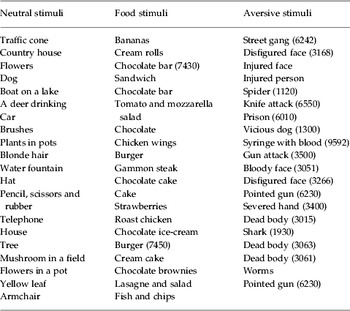
Twenty images from each stimulus category (food, aversive and neutral) were selected from the International Affective Picture System (Lang et al. Reference Lang, Bradley and Cuthbert1996) and from a database created by the authors (Table 1). The stimuli were independently rated and selected because of their recognizability and content diversity. Aversive stimuli included scenes of violence and injury and were rated as highly salient and unpleasant: these are images that are rated high on arousal and negative on valence (Lang et al. Reference Lang, Bradley and Cuthbert1996). Food stimuli were matched to neutral stimuli by ratings for colour and visual complexity and consisted of sweet (chocolate, cake, etc.) and savoury (pasta, hamburgers, etc.) images. Neutral stimuli were inanimate objects, e.g. household objects, vehicles and outdoor scenes.
List of imagesFootnote a

a For the images selected from the International Affective Picture System (IAPS; Lang et al. Reference Lang, Bradley and Cuthbert1996), numbers of the images in the original IAPS database are given in parentheses.
Statistical analysis
A repeated-measures general linear model (ANOVA) was used to explore the main effects and interactions of the factors, i.e. stimuli (food, aversive, neutral), condition (subliminal, supraliminal), group (AN, control) and task (1-back, 2-back). This procedure was completed twice, once for the accuracy data and again for reaction times. Exploratory analyses revealed that the accuracy data were skewed; they were normalized using a log-transformation and ANOVAs were performed on the transformed accuracy data. A non-parametric Spearman ρ correlation was performed on the original accuracy data and the demographic variables for this same reason. All p values indicate two-tailed levels of significance.
Results
Objective and subjective thresholds to the subliminal stimuli
Prior to commencement of the forced choice task, the 24 participants in the subliminal condition were asked if they had seen any images during the tasks. A total of 80% said that they had seen something flashed up on the screen but could not name it and 20% said they had not seen any images. Five participants (two AN subjects and three controls) randomized to the subliminal condition performed above the chance level in the forced choice task: these were considered to be ‘aware’ and were excluded from analysis and replaced by newly recruited participants. The remaining participants randomized to the subliminal condition performed at chance level in the forced choice test. They correctly identified 13.12 (s.d.=1.08) out of the 30 of images presented during the task from the novel pictures.
Effects of subliminal and supraliminal stimuli on response times
Mean reaction times of correct responses were analysed for both the 1-back and 2-back tasks using a 2×2×3 repeated-measures general linear model, with between-subject factors of condition (2) and group (2) and the within-subject factor of stimulus (3). The main effect of stimulus was significant in the 1-back task [F(1, 44)=3.29, p<0.05] due to slower reaction times for aversive stimuli compared with food and neutral stimuli. Mean reaction times of correct responses were also analysed across stimuli by a 2×2×2 general linear model; task (2), condition (2) and group (2). There was a main effect of task [F(1, 44)=37.92, p<0.001], which was due to slower reaction times in the 2-back task compared with the 1-back task.
Effects of subliminal and supraliminal stimuli on accuracy
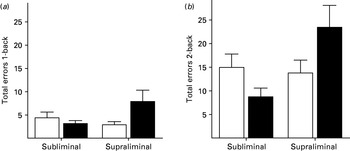
Errors in performance from the 1-back and 2-back tasks were analysed separately using a 2×2×3 repeated-measures general linear model, with between-subject factors of condition (2) and group (2) and the within-subject factor of stimulus (3). In the 1-back task, there were no significant main effects or interactions except for a trend for an interaction between condition and group [F(1, 44)=3.22, p<0.07]. In the 2-back task, there was no significant main effect of either stimulus (food, aversive or neutral) or participant group, although there was a significant main effect of condition (subliminal or supraliminal) [F(1, 44)=4.77, p<0.05], which resulted from more errors being made in the supraliminal condition compared with the subliminal condition. There was a significant two-way interaction between condition and group [F(1, 44)=3.88, p<0.05] which was due to participants with AN making more errors than controls in the supraliminal condition but fewer errors than the control group in the subliminal condition.
To examine whether there were significant differences in total error scores across tasks, error scores were collapsed across stimulus types. Total error scores were analysed using a 2×2×2 general linear model; task (2), group (2) and condition (2). There was a significant main effect of task [F(1, 44)=126.55, p<0.001] (Fig. 1 a, b). There was also a significant interaction between condition and group [F(1, 44)=6.82, p<0.01], which was due to participants with AN making fewer errors in the subliminal condition and more errors in the supraliminal condition compared with the control group. Inspection of the data shows that there is a similar pattern in the 1-back and 2-back tasks (Fig. 1 a, b).
Total errors made during (a) performance of the 1-back task and (b) performance of the 2-back task by control subjects (□) and anorexic subjects (■).

Correlations between accuracy and demographic variables
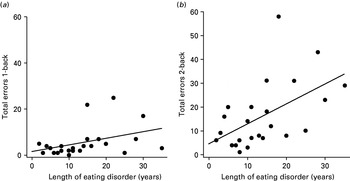
We explored whether the total error scores in the AN group were affected by age, BMI and duration of AN. A significant positive correlation was obtained between total error scores in both the 1-back (r s=0.46, n=24, p<0.05) and 2-back (r s=0.53, n=24, p<0.01) tasks and the duration of the eating disorder (Fig. 2 a, b).
Relationship between length of eating disorder and total errors made during (a) performance of the 1-back task and (b) performance of the 2-back task by anorexic subjects.

Discussion
This study examined the influence of supraliminally and subliminally presented stimuli (food, neutral and aversive images) on performance of two working-memory tasks in women with AN and in a healthy comparison group. Compared with the comparison group, the participants with AN made more errors in the supraliminal condition but fewer errors in the subliminal condition and this was irrespective of whether the stimuli were disorder salient (food), emotionally salient (aversive) or neutral. The results suggest that in women who are ill with AN, there is a general stimulus-independent attentional impairment at a conscious processing level; these findings do not support our hypotheses of attentional biases towards disease-salient stimuli at a conscious processing level. As the group suffering from chronic AN apparently perform a task less accurately if they are distracted by consciously perceived stimuli, our data are consistent with the selective attention deficit reported by Lauer et al. (Reference Lauer, Gorzewski, Gerlinghoff, Backmund and Zihl1999) but not with the explanation that it is due to interfering stimulus-unrelated cognitions. As the participants with AN performed more accurately than the control group in the subliminal condition, they have demonstrated an ability to concentrate well in the absence of explicit distracting stimuli. The finding of fewer errors in the subliminal task is in accord with other studies of cognitive tasks that do not require flexibility, creativity or an inventive approach (Fox, Reference Fox1981; Rovet et al. Reference Rovet, Bradley, Goldberg and Wachsmuth1988; Pieters et al. Reference Pieters, Sabbe, Hulstijn, Probst, Vandereycken and Peuskens2003).
We have observed a relationship between enhanced distractibility (i.e. impaired performance of the task when supraliminal stimuli were presented) and duration of illness. This could be due to extreme attention to detail: this concept covers a range of cognitive abilities necessary for flexible and adaptive behaviour (Happe & Frith, Reference Happe and Frith2006) and, thus, enhanced distractibility, set-shifting difficulties and weak central coherence skills may be components of a core cognitive impairment related to AN. It could be a maintenance factor in AN and may predict chronicity, i.e. it could indicate a worse prognosis given that the likelihood of complete recovery is diminished after a mean illness duration of 12.5 years (Strober et al. Reference Strober, Freeman and Morrell1997). This could result from long-term starvation, as Duchesne et al. (Reference Duchesne, Mattos, Fontenelle, Veiga, Rizo and Appolinario2004) suggest that there is a limit on the duration of weight loss beyond which normalization of brain function is more difficult, and/or that a longer period of normal eating and weight maintenance is required to improve cognitive functioning. Thus, it is possible that an adaptation to starvation results in a reduction in cognitive processing.
There are parallels between our findings and neuroimaging research in AN. In a baseline resting state, structural and functional neuroimaging evidence indicates abnormalities in the lateral prefrontal and parietal cortices (Delvenne et al. Reference Delvenne, Lotstra, Goldman, Biver, De, Pelboom-Fondu, Schoutens, Bidaut, Luxen and Mendelwicz1995; Kerem & Katzman, Reference Kerem and Katzman2003). These neocortical regions are responsible for focused attention processes, and their underactivation and atrophy may reflect inadequate use of selective attention. In response to disease-related stimuli such as food, people with AN activate the ventromedial prefrontal cortex and the anterior cingulate cortex, a region which is involved in suppressing irrelevant information during the Stroop interference task (Uher et al. Reference Uher, Murphy, Brammer, Dalgleish, Phillips, Ng, Andrew, Williams, Campbell and Treasure2004; Ferro et al. Reference Ferro, Brugnolo, De, Dessi, Girtler, Morbelli, Rossi, Falchero, Murialdo, Rossini, Babiloni, Schizzi, Padolecchia and Rodriguez2005). Many of these changes persist after recovery and appear to be trait related (Uher et al. Reference Uher, Brammer, Murphy, Campbell, Ng, Williams and Treasure2003). On the other hand, there are large overlaps in the cortical locations of various cognitive processes, and hence these parallels between cognitive style and neuroimaging data are not unequivocal evidence for a specific cognitive process.
It is not known whether attentional impairment persists during weight gain and/or after full psychiatric recovery. Hamsher et al. (Reference Hamsher, Pieters and Eelen1981) and Lauer et al. (Reference Lauer, Gorzewski, Gerlinghoff, Backmund and Zihl1999) found an improvement in cognitive deficits on refeeding whilst other studies have not (Green & McKenna, Reference Green and McKenna1993; Kingston et al. Reference Kingston, Szmuckler, Andrewes, Tress and Desmond1996; Grunwald et al. Reference Grunwald, Ettrich, Assman, Busse, Krause and Gertz2001; Katzman et al. Reference Katzman, Christensen, Young and Zipursky2001; Tchanturia et al. Reference Tchanturia, Anderluh, Morris, Rabe-Hesketh, Collier, Sanchez and Treasure2004). Similarly, there appears to be only partial normalization of structural and functional abnormalities in AN after recovery (Uher et al. Reference Uher, Brammer, Murphy, Campbell, Ng, Williams and Treasure2003; Kerem & Katzman, Reference Kerem and Katzman2003). In line with other evidence (Channon et al. Reference Channon, Hemsley and Silva1988; Bayless et al. Reference Bayless, Kanz, Moser, McDowell, Bowers, Andersen and Paulsen2002; Fassino et al. Reference Fassino, Piero, Daga, Leombruni, Mortara and Rovera2002), we have not observed an association between BMI and neuropsychological performance. This may reflect the fact that distractibility may be a cognitive trait predisposing to chronicity and may contribute to the maintenance of AN or that it is a consequence of long-term undernutrition. Lack of correlation between distractibility with current BMI indicates that distractibility is unlikely to improve with short-term refeeding. Further studies are needed with long-term longitudinal follow-up or involving fully recovered AN participants to examine these alternative explanations of our current findings.
There are some limitations in this study. The finding of no pre-attentive bias and little distraction from subliminally presented stimuli in the AN group may be because they have a raised threshold for subliminal perception (also possibly a consequence of prolonged starvation). However, the forced choice task we used is a test of explicit memory of stimulus presentation and does not measure perceptual threshold levels. Future studies of subliminal information processing in AN should therefore include measures of perceptual thresholds. The n-back task measures working memory and does not directly measure attention, so to extend our findings, measures of different aspects of attention should be used. Due to potential differences between the early phase and later phase of AN (Treasure & Schmidt, Reference Treasure and Schmidt2005) our AN group consisted of those who have suffered from restrictive AN for more than 2 years. As existing evidence points to a lack of correlation between illness duration and neuropsychological task performance (Cooper & Todd, Reference Cooper and Todd1997; Wilson & Wade, Reference Wilson and Wade2006) the generalizability of our conclusions is limited to chronic illness.
The enhanced distractibility seen in the AN group and its relation to illness duration has implications for the development and complexity of cognitive interventions and for patient engagement, as several studies recommend using such evidence to inform targeted interventions (Duchesne et al. Reference Duchesne, Mattos, Fontenelle, Veiga, Rizo and Appolinario2004; Southgate et al. Reference Southgate, Tchanturia and Treasure2005; Treasure et al. Reference Treasure, Tchanturia and Schmidt2005), for example, cognitive remediation therapy which has been used in patients with AN (Tchanturia et al. Reference Tchanturia, Davies and Campbell2007) and other psychiatric conditions (Wykes et al. Reference Wykes, Reeder, Williams, Corner, Rice and Everitt2003). In addition, if distractibility is a core feature it could contribute to a range of disabilities including parenting (Bryant-Waugh et al. Reference Bryant-Waugh, Turner, East and Gamble2007).
Declaration of Interest
None.