Attempts to tell the history of French Wagnerism are typically centred around a small group of events, texts and compositions. The main events are the debut of Wagner's music in Paris (orchestral excerpts in 1860 and an opera (Tannhäuser) in 1861), the opening of the Bayreuther Festspielhaus in 1876 (which precipitated many pilgrimages by French composers and critics), and the premiere of Claude Debussy's Pelléas et Mélisande in 1902, which has often been considered the turning point in the liberation of French opera from Wagnerian influence.Footnote 1 The most notable critical texts are Baudelaire's essay on Wagner and Tannhäuser, which appeared in the 1 April 1861 issue of the Revue européenne, and the short-lived Revue wagnérienne (1885–8), to which Mallarmé, Huysmans, Villiers de l'Isle-Adam and other prominent French literary figures contributed essays.Footnote 2 Last but not least, the most prominent examples of Wagnerian opera in France are Emmanuel Chabrier's Gwendoline (1885), Vincent d'Indy's Fervaal (1895) and Ernest Chausson's Le Roi Arthus (1895).Footnote 3
If the name of Maurice Ravel ever arises within this standard narrative, it appears in discussions of French musical parodies of Wagner.Footnote 4 In addition to the examples usually cited – Chabrier's Souvenirs de Munich (1886), Gabriel Fauré and André Messager's Souvenirs de Bayreuth (about 1888), and ‘Golliwog's Cake Walk’ from Debussy's Children's Corner (1908) – scholars will occasionally remember to cite the ‘Fanfare’ that Ravel contributed to the collaboratively composed ballet L'Éventail de Jeanne (1927).Footnote 5
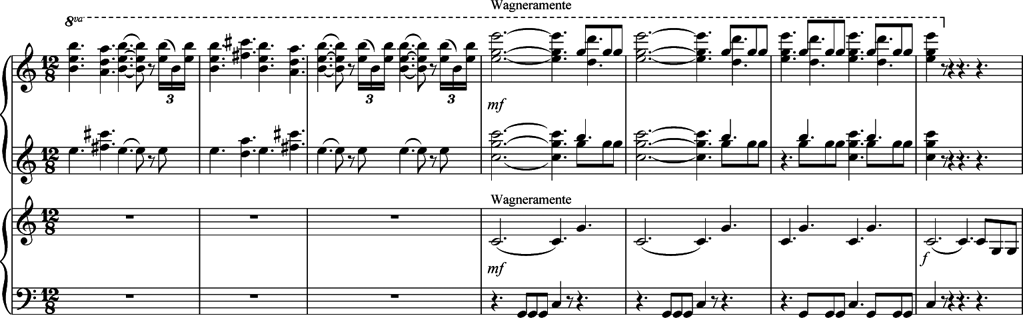
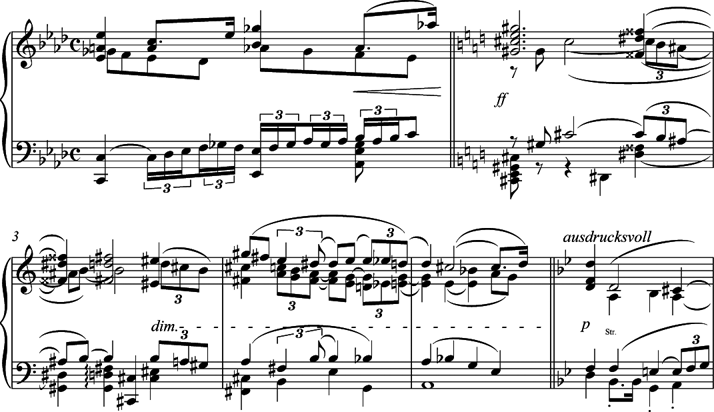
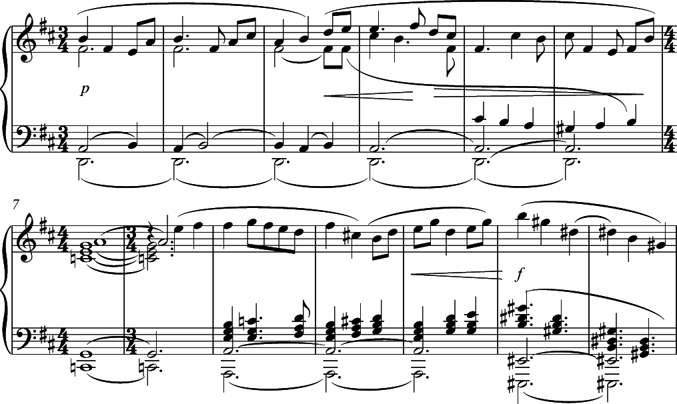
Should we seek a model for the Fanfare, ‘Golliwog's Cake Walk’ immediately comes to mind. Composed for the students of the ballet school run by Jeanne Dubost, L'Éventail de Jeanne was supposed to animate the limbs of her young ballerinas just as Debussy's piece was supposed to animate the limbs of his daughter's golliwog doll.Footnote 6 However, while the Cake Walk lampoons Tristan and its erotic melodrama, the ‘Wagneramente’ episode in the Fanfare (Ex. 1) evokes a different aspect of Wagner – namely, the brassy pomp that was well known from such popular concert excerpts as the ‘Entry of the Guests’ from Tannhäuser and the Wedding Music from Lohengrin. Ravel could easily have composed this passage without writing ‘Wagneramente’ above it, but he would then have forfeited an opportunity to announce his intention both to enrich children's music with some adult irony and to participate in a vibrant and long-standing tradition of musical parody. As Chabrier, Fauré, Messager and Debussy had already shown, few things were more droll than to incorporate Wagnerian grandiosity into genres – social dance, ballet, children's music – that were so ill-suited to it.Footnote 7
Ravel's ‘Fanfare’ (bb. 15–21) from L'Éventail de Jeanne (for piano four-hands).

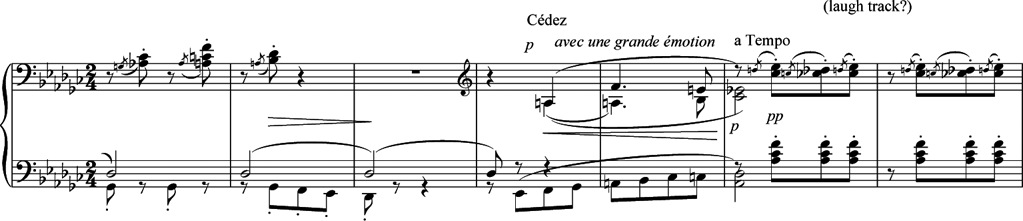
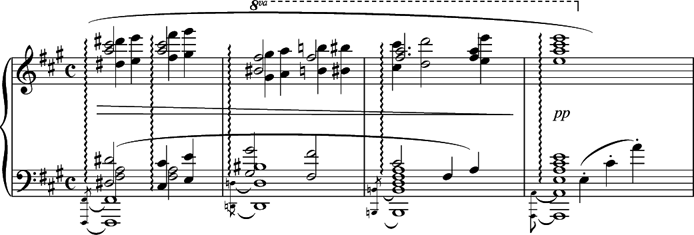
The humorous effect of both the Cake Walk and the Fanfare, however, is threatened by their chronology; composed well after the heyday of French Wagnerism (about 1880–1900), they would seem to lack the topicality on which parody often feeds. Davinia Caddy has recently underscored a certain topicality to the Cake Walk by demonstrating its involvement with contemporary trends in popular French culture, including American band music, early film and the circus, as well as the more obvious minstrelsy.Footnote 8 Moreover, she makes a claim for its personal relevance to Debussy, insofar as he would have identified with the clownish performer of the Cake Walk. Although Caddy does not draw the Wagnerian allusion into her argument, we could easily do so by suggesting that the reference to Tristan is the artist's self-portrait as a young Wagnerite, especially since he knew this opera so well.Footnote 9 Debussy might even be cueing our response by incorporating something like a laugh track into the score itself – namely, the pianissimo chuckling that sounds after each statement of the Sehnsuchtsmotiv (Ex. 2).
‘Golliwog's Cake Walk’ (bb. 58–63) from Debussy, Children's Corner (for solo piano).
It is more difficult to claim either topicality or personal relevance for the Wagnerian allusion in the Fanfare. Not only did Ravel compose it almost two decades after Debussy had composed the Cake Walk, but there is also little evidence of Ravel's direct engagement with Wagner's music.Footnote 10 Further, its allusion is neither as extensive nor as complex as the one in Debussy's piece, and would probably not even be recognisable without the label Ravel applied to it. Simply put, the reference is too little and too late to be effective; if historians happen to omit the Fanfare from their short list of French parodies of Wagner, we have little reason to chide them for it.
While the Fanfare may constitute a weak attempt at parody, the general claim that subtends it – namely, the incongruity between one repertoire and the other, the text and its intertext – still holds. At the risk of overgeneralisation, we can express this incongruity in a series of dichotomies: if Wagner's music emphasises gravity, profundity and interiority, Ravel's inclines towards levity, simplicity and exteriority; and if Wagner's output embodies the expressivity, informality, monumentality and chromaticism characteristic of Romanticism, Ravel's oeuvre tends towards the inexpressivity, formalism, miniaturism and diatonicism associated with neo-classical Modernism.Footnote 11 According to this scheme, both composers are totems that, in their diametrical opposition, mark the boundaries of their respective historical, cultural and aesthetic domains: the nineteenth century versus the twentieth century, Romanticism versus Modernism, German versus French, and so forth.
It must have been this perception of absolute incompatibility that compelled Arbie Orenstein to claim in his seminal biography Ravel: Man and Musician (1975) that ‘the aesthetic distance’ between Ravel and Wagner ‘can perhaps be measured only in terms of light-years’.Footnote 12 We cannot dismiss this claim out of hand, since no one has yet entertained the possibility of a direct and significant relation between the two.Footnote 13 However, if we ever wished to re-open this cold case, a good first step would be to adopt a dialectical perspective – not to eliminate the difference between the two composers, but to make it more productive.
The two essays Adorno wrote about Ravel are helpful in this regard. In the one published in 1930, Adorno argues that the marked contrast between Wagner's music and Ravel's qualifies the French composer as ‘the last anti-Wagnerian of a situation in which the spell of Bayreuth had otherwise completely dissipated’.Footnote 14 From a dialectical point of view, Ravel is not simply different from Wagner but represents the antithesis that sprang from the Wagnerian thesis. Moreover, in the context of the entire essay, which invests Ravel with an acute awareness of his mortality and the passing of his generation, Adorno's description of the composer as the ‘last anti-Wagnerian’ suggests that Ravel may have had a nostalgic attachment to both Wagner and French Wagnerism, two admittedly central and potentially formative presences within his obsolescent world.Footnote 15 Admittedly rather common among French musicians of the fin de siècle, the anti-Wagnerian Wagnerian – the Wagnerian malgré lui – had its most famous example in Nietzsche, and not only because he ended his diatribe against the German composer in The Case of Wagner by confessing feelings of ‘gratitude’ towards him.Footnote 16
A dialectical perspective is even more explicit in the unpublished essay from about 1928 in which Adorno invokes the notion of sexual desire to distinguish Ravel's music from other repertoires, especially Wagner's; while the German dwells on the lover's alternation between frenzy and languor, the Frenchman attends instead to the idealised image of the beloved. However, when making this argument he describes Ravel as ‘Wagner's last foe, since the latter's conception of erotic music is so similar and yet so dangerously opposed to his own.’Footnote 17 How, we may wonder, can the two conceptions be ‘so similar’ if they oppose each other? And how can an opposition that helps to differentiate one conception from another be ‘dangerous’? The solution to these riddles resides, once again, in a dialectical, psychological and genealogical viewpoint. Born from the thetical Other, the antithetical Self incurs a debt that it can never repay, but whose compulsion to do so generates a variety of responses to its creditor, which should be familiar to us from Bloomian and post-Bloomian theories of influence: rejection, contradiction, assimilation, and parody, but never indifference. Thus strong opposition need not hold opponents ‘light-years’ apart, but can stimulate a fruitful rapprochement.
This article seeks to perform a rapprochement between Ravel and Wagner in a process that divides into three phases. First I analyse the comments Ravel made about Wagner in his articles, interviews, and correspondence. Next, I bring to light a previously unrecognised allusion to Parsifal in Ravel's Trio (1914), which he began writing shortly after he attended the opera's premiere in Paris. Finally, I track Parsifal's influence on two additional works that Ravel composed on either side of the Trio – Daphnis et Chloé (1909–12) and L'Enfant et les sortilèges (1920–5) – and discuss the consequences of his engagement with Wagner for a dialectical understanding of his style. As the result of this investigation, I hope to have expanded our understanding of French Wagnerism by incorporating Ravel and his work into its catalogue of events, criticism and music.
Laloy versus Lalo
As a young musician in fin-de-siècle Paris, Ravel would have encountered Wagner at every turn. In addition to the frequent performance of Wagner's music at the Opéra and the Concerts Lamoureux, as well as at private venues such as the ‘Petit Bayreuth’ and the home of Wilhelm Enoch (Ravel's first publisher), the German was the subject of continual discussion and debate, due in particular to critics and artists returning from their pilgrimages to Bayreuth and Munich, and to the authors of a stream of monographs on Wagner.Footnote 18 Even though a twenty-one-year-old Ravel is supposed to have wept at an orchestral performance of the Tristan Prelude, he did not react as a public figure to Wagner's music until Louis Laloy's enquête (survey), which appeared in the April and May 1909 issues of the journal La Grande Revue.
In this survey Laloy prompted twelve composers to respond to another critic's suggestion that French musicians re-establish their link to Wagner. The critic in question was Pierre Lalo, whose article about French Wagnerism and Debussyism had appeared in the 18 August 1908 issue of Le Temps, the daily newspaper for which Lalo had already been writing for a decade. Laloy introduces the survey with a summary that centres on the following two points from Lalo's article: French musicians of the younger generation have rejected Wagner only to replace his influence with Debussy's; since Debussyism produces stillborn miniatures, French music might fare better by returning to Wagnerism. Admittedly, Laloy was not neutral about either possibility. On the one hand, he was a staunch supporter of Debussy. On the other, he clearly expressed his attitude towards the German composer in the statement that Lalo ‘would like to reopen our borders to the very same Wagner that we escorted there with cries of liberation only a few years ago’.Footnote 19
Laloy's take on Lalo may not be wildly inaccurate, but it is wanting. Even if we felt that it were merely par for the course amid the factious French music journalism of that time, we should still acknowledge the considerable liability it creates for the survey. Not only does it provide the basis for the ensuing discussion, but it is also the sole source of Lalo's arguments for everyone who did not have the opportunity to read the original article.
If we look back at Lalo's article, we discover a number of items that Laloy failed to mention. For example, the debate about Debussy and Wagner was initiated not by Lalo himself but rather by an unnamed German asserting in a letter that contemporary French music, as represented by Debussy's Pelléas et Mélisande, cannot rival Wagner's contributions either in artistic power or in historical importance. Unlike his German correspondent, Lalo is not primarily concerned with condemning Debussy and exalting Wagner but rather wishes to critique imitation as a modus operandi for young composers, due to its tendency to make the original trite and the spontaneous mechanical; he even states his position concisely in the overview at the head of the article, which reads in part: ‘Wagnerian imitation. Debussyian imitation. Disadvantages of both’ (emphasis mine).Footnote 20 To his mind, young composers have misunderstood the lesson to be learned from Debussy's ‘independent and original oeuvre’, which is supposed to inspire them to ‘be themselves’ rather than to ‘be Debussy’.
Laloy's summary leads us to believe that Lalo condemned Debussy's music, praised Wagner to the skies, and lumped together all young French composers as wayward Debussyists. On the contrary, Lalo does not subsume all of contemporary French music under the heading of Debussyism but instead leaves space for ‘independents’ such as d'Indy, Dukas and Magnard. Further, he celebrates the debut of Pelléas as a groundbreaking event in recent French musical history, lauds Debussy for his sentiment poétique (poetic feeling or sensibility), admits the potential for greatness in miniaturist art, and acknowledges the growing audience for this work.Footnote 21 Finally, he argues that, even if Pelléas had not catalysed anti-Wagnerism in France, the French would have rejected Wagner anyway for the many aspects of his music that dissonated with a contemporary national perspective, including an ‘aggressive philosophical Romanticism’, an excessive appeal to complexity and profundity, and an overuse of symbolism. Although Lalo does not recommend imitating either composer, the respective consequences of these imitations differ, as he explains in the central passage of the article:
All imitators take the wrong path, but [the imitators of Debussy] are more assured to get lost than the others, due to the exceptionality of their model. It is still conceivable to imitate someone like Wagner [imiter un Wagner], who is immense and encompasses all music; nevertheless, what has Wagnerian imitation produced? But it's pure deviance to imitate someone like Debussy [imiter un Debussy], who is narrow, subtle and rarefied. The art of these young people can be reduced to the exploitation of certain trifling procedures, with the result that it is becoming pettier and pettier. We almost wish [On souhaite presque] to restore Wagnerian influence in France.Footnote 22
This passage conveys two important aspects of Lalo's argument that Laloy misrepresents in his summary. Lalo does not actually say that one should imitate Wagner and avoid imitating Debussy, but rather cites them in order to refer to the imitability of the types they represent; in his understanding, composers such as Wagner who draw upon a wide range of materials are easier to imitate than those such as Debussy who are more selective. Lalo also emphasises that he is not recommending to French composers that they write like Wagner: first, with the rhetorical question, ‘what has Wagnerian imitation produced?’ (implicit response: nothing of lasting value), and second, with the adverb ‘almost’, which appears in the last sentence of the paragraph. Without this qualifier, Lalo would indeed be guilty of the crime that Laloy accuses him to have committed – namely, to have called for the restoration of French Wagnerism. With it, however, Lalo negates this wish and thereby compels us to remember the reasons he has already given for this negation: mere imitation is never artistically sufficient, rarely advisable and usually sterile; Wagnerism is incompatible with French taste; a return to Wagner is practically impossible and stylistically unthinkable in the wake of Pelléas. Ironically, an error that Laloy makes in transcribing these passages – substituting the conditional ‘would wish’ [souhaiterait] for the indicative ‘wish’ [souhaite] – only ends up intensifying the negation of the wish by making it part of a contrafactual statement.Footnote 23
Laloy's misreading of Lalo's article testifies to the fervid pitch of French musical politics during this era, as well as the tendency for its participants to retreat to their respective trenches rather than explore more moderate positions.Footnote 24 Just as important, though, is the evidence it provides for the continuing ability of Wagner's name to provoke a defensive overreaction almost a decade after French Wagnerism is supposed to have subsided. This, then, is the context in which Ravel makes his first public statement about Wagner, a statement which attests to his allegiances and those of contemporary French music at large.
Ravel and the enquête
The April 1909 publication in La Grande Revue of the enquête spilled over into the May issue, apparently because Ravel and Florent Schmitt sent in their contributions late. Here is the full text of Ravel's response to the question whether French musicians in 1909 ought to re-establish their link to Wagner:
Vraiment il y aurait beaucoup trop à dire là-dessus. Voir d'abord en Wagner ce qu'il fut surtout, un musicien magnifique.
Il est trop tard. On aurait l'air de faire du paradoxe après Nietzsche, Catulle Mendès, et M. Joséphin Péladan.
… Le vœu est singulier? Pas tant! Je le retrouve dans un vieux papier. Il y a ‘Wagner’ au lieu de ‘Debussy’, ‘Rossini’ à la place de ‘Wagner’. C'est signé: Scudo.Footnote 25
(In truth, there would be much too much to say about it. Let's first recognise in Wagner what he was above all else: a magnificent musician.
It's too late. After Nietzsche, Catulle Mendès, and Mr. Joséphin Péladan, we would seem to be committing a paradox.
… The wish is unique? Hardly! I rediscovered it in an old article. There's ‘Wagner’ instead of ‘Debussy’ and ‘Rossini’ instead of ‘Wagner’. It's signed: Scudo.)Footnote 26
Ravel's text is so terse and cagey that we can barely discern the question it is supposed to answer. Indeed, Ravel's initial claim that there is ‘much too much to say’ about Wagner and his legacy only manages to raise the text's brevity into further relief. Different from Wagner in so many respects, Ravel surprises us by describing the German as a ‘magnificent musician’, so the little he says goes a long way.Footnote 27 But Ravel's response is fundamentally a refusal to respond, which he justifies with the following reasons: the matter is too big to grapple with in such a limited space; the historical moment for such discussion has passed; and the desire to restore Wagnerism in France is merely another instance of the perennial attempt by critics to depreciate the present by invoking the past.
Tensions and contradictions within this response, however, compel us to examine it more closely. The dire proclamation of ‘it's too late’ stands in stark contrast to the preceding claims about Wagner's ‘magnificence’ and the ‘much too much’ that still remains to be said about him. Indeed, if Wagner were indeed ‘magnificent’, would he not still be worthy of discussion among critics and emulation by composers? Unfortunately, we cannot resolve the contradiction between simultaneous assertions of the timeliness and the untimeliness of this debate simply by identifying the subject of ‘it's too late’. It is natural for us to assume that the referent is the question of reinstating Wagnerian influence on French composers, but the list of critics in the subsequent sentence challenges this assumption. If we interpret ‘it’ as referring instead to the reception of Wagner in music criticism, we have a better chance at unravelling this knotty text.
For Ravel, criticism is not only distinct from composition but can harm it. As he proposes in the final sentence of the response, critics are all too susceptible to a conservatism that likes to wedge the past against the present in an act of patriarchal suppression; given his immense authority and esteem as a historical figure, Wagner is a particularly dangerous weapon for critics to wield against a younger generation of composers. Moreover, Ravel's description of Wagner as ‘above all else’ a musician implicitly criticises as dilettantish and possibly irrelevant any discourse focused on something other than his musical accomplishments. As Ravel surely knew, an irony lay in the fact that Wagner was the worst offender, due to the example he set among present and future Wagnerians for speculating about a wide range of topics. And yet, as Ravel probably also knew, it is not so easy to separate the musical wheat from the non-musical chaff. This truism is especially applicable to Wagner, whose ideology and ambitions were integral to his artistic production and would provide an almost inescapable context for the theory and practice of Western art at the end of the nineteenth century.
We encounter a similar dilemma upon scrutinising the sentence about the ‘paradox’. Despite its apparent intent to shut down any further consideration of Wagner, it leaves open several loopholes. First, as an artist who took a page from Oscar Wilde in claiming to be ‘artificial by nature’, and whose music was widely appreciated for its paradoxical qualities, Ravel may actually be understood to invite the revival of Wagner reception by identifying it as a paradox. Next, his selection and ordering of the three critics in terms of chronology and decreasing renown demonstrate a connoisseurship and investment in criticism that undermine his complaints about the practice. Nietzsche, whose fame allowed Ravel in 1909 to cite him solely by his last name, published his final book in 1888 and died in 1900; Catulle Mendès had just died, and the ‘Monsieur’ applied to Péladan is presumably meant to indicate that he was still alive when Ravel was writing his response. Third, to name only three critics – none of whom Ravel would have considered to be a bonafide professional musician – is to suggest that there are still many perspectives on Wagner that have not yet been aired, especially those focused on his music. Finally, his citation of this trio implies that they constitute a representative sampling of Wagnerian criticism and possibly even express the last word in Wagner reception. If our inference is correct, we are then compelled to ask what they had to say about Wagner and how it might further illuminate Ravel's position.
The sequence Nietzsche–Mendès–Péladan is notable for comprising a variety of attitudes towards Wagner. The most idolatrous of the three, Péladan expressed his esteem for the German composer in an 1894 survey of his operas (Le Théâtre complet de Wagner) and several instances of fiction (the plays Le Fils des étoiles and Babylon, and the novels La Victoire du mari and Le Panthée, among others).Footnote 28 Ravel deflates this figure somewhat by referring to him as neither the famous ‘Péladan’ nor the self-proclaimed ‘Sâr Péladan’ but rather the more pedestrian ‘Mr. Joséphin Péladan’, thereby placing him once again amid the multitude of ‘middling souls’ (âmes moyennes) from whom the self-appointed czar wished to distinguish himself.Footnote 29 If this is what Ravel meant to do, why did he do it? At first, we may suppose that he simply wanted to distance himself from Péladan due to the latter's distasteful idolatry of Wagner. However, it is also possible that Ravel disagreed with Péladan's specific understanding of Wagner's contribution as an artist; the dramatist's claim in Le Théâtre complet that it is an ‘error and a lie’ to describe Wagner as ‘above all a musician’ directly contradicts the composer's assessment in the 1909 survey.Footnote 30
Poet, playwright, critic and erstwhile husband of the fervent Wagnerian Judith Gautier, Catulle Mendès may have been on Ravel's mind for having fallen to his death on a railroad track in February 1909. In comparison with Péladan, Mendès was more ambivalent towards Wagner. While the tone of his 1886 monograph Richard Wagner is generally celebratory, he nevertheless reminds us in the Preface of the gratuitous cruelty of ‘Une capitulation’ (Wagner's farce about the Franco-Prussian war), lampoons the composer in the chapter titled ‘Épitre au roi de Thuringe’, and, in the Epilogue, cautions young French composers against imitating Wagner's essentially Germanic music.Footnote 31
If Mendès harboured some ambivalence towards Wagner, Nietzsche swung hard between extremes, transforming himself from an enthusiastic advocate in The Birth of Tragedy from the Spirit of Music (1872) to a scathing critic in The Case of Wagner (1888) and other late writings. Yet, despite the near-hysterical denunciation of Wagner in the latter – where he famously claims that Wagner is a ‘neurosis’ that has ‘made music sick’ – he also acknowledges the composer's value.Footnote 32 According to Nietzsche, if Wagner's music is corrupt, at least it is thoroughly and unabashedly so, and thus exemplifies ‘courage, will, conviction in corruption’ (emphasis his).Footnote 33 In ‘Nietzsche contra Wagner’ he also says that, as a pure expression of the ‘modern soul’ (âme moderne), Wagner's music has been beneficial for forcing him to confront modernity in its cultural decadence, and recognise himself in his complicity as a fellow decadent – a self-accusation that presumably acknowledges the hysteria in his own reaction against Wagner.Footnote 34 Furthermore, he supposes that Wagner's diseased music is also effective as a ‘stimulus of life’ that ultimately impels its subject to formulate healthier ideals over and against it.Footnote 35
Nietzsche dubs his main counter-ideal ‘Mediterranean music’ and describes it as ‘a mocking, light, fleeting, divinely untroubled, divinely artificial art that, like a bright flame, blazes into an unclouded sky!’Footnote 36 Although, in The Case of Wagner, he exalts Bizet's Carmen as a prime example of this musical type, we can easily locate other plausible candidates in early Ravel, including Jeux d'eau (1901), ‘Alborada del gracioso’ from Miroirs (1905), the Introduction et allegro (1905) and ‘Feria’ from Rapsodie espagnole (1907). However, in each of these instances anxious, melancholy and chromatic strains, usually appearing in a piece's interior, belie a gay façade; this ‘decadent dialectics’ – a process of identity formation whereby decadence and its opposite produce the one out of the other – appears equally in Nietzsche, whose awareness of his own decadence not only spurs his hope for transcendence, but also periodically returns to overcloud this hope.Footnote 37
For both Nietzsche and Ravel, decadent and, by association, Wagnerian topics, are not a thing of the past but an aspect of the present that continues to aid them in their self-fashioning as thinkers and artists. This is probably the reason that Nietzsche cannot seem to end The Case of Wagner, as is evident in its two Postscripts and an Epilogue; as cited previously, the ‘gratitude’ he expresses towards Wagner in the final sentence of the Epilogue implicitly acknowledges an ongoing debt that renders any conclusion merely provisional. If the motivation for this polemic initially appeared to be the desire to pronounce the last word in Wagner reception, it finishes by abandoning this goal and leaving room, instead, for the endless ‘rumination’ he identifies elsewhere as essential to understanding his writings and, perhaps, all writing.Footnote 38 If Nietzsche was not done with Wagner, we have good reason to suspect that the thoughtful Ravel was not either. After all, this is the same person who set great stock by the request of his composition teacher, Fauré, to re-examine a piece by Ravel that he had just rejected, in the event that he might have misjudged it.Footnote 39
The other eleven responses to the survey, as well as Laloy's summary comments, provide a further context for interpreting Ravel's contribution. The most obvious difference between this submission and the others is its greater brevity; the only other response that comes close to its seventy-four words is the single paragraph by Raymond Bonheur, who uses 141 words merely to defer to Laloy's better judgement on the matter. This context therefore brings Ravel's refusal to answer the central question of the enquête into even sharper relief.
As for its content, Ravel's response lies on the more positive end of the spectrum for declaring Wagner to have been a ‘magnificent musician’. More specifically, we can situate Ravel between two groups: one comprising Alfredo Casella and Gustave Samazeuilh, both of whom uphold Wagner's music as still worthy of study, and another comprising Gabriel Dupont, Jean Huré and Laloy himself, all of whom seek to balance its strengths (grandeur and orchestration) against its weaknesses (ponderousness and obscurity); although Ravel gives Wagner higher praise than anyone else, it is mitigated by his judgement about the belatedness of this initiative (‘it's too late’). At the other end of the spectrum, Florent Schmitt, Albert Roussel and three other composers express nationalist and isolationist values in rejecting Wagner and his influence on French music. Given the popularity and predictability of this protectionist brand of patriotism, Ravel implicitly rejects it by formulating his response as he did. At the same time, he preserves a measure of openness towards Wagner and his legacy. Finally, Ravel stands out for being the only one of the twelve respondents to demonstrate an awareness of Wagner's critical reception.
Wars of succession
Ravel's career surged over the next five years (1909–14), during which time he not only hit his stride as a creative artist but also recognised and embraced his potential as an important historical actor. In June 1909 he accepted a prestigious commission from Diaghilev's Ballets Russes, which were sensationally popular at that time in Paris, and soon thereafter witnessed the premiere performance of four of his major stage works: an opera (L'Heure espagnole) in 1911 and three ballets (Ma Mère l'oye, Adélaïde, Daphnis et Chloé) in the first half of 1912. He withdrew from the Société Nationale and collaborated with other former students of Fauré to found the Société Musicale Indépendante in 1910; as evidence for the substantial rivalry of these two societies, the SMI produced thirty-nine concerts – all brimming with premieres – to the SN's forty-one during a period that stretched from the debut of the SMI (20 April 1910) to the beginning of the First World War (28 July 1914).Footnote 40
Another testament to Ravel's desire to play a more prominent role on the national stage in these five years is his emergence as a music critic. Considering the attitude he expressed towards this profession in Laloy's survey, we might be surprised that he would wish to become what he had previously seemed to despise.Footnote 41 However, we could also interpret this new career path more positively as the expression of a desire to supplement his ongoing efforts to shape musical life in Paris as a composer and concert programmer by articulating his point of view in a third form. And whenever he wished, he could also use this medium to counter the opinions of his opponents and to overturn any mistaken preconceptions his readers may have held about him.
His crusade against the critics is a common element in these essays, continuing almost without interruption from the 1909 enquête to his review of Stravinsky's Le Rossignol in 1914. The most forceful rebuke appears in an article he wrote about Debussy's orchestral Images and published in February 1913. He sets the tone by placing at the head of the article an epigraph by the belletrist Antoine Bauderon de Sénecé (1643–1737), who identifies the ‘jealousy which one feels towards the moderns’ as ‘often the better part of the admiration which one shows for the ancients’.Footnote 42 Ravel then assigns persons to the three roles staked out in the epigraph: Wagner is the admirable ancient, Debussy the reviled modern, and Lalo the jealous critic. Should the reader not recall the specific moment of Lalo's recent offence, Ravel pointedly cites the article that provoked Laloy's survey.Footnote 43 Although Ravel ultimately finds Debussy's critics to have been unsuccessful in their attacks on the composer, he still cannot refrain from putting them in their place by describing them as ‘morose incompetents who have never felt the ardent passion inspired by these landscapes and this picturesqueness [in the Images], and who cannot discover the musical expression of that passion in a composition’.Footnote 44
The critique that Ravel aims at Lalo and his ilk also involves refuting the opposition they wished to establish between Wagner and the Debussyists. In a review of the Concerts Lamoureux from March 1912, Ravel not only avoids making any negative comments about the German composer but also actually marvels at the ‘extraordinary spontaneity’ of his music, ‘which synthesized all the sensibility of the nineteenth century’ and exerted a ‘powerful attraction’ upon its audience.Footnote 45 Ravel then dovetails his discussion of Wagner into a history of recent French music.
Even today, when one hears the resounding Venusberg music [from Tannhäuser], which is one of the most representative examples of Wagner's art, it is understandable that after this explosion of passionate joy and suffering, after this roaring outburst of pagan vitality, the need must have been felt for a peaceful, even austere, retreat.Footnote 46 In France, this meditation produced various results: first, from the Franckist cloister, there emerged a solemn procession of artists whose devotion to the will [la volonté] has only grown stronger over time. This was followed by a less organised group of young people with a fresh new spirit who let their instinct sing freely; their sensibility sought to perceive its slightest external manifestations profoundly, and with more subtlety than their predecessors.Footnote 47
This passage might seem simply to narrate the succession from Wagner to Franck to Debussy, but it is actually more polemical than that. Although Ravel acknowledges that the Franckists preceded the Debussyists, he nevertheless puts them on equal footing as part of the same ‘peaceful, even austere, retreat’ in France from the ‘roaring outburst of pagan vitality’ in Wagner. This equivalence provides the basis for a comparison in which one fares better than the other: while the Franckists (read: d'Indy's Société Nationale) are overly wilful and dogmatic in their approach to art, the Debussyists (read: Ravel's Société Musicale Indépendante) follow their instincts, which allows them greater subtlety in their art. Both groups are post-Wagnerian, but in this article the Debussyists arguably become the rightful heirs of Wagner and the Romantic spirit that he embodies; the natural ‘spontaneity’ of the latter resurfaces in the Debussyian ‘instinct’, not in the Franckist ‘will’. By appropriating the inheritance that the Franckists claimed as their own, Ravel turns the prevailing narrative upside-down.
Ravel expands upon this bold assertion in a January 1913 review of d'Indy's Fervaal, which had just been performed at the Paris Opéra. Although he complains once again about the general tendency of critics to condemn new music for being either too Wagnerian or not Wagnerian enough, he is nevertheless forced to agree with the long-standing judgement that Fervaal is ‘entirely Wagnerian … by the very essence of its music, by its theatrical scheme, its philosophy, the realisation of this philosophy, by the symbolic role of the characters and their obscure language’.Footnote 48 Ravel recognises that the subject matter of Fervaal is well suited to a Wagnerian treatment but still chides d'Indy for adopting these elements wholesale; consequently, the libretto is overly laden with symbolism and the music is excessively freighted with leitmotifs. Pressed to compare the Wagnerian original with the d'Indyian copy, Ravel exalts the former and condemns the latter.
Wagner's own work offers the most complete example of assimilation on the grandest scale. Uniting the most diverse materials, this giant constructed a splendid and original palace, whose dimensions were proportioned to his stature. Mr. d'Indy moved into this grandiose edifice, carefully shutting its doors and windows. The fiery sun, which the architect allowed into his abode, was replaced by candles of exceptional clarity, but of less heat. In this artificial light, objects become tarnished, taking on a moribund appearance. The symbol of Fervaal proclaiming the victory of life and love while bearing a woman's corpse towards the heights is more significant than M. d'Indy intended it to be.Footnote 49
Although the remaining paragraphs of Ravel's review are devoted to praising various aspects of Fervaal, they do little to offset this stinging critique, which is even harsher than the comments he made earlier about the Franckists. D'Indy is no longer the leader of a ‘solemn procession’ of composers in ‘austere retreat’ from Wagner, but rather a squatter on Wagner's estate who has violated this property by transforming its ‘splendid palace’ into a musty sarcophagus. Once again, a double negation embedded in this argument draws Ravel closer to Wagner; if d'Indy opposes Wagner and Ravel opposes d'Indy – albeit in different ways – then Ravel might actually share more with Wagner than the avowed Wagnerian himself.
The shadow of a doubt
However appealing and convincing Ravel's arguments may be, they are potentially undermined by several inconsistencies in his actions. As previously mentioned, it is surprising to see the composer become a music critic after having expressed such negativity towards the profession in his response to Laloy's survey. But it is even more disconcerting to witness his adoption of the same tactics for which he condemned Lalo – namely, using Wagner to diminish the achievements of present-day French composers. Ravel was undoubtedly aware of this contradiction, as is evident in his 1913 review of Fervaal. Although he begins the review by berating critics for their compulsion to belittle all new music by finding it to be derivative of the work of strong predecessors such as Wagner and Debussy, he nevertheless continues by claiming that Fervaal is one of the few pieces to deserve this critique, before launching into a detailed and ultimately unflattering comparison of Fervaal with the Wagnerian music drama. But this attempt to differentiate his mode of criticism from Lalo's ironically only brings him closer to it, since Ravel's complaint that Fervaal suffers from its wholesale appropriation of Wagnerian elements (declamation, philosophy, stage action, leitmotifs) echoes Lalo's judgement about the tendency for imitation to produce trite and mechanical works. A year later Ravel would expand his critique of Fervaal into one encompassing French musical Wagnerism in general, which produced a ‘deplorable multitude of theatrical works, chamber music, and songs, whose disproportion, heaviness, and sadness were so uninspired, that they have not survived these twenty years’.Footnote 50
We may be tempted to ask whether Ravel's simultaneous rejection and emulation of Lalo rises to the level of hypocrisy, but the question that is more pertinent to our present enquiry concerns his sincerity. The more he invokes Wagner to undercut the achievements of d'Indy and his like-minded colleagues in the Société Nationale – just as he acknowledged other critics to have done in their invocation of ‘admirable’ predecessors – the more difficult it is for us to take his positive comments about the German composer at face value. Once raised, these doubts cast their shadow on other acts by Ravel whose intentions may have otherwise seemed clear. A case in point is his 7 June 1916 letter to the Committee of the National League for the Defense of French Music. In their official notice, the League called for banning wartime performances of ‘contemporary Austro-German works which are not yet in the public domain’ and for promoting the performance and publication of French music.Footnote 51 Upon receiving a request to join the League, Ravel responded by writing a letter in which he declined the invitation and explained his decision by striking down their claims, one by one: those who wish to take ‘action’ against the enemy should join the war effort as he did, instead of trying to suppress transnational artistic exchange; the notion that music is primarily ‘economic and social’ is overly general and of limited application; the ban on German and Austro-Hungarian music would not help but rather hinder French composers by depriving them of ‘beneficial’ foreign influences such as Schoenberg, Bartók and Kodály; French music does not need special protection and is not intrinsically valuable simply because it is French; and so forth.Footnote 52
Wagner's name does not appear either in the notice or in Ravel's letter. Nonetheless, Arbie Orenstein senses his implication in this exchange and consequently ends his discussion of this episode with the observation that ‘Ravel made it a point to attend’ and applaud ‘enthusiastically’ one of the first performances of Wagner's music in Paris after the end of the war, presumably in continued demonstration of his opposition to the League's xenophobia and protectionism.Footnote 53 At first glance, we may think that Orenstein has made a leap of logic; not only did either side fail to mention Wagner but also his music was not technically at issue here, since it had already fallen into the public domain by 1916. On further review, though, the implication seems more plausible, at least on the part of the League, due to the explicit hostility towards Wagner that had been recently expressed by some of the most prominent members of the group.Footnote 54
Even if we were convinced that the League meant to condemn Wagner and Ravel meant to defend him, we still have reason to believe that Ravel's fundamental motivation was not a deep attachment to the German but rather an ongoing involvement in the conflict between the SMI and the SN, whose members populated the ranks of the League, including Honorary President d'Indy. Indeed, just two years earlier he had voiced complaints that resembled those of the League. In a January 1914 review of Francesca da Rimini at the Opéra-Comique, Ravel scolds the company for refusing two operas by Frenchmen – La Forêt bleue by Louis Aubert (a fellow SMI member) and Eros vainqueur by Pierre de Bréville (an SN member!) – before he launches into a critique of the opera by Franco Leoni, ‘an Italian residing in London’. His grievance in this review is not only that the French operas were more deserving of production than the Italian one (which he pans as verismo hackwork), but also that the Opéra-Comique failed to fulfil its obligation as a national theatre which ‘receives a government subsidy specifically intended to promote works by French composers’.Footnote 55 Although Ravel spends the second half of the review praising the Spanish composer Manuel de Falla and the production of his La Vida breve at the Opéra-Comique, it does not fully dispel the effect of the first half, which comes off as sharing more than a little with the xenophobia and protectionism in the League's notice.
Ravel's apparent praise for Wagner is further eroded by direct criticism. One object of this critique is Wagner's orchestration, which, to Ravel's ear, can sometimes sound like a less effective version of Meyerbeer's ‘military music’.Footnote 56 Another is his vocal writing, whose awkward qualities and harsh accentuation not only present a ‘dangerous example’ for other composers to follow but also seem to display ‘contempt’ for ‘the most expressive of sonorous instruments’.Footnote 57 After having taken Wagner to task in a review from 1914, Ravel makes a few concessions that can only be described as grudging: any aspects of Wagner that seem objectionable to him as a Frenchman might well be interpreted by a German as ‘virtues’; as an instance of this vice-turned-virtue, Wagner's typically Germanic ‘long-windedness’ is ‘never entirely without significance’.Footnote 58
Thus the longer and more closely we examine Ravel's utterances about Wagner, the bleaker is the prospect for creating any genuine rapprochement between the two. Nevertheless, a substantial possibility remains for casting Ravel's attitude towards Wagner in a positive light: Parsifal. As we will see, several moments in Ravel's music bear a striking affinity with aspects of Wagner's last opera and perhaps even testify to a direct influence that Ravel intended for his listeners to recognise. First, however, we will examine the role that Parsifal played in Ravel's career as a critic.
The Wagnerian downbeat of 1914
Midnight between 31 December 1913 and 1 January 1914 marked the expiration of the Berne Convention's claim on Parsifal, which forbid staged performances of the opera outside of Bayreuth for thirty years after Wagner's death in 1883. Although it was mounted elsewhere on several occasions – most famously by New York's Metropolitan Opera in 1903 – the exceptionality of these occasions demonstrates the Convention's overall effectiveness.Footnote 59 But this prohibition also had positive consequences. One was the special aura it conferred upon Parsifal: not only was it Wagner's last opera, a ‘late’ work (and thus the fruit of a lifetime's wisdom), and the sole member of a genre that the composer invented specially for it (a Bühnenweihfestpiel, a ‘stage consecration festival play’), but also the prohibition made Parsifal into the object par excellence of the pilgrimage to Bayreuth, since it was specifically intended for that auditorium and, for three decades, could only be viewed there in its integrity.Footnote 60 The prohibition also transformed 1 January 1914 into a date of worldwide significance for producers and consumers alike; every major opera house felt the pressure to stage Parsifal on or around that day, and every opera aficionado felt compelled to attend.
While the Paris Opéra may have split the event in two – placing the répétition générale on 1 January and the création on 4 January – it still made quite a stir, as is evident by the breadth of its coverage and the eminence of its reporters. In addition to professional music critics such as Gaston Carraud, Jean Chantavoine, Pierre Lalo, Louis Laloy and Émile Vuillermoz, the ranks of reviewers also included the composers Gabriel Fauré, Charles Koechlin, Alfred Bruneau, Reynaldo Hahn and Maurice Ravel.Footnote 61 As in Laloy's enquête, the reviewers express a variety of attitudes that range from the adulation of Fauré and Carraud to the qualified enthusiasm of Bruneau and Raymond Charpentier to the negativity of Adolphe Boschot and Chantavoine. Although Chantavoine complains about various aspects of Wagner's music – it is dragging, overly repetitive and inconsistent in quality – the most common object of criticism is the fundamental impropriety, above and beyond the legal Convention, of any attempt to perform Parsifal outside of Bayreuth. For both Hahn and Boschot it is a profanation that strips the opera of its mystery and piety. Vuillermoz makes the same claim but in a more complex manner. He acknowledges the inevitable loss of Parsifal's mystical aura upon being transplanted to the Opéra, while simultaneously threatening to deflate this aura with an apparently sarcastic reference to Mesmer's theories of animal magnetism: ‘You need so many climatic and atmospheric conditions, so many felicitous acquiescences of a complicit nature for the mysterious fluid of the Beyond to propagate to our nerves, for the air that we breathe suddenly to become a good conductor of the natural electricity!’Footnote 62
Like the article by his fellow Apache Vuillermoz, Ravel's review of Parsifal, which was published in Comœdia illustré on 20 January, also uses a bit of erudition sarcastically to distinguish its point of view from that of cultish Wagnerians; even after he admits never having been to Bayreuth, he is nevertheless happy to relay the report that ‘Parsifal is performed there somewhat like the Eleusinian mysteries.’Footnote 63 In general, however, the article is quite positive. It divides into two parts: a historical survey of Wagnerism and anti-Wagnerism in France, and a glowing review of Parsifal's premiere at the Opéra. In the latter Ravel praises all the musicians – the soloists, chorus, orchestra and conductor – but criticises the staging, which he finds to be so conventional and literal that it detracts from the music's transcendent effect. He also steps beyond this production repeatedly to exalt Wagner in various respects: ‘the genius of this great artist’ deserves recognition from musicians and non-musicians alike; even if one were to separate Wagner's music from its accompanying texts (libretti, treatises, critical essays, etc.), it will still be full of ‘charm and richness’; those, like Ravel, who opposed Wagnerian influence in France, nevertheless cannot deny his ‘prodigious creativeness and profound musicality’; in the case of Parsifal, the opera is ‘magic’, amounting to ‘four hours of wonderful music’ whose highlights include the ‘marvelous Good Friday music’ and the ‘sublime’ redemption at the end.Footnote 64
Once again, if we had not collated the comments Ravel actually made about Wagner but merely relied on Orenstein's claim that the two composers stood ‘light-years’ apart, we would probably be disoriented by Ravel's effusive comments about Parsifal. Roger Nichols, one of the few to have commented on this review, wards off any potential disorientation by emphasising certain aspects of the first half and downplaying the second. First, he argues that Ravel's lengthy introduction about the history of Wagner in France makes it ‘obvious’ that the composer was ‘not entirely comfortable’ in reviewing this music.Footnote 65 He then gestures towards the second half upon suggesting that Ravel's ‘emotional reaction to Parsifal was little different from that to the Tristan Prelude in 1896’, but he immediately overrides this suggestion by redirecting attention back to the first half.Footnote 66 Here, Ravel appears to be ‘convinced of the damage the Wagnerian influence had done to French music’ and aware of the fact that ‘to him, technically and aesthetically, Wagner had very little to say’.Footnote 67
I do not dispute Nichols's claim about Ravel's discomfort. Indeed, the level of equivocation in the first half of the review – as encapsulated in the oxymoronic interjection ‘fortunately, alas!’ (heureusement, hélas!) that appears in the midst of this section – borders on the extreme: Wagner's vices may also be his virtues; his music is both the instigator and the victim of the dilettantish commentary (littérature) that surrounds it; musicians should have been the first to weigh in on Wagner, but even if they had, they would not have recognised his worth; anti-Wagnerism among the French was justified, but by now it has degenerated just as much as Wagnerism; Parsifal is not as entertaining as Offenbach, but it is less ‘annoying’ than the Missa solemnis; and so forth.
Among Nichols's claims, however, I am less satisfied with his conclusion that ‘technically and aesthetically, Wagner had very little to say’ to Ravel. I propose instead that we interpret Ravel's 1914 review of Parsifal as an expansion of the first two sentences from his response to the 1909 enquête: the first half acknowledges that there is ‘much too much to say’ about Wagner, while the second impels us to ‘recognize in Wagner what he was above all else: a magnificent musician’. In the first half, Ravel is not necessarily dismissing Wagnerian influence tout court, but rather is criticising French imitation of Wagner; if only they had injected a goodly amount of inspiration, lightness, levity and proportion into their ‘uninspired’, ‘heavy’, ‘sad’ and ‘disproportionate’ pieces, they would presumably have benefited, rather than suffered, from this influence.Footnote 68 Further, I do not think we need to interpret the preamble in which Ravel provides a history of Wagner in France and equivocates about his legacy as merely an indication of personal discomfort. Rather, I would describe this section as a serious attempt by a critic deeply invested in music and its reception history to lay some groundwork for any future consideration of this phenomenon. In so doing he encounters an ambivalence about the composer similar to that which many scholars still feel today. Moreover, I find it more fruitful to attend closely to, rather than gloss over, the many positive comments Ravel makes about Wagner in this review, for, as we have seen, they form part of a broader effort by Ravel to measure both the greatness and the limitations of the German composer. Although Ravel's ongoing feud with d'Indy and the Société Nationale somewhat vitiates this effort, the following discussion of the ‘Passacaille’ from Ravel's Trio seeks to redeem it.
The passion of the Passacaille
Notations on the manuscript of Ravel's Trio for piano, violin and cello, which was his major compositional project of 1914, indicate that he began this piece on 3 April – three months after the premiere of Parsifal in Paris – and completed it on 7 August, five days after the mobilisation of French troops. The Trio is in four movements: a relatively concise initial sonata form, an expansive scherzo entitled ‘Pantoum’ (presumably after the Malayan verse-form that various nineteenth-century French poets had dabbled in), a slow movement with the neo-Baroque title of ‘Passacaille’ (passacaglia), and a virtuosic ‘Final’. Although we know that Ravel patterned the ‘Forlane’ in Le Tombeau de Couperin after an example of this dance from François Couperin's fourth Concert royal (1722), no one has found a convincing model – whether in the recent or the distant past – for the Passacaille.Footnote 69
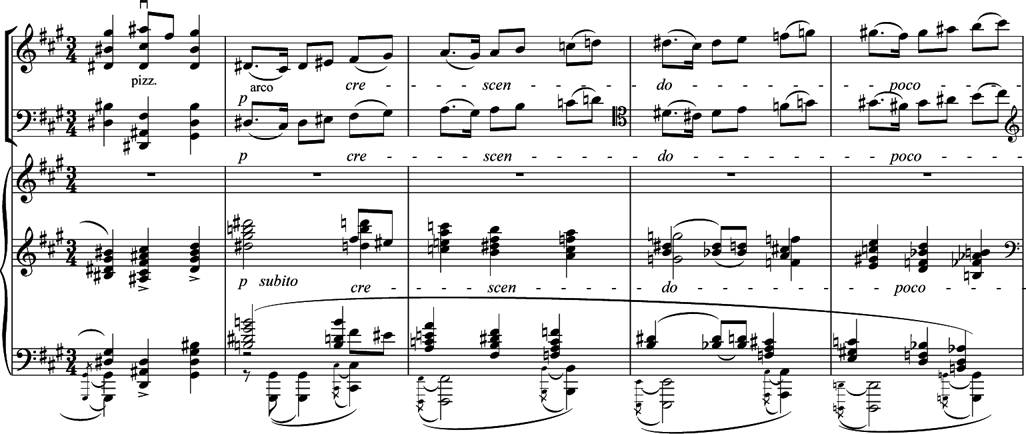
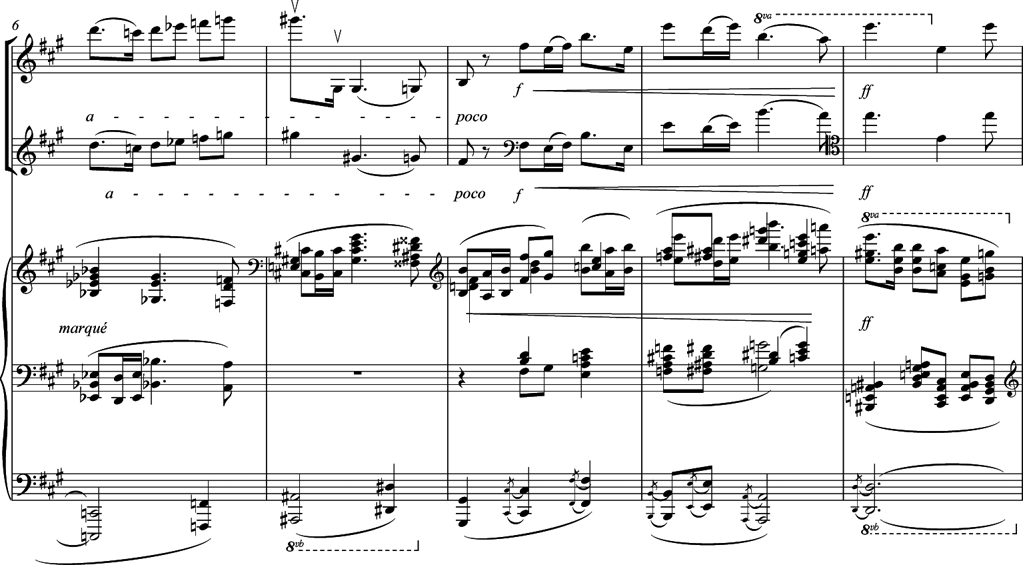
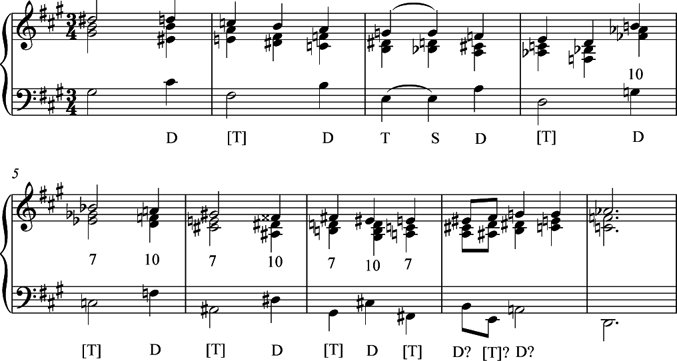
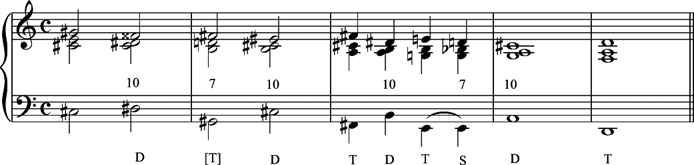
In order to solve this riddle, I am proposing that we look to Wagner and his Parsifal, an interpretation that hangs upon the phrase reproduced in Example 3. As the sixth phrase of the Passacaille, it lies exactly at the centre of the movement, which comprises eleven eight-bar phrases that – true to the classical passacaglia format – follow one another without break. Example 4, in turn, reduces this phrase to its harmonic progression, which has the following features:
1. It is a descending, root-position, circle-of-fifths sequence which nearly completes three cycles of the sequence in connecting its initial G♯ in the bass with the D pedal that underlies phrase 7.
2. It is a highly chromatic passage with numerous harmonic extensions (ninths, elevenths and thirteenths of varying tonal membership), semitonal voice-leading, and a bass line which passes through the chromatic aggregate more than once.
3. The mid-phrase reintroduction of the Passacaglia's primary motive in the piano forms part of a configuration that places a chromatic line in the soprano, another chromatic line a major third below in the alto, and a 10–7 intervallic pattern between the outer voices.
4. The passage abounds in harmonic substitutions – progressing from dominants (D) to subdominants (S, usually a half-diminished seventh chord) that elide the expected tonics (T) – and increases the frequency of these substitutions around the reintroduction of the primary motive and its ensuing stretto.Footnote 70
Phrase 6 (bb. 41–8) of the Passacaille from the Ravel Trio (bb. 40 and 49 supply context).
A harmonic reduction of phrase 6 of the Passacaille.
Instances of these individual techniques can be found throughout Ravel's music. The piano suite Gaspard de la nuit (1908), for example, features chromaticised fifth-sequences (‘Le gibet’, b. 25), elided tonics (‘Ondine’, bb. 27–8), chromatic descents in major thirds (‘Le gibet’, bb. 21–2), and intensifications over a stepwise bass descent (‘Ondine’, bb. 62–6, and ‘Scarbo’, bb. 556–63). But the way Ravel constellates these elements and sets this constellation within a weighty texture makes the passage in Example 3 one of the most extraordinary moments in his music. The model I am proposing for this passage is Example 5.
The Wehelaute from Wagner, Parsifal, Act I, ‘March to the Castle of the Grail’.
Example 5 is a version of the Heilandsklage, the ‘Savior's Lament’ that is supposed to express, through the travails of the Christ-figure Amfortas, the suffering of humankind in its sinfulness.Footnote 71 This particular version is called Wehelaute, or ‘Sounds of Pain’, and is featured in the ‘March to the Castle of the Grail’ in Act I of the opera. By reducing the Wehelaute to its harmonic progression, Example 6 helps to highlight its similarities to the passage in Ravel:
1. It is a descending, root-position, circle-of-fifths sequence which completes one cycle of the sequence in connecting the bass D♯ in the first bar with the cadential D in the last.
2. It is a chromatic passage which features a chromatic octachord in the melody and modulates between tritone-related keys (G♯ minor and D minor).
3. It is voiced to configure a chromatic descent or ‘lament’ in the soprano, another chromatic lament a major third below in the tenor, and a 10–7 intervallic pattern between the outer voices.
4. It counteracts the predictability of the harmonic sequence by substituting half-diminished seventh chords for tonics – outright on the downbeat of bar 2, and more gradually in bar 3, which also occurs in the corresponding bars of phrase 6.
Harmonic reduction of the Wehelaute.
The two passages are, of course, different in many important respects, including melody, harmonic complexity, meter, length, dynamic shape, instrumentation and genre. And even if Ravel had cut and pasted the Wehelaute motive directly into the Passacaille, the philosophical argument could still be made that the two passages are essentially different, insofar as they draw their identity and meaning from their strongly differing contexts. As significant as these qualifications may be, however, they do not ultimately dissuade me from making the following five claims, each of which builds upon the previous one, and most of which rely on simile and synecdoche to establish relationships among the entities involved.
1. Phrase 6 in Ravel's Passacaille is indebted to Wagnerian harmony, especially that found in the Wehelaute from Parsifal.
The harmonic technique involved here is not the general use of half-diminished seventh chords, but rather the one exemplified in the Wehelaute, whereby a half-diminished seventh chord replaces a chord with an expected tonic function within a descending circle of fifths. The product of this technique is something we might call a ‘ruined tonic’, whose ruination is immediate on the downbeat of bar 2 in both phrases, but is more gradual in bar 3, as if we were witnessing the tonic decay in real time. Given the intended meaning of the Wehelaute, its effect is probably best described as ‘excruciating’ – that is, it expresses the agony of Christ's crucifixion.
2. Just as the central phrase of the Passacaille is indebted to the Wehelaute, so, too, is the Passacaille as a whole indebted to the March to the Castle of the Grail in Parsifal.
The overarching basis for this claim is the arch-like design of both pieces, as well as the similar role of the highlighted phrases in their respective contexts; like phrase 6 in the Passacaille, the Wehelaute emerges in the middle of the piece before giving way to a reprise of the A section (the march).Footnote 72 Further comparison reveals other similarities: both have slow, processional tempi, with the March marked ‘slow and solemn’ (langsam und feierlich) and the Passacaille set to a ‘very broad’ (très large) quarter note=40; thematic pentatonicism is as fundamental to the March (in its anticipation of the bell theme into which it eventually flows) as it is to the Passacaille, and lends both an elemental and primordial quality; the seemingly infinite, quintessentially Wagnerian cycling of both the march and the Wehelaute themes back into themselves is matched by the looping of the eight-bar passacaglia theme back into itself; in both pieces, these circles are inscribed within a larger circuit that transports us from one pole to its opposite – from the jaunty march to the anguished Wehelaute in the Wagner piece, and from the sombre passacaglia theme to the similarly tortured phrase 6 in the Ravel movement – and back again.Footnote 73 Finally, as an instrumental number, the March is well suited for emulation by an ensemble such as the piano trio.
3. By assuming the March as its referent, the Passacaille is not only indebted to a specific movement in Parsifal but pays homage to the opera as a whole.
One basis for this claim is the important role the March's Wehelaute plays in establishing the characteristic sound of the entire opera, as Robin Holloway has persuasively argued.Footnote 74 Another is the synecdochical relation of the March to the overall plot of Parsifal. If we take the libretto at face value, the March merely represents the journey that Parsifal and Gurnemanz make from the forest surrounding the Castle to the Castle itself. However, in the sequence of its associative themes – March, Wehelaute, Communion – the music marks the stations of the hero's journey, as well as our own. It carves a path that brings us before the abject suffering of Amfortas, reveals it to be the human condition, and inspires us to participate in the healing of this suffering and the redemption of this sin. The Passacaille revises its putative model by omitting the promise of redemption – possibly in order to fulfil it in the festive ‘Final’, as I argue below.
Another way to relate the Passacaille to Parsifal is as a musical pendant to the enthusiastic review he published in Comœdia illustré earlier that year. In this case we can explain it as the recipient of various ideas he had had about the opera but either did not fit into the review or occurred to him after he had completed it. But we can also consider it to be the most direct way that one Tondichter could pay homage to another: in tones, not words.
4. The Passacaille is not merely an homage to Parsifal, but also leads us on an imaginary pilgrimage to Bayreuth.
Having admitted in his 1914 review that he had never actually been to Bayreuth, Ravel creates the Passacaille as compensation and wish-fulfilment.Footnote 75 According to this fantastic scenario Ravel is Parsifal, Bayreuth is Monsalvat, and Wagner is Amfortas lying at the centre of the Hall of the Grail Knights – an archetypal figure who, like Tannhäuser and Tristan, has been wounded by desire.Footnote 76 Ravel would then have realised the cryptic remark with which Gurnemanz begins the march by translating time into space – hence the ‘very broad’ (très large) stride of every beat in the Passacaille.Footnote 77 By the beginning of phrase 6 we can hear the groans of Amfortas-Wagner, and by the beginning of phrase 7 our ears are ringing with the climactic version of the secondary motive of the Passacaille, whose dissonant harmonisation and gradual, three-octave descent bring to mind Kundry's scream.
5. The ultimate object of homage in the Passacaille is neither Parsifal nor the pilgrimage to Bayreuth, but Wagner in his full, stereotypical glory.
No contemporary figure in fin-de-siècle Europe was more strongly associated with the medieval and the legendary than Richard Wagner.Footnote 78 Replete with Romantic musical medievalisms (chant-like monophony, unmitigated parallel fifths, slow tempo, lugubrious affect), the Passacaille has already manifested its Wagnerian tendencies by the middle of its second phrase. Ravel's handling of material in the interior of the piece is also highly evocative of Wagner. While the first appearance of the secondary motive in phrase 5 turns the music briefly towards major, its recurrence brings a doleful chromaticism to phrase 6 and outright anguish to phrase 7. The periodic return of a dirge within a slow, triple-meter march is the hallmark of the Pilgrim's Chorus from Tannhäuser, whose recurring B section laments the ‘burden of sin’ (der Sünden Last). The simultaneous combination of the form of Tannhäuser with the sound of Parsifal elevates the reference in the Passacaille beyond any particular opera, aiming instead at the unique essence of Wagner's contribution to Western music.Footnote 79
In the penumbra of Parsifal
Ravel may have thought he was paying his final respects to Wagner in the Passacaille, but he would soon encounter them again, albeit in masquerade. In 1918 Ravel received a libretto from Colette that he would eventually set as the text for L'Enfant et les sortilèges. Over the course of this ‘lyric fantasy’ the Child undergoes a Parsifalian process of maturation that transforms an initial impulse to do violence to animals (cf. the thoughtless killing of the sacred swan by the ‘pure fool’ in Act I) into a compassion that moves him to dress their wounds. The propinquity of this narrative to the prophetic fragment from Parsifal – ‘wisdom through compassion’ (durch Mitleid wissend) – would probably not have been lost on either Ravel or Colette; unlike Ravel, she had made numerous pilgrimages to Bayreuth and had seen Parsifal many times before she received the commission for L'Enfant.Footnote 80
Resonances with Parsifal also occur in music by Ravel that predates the Trio. A clue can be found in a comment Vladimir Jankélévitch makes at the end of his Ravel book about the final chorus in L'Enfant, which he finds to convey ‘the supreme message of innocence: gracious redemption through pity, the infinite value of a charitable impulse’.Footnote 81 Jankélévitch does not mention Parsifal – and probably never would, given his deep aversion to Wagner – but it is difficult not to notice when its moral is being paraphrased, wittingly or no. In addition, the connection he makes in the same paragraph between the chorus of L'Enfant and the Daybreak (Lever du jour) from Daphnis et Chloé (1909–12) is productive for our enquiry, insofar as it prompts us to ask a general question: if Daphnis resembles L'Enfant, and L'Enfant resembles Parsifal, might Daphnis resemble Parsifal? A cursory comparison between the two reveals some rather conventional similarities: both have a tripartite division, with Parsifal falling into three Acts and Daphnis into three ‘parts’ (parties), and both follow an ABA' format in which the A' section returns to the same setting and cast of characters from which the B section departed (Klingsor's Castle in Parsifal, and the Pirates' Camp in Daphnis).
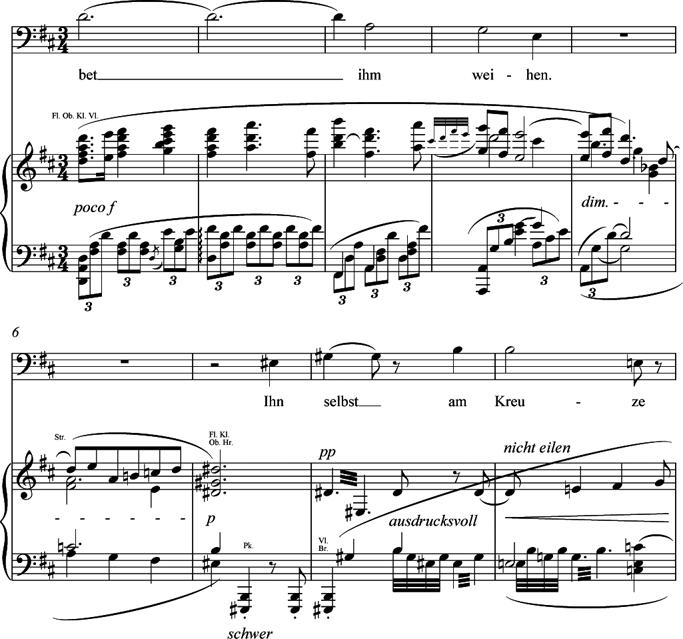
A more unusual resemblance between Parsifal and Daphnis is their shared emplotment of nature's reawakening at the beginning of the third and final part, with the Good Friday Music (Karfreitagszauber) in Wagner's opera corresponding to the Daybreak in Ravel's ballet. This observation brings us back to Jankélévitch's comment, which, in assimilating the Daybreak to the final chorus from L'Enfant, also associates it with the Parsifalian message of the latter, ‘gracious redemption through pity’. In order to explore the possibility of a meaningful affiliation between the Daybreak and the Good Friday Music – the famous excerpt from Parsifal that Ravel proclaimed in his review to be ‘marvelous’ – I have juxtaposed central passages from these pieces in Examples 7 and 8. As we can see, both incorporate lush textures and soaring melodies into a major, triple-meter context, as is common for pastoral music.Footnote 82 In addition, both emphasise the second beat in a manner evocative of the sarabande; while the dance's calling card – the dotted quarter note on beat two – only appears in the interior of the fourth and ninth bars of the Daybreak excerpt, this rhythm has nevertheless been reverberating in the listener's inner ear since the tutti climax that began the movement (rehearsal 157) and spawned its primary theme, and will recur in even more dazzling fashion at its conclusion (rehearsal 168).Footnote 83
The Good Friday Music from Wagner, Parsifal (Gurnemanz is singing.)
Daybreak (Fig. 161) from Ravel, Daphnis et Chloé.
The most striking element shared between Examples 7 and 8, however, is the use of the same half-diminished seventh chord on E♯ to interrupt the flow of the music – a gesture of negation that epitomises the Wagnerian sound from Tristan on.Footnote 84 The dissonance and chromaticism of this chord in both contexts help to represent the sudden intrusion of a painful memory into consciousness. In Parsifal it marks Gurnemanz's recollection of Christ's crucifixion on Good Friday,Footnote 85 and in Daphnis it marks the hero's recollection of Chloe's violent abduction by the pirates, both of which are soon mitigated by subsequent events: Gurnemanz's narrative about Christ's redemption of humanity through his self-sacrifice, and Chloe's reunion with Daphnis.Footnote 86 However, from a broader symbolic perspective – one which implicates the listener as a sympathetic participant – the chordal intrusion can feel to us as if we were suddenly recalling, and even re-experiencing, the original fall from grace.Footnote 87 Accordingly, the resumption of the D major music soon thereafter feels like the miraculous restoration of paradise – or, to quote Jankélévitch, a ‘gracious redemption’. This interpretation also calls to our attention the similarity of the Grail motive to the median cadence in the opening ‘Danse religieuse’ of Daphnis (Ex. 9); the fact that it attains the pure diatonicism of the Dresdener Amen in its final bars only sweetens the achievement. Instead of overlooking this similarity or dismissing it as mere coincidence, we can now appreciate it as a potential invitation by Ravel to view the ballet through the lens of Parsifal.
The Median cadence (bb. 32–5) in the ‘Danse religieuse’ from Ravel, Daphnis et Chloé.
A dialectic of two decadences
A new appreciation of Wagnerism in Ravel also helps to deepen our understanding of the decadent dialectics at work in his music. To be sure, Wagner's decadence is not identical with Ravel's: while the former emphasises psychological interiority, the latter cultivates a perfect exteriority which can be interpreted as a musical expression of the composer's dandyism. Ultimately, however, the opposition between these two decadences leads not to their mutual exclusion but to a dialectical interaction that manifests itself in three tropes. As I have discussed elsewhere, in the trope of the ‘interrupted dandy’, an expressive outburst momentarily shatters a prevailing calm and transforms the imperturbable dandy into an interruptable figure whose psychological interior could re-emerge at any moment.Footnote 88 A prime example is the ‘Light and Graceful Dance of Daphnis’ from Ravel's ballet. Here, an apparent allusion to the Desire motive from Tristan within an agitated inner section (the ‘interruption’) signifies the lust of a dandified Daphnis for Chloe and its destabilising effect on him.Footnote 89
Having laid the groundwork in this article for a broader consideration of Wagnerism in Ravel, we can now add two further tropes. In the trope of the ‘interrupting dandy’, a moment of aplomb disrupts a stretch of quasi-Wagnerian abandon, as appears in the sudden and short-lived reversion to the initial waltz within the bacchanalian ending to La Valse. In the trope of the ‘dandy's last word’, a final gesture in a piece distances itself from preceding complications within that piece. A relevant instance appears in ‘Nahandove’, a song whose multiple debts to Tristan and its particular brand of nineteenth-century eroticism – its prominent half-diminished seventh chords, surging textures, ecstatic repetitions and languorous dénouements – are dissolved in a coda that reprises the opening only to idealise and miniaturise the song, along with its grand, Wagnerian emotions. It is as if, in a dandy's paradox, the primary reason for the lover's rendezvous with the beautiful Nahandove were not to experience it in the present but to re-experience it in retrospect, transfigured by nostalgia.
These dialectical ruminations bring us back to the 1928 essay by Adorno that we discussed in the introduction. Adorno was at least half-right: Ravel does, indeed, create alternatives to Wagner's ‘panic archetype of love’, but he also likes to pit one type against another in an overt display of decadent dialectics within his own oeuvre. Wagnerism in the Passacaille transforms the Trio into an important and complex example of such a display.Footnote 90 The tipping point between thesis and antithesis is the moment of transition between the Passacaille and the Final, when the dark night of the former gives way to the ethereal dawn music that begins the latter. One way to understand this transition is as a musical re-enactment of the historical reaction that Ravel asserted in his March 1912 concert review, where he described post-Romantic French composers as beating a ‘peaceful retreat’ from Wagner and his violent expressivity. Along similar lines, the playful opening measures of the Final make it an excellent candidate for Nietzsche's ‘Mediterranean music’, which, as previously discussed, he conceived to be the antidote to Wagner's operas: a ‘mocking, light, fleeting, divinely untroubled, divinely artificial art that, like a bright flame, blazes into an unclouded sky!’
The qualities of Nietzsche's ‘Mediterranean music’ turn our thoughts once again to the dandy. This character first makes its presence felt in the Trio at the end of the first movement, where he pronounces his ‘last word’ with a surprising swerve into a C Lydian, ‘distant’ (lointain) pianissimo version of the primary theme in the coda. The subsequent three movements, in turn, showcase the ‘dandy's interruption’ at the level of the suite, with the penitent and anguished Passacaille interrupting the ‘mocking, light, fleeting, divinely untroubled’ tenor of its surrounding movements, the Pantoum and the Final. As with all dialectical instances of this trope, however, the section that follows the interruption as its conclusion and resolution actually contains the seeds of its own undoing. In advancing from the Passacaille into the Final we have not transcended Wagnerism but exchanged one of its modes for another. To appropriate, once again, the language Ravel applied to Wagner in the March 1912 concert review, the ‘passionate suffering’ in the middle of the Passacaille is followed by the ‘passionate joy’ of the climactic secondary theme in the Final. Admittedly, the theme does not sound like something Wagner would have composed. Nevertheless, with its high, fortissimo trills in the strings, thunderous pianism and Fauvist harmonic juxtapositions, it is a ‘roaring outburst of pagan vitality’ that can stand toe to toe with any comparable passage in Wagner. After all, it is a virtual facsimile of the climactic theme from one of the shining examples of pagan vitality in French musical Modernism – namely, the bacchanale that ends Daphnis.
A kinder, gentler giant
Wagner was an ineradicable part of Ravel's cultural and artistic inheritance, due not only to widespread Wagnerism in France during his youth, but also to the incorporation of Wagnerian elements into the work of his two strongest French musical influences, Chabrier and Debussy. As I have argued here, we can also link Wagner directly to Ravel, especially through the influence of Parsifal on both Daphnis et Chloé and the Trio. At first glance, it may seem strange that Ravel would draw on Wagner so late in his career, since Wagnerism in other French composers is often understood as an aspect of their early style which they needed to overcome in order to find their own voice. One way to explain this choice is through circumstance. In the case of Daphnis, Wagner was a model for the Gesamtkunstwerk that Diaghilev and his Ballets Russes envisioned for their artistic enterprise;Footnote 91 with regard to the Trio, the Parisian premiere of Parsifal, which Ravel reviewed enthusiastically for Comœdia illustré, took place right before he began to compose the piece.
These two circumstantial reasons may be compelling, but they only paint part of the picture. Instead, I prefer to view Ravel's musical and critical engagement with Wagner around 1909 as the consequence of a surge in professional ambition, which also manifested itself in his assumption of new identities as a concert reviewer and organiser. Moreover, it promised to mitigate the perception that he could only compose small-scale, unserious works.Footnote 92 Even more fundamental, it helped to fulfil his ardent desire for continual growth as an artist. As he argued in his 1928 lecture titled ‘Contemporary Music’, exposure to external influences, especially those originating outside one's national music, expands the ‘horizon of the aspiring artist’ by providing new means of ‘emotional expression’ and paths for creative exploration.Footnote 93 He mentions Wagner as a central case but, to our surprise, casts him as the recipient of influence (by Liszt) rather than its source. Although Ravel may well have intended this comment simultaneously to rattle the common sense of his audience and take the German down a peg or two, I would rather interpret it as an attempt to bring out the softer side of Wagner. By this I mean that we view Wagner neither as a ‘giant’ living in the ‘palace’ of his Valhalla-like oeuvre, nor as a transcendent genius – isolated in his originality, untouched by worldly considerations, and unbending in purpose, hammering out leitmotivic music in his study just like Siegfried reforging the shattered Nothung in his cave – but rather as an impressionable artist of his time who was shaped by his contemporaries just as much as he shaped them. It is also primarily a softer, Parsifalian aspect of Wagner's ‘emotional expression’ that filters into Ravel's work, as exemplified by the heartbreaking sounds of suffering in the Passacaille and the heartwarming hymn to redemption in the Daybreak. But the softest touch of all may have been Ravel's, who wove Wagnerian strands so dexterously into his music that, for the past one hundred years, no one has been the wiser.