Introduction
Ordovician bryozoans from tropical and middle to low paleolatitudes were especially abundant (Taylor and Allison, Reference Taylor and Allison1998; Taylor and Sendino, Reference Taylor and Sendino2010). Notwithstanding the general prevalence of bryozoans in the low to middle latitudes during the Paleozoic, in the Late Ordovician they also became one of the most abundant invertebrate groups on the temperate platforms of North Gondwana (Jiménez-Sánchez et al., Reference Jiménez-Sánchez, Spjeldnaes and Villas2007), located between 40º and more than 60ºS in that time (Jiménez-Sánchez and Villas, Reference Jiménez-Sánchez and Villas2010), or even higher than 70ºS, according to recent paleogeographic reconstructions (Harper et al., Reference Harper, Rasmussen, Liljeroth, Blodgett, Candela, Jin, Percival, Rong, Villas and Zhan2013).
A change from siliciclastic to carbonate-dominated sedimentation took place in the late Katian on most of the platforms bordering the North Gondwana margin, accompanied by extensive colonization by bryozoans and pelmatozoans, as well as by a varied group of brachiopod, trilobites, and mollusks (Vennin et al., Reference Vennin, Álvaro and Villas1998). Nevertheless, most of the Anti-Atlas region remained dominated by siliciclastic sedimentation during the late Katian (Álvaro et al., Reference Álvaro, Vennin, Villas, Destombes and Vizcaïno2007), with the only exception of the Erfoud area (the eastern-most edge of the Anti-Atlas). Here a mixed siliciclastic-carbonate platform developed, dominated by bryozoans as well as rare echinoderm, trilobite, brachiopod, and gastropod (Vinnin et al., Reference Vennin, Álvaro and Villas1998). A peculiar feature of this platform is that it was never colonized by the Nicolella brachiopod fauna (Pickerill and Brenchley, Reference Pickerill and Brenchley1979; Havlíček, Reference Havlíček1981), so typical of more northern areas, characterized by a diverse brachiopod association (Villas et al., Reference Villas, Vizcaïno, Álvaro, Destombes and Vennin2006). The fauna was mainly made up of cold-temperate immigrant genera that thrived during the late Katian in pelmatozoan-bryozoan meadows of the southwestern Europe North Gondwana platforms (Vinnin et al., Reference Vennin, Álvaro and Villas1998).
The Erfoud bryozoan-dominated limestones have been puzzling for a long time, with different criteria even on their dating. They were initially correlated with the Caradocian of the British time scale (Destombes et al., 1985), but subsequent trilobite records by Destombes (Reference Destombes1987) and brachiopods, herein, allow for correlation with the upper Katian of the global time scale.
A systematic study on the Upper Ordovician bryozoans from Erfoud will help elucidate the environmental changes through the North Gondwana platforms, from the northernmost carbonate-dominated ones recorded in the Carnic Alps (Schönlaub, Reference Schönlaub1998) and the Montagne Noire (Colmenar et al., Reference Colmenar, Villas and Vizcaïno2013) and colonized by the Nicolella fauna, to the southernmost mixed siliciclastic-carbonate platforms of the easternmost Anti-Atlas, with a minimum latitudinal separation of 30º according to recent estimates (Harper et al., Reference Harper, Rasmussen, Liljeroth, Blodgett, Candela, Jin, Percival, Rong, Villas and Zhan2013). As a first step in a longer-term project toward achieving this goal, we describe 11 species belonging to six genera of the Trepostomata bryozoan families Amplexoporidae and Monticuliporidae. Their zoaria show robust branching, discoidal to monticular, and incrusting laminar, and have been mostly collected from the unconsolidated marly horizons of the intermediate unit of the Khabt-el-Hajar Formation (Destombes et al., 1985).
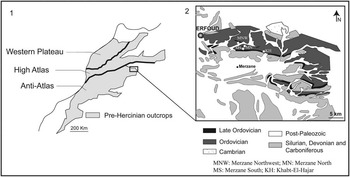
The only previous systematic studies on the bryozoans of this region are those by Termier and Termier (Reference Termier and Termier1950) and Destombes et al. (Reference Destombes, Termier and Termier1971) who report a total of six species: Arthropora laghdadensis Termier and Termier, Prasopora clariondi Termier and Termier, Stigmatella sp., Trematopora filalensis Termier and Termier, Trematopora grandis Termier and Termier and Trematopora clariondi Termier and Termier. They were collected in the classic locality called “North of Hamar-Laghdad” by Termier and Termier (Reference Termier and Termier1950), referred herein as Khabt-el-Hajar following Destombes et al. (1985) (Fig. 1). At this locality the marly intermediate unit of the Khabt-el-Hajar Formation is not exposed, and is replaced by a major erosional surface. The bryozoans described from Khabt-el-Hajar by Termier and Termier (Reference Termier and Termier1950) must have been collected either from the basal mixed siliciclastic-carbonate unit, or from the upper bioclastic limestone unit, described below. Both represent high-energy mid-ramp environments that are substantially different from the low energy outer-ramp environments inhabited by the bryozoans described in this paper. Thus, it is not unusual that none of the Khabt-el-Hajar species of Termier and Termier (Reference Termier and Termier1950) have been identified in our work.
(1) Geologic map of the east area of Erfoud (Anti-Atlas, Morocco), with the location of the studied stratigraphic sections (2).

The first study of the bryozoans from the Mediterranean margin of Gondwana was carried out by Sharpe (Reference Sharpe1853), who studied the bryozoans of Portugal. This pioneering study was followed by those of Počta (Reference Počta1902), Kettner (Reference Kettner1913), and Röhlich (Reference Röhlich1957) in Bohemia, Vinassa de Regny (Reference Vinassa de Regny1910, Reference Vinassa de Regny1914, Reference Vinassa de Regny1915, Reference Vinassa de Regny1942) in the Carnic Alps, Dreyfuss (Reference Dreyfuss1948), and Boulange (Reference Boulange1963) in the Montagne Noire (France), and Termier and Termier (Reference Termier and Termier1950), and Destombes et al. (Reference Destombes, Termier and Termier1971) in Morocco, all in the Upper Ordovician. More recently, Conti (Reference Conti1990) studied the Upper Ordovician bryozoans of Sardinia (Italy), Ernst and Key (Reference Ernst and Key2007) revised some Upper Ordovician genera studied previously by Vinassa de Rengy in the Carnic Alps, and contributed to new knowledge of the bryozoans from the Upper Ordovician of the Montagne Noire. Jiménez-Sánchez (Reference Jiménez-Sánchez2009, Reference Jiménez-Sánchez2010) and Jiménez-Sánchez et al. (Reference Jiménez-Sánchez, Anstey and Azanza2010) described the Upper Ordovician bryozoans from the Iberian Chains (NE of Spain). The most recent contributions to the knowledge of the Upper Ordovician bryozoan in North Africa come from Buttler and Massa (Reference Buttler and Massa1996) and Buttler et al. (Reference Buttler, Cherns and Massa2007) on the Upper Ordovician bryozoans of Libya.
In the context of the Upper Ordovician bryozoans from the North Gondwana margin, the Moroccan Anti-Atlas bryozoans from Erfoud are of special interest because of their considerably lower diagenetic alteration compared to those from other Mediterranean localities. The preservation of the bryozoans in soft, unconsolidated marls, allows a detailed and complete study of both their external and internal morphology. This will also permit a more complete analysis of the mineralogical, geochemical, and morphological features of high latitude bryozoans for comparison with those from middle and low latitudes.
At first sight, several of the bryozoans described here stand out for their strikingly large size. Considering the high latitudes where they thrived, the question immediately rises if they represent an example of polar gigantism, well known in various ectothermic animals from the icy polar waters (Ververk and Atkinson, 2013). A further aim of this work is to analyze the possible causes of the observed gigantism.
Geographical and geological setting
The Anti-Atlas belt is a large antiform structure striking NE-SW created by the Variscan Late Carboniferous-Permian compression event. It exposes the Paleozoic and Panafrican series as well as older basement lithologies (Piqué, Reference Piqué2001). The Major Anti-Atlas suture, or Panafrican suture, resulted from the collision between the West African Craton and the Reguibat Shield during the Panafrican compressive phase (Black and Fabre, Reference Black and Fabre1980; Coward and Ries, Reference Coward and Ries2003). Following the Panafrican compression, the early Paleozoic was characterized by relative tectonic stability, although there is evidence of limited extensional tectonics during the earliest Cambrian (Burkhard et al., Reference Burkhard, Caritg, Helg, Robert-Charrue and Soulaimani2006). From the late Cambrian to the Ordovician, an extensional tectonic regime led to the development of graben and half-graben structures (Zagora graben), oriented NE-SW to E-W, that are related to the reactivation of Panafrican structures (Robert-Charrue and Burkhard, Reference Robert-Charrue and Burkhard2008). The Caledonian compressive phase, from the Ordovician to the Early Devonian, led to complete differentiation of large basins initiated during the Cambrian, whereas the Variscan compression phase, oriented SSE-NNW, led to the folding, uplift, and subsequent erosion of the Paleozoic cover. According to Clerc et al. Reference Clerc, Buoncristiani, Guiraud, Vennin, Desaubliaux and Portier(2013), the Mesozoic and Cenozoic series unconformably overlie the Paleozoic Anti-Atlas forming hamadas (gently dipping plateaus).
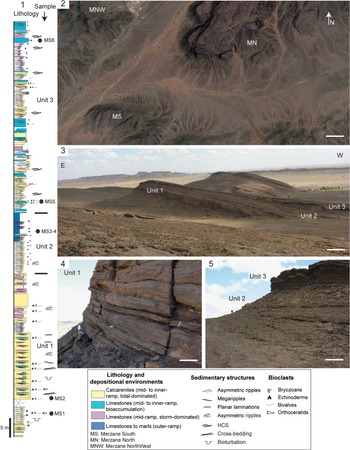
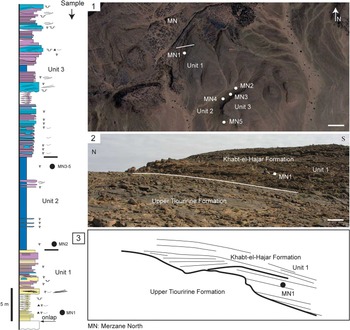
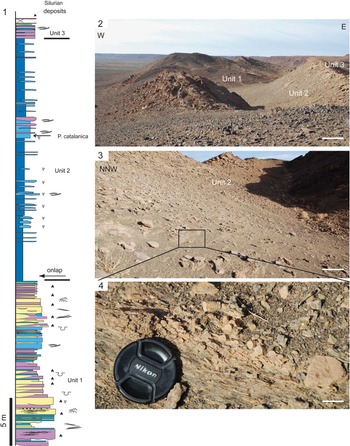
The study area is near Erfoud, where three exposed sections named Merzane North, Merzane South and Merzane Northwest have been logged and sampled (Figs. 1−4). The Erfoud area corresponds to a well-preserved carbonate-siliciclastic platform developed in the easternmost edge of the Moroccan Anti-Atlas. Its lateral boundaries are sharp and it is considered as an isolated platform (Maazouz and Hamoumi, Reference Maazouz and Hamoumi2007). Late Katian deposits from the North Gondwana margin have recorded a key episode of temperate to cool water carbonate productivity (Vennin et al., Reference Vennin, Álvaro and Villas1998) that predates the onset of the Hirnantian glaciation. Cherns and Wheeley (Reference Cherns and Wheeley2007) considered that episode to represent global cooling, which is a drastically opposing point of view to that of Fortey and Cocks (Reference Fortey and Cocks2005). These authors had introduced the term Boda event to name a late Katian global warming episode, which is an interpretation followed and substantiated by most subsequent authors (Jiménez-Sánchez and Villas, Reference Jiménez-Sánchez and Villas2010). As shown by Álvaro et al. (Reference Álvaro, Vennin, Villas, Destombes and Vizcaïno2007), carbonate productivity was not laterally persistent in the eastern Anti-Atlas. In the Tskaouine and Gaiz Jebels of the Alnif area (Álvaro et al., Reference Álvaro, Vennin, Villas, Destombes and Vizcaïno2007) and in the Western Tafilalt domain (Maazoouz and Hamoumi, Reference Maazouz and Hamoumi2007) a siliciclastic-dominated platform records low activity of carbonate factories. These were intensive in the Erfoud area as indicated by the bryozoan-dominated limestones of the late Katian Khabt-el-Hajar Formation. The litho- and bio-stratigraphic framework of the Upper Ordovician sedimentary rocks (Sandbian to Katian stages) in the Moroccan Anti-Atlas follows Destombes et al. (1985) and Destombes (Reference Destombes1987).
Merzane South section. (1) Stratigraphic log showing locations of the studied samples. (2) Google EarthTM view of the Erfoud area showing the three studied outcrops of the Khabt-el-Hajar Formation: Merzane North (MN), Merzane South (MS) and Merzane Northwest (MNW); scale bar is 200 m. (3) panorama of MS section with units 1 to 3; scale bar is 5 m. (4) Detail of unit 1 with trough cross bedding, bidirectional current structures and bioclast accumulations; scale bar is 35 cm. (5) Detail of units 2 and 3 with thin carbonate beds and bryozoan accumulations.

Merzane North (MN) section. (1) Google EarthTM view of the section; scale bar is 62.5 m. (2) Panorama of MN section showing onlap of unit 1 on sandstones of the Upper Tiouririne Formation; scale bar is 2 m. (3) Stratigraphic log of the section and scheme of the bedding with position of sample MN1. Legend as for Fig. 2.

Merzane Northwest (MNW) section. (1) Stratigraphic log showing locations of the studied samples. (2) Panorama of MNW section showing units 1 to 3; scale bar is 2.5 m. (3) Unit 2 with bryozoan patches embedded in marls; scale bar is 0.5 m. (4) Detail of bryozoan accumulation with delicate-branching and robust-branching bryozoans; scale bar is 2 cm. Legend as for Fig. 2.

Stratigraphy
The limestone sedimentary succession of the Erfoud area (eastern Anti-Atlas) corresponds to the bryozoan-rich Khabt-el-Hajar Formation (Destombes et al., 1985). Destombes et al. (1985) considers it a lateral variant of the Upper Tiouririne Formation, but it is interpreted herein as an overlying succession to this unit. The succession consists of two-mixed siliciclastic-carbonate units bounded by a marly unit in distal areas and by a major disconformity in proximal areas. A preliminary sedimentologic and stratigraphic study of the succession has been presented by Meddour et al. (Reference Meddour, Razin, Jati and Rubino2010).
The first mixed siliciclastic-carbonate unit that onlaps the sandstones of the Upper Tiouririne Formation is up to 40 m thick and corresponds to tide-dominated deposits. Facies are composed of calcarenites to bioclastic packstones and grainstones that are rich in fragmented bryozoans, echinoderms and brachiopods, with variable siliciclastic sand content (25–40%). Tabular bars 0.5–1 m thick and 10–100 m wide characterize this unit. The bars exhibit high-energy planar bedding, planar bidirectional laminations, trough cross-bedding, and erosive bases. This unit contains the bryonoderm biofacies dominated by thick crinoids and robust-branching bryozoans, developed in a mid-ramp setting and corresponds to pelmatozoan-bryozoan meadows degraded by wave activity with an input of siliciclastic material. In Khabt-el-Hajar a delta front system is developed where an epibenthic community, which colonized and stabilized the siliciclastic substrates, is commonly observed at the top of sand shoals and on abandoned marginal channels. Khabt-el-Hajar is the classic locality for bryozoan-rich accumulations called North of Hamar-Laghdad by Termier and Termier (Reference Termier and Termier1950), and also described by Destombes et al. (1985, plate 9). Encrusting, erect-rigid, and robust-branching forms have been identified in this biofacies. Some of the bryozoans studied here came from the basal beds of this first unit, from the Merzane North (MN) and Merzane South (MS) sections (Figs. 2 and 3).
The second unit, comprised of marls to fine-grained limestones, shows large lateral variations in thickness, from 25 m at Merzane Northwest (MNW) to 15 m in Merzane South (MS), and 14 m in Merzane North (MN). It disappears toward the northeast where it is replaced by a major erosional surface in Khabt-el-Hajar. In this area, the following third unit rests unconformably on the first one. The bryozoan biofacies that characterizes this unit is composed of in situ delicate-branching bryozoans that formed meter-scale patches and bioaccumulations embedded in a marly substrate, which developed in outer-ramp environments. Most of the robust-branching, monticular or discoidal bryozoans (only slightly fragmented) studied herein come from the uppermost marls and fine-grained limestones of this unit cropping out in MN and MS (Figs. 2 and 3).
The third continuous carbonate unit is 5–45 m thick and is characterized by both bryozoan and bryonoderm biofacies, dominated by encrusting bryozoans, secondary robust-branching bryozoans and echinoderms. Facies are composed of bioclastic packstones to wackestones and low siliciclastic content (less than 10%). Tabular bars, 0.1–0.3 m thick and up to 100 m wide, characterize this unit. The bars exhibit hummocky cross stratification and isolated to amalgamated erosive bases. This unit corresponds to a storm-dominated mid-ramp setting.
Destombes (Reference Destombes1987) recorded from the uppermost beds of the Khabt-el-Hajar Formation the trilobites Brongiartella platynota marocana Destombes, Reference Destombes1966 and Mucronaspis termieri (Destombes, Reference Destombes1963). These trilobites are characteristic of the rich fossiliferous beds of the Upper Ktaoua Formation, which is correlated with the Rawtheyan stage of Britain and the Kralodvorian stage of Bohemia (Destombes et al., 1985). According to this relationship, at least the uppermost part of the studied unit can be indirectly correlated with the late Katian global stage (Bergstrom et al., Reference Bergström, Chen, Gutiérrez-Marco and Dronov2009).
The intermediate horizons of the Khabt-el-Hajar Formation have also yielded brachiopods, which allow an indirect correlation with the late Katian global stage. In the second unit of the formation, which form part of the meter-scale patches made up by delicate-branching bryozoans at MNW (Fig. 4), we have recorded Paucicrura catalanica Villas (in Villas et al., Reference Villas, Durán and Julivert1987). This brachiopod is known from the Catalonian Coastal Ranges (northeastern Spain), in the uppermost part of the La Mora Slates, correlated with the early Ashgill British series (Villas et al., Reference Villas, Durán and Julivert1987), and therefore also with the late Katian global stage (Bergstrom et al., Reference Bergström, Chen, Gutiérrez-Marco and Dronov2009).
No fossils of biostratigraphic value have been recorded from the lowermost unit of the Khabt-el-Hajar Formation, but brachiopods collected from its underlying sandstones at MNW indicate a late Katian age. These beds, which can be considered as the uppermost Upper Tiouririne Formation, have yielded the brachiopod Rostricellula termieri Havlíček, Reference Havlíček1971. The same species have been recorded in other Anti-Atlas regions from the Upper Tiouririne and the Upper Ktaoua Formations (Havlíček, Reference Havlíček1971), as well as from the Cystoid Limestone Formation in the Iberian Chains, NE Spain (Villas, Reference Villas1985). Both the Moroccan and the Spanish formations are correlated with the early and middle Ashgill Series of the British time scale (Villas et al., Reference Villas, Vizcaïno, Álvaro, Destombes and Vennin2006).
Systematic paleontology
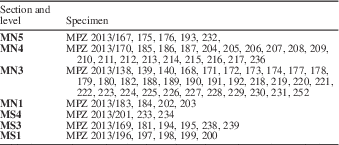
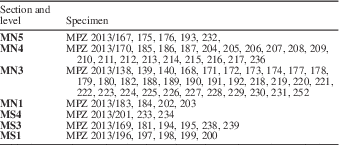
A total of 109 thin sections cut from 70 colonies were examined under a transmitted light petrographic microscope. The measurements have been taken directly from the thin sections through the microscope with a micrometer. The material described herein is housed in the Museo de Ciencias Naturales of the University of Zaragoza (Spain) with catalog numbers MPZ 2013/X, where “X” is the identification number for each specimen. These numbers appear in the description of the species. Table 1 shows the stratigraphic section and horizon where each specimen was collected.
Class Stenolaemata Borg, Reference Borg1926
Order Trepostomata Ulrich, Reference Ulrich1882
Family Amplexoporidae Miller, Reference Miller1889
Genus Anaphragma Ulrich and Bassler, Reference Ulrich and Bassler1904
Stratigraphic distribution of the specimens described in the text. MNx refers to Merzane North section and MSx to Merzane South section, where “x” is the horizon in which the specimen has been collected.
Type species
Anaphragma mirabile Ulrich and Bassler, Reference Ulrich and Bassler1904. Upper Ordovician of Illinois and Wisconsin in the Richmond Formation.
Diagnosis
Following the amended diagnosis of Ernst and Nakrem (Reference Ernst and Nakrem2011), the genus Anaphragma is characterized by ramose colonies. In endozone autozooecial walls thin, ranging from straight to crenulated; in exozone autozooecial walls undergo considerable thickening and have laminated microstexture with U-shaped pattern in longitudinal section, less common V-shaped; boundaries in walls between adjacent zooecia visible in both endozone and exozone. Autozooecial diaphragms absent or very scarce. Acanthostyles present and of variable size within a species. Exilazooecia from common to rare and with walls similar in texture and thickness to those of autozooecia.
Occurrence
Middle and Upper Ordovician of North America and Europe, Upper Ordovician of North Africa and Upper Silurian of England and China.
Anaphragma mirabile Ulrich and Bassler, Reference Ulrich and Bassler1904
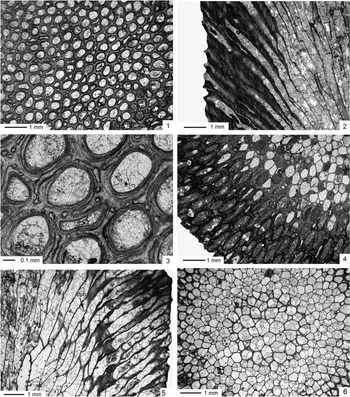
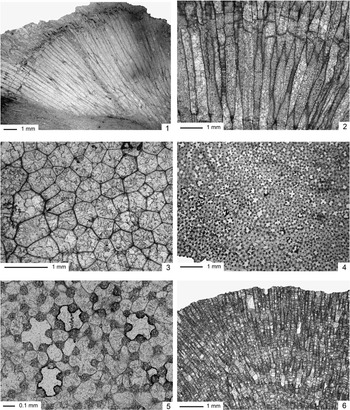
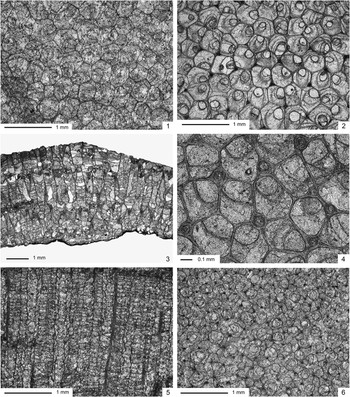
(1–4) Anaphragma mirabile Ulrich and Bassler, Reference Ulrich and Bassler1904; (1) tangential section of specimen MPZ 2013/200; (2) longitudinal section of specimen MPZ 2013/186 where irregular wall lamination and absence of diaphragms is evident; (3) a detail view of the specimen MPZ 2013/200 showing acanthostyles clearly visible; (4) transverse view of specimen MPZ 2013/192. (5, 6)Anaphragma undulata new species; (5) longitudinal section of the holotype (MPZ 2013/204) with diaphragms (dph) and irregular thickness of the zooecial walls; (6) transverse section of specimen MPZ 2013/207 showing the regular disposition of autozooecia in the endozone, with the larger ones located in its axial part. Specimen MPZ 2013/200 from horizon MS1; specimen MPZ 2013/192, from horizon MN3; specimens MPZ 2013/186, 204 and 207 from horizon MN4.

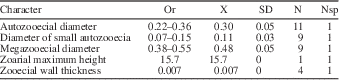
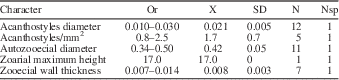
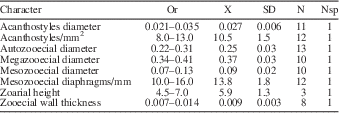
Summary of the statistical analysis of Anaphragma mirabile Ulrich and Bassler, Reference Ulrich and Bassler1904, including: observed range (Or), mean value (X), standard deviation (SD), total number of measurements (N) and number of colonies on which measurements have been taken (Nsp). All measurements in mm.

1904 Anaphragma mirabile Ulrich and Bassler, p. 49−50, pl. XIII, figs. 9−11.
1911 Anaphragma mirabile; Bassler p. 298−299, text. fig. 183.
1911 Anaphragma mirabile var. cognata Ulrich and Bassler; Bassler, p. 299−301, text. fig. 184.
1960 Anaphragma mirabile; p. 13−16, pl. 3, figs. 1−4, pl. 4, figs. 1−4.
Type specimens
USNM (National Museum of the Smithsonian Institution) 43218-43219.
Occurrence
This species has been described in the Richmondian Stage (upper Katian) in Illinois and Wisconsin (USA), in the Lyckholm Limestone (upper Katian of Russia), and in the Khabt-el-Hajar Formation in horizons MN1, MN3, MN4, MN5, MS1, MS3, and MS4, northeastern Moroccan Anti-Atlas, (Upper Ordovician, upper Katian).
Description
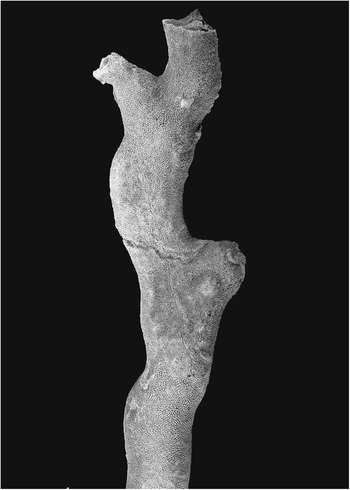
Ramose zoaria with dichotomously divided branches of average diameter 16.2 mm; external surface without monticules (groups of larger zooecia forming maculae can be seen only in one specimen). In tangential section autozooecia with oval boundaries and apertures that range from oval to rhomboidal, with maximum and minimum average diameters of 0.44 mm and 0.28 mm, respectively. Exilazooecial apertures subcircular or elongated, with an average maximum diameter of 0.12 mm and evenly distributed between autozooecia. Acanthostyles irregularly distributed in the colony, with some autozooecial apertures completely surrounded by acanthostyles, while in others they are completely absent; without taking into account this irregular distribution, 8.9/mm2; they are composed of a clear hyaline core with an average diameter of 0.032 mm. Autozooecial and exilazooecial walls have an average thickness of 0.081 mm, with a concentric laminated texture around apertures. In longitudinal section autozooecia are seen as large and long tubes growing parallel to the growth direction of the branch in the axial endozone, and gently curving outward in the peripheral endozone; in the internal exozone curvature becomes stronger, forming an average angle of 60º with the zoarial surface, but the angle can vary from less than 35º to 90º in different specimens; autozooecial diaphragms absent in almost all autozooecia and, when present, no more than one per autozooecium; autozooecial walls thin, from straight to crenulated in endozone, giving to the autozooecia a slightly undulated appearance; in exozone autozooecial walls with a V-shaped laminated pattern that varies from a perfect alignment of the V-vertices, giving rise to a regular lamination, to a very irregular alignment giving rise to a rough lamination. Exilazooecia develop in the endozone-exozone transition and with walls that are indistinguishable from those of the autozooecia. Some autozooecia and exilazooecia are filled with calcitic laminar deposits with broad U-shaped laminae forming part of the zooecial morphology. Acanthostyles present in the external exozone, consisting of hyaline rods that cut across the V-vertices. In transversal section endozone has an average diameter of 8.5 mm; here autozooecia are irregularly polygonal or subcircular in cross-section and very variable in size; the exozone has an average thickness of 3.7 mm.
Materials
Eighteen zoaria in tangential, longitudinal and transversal sections (MPZ 2013/183−194, 196, 198−201 and 252); one zoarium in tangential and longitudinal section (MPZ 2013/197); and one zoarium in tangential section (MPZ 2013/195). The external morphology has been also studied in all specimens.
Remarks
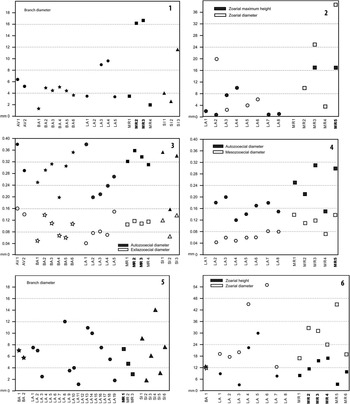
These specimens show the main diagnostic characters described in Ernst and Nakrem (Reference Ernst and Nakrem2011) for Anaphragma and they are here assigned to this genus. They also display the main diagnostic characters of the species Anaphragma mirabile as was described by Ulrich and Bassler (Reference Ulrich and Bassler1904) in the Upper Ordovician of Illinois and Wisconsin, by Bassler (Reference Bassler1911) in the Upper Ordovician of Russia and by Boardman (Reference Boardman1960) in his revision of the species. They share the shape of autozooecial and exilazooecial walls, both in the endozone (from straight to crenulated) and the exozone (V- or U-shape lamination), the absence of autozooecial and exilazooecial diaphragms, the ratio of acanthostyle diameter to tangential section depth and the large development of the exozone. Therefore, this material is assigned here to A. mirabile. However, the average branch’s diameter of the Moroccan colonies included in A. mirabile is greater than 40% larger than the average branch’s diameter of the colonies reported for this species. This is also true for the autozooecia and exilazooecia, which are greater than 35% larger than those in colonies from other localities (see Supplemental Data 1). But the large qualitative similarity between the Moroccan and the other colonies led us to conclude that the quantitative size difference is probably the result of intraspecific ecophenotypic variation not interspecific genetic variation.
Anaphragma mirabile can be easily distinguished from A. meneghinii (Vinassa de Regny, Reference Vinassa de Regny1942), the other species of this genus described in the Mediterranean region (Conti, Reference Conti1990, Upper Ordovician of Sardinia, Italy) because in A. mirabile the exilazooecia are more abundant, the diaphragms are absent in autozooecia and exilazooecia, the zooecial boundaries are discernible and the exozone has a greater development.
Anaphragma undulata new species (by Jiménez-Sánchez)
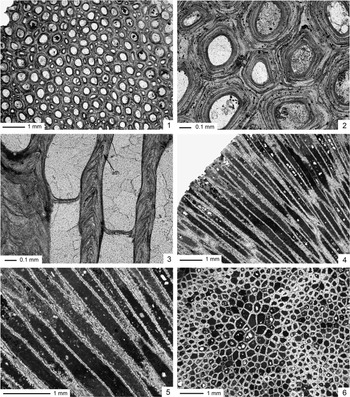
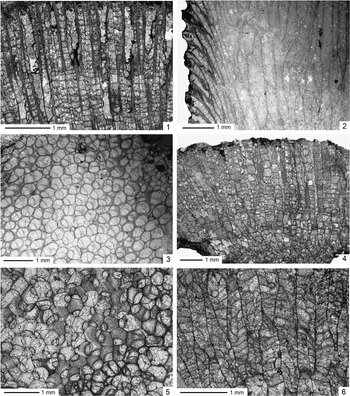
(1–3) Anaphragma undulata new species; (1) tangential section of specimen MPZ 2013/206; (2) detailed tangential section of specimen MPZ 2013/221 showing acanthostyles and polygonal zooecial boundaries; (3) detailed view of the external exozone in a transverse section of specimen MPZ 2013/209 showing diaphragms, V-shape laminated pattern in the walls, and discontinuous acanthostyles (ath) cutting across the V-vertices of the laminae. (4–6) (MPZ 2013/170) Monotrypa jewensis Bassler, Reference Bassler1911; (4) longitudinal section; (5) detailed view of the same section showing the thin crenulated autozooecial walls; (6) tangential section showing irregularly polygonal autozooecia in cross-section and a macula composed of larger autozooecia in the center part of the image. Specimen MPZ 2013/221 from horizon MN3, MPZ 2013/170, 206, 209 from horizon MN4.

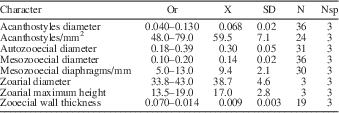
Summary of the statistical analysis of Anaphragma undulata new species. Abbreviations as in Table 2.

Types
Holotype: MPZ 2013/204. Paratypes: MPZ 2013/206, MPZ 2013/207, MPZ 2013/209 and MPZ 2013/221.
Diagnosis
Anaphragma characterized by the irregularly polygonal autozooecial boundaries; by the irregular thickness changes in autozooecial and exilazooecial walls; by the presence of diaphragms in autozooecia, both in endozone and exozone; by the presence of numerous acanthostyles composed of a discontinuous hyaline rods; and by the great thickness of the exozone.
Occurrence
This species is limited to the Khabt-el-Hajar Formation in horizons MN1, MN3, MN4, MN5, and MS4, northeastern Moroccan Anti-Atlas (Upper Ordovician, upper Katian).
Description
Ramose zoaria with dichotomously divided branches, with an average diameter of 16.7 mm; external surface without monticules, but nearly 20% of specimens showing groups of larger autozooecia forming maculae. In tangential section, autozooecia have irregularly polygonal boundaries, with oval apertures, less frequently subcircular, with maximum and minimum average diameters of 0.41 mm and 0.26 mm, respectively. Exilazooecial apertures subcircular or irregularly polygonal, with an average diameter of 0.11 mm, but with a wide range of sizes, and evenly distributed between autozooecia. Acanthostyles irregularly distributed at autozooecial boundaries in the same colony; composed of a clear hyaline core with an average diameter of 0.032 mm and an average density of 12.1/mm2. Autozooecial and exilazooecial walls have an average thickness of 0.097 mm, with a concentric laminated texture around apertures and showing a distinct dark line separating neighboring zooecia. In longitudinal section autozooecia are seen as large and long undulating tubes growing parallel to the growth direction of the branch in the axial endozone and gently curving in the peripheral endozone; in the internal exozone curvature becomes stronger, forming an average angle close to 66º with the zoarial surface, but the actual angle can vary from less than 45º to more than 90º in different specimens; autozooecial diaphragms present in endozone and exozone in almost all autozooecia, but with a variable density of between 1 and 6 diaphragms per autozooecium; autozooecial walls range from crenulated to wavy in endozone, with irregular thickness, giving to autozooecia an undulated appearance; in exozone autozooecial walls with a V-shape laminated pattern that varies from a perfect alignment of the V-vertices, giving rise to a very regular lamination, to a very irregular alignment, giving rise to a rough lamination. Exilazooecia developed in the endozone-exozone transition with walls that are indistinguishable from those of the autozooecia. Some autozooecia and exilazooecia are filled with calcitic laminar deposits with broad U-shaped laminae forming part of the zooecial morphology. Acanthostyles present only in the external exozone, consisting of discontinuous hyaline rods that cut across the V-vertices. In transverse section, endozone has an average diameter of 7.9 mm; here autozooecia are irregularly polygonal in cross-section and with the larger ones located in the axial part of endozone; the exozone has a large average thickness of 4.4 mm.
Etymology
After the undulating aspect of autozooecial tubes due to the irregular thickness of the walls.
Materials
Twenty-seven zoaria in tangential, longitudinal, and transversal section (MPZ 2013/202−218, 221−227, 229, 231, 234 and MPZ 2014/236); two zoaria in tangential and longitudinal sections (MPZ 2013/220 and 233); three zoaria in tangential and transversal section (MPZ 2013/219, 228, 230); and one zoaria in longitudinal and transversal section (MPZ 2013/232). The external morphology has been also studied in all specimens.
Remarks
The description of this material fits well in the diagnosis of the genus Anaphragma, as all the generic diagnostic characters can be seen in it: the ramose habit of growth, the texture and shape of the zooecial walls both in endozone and exozone; the scarcity of diaphragms; the presence of acanthostyles; and the presence of exilazooecia without diaphragms, but with walls similar to those of autozooecia.
Anaphragma undulata can be distinguished from A. mirabile, as previously described by Ulrich and Bassler (Reference Ulrich and Bassler1904), Bassler (Reference Bassler1911), and Boardman (Reference Boardman1960), and also described in this work, because the new species has autozooecial diaphragms, polygonal autozooecial boundaries, autozooecial and exilazooecial walls more irregularly thickened, and a thicker exozones than A. mirabile. But both species, as they have been described here, have a very similar external morphology, with similar autozooecial, exilazooecial, acanthostyle and branch diameters, and they also share the presence of calcitic laminar deposits filling autozooecia and exilazooecia.
Anaphragma undulata can be easily distinguished from A. meneghinii, described in the Mediterranean region, because in the new species the exilazooecia are more abundant, the diaphragms are also present in the autozooecia, the zooecial boundaries are discernible, and the exozone is thicker. Anaphragma undulata can be also compared to A. schucknellensis Owen, Reference Owen1962, from the Ludlow (Silurian) Series of England, since both species have autozooecial diaphragms, but can be easily distinguished because the Silurian species lacks exilazooecia or acanthostyles.
Trematopora grandis Termier and Termier, Reference Termier and Termier1950 described from the same formation studied herein and the classical Khabt-el-Hajar locality, displays some features suggesting its possible inclusion in Anaphragma. But, even if future studies confirm that A. undulata and T. grandis are congeneric, they can be easily distinguished because in the latter the acanthostyles are absent and the exilazooecia are scarce.
Genus Monotrypa Nicholson, Reference Nicholson1879
Type species
Chaetetes undulatus Nicholson, Reference Nicholson1879. Trenton Limestone (Middle Ordovician) of Canada.
Diagnosis
Following Ernst and Key (Reference Ernst and Key2007). Zoaria discoidal, hemispheric or irregularly massive; without distinction between endozone and exozone; autozooecia with thin undulating walls and polygonal apertures; diaphragms thin, rare and sometimes absent; mesozooecia rare or absent; acanthostyles absent.
Occurrence
This genus has a broad spatial and temporal distribution, being present in materials from the Middle Ordovician to the Upper Devonian in North America, Europe and China, and in the Upper Ordovician of North Africa.
Monotrypa jewensis Bassler, Reference Bassler1911
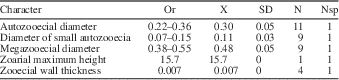
Summary of the statistical analysis of Monotrypa jewensis Bassler, Reference Bassler1911. Abbreviations as in Table 2.
1911 Monotrypa jewensis, Bassler, p. 310, Text. fig. 191.
2011 Monotrypa jewensis; Koromyslova, p. 947.
Holotype
USNM 57410.
Occurrence
Monotrypa jewensis occurs in horizons BI and BII of the Volkhov Formation and in horizons BI, BII and BIII of the Lynna Formation (Lower Ordovician, Floian) in the Leningrad region (Russia); in the Jewe Limestone (D1) and in the Kegel Limestone (D2) (Upper Ordovician, Sandbian) in Estonia; and in the Khabt-el-Hajar Formation, in the horizon MN4, northeastern Moroccan Anti-Atlas (Upper Ordovician, upper Katian).
Description
Zoarium hemispheric with a maximum diameter of 31.0 mm and a maximum height of 15.7 mm; monticules slightly elevated at the zoarial surface and composed of larger than average autozooecia. Autozooecia with a large longitudinal development and apertures irregularly polygonal (four, five or six-sided), with an average diameter of 0.30 mm in the intermacular areas and of 0.48 mm in the macular areas; small angular zooecial apertures (considered here as young autozooecia) evenly distributed throughout the colony and having an average diameter of 0.11 mm. Autozooecial diaphragms scarce, only present as isolated diaphragms in some autozooecial tubes and always on the lower half of them. Autozooecial walls not thicker than 0.007 mm and finely crenulated in most autozooecia. No distinction between endozone and exozone. Mesozooecia and acanthostyles absent.
Materials
One complete zoarium studied in longitudinal and tangential sections, as well as its external morphology (MPZ 2013/170).
Remarks
The features described in this material fit well with those characterizing the species Monotrypa jewensis as described by Bassler (Reference Bassler1911) in the Upper Ordovician of Estonia. Specimens from both localities have the irregular polygonal form of the autozooecial apertures, the presence of macula composed of larger autozooecia, the presence of numerous young autozooecia that in tangential section can be mistaken for mesozooecia, the almost total absence of diaphragms (only present in some autozooecia) and the fine crenulation of the walls. So, the zoarium described here is assigned to M. jewensis. The only difference that can be observed is that in the Estonian type collection the diaphragms, when present, are located in the upper half of the autozooecial tube, whereas in the Moroccan specimens the diaphragms are located in the lower half. Due to the scarce number of diaphragms in both populations, we do not consider this difference sufficient to distinguish between the Baltic and the Mediterranean material.
Monotrypa jewensis is closely related to M. benjamini Bassler, Reference Bassler1906, described from the Rochester Shale (Upper Ordovician) in New York, and to M. cantarelloidea Dreyfuss, Reference Dreyfuss1948, described from the Upper Ordovician in the Montagne Noire. But it can be easily distinguished from the two species because none of them have maculae or diaphragms. From M. cantarelloidea can also be distinguished because the Montagne Noire species has larger autozooecial apertures (1.00 mm average diameter vs. 0.30 mm in the Moroccan species).
Monotrypa jewensis can be distinguished from M. squamata Dreyfuss, Reference Dreyfuss1948, in the Upper Ordovician from the Montagne Noire and from M. testudiformis Dreyfuss, Reference Dreyfuss1948, described by this author and by Ernst and Key (Reference Ernst and Key2007) in the Upper Ordovician from the Montagne Noire, the other two Monotrypa species described in the Mediterranean region, because M. squamata has a constant number of two diaphragms per autozooecia and M. testudiformis has mesozooecia and small acanthostyles.
Monotrypa cf. osgoodensis Bassler, Reference Bassler1906
(1)Monotrypa cf. osgoodensis Bassler, Reference Bassler1906, longitudinal section of specimen MPZ 2013/169 showing diaphragms in exozone, regularly distributed at similar heights in all autozooecia. (2–3)Monotrypa sp. (MPZ 2013/171); (2) Longitudinal section showing the regular distribution of diaphragms in exozone as well as the crenulated autozooecial walls; (3) transverse section showing irregularly hexagonal autozooecia in cross section and acanthostyles in corners of autozooecia. (4–6)Atactoporella moroccoensis new species; (4) tangential section of specimen MPZ 2013/139 showing abundant acanthostyles and petaloid shape of autozooecial apertures; (5) detailed view of the previous tangential section; (6) longitudinal section of specimen MPZ 2013/140 showing large acanthostyles discontinuously developed in endozone and exozone. Specimen MPZ 2013/169 from horizon MS3; Specimens MPZ 2013/139, 140 and 171 from horizon MN3.

Summary of the statistical analysis of Monotrypa cf. osgoodensis Bassler, Reference Bassler1906. Abbreviations as in Table 2.

cf. 1906 Monotrypa osgoodensis Bassler, p. 46, pl. XVI, figs. 1−5.
cf. 1960 Monotrypa osgoodensis (Bassler); Perry and Hattin, p. 707, 708, pl. 90, figs. 1, 2.
Type specimens
USNM 35498, 35499, 44118.
Occurrence
Monotrypa osgoodensis occurs in the Khabt-el-Hajar Formation, in horizons MN3 and MS4, northeastern Moroccan Anti-Atlas (Upper Ordovician, upper Katian); in the Osgood Formation (Silurian, Wenlock) in Osgood, Indiana; and in the Rochester Shale, upper Clinton Group (Lower Silurian) in Lockport and Rochester, New York.
Description
Zoarium hemispheric with a maximum diameter of 25.0 mm and a maximum height of 11.4 mm. Autozooecial apertures irregularly pentagonal or hexagonal, with an average diameter of 0.30 mm; some larger autozooecial apertures can be observed, but the available area is not large enough to assess whether they group forming maculae. Autozooecial diaphragms present in all autozooecial tubes, two to five per autozooecium, mainly located in the exozone and at similar height in all autozooecia; they are straight, concave, convex, or sinuous. Autozooecial walls thin, 0.010 mm average thickness, slightly thickened in the upper part of the zoarium and without crenulation. Mesozooecia and acanthostyles are absent.
Materials
Two zoaria: MPZ 2013/169 in longitudinal and tangential section and MPZ 2013/168 in longitudinal section. The zoorial surface is so eroded that it has been impossible to study the external features. This alteration affects the outer 2 mm of the colonies, and the characters studied in tangential section are only visible in a small region of the zoaria; thus only a few measurements have been taken.
Remarks
The features described in these specimens are similar to those characterizing the species Monotrypa osgoodensis, as described by Bassler (Reference Bassler1906) in the Lower Silurian of New York and by Perry and Hattin (Reference Perry and Hattin1960) in the Lower Silurian of Indiana. They share the irregularly pentagonal and hexagonal autozooeial apertures; the absence of crenulation in autozooecial walls, with walls slightly thicker in the exozone; the absence of mesozooecia and acanthostyles; and autozooecial diaphragms in the exozone and at similar height in all autozooecia. In M. osgoodensis maculae have been described, whereas the abrasion of the external surface of our Moroccan material prevents its identification, making us to only refer this material as M. cf. osgoodensis.
Monotrypa cf. osgoodensis can be distinguished from Monotrypa jewensis, previously described, because the former has more regular autozooecial apertures, more diaphragms, no crenulation in autozooecial walls, and young autozooecia have not been found. It can be distinguished from the rest of Monotrypa species described in the Mediterranean region because M. cantarelloidea has diaphragms and its autozooecial apertures are anomalously large; Monotrypa squamata has a constant number of two diaphragms per autozooecium; and from M. testudiformis because this species has mesozooecia and small acanthostyles.
Monotrypa sp.
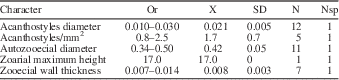
Summary of the statistical analysis of Monotrypa sp. Abbreviations as in Table 2.
Occurrence
Monotrypa sp. is exclusive of the Khabt-el-Hajar Formation in the horizon MN3, northeastern Moroccan Anti-Atlas (Upper Ordovician, upper Katian).
Description
Zoarium hemispheric with a maximum diameter of 24.3 mm and a maximum height of 17.0 mm. Zoarial surface is eroded, but circular monticules can be observed. Autozooecial apertures mainly irregularly hexagonal, but pentagonal cross-sections can also be seen; with an average diameter of 0.42 mm; autozooecial apertures with a slightly larger diameter are grouped forming monticules; other zooecial apertures, considerably smaller than the average diameter and interpreted here as young autozooecia, are evenly distributed across the colony. Diaphragms present in all autozooecia, with no more than one of them in the endozone, located at similar height in neighboring tubes, and more numerous in the exozone where they can be as close as one and a half autozooecial diameters and, as in the endozone, located at similar height in neighboring tubes; diaphragms can be straight or inclined, slightly concave or convex. Small acanthostyles (0.021 mm average diameter) present, but not abundant (an average of 1.7/mm2); mainly located in autozooecial corners and with a discontinuously longitudinal development; in cross-section they are composed of a small hyaline core surrounded by thin dark sheets. Autozooecial walls thin, 0.008 mm average thickness, but can be thickened where acanthostyles are present; strongly crenulated in some regions of the colony. Mesozooecia absent.
Materials
One zoarium studied in longitudinal and tangential section as well as its external morphology (MPZ 2013/171).
Remarks
This specimen presents all diagnostic features of the genus Monotrypa: zoarial habit of growth; poor distinction between endozone and exozone; autozooecia polygonal in cross-section with thin undulating walls; diaphragms thin, rare or sometime absent; and mesozooecia absent. However, acanthostyles are absent in the diagnosis given by Ernst and Key (Reference Ernst and Key2007), but they are present in this material. In spite of this difference, this specimen is here included in Monotrypa taking into account the rest of the shared diagnostic characters.
Only two species of Monotrypa with acanthostyles have been found by us in the literature: M. testudiformis, as described by Dreyfuss, Reference Dreyfuss1948 from the Upper Ordovician of the Montagne Noire (France) and by Ernst and Key (Reference Ernst and Key2007), also from the Upper Ordovician of the Montagne Noire; and M. shaanxiensis Hu, Reference Hu1990, from the Lower Silurian of Ningqiang (China). The presence of mesozooecia and the absence of crenulation in the autozooecial walls, typical in M. testudiformis, prevent the inclusion of this Moroccan specimen in the latter species. The difference in the distribution of autozooecial diaphragms, as well as in the composition of acanthostyles (described as “small dark tissue” by Hu, Reference Hu1990), prevents the assignation to M. shaanxiensis. The impossibility of including this specimen in any of the acanthostyle-bearing Monotrypa species, together with the fact that we only have one specimen (where not enough measurements have been taken), makes the definition of a new species unwarranted. Thus, we are leaving this taxon in open nomenclature to the species level.
Monotrypa sp. is distinguished from M. jewensis and M. cf. osgoodensis, described above, because none of them have acanthostyles and both have smaller autozooecia and fewer diaphragms than Monotrypa sp. From Monotrypa cf. osgoodensis can also be distinguished because in the latter species the walls are not crenulated.
Family Monticuliporidae Nicholson, Reference Nicholson1881
Genus Atactoporella Ulrich, Reference Ulrich1883
Type species
Atactoporella typicalis Ulrich, Reference Ulrich1883, Upper Ordovician (Cincinnatian) of Ohio and Covington (USA).
Diagnosis
Following Ernst and Key (Reference Ernst and Key2007). Zoarium encrusting, but can also be ramose or massive; zooecia thin-walled; autozooecia with diaphragms and cystiphragms; mesozooecia large and numerous, almost isolating autozooecia and densely tabulated by diaphragms; acanthoslyles large and numerous, causing autozooecial apertures to become petaloid.
Occurrence
Upper Ordovician of North America and North Africa, as well as Upper Ordovician to Middle Silurian of Europe and Asia.
Atactoporella moroccoensis new species (by Jiménez-Sánchez)
(1)Atactoporella moroccoensis new species, longitudinal section of specimen MPZ 2013/138 showing large acanthostyles in autozooecia and mesozooecia, mesozooecia narrowly tabulated by diaphragms and cystiphragms covering one or both side of the autozooecial walls. (2, 3)Homotrypa aff. alta Cumings and Galloway, Reference Cumings and Galloway1913, longitudinal (2) and tangential (3) sections of specimen MPZ 2013/239. (4, 5)Monticulipora globulata new species; (4) Longitudinal section of specimen MPZ 2013/174 showing the distribution of large cystiphragms and their increase in size through the exozone; (5) tangential section of specimen MPZ 2013/176, showing irregularly pentagonal/hexagonal autozooecia in cross section and scarce mesozooecia. (6)Monticulipora aff. grandis Ulrich, Reference Ulrich1886 (MPZ 2013/172), longitudinal section showing distribution of diaphragms and cystiphragms. Specimen MPZ 2013/239 from horizon MS3; specimens MPZ 2013/138, 172, 174 from horizon MN3; specimen MPZ 2013/176 from horizon MN5.

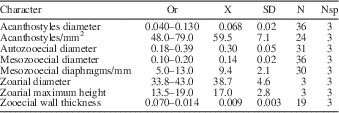
Summary of the statistical analysis of Atactoporella moroccoensis new species. Abbreviations as in Table 2.
Types
Holotype: MPZ 2013/138. Paratypes: MPZ 2013/139 and MPZ 2013/140.
Diagnosis
Atactoporella characterized by having autozooecial apertures with a very obvious petaloid shape due to the insertion of large acanthostyles; mezooecia are numerous (nearly ten mesozooecia per autozooecium); acanthostyles are the most abundant component in the colony, developing from the base to the top of the colony, but in a discontinuous way; autozooecial cystiphragms are scarce, although developed along the entire lengths of autozooecial tubes.
Occurrence
This species in known exclusively in the Khabt-el-Hajar Formation in the horizon MN3, northeastern Moroccan Anti-Atlas (Upper Ordovician, upper Katian).
Description
Zoaria with massive growth habit, hemispherical in shape, with an average maximum diameter of 38.7 mm and an average maximum height of 17.0 mm. Autozooecial apertures strongly petaloid in shape with an average maximum diameter of 0.30 mm, and completely surrounded by mesozooecia; diaphragms and cystiphragms present in all autozooecia, but not too numerous, although developed along all the length of the autozooecial tube; cystiphragms flattened in shape, generally covering only one side of autozooecial chamber. Mesozooecia very numerous with several rows of them surrounding each autozooecial aperture; densely tabulated by diaphragms, an average of 9.4/mm, oriented perpendicular to mesozooecial walls; mesozooecial apertures irregularly polygonal with an average diameter of 0.14 mm. Acanthostyles abundant (59.5/mm2); protruding from the external zoarial surface; with a large diameter, 0.068 mm on average, and composed of a distinct hyaline core and dark sheaths; evenly distributed over the colony, occurring both in autozooecia and mesozooecia, but only autozooecial aperture are modified by them; they develop from the base to the top of the colony, but in a discontinuous way. Zooecial walls thin, 0.009 mm on average and with microgranular texture in appearance.
Etymology
Refers to Morocco, from where the species has been described for the first time.
Materials
Three complete zoaria studied in tangential and longitudinal sections, as well as the external morphology (MPZ 2013/138−140).
Remarks
The small number of autozooecia and the distinct petaloid shape of its apertures, the large number of mesozooecia and acanthostyles (the latter being the most abundant component in the colony), as well as the way in which acanthostyles are distributed, both on the colony’s surface and internally, allows discrimination of these zoaria from all the known species of Atactoporella.
Atactoporella moroccoensis can be distinguished from the type species A. typicalis because the latter has incrusting or subramose zoaria, maculae can be seen in its surface, and the number and distribution of mesozooecia are different. It can be distinguished from the other two Atactoporella species described in the Mediterranean province because A. magnopora Ernst and Key, Reference Ernst and Key2007, described in the Upper Ordovician (Katian) of the Montagne Noire (Southern France), has incrusting zoaria, overgrowth marked by the presence of acanthostyles, autozooecial apertures rounded or slightly angular to petaloid, fewer mesozooecia, acanthostyles located mainly between mesozooecia, and by the presence of macula. Atactoporella moroccoensis can be distinguished from A. irregularis Boulange, Reference Boulange1963 as originally and further described by Ernst and Key (Reference Ernst and Key2007) from the Upper Ordovician (Katian) of Montagne Noire (France), because the latter has ramose zoaria, differentiated endozone and exozone, rounded to polygonal autozooecial apertures, very abundant cystiphragms, rare mesozooecia except in macula and smaller and less common acanthostyles.
Genus Homotrypa Ulrich, Reference Ulrich1882
Type species
Homotrypa curvata Ulrich, Reference Ulrich1882. Upper Ordovician of Cincinnati (USA).
Diagnosis
Following Ernst and Key (Reference Ernst and Key2007) the genus Homotrypa is characterized by having a ramose or frondose zoarium, sometimes encrusting and irregularly massive in the first stages; autozooecial apertures polygonal, rounded or oval; autozooecial walls slightly thickened in exozone, with laminated microstructure; diaphragms more abundant in exozone than in endozone, where can be absent, and cystiphragms only in exozone; mesozooecia from scarce to abundant, sometimes clustered and forming maculae; acanthostyles abundant and small.
Occurrence
Homotrypa has a wide geographic range, being known from North America, Europe, Australia and Siberia, in rocks of Middle Ordovician to Lower Silurian, as well as in the Upper Ordovician of North Africa.
Homotrypa aff. alta Cumings and Galloway, Reference Cumings and Galloway1913
Summary of the statistical analysis of Homotrypa aff. Alta Cumings and Galloway, Reference Cumings and Galloway1913. Abbreviations as in Table 2.

aff. 1913 Homotrypa alta Cumings and Galloway, p. 429−430, pl. IX, figs. 1−1c, pl. X, figs. 1−1c.
aff. 1913 Homotrypa spinea (Cumings and Galloway), p. 431, pl. XII, figs. 1−1c, pl. XIII, figs. 1−1d.
aff. 1985 Homotrypa alta; Brown and Daly, p. 52−53, pl. 6, figs. 10−16.
Type specimens
163.21-23, Fairmount. Upper 40 feet of cut. 2. Guilford, Indiana.
Occurrence
This species has been described in Hope-Fairmount Formation (Maysvillian Stage, middle Katian) and in the Dillsboro Formation (Maysvillian-lower Richmondian stages, upper Katian) in Indiana (USA). The specimen described here is from the Khabt-el-Hajar Formation in horizon MS3, northeastern Moroccan Anti-Atlas (Upper Ordovician, upper Katian).
Description
Ramose zoaria with circular branches of an average diameter of 7.3 mm; external surface smooth, but with maculae composed of solid calcitic extrazooecial deposit and some small mesozooecia. In tangential section autozooecia have rounded or oval apertures with an average maximum diameter of 0.33 mm; at least in 25% of all autozooecial apertures the cross-section of a cystiphragm can be seen. Mesozooecial apertures irregular in shape when between autozooecia and more regular when in maculae, with an average maximum diameter of 0.11 mm. Acanthostyles scarce and small in diameter, with an average of 2.7/mm2; composed of concentrically arranged laminae, but without a central core. Autozooecial walls laminated, with an average thickness of 0.066 mm. In longitudinal section, autozooecia are seen as long tubes growing parallel to the branch axis in the endozone and gently curving in the endozone-exozone boundary; in the exozone autozooecial curvature becomes stronger, forming an average angle of 50º with the zoarial surface; autozooecial diaphragms absent or scarce in endozone, present throughout the exozone, with a separation between them smaller than one autozooecial diameter; they are mainly perpendicular to the walls and join cystiphragms to opposite wall. Cystiphragms developed from internal exozone as isolated series covering only one side of the autozooecial walls (always the side facing the branch axis). Mesozooecia develop in the internal exozone, but inconspicuous as they seem to be filled by calcitic deposits; where visible they are densely tabulated by diaphragms with a separation between them approximately equal to one mesozooecial diameter. Acanthostyles inconspicuous in this section. The most noticeable feature in transverse section is the large diameter of endozone (mean 5.7 mm) with respect to the thickness in exozone (1.2 mm on average); in axial endozone large autozooecia with a regular polygonal shape; this shape becomes more irregular in the peripheral endozone, where autozooecia are smaller.
Materials
Two zoaria studied in tangential and longitudinal sections; external morphology has been also studied (MPZ 2013/238−239).
Remarks
The Moroccan material shares with Homotrypa its main diagnostic characters: ramose growth habit, autozooecial apertures rounded to oval, autozooecial walls thickened in exozone with a laminated microstructure, diaphragms more abundant in exozone and cystiphragms present only in exozone, as well as mesozooecia and acanthostyles present, but variable in abundance.
These specimens are related to Homotrypa alta, sharing with it the subsolid composition of the macula, the oval shape of autozooecial apertures, the presence of mesozooecia filled with a calcitic deposit, the absence of a central core in acanthostyles, and the distribution of diaphragms and cystiphragms. However, in H. alta, as was defined by Cumings and Galloway (Reference Cumings and Galloway1913) in the Upper Ordovician of Indiana (USA), the subsolid macula are regularly star-shaped, autozooecia form an angle of 90º with the external zoarial surface, and diaphragms in exozone are more scarce. These last two differences preclude assigning this material to H. alta with certainty.
In the Mediterranean region, Ernst and Key (Reference Ernst and Key2007) described H. miqueli (Prantl, Reference Prantl1940) in the Upper Ordovician of the Montagne Noire (France) and the Carnic Alps in Italy. This species can be easily distinguished from the Moroccan H. aff. alta because of the absence of mesozooecial diaphragms and the presence of two types of acanthostyles. Also Jiménez-Sánchez (Reference Jiménez-Sánchez2009) described from the Upper Ordovician of the Iberian Chains (Spain) two specimens that were included in Homotrypa, but without specific assignation. The Iberian Homotrypa sp. can be distinguished from H. aff. alta because it has polygonal autozooecial apertures, scarcer mesozooecia and more numerous diaphragms.
Genus Monticulipora d’Orbigny, Reference d’Orbigny1850
Type species
Monticulipora mammulata d’Orbigny, Reference d’Orbigny1850, Upper Ordovician of Ohio.
Diagnosis
Following Jiménez-Sánchez (Reference Jiménez-Sánchez2010). Zoarium with massive, frondescent or branching growth habit; autozooecial apertures polygonal or subpolygonal; with simple cystiphragms, larger in endozone than in inner exozone; autozooecial diaphragms join cystiphragms to the opposite wall; mesozooecia not abundant, located in autozooecial corners and monticules, densely tabulate by diaphragms; acanthostyles mainly in exozone; monticules present and composed of mesozooecia and autozooecia with larger apertures than those of intermonticular areas.
Occurrence
Middle and Upper Ordovician of North America and Upper Ordovician of Siberia and South Europe.
Monticulipora globulata new species (by Jiménez-Sánchez)
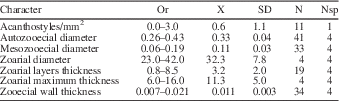
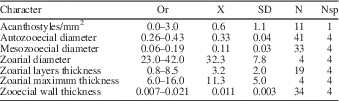
Summary of the statistical analysis of Monticulipora globulata new species. Abbreviations as in Table 2.
Types
Holotype: MPZ 2013/174. Paratype: MPZ 2013/173 and MPZ 2013/176.
Diagnosis
Monticulipora characterized by having large globular cystiphragms, larger in exozone than in endozone, and by scarce acanthostyles.
Occurrence
This species is known exclusively from the Khabt-el-Hajar Formation in horizons MN3 and MN5, northeastern Moroccan Anti-Atlas (Upper Ordovician, upper Katian).
Description
Zoarium composed of superimposed layers with an average diameter of 32.3 mm, always growing over other colonies of bryozoans and with an external morphology that depends on the substrate; individual overgrowths have an average thickness of 3.2 mm. In all the specimens the external surface of the colonies is slightly eroded, thus it is not possible to describe the morphology of monticules other than they are circular in shape. Autozooecial apertures irregularly hexagonal, less commonly pentagonal, with an average diameter of 0.33 mm, and with macular autozooecia slightly larger than the others. Autozooecial cystiphragms large, present in both endozone and exozone and generally increasing in size in exozone, located only in one side of autozooecial walls; generally more than 75% of autozooecial tubes are occupied by large cystiphragms, attached to either side of autozooecial wall. Diaphragms present in all autozooecia, straight and joining cystiphragms to the opposite wall. Mesozooecia scarce, irregular in shape and tabulated by numerous diaphragms with an average diameter of 0.11 mm; located generally in macular areas. Acanthostyles present in all specimens, but so scarce that its density has only been measured in one specimen, with an average of 0.6/mm2, located mainly in autozooecial corners; in tangential section they are seen as dark points and in longitudinal section as a thickening of the wall. Zooecial walls thin, 0.011 mm thick on average, and very regular in thickness.
Etymology
Refer to the globular shape of its cystiphragms.
Materials
Four complete zoaria studied in longitudinal and tangential sections, as well as its external morphology (PMZ 2013/173−176).
Remarks
Although this material has many common characters with other Monticulipora species, we consider that the large size of the globular cystiphragms and their peculiar distribution, larger in exozone than in endozone, as well as the scarcity of acanthostyles, is enough to define a new species.
Monticulipora globulata shares with M. cystiphragmata Jiménez-Sánchez, Reference Jiménez-Sánchez2010, from the Upper Ordovician of the Iberian Chains, the globular shape of its cystiphragms, but they are easily distinguishable because in the Iberian species cystiphragms are larger in endozone, and they are always located in the side facing the center of the colony; mesozooecial apertures are triangular to quadrangular in shape, and acanthostyles are more numerous. From M. kolaluensis Jaroshinskaja, Reference Jaroshinskaja1962, from the Upper Ordovician of the Altai Mountains (Siberia, Russia), and further described by Jiménez-Sánchez (Reference Jiménez-Sánchez2010) from the Upper Ordovician of the Iberian Chains (Spain), the new species can be distinguished because M. kolaluensis has smaller cystiphragms located either on both sides of the wall as a single series or as double series on a single side; and acanthostyles are also more numerous.
Monticulipora aff. grandis Ulrich, Reference Ulrich1886
(1)Monticulipora aff. grandis Ulrich, Reference Ulrich1886 (MPZ 2013/172), tangential section showing hexagonal autozooecia and small and scarce mesozoocia. (2–4)Monticulipora irregularis new species; (2) tangential section of specimen MPZ 2013/178 showing autozooecial apertures containing multiple cystiphragm, the absence of mesozooecia and the presence of acanthostyles in autozooecial corners; (3) longitudinal section of specimen MPZ 2013/180 showing the irregular size and the disordered development of cystiphragms; (4) detailed tangential section of the specimen MPZ 2013/181 showing large acanthostyles in autozooecial corners. (5, 6) MPZ 2013/182, Prasopora falesi (James, Reference James1884); (5) longitudinal section showing shape and distribution of cystiphragms and diaphragms in autozooecia and longitudinal development of large acanthostyles; (6) tangential section showing mesozooecia and acanthostyles. Specimen MPZ 2013/181 from horizon MS3; specimens MPZ 2013/172, 180, 181, 182 from horizon MN3.

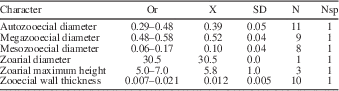
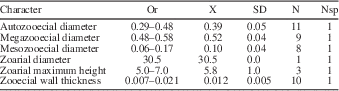
Summary of the statistical analysis of Monticulipora aff. grandis Ulrich, Reference Ulrich1886. Abbreviations as in Table 2.
aff.1886 Monticulipora grandis Ulrich, Minnesota Geological and Natural History Survey, 14th Annual Report, p. 78−79; 1885, ibid., Paleontology, v. 3, pt. 1, p. 219−220, Pl.15, figs.1−6.
aff.1900. Prasopora grandis (Ulrich); Nickels and Bassler, p. 371.
aff.1968 Monticulipora grandis; Bork and Perry, p. 1042−1065, Pl. 136, figs. 8, 9.
Holotype
5969, base of the Trenton Shales at Minneapolis.
Occurrence
The species to which the Moroccan zoarium is referred to has been described in the Guttenberg and Ion Formations (Mohawkian Serie, lower Katian) in Iowa; in the Trenton Shale (Mohawkian Serie, lower Katian) in Minnesota. The studied zoarium is from the Khabt-el-Hajar Formation in horizon MN3, northeastern Moroccan Anti-Atlas (Upper Ordovician, upper Katian).
Description
Zoarium encrusting a dome-shaped bryozoan colony, with a height of 5.8 mm and a diameter of 30.5 mm. Monticules circular in shape and composed of autozooecia with larger apertures than those of intermonticular areas. Autozooecial apertures irregularly hexagonal, with an average diameter of 0.39 mm in intermonticular areas and 0.52 mm in monticules. Autozooecia are long and can be followed from the base of the colony to the colony surface. Autozooecial cystiphragms variable in size and present from the inner endozone to the external exozone; attached to one or both sides of the walls as single rows, but with some individual cystiphragms overlapping the previous one; generally more than 75% of the autozooecial tube are occupied by cystiphragms, and in tangential section circular or subcircular cross-section of cystiphragms can be seen inside the autozooecial aperture. Autozooecial diaphragms present joining cystiphragms to the opposite wall or to the opposite cystiphragm. Mesozooecia small in size (0.10 mm average diameter) and scarce; always growing in the upper part of the zoarium. Acanthostyles absent. Zooecial walls thin, 0.012 mm thick on average, slightly thicker in exozone than in endozone.
Materials
One complete zoarium studied in tangential and longitudinal sections as well as its external morphology (MPZ 2013/172).
Remarks
This specimen is closely related to Monticulipora grandis, as described by Bork and Perry (Reference Bork and Perry1968) in the Middle Ordovician of North-western of Illinois. They share the polygonal shape of the autozooecial apertures, the distribution of cystiphragms and diaphragms inside the autozooecia, as well as the scarcity of mesozooecia and the absence of acanthostyles. But M. grandis, as described by Bork and Perry (Reference Bork and Perry1968), has a subramose zoarium (the zoaria described here is encrusting), smaller autozooecial diameters (0.25 mm in the North American material vs. 0.39 mm in the Moroccan one), thicker autozooecial walls (a range of 0.020−0.040 mm in the North American material vs. 0.007−0.021 mm in the Moroccan one) and smaller cystyphragms. Therefore, we provisionally refer this specimen to M. grandis until new material can be studied to define a new species.
Monticulipora aff. grandis can be distinguished from M. globulata, described above, because the latter has cystiphragms on only one side of the autozooecial walls, has more mesozooecia and acanthostyles; although they are not numerous, they are present in all studied specimens of M. globulata.
Monticulipora irregularis new species (by Jiménez-Sánchez)
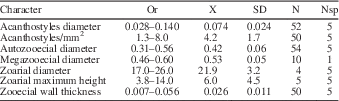
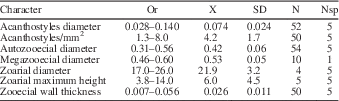
Summary of the statistical analysis of Monticulipora irregularis new species. Abbreviations as in Table 2.
Types
Holotype: MPZ 2013/178 Paratype: MPZ 2013/180−181.
Diagnosis
Monticulipora characterized by the irregular size and disordered development of the cystiphragms, which can be found on one side or on both sides of the autozooecial walls, with superposition of one over the other without any discernible order; as well as by the presence of large and numerous acanthostyles with a clear core; and the complete absence of mesozooecia even in monticular areas.
Occurrence
This species is known exclusively from the Khabt-el-Hajar Formation in horizons MN3 and MS3, northeastern Moroccan Anti-Atlas (Upper Ordovician, upper Katian).
Description
Zoaria lenticular to monticular with several growth stages, with a maximum average height of 6.0 mm and a diameter of 21.9 mm; monticules circular in plan view and composed of autozooecia with slightly larger apertures than intermonticular areas. Autozooecial apertures irregularly pentagonal, with an average diameter of 0.42 mm for those located in intermonticular areas and 0.53 mm for those located in monticules. Autozooecial cystiphragms present in external endozone and throughout exozone, with irregular distribution, shape and size, and located in one or in both sides of the walls as single series, but with irregular superposition of one over the other (one cystiphragm can cover several previous ones); up to four sections of cystiphragms can be seen in the tangential section of autozooecia. Diaphragms present in endozone and exozone, joining the cystiphragms to the opposite wall in the latter; with a concave or sinusoidal shape. Mesozooecia absent. Acanthostyles abundant (an average 4.2/mm2); very large, 0.074 mm average diameter, and composed of a distinct hyaline core surrounded by dark sheaths; mainly located in autozooecial corners, occasionally from the base to the surface colony. Autozooecial walls with a laminar microstructure and 0.026 mm average thickness.
Etymology
Refers to the irregular order and superposition of the cystiphragms.
Materials
Five complete zoaria studied in longitudinal and tangential sections, as well as their external morphology (MPZ 2013/177−181).
Remarks
The irregular size, shape and distribution of cystiphragms in this material has not been described in any other Monticulipora species. The abundance of acanthostyles, as well as the complete absence of mesozooecia, are also features that distinguish these specimens from the other known species. Thus, the new species Monticulipora irregularis is defined to include this material.
Monticulipora irregularis can be distinguished from M. cystiphragmata Jiménez-Sánchez, Reference Jiménez-Sánchez2010, and M. kolaluensis Jaroshinskaja, Reference Jaroshinskaja1962, the two others species of Monticulipora described in the Mediterranean region (Upper Ordovician of the Iberian Chains), mainly by the irregular distribution, shape and size of the cystiphragms, as well as by the different morphology of the acanthostyles (massive in the Iberian species versus with a clear core in the Moroccan species), and by the absence of mesozooecia that characterizes this new species. It can also be distinguished from M. kolaluensis because the latter has irregularly hexagonal autozooecial apertures whereas in M. irregularis the apertures are irregularly pentagonal. Monticulipora irregularis can be distinguished from M. globulata, previously described here, because the cystiphragms are different in shape and distribution, as well as because the former has more acanthostyles (4.2/mm2 versus 3.0/mm2 in M. globulata) with a clear core, and lacks mesozooecia.
Genus Prasopora Nicholson and Etheridge, Reference Nicholson and Etheridge1877
Type species
Prasopora grayae Nicholson and Etheridge, Reference Nicholson and Etheridge1877. Upper Ordovician of Scotland.
Diagnosis
Following the original diagnosis (Nicholson and Etheridge, Reference Nicholson and Etheridge1877), zoarium conical, hemispherical, discoidal or irregular, with a free life habit in the later astogeny. Autozooecial apertures subcircular or subpolygonal, with thin walls lined by cystiphragms in endozone and exozone; diaphragms present. Mesozooecia abundant, sometimes completely isolating autozooecia, and narrowly tabulated by diaphragms. Acanthostyles generally present, but neither numerous nor large.
Occurrence
Prasopora has a broad temporal distribution since the Middle Ordovician until the Lower Silurian in North America and it is also present in the Upper Ordovician of South Europe and Morocco.
Prasopora falesi (James, Reference James1884)
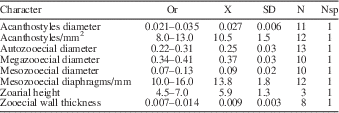
Summary of the statistical analysis of Prasopora falesi (James, Reference James1884). Abbreviations as in Table 2.
1884 Monticulipora falesi James, p.138, pl. 7, figs. 2−2d.
1886 Prasopora simulatrix Ulrich, p. 85.
1890 Prasopra lycoperdon Ulrich, p. 318, figs. 7a, 7b.
1893 Prasopora simulatrix; Ulrich, p. 245, pl. 16, figs. 3−5, 8−10.
1893 Prasopora similatrix var. orientalis (Ulrich); Ulrich, p. 246−249, pl. XVI, figs. 1, 2, 6, 7.
1895 Monticulipora selwynii James, p. 86.
1896 Prasopora simulatrix Ulrich; Zittel, fig. 452.
1897 Prasopora simulatrix Ulrich; Simpson, p. 587, figs. 171−172.
1900 Prasopora simulatrix; Nickles and Bassler, p. 372.
1901 Prasopora simulatrix; Sardeson, p. 10, pl. A, fig. 709.
1903 Prasopora simulatrix; Weller, p. 140, pl. 8, figs.1−3.
1905 Prasopora simulatrix; Nickles, p. 41, pl. 1, fig. 1.
1906 Prasopora falesi; Bassler, p. 48, pl. 1, figs. 1−4.
1907 Prasopora simulatrix; Grabau and Shimer, p. 129, fig. 186d.
1907 Prasopra lycoperdon; Grabau and Shimer, p. 130.
1909 Prasopora simulatrix; Bassler, pl. 7, figs. 1, 2.
1913 Prasopora simulatrix; Bassler, p. 332, fig. 478.
1962 Prasopora similatrix var. orientalis; Perry, p. 17, 18, pl. 3, figs. 7−9.
1965 Prasopora falesi; Brown, p. 985−986, pl. 112, figs. 3, 5−7.
1965 Prasopora simulatrix?; Brown, p. 983−984, pl. 112, figs. 1, 2, 4, 8.
1968 Prasopora simulatrix; Bork and Perry, p. 1058−1061, pl. 137, figs. 8−10, pl. 138, figs. 5−7.
1984 Prasopora falesi; Karklins, p. 42−45, pl. 13, 14.
Holotype
Cincinnati Group.
Occurrence
Prasopora falesi has a broad distribution in the Guttenberg and Ion formations (lower-middle Whiterockian Series, Middle Ordovician) in Iowa; in the Guttenberg Formation (lower-middle Whiterockian Series, Middle Ordovician) in Wisconsin; in the Spechts Ferry Formation (Mohawkian Series, Upper Ordovician) of Wisconsin; in the Quimbys Mill Formation (upper Mohawkian Series, Upper Ordovician) in Wisconsin; in the Trenton Shales (upper Whiterockian Series, Middle Ordovician) in Minnesota and Tennessee; in the Logana and Jessamine Members of the Lexington Limestone (upper Chazyan Stage, Upper Ordovician) in Kentucky; in the Hermitage Formation (Chatfieldian Stage, Upper Ordovician) in Tennessee; and in the Khabt-el-Hajar Formation in horizon MN3, northeastern Moroccan Anti-Atlas (Upper Ordovician, upper Katian).
Description
Zoarium lenticular with an average height of 5.9 mm. Monticules slightly elevated at the zoarial surface and composed of large autozooecia and more numerous mesozooecia; circular in shape. Autozooecial apertures subcircular or irregularly hexagonal with an average diameter of 0.25 mm for those located in intermonticular areas and 0.37 mm for those located in monticules. Autozooecial cystiphragms present from the internal endozone to the external exozone throughout the length of the autozooecial tube; generally not globose and as single series covering both sides of the wall, but other arrangements also exist (isolated double series, resting over diaphragms, etc.); a variety of cystiphragms in cross-section can be seen in the autozooecial apertures. Autozooecial diaphragms present, but not numerous, with variable morphologies: straight, concave, convex, and sinuous, and always joining a cystiphragm with the opposite one or with the opposite wall. Mesozooecia abundant, sometimes isolating autozooecia; apertures have an average maximum diameter of 0.09 mm, but variable in size and shape; narrowly tabulated by diaphragms, with an average of 13.8/mm. Acanthostyles large (0.027 mm average diameter) and numerous (an average 10.5/mm2); with a large longitudinal development and composed of a clear central core surrounded by dark sheets; evenly distributed throughout the colony, and some of them infecting the autozooecial apertures. Autozooecial walls thin, 0.009 mm on average, and without a discernible microstructure.
Materials
One complete zoarium studied in longitudinal and tangential sections, as well as its external features. (MPZ 2013/182).
Remarks
James (Reference James1884) described Monticulipora falesi in specimens from the Trenton Group in Danville, Kentucky. Bassler (Reference Bassler1906) redescribed this species and considered that its morphological features fit better in the genus Prasopora.
Ulrich (Reference Ulrich1886) defined Prasopora simulatrix, from the Trenton Shale (Upper Ordovician) of Minnesota and from the Trenton Group of Kentucky and Tennessee, as a Prasopora species lacking acanthostyles. Latter, Ulrich (Reference Ulrich1893) redefined this species and described the new variety P. simulatrix var. orientalis in the Middle Ordovician of New York and Canada also as lacks acanthostyles.
Marintsch’s (Reference Marintsch1981), study of Prasopora specimens from the Hermitage Formation (upper part of the Middle Ordovician) in Tennessee, revealed that an important number of them had the same features as P. simulatrix as described by Ulrich (Reference Ulrich1893), with the only difference that in this new group of Prasopora acanthostyles were present. New studies with acetate peels of the P. simulatrix’s type material (Marintsch, Reference Marintsch1981) showed that acanthostyles were indeed present throughout the colonies.
Prasopora falesi and P. simulatrix were considered two closely related Prasopora species, whose major difference was the presence of acanthostyles in the former and the absence in the latter.
Marintsch (Reference Marintsch1981), taking into account the results of his new study on the type material of P. simulatrix, concluded that there is no real basis for distinguishing P. simulatrix var. orientalis from P. simulatrix, and considered this species as junior synonym of P. falesi, since P. falesi was described earlier.
The following features in this zoarium are shared with P. falesi as described by Brown (Reference Brown1965) in the Middle Ordovician of Kentucky: subpolygonal shape of the autozooecial apertures, occasionally inflected by acanthostyles; the distribution, form and size of cystiphragms inside autozooecia; the distribution, form and size of mesozooecia; as well as the large number of acanthostyles and their microstructure. These characters are used to distinguish P. falesi from the other species of the genus; therefore this Moroccan material is here assigned to P. falesi.
Termier and Termier (Reference Termier and Termier1950) defined P. clariondi, coming from the same formation as this specimen, but they did not make a detailed description of it. However, in the drawings provided in their work, it can be observed that this species is completely different from the zoarium ascribed here to P. falesi. Prasopora clariondi does not have acanthostyles, mesozooecia are scarce, and cystiphragms are very different from those in P. falesi.
Prasopora falesi can be easily distinguished from all other species of Prasopora described in the Mediterranean Region: P. carnica Vinassa de Regny, Reference Vinassa de Regny1915 and P. fistuliporoides (Vinassa de Regny, Reference Vinassa de Regny1910), described by Conti (Reference Conti1990) in the Upper Ordovician of Sardinia (Italy); Prasopora fistuliporidaes and P. grayae, described by Ernst and Key (Reference Ernst and Key2007) in the Upper Ordovician of the Montage Noire (France); and P. carnica and P. spjeldnaesi Jiménez-Sánchez, Reference Jiménez-Sánchez2010, described by Jiménez-Sánchez (Reference Jiménez-Sánchez2010) in the Upper Ordovician of the Iberian Chains (Spain), because neither of them have the large and numerous acanthostyles that are characteristic of P. falesi.
Analysis of the gigantism
The tendency of some high-latitude marine animals to be large-bodied, known as polar gigantism, has received a continuous interest by biologist. It has been especially studied in arthropods (Chapelle and Peck, Reference Chapelle and Peck1999; Woods et al., 2009) although it has been reported among many other taxa of marine organism (Moran and Woods, Reference Moran and Woods2012). One of the most outstanding examples of polar gigantism in the paleontological record is that described by Gutiérrez-Marco et al. (Reference Gutiérrez-Marco, Sá, García-Bellido, Rábano and Valério2009) for Middle Ordovician trilobites from Portugal. Nevertheless, carbonate shelled animals, as mollusks or corals, have never been shown to exhibit polar gigantism, likely as a consequence of the high metabolic expense to build and maintain their skeletons in cold waters with high proportions of dissolved CO2 (Arnaud, Reference Arnaud1974). Brachiopods are also included in the same group of carbonate-shelled organism with no known continuous trend in size with latitude (Peck and Harper, Reference Peck and Harper2010). Because their robust carbonate zoaria, trepostomate bryozoans must be also included, a priori, among those animals without expected polar gigantism. Known cases of gigantism recorded in trepostomate bryozoans are from the equatorial Laurentia during the Ordovician (Raizen et al., Reference Raizen, Cuffey and Rockwell-Garland1999) and the temperate Greenland northern margin of Pangea during the Permian (Håkansson and Madsen, Reference Håkansson and Madsen1991). This latter case was interpreted as the result of endosymbiosis with algae (Håkansson and Madsen, Reference Håkansson and Madsen1991), a hypothesis rejected by Key et al. (Reference Key, Jackson, Håkansson, Patterson and Moore2005) with refined carbon and oxygen isotopic analysis.
Jiménez-Sánchez et al. (Reference Jiménez-Sánchez, Taylor and Gómez2013) analyzed the morphological differences among congeneric species of Ordovician bryozoans, including trepostomates, from warm- and cold-water settings. They concluded that cold-water species of six genera, five trepostomates and one cystoporate, had larger internal zooecial diameters and, accordingly, larger zooids. They also recognized the greatest temperature-related morphological differences among the Trepostomata genera. Jiménez-Sánchez et al. (Reference Jiménez-Sánchez, Taylor and Gómez2013) did not analyze if the colonies, branches or zooecia of their cold-water species reached sizes that could be considered gigantic. Nevertheless, their results clearly fit with the tendency of some high-latitude marine animals to develop larger sizes, occasionally reaching the gigantism mentioned above.
One of the most accepted factors driving latitudinal clines in body size is the higher polar oxygen availability coupled to low metabolic rates (Chapelle and Peck, Reference Chapelle and Peck1999; Woods et al., Reference Woods, Moran, Arango, Muller and Shields2009). More recently, Verberk and Atkinson (Reference Verberk and Atkison2013) have proposed that larger body sizes in aquatic ectotherms of polar waters represent a respiratory advantage that helps to overcome the larger viscous forces in water. If this is so, it especially matches the case of the bryozoan autozooids, smaller than a half millimeter in diameter, with small respiratory and food gathering lophophores, and possibly also to other smaller polymorphic zooids. Small increments in their sizes would provide them respiratory benefits in cold waters. Nevertheless, their increasing zooid sizes should be limited by the inherent growth of the carbonate zooecia, and thus the increment of the metabolic expenses in CO2 charged waters.
Three of the 11 trepostomate species studied herein display large robust zoaria, which merit a further analysis about their possible gigantism. The analysis presents an added interest because the species inhabited latitudes close to or beyond the Antarctic Polar Circle during the latest Ordovician (Jiménez-Sánchez and Villas, Reference Jiménez-Sánchez and Villas2010; Harper et al., Reference Harper, Rasmussen, Liljeroth, Blodgett, Candela, Jin, Percival, Rong, Villas and Zhan2013). The ramose new species Anaphragma undulata displays very large zoaria, with maximum branch diameter of 24.0 mm, with mean diameter values of 16.7 mm, and zoaria lengths larger than 15 cm (Fig. 10). The Anaphragma mirabile from Morocco also displays very robust zoaria, with a maximum branch diameter of 22.5 mm and mean diameter values of 16.2 mm. These values are not only considerably larger than those of the conspecific associations from Laurentia (Ulrich and Bassler, Reference Ulrich and Bassler1904; Boardman Reference Boardman1960), but also considerably larger than other Anaphragma species across the world, included the temperate-cold Bryozoan Mediterranean Province (Fig. 11.1). In both species, the zoaria display sizes twice as large as the mean size in their genus and they are in the top 5% for its genus, the criteria postulated by DeBroyer (Reference DeBroyer1977) and Chapelle and Peck (Reference Chapelle and Peck1999), respectively, to categorize a species as giant. The robust monticular new species Atactoporella moroccoensis is also relatively large (Fig. 11.2), with zoaria diameters between 34 and 43 mm, again more than twice the mean diameter values of well-known Atactoporella species (Fig. 11.2).
Incomplete zoarium of a large specimen (MPZ 2014/236) of Anaphragma undulate from horizon MN4.

Comparison of Moroccan species with the congeneric species of the paleocontinent of Avalonia (AV), Baltica (BA), Laurentia (LA), Siberia (SI) and the Mediterranean Region (MR); Moroccan species are shown in bold in the X-axis. (1) plot of branch diameter of Anaphragma species. (2) Plot of zoarium maximum height and zoarial diameter of Atactoporella species. (3) Plot of the autozooecial and exilazooecial diameter of Anaphragma species and (4) autozooecial, mesozooecial and acanthostyle diameter of Actatoporella species. (5) Plot of branch diameter of Homotrypa species and (6) zoarium maximum height and zoarial diameter of Monotrypa. The statistical data for these graphs are provided as Supplemental Data 1.

Based on their zoarial sizes Anaphragma mirabile and Anaphragma undulata can be considered gigantic. Nevertheless, although their autozoecia and mesozoecia internal diameters are among the largest known within the genus, their diameters do not significantly deviate from the mean values of other congeneric species (Fig. 11.3). Therefore, attending to the colony zooids, the ones that could obtain the respiratory advantages in cold waters suggested by Verberk and Atkinson (Reference Verberk and Atkison2013), Anaphragma mirabile and Anaphragma undulata cannot be categorized as gigantic. However, Atactoporella moroccoensis, with its gigantic zoarium, can be considered gigantic based on zooecial dimensions as well (Fig. 11.4). Its autozoecial diameters range between 0.18 and 0.39 mm (mean, X=0.30 mm; standard deviation, SD=0.05; number of measurements, N=31). This is at the 95th percentile of the normal distribution of the mean of Atactoporella species (X=0.20 mm), with the smallest species mean is 0.12 mm (SD and N unknown) for Atactoporella densa Dyer, 1925 and the largest species mean diameter, known up to now, is 0.31 mm (SD=0.03, N=24) for Atactoporella magnopora Ernst & Key, Reference Ernst and Key2007. Actually, with an autozoecial mean diameter in the top 5% of the genus, Atactoporella magnopora, which also thrived in the temperate-cold Mediterranean Province (Jiménez-Sánchez and Villas, 2010), can be considered gigantic. In the case of Atactoporella moroccoensis, the gigantism also applies to the mesozooids since the mesozoecial diameter mean value, 0.14 mm (SD=0.02, N=36), also coincides with the 95th percentile of the normal distribution of the mean of all published Atactoporella species (0.14 mm). Thus, whatever the advantage of getting a large size in cold water could have been given to the bryozoans, it was shared by the Atactoporella autozooids and at least by one of the most conspicuous polymorphs within the Trepostomata, the mesozooids.
The distinct zooidal response of the species of Anaphragma and Atactoporella to develop gigantism in cold waters can be related to their distinct zoecial wall thicknesses. The zooecial wall thickness of Anaphragma undulata, for instance, ranges from 0.028 to 0.325 mm (X=0.097 mm, SD=0.04, N=273). However, the zooecial wall thickness of Atactoporella moroccoensis ranges from 0.007 to 0.014 mm (m=0.009 mm, SD=0.003, N=19), that is, one order of magnitude thinner than Anaphragma undulata. Considering the observations above and the known difficulties of carbonate shelled organism to build and maintain their skeletons in cold waters, it can be hypothesized that only those bryozoans with thinner zoecial walls, and thus lower metabolic expenses for building and preserving their zoaria, could develop polar gigantism. Our conclusions on bryozoan gigantism and the expressed hypothesis on the possible constraints of zoaria with thickly walled zooecia to reach gigantic sizes must be tested in a larger sample. The 11 species of the trepostomate families Amplexoporidae and Monticuliporidae studied herein are part of a diverse association of more than 21 species and 11 genera of the orders Cryptostomata and Trepostomata from the same Anti-Atlas localities. Their study will potentially reveal the characteristics, developing trends and structural constrains of gigantism in bryozoans.
The sizes of the other studied species do not display significant deviations from the mean values of their genera; in fact, they are occasionally smaller than other congeneric species from temperate or tropical paleocontinents. See, for instance, the branch diameters of Homotrypa species (Fig. 11.5) and the zoarium maximum height and diameter of Monotrypa species (Fig. 11.6).
Considering the observations above, the large zoarial size of the two studied Anaphragma species cannot be considered examples of polar gigantism, and further environmental causes should be invoked to explain it. Photosynthesizing endosymbiotic algae can also generate gigantism in their hosts (Hallock, Reference Hallock1981, Reference Hallock1996; Cowen, Reference Cowen1983), and although it has never been documented in extant bryozoans, it has been tested in fossil bryozoans with negative results (Key et al., Reference Key, Jackson, Håkansson, Patterson and Moore2005). The development of endosymbiotic association with photosynthetic algae in the studied bryozoan is improbable. They are interpreted to have inhabited an outer-ramp environment, below the fair weather wave base, close to a delta front system, where the depth and presumed turbidity would place it in the lowest mesophotic to oligophotic zone (Morsilli et al., 2012, fig. 8). The light penetration would be even more reduced because the low angle of incidence of light at such high latitude. Therefore, gigantism related to symbiosis with algae can be ruled out.
Gigantism in a variety of animals has been related to a highly oxygenated atmosphere during the late Paleozoic (Chapelle and Peck, Reference Chapelle and Peck1999; Verberk and Atkinson, Reference Verberk and Atkison2013). Nevertheless the significantly low oxygen levels during the Ordovician in the coupled ocean-atmosphere system, which is approximately 50% of the present atmospheric level (Berner, Reference Berner2001), is an argument against this hypothesis for these bryozoans.
Key et al. (Reference Key, Jackson, Håkansson, Patterson and Moore2005) concluded that the gigantism of the trepostomate bryozoan Tabulipora sp. from the Permian of North America could have been simply a function of exposure to ideal growing conditions. A similar conclusion can apply to the Anaphragma species from the Moroccan Ordovician. Their mechanically well-balanced, robust branching form, with relatively wide basal supporting surface, more than twice the diameter of the main branch in some specimens, is adapted to unconsolidated substrates in environments below wave base. It could have resulted in a greater longevity of the colonies and thus in larger zoaria. Their great stability in outer-ramp environments, affected only by exceptional storms with long return periods, would allow the zoaria to reach large sizes before being overturned and buried.
Acknowledgments
We acknowledge the financial support to the project EXLIZ CZ.1.07/2.3.00/30.0013, co-financed by the European Social Fund and the state budget of the Czech Republic, as well as to the project CGL 2012-39471of the Spanish Ministerio de Economía y Competitividad. It is also a contribution to the project E-17 “Heritage and Paleontological Museum”, from the Department of Science, Technology and University of the Government of Aragon, with participation of the European Social Fund, and the IGCP 591 project “The Early to Middle Paleozoic Revolution”. We thank the technician support to the University of Huelva (Spain) and to the Servicio General de Apoyo a la Investigación-SAI, Universidad de Zaragoza. Thanks also go to the two referees (Marcus Key and Caroline Buttler) for much improvement in the final manuscript, and to Zarela Herera and Pierre Clement for field trip assistance.
Supplemental data
Supplemental data deposited in the Dryad repository: