In the study of the history of biblical scholarship, there has been a tendency among historians to emphasize biblical philology as a force which, together with the new philosophy and the new science of the seventeenth century, caused the erosion of universal scriptural authority from the mid-seventeenth century onwards.Footnote 1 A case in point is Jonathan Israel's impressive account of how biblical criticism in the hands of Spinoza paved the way for the Enlightenment.Footnote 2 Others who have argued for a post-Spinozist rise of biblical criticism include Frank Manuel, Adam Sutcliffe, and Travis Frampton.Footnote 3 These scholars have built upon longer standing interpretations such as those of Hugh Trevor-Roper and Paul Hazard. However, scholars in the past two decades such as Anthony Grafton, Scott Mandelbrote and Jean-Louis Quantin have altered the picture of an exegetical revolution inaugurated by Thomas Hobbes (1588–1679), Spinoza (1632–1677), and Richard Simon (1638–1712). These heterodox philosophers in fact relied on philological research that had been largely developed in the first half of the seventeenth century. Moreover, such research was carried out by scholars who had no subversive agenda. This is to say that the importance attached to a historical and philological approach to the biblical text had a cross-confessional appeal, not just a radical-political one.Footnote 4
The dearth of studies regarding the biblical philology and textual scholarship of orthodox men like, in the Dutch context, Franciscus Gomarus, Gisbertus Voetius, Jacobus Revius, Claude Saumaise, and even André Rivet, suggests that biblical philology was the prerogative of other, more progressive or latitudinarian thinkers. The great historian of the early modern study of the New Testament, Henk Jan de Jonge, has predominantly worked on Joseph Scaliger (1540–1609), Daniel Heinsius (1580–1655), and Hugo Grotius (1583–1645).Footnote 5 De Jonge's students have produced pioneering studies of other figures who were active in the first half of the seventeenth-century Dutch Republic. However, these studies have not seriously altered the prevalent narrative.Footnote 6 Yet, biblical philology was used to support political and eschatological agendas of a variety of parties and individuals, and sometimes merely to provide ambitious scholars with a platform to further their own careers.Footnote 7 Among the many stakeholders was the well organized and state–sponsored Dutch Reformed Church, which after the Synod of Dordrecht (1618–1619) embarked on an agenda to further confessionalize society—a program known in historiography as the Further Reformation.Footnote 8 This program entailed an ongoing attempt to formulate more precisely the tenets of Reformed orthodoxy and to instill a more profound piety in church folk. This process necessarily involved biblical criticism and the translation of the Bible into the vernacular.
This essay provides a case in which biblical criticism was not the prerogative of latitudinarian factions of Calvinism. It demonstrates that orthodox theologians were just as accomplished in the field of philology. It shows, moreover, that philology proved to be a powerful tool in the hands of card-carrying orthodox divines: the translators and revisers of the Dutch authorized version of 1637, the so-called States’ Translation.Footnote 9 The States’ Translation is the Dutch equivalent of the King James Bible, on which it was modeled. It provided the backbone of the Dutch Reformed Church for centuries, and continues to do so for some orthodox Reformed currents. The States’ Translation helped to bring about a standard Dutch language and it exerted a profound influence on the history of its literature. For at least two centuries, it was the single most owned book in Dutch society. It embodied the Word of God speaking unambiguously in support of Reformed orthodoxy and is still regarded as a monument of seventeenth-century orthodox Calvinist unanimity.
This study, however, reveals that the making of the States’ Translation was a process of long and difficult consensus formation, carried out not only through theological reasoning, but also on the basis of philological discussions. The delegates at the Synod of Dordrecht in their Canons defined Reformed orthodoxy by identifying what they regarded as the errors of Arminianism, but the Canons remained silent on biblical scholarship. The making of the States’ Translation was therefore an experiment in exploring the boundaries of what the inner circles of the Dutch Reformed Church thought should or could be communicated to the public. In discussing these issues, it turned out that the first draft of the translation had to be fine-tuned: the revisers who corrected this draft had to reckon with the theological implications of the philological choices they were making. The backstage discussions that were conducted among the twenty members of the two teams of translators and editors who worked on the translation for over a decade were of a profound philological nature.
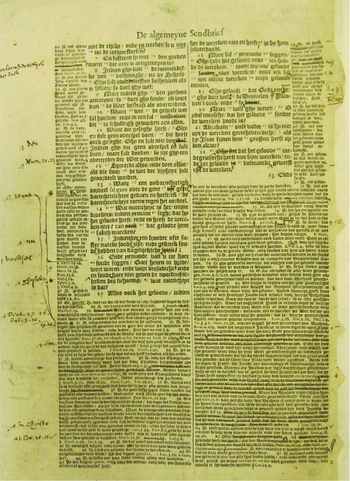
This essay derives its importance not only from this conclusion, but also from the fact that it is based on a source that has never been the subject of study before: it analyzes the unique type-set draft of the translation, the Autographon. This interleaved book carries thousands of manual interventions by the revisers, showing their reformulation of the translations and marginal annotations, and often even their rewriting of their own reformulations.Footnote 10 The revisers scrutinized the translations of and annotations to both the Old and New Testaments.Footnote 11 For the sake of brevity and to maintain consistency, I here only treat the New Testament. A discussion of a number of theologically contested passages from the New Testament will show that the revisers often obscured the textual problems and linguistic ambiguities, but sometimes also plainly admitted that the text could be translated in a variety of ways. Although not all of these problems could be swept under the carpet in the final, printed version of the States’ Translation, this article shows that behind the scenes, enormous effort was put into overcoming unwelcome results of philological research and enlisting philology securely in the service of Reformed orthodoxy.
This orthodoxy was not always made explicit or even fully developed: complicated issues such as infra- and supralapsarianism, for example, were left unaddressed in the marginal annotations to the new translation. Reformed orthodoxy in the seventeenth century is characterized not only by polemics with those who were deemed to be unorthodox, but also by ongoing internal debates. Witness, for example, the fact that in 1628 a conflict arose between Franciscus Gomarus, then professor of theology in Groningen, and some of his colleagues on account of the former's critique of the great German reformed theologian Johannes Piscator. Gomarus, who at the time acted as a reviser of the translation of the Old Testament, thought that Piscator's interpretation of justification had a corrupting influence on his students. In 1640, two ministers complained that a disputation of Gomarus was not in accordance with the Canons of Dordrecht. Both in 1628 and in 1640, the Faculty of Theology of Leiden University acted as board of judges.Footnote 12 Yet, the authority of the Leiden divines was not uncontested: during the Dutch polemics in the 1640s about the question whether men should be allowed to wear long hair, the theological professors of Leiden found themselves opposed by the Theological Faculty of Utrecht.Footnote 13
Documents such as the Belgic Confession, the Heidelberg Catechism, the Canons of Dordrecht, as well as the Synopsis purioris theologiae (1625) acted as a yard stick in intraconfessional conflicts. The Synopsis, published by the Leiden divines Johannes Polyander à Kerkchoven, André Rivet, Antonius Wallaeus, and Anthonius Thysius, evidenced a certain anxiety to define Christian doctrine from a Reformed point of view. Clearly, after the Synod of Dordrecht, the need was felt to secure the stability of the church by a detailed formulation of its doctrine.
This same anxiety informed the decision, made at the Synod of Dordrecht, to authorize a new translation. This decision, moreover, acknowledged that a vernacular Bible was indispensable for fostering a profound sense of religiosity in the faithful. At the time, the main Dutch Bibles were the so-called Liesvelt Bible, printed in Antwerp in 1526 and derived from Luther's German translation, and the Deux-Aes Bible (Emden, 1562), which contained a New Testament translated directly from the Greek.Footnote 14 Increasingly the Dutch Reformed Church felt the intertwining of Lutheran and Calvinist translations to be a liability. The States General (in 1594) and the Synod of South-Holland (from 1599 onwards) undertook various attempts to come to an entirely new, Calvinist translation. They enlisted the services of Philips Marnix of Saint Aldegonde, Arnoldus Cornelii Crusius, Werner Helmichius, Johannes Drusius, Jodocus Larenus, Gerson Bucerus, and Hermannus Faukelius, but the body of translation work which they prepared failed to coalesce into a complete translation.Footnote 15
That in the new translation philology was made subservient to a theological agenda was in itself unsurprising. Latitudinarian thinkers in fact did precisely the same thing, although this usually remains unacknowledged. Hugo Grotius's biblical annotations, for example, were published in the context of his religious-political ideal of rapprochement of Protestant and Catholic churches. The rather inconsistent radical biblical criticism of Isaac de La Peyrère (1596–1676) fitted into a millennial program. Even Erasmus's biblical philology was part of a well-designed philosophy: to establish (or re-establish) a more direct bond between man and God and to rid the Church and its traditions of corruptions that impeded such a bond. The main point, then, is that “philology,” like any other science, has never been a neutral force in its own right.
In the case of the States’ Translation, philology was used as part of a coordinated, collective action of Reformed Calvinism, both by capitalizing on its usefulness and by negotiating its results when they were unwelcome. In particular, it is revealed that individual Reformed thinkers responded differently and that consensus was wrought behind closed doors. The Autographon hence gives a unique insight into the anxiety of the inner circles of Reformed orthodoxy. The creation of a particular confessional group identity rested on compromises of authorities within that group. Little wonder, then, that the seventeenth century would continue to witness latitudinarian critics who grew up within the Reformed Church: religious dissension was, in the first place, a household problem of a particular confession. Keeping the house clean necessitated a constant process of disciplining.
I will first demonstrate that during the translation process, philology was consciously made subservient to the Reformed orthodoxy as formulated at the Synod of Dordrecht. Next, I will treat three passages from the New Testament that have been the focus of theological controversies between Protestants and Catholics: 1 John 5:7–8 (Comma Johanneum), Romans 9 and 11, and Jas 2:21. The Comma Johanneum had a long history of discussion and contestation, both among Catholic and Protestant biblical scholars.Footnote 16 The passage played a central role in trinitarian debates, including the debate about Socinianism, which ensued in Holland in the period in which the States’ Translation was prepared. There appeared in the seventeenth-century Dutch Republic about one hundred and fifty publications inspired by the rational theology of Fausto Sozzini (1539–1604), which were responded to by over four hundred antisociniana.Footnote 17 Johannes Bogerman (1576–1637), president of the Synod of Dordrecht and one of the translators of the States’ Translation, had himself written pamphlets against Socinianism, which he associated with the theology of Jacob Arminius (1560–1609). Bogerman argued that Socinians stood in the tradition of the heterodox Church Father Arius (250/6–336).Footnote 18 It is no coincidence that Arius is mentioned in the States’ Translation's marginal annotation on the Comma Johanneum: the Trinity was a hot topic in contemporary theological discourse. During the decade of religious troubles which preceded the Synod of Dordrecht, the second passage selected for scrutiny below was also of pivotal importance. Chapters 9–11 of Paul's Epistle to the Romans took center stage in the theological discussions on predestination, election, and grace. The translators all bore fresh memories to these debates, which explains why they took great care in formulating their annotations. Finally, the passage from James about good works was a bone of contention in the ongoing polemics between Reformed and Catholic theologians and thus links the philological explication of the States’ Translation to wider confessional debates. Precisely at the time, for instance, that the annotations were formulated, a Dutch divine published a major Latin treatise on James's Epistle that takes issue with Catholic theologians such as Nicolaus Serarius (1555–1609) and Robert Bellarmine (1542–1621).Footnote 19 This discussion was again related to the Arminian controversy and to the measure of space that Arminius allowed to human agency in salvation.
The Making of the States’ Translation
Delegates of the Calvinist Church at the Synod of Dordrecht decided in November 1618 (in two sessions held between November 6–13 and November 19–26) to commission an entirely new vernacular translation, explicitly following the example of the King James Bible. The English delegates informed the Synod that before the Authorized Version was drawn up, it had been decided that only a few annotations were to appear in the book's margins, restricted to parallels, alternative translations of Hebrew and Greek words, variants from approved manuscripts, and obscure Hebrew or Greek expressions.Footnote 20 On hearing this, the Synod recommended to avoid glosses and explanations, to note parallels in the margins, and to give marginal “paraphrases of those phrases of which the sense cannot be conveyed by one phrase only.” Hebraisms and Graecisms should be maintained to familiarize Dutch readers with the language of the Holy Spirit. Paul himself had not avoided Hebraisms in his Greek epistles.Footnote 21 However, if keeping the idiom was deemed impossible, there ought to be a marginal notation of the fact.Footnote 22 The delegates decided “to add some short explanations, accounting for the translations of obscure passages; but it is judged neither necessary nor advisable to add observations on doctrinal issues.”Footnote 23 As will become clear from the discussion below, this resolution was ignored: the States’ Translation is accompanied by a heavy apparatus which regularly discusses doctrinal subjects.
A contradictory decision was made: the new translation had to be made straight from the source text; existing translations, commentaries, explanations, and the opinions of learned men were to be taken into account only in more difficult passages,Footnote 24 presumably in the process of translating them. At the same time, however, the Synod advised to keep intact everything in the then often used Deux-Aes Bible which could serve both the truth and the purity and character of the Dutch language.Footnote 25
Four teams were appointed: one each to translate the Old and the New Testaments (three translators each), and one each to revise the translations (seven revisers each). The six translators were active ministers who were selected from different provinces to prevent the dominance of any single regional dialect of Lower–Dutch. The fourteen revisers included some of the translators, but also several professors of theology. The four teams gathered in Leiden, where they worked, mostly consecutively, on the translation and revision from 1626 to 1637.Footnote 26 In 1637, the translation was presented to the States General, who had financed the project; hence the name, States’ Translation.
The story of the making of the States’ Translation has been told several times in detail in studies that have appeared exclusively in Dutch, most elaborately on its third centenary in 1937 and during the 350-year celebration in 1987. Since then there have been very few studies devoted to the States’ Translation, its annotations, and its reception. Most of the literature draws heavily on the rather descriptive studies published in 1937 and 1987. Although the historiography of the States’ Translation is gradually losing its dominant Calvinist character, its history and reception have scarcely been appropriated, for example, by historians of the book, or those addressing reading practices, biblical philology, or confessionalization.Footnote 27 Research is now made easier by the digitization of the States’ Translation.Footnote 28 This article is, however, based not on the published States’ Translation, but on the Autographon. The revisers’ changes, visible in this draft, allow us to reconstruct the long discussions which had gone on behind the scenes, before the translation was presented to the outside world as the touchstone of Calvinist orthodoxy. In this process, the revisers attempted to make philology subservient to theology, but we will see that they did not always succeed.
Philology: Theology's Handmaiden?
Several years after the publication of the States’ Translation, one of the revisers of the New Testament translation, Casper Sibelius (1590–1658), gave an idea of how difficult the task had been. He recollected how his fellow reviser Festus Hommius (1576–1642), also one of the translators, was forced to change many things in the initial translation he himself had helped prepare:
Because in each chapter so many words, phrases, things, and Scriptural passages cited by the translators, were changed, transposed, and corrected, the secretary and scribe [Festus Hommius] was overwhelmed and distracted by the various changes and corrections, and was hardly able to keep track of each of them and to implement the changes. This was mainly because he had grown old, burdened, and tired, and because the sustained labor had broken his strength. For perhaps it sometimes struck him as troublesome, difficult, and cumbersome when the revisers changed something which he himself had translated from the Greek or had annotated in the margin. It rendered him silent and pensive, and he forgot to make the changes.Footnote 29
From the copious changes to the draft translation and annotations, it appears that unanimity was the result of discussion and negotiation. A disadvantage was that the group of revisers was quite large. Although the precise composition of the teams changed throughout the process due to a sad string of eight deaths and one illness in less than ten years,Footnote 30 vacancies on the committees were quickly refilled. It might seem that there would be many clergymen qualified to revise a Hebrew or Greek translation, but appearances can be deceptive in this regard. At least as important as being a good philologist was being a sound theologian. This is demonstrated by an unpublished letter from Old Testament translator Johannes Bogerman about the replacement of Ubbo Emmius (1547–1625) as one of the revisers of the Old Testament translation. The theologian Henricus Alting (1583–1644) had little confidence that his Hebrew was up to standard, but Bogerman dismissed his scruples:
You don't need to have the kind of expert and rare familiarity with the Hebrew language that Franciscus Junius had in translating the Bible, and with which your colleague Franciscus Gomarus is invested, who combined the teaching of that language with theology. . . . An average knowledge will suffice, just as you well know has been found and still is ordinarily and commonly found today in the theological professors of all universities. . . . On the contrary, you can be congratulated on this vocation for the following reason: because of this occasion you will silently be able to make progress in Hebrew, which should be easy with such a great quantity of aids, which this age enjoys in abundance. In a short time the use of Buxtorf's Old and New Hebrew Concordances alone will help a great deal. After having dealt with scarcely one chapter of the Old Testament, you will already satisfy yourself.
And as if this message were not clear enough, Bogerman added: “The solid explanation (explicatio) of a biblical place is far more important than the conjectures of a thousand critics, in which some men so childishly rejoice.”Footnote 31 This letter reveals that for Bogerman, dogmatic exegesis trumped textual criticism. He speaks specifically of the explicatio of a passage, which suggests that he was concerned not merely with translating but also with commenting—an element of the States’ Translation which will be treated in more detail below.
Revising the New Testament
A. Preliminary Decisions
The translators’ analysis of Hebrew and Greek syntax and semantics, their discussion of variants, and their historical contextualizations gave the revisers much to comment on. A first concern was to formulate criteria of what was to be annotated and what not, for example when the constitution of the text was uncertain. A second question concerned which texts and translations were to be deemed authoritative.
In his memoirs of 1645 (published posthumously in 1777), one of the revisers of the New Testament translation, Lodewijk Gerard van Renesse (1599–1671), recalled the discussions about the guidelines on which the revisers tried to agree. Parallels in the Apocrypha and in profane authors, such as “Plutarch, Pliny, Vegetius, Josephus, etc.”Footnote 32 were to be cited very sparingly in the marginal annotations, and never without further explication. But Renesse also relates that some of the revisers thought it better to make no mention of any such parallels at all, as was the editorial practice in the kjv, “in which they are said to have been occupied for twelve years laboring on it and adorning it, providing us their example.”Footnote 33
The revisers cross-checked the initial translation of the New Testament with the Greek (they used Theodorus Beza's 1588/1589 “fourth edition” of Stephanus) and compared it with the Deux-Aes Bible.Footnote 34 The revisers also used other editions of the source text, for they decided
not to observe nor annotate the large number of evident different readings in various Greek exemplars, lest the self-evident credibility and the stability of Holy Scripture would suffer on account of it and an excuse would be given to hair splitting or the minds of the readers be blindly distracted. Yet whenever some notable variety (notabilis varietas) occurred, we carefully inspected the best copies of the Greek editions and always placed our judgement modestly in the margin with the addition of the word “alternatively.”Footnote 35
The revisers’ critique of the Italian translation of the Swiss jurist Giovanni Diodati (1576–1649) underscores their fears that singling out variants undermined biblical authority:
The Italian translation of a very learned and most honourable brother of ours in Christ from Savoy may be more vigorous in annotating variant readings, but on account of that is said to have satisfied the curious readers more than the judicious ones and therefore has not enjoyed equal acceptance in the churches which use that language.Footnote 36
Diodati, that is, might have thought that judicious minds could choose a reading for themselves, but in fact his policy turned out to be counterproductive. Here we have a clear indication of the hermeneutics which were to guide the translators: variant readings could be noted, but not if they threatened to undermine scriptural authority. In other words, the selection of results was guided not by intrinsic philological principles, but by religious concerns.
Following the advice of the Leiden professor and polymath Claude Saumaise (1588–1663), the revisers decided to ignore the Peshita, the ancient translation in Syriac (a dialect of the Aramaic spoken by Jesus).Footnote 37 The parallels listed by Johannes Utenhovius (1520–1565, who had translated the New Testament in 1556) were deemed useful in many instances, but most help was gained from Johannes Piscator's (1546–1625) German translation:
Of great support was also the translation by Johannes Piscator, in its last versionFootnote 38 together with his numerous own manuscript additions. These were acquired and supplied to us by the Illustrious and Almighty States General from Piscator's heirs. In them, Piscator corrected, explained, and expanded his own prior editions in many places.Footnote 39
Thanks to the States, the revisers had access to valuable unpublished sources from one of the leading spirits of Calvinism.
Where the Greek text allowed multiple interpretations, Renesse said that they had selected the “best ones,” and what was “best,” we are to understand, was what accorded best with a doctrinally sound reading. A verse in Matthew (15:5) prompted the question of how to consistently translate the aorists, the simple Greek verb forms that bear no indication of the completeness or ongoing relevance of past actions. In this case the revisers completely rewrote the initial translation. Renesse admitted that such questions arose continually: “And so it was in very many other places; because of the conciseness of the phraseology and the obscurity of predicate, subject, connective or verb, the most learned come to different conclusions.” The revisers stuck to the Deux-Aes Bible and opted against commenting on the passage, so as not to draw attention to a problem in the text, which would needlessly confuse the reader.Footnote 40 Yet they presented two more alternative translations than the translators had initially given (leaving intact the translators’ conclusion about the text's meaning).Footnote 41 So here the more philologically minded revisers had a small victory, which could safely be granted them because the annotation stipulated how the text must be read anyway.
The New Testament gatekeepers had to maneuver with caution. Their annotations touched upon issues that were at the core of religious debates between Calvinists and Arminians, but they could also have social and perhaps even economic repercussions. Working on Matt 25:27 (on usury), for example, the revisers engaged in a long discussion on usury and interest.Footnote 42 The initial marginal annotation only glossed the Greek word tokos as “i.e., profit,” but the revised note points out that usury can be either fair or unfair.Footnote 43 Shortly after the publication of the States’ Translation, the subject of usury would explode onto the Dutch public scene. The United Provinces was built on trade in money and on interest. Claude Saumaise published three books on the subject, and theologians and legal scholars voiced their disagreements with Saumaise loudly and clearly. It was not yet a full-blown controversy prior to 1637, but the issue had always been a sensitive one.Footnote 44
The annotations had repercussions on another controversy soon to erupt. During the “Hairy War” of the 1640s, the defenders of men's liberty to wear their hair long referred repeatedly to the translations and marginalia in the States’ Translation to bolster their position.Footnote 45 Although the reception of the printed States’ Translation merits a discussion of its own, what these examples suggest is that the revisers constantly had to decide whether to give guidance to the reader. The danger was that such guidance could make it appear that the text was not self-evident. Although the revisers said they refrained from offering their own interpretations, in fact they refuted certain heterodoxies. Renesse wrote, “we have refuted, where necessary, the opinions of chiliasts and semi-chiliasts, with solid arguments, in particular in Revelation 20.”Footnote 46 Renesse claimed that ambiguities (or the breadth of meaning, as he called it) that were present in the original text, had been maintained “so that the reader would be confronted with the richness of Holy Scripture and the prudent and pious investigator of the Evangelical Mystery enjoy his own opinion.” He pointed out the example of John 14:1, where the second half of the verse can be read in four different ways: as affirmative throughout, as interrogative and consecutive, as imperative, and as affirmative and consecutive. Indeed, the revisers added the fourth sort of reading to the three categories already provided by the translators.Footnote 47 So the revisers, as Renesse explained, sometimes made explicit the ambiguity of a single interpretation, but they deviated as little as possible from tradition, so as not to jeopardize the authority of established articles of faith.Footnote 48 They resolved to make the text uniform whenever more than one of the evangelists used the same formula, “so that the reader would find a more common and equal harmony of contents and words.”Footnote 49
B. Stabilizing the Text by Discussing its Transmission
The way in which the translators and revisers dealt with a particularly famous crux illustrates their struggles with the theological consequences of textual criticism. The Comma Johanneum (1 John 5:7–8) provided crucial scriptural support for the doctrine of the Trinity. In the quotation below, taken from the Autographon, I have indicated the text of the Comma Johanneum in italics.
7 15Because 16three are there who testify 17 in Heaven, the Father, 18 the Word and the Holy Spirit: and 19 those \these/ three are 20 one. 8 And 21 three are there who testify on earth, 22the Spirit, and the water, and the blood: and these \those/ three are 23together.Footnote 50 (kjv)
The nine superscript note references (15–23) indicate that these two verses, contrary to the policy of annotation decided at the Synod, were quite heavily annotated.
The Autographon shows that this particular annotation was the result of a long struggle. The revisers, in their first note to verse 7 (note 15), insisted much more than the translators that the passage was genuine and that the Arians were to blame for leaving it out of the Greek manuscripts.
Added in the revised note are two mentions that the words contained a witness of the Trinity. Instead of admitting plainly that the passage was absent in some books (a remark they crossed out), they played down this fact by noting that some manuscripts “seemed” not to have the words because the Arians had left them out. The revisers left intact the remark that teachers from before the time of Arius had had it in their books, and added that it is found in all Greek manuscripts (later on, they modified this again by adding the word “almost,” hence: “in \almost/ all Greek manuscripts,” still indicating that it was present in the vast majority of codices). In both these alterations, philological data was attenuated by the use of the modifiers “seemed” and “almost.” The original note merely stated that the passage “has been there”; the rewritten note took pains to argue that it “must have been there.” Where a proof was marshaled, the word “also” was added, to strengthen the impression that this was yet another piece of evidence:
15 This entire verse is not found in some charter books, as it is also not in the Syriac translation. But it is, however, \This verse, because it contains a very clear witness of the Holy Trinity, is deleted seems to have been deleted by the Arians from some old books, but is \found/ in \almost/ all Greek manuscripts and it is also,/ by many old and prestigious teachers, who also \lived/ before the time of the Arians who are thought to have deleted this verse, found,\who have lived, adduced therefrom \ghost/ adduced therefrom as a proof of the Holy Trinity/: and the contrast of the witnesses on earth (verse 8) clearly shows that this verse has been there \must have been there/, as is \also/ clear from verse 9, where mention is made of this witness of God.Footnote 51
Note 17 explains that “in den Hemel” (in heaven) means not only that the witnesses are in heaven, but also that the act of witness comes straight from heaven, as the revisers wanted to make undeniably clear: “17I.e., they give hereof \from the heaven/ a heavenly and Godly witness, which may not be doubted.”Footnote 52
With another change the revisers meant to make the annotation more succinct, less apologetic, and less confusing: they put more emphasis on the Trinity and deleted a discussion of the personality of the three witnesses. They crossed out part of note 21 which glosses “three witnesses are there on earth”: “I.e., there are three witnesses on earth who give witness of the same. These are strictly speaking no persons, but they are introduced here figuratively as persons.”Footnote 53
Specifically Calvinist guidance was given in their revision of note 22, which accompanied the word “Spirit” in 1 John 5:8. Originally this note was very short and referred only to a prior annotation on 1 John 5:6. But the revisers felt compelled to add a long explanation of the essence of baptism. They also crossed out part of their initial additions and changed them again above the lines. This process of rewriting reveals the revisers’ struggle to come to a satisfactory wording and no doubt reflects the discussion which went on among them:
22 \I.e., the Spirit of the acceptance of children, which is given to the faithful \in the communion/ here on earth, and the water of rebirth, through which the faithful is certified of its childhood \community with the Father and the Son/ and the blood of the New Testament, through which they often receive forgiveness of their sins and reconciliation with God and thereof. \Others understand with the Spirit the doctrine of the Gospel and with the water the Sacrament of Baptism, and with the blood the Sacrament of the Lord's Supper, three ways by which the faithful \in the Church/ here on earth are assured of forgiveness of their sins \through Christ/ and of eternal life, as if through \three/ secure witnesses./ See \also/ the annotation on verse 6.Footnote 54
This long addition explained that the “water” in the passage referred to the sacrament of baptism. It makes clear that baptism only certifies the faithful member of his community with the Father and the Son, i.e., it confirms his elect status as a true Christian. In other words: baptism does not make one a member of the community; it does not change one's status from a non-member to a member. Whereas Catholic, Lutheran, and Anglican theology saw baptism as a precondition for salvation, the revisers steered the reader towards a Calvinist interpretation by stressing that baptism was only a certification, i.e., an outward sign, of a salvation already predestined. The phrases “in the communion” and “in the Church,” added by some revisers, emphasized the exclusivity of members of the Church; the notion of the indispensability of Christ in the forgiveness of sins is stressed by the addition “through Christ” in the penultimate line.
In a final note on the Comma Johanneum, where it was explained that “Jesus is the Christ,” the word “Christ” is replaced by “Salighmaker” (savior), not a translation of the Greek word (which means “the anointed one”) but a further interpretation as “the one who brings salvation”: “23 I.e., they see one thing, and give one witness thereof, namely that Jesus is the Christ \Savior/ and the Son of God. Verse 5.”Footnote 55
These changes served primarily to guide the reader towards a Reformed, and sometimes even specifically orthodox Calvinist interpretation. In the process they stabilized the text of 1 John by vouching for the historicity of the Comma Johanneum. They acknowledged the text-critical problems with the Comma, but addressed these in such a way that little ammunition was given to antitrinitarian interpretations.Footnote 56
C. Inculcating Predestination and Election
A crucial passage informing discussions on predestination is Rom 8:29–33. In the marginal annotations, one can detect a noticeable inclination to direct the reader toward an expressly Calvinistic view, for instance by glossing “whom he did foreknow” (Rom 8:29 KJV) as “those whom God from eternity in Christ has elected for eternal life.” Verse 31 (“What shall we then say to these things? If God be for us, who can be against us?”) is said to express the apostle's “holy pride and fame in Christ, against all allegations and oppressions, which the Devil and the world might bring against them.”Footnote 57 Here, the annotation introduces the notion of the Devil, who is not mentioned in the text. “If God be for us” is glossed as “is reconciled with us through Christ; has elected us, called us and made us justified, and shall glorify us.” Where God is said to “freely give us all things” through the sacrifice of Christ, the annotation makes clear that this “giving” is done “through grace, as the Greek word implies: which is opposed to all the merits of the people.” Salvation is achieved, then, not by human merits or the works of men but only via the grace of God.
Another central passage for the understanding of predestination, Rom 9:11–21, is also heavily annotated, but here again, the revisers were happy with the initial annotations and made only a few changes. Explaining “of him that willeth” (Rom 9:16 KJV) it is said: “46I.e., of the man who through his good will and good behavior in life should move God thereto [i.e., to bestow grace]. Rom. 11:35; Phil. 2:13. \as nobody has this of himself/.”Footnote 58 This last addition makes absolutely clear that man in and of himself has no influence on the receiving of God's grace.
More on the level of semantics is a gloss found with regard to Rom 11:8, which in the Autographon runs as follows: “(According as it is written, God hath given them the slumbering spirit \of deep sleep/, eyes that they should not see, and ears that they should not hear;) unto this day.”Footnote 59 Here the “spirit of deep sleep” is glossed as “a gnawing, irritating spirit \as is also the meaning of the Greek word. However, the first meaning better accords with the Hebrew \Isa. 29:10/ word/.”Footnote 60 This shows an awareness of the Hebraisms in New Testament Greek, and informs readers of this peculiar character of the Greek in the New Testament. This had already been observed by Scaliger and it would be the subject of a controversy between Heinsius and Saumaise.Footnote 61 The note shows that the revisers were fully aware of the latest developments in biblical philology. In this case, the alteration had no theological consequences, so there was no harm in mentioning a philological insight.
One last example of how the revisers made efforts to advance the doctrine of predestination and election is found, not in Romans, but in an annotation to Eph 1:4:
According as he hath chosen us in him before the foundation of the world, that we should be holy and without blame before him in love:
The translators glossed the words “he hath chosen” by adding an alternative translation in the margin: “or elected. I.e., from the common crowd of \depraved/ people.” The revisers here supplied the word verdorven (depraved, corrupt(ed)), an addition that stressed the innate corruption of man, and hence emphasized the privileged state of the elect.
D. Faith and Works
The relation between faith and works was a bone of contention in polemics between Catholic and Reformed theologians, and the revisers felt strongly that they had to avoid a Catholic interpretation of the text. The way they treated the famous passage of Jas 2:21–22 is a case in point. Their elaborate annotation shows just how much mediation they thought was necessary to guide readers to an interpretation which accorded with predestination and the Calvinist attitude to good works as having no influence on bringing about justification. The two verses run: “Was not Abraham our father63 justified by works, when he had offered Isaac his son upon the altar? Seest thou how faith wrought with his works, and by works was faith made perfect?” (KJV).
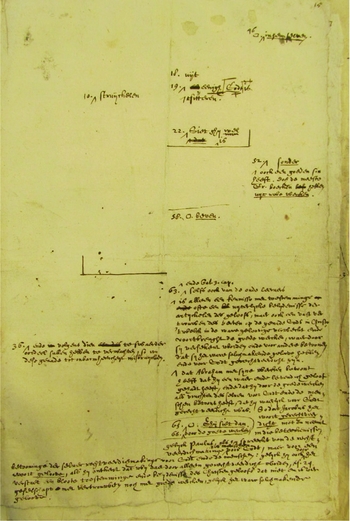
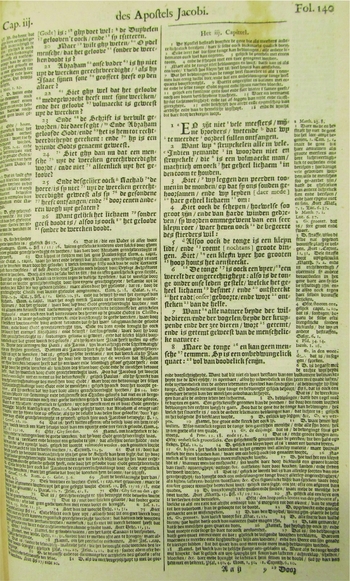
First, the annotators acknowledge in their note 63 the apparent contradiction with Paul's conclusion in Romans 4 (and in Galatians 3, as the revisers were keen to add) that Abraham was justified not because of his works, but because of his faith: “This led some \even among the ancient teachers/ to doubt whether this epistle of James should be acknowledged as belonging to Holy Scripture.” Not only Romans 4, but also Galatians 3 seemed to constitute a contradiction, and not only “some” people but venerated ancient teachers in fact had denied a canonical status to this epistle. But this view was of course wrong: “If one looks into the matter well, then there is no contradiction at all,” the note promises. The note ignores that the reason for the rejection of James's authority was not always the apparent contradiction with Romans 4, but linguistic and historical problems posed by the Epistle: Joseph Scaliger had rejected the canonical status of James's Epistle on the basis of its “Judaisms” and because the author addressed the “twelve tribes which are scattered abroad” (Jas 1:1 KJV).Footnote 62 This dispersion only took place after the destruction of the Second Temple in 70 CE, whereas James lived earlier. The revisers confronted this historical problem with a note to the effect that ten Jewish tribes had already been dispersed by the Assyrians, and two by the Babylonians. The latter had returned to Jerusalem, but some Jews had lingered “in dispersion.” So even before the end of the Second Temple Period one could have spoken of the twelve tribes abroad.Footnote 63 Historical scholarship was overruled here by religious anxiety to keep the Protestant Canon intact. After having thus creatively and succinctly dealt with a historical problem posed by the text, the revisers were far more eager to resolve a theological problem. On the occasion of Jas 2:21–22 they drew up one of the longest annotations in the entire apparatus of the States’ Translation (figure 3). The explanation takes into account the differences in the historical contexts in which James and Paul each wrote.
The Autographon (above, n. 10, catalogue no. 140, second foliation, fol. 97v) with, in the right column, Jas 2:21–22, and the long marginal annotation note 63, with deletions (images 1a and 1b by courtesy of the Utrechts Archief).

The Autographon (ibidem, inserted leaf, recto, facing fol. 97v), with handwritten additions to note 63.

The published States’ Translation with Jas 2:21–22 in the left column and the long marginal annotation note 63 on fol. 140v (Amsterdam University Library, shelf mark: OTM: KF 61–2731; reproduction by courtesy of Amsterdam University Library).

Paul preached against false apostles. James, on the other hand, inveighed against “mondt-Christenen” (mouth-Christians), i.e., those who only said they believed in Christ. After exploring these specific rhetorical and historical settings, the revisers deleted a passage that claimed that external confession needed to be accompanied by good works, showing the living faith, and replaced it with a passage stressing the importance of faith in the mercy of God in Christ, which inspires (verweckt) good works. When James speaks of Abraham's justification from his works, he means specifically Abraham's near-sacrifice of Isaac. The translators’ note had originally glossed “from the works” as “a faith that has been active through works,” placing “faith” logically before “works.” In a somewhat obscure parenthesis, it explains that James misrepresented “from the works”: he used “a figurative way of speaking, by which the working cause is mentioned with the name of the effect or the work.” This comment apparently aimed to argue that the “works” were in fact not the “working” cause (causa efficiens) of faith, but an effect or outcome of it (causa finalis), but the phrasing was ambiguous: it put the matter precisely the other way around, saying that James labeled the sacrifice as the “effect,” whereas he should have said it was the efficient cause. When James says “from the works,” he calls it the effect, but in fact he means to say the cause. But this was contradictory to Calvinist doctrine, according to which it was precisely the other way around: James seems to be mentioning good works as the causa efficiens of justification, but of course he should mean the causa finalis, i.e., the good works as the effect or outward sign of justification. Thus, the translators, in their original note, had mixed up their Aristotelian metaphysics. No wonder the revisers crossed out this note: church folk would only be confused by such technical scholastic terminology, which in the original formulation did not conform to Calvinist doctrine in the first place.
As revised, the note possessed a theological twist that protected the reader from a seemingly self-evident Catholic interpretation. It explained that Abraham's justification means something different in James than it does in Paul's speaking of the justification of men before God (“of men,” as the revisers made sure to add above the line to their own addition to the revised note). By “justification” James means the manifestation of justification before God and the people (“een betooninge der selver rechtveerdighmakinge voor Godt ende de menschen” [italics added]). Likewise, James uses the word “faith” in a specific sense. When he says (in 2:24) “that by works a man is justified, and not by faith only” he in fact means by “faith” merely the profession of faith which is not accompanied by trust and good works, i.e., a profession by “mondt-Christenen.” Hence, a man is justified not through works but by faith, which is necessarily accompanied by good works as the result of faith. For of course, the revisers claimed, Abraham was already justified long before he stretched out his arm and took his knife to slaughter Isaac (Gen 22:10). The revisers then deleted an explanation which partly repeated their own addition.Footnote 64 In the following verse, again, an original explanation is largely deleted and is adapted to prove the same point. Evidently, the revisers were even more keen than the translators to guide the reader towards a Calvinist interpretation. They did so not on the basis of a philological annotation, but by means of a purely theological comment. At the beginning of James's Epistle they solved a historical problem and entirely ignored arguments of a linguistic nature which spoke against the Epistle's authenticity. Now, they gave theological guidance. Theology, that is, trumped philology.
Conclusion
The examples presented above demonstrate that the revisers were not immediately satisfied with the draft translation they received, and even less so with the annotations, even though the translation of the New Testament was the work of the authoritative theologians Jacobus Rolandus (1562–1632), Antonius Walaeus (1573–1639), and Festus Hommius. The closer the project came to its conclusion, the more anxiety the revisers showed to present the reader with a Calvinist understanding of the biblical text.
On the other hand, the annotations occasionally did concede that the New Testament posed problems in the transmission of the text and in the interpretation of the Hebraising character of the Greek. Some of the Greek was fundamentally ambiguous. Here, in the most widespread and commonly used book in the United Provinces, in the Calvinist, most authoritative, and most public version possible of the Bible in the Dutch Republic, problems of translation, textual criticism, and historical circumstances were openly admitted. The complexities of biblical philology evidently required negotiation to make the bible accord with an unambiguous theological interpretation.
Although the text is presented as solid and stable, although not every variant is singled out, and although philological problems are repeatedly ignored, the frequent identification of variants by the word “alternatively” (anders) signaled to an attentive reader that the Holy Ghost had failed to guide the transmission of the text in the same perfect manner as he had inspired the tongues of the prophets and the hands of those who wrote down their stories for the first time. It was now perceptible from the States’ Translation that philology and theology were not always in accord.
Of course, this gives rise to the question as to what extent the open acknowledgment of these problems was exploited by less orthodox writers later in the century. Such a history of the States’ Translation's reception, however, remains to be written. But this essay has shown that the new translation was the result of much discussion following on disagreement, even within the core of Reformed orthodoxy. It has also become clear that philology was not the prerogative of latitudinarian thinkers, but a powerful tool in the hands of the Reformed orthodox, which curbed or ignored its unwelcome results, and used it to present their monumental translation as the unequivocal Word of God.