INTRODUCTION
Provision of supplementary feeds is usually required to achieve acceptable levels of production by ruminants fed forage-based diets. This subject has been the topic of extensive study in the past but the impact of this practice on animal performance varies considerably between forage and supplement type. Previous studies (Kozloski et al. Reference Kozloski, Netto, Bonnecarrère Sanchez, Lima, Cadorin, Fiorentini and Härter2006, Reference Kozloski, Reffatti, Bonnecarrère Sanchez, Lima, Cadorin, Härter and Fiorentini2007) showed that nutrient supply to lambs fed low-nitrogen (N) tropical-grass-based diets decreased when supplementation included only a low-N high-starch source, whereas it was improved when supplements included both high-starch and high-degradable N sources. Temperate grasses, in turn, are usually more digestible and have higher, total and soluble, N content than tropical grasses. Thus, ammonia uptake by rumen bacteria and amino acid supply to the small intestine should improve by supplementing this forage type with non-fibre carbohydrate (NFC) (Poppi & McLennan Reference Poppi and McLennan1995; Klopfenstein Reference Klopfenstein1996). As expected, some studies have reported positive effects of molasses or high-starch supplementation on daily weight gain by sheep grazing temperate grasses (Griffiths et al. Reference Griffiths, Lyle, Marais and Louw1999; De Villiers et al. Reference De Villiers, Dugmore and Wandrag2002; Farinatti et al. Reference Farinatti, Da Rocha, Poli, Pires, Pötter and Da Silva2006). However, this positive impact has also been observed when soybean meal, a high-degradable N supplement, was offered to ewes grazing on a temperate grass pasture (Farinatti et al. Reference Farinatti, Da Rocha, Poli, Pires, Pötter and Da Silva2006). Most individual experiments have tested the effect of the supplement type on animal performance and only a few have attempted to explain differences in this variable based on the supplement-mediated changes in digestion processes and in energy or protein supply (Kolver Reference Kolver2003).
The objective of the present study was to evaluate if the energy and/or amino acid supply to lambs fed annual ryegrass are increased through supplementation using feeds varying in starch and crude protein (CP) content and degradability.
MATERIALS AND METHODS
Feedstuffs, animals, housing and experimental design
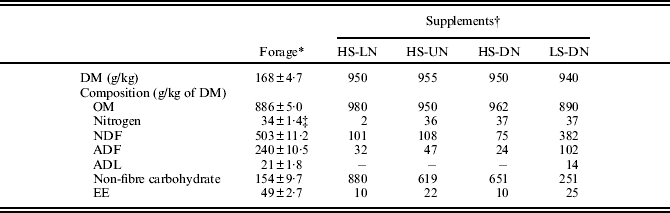
Ten Polwarth×Texel lambs (26±2·1 kg live weight (LW)), housed in metabolism cages and offered Italian ryegrass (Lolium multiflorum Lam cv. Comum) ad libitum, were used in a 5×5 Latin Square design to evaluate the effect of supplement type on digestion processes and on amino acid and energy supplies. Five of the 10 lambs were fitted with a chronic rumen catheter (siliconized PVC, length 350 mm, external diameter 10 mm, internal diameter 7 mm) and proximal duodenal cannulae (T-type PVC cannulae) with surgically prepared and intact lambs being considered as split-plots within the Latin Square design. Surgical procedures were performed under general anaesthesia and animals were treated in accordance with the guidelines of the Animal Care and Ethical Committee of the Universidade Federal de Santa Maria. Treatments were either no supplement (control) or supplementation with either cassava meal (Manihot esculenta, high-starch low-nitrogen (HS-LN), cassava meal plus corn gluten meal (high-starch high-undegradable N (HS-UN)), cassava meal plus calcium caseinate (high-starch high-degradable N (HS-DN)) or corn gluten feed (low-starch high-degradable N (LS-DN)). Calcium caseinate or corn gluten meal was mixed with cassava meal at proportions of 1:2·8 and 1:2·0, respectively, in order to achieve CP content similar to that of both forage and corn gluten feed (c. 230 g/kg of dry matter (DM)). The chemical composition of forage and supplements are shown in Table 1.
Chemical composition of forage and supplements
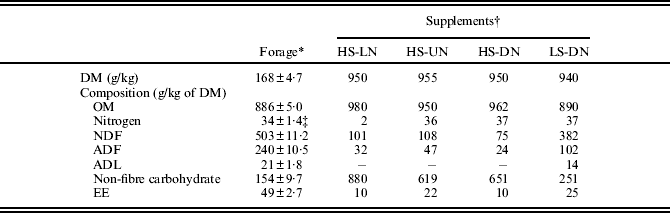
* Ryegrass (L. multiflorum) cut at 50 mm from soil when the swards reached a height of 150–200 mm. Values are means±s.e. of samples taken throughout experimental periods (n=5).
† HS-LN, cassava meal (high-starch low-N); HS-UN, cassava meal plus corn gluten meal (2:1, HS-UN); HS-DN, cassava meal plus calcium caseinate (2·8:1, HS-DN) and LS-DN, corn gluten feed (LS-DN).
‡ Soluble N: 462 g/kg N; NDIN: 383 g/kg N and ADIN: 170 g/kg N.
The experiment was carried out from August to October of 2006 in Southern Brazil (29°43′S, 53°42′W, 95 m asl). Ryegrass pasture was established in May 2006 and was fertilized monthly with 25 kg N/ha. The pasture area was divided into plots of c. 25 m2 and managed as a rotational system, with forage being harvested when the swards reached a height of 150–20 mm, at intervals that varied from 30 to 45 days. Ryegrass was harvested (cut 50 mm above ground level) daily between 16.00 and 17.00 h and stored at −10°C until feeding to reduce plant tissue metabolism. Forage was offered at 08.30, 11.30, 14.00 and 17.00 h in a manner that ensured that 100–200 g orts/kg remained for each lamb. Supplements were fed, separately from forage, at a rate of 7 g/kg LW, in two meals daily (at 08.30 and 17.00 h). This amount of supplement is a mean value of the levels tested in previous experiments with sheep and cattle grazing on temperate pastures (Frizzo et al. Reference Frizzo, Da Rocha, Restle, Montagner, De Freitas and Dos Santos2003; Pilau et al. Reference Pilau, Da Rocha, Restle, Da Silva, De Freitas and Macari2005; Farinatti et al. Reference Farinatti, Da Rocha, Poli, Pires, Pötter and Da Silva2006). There were no supplement refusals in any experimental period. A commercial mineral mixture containing (g/kg): Ca: 100, P: 45, S: 4·12, Na: 205, Co: 0·025, Cu: 0·450, Fe: 1·5, I: 0·05, Mn: 1·0, Se: 0·009, Zn: 2·52 and F: 0·45 was mixed with the concentrate at a rate of 10 g/kg DM.
Each experimental period was conducted over 15 days, with a 10-day adaptation and a 5-day measurement period. Feed offered and refused, as well as faeces, were weighed daily and sub-sampled from days 10–15 of each experimental period. All samples were oven-dried at 55°C for at least 72 h and ground through a 1 mm screen for subsequent chemical analysis. Urine was collected daily during the collection period, in buckets containing 100 ml of 3·6 m sulphuric acid (H2SO4). The volume of urine was measured and a sample of 10 ml/l was stored frozen (−20°C) until analysed. On day 14, eight duodenal samples (50 ml) were collected at 3 h intervals over a 24 h period, which were pooled for each animal in each period and centrifuged (1000 g for 20 min). An aliquot of 4·5 ml from the supernatant was taken, mixed with 0·5 ml 500 g/l trichloroacetic acid (TCA) and centrifuged at 4000 g for 20 min. Acidified and non-acidified supernatants were stored frozen (−20°C) while the residues were oven dried at 55°C and ground through a 1 mm screen. On day 15 of each period, feed was offered only at 08.30 h and rumen fluid samples (approximately 150 ml) were collected at 0, 1, 2, 3, 4, 6 and 8 h after feeding. These samples were filtered through a 50 μm nylon filter, pH was immediately measured with a digital pH meter (Marte Ltda, MG, Brazil) and two aliquots (18 ml) of filtered fluid were removed. In one sample, 2 ml of 3·6 m H2SO4 was added and, in the other, 2 ml of 500 g/l TCA. Samples were centrifuged (4000 g for 20 min) at room temperature and the supernatants collected and stored frozen at −20°C. Pellets were discarded. The supernatant of TCA acidified samples were assumed to contain free amino acids and short-chain peptides, while the pellet comprised protein and long-chain peptides (Greenberg & Shipe Reference Greenberg and Shipe1979).
Chemical analysis
Samples of feed, feed refusals and faeces were pooled on a 5-day basis within each experimental period. DM content of these samples was determined by drying at 105°C for 8 h. Ash was determined by combusting at 550°C for 3 h and organic matter (OM) by mass difference. Total N was assayed by a Kjeldahl method (Method 984.13; AOAC 1997). Analysis of the concentration of neutral detergent fibre (NDF) included alpha amylase but did not include either ash or sodium sulphite. This analysis was performed according to Mertens (Reference Mertens2002) except that samples were weighed into polyester filter bags and treated with neutral detergent in an autoclave at 110°C for 40 min (Senger et al. Reference Senger, Kozloski, Bonnecarrère Sanchez, Mesquita, Alves and Castagnino2008). Concentrations of acid detergent fibre (ADF) and sulphuric acid detergent lignin (ADL) were analysed according to Method 973.18 of AOAC (AOAC 1997) except that samples were weighed into polyester filter bags and treated with acid detergent in an autoclave at 110°C for 40 min (Senger et al. Reference Senger, Kozloski, Bonnecarrère Sanchez, Mesquita, Alves and Castagnino2008). Acid detergent insoluble N (ADIN) and neutral detergent insoluble N (NDIN) were analysed according to Licitra et al. (Reference Licitra, Hernandez and Van Soest1996). Concentration of ether extract (EE) was determined in a reflux system with ethyl ether, at 180°C for 2 h (Soxtherm, Gerhardt, Germany). The content of NFC (g/kg) was calculated as: OM–[(NDF–(NDIN×6·25))+(N×6·25)+EE], according to Van Soest et al. (Reference Van Soest, Robertson and Lewis1991). True digestibility of OM (OMTD) was estimated considering that only the NDF fraction of the faeces originated from the feed (Van Soest Reference Van Soest1994).
Urine samples were pooled on a 5-day basis within each experimental period. Total N in these samples was assayed by the Kjeldahl method and allantoin and uric acid concentrations were determined according to Chen & Gomes (Reference Chen and Gomes1992). Uric acid was determined using a commercial kit (LABTEST, Lagoa Santa MG, Brazil) after xanthine and hypoxanthine were converted to uric acid with xanthine oxidase. Thus, the uric acid values were the sum of uric acid, xanthine and hypoxanthine and the total purine derivatives (PD) were the sum of uric acid and allantoin.
Rumen fluid samples acidified with H2SO4 were analysed for ammonia (Weatherburn Reference Weatherburn1967). The TCA-acidified samples were treated with 6 m hydrochloric acid (2 ml of sample and 2 ml of 6 m hydrochloric acid) at 110°C for 24 h, neutralized by adding 16 ml of 0·75 m sodium hydroxide, filtered and analysed for amino acid N (Palmer & Peters Reference Palmer and Peters1969).
Duodenal residue samples were analysed for DM, OM, ADF, ADL and N. Acidified supernatants from duodenal samples were analysed for ammonia (Weatherburn Reference Weatherburn1967). Additionally, duodenal digesta samples were reconstituted by addition of c. 0·1 g of dried residues and adding an original proportion of non-acidified supernatant. These reconstituted duodenal samples were analysed for total N and amino acids (Palmer & Peters Reference Palmer and Peters1969). For amino acid analysis reconstituted samples (5 ml) were treated with 5 ml of 6 m hydrochloric acid at 110°C for 24 h, neutralized with 40 ml of 0·75 m sodium hydroxide and filtered.
Microbial N supply
The amount of absorbed purines (X, mm/day) corresponding to the amount of PD excreted (Y, mm/day, considering 158 mg/mm of allantoin and 168 mg/mm of uric acid), was calculated from the relationship derived by Chen & Gomes (Reference Chen and Gomes1992): Y=0·84X+(0·150 LW 0·75e−0·25X). The calculation of X based on the value of Y was made using the Newton–Raphson iterative process as:

The supply of microbial N (Nm) was estimated as: Nm (g/day)=70X/(0·116×0·83×1000)=0·727X assuming a digestibility of the microbial purines of 0·83, a N content in the purines of 70 mg/mm and a ratio of purine N/microbial N of 0·116 (Chen & Gomes Reference Chen and Gomes1992).
Duodenal flux of DM and N compounds
Duodenal flux of DM was estimated based on ADL concentration in duodenal digesta and faeces as follows: Duodenal DM (g/day)=[faecal DM (g/day)×faecal ADL (g/kg DM)]/duodenal ADL (g/kg DM) (Porter & Singleton Reference Porter and Singleton1971).
Ruminal apparent digestibility of OM was calculated as: 1−[duodenal OM (g/day)/OM intake (g/day)].
Ruminal true digestibility of OM was calculated as: 1−[(duodenal OM (g/day)−microbial OM (g/day))/OM intake (g/day)].
Duodenal flux of OM from microbial origin was calculated assuming the microbial N, which was estimated from urinary output of PD, represented 99·6 g/kg microbial OM (Clark et al. Reference Clark, Klusmeier and Cameron1992).
Duodenal flux of N compounds (g/day) was calculated multiplying their concentration in duodenal digesta (g/kg DM) by duodenal flux of DM (g/day). Ruminal degradability of dietary N (RDN) was calculated as: 1−[(duodenal N (g/day)−microbial N (g/day)−ammonia N (g/day))/N intake (g/day)].
Statistical analysis
Because four cannulated lambs failed to complete the final period, data from the last experimental period from all cannulated lambs were excluded from analysis and the experiment was analysed as an incomplete Latin Square. Data were analysed using the PROC MIXED option of SAS (2002) according to the model:

where A and P are the random effects of animal and period, respectively, and S the fixed effect of supplement type. μ is the overall mean and e ijkl is residual error. Data derived from rumen samples collected at each sampling interval were analysed as repeated measurements using the PROC MIXED of SAS according to model:

where T is time, S×T is supplement by time interaction, A(P×S) is the between unit random effect and e ijkl is the within units residual error. When treatment effect was significant least square means were compared using the Student t test and probability levels were reported.
RESULTS
Intake and total digestibility
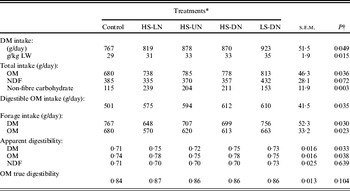
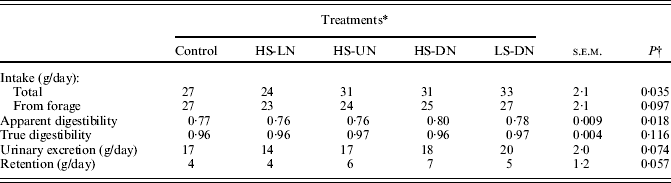
Results of intake and total digestibility of non-nitrogenous and nitrogenous compounds are shown in Tables 2 and 3, respectively. Total intake of DM and OM, and digestible OM intake was increased with HS-UN, HS-DN and LS-DN (P⩽0·049). Forage DM intake was reduced (P=0·030) by HS-LN. Intake of NDF was not affected by supplements whereas all supplements increased NFC intake (P⩽0·003). Apparent digestibility of DM and OM was increased by HS-LN and HS-DN (P⩽0·038). Digestibility of NDF and OM true digestibility were similar for all treatments. Total N intake was increased by HS-UN, HS-DN and LS-DN (P⩽0·035) whereas only HS-DN increased (P=0·018) the apparent digestibility of N. None of the supplements affected N true digestibility. Compared to control treatment, N urinary excretion tended (P=0·074) to be higher in LS-DN and N retention tended (P=0·057) to be higher in the HS-DN treatment.
Effect of supplement type on intake and total digestibility of non-nitrogenous compounds by lambs fed a ryegrass-based diet
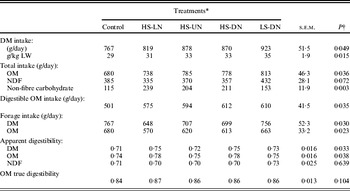
* HS-LN, cassava meal (high-starch low-N); HS-UN, cassava meal plus corn gluten meal (2:1, HS-UN); HS-DN, cassava meal plus calcium caseinate (2·8:1, HS-DN) and LS-DN, corn gluten feed (LS-DN).
† Probability of supplementation effect, where n=9 per treatment.
Effect of supplement type on N intake, total digestibility and retention by lambs fed a ryegrass-based diet
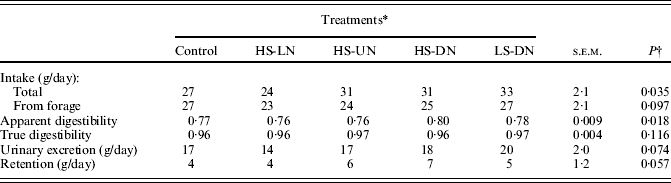
* HS-LN, cassava meal (high-starch low-N); HS-UN, cassava meal plus corn gluten meal (2:1, HS-UN); HS-DN, cassava meal plus calcium caseinate (2·8:1, HS-DN) and LS-DN, corn gluten feed (LS-DN).
† Probability of supplementation effect, where n=9 per treatment.
Ruminal digestibility and rumen microbial protein synthesis
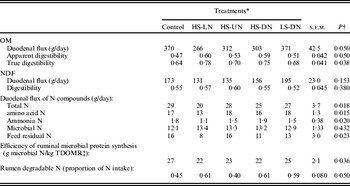
Results of duodenal variables, ruminal digestibility and rumen microbial protein synthesis are shown in Table 4. Duodenal flux of OM was reduced by HS-LN (P=0·050) whereas apparent ruminal digestibility of OM was increased by HS-LN and HS-DN (P⩽0·050). The true ruminal digestibility of OM was increased only by HS-LN (P=0·038). Ruminal digestibility of NDF was not affected by any supplement. Supplementation with HS-LN decreased duodenal flux of total N (P=0·018), amino acid N (P=0·015), ammonia N (P=0·020), and feed residual N (P=0·023). None of the supplements affected rumen microbial protein entering the small intestine whereas the efficiency of rumen microbial protein synthesis (EMPS) was decreased by HS-LN and HS-DN (P⩽0·036). Ruminal RDN was increased by HS-LN, HS-DN and LS-DN (P⩽0·050).
Effect of supplement type on duodenal flux and ruminal digestibility of OM, NDF and N compounds, and rumen microbial protein synthesis by lambs fed a ryegrass-based diet

* HS-LN, cassava meal (high-starch low-N); HS-UN, cassava meal plus corn gluten meal (2:1, HS-UN); HS-DN, cassava meal plus calcium caseinate (2·8:1, HS-DN) and LS-DN, corn gluten feed (LS-DN).
† Probability of supplementation effect, where n=4 per treatment.
‡ True digestible OM in the rumen.
Rumen fermentation
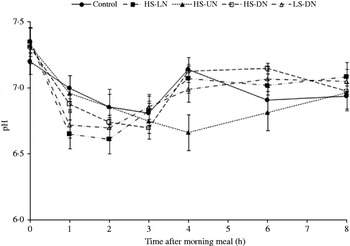
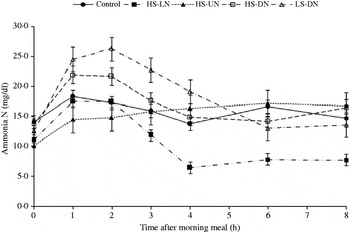
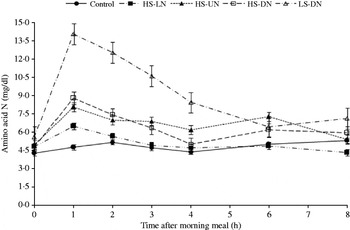
Except for amino acid N (P=0·002), there was no treatment×time interaction for other rumen variables. Rumen pH (Fig. 1) was not affected by treatments nor did the concentration of ammonia N (Fig. 2). Both variables were affected (P<0·001) by time after feeding. However, compared to control treatment, only LS-DN increased (P=0·005) rumen concentration of amino acid N (Fig. 3). Postprandial effect on this rumen variable was observed only in treatments HS-DN (P=0·040) and LS-DN (P=0·002).
Rumen pH in lambs fed ryegrass non-supplemented or supplemented with either HS-LN, HS-UN, HS-DN or LS-DN. s.e.m.=0·02, where n=28 per treatment. Interaction time × supplement effect: P=0·75; supplement effect: P=0·62; time effect: P<0·001.

Rumen ammonia N in lambs fed ryegrass non-supplemented or supplemented with either HS-LN, HS-UN, HS-DN or LS-DN. s.e.m.=0·1, where n=28 per treatment. Interaction time×supplement effect: P=0·27; supplement effect: P=0·17; time effect: P<0·001.

Rumen amino acid N in lambs fed ryegrass non-supplemented or supplemented with either HS-LN, HS-UN, HS-DN or LS-DN. s.e.m.=0·03, where n=28 per treatment. Interaction time×supplement effect: P=0·002.

DISCUSSION
The major objective of the current study was to evaluate the effect of offering supplements with different chemical composition and, consequently, distinct fermentation characteristics on intake, digestion and nutrients supply to lambs fed an annual ryegrass-based diet. As expected, rumen concentration of amino acid N increased markedly after feeding with LS-DN. However, this effect was not observed for HS-DN treatment. These results indicated that degradation rate of N compounds from corn gluten feed is higher than that from calcium caseinate. Rumen amino acid N concentration did not differ between caseinate and corn gluten meal-containing treatments and there was no clear increase in ammonia concentration after feeding when degradable N-containing supplements were offered. Moreover, rumen pH was not affected by supplementation and a depressive effect of HS-LN on rumen ammonia concentration tended to only occur from the 4th hour after feeding. These observations were not expected. Supplements represented on average only 0·19 of total DM ingested by lambs in all treatments and it is likely that this proportion was not high enough to modify most rumen variables markedly.
Level of feed intake is usually the most relevant variable affecting nutrient supply and performance of ruminants. Supplementation of forage based-diet with high-starch sources typically increases total feed intake but exerts a negative effect on forage intake (Gallardo et al. Reference Gallardo, Cangiano, Gagliostro and Gonda1991; Sayers et al. Reference Sayers, Mayne and Bartram2003). In the present study, only supplementation with cassava meal alone depressed forage DM intake without improving total feed intake. A similar effect was observed by offering this supplement type to lambs fed tropical grass-based diets (Kozloski et al. Reference Kozloski, Netto, Bonnecarrère Sanchez, Lima, Cadorin, Fiorentini and Härter2006, Reference Kozloski, Reffatti, Bonnecarrère Sanchez, Lima, Cadorin, Härter and Fiorentini2007). The negative effect of HS-LN supplementation on forage intake is usually associated with a decrease in either particle passage rate or fibre digestibility (Russell et al. Reference Russell, O'Connor, Fox, Van Soest and Sniffen1992; Russell Reference Russell1998). As ruminal digestibility of NDF was not affected in the current study, it is probable that digesta passage rate was depressed in treatment with cassava meal alone. This depressive effect on forage intake was reduced when a protein source was added to cassava meal, regardless of it was rumen degradable (calcium caseinate) or undegradable (corn gluten meal) protein. Caseinate inclusion counterbalanced the negative impact of cassava meal on forage intake also in lambs fed a tropical grass-based diet (Kozloski et al. Reference Kozloski, Reffatti, Bonnecarrère Sanchez, Lima, Cadorin, Härter and Fiorentini2007). The explanation for this protein-positive effect is not clear. However, variations in blood concentration of glucose or acetate as well as the balance either between amino acids and energy-yielding or between glucogenic and ketogenic substrates supplied to tissues are also included among the factors affecting feed intake (Illius & Jessop Reference Illius and Jessop1996). Although speculative, feed intake might be reduced if there are metabolic constraints in energy processing by tissues, such as a low availability of amino acids. Amino acid absorption was not measured in the present study but duodenal flux of amino acid N decreased when cassava meal alone was offered as supplement.
Another nutritional variable expected to improve the supplementation of forage-based diets is the supply of metabolizable protein. Poppi & McLennan (Reference Poppi and McLennan1995) stated that losses of dietary protein, as ammonia absorbed from rumen and excreted as urea in urine, will occur when CP content of forage exceeds c. 210 g/kg digestible OM. Moreover, in vitro studies indicated that approximately 3·5 mg of N is incorporated in microbial biomass when 100 mg of MO is fermented (Grings et al. Reference Grings, Blümmel and Südekum2005). In the present study, control treatment (ryegrass) showed a proportion of 10 mg of soluble N/100 mg NFC and 330 g of CP/kg of digestible OM, indicating excessive ruminal N availability. Thus, ammonia capture by rumen bacteria and intestinal amino acid supply should be improved by offering HS-LN supplements. However, when only cassava meal was offered as supplemental feed there was a marked reduction in duodenal flux of amino acid N as consequence of a negative impact in the EMPS. Supplementation with high-starch sources usually decreases EMPS because particle passage rate is decreased and energy expenditure by bacterial cells is increased (Russell et al. Reference Russell, O'Connor, Fox, Van Soest and Sniffen1992; Russell Reference Russell1998). The negative impact of cassava meal on EMPS was reduced by the addition of corn gluten meal but no reduction in this negative response was observed with the addition of caseinate to cassava meal. However, although EMPS was not improved, inclusion of caseinate reduced the negative impact of cassava meal on duodenal flux of amino acid N. No explanation for this effect is apparent but it is likely that inclusion of caseinate in a cassava meal increased the proportion of rumen soluble amino acid N compounds flowing to the small intestine.
CONCLUSION
Amino acid supply to the small intestine was negatively affected by high-starch low-protein supplementation of lambs fed on ryegrass. In turn, supplementing lambs fed on ryegrass with high-protein concentrate increased the amino acids supply without affecting the supply of digestible energy, regardless of both the starch content and the degree of ruminal degradability of the protein source. These results indicate that supplementation of ryegrass-based diets should include both starch and true protein sources.