In the intensive care unit (ICU), prior room contamination by patients with, for example, vancomycin-resistant Enterococci (VRE), and extended-spectrum β-lactamase–producing Enterobacteriaceae (ESBL-E) is predictive for the acquisition of infections.Reference Mitchell, Dancer, Anderson and Dehn 1 However, while daily chlorhexidine bathing reduces infection rates due to multidrug-resistant pathogens,Reference Climo, Sepkowitz and Zuccotti 2 the effect of this practice on environmental contamination rates are largely unknown. Surveillance of the healthcare environment is usually only conducted in response to outbreaks along with other infection prevention and control (IPC) investigations and interventions.Reference Dancer 3 This is largely due to resource constraints, the transient nature of environmental contamination, low yields from environmental screening, and culture delays, all of which preclude rapid decision making based on these results. In an observational study in a 12-bed adult medical/surgical ICU during non-outbreak periods, we assessed the overall bacterial contamination of near-patient surfaces of occupied beds, including VRE and ESBL-E, before and after the introduction of a chlorhexidine bathing protocol.
A total of 1,703 swabs (Copan E-swabs, Copan Diagnostics, Murrieta, CA) were taken from the immediate environment (within a ~1-m radius) of 157 ICU patients in seven 3-week intervals between October 2012 and June 2014. A chlorhexidine bathing protocol was introduced after period 4 (October 2013). For patient washing, 2% chlorhexidine gluconate cloths, (Sage Products, Cary IL) were universally adopted for use with 100% of ICU patients following a 1-month staff training period. In each 3-week period, 6 ‘high-touch’ sites in occupied beds (Figure 1A) were swabbed twice weekly, as described previously.Reference McDermott, Skally, O’Rourke, Humphreys and Fitzgerald-Hughes 4 For some patients, their environment was sampled more than once because their ICU stay exceeded 48 h and because some patients moved beds. Swabs were processed for identification of VRE and ESBL-E among Enterococci and Enterobacteriaceae as described previously.Reference McDermott, Skally, O’Rourke, Humphreys and Fitzgerald-Hughes 4
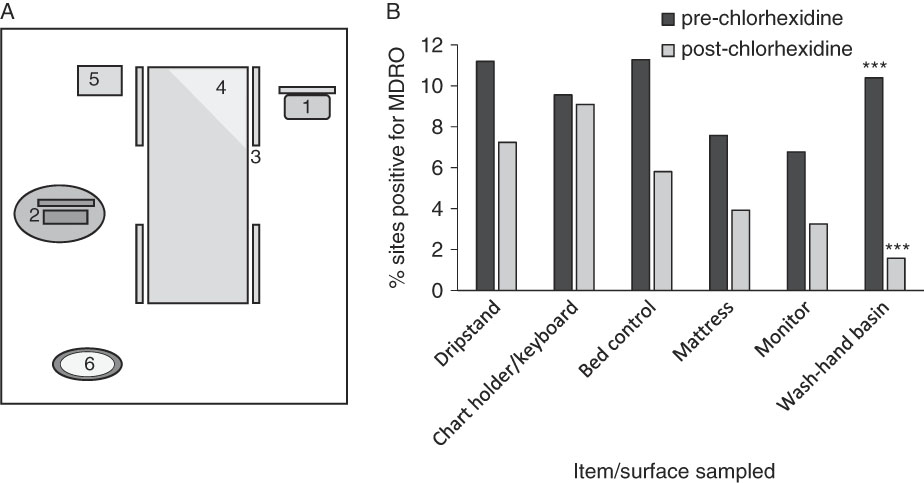
Surface contamination with multidrug-resistant organisms (MDROs): vancomycin-resistant Enterococci or extended-spectrum β-lactamase–producing Enterobacteriaceae (VRE/ESBL-E). (A) Schematic of patient representative bed space indicating the 6 sampling points: (1) drip stand, (2) chart-holder/keyboard, (3) bed control, (4) mattress, (5) monitor, and (6) handwashing basin. For sampling of handwashing basins, those located in isolation rooms were sampled or the unit handwashing basin, if in the open plan area. (B) Percentage of sampled sites positive for VRE/ESBL-E, before and after the introduction of chlorhexidine wipes for patient bathing. Number of sites sampled=745 before chlorhexidine bathing was introduced (63 VRE-positive, 7 ESBL-positive) and 958 after chlorhexidine introduction (45 VRE-positive, 3 ESBL-E positive). *** indicates statistical significance; P value<.005.

Of 1,703 environmental swabs, 1,186 (70%) were positive for bacterial growth. In total, 176 of 1,186 (14.8%) were positive for Enterococcus spp, of which 61% were VRE, and 49 of 1,186 (4.1%) were Enterobacteriaceae, of which 20% were ESBL-E. Of the 1,703 sites sampled, 745 (43.7%) were taken before chlorhexidine bathing was introduced and 958 (56.3%) were taken after chlorhexidine bathing was introduced.
Following the introduction of chlorhexidine cloths for patient bathing, we observed a statistically significant reduction in overall contamination of the environment (74% before vs 62% after; P=.0005, Fisher’s exact test) and in VRE/ESBL-E contamination (9.4% vs 5.0%; P<.0001). The distribution of VRE/ESBL-E between the surfaces sampled before and after chlorhexidine introduction is shown in Figure 1B. A statistically significant reduction in VRE/ESBL-E was observed for handwashing basins only. Cleaning practices, which involved sequential cleaning of patient bed spaces and general ICU areas with 1000 ppm sodium dichloroisocyanurate (Presept®, GS Medical, Dublin, Ireland), were unchanged before and after chlorhexidine bathing was introduced. Hand hygiene audits conducted over the periods in which sampling took place averaged 80.3±10.5% before chlorhexidine bathing was introduced versus 85.5±6.5% after chlorhexidine introduction, and the difference was not statistically significant (P=.52, unpaired t test). Data from an ICU annual audit revealed a 15% increase in the number of patients admitted to the unit over the study period; bed-space occupancy increased from 98% to 110% and mean length of stay decreased from 7.0 to 6.3 days. Higher bed occupancy is reported to positively correlate with HCAI rates.Reference Borg, Waisfisz and Frank 5 , Reference Humphreys 6 Therefore, the reduction in environmental contamination observed following the introduction of chlorhexidine bathing, despite increased pressure on the unit in terms of bed occupancy, is notable. Other potential confounders that may have affected ward activity in the 2 phases included ambient temperature (as a measure of seasonal alterations) and antibiotic consumption. The mean ambient monthly temperature recorded by the nearest weather station (<6 km) over the 2 sampling phases and available from the Irish meteorological service MetEireann 7 was lower after chlorhexidine bathing was introduced, but not significantly so (7.9±0.47°C vs 8.5±0.37°C; P=.70). The ICU ambient temperature was constant between study phases (temperature, 22–24°C; humidity 30–60°C). In addition, ICU antibiotic consumption, measured by total defined daily dose (DDD) over the 2 periods, indicated a 16% increase in the post-chlorhexidine phase (from 6,023 to 6,982), but the difference was not statistically significant (P=.176).
The microbiome of the ICU may be affected by factors including the patient cohort, changes in staff, the nature of and compliance with cleaning regimens, IPC policies, and seasonal changes in ward activity. The sampling periods investigated here can be regarded as ‘snapshots’ in time over 20 months based on environmental sampling of high-touch ICU surfaces.
Our study has several limitations. It was a single-center study, and the results may not be generalizable to other locations or populations. The before-and-after study design lacked a control for comparison. Also, we did not use molecular typing to characterize recovered bacteria, and the identification of environmental contamination was not linked to individual patients (eg, patients with incontinence/diarrhea) and their specific flora.
Patient chlorhexidine bathing has been reported to reduce acquisition of VRE, MRSA, and coagulase-negative staphylococcal bloodstream infection rates,Reference Climo, Sepkowitz and Zuccotti 2 but few studies have investigated its potential impact on the healthcare environment. Of the 7 MDR organisms of major public health importance, VRE and ESBL-E were investigated here as target gram-positive and gram-negative MDR-pathogens due to the relatively high VRE rates in Ireland and the growing ESBL-E rates. 8 The small but significant reduction in contamination overall of the healthcare environment, but particularly the significant reduction in environmental VRE/ESBL-E found here, warrants further investigation.
Financial support
No financial support was provided relevant to this article.
Potential conflicts of interest
H.H. has received research support from Pfizer and Astellas in recent years. He has also recently received lecture and other fees from Pfizer and AstraZeneca. All other authors report no conflicts of interest relevant to this article.
Acknowledgments
The authors thank Ms Leah Gaughan, Antimicrobial Pharmacist, Beaumont Hospital, for providing antibiotic consumption data.