

Introduction
Haematophagous insects, including mosquitoes (Diptera: Culicidea), use vision, heat and humidity, but predominantly volatile chemical cues, known as kairomones, to locate potential vertebrate hosts (Khan et al., Reference Khan, Maibach, Strauss and Fenley1966; Eiras & Jepson, Reference Eiras and Jepson1994; Gibson & Torr, Reference Gibson and Torr1999). One of the most extensively studied kairomones for haematophagous insects is 1-octen-3-ol. This compound, which exists in two enantiomeric forms, is released by many vertebrates and plant species (Hall et al., Reference Hall, Beevor, Cork, Nesbitt and Vale1984; Knudsen et al., Reference Knudsen, Tollsten and Bergstrom1993; Kline et al., Reference Kline, Allan, Bernier and Welch2007). 1-Octen-3-ol was first described in relation to haematophagous insects as a component of ox odour and has since been shown to be effective at increasing catches of tsetse flies (Diptera: Glossinidae) (Bursell, Reference Bursell1984; Hall et al., Reference Hall, Beevor, Cork, Nesbitt and Vale1984; Vale & Hall, Reference Vale and Hall1985a,Reference Vale and Hallb). In combination with carbon dioxide (CO2), a major component of vertebrate breath, 1-octen-3-ol has also been shown to increase behavioural responses and trap catches of mosquitoes, including those of the genera Aedes and Anopheles (Vythilingam et al., Reference Vythilingam, Lian and Thim1992; Kemme et al., Reference Kemme, Van Essen, Ritchie and Kay1993; Becker et al., Reference Becker, Zgomba, Petric and Ludwig1995; Kline & Lemire, Reference Kline and Lemire1995; Mboera et al., Reference Mboera, Takken and Sambu2000; Burkett et al., Reference Burkett, Lee, Lee, Kim, Lee, Lee, Shin, Wirtz, Cho, Claborn, Coleman and Klein2001; Russell, Reference Russell2004; Miller et al, Reference Miller, Wing, Cope, Davey and Kline2005; Kline et al., Reference Kline, Allan, Bernier and Welch2007). Interestingly, 1-octen-3-ol was found to have little behavioural effect on most Culex spp. mosquitoes, despite the fact that some have olfactory receptors on their antennae and maxillary palps (Takken & Kline, Reference Takken and Kline1989; Hill et al., Reference Hill, Hansson and Ignell2009).
1-Octen-3-ol is found in cattle breath to be predominantly (R)-1-octen-3-ol, varying between 80:20 R:S and 92:8 R:S (Hall et al., Reference Hall, Beevor, Cork, Nesbitt and Vale1984). Despite this, most investigations on haematophagous insects have assessed this compound only in its racemic form (1:1, R:S). Furthermore, the racemic form of 1-octen-3-ol is used in commercially available insect traps, such as the Mosquito Magnet and Midgeaters (Vythilingam et al., Reference Vythilingam, Lian and Thim1992; Kemme et al., Reference Kemme, Van Essen, Ritchie and Kay1993; Becker et al., Reference Becker, Zgomba, Petric and Ludwig1995; Mboera et al., Reference Mboera, Takken and Sambu2000; Burkett et al., Reference Burkett, Lee, Lee, Kim, Lee, Lee, Shin, Wirtz, Cho, Claborn, Coleman and Klein2001; Russell, Reference Russell2004; Miller et al., Reference Miller, Wing, Cope, Davey and Kline2005). Although no differences in either electroantennogram (EAG) activity, behaviour in a wind tunnel or attractiveness in the field between the (R) and the (S) enantiomers have been found for tsetse flies (Bursell, Reference Bursell1984; Hall et al., Reference Hall, Beevor, Cork, Nesbitt and Vale1984; Vale & Hall, Reference Vale and Hall1985a, Reference Vale and Hallb), there is evidence that mosquitoes can discriminate between the enantiomers. For example, a study by Kline et al. (Reference Kline, Allan, Bernier and Welch2007) showed an increase in numbers of Anopheles crucians and Ochlerotatus infirmatus caught in traps when using the (R)-1-octen-3-ol enantiomer compared to the (S)-1-octen-3-ol enantiomer. In line with this, a recent study showed that an olfactory receptor neuron (ORN) in the maxillary palps of Cx. quinquefasciatus mosquitoes displayed ‘remarkable sensitivity’ to the (R)-1-octen-3-ol enantiomer compared to the (S)-1-octen-3-ol enantiomer (Syed & Leal, Reference Syed and Leal2007). Similarly, an odorant receptor of the yellow fever mosquito, Ae. aegypti, has been shown to be enantioselective in vitro, responding predominantly to the (R)-1-octen-3-ol enantiomer, when heterologously expressed in Xenopus oocytes (Bohbot & Dickens, Reference Bohbot and Dickens2009). Therefore, one might expect to see stronger, as yet undefined, behavioural responses of Aedes and Culex species mosquitoes to the (R) enantiomer. However, this has not been investigated to date and is further complicated by the fact the Ae. aegypti and Cx. quinquefasciatus have different host preferences. Aedes aegypti is a known anthropophilic mosquito that responds preferentially to human host odours, as well as other mammals, and Cx. quinquefasciatus preferentially feeds on birds (Takken & Kline, Reference Takken and Kline1989; Takken, Reference Takken1991; Zinser et al., Reference Zinser, Ramberg and Willott2004). 1-Octen-3-ol has been identified from human odour previously; therefore, Ae. aegypti would be expected to show positive behavioural responses to the compound. To our knowledge, 1-octen-3-ol has not been identified from bird odour, and so its ecological role is difficult to predict for Cx. quinquefasciatus mosquitoes.
The aim of this study was to further our understanding on the role of 1-octen-3-ol and to provide possible explains for the inconsistency in trapping efficacy of previous studies. To achieve this, we investigate the behavioural and electrophysiological effect of pure enantiomers of 1-octen-3-ol and mixtures on the attraction of Ae. aegypti and Cx. quinquefasciatus mosquitoes using laboratory based olfactometer bioassays and electrophysiology employing single-sensillum recordings (SSRs).
Materials and methods
Behaviour
Insects
Aedes aegypti mosquitoes, refm strain, were originally obtained from the London School of Hygiene and Tropical Medicine and were kept in culture in the laboratory at Rothamsted Research. The culture was maintained in a controlled environment at 27±2°C, 55–60% relative humidity (RH) and a L:D 12:12 h photoperiod. The larvae were fed daily with Tetramin® Tropical Fish Flakes according to larval density of rearing trays. Adult insects were kept in BugDorm-1 (MegaView, Taiwan) plastic rearing cages and provided with 10% sucrose solution (Fischer Scientific UK Ltd, UK) on cotton wool. Females were blood-fed weekly on sheep blood in Alsevers (TCS Biosciences, UK) using a Hemotek® Membrane Feeding System (Discovery Workshops, UK).
Culex quinquefasciatus mosquitoes were originally obtained from the Thai strain provided by the Liverpool School of Tropical Medicine. Similar to Ae. aegypti, this culture was maintained at Rothamsted Research in a controlled environment at 27±2°C, 55–60% RH, although the photoperiod was inverted, D:L 12:12 h. Larvae were fed regularly with Brewer's Yeast Tablets (500 mg) (Holland & Barrett, UK). Adults were kept in BugDorm-1 rearing cages and were fed on defibrinated horse blood (TCS Biosciences, UK) weekly.
For behavioural bioassays, female mosquitoes aged between 5–12 days that had not been previously blood-fed, were collected and stored in plastic pre-release chambers (WHO, Malaysia), without sucrose and water, in the bioassay room for two hours, allowing time for the insects to acclimatize.
Behavioural assays
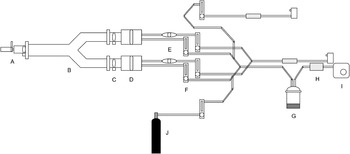
A Y-tube olfactometer (Logan et al., Reference Logan, Birkett, Clark, Powers, Seal, Wadhams, Mordue and Pickett2008), comprising a Y-shaped Plexiglass tube (id 62 mm; fig. 1B–D) that allows insects to move towards odours coming from the upwind end, was used for the behavioural bioassays. Air was pumped through an activated charcoal filter then a glass bell jar (5 l), containing distilled water (dH2O, 1 l; fig. 1G–I) prior to being split between the two arms of the olfactometer. Flow meters regulated the airflow in each arm at 10 l min−1 (fig. 1F). Chemicals in solvent (hexane) were introduced onto filter paper (10 μl; Whatman No. 1, 9-cm diameter filter papers, Whatman plc, UK) by micropipette (Drummond, UK) and placed in sintered glass expander/reductor couplings (fig. 1E). A second pump provided a charcoal filtered airflow over the chemical samples, regulated at 20 ml min−1, and this was introduced through polytetrafluoroethylene (PTFE) tubing adjacent to the main airflow. For dose response experiments, chemicals were introduced in the presence of CO2 presented via a pressurized cylinder (BOC, UK) and introduced directly into the main airflow before the split, or in the required tubing arm after the split (fig. 1J). Airflow was regulated by a flow meter (20 ml min−1) and was balanced in the opposite arm of the Y-tube by the addition of another pump introducing charcoal filtered air at the same flow rate (fig. 1). The Y-tube olfactometer and components were changed after every third treatment and cleaned thoroughly using distilled water and Tepol (Harvey, Waddington, UK) then allowed to air dry. Additionally, the PTFE tubing was rinsed with ethanol, and the sintered glass vessels were cleaned with acetone and distilled water. Both the tubing and vessels were then placed for two hours at 180°C in an oven.
Y-tube olfactometer bioassay design. Female insects were collected in pre-release chambers (A) and allowed to acclimatize for two hours. These chambers were designed to easily attach to the main Y-tube olfactometer (B). Air was pumped (I) through a charcoal filter (H) and humidified in a glass bell jar containing dH2O (G). The airflow was regulated by flowmeters (F). Chemicals were applied to filter papers and placed in sintered glass vessels (E). Where necessary, CO2 was introduced from a cylinder located in the bioassay room (J).

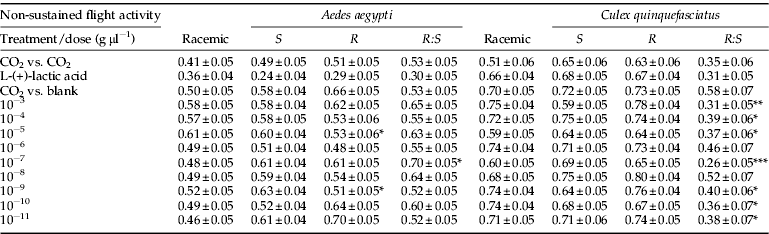
In all experiments, three behavioural parameters were recorded: relative attraction (the proportion of mosquitoes in the arm of the Y-tube containing the odour stimulus out of the total number of mosquitoes in both arms); upwind flight activity (the proportion of mosquitoes that had flown upwind beyond 30 cm in the stem of the Y-tube) and non-sustained flight activity (NSFA; the proportion of mosquitoes that had flown beyond 30 cm in the stem of the Y-tube, but did not reach the capture chambers at the end of the arms).
Dose response experiments
Racemic 1-octen-3-ol, (R)-1-octen-3-ol, (S)-1-octen-3-ol and an (R:S)-1-octen-3-ol mixture (84:16) were prepared in hexane and serial diluted ten-fold to provide solutions of 10−12–10−4 g μl−1. Aliquots of 10 μl were applied in each replicate, giving doses of 10−11–10−3 g μl−1 (treatment vs. blank). All treatments were tested with CO2. In addition to the nine treatment doses, three controls were also included: (i) CO2 vs. blank, (ii) CO2 vs. CO2 (to ensure there was no bias in the Y-tube set up) and (iii) aqueous L-(+)-lactic acid+CO2 vs. distilled water (dH2O) (a positive control). Experiments were done using a semi-randomized block design. Treatments were randomized then ordered by ascending dose within the groups that occurred between equipment changes/washes. Twelve replicates were conducted and the randomisation also included orientation of the Y-tube olfactometer, so six replicates were conducted with the test compound in the left arm and six in the right arm.
A pre-release chamber containing approximately 20 female mosquitoes was attached to the release chamber and the door opened to allow the mosquitoes to move. The cover of the visual occlusion frame was replaced, the main airflow turned on and the insects were given five minutes to acclimatize. During this time, the treatments were prepared on filter papers as above, allowing one minute for the solvent to evaporate. After acclimatization, the papers were introduced into the sintered glass vessels, and the secondary airflows were turned on along with the CO2 and the balancing airflow. Once all flow meters had settled, the insects were released for a duration of 90 s. The swivel doors on the capture chambers and release chambers were closed, and the position of all insects in the stem and arms was recorded. The cover to the visual occlusion frame was removed, and the insects in the capture chambers and release chambers were counted. The CO2 cylinder, as well as the balancing airflow, was turned off. The insects in the olfactometer were removed by suction. Experiments were conducted in the light with Ae. aegypti and under red-light (artificial night) with Cx. quinquefasciatus.
Electrophysiology
Insects
Aedes aegypti, Rockefeller strain, and Culex quinquefasciatus, Thai strain (obtained as eggs from Rothamsted Research Institute, UK), were used for electrophysiology experiments. Both mosquito species were cultured at SLU, Alnarp. The cultures were maintained at 27°C, with a relative humidity of 70% at an L:D 12:12 h photoperiod (the photoperiod was inverted for Cx. quinquefasciatus, D:L 12:12 h). Adults were maintained in mesh and plastic culture cages with free access to 10% sucrose through a filter paper wick. Larvae were reared in a separate chamber (27°C, 60% RH and 12:12 L:D) in distilled water-filled plastic trays (20 cm×30 cm×10 cm). Larvae were kept in groups of ∼500 per tray with free access to fish food (Tetramin® Tropical Fish Flakes). Pupae were collected daily in 30 ml containers and transferred to the adult cages. For electrophysiology, non-blood-fed female mosquitoes were chosen at random from a population aged between three and five days.
Insect preparation
To obtain a stable recording, a female mosquito was anesthetized (1.0–1.5 min at −20°C) and mounted over double-sided tape on a microscope slide (76×26 mm). To secure the insect, half of the thorax and the entire abdomen were covered by tape fixed to the microscope slide. The cover slip, partially covered with double-sided tape, was positioned abutting the mosquito head, above and at a right angle to the proboscis. Maxillary palps were lifted and extended smoothly onto the cover slip. The scales that cover the basiconic sensilla on the maxillary palps were removed by gentle rubbing. The mounted mosquito was placed in the single sensillum recording (SSR) rig under a Nikon Eclipse (E600FN) microscope. The maxillary palps were visualized at high magnification (750×).
Single sensillum recording
Maxillary palps of mosquitoes house three types of olfactory receptor neurons, and their extracellular spikes can easily be resolved into three distinct populations based on differences in amplitude. In order to determine a comparative olfactory response profile for the olfactory receptor neurons to the three forms of 1-octen-3-ol, SSRs were performed on ten maxillary palp basiconic sensilla from each culicine species, Ae. aegypti and Cx. quinquefasciatus.
Two tungsten electrodes were electrolytically sharpened (∼1-μm tip diameter) by dipping repeatedly in a 10% KNO2 at 5–10 V. The reference electrode was inserted into the eye of the mosquito under low magnification (75×). The recording electrode was connected to a preamplifier (10×, Syntech, Kirchzarten, Germany) and inserted into the base or shaft of a basiconic sensillum to extracellularly record the activity of the olfactory receptor neurons housed within the sensilla. The preamplifier was connected to an analogue to digital signal converter (IDAC, Syntech), which in turn was connected to a PC computer for data acquisition and storage. The data were analyzed with Autospike v.3.0 (Syntech).
Stimuli and stimulus delivery
Seven concentrations of racemic 1-octen-3-ol, (R)-1-octen-3-ol and (S)-1-octen-3-ol enantiomers were used to describe the dose-response relationships. Each of the three volatiles was dissolved in hexane to make a stock solution of 10 μg μl−1. Aliquots of 10 μl of each serially diluted compound (10−12 g μl−1−10−6 g μl−1) were loaded onto a piece of filter paper (5×10 mm) and placed into the glass Pasteur pipette. Hexane (10 μl) alone was used as a control. All pipettes were prepared in a fume hood and left for 40 min to ensure the evaporation of the hexane solvent.
A continuous humidified air stream delivered at 1.5 l min−1 through a glass tube (10 mm id) passed over the maxillary palp preparation. Stimuli were applied through a hole in the glass tube, which was 11 cm away from the outlet. A stimulus controller (Syntech, Germany) was used to pass 0.5 l min−1 through the stimulus cartridge for 500 ms into the continuous air stream through the hole in the glass tube. Fresh stimulus cartridges were applied for each new replicate. Throughout this study, synthetic CO2-free air (Scan Gas, Sweden) was used for the main airflow and stimulus delivery. One-to-two recordings were taken from each mounted insect.
Chemicals
Racemic 1-octen-3-ol was obtained from Alfa-Aeser (Heysham, Lancashire, UK). (R)-1-Octen-3-ol and (S)-1-octen-3-ol were provided by Botanix Ltd (Paddock Wood, Kent, UK), and Agrisense BCS Ltd (Pontypridd, Gwent, UK). The enantiomeric purity/composition of materials was determined by derivitization to respective butyrate esters using pyridine and butyric anhydride. The esters were then analysed by high resolution gas chromatography (GC), using an Agilent 6890 GC equipped with a β-cyclodextrin column (25 m×0.32 mm id×0.25 μm film thickness), cool on-column injector and a flame ionization detector (FID). The following oven temperature programme was used: 40°C per 1 min, then 3°C min−1 to 150°C, hold for 0.1 min, then 5°C min−1 to 180°C, hold for 15 min. The derivatized enantiomers resolved clearly and their composition was determined by analysis of the resultant peak areas. Enantiomeric purity was determined to be: (R)-(−)-1-octen-3-ol, 99%; (S)-(+)-1-octen-3-ol, 99%; (R:S)-1-octen-3-ol, 84:16 and racemic 1-octen-3-ol (50:50).
Statistical analysis
For behavioural data, a generalized linear model (GLM) with binomial distribution and logistic regression was used to perform pairwise comparisons between the CO2 or blank control and the test treatments (Genstat®, 12th edn). The mean proportions of mosquitoes responding to each treatment were compared. Initially, the model blocked by day and layered out each of the controls to determine where effects were occurring. Following this, the model was simplified to only block by day to compare all treatments. Predictions, taking into account total variance, were produced along with standard errors and Least Significant Differences (LSDs). Results are shown with significance levels (P<0.05, P<0.01, P<0.001).
The electrophysiological data were analyzed using a two-way repeated measures ANOVA followed by Bonferroni post test (Graph Pad Prism vs. 5.0a).
Results
Behaviour
Relative attraction
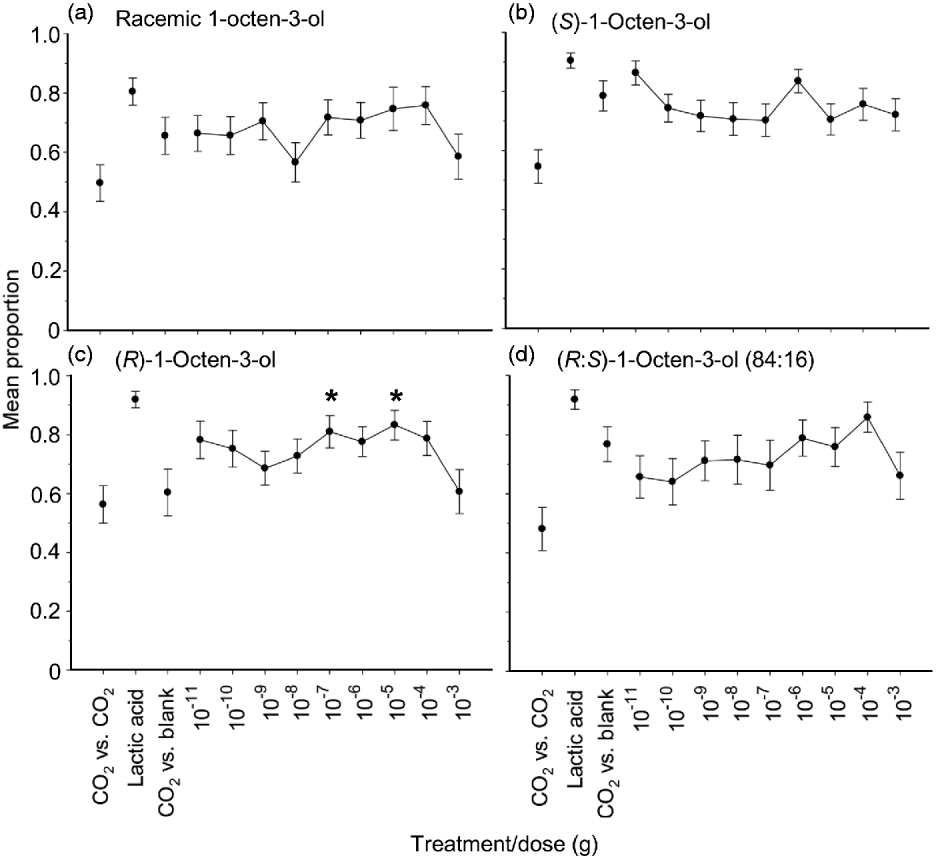
To determine the optimum concentration and composition of 1-octen-3-ol enantiomers to elicit a behavioural response, behavioural bioassays were performed in the laboratory. In all cases, with Ae. aegypti, the positive control (L-(+)-lactic acid+CO2 vs. dH2O) produced significantly greater relative attraction (the proportion of mosquitoes in the arm of the Y-tube containing the test odour stimulus) compared with the CO2 vs. blank control (fig. 2). Relative attraction in response to the (R)-1-octen-3-ol enantiomer was significantly greater than the CO2 vs. blank control for two doses, 10−5 g μl−1 (P=0.019) and 10−7 g μl−1 (P=0.023) (fig. 2c).
Relative attraction of Aedes aegypti female mosquitoes in a Y-tube olfactometer to 1-octen-3-ol treatments (plus CO2) and controls: CO2 vs. blank, CO2 vs. CO2 and L-(+)-lactic acid+CO2 vs. dH2O. Relative attraction is the proportion of mosquitoes that flew upwind and were caught in the capture chamber of the treated arm of the Y-tube olfactometer. (a) racemic 1-octen-3-ol, (b) (S)-1-octen-3-ol, (c) (R)-1-octen-3-ol and (d) (R:S)-1-octen-3-ol (84:16) mixture. Asterisks show statistically significant differences in response compared to the CO2 vs. blank control. (GLM, *P<0.05, n=12).
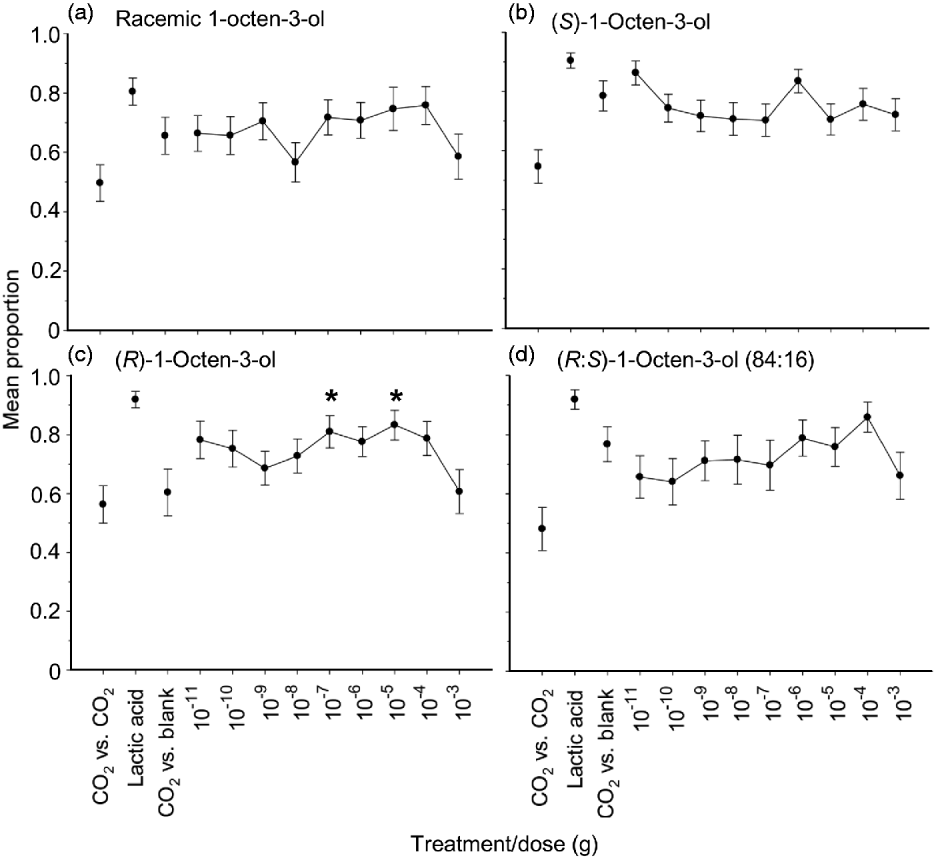
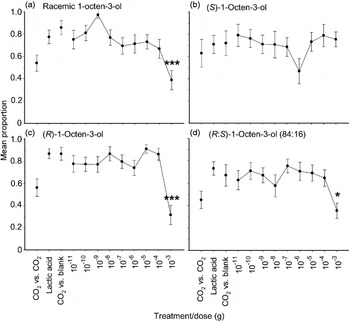
No significant differences were found between the positive control and CO2 vs. blank control for Cx. quinquefasciatus mosquitoes (fig. 3). The (R)-1-octen-3-ol enantiomer caused a significantly lower relative attraction than the CO2 vs. blank control at one dose 10−3 g μl−1 (P<0.001) (fig. 3c). A similar result was noted with racemic 1-octen-3-ol and the (R:S)-1-octen-3-ol mixture (84:16) in which the relative attraction to the 10−3 g μl−1 dose was also significantly lower than the CO2 vs. blank control (P<0.001 and P=0.014, respectively) (fig. 3a,d). No statistically significant differences were found for relative attraction with the (S)-1-octen-3-ol enantiomer (fig. 3b).
Relative attraction of Culex quinquefasciatus female mosquitoes in a Y-tube olfactometer to 1-octen-3-ol treatments (plus CO2) and controls: CO2 vs. blank, CO2 vs. CO2 and L-(+)-lactic acid+CO2 vs. dH2O. Relative attraction is the proportion of mosquitoes that flew upwind and were caught in the capture chamber of the treated arm of the Y-tube olfactometer. (a) racemic 1-octen-3-ol, (b) (S)-1-octen-3-ol, (c) (R)-1-octen-3-ol and (d) (R:S)-1-octen-3-ol (84:16) mixture. Asterisks show statistically significant differences in response compared to the CO2 vs. blank control. (GLM, *P<0.05, ***P<0.001, n=12).

Flight activation
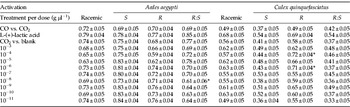
For flight activation (the proportion of mosquitoes that had flown upwind beyond 30 cm in the stem of the Y-tube) with Ae. aegypti, no significant differences were found for the racemic 1-octen-3-ol or either enantiomer when compared with the CO2 vs. blank control (P>0.05) (table 1). The (R:S)-1-octen-3-ol mixture (84:16) showed significantly less activation at 10−8 g μl−1 (P=0.030) (table 1).
Flight activation of Aedes aegypti and Culex quinquefasciatus female mosquitoes in a Y-tube olfactometer to 1-octen-3-ol treatments (plus CO2) and controls: CO2 vs. blank, CO2 vs. CO2 and L-(+)-lactic acid+CO2 vs. dH2O.

Flight activation is the proportion of mosquitoes that were activated and flew upwind leaving the release chamber of the Y-tube olfactometer in response to racemic 1-octen-3-ol, (S)-1-octen-3-ol, (R)-1-octen-3-ol and (R:S)-1-octen-3-ol (84:16) mixture. Data are presented as mean±standard error. Asterisks show statistically significant differences in response compared to the CO2 vs. blank control. (GLM,
* P<0.05, n=12).
With Cx. quinquefasciatus, no significant differences were found for racemic 1-octen-3-ol (P>0.05) (table 1). Activation was significantly greater than the CO2 vs. blank control for (R)-1-octen-3-ol at 10−4 g μl−1 (P=0.027) and 10−6 g μl−1 (P=0.048) (table 1). It was noted, generally, that these mosquitoes elicited a lower activation response compared to Ae. aegypti.
No significant differences between the positive control and the CO2 vs. blank control were noted for either mosquito species in relation to flight activation.
Non-sustained flight activity (NSFA)
In all the experiments with Ae. aegypti, the positive control (L-(+)-lactic acid+CO2 vs. dH2O) produced significantly lower NSFA (the proportion of mosquitoes that had flown beyond 30 cm in the stem of the Y-tube but did not reach the capture chambers at the end of the arms) compared with the CO2 vs. blank control (table 2). The (R:S)-1-octen-3-ol mixture (84:16) elicited a significantly greater NSFA than the CO2 vs. blank control at the 10−7 g μl−1 dose (P=0.011) (table 2). No significance was found when using (S)-1-octen-3-ol (P>0.05) (table 2). The (R)-1-octen-3-ol produced significantly lower NSFA at 10−6 g μl−1 (P=0.017) and 10−9 g μl−1 (P=0.047) (table 2).
Non-sustained flight activity (NSFA) of Aedes aegypti and Culex quiquefasciatus female mosquitoes in a Y-tube olfactometer to 1-octen-3-ol treatments (plus CO2) and controls: CO2 vs. blank, CO2 vs. CO2 and L-(+)-lactic acid+CO2 vs. dH2O. NSFA is the proportion of mosquitoes that were activated and flew upwind leaving the release chamber, however, failed to reach the capture chambers of the Y-tube olfactometer in response to racemic 1-octen-3-ol, (S)-1-octen-3-ol, (R)-1-octen-3-ol and (R:S)-1-octen-3-ol (84:16) mixture.
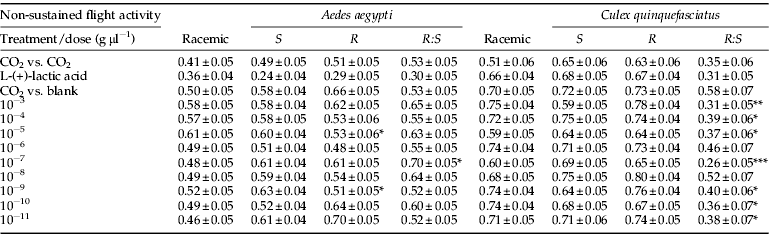
Data are presented as mean±standard error. Asterisks show statistically significant differences in response compared to the CO2 vs. blank control. (GLM,
* P<0.05,
** P<0.01,
*** P<0.001, n=12).
With Cx. quinquefasciatus mosquitoes, the positive control (L-(+)-lactic acid+CO2 vs. dH2O) produced no significant differences in NSFA compared with the CO2 vs. blank control except for the experiment where the 1-octen-3-ol mixture (84:16 R:S) was tested, in which the response to L-(+)-lactic acid+CO2 was significantly lower (P=0.002) (table 2). No significant differences in NSFA were found using the racemic 1-octen-3-ol or the (R)-1-octen-3-ol enantiomer (P>0.05). The (R:S)-1-octen-3-ol mixture (84:16) elicited a significant decrease in NSFA compared to the CO2 vs. blank control at most doses: 10−3 g μl−1 (P=0.003); 10−4 g μl−1 (P=0.035); 10−5 g μl−1 (P=0.03); 10−7 g μl−1 (P<0.001); 10−9 g μl−1 (P=0.05); 10−10 g μl−1 (P=0.026) and 10−11 g μl−1 (P=0.047) (table 2).
Electrophysiology
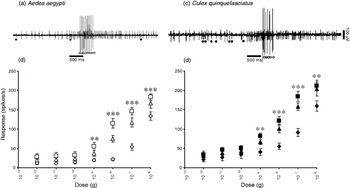
The B cell, i.e. the olfactory receptor neuron with an intermediate amplitude, of the maxillary palp basiconic sensilla of both species responded to racemic 1-octen-3-ol, as well as the two enantiomers in a dose dependent manner (fig. 4).
Dose response relationships for the basiconic sensillum on the maxillary palp in Aedes aegypti and Culex quinquefasciatus female mosquito. 1-Octen-3-ol and its enantiomers elicit dose-dependent responses in the B neuron of basiconic sensilla on the maxillary palp of Ae. aegypti and Cx. quinquefasciatus female mosquitoes. (a), (c) Response of the B neuron to (R)-1-octen-3-ol and the A neuron (open circle) to ambient CO2 trapped in the stimulus cartridge in Ae. aegypti and Cx. quinquefasciatus, respectively. Closed circles indicate the smallest spiking neuron, the C neuron. Unmarked intermediate response spikes are from the B neuron. (b), (d) The B neurons in Ae. aegypti and Cx. quinquefasciatus express significantly higher responses to (R)-1-octen-3-ol as compared to (S)-1-octen-3-ol. (two-way repeated measures ANOVA; *P<0.05, **P<0.01, ***P<0.001). Significant differences are also found between the response to racemic 1-octen-3-ol and its enantiomers (see results), n=10; mean±SEM (◊, S (+)1-octen-3-ol Aedes; □, R (−)1-octen-3-ol Aedes; ∆, (R+S)1-octen-3-ol Aedes) (⧫, S (+)1-octen-3-ol Culex; ▪, R (−)1-octen-3-ol Culex; ▲, (R+S)1-octen-3-ol Culex).

In both species, the B neuron showed a significant difference in selectivity between the enantiomers, with (R)-1-octen-3-ol eliciting a greater response, followed by racemic 1-octen-3-ol then (S)-1-octen-3-ol (fig. 4). For Ae. aegypti, (R)-1-octen-3-ol produced significant differences compared to racemic 1-octen-3-ol at 10−9 g μl−1, 10−8 g μl−1 and 10−7 g μl−1 (P=0.047, P=0.002 and P=0.01); whereas, significant differences were only found at 10−7 g μl−1 (P=0.032) with Cx. quinquefasciatus (fig. 4b, d). In both species, the racemic 1-octen-3-ol elicited a significantly greater response compared to (S)-1-octen-3-ol at 10−8 g μl−1, 10−7 g μl−1 and 10−6 g μl−1 (Ae. aegypti: P=0.0005, P=0.0002, P=0.004; Cx. quinquefasciatus: P=0.001, P=0.0003 and P=0.004, respectively). Similarly, comparison of responses to the enantiomers showed that (R)-1-octen-3-ol produced significantly greater responses in both species at 10−9 g μl−1, 10−8 g μl−1, 10−7 g μl−1 and 10−6 g μl−1 (Ae. aegypti: P=0.003, P=0.0001, P=0.0001, P=0.0008; Cx. quinquefasciatus: P=0.005, P=0.0003, P=0.0001 and P=0.001, respectively). No significant differences were found for any treatments below 10−9 g μl−1.
Discussion
In this study, we investigated the behavioural and electrophysiological responses of Ae. aegypti and Cx. quinquefasciatus mosquitoes to (R)-1-octen-3-ol, (S)-1-octen-3-ol and to mixtures of the enantiomers in combination with CO2. Previous studies have investigated the role of racemic 1-octen-3-ol in mosquito attraction. However, few investigations have examined the effect of the individual enantiomers. In our study, clear electrophysiological and behavioural differences between Ae. aegypti and Cx. quinquefasciatus were recorded in response to the enantiomers.
Aedes aegypti maxillary palp ORNs detected and discriminated between the (R) and (S) enantiomers at a stimulus concentration of 10−9 g μl−1 and above and discerned (R)-1-octen-3-ol from the racemic mixture at concentrations of 10−9 g μl−1, 10−8 g μl−1 and 10−7 g μl−1. However, only the (R)-1-octen-3-ol enantiomer elicited a behavioural response in the form of significant increase in relative attraction and a reduction in non-sustained flight activity for Ae. aegypti. The (R:S)-1-octen-3-ol mixture (84:16), based on ratios from cattle breath (Hall et al., Reference Hall, Beevor, Cork, Nesbitt and Vale1984), failed significantly to attract either species. However, this could be due to the fact that Ae. aegypti would not normally feed on cattle; and, therefore, it is possible that a different species showing a greater preference for cattle (e.g. certain Anopheles spp.) may elicit significant behavioural results (Takken, Reference Takken1991). All treatments had little effect in terms of flight activation; however, it was noted that, across all experiments, Ae. aegypti showed a greater average flight activation compared with Cx. quinquefasciatus. (R)-1-Octen-3-ol, (S)-1-octen-3-ol, racemic 1-octen-3-ol and the mixture of the 1-octen-3-ol enantiomers did not elicit a significant relative attraction by Cx. quinquefasciatus. These results suggest that Ae. aegypti has greater selectivity of the (R) enantiomer at the electrophysiological level and has the most pronounced effect on behaviour, causing activated mosquitoes to sustain their flight and orientate towards the compound. This is the first time electrophysiological selectivity has been shown for a 1-octen-3ol enantiomer in Ae. aegypti in vivo. Bohbot & Dickens (Reference Bohbot and Dickens2009) demonstrated that the in vitro expression of AaOR8 in Xenopus oocytes shows a strong preference towards the (R)-1-octen-3-ol enantiomer, which supports our study.
To our knowledge, no other investigation has examined the effect of the 1-octen-3-ol enantiomers on Ae. aegypti behaviour, and few studies have examined the behavioural effect on other mosquitoes species. In the field, Kline et al. (Reference Kline, Allan, Bernier and Welch2007) demonstrated that traps baited with (R)-1-octen-3-ol, when tested in combination with CO2, caught greater numbers of mosquitoes (Anopheles crucians, Culex salinarius) compared to (S)-1-octen-3-ol, which performed equally or less well than CO2 alone. No significant increase in trap catch of Cx. quinquefasciatus was recorded. Numerous other studies have reported no significant behavioural effects with racemic 1-octen-3-ol and Culex spp. For example, Culex sitiens and Culex annulirostris have been reported to show either no response or a repellent response to racemic 1-octen-3-ol (Kemme et al., Reference Kemme, Van Essen, Ritchie and Kay1993; Van Essen et al., Reference Van Essen, Kemme, Ritchie and Kay1994). In Tanzania, a study using unlit CDC traps and racemic 1-octen-3-ol found that the number of Cx. quinquefasciatus caught did not differ significantly from the unbaited control (Mboera et al., Reference Mboera, Takken and Sambu2000). Similarly, studies of other arthropods have shown a lack of preference for the racemic mixture or enantiomers of 1-octen-3-ol. For example, the bont tick, Amblyomma variegatum, has been shown to display the same orientated movements towards the racemic mixture and (R)-1-octen-3-ol using a servosphere bioassay (McMahon et al., Reference McMahon, Guerin and Syed2001). In a pitfall olfactometer, an equivalent increase in catches of grain beetle, Oryzaephilus mercator, was recorded to the separate 1-octen-3-ol enantiomers and the racemic mixture in comparison to the controls (Pierce et al., Reference Pierce, Pierce, Borden and Oehlschlager1989).
Culex quinquefasciatus mosquitoes possess ORNs that detect 1-octen-3-ol, and these are located in the basiconic sensilla of the maxillary palps (B neuron). In previous studies, the B cells in maxillary palp sensilla have been shown to have remarkable selectivity, being more sensitive to the (R)-1-octen-3-ol enantiomer than the (S) enantiomer (Syed & Leal, Reference Syed and Leal2007). In An. gambiae it is also the B cell that responds to 1-octen-3-ol (Lu et al., Reference Lu, Qiu, Wang, Kwon, Rutzler, Kwon, Pitts, Van Loon, Takken, Carson and Zwiebel2007), which suggests that this olfactory receptor neuron (ORN) could be conserved throughout the mosquito lineage. Indeed, in our electrophysiological experiments with Aedes, we found supporting evidence for this and the B cell responded in a similar manner, discriminating between the (R) and (S) enantiomers at a stimulus concentration of 10−9 g μl−1 and above and discerning (R)-1-octen-3-ol from the racemic mixture at a concentration of 10−7 g μl−1.
Although the (R)-1-octen-3-ol enantiomer caused an increase in activation for Cx. quinquefasciatus at two doses, the most notable effect was that the (R:S)-1-octen-3-ol mixture (84:16) at seven of the doses tested caused significantly more mosquitoes to sustain their flight and reach the capture chambers (demonstrated by a reduced NSFA), suggesting that it may have a behaviourally excitatory effect. Additionally, at the highest concentration, the few mosquitoes that did reach the capture chambers moved towards the control chamber rather than the arm containing the (R)-1-octen-3-ol enantiomer. Interestingly, this reduced relative attraction response was observed for all treatments containing the (R)-1-octen-3-ol enantiomer either on its own or as part of a mixture, but not with the (S)-1-octen-3-ol enantiomer. It is unknown whether this effect is true repellency, as the design of the Y-tube olfactometer bioassay does not allow measurement of such behaviour. Similarly, one laboratory study found that CO2 plus racemic 1-octen-3-ol caused a repellent effect in Anopheles quadriannulatus (Pates et al., Reference Pates, Takken and Curtis2005).
The behavioural differences observed here between Aedes and Culex mosquitoes may be due to feeding preferences as, although both species are known to feed on humans (Takken, Reference Takken1991; Zinser et al., Reference Zinser, Ramberg and Willott2004), Cx. quinquefasciatus can feed opportunistically, and it is preferentially an ornithophilic species (Takken & Kline, Reference Takken and Kline1989). These results are supported by previous research which shows differences in levels of attraction between mosquito species. For example, one study, using modified Fay-Prince traps to test the effects of CO2 and racemic 1-octen-3-ol on catches of Ae. aegypti, found that it had no effect on increasing trap catches over CO2 alone (Canyon & Hii, Reference Canyon and Hii1997). In contrast, other studies, using racemic 1-octen-3-ol with encephalitis vector surveillance (EVS) traps, showed that 1-octen-3-ol combined with CO2 considerably enhanced catches of Aedes vigilax and Aedes funereus (Kemme et al., Reference Kemme, Van Essen, Ritchie and Kay1993; Van Essan et al., Reference Van Essen, Kemme, Ritchie and Kay1994). Using CDC light traps in a salt marsh area of North Carolina, USA, it was found that Aedes sollicitans, Aedes taeniorhynchus, Anopheles bradleyi and Culex salinarius were significantly attracted to racemic 1-octen-3-ol in combination with CO2 and light. Additionally, Anopheles atropos showed a highly significant response regardless of the presence of light. Interestingly, when they repeated the experiment in the creek flood plain, none of the 24 species collected were significantly attracted to racemic 1-octen-3-ol in combination with CO2 and light compared to CO2 and light alone (Rueda et al., Reference Rueda, Harrison, Brown, Whitt, Harrison and Gardner2001). More recently, CDC Fay-Prince traps have been used in Maryland, USA, to test the effects of CO2 and racemic 1-octen-3-ol on catches of Aedes albopictus. It was found that, while traps baited with racemic 1-octen-3-ol and CO2 generally caught more Ae. albopictus mosquitoes, this was not significantly different from CO2 alone (Shone et al., Reference Shone, Ferrao, Lesser, Glass and Norris2003). The reason for such varied responses in field trapping could be due to the fact that the racemic form of 1-octen-3-ol does not provide an appropriate cue and therefore results in inconsistent trap catches.
Conclusion
This study investigated the effects of enantiomers of 1-octen-3-ol using laboratory behaviour bioassays and SSR. In summary, Ae. aegypti mosquitoes differentiate the 1-octen-3-ol enantiomers at the electrophysiological level and make oriented movements towards the (R)-1-octen-3-ol enantiomer and do not respond in the same way to either the (S)-1-octen-3-ol enantiomer or to any mixture tested. Flight activation is little affected by the treatments, although a negative behavioural effect was observed in response to the 84:16 (R:S)-1-octen-3-ol mixture. Therefore, the (R)-1-octen-3-ol could be a more important kairomone and would be the obvious choice for incorporation into a trap for Ae. aegypti. Culex mosquitoes also distinguished between the treatments at the electrophysiological level and appeared to be more sensitive to the (R) enantiomer. However, the associated behavioural response was not characteristic of a kairomone. Instead, the mosquitoes made oriented movements away from the (R)-1-octen-3-ol enantiomer at high concentrations. Although the mosquitoes were also more activated by this enantiomer than the (S)-1-octen-3-ol enantiomer or any mixture tested, this could be due to an excitatory response and is not necessarily conducive to the development of a suitable attractant for traps for this species. The fact that the SSR response of Culex mosquitoes to the (R)-1-octen-3-ol enantiomer plateaued at the highest concentration suggests that the ORNs became saturated, which may reflect the negative behavioural response observed to this compound at the high concentrations. However, it is worth noting that the behavioural response to the CO2 control was high compared with Ae. aegypti even though their overall activation was lower. This could be due to differences in their perception of CO2 (as may be expected due to their feeding habits) and may have masked any fine attractant effects caused by the 1-octen-3-ol treatments tested. Further field evaluation of the enantiomers is undoubtedly required. However, the (R)-1-octen-3-ol enantiomer could be used for selective trapping for research purposes in areas where Ae. aegypti and Cx. quinquefasciatus are prevalent. With some further investigation, it may even be possible to use (R)-1-octen-3-ol to interfere with host seeking behaviour of Cx. quinquefasciatus mosquitoes.
Acknowledgements
This project was supported by a DTI-LINK grant (J0018 K). We thank Stephen Powers for advice on the statistical analysis and Göran Birgersson for technical help. Rothamsted receives grant-aided support from the Biotechnology and Biological Sciences Research Council (BBSRC) of the United Kingdom. This study was also supported by the Linnaeus-program Insect Chemical Ecology, Ethology and Evolution IC-E3.