Introduction
The recent international uproar caused by the publication of the “Muhammad Cartoons”1
Go to http://cagle.msnbc.com/news/BLOG/MuhammadColumn.asp for interesting background information about the issue. This site also con-tains a link to the offending cartoons. Next, go to the home page of this site and click on two groupings of related cartoons, “Pen vs. Sword” and “Cartoons about the Muhammad Cartoons,” to review the chain reaction the publication of the 12 cartoons triggered. Accessed 5/11/2006.
Political cartooning during President Suharto's 1966–1998 rule was a risky business. Anyone who dared to criticize the military in general or General Suharto in particular risked serious consequences. Two examples are illustrative. At a conference in 1999, I talked to featured speaker Wimar Witoelar, who was then best known as the Larry King of Indonesia because of his award-winning TV talk show. I suggested that he devote a program to editorial cartoons because I had found them to be such provocative discussion starters in my classes. Wimar immediately responded that he already knew very well how provocative cartoons can be—he was once arrested and briefly jailed for distributing copies of cartoons that some of his university student friends had created!2
Indonesian Studies Conference, “Orders: The Old, The New and The Next,” University of Oregon Center for Southeast Asian Studies, July 16–17, 1999.
“Cartoonist Taken off Wanted List,” Jakarta Post, June 11, 1998. www.lexis-nexis.com, accessed 5/9/2006.
Since 1997, I have collected and researched the work of over a dozen cartoonists concerned with events in Indonesia. The purpose of this article is to present three lessons I have learned through study of this collection that are relevant to the issues raised by the “Muhammad Cartoons” controversy in particular, and the state of the editorial cartoon in general.
Lesson #1: The Prophylactic Value of Subtlety and Ambiguity
I first learned the value of subtlety and ambiguity in the risky business of expressing one's political opinions by creating and distributing cartoons in Indonesia when I purchased Bali Dalam Kartun, a book of cartoons published by Wayan Gunasta Pendet (1997). The day after I purchased the book from a tall stack of over a hundred copies, I discovered that my copy was missing pages 35 through 70, which the Table of Contents indicated contained cartoons in the categories of politics and economics. When I went to return my defective copy for a complete one, I discovered that every copy was missing the same two sections.
My suspicion of government censorship was confirmed when I visited the publisher's headquarters. Dozens of books were on display, but not the cartoon book. When I asked for it by title the clerk first checked to be certain no one else was present in the showroom, then disappeared into a back room. Minutes later he returned with a book securely wrapped in plain brown paper and rang up the sale. I doubt that any connoisseur of pornography has ever gotten as great a thrill as I did when I unwrapped the book and studied those missing pages.
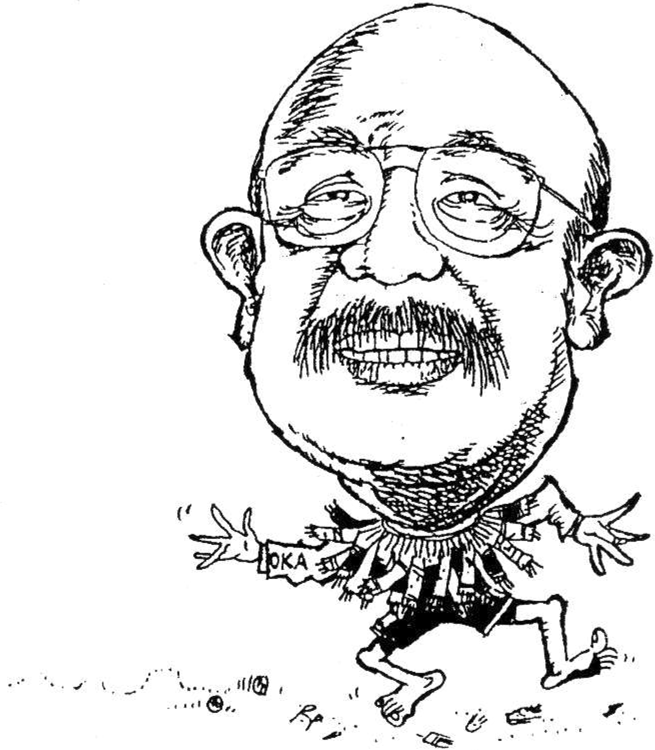
Later, however, I discovered that the most critical cartoon in the book was one that the censors (and I) had missed, perhaps because it was on page 129 in a section of caricatures of Balinese men. The sketch of Bali's Governor Oka depicts him as a traditionally dressed dancer (Figure 1). Its subtle political message is communicated by the extremely small drawing of Rp (for rupiah, the Indonesian currency) coins and bills being tossed at the dancer's feet, as one might expect from members of an appreciative audience. I didn't fully understand this cartoon until I read a paper by Carol Warren (1996), which reports that whenever Governor Oka was seen on television or his name was mentioned, some Balinese would shout “O.K.! Oka” because he “ok'ed every development project that came down from Jakarta.” Clearly, any Balinese who noted the money being thrown at Oka's feet in this cartoon would understand that it was not his dancing ability that was being rewarded, but rather his approval of controversial tourism megaprojects, such as those known by the initials BNR and GWK, that significant groups of Balinese protested because of religious, environmental, and other concerns.

Used with permission.
President Suharto rewarded the performance of Governor Oka with appointments to the central government positions of minister of population and chairman of the National Family Planning Board. Three years after Suharto's fall, however, Oka was finally arrested on corruption charges. The Bali Corruption Watch chairman lamented that “most of his policies did grave harm to the people of Bali” and noted that because Oka had been “the most untouchable man in Bali” when Suharto was in power, his arrest was “a good example that the legal system in Bali is now working.”4
“Oka's Arrest: Supremacy of Law ‘still Respected in Bali,’ ” Jakarta Post, July 13, 2001. www.lexis-nexis.com, accessed 5/4/2006.
People having money or political connections rarely get convicted in Indonesia; Governor Oka has both. This reinforces the accuracy of the annual corruption index at www.transparency.org, which has always ranked Indonesia among the 10% most corrupt countries.
Pendet's subtle, ambiguous, and humble style not only kept him out of trouble during Suharto's repressive rule, but earned the gratitude of his country. No other political cartoonist I know of has been honored by his country with a postage stamp.
Lesson #2: Don't Count on Fooling All the Censors All the Time
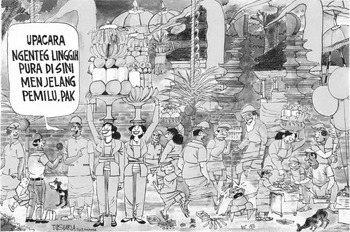
Before the cartoon exhibition at the 1997 Bali Arts Festival was allowed to open, military censors removed a number of the over 60 cartoons that had been hung on the walls for display and sale. I liked Tusuaria's cartoon (Figure 2) because it was dominated to an extreme by the color yellow, which was strongly associated with Suharto's Golkar political party—in contrast to the green of the Islamic party and the red featured by the third party allowed to compete in the elections of the Suharto era. The strong association of these three colors with the three competing parties led to the outbreak of the “color war,” which began after some white government buildings were painted yellow by the government-supported Golkar party. The two other parties complained that this “yellowization” campaign was unfair, but to little avail. Supporters of the opposition parties retaliated by surreptitiously repainting the yellowized buildings green or red to demonstrate their own prowess. Imagine the outcries in the U.S. if the Republicans had the White House painted red and the Democrats retaliated and repainted it blue just before the next elections!

Cartoon by “Tusuaria.” Original in author's collection. Used with permission.
Pleased that the censors allowed this cartoon reference to the “yellowization” campaign controversy to remain in the exhibition, I decided to buy it. While paying, I asked the young man at the desk to help me translate what the Balinese villager was saying to the interviewer holding the microphone. Suddenly his English became very weak compared to what I had overheard him saying to other customers when I had entered the building. Back at my hotel, I consulted my Indonesian language dictionary to confirm that the villager was telling the reporter that this particular Hindu temple ceremony (for which elaborate offerings of food and drink are prepared to attract the gods to the temple and make them happy so they will stay longer and bring more blessings to the worshippers in the future) was being held for the coming national elections.
I finally realized that the censors goofed by not removing this cartoon from the exhibition. A knowledgeable observer would understand that the artist is showing that the real function of elections in Suharto's Indonesia was not to select which political party's leaders would govern the country. Instead, the purpose was merely ceremonial, like the annual Hindu temple festivals. The people propitiate the god-like Golkar Party leaders with offerings (i.e., votes), which will make them happy and thus motivate them to bestow blessings (e.g., development projects to villages, government licenses and permits to individuals) in return.
This interpretation is reinforced by the inclusion of a Hindu priest who looks like Santa Claus. The implication is that if the voters behave and vote correctly, they will be given presents in return. The Suharto regime's top political leader in Serang, West Java, was not subtle about this “presents in return for votes” election ceremony. He promised to give three goats to any precinct in which 100% of the votes were for Suharto's Golkar Party. If all the precincts in a village voted 100% for Golkar, the reward would be three water buffalo. If a whole subdistrict of villages delivered a 100% victory to Golkar, it would be given three motorcycles. This strategy worked, especially in the Carenang subdistrict in which all 20 precincts in all four villages voted completely for Golkar. Overall, Golkar raised its share of the votes from 57% in 1992, to 72% in the 1996 election.6
“Serang Residents Seek Gifts for Voting Golkar,” Jakarta Post, June 3, 1997. www.lexis-nexis.com, accessed 5/1/2006.
On my next annual visit to Bali, I discovered that the man at the exhibition sales desk was one of the island's most active cartoonists. He seemed relieved when I gave him my business card and a copy of one of my publications. At our third meeting another year later, he finally confided to me that he had become very worried when I had asked him to help me translate the cartoon. In fact, he feared that I was a CIA operative who understood how the cartoonist was attacking the Indonesian government and was buying it as evidence to turn over to the Suharto regime. He was so worried that as soon as I left he called his cartoonist friend to warn him that his cartoon had been discovered and thus might want to go into hiding!
Lesson #3: The Need for Awareness of Significant Cultural Sensitivities
That even foreign cartoonists could not always avoid serious retaliation by Suharto's authoritarian regime is illustrated by a Peter Nicholson cartoon published in the Australian newspaper on October 18, 1997. It pictured President Suharto as an orangutan swinging through a rainforest tree under the label, “Endangered Species.” Beneath him was a forest fire labeled “Corrupt Economics.” This cartoon analogy proved to be accurate in two ways. First, the orangutans of Indonesia suffered greatly in 1997 as drought-aided forest fires (set primarily by plantation workers ordered to cheaply but illegally clear more jungle land) killed many of these primates and deprived even more of the habitat this endangered species requires for survival. Second, Suharto was pressured to resign seven months later as a result of the public response to government-orchestrated violence in the capital of Jakarta against students and many Chinese minority residents protesting against his corruption, collusion, and nepotism.
I wrote Nicholson to obtain a copy of the cartoon (and permission to use it) plus ask about the uproar it created. His reply (Nicholson 1999) highlights how critical it is that cartoonists and their editors are aware of important cultural sensitivities, and thus merits quotation at length:
The story of this cartoon shows you the type of random accident that can determine the content of a newspaper, however reputable!
I had quite a prolific day and sent up a few ideas to our Sydney office (I work in Melbourne). The orangutan idea was among them. At their editorial meeting in Sydney our Chief-of-Staff, who had spent a lot of time in Indonesia, made the comment that we shouldn't use the orangutan idea as it would be deeply offensive to many Indonesians because the Dutch used to call the Javanese “monkeys.” The word obviously had strong racist overtones to the Javanese.
The editorial meeting suggested I use one of the other ideas, which I did, but no one relayed on to me the comment about the racism overtones. I was blissfully unaware of this—I draw politicians as monkeys all the time, and in the context of drawing Suharto the possible racist overtone simply didn't occur to me.
Anyway some days later I revisited the topic and thought I would use the idea. On that day the Editor went overseas, and the Editor-in-Chief came back from overseas. He hadn't been at the original meeting. He saw my “rough” on his desk and approved it. So I went ahead and drew it up, and in the paper it went.
Nicholson continues by explaining that apparently someone in the Presidential Palace saw the cartoon and showed it to someone in Suharto's family, if not Suharto himself, and “the next thing we heard was that they were going to close our (very important) Bureau in Jakarta and expel our correspondent (and my close friend) Patrick Walter.” The damage control efforts that followed included those of Australia's foreign minister trying to “cool the wrath of the Palace and assure them that we drew politicians as monkeys all the time” and the editor-in-chief flying to Jakarta to talk to Indonesia's foreign minister. In the end, Nicholson continues, “We kept our Bureau, and I was hailed on a TV program as a brave hero fighting the good fight against totalitarianism—none of which I particularly deserved.” Nicholson concludes by noting that he would have been quite happy to pull the cartoon.
In summary, Nicholson would not have drawn Suharto as an ape if he had known of the Indonesians' colonial and racist cultural sensitivities, felt undeserving of his TV program fame as a brave hero fighting totalitarianism, and felt guilty about jeopardizing his newspaper's important bureau in Indonesia and his friend's career as a correspondent there. Clearly, Nicholson is a good role model for the qualities a cartoonist should have in our twenty-first-century world of tender racial, religious, and cultural sensitivities and the dangerous and destructive reactions that can result from upsetting them.
Concluding Comments
Comments by Wimar Witoelar (the Indonesian jailed for selling cartoons mentioned in the Introduction) on the “Muhammad Cartoons” controversy merit consideration because he learned to love Denmark and its people when he lived there as an eight to 12 year old and is now a respected political commentator in Indonesia, the world's most populous Islamic country.
In a Jakarta Post article,7
“As far as I Remember Denmark is Very Tolerant,” Jakarta Post, February 15, 2006. www.lexis-nexis.com, accessed 5/9/2006.
Next, Wimar states that he does not think the Danish cartoonists “are that guilty” because “they make their living trying to be funny. They will draw anything to make people laugh and make themselves a bit of money.” Indeed, since editors make the final decisions it is reasonable to consider them guiltier than the cartoonists when serious problems and damages result.
Wimar continues by castigating the editors of Jyllands-Posten, the offending Danish newspaper which solicited the “Muhammad Cartoons,” for not having “better sense.” Perhaps a list of cultural sensitivities experts (including email addresses and phone numbers) should be posted in every editorial office. Since cartoonists are very creative people they can usually express an opinion in several alternative drawings (as Nicholson's letter indicates), and thus make their political points in less incendiary but still very effective ways.
Wimar's final opinion that merits comment here is that editors should publish newspapers “to inform and to enlighten, not to demean and to endanger.” This is an increasingly idealistic goal given the present trends of local newspapers being bought up by giant media companies and the declining number of newspaper subscribers. The plight of U.S. cartoonists in these changing conditions is presented by Chris Lamb (2004) in Chapter 5, “Second-Class Citizens of the Editorial Page,” and Chapter 6 “We Certainly Don't Want to Make People Uncomfortable Now, Do We?” of a very informative and entertaining book that is essential background reading for anyone concerned about the current state of the editorial cartoon in the U.S.
My final conclusion is really a prediction about the future state of editorial cartoons: they will even more often become dangerous catalysts in emotionally charged political controversies—especially international ones. This is due both to the expansion of their reach through the increasing ease of transmitting these drawings around the world, thereby enabling millions of people to view them, and to the many well-publicized protest reactions that the wide distribution of the “Muhammad Cartoons” generated.
For example, as I was struggling to complete this article before the submission deadline, my wife handed me the May 12 edition of the International Herald Tribune. On page 3, an article by Matthew Brunwasser, “Bulgaria tries to contain new cartoon uproar,” caught my eye. It and two other articles8
“Kadhafi Cartoons Strain Bulgaria-Libya Relations ahead of Nurses Retrial,” Agence France Press, May 3, 2006. www.lexis-nexis.com, accessed 5/21/2006; and “Bulgaria's Gadafy Cartoons Rankle ahead of Nurses' Trial,” Irish Times, May 9, 2006. www.lexis-nexis.com, accessed 5/21/2006.
- Five Bulgarian nurses (who have already spent seven years in a Libyan prison) were sentenced to death in 2004 for “knowingly” injecting at least 426 children with HIV-contaminated blood at a Libyan hospital. Some of the nurses have claimed they were tortured into confessing.
- They appealed their conviction on the basis of an investigation by “international medical experts” that concluded that the HIV outbreak began before the nurses had even arrived at the hospital.
- The nurses were granted a new trial scheduled to begin on May 11, 2006.
- On May 3, however, a Bulgarian newspaper published a dozen cartoons that mocked Libyan leader Muammar Abu Minyar al-Qaddafi and called for him to “realize the monstrous absurdity” of the trial.
- The Libyan embassy in Sofia complained that the cartoons were “humiliating and offensive,” and a group of Arab ambassadors stationed there interpreted them as “anti-Libyan and anti-Islamic.”
- Three of the most offensive cartoons were described as: a veiled Islamic woman with a condom over her head, Qaddafi as a trident-wielding devil standing over a boiling cauldron of blood-red soup that had nurse hats floating in it, and Qaddafi writing a thank-you note (for “quiet diplomacy”) to Bulgaria with a picture of a hangman's gallows in the background.
- The editor of the Bulgarian newspaper not only strongly defended his decision to publish the cartoons (“There is no real justice in Libya, and we hope that the international media community will shine light on this trial.”) but also sent the cartoons to all of the newspapers (about 100) that had reprinted the infamous “Muhammad Cartoons.”
- Libya has suggested that the nurses may be freed if €4 billion is paid to the relatives of the victims. Also, there had been speculation that, as part of a deal, Bulgaria could forgive the €41 million Libya owes for Soviet-era loans.
- Negotiations involving Bulgaria, Libya, the UK, and the U.S. were taking place in an attempt to find a diplomatic solution.
- A Bulgarian foreign ministry spokesman criticized his country's newspaper by stating: “It is unacceptable to use this freedom to instill a religious intolerance uncharacteristic of the Bulgarian people.”
In summary, this festering international issue between Libya and Bulgaria was seriously complicated by the Bulgarian newspaper's publication and wide distribution of the provocative cartoons. Clearly, its editor and the cartoonists are guilty of ignoring the #1 and #3 lessons presented in this article. Although the state of editorial cartooning could be made less risky by applying the simple lessons I have gleaned from the experiences of editorial cartooning in Indonesia over the past decade, it appears more likely that editorial cartooning will continue its current trend of becoming an even riskier business—particularly when emotional international issues are involved.