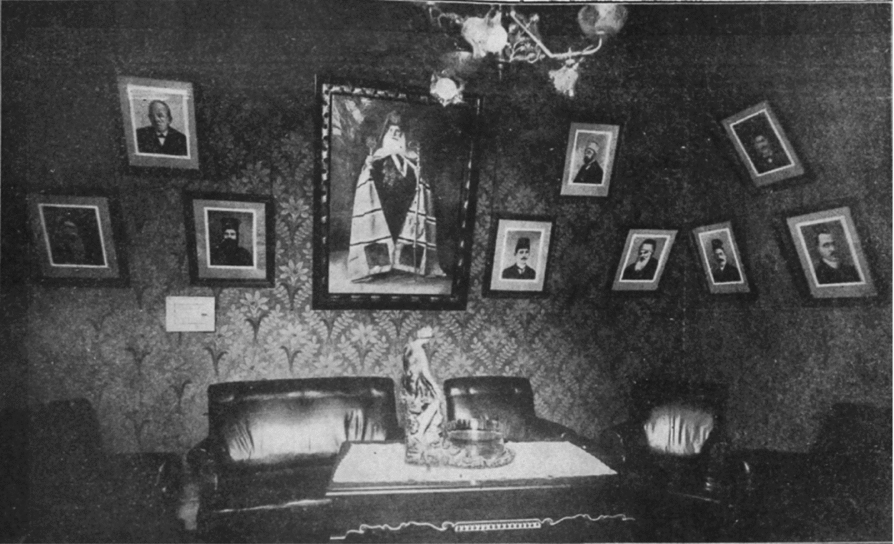
On 2 May 1920, al-Nadi al-Homsi (the Homs Club) opened its doors on Rua 25 de Março in the heart of São Paulo's Syrian neighborhood. Surrounded by textile merchants, ethnic grocers, and itinerant peddlers returning from the Brazilian interior, al-Nadi al-Homsi was a fraternity (futuwwa) for young men of a certain level of education, piety, and patriotism. The club provided a space for civilized leisure and refuge from the Syrian neighborhood's bustling commerce, and its members cultivated a careful respectability centered on the preservation of Syrian literary traditions, charitable work, and the training of the body through sport. At al-Nadi al-Homsi's opening celebration, one of the organization's founders, Syrian intellectual Jurj Atlas pronounced, “this nādī would not be a brotherhood but for the society [mujtamaʿ] that exists within it.” He noted a series of portraits of prominent nationalist personalities from the city of Homs adorning the clubhouse's walls: ʿAbd al-Massih Haddad, ʿAbd al-Hamid al-Zahrawi, Orthodox Bishop Athanasius ʿAtallah, and Shaykh Ibrahim al-Hourani (see Figure 1).Footnote 1 Atlas continued: “fraternity is what happens when its brothers return to this space . . . you are all sons of madīnat al-ḥarāra,Footnote 2 and the eyes of its shaykhs look to you. Illuminate the winter of their lives with your youthful vigor, shining like rays of sun.”Footnote 3
Al-Nadi al-Homsi's Sitting Room, 1920. Portraits include, in the center, Bishop Athanasius ʿAtallah; top from left, Ibrahim Hourani, ʿAbd al-Hamid al-Zahrawi, Yusuf Shahin; and bottom from right, ʿAbd al-Massih Haddad (1), Hanna Khabbaz (2), Rafiq Rizq Sallum (4), ʿIsa Asʿad (5). Source: Al-Nadi al-Homsi, al-Nadi al-Homsi: Haflat al-Tadshin wa-l-Yubil al-Fadi: Musadarat bi-Fadhlaka Tarikhiyya (São Paulo: Dar al-Tibaʿa wa-l-Nashr al-ʿArabiyya, 1946), 15.

Within the halls of al-Nadi al-Homsi during the 1920s and 1930s, young Syrian men worked out new definitions of patriotic masculinity. Young men of up to twenty-eight years of age from bilād al-shām could join if they accepted the club's mission: the disciplining of body and mind, participation in a secular patriotic ethos stressing anticolonial unity, and a devotion to philanthropy as the primary work of the nation. The fraternity got its name from the oft-repeated saying that “the Homsi is strong in tradition,” a notion that prevailed among Syrians both at home and in the mahjar (diaspora). Al-Nadi al-Homsi saw its role as giving young men an Eastern cultural education, raising them into men with a strong national tradition.Footnote 4
Founded just weeks before the 1920 Battle of Maysalun that extinguished Amir Faysal's Arab nationalist government based in Damascus, al-Nadi al-Homsi sat within a transnational constellation of clubs spanning the entire Syrian mahjar. Drawing on existing networks of philanthropy and patronage, the fraternity initiated a program of cultural reform aimed squarely at remaking a patriotic Syrian manhood. The project had its intellectual origins in Ottoman Syria's last constitutional period (1908–13) and evolved with the rise of Hashimite Arab nationalism during World War I and with the subsequent emergence of anticolonial Syrian nationalism during the early French Mandate. Through charitable work, moral training, intellectual self-improvement, and physical challenge, al-Nadi al-Homsi charged young men with taking the mantle of an enlightened Syrian manhood, rendered simultaneously in paternalist and patriotic terms. Using materials culled from al-Nadi al-Homsi's library (established in 1923), from the personal libraries of the club's founders, and from Syria's diasporic press, this article traces al-Nadi al-Homsi's history during the 1920s and early 1930s.Footnote 5 It argues that the fraternity undertook a transnational cultural mission to make Syrian men, striving through philanthropy, social activism, and education to develop strong Syrian minds and bodies, which the club's founders hoped would lead to the liberation of the Syrian homeland.
Mass emigration from Syria and Mount Lebanon began as early as the 1870s, and as sizeable numbers of migrants arrived in the Americas, large ethnic “colonies” (jāliyyāt) emerged in New York City, Buenos Aires, and São Paulo.Footnote 6 An estimated 107,000 emigrants from bilād al-shām arrived in Brazil between 1870 and 1930, and São Paulo's Syrian colony on Rua 25 de Março became the country's largest Syrian urban enclave, a hub for new social institutions that rose to meet the needs of a swiftly transnationalizing community.Footnote 7 Banks, employment agencies, welfare societies, and periodicals saw to the continuous circulation of migrants, money, and ideas across the mahjar. New Syrian economies emerged in shipping, the sale of textiles and coffee, and the celebrated practices of pack peddling and small-scale retail.Footnote 8
The economic success of Syrians living abroad fueled continued emigration and contributed to the growth of a transnational middle class capable of using its financial influence to affect change in the homeland. The mahjarī bourgeoisie aspired to develop both Syria and its diaspora through philanthropic giving and the building of institutions like schools, orphanages, and printing houses. Through education and the provision of needed philanthropic services, Syrians abroad envisioned their work as uplifting, advancing, and liberating Syria and Syrians through public social reform.Footnote 9 Major Syrian printing houses emerged in São Paulo, Buenos Aires, and New York City in the 1890s, and newspapers subsequently became a favored medium for reformers seeking a public platform.Footnote 10 The production, consumption, and discussion of political dailies set a rhythm for middle-class male sociability, and participation in the newspaper industry became a mark of cultural sophistication.Footnote 11 During World War I, the earliest Syrian and Lebanese political committees operated alongside (and often coordinated with) major Syrian printing firms, and newspapers constituted major sites for critiques of, and opposition to, the Ottoman state.Footnote 12 The concurrent explosion in Syrian and Lebanese welfare societies, philanthropic institutions, schools, and orphanages abroad is best understood within the context of transnational class formation in general and within the mahjar's growing demands for social services and political enfranchisement in the homeland in particular.
Shifts in gender codes and family structures accompanied the rise of the mahjar's middle class, and were influenced both by the experience of Syrian immigrants in the Americas and by the development of an Arab feminism in the women's press.Footnote 13 Historians of the mahjar have detailed distinctly female patterns of migration, work, and transnational activism into the interwar period, demonstrating that migrant women were active agents in Syrian and Lebanese transnational economies (as factory workers, peddlers, philanthropists, and entrepreneurs) and in the construction of a new moral order centered on modernity and respectability.Footnote 14 Fewer studies concentrate on masculinity in the mahjar or on its influence on Syrian political culture. This article argues that during the early Mandate period, Syrian men and boys became critical subjects for a nationalist social reform project that was inherently transnational. Borrowing Nina Glick Schiller's definition of second-generation transnationalism to include the “entire generation in both homeland and new land who grow up within transnational social fields,” this article shows that the project of making Syrian men depended on philanthropists and institutions in Homs and São Paulo, and was targeted at young men and boys living both at home and in the diaspora.Footnote 15
AL-NADI AL-HOMSI'S ORIGINS: HOMS REACHES BEYOND THE SEA
The city of Homs enjoyed an unprecedented period of growth in the early 20th century, fueled by a flourishing weaving industry. The various facets of Homs’ textile industry—the investment of capital, the production and shipping of bulk cloth, piecework and sale of ready-wear garments—linked the city to Syria's diaspora, reinforcing patterns of chain migration whereby men, boys, male cousins, and uncles selectively emigrated along routes determined by patterns of employment, credit, information, and trust.Footnote 16 Although they comprised only one-third of the city's population, Homsis from the Greek Orthodox and Syrian Protestant communities emigrated in the largest numbers, working as weavers, wholesalers, and merchants of cloth.Footnote 17 The influx of Homsis into São Paulo encouraged that city's own boom in cotton textiles. When Syrian-Lebanese cotton mogul Nami Jafet opened his 1,000 loom factory in 1907, he relied primarily on weavers and journeymen from Homs.Footnote 18 By the 1930s, seventy-three Syrian textile factories operated in Brazil, comprising 80 percent of the Syrian immigrant community's total industry.Footnote 19
As a human network of weavers and cloth traders linked Homs to São Paulo, a remittance economy emerged which included new transnational patterns of private investment in Syrian philanthropic societies, schools, and orphanages. Donations and capital bound for charitable causes flowed not only from the diaspora homeward but also from Syria into the American mahjar. In Homs, the Orthodox Church took particular interest in developing philanthropic infrastructure abroad, especially under Bishop Athanasius ʿAtallah and his colleague, the priest ʿIsa Asʿad. Born in Shwayfat and educated in Suq al-Gharb (in present-day Lebanon), Athanasius ʿAtallah arrived in Homs in 1886 after a succession of clerical posts in Istanbul, Latakia, and Mar Ilyas.Footnote 20 A man of the nahḍa, Bishop ʿAtallah firmly believed in the power of education (both religious and secular) to foster social and political progress, and he founded dozens of schools, hospitals, charities, and workers’ education programs across Syria.Footnote 21 In 1908, he supported the Young Turk revolutionaries and swiftly refocused his efforts on building a network of constitutionalist patriotic clubs across Syria and its diaspora. In Homs, he endowed the Jamaʿiyyat al-Rabita al-Adabiyya, a youth group led by ʿIsa Asʿad with the mission to create an empowered male citizenry among the city's middle class. From Homs, ʿAtallah and Asʿad seeded several more charities and patriotic clubs in the mahjar: the Jamaʿiyyat al-Shabiba al-Homsiyya in Argentina and Chile (in 1908 and 1909, respectively), Homs al-Fatat in São Paulo (in 1912), and finally, al-Nadi al-Homsi in 1920. Neither priest ever visited South America, but as their network of Homsi clubs expanded, ʿAtallah's project of making Syrian men found expression within a transnational space between Homs and its communities abroad.
With the beginning of World War I, ʿAtallah's patriotic clubs served important social and political functions. Each branch provided charitable assistance, education, and social services to Syrian emigrants, while also remitting donations to Homs. They also provided political support for the Syrian constitutionalist cause, first under the Ottoman banner (1908–13) and then under Amir Faysal (1916–20).Footnote 22 The war was a catastrophe for Homs, but an important watershed moment for Syrian activism in the mahjar. In 1915, Ottoman general Cemal Pasha occupied Syria and forced Homs’ civilian government into exile. Bishop ʿAtallah and ʿIsa Asʿad watched helplessly as their schools and hospitals were requisitioned by Ottoman troops and the Jamaʿiyyat al-Rabita al-Adabiyya banned and pushed underground.Footnote 23 As the fatal realities of military government, famine, and disease set in, ʿAtallah and Asʿad joined a clandestine branch of Amir Faysal's Arab Revolt, laying the ground for a general uprising in Homs upon the arrival of Hashimite Arab forces.Footnote 24 They encouraged Homsis around the world to join their movement by raising money and material relief for the homeland, petitioning foreign governments in support of the Arab Revolt and, where possible, enlisting in the armed forces to liberate the homeland.
Cemal Pasha's mass hanging of Syrian journalists and reformers on 6 May 1916 marked a major turning point in the war, fundamentally altering Syrian opinion of the Ottoman government in the diaspora. ʿAtallah's societies abroad sprang to action, funneling young emigrant men into the French infantry. Hafiz Khizam, a peddler living in São Paulo, was the first to join up; one of the Bishop's clandestine organizations, Homs al-Fatat, paid his passage across the Atlantic.Footnote 25 The following year Syrians from across South America joined the Legion d'Orient, a French-led irregular unit comprised of Syrian and Armenian emigrants seeking to liberate their homeland from Ottoman rule.Footnote 26 The short-lived alliance between Syria's nationalist movement and the French Foreign Ministry would fall apart after 1918, but during the war the Syrians of Brazil provided a critical source of material support for the Allied Powers as they engaged Ottoman soldiers in the Levant.Footnote 27
With the liberation of Homs on 2 October 1918, Amir Faysal appointed ʿIsa Asʿad the official representative of the city's Orthodox Christians. With government support, Bishop ʿAtallah reopened the Jamaʿiyyat al-Rabita al-Adabiyya as a mouthpiece for Homsi youth living at home and abroad.Footnote 28 Empowered by this turn of events, a new political culture grew up between Homs and its mahjar through the fraternities they shared. As Faysal spent 1919 shuttling between Damascus and Paris suing for Syria's complete independence (al-istiqlāl al-tāmm), Syrian intellectuals abroad set about defining their national community and its development. They equated the work of nation-building with the moral, intellectual, and physical development of Syrian men, their masculinity, and their placement at the head of a paternalist social order.Footnote 29 This vision wedded Syrian masculinity to desires for territorial liberation, cultural renewal, and parliamentary democracy. As these thinkers associated masculinity with national strength, boys became subjects of social reform.
In July 1920, just six weeks after al-Nadi al-Homsi opened its doors for the first time, the French soundly defeated Faysal's troops at the Battle of Maysalun.Footnote 30 But rather than extinguishing the diaspora's nationalist aspirations, the independence movement's suppression at home only stoked patriotic flames abroad. Al-Nadi al-Homsi became an experiment in generating a patriotic male class that demonstrated intellectual, physical, and political sovereignty, with the utopian goal of returning to Syria to reignite the cause of Syrian unity and nationalism.
The image of the able-bodied male patriot as the ideal combatant of Western imperialism circulated in the Syrian press at home, in Egypt, and in the American mahjar from 1919 through the 1930s.Footnote 31 Linked to larger ongoing discussions around social eugenics, al-Nadi al-Homsi's project had two broad goals. The fraternity focused first on Syrian children, particularly orphans, as potent symbols of the nation, its peril, and its future. Al-Nadi al-Homsi and its members built orphanages in both São Paulo and Homs, devoting volunteers and services to raising children who had lost their parents during World War I and the 1920 war of French occupation. Provisioning for orphans became a nationalist duty for Syrian men specifically. Mentoring Syria's orphans not only restored hope in Syria's future by saving a generation of children poorly served by colonialism but also provided the Nadi's young men with moral training and preparation for their future roles as fathers of the nation.
Al-Nadi al-Homsi was similarly invested in making Syrian men through a rigorous program of moral, intellectual, and physical self-improvement. The fraternity stressed a holistic balance between an active intellectual life, moral health, and corporeal discipline through sports. Each of these faculties would produce the modern Syrian male, which the fraternity believed presaged Syria's political independence. To this end, al-Nadi al-Homsi built a library for the colony and held lectures, poetry readings, and theatrical performances, which all nurtured Syrian ethnic identity and offered anticolonial readings of events back home. At the same time, the club supported physical education and maintained a masculine physical culture that drew analogies between strong bodies and national self-determination.
AL-NADI AL-HOMSI'S FORMATIVE PERIOD
In order to found a patriotic fraternity in a Syrian colony he had never seen, Bishop Athanasius ʿAtallah required local contacts. He found them in two Homsi emigrants of very different backgrounds: Bishara Mahradawi and Jurj Atlas. An Orthodox wholesaler, Bishara Mahradawi had a longstanding relationship with the bishop in Homs. Mahradawi moved to São Paulo at the turn of the century, where he struck success as an importer. In his store on Rua 25 de Março, he sold silk and cotton textiles, sewing notions, and ready-wear clothing; on the side, he extended credit to new Syrian immigrants.Footnote 32 In many ways, Mahradawi epitomized the success story that kept bringing Syrians across the seas. He believed firmly in assisting his stifled homeland and his Orthodox Church; for example, in 1909, he sent his home city an old Arabic printing press that he had purchased from a defunct Syrian newspaper in Brazil. Mahradawi hoped that the press could serve the causes of Syrian patriotism and transnational activism in Homs.Footnote 33 Bishop ʿAtallah entrusted it to the Jamaʿiyyat al-Rabita al-Adabiyya, which founded Homs newspaper, the city's first patriotic weekly.
For Bishara Mahradawi, the move to the mahjar was a savvy business move, but his contemporary, Jurj Atlas, had settled there quite by accident. The son of Mikhaʾil Samʿan Atlas, a Protestant convert who had assisted Ahmad al-Shidyaq in translating the Bible into Arabic in the 1850s, Jurj Atlas had received an American missionary education which took him from Homs to Suq al-Gharb, Tanta, and finally to Oxford, where he attended university.Footnote 34 Atlas worked briefly in London before returning to Homs to marry and strike out a path as a journalist. In 1914, he married Salwa Salama Atlas; the couple was in Brazil on honeymoon when World War I began. Unable to return home, they permanently resettled in São Paulo and integrated themselves into the colony's social elite. They established al-Karma, a literary magazine that included translations of European philosophers, discussions of Syrian politics, church news, and reports on pedagogy, science, and medicine. The magazine later served as al-Nadi al-Homsi's official organ.Footnote 35
In his spare time, Jurj organized politically with Homs al-Fatat.Footnote 36 Al-Nadi al-Homsi's clearest predecessor, Homs al-Fatat was a pro-Hashimite fraternity for young men in São Paulo that advocated revolutionary action against the Ottoman state.Footnote 37 Atlas combined his interests in youth education with his knack for political activism as Homs al-Fatat's mentor. When in 1916 Atlas learned that an acquaintance of his from home, the Ottoman parliamentarian ʿAbd al-Hamid al-Zahrawi, had been among those martyred by Cemal Pasha, Jurj responded by founding a political magazine called al-Zahrawi which carried the tagline “independence or death.”Footnote 38 He called for Syrians to “break the Turkish yoke” by joining the Legion d'Orient and rising in revolt.Footnote 39 Atlas supported the Arab Revolt of 1916 and, after the war's end, the Arab nationalist government that emerged under Amir Faysal.Footnote 40 This activist resume made Atlas Bishop ʿAtallah's ideal partner for his postwar project: to establish a Syrian fraternity in Brazil, built on the model of the Jamaʿiyyat al-Rabita al-Adabiyya. Bishara Mahradawi and Bishop ʿAtallah provided the Nadi's clubhouse on Rua 25 de Março, while Atlas was tasked with developing a mission and overseeing recruitment.Footnote 41
The fraternity frequently invoked its secular orientation as well as its multireligious membership, stating in its founding charter that “we are all Syrians first” and that “we honor Syrian genius, literature, and knowledge without regard for madhhab or religion.”Footnote 42 The club's membership was largely Orthodox and Syrian Protestant, but included smaller numbers of Maronites, Melkites, Druze, and Sunni Muslims.Footnote 43 Its executive board was made up of Orthodox and Protestant Homsi immigrants: Tawfiq Bunduqi, Shakib Jarrab, Daud Shakkur, Husni Gharrab, and Nazir Zaytun, among others.Footnote 44 The club maintained a close relationship with the Orthodox Church of Homs, but at the same time encouraged social interaction between Syrians of varied religious backgrounds, sponsoring plays, concerts, poetry readings, and social mixers designed to foment discussions about secularism, patriotism, and literature. Al-Nadi al-Homsi believed that sanctioned social mixing between young Christian, Muslim, and Druze youth was a critical part of its mandate; the fraternity similarly believed that Syrians in the mahjar had a greater opportunity to transgress older social boundaries than did their brothers at home. Coed events were also common; al-Nadi al-Homsi hosted chaperoned receptions for young singles. In overseeing courtship, the Nadi's founders hoped to end the practice of Syrian men returning to Homs for a bride, a practice that many in the mahjar saw as outmoded and problematic.Footnote 45
Freemasonry, then in vogue among the Syrians of São Paulo, also contributed to al-Nadi al-Homsi's interfaith politics. Several of the club's founders, most notably Jurj Atlas, Bishara Mahradawi, Nazir Zaytun, and Khalil Saʿadih, belonged to masonic lodges and built the principles of brotherhood and collective self-improvement into al-Nadi al-Homsi.Footnote 46 At the Nadi's inaugural meeting in 1920, Jurj Atlas outlined the fraternity's agenda for a group of young men selected from the community. Most had been members of Homs al-Fatat; others had been meeting at a cafe next to Mahradawi's store, which was locally famous for poetry readings and raucous political debate.Footnote 47 At this meeting, Atlas described al-Nadi al-Homsi as a social experiment with deep historical roots dating back to the freemasonry of the European Enlightenment. He argued that the networks of educated gentlemen spanning the oceans brought liberty, fraternity, and democracy to the Americas, importing constitutional ideas from Europe. He then invoked the most important thinkers of the nahḍa, Butrus Bustani, Ibrahim Yaziji, and Shibli Shumayyil, all of whom “served the cause of the homeland and its progress.” Al-Nadi al-Homsi's goal was to combine the best of Syria's cultural, social, and political traditions into a new complete package to be remitted to the homeland, ending its colonized despair. “May God steady your hands for this work,” Atlas concluded, “for the volcano raises up mountains with fire, not steam.”Footnote 48
Al-Nadi al-Homsi's clubhouse provided a social setting not only for the fraternity itself but also for the broader Syrian community in Brazil. The fraternity encouraged stewardship over the colony's social rhythms, and it hosted social occasions (especially those associated with life milestones) with a great deal of ceremony. The Nadi's most frequent gatherings in its early years were not joyous ones, however; the clubhouse was often used as an improvised funeral home. Mass immigration to Brazil began in the 1880s; as the mahjar's second generation came of age, their parents had aged significantly.Footnote 49 Providing this generation's final services carried symbolic weight and marked the rise of a new generation. Through these ceremonies, al-Nadi al-Homsi shaped the colony's collective memory while officiating over its communal affairs. In eulogies offered by Nadi members, the memory of the deceased was often celebrated as a patriotic example of a life well-lived. In 1922, for example, Syrian writer Farah Antun passed away in Egypt after a heart attack. Antun had never visited Brazil, although his writings were much enjoyed by the Brazilian Arabic press, particularly Naʿum Labaki's al-Munazir. Footnote 50 Antun's own experience in the American mahjar was a stint in New York City between 1899 and 1909 as the editor of the literary magazine al-Jamaʿa. After the serial folded in 1906, Antun left America, ultimately settling in Alexandria, where he contributed to Cairo's al-Ahram and became an important public intellectual.Footnote 51 Antun's first love was theater, and he wrote plays like Sultan Saladin and the Kingdom of Jerusalem, where he engaged reformist themes and championed an Eastern cultural identity conversant with (but not subservient to) Western-style modernity.Footnote 52
The brothers at al-Nadi al-Homsi saw their group as putting Antun's philosophies into practice, and on 28 October 1922 they held a day of speeches and poetry recitation in Antun's memory. Khalil Saʿadih, founder of the pan-Syrian al-Hizb al-Watani al-Suri and Farah Antun's former colleague at Beirut's Syrian Protestant College, gave the eulogy.Footnote 53 Saʿadih described Antun as the Eastern man par excellence, who in ceaseless intellectual pursuit (quwwat al-tafkīr) struggled against darkness, tyranny, and religious extremism. He was a part of an “intellectual revolution,” (thawra fikriyya) that would bring Syria “into the light, and from the light to the Sun” (ilā al-nūr wa-min al-nūr ilā al-ḥarāra).Footnote 54 Saʿadih painted a Manichean image of the Syrian world divided between the forces of light and darkness; his congregants in al-Nadi al-Homsi represented a force for enlightenment and the “union of all Eastern peoples” who stood opposed to the dark forces of ignorance and oppression under the “Western yoke” (nīr al-gharb).Footnote 55
Saʿadih placed Farah Antun's memory among those of other “martyrs of the pen” (shuhadāʾ al-aqlām) from the 19th-century nahḍa: Ibrahim al-Yaziji, Shibli Shumayyil, and Jirji Zaydan, as well as those “martyrs of the nation” (shuhadāʾ al-waṭan) executed during World War I.Footnote 56 He pressed al-Nadi al-Homsi to follow the examples of great men “who burn themselves up to light the way for the nation,” equating the fraternity's quest for knowledge with the nationalist political pursuit.Footnote 57 He closed the eulogy with a challenge, directed at the four hundred men and youth present that day:
if there remains any strength in the conquerors of Syria, let it be for this holy obligation. Who in the São Paulo colony will shout out like roaring thunder? Who will make the needed sacrifice to fulfill his patriotic prophecy, for something much greater than himself, for the cause of his fellow citizen [muwāṭinihi]?Footnote 58
Saʿadih's “holy obligation” referred to the Syrian colony's responsibility to develop its community, society, and nation; to his mind, the most beneficial way to do this was though the mahjar's fraternities, which he linked to Enlightenment ideas and secular political progress. Saʿadih invoked both the masculinity and piety of his audience: Farah Antun set the pious example for the eastern man (rajul al-sharq fi al-sharq) whose mission was (in Saʿadih's words) “like that of a lighthouse: to illuminate the beaches and guide the ships of the East, where (until now) ingenuity and genius are unpardonable crimes.”Footnote 59
Holding funerals at al-Nadi al-Homsi was important for several reasons. First, such services gathered São Paulo's Syrian community in a new public space to celebrate and distill meaning from the lives of its cultural icons. Saʿadih's eulogy demonstrates that patriotism, liberation, and the nahḍa's revivalist spirit provided recognizable signposts rooted in unity, secularism, and an authentic Syrian modernity. Similarly, at these events speakers sketched out the masculine ideal centered on cosmopolitan worldliness, a reverence for Syrian literary culture, and a project to enlighten the Syrian people, characteristics that al-Nadi al-Homsi tied to political liberation. Finally, such events cemented the club's place at the center of the colony's social life. By leading the community in grief, the Nadi also accepted the mantle of social leadership.
Through the provision of meaningful social services, al-Nadi al-Homsi rooted itself firmly within a transnational community of Syrians. The fraternity's members saw themselves as agents of modernizing social change within a patriotic milieu. At the same time, the Nadi also viewed young men as subjects of social reform, and the club's fellowship was built on a rigorous schedule of philanthropy, intellectual cultivation, and corporeal discipline through sport. The image of Syrian men as self-possessed, sovereign, and strong patriarchs depended on their training early in life; the Nadi saw this training as the most important part of its work in Brazil.
CHARITY AND CHILDREN: NADI HOMSI'S ORPHANAGES AND IḤSĀN AS PATRIOTIC DUTY
Philanthropy comprised al-Nadi al-Homsi's first pillar. As stewards of the community, members donated resources and time to maintaining the clubhouse, volunteering at Nadi events, and providing gifts to the poor. This work was in many ways an extension of larger Middle Eastern social processes. For example, in Managing Egypt's Poor, Mine Ener argues that the Egyptian state's 19th-century retreat from poor provisioning produced a “philanthropy gap,” which prompted Egyptian elites to create private charities and mutual aid societies. By the 1920s, these charities provided the Egyptian nationalist movement with space for “managing” poverty, often while competing with the colonial administration over who was best suited to care for Egypt's poor.Footnote 60 A “politics of benevolence” appeared, creating hierarchies of worthiness and bringing new focus on ameliorating the suffering of the nation's most vulnerable members.Footnote 61 Ener illustrates this most clearly when discussing the 1919 Revolution, which she argues brought new emphasis to the plight of impoverished children as the symbols of an emerging Egyptian nation.Footnote 62
With its private endowment, connection to an emerging Syrian bourgeoisie, and preoccupation with youth development, al-Nadi al-Homsi resembled Ener's philanthropic societies in Cairo. Furthermore, this club operated on the principles of mutual aid, collective decision making, and good works done in the name of iḥsān (benevolence).Footnote 63 It appealed to a transnational Syrian public with the languages of honor and patriotic duty to encourage young men to participate, placing such obligations within a “discourse of responsibility and shame” that was cast increasingly in secular terms. And in the early 1920s, the Nadi placed special emphasis on caregiving for the colony's most worthy poor: young Syrian orphans who populated the slums and poorer neighborhoods within the Syrian “colonies.” Al-Nadi al-Homsi helped found two large orphanages: the first, Dar al-Aytam al-Suriyya, opened in São Paulo in 1923; the second, al-Maytam al-Urthudhuksi, opened in Homs the following year. Although the orphanages operated within local contexts that were in many ways distinct, they shared a common mission that transformed Syrian children (and especially boys) into objects of national reform, casting them as the future liberators of French-occupied Syria.
In São Paulo, the Dar al-Aytam al-Suriyya's creation resolved some practical issues regarding the provision of social welfare in the Syrian community. Most of the Syrians living in São Paulo lacked Brazilian citizenship and had limited access to Brazilian public educational, medical, or welfare services.Footnote 64 Typically, Syrian immigrants clustered tightly in neighborhoods like that on Rua 25 de Março, where they founded their own schools, hospitals, banks, and philanthropic institutions.Footnote 65 This situation offered opportunities to the mahjar's rising elite to build up the community's social infrastructure and ultimately promoted ongoing networks of philanthropy between the mahjar and its homeland. Indeed, philanthropic assistance flowed in all directions across this transnational space: Khalil Saʿadih and Salwa Salama Atlas opened Syrian primary schools in Brazil, Argentina, and Chile while simultaneously raising funds for a new hospital in Homs, for example.Footnote 66 When the Brazilian government refused to admit a destitute Syrian child into São Paulo's municipal orphanage, the Syrian community relied instead on its own philanthropic networks, collecting donations for a private orphanage from Syrians living in Argentina, Chile, and the United States as well as Beirut, Hasbaya, Zahle, and Homs.Footnote 67
The largest source of funding for the São Paulo orphanage came not from the mahjar but from the homeland: Orthodox Bishop Athanasius ʿAtallah provided the Dar al-Aytam al-Suriyya's original endowment, entrusting it to local businessman Bishara Mahradawi, who served as the orphanage's resident director.Footnote 68 Nevertheless, the orphanage's budget was extremely limited, and the institution depended on around-the-clock volunteer labor. To this end, al-Nadi al-Homsi dedicated manpower to the initiative. Relying on a Syrian discourse of self-assistance, communal responsibility, and good works as a patriotic virtue (references to honor that “made the colony's heart leap from its chest,” according to member Nazir Zaytun), al-Nadi al-Homsi called on local Syrians to donate their time in the name of the homeland, honor, and iḥsān. A corps of Syrian volunteers built the boarding house on some farmland that Mahradawi had purchased. Nazir Zaytun, present at the construction site, recalled that “the people were amazed at their self-realization; was all of this great work from their own hands?”Footnote 69 Five children moved in and were provided with safe lodging, good food, and a secular education. Jurj Atlas’ wife, Salwa, gave lessons, and al-Nadi al-Homsi provided grounds-keeping, cooking, tutoring, and physical education.
The Brazilian Dar al-Aytam proved a success, and in 1926 Mahradawi enlarged the structure to incorporate full-size classrooms and a recreational yard for its growing population.Footnote 70 A day school operated in conjunction with the boarding house, and residents attended classes in Arabic and Portuguese languages, writing, recitation, mathematics, and the sciences with Syrian children from the neighborhood, all free of charge. Students also took classes in Arabic poetry (qaṣīḍāt), music, and nationalist history and sciences (al-qawmiyyāt). Beyond the classroom, resident children had daily chores and were expected to help out with cooking, cleaning, and tending to the local Orthodox Church during its services.Footnote 71 When these duties were completed, al-Nadi al-Homsi provided extracurricular activities: a sports program, guided poetry readings, and a theater club. The children reenacted the classics as well as patriotic plays directed by playwright and al-Nadi al-Homsi member Daud Qustantin al-Khuri. The children occasionally presented al-Khuri's originals, the most popular of which featured the wily Karagöz, a character borrowed from shadow puppetry.Footnote 72
Although al-Nadi al-Homsi provided the Dar al-Aytam's volunteer workforce, in many ways the orphanage remained a transnational project with ties running across the mahjar. Bishara Mahradawi made regular visits to Homs, Beirut, Hasbaya, and Zahle seeking donations for the orphanage, and as the 1920s wore on he solicited not only from Orthodox and Protestant donors but also from Maronites, another community with numerous emigrants in Brazil.Footnote 73 Similarly, the Jamaʿiyyat al-Rabita al-Adabiyya of Homs sent annual payments to Brazil for the building's upkeep.Footnote 74 Meanwhile, al-Nadi al-Homsi drew up plans for a second orphanage to be built in Homs, al-Maytam al-Urthudhuksi. They submitted building blueprints, curricular information, and a small collection of books printed in São Paulo to ʿIsa Asʿad in Homs. Asʿad coordinated with the Jamaʿiyyat al-Rabita al-Adabiyya of Homs to build the orphanage, Dar al-Aytam al-Suriyya's twin, in Homs’ Hamidiyya district. It opened its doors on 25 March 1924, a date selected in recognition of the donors living on Rua 25 de Março.Footnote 75
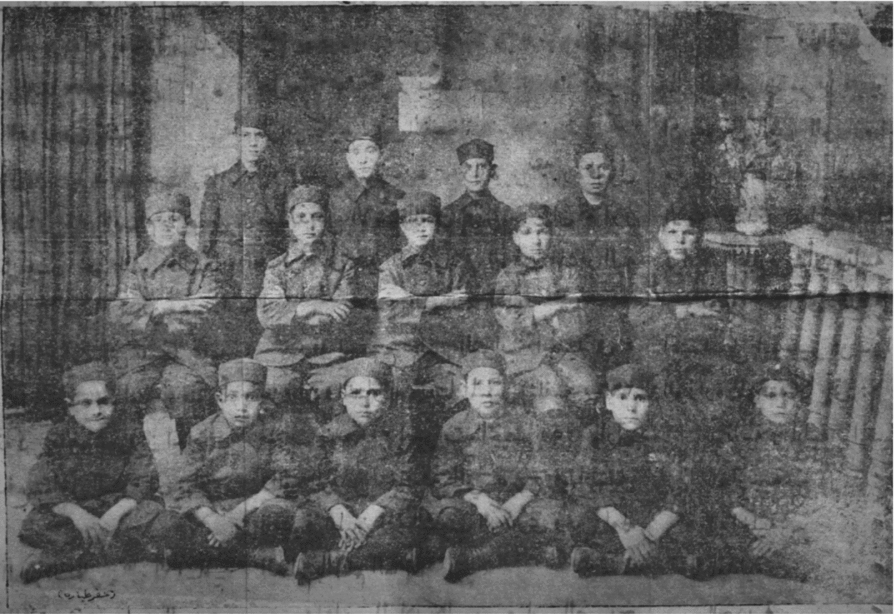
Al-Maytam al-Urthudhuksi of Homs took in fifteen boys in 1924, expanding to twenty-five the following year (see Figure 2).Footnote 76 Most had lost their families during the instability of World War I and the short-lived period of Faysal's Arab Kingdom, a “string of disasters” that al-Nadi al-Homsi member Daud Qustantin al-Khuri said “left their sad effects, one of which is the orphans remaining in the land, whose number is not small and who have no home.”Footnote 77 Orphaned by war, famine, and foreign occupation, these orphans were living symbols of Syria's political situation. As both a priest and a nationalist, ʿIsa Asʿad sought to not only save the children from a life of idleness, crime, and privation; by raising them into competent men and patriots, he also reckoned that the Maytam could liberate Syrian society as a whole. In Homs newspaper, Asʿad explained that a people “cannot be free when [they are] afflicted by illness, ignorance, orphaned, or until they are liberated from their sins. The way to beneficence is difficult, as is that of society's betterment.”Footnote 78 As vulnerable symbols of a nation under threat, Asʿad argued that children were most worthy of charity: “a child has a heart that beats and a brain that thinks, but neither grows without sustenance. Neither develops without nurturing.”Footnote 79 Asʿad framed the Maytam's work in a pious and patriotic light, and he emphasized how assisting Homs’ lost children served elite Syrians with a way to atone for both personal sins and a lost vision of the nation. Volunteering at the Maytam, or donating resources in its name, would help Syria heal. As for the boys, they were to learn patriotic values, receive vocational training, and gain access to the fellowship of the Jamaʿiyyat al-Rabita al-Adabiyya. For Asʿad, Homs’ orphans had already made greater sacrifices than most for the Syrian national movement; with training and beneficence, he promised “they will also, God willing, be this nation's future.”Footnote 80
Al-Maytam al-Urthudhoksi residents, Homs, Syria, June 1924. Source: ʿIsa Asʿad, “al-Aytam,” Homs, 14 June 1924, 5.
Meanwhile, al-Nadi al-Homsi in Brazil labored to sustain both orphanages through fundraising, volunteering, and material donations. Its members maintained a lively public correspondence with the Jamaʿiyyat al-Rabita al-Adabiyya in Homs on the aims and merits of Syrian philanthropy; this discussion was published in Homs newspaper for consumption by a transnational reading public. Playwright, Homs columnist, and Jamaʿiyyat al-Rabita al-Adabiyya member Daud Qustantin al-Khuri wrote to al-Nadi al-Homsi so frequently that he was dubbed an honorary member in 1924 and elected al-Nadi al-Homsi's president in 1925, a year before he actually emigrated to Brazil.Footnote 81 After his relocation, al-Khuri continued to submit monthly letters to Homs newspaper, eliciting discussions about piety, patriotism, and philanthropy among Syrians living throughout the mahjar. Beyond the practical demands of philanthropic activism, nurturing intellectual links across the transnational Syrian world remained important for symbolic reasons: ʿIsa Asʿad not only compared the experience of diaspora to the hardships of being orphaned but also blamed French imperial rule for deliberately “partitioning brother from brother, and cutting fathers from sons,” especially in the context of partitioning Lebanon from Syria. To Asʿad, the Mandate system was designed to create more Syrian orphans, both metaphorically and literally.Footnote 82 As orphans became a symbol for the Syrian national community, caring for them presented a concrete means of repudiating the Mandate while building an image of Syrian masculinity rooted in piety and strength.
Whether in Homs or abroad, orphaned children became objects of Syrian social reform discourse during the 1920s. In Brazil's Syrian press, writers often drew analogies between the beleaguered homeland and the plight of young orphans. In the Atlas’ magazine, al-Karma, young writers told the nation's story through an orphan's pain and redemption. In January 1927, for example, Salwa Atlas published four full-page images of crying boys, asking her young readers to submit captions narrating each boy's story (see Figure 3).Footnote 83 Young men from al-Nadi al-Homsi and around the Syrian colony responded, and the captions were printed the following March.
Crying Boy, 1927. Source: Salwa Salama Atlas, “al-Tifl al-Baki,” al-Karma, January 1927, 64.
The respondents described some of the basic hardships of life in the mahjar. For example, one wrote: “this boy cries because his mother took fancy buttons from her kasheh and gave them to his sister.”Footnote 84 Others explained, “he cries because his parents have returned from the homeland, and he's forgotten his Arabic,” or “because he cannot understand his grandparents.” Statements about linguistic displacement dramatize the commonplace sense of isolation and generational change that drove a wedge between first-generation Syrian immigrants and their Brazilian-born youngsters. But in 1927, the most numerous responses were political explanations linking orphaned children to French-occupied Syria: “he cries because his father is absent, has gone to assist the devastated in the homeland [al-mankūbīn fi al-waṭan],”Footnote 85 or “because his parents have forsaken him,” and, most clearly, “because he sees São Paulo's orphans in the [Dar al-Aytam] al-Suri, and he fears he might [also] become one.”Footnote 86
While al-Maytam al-Urthudhuksi in Homs took in Greek Orthodox boys only, São Paulo's Dar al-Aytam al-Suriyya was coed and admitted Christian children from the Orthodox, Protestant, and Maronite communities. Similarly, while the orphanage in Homs was run by an entirely male staff (clergymen and volunteers from the Jamaʿiyyat al-Rabita al-Adabiyya), many of the educators in São Paulo's Dar al-Aytam al-Suriyya were women, employed by the headmistress Salwa Salama Atlas, wife of al-Nadi al-Homsi founder Jurj Atlas. A feminist and nationalist, Salwa Atlas was an important advocate for girl's education as a means of national progress, a subject she wrote on regularly for al-Karma magazine. But despite the fact that women comprised parts of both the Dar al-Aytam's workforce and its residents, the orphanage cultivated a public image that remained unambiguously male. Photos, stories, and descriptions of the orphanages in the Syrian press focused wholly on boys, stressing not only their vulnerability but also their reform through education. Their degree of visibility and intensive grooming for national service confirmed expectations that theirs would be a lifetime of public and patriotic work.
“SOUND MINDS IN SOUND BODIES”: INTELLECTUAL REFINEMENT AND CORPOREAL DISCIPLINE
In both Homs and São Paulo, orphaned boys became symbols of Syria's troubled present and imperiled future, and with the provision of an authentically Syrian political education, young orphaned Syrians could be transformed into capable, self-determined citizens. In addition to orphanages, al-Nadi al-Homsi also helped to found secondary schools, colleges, and vocational training centers across Syria.Footnote 87 Drawing on a 19th-century vision of education as the driving force of a nonsectarian Syrian modernity (a vision that owed much to the nahḍa and the pedagogical ideas of Butrus al-Bustani),Footnote 88 al-Nadi al-Homsi brought secular “national” education beyond the classroom, into public lecture halls, social parlors, and popular festivals in São Paulo. Founder Jurj Atlas believed that popular education and intellectual pursuit (al-jihād al-ʿaqlī) would forge young Syrian men into the “enlightened class” (al-ṭabaqa al-mutanawwira) needed to restructure Syrian society and continue the struggle for independence.Footnote 89
Pedagogy remained one of al-Nadi al-Homsi's foremost interests during the 1920s. This faith in national education as a modernizing force derived from the background of the club's founders. Jurj Atlas had been educated in American Protestant schools, and several other members attended the Kulliyyat Homs al-Wataniyya, a “national school” established in Homs by Protestant convert Hanna Khabbaz in 1908.Footnote 90 Before the war, Khabbaz had opened his school to Syrian students of all classes, sects, and backgrounds, and his curriculum emphasized secular patriotism, instruction in Arabic, and Syrian political unity.Footnote 91 He was exiled for his efforts in 1914, but in 1922 he returned to Syria, reopened the school, and toured the mahjar, lecturing on the importance of compulsory Syrian national education to combat foreign political domination.
When Hanna Khabbaz arrived in São Paulo in 1922, he toured al-Nadi al-Homsi and was greeted there by his former students, Nadi members Nazir Zaytun and Husni Gharrab. That evening he delivered a lecture on anticolonial pedagogy, attended by more than 1,000 Syrians from across South America. Khabbaz cast the objective of learning in terms of national sovereignty. His concept of education stressed the cultivation of all human faculties together, placing equal emphasis on reason, logic, literary capacities, and physical education among young Syrian men. According to Khabbaz, what distinguished this approach from older, traditional Syrian pedagogy was its emphasis on unity and balance. He explained that the brain was divided into several sections, which mirrored Syria's division into spheres of colonial influence (manāṭiq al-nufūdh). Because traditional education sought to develop aptitude in the religious sciences at the expense of technical skills or a broader Syrian patriotism, Syrian minds had become as fragmented as the Syrian homeland. There was no mystery in it for Khabbaz: the nation's schools played right into imperialism, turning out students intellectually incapable of self-determination along a national model.Footnote 92 The French exploited this handicap capably, partitioning bilād al-shām, manipulating Syria's religious diversity to foster social divisions, and importing French educational models to deplete Syrian minds of their sense of history and national destiny. A new pedagogy was needed, authentic and indigenous but simultaneously patriotic and technocratic. For Khabbaz, a successful struggle against imperialism depended wholly on the ability of colonized men to educate themselves.Footnote 93
Khabbaz offered a two-point solution to the problem. First, he argued that Syrians must assert educational sovereignty at home, founding national schools with modern curricula and Arabic-language instruction. Courses must teach practical vocational skills, civics, and patriotic values to craft the Syrian people into a community with shared goals and aspirations. Similarly, for Khabbaz the best way to create a patriotic culture in the schoolyard was through the preservation of Syria's authentic “eternal knowledge” (al-ʿilm al-khālid): those great Syrian contributions to world civilization, among them mathematics, the medical sciences, and Arabic poetry (qaṣīḍāt and zajal).Footnote 94 Honoring Syrian history and culture went hand in hand with asserting curricular sovereignty, and through Arabic language instruction, national schools would work for the public good (al-maṣlaḥa al-ʿumumiyya) until independence was possible.Footnote 95
Khabbaz's audience at al-Nadi al-Homsi applauded this approach to education, funding a scholarship program at the Kulliyyat Homs al-Wataniyya for impoverished students.Footnote 96 This began a tradition of diasporic subsidies for Syria's national schools; in 1929, for example, al-Nadi al-Homsi opened its own college in Homs, dedicating it to Syrian National Bloc leader Hashim al-ʿAtasi.Footnote 97 Back in São Paulo, schoolhouses remained only one of many sites for a patriotic education. When the clubhouse was not used for festivals, funerals, or lectures, it served as a library for young men with literary or political ambitions. Outlined in its founding charter, the Nadi allocated an annual endowment for the collection of historical, literary, and scientific texts in Arabic, Portuguese, French, and English for a community library within its walls.Footnote 98 The club brokered deals with the colony's Arabic language presses, specifically the Atlas’ al-Karma, Rashid ʿAtieh's political daily Fatat Lubnan,Footnote 99 and, later, the printing house Dar al-Tibaʿa wa-l-Nashr al-ʿArabiyya, owned by al-Nadi al-Homsi members Jubran and Jurj Bunduqi.Footnote 100 Each submitted copies of their materials to the Nadi's collection, and in 1923, the director of the library project, Mikhaʾil Maluhi, reported to Homs newspaper that Maktabat al-Nadi al-Homsi had become “the single largest such collection in Brazil,” growing at a pace of 1,000 texts annually.Footnote 101 Shakib Jarrab, then Nadi president, described the library as an integral part of the club's “national duty,” which would abet the enlightenment of Syrians abroad and assist them in “the pursuit of all that is fitting of the name ‘Homsi.’”Footnote 102
The Maktabat al-Nadi al-Homsi became a place of refuge for an emerging intellectual movement in Brazil, with political philosophy and poetry being the favored genres. Nazir Zaytun translated the works of Maxim Gorky, focusing particularly on Gorky's theological ideas, which he republished in a volume called Where Is God? Footnote 103 Meanwhile, his colleagues Daud and Rashid Shakkur wrote a nationalist history of bilād al-shām for use in the local Syrian colony, called East and West. The volume pinpointed Syria's origins between the Phoenician and the biblical eras, and emphasized Syrian contributions to Western history, religion, and society. By teaching “the enlightened Arab youth” the greatness of their past, the Shakkur brothers hoped to create the type of national solidarities needed for Syrians to “break the yoke of imperialism, and extract themselves from bondage” through a recognition of their political culture.Footnote 104
Although philosophy was the Nadi's primary concern, the group became even more famous for its poetry. Husni Gharrab, Ilyas Farhat, Shafiq ʿAoun, Anis Jaoquim al-Rasi, and Musa Kuraiem attended the club regularly, where they recited zajal, the Syrian lyrical style then in fashion.Footnote 105 The Nadi also invited Brazil's most famous poets—Fawzi and Michel Maʿluf, and Rashid Salim al-Khuri (famously known as al-shāʿir al-qarawī)—to share their work with the group. By the late 1920s, al-Nadi al-Homsi's patriotic poetry was widely celebrated across South America, as well as in Syria and Lebanon. In 1932, the group formed a formal literary society, al-ʿUsba al-Andalusiyya (the Andalusian League), and established a literary monthly, al-ʿUsba, to showcase the group's work.Footnote 106
With its immense library, regular poetry readings, regular lectures given in the interest of public edification, and rolling philanthropic schedule, al-Nadi al-Homsi offered amenities that gave it a unique place in the intellectual life of the Syrian mahjar. The mind's refinement, moreover, was paired with the body's discipline. The fraternity emphasized physical fitness as the final pillar of a complete Syrian manhood, and physical strength was openly equated with moral fortitude and political sovereignty. “It is commonly said that ‘a sound mind [rests] in a sound body’ [al-ʿaql al-salīm fi al-jism al-salīm], because the security of the whole ensures that of all parts,” Jurj Atlas wrote in 1914: “the mind is merely one part of that whole totality.”Footnote 107 In an article explaining the moral benefits of sports, Atlas argued that in addition to preventing bodily decay (al-inḥiṭāṭ al-jasadī), physical education helped produce a manly sense of honor to complement an active mind. Physical education, which Atlas alternatively called al-riyāḍa al-jasadiyya and al-riyāḍa al-badaniyya, was as crucial to the project of making new Syrian men as were fluency in Arabic, philanthropic values, and a patriotic worldview.Footnote 108 Atlas emphasized team sports such as soccer and basketball because they required cooperation. He linked the ability to compete as part of a team directly to a boy's transition into manhood; team sports demanded that individuals strive for something collectively. Atlas contrasted such images of honorable homosocial interaction with the disreputable aimlessness of the Brazilian nightclub, a space where he argued too many Syrian youths wasted their time. Atlas made a strong connection between sporting culture and political liberation: successful nations present a class of men, an “an enlightened class amidst ignorance” cooperating as a team on the world stage, whereas colonized peoples seek only their own small ends at the expense of the whole.Footnote 109
By the 1920s, São Paulo's Syrian colony already had a small collection of sports clubs, the most popular of which was al-Nadi al-Riyadi al-Suri, which had been endowed by cotton mogul and industrialist Nami Jafet in 1917.Footnote 110 Al-Nadi al-Homsi formed an affiliation with al-Nadi al-Riyadi al-Suri, and urged its members to join either the soccer or basketball program. Men who joined would meet other Syrians as well as Brazilians of Portuguese, Italian, and German descent on the courts.Footnote 111 A common masculine culture of sportsmanship, fair play, and a valuation of the male body as a national symbol emerged in this context. In the words of al-Nadi al-Riyadi president Faris Dabaghi, sports ensured that Syrian bodies, like Syrian minds, would become “strong like steel” (qawī ka-l-ḥadīd).Footnote 112
More than any other space in the Syrian colony, sports clubs allowed for social mixing between Syrian men and other immigrant groups living in São Paulo. In an interview with Betty Loeb Greiber, Lily Saʾigh Hashim reported that during her youth in the late 1920s, al-Nadi al-Riyadi al-Suri's main rival was the local German Club. Their rivalry was fueled in part by the fact that the German Club encouraged Syrian players to join their side, as Lily's brother Richard did in 1924.Footnote 113 While soccer had long been a popular pastime both in Brazil and among Syrians and Lebanese, the Syrian club's inclusion of basketball raises more questions. An American sport, it is known that American missionary schools in the Mashriq introduced basketball in their sports programs; Lily Hashim recalled that her father Fadlallah preferred basketball to soccer, having played for the Syrian Protestant College before coming to Brazil.Footnote 114 In 1930, basketball had caught on in São Paulo; of al-Nadi al-Riyadi al-Suri's five hundred members, one-third participated in the basketball program.Footnote 115
Although al-Nadi al-Riyadi al-Suri clearly drew analogies between the building of strong bodies and the building of nations, the organization denied its role in Syrian and Lebanese politics, claiming instead (as al-Nadi al-Homsi did) to take a stance against partisanship (ḍidd taḥazzub) in the interest of unity. This stance, however, was itself part of a political program, and al-Nadi al-Riyadi al-Suri was broadly associated with pan-Syrian territorial nationalism. Most of the sports clubs members, including al-Nadi al-Riyadi al-Suri president Faris Dabaghi, also belonged to al-Hizb al-Watani al-Suri, a Syrian nationalist party founded by Khalil Saʿadih shortly after his arrival in São Paulo in 1920. The club's political affiliations sometimes generated controversy, for example in 1925, when many of its members supported the Great Syrian Revolt against the French, provoking conflict with a local Lebanese Maronite club then supportive of the Mandate. That said, al-Hizb al-Watani al-Suri's support for the sports club lay in Saʿadih's belief that sports mimicked politics and fostered patriotic solidarity. In May 1926, Khalil's son, Antun, gave a speech at the club's annual reception. He remarked that the building of sound bodies and free minds must precede the Syrian people's liberation, and he praised the Syrian men of São Paulo for developing their “physical and intellectual strengths together” (al-quwwa al-māddiyya wa-l-quwwa al-ʿaqliyya maʿan).Footnote 116 Four years later, al-Hizb al-Watani al-Suri president Faris Dabaghi argued that “in playing sports one finds the importance of national life [hayat al-umma]. What al-Nadi al-Riyadi achieves in advancing the Syrian name will also contribute to the strength we build in our players as a unit, influencing our society. [Our team] is like all of the masses, eager for victories,” both on the field and off.Footnote 117
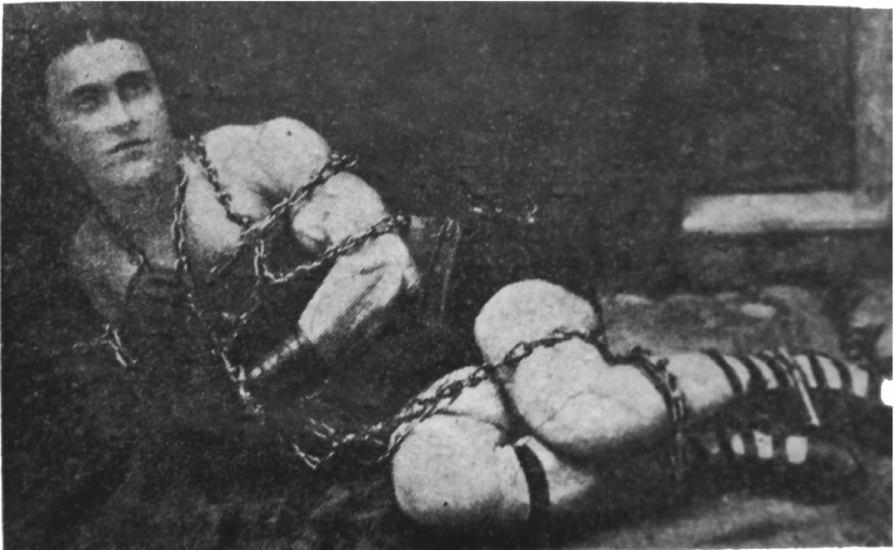
São Paulo's Syrian community did not limit its interest to team sports alone. Body building, weight lifting, and the appreciation of the male physique also became practices closely related to feelings of anticolonial nationalism. In the late 1920s, Syrian bodybuilder ʿAbd al-Rahman al-Jizawi, or al-baṭal (the champion) as he was locally called, toured South America in power-lifting competitions, leaving his home in Santiago, Chile, where he had lived since 1924 (see Figure 4). When al-Jizawi arrived in Buenos Aires, the city's Arab nationalist newspaper al-Islah ran a feature on him, positing him as a model of masculine strength and soundness of mind. The article gave his biography, emphasizing that he was highly educated, with advanced degrees from Lebanon and Germany. Al-Jizawi was fluent in Spanish, French, and German in addition to Arabic, and before becoming a body-builder he had struck success as a merchant in Chile. And he had done all of this by the time he was twenty-five years old, noted al-Islah reporter Nasim Khayrallah. For Khayrallah, al-Jizawi's youth, paired with his well-formed balance between intellect and physique, made him an ideal role model for Syrian youth in the mahjar. As al-baṭal trounced dozens of competitors in tournaments in Santiago, Buenos Aires, and São Paulo, Khayrallah noted that the lifter's serene air and dignified self-possession presaged true personal sovereignty:
His religion is temperate, and he disdains saucy speeches and cursing. His patriotism is sincere and jealously guarded. He is proud of his Arab predecessors and their unsung glories . . . and as I watched [al-Jizawi] compete, he proved that the pinnacle of a man's physical strength and ability derives not from outward appearances, nor his weight, nor his stature, but from somewhere else entirely.Footnote 118
Khayrallah drew clear associations between al-Jizawi's good character, intellectual clarity, and physical strength, all of which (Khayrallah argued) worked in service to his patriotism and national pride.
ʿAbd al-Rahman al-Jizawi. Source: Julio Atlas, “al-Batal ʿAbd al-Rahman,” al-Karma, July 1931, 45.
Two years later, al-Jizawi visited São Paulo, where he arrived at al-Nadi al-Homsi for an interview with Jurj Atlas’ son, Julio. Julio Atlas had followed his father's footsteps: a lifetime member of al-Nadi al-Homsi, he had assumed chief editorship of al-Karma in 1930. Sitting down with al-baṭal in 1931, Julio clearly saw al-Jizawi as the exemplary Syrian patriot, proclaiming: “tomorrow is our generation's age of strength, for we do not bind our political pillars save by strength, and we cannot win our political goals but with strength. And this strength, these strongmen, [they] show us and the world the ideal way of life.”Footnote 119 He detailed al-Jizawi's characteristics, such as his broad shoulders and deep brown complexion. At 5 feet 9 inches, the lifter's average stature concealed his strength: al-Jizawi boasted that he could carry 1,000 kilograms on his head. But what also interested Julio Atlas was al-Jizawi's intelligent eyes and “electric wit.”Footnote 120 In the Syrian cult of the body, admiration for the physical form was nearly always accompanied by a discussion of intellectual prowess.
Al-Jizawi told Julio Atlas that he had fancied bodybuilding since his boyhood in Syria, concluding that weightlifting “took him home” in a metaphorical sense. This piqued Julio's political sensibilities, prompting him to ask whether reconnection with Syria was al-Jizawi's political goal. Julio's assumption missed its mark, however; al-Jizawi insisted that sports brought him back to his childhood, and not to a mythic national past or any political agenda. Undeterred, Atlas pressed al-Jizawi on his politics further, a decision that was clearly unappreciated; Julio admitted that at that point, “the words between us ran out” and the pair fell into charged, awkward silence.Footnote 121 This interview dramatizes the expectations Julio Atlas placed upon al-baṭal, demonstrating that the politicization of male bodies often began with the audience rather than with participants themselves. So closely was Syrian sporting culture infused with the politics of nationalism that, regardless of his own motivations, al-Jizawi had to confront such assumptions regularly.
Although misplaced in this instance, Julio Atlas’ expectation that sports mimic politics was a common one. Al-Nadi al-Homsi members frequently invoked sports in political ways, especially in the context of a young man's realization (or reclamation) of his social rank within the nation. Indeed, just weeks after Julio's interview with al-Jizawi, the famous poet Rashid Salim al-Khuri spoke on the topic at the clubhouse, proclaiming that the importance of sports lay primarily in teaching young men to accept social rank. “Trader and writer, poor and rich, strong and weak alike . . . have their obligatory work” on the field and in the nation. While the enlightened man knows each role is of equal worth, al-Khuri argued that a man's strength was in finding (and knowing) his place within that organic political order. Dividing the Syrian community into “bodies tired from practice and toil” and “minds exhausted by hope,” al-Khuri concluded that Syria's “true athletes” were those who joined efforts, striving and struggling together off field, in the realm of patriotic politics.Footnote 122
CONCLUSION
As a fraternal organization, São Paulo's al-Nadi al-Homsi stressed philanthropy, education, and physical discipline as the highest callings of the young male patriot. Each characteristic built on the others, forging an organic whole that would transform Syrian political society, creating an empowered generation of Syrian men ready for the challenges of a modern, civics-minded citizenship. These men provided social services, invested in philanthropic infrastructure, and strove for intellectual and physical self-improvement. Each of these endeavors was tied to the belief of the club's founders that national sovereignty and self-determination started with the construction of an authentic national culture, albeit one with significant transnational dimensions.
The density of the institutional networks laid out above—the continuous circulation of people, money, printed materials, and ideas between Homs and São Paulo—underscores the extent to which Syrians in the interwar period lived transnational lives, whether migrants or not. Bishop Athanasius ʿAtallah and ʿIsa Asʿad founded al-Nadi al-Homsi from afar, collaborating with Syrian emigrant “colonists” in a long-distance nationalist project. ʿAtallah's Homs newspaper was printed in Syria on a press from Brazil; half of Homs’ readership resided in Brazil, and the paper's chief editor (Daud Qustantin al-Khuri) was elected al-Nadi al-Homsi's president months before his arrival in São Paulo. Hanna Khabbaz's national school in Homs, the Kulliyat Homs al-Wataniyya, depended on funds raised in Nadi Homsi's clubhouse. Homs’ Orthodox orphanage was built on blueprints drawn by Syrian hands in São Paulo.
In sum, al-Nadi al-Homsi's philanthropic works tied Syria to São Paulo, the Mashriq to the mahjar. The club promoted a transnational patriotic masculinity to be shared by Syrians living in both places, leading to a degree of transnationalization in Homs itself. Piecing together the fragments of al-Nadi al-Homsi's early records, event ephemera, and the publications of its founders, this article has shown how a tightly bound network of emigrant activists strove to make Syrian men. In doing so, they influenced patterns of philanthropy, education, and male sociability not only in the mahjar but also in the homeland. These mahjarī influences can be successfully written back into Syrian social history if historians think about the diaspora the same way Bishop Athanasius ʿAtallah did: as a source of moral, fiscal, and political support, as a culturally fecund human network capable of contributing to Syrian advancement, and, most importantly, as a distant (but significant) hinterland to a modern, post-Ottoman Syria hiding “behind the seas” (warāʾ al-biḥār).