





Adolescent mental disorders represent a substantial and growing public health concern globally, with estimates indicating that approximately 1 in 7 adolescents aged 10–19 years (around 14%) experiences a mental disorder; although broader figures often range from 10 to 20%, depending on the inclusion of specific conditions and diagnostic criteria. Reference Solmi, Radua, Olivola, Croce, Soardo and Salazar de Pablo1 In Nigeria, community- and school-based studies report prevalence estimates for depression, anxiety disorders and substance use disorder (SUD) ranging from approximately 12 to >25%, reflecting a considerable but often underrecognised burden. Reference Ogunlade, Abioye, Kuyebi, Musa, Abubakar and Yisa2–Reference Adewuya, Wright and Njokanma4 Early-onset psychiatric disorders are associated with academic disruption, interpersonal difficulties and elevated risk of chronic mental illness in adulthood. Reference Solmi, Radua, Olivola, Croce, Soardo and Salazar de Pablo1 Understanding family-level determinants of adolescent mental health is therefore central to prevention efforts, particularly in low- and middle-income countries where specialist services remain limited. Reference Wada, Rajwani, Anyam, Karikari, Njikizana and Srour5
Parental substance use (PSU) has consistently been associated with adverse developmental outcomes among offspring, including increased risk of SUD, depression, anxiety and behavioural disorders. Reference Miller, Bogdan, Agrawal and Hatoum6–Reference Marceau, Yu, Knopik, Ganiban and Neiderhiser8 Theoretical explanations for these associations typically invoke cumulative risk exposure, social learning processes, genetic vulnerability and family environmental disruption. Reference Bandura and Walters9–Reference Sinha11 In particular, social learning models suggest that adolescents may model substance-related behaviours observed in parents, Reference Bandura and Walters9,Reference Andrews, Hops and Duncan12 whereas family stress models posit that PSU contributes to conflict, instability and diminished caregiving capacity, thereby increasing psychiatric vulnerability among offspring. Reference Lander, Howsare and Byrne13,Reference Jacobs and Strumpher14
The term ‘intergenerational transmission’ is frequently used to describe such patterns. Reference Marceau, Yu, Knopik, Ganiban and Neiderhiser8,Reference Jiang and Lin10 However, formal investigation of intergenerational transmission ordinarily requires longitudinal designs capable of establishing temporal ordering and, ideally, genetically sensitive approaches to disentangle inherited from environmental influences. Reference Miller, Bogdan, Agrawal and Hatoum6,Reference Gerring, Thorp, Treur, Verweij and Derks15 Cross-sectional epidemiological studies, such as the present investigation, cannot establish causal transmission pathways. Rather, they identify cross-generational associations that may be consistent with intergenerational risk frameworks. Accordingly, the current study examines cross-sectional associations between PSU patterns and adolescent psychiatric outcomes, interpreted cautiously and without assuming temporal precedence.
Family environmental mechanisms represent one plausible pathway linking PSU to adolescent mental health. A substantial body of research demonstrates that PSU is associated with increased domestic violence, high interparental conflict and broader family dysfunction. Reference Brown, Nkemjika, Ratto, Dube, Gilbert and Chiang16–Reference Apeh and Bernice18 Exposure to domestic violence and chronic family conflict, in turn, is robustly associated with adolescent depression, anxiety, substance use and suicidality. Reference Adewuya and Oladipo3,Reference Deniz, Humphrey, Demkowicz, Lereya and Deighton19,Reference Xiong, Fang, Wang, Xie, Liu and Niu20 Within Sub-Saharan African contexts, where extended family structures and communal living arrangements are common, family disruption may have distinct social and psychological consequences compared with Western settings. Reference Evans, Matola and Nyeko21,Reference Fatimilehin and Hassan22 However, empirical examination of these associations in Nigerian adolescents remains limited. In this study, we focus specifically on domestic violence and high family conflict as measured indicators of family dysfunction, rather than broader constructs such as parental attachment or monitoring, which were not directly assessed.
Gender differences in parental influence have also been reported in prior literature. Some studies suggest stronger same-gender associations in substance use outcomes, consistent with social learning hypotheses. Reference Andrews, Hops and Duncan12 In Nigeria, prevailing gender norms may shape both the visibility and social meaning of PSU. Reference Fatimilehin and Hassan22 Substance use among mothers, for example, may be particularly stigmatised, potentially marking more severe family dysfunction or social marginalisation. At the same time, extended kinship networks may buffer certain forms of family adversity. These contextual dynamics underscore the importance of examining PSU within specific cultural settings. However, cultural moderation was not directly measured in the present study; therefore, any interpretation regarding gender or maternal effects is necessarily exploratory.
Most evidence on PSU and adolescent psychiatric outcomes derives from high-income Western contexts. The extent to which observed associations generalise to Nigerian or West African settings remains uncertain. Patterns of substance use, family structure (including polygamous households), urban–rural disparities and normative gender expectations differ substantially across contexts. Reference Ogunlade, Abioye, Kuyebi, Musa, Abubakar and Yisa2,Reference Akpan, Olojo, Oni, James and Onoja23,Reference Ebrahim, Adams and Demant24 Empirical investigation within Nigerian samples is therefore essential to determine whether cross-generational associations follow similar or distinct patterns.
Using data from the Lagos Schools Emotional and Behavioural Health Survey (LSEBHS), a large school-based sample of adolescents aged 11–17 years, Reference Adewuya and Oladipo3,Reference Adewuya, Wright and Njokanma4 this study examines associations between PSU patterns (neither parent, father-only, mother-only, both parents) and Mini-International Neuropsychiatric Interview for Children and Adolescents (MINI-KID) algorithm-defined adolescent psychiatric symptom profiles. We tested three primary aims. First, we assessed whether PSU is associated with substance-related, depressive, anxiety and behavioural symptom profiles in a graded fashion consistent with cumulative exposure frameworks. Reference Brown, Nkemjika, Ratto, Dube, Gilbert and Chiang16,Reference Deniz, Humphrey, Demkowicz, Lereya and Deighton19,Reference Xiong, Fang, Wang, Xie, Liu and Niu20 Second, we examined whether family dysfunction, operationalised as domestic violence or high family conflict, statistically attenuates these associations in cross-sectional statistical decomposition analyses. Third, we explored whether associations differ by parental gender and adolescent gender, recognising that such analyses are exploratory given the cross-sectional design and subgroup sizes.
In keeping with the limitations inherent in cross-sectional data, we interpret findings as associative rather than causal. Although patterns may be consistent with intergenerational risk frameworks, longitudinal and genetically informed studies are required to establish temporal ordering, clarify mediating mechanisms and distinguish environmental from inherited influences. Reference Marceau, Yu, Knopik, Ganiban and Neiderhiser8,Reference Gerring, Thorp, Treur, Verweij and Derks15 The psychiatric outcomes should also be interpreted as self-reported symptom profiles meeting MINI-KID algorithm thresholds, rather than clinician-confirmed diagnoses, because the MINI-KID modules were completed in a structured self-report format with research-assistant support, and no psychometric validation of this self-completed format currently exists in this population.
Method
Study design and setting
This study analysed data from the LSEBHS, a large, school-based epidemiological survey conducted between March 2017 and September 2018, across secondary schools in Lagos State, Nigeria. Reference Adewuya and Oladipo3,Reference Adewuya, Wright and Njokanma4 The survey employed a cross-sectional design. Accordingly, analyses examine associations between PSU and adolescent psychiatric outcomes rather than causal or temporal transmission processes. Because exposure, family dysfunction and outcome variables were measured concurrently, temporal ordering and causal pathways cannot be established. Ethical approval was obtained from the Lagos State University Teaching Hospital Ethics Committee (identifier: LREC/06/10/1295) and the Lagos State Ministry of Education. Written parental consent and adolescent assent were secured before participation.
Patient and public involvement
Adolescents were not involved in study design, research questions or outcome measure selection. However, community advisory board members including parents, teachers and school administrators provided input on culturally appropriate data collection methods and questionnaire content. The study questionnaire was pilot tested with 50 adolescents from non-participating schools to ensure clarity and cultural appropriateness. Findings will be disseminated to participating schools through summary reports and presentations to administrators and parents’ associations. We plan to collaborate with Lagos State Ministry of Education to translate findings into school-based mental health policies and programmes.
Participants and sampling
The LSEBHS employed multistage, stratified cluster sampling to obtain a representative sample of in-school adolescents. Schools were stratified by urbanicity (urban, semi-urban, rural) and sector (public, private), and selected proportionally. Within selected schools, intact classes were randomly sampled, and all students in selected classes were invited to participate. Of 10 202 invited students, 9441 provided consent and assent (response rate 92.5%). Four participants aged 18 years or older were excluded because the MINI-KID diagnostic instrument is validated for ages 6–17 years only. Reference Sheehan, Shytle, Milo, Janavs, Lecrubier and Rogers25 Although the original sampling frame included older students because of grade repetition practices, analyses were restricted to the validated age range to ensure methodological rigour. The final analytic sample therefore comprised 9437 adolescents aged 11–17 years (mean age 15.61 years; 50.4% female). A flow diagram detailing recruitment, exclusions and analytic sample derivation is presented in Fig. 1.
Participant flow, analytic sample and missing data. Sample was obtained from the Lagos Schools Emotional and Behavioural Health Survey (LSEBHS), Lagos State, Nigeria. Of 10 202 students invited, 9441 provided consent and assent (92.5%). Four participants aged ≥18 years were excluded because the MINI-KID is validated for ages 6–17 years, resulting in a final analytic sample of 9437 adolescents aged 11–17 years. Complete data across all variables in the primary adjusted models were available for 9184 adolescents. Variable-specific missingness ranged from 0.0 to 2.7%, and primary analyses used multiple imputation with consistent complete-case findings. Psychiatric outcomes are interpreted as MINI-KID algorithm-defined symptom profiles rather than clinician-confirmed diagnoses. MINI-KID, Mini-International Neuropsychiatric Interview for Children and Adolescents.

Complete data across all variables included in the primary adjusted models were available for 9184 adolescents (97.3% of the analytic sample). Variable-specific missingness ranged from 0.0 to 2.7%, and missingness for PSU, family dysfunction indicators and MINI-KID algorithm-defined psychiatric outcomes was below 3% for each variable.
Measures
PSU
PSU was assessed with four adolescent-reported items querying whether the mother and/or father ‘regularly’ consumed alcohol and/or smoked tobacco. ‘Regularly’ was operationalised as at least weekly use over the past 12 months. This definition reflects visible, repeated behaviour rather than clinical SUD, dependence, harmful use, quantity consumed, duration, chronicity or severity. Reference Williams and Nowatzki26 PSU was categorised into four mutually exclusive groups: neither parent; father-only use; mother-only use and both parents. This categorisation permitted examination of differential maternal and paternal associations as well as cumulative exposure.
Alcohol and tobacco use were combined into a single PSU construct because both represent observable substance-related behaviours within the family environment that may operate through overlapping mechanisms, including modelling, normalisation, family stress and family conflict. Reference Bandura and Walters9,Reference Andrews, Hops and Duncan12 However, alcohol and tobacco differ in pharmacological effects, social meanings and likely family-level consequences. The combined PSU construct should therefore be interpreted as a broad marker of visible household substance-related behaviour rather than an assumption that alcohol and tobacco exposures are equivalent. Exact wording, response options, time frames and coding rules for the PSU items are provided in Supplementary Table 1. Sensitivity analyses separated parental alcohol and tobacco exposure and are reported in Supplementary Table 2.
Dose–response analyses operationalised ‘dose’ as the number of substance-using parents (0, 1 or 2), not frequency or severity of use. Because PSU was based on adolescent report, it likely captures observable behaviours rather than precise consumption patterns. Underreporting of maternal use may be possible in contexts where female substance use carries heightened stigma. Reference Fatimilehin and Hassan22
Adolescent psychiatric symptom outcomes
Psychiatric outcomes were assessed with a structured self-completion adaptation of the MINI-KID. Reference Sheehan, Shytle, Milo, Janavs, Lecrubier and Rogers25 The MINI-KID was originally developed and validated as a structured clinician- or interviewer-administered diagnostic interview. In the present study, modules were adapted for structured self-completion in classroom settings with trained research-assistant support. Assistants provided standardised instructions, clarified item wording on request without interpreting symptom content or influencing responses, supported adherence to skip patterns and monitored participant well-being throughout. This mode of administration represents an extrapolation from the fully interviewer-administered format. Because no psychometric validation of this self-completed administration format currently exists in this population, and because self-completion removes the clinician-administered elements (symptom probing, impairment assessment, differential judgement) on which the diagnostic validity of the MINI-KID depends, outcomes are reported here as self-reported symptom-endorsement patterns meeting MINI-KID algorithm thresholds, rather than as probable or presumptive diagnoses. For brevity, these are referred to hereafter by using shorthand labels (e.g. ‘SUD symptom profile’, ‘MDD symptom profile’), denoting the underlying algorithm-defined symptom variable rather than a clinician-confirmed diagnosis. This terminology is applied consistently throughout the Method, Results and Discussion.
Primary outcome categories examined were the symptom profiles corresponding to major depressive disorder (MDD), any anxiety disorder, any behavioural disorder, substance use disorder and alcohol use disorder (AUD). The SUD and AUD symptom-profile outcomes were derived from the relevant MINI-KID modules, using algorithmic scoring. These modules assessed substance- and alcohol-related symptoms consistent with DSM-IV misuse and dependence criteria, including recurrent use, impaired control, continued use despite problems and related functional or behavioural consequences. The adolescent substance/alcohol symptom-profile outcomes are distinct from the parental PSU exposure variable, which was measured with separate adolescent-reported parental alcohol and tobacco items. Key item domains and coding rules are summarised in Supplementary Table 1. DSM-IV–DSM-5 concordance studies indicate substantial continuity for SUD and mood and anxiety disorders. In the current sample, internal consistency coefficients ranged from α = 0.82 to 0.91 across modules. Symptom-profile outcomes were coded as binary variables (present/absent) based on MINI-KID algorithmic thresholds.
Family dysfunction
Family dysfunction was assessed with items capturing exposure to domestic violence and high family conflict. Domestic violence referred to reported physical violence between caregivers. High family conflict referred to frequent, intense verbal conflict within the household. A composite binary variable was created, coded as present if either domestic violence or high conflict was endorsed. This composite was used in primary attenuation analyses to reflect severe family dysfunction characterised by instability and hostility, consistent with adverse childhood experience frameworks. Reference Brown, Nkemjika, Ratto, Dube, Gilbert and Chiang16–Reference Apeh and Bernice18 Exact item wording and coding rules are provided in Supplementary Table 1. Domestic violence and high family conflict were also examined separately in sensitivity analyses, reported in Supplementary Table 3.
Covariates
Covariates were selected based on theoretical plausibility as confounders and variables associated with both PSU and adolescent psychiatric outcomes. These included age (continuous), gender (male/female), socioeconomic status (low versus not low, based on parental education and occupation), geographic location (urban, semi-urban, rural), living arrangement (two-parent versus other) and polygamous household structure (yes/no). Socioeconomic status and urbanicity are associated with both PSU and adolescent mental health risk. Living arrangement and polygamous household structure were included to account for family structural complexity in the Nigerian context. Reference Evans, Matola and Nyeko21,Reference Fatimilehin and Hassan22 Polygamous household structure was conceptualised as a contextual family-structure variable rather than a primary exposure. It was included because household structure may be associated with PSU and adolescent mental health risk through caregiving arrangements, family complexity, socioeconomic patterning and household stress. Age and gender were included both as confounders and as potential moderators in interaction analyses.
Risk management and referral procedures
Risk management procedures were built into fieldwork because the survey involved adolescent mental health assessment in school settings. Research assistants were trained to pause assessment when a participant became visibly distressed, requested assistance or disclosed serious current risk. Such adolescents were referred to the designated school counsellor or senior pastoral-care staff member, with onward referral to Lagos State University Teaching Hospital or Federal Neuro-Psychiatric Hospital Yaba when specialist assessment was considered necessary. Participating schools were informed of referral options before data collection, and adolescents were provided with information on available support through school-linked channels. Although the protocol included referral procedures for adolescents who became distressed or required assistance, subsequent uptake of school-based or specialist support was not systematically recorded as a study outcome. This is acknowledged as a limitation.
Statistical analysis
Analyses were conducted in Stata version 17 for Windows (StataCorp LLC, College Station, Texas, USA; https://www.stata.com/). Statistical significance was defined as p < 0.05 (two-tailed). False discovery rate (FDR) correction was applied to families of related hypothesis tests.
Model specification
Three sequential logistic regression models were estimated for each psychiatric symptom-profile outcome. Model 1 (the base model) consisted of the PSU categories predicting outcome, adjusted for age, gender, socioeconomic status and geographic location. For model 2 (maternal versus paternal comparison), father-only and mother-only PSU indicators were entered simultaneously, with ‘neither parent uses’ as the reference category. Models were adjusted for age, gender, socioeconomic status, geographic location, living arrangement and polygamous household structure. Wald tests were used to compare maternal and paternal coefficients. This model addressed the secondary question of whether maternal-only and paternal-only exposure coefficients differed when entered simultaneously, and served as the reference model for the family dysfunction attenuation analysis. The four-category PSU variable was retained for describing the overall exposure gradient and cumulative pattern. Model 3 (adjusted for family dysfunction) comprised model 2 plus the composite family dysfunction variable. Dose–response analyses used binary logistic regression, with the number of substance-using parents (0, 1 or 2) entered as an ordinal predictor; the resulting trend odds ratio therefore represents the change in odds of the symptom-profile outcome associated with each additional substance-using parent.
Attenuation by family dysfunction
To quantify the extent to which adjustment for family dysfunction attenuated selected PSU–symptom-profile associations, model 2 was compared with model 3, which differed only by inclusion of the composite family dysfunction variable. Percentage attenuation was calculated on the log-odds scale as 100 × [ln(odds ratio in model 2) − ln(odds ratio in model 3)]/ln(odds ratio in model 2). Because PSU, family dysfunction and psychiatric symptom profiles were measured concurrently, these estimates are descriptive cross-sectional attenuation measures and are not interpreted as mediation or causal indirect effects. Family dysfunction may plausibly represent a correlated contextual factor, confounder, moderator or consequence of broader household adversity rather than a temporally ordered mediator.
Moderation and gender-stratified analyses
Interaction terms (PSU × adolescent gender) were tested to explore potential gender differences in associations. Where interaction terms reached statistical significance, gender-stratified models were estimated. These analyses were considered exploratory, particularly for maternal-only exposure, given the small subgroup size.
Missing data and multiple imputation
Missing data were addressed with multiple imputation by chained equations. The imputation model included all exposure, outcome, family dysfunction and covariate variables. Twenty imputed data-sets were generated, and estimates were combined using Rubin’s rules. Primary analyses are presented using imputed data-sets. Complete-case analyses were conducted as sensitivity checks. Complete-case estimates differed from the multiply imputed estimates by < 10%, and did not alter substantive interpretation.
Sensitivity analyses
Sensitivity analyses assessed the robustness of the main findings in five ways. First, complete-case models were compared with multiply imputed models. Second, the four excluded 18-year-old participants were included to assess whether their exclusion materially altered estimates. Third, analyses were repeated without FDR correction. Fourth, parental alcohol and tobacco exposure were examined separately rather than only as a combined PSU construct. Fifth, domestic violence and high family conflict were examined separately rather than only as a composite family dysfunction variable.
Shared informant considerations
Both PSU exposure and psychiatric outcomes were based on adolescent report, raising the possibility of shared informant bias. Reference Williams and Nowatzki26 Psychiatric symptom outcomes were derived from structured MINI-KID self-report algorithms, whereas PSU and family dysfunction items were brief behavioural reports. Although algorithmic scoring may reduce some subjectivity, shared method variance and differential reporting cannot be fully excluded.
Results
Sample characteristics
Of the 9441 students who provided consent and assent, 4 participants aged 18 years or older were excluded because the MINI-KID diagnostic instrument is validated for ages 6–17 years. The final analytic sample therefore comprised 9437 adolescents aged 11–17 years (mean age 15.61 years, s.d. = 1.49), of whom 50.4% were female. Participant flow is illustrated in Fig. 1.
Overall, 20.0% of adolescents reported PSU. Specifically, 17.3% reported father-only use, 1.3% reported mother-only use and 1.4% reported both parents using substances. The remaining 80.0% reported that neither parent regularly consumed alcohol or smoked tobacco. Table 1 presents detailed sample characteristics by PSU category.
Sample characteristics by parental substance use category (N = 9437)

Table 1 Long description
The table presents sample characteristics categorized by parental substance use, including neither parent, father-only, mother-only, and both parents. It has 5 columns and 6 rows, including headers. Column headers are Characteristic, Neither parent (n = 7549), Father-only (n = 1634), Mother-only (n = 123), Both parents (n = 131), and p-value. Row labels include Age, years, mean (s.d.), Female, n (%), Low socioeconomic status, n (%), Urban location, n (%), Polygamous household, n (%), and Living with both parents, n (%). Each row provides specific values for each category and a p-value indicating statistical significance. Notable trends include variations in socioeconomic status, urban location, and household structure across different parental substance use categories.
Percentages are weighted for sampling design. Parental substance use refers to adolescent-reported at least weekly parental alcohol consumption or tobacco use over the past 12 months. Socioeconomic status was based on parental education and occupation.
Adolescents exposed to PSU were more likely to reside in socioeconomically disadvantaged households and non-intact family structures. Compared with unexposed peers, exposed adolescents were more frequently from low socioeconomic status households, more likely to live in urban areas and less likely to reside with both biological parents (all p < 0.001). Polygamous household structure was also more common among exposed adolescents. These structural gradients suggest that PSU clustered within broader contextual vulnerabilities.
Prevalence of psychiatric symptom profiles by PSU
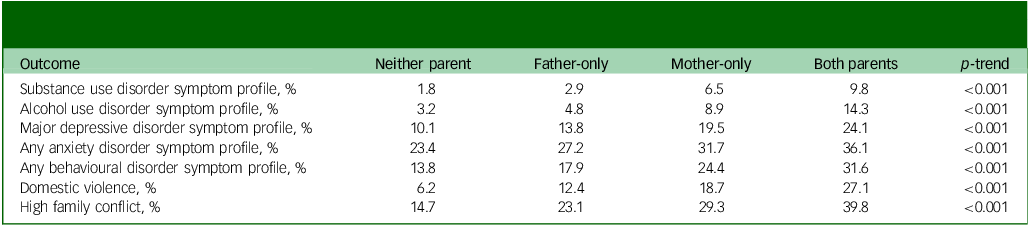
Weighted prevalence estimates are shown in Table 2. Clear graded patterns were observed across psychiatric symptom profiles and family functioning outcomes (all p-trend <0.001).
Weighted prevalence of MINI-KID algorithm-defined adolescent psychiatric symptom profiles and family dysfunction by parental substance use category

Table 2 Long description
A table comparing psychiatric symptom profiles and family dysfunction by parental substance use. The table has 8 rows and 5 columns. The columns are labeled as Outcome, Neither parent, Father-only, Mother-only, Both parents, and p-trend. The rows list different outcomes and their corresponding percentages for each parental substance use category. Row 1: Substance use disorder symptom profile, 1.8, 2.9, 6.5, 9.8, <0.001. Row 2: Alcohol use disorder symptom profile, 3.2, 4.8, 8.9, 14.3, <0.001. Row 3: Major depressive disorder symptom profile, 10.1, 13.8, 19.5, 24.1, <0.001. Row 4: Any anxiety disorder symptom profile, 23.4, 27.2, 31.7, 36.1, <0.001. Row 5: Any behavioural disorder symptom profile, 13.8, 17.9, 24.4, 31.6, <0.001. Row 6: Domestic violence, 6.2, 12.4, 18.7, 27.1, <0.001. Row 7: High family conflict, 14.7, 23.1, 29.3, 39.8, <0.001.
Estimates are weighted percentages. Psychiatric outcomes denote self-reported symptoms meeting MINI-KID algorithm thresholds (‘symptom profiles’) rather than clinician-confirmed diagnoses. p-trend values were derived from binary logistic regression models with number of substance-using parents coded as 0, 1 or 2 and entered as an ordinal predictor. MINI-KID, Mini-International Neuropsychiatric Interview for Children and Adolescents.
The prevalence of the SUD symptom profile increased from 1.8% (95% CI 1.5–2.2) among adolescents with neither parent using substances to 2.9% among those with father-only exposure, 6.5% among those with mother-only exposure and 9.8% among those exposed to both parents using substances. A similar escalation was observed for the AUD symptom profile, rising from 3.2 to 14.3% across exposure categories. The prevalence of the MDD symptom profile increased from 10.1% among unexposed adolescents to 24.1% among those exposed to dual-parent substance use.
Parallel gradients were observed for the anxiety and behavioural symptom profiles. Family dysfunction indicators demonstrated particularly marked increases. Exposure to domestic violence rose from 6.2% among adolescents with no PSU to 27.1% among those with both parents using substances. High family conflict increased from 14.7 to 39.8% across the same gradient.
In several domains, mother-only exposure was associated with higher prevalence estimates than father-only exposure, although the mother-only subgroup represented a small proportion of the total sample (1.3%).
Adjusted associations between PSU and adolescent psychiatric symptom profiles
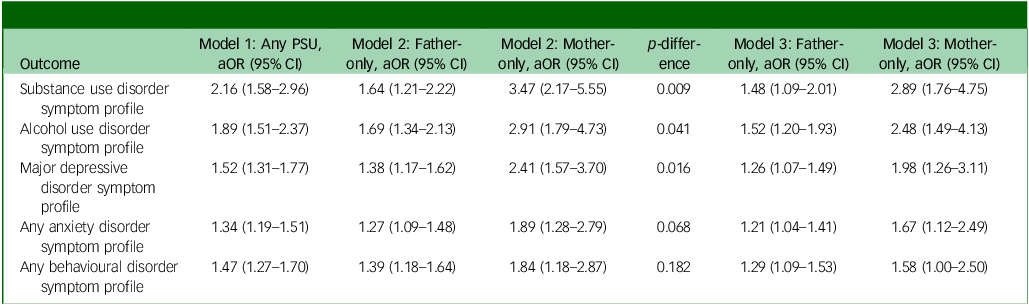
Multivariable logistic regression results are presented in Table 3. All adjusted odds ratios (aORs) for father-only and mother-only PSU are estimated relative to adolescents reporting that neither parent used substances. Maternal–paternal differences were assessed with Wald tests comparing the mother-only and father-only coefficients within the same model, rather than as a direct binary maternal versus paternal comparison.
-
(a) Model 1 (demographic-adjusted associations): After adjustment for age, gender, socioeconomic status and geographic location, any PSU was associated with elevated odds of the SUD symptom profile (aOR = 2.16, 95% CI 1.58–2.96), the AUD symptom profile (aOR = 1.89, 95% CI 1.51–2.37) and the MDD symptom profile (aOR = 1.52, 95% CI 1.31–1.77). Adolescents exposed to both parents using substances exhibited substantially higher odds of the SUD symptom profile (aOR = 5.84, 95% CI 3.42–9.97), the AUD symptom profile (aOR = 4.98, 95% CI 3.09–8.03) and the MDD symptom profile (aOR = 2.81, 95% CI 1.94–4.07), consistent with cumulative exposure patterns.
-
(b) Model 2 (maternal versus paternal exposure): When father-only and mother-only exposure were entered simultaneously, maternal substance use was more strongly associated with the SUD symptom profile (aOR = 3.47, 95% CI 2.17–5.55) than paternal substance use (aOR = 1.64, 95% CI 1.21–2.22; p-difference = 0.009). A similar pattern was observed for the AUD symptom profile (maternal aOR = 2.91, 95% CI 1.79–4.73 versus paternal aOR = 1.69, 95% CI 1.34–2.13; p-difference = 0.041) and the MDD symptom profile (maternal aOR = 2.41, 95% CI 1.57–3.70 versus paternal aOR = 1.38, 95% CI 1.17–1.62; p-difference = 0.016). For the anxiety and behavioural symptom profiles, maternal coefficients were numerically larger than paternal coefficients; however, these differences did not remain statistically significant following FDR correction.
-
(c) Model 3 (family dysfunction-adjusted model): Further adjustment for family dysfunction attenuated selected associations but did not eliminate them. For example, the association between paternal substance use and the SUD symptom profile decreased from 1.64 to 1.48, whereas the maternal association decreased from 3.47 to 2.89. Similar attenuation was observed for the MDD symptom profile. The magnitude of attenuation is quantified on the log-odds scale in Table 4.
Adjusted odds ratios for MINI-KID algorithm-defined adolescent psychiatric symptom profiles by parental substance use category (N = 9437)

Table 3 Long description
A table with six columns and five rows presenting multivariable logistic regression results. The columns are labeled as follows: Outcome, Model 1: Any PSU, aOR (95% CI), Model 2: Father-only, aOR (95% CI), Model 2: Mother-only, aOR (95% CI), p-difference, Model 3: Father-only, aOR (95% CI), Model 3: Mother-only, aOR (95% CI). The rows are labeled with different psychiatric symptom profiles: Substance use disorder symptom profile, Alcohol use disorder symptom profile, Major depressive disorder symptom profile, Any anxiety disorder symptom profile, Any behavioural disorder symptom profile. Each cell contains specific adjusted odds ratios and confidence intervals for each model and outcome. Notable trends include higher odds ratios for mother-only substance use compared to father-only use in several symptom profiles, with significant p-difference values indicating statistical differences.
Model 1 adjusted for age, gender, socioeconomic status and geographic location. Model 2 included father-only and mother-only PSU indicators simultaneously, with neither parent using substances as the reference category, and adjusted for age, gender, socioeconomic status, geographic location, living arrangement and polygamous household structure. Model 3 further adjusted for composite family dysfunction. p-difference values are from Wald tests comparing father-only and mother-only coefficients within the same model and are false discovery rate corrected. Outcomes denote self-reported symptoms meeting MINI-KID algorithm thresholds rather than clinician-confirmed diagnoses. MINI-KID, Mini-International Neuropsychiatric Interview for Children and Adolescents; PSU, parental substance use; aOR, adjusted odds ratio.
Cross-sectional attenuation of selected parental substance use–symptom-profile associations after adjustment for family dysfunction

Table 4 Long description
A table with four rows and six columns comparing the adjusted odds ratios for adolescent psychiatric symptom profiles by parental substance use category. The columns are labeled as Model 2 odds ratio, Model 3 odds ratio, and % attenuation. The rows are labeled as Father-only PSU -> SUD symptom profile, Mother-only PSU -> SUD symptom profile, Father-only PSU -> MDD symptom profile, and Mother-only PSU -> MDD symptom profile. The values in the table are as follows: Row 1: Model 2 odds ratio, 1.64; Model 3 odds ratio, 1.48; % attenuation, 21%. Row 2: Model 2 odds ratio, 3.47; Model 3 odds ratio, 2.89; % attenuation, 15%. Row 3: Model 2 odds ratio, 1.38; Model 3 odds ratio, 1.26; % attenuation, 28%. Row 4: Model 2 odds ratio, 2.41; Model 3 odds ratio, 1.98; % attenuation, 22%.
Model 2 adjusted for age, gender, socioeconomic status, geographic location, living arrangement and polygamous household structure. Model 3 additionally adjusted for composite family dysfunction (domestic violence or high family conflict). Percentage attenuation was calculated on the log-odds scale as 100 × [ln(odds ratio in model 2) − ln(odds ratio in model 3)]/ln(odds ratio in model 2), using the displayed model estimates and rounded to the nearest whole percentage. Because parental substance use, family dysfunction, and symptom-profile outcomes were measured concurrently, attenuation should not be interpreted as mediation or a causal indirect effect. PSU, parental substance use; SUD, substance use disorder; MDD, major depressive disorder.
Attenuation of associations by family dysfunction
Cross-sectional attenuation estimates are presented in Table 4. Adjustment for family dysfunction reduced selected PSU–symptom profile associations by approximately 15–28% on the log-odds scale. For paternal substance use and the SUD symptom profile, the odds ratio decreased from 1.64 to 1.48, corresponding to 21% attenuation; for maternal substance use and the SUD symptom profile, it decreased from 3.47 to 2.89, corresponding to 15% attenuation. For the MDD symptom profile, attenuation was 28% for paternal substance use (1.38 to 1.26) and 22% for maternal substance use (2.41 to 1.98). Because exposure, family dysfunction and outcome were measured concurrently, these values describe statistical attenuation after adjustment and should not be interpreted as evidence of temporal mediation.
Gender-stratified associations
Gender-stratified analyses are presented in Table 5. Evidence consistent with same-gender modelling was observed for substance-related symptom profiles.
Gender-stratified associations between parental substance use and adolescent substance-related symptom profiles (model 3)

Table 5 Long description
The table presents gender-stratified associations between parental substance use and adolescent substance-related symptom profiles. It has four rows and five columns. The columns are labeled Exposure, Outcome, Sons aOR (95% CI), Daughters aOR (95% CI), and Interaction p-value. The rows detail the associations for father-only PSU and mother-only PSU with substance use disorder symptom profile and alcohol use disorder symptom profile for both sons and daughters. Notable values include aORs and their confidence intervals for sons and daughters, as well as interaction p-values indicating the significance of the associations.
Model 3 adjusted for age, socioeconomic status, geographic location, family dysfunction, living arrangement and polygamous household structure. Estimates are relative to adolescents reporting that neither parent used substances. Gender-stratified findings should be interpreted cautiously because the mother-only subgroup was small. aOR, adjusted odds ratio; PSU, parental substance use.
Paternal substance use was more strongly associated with the SUD symptom profile among sons (aOR = 1.89, 95% CI 1.32–2.71) than daughters (aOR = 1.38, 95% CI 0.91–2.09), with a statistically significant interaction (p = 0.042). Conversely, maternal substance use demonstrated a stronger association with the SUD symptom profile among daughters (aOR = 4.12, 95% CI 2.18–7.79) than sons (aOR = 2.84, 95% CI 1.45–5.56; interaction p = 0.031). Similar patterns were observed for the AUD symptom profile.
Although cross-gender associations were present for certain psychiatric symptom profiles, interaction effects were most consistent for substance-related symptom profiles, and should be interpreted cautiously given the small maternal-only subgroup.
Dose–response relationships
Binary logistic regression models treating the number of substance-using parents (0, 1 or 2) as an ordinal predictor confirmed significant dose–response relationships with psychiatric symptom profiles (Fig. 2). Each additional substance-using parent was associated with increased odds of the SUD symptom profile (trend odds ratio 2.24, 95% CI 1.78–2.82), the AUD symptom profile (trend odds ratio 2.08, 95% CI 1.74–2.49) and the MDD symptom profile (trend odds ratio 1.67, 95% CI 1.46–1.92) (all p < .001).
Dose–response relationships between parental substance use and adolescent psychiatric symptom profiles. Weighted prevalence of (a) substance-related and (b) other psychiatric symptom profiles, together with (c) family dysfunction indicators, by number of substance-using parents (0, 1, 2). Error bars represent 95% confidence intervals. Binary logistic regression models treating number of substance-using parents as an ordinal predictor demonstrated significant graded associations across symptom profiles (all p < 0.001). Odds ratios (with 95% confidence intervals in parentheses) shown reflect adjusted trend estimates. Psychiatric outcomes are MINI-KID algorithm-defined symptom profiles rather than clinician-confirmed diagnoses. AUD, alcohol use disorder; MINI-KID, Mini-International Neuropsychiatric Interview for Children and Adolescents; SUD, substance use disorder; MDD, major depressive disorder.

In absolute terms, the prevalence of the SUD symptom profile was more than fivefold higher among adolescents exposed to dual-parent substance use compared with unexposed peers (9.8 v. 1.8%), illustrating a cumulative risk gradient.
Sensitivity analyses
Sensitivity analyses including the four excluded 18-year-old participants yielded materially similar estimates. Complete-case models and alternative model specifications produced effect sizes that differed by <10% from primary analyses, and maternal–paternal contrasts remained statistically significant (Table 6). These findings indicate that results were robust to analytic assumptions and minor variations in sample composition.
Sensitivity analyses for key parental substance use associations

Table 6 Long description
The table presents data on the effects of different models on outcomes related to parental substance use. It has four columns and four rows. The columns are labeled ‘Primary model 3’, ‘Complete-case model’, ‘Including 18-year-olds’, and ‘No false discovery rate correction’. The rows are labeled ‘SUD symptom profile, father-only PSU’, ‘SUD symptom profile, mother-only PSU’, ‘MDD symptom profile, father-only PSU’, and ‘MDD symptom profile, mother-only PSU’. Row 1: Primary model 3, 1.48; Complete-case model, 1.44; Including 18-year-olds, 1.49; No false discovery rate correction, 1.50. Row 2: Primary model 3, 2.89; Complete-case model, 2.76; Including 18-year-olds, 2.92; No false discovery rate correction, 2.93. Row 3: Primary model 3, 1.26; Complete-case model, 1.23; Including 18-year-olds, 1.27; No false discovery rate correction, 1.28. Row 4: Primary model 3, 1.98; Complete-case model, 1.91; Including 18-year-olds, 2.01; No false discovery rate correction, 2.03.
Values are adjusted odds ratios. Complete-case analyses were based on 9184 adolescents with complete data across all variables included in the primary adjusted models. Estimates varied by less than 10% across specifications, and substantive interpretation was unchanged. Primary model 3 was adjusted for age, gender, socioeconomic status, geographic location, family dysfunction, living arrangement and polygamous household structure. Outcomes denote self-reported symptoms meeting MINI-KID algorithm thresholds rather than clinician-confirmed diagnoses. SUD, substance use disorder; PSU, parental substance use; MDD, major depressive disorder; MINI-KID, Mini-International Neuropsychiatric Interview for Children and Adolescents.
In separated exposure models, parental alcohol and parental tobacco use showed positive associations with adolescent MINI-KID algorithm-defined psychiatric symptom profiles, with patterns broadly consistent with the combined PSU construct (Supplementary Table 2). Adjustment for domestic violence and high family conflict separately attenuated the maternal and paternal PSU associations in the same direction as the composite family dysfunction variable (Supplementary Table 3). These findings support the interpretation of the combined PSU and family dysfunction variables as pragmatic summary constructs, in addition to showing that their components are not interchangeable.
Discussion
This study examined cross-sectional associations between PSU and MINI-KID algorithm-defined psychiatric symptom profiles among 9437 Nigerian adolescents aged 11–17 years. Three principal findings emerged. First, PSU was associated with increased odds of substance-related, depressive, anxiety and behavioural symptom profiles in a graded pattern consistent with cumulative exposure frameworks. Reference Brown, Nkemjika, Ratto, Dube, Gilbert and Chiang16,Reference Deniz, Humphrey, Demkowicz, Lereya and Deighton19,Reference Xiong, Fang, Wang, Xie, Liu and Niu20 Second, maternal substance use demonstrated stronger associations than paternal substance use for selected outcomes, particularly the SUD, AUD and MDD symptom profiles. Third, adjustment for family dysfunction partially attenuated selected associations. Throughout, findings should be interpreted as cross-sectional relationships rather than evidence of causal intergenerational transmission, consistent with longstanding cautions regarding causal interpretation in concurrent exposure, family dysfunction and outcome measurement. In addition, outcome classifications should be interpreted as self-reported symptom patterns meeting MINI-KID algorithm thresholds, rather than clinician-confirmed diagnoses, because the MINI-KID modules were completed through structured self-completion with research-assistant support, and no validation of this format currently exists in this population.
Graded associations and cumulative exposure
The most consistent pattern observed was a dose–response relationship between number of substance-using parents and adolescent psychiatric symptom profiles. Adolescents exposed to dual-parent substance use exhibited markedly elevated odds of the SUD, AUD and MDD symptom profiles compared with unexposed peers, and ordinal trend analyses supported a graded association. Such gradients are compatible with cumulative risk perspectives that emphasise compounding exposure to adverse family conditions. Reference Andrews, Hops and Duncan12,Reference Lander, Howsare and Byrne13 Importantly, the pattern extended beyond substance-related symptom profiles to include internalising symptom profiles, suggesting that PSU may be embedded in broader stress and relational dynamics rather than operating solely through behavioural modelling. Reference Brown, Nkemjika, Ratto, Dube, Gilbert and Chiang16 These findings align with the broader literature linking PSU with offspring internalising and externalising outcomes. Reference Miller, Bogdan, Agrawal and Hatoum6,Reference Gelernter and Polimanti7 However, because the present design is cross-sectional, several alternative explanations remain plausible, including shared upstream determinants (e.g. socioeconomic stressors), reverse causation (adolescent difficulties contributing to household stress) and unmeasured parental psychopathology.
Maternal and paternal differences
When maternal and paternal exposure were modelled simultaneously, maternal substance use was more strongly associated with the SUD, AUD and MDD symptom profiles than paternal substance use. These estimates compare each parental exposure group with adolescents reporting that neither parent used substances. They should not be interpreted as direct maternal versus paternal contrasts, but rather as associations of each parental exposure pattern relative to no PSU. The maternal–paternal difference was assessed through Wald tests comparing model coefficients within the same regression framework.
Several non-mutually exclusive interpretations could be considered. First, in Nigeria, maternal substance use may be relatively less socially normative and more stigmatised, potentially marking greater social marginalisation, concealment or co-occurring family strain. Reference Fatimilehin and Hassan22 Second, maternal roles in caregiving and household management may shape adolescents’ day-to-day exposure to substance-related behaviours and their consequences. Third, measurement considerations are salient: adolescent report is likely to capture visible behaviour rather than precise patterns of consumption, and underreporting of maternal use may occur where stigma is pronounced. Reference Williams and Nowatzki26 At the same time, the maternal-only subgroup comprised a small proportion of the sample (1.3%), which limits precision and invites caution in interpreting differences as definitive. Wider confidence intervals and the possibility of differential misclassification mean that the maternal–paternal contrast is best treated as an important signal for future work rather than a settled conclusion. Reference Andrews, Hops and Duncan12
Partial attenuation by family dysfunction
Family dysfunction, operationalised as domestic violence or high family conflict, attenuated selected associations between PSU and adolescent symptom profiles after adjustment. This is consistent with prior evidence linking PSU with household conflict, violence and instability, and with extensive literature connecting exposure to domestic violence and chronic conflict to adolescent depression, anxiety and behavioural problems. Reference Lander, Howsare and Byrne13,Reference Brown, Nkemjika, Ratto, Dube, Gilbert and Chiang16–Reference Apeh and Bernice18 In the present analyses, adjustment for family dysfunction reduced selected associations by approximately 15–28% on the log-odds scale. These estimates indicate statistical overlap between PSU, family dysfunction and adolescent symptom profiles, but because all three were measured concurrently, they should not be interpreted as evidence of temporal mediation or a causal indirect pathway. Family dysfunction may instead function as a correlated contextual factor, confounder, moderator or consequence of broader household adversity. The persistence of associations after adjustment suggests that additional mechanisms may be operative, including unmeasured aspects of caregiving quality, household economic volatility, peer contexts, parental mental health or shared genetic liability. Reference Marceau, Yu, Knopik, Ganiban and Neiderhiser8,Reference Gerring, Thorp, Treur, Verweij and Derks15
Gender-specific patterns
Exploratory interaction analyses indicated patterns consistent with same-gender associations for substance-related symptom profiles, with stronger paternal associations among sons and stronger maternal associations among daughters. Such patterns are broadly consistent with social learning accounts that emphasise modelling and identification processes in parent–child dyads. Reference Bandura and Walters9,Reference Andrews, Hops and Duncan12 However, cross-gender associations were also observed, and interaction evidence was not uniformly robust across symptom profiles. Given the small maternal-only subgroup and the cross-sectional design, gender-specific findings should be treated as hypothesis-generating.
Contextual considerations
Most evidence on PSU and adolescent psychiatric outcomes derives from high-income Western settings. The present findings extend this literature to a large Nigerian school-based sample within a social context where family structure (including polygamy), normative expectations and extended kinship support may differ markedly. Reference Evans, Matola and Nyeko21,Reference Fatimilehin and Hassan22 In some circumstances, extended family networks may buffer adversity through caregiving substitution or social support. Conversely, stigma surrounding maternal substance use may amplify stress and concealment, potentially shaping both family functioning and adolescent experiences. Reference Ogunlade, Abioye, Kuyebi, Musa, Abubakar and Yisa2,Reference Akpan, Olojo, Oni, James and Onoja23,Reference Ebrahim, Adams and Demant24 Because cultural moderation was not directly measured, these interpretations remain provisional.
Strengths and limitations
Several strengths should be noted. The study drew on a large school-based sample and used structured MINI-KID algorithmic symptom-profile classification rather than brief, non-specific symptom screens. The large sample provided sufficient power to detect small-to-moderate associations, and missing data were addressed by using multiple imputation with sensitivity analyses indicating robustness. Limitations warrant emphasis. First, cross-sectional design limits causal inference and precludes establishing temporal ordering. Second, a central measurement limitation concerns the mode of MINI-KID administration. MINI-KID modules were completed as structured self-report items with trained research-assistant support, rather than as fully interviewer-administered diagnostic interviews. Direct psychometric validation of this specific self-completed format in Nigerian school-based adolescents is not available. Because self-completion removes the clinician-administered elements – symptom probing, impairment assessment and differential judgement – on which the diagnostic validity of the MINI-KID depends, the resulting outcomes are best understood as self-reported symptom profiles meeting algorithm-defined thresholds, rather than as definitive clinical diagnoses, and we have revised our terminology throughout this paper accordingly. This approach may introduce misclassification, particularly for conditions requiring clinical probing, assessment of impairment or differential diagnostic judgement. Replication using interviewer-administered assessments would strengthen confidence in these findings. More broadly, self-report and algorithm-based screening instruments for adolescent psychiatric symptoms, including the self-completed MINI-KID format used here, have not been formally validated against clinician-administered diagnostic reference standards in Nigerian or comparable West African adolescent populations. Prospective validation studies pairing self-completed screening with independent clinical diagnostic interviews represent an important priority for future research, and would allow subsequent studies in this population to report on diagnostic rather than symptom-based outcomes with confidence.
Third, PSU and family dysfunction were derived from adolescent report, raising the possibility of shared informant bias. Reference Williams and Nowatzki26 Fourth, PSU was defined as at least weekly alcohol or tobacco use and did not capture severity, duration, quantity, chronicity, impairment or other substances, which may be consequential in understanding heterogeneity of risk. Although separated sensitivity analyses showed directionally consistent associations for parental alcohol and tobacco exposure, the combined PSU construct should be interpreted as a pragmatic marker of visible household substance-related behaviour rather than a measure of PSU disorder. Fifth, binary algorithm-defined classifications do not capture symptom severity, impairment gradients, subthreshold presentations or dimensional psychopathology, which may be important for interpreting adolescent psychiatric risk. Sixth, the small maternal-only subgroup reduces precision and increases vulnerability to misclassification or selection effects, particularly in settings where maternal substance use is stigmatised. Seventh, although referral procedures were in place for adolescents who became distressed or required assistance, subsequent uptake of school-based or specialist support was not systematically recorded as a study outcome. Finally, the sample is school-based and may not generalise to out-of-school adolescents, who may experience different risk profiles.
In conclusion, in this large, Nigerian school-based sample, PSU was associated with increased odds of MINI-KID algorithm-defined adolescent psychiatric symptom profiles in a graded fashion. Maternal substance use showed stronger associations than paternal substance use for selected outcomes, and family dysfunction partially attenuated observed relationships. These findings are consistent with intergenerational risk frameworks, but should not be interpreted as evidence of causal transmission, given the cross-sectional design. Reference Marceau, Yu, Knopik, Ganiban and Neiderhiser8,Reference Gerring, Thorp, Treur, Verweij and Derks15 Conceptually, the study extends predominantly high-income country evidence on cross-generational family risk into a Nigerian adolescent population, where family structures, gender norms and service configurations differ substantially. From a public health perspective, the findings suggest that visible parental substance-related behaviour may help identify adolescents who could benefit from school-linked or primary care-based mental health assessment and family-sensitive prevention strategies. Longitudinal studies using interviewer-administered diagnostic assessments, alongside dedicated validation of self-report screening tools against clinical diagnostic reference standards, are needed to clarify temporal ordering, mechanisms, diagnostic accuracy and culturally situated intervention targets.
Supplementary material
The supplementary material is available online at https://doi.org/10.1192/bjo.2026.12120
Data availability
De-identified participant data and data dictionary will be made available to researchers with approved proposals. The study protocol and statistical analysis plan will also be shared. Data will be available 9 months to 5 years after publication. Proposals should be submitted by email to the corresponding author, A.O.A. Those requesting the data must sign a data access agreement and obtain Lagos State Schools Board Ethics Committee approval before data release.
Acknowledgements
We thank the Lagos State Schools Board for permission to conduct this research. We are grateful to administrators, teachers and staff of all 47 participating schools for their cooperation. We express deep gratitude to the adolescents who participated. We acknowledge the research assistants who conducted surveys with professionalism and sensitivity.
Author contributions
A.O.A. contributed to study conceptualisation, methodology, formal analysis, investigation, resources, data curation, supervision, project administration, validation, writing the original draft and reviewing and editing the manuscript. A.O.A. directly accessed and verified all underlying data. O.E.O. contributed to study conceptualisation, methodology, formal analysis, validation and reviewing and editing the manuscript. O.E.O. also contributed to statistical analysis planning and methodological expertise. A.E.E. contributed to study methodology, investigation, validation and reviewing and editing the manuscript. A.E.E. also provided expertise in adolescent mental health assessment and diagnostic instrument adaptation. All authors had full access to all the data in the study, accept responsibility to submit for publication and approved the final version of the manuscript. A.O.A. and O.E.O. are guarantors and affirm that this manuscript is an honest, accurate and transparent account of the study being reported; that no important aspects have been omitted and that any discrepancies from the planned study have been explained.
Funding
The Lagos Schools Emotional and Behavioural Health Survey was supported in part by the Tertiary Education Trust Fund (TETFund), Nigeria (grant number TETF/16/RP/001). The views expressed are those of the authors and not necessarily those of TETFund. The funder had no role in study design; in the collection, analysis and interpretation of data; in the writing of the report or in the decision to submit the article for publication. The corresponding author had full access to all the data in the study and had final responsibility for the decision to submit for publication.
Declaration of interest
None.
Ethical standards
All procedures performed in studies involving human participants were in accordance with the ethical standards of the institutional and national research committee and with the 1964 Helsinki Declaration and its later amendments or comparable ethical standards. The study procedures received ethical clearance from the Lagos State University Teaching Hospital Ethics Committee (identifier LREC/06/10/1295). Written informed consent was obtained from all the parents/legal guardians and assent was obtained from the participating adolescents before data collection.








 Open access


eLetters
No eLetters have been published for this article.