Introduction
Dementia is a significant public health problem. It is one of the most common diseases in the elderly and a major cause of disability worldwide (Ritchie and Lovestone, Reference Ritchie and Lovestone2002; Berr et al., Reference Berr, Wancata and Ritchie2005). Older people with dementia often exhibit numerous functional impairments and behavior problems (Spira and Edelstein, Reference Spira and Edelstein2006). Traditionally, cognitive function has been the main focus of interest in treatment and research on people with dementia. It is becoming increasingly recognized, however, that non-cognitive symptoms are quite disturbing to families and caregivers and may seriously impact patients’ well-being (Sadowsky and Galvin, Reference Sadowsky and Galvin2012). As the disease progresses, non-cognitive symptoms become predominant problems and take an enormous toll, both emotionally and financially (Cohen-Mansfield, Reference Cohen-Mansfield2001).
It has been shown that the effectiveness of pharmacological treatments is limited. As there are no curative treatments yet for dementias, it is important to promote well-being and quality of life to improve the lives of those who have the condition now (Algar et al., in press). Thus, non-pharmacological interventions for dementia patients have gained attention in recent years. One non-pharmacological therapy that has shown its effectiveness in dementia is RT, which provides emotional and even social benefits.
Reminiscence is a psychosocial intervention that is commonly used with older people and in dementia treatment. It is a way to maintain the personal past and perpetuate the person's identity, and it uses stimulation, communication, socialization, and entertainment. Reminiscence can also be regarded as the generator of memories and interpretations in the present of life events from some point in our past, usually the distant past (Webster, Reference Webster2003).
The definition offered by Woods et al. (Reference Woods, Spector, Jones, Orrell and Davies2005) appears quite frequently in the literature on dementia and gives a more detailed account of the various processes involved in a reminiscence activity: RT involves the discussion of past activities, events, and experiences with another person or group of people, usually with the aid of prompts such as photographs, household and other familiar items from the past, music and archive sound recordings. Various authors argue that the variations in definitions, types, functions, and conceptualizations of reminiscence across studies highlight the challenge in extrapolating and analyzing data to support its effectiveness as a psychosocial intervention (Lin et al., Reference Lin, Dai and Hwang2003; Woods et al., Reference Woods, Spector, Jones, Orrell and Davies2005). In this regard, several studies demonstrate the effectiveness and efficacy of this therapy in people with dementia, especially for improving mood and reducing depressive symptoms, increasing life satisfaction, and reducing agitation behaviors (Lai et al., Reference Lai, Chi and Kayser-Jones2004; Tadaka and Kanagawa, Reference Tadaka and Kanagawa2007; Wang, Reference Wang2007; Serrani, Reference Serrani Azcurra2012; Woods et al., Reference Woods2012).
However, RT work with people with dementia involves a number of peculiarities (Martínez, Reference Martínez2012): the objectives must be flexible enough to adapt them to the participants and their cognitive ability; the materials used should be as close as possible to the participants; groups should be small, and to form the groups the cognitive performance of the participants should be taken into account. The involvement of family members can be sought in preparing the sessions, or they can even participate in them and, thus, have each participant's personal information, in order to provide support when needed. If inaccurate or incorrect memories arise, it is advisable to listen without correcting. The prime objective of the activity should be emotional validation over the orientation.
One of the objectives of applying interventions based on reminiscence, like the one discussed in this paper, is to make sense of the person's relationship with his/her past, helping him/her to keep the proper meaning (Lin et al., Reference Lin, Dai and Hwang2003). This type of intervention establishes a connection with past moments, bringing them to the present in such a way that the participant creates a sense of continuity and deepens his/her sense of personal identity, well-being, self-esteem, and integrity, all of which can be reduced or even lost with the onset of dementia symptoms. Thus, the purpose of the present study is to examine the benefits of a reminiscence program for elderly people with dementia in reducing depressive symptoms and increasing self-esteem and psychological well-being dimensions.
Methods
Participants
Participants included 42 elderly people over 65 years old, living in two nursing homes (institutionalized participants) in the province of Valencia (Spain). A quasi-experimental, single-blind design was applied with pre- and post-treatment measures. The nursing homes were randomized to determine where the intervention program would be administered. The control group, who are on the waiting list to do RT, receive their usual day-care program, which does not have any impact on the studied variables. Participants assigned to the treatment group were divided into three smaller groups, taking into account their cognitive characteristics, because when working with people with dementia the groups should be smaller.
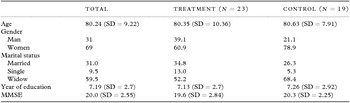
Diagnosis was the outcome of a prior evaluation in the Neurology Department of the General Hospital of Valencia, Spain. The inclusion criteria for this study were: (i) diagnosis of AD determined by the DSM-IV-TR (American Psychiatric Association, 2000); (ii) a Mini-Mental State Examination Spanish version (Lobo et al., Reference Lobo, Saz and Marcos2002), with scores under 23 and impairment on the neuropsychological examination; (iii) no speech or vision disorders; and (iv) being between levels 3 and 4 on the Global Deterioration Scale (GDS; Reisberg et al., Reference Reisberg, Ferris, de Leon and Crook1982). Regarding the GDS, from level 5, moderate dementia, patients have greater difficulty communicating and remembering and may even need external aid. Therefore, the maximum level established for this study is 4 (mild dementia). Exclusion criteria for patients were: a history of previous symptomatic stroke, taking any medical condition significantly affecting the brain, serious psychiatric symptoms, or a history of drug abuse. All participants gave informed consent to take part in the study. Table 1 provides descriptive information about the sample and groups.
Demographic data

Tests for homogeneity revealed no significant differences between the groups at pre-treatment: age (t(40) = 0.098, n.s.), gender (χ2(1) = 6.01, n.s.), marital status (Mann–Whitney z = 0.928, n.s.), years of education (t(40) = 0.153, n.s.), MMSE (t(40) = 0.506, n.s.).
Instruments
In addition to collecting socio-demographic data, various tests and scales were administered to take pre- and post-intervention measures. The pre-treatment assessment was performed two weeks before the beginning of the intervention, and the post assessment was performed immediately after the intervention. Scales were administered in a semi-structured interview format. The Mini-Mental State Examination Spanish version (Lobo et al., Reference Lobo, Saz and Marcos2002) was administered as a screening method to detect cognitive impairment by assessing performance in different cognitive areas. To tap depressive symptomatology, the Center for Epidemiological Studies-depression scale (CES-D; Radloff, Reference Radloff1977) was used. This scale measures the subject's level of depressive symptomatology. The scale consists of 20 items assessing symptoms of depression during the week before the test performance. Each item is assessed on a 4-point scale, from zero (little or no experience of the symptom) to three (almost constant experience of the symptom). The maximum score is 60, and a cut-off point of 16 is used to identify subjects with depressive symptoms.
Self-esteem was assessed with the 10-item Rosenberg Self-Esteem Scale (RSES; Rosenberg, Reference Rosenberg1965), which aims to assess both positive and negative feelings toward oneself. The RSES, a 10-item assessment, has been widely used as a global index of self-esteem in several research domains. Participants respond on a 5-point Likert scale ranging from 1 (strongly agree) to 5 (strongly disagree).
Finally, the Ryff Psychological Well-Being scales (PWB; Ryff, Reference Ryff1989) were administered; they are often used in elderly adults, and their psychometric properties have been widely studied (Tomás et al., Reference Tomás, Meléndez and Navarro2008). The response format for all the PWB items consisted of six ordered categories ranging from “strongly disagree” to “strongly agree,” and including items with both positive and negative contents. They assess the dimensions of self-acceptance, environmental mastery, positive relations with others, autonomy, personal growth, and purpose in life.
Procedure
We implemented a program based on earlier research (Meléndez et al., Reference Meléndez, Charco, Mayordomo and Sales2013). We used several strategies, activities, and dynamics that researchers had used in the past to conduct reminiscence intervention. The sessions were adapted to the cognitive and personal characteristics of the participants, and all of them were carried out in a group. The program, led by a psychologist, consists of ten weekly sessions lasting 60 minutes each; in each session, all the life stages (childhood, youth, adulthood, and current old age) were worked on using different topics.
All the sessions have the same structure: at the beginning, the members of the group are welcomed, and they are told what topic will be addressed. After that, two activities are performed using specific elicitors (music, images, objects, etc.) to evoke their memories and sayings and quotations related to the topic of the session. The first of these activities aims to strengthen personal identity and coherence through the meaningful integration of lived experience, and the second promotes the integration of people from the current time and social context. In both cases, participants perform a free association exercise consisting of saying or writing the first word or expression provoked by the stimulus; then open questions are formulated to facilitate the arrival of positive personal memories; finally, the exercise aims to connect these memories with the present.
Presented below are the main objectives of each session and the central theme used to generate remembrance. The first session's primary goal is to inform participants about the concept of reminiscence and the procedure to be followed, and facilitate their initial contact with each other; the main topic of the session is important life events throughout the life cycle. The second session aims to encourage conversation, bring out feelings and emotions, and reduce the use of maladaptive negative thoughts and memories, with the main topic of the session being places and things from the past and remote everydayness. The third session aims to promote the positive aspects of the self, leaving behind self-blame, and self-criticism; this session mainly addresses people's different roles across the life span, and the main responsibilities, demands, and requirements of daily life at various stages. The fourth session works on interpersonal relationships established throughout life, the importance attached to them in the past, and the importance given now. The aim of the session is to encourage active participation in their environment, promoting sociability, and openness to relationships and the use of social and family support. The fifth session aims to promote a positive attitude toward oneself, recognizing and accepting the many aspects of the self, including both the negative and the positive, and developing a positive feeling about what has already been lived. By maintaining a feeling of continuous development and improvement over time, the person observes him/herself expanding and growing and is open to new experiences. The central themes of the session are the goals and objectives that have been achieved throughout the person's life story. The sixth session is designed to recall the changes in lifestyles, in order to develop a symposium in which participants share their experiences, promoting the social bond, making a journey through history, and noting the advances that have occurred at different levels (technological, nutritional textile, social, etc.). In the seventh session, the main target is the autobiographical memory of important life events. These events are a means to identify these good feelings from the past and redirect them to modern life, promoting autonomy and personal identity. The aim of the eighth session is to generate positive emotions and feelings, strengthen existing social ties through narratives of traditions, and share experiences and learning by promoting each person's personal and social identity. The ninth session's objective is to utilize traditional games as a vehicle for remembering events and positive emotions from the past, and promote self-esteem. In the last session, the aim is to utilize music, film and advertisements as a vehicle for remembering positive emotions from the past.
Data analysis
We performed t-tests for independent samples, χ2 tests, and U Mann–Whitney to determine whether or not the groups were homogenous prior to treatment. To analyze the intervention's effects, a mixed-factor analysis of variance (2 groups: between subjects X 2 time: within subjects) was conducted. Simple effects and interaction effects (group X time) were examined. The level of statistical significance employed was p < 0.05. All analyses were carried out using the SPSS 19 statistical package.
Results
Regarding the results, all the variables show the effects of the large-group interaction and simple effects of each of the groups. In the simple effects, it can be seen that there are differences in the intervention group after it, while the control group did not modify their scores.
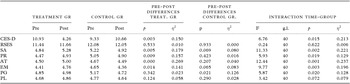
In the evaluation of depression, the time-group interaction was indeed found to be significant (F1, 40 = 6.76, p = 0.015, η2 = 0.213); therefore, the application of the treatment was effective in reducing depressive symptomatology. The analysis of simple effects showed that there were no differences in scores between the treatment group and the control group before starting the intervention. Therefore, we can conclude that the two groups were homogeneous. When analyzing the evolution of each group independently, a significant pre-post decrease in scores was observed in the treatment group (F1, 40 = 10.56, p = 0.003, η2 = 0.150; Measurement 1 (M1) = 10.93; Measurement 2 (M2) = 4.26), while in the control group, no significant change in scores was observed (M1 = 9.33; M2 = 10.66).
Next, we studied the effect of the intervention on RSES. The time-group interaction did not show a significant effect (F1, 40 = 0.24, p = 0.622, η2 = 0.006). Moreover, no significant differences were found between the groups at pre-treatment. Analysis of the groups over time indicated no significant differences between the control group (M1 = 12.08; M2 = 12.05) and the treatment group (M1 = 11.44; M2 = 11.66).
In relation to psychological well-being, results for the time-group interaction were significant for all dimensions except for purpose in life. The study of simple effects confirmed the homogeneity of the groups in all dimensions, with no differences in pre-treatment scores. In addition, no statistically significant differences were observed in the control group, except for a significant decrease in personal growth; in the treatment group's scores, a significant increase was observed between the two measures in self-acceptance, positive relations with others, autonomy and environmental mastery (for statistical data, see Table 2).
Statistical data of PWB dimension between measures and interaction time group

SA = self-acceptance; PR = positive relations with others; AT = autonomy; EM = environmental mastery; PG = personal growth; PL = purpose in life.
Discussion
The combined prevalence of MCI and dementia highlights the public health impact of these conditions and the urgent need to find therapies. This study demonstrated the effectiveness of reminiscence group intervention in elderly patients with dementia; the results support the idea that reminiscence alleviates depressive symptoms and improves psychological well-being (self-acceptance, positive relations with others, autonomy, environmental mastery, and personal growth). However, not all the proposed objectives could be confirmed: self-esteem and purpose in life showed no effect in the interaction. For elderly people with dementia, it is believed that new learning is difficult, but if old memories are well rehearsed, they will remain accessible and can be shared with others (Brooker and Duce, Reference Brooker and Duce2000); therefore, it is thought that RT can encourage elderly people with dementia, as well as elderly people without dementia, to value their lives by re-experiencing their good old days, and to have meaningful social interaction when sharing re-experiences with the group members (Tadaka and Kanagawa, Reference Tadaka and Kanagawa2007).
Different studies suggest that depressive disorder is associated with an increased risk of developing cognitive dysfunction (Castaneda et al., Reference Castaneda, Tuulio-Henriksson, Marttunen, Suvisaari and Lönnqvist2008) and eventually dementia, particularly Alzheimer's disease (Ownby et al., Reference Ownby, Crocco, Acevedo, John and Loewenstein2006). Several groups have examined the temporal relationship between depression and Alzheimer's disease to understand whether depression is simply a prodromal symptom of Alzheimer's disease that precedes the onset of cognitive deficits, or whether a history of depression might represent an independent risk factor for the development of Alzheimer's disease. Moreover, depression may occur in 30%–40% of Alzheimer's disease patients (Starkstein et al., Reference Starkstein, Jorge, Mizrahi and Robinson2005), and it affects the clinical evolution of this disease. Many depressed people ignore positive information and focus on memories that support their dysfunctional reviews. RT helps to find more complete and detailed aspects of one's life history and interpret them in a more balanced way, taking a more realistic and objective view of these aspects. As in other studies (Wang, Reference Wang2007; Serrani, Reference Serrani Azcurra2012; Woods et al., Reference Woods2012), the results indicate that reminiscence may be an effective treatment for depressive symptoms in older adults with dementia. Therefore, identifying depression in people with dementia is important, and at the same time, implementing psychosocial intervention is a necessary process in order to improve the life satisfaction of this population group (O’Shea et al., Reference O’Shea2014).
Regarding the psychological well-being dimensions, other interventions (Meléndez et al., Reference Meléndez, Charco, Mayordomo and Sales2013) show the efficacy of this therapy in improving some of these dimensions. In cross-sectional research with older adults, positive self-functions demonstrated a direct and positive association with participants’ well-being. These findings suggest that using RT to foster identity and self-continuity, and to achieve a sense of coherence and meaning in life, appears to have a positive and direct link to well-being (O’Rourke et al., Reference O’Rourke, Cappeliez and Claxton2011). In this regard, the self-acceptance dimension shows increased scores in the treatment group and a marginal decrease in the control group, indicating the effectiveness of this therapy in the maintenance of consciousness. It is important that, in the development of the disease, people can be affected by the loss of self-awareness (even in advanced stages of the disease); therefore, working on this dimension is crucial to the maintenance of self-identity, despite the advance of the disease. Furthermore, based on the social nature of reminiscences, the memory can play a big role in the reconstruction and maintenance of the self, approaching the idea of integrity.
With regard to positive relationships with others, it is important to note that in aging there is a clear reduction in the sources of support (Meléndez et al., Reference Meléndez, Tomás and Navarro2011). RT encourages this population to assess their lives in order to re-experience the good old days; it can encourage meaningful social interaction by sharing lived experiences with group members (Tadaka and Kanagawa, Reference Tadaka and Kanagawa2007). Through RT, an activated interaction occurs between group members, making reminiscence a stimulating, sociable and inclusive activity and, therefore, providing social support (Brooker and Duce, Reference Brooker and Duce2000). Furthermore, reminiscence group therapy provides cognitively impaired individuals with opportunities for social interaction.
Regarding the autonomy dimension, it is important to note that people with dementia become dependent. Therefore, the application of this therapy is important, as it has been shown that people receiving treatment have improved their own individuality. The greater the autonomy of the patient with dementia, the longer it takes to become dependent in performing daily activities. People involved in RT create a new meaning for the circumstances experienced in the past and in the present, and meaning is a mental representation of possible relationships among things, events, and relationships (Baumeister, Reference Baumeister1991). In addition, there was an improvement in scores in the proficient environment dimension in the treatment group, while the control group decreased their scores. Thus, the control group has more difficulty adapting to their own context and developing suitable contexts. Promoting adaptability to both their own context and new contexts slows the loss of certain skills. People implement strategies they thought they had lost and that have been brought to the present through reminiscence. It is useful to perceive that they still retain the ability to adapt to changes that may occur and still have the perception of control, combining this improvement with the increase in autonomy when doing certain activities in daily life that can still be performed in early stages of the disease.
In relation to personal growth, a decrease was observed in the control group, and purpose in life showed no significant interaction. As noted, RT is a way of keeping the personal past, not developing new learning strategies, objectives or goals, but it promotes the maintenance of identity through the memory of past experiences.
As a strength of the study, we can conclude that the RT work in older people with dementia has been shown to have positive effects, leading us to believe that there is a positive impact of this type of therapy in promoting a good fit and, therefore, adaptation. In this sense, reminiscences should be promoted and/or paid attention to as much as drug treatment, because they decrease depressive symptoms and increase psychological well-being, improving quality of life.
One of the study limitations is the small sample size; however, despite its small size, significant results were obtained. On the other hand, there has been no follow-up to determine the long-term effectiveness of the program. In this regard, and as some authors point out (Tadaka and Kanagawa, Reference Tadaka and Kanagawa2007), care must be taken when interpreting the apparent benefits of the intervention program, as some studies have shown that affective improvements resulting from RT present more short-term effects than long-term. Moreover, as a future line of work, studies could assess whether the changes in mood of patients with dementia affect behavioral symptoms, and whether they could have an impact on the decrease in the caregiver's perception of overload.
Conflict of interest declaration
None.
Description of authors’ roles
Jesus Gonzalez and Marta Torres were responsible for the collection and evaluation of the sample, as well as for carrying out the program. Teresa Mayordomo and Alicia Sales helped in constructing and controlling the intervention and advising on the guidelines to be followed. Juan C. Melendez was responsible for the statistical analyses performed. Finally, all the authors were responsible for finding information and writing the manuscript.