Historically not a feature of this journal
Ghee, a widely used dairy product in the Indian subcontinent, is a clarified butterfat made from cow, buffalo or a combination of their milk. In commercial production, milk cream or butter is clarified at temperatures ranging from 110°C to 120°C and heated for suitable time periods. The separation of the oily phase from the residue is achieved through clarification and filtration. Ghee is frequently used to enrich the flavour of dishes and is a favoured option for frying traditional Indian foods. It is also a preferred cooking medium for making desserts. Despite its high saturated fatty acid content (∼65%), ghee has a shorter shelf life compared to most vegetable oils due to its lower antioxidant levels. The primary spoilage concern for ghee is the development of off-flavours during storage caused by autoxidation, as well as undesirable sensory changes during frying due to thermal oxidation (Kumbhare et al. Reference Kumbhare, Prasad, Khamrui, Wani and Sahu2021).
Lipid oxidation is a process driven by free radicals that can have negative implications on food quality and shelf life. When unsaturated fatty acids interact with oxygen during this process, they form lipid hydroperoxides, which eventually break down into small, volatile compounds like aldehydes and ketones. These compounds lead to an undesirable taste and smell, affecting the overall acceptance of lipid-containing products. Dietary cholesterol, like unsaturated fatty acids, is prone to oxidation and can be absorbed into human serum lipoproteins. The oxidation of both fatty acids and dietary cholesterol poses a risk factor for cardiovascular diseases (Chistiakov et al. Reference Chistiakov, Bobryshev and Orekhov2016). Unfortunately, thermal processing of foods leads to the formation of significant levels of lipid oxidation products, meaning that individuals consume these products regularly. Incorporating antioxidants during processing is a key strategy to safeguard lipids from autoxidation and thermal oxidation. While synthetic phenolic compounds like butylated hydroxytoluene (BHT) and butylated hydroxyanisole (BHA) have traditionally been used as antioxidants in lipid-based products, concerns exist regarding their adverse health effects (Lourenco et al. Reference Lourenço, Moldão-Martins and Alves2019). As a result, the quest for natural antioxidants has become a crucial focus in the dietary fat industry. This has spurred extensive research efforts, including the exploration of various plant extracts, to identify effective preservatives for ghee and other dairy products rich in fats.
India, the second largest producer of paddy/rice (Oryza sativa), extracts numerous valuable chemicals and nutraceuticals from rice derivatives. A key phytochemical present in high amounts (10–30 mg/g) in rice bran oil (RBO) is gamma-oryzanol (γ-oryzanol), which consists of ferulic acid esters of phytosterols and triterpene alcohols. Notably, ferulate esters of cycloartenol, β-sitosterol, 24-methylenecycloartenol and campesterol are the predominant compounds. Gamma oryzanol acts as a powerful natural antioxidant in RBO (Liu et al. Reference Liu, Xu, Chang, Tang, Lu, Liu, Jin and Wang2021) and is linked to various health benefits, including the reduction of plasma cholesterol level (Bumrungpert et al. Reference Bumrungpert, Chongsuwat, Phosat and Butacnum2019), preventing cholesterol absorption and platelet aggregation (Wong et al. Reference Wong, Ismail, Tohit, Abdullah and Zhang2016). Additionally, gamma-oryzanol has been utilized for treating hyperlipidaemia (Phunikhom et al. Reference Phunikhom, Sattayasai, Tiamkao and Gaysonsiri2021), treating menopausal disorders (Kim et al. Reference Kim, Yoon, Cho, Lee and Um2024), supporting the growth of muscle mass (Ahn et al. Reference Ahn, Son, Seo, Ha, Ahn, Lee and Jang2021) and exhibiting anti-tumour properties (Castanho et al. Reference Castanho, Lageiro, Calhelha, Ferreira, Sokovic, Cunha and Brites2019).
The antioxidant properties of ferulates are attributed to the creation of multiple resonance-stabilized structures. γ-Oryzanol is commonly utilized in high-fat food products like edible vegetable oils (Yao et al. Reference Yao, Yuan, Zheng, Wang and Li2024), whole milk powder (WMP; Nanua et al. Reference Nanua, McGregor and Godbert2000), lard (Suh et al. Reference Suh, Yoo and Lee2007), confectionery items (Sharif et al. Reference Sharif, Butt, Anjum and Nasir2005), yoghurt (Zhong et al. Reference Zhong, Yang, Cao, Liu and Qin2018) and cosmetic formulations (Juliano et al. Reference Juliano, Cossu, Alamanni and Piu2005) due to its antioxidative characteristics. Research has demonstrated its ability to inhibit the generation of cholesterol oxidation products (COPs) in foods containing animal fats. Considering that processing ghee at elevated temperatures can result in the oxidation of cholesterol and the creation of COPs (Nath et al. Reference Nath, Usha and Murthy1996), the inclusion of γ-oryzanol can help prevent cholesterol oxidation during the frying of food in ghee. The hypothesis of this study is that gamma-oryzanol, a natural antioxidant from RBO, may improve the autoxidative and thermal stability of clarified butterfat. For this study, the assessment of the antioxidant potential of ghee with added γ-oryzanol at a 0.5% had been done. Determination of the antioxidant levels using the HPLC method during ghee storage and frying, and investigation of the impact of the supplemented antioxidant on cholesterol oxidation were conducted.
Materials and methods
Gamma-oryzanol (with a minimum assay of 98%) was sourced from Tsuno Rice Fine Chemicals Co. Ltd., Wakayama, Japan. Chromatographic analysis was conducted using a Sun Fire TM C18 HPLC column (Waters, Milford, MA, USA). The synthetic antioxidant, BHA, was sourced from Sigma Aldrich (St. Louis, MO, USA). HPLC-grade solvents from Merck Millipore (Billerica, MA, USA) were employed for the HPLC analysis. All chemicals and reagents used in the study were of analytical reagent (AR) grade and obtained from reputable suppliers.
Preparation of ghee
Ghee was prepared using the creamery butter method, which involved clarifying butter at 110°C ± 1°C. To begin, cream with 40%–42% fat content was utilized, cooled to 8°C and left to age overnight at this temperature. The aged cream was then processed into butter at 10°C using a household blender. Subsequently, the butter was clarified at 110°C ± 1°C to achieve browned milk solids and was then filtered through cheesecloth. The resulting ghee was cooled to 60°C for the addition of either 0.5% γ-oryzanol or 0.02% BHA. Ghee without any additional antioxidants was utilized as a control.
Determination of physicochemical properties of ghee
The physicochemical properties of ghee were determined by analysing samples with 0.5% γ-oryzanol, 0.02% BHA and a control sample. The analysis included testing for moisture content (IS: SP: 18 Part XI, 1981), butyro refractometer reading at 40°C (IS: SP: 18 Part XI, 1981), slip point (IS: SP: 18 Part XI, 1981), free fatty acids as a percentage of oleic acid (IS: SP: 18 Part XI, 1981) and Reichert Meissl value (IS: SP: 18 part XI, 1981).
The size and quantity of grains formed during granulation of ghee were determined according to the procedure described by Arumughan and Narayanan with some modifications (Arumughan and Narayanan, 1979). Fifty millilitres of molten (60°C) ghee was placed in a centrifuge tube and incubated at 29°C for 24 h to achieve complete granulation. The tubes were then centrifuged at 250 g for 10 min to separate the grains, and the amount of grains was calculated as percent grain yield. The size of the grains (n= 50) was measured with a compound microscope (Zeiss Axioskop 2 plus, USA) at 10× magnification using Zen-lite software.
Antioxidant activity of ghee using the 2,2-diphenyl-1-picrylhydrazyl (DPPH)-free radical
The antioxidant capacity of ghee samples (containing 0.5% γ-oryzanol, 0.02% BHA and control) to quench 2,2-diphenyl-1-picrylhydrazyl (DPPH) radicals was determined following the method (Espin et al. Reference Espin, Soler-Rivas and Wichers2000). The procedure entailed mixing 0.2 ml of the ghee sample with 3.8 ml of ethyl acetate to form a 4 ml mixture, after which 1 ml of DPPH solution was added (6.09 ×10⁻⁵ mol in ethyl acetate). After a 10-min incubation period, the absorbance was measured at 520 nm using a spectrophotometer (Secomam Anthelie WW-83105-10, France). A reference sample was prepared using 1 ml of DPPH solution and 3 ml of ethyl acetate. A standard curve was generated by measuring the absorbance of known concentrations (50–300 μM solution) of 6-hydroxy-2,5,7,8-tetramethylchroman-2-carboxylic acid (Trolox), and the results were expressed as Trolox equivalent antioxidant capacity (TEAC) values (μM of Trolox equivalent/g of ghee). The DPPH radical scavenging activity percentage was calculated utilizing the provided formula.
 \begin{align*}
&{\rm {Per\,cent\,radical\,scavenging\,activity}}\nonumber\\
&\quad = \frac{{ControlOD - SampleOD}}{{ControlOD}}\ X\ 100
\end{align*}
2,2’-Azino-bis(3-ethylenebenzothiazoline-6-sulphonic acid) radical cation decolourization assay
The radical scavenging activity of the ghee samples (containing 0.5% γ-oryzanol, 0.02% BHA and control) was assessed using the ABTS (2,2’-Azino-bis(3-ethylenebenzothiazoline-6-sulphonic acid)) method (Re et al. Reference Re, Pellegrini, Proteggente, Pannala, Yang and Rice-Evans1999). One gram of ghee was precisely weighed and dissolved in 5–8 ml of ethyl acetate, then adjusted to a final volume of 10 ml with the solvent. A stock solution of ABTS was prepared by dissolving it in ethanol to a concentration of 7 mM. Just before each experiment, the ABTS working solution was made by diluting the ABTS stock solution with ethanol to achieve an absorbance of 0.70 ± 0.02 at 734 nm against ethanol. Three millilitres of the ABTS working solution were placed in a 3 ml cuvette, and thirty microliters of the diluted ghee sample (1:10) were added to both the ABTS working solution and the blank (cuvette with 3 ml ethanol). The mixture was briefly mixed for 5 seconds, and the change in absorbance at 734 nm was monitored over 6 min using a dual-beam spectrophotometer (Secomam Anthelie WW-83105-10, France). A standard curve was constructed using known concentrations (50 to 500 μM) of Trolox solution instead of the ghee sample. The results were expressed as TEAC in μM Trolox equivalent per gram of ghee. The percentage of radical scavenging activity was calculated using a specific formula.
 \begin{align*}
&{\rm {Per{\text{ }}cent{\text{ }}radical{\text{ }}scavenging{\text{ }}activity{\text{ }}}} \nonumber\\
&\quad = \frac{{ControlOD - SampleOD}}{{ControlOD}}\ X\ 100
\end{align*}
Estimation of induction period
The induction period of control ghee and ghee with γ-oryzanol and BHA was measured using a Rancimat apparatus (Metrohm Rancimat Model 743, Herisau, Switzerland). The instrument was set to operate at a temperature of 130°C, with an airflow rate of 20 l/h and a sample size of 3 g. After accurately weighing the completely melted ghee into the reaction vessels, they were placed in the heating block of the Rancimat apparatus and connected to the measuring vessels through a connecting tube. Each measuring vessel, containing electrodes, received 60 ml of deionized water before being inserted into the apparatus. The test was conducted at 130°C until the end points of all samples were reached. The effectiveness of γ-oryzanol and BHA in ghee was quantified using the stabilization factor (SF), which represents the ratio of the induction period of the sample with the antioxidant to the induction period without the antioxidant.
Gamma -oryzanol content in ghee during storage
Samples of ghee containing 0.5% γ-oryzanol were placed in glass bottles, stored at two distinct temperatures (37°C ± 1°C and 60°C ± 1°C) and subjected to regular analysis of γ-oryzanol content.
Gamma -oryzanol content in ghee during deep frying
Gulabjamun balls weighing 6–7 g were deep-fried in 1500 g of ghee at 180°C using a stainless steel deep fryer (Inalsa, Professional-2, New Delhi, India). The frying process lasted for 60 min, and the γ-oryzanol content of the ghee samples was analysed after every 15 min of frying.
Estimation of γ-oryzanol content in ghee using HPLC
The estimation of γ-oryzanol was conducted using a reverse phase HPLC system (Waters, Milford, MA, USA) with a UV-Vis detector, following the procedure outlined by Sakunpak et al. (Reference Sakunpak, Suksaeree, Pathompak, Charoonratana and Sermkaew2014)
Isolation of γ–oryzanol from ghee
Around 250 mg of ghee was weighed and then diluted with 5 ml of a 7:3 (v/v) mixture of isopropanol and acetonitrile. The mixture underwent centrifugation at 700 g for 10 min. The resulting supernatant solution was collected and stored at −20°C.
Estimation of γ-oryzanol components
An aliquot of 50 μl of supernatant was injected into an HPLC system (Waters, Milford, MA, USA) equipped with a C-18 reversed-phase column (Waters, Milford, MA, USA, 4.5 × 260 mm I.D., 5 µm). The separation process was conducted at 25°C with a constant flow rate of 1 ml/min using the mobile phase, and the separated components were detected at 325 nm using a UV-Vis detector. Gradient elution was performed with two mobile phases: 50:40:10 (A) and 30:65:5 (B) acetonitrile–methanol–isopropanol mixtures (v/v/v). The elution process involved isocratic elution with phase A for 7.5 min, followed by a linear gradient change to phase B over 16 min, then isocratic elution with phase B for 7.5 min, and finally returning to phase A in 2 min. To quantify the γ-oryzanol content, a standard γ-oryzanol (Sigma-Aldrich, St. Louis, MO, USA) was used under similar conditions. The peak areas from the chromatograms were recorded, and the peak area ratio with the standard was used to calculate the concentration of γ-oryzanol components in the sample. The sum of all four components (peaks) was represented as the γ-oryzanol content (%).
Identification of COPs
COPs in ghee samples were identified using the method by Nath and Murthy (Reference Nath and Murthy1988).
Cold saponification of ghee and extraction of unsaponifiable matter
Two grams of ghee was weighed and added to a 250 ml round-bottom flask with 50 ml of 0.5 N ethanolic potassium hydroxide solution. The mixture was shaken vigorously for a few minutes and then saponified under nitrogen for 2 h. The saponified mixture was transferred to a 250 ml separatory funnel, where the unsaponifiable matter (USM) was extracted three times with 25 ml portions of diethyl ether. The ether extracts were combined and washed three times with 25 ml of 0.5 N aqueous potassium hydroxide, followed by rinsing with distilled water until all alkali was removed. The extract was filtered through Whatman filter paper No. 1 with anhydrous sodium sulphate, and the ether was evaporated under reduced pressure, leaving the USM dissolved in 5 ml of chloroform.
Thin-Layer Chromatography for the separation and identification of cholesterol oxidation products
A small volume (20 μl) of the USM solution was applied to a Silica gel 60 F254 Thin-Layer Chromatography (TLC) plate (Aluminium sheets, 20 × 20 cm). The plates were then developed in a developing solvent (heptane/ethyl acetate, 1:1 v/v). The spots were visualized by spraying the plates with a solution of 10% copper sulphate in 8% orthophosphoric acid, followed by heating at 110°C in a hot air oven for 8 min. The separated Cholesterol Oxidation Products (COPs) and cholesterol were identified by comparing them with standard COPs and cholesterol separated under the same chromatographic conditions.
Statistical analysis
For each analysis, data from three replicates were statistically analysed using one-way analysis of variance (ANOVA) with a significance level of p < 0.05. Treatment mean comparisons were conducted using the Tukey multiple comparison test in SPSS software version 20 (IBM Corporation, Armonk, NY, USA).
Results and discussion
This study aimed to assess the effects of γ-oryzanol, a natural antioxidant, on the oxidative and thermal stability of ghee (clarified butterfat) and to compare its antioxidant properties with those of BHA, a commonly used synthetic antioxidant in fat-rich dairy products.
Physicochemical properties of ghee added with 0.5% γ-oryzanol
Ghee containing 0.5% added γ-oryzanol was analysed for various parameters, including moisture content, free fatty acid level, BR reading, slip point, RM value, and grain size and quantity (%) after 24 h of incubation at 29°C. The results were compared with those of a control sample and ghee with 0.02% added BHA, as shown in Table 1. There were no significant differences observed in most physicochemical properties, except for the size and quantity of grains. The addition of antioxidants (both γ-oryzanol and BHA) led to an increase (p < 0.05) in grain size (130.64 and 113.63 mm, respectively) and a decrease (p < 0.05) in the number of grains (57.44% and 63.85%, respectively) compared to ghee without antioxidants (size 66.87 mm and number 80.55%), as illustrated in Figure 1. These changes in granulation properties fall within the typical range observed for ghee. The results of the present investigation are consistent with those of curcumin-fortified ghee, where the moisture content of butteroil (ghee) was reported to be in the range of 0.1%–0.19%, the free fatty acid value in the range of 0.14%–0.48% oleic acid and the melting point ranging from 29.44°C to 37°C (Meena et al., Reference Meena, Raj, Meena, Reddy, Rai, Duary and Singh2024).
Micrograph of ghee grains at 100× magnification. (A) Control ghee, (B) ghee added with 0.5% γ-oryzanol and (C) ghee added with 0.02% BHA.

Physicochemical characteristics of ghee added with antioxidants

FFA, free fatty acid; BR, butyro refractometer; RM, Reichert Meissl; OA, oleic acid.
Mean ± SE, n = 3.
a, b, c indicate that means in each row with different letters differ significantly from each other (p < 0.05).
DPPH radical scavenging activity of ghee added with γ-oryzanol
To determine the antioxidant activity of γ-oryzanol in ghee, the samples incorporated with γ-oryzanol (0.5) and the control ghee were analysed for their potential to quench DPPH radicals. For comparison, ghee containing 0.02% BHA was also included in the study. It was found that the DPPH radical scavenging activity of ghee added with γ-oryzanol was 1187.97 μmol Trolox equivalent/g, while it was 587.09 and 70.45 μmol Trolox equivalent/g for the ghee with BHA and the control ghee, respectively. The percent radical scavenging activity of the control ghee and the ghee added with γ-oryzanol and BHA were 21.37, 74.43, and 45.90, respectively. The results indicated that ghee supplemented with γ-oryzanol exhibited significantly higher antioxidant potential (p < 0.05) compared to ghee with BHA and the control ghee (Table 2).
Antioxidant potential of ghee with γ-oryzanol and BHA

RSA, radical scavenging activity.
Mean ± SE, n = 3
a, b, c Values within rows with different lowercase superscripts are significantly different (p < 0.05) from each other.
Vorarat et al. (Reference Vorarat, Managit, Iamthanakul, Soparat and Kamkaen2010) investigated the antioxidant activity of different concentrations of gamma-oryzanol through the DPPH radical scavenging assay. The TEAC values varied from 0.0015 to 0.0206 mmol/g at concentrations ranging from 0.0625 to 1.0000 mg/ml. Biscuits prepared with oryzanol-enriched fat and stored for 120 days demonstrated that the inclusion of oryzanol led to an increase in radical scavenging activity (81 ± 1%) compared to the control (Kumar et al. Reference Kumar, Sai Manohar, Indiramma and Gopala Krishna2014). In a study by Choudhary and Grover (Reference Choudhary and Grover2013), stable mixtures of RBO and traditional oils were developed. They discovered that a blend of RBO and olive oil in a ratio of 70:30 exhibited the highest radical scavenging activity (67.7%) against DPPH-free radicals. The blending of soybean oil with RBO and sesame oil enhanced the oxidative stability of soybean oil due to the presence of tocopherols and γ-oryzanol from RBO and sesame lignans from sesame oil. Sesame oil demonstrated significant inhibition in the formation of oxidation compounds, followed by RBO (Li et al. Reference Li, Ma, Qi, Rokayya, Li, Wang, Hong, Sui and Jiang2014).
ABTS radical scavenging activity of ghee added with γ-oryzanol
The ABTS radical cation scavenging activity of ghee, both with the addition of γ-oryzanol and BHA, as well as control ghee, was assessed. Results showed that ghee with γ-oryzanol and BHA had ABTS radical scavenging activities of 4118.53 and 1410.71 mM of Trolox equivalence/g, respectively, while control ghee had 383.09 mM of Trolox equivalence/g. The percentages of radical scavenging activity for control ghee, ghee with γ-oryzanol, and BHA were 3.51, 52.22 and 16.91, respectively. The data in Table 2 indicate that ghee with γ-oryzanol exhibited significantly higher antioxidant potential (p < 0.05) compared to BHA-added and control ghee.
Oxidative stability of ghee added with γ-oryzanol by using Rancimat
The induction period, also known as the oxidative stability index, is a crucial factor in assessing the oxidative stability of animal and vegetable fats. The Rancimat test measures this period by monitoring changes in water’s electrical conductivity due to the formation of short-chain compounds during the oxidation of fats and oils at high temperatures (>110°C) and increased aeration (20 l/h). Table 2 displays the induction times at 130°C for ghee samples containing γ-oryzanol, BHA and control. The data show that the control ghee, ghee with 0.50% γ-oryzanol and ghee with 0.02% BHA had induction periods of 1.705 ± 0.42, 9.845 ± 0.32 and 4.357 ± 0.06 h, respectively. Additionally, the SF indicates that γ-oryzanol (5.77) was more effective than BHA (2.56) in terms of stability.
A study examined the influence of high oryzanol RBO on the oxidative stability of low-heat and high-heat WMP. Whole milk with 3.6% fat was enriched with RBO at concentrations of 0.1% and 0.2% (w/w), concentrated and dried. The addition of 0.1% RBO notably reduced the oxidation of low-heat WMP, indicating the potential of RBO as a natural antioxidant in WMP (Nanua et al., Reference Nanua, McGregor and Godbert2000). The antioxidant properties of γ-oryzanol were examined using several in vitro models. Its effect on the oxidative stability of vegetable oils used in pharmaceutical and cosmetic applications was assessed through accelerated oxidation tests, with comparisons made to well-known antioxidants like BHA and BHT. The findings showed that γ-oryzanol effectively prevents lipoperoxidation as a radical scavenger. Additionally, when incorporated into oils at concentrations between 2.5 and 10 mmol/kg, γ-oryzanol demonstrated a dose-dependent enhancement in induction times (Juliano et al., Reference Juliano, Cossu, Alamanni and Piu2005). These findings suggest that γ-oryzanol functioned as a potent antioxidant in ghee by reducing the production of volatile oxidative compounds, as evidenced by its significantly longer (p < 0.05) induction period compared to BHA.
γ-Oryzanol content in ghee during storage by High Performance Liquid Chromatography
The High Performance Liquid Chromatography (HPLC) separation of γ-oryzanol components followed the method outlined by Sakunpak et al. (Reference Sakunpak, Suksaeree, Pathompak, Charoonratana and Sermkaew2014). The analysis revealed four distinct peaks: cycloartenylferulate (peak A, retention time 16.5 min), 24-methylcycloartenylferulate (peak B, retention time 17.9 min), campesterylferulate (peak C, retention time 19.6 min) and β-sitosterylferulate (peak D, retention time 22.0 min). The chromatograms depicting these peaks can be observed in Figure 2.
RP-HPLC chromatogram of γ-oryzanol. (A) Cycloartenyl ferulate, (B) 24-methylenecycloartenyl ferulate, (C) campesteryl ferulate and (D) β-sitosteryl ferulate.

During the storage of ghee with 0.5% γ-oryzanol at temperatures of 37°C ± 1°C and 60°C ± 1°C, regular analysis was conducted using HPLC to measure antioxidant levels. The quantification of γ-oryzanol in each sample was carried out by comparing the peak area in the HPLC to that of the standard under identical chromatographic conditions. The results, presented in Table 3, show a gradual decrease in γ-oryzanol levels over time. For example, at 37°C ± 1°C, the content decreased from 0.48% initially to 0.40%, 0.38% and 0.37% on days 60, 145 and 210, respectively. Similarly, at 60°C ± 1°CC, the levels decreased from 0.48% to 0.43% and 0.41% on days 30 and 60. Despite these decreases, γ-oryzanol appears to remain stable in ghee during storage at both temperatures. Chotimarkorn and Ushio (Reference Chotimarkorn and Ushio2008) also found that the addition of methanolic extracts of crude rice bran to tuna oil did not lead to a decrease in residual γ-oryzanol content during storage.
γ-Oryzanol content in ghee during storage

Mean ± SE, n = 3.
γ-Oryzanol content in ghee during deep frying by HPLC
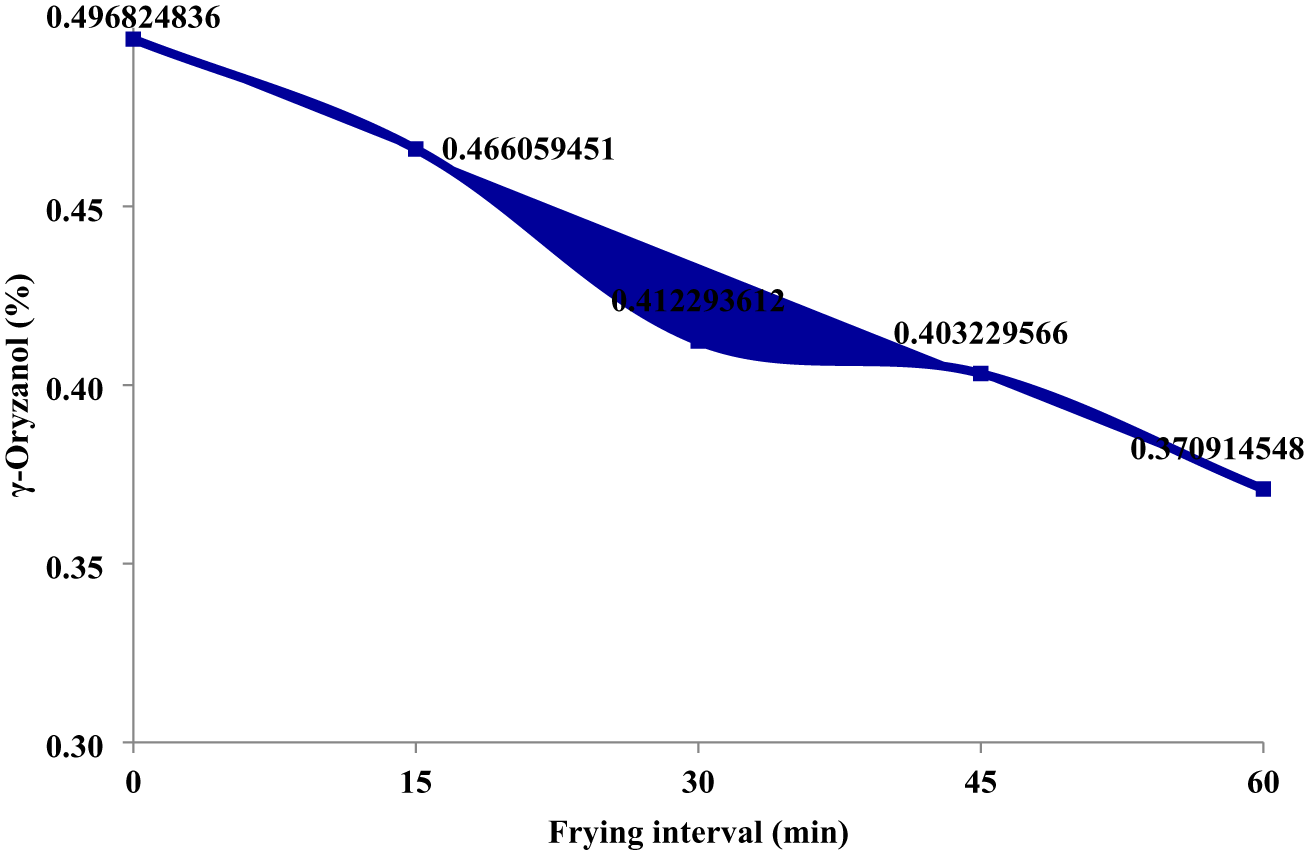
Ghee enriched with 0.5% γ-oryzanol was utilized for deep frying and subjected to HPLC analysis at regular intervals (every 15 min) to measure γ-oryzanol levels. The quantification of γ-oryzanol in each sample was carried out by comparing the peak area in the HPLC chromatogram to that of the standard under identical conditions. The results, depicted in Figure 3, show a gradual decrease in γ-oryzanol content from 0.49% to 0.47%, 0.41%, 0.40% and 0.37% in ghee fried for 15, 30, 45 and 60 min, respectively. This decline could be attributed to the degradation of γ-oryzanol at higher temperatures. Srisaipet and Nuddagul (Reference Srisaipet and Nuddagul2014) noted changes in the γ-oryzanol concentration in edible commercial RBO at temperatures exceeding 120°C due to degradation. Hamid et al. (Reference Hamid, Pak Dek, Tan, Mohd Zainudin and Wee Fang2014) conducted a study on the degradation of γ-oryzanol in RBO over 60 frying cycles, observing a significant decrease in γ-oryzanol concentration with each cycle. They reported that fresh oil with a concentration of 3.0 mg/g γ-oryzanol experienced an 80% reduction after 60 frying cycles. The primary cause of γ-oryzanol degradation during deep-frying is attributed to the thermal oxidation process.
γ-Oryzanol content in ghee during deep frying at 180°C.

Anti-polymerization and antioxidant activity at frying temperatures of rice steryl ferulates (oryzanol), and a mixture of alpha and gamma tocopherols were evaluated in soybean oil. Antioxidant activity was measured by the estimation of polymerized triacylglycerol formation. Oryzanol provided more effective protection against the oxidation and polymerization of soybean oil triacylglycerols heated at 180°C compared to a mixture of alpha and gamma tocopherols. However, tocopherols had a protective effect on oryzanol at high temperature. These results demonstrate that oryzanol may be an effective antioxidant for use in frying oils, and its activity was enhanced by tocopherols, which are already present in frying oils (Jill et al. Reference Jill, Rennick, Hwang, Berhow and Vaughn2013).
Effect of the addition of γ-oryzanol on the formation of COPs in ghee during deep frying
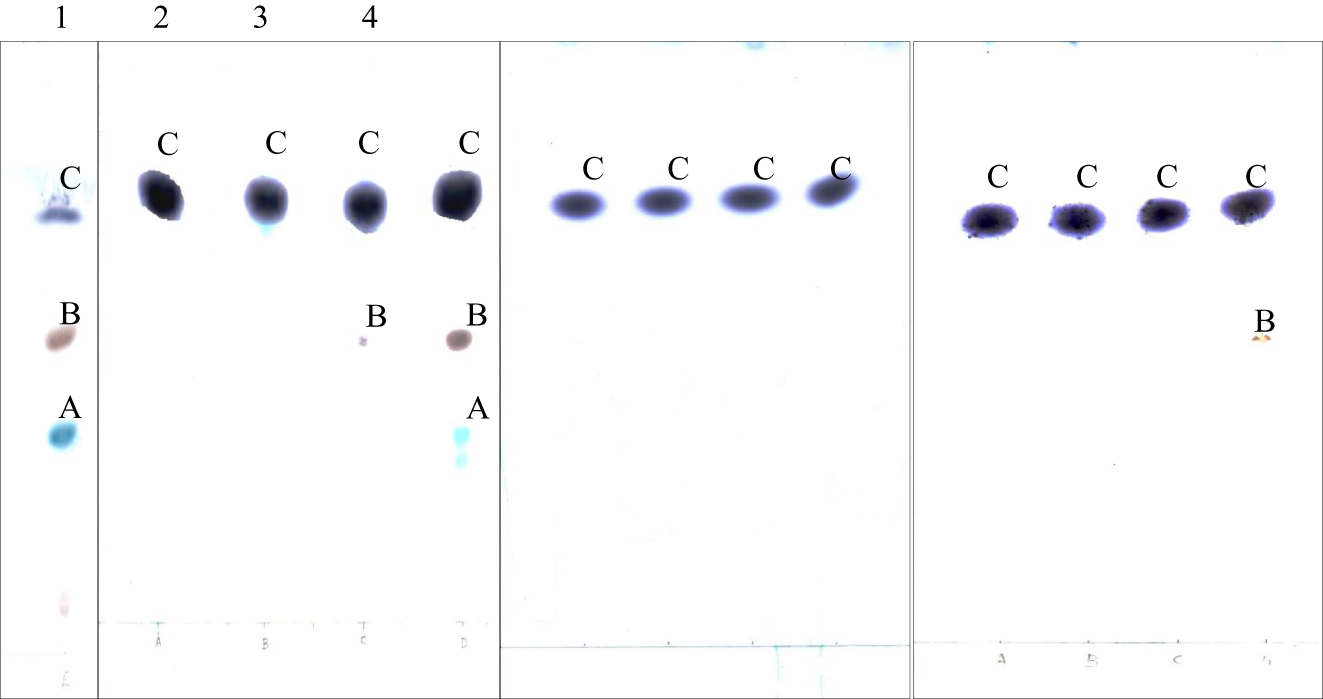
The presence of COPs in foods has generated significant interest due to associated health concerns. The effect of γ-oryzanol incorporation on the development of COP in ghee during deep frying was done by TLC and the chromatograms are presented in Figure 4. It was observed that the TLC chromatogram of USM obtained from ghee samples at the beginning of frying did not show any COPs. During the frying process, control ghee fried for 45 min showed the presence of COP, identified as cholesterol 5α, 6α-epoxide. After 60 min of frying, both cholesterol 5α, 6α-epoxide and 7β-hydroxy cholesterol were detected. In BHA-added ghee, COP (cholesterol 5α, 6α-epoxide) was observed after 60 min of frying. Conversely, ghee supplemented with γ-oryzanol effectively inhibited the oxidation of cholesterol throughout the entire 60-min frying process.
TLC chromatogram of unsaponifiable matter isolated from ghee used for deep frying at 180°C. Lane 1 = marker; 2 = control ghee used for deep frying for 0, 30, 45 and 60 min; 3 = ghee added with γ-oryzanol used for deep frying for 0, 30, 45 and 60 min; and 4 = ghee added with BHA used for deep frying for 0, 30, 45 and 60 min (A = 7β-hydroxy cholesterol, B = cholesterol 5α, 6α-epoxide or 5β, 6β-epoxide and C = cholesterol).

Nath and Murthy (Reference Nath and Murthy1988) demonstrated that ghee produced and stored under normal conditions did not contain COPs. Frying ghee for a short duration did not lead to COP formation, but after 15 min of frying, COPs were generated. Additionally, incorporating ghee residue as a natural antioxidant source delayed COP formation for up to 60 min of frying (Nath et al. Reference Nath, Usha and Murthy1996). The antioxidant properties of vitamin E (α-tocopherol, α-tocotrienol, γ-tocopherol and γ-tocotrienol) and γ-oryzanol components (cycloartenyl ferulate, 24-methylenecycloartanyl ferulate and campesteryl ferulate) extracted from rice bran were studied in a cholesterol oxidation system accelerated by 2,2’-azobis(2-methylpropionamidine) dihydrochloride. It was observed that all components exhibited significant antioxidant activity in inhibiting cholesterol oxidation. The highest antioxidant activity was observed for 24-methylenecycloartanyl ferulate, with all three γ-oryzanol components demonstrating greater activities than any of the four vitamin E components (Xu et al. Reference Xu, Hua and Godber2001).
In conclusion ghee added with γ-oryzanol, a natural antioxidant, demonstrated enhanced antioxidant properties when assessed through DPPH- and ABTS-free radical scavenging assays. This fortified ghee also exhibited an extended induction period as determined by the Rancimat method. The antioxidant capacity of γ-oryzanol was found superior than that of the approved synthetic antioxidant BHA. The use of HPLC proved effective in quantifying the added γ-oryzanol in ghee during storage and deep frying processes. γ-Oryzanol displayed notable stability in ghee throughout storage and deep fat frying, effectively preventing the formation of COPs during 60 min of deep frying. The research conclusively highlighted the potential of γ-oryzanol as a natural antioxidant to prolong the shelf-life of ghee and safeguard it from thermal oxidation during high-temperature processing.
Acknowledgements
The authors express their gratitude to the Director of the Indian Council of Agricultural Research – National Dairy Research Institute, Karnal, India, for providing the essential facilities for conducting the current investigation. The first author extends thanks to the Department of Science and Technology (Government of India) for the financial support received in the form of an INSPIRE Fellowship.