1. Introduction
Formation control has been a major research concern in recent years because of its practicability in persistent surveillance, target tracking, transportation,etc. The ability to coordinate multiple mobile robots in comparison with a single complex robot is not limited to performance, reliability, adaptability and flexibility [Reference Toda and Kubota1]. The formation control challenges correspond to designing, stabilizing, path-following and tracking controllers to make a group of autonomous vehicles to hold or track the appropriate positions together with orientations as to one or more reference points. There exist many approaches in obtaining an appropriate formation which can be branched into leader-following approaches [Reference Yousuf, Khan and Noor2, Reference Dai and Lee3], behavior-based techniques [Reference Huda, Yu and Cang4, Reference Nakhaeinia and Karasfi5] and virtual-structure methods [Reference Ren and Beard6, Reference Lee, Kim, Park, Ji, Moon and Cho7]. The leader-follower formation control is the preferred in practice because of its simplicity and reliability [Reference Peng, Wen, Rahmani and Yu8]. This issue has been addressed by considering many practical aspects for tractor trailers [Reference Shojaei9], car-like mobile robots [Reference Shojaei10] and underwater vehicles [Reference Shojaei11]. In ref. [Reference Peng, Wang, Chen, Hu and Lan12], a dynamic surface control (DSC) approach is proposed for autonomous surface vessel (ASVs) in the presence of uncertainties and ocean disturbances. To provide the transient performance specifications on the formation errors, the prescribed performance control (PPC) is applied to the control design [Reference Dai, He, Lin and Wang13]. Thus, a leader-following attitude control is proposed by ref. [Reference Wei, Luo, Dai and Duan14] for the spacecraft formation subjects to a preassigned performance, where unknown inertial parameters, external disturbance torques and unmodeled uncertainties are taken into account.
Managing the constraints in a rigorous manner of control design and analysis has become the focus in different fields of science and engineering, because of their theoretical challenges and essence in real-world applications [Reference Niu and Zhao15]. In the physical systems, constraints are ubiquitous, manifesting themselves as physical stoppages, saturation, performance and safety specifications. The constraints’ violation in a process may lead to degradation in performance, accidents or system damage. The Barrier Lyapunov function (BLF)-based control design is applied for these challenges to assure the constraint states. In this context, the barrier function
 $\Upsilon (x)$
is proposed as continuous function where the value tends to be at infinity when
 $x$
approaches to the feasible region boundary [Reference Tee and Ge16]. The model predictive control is assessed in ref. [Reference Dunbar and Murray17] for the formation control by introducing constraints in the cost function as coupling terms. To assess the line-of-sight (LOS) range and angle constraints, tan-type BLF are suggested in the control approach [Reference Jin18]. In ref. [Reference He, Yin and Sun19], an adaptive NN control with the asymmetric BLF is adopted in the formation control of marine vessels. Moreover, the finite-time is more advantages than the asymptotic control due to the protocols applied in its design by finite-time control, which are of rapid convergence rate [Reference Zhang, Yan, Narayan and Yu20, Reference Zhang, Yan, Narayan and Yu21]. The minimal learning parameters (MLP) and NN approaches are applied to all ASVs through finite-time formation control in ref. [Reference Huang, Zhang and Zhang22]. The major features of finite-time control consist of high tracking precision, powerful disturbance rejection, appropriate robustness and fast convergence rate.
All ASVs are exposed to different types of marine disturbances like waves and ocean currents. Unexpected external disturbances have an inverse effects on the system performance to an extent that it may lead to the control system destabilization [Reference Homayounzade and Khademhosseini23, Reference Zou, de Ruiter and Kumar24]. Applying a nonlinear disturbance observer will be contributive in rejecting disturbances in all ASVs [Reference Mohammadi, Tavakoli, Marquez and Hashemzadeh25, Reference Do and Pan26]. These observers are devised for compensating the inflicted forces and the accelerations of the vessels. These disturbances are modeled through first- and second-order models in the control design in ref. [Reference Park and Pan27]. To enhance the antidisturbance capability and improve the control accuracy of complex systems, various disturbance rejection methods have been extensively studied. Researchers in refs. [Reference Zhang, Liu, Xia, Zuo and Wang28, Reference Zhu, Qiao and Guo29] devised a disturbance rejection based on terminal sliding-mode control. This newly finite-time control lacks the capability of disturbance rejection, which may lead to the performance degradation due to impact on the limited and predefined error bounds.
Motivated by the above discussions, the control objective is to make the constrained formation control of all ASVs moving on a specified trajectory in the presence of the imposed environment disturbances under output constraints without velocity measurements. Although the previous disturbance observers are able to provide the tracking controller design with a high-precision estimation of disturbances, nearly all of them are designed such that they only assure that the disturbance estimation errors converge to zero without finite settling time in the stability analysis. The infinite settling time is not desirable during the formation control problem execution. Moreover, if the imposed disturbances on the dynamics of all ASVs are not compensated within the finite-time, the improper transient performance of the formation errors causes collisions and will affect in the deterioration of control efficiency. However, the trajectory errors of all ASVs in the formation control problem are transgressed from the limited and predefined bounds due to the limited field-of-view (FOV). Consequently, to cope with these challenges, a BLF-based constrained control structure with a disturbance observer design is proposed for the formation control problem of ASVs that improve the transient performance. Both the controller and disturbance observer are designed through finite-time approach.
Compared with previous related works, the main contributions of this article are expressed as follows:
-
For the first time, the finite-time BLF-based DSC approach is successfully combined with a finite-time terminal sliding-mode disturbance observer for the formation control of ASVs due to the powerful disturbance rejection of the finite-time technique which increases effectively the convergence rate of the system response and compensates the disturbance effects in finite-time.
-
Compared with the available obtained results [Reference Chen, Ren, Gao, Yu, Guan and Wang30–Reference Huang, Zhang and Zhang33], the BLF-based control laws are proposed for all ASVs to solve the formation control problem while making them keep the formation tracking errors in the limited and predefined bounds in the presence of model uncertainties, external disturbances and output states constraints.
-
Compared with [Reference Peng, Wang, Wang and Han34–Reference Gu, Wang, Peng, Wang and Han36], an effective nonlinear terminal sliding-mode disturbance observer is applied to compensate the imposed environment disturbance effects in the formation control of these systems. The proposed controller guarantees the asymptotic trajectory tracking and removes the restrictions of the previous methods that require the external disturbances to be constant or its first-time derivative to be bounded.
-
The suggested control design is performed for the full constrained states and without the velocity measurements. Applying of a high-gain observer (HGO) is an effective technique in the design of the output feedback control for the formation control problem of ASVs, which does not require any prior knowledge of the system dynamic model.
-
Compared with [Reference Yu, Dong, Li, Lu and Ren37–Reference Gu, Wang, Peng and Wang40], in the distributed control, the communication strategy not only is achieved based on the graph theory but also in the formation control problem, this issue is achieved based on the image vision, which is affected under the limited FOV. To solve this problem, it is necessary to consider limited FOV constraints in the formation control problem which imposes some restrictions on the tracking errors.
The rest of this article is organized as follows. Preliminaries and problem statements are presented in Section 2. The BLF is introduced in Section 3. The formation controller design for all ASVs is implemented in Section 4. The simulation results are presented in Section 5, and the article is concluded in Section 6.
2. Preliminaries and problem statements
Consider a group of cooperative autonomous surface vessels governed by the following kinematic and dynamic equations:
 \begin{equation} \begin{array}{l} \quad \quad \quad \quad{\dot \eta _i} ={J_i}({\psi _i}){\upsilon _i}\quad i = 1,\ldots,N,\\\\{M_i}{\dot \upsilon _i} +{C_i}({\upsilon _i}){\upsilon _i} +{D_i}({\upsilon _i}){\upsilon _i} +{G_i}\!\left ({{\eta _i}} \right ) ={\tau _i} +{\tau _{di}}. \end{array} \end{equation}
where
 ${M_i} \gt 0$
is the inertia matrix,
 ${C_i}({\upsilon _i})$
is the total Coriolis and Centripetal acceleration matrix,
 ${D_i}({\upsilon _i})$
is the damping matrix, the vector
 ${\eta _i} ={[{x_i},{y_i},{\psi _i}]^T}$
is the output of all ASVs,
 ${\upsilon _i} ={[{u_i},{v_i},{r_i}]^T}$
is the vector of angular velocity,
 ${\tau _i} \in{R^3}$
is the control inputs and the vector
 ${\tau _{di}} = [{\tau _{d1}},{\tau _{d2}},{\tau _{d3}}]^T \in{R^3}$
contains the external disturbances, and
 ${G_i}\!\left ({{\eta _i}} \right ) \in{R^3}$
is the gravity vector. Moreover, the rotational matrix
 ${J_i}({\psi _i})$
and the dynamic equations of velocities are defined as follows:
 \begin{equation} {J_i}({\psi _i}) = \left ({\begin{array}{*{20}{c}}{\cos{\psi _i}}&\;\;\;\;{ {-}\sin{\psi _i}}&\;\;\;\;0\\[5pt]{\sin{\psi _i}}&\;\;\;\;{\cos{\psi _i}}&\;\;\;\;0\\[5pt] 0&\;\;\;\;0&\;\;\;\;1 \end{array}} \right ), \end{equation}
 \begin{equation} \left \{ \begin{array}{l}{m_{11i}}{{\dot u}_i} ={m_{22i}}{v_i}{r_i} -{d_{11i}}{u_i} +{\tau _{ui}} -{\tau _{wui}}(t),\\[5pt]{m_{22i}}{{\dot v}_i} = -{m_{11i}}{u_i}{r_i} -{d_{22i}}{v_i} -{\tau _{wvi}}(t),\\[5pt]{m_{33i}}{{\dot r}_i} = ({m_{11i}} -{m_{22i}}){u_i}{v_i} -{d_{33i}}{r_i} +{\tau _{ri}} -{\tau _{wri}}(t). \end{array} \right. \end{equation}
With respect to kinematics and dynamics of all ASVs, the state equations are expressed as:
 \begin{equation} \left \{ \begin{array}{l}{{\dot \eta }_i} ={J_i}({\psi _i}){\upsilon _i}\\[5pt]{{\dot \upsilon }_i} ={M_i}^{ - 1}\!\left ({{\tau _i} +{\tau _{di}} -{C_i}({\upsilon _i}){\upsilon _i} -{D_i}({\upsilon _i}){\upsilon _i} -{G_i}\!\left ({{\eta _i}} \right )} \right ). \end{array} \right. \end{equation}
A leader-follower formation structure.

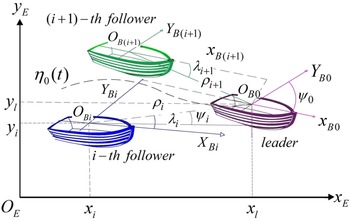
The solutions of formation control consist of position-based, distance-based, orientation-based and their combinations. In this article, the position-based formation control is applied to the autonomous surface vessels. The geometric structure of two autonomous surface vessels moving in a leader-follower formation is shown in Fig 1. The LOS range
 $\rho _{i}$
and angle
 $\lambda _{i}$
between the leader and the followers are defined as:
 \begin{equation} \begin{array}{l}{\rho _{i}} = \sqrt{{{({x_0} -{x_i})}^2} +{{({y_0} -{y_i})}^2}},\\\\{\lambda _{i}} = a\tan 2({y_0} -{y_i},{x_0} -{x_i}). \end{array} \end{equation}
The objective is to design a control input
 $\tau _i$
for the follower
 $i$
to track its leader with desired command where the following formation tracking errors are required to be constrained. In this context, let a desired reference trajectory
 ${\eta _0} = [{x_0},{y_0},{\psi _0}]^T$
and its first-time derivatives
 $\dot \eta _0$
provide the leading formation problem, and then, the formation tracking errors are defined for each autonomous surface vessel as follows:
 \begin{equation} {z_{1i}}(t) ={\eta _i}(t) -{\eta _0}(t).\quad i = 1,\ldots,N. \end{equation}
The formation tracking errors for each autonomous surface vessel in the formation problem should meet the constraint requirements due to the limited FOV; thus, to assure the formation control objective, the following inequality must be of concern:
 \begin{equation} \|{z_{1i}}(t)\| \lt{\beta _i}\quad i = 1,\ldots,N. \end{equation}
where
 $z_{1i}$
denotes the formation tracking error and
 $\beta _i$
is the constrained bound of the tracking error for
 $i = 1,\ldots,N$
.
Lemma 2.1. Young’s inequality (ref. [Reference Park and Pan27]) For any
 $\forall (x,y) \in \Re _{}^{2}$
, the following inequality holds true:
 \begin{align} xy \le \frac{{\vartheta _{}^p}}{p}{\left | x \right |^p} + \frac{1}{{q\vartheta _{}^q}}{\left | y \right |^q}, \end{align}
where
 $ \vartheta \gt 0,\;p \gt 1,\;q \gt 1$
and
 $ (p - 1)(q - 1) = 1.$
Remark 1. A critical issue in the formation control problem is designing an appropriate algorithm to make the team of autonomous surface vessels to cover a desired formation. If the positions of individual autonomous surface vessels are controlled in an active sense, the autonomous surface vessels can move towards their desired positions any interact. Then, the surface vessels need to maintain their formation as a rigid body. Each autonomous surface vessel can only draw decisions based on the local information within a certain locality due to limited FOV, limited sensing range and communication constraints. In the available studies, the control problem in case of output constraints is not of concern. Moreover, there exist no strict theoretical basis to indicate that these constraints will never be violated. For safety and security, this issue cannot be ignored in practice. In this article, a symmetric BLF is applied to avoid the limits violation and keep all the states within the predefined bounds.
3. BLFs
A specific property of the BLFs is high growth of such functions with approaching to the constrained bounds in the neighborhoods. This issue enables us to get the solution process at any inner point of the feasible set and to remain in the interior without taking particular care of the constraints [Reference Tee and Ge16]. Therefore, the following definition is of concern.
According to ref. [Reference Tee and Ren41], a BLF
 $\Upsilon (x)$
is a scalar function, defined in accordance with the system
 $\dot x = f(x)$
on an open region
 $D$
containing the origin. This scalar function
 $\Upsilon (x)$
is continuous and positive-definite. It has continuous first-order partial derivatives at every point of
 $D$
and with the property
 $\Upsilon (x) \to \infty$
as
 $x$
approaches the boundary of
 $D$
, meets
 $\Upsilon (x) \le \beta$
,
 $\forall t \ge 0$
as to the solution
 $\dot x = f(x)$
for
 $x(0) \in D$
and some positive constant
 $\beta$
, which is related to the initial value of
 $x$
. Parameter
 $\beta$
is introduced to describe the upper bound of this function.
Remark 2. With respect to the Remark 1, the state space is split for each autonomous surface vessel into errors
 $z_{1i}$
and
 $z_{2i}$
, where
 $z_{1i}$
is the state to be constrained and
 $z_{2i}$
is the free state. The state
 $z_{1i}$
requires the BLF
 $\Upsilon _i$
to prevent it from reaching the limits
 $\beta _{1i}$
, while
 $z_{2i}$
may involve a quadratic function. Here, based on Lemma 1,
 ${\eta _i},{\upsilon _i} \in R^3$
are the states variables where
 $\eta _i$
is required to meet
 $\left |{{\eta _i}(t)} \right | \lt{\beta _{1i}}$
,
 $\forall t \ge 0$
with
 $\beta _{1i}$
being a constrained bound. The following Lemma formalizes the result for general forms of BLFs to assure that the outputs or state constraints are not violated.
Lemma 3.1. (ref. [Reference Tee and Ren41]) For any positive constants
 $\beta _{1i}$
and
 $\beta _{2i}$
, let
 ${z_{1i}}\;:\!=\; \left \{{{z_{1i}} \in \,:\,{\beta _{1i}} \lt{z_{1i}} \lt{\beta _{2i}}} \right \} \subset R^3$
. Consider the system
 \begin{equation} \dot \eta _{i} = h(t,\eta ), \end{equation}
where
 $\eta _{i} \;:\!=\;{[\omega _{i},{z_{1i}}]^T}$
and
 $h$
is the piecewise continuous in
 $t$
, locally Lipchitz in
 $z$
and uniformly in
 $t$
. Assume that there exists function
 $U_{i}\,:\,{\Upsilon _{i}}({z_{1i}} \to{R^+})$
continuously differentiable and positive-definite in their respective domains in a sense that
 \begin{equation} {\Upsilon _{i}}({z_{1i}}) \to \infty \;as\;{z_{1i}} \to -{\beta _{1i}}\;or\;{z_{1i}} \to{\beta _{1i}}, \end{equation}
 \begin{equation} {\gamma _{1i}}(\!\left \| \omega _{i} \right \|) \le U _{i}(\omega _{i} ) \le{\gamma _{2i}}(\!\left \| \omega _{i} \right \|\!), \end{equation}
where
 $\gamma _{1i}$
and
 $\gamma _{2i}$
are the class
 $k_\infty$
functions. Let
 $\Upsilon _{i} (\eta ) = \Upsilon _{i} ({z_{1i}}) + U _{i}(\omega _{i} )$
and the initial error
 ${z_{1i}}(0)$
belongs to the set
 ${z_{1i}} \in ({-}{\beta _{1i}},{\beta _{2i}})$
. If the following inequality holds true:
 \begin{equation} \dot \Upsilon _{i} = \frac{{\partial \Upsilon }}{{\partial \eta }}h \le 0, \end{equation}
then the error
 ${z_{1i}}(t)$
remains in the open set
 ${z_{1i}} \in ({-}{\beta _{1i}},{\beta _{1i}})$
 $\forall t \in [0,\infty )$
.
Lemma 3.2. (ref. [Reference S. S. and E. H.42]) For any positive constant
 $\beta _{1i}$
, the following inequality holds for all errors
 $z_{1i}$
in the interval
 $\left \|{{z_{1i}}} \right \| \lt{\beta _{1i}}$
:
 \begin{equation} \log \frac{{\beta _{1i}^2}}{{\beta _{1i}^2 - z_{1i}^2}} \lt \frac{{z_{1i}^2}}{{\beta _{1i}^2 - z_{1i}^2}}.\ \end{equation}
Assumptions: The following assumptions are essential to meet the mentioned control objectives:
-
1. Over the compact set
 $\upsilon _{i} \in{\Omega _\upsilon }$
, the NN ideal weight vector
$\theta _{i} ^*$
, and the minimum approximation error
${\delta _{i} ^*}(\upsilon _{i})$
of NN are bounded through(14)where
\begin{equation} \|{{\theta _{i} ^*}}\| \le{\theta _{mi}},\quad \|{{\delta _{i} ^*}(\upsilon _{i})}\| \le \varepsilon _{i},\quad \forall \upsilon _{i} \in{\Omega _{\upsilon i}}, \end{equation}
$\theta _{mi}$
and
$\varepsilon _{i}$
are the positive constants.
-
2. The sway velocity
$\nu _i$
is passive bound. This feature is systematically analyzed with respect to different cases in ref. [Reference Shojaei10]. This assumption is highly actual in practice because the hydrodynamic damping force is dominant in the sway direction which damps out the sway speed. -
3. The external disturbance
$\tau _{di}$
acting on each surface vessel which is subjected to wind, wave and sea currents is bounded in practical engineering. Consequently, there exist a scalar
${\Sigma _i} \in{R^+ }$
such that
$ \|{{\tau _{di}}}\| \le{\Sigma _i}$
.


Lemma 3.3. Finite-time theory (ref. [Reference Zhang, Yan, Narayan and Yu21]) Consider the nonlinear system
 $\dot x_{i} = f_{i}(x_{i})$
with both
 $f_{i}(0) = 0$
and
 $x_{i}(0) ={x_0}$
. Provided that the function
 $\Upsilon _{i} (x)\,:\,U_{i} \to R$
is defined as continuously differentiable, positive-definite on a neighborhood and the time derivative of this function is obtained as:
 \begin{equation} \dot{\Upsilon }_{i}(x) \le -{C_{1i}} \Upsilon _{i}(x) -{C_{2i}}{\Upsilon _{i}^{\mu _i}(x)}, \end{equation}
where
 ${C_{1i}},{C_{2i}} \gt 0$
and
 $ 0 \lt \mu _{i} \lt 1$
, then the origin is locally finite-time stable. Provided that
 $U_{i} ={R^N}$
and
 $\Upsilon _{i}(x)$
are bounded in their radial sense, then the origin is globally finite-time stable. In this context, the finite-time
 $T_{i} \in [0,\infty )$
meets the following requirements based on the initial states:
 \begin{equation} T_{i} \le \frac{1}{{{C_{1i}}(1 - \mu _{i})}}Ln\frac{{{C_{1i}}{\Upsilon _{i} ^{1- \mu _{i}}}({x_0}) +{C_{2i}}}}{{{C_{2i}}}}. \end{equation}
Remark 3. In practice, unlike the original control systems, it is necessary for the closed-loop system to achieve finite-time stability. A slow convergence speed may require longer time for the autonomous surface vessels to reach the desired position, and high overshoot might result in a collision between the follower and its predecessor. Both the finite-time convergence and stabilization not only assure higher convergence rate but also guarantee a better disturbance rejection, higher accuracy and greater robustness against uncertainties.
4. Formation control design for autonomous surface vessels
4.1. Neural network approximator
According to the universal approximation property, radial basis function neural networks (RBFNNs) are widely applied to compensate structured uncertainties due to the fact that RBFNNs are capable to approximate smooth uncertain functions in many nonlinear systems such as autonomous surface vessels. To this end, a nonlinear function is approximated as follows:
 \begin{equation} \hat{f}_{i}(\upsilon _{i})\;:\!=\;{\hat{\theta }_{i}^T}\Phi _{i}(\upsilon _{i}), \end{equation}
where
 $\upsilon _{i} \in{\Omega _{\upsilon i}} \subset{R^q}$
is the input vector and
 $q$
is the NN input dimension,
 $\hat \theta _{i} ={[{\hat \theta _{1i}},{\hat \theta _{2i}},\ldots,{\hat \theta _{li}}]^T} \in{R^l}$
is the NN weights vector and
 $l \gt 1$
is the NN number. The regression vector
 $\Phi _{i} (\upsilon _{i}) ={[{\varphi _{1i}}(\upsilon _{i}),\ldots,{\varphi _{li}}(\upsilon _{li})]^T}$
is the basis function vector where
 ${\varphi _i}(\upsilon _{i})$
is defined as
 ${\varphi _i}(\upsilon _{i}) = \exp\![{{\|\upsilon _{i} -{\mu _i}}\|^2}/{c _i}]$
,
 $i = 1,\ldots,l$
; where,
 ${\mu _i} ={[{\mu _{i1}},\ldots,{\mu _{iq}}]^T}$
is the center of Gaussian functions and
 ${c _i} \gt 0$
is the width of them. For any unknown nonlinear function
 $f_{i}(\upsilon _{i})$
that contains
 $C_{i}(\upsilon _{i})$
and
 $D_{i}(\upsilon _{i})$
, there exists the NN function
 ${{\theta _{i}}^*{^T}}\Phi _{i}(\upsilon _{i})$
in a sense that
 \begin{equation} f_{i}(\upsilon _{i})\;:\!=\;{\theta _{i}^{{*^T}}}\Phi _{i}(\upsilon _{i}) +{\delta _{i}^*}(\upsilon _{i}),\quad \forall \upsilon _{i} \in{\Omega _{\upsilon i} } \in{R^q}, \end{equation}
where
 ${\delta _{i}^*}(\upsilon _{i})$
is the minimum approximation error and
 $\theta _{i}^*$
is the ideal constant vector defined as:
 \begin{equation} {\theta _{i}^*}\;:\!=\; \arg \;{\min _{\hat \theta _{i} \in{R^l}}}\ {{{{{\sup }_{\upsilon _{i} \in{\Omega _{\upsilon i}}}}} f(\upsilon _{i}) -{{\hat \theta _{i} }^T}\Phi _{i} (\upsilon _{i})} }.\ \end{equation}
4.2. HGO
In some practical systems, the limitations and environmental disturbances together with technological limitations make accurate velocity measurements of surface vessels difficult [Reference Sarrafan44]. A HGO is applied to estimate these unmeasurable states, referred to as
 $\upsilon _i$
for
 $i = 1,\ldots,N$
. The dynamics of HGO are expressed as follows:
 \begin{equation} \left \{ \begin{array}{l}{m_i}{{\dot \lambda }_{i1}} ={\lambda _{i2}}\\[5pt]{m_i}{{\dot \lambda }_{i2}} = -{m_{1i}}{\lambda _{i2}} -{\lambda _{i1}} +{\eta _i} \end{array} \right ., \end{equation}
where
 ${\lambda _{i1}},{\lambda _{i2}} \in{R^n}$
are the state vectors of HGO,
 $m_{1i}$
and
 $m_i$
are the small positive constants. To prevent peaking, the saturation functions are applied to a given observer signal when it is outside the preferable range
 $\Omega$
as [Reference Khalil46]:
 \begin{equation} {\lambda _{ij}} ={\textrm{B}_{ij}}\Delta \!\left(\frac{{{\lambda _{ij}}}}{{{\textrm{B}_{ij}}}}\right),\quad{\textrm{B}_{ij}} \ge \mathop{\max\! ({\lambda _{ij}})}\limits _{\upsilon \in{\Omega _{\upsilon i}} }, \ \end{equation}
where
 \begin{align*} \Delta (a) = \left \{ \begin{array}{l} - 1\quad \quad for\;a \lt - 1\\[5pt] a\quad \quad \;for\;\left | a \right | \le + 1\\[5pt] + 1\quad \quad for\;a \gt + 1 \end{array} \right. \end{align*}
Consequently, the following equation can be proved [Reference Tee45]:
 \begin{equation} {\Lambda _{i2}} = \frac{{{\lambda _{2i}}}}{{{m_i}}} -{\upsilon _i} ={m_i}\textrm{X}_i^{(2)} \end{equation}
where
 ${\textrm{X}_i} ={\lambda _{i2}} +{m_i}{\lambda _{i1}}$
and there exist positive constants
 $t^*$
and
 $g_{i2}$
in a sense that
 $\forall \;t \gt{t^*}$
,
 $\left \|{{\Lambda _{i2}}} \right \| \le{\kappa _i}{g_{i2}}$
holds true.
4.3. Output feedback adaptive-neural formation controller design
To design DSC for the formation control of surface vessels, the formation tracking errors are defined for the first and second steps through the state variables
 $\eta _i$
and
 $\upsilon _i$
as:
 \begin{equation} \left \{ \begin{array}{l}{z_{1i}} ={\eta _i} -{\eta _0}\\[5pt]{z_{2i}} ={\upsilon _i} -{\textrm{P}_{iF}} \end{array} \right .\quad i = 1,\ldots,N. \end{equation}
Let
 ${z_{1i}} ={[{z_{11i}},{z_{12i}},{z_{13i}}]^T}$
and
 ${z_{2i}} ={[{z_{21i}},{z_{22i}},{z_{23i}}]^T}$
. With respect to the suggested HGO, the estimation of second surface errors in (23) is rewritten as:
 \begin{equation} {\hat z_{2i}} ={\hat \upsilon _i} -{\textrm{P}_{iF}} ={J^{ - 1}}({\psi _i})\frac{{{\lambda _{2i}}}}{{{m_i}}} -{\textrm{P}_{iF}}, \end{equation}
where
 $\textrm{P}_{iF}$
is the virtual control signal that is passed through the following first-order filter:
 \begin{equation} {\alpha _i}{\dot{\textrm{P}}_{iF}} +{\textrm{P}_{iF}} ={\textrm{P}_i}\quad \quad{\textrm{P}_{iF}}(0) ={\textrm{P}_i}(0), \end{equation}
where
 $\textrm{P}_i$
is the virtual controller and
 $\alpha _i$
is a design parameter. Consequently, the following error is defined for each surface vessel in the formation control:
 \begin{equation} {\textrm{P}_{ie}} ={\textrm{P}_{iF}} -{\textrm{P}_i}. \end{equation}
Next, one has the following equation through (25) and (26):
 \begin{equation} {\dot{\textrm{P}}_{ie}} ={\dot{\textrm{P}}_{iF}} -{\dot{\textrm{P}}_i} = \frac{1}{{{\alpha _i}}}{\textrm{P}_{ie}} -{\dot{\textrm{P}}_i}. \end{equation}
Consequently, one may find that
 \begin{equation} \left \|{{{\dot{\textrm{P}}}_{ie}} + \frac{{{\textrm{P}_{ie}}}}{{{\alpha _i}}}} \right \| \le \varpi, \end{equation}
where
 $\varpi$
is the continuous function of closed-loop variables and their derivatives that is used to derive the following inequality, where will be used in the stability analysis in the sequel:
 \begin{equation} \textrm{P}_{ie}^T{\dot{\textrm{P}}_{ie}} \le - \frac{1}{{{\alpha _i}}}{\left \|{{\textrm{P}_{ie}}} \right \|^2} +{\left \|{{\textrm{P}_{ie}}} \right \|^2} + \frac{1}{4}{\varpi ^2}. \end{equation}
In the second step, the virtual surface error of each surface vessel is obtained by
 \begin{equation} {\tilde z_{2i}} ={\hat z_{2i}} -{z_{2i}} ={J^{ - 1}}({\psi _i})\frac{{{\lambda _{2i}}}}{{{m_i}}} -{\textrm{P}_{iF}} -{\upsilon _i} +{\textrm{P}_{iF}} ={\Lambda _{i2}}. \end{equation}
With respect to the conditions of HGO and
 $\left \|{{J^{ - 1}}} \right \| \le{S_i}$
where
 ${S_i} \in{\Re ^ + }$
is an unknown constant, the following inequalities are of concern:
 \begin{equation} \left \|{{{\tilde z}_2}} \right \| = \left \|{{J^{ - 1}}(\eta )\left(\frac{{{\lambda _{i2}}}}{{{m_i}}} - \dot \eta \right)} \right \| = \left \|{{J^{ - 1}}(\eta ){m_i}\ddot \chi } \right \| \le{m_i}{P_2}\!\left \|{{J^{ - 1}}(\eta )} \right \| \le{m_i}{P_2}{S_i}\;:\!=\;{S_2}, \end{equation}
 \begin{equation} {\left \|{{{\tilde z}_2}} \right \|^2} ={\left \|{{J^{ - 1}}(\eta )\left(\frac{{{\lambda _{i2}}}}{{{m_i}}} - \dot \eta \right)} \right \|^2} ={\left \|{{J^{ - 1}}(\eta ){m_i}\ddot \chi } \right \|^2} \le m_i^2P_2^2{\left \|{{J^{ - 1}}(\eta )} \right \|^2} \le m_i^2P_2^2S_i^2\;:\!=\; S_2^2. \end{equation}
By replacing
 ${\hat \upsilon _i} ={\hat z_{2i}} +{\textrm{P}_{iF}}$
and derivation from the calculated tracking errors, the following equations are obtained:
 \begin{equation} \begin{array}{l}{\dot z_{1i}} ={J_i}({\hat z_{2i}} +{\textrm{P}_{iF}}) -{\dot \eta _0},\\\\ \quad \quad{\dot z_{2i}} ={\dot{ \hat{ \upsilon }}}_i -{\dot{\textrm{P}}_{iF}}. \end{array} \end{equation}
At this step, to facilitate discussion on the limited FOV constraint requirements of the formation tracking errors, the symmetric BLF is introduced for each surface vessel [Reference Huang, Zhang and Zhang22] as follows:
 \begin{equation} {\Upsilon _{1i}} = \frac{1}{2}\log \frac{{\beta _{1i}^2}}{{\beta _{1i}^2 - z_{1i}^T{z_{1i}}}}, \quad \left \|{{z_{1i}}(0)} \right \| \lt{\beta _{1i}}. \end{equation}
The derivative of the BLF is calculated based on the formation tracking errors of each surface vessel. By inserting the calculated dynamic error in the derivative of the BLF, the following equation is obtained:
 \begin{equation} {\dot \Upsilon _{1i}} = \frac{{z_{1i}^T{{\dot z}_{1i}}}}{{\beta _{1i}^2 - z_{1i}^T{z_{1i}}}}= \frac{{z_{1i}^T({J_i}({\psi _i})({{\hat z}_{2i}} +{\textrm{P}_i}) -{{\dot \eta }_0})}}{{\beta _{1i}^2 - z_{1i}^T{z_{1i}}}}. \end{equation}
Consequently, the virtual control signals are designed according to the BLF derivative and finite-time approach on the formation control of autonomous surface vessels as
 \begin{equation} {\textrm{P}_i} ={J_i^{-1}}({\psi _i})({\dot \eta _0} -{c_{1i}}{z_{1i}}(\beta _{1i}^2 - z_{1i}^T{z_{1i}}) -{c_{2i}}{{\textrm{sgn}} ^\alpha }({z_{1i}})), \end{equation}
where
 $c_{1i}$
and
 $c_{2i}$
are the designed positive parameters,
 ${{\textrm{sgn}} ^\alpha }({z_{1i}}) ={\left |{{z_{1i}}} \right |^\alpha }sign({z_{1i}})$
which
 $0.5 \lt \alpha \lt 1$
. With substituting the virtual control (36) into (35), the following equation is obtained:
 \begin{equation} {\dot \Upsilon _{1i}} = \frac{{{J_i}{z_{1i}}{{\hat z}_{2i}} -{c_{1i}}z_{1i}^2(\beta _{1i}^2 - z_{1i}^T{z_{1i}}) -{c_{2i}}{z_{1i}}{{{\textrm{sgn}} }^\alpha }({z_{1i}})}}{{\beta _{1i}^2 - z_{1i}^T{z_{1i}}}}. \end{equation}
With respect to equation
 ${z_{1i}}sign({z_{1i}}) = \left |{{z_{1i}}} \right |$
, term
 ${c_{2i}}{\left |{{z_{1i}}} \right |^{\alpha + 1}}$
is replaced into
 ${c_{2i}}{z_{1i}}{{\textrm{sgn}} ^\alpha }({z_{1i}})$
; thus, the following equation is achieved:
 \begin{equation} {\dot \Upsilon _{1i}} = -{c_{1i}}z_{1i}^2 + \frac{{{J_i}{z_{1i}}{{\hat z}_{2i}}}}{{\beta _{1i}^2 - z_{1i}^T{z_{1i}}}} - \frac{{{c_{2i}}{{\left |{{z_{1i}}} \right |}^{\alpha + 1}}}}{{\beta _{1i}^2 - z_{1i}^T{z_{1i}}}}. \end{equation}
By applying a simple math calculations, the following equation is obtained:
 \begin{equation} {\dot \Upsilon _{1i}} = -{c_{1i}}z_{1i}^2 + \frac{{{J_i}{z_{1i}}{{\hat z}_{2i}}}}{{\beta _{1i}^2 - z_{1i}^T{z_{1i}}}} -{c_{2i}}{(\beta _{1i}^2 - z_{1i}^T{z_{1i}})^{\frac{{\alpha - 1}}{2}}}{\left(\frac{{z_{1i}^2}}{{\beta _{1i}^2 - z_{1i}^T{z_{1i}}}}\right)^{\frac{{\alpha + 1}}{2}}}. \end{equation}
According to Lemma 1, we have
 $\dfrac{1}{2}\log \dfrac{{\beta _{1i}^2}}{{\beta _{1i}^2 - z_{1i}^T{z_{1i}}}} \lt \dfrac{{z_{1i}^2}}{{2(\beta _{1i}^2 - z_{1i}^T{z_{1i}})}}$
. Let
 ${\rho _{1i}} = \beta _{1i}^2 - z_{1i}^T{z_{1i}}$
which is positive, then, the following equation is obtained:
 \begin{equation} {\dot \Upsilon }_{1i}=- 2{c_{1i}}{\rho _{1i}}{\Upsilon _{1i}} -{c_{2i}}{\rho _{1i}}^{\frac{{\alpha - 1}}{2}}{(2{\Upsilon _{1i}})^{\frac{{\alpha + 1}}{2}}} + \frac{{{J_i}{z_{1i}}{{\hat z}_{2i}}}}{{\beta _{1i}^2 - z_{1i}^T{z_{1i}}}}. \end{equation}
Remark 4. An extra term
 $-{c_{2i}}{{\textrm{sgn}} ^\alpha }({z_{1i}})$
in the virtual control (36) is proposed for the finite-time stability which would increase the convergence rate and accuracy. Because of to
 $0.5 \lt \alpha \lt 1$
, the derivatives of this term may lead to singularity problem on the error surface. Consequently, to overcome this drawback, the first-order SMD which can engulf the derivatives of the virtual control laws which are applied to the DSC approach.
After designing the virtual control singals for each surface vessel in step 1, the quadratic Lyapunov function is proposed in step 2 as follows:
 \begin{equation} {\Upsilon _{2i}} ={\Upsilon _{1i}} + \frac{1}{2}z_{2i}^T{M_i}\,{z_{2i}} + \frac{1}{{2{\gamma _i}}}\tilde \theta _i^T{\tilde \theta _i} + \frac{1}{2}\textrm{P}_{ie}^T\textrm{P}_{ie}, \end{equation}
where
 ${\gamma _i} \gt 0$
is a design parameter and
 ${\tilde \theta _i} = \theta _i^* -{\hat \theta _i}$
. By calculating the derivative of Lyapunov function in step 2, the following equation is obtained:
 \begin{equation} {\dot \Upsilon _{2i}} ={\dot \Upsilon _{1i}} + z_{2i}^T{M_i}\,{\dot z_{2i}} - \frac{1}{{{\gamma _i}}}\tilde \theta _i^T{\dot{ \hat{\theta }} _i} + \textrm{P}_{ie}^T{\dot{\textrm{P}}_{ie}}. \end{equation}
By inserting the error dynamic into this derivative, the following result is achieved:
 \begin{align} {{\dot \Upsilon }_{2i}} & = - 2{c_{1i}}{\rho _{1i}}{\Upsilon _{1i}} -{c_{2i}}{\rho _{1i}}^{\frac{{\alpha - 1}}{2}}{(2{\Upsilon _{1i}})^{\frac{{\alpha + 1}}{2}}} + \frac{{{J_i}z_{1i}^T{{\hat z}_{2i}}}}{{\beta _{1i}^2 - z_{1i}^T{z_{1i}}}}\nonumber \\[5pt] & \quad + z_{2i}^T({ -{C_i}({{\upsilon _i}}){z_{2i}} -{D_i}({{\upsilon _i}}){z_{2i}} +{\tau _i} + f_i^*({\upsilon _i})}) - \frac{1}{{{\gamma _i}}}\tilde \theta _i^T{{\dot{\hat{\theta }}}_i} + \textrm{P}_{ie}^T{{\dot{\textrm{P}}}_{ie}}, \end{align}
where
 $f_i^*({\upsilon _i}) = -{C_i}({\upsilon _i}){\textrm{P}_{iF}} -{D_i}({{\upsilon _i}}){\textrm{P}_{iF}} -{G_i}\!\left ({{\eta _i}} \right ) -{M_i}{\dot{\textrm{P}}_{iF}}.$
By inserting
 $f_i^*({\upsilon _i}) = \theta _i^{{*^T}}{\varphi _i} +{\varepsilon _i}$
into Eq. (43), where
 $\varepsilon _i$
is the approximator error in the derivative of Lyapunov function in step 2, the following is yield:
 \begin{align} {{\dot{\Upsilon }}_{2i}} & = - 2{c_{1i}}{\rho _{1i}}{\Upsilon _{1i}} -{c_{2i}}{\rho _{1i}}^{\frac{{\alpha - 1}}{2}}{(2{\Upsilon _{1i}})^{\frac{{\alpha + 1}}{2}}} + \frac{{{J_i}z_{1i}^T{{\hat{z}}_{2i}}}}{{\beta _{1i}^2 - z_{1i}^T{z_{1i}}}}\nonumber \\[5pt] & \quad + z_{2i}^T\!\left ({ -{C_i}\!\left ({{\upsilon _i}} \right ){z_{2i}} -{D_i}({{\upsilon _i}}){z_{2i}} +{\tau _i} + \tilde \theta _i^T{\varphi _i} + \hat{\theta }_i^T{\varphi _i} +{\varepsilon _i}} \right ) - \frac{1}{{{\gamma _i}}}\tilde \theta _i^T{{\dot{\hat{\theta }}}_i} \nonumber \\[5pt] & \quad - \left ({\frac{1}{{{\alpha _i}}} - 1 - 0.5{\lambda _{\max }}\{{J_i}({\psi _i})\} } \right ){\left \|{{\textrm{P}_{ie}}} \right \|^2} + \frac{1}{4}{\varpi ^2}. \end{align}
The sigma-modification structure is utilized as a robust adaptive law until it makes the estimated parameters to become fixed at specific points. The adaptive laws are chosen for each surface vessel as follows:
 \begin{equation} \dot{\hat{\theta } } _i={\gamma _i}z_{2i}^T{\varphi _i} -{\gamma _i}{\delta _i}({\hat \theta _i} -{\theta _{i0}}), \end{equation}
where
 ${\gamma _i} \gt 0$
and
 ${\delta _i} \gt 0$
are the design parameters. The parameters
 ${\theta _{i0}} \in{R^3}$
are priori estimates of the parameters
 $\theta _i$
. Consequently, the formation control signal for each surface vessel is designed as:
 \begin{equation} {\tau _i} = -{c_{3i}}{\hat z_{2i}} -{c_{4i}}si{g^\alpha }({\hat z_{2i}}) - \hat \theta _i^T{\varphi _i} - \frac{{{J_i}{z_{1i}}}}{{\beta _{1i}^2 - z_{1i}^T{z_{1i}}}} -{\hat \tau _{di}}, \end{equation}
where parameters
 $c_{3i}$
and
 $c_{4i}$
are the designed positive constants and
 ${\hat \tau _{di}}$
will be designed as the finite-time disturbance observer in the next step. With respect to
 $z_{2i}^T\!\left ({{{\dot M}_i} - 2{C_i}\!\left ({{\upsilon _i}} \right )} \right ){z_{2i}} = 0$
and by substituting the control signals into the derivative of Lyapunov function, the following equation is obtained:
 \begin{equation} \begin{array}{l}{{\dot \Upsilon }_{2i}} = - 2{c_{1i}}{\rho _{1i}}{\Upsilon _{1i}} -{c_{2i}}{\rho _{1i}}^{\frac{{\alpha - 1}}{2}}{(2{\Upsilon _{1i}})^{\frac{{\alpha + 1}}{2}}} - z_{2i}^T{c_{3i}}{z_{2i}} - z_{2i}^T{c_{3i}}{{\tilde z}_{2i}}\\\\ \,\quad \quad \; -{c_{4i}}{\left ({{{\left \|{{z_{2i}}} \right \|}^2}} \right )^{\frac{{\alpha + 1}}{2}}}\; -{c_{4i}}{\left ({{{\left \|{{{\tilde z}_{2i}}} \right \|}^2}} \right )^{\frac{{\alpha + 1}}{2}}} - z_{2i}^T{D_i}{z_{2i}} + z_{2i}^T{\varepsilon _i} + \tilde \theta _i^T{\delta _i}({{\hat \theta }_i} -{\theta _{i0}})\\\\ \,\quad \quad \; -\left({\frac{1}{{{\alpha _i}}} - 1 - 0.5{\lambda _{\max }}\{{J_i}({\psi _i})\} }\right){{{\textrm{P}_{ie}}}^2} + \frac{1}{4}{\varpi ^2}. \end{array} \end{equation}
With respect to inequalities (29) and (32) and through assumption
 ${{{\varepsilon _i}}^2} \lt \varepsilon _i^{{*^2}}$
and Lemma 2, the following inequalities can be obtained by applying the Young’s inequality as follows:
 \begin{equation} z_{2i}^T{\varepsilon _i} \le \frac{1}{2}z_{2i}^T{z_{2i}} + \frac{1}{2}\varepsilon _i^{{*^2}}, \end{equation}
 \begin{equation} \tilde \theta _i^T{\delta _i}({\hat \theta _i} -{\theta _{i0}}) \le - (1 - 0.5/{k^2}){\delta _i}{\left \|{{{\tilde \theta }_i}} \right \|^2} + 0.5{\delta _i}{\left \|{{\theta _i} -{\theta _{i0}}} \right \|^2}, \end{equation}
 \begin{equation} - z_{2i}^T{c_{3i}}{\tilde z_{2i}} \le 0.5{\lambda _{\max }}\!\left \{{{c_{3i}}} \right \}{\left \|{{z_{2i}}} \right \|^2} + 0.5{\lambda _{\max }}\!\left \{{{c_{3i}}} \right \}{\left \|{{{\tilde z}_{2i}}} \right \|^2}. \end{equation}
Consequently, with replacing the inequalities (48)–(50) into Eq. (47), the following inequality is achieved:
 \begin{equation} \begin{array}{l}{{\dot \Upsilon }_{2i}} \le - 2{c_{1i}}{\rho _{1i}}{\Upsilon _{1i}} -{c_{2i}}{\rho _{1i}}^{\frac{{\alpha - 1}}{2}}{(2{\Upsilon _{1i}})^{\frac{{\alpha + 1}}{2}}} -{\rho _{2i}}{\left \|{{\textrm{P}_{ie}}} \right \|^2} -{\rho _{5i}}{\left \|{{z_{2i}}} \right \|^2}\\\\ \quad \quad -{c_{4i}}{\left ({{{\left \|{{z_{2i}}} \right \|}^2}} \right )^{\frac{{\alpha + 1}}{2}}} -{\rho _{3i}}{\left \|{{{\tilde \theta }_i}} \right \|^2} + \frac{1}{2}\varepsilon _i^{{*^2}} +{\rho _{4i}} +{\rho _{6i}}, \end{array} \end{equation}
where parameters
 ${\rho _{2i}} = \left ({\frac{1}{{{\alpha _i}}} - 1 -{\lambda _{\max }}\!\left ({{J_i}\!\left ({{\psi _i}} \right )} \right )} \right )$
,
 ${\rho _{3i}} = (1 - 0.5/{k^2}){\delta _i}$
,
 ${\rho _{4i}} = 0.5{\delta _i}{\left \|{{\theta _i} -{\theta _{i0}}} \right \|^2}$
,
 ${\rho _{5i}} ={\lambda _{\min }}\!\left \{{{D_i} +{c_{3i}} +{c_{4i}}} \right \} - 0.5{\lambda _{\max }}\!\left \{{{c_{3i}}} \right \}$
and
 ${\rho _{6i}} = \frac{{S_2^2}}{2} + \frac{1}{4}{\varpi ^2}$
are positive constants with conditions
 ${\lambda _{\min }}\!\left \{{{D_i} +{c_{3i}} +{c_{4i}}} \right \} \gt 0.5{\lambda _{\max }}\!\left \{{{c_{3i}}} \right \}$
and
 $\frac{1}{{{\alpha _i}}} \gt 1 +{\lambda _{\max }}\!\left ({{J_i}\!\left ({{\psi _i}} \right )} \right )$
.
Remark 5. Since in the constrained formation control problem, each ASV can only acquire the position information from its immediate predecessor, such position states of ASVs are unmeasurable and the tracking errors can be considered in the predefined and constrained bounds which are time-varying by recalling the limited FOV. To satisfy these constraints on the formation tracking errors, the following constraints are considered:
 \begin{equation} {\underline \beta _i}(t) \le{z_i}(t) \le{\bar \beta _i}(t) \end{equation}
with
 \begin{equation} \begin{array}{l}{{\bar \beta }_i}(t) ={{\bar \beta }_{i,\infty }} + ({{\bar \beta }_{i,0}} -{{\bar \beta }_{i,\infty }}){e^{ -{k_i}t}},\\\\{\underline \beta _i}(t) ={\underline \beta _{i,\infty }} + ({\underline \beta _{i,0}} -{\underline \beta _{i,\infty }}){e^{ -{k_i}t}}, \end{array} \end{equation}
where
 ${\bar \beta _{i,0}},$
 ${\bar \beta _{i,\infty }},$
 ${\underline \beta _{i,0}},$
 $\underline \beta _{i,\infty }$
and
 $k_i$
are the positive design parameters,
 ${\bar \beta _i}(t)$
and
 ${\underline \beta _i}(t)$
are the maximum and minimum allowable tracking errors with
 ${\bar \beta _{i,\infty }} \le{\bar \beta _{i,0}}$
and
 ${\underline \beta _{i,\infty }} \le{\underline \beta _{i,0}}$
, respectively. These time-varying boundaries of the tracking errors are utilized in the conversion of the error transformation.
The asymmetric BLFs are proposed to assure the time-varying limited FOV errors constrained within certain bounds such that leaders and followers can preserve the predefined structure and ensure the desired steady-state bounds as follow:
 \begin{equation} {\Upsilon _i} = \frac{{{q_z}({z_i})}}{2}\log \frac{{\overline \beta _i^2}}{{\overline \beta _i^2 - z_i^2}} + \frac{{1 -{q_z}({z_i})}}{2}\log \frac{{\underline \beta _i^2}}{{\underline \beta _i^2 - z_i^2}}, \end{equation}
where
 $q_z$
is the logic variable which is equal to one if the kinematic error
 $z_i$
is positive and the otherwise is equal to zero;
 $\underline \beta _i$
and
 $\overline \beta _i$
are the minimum and maximum constraints on the time-varying error
 $z_i$
, respectively. To dominate the time dependency, the following conversion of variables is proposed:
 \begin{equation} {\Omega _{z1}} = \frac{{{z_i}}}{{{\beta _i}}},\quad{\Omega _{z2}} = \frac{{{z_i}}}{{{\beta _i}}},\quad{\Omega _z} ={q_z}{\Omega _{z2}} + \left ({1 -{q_z}} \right )\!{\Omega _{z1}}. \end{equation}
With the above conversion of coordinates, the BLF
 $\Upsilon _i$
is rewritten without the time dependency as follows:
 \begin{equation} {\Upsilon _i} = \frac{1}{2}\log \frac{1}{{1 - \Omega _z^2}}. \end{equation}
It is obvious that the BLF
 $\Upsilon _i$
is positive-definite and continuously differentiable in the set
 $\left |{{\Omega _z}} \right | \lt 1$
. This suggested BLF based on the error transformation can be substituted into the proposed BLF in Eq. (34) with respect to the time-varying predefined and limited FOV constraints.
4.4. Terminal sliding-mode disturbance observer design
The environmental disturbances vector
 $\tau _{di}$
is bounded and not measurable precisely in practice, indicating that the designed terminal sliding-mode disturbance observer has more practical value. The physical meanings of these imposed environmental disturbances are mostly due to the sea and ocean currents, storms, waves and winds. However, its interpretation may generally cover strong couplings, uncertain nonlinearities, modeling errors and unmodeled dynamics of the system. In this step, a terminal sliding-mode observer-based estimation scheme will be developed more to assure the actual external disturbance for each surface vessel to allow high-accuracy estimation after finite-time. To design an estimation law for disturbance
 $\tau _{di}$
, the new error variable
 ${\Xi _i} ={\upsilon _i} -{\Phi _i}$
is introduced firstly for each surface vessel where
 ${\Phi _i} \in{R^3}$
is updated through the following equation:
 \begin{equation} {\Phi _i} = M_i^{ - 1}({K_{i1}}{\Xi _i} +{K_{i2}}{\textrm{sgn}} ({\Xi _i}) +{\tau _i} -{C_i}({\upsilon _i}){\upsilon _i} -{D_i}({\upsilon _i}){\upsilon _i} -{g_i}({\eta _i})). \end{equation}
This nonlinear terminal sliding-mode disturbance observer estimation law is implemented in the control design to obtain in a high performance control against external disturbances through finite-time convergence of tracking errors vector for each surface vessel into a compact set as:
 \begin{equation} {\hat \tau _{di}} ={K_{1i}}{\Xi _i} +{K_{2i}}{\textrm{sgn}} ({\Xi _i}) \end{equation}
where
 $K_{1i}$
and
 $K_{2i}$
are positive constants. The actual
 $\tau _{di}$
can be estimated precisely through
 $\hat \tau _{di}$
. Moreover, the estimated disturbance error
 ${e_{di}} ={\hat \tau _{di}}-{\tau _{di}}$
for each surface vessel is assured to converge to zero in an asymptotic manner. In practice, to reduce the chattering in the finite-time convergence, a continuous function
 ${{\Xi _i}} \mathord{\left/ \right. }{(\!\left \|{{\Xi _i}} \right \| +{\varepsilon _i})}$
must be adopted to approximate the
 ${\textrm{sgn}} ({\Xi _i})$
function. This designed terminal sliding-mode disturbance observer is implemented without any assumption on the upper bound of disturbances in the control design to increase the control system performance.
To prove the convergence of this terminal sliding-mode disturbance observer law, the following Lyapunov function is proposed for each surface vessel:
 \begin{equation} {\Upsilon _{3i}} = 0.5\,\Xi _i^T{M_i}{\Xi _i}. \end{equation}
With respect to Eq. (4), control signal (46) and terminal sliding-mode law (53), the following equation is yielded:
 \begin{equation} \begin{array}{l}{M_i}{{\dot \Xi }_i} ={M_i}{{\dot \upsilon }_i} -{M_i}{{\dot \Phi }_i}\\[5pt] \quad \quad \;\, = -{K_{i1}}{\Xi _i} -{K_{i2}}{\textrm{sgn}} ({\Xi _i}) +{\tau _{id}}. \end{array} \end{equation}
The time derivative of Lyapunov function (59) is calculated along with disturbance observer error
 ${\Xi }_i$
as:
 \begin{equation} \begin{array}{l}{{\dot \Upsilon }_{3i}} = \Xi _i^T({\tau _{di}} -{K_{i1}}{\Xi _i} -{K_{i2}}{\textrm{sgn}} ({\Xi _i}) -{K_{i3}}{\left \lfloor{{\Xi _i}} \right \rfloor ^{{{{p_i}} \mathord{\left/ \right. }{{q_i}}}}})\\[5pt] \quad \; \le -{K_{i1}}{\left \|{{\Xi _i}} \right \|^2} -{K_{i2}}\!\left \|{{\Xi _i}} \right \| +{\Sigma _i}\!\left \|{{\Xi _i}} \right \| -{K_{i3}}\Xi _i^T{\left \lfloor{{\Xi _i}} \right \rfloor ^{{{{p_i}} \mathord{\left/ \right. }{{q_i}}}}}\\[5pt] \quad \; \le -{K_{i1}}{\left \|{{\Xi _i}} \right \|^2} -{K_{i3}}\Xi _i^T{\left \lfloor{{\Xi _i}} \right \rfloor ^{{{{p_i}} \mathord{\left/ \right. }{{q_i}}}}} \end{array} \end{equation}
With applying Lemma 1, the inequality (61) will be bounded more through:
 \begin{equation} {\dot \Upsilon _{3i}} \le - \frac{{2{K_{i1}}}}{{{\lambda _{\max }}({M_i})}}{\Upsilon _{3i}} -{K_{3i}}{\left(\frac{2}{{{\lambda _{\max }}({M_i})}}\right)^\sigma }{({\Upsilon _{3i}})^\sigma } \end{equation}
where
 $\sigma = \dfrac{{{p_i} +{q_i}}}{{2{q_i}}}$
. Consequently,
 ${\dot \Upsilon _{3i}}(t) \equiv 0$
for all convergence rate
 $t \ge{t_{ix}}$
, which,
 $t_{ix}$
is obtained through the following inequality at finite-time [Reference Xiao, Yang and Huo43].
 \begin{equation} {t_{ix}} \le \frac{1}{{c(1 + \alpha )}}\ln \frac{{c\Upsilon _{3i}^{1 - \alpha }(0) +{\iota _i}}}{{{\iota _i}}} \end{equation}
where
 ${\iota _i} = \dfrac{{2{K_{i1}}}}{{{\lambda _{\max\! ({M_i})}}}}$
and
 ${c_i} ={K_{i3}}{\left(\dfrac{2}{{{\lambda _{\max\! ({M_i})}}}}\right)^{{\sigma _i}}}$
.
Consequently, it can be deduced that
 ${\Upsilon _{3i}} \equiv 0$
, where
 ${\dot \Xi _i} = 0,\;t \ge{t_{ix}}$
and the disturbance estimation error
 $e_{di}$
meets
 \begin{align} {e_{di}} & ={K_{i1}}{\Xi _i} +{K_{i2}}{\textrm{sgn}} ({\Xi _i}) +{K_{i3}}{\left \lfloor{{\Xi _i}} \right \rfloor ^{{{{p_i}} \mathord{\left/ \right. }{{q_i}}}}} - ({M_i}{\upsilon _i} +{C_i}({\upsilon _i}){\upsilon _i} -{\tau _i} +{D_i}({\upsilon _i}){\upsilon _i} + G({\eta _i}))\nonumber \\[5pt] &={M_i}({-}{{\dot \upsilon }_i} +{{\dot \Phi }_i}). \end{align}
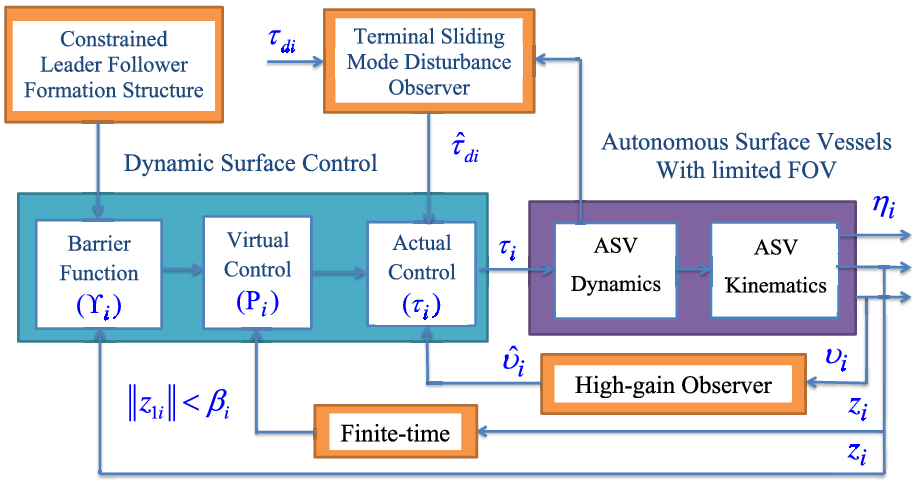
Suggested block diagram for the leader-follower formation control of autonomous surface vessels.

As a result,
 ${e_{di}} = -{M_i}{\dot \Xi _i}$
, which is finite-time stable,
 ${e_{di}} \equiv 0,\;t \ge{t_{ix}}$
. Thus, the states of the closed-loop control system converge to the origin in finite-time and the estimation parameters are bounded. This suggested control structure is illustrated for the leader-follower formation control of autonomous surface vessels in Fig. 2.
Remark 6. In comparison with ref. [Reference Ghommam and Chemori32], where the leader-follower performed based on range and bearing constraints, in this article, the leader-follower formation control accomplished based on the tracking error constraints. Moreover, since the control approach is based on finite-time, the finite-time disturbance observer is applied in this article which increases the disturbance rejection powerfully and improves both the high tracking precision and fast convergence rate in the formation control problem.
Remark 7. The negligence of the effects of external ocean disturbances in the formation control problem may lead to the system instability and collision of ASVs. Therefore, the finite-time terminal sliding-mode disturbance observer is proposed in this article to compensate such disturbances in the dynamics of all ASVs. This suggested finite-time disturbance observer-based controller for ASVs picks up the previous restrictions on the number of ASVs and the formation arrangement.
Theorem 4.1.
Consider a group of cooperative autonomous surface vessels with kinematic and dynamic equations which are given by (
1
) and (
4
). Subjected to Assumptions
1
-
3
and constraint (
7
), the proposed control law (
46
) with applying HGO (
20
)-(
22
), adaptive law (
45
) and nonlinear disturbance observer (
53
) ensure that all the signals in the closed-loop control system remain bounded as
 $t \to \infty$
and the tracking errors
 ${z_{1i}}(t)$
and
 ${z_{2i}}(t)$
are semi-globally uniformly ultimately bounded (SGUUB) and converge into a small ball including the zero.
Proof. Consider the following Lyapunov function for the overall formation control system:
 \begin{equation} {\Upsilon _T}(t) = \sum \limits _{i = 1}^N{\left ({\frac{1}{2}\log \frac{{\beta _{1i}^2}}{{\beta _{1i}^2 - z_{1i}^T{z_{1i}}}} + \frac{1}{2}z_{2i}^T{M_i}\,{z_{2i}} + \frac{1}{{2{\gamma _i}}}\tilde \theta _i^T{{\tilde \theta }_i} + \frac{1}{2}\textrm{P}_{ie}^T\textrm{P}_{ie} + \frac{1}{2}\,\Xi _i^T{M_i}\,{\Xi _i}} \right )}. \end{equation}
The following inequality is obtained for the entire formation control system:
 \begin{equation} \begin{array}{l}{{\dot \Upsilon }_T}(t) \le \sum \limits _{i = 1}^N{\left ({ - 2{c_{1i}}{\rho _{1i}}{\Upsilon _{1i}} -{c_{2i}}{\rho _{1i}}^{\frac{{\alpha - 1}}{2}}{{(2{\Upsilon _{1i}})}^{\frac{{\alpha + 1}}{2}}} -{\rho _{2i}}{{\left \|{{\textrm{P}_{ie}}} \right \|}^2}\; -{\rho _{3i}}{{\left \|{{{\tilde \theta }_i}} \right \|}^2} -{\rho _{5i}}{{\left \|{{z_{2i}}} \right \|}^2}} \right .} \\\\ \left .{\quad \quad \quad -{c_{4i}}{{\left ({{{\left \|{{z_{2i}}} \right \|}^2}} \right )}^{\frac{{\alpha + 1}}{2}}} + \frac{1}{2}\varepsilon _i^{{*^2}} +{\rho _{4i}} +{\rho _{6i}} - \dfrac{{2{K_{i1}}}}{{{\lambda _{\max }}({M_i})}}{\Upsilon _{3i}} -{K_{3i}}{{\left(\dfrac{2}{{{\lambda _{\max }}({M_i})}}\right)}^\sigma }{{({\Upsilon _{3i}})}^\sigma }} \right ). \end{array} \end{equation}
Consequently, inequality (66) can be represented for the overall formation control of autonomous surface vessels as follows:
 \begin{equation} {\dot \Upsilon _T}(t) = \sum \limits _{i = 1}^N{\left ({ -{s_i}{{\left \|{{\chi _{ti}}(t)} \right \|}^2} +{\gamma _i}(t)} \right )} \le -{s_{\min }}{\left \|{{\chi _t}(t)} \right \|^2} + \gamma (t), \end{equation}
where
 ${\chi _{ti}} = [z_{1i}^T,z_{2i}^T,\tilde \theta _i^T,\,{\textrm{P}_{ie}},\Xi _i^T]$
,
 ${\chi _t} ={[\chi _{t1}^T,\chi _{t2}^T,\ldots,\chi _{tN}^T]^T}$
,
 ${s_{\min }} = \min \!\left \{{{s_i}} \right \}_{i = 1}^N$
and
 $\gamma (t) = \sum \limits _{i = 1}^N{{\gamma _i}(t)}$
. In this context,
 $\xi _i$
and
 $\gamma _i$
are defined as follows:
 \begin{equation} {\xi } = \min \!\left \{{2{c_{1i}}{\rho _{1i}},{c_{2i}}{\rho _{1i}}^{\frac{{\alpha - 1}}{2}},{\rho _{2i}},{\rho _{5i}},{\rho _{3i}},{c_{4i}},\frac{{2{K_{i1}}}}{{{\lambda _{\max }}({M_i})}},{K_{3i}}{{\left(\frac{2}{{{\lambda _{\max }}({M_i})}}\right)}^\sigma }} \right \}. \end{equation}
 \begin{equation} {\gamma } ={\rho _{4i}} +{\rho _{6i}} + \frac{1}{2}\varepsilon _i^{{*^2}}. \end{equation}
Consequently, with respect to definitions (68) and (69), the following inequality is obtained for the overall formation control of autonomous surface vessels:
 \begin{equation} {\dot \Upsilon _T}(t) \le - \xi \,{\Upsilon _T}(t) + \gamma, \end{equation}
which assures that the closed-loop control system is SGUUB. According to Lemma 1, inequality
 $\left \|{{z_{1i}}(t)} \right \| \lt{\beta _{1i}}$
 $\forall t \gt 0$
yields that the initial conditions
 $\left \|{{z_{1i}}(0)} \right \| \lt{\beta _{1i}}$
are satisfied. Hence, it is known that
 ${\eta _i}(t) ={z_{1i}}(t) +{\eta _0}(t)$
,
 $\left \|{{z_{1i}}(t)} \right \| \lt{\beta _{1i}}$
and
 $\left \|{{\eta _0}(t)} \right \| \le{A_0}$
, consequently,
 $\left \|{{\eta _i}(t)} \right \| \lt{\beta _{1i}} +{A_0}$
and the position output constraints will never be violated. The signals
 ${z_i}(t) ={[{z_{1i}}(t),{z_{2i}}(t),{z_{3i}}(t)]^T}$
remain in a defined bounded compact set through:
 \begin{equation} {\Omega _z} = \left \{{{z_i} \in{R^n}\;:\left |{{z_{1i}}} \right | \le \beta _{1i}^2\sqrt{1 -{e^{ - 2{\Upsilon _{1i}}}}},\left \|{{z_{2i}}} \right \| \le \sqrt{\frac{{\max \!\left \{{\Upsilon ({t_0}),\dfrac{{{\gamma _i}}}{{{s_i}}}} \right \}}}{{{\lambda _{{z_{\min }}}}}}} } \right \}. \end{equation}
This equation indicates that
 $\left \|{{z_i}(t)} \right \|$
decreases whenever
 ${z_i}(t)$
is outside the set
 $\Omega _z$
, revealing that
 ${z_i}(t)$
is SGUUB and converges exponentially to a neighborhood of the origin which assures that the leader-follower formation control system for the surface vessels under output constraints is SGUUB. By the function approximation capability of NNs, an adaptive-neural formation controller is designed for each surface vessel in a sense that all of them can synchronize the leader with tracking errors by being SGUUB in an asymptotic manner. Thus, all the signals in the closed-loop system are bounded and the tracking errors converge to a small neighborhood of the origin by choosing the design parameters appropriately. Consequently, the obtained proof process is analogous to theorem. The proposed control method not only can guarantee the formation objective achieved within finite settling time but also can estimate the external disturbances in the finite-time. It is easy to draw the conclusion that the formation control problem of surface vessels can be solved with constrained states.
5. Simulation results
To illustrate the performance of this newly proposed disturbance observer-based finite-time formation controller, a simulation of
 $N = 5$
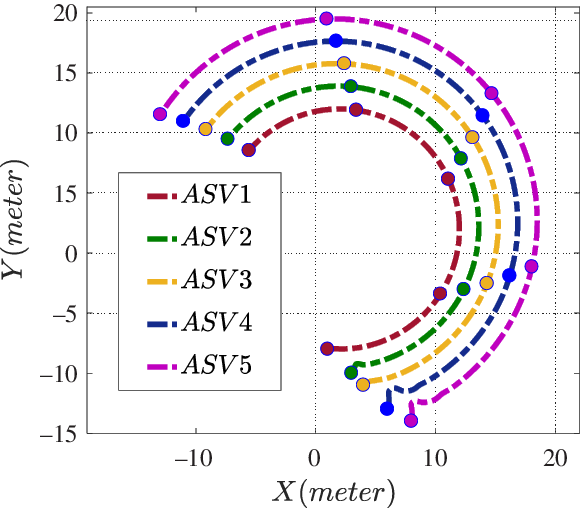
identical models of the autonomous surface vessels is carried out where the system parameters are obtained from ref. [Reference He, Yin and Sun19]. Undoubtedly, there exist some model uncertainties and time-varying disturbances that are introduced in this model. The objective here is to make the formation control to achieve the desired trajectory to form the circle shapes with a radius of
 $12m$
with
 ${\eta _0}={[2,-8,-1.5]^T}$
for autonomous surface vessels, while avoiding from violation of constraints in the presence of uncertainties and disturbances. The initial positions and orientation of each surface vessel are represented by
 ${\eta _1}(0) ={[1,-8,-1]^T}$
,
 ${\eta _2}(0)={[3,-10,-1.5]^T}$
,
 ${\eta _3}(0)={[4,-11,-1]^T}$
,
 ${\eta _4}(0)={[6,-13,-1]^T}$
,
 ${\eta _5}(0)={[8,-14,-1]^T}$
, which meet Lemma 1, and the initial velocities are
 ${\upsilon _i}(0)={[0,0,0]^T}$
. The formation trajectory of autonomous surface vessels in 2-D plane is illustrated in Fig. 3 where the followers have to follow the leaders at the finite-time in the presence of state constraints, external disturbances and uncertainties.
Formation control of autonomous surface vessels with circle desired trajectory.

The constant coefficient of the first-order filter is considered as
 $\alpha _{i}=0.005$
; the virtual and actual controller coefficients
 ${c_{1i}} = 50$
,
 ${c_{2i}} = 40$
,
 ${c_{3i}} = 2$
,
 ${c_{4i}} = 3$
are designed; the finite-time coefficient is considered as
 $\alpha =0.85$
; the high-gain velocity observer parameters are considered as
 $m_{i}=0.2, m_{1i}=5$
; The designed disturbance observer parameters are selected as
 ${K_{1i}} = 60$
,
 ${K_{2i}} = 20$
,
 ${\delta _i} = 5$
; the constraint bound for the formation tracking errors are selected as
 ${\beta _{1i}} = 0.05$
. The initial estimated RBFNN parameters are selected as
 ${\theta _{1i}}(0) = 10$
,
 ${\theta _{2i}}(0) = 2$
and
 ${\theta _{3i}}(0) = 1$
in the formation control of each autonomous surface vessel. Moreover, the time-varying reign of tracking errors regarding the limited FOV bound is suggested as
 ${\bar z_{i,0}=+1},$
 ${\bar z_{i,\infty }=+0.05},$
 ${\underline z_{i,0}=-1},$
 $\underline z_{i,\infty }=-0.05$
and the exponential rate coefficient is selected as
 $k_i=2$
.
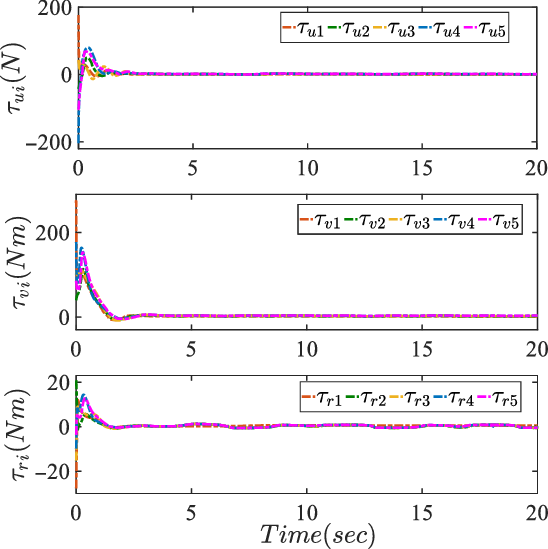
The designed actual control signals of autonomous surface vessels
 $\tau _{ui}$
,
 $\tau _{vi}$
and
 $\tau _{ri}$
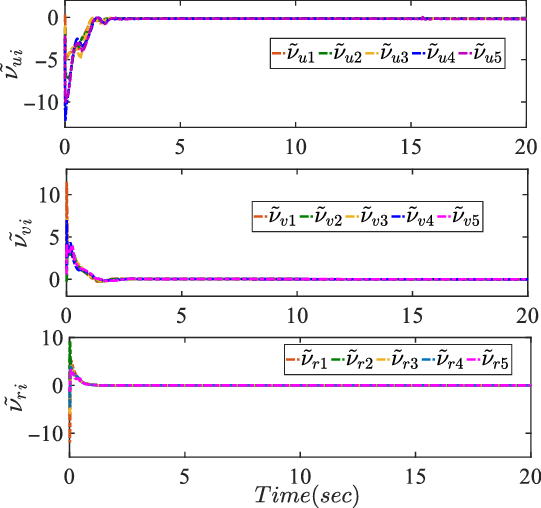
are shown in Fig. 4. The high-gain velocity observer errors
 $\tilde \upsilon _{ui}$
,
 $\tilde \upsilon _{vi}$
and
 $\tilde \upsilon _{ri}$
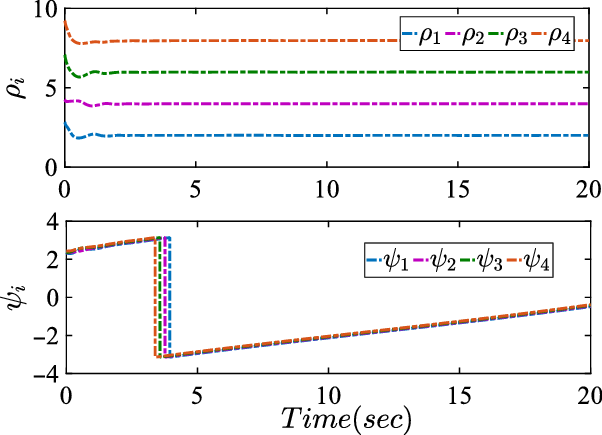
are illustrated in Fig. 5. It is clear that all signals are saturated due to the initial tracking error as well as the effects of HGO approximation. The distances and angles between autonomous surface vessels
 $\rho _{i}$
,
 $\psi _{i}$
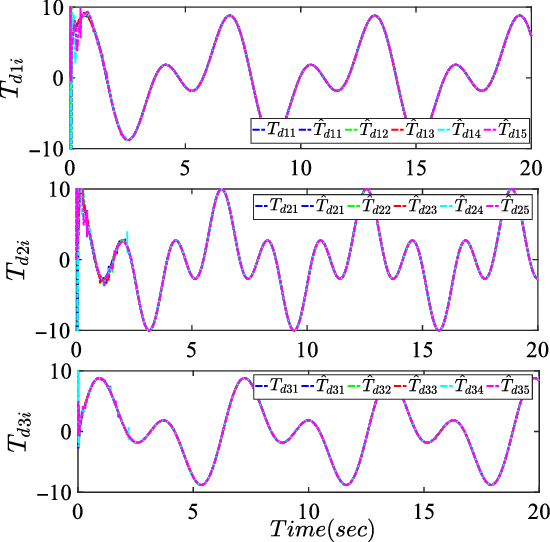
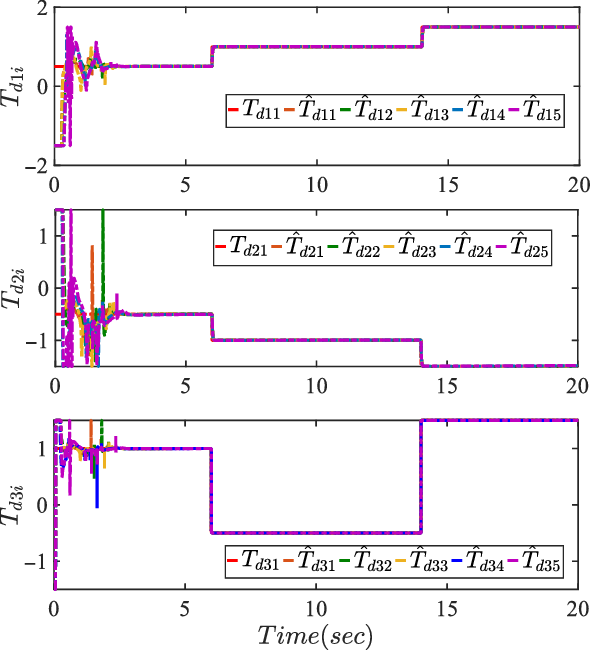
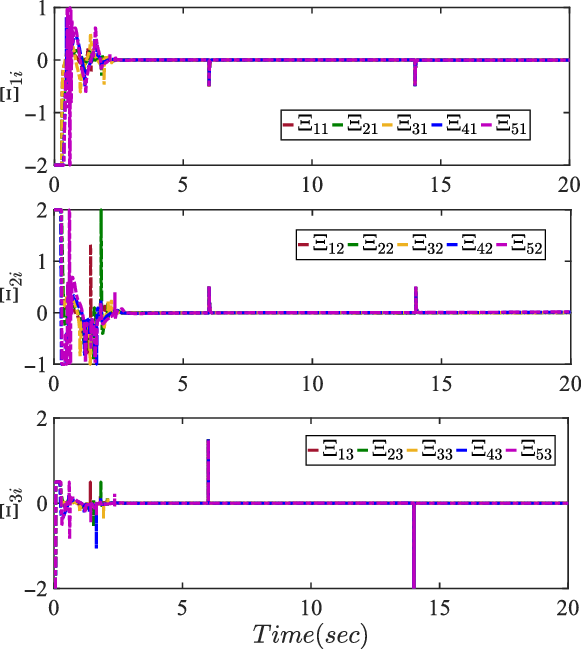
are shown in Fig. 6. The disturbance observer output in the formation control is shown in Fig. 7. The disturbance observer errors of all ASVs
 $\Xi _{d1i}$
,
 $\Xi _{d2i}$
,
 $\Xi _{di3}$
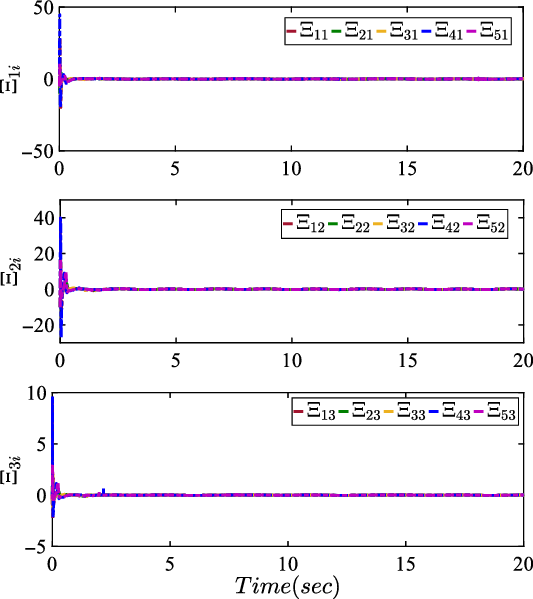
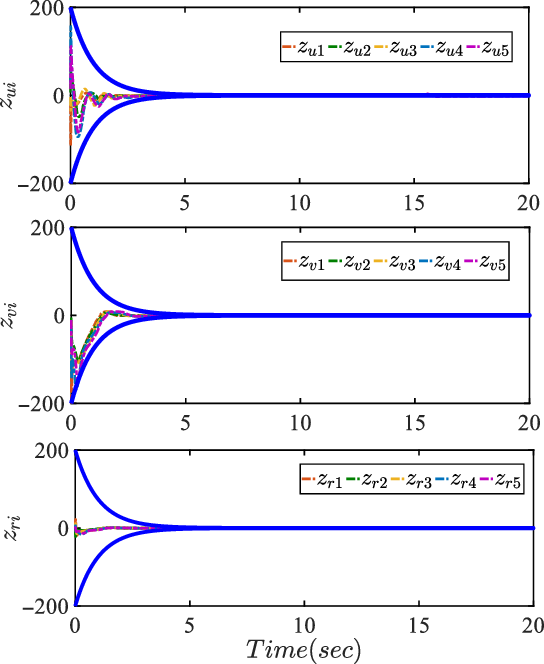
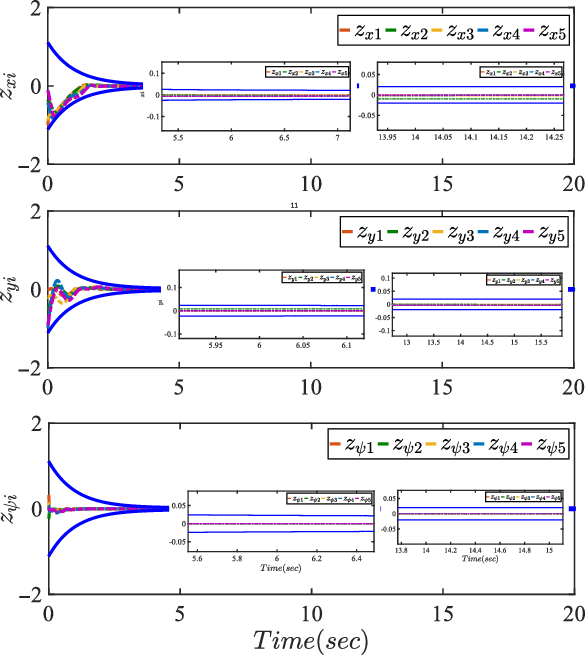
are shown in Fig. 8. The first surface errors of each ASV
 $z _{xi}$
,
 $z _{yi}$
,
 $z _{\psi i}$
and the second surface errors of each ASV
 $z _{ui}$
,
 $z _{vi}$
and
 $z _{ri}$
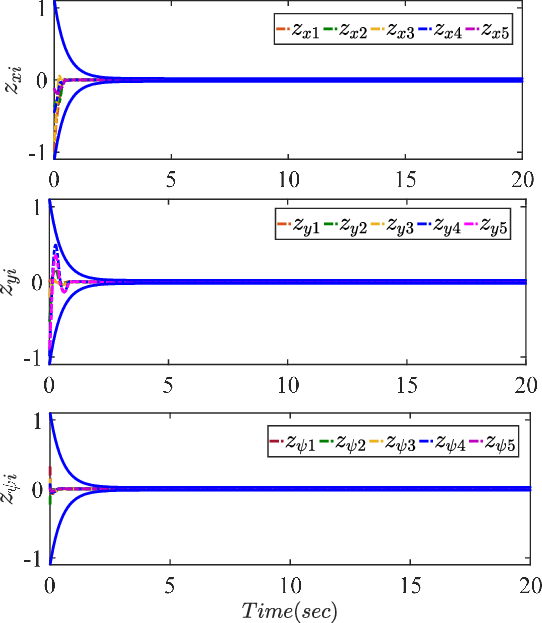
are illustrated in Figs. 9 and 10, respectively.
Actual control signals of each autonomous surface vessels
 $\tau _{ui}$
,
 $\tau _{vi}$
and
 $\tau _{ri}$
.

High-gain velocity observer errors of the autonomous surface vessels
 $\tilde \upsilon _{ui}$
,
 $\tilde \upsilon _{vi}$
and
 $\tilde \upsilon _{ri}$
.

Distances and orientation angles between the autonomous surface vessels
 $\rho _{i}$
and
 $\psi _{i}$
.

Disturbance observer output of the autonomous surface vessels
 $\tau _{d1i}$
,
 $\tau _{d2i}$
and
 $\tau _{di3}$
.

Disturbance observer errors of the autonomous surface vessels
 $\Xi _{d1i}$
,
 $\Xi _{d2i}$
and
 $\Xi _{di3}$
.

First surface errors of the autonomous surface vessels
 $z _{xi}$
,
 $z _{yi}$
and
 $z _{\psi i}$
.

Second surface errors of the autonomous surface vessels
 $z _{ui}$
,
 $z _{vi}$
and
 $z _{ri}$
.

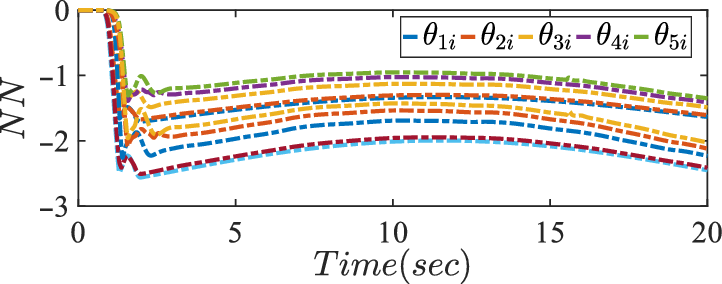
The Frobenious norm of estimated NN parameters is illustrated in Fig. 11. An appropriate increasing of the NN nodes number will lead to a smaller approximation error, thus a decreasing in compact set
 $\Omega _i$
. This fact indicates that the formation is performed well despite the available time-varying disturbances and uncertainties. All surface vessels successfully track the leader to construct the desired formation without violating the constraints and the formation tracking performance of the cooperative autonomous surface vessels is met at finite-time.
Frobinious norm of the RBF neural network
 $\theta _{1i}$
,
 $\theta _{2i}$
,
 $\theta _{3i}$
,
 $\theta _{4i}$
and
 $\theta _{5i}$
.

As it can be seen in the Fig. 5, the HGO estimates the velocities of all ASVs in the finite settling time within about 2 s. It is clear that these estimates arrive at their respective saturation values and converge quickly to the actual output derivatives in a small neighborhood of their values.
The external disturbance signals and the disturbance observer signals of all ASVs
 $\tau _{d1i}$
,
 $\tau _{d2i}$
and
 $\tau _{di3}$
are illustrated by Fig. 12. Also, the disturbance observer errors of all ASVs
 $\Xi _{d1i}$
,
 $\Xi _{d2i}$
,
 $\Xi _{di3}$
are shown in Fig. 13. Moreover, the first error surface signals of all ASVs
 $z_{xi}$
,
 $z _{yi}$
and
 $z _{\psi i}$
in the presence of the external disturbances are illustrated by Fig. 14. It can be seen from Fig. 12 that the proposed disturbance observer (58) could process the disturbance estimations of all ASVs successfully in
 ${t_{ix}} = 2 s$
according to (63).
Disturbance observer output of the autonomous surface vessels
 $\tau _{d1i}$
,
 $\tau _{d2i}$
and
 $\tau _{di3}$
.

Disturbance observer errors of the autonomous surface vessels
 $\Xi _{d1i}$
,
 $\Xi _{d2i}$
and
 $\Xi _{di3}$
.

First surface errors of the autonomous surface vessels
 $z _{xi}$
,
 $z _{yi}$
and
 $z _{\psi i}$
in the presence of imposed external disturbances.

5.1. A comparative experiment
To verify the performance of the suggested controller for the formation control of surface vessels, four scenarios are considered in this study. In the first scenario, the simulation is carried out for the DSC approach. In the second scenario, the BLF-based design is implemented in the suggested controller. In the third scenario, the finite-time technique is applied to the DSC approach, and in the fourth scenario, both BLF and finite-time strategies are utilized in the proposed control system. To compare between these approaches, the following performance indices are defined:
 \begin{equation} \left \{ \begin{array}{l} ISE = \int _0^T{{e_{i}^2}(t)dt}, \\\\ IAE = \int _0^T{\left |{e_{i}(t)} \right |dt}, \\\\ ITAE = \int _0^T{t\!\left |{e_{i}(t)} \right |dt}, \end{array} \right. \end{equation}
where
 $e_{i}(t)$
is the tracking error of the formation control,
 $T$
is the constant time in which the transient response settles and Integral Square Error (ISE), Integral Absolute Error (IAE) and Integral Time Absolute Error (ITAE) are the ISE, IAE and ITAE, respectively. The overshoot, settling time, the tracking errors
 $z_{xi}$
,
 $z_{yi}$
and
 $z_{\psi i}$
in terms of three well-known criteria including ISE, IAE and ITAE are reported in Tables I and II, respectively, between four scenarios without considering disturbances and with applying disturbances. Environmental disturbances as currents and waves effects cause the desired performance not to be achieved and the tracking errors of the formation control are transgressed. The forced external disturbances to each autonomous surface vessel are considered as follows:
 \begin{equation} {\tau _{di}} = \left \{ \begin{array}{l}{\tau _{d1}} = 5\sin\! (2t) + 5\cos\! (t),\\\\{\tau _{d2}} = 5\cos\! (3t) + 5\cos\! (2t),\\\\{\tau _{d3}} = 5\sin\! (2t) + 5\sin\! (t), \end{array} \right. \end{equation}
By a comparison between different scenarios, in Scenario 1, the control structure only assures the tracking of all ASVs without any novelty. In Scenario 2, the BLF approach decreases the formation tracking errors for all ASVs in the defined and limited bounds. In Scenario 3, the finite-time approach decreases the settling time and increases the convergence rate in an effective way. In Scenario 4, the control performance is significantly increased via a combination of the finite-time control and BLF-based design in the control structure. In Fig. 4, the yaw moment
 $\tau _r$
is presented to be much more noisy than
 $\tau _u$
and
 $\tau _v$
. This is because the relative effect of the noise in the yaw dynamics is larger than that one in the surge motion.
5.2. The efficacy and robustness of the proposed controller
To verify the efficacy and robustness of this proposed controller, the following disturbances are applied to the dynamic models of ASVs:
 \begin{equation} {\tau _{di}} = \left \{ \begin{array}{l}{\tau _{d1}} = + \frac{1}{2}u(t) + \frac{1}{2}u(t - 6) + \frac{1}{2}u(t - 14) \\\\{\tau _{d2}} = - \frac{1}{2}u(t) - \frac{1}{2}u(t - 6) - \frac{1}{2}u(t - 14). \\\\{\tau _{d3}} = + 1u(t) - 2u(t - 6) - \frac{5}{2}u(t - 14) \end{array} \right. \end{equation}
As can be seen from Figs. 12 and 13, despite the imposed disturbances to the ASVs dynamics, the desired trajectory tracking of ASVs in the formation control problem is performed well. Although this methodology is an effective approach to handle these disturbances, unwanted peaks are appeared in the disturbance observer errors, while the consecutive step disturbances in Eq. (74) are applied to the ASVs dynamics. In spite of such a peaking, which may be removed by employing the saturation function in the disturbance observer design, all ASVs successfully track the desired trajectories in the formation control problem and the boundary of tracking errors are never transgressed. Moreover, we can see that the finite-time terminal sliding-mode disturbance observer estimates the disturbance
 $\tau _{di}$
quite well for a finite-time presentation of
 $t _{ix}$
.
It is clear that from Fig. 14, in spite of peaking at
 $t=6$
and
 $t=8$
s due to the consecutive step disturbances calculated from Eq. (74), all the vehicles construct the desired formation very well. In comparison with the other disturbance observers in the literature, the proposed approach is illustrated as a suitable solution to the problem of disturbance observer design with the finite-time convergence
 $t _{ix}$
. Moreover, the proposed methodology can eliminate the well-known assumptions on the existence of the derivative of external disturbances in previous works. It is clear that this method does not require any knowledge about the amplitude and frequency of imposed environmental disturbances, and such parameters are not implemented in the controller design.
Comparison results between four scenarios without disturbance effects on ASVs.

Comparison results between four scenarios with disturbance effects on ASVs.

6. Conclusion
A constrained formation control scheme for a cooperation of autonomous surface vessels was presented in this article. A dynamic surface controller was designed based on the finite-time technique and the reference trajectory of the formation control could be tracked in a finite-time. The formation control of surface vessels employed an adaptive NN technique to compensate the uncertain parameters and unmodeled dynamics. A symmetric BLF was applied to prevent the transgression of the output constraints, and it was illustrated that such outputs are able to start from anywhere in the initial constrained output space. The finite-time BLF-based DSC approach has been combined with a finite-time terminal sliding-mode disturbance observer due to the powerful disturbance rejection of the finite-time technique which increases effectively the convergence rate of the system response and compensates disturbance effects in a finite-time. The obtained simulation results have indicated that the constraints on the formation tracking errors are never violated. Consequently, the formation tracking errors in this newly proposed control algorithm has remained strictly within the constrained region at the finite-time, and the semi-global uniform ultimate boundedness of tracking errors was achieved, and all the closed-loop control signals have remained bounded in the limited and predefined bounds subjected to a mild requirement on the initial conditions.
Authors’ contributions
-
Amir Naderolasli: Conceptualization, Investigation, Methodology, Modeling, Design, Simulation, Writing, Editing.
-
Khoshnam Shojaei: Conceptualization, Investigation, Methodology, Reviewing, Editing.
-
Abbas Chatraei: Methodology, Reviewing, Editing.
Financial support
This research received no specific grant from any funding agency, commercial or not-for-profit sectors.
Conflict of interest
The authors declare none.
Ethical considerations
None.