1. Introduction and Background
Liberalizing services market access is difficult (Sauvé, Reference Sauvé2013). This was demonstrated at the multilateral level in the Doha Round negotiations (Gootiiz and Mattoo, Reference Gootiiz and Mattoo2009) and continues to be true in the moribund plurilateral Trade in Services Agreement (TiSA) negotiations (International Centre for Trade and Sustainable Development, 2015; Matthews et al., Reference Matthews, Wayne and Pan2018). Even in ambitious bilateral/regional trade agreements, such as the Comprehensive and Progressive Agreement for Trans-Pacific Partnership (CPTPP), the main achievements have been to bind existing market access (Ciuriak et al., Reference Ciuriak, Xiao and Dadkhah2017). If the main impact of trade agreements is not to liberalize services market access, but to bind existing access, the value of bindings moves front and centre for public policy evaluation.
Bindings reduce uncertainty for firms about future market access. In theory, reducing uncertainty should induce greater trade. This is brought out by firm-level trade theory, which takes into account the fixed costs of foreign market entry (Melitz, Reference Melitz2003; Bernard et al., Reference Bernard, Eaton, Jensen and Kortum2003). In the face of uncertainty about future market access, not all firms capable of exporting or investing abroad will incur the costs of market entry and, of those that do, many will make the necessary market-entry investments in fewer markets than they might optimally serve.
Conceptualizing uncertainty about market access as an investment issue sharpens the argument. In the investment literature, firms are understood as making state-contingent decisions; given uncertainty about future states and at least partial irreversibility of investment decisions, the opportunity cost of immediate investment (i.e., the option value of delaying and accumulating additional information) is included in the firm's cost of investment. As Dixit and Pindyck (Reference Dixit and Pindyck1994) emphasize, ‘hurdle rates’ for firm investments are substantially higher than the cost of capital;Footnote 1 they suggest that the value of real options is thus very significant, implying uncertainty is also a very significant factor inhibiting investment. Bloom et al. (Reference Bloom, Bond and Van Reenen2007) make the case that uncertainty does indeed make firms more cautious and, further, that this effect is large.
There is also some documentary evidence that sunk costs of market entry in services markets are significant. Kox and Lejour (Reference Kox and Lejour2006: 6) make the case that set-up costs are particularly high for small and medium-sized enterprises (SMEs), even for EU firms entering into services trade in the EU single market. As they note:
In a survey among a large number of business-services firms in the EU, 78 per cent of the responding firms mention that setup costs of selling services in other EU states are ‘significant’ or ‘very significant’ trading barriers. The setup cost effects are largest for small and medium-sized enterprises (SME). According to CSES (2001):Footnote 2 ‘Evidence collected from SMEs and SME-supporting organisations suggests that many SMEs back off after initial inquiries about administrative requirements and procedures because they feel they do not have the necessary resources to deal with the current complexity.’
Accordingly, uncertainty about the terms and conditions of future market access, which puts sunk costs at risk, likely deters market entry. By the same token, binding commitments should unambiguously trigger new market entry at the margin.
A growing literature suggests that trade agreements induce additional trade by reducing uncertainty. In a study most closely related to ours, Lamprecht and Miroudot (Reference Lamprecht and Miroudot2018) construct bilateral binding indexes that indicate how close actual regulations are from a fully bound regime by comparing commitments in the WTO General Agreement on Trade in Services (GATS) and free trade agreements (FTAs) with actual regulations. The reduction in this measure of uncertainty is found to lead to greater trade in services.
Handley and Limão (Reference Handley and Limão2015) and Lakatos and Nilsson (Reference Lakatos and Nilsson2015) provide confirmatory evidence from alternative natural experiments: the expansion of Portugal's trade with EU Member States upon accession and the expansion of EU–South Korea trade anticipating the coming into force of the EU–South Korea FTA. Conversely, new uncertainty about future market access generated by renegotiation of a trade agreement reduces firm entry into trade and increases firm exit from trade (Crowley et al., Reference Crowley, Exton and Han2018).
Studies on the impact of bilateral investment treaties (BITs) have also reached generally confirmatory conclusions that a reduction of risk impacts on investment decisions. Kekic and Sauvant (Reference Kekic and Sauvant2007: 96) report that two-thirds of executives of multinationals, responding to the question ‘To what extent does the existence of an international investment agreement (for example, a bilateral investment treaty) influence your company's decision on which markets to invest in?’, indicated that BITs influence their decision to at least some degree. Yackee (Reference Yackee2010) reports that providers of political risk insurance only inconsistently take BITs into account when making underwriting decisions and the majority of the providers he surveyed did not, in fact, view BITs as relevant to their underwriting decisions. At the same time, his results indicate that at least some underwriters take BITs into account in assessing political risk. Thomas Waelde argues that ‘it would be a sign of negligent management and counsel if political risk management and investment protection were not planned with the potential of investment-treaty based arbitration in mind’ (cited in Orr, Reference Orr2007). As argued above, the findings of this literature are at least tangentially relevant to the question of the impact of services bindings.
If binding market access reduces uncertainty and less uncertainty increases trade by inducing market-entry related investments at the firm level, we then must address the following questions. What are the metrics by which we measure uncertainty and – more particularly – what are the metrics by which we measure the reduction of uncertainty through a trade agreement? And, how much does reduction in uncertainty matter for trade in services?
To address these questions, we draw on recent advances in measuring services trade restrictions and uncertainty made by the OECD. As regards the restrictions, the OECD has developed the highly granular Services Trade Restrictiveness Index (STRI) (Geloso Grosso et al., Reference Geloso, Gonzales, Miroudot, Rouzet and Ueno2015). It captures the restrictiveness of actual regulations applied by countries with respect to trade in services, with coverage of all four modes of services supply: cross-border services flows, consumption abroad, commercial presence, and movement of persons.
To quantify uncertainty, we draw on another OECD index, the GATS Trade Restrictiveness Index (GTRI) (Miroudot and Pertel, Reference Miroudot and Pertel2015). That index measures restrictiveness in commitments made in the GATS. The STRI can be less restrictive than the GTRI; this is akin to a most-favoured nation (MFN) tariff applied by a country being lower than the corresponding maximum MFN tariff to which the country committed in the WTO. The difference between the STRI and the GTRI is the ‘water’ in the GATS bindings. Water quantifies the extent to which existing market access restrictions could be increased without violating WTO commitments and thus provides a measure of uncertainty of services market access for trading partners that do not have an FTA in force.
In cases where countries, besides making commitments in the GATS, also have made commitments on trade in services in FTAs, we calculate an index analogous to the GTRI based on our review of FTAs and measure water as the difference between the FTA-based index of commitments and the STRI. We develop these measures for 27 FTAs.
We employ a gravity model to estimate the impact on services trade of actual restrictions, as measured by the STRI, and of policy uncertainty, in terms of the scope for countries to legally reduce market access without penalty. We contribute to the literature by separately quantifying the impacts of these two factors. The estimated coefficients can be used to evaluate the impact of the introduction of improved services bindings under an FTA.
An alternative empirical approach to estimating the impact of services commitments in FTAs is suggested by Lamprecht and Miroudot (Reference Lamprecht and Miroudot2018). Their approach is to create a new index that follows the schedule of GATS commitments and GATS-inspired services chapters of FTAs. This index is based on five states: (a) full commitment (no limitations); (b) standstill on limitations plus ratchet mechanism; (c) standstill on limitations; (d) water; and (e) unbound. While the index identifies whether there is water in the GATS or FTA regimes for a given bilateral relationship, it does not take into account the amount of water; moreover, liberalizing credit is given only if there is a change in state – e.g., from water in the GATS to a standstill on limitations under the FTA – as opposed for a discrete change in the amount of water. Conversely, the Lamprecht–Miroudot index gives liberalizing credit for the ratchet clause in FTAs, which our approach does not. Applied empirically in a gravity model setting, in which each bilateral relationship receives a binding score based on combining the GATS and FTA analysis, Lamprecht and Miroudot find a positive effect on trade from improved certainty of market access provided by FTAs that is broadly comparable to our results in terms of the implied increase in trade from reduction of uncertainty.
To preview our main conclusions, water in services bindings is associated with less services trade; the effect of reducing water is weaker than the effect of reducing actual restrictions. In our preferred regression, the response of services trade to reductions of both the STRI and water is inelastic: the point estimates for the elasticities are about –0.40 for the STRI and –0.14 for water. On average, moving from the commitments in GATS to the commitments in FTAs leads to a 4.70% increase in services trade because of the reduction in uncertainty.
The rest of this paper is organized as follows. Section 2 reviews the literature on services trade restrictions and liberalization, with particular focus on gravity model frameworks. Section 3 describes the data and empirical strategy. Section 4 presents the results. Section 5 discusses the results and concludes.
2. Applying Gravity Models to Services Trade
Quantitative analysis of services trade remains much less well developed than the comparable analysis of goods trade. The reasons are well known: poor quality services data and significant challenges in quantifying barriers to services trade (Francois et al., Reference Francois, Hoekman and Woerz2007). The survey by Francois and Hoekman (Reference Francois and Hoekman2010) identifies only scattered and inconclusive research in these areas prior to the 2000s. Since about 2000, the literature has expanded markedly both as regards measuring services trade barriers and as regards their impact on trade. Dee (Reference Dee2005), Dihel and Shepherd (Reference Dihel and Shepherd2007), Francois and Hoekman (Reference Francois and Hoekman2010), and Van der Marel and Shepherd (Reference Van der Marel and Shepherd2013) provide useful surveys of this growing literature; Nordås and Rouzet (Reference Nordås and Rouzet2017) cover the more recent contributions.
Anderson et al. (Reference Anderson, Milot and Yotov2014) apply a structural gravity model to the analysis of trade in services using Canadian bilateral provincial data. The gravity model follows the one used by Anderson and Yotov (Reference Anderson and Yotov2010) for the analysis of trade in goods; however, policy barriers, such as those that enter the STRI, are not explicitly included in its empirical specification.
The most relevant empirical study for our work is Nordås and Rouzet (Reference Nordås and Rouzet2017). This study provides the first estimates of the STRI's impact on trade in services. It finds that higher STRI scores are associated with lower levels of services trade at the aggregate level.
Overall, it appears fair to conclude from this literature that gravity ‘works’ for services trade – that is, services trade patterns appear to broadly conform to the expected patterns in the gravity model literature for goods. At the same time, there is little consensus concerning coefficient values for important determinants of services trade. Moreover, there are several major areas of active investigation.
One general theme in the literature is sectoral heterogeneity. Intuitively, construction services trade might fall off steeply with increasing distance, but maritime transportation services trade might grow with distance. Exporter gross domestic product (GDP) need not be positively related to services export sales in all service sectors – the counter example is small island states that export tourism services intensively (see Walsh, Reference Walsh2008, who includes a temperature variable to identify sun destinations). Neglecting this heterogeneity may lead to biased and inconsistent estimates of gravity model parameters (Haque et al., Reference Haque, Pesaran, Sharma, Krishnakumar and Ronchetti2000). Cheng and Wall (Reference Cheng and Wall2005) provide a detailed discussion of the importance of taking into account sectoral heterogeneity in the gravity model.
A second general theme concerns the econometrics of the gravity model. There are several issues that have generated active debate.
Taking into account multilateral resistance is particularly problematic. Multilateral trade resistance (MTR) captures bilateral trade costs relative to the rest of the world (Anderson and van Wincoop, Reference Anderson and van Wincoop2003). MTR is not observed, but, if omitted from a model, can lead to biased and inconsistent estimates of the impact of explanatory variables. To control for MTR, gravity studies frequently include country or country–year fixed effects; however, this approach can be problematic because of collinearity of the fixed effects with explanatory variables in specific configurations of the model. Remoteness has been used to proxy MTR, but Suvankulov (Reference Suvankulov2015), for example, finds that exporter and importer remoteness are collinear. Nordås and Rouzet (Reference Nordås and Rouzet2017) address the MTR issue by checking the robustness of results obtained without controlling for MTR, using several alternative model specifications that include some, but not all, of the theoretically required fixed effects.
The large number of zeros in the bilateral trade matrix constitutes another problem. Multiple zero data points in bilateral trade flows may contain important information on existing barriers to trade; however, this information is lost with conventional log-linear specifications, since these zeros require truncating the dataset. Since the influential paper by Santos Silva and Tenreyro (Reference Santos Silva and Tenreyro2006), the Poisson pseudo-maximum likelihood (PPML) estimator has become a popular estimation technique to address this issue (e.g., Anderson et al., Reference Anderson, Milot and Yotov2014; Nordås and Rouzet, Reference Nordås and Rouzet2017; Suvankulov, Reference Suvankulov2015).
Heteroscedasticity in panel data is also problematic. Santos Silva and Tenreyro (Reference Santos Silva and Tenreyro2006) showed that the PPML estimator outperforms Ordinary Least Squares (OLS): the OLS estimator produces biased and inconsistent estimates in the presence of heteroscedasticity because of the log-linearization.
Of critical importance, the results for important coefficients change markedly in these various studies with different estimation approaches – all of which have their problems. Accordingly, the as-yet-unsettled state of econometrics means that empirical estimates in the literature remain open to question.
3. Empirical Approach
3.1 Data
Our data on services trade restrictions are drawn from the OECD's STRI database, which covers measures affecting services trade restrictions in 18 services sectors and 40 countries (OECD, 2014). The data on the GTRI come from Miroudot and Pertel (Reference Miroudot and Pertel2015).Footnote 3 Importantly, the GTRI and the STRI are measured by the same indicators and feature the same weighting scheme as the STRI. For bilateral services trade flows that are not subject to provisions in FTAs, water is calculated as the difference between the GTRI and the STRI.
For bilateral trade flows that are subject to FTA commitments, water is calculated as the difference between the STRI and an index based on the FTA commitments constructed following the methodology of the GTRI.Footnote 4 We call the new index the FTA Trade Restrictiveness Index (FTRI). We calculated the index of commitments for 27 FTAs. They were drawn from the WTO regional trade agreement (RTA) database and included FTAs with provisions on trade in services and that were in effect between countries and in the period covered by our trade data.Footnote 5
For the most part, we find that commitments in FTAs do not improve upon market access as measured by the STRI; accordingly, the multilateral STRI can be used as the basis for calculation of remaining water. However, where an FTA does improve upon the STRI, the STRI score for the bilateral relationship must be reduced commensurately. It should be noted that in an instance where an FTA improves upon applied market access but is not bound, the FTRI would remain equal to the GTRI.
Finally, we also accounted for the MFN clause related to trade in services that is typical for trade agreements by assigning the lowest FTRI of an importer to all exporters that have FTAs with that importer in our dataset. We did the same with STRI for those cases where FTA improves upon STRI and STRI scores were changed as noted above.
Thus, water becomes a bilateral variable that is calculated as the difference between FTRI and STRI for the country pairs with FTAs and as the difference between GTRI and STRI for the country pairs without FTAs.Footnote 6
The STRI and GTRI/FTRI cover all modes of supply: cross-border services flows, consumption abroad, commercial presence, and movement of persons. For commercial banking and insurance, GTRI indexes are not available and, therefore, these sectors are not included in the analysis. Also, after preliminary analysis, we dropped transportation and construction from the sample. In the case of transportation, road and rail services are traded only within continents. Air services and maritime services are not likely to follow the gravity model logic for a number of reasons. Construction features little trade across borders and regressions result in wrong signs, also suggesting misspecification of equations.
Data on services trade from the OECD's Trade in Services database are available for 12 of the 18 sectors covered by the STRI, namely: computer services, construction, accounting, legal services, telecommunications, four different modes of transportation (air, maritime, road, and rail), courier services, commercial banking, and insurance. We use 2008–2012 data to cover the period for which the STRI captures regulations and laws. We use mirror trade data (i.e., data reported by the trade partner) if observations are missing.
The trade data do not cover trade in services through commercial presence (foreign direct investment, FDI) because the latter does not represent transactions between residents and non-residents recorded in the Balance of Payments (United Nations et al., 2002). However, this does not mean that restrictions on commercial presence included in the STRI are irrelevant for cross-border trade in services. In fact, FDI and cross-border trade in services may be strongly related as complements or substitutes, as discussed by Nordås and Rouzet (Reference Nordås and Rouzet2017).
Finally, we exclude intra-EU observations. While we created the FTRI to calculate water for countries that made commitments in FTAs, calculation of the FTRI based on intra-EU treaties was beyond the scope of this study.
Our sample thus covers 40 countries and five service sectors: accounting, computer services, courier services, legal services, and telecommunications. Using this sample, we estimate a panel model in which trade data vary over time, sector, and country, while the STRI and water are time-invariant, but vary over sector and country.
As regards the sources of the gravity data, GDP in current US dollars is sourced from the IMF, World Economic Outlook Database. Other gravity variables come from the CEPII gravity dataset.
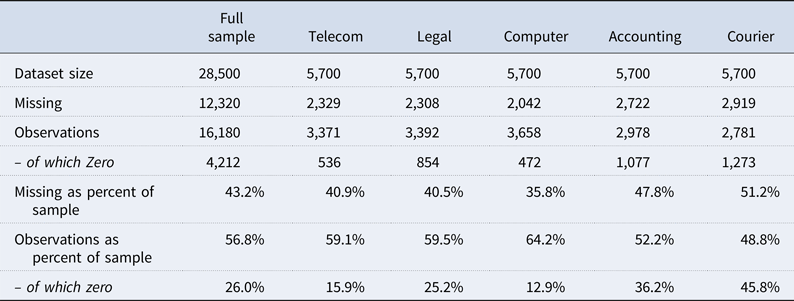
Table 1 provides a summary of the size of the sample, the number of missing observations, and the percentage of the observations on exports that are zero.Footnote 7 Having many zeros in the sample is expected, because we work with sector-level data and because services trade is characterized by much smaller values of bilateral trade flows as compared to trade in goods.
Sample size

Source: Calculations by the authors.
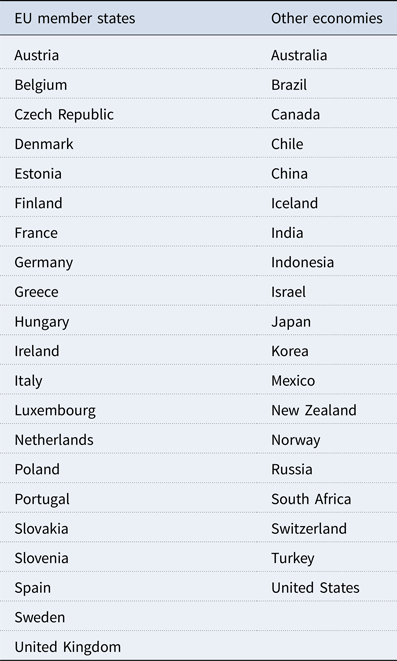
Table 2 provides the list of countries in the sample.
Countries in the sample

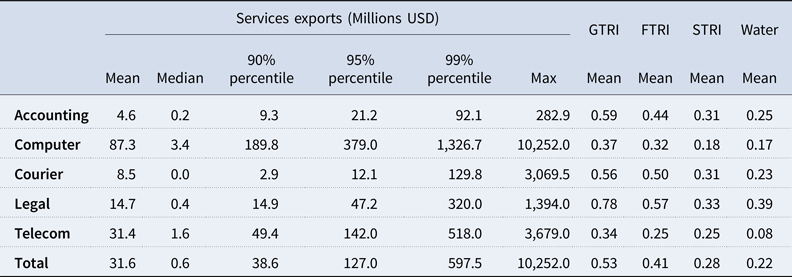
Table 3 summarizes key variables. The FTRI is lower than the GTRI, as expected, but its average values appear to be quite high – varying between 0.25 in telecommunications and 0.57 in legal services – thus leaving room for water. On average, there is roughly the same level of applied restrictiveness (0.28) as there is of water (0.22) across the sectors.
Summary statistics of exports, GTRI, FTRI, STRI, and water, by service sector, across countries, 2008–2012

Source: calculations by the authors.
Table 3 also shows the distribution of export values. Clearly, annual export flows are dominated by relatively low value exports (compared for example with what would be the case if we were analyzing goods exports flows) but in each sector there are export flows that are far from averages. We consider two data points to be outliers and drop them from the analysis, specifically, export of courier services from the United States to Germany in 2012 was more than two times higher than the second-largest annual export flow in this sector, reaching US$3.1 billion. Also, export of telecommunications services from the United States to Brazil in 2012 was about two times larger than the second-largest annual export flow in this sector, reaching $3.7 billion. The results are to some extent sensitive to the omission of these two observations as noted in the results section.
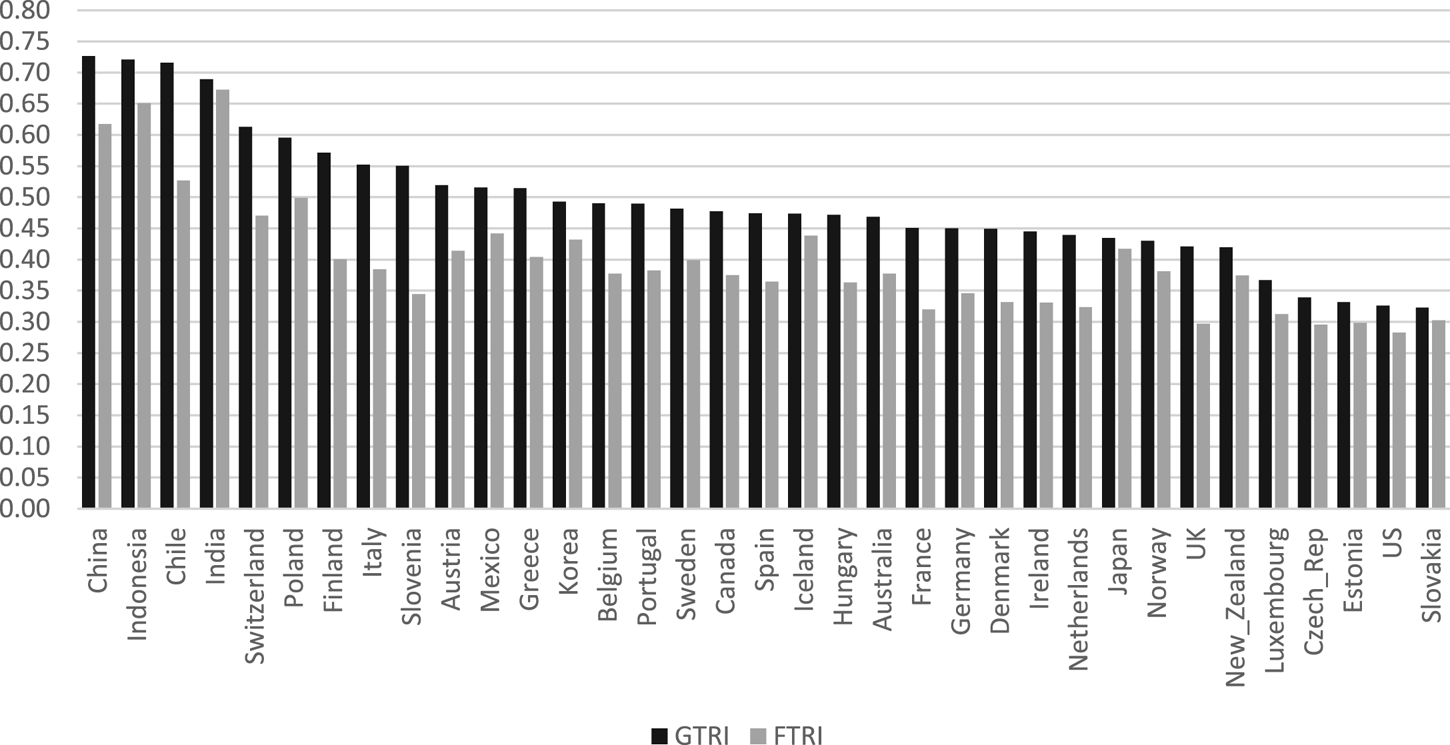
Figure 1 shows averages of the FTRI and the GTRI across sectors and partners by country. Countries do not always make stronger commitments in FTAs than in the GATS, and when they do the extent of the improvement varies sharply. For example, for Slovenia, Italy, and Finland, the average FTRI is in the range of 60–70% of their average GTRI; by contrast, India and Japan hardly move beyond their GATS commitments and the FTRI to GTRI ratio for these countries is in the range of 95–99%.
GTRI and FTRI, average across sectors and FTA partners

3.2 Estimation and Regressors
Following Nordås and Rouzet (Reference Nordås and Rouzet2017) and other recent gravity studies, we adopt the PPML estimator, because it provides unbiased and consistent estimates in the presence of heteroscedasticity in a non-linear gravity model (Santos Silva and Tenreyro, Reference Santos Silva and Tenreyro2006; Wooldridge, Reference Wooldridge2002: Ch. 19). Another key PPML advantage is that it can deal with zeros in the trade data, because the dependent variable is kept in levels.
We estimate a panel model in which the dependent variable is bilateral exports of services by sector with data for five years, 2008–2012. Our regressors of interest are the sector-specific STRI and a measure of sector-specific water.
We control for distance, GDP, common language, contiguity, and common legal origins. Nordås and Rouzet (Reference Nordås and Rouzet2017) include the time difference between trading partners, but we do not use this variable, as it is very strongly correlated with distance. To proxy MTR, we first include remoteness calculated as a weighted average of distance between a country and its trading partners using GDP as weights and then we experiment with different sets of fixed effects. An alternative approach, suggested by Baier and Bergstrand (Reference Baier and Bergstrand2009), is to use a linear approximation of MTR that includes a number of elements of trade costs besides remoteness. We do not attempt this, because it is unknown how proxies of trade costs perform in the services gravity model, while distance exhibited relative stability in our preliminary regressions.
Applying PPML, we estimate the following econometric model:
 $$\eqalign{E_{ijst} =& \exp \lpar {\alpha_0 + \alpha_1{\rm ln}Y_{it} + \alpha_2{\rm ln}Y_{\,jt} + \alpha_3{\rm ln}D_{ij} + a_4L_{ij} + a_5C_{ij} + a_6LG_{ij}} \cr&{+ \alpha_7STRI_{ijs} + \alpha_8WATER_{ijs}} \rpar + u_{ijst},}$$
where i, j, t, and s indicate exporting country, importing country, year, and sector, respectively; E denotes services exports; Y is GDP; D is distance; L is the common language dummy; C is the contiguity dummy, LG is the common legal origins dummy; and u is the error term.
STRI and water are not logged in this equation. Therefore, for example,  $100\cdot \alpha _7$ shows the percentage change in services exports when STRI increases by one. Because STRI is constrained to be between zero and one, it is more meaningful to look at α 7 as the percentage changes in services exports when STRI increases by 0.01. The interpretation of the water coefficient α 8 is the same.
We cluster standard errors at the exporter–importer–year level.Footnote 8
4. Results
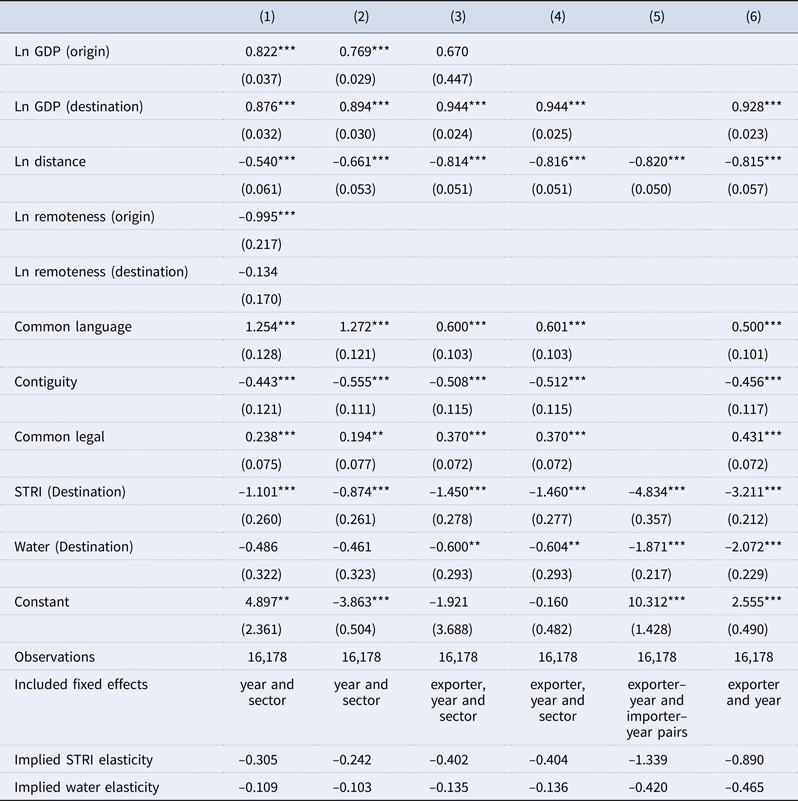
Table 4 presents the results. The regression incorporating remoteness (column 1) identifies a negative but statistically insignificant effect of water on services trade (–0.49). The effect of water is less than half the effect of actual barriers to services trade as measured by the STRI (–1.10). The impact of STRI is statistically significant. The latter estimate suggests that an increase in STRI by 0.01 leads to a decrease in services trade by 1.10%. The mean value of STRI across all sectors is 0.28 (Table 3). An increase by 0.01 represents an increase by 3.6% from its mean while 1% of the mean level of STRI is 0.0028. Accordingly, an increase in STRI by 1% from its mean leads to a decrease in services trade by 0.31% calculated as –1.10*0.0028*100%.
Regression results

Notes: (1) dependent variable is level of export (2) standard errors are in parentheses; they are clustered at the exporter–importer–year level (3) ***, **, and * denote significance at 1%, 5%, and 10% levels, respectively. See the explanation of the calculation of the implied elasticities in section 4.
The standard gravity variables perform in a manner consistent with the literature. The coefficients on GDP are positive and less than unity, echoing the results in Santos Silva and Tenreyro (Reference Santos Silva and Tenreyro2006); the coefficient on distance is also negative and statistically significant. Contiguity, however, has a negative sign, which is not what would be expected in the goods gravity model. Exporter remoteness is statistically significant; importer remoteness is not.
In the next regression (column 2), we omit remoteness but retain sector and year fixed effects. The impacts of STRI and water decrease and the latter remains statistically insignificant.
We then introduce exporter fixed effects (column 3). An immediate observation is that the coefficient of exporter's GDP loses significance – its impact is likely captured by exporter and year fixed effects – so we re-run the regression omitting this variable (column 4). An important change is that the effect of Water increases in absolute value (–0.60) and becomes statistically significant. The interpretation in terms of the elasticities similar to the one for STRI above suggests that an increase in Water by 1% from its mean at 0.22 leads to a decrease in services trade by 0.14%. The STRI coefficient increases in absolute value as well: it is estimated at –1.46 in this regression (the implied elasticity at the mean value is –0.40%).
Our next regression (column 5) includes exporter–year and importer–year fixed effects to allow for the possibility that MTR varies over time. Because this set of fixed effects is perfectly collinear with the GDP of both exporters and importers, we omit the latter control variables. We also omit the common language, contiguity, and common legal origins dummies as they have limited additional variation as compared to fixed effects. Contrary to our expectations that the STRI and water coefficients will lose their power, because fixed effects might absorb their impact on trade, the STRI coefficient jumps to –4.83 and the water coefficient jumps to –1.87.Footnote 9
The results in the last regression may reflect the omission of sector dummies that were helping to control for sectoral heterogeneity – they cannot be included because the set of fixed effects would be perfectly collinear with STRI and water. To check the importance of sector dummies, we repeat the regression in column 4 while excluding them. The impact of STRI jumps to –3.2 and that of water jumps to –2.1 (column 6). This highlights the importance of controlling for sector dummies, which cannot be done in the regression in column 5.
The results are to some extent sensitive to the omission of the two outliers from our sample. The STRI coefficients are not affected in terms of the magnitude of the coefficients or statistical significance. However, if the two outliers are included in the sample, the coefficient of water drops and loses statistical significance in the regressions reported in columns 3 and 4. This happens because, by including these observations, we let very high values of exports to be associated with relatively high values of water: 0.47 in the case of the outlier in the courier services sector, which is more than two times higher than the mean water in that sector; and 0.32 in the case of the outlier in the telecommunications sector, which is four times higher than the mean water in the sector.Footnote 10
Remarks on the Results
As noted earlier, there is no established state of the art in this area and no consensus on stylized facts. Yet, theory suggests that water has an effect and we find evidence for it. In regressions controlling for MTR through fixed effects that include sector fixed effects to control for sector heterogeneity, STRI elasticity tends to be in the range of 0.24–0.40 while water elasticity tends to be in the range of 0.10–0.14 (columns 2–4).
From the perspective of the choice of a specification, the regression with only exporter, year, and sector fixed effects (column 4) appears to be the most compelling. While it does not completely control for MTR, it does so to the extent possible, while not absorbing the impacts of the importer's STRI and water into fixed effects, but controlling for sector heterogeneity. This regression assigns a coefficient 2.4 times larger to the STRI than to water. On this basis, our preferred estimates of the coefficient are –0.60 for water and –1.46 for STRI (corresponding elasticities at the mean are –0.14 and –0.40).
One potential source of concern is endogeneity. In the gravity modelling literature, endogeneity issues are sometimes addressed using the Hausman and Taylor model (HTM), which is a random-effects model in which some of the regressors are correlated with the unobserved random effects (Egger, Reference Egger2005; Walsh, Reference Walsh2008). The endogenous variables are instrumented by the variables of the model, which are treated as exogenous. We do not use this method, because, if we specify water and the STRI as endogenous variables, the rest of the variables appear to be weak instruments. Furthermore, applying the HTM would require log-linearization of the model, which has theoretical disadvantages, as previously discussed. Using other instrumental variables (IV) estimators would be problematic for similar reasons.
Concerns about endogeneity are, in fact, very modest for the present exercise. Trade flows in a specific year are unlikely to have significant feedback effects on regulations, as the policy formation process is lengthy and complex with many factors at play – political, economic, and institutional. The GTRI and the FTRI commitments that underlie calculations of water might be endogenous, as countries’ negotiating positions are driven by their economic performance; however, given that these commitments were negotiated at specific times, some of them about 20 years earlier than the period covered by our sample, it is likely that the service sectors have changed so significantly that the linkages between the economic performance of service sectors and the commitments made have already been lost. In this context, our judgement is that the PPML estimator produces more reliable estimates than IV estimators.
5. Concluding Remarks
Are these estimates sufficiently reliable to use in policy-relevant evaluations of FTAs? We make several observations in this regard.
First, the results are in line with theory, general empirical evidence on the effect of uncertainty on trade, and the intuition of trade negotiators who assign a high value to obtaining binding commitments. Our findings do not overturn conventional wisdom, but rather quantify it. For example, the European Commission routinely includes a bindings effect in its computable general equilibrium (CGE) estimates of the impact of trade agreements; this is based on a notional 3% reduction in services trade costs due to the reduction of uncertainty (see, e.g., European Commission, 2013). Our estimates provide empirical support for this practice as well as a basis for aligning the trade cost reduction with the specific commitments in the FTA being evaluated.
Second, the specific point estimate on which we settle for water is reasonably related to the size of the estimate we settle on for the STRI. Further, our preferred point estimate for the effect of the STRI is very close to the Nordås and Rouzet (Reference Nordås and Rouzet2017) estimate of the elasticity of services exports with respect to STRI in the pooled regression (–0.42).
Our results show the gains from liberalization of trade in services in FTAs compared to GATS. The average water in countries without FTAs is 0.246 and the average water in countries with FTAs is 0.168. Thus, FTAs decrease water by 0.078. Applying the water coefficient from column 4 (–0.604) to this change in water resulting from FTAs, the estimated percentage change in services trade is 4.70% calculated as –0.604*(–0.078)*100. Lamprecht and Miroudot (Reference Lamprecht and Miroudot2018) estimate that moving from average commitments in GATS to the average commitments in FTAs leads to an increase in trade of between 8% and 12% in different sectors. However, in some sectors this effect is statistically insignificant. Overall, the latter study provides corroborating evidence that reducing uncertainty increases services trade with an order of magnitude comparable to what our results suggest (particularly taking into account the differences in FTA coverage between the two studies).
Another key takeaway from the regression analysis is that it establishes that actual market restrictions, as measured by the STRI, have more than twice – specifically 2.4 times – the restrictive power as an equivalent amount of water, based on our recommended coefficients for the effect of a reduction in the STRI of –1.46, and for bindings of –0.60.
Overall, we believe our results provide the basis for improved empirical assessments of trade agreements and establish that FTA texts should be systematically coded against the STRI/GTRI to measure changes implied by the agreements both in applied regulations and in water. We take particular encouragement from the similarity of our results to those of Nordås and Rouzet (Reference Nordås and Rouzet2017); given the information from the FTRI developed for this study, the main impact of FTAs on trade runs through uncertainty and this result is consistent with the findings by Lamprecht and Miroudot (Reference Lamprecht and Miroudot2018).
However, there remains an extensive agenda for further work.
• The impact of reducing water is likely to be heterogeneous across countries due to varying levels of risk of increasing restrictiveness of regulations. The value to a trading firm of a trade agreement binding is analogous to the value of an insurance policy: for a given face value of risk (water), the value of insurance (the binding) falls as the likelihood of the risk being actuated falls.Footnote 11 More generally, analysis might usefully take into account different levels of credibility of commitments, which in turn depend on dispute settlement mechanisms of FTAs as well as on many characteristics of the parties entering into FTAs, including the political structure of countries which may be taken into account while differentiating between unitary states and federations with different powers of sub-federal entities.
• Regulatory heterogeneity is also an issue – that is, differences in regulatory mixes between importing and exporting countries might represent a trade cost even if the total STRI values are the same. This is shown by Nordås (Reference Nordås2016). Consequently, the ‘composition’ of uncertainty – water – might also be important as well as its level.
• Finally, trade through commercial presence has to be taken into account in evaluating the overall impacts of FTAs, as well as possible interactions between different modes of trade; for example, cross-border trade might be facilitated by improvements in commercial presence or movement of natural persons.
Acknowledgements
We would like to thank two anonymous referees and the editor of this journal for their very insightful and helpful comments. The paper has also benefited from discussions with staff at the OECD Services Directorate, the European Commission, and at conferences of the Canadian Economics Association and of the Atlantic Canada Economics Association. We would particularly like to acknowledge the encouragement to pursue this line of inquiry by Lucian Cernat, Zornitsa Kutlinova-Dmitrova, and Lars Nilsson. We are further grateful for comments from Daniel Schwanen and anonymous reviewers at the C.D. Howe Institute on a technical paper supporting the study Ciuriak, Dadkhah, and Xiao (2016) ‘Better In than Out? Canada and the Trans-Pacific Partnership,’ C.D. Howe Institute. We also thank Natassia Ciuriak for editing the manuscript.
Author ORCIDs
Dmitry Lysenko, 0000-0001-7092-5568.
Supplementary Material
To view supplementary material for this article, please visit https://doi.org/10.1017/S1474745618000496.