


Introduction
Technology is increasingly being incorporated throughout psychological practice, and has the potential to provide greater outreach and increased cost-efficiency of current services (Barnett and Scheetz, Reference Barnett and Scheetz2003). The impact of this technology can be seen in the rising clinical use of services such as e-mail, the internet, and telephone (e.g. Overholser, Reference Overholser2012; Wolf, Chung and Kordy, Reference Wolf, Chung and Kordy2010; Wolf, Maurer, Dogs and Kordy, Reference Wolf, Maurer, Dogs and Kordy2006). One area of adjunctive technologies involves the use of Short Message Service (SMS) appointment reminders, which may be effective in reducing client dropout and non-attendance (Clough and Casey, Reference Clough and Casey2011a,Reference Clough and Caseyb). Client dropout and non-attendance are common throughout psychological practice. Difficulties in these areas can reduce the success and effectiveness of treatment, result in poor use of resources, staff, and client time, and increased costs associated with treatments (Car, Gurol-Urganci, de Jongh, Vodopivec-Jamsek and Atun, Reference Car, Gurol-Urganci, de Jongh, Vodopivec-Jamsek and Atun2012; A. Chen, Reference Chen1991). Yet, despite systematic investigation of the effects of SMS reminders in other disciplines (e.g. Z.-w. Chen, Fang, Chen and Dai, Reference Chen, Fang, Chen and Dai2008; Guy et al., Reference Guy, Hocking, Wand, Stott, Ali and Kaldor2012), intervention effects in psychological settings remain unclear.
Dropout is defined as client termination of treatment before the completion of the therapy programme (Barrett, Chua, Crits-Christoph, Gibbons and Thompson, Reference Barrett, Chua, Crits-Christoph, Gibbons and Thompson2008; Melville, Casey and Kavanagh, Reference Melville, Casey and Kavanagh2007; Ogrodniczuk, Joyce and Piper, Reference Ogrodniczuk, Joyce and Piper2005). Client dropout has been estimated to be as high as 40–60% in mental health clinics (Baruch, Vrouva and Fearon, Reference Baruch, Vrouva and Fearon2009). In contrast, non-attendance, or no-show, is client failure to attend booked appointments. The rate of non-attended appointments has been estimated to be as high as 60% in mental healthcare settings, with non-attendance often being a precursor to client dropout (Lefforge, Donohue and Strada, Reference Lefforge, Donohue and Strada2007). Non-attendance can have many negative consequences, including poor use of staff time and resources, increased length of waiting lists, poorer treatment outcomes, and loss of income for therapists and clinics (Chen, A., Reference Chen1991; Conduit, Byrne, Court and Stefanovic, Reference Conduit, Byrne, Court and Stefanovic2004; Lefforge, Donohue and Strada, Reference Lefforge, Donohue and Strada2007).
Previous research
To date, no definitive cause of dropout or non-attendance has been identified. Some client characteristics and social factors have been associated with increased risk (e.g. Barrett et al., Reference Barrett, Chua, Crits-Christoph, Gibbons and Thompson2008; El-Mallakh et al., Reference El-Mallakh, James, Khan, Katz, McGovern and Nair2004; Marini et al., Reference Marini, Semenzin, Vignaga, Gardiolo, Drago and Caon2005). However, research is in large part still inconclusive, and sometimes even conflicting (Arnow et al., Reference Arnow, Blasey, Manber, Constantino, Markowitz and Klein2007).
Appointment reminders and prompts have been researched as one strategy for decreasing no-shows and preventing dropout. Appointment reminders may be effective because they reduce the risk of prospective memory failures (Tanke and Leirer, Reference Tanke and Leirer1994). This suggestion is consistent with research finding the most common reason clients give for missing an appointment is that they simply forgot about the appointment (e.g. Carrion, Swann, Kellertcecil and Barber, Reference Carrion, Swann, Kellertcecil and Barber1993).
Appointment reminders and prompts have been in use for over 30 years in psychological settings. Early research utilized reminders sent by mail; however telephone reminders have been the focus of more recent research (e.g. Conduit et al., Reference Conduit, Byrne, Court and Stefanovic2004; Hochstadt and Trybula, Reference Hochstadt and Trybula1980). With the rise of e-mail and mobile phone technologies, greater options are now available for the delivery of appointment reminders and prompts.
A recent review identified 14 studies as utilizing some form of technological device (such as e-mail or telephone) to deliver appointment reminders and prompts in psychological settings (Clough and Casey, Reference Clough and Casey2011b). Three of these 14 studies found appointment reminders to be ineffective in increasing client attendance, whilst 11 studies indicated positive effects associated with the reminder interventions. In most studies, reminders were also cost effective, and initial outlays were returned by the increase in kept appointments.
Although these studies demonstrate that appointment reminders may be an effective intervention to increase client appointment attendance, there have been limitations with the research to date. There is often a lack of detail in reporting study methodology, as well as rigour in testing and statistical analyses (Clough and Casey, Reference Clough and Casey2011b). The area is lacking appropriate randomized controlled trials, including an examination of the effects of reminder interventions separate from other non-attendance interventions. Furthermore, none of the studies identified in the above review (Clough and Casey, Reference Clough and Casey2011b) examined the use of SMS reminders.
Subsequently, Sims and colleagues (Reference Sims, Sanghara, Hayes, Wandiembe, Finch and Jakobsen2012) have reported a preliminary examination of the use of SMS reminders in a psychological treatment setting and found reductions in missed appointments of between 25–28%. Although these results are promising, this study did not investigate the effect of reminders on overall client dropout, and implemented the intervention on a widespread basis and compared attendance rates to prior to the intervention. As such, the use of the SMS reminder intervention still requires investigation with randomized methodology, and with a concurrent focus not only on appointment attendance, but dropout. The investigation of SMS procedures is of particular importance given that services can be easily automated and that the reminders go to the mobile phone, which is often carried with the client throughout the day. These factors have led to SMS reminders becoming a particularly attractive intervention for clinics to uptake, despite the limited research in the area.
Aim
The aim of the present research was to conduct a randomized controlled trial (RCT) investigating the effectiveness of SMS appointment reminders at reducing client non-attendance and dropout at an outpatient university psychology clinic. Based on previous research, it was predicted that the SMS appointment reminders would result in a significant reduction in non-attended initial psychology appointments. It was also predicted that the reminders would result in a significant reduction in clients’ overall number of missed appointments, as well as a reduction in client dropouts from therapy programmes. It was further predicted that the reminders would prompt participants to reschedule problematic appointments rather than simply missing them. This effect would result in an increased proportion of rescheduled compared to missed appointments for the reminder versus no reminder groups. Participant characteristics previously found to be associated with dropout and non-attendance such as gender (Chariatte, Berchtold, Akre, Michaud and Suris, Reference Chariatte, Berchtold, Akre, Michaud and Suris2008), age (Chariatte et al., Reference Chariatte, Berchtold, Akre, Michaud and Suris2008), previous contact with psychological services (Marini et al., Reference Marini, Semenzin, Vignaga, Gardiolo, Drago and Caon2005), time spent on the waiting list (Bender and Koshy, Reference Bender and Koshy1991), and chronicity of disorder were also examined (Hoste, Zaitsoff, Hewell and le Grange, Reference Hoste, Zaitsoff, Hewell and le Grange2007).
Method
Participants
Minimum sample size was determined based on apriori power analysis. The power analysis was conducted using G* Power version 3.1.5 (Faul, Erdfelder, Lang and Buchner, Reference Faul, Erdfelder, Lang and Buchner2007) based on chi squared analyses with degrees of freedom = 2, alpha = .05, power = .80, and an estimated medium effect size of w = .03. As dropout and non-attendance were variables of interest in this study, no allowances in sample size were needed in relation to participant attrition. Minimum sample size was determined to be 108 participants, which was exceeded for the final analyses.
Participants were 140 consecutive adult clients seeking psychotherapeutic treatment at an outpatient psychology clinic attached to a Brisbane university. This university is staffed by provisionally registered psychologists who are completing their postgraduate training under the supervision of senior clinical psychologists. Clients treated at the clinic primarily suffer from mood or anxiety disorders, and the therapies offered are grounded in cognitive behavioural principles. Participants were excluded from the study if they were younger than 18 years of age, did not own a mobile phone, were attending the clinic for cognitive or neuropsychological assessment, or were attending the clinic for family or couples counselling. Families and couples were excluded from the study as the clinic booking system did not allow for researchers to determine the members that would be attending specific appointments. One client was later excluded from analyses as they had an arrangement with their therapist for same day appointments as required. As such, appointment reminders could not be arranged for this client. The final sample size was therefore 139 adults (58 male, 81 female) aged between 18 and 80 years (M = 36.42, SD = 13.49).
Design
Participants were randomly allocated to either receive an SMS appointment reminder (n = 70), or to receive no appointment reminder (n = 69). The study investigated the relationship between appointment reminders and dropout, initial appointment attendance, and total appointment attendance.
Measures
Appointment attendance
Appointment attendance was measured for both initial appointment attendance, and total appointment attendance. Initial appointment attendance was a categorical variable with three levels, namely, attended, not attended, and cancelled. This variable measured the total frequency of attended, missed, and rescheduled intake appointments for the clinic over the testing period. In line with clinic policy that stated that at least 24 hours notice was required for appointment cancellations; rescheduled appointments that were requested prior to 24 hours before the original appointment time were recorded as rescheduled appointments. Rescheduled appointments that were requested within 24 hours of the original appointment time were recorded as missed rather than rescheduled. Total appointment attendance was also categorical, and represented the total frequency of attended, missed, and rescheduled appointments for the clinic over the testing period.
Dropout
Dropout was measured dichotomously by therapist ratings of whether clients completed treatment programmes or terminated early. There has been some debate in the literature whether to measure dropout by therapist judgment, or by the completion of a set number of sessions. However, as this intervention was designed to be implemented across disorders, therapists, and treatment orientations, a therapist judgement of dropout was deemed to be more appropriate than estimating an arbitrary cut-off for number of sessions. Therapists were asked to provide this rating upon client termination. Where therapists did not provide ratings, information was gathered by means of accessing compulsory termination forms completed by each therapist upon client termination from the clinic.
Participant variables
Other variables of interest included time spent on the waiting list, and demographic variables such as age, gender, chronicity, and previous contact with psychological services, which were tested as possible correlates of dropout and non-attendance. These variables were selected as previous research has found them to be associated with appointment non-attendance (e.g. Conduit et al., Reference Conduit, Byrne, Court and Stefanovic2004; Kourany, Garber and Tornusciolo, Reference Kourany, Garber and Tornusciolo1990). Time spent on the waiting list was measured as the number of days between first contact with the clinic and the first scheduled appointment. Previous contact with psychological services was measured dichotomously as “yes” or “no”. Therapists, as based on client report, provided estimates of chronicity. Where therapists did not provide these data, they was obtained through accessing therapy reports or otherwise coded as missing.
Demographic variables not measured in the present study included socioeconomic status, ethnic background, and source of referral. Previous reminder studies have found little evidence of a relationship between these variables and non-attendance (e.g. Conduit et al., Reference Conduit, Byrne, Court and Stefanovic2004; Kourany et al., Reference Kourany, Garber and Tornusciolo1990; Swenson and Pekarik, Reference Swenson and Pekarik1988).
Materials and procedure
All new clients requesting an appointment at the clinic were placed on an intake list. A provisionally registered psychologist then contacted each client to schedule an initial (intake) appointment. Upon a first appointment being scheduled, clients who provided the clinic with a valid mobile telephone number were then randomly allocated, via simple electronic randomization procedures, to reminder and no reminder conditions. Allocation was conducted based on simple randomization procedures, using computerized random numbers. Therapists were not informed as to the condition in which their clients were allocated. However, it was noted that many clients in the SMS condition did inform their therapists of receiving the appointment messages. Standard appointment scheduling procedures were maintained for those clients not in the SMS condition. That is, clients were not prohibited from making written or electronic notes of upcoming appointments. Data were recorded as to the number of days between initial contact and the first scheduled appointment. SMS reminders were sent the day prior to scheduled appointments, between approximately 8.30–9.00 a.m. Reminders were sent using web based text messaging software (http://www.esendex.com.au). This software allowed messages to be directional so that clients were not able to reply. Clients were required to phone the clinic to cancel or reschedule appointments. Clients were advised prior to starting treatment at the clinic that if they failed to provide at least 24 hours’ notice for rescheduling an appointment, they may be charged for the appointment.
Messages were in a standard format, and included the client's name, appointment day and time, and contact details for the clinic. For confidentiality, messages did not state the nature of the appointment. Participant consent was not required to send the text messages, as they form part of quality assurance methods. Ethical approval was granted by the Human Research Ethics Committee attached to Griffith University.
Results
Data were analyzed using SPSS version 20 (Barnett and Scheetz, Reference Barnett and Scheetz2003). Effect sizes are reported using Cramer's phi (φc), omega squared (ω2) and Cohen's d as appropriate.
Equality of groups
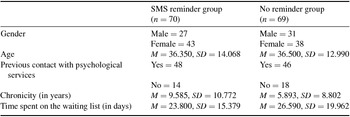
Analyses were conducted to determine whether the SMS and control group differed on demographic variables. Chi-square tests for independence (with Yates Continuity Correction) revealed no significant differences between groups in the distributions of gender (χ2 (1, n = 139) = .577, p = .447, φc = .064) or previous contact with psychological services (χ2 (1, n = 126) = .511, p = .475, φc = .064). Independent samples t tests revealed no significant differences between groups on the mean number of days spent on the waiting list (t (137) = −.925, p = .356, d = .157), or client age (t (135) = −.066, p = .948, d = .011). Descriptive statistics for the two groups are displayed in Table 1.
Descriptive statistics for reminder and no reminder conditions

Notes: Numbers displayed are frequencies unless otherwise stated. Means and Standard Deviations are represented as M and SD respectively. Final sample size was 139 participants.
Intervention effects
Dropout
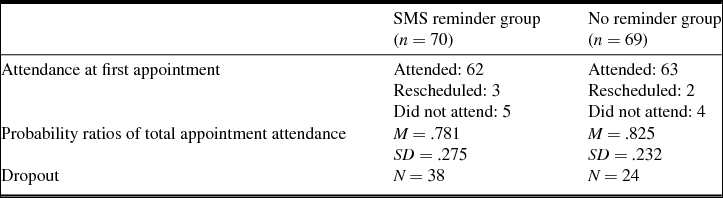
A Chi-square test for independence was used to determine whether the appointment reminders (two levels; present or absent) resulted in decreased rates of client dropout. The analysis (with Yates Continuity Correction) revealed a significant difference in the distribution of the groups, such that there was a significantly greater number of client dropouts in the reminder (n = 38) than the no reminder (n = 24) conditions (χ2 (1, n = 139) = 4.589, p = .032, φc = .196).
Attendance
A Chi-square test for independence was used to determine whether the appointment reminders (two levels; present or absent) resulted in decreased rates of missed initial appointments (three levels; attended, rescheduled, missed). The analysis revealed no significant differences in appointment distributions between the reminder and no reminder groups (χ2 (2, n = 139) = .312, p = .856, φc = .047).
To assess the effects of reminders on total appointment attendance, individual probabilities for each participant were calculated, as Chi-square tests were deemed inappropriate due to a lack of independence between the three appointment categories. For each participant, in each group, the probability of attending an appointment (number of attended appointments divided by number of scheduled appointments) was calculated. An independent samples t test revealed no significant difference between the SMS (M = .781, SD = .275) and no SMS (M = .825, SD = .232) groups in the mean probability of appointment attendance (t (137) = −1.010, p = .314, d = .173). Frequencies for client dropout and non-attendance by condition are displayed in Table 2.
Client attendance and dropout for the reminder and no reminder conditions

Notes: Numbers displayed are frequencies unless otherwise stated. Means and Standard Deviations are represented as M and SD respectively. Final sample size was 139 participants.
Individual probabilities were also calculated to assess the effects of the messages on rescheduling rather than missing appointments without notice. This probability was calculated as the total number of rescheduled appointments divided by the total number of missed (rescheduled and no show) appointments. An independent samples t test revealed no significant differences between the SMS (M = .401, SD = .466) and no SMS (M = .346, SD = .421) groups in the mean probability of rescheduling a missed appointment (t (91) = .589, p = .557, d = .124).
Associations with demographic variables
Attendance
The first set of analyses assessed the relationship between the demographic variables and initial appointment attendance. Three one-way Analyses of Variance (ANOVAs) were conducted to test for differences on the demographic variables of client age, chronicity, and number of days spent on the waiting list between the attendance groups (three levels; attended, rescheduled, did not attend) for the first scheduled appointment. No significant differences were found between those clients who attended, rescheduled, or missed the first appointment for mean days spent on the waiting list (F (2, 136) = 1.295, p = .277, ω2 = .004), client age (F (2, 134) = .015, p = .985, ω2 = .015), or chronicity of presenting difficulty (F (2, 115) = .641, p = .529, ω2 = .006). Two Chi-square tests of independence were conducted to assess the relationship between previous contact with psychological services (two levels; yes or no), gender (two levels; male, female) and initial appointment attendance (three levels; attended, rescheduled, did not attend). These analyses revealed no significant differences between the three attendance groups with regards to client gender (χ2 (2, n = 139) = .290, p = .865, φc = .046) or previous contact with psychological services (χ2 (2, n = 126) = .177, p = .915, φc = .037). These results should however be interpreted with caution, due to some cells containing less than the recommended number of five observations for the Chi-square analysis.
A second set of analyses was conducted to assess the relationships between demographic variables and total appointment attendance. Three bivariate correlations were used to assess the relationship between client age, days spent on the waiting list, chronicity, and the percentage of attended scheduled appointments. Neither client age (r = .017, n = 137, p = .847) days spent on the waiting list (r = −.085, n = 139, p = .319), nor chronicity of presenting problem (r = .109, n = 139, p = .242) were significantly associated with the percentage of total attended appointments. The variables of gender and previous contact with psychological services were dummy coded, and bivariate correlations were conducted to assess for relationships with percentage of attended appointments. Neither gender (r = −.104, n = 139, p = .222) nor previous contact with psychological services (r = .020, n = 126, p = .827) was found to be significantly associated with percentage of attended appointments.
Dropout
Two Chi-square tests of independence were conducted to assess for relationships between dropout (two levels; yes or no) and the demographic variables of previous contact with psychological services (two levels; yes or no) and gender (two levels; male or female). No significant differences in frequencies were observed on the variables of gender (χ2 (1, n = 139) = .673, p = .412, φc = .084) or previous contact with psychological services (χ2 (1, n = 126) = .106, p = .745, φc = .047), in relation to client dropout (with Yates Continuity Correction). Three independent samples t tests were used to assess for differences between those clients who completed treatment and those that terminated treatment early, on the demographic variables of age, chronicity, and days spent on the waiting list. No significant differences were found between the groups on mean client age (t (135) = −1.288, p = .200, d = −.224), chronicity (t (116) = .108, p = .914, d = .020), or days spent on the waiting list (t (137) = .616, p = .539, d = .105).
Discussion
The aim of the present research was to investigate the effectiveness of SMS appointment reminders at reducing client non-attendance and dropout in psychological treatment. Contrary to predictions, data analysis revealed non-significant findings between the SMS and no SMS groups on initial appointment attendance, total appointment attendance, and probability of rescheduling rather than missing an appointment. A significant difference was found between the groups in the therapist ratings of dropouts, such that there were a greater number of client dropouts in the SMS than the no SMS group. This significant difference was in the opposite direction to the difference predicted.
Exploratory analyses were also conducted to examine relationships between dropout, non-attendance, and participant characteristics. No relationships were found between the participant characteristics of age, gender, chronicity, days spent on the waiting list, previous contact with psychological services, and the outcome variables of first appointment attendance, total appointment attendance, or dropout.
Only one other study has examined the use of SMS appointment reminders in a psychological setting (Sims et al., Reference Sims, Sanghara, Hayes, Wandiembe, Finch and Jakobsen2012). However, in contrast to the current study, Sims et al. (Reference Sims, Sanghara, Hayes, Wandiembe, Finch and Jakobsen2012) did not use a concurrent control group, nor follow patients through for the duration of their treatment program. To the best of our knowledge this is the first study to assess the effectiveness of these messages in an RCT, in a psychological setting.
It has been theorized that appointment reminders may be effective through counteracting prospective memory failures (Tanke and Leirer, Reference Tanke and Leirer1994). Others have explained the effect through social and operant learning theory (Martinez and Wong, Reference Martinez and Wong2009). Social and operant learning theory may be able explain why the reminders had no effect on total appointment attendance. This theory predicts that the reminders would be effective at increasing appointment attendance provided the clients were receiving some benefit from their attendance. However, if the antecedent prompts have no value in predicting the consequent stimuli, that is, if clients no longer found the therapy sessions rewarding, then the client would eventually ignore the prompts. Similar to SMS studies in other disciplines, this study contained no measures of client attitudes, expectations, or perceived progress relating to therapy. It is therefore possible that beyond the initial appointment, the effectiveness of SMS reminders is moderated by such client factors.
However, previous research into the use of reminders in psychology appointment attendance (Conduit et al., Reference Conduit, Byrne, Court and Stefanovic2004; Shivack and Sullivan, Reference Shivack and Sullivan1989) suggests that SMS should have had a positive effect, at least for the initial therapy appointment. This result was not found. One possible explanation relates to existing practice at the clinic. As part of standard clinic procedure, administrative staff mailed an appointment letter to clients upon a first appointment being scheduled. This letter contained their appointment details, campus map and directions, and fee structure of the clinic. As the letter was mailed upon the appointment being scheduled, the timing of the letter in relation to the appointment was not standardized. However, in reassessing the results of the current study it was hypothesized that the SMS manipulation for the first appointment was not as strong as it could have been, due to the concurrent appointment letter. Arguably, the appointment letter provided clients with a sufficient prompt in relation to initial appointment attendance, creating a ceiling effect. Indeed, the overall number of missed initial appointments for the testing period accounted for just 6% of the total number of scheduled first appointments. It is unclear from the Sims et al. (Reference Sims, Sanghara, Hayes, Wandiembe, Finch and Jakobsen2012) study whether their sample also received any similar standardized written communication from the outpatient clinics, or whether the clients only received the SMS reminders.
The participant sample in the current study also included a relatively high proportion of participants experienced in the therapy process, with approximately 75% of the sample having had previous contact with psychological services. It may be that this sample was more socialized to the therapy, and as such more likely to attend scheduled appointments regardless of the SMS reminders. Important demographic and clinical differences exist between the clinic sample involved in the current study and other service organizations, such as those within public health care systems. Results from the current study would indicate that the SMS reminder provided no additional benefits beyond mailing appointment information; however these results should be interpreted with caution when generalizing to other service settings.
There were a greater number of client treatment dropouts in the SMS than the no SMS condition. One possible explanation relating to this effect is that the SMS reminders may have inadvertently resulted in clients being less actively engaged in their treatment plan. Anecdotally, one therapist reported that most of his clients not in the reminder group usually made hand written notes at the end of sessions (in diaries or on forms) with details of their upcoming appointments, whereas his clients in the reminder group relied purely on these messages to remind them the day before an appointment, and did not make any additional notes. It is possible that in effect the SMS reminders resulted in clients taking a more passive approach to upcoming appointments and treatment planning, facilitating a more external locus of control relating to their treatment program. It may be that the SMS reminders reduced client motivation or effort toward therapy, by reducing their sense of personal responsibility for appointment keeping. However, no quantitative data were collected relating to this effect, and as such is only offered as one possible explanation to the current trend in the data. Inclusion of measures of client attitudes, expectancies or perceived progress may have assisted in understanding this effect in the data. Future research should examine more closely the therapeutic process factors involved in relation to the appointment messages.
Regardless of initial or subsequent appointment attendance, the current research suggests that there is likely more to client non-attendance than the simple forgetting of appointments. The SMS intervention did not result in increased appointment attendance or increased probability of rescheduling (as opposed to missing) appointments. These results are contrary to those found in health and medical trials of such appointment messages (e.g. Downer, Meara and Da Costa, Reference Downer, Meara and Da Costa2005; Leong et al., Reference Leong, Chen, Leong, Mastura, Mimi and Sheikh2006; Milne, Horne and Torsney, Reference Milne, Horne and Torsney2006). However it is important for researchers and clinicians to consider the important differences that exist between many medical and psychology clinics in terms of appointment frequency, duration, length of treatment, and client characteristics. Appointments in medical healthcare settings tend to be less regular and less frequent than those in psychological settings. For many clients in psychological settings, the majority of the treatment will consist of regular appointments at weekly intervals. It may be that in a psychological setting, appointment attendance involves a combination of more complex factors and interactions than those typical in other healthcare settings. No significant relationships were found between the exploratory client factors and attendance and dropout. As such future research would likely benefit from an examination of therapeutic and client process variables, such as attitudes, expectations, and perceived progress, in relation to non-attendance, dropout, and the effectiveness of SMS reminders. Use of SMS reminders is increasing, but as the current research demonstrates, there may be potential negative effects associated with relying on SMS appointment reminders. This research suggests that careful investigation of this area, and the use of such technological adjuncts, is warranted.



Comments
No Comments have been published for this article.