






No CrossRef data available.
Article contents
Don't ignore cognitive evolution during the three million years that preceded the archaeological record of material culture!
Published online by Cambridge University Press: 14 January 2025
Abstract
The target article rightly questions whether the archaeological record is useful for identifying sea changes in hominin cognitive abilities. This commentary suggests an alternative approach of synthesizing findings from primatology, evolutionary developmental biology, and paleoanthropology to formulate hypotheses about cognitive evolution in hominins that lived during the three million years that preceded the record of material culture (the Botanic Age).
Information
- Type
- Open Peer Commentary
- Information
- Copyright
- Copyright © The Author(s), 2025. Published by Cambridge University Press
References
Anderson, H. (2012). Crossing the line: The early expression of pattern in Middle Stone Age Africa. Journal of World Prehistory, 25(3–4), 183–204.CrossRefGoogle Scholar
Beaumont, P. B., & Vogel, J. C. (2006). On a timescale for the past million years of human history in central South Africa. South African Journal of Science, 102, 217–228.Google Scholar
Falk, D. (2004). Prelinguistic evolution in early hominins: Whence motherese? (target article). Behavioral and Brain Sciences, 27(4), 491–541.CrossRefGoogle Scholar
Falk, D. (2024). Evolution of the mind's eye: A possible explanation for why early hominins produced geometric figures before representational ones. In Kumar, G. (Ed.), Study of palaeoart of the world: A quest for understanding the evolution of human constructs of reality (Vol. 2, pp. 101–116). Research India Press.Google Scholar
Falk, D. (2025). The Botanic Age: Planting the seeds of human evolution. University of Toronto Press, forthcoming.Google Scholar
Fruth, B., & Hohmann, G. (1996). Nest building behavior in the great apes: The great leap forward? In McGrew, L. M. W. & Nishida, T. (Eds.), Great ape societies (pp. 225–240). Cambridge University Press.CrossRefGoogle Scholar
Joordens, J. C., d'Errico, F., Wesselingh, F. P., Munro, S., De Vos, J., Wallinga, J., … Kuiper, K. F. (2015). Homo erectus at Trinil on Java used shells for tool production and engraving. Nature, 518(7538), 228–231.CrossRefGoogle ScholarPubMed
Köhler, W. (1925). The mentality of apes (E. Winter, Trans.). Harcourt, Brace. (Original work published 1924).Google Scholar
Larsson, M., & Falk, D. (2025). Direct effects of bipedalism on early hominin fetuses stimulated later musical and linguistic evolution. Current Anthropology, forthcoming.Google Scholar
Larsson, M., Richter, J., & Ravignani, A. (2019). Bipedal steps in the development of rhythmic behavior in humans. Music & Science, 2, 1–14.CrossRefGoogle Scholar
Lindsay, D. (2019). When the bough breaks: A contribution to Falk's hypothesis. Journal of Language Evolution, 4(1), 71–77.CrossRefGoogle Scholar
Ross, C. (2001). Park or ride? Evolution of infant carrying in primates. International Journal of Primatology, 22, 749–771.CrossRefGoogle Scholar
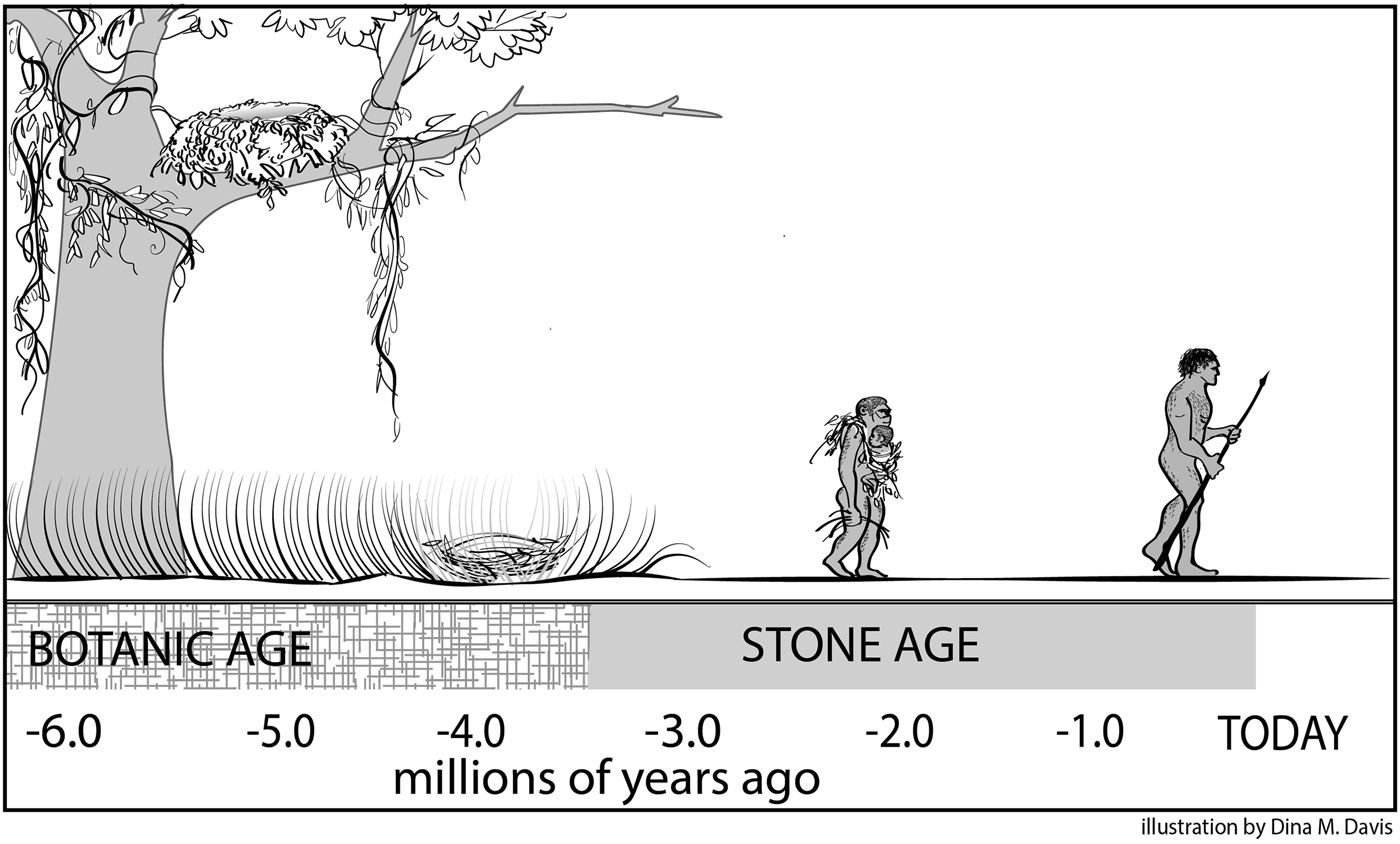
Figure 1. Hominins existed for approximately three million years before the Stone Age began, a prolonged period identified here as the Botanic Age. As hominins became bipedal during the Botanic Age, babies lost the ability to cling to their mothers. In response, mothers likely used their skills for making tree nests to weave baby slings from vines and flexible branches. Highly perishable tools continued to be invented from botanical matter throughout the Stone Age, including wooden spears dated to around 400,000 years ago.
Target article
Related commentaries (21)
Animal artefacts challenge archaeological standards for tracing human symbolic cognition
Cultural innovation is not only a product of cognition but also of cultural context
Material culture both reflects and causes human cognitive evolution
The cognitive and evolutionary science of behavioural modernity goes beyond material chronology
Because of the target article's focus on symbolic artifacts, its analysis excludes “clothing items with a practical purpose … [and] undecorated subsistence tools, storage containers, utensils etc” (target article, sect. 8, para. 3). Some, if not all, of the excluded items are “plant-derived materials (e.g., wood, bark, fruit shells, seeds, leaves) and processed plant derivatives (e.g., rope fibre) … [that have] a ‘weak’ taphonomic signature” (target article, sect. 7, para. 4). Much of the analysis uses information about present-day foragers to reveal problems associated with making inferences about cognitive evolution based on the archaeological record of material culture. The paper is convincing and even brilliant, but it raises the question of how, given its conclusions, one might reasonably speculate about the emergence and evolution of advanced cognition in early hominins.
My approach complements the target article by focusing, in part, on some of the non-symbolic materials that the article excludes. I begin with the origin of hominins (5–7 million years ago) and move forward in time (Fig. 1). There is no record of material culture during the first half of hominin evolution, but findings from comparative primatology, comparative psychology, evolutionary developmental biology (evo-devo), paleoanthropology, paleoneurology, and ethnology may be synthesized to consider cognitive evolution during the three million years that preceded the start of the Stone Age. I call this prolonged period the Botanic Age (Falk, Reference Falk2025) (Fig. 1).
Hominins existed for approximately three million years before the Stone Age began, a prolonged period identified here as the Botanic Age. As hominins became bipedal during the Botanic Age, babies lost the ability to cling to their mothers. In response, mothers likely used their skills for making tree nests to weave baby slings from vines and flexible branches. Highly perishable tools continued to be invented from botanical matter throughout the Stone Age, including wooden spears dated to around 400,000 years ago.
Among primates, only great apes weave branches into arboreal sleeping nests each evening. The ability to construct these basketlike containers entails an intuitive grasp of how the physical world works, that is, “a kind of purely concrete and practical ‘sense’ of elementary implements,” as documented long ago for chimpanzees (Köhler, Reference Köhler1925, p. 77). Evolutionary anthropologists have speculated that “nest building is not only properly placed within the realm of tool use, but it [the nest] is also the original tool that led to the mental and physical ability to use the tools we see today” (Fruth & Hohmann, Reference Fruth, Hohmann, McGrew and Nishida1996, p. 226). But how?
It is generally accepted that early hominins spent increasing amounts of time on the ground as they adapted to habitual bipedalism. Fossils show that, over time, feet changed from grasping to weight-bearing organs with aligned big toes. Consequently, today's human babies cannot grasp and ride on their mothers like all monkey and ape babies do (Ross, Reference Ross2001). Evo-devo studies of motor reflexes in human babies and apes suggest that a gradual loss of clinging ability in early hominin infants was associated with babies falling off their traveling mothers in increasing numbers that may have caused severe infant mortality (Lindsay, Reference Lindsay2019). Under these circumstances, mothers likely applied their nest-weaving skills to inventing life-saving baby slings woven from plant matter – possibly the first textiles (Fig. 1).
Although textiles have a weak taphonomic signature, fiber expert Helen Anderson speculates that the geometric zigzags and crosshatched patterns entailed in the earliest basketry may have contributed to hominins' eventual understanding of numbers, patterns, and structures and that, as such, incised artifacts may be “used as proxies for an early capacity for symbolic thought” (Anderson, Reference Anderson2012, p. 183). Dated to about half a million years ago, hominins' earliest known geometric markings, etched on a shell in Indonesia (Joordens et al., Reference Joordens, d'Errico, Wesselingh, Munro, De Vos, Wallinga and Kuiper2015) and incised on slabs in South Africa (Beaumont & Vogel, Reference Beaumont and Vogel2006), postdate the Botanic Age. But evidence from the development of artistic skills in apes and children and comparative neuroanatomy of the primary visual cortices in primates including humans (Falk, Reference Falk and Kumar2024) is consistent with the hypothesis that the invention of woven botanical textiles with their inherent cross-hatched patterns could have occurred much earlier during the Botanic Age and been entwined (so to speak) with cognitive evolution.
Bipedalism was associated with more than the invention of material culture like baby slings. It may also have serendipitously resulted in new neurological connections that paved the way for the emergence of an ability to keep a beat (i.e., “entrain”) to external rhythmic sounds as gestating infants simultaneously heard and felt the regular footfalls of their walking mothers (Larsson, Richter, & Ravignani, Reference Larsson, Richter and Ravignani2019). As detailed elsewhere (Falk, Reference Falk2004) and recently updated (Falk, Reference Falk2025), intermittent physical separation of infants and mothers caused by the loss of sustained grasping ability in the former may have prompted development of entrained reciprocal mother–infant vocalizations that contributed to the eventual emergence of motherese and, later, protolanguage. The ability to entrain to perceived external rhythms is essential for anticipating and keeping pace with clapping, dancing, foot tapping, music, and singing in addition to the linguistic utterances of conversational partners. This capability is unique in humans among primates and a necessary component of both music and language. The evolution of bipedalism likely seeded the emergence of the ability to entrain to rhythmic sounds long before this aptitude was exapted during the evolution of both music and language (Larsson & Falk, Reference Larsson and Falk2025).
The target article concerns the Stone Age because of its record of material culture. Although the appearance of some early stone tools, indeed, suggests that their makers had certain specifications in mind when knapping them, it is a bridge (or “cognitive leap”) too far to accept them as proxies for major evolutionary advances in cognition. It is unreasonable to believe that hominins were cognitively stagnant during the three million years that preceded the appearance of the first stone tools. Despite the lack of a material record during the first half of hominin evolution, one can begin to speculate about the cognitive evolution of the earliest hominins by synthesizing evidence from multiple fields.
Financial support
This research received no specific grant from any funding agency, commercial or not-for-profit sectors.
Competing interests
None.