INTRODUCTION
The east Po valley (northern Italy) is an intensive-cultivation area which represents typical arable land under risk of desertification (Jones et al. Reference Jones, Hiederer, Rusco, Loveland and Montanarella2004, Reference Jones, Stolbovoy, Rusco, Gentile, Gardi, Marechal and Montanarella2009). This farmland produces 0·74 of common potato in Italy on 4479 ha per year, which accounts for 0·72 of the total land under potato cultivation in Italy, and is concentrated in the Bologna and Ferrara provinces of the Emilia Romagna region. This area has been devoted to potatoes for many years. They are currently cultivated in succession to wheat with a 3–4 year rotation interval, according to the regional integrated production guidelines introduced in the early 1990s, when local regional authorities implemented European Union Directives on integrated production. Although crop rotation is known as a main agronomic option for controlling soil-borne fungal pathogens in potato (Peters et al. Reference Peters, Sturz, Carter and Sanderson2003, Reference Peters, Sturz, Carter and Sanderson2004), potato-growers’ associations have observed a progressive decline in crop health and quality standards over the last 12 years in this specialized area, particularly when stress conditions (such as long periods of dry, cold or wet conditions) occur. Yield losses caused by soil-borne fungal pathogens and Oomycetes are difficult to evaluate because of uncertainties in identifying the agents and in evaluating the degree to which they interfere with crop development and final production. Yield losses caused by pests and pathogens in potato crops have been estimated to account for 16–18% (Oerke Reference Oerke2006). However, as plant susceptibility to soil-borne pathogens is increased by abiotic stress, yield losses can be much higher and can vary greatly according to seasonal climatic conditions (Duveiller et al. Reference Duveiller, Singh and Nicol2007).
One of the major causes of yield decline in the potato crop is a complex of soil-borne fungal pathogens, of which Rhizoctonia solani anastomosis group (AG)-3 and Colletotrichum coccodes are the most important (Jeger et al. Reference Jeger, Hide, Van Den Boogert, Termorshuizen and Van Baarlen1996). Potato yield losses caused by Colletotrichum have been estimated to vary from 22 to 30% (Tsror et al. Reference Tsror, Erlich and Hazanovsky1999) while those by Rhizoctonia vary greatly as they are strongly affected by temperature and susceptibility of potato cultivars (Carling et al. Reference Carling, Leiner and Westphale1989). In any case, for both these soil-borne pathogens, duration, frequency and types of crop in rotation with potato can influence disease incidence and development (Peters et al. Reference Peters, Sturz, Carter and Sanderson2004; Nitzan et al. Reference Nitzan, Lucas and Christ2006).
A recent survey carried out in 2008 on soil health in several specialized potato farms of the east Po valley confirmed that those two pathogens are endemic in these growing areas and that C. coccodes inoculum everywhere exceeds that of R. solani AG-3 (Manici & Caputo Reference Manici and Caputo2009). As R. solani AG-3 was the main pathogen in the 1980s and early 1990s when C. coccodes was reported as a secondary root pathogen of potato (Zitter et al. Reference Zitter, Hsu and Halseth1989), these findings were consistent with the increased occurrence of C. coccodes noticed in the early 2000s by Lees & Hilton (Reference Lees and Hilton2003).
Nevertheless, symptoms of ‘white collar’ stem and typical Rhizoctonia lesions in potato stolons and roots, indicating R. solani attacks, continue to be observed as a cause of yield losses on the potato crop in colder and wet springs in the east Po valley as well as in other potato-growing areas worldwide (Brewer & Larkin Reference Brewer and Larkin2005; Wharton et al. Reference Wharton, Kirk, Berry and Snapp2007).
Both Rhizoctonia and Colletotrichum are favoured by wet conditions (Wharton et al. Reference Wharton, Kirk, Berry and Snapp2007; Brierley et al. Reference Brierley, Hilton, Wale, Peters, Gladders, Bradshaw, Ritchie, MacKenzie and Lees2015), but C. coccodes sporulation increases from 16 to 28 °C showing a relatively high optimum temperature range of infection (Dillard Reference Dillard1989) as compared with R. solani AG-3, which is reported in the literature as having maximum virulence around 10 °C (Carling & Leiner Reference Carling and Leiner1990).
Therefore a study was performed to evaluate the competition between R. solani AG-3 and C. coccodes in colonizing potato roots under two differing spring temperature ranges similar to the east Po valley climatic conditions. In this area, potato sowing is performed from late February to mid-March, when temperatures reach the lower limit for tuber germination (8 °C); vegetative growth occurs in April followed by tuber initiation and further tuber bulking in May. Tuber filling occurs in June, while maturity and harvesting occur mostly in July.
The aim of the current study was to evaluate how temperature increase can impact on the relative incidence of C. coccodes and R. solani on potato in the medium term (from 2000 to 2030). Indeed, model-based projections estimate that temperature increase will account for an average of 0·2 °C per decade during the 21st century (IPCC Reference Solomon, Qin, Manning, Chen, Marquis, Averyt, Tignor and Miller2007). However, expected changes in temperature and precipitation are not uniform and extreme events are expected to be more intense in some areas of the world (IPCC Reference Pachauri and Meyer2014), including Italy (Brunetti et al. Reference Brunetti, Buffoni, Mangianti, Maugeri and Nanni2004). As the east Po valley is one of the weakest cropping systems of northern Italy, classified as being on the verge of desertification by Jones et al. (Reference Jones, Stolbovoy, Rusco, Gentile, Gardi, Marechal and Montanarella2009), the final aim of the current research was to provide useful information for implementing adaptation strategies of specialized potato-growing areas in view of predicted climate changes.
MATERIALS AND METHODS
Soil-borne fungal pathogens live saprophytically in soil and tend to partially adapt to temperature and environmental conditions. Therefore, the current study began with an evaluation of the temperature requirements of R. solani AG-3 and C. coccodes inhabiting soil of the east Po valley on the edges of the Mediterranean belt, characterized by a temperate sub-continental climate. Potato crop water requirements exceed the average monthly precipitation by about 60 mm (600 m3/ha) from the tuber initiation stage (May) to harvesting (July) in this area, so irrigation is applied based on crop requirements.
Temperature limits of Rhizoctonia solani anastomosis group-3 and Colletotrichum coccodes
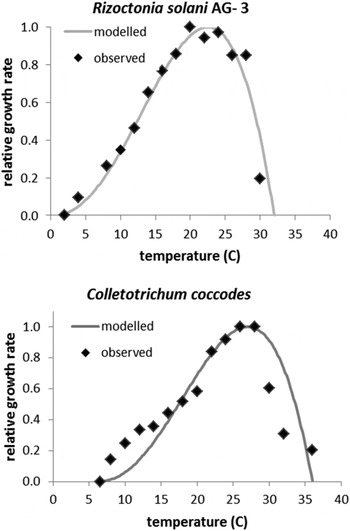
Pure colonies of R. solani AG-3 (Rh105, Genbank Accession N. HM625913) and C. coccodes (Ccocc4, Genbank n. EF017205), isolated from potato grown in the intensive-potato-growing area of Bologna province, were subjected to temperature growth response to evaluate their minimum (T min), maximum (T max) and optimal (T opt) temperature requirements. Three Petri plates (diameter 90 mm) containing 10 ml of Potato Sucrose Agar (PSA) made according to Smith & Onions (Reference Smith and Onions1983) using agar technical Oxoid n. 3 (Oxoid Ltd, UK) were inoculated with agar disks of a 5–6 day old R. solani or C. coccodes strain. Plates were incubated at 15 different temperatures ranging from 1 to 40 °C, defined according to the temperature response of two pathogens (Fig. 1), in a Binder KBW 400 (Binder Tuttlingen, Germany) growth chamber (from 8 to 45 °C) and in a ventilated cooled (from 1 to 9 °C) chamber. For each testing temperature, the minor and major radii of each colony were measured at the beginning and the end of each working day for temperatures close to the expected optimum, and daily for other temperatures, until all colonies reached the edge of the Petri plate, or the 7th day of incubation was reached. Response was expressed as growth rate (mm/day), resulting from the average of the daily increase of the radii. Two growing cycles were carried out in controlled chamber experiments.
Observed and modelled normalized growth rates for R. solani anastomosis group (AG)-3 and C. coccodes strains isolated from potato plants in the east Po valley, Italy.

Growth rates were normalized by dividing the observed response to a given temperature by the maximum growth rate measured for each pathogen. This normalization permitted comparison of the responses of two different pathogens to temperature. Growth rates were hence expressed as 0–1 values, with 1 corresponding to the response to optimal temperature for growth. The function proposed by Yan & Hunt (Reference Yan and Hunt1999) was used to fit soil-borne pathogen growth response to temperature. The resulting curve is based on the three cardinal temperatures: T min (°C), minimum temperature for growth (below this temperature there is no observable growth), T opt (°C), optimum temperature for growth and T max (°C), maximum temperature, above which the fungus stops growing. The function is:
 $$\eqalign{f\,(t) =& \left( {\displaystyle{{T_{\max} - T} \over {T_{\max} - T_{{\rm opt}}}}} \right)\cr & \times \left( {\displaystyle{{T - T_{\min}} \over {T_{{\rm opt}} - T_{\min}}}} \right)^{(T_{{\rm opt}} - T_{\min} )/(T_{\max} - T_{{\rm opt}} )}}$$
where T(°C) is the testing temperature. The parameters corresponding to the cardinal temperatures of the R. solani and C. coccodes were optimized using the Microsoft Excel Solver add-in, using as objective function the minimization of the sum of squares of differences estimated-observed growth rates.
Rhizoctonia solani and Colletotrichum coccodes infection of potato roots under differing climatic conditions
Inoculum of R. solani AG-3 and C. coccodes was obtained starting from 7-day-old colonies grown in 9 cm diameter petri dishes on PSA. Each of the 500 ml autoclavable plastic jars contained 270g sand, 30 g maize meal, 60 ml water and was autoclaved twice at 121 °C for 20 min before inoculation with half of the 9 cm diameter fungal colony and incubation at 24 ± 2 °C for 3 weeks prior to soil inoculation.
The experiment was carried out to evaluate R. solani and C. coccodes response to four different weather conditions in the potato crop from planting time, which in the Po valley occurs in mid-March, up to tuber initiation, commonly occurring in early May. Non-sterilized topsoil was used for the current experiment to reproduce a soil system similar to field conditions, including soil microbial communities. Soil samples came from a field located inside the potato-growing area in Bologna province (44°30′N, 11°24′E, 25 m asl), with a clay-loam soil texture, pH 6·4 and soil organic matter (1·4%) content very similar to those of nearby specialized potato farms. Based on a previous survey (Manici & Caputo Reference Manici and Caputo2009), a sampling field that had not been cultivated with potato for the previous 30 years and had been subjected to a cereal–sugar beet rotation over the last 30 years was selected. In this way, R. solani AG-3 and C. coccodes were inoculated into native soil that was free of potato-specific soil-borne pathogens, but had physico-chemical and biological features typical for the East Po valley.
Soil samples taken from the top 25 cm layer of the sampling field were dried at room temperature for 48 h and coarsely sieved (through a 0·5 cm sieve), then 12 kg of soil was co-inoculated with both R. solani AG-3 and C. coccodes using 24/1 (v/v) and 40/1 (v/v) sieved soil/sand-meal inoculum, respectively. Dose proportion was decided on the basis of different propagation methods of R. solani AG-3 (sterile mycelium) and C. coccodes (spores) in soil, in order to obtain the most similar degree possible of soil infestation. This co-inoculation was aimed at reproducing the soil-borne pathogen inoculum which in a previous survey had been found to be widespread in specialized potato farms in the east Po valley (Manici & Caputo Reference Manici and Caputo2009). Potatoes of cvar Hermes were washed, slightly disinfected with 0·5% of sodium hypochlorite solution for 30 s and carefully rinsed with sterile water, then single sprouts were excised and planted in 36 pots (20 × 20 cm2) on native soil co-inoculated with R. solani and C. coccodes. A two-factorial experiment design was hence performed dividing pots into two phytotrons (SANYO, SGC.097CFX) at two thermal regimes:
-
– cold spring with 18 pots (C)
-
– warm spring with 18 pots (W).
Thermal regimes were established on the basis of the coldest temperatures recorded in 20 years in the potato-growing area of Bologna province from 1988 to 2008, whereas the warmest were inferred from the 2030 projection derived from the bias-corrected ENSEMBLES dataset (Dosio & Paruolo Reference Dosio and Paruolo2011) at a spatial resolution of 25 × 25 km2, by down-scaling the realizations of the IPCC A1B emission scenario (IPCC Reference Solomon, Qin, Manning, Chen, Marquis, Averyt, Tignor and Miller2007) as described in Manici et al. (Reference Manici, Bregaglio, Fumagalli and Donatelli2014). The night/day temperatures inferred from these projections were defined to maximize differences with those of the cold regime. Each thermal regime (C and W) was split into two different soil moisture contents:
-
– field capacity (FC), nine pots (three replicates of three pots each) in cold (C-FC) and nine pots in warm regime (W-FC);
-
– half field capacity (HFC), nine pots in cold (C-HFC) and nine pots in warm regime (W-HFC).
Pots were arranged according to a completely randomized design within each phytotron and grown for 63 days. The two soil water contents were maintained over the whole trial period.
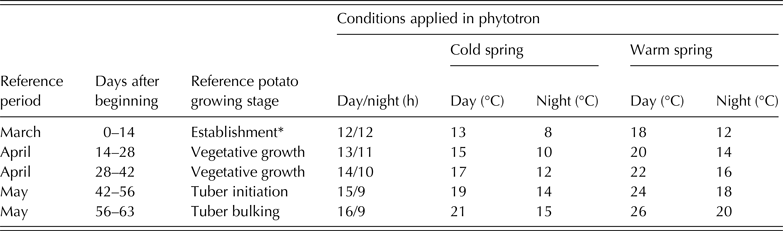
The plant growth assay under cold (C-FC and C-HFC, Table 1) and warm spring conditions (W-FC and W-HFC, Table 1) began from sowing time in the 3rd week of March under 12/12 day/night hours with 13/8 °C and 12/18 °C day/night temperature, respectively (Table 1). Using 58–60 µmol/m2/s constant light intensity, photoperiod and temperatures were changed five times in 63 days (Table 1) to reproduce early growth stages of potato in the east Po valley from sowing time up to tuber initiation–tuber bulking (Gudmestad Reference Gudmestad and Johnson2008). A relative humidity of 60% was maintained in both phytotrons. Temperatures of soil in pots during the trial corresponded to that set for the experiment. Soil samples for DNA extraction were taken 20, 30 and 60 days after planting time. At each sampling, 3 g-samples of soil were taken from the same pot in two replicates per treatment by mixing small sub-samples picked randomly with tweezers. Two samples per treatment were thus air dried and stored at –20 °C. This reduced the sampling impact on soil fungi and minimized the quantity of soil sampled for DNA extraction.
Temperature, soil water content and light conditions implemented to simulate cold and warm spring regimes during the first growing stage of potato for the Emilia Romagna specialized potato producing area, located in east Po valley (Italy)
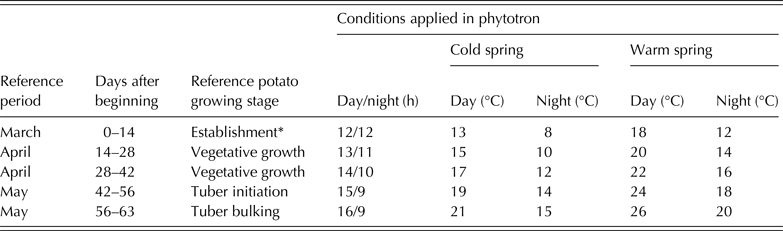
* Sprouting and first leaf development.
Evaluation of total root colonization and species-abundance
At the end of the 63-day trial period, roots of potato plants were managed as ‘living bites’. Roots were washed under running water, disinfected for 1 min in 1% sodium hypochlorite and rinsed twice with sterile water; a total of 864 root explants (corresponding to 24 root explants taken from each plant grown in 36 pots) were placed on water agar in Petri dishes and incubated for 4 days at 24 ± 2 °C under natural light. The total root colonization frequency was recorded by dividing the number of root segments on which fungal hyphae grew by the number of root segments incubated. Data were ln (x + 1) transformed and total fungal colonization frequency was analysed with two-way analysis of variance (ANOVA) for the factors temperature and soil water content.
The relative frequency of each species (or abundance) was evaluated by transferring each colony onto PSA amended with 200 mg/l of streptomycin sulphate, and identified on the basis of macroscopic and microscopic morphological characteristics using the relevant taxonomic keys (Nelson et al. Reference Nelson, Tousson and Marasas1983; CAB 1990; Watanabe Reference Watanabe2002). Rhizoctonia isolates were identified by submitting internal transcribed spacer (ITS) sequence fragments, amplified with ITS1 and ITS4 according to Manici & Bonora (Reference Manici and Bonora2007), to the nucleotide basic local alignment search tool (BLAST) program, choosing the nucleotide collection database on the web at the National Centre for Biotechnology Information (available from: http://www.ncbi.nlm.nih.gov/nuccore verified 19 November 2015). Two-way non parametric multivariate analysis of variance (MANOVA) and principal component analysis (PCA) using the Bray Curtis distance measure and 9999 permutation number were performed on a species/abundance data matrix obtained from five species/groups (R. solani AG-3, C. coccodes, bnRhizoctonia AG-A, bnRhizoctonia AG-G and ‘Other fungi’); using the PAleontological STatistics (PAST) program software for data analysis in paleoecology version 3.0 (Hammer et al. Reference Hammer, Harper and Ryan2001, available from: http://folk.uio.no/ohammer/past/ verified 19 November 2015).
Soil infestation by Rhizoctonia solani anastomosis group-3 and Colletotrichum coccodes over the trial period
Quantitative polymerase chain reaction (qPCR) was performed to monitor the level of soil infestation of C. coccodes and R. solani AG-3 in soil over the trial period.
An Ultra Clean Soil DNA Kit (Mo Bio Laboratories, Solana Beach, CA, USA) was used to extract DNA from a 0·5 g portion of soil. The standard curves to calculate concentration of R. solani AG-3 and C. coccodes in soil were obtained starting with the DNA from pure colonies of each pathogen. Pure colonies of R. solani AG-3 and C. coccodes were grown on potato broth in 5 cm diameter Petri dishes for 5 days; DNA was extracted using the DNeasy Plant Mini Kit (Qiagen AG, Hombrechtikon, Switzerland) from 0·25 mg of mycelia. The standard curves to calculate concentration of R. solani AG-3 in soil samples were obtained with amplification of undiluted fungal DNA at a concentration of 41 ng/ml and diluted according to the following serial dilutions in ultra-pure double distilled water (ddH2O): 1 : 10, 1 : 100; 1 : 1000. In order to calculate concentration of C. coccodes in soil, standard curves were obtained with serial dilutions in ultra-pure ddH2O: 1 : 10, 1 : 100; 1 : 1000, 1 :·10 000 of amplification of fungal DNA at a concentration of 122 ng/ml. Aliquots of DNA (1 µl) extracted from pure cultures of R. solani AG-3 and C. coccodes were amplified with specific primers ST-RS1/ITS4 and Cc1NF1/Cc2NR1, respectively (Cullen et al. Reference Cullen, Lees, Toth and Duncan2002; Lievens et al. Reference Lievens, Brouwer, Vanachter, Cammue and Thomma2006), using a Rotor-GeneTM SYBR® Green PCR Kit (Qiagen, Hilden, Germany) for fast qPCR. Linear correlation between log-transformed concentrations of DNA and threshold cycle (Ct) had a correlation coefficient of R 2 = 0·927 and R 2 = 0·966 for R. solani and C. coccodes, respectively.
The relative quantification of the two inoculated pathogens in soil was performed using 1 µl aliquot of soil DNA in two replicates which were amplified with the specific primers mentioned above using Rotor-GeneTM SYBR® Green PCR Kit for fast qPCR. The infestation level of R. solani AG-3 and C. coccodes in soil samples was calculated based on the regression equations of the standard curves obtained with DNA from pure colonies.
RESULTS
Temperature limits of Rhizoctonia solani anastomosis group-3 and Colletotrichum coccodes
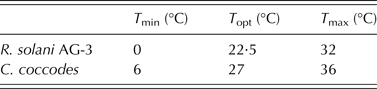
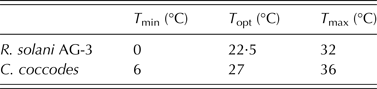
Relative growth rates v. temperature response of R. solani AG-3 and C. coccodes and the calibrated functions (Fig. 1), together with the estimated parameter values (Table 2) suggest that both pathogens can grow in a wide range of temperatures. Nevertheless, minimum (T min) and maximum (T max) limit temperatures of R. solani AG-3, as well as the optimum (T opt), were 5–6 °C lower than for C. coccodes (Fig. 1, Table 2); in particular, R. solani AG-3 stopped growing at a temperature close to 0 °C, showing much higher adaptability to cold conditions when compared with C. coccodes (Fig. 1, Table 2).
Parameters calibrated for R. solani and C. coccodes isolated from potato in east Po valley
AG, anastomosis group; T min, minimum temperature for development, T opt, optimum temperature for development, T max, maximum temperature for development.
Impact of cold and warm weather regimes on root infection
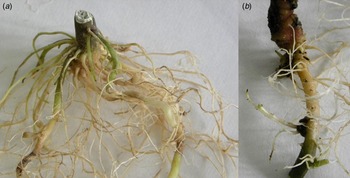
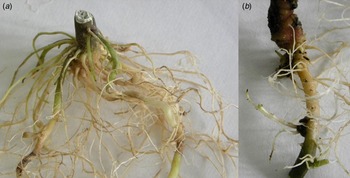
Potato plants grown in warm conditions showed earlier emergence and faster vegetative growth than in the cold regime; this advantage accounted for 8 days’ plant development and was maintained until the end of the growth assay, independent of water regime. Therefore, given that the two temperature regimes applied affected plant growth rate, evaluation was limited to fungal infection in potato roots, by dealing with potato plants as bait for soil-inhabiting and artificially inoculated fungal pathogens (Fig. 2(a)). As with the first series of roots, which were completely lost at the end of the plant growth assay, all potato plants showed severe necrosis at collar level irrespective of treatment (Fig. 2(b)).
Damage caused by R. solani anastomosis group (AG)-3 and C. coccodes on the potato root system: (a) root discoloration and necrosis in plants grown under warm spring weather; (b) severe necrosis at collar level in correspondence to the youngest series of roots produced which were completely destroyed irrespectively of temperature regime. (colour online)
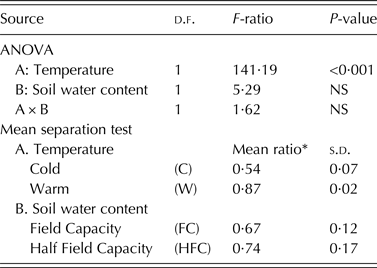
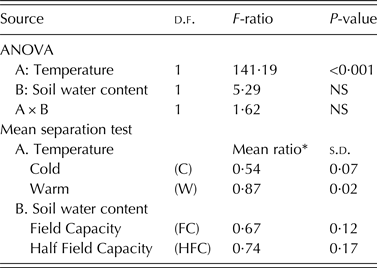
Total root infection frequency was affected significantly (P < 0·001) by temperature but poorly by soil water content, while no effect of interaction between temperature and water content was observed (Table 3).
Two-way ANOVA on root infection frequency for two temperature regimes (C and W) and two soil moistures (FC and HFC)
ANOVA, analysis of variance; NS, not significant; s.d., standard deviation.
Analysis made on ln (x + 1) transformed data.
* Ratio between number of root segments on which fungal hyphae grew and the number of root segments incubated.
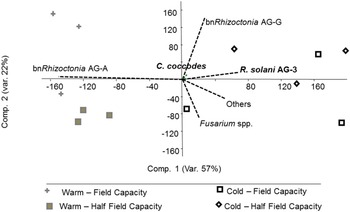
According to one-way MANOVA, temperature regimes impacted significantly on the composition of root-inhabiting fungi in potato (P < 0·001) while soil water content did not. Both target pathogens were re-isolated from roots; C. coccodes was always the most abundant colonizing fungus, by reaching a proportion of 0·77 and 0·71 infected explants in cold and warm regimes, respectively; while R. solani AG-3 was not isolated in plants grown under warm regimes (WF and WFC) (Table 4). These findings were summarized well by PCA (Fig. 3), which displayed composition of root-colonizing fungal communities of samples grown under cold and warm temperatures in two opposite X quadrants of a biplot graph, suggesting root infection differing by species/abundance. The weight of different root-colonizing fungi on this distribution in PCA is represented by vector length and orientation (Fig. 2). The R. solani AG-3 vector was orientated towards cold samples (C-FC and C-HFC) in quadrants −X, suggesting that Rhizoctonia AG-3 is favoured by the colder condition. Conversely, C. coccodes, represented by a short vector in the +X quadrants, shows that this pathogen was present everywhere and, although the highest limiting temperatures were observed for this pathogen in the test for growth response to temperature, the cold temperatures implemented in this bioassay were not a limiting factor for this pathogen.
Principal component analysis showing the impact of two differing spring temperature regimes on relative potato root colonization by R. solani and C. coccodes (artificially inoculated) along with other root colonizing fungi naturally inhabiting to soil. Vectors are projections of the original variables onto the two-dimensional scattergram and show to what degree they enter into the different components.

Root infection frequency on potato roots by the main fungal species/groups in cold and warm temperature regimes

* Artificially inoculated fungi.
† Root colonizing fungi naturally present in soil samples.
‡ Ratio between number of root segments on which fungal hyphae grew and the number of root segments incubated.
With regard to fungi that were naturally present in native soil as saprophyte and were able to colonize roots which had not been inoculated, only binucleate Rhizoctonia (bnRhizoctonia) AG-A was affected by temperature, being favoured by the warmest conditions. This is indicated by the length of the vector oriented toward the +X quadrant, which displays W-FC and W-HFC treatments (Fig. 3). Fusarium spp. (Fusarium oxysporum and Fusarium solani) and a group of saprophytic non-pathogenic fungi defined as ‘Others’ (Alternaria sp., Phoma sp., Moniliella sp) showed similar relative infection (0·10) in both temperature regimes, as well as bnRhizoctonia AG-G which rarely occurred in both regimes (Table 4).
Soil infestation by Rhizoctonia solani anastomosis group-3 and Colletotrichum coccodes over the trial period
Rhizoctonia solani AG-3 and C. coccodes were detected in all soil samples over the whole trial period. Given the well-known difficulties in extracting and estimating R. solani in soil (Lees et al. Reference Lees, Cullen, Sullivan and Nicolson2002) and the overall magnitude variability of PCR efficiency found when determining C. coccodes in soil using qPCR (Dauch et al. Reference Dauch, Watson, Seguin and Jabaji-Hare2006), this evaluation was aimed solely at monitoring artificial soil infestation during the bioassay and detecting the more pronounced quantitative changes in response to simulation of different climate regimes.
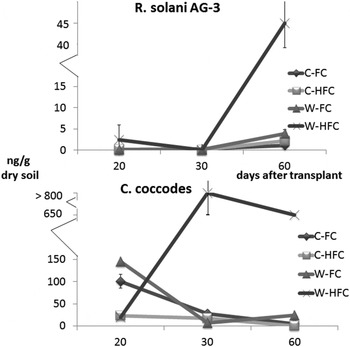
Rhizoctonia solani showed only a slight variation of concentration in soil from 20 (average 0·69 ng/g dry soil), up to 30 days after the beginning of the trial in all treatments; whereas after 60 days, each treatment showed a slight increasing trend of concentration in soil except in W-HFC, where R. solani increased >20 times compared with other treatments (Fig. 4).
Relative quantification of R. solani anastomosis group (AG)-3 and C. coccodes inoculum in soil recorded with quantitative polymerase chain reaction (qPCR) from 20 days after the beginning of the trial up to the end.

Colletotrichum coccodes, with an average concentration of 72 ng/g soil 20 days after the beginning of the trial, showed a declining trend in all treatments up to 60 days with a final average concentration of 9·4 ng/g dry soil, except in W-HFC that showed an increasing trend from the first sampling time with a final concentration that was much larger (Fig. 4) than other treatments (>600 ng/g dry soil).
DISCUSSION
The current findings indicate that growth of R. solani AG-3 and C. coccodes responds to a wide range of temperatures and that temperature should not limit their infection on potato in the eastern Po valley. However, the highest temperature limits of C. coccodes growth as compared with those of R. solani AG-3 may favour one pathogen more than the other in infecting the potato crop in view of average future global temperature increase, as shown in “Intergovernmental Panel on Climate Change” synthesis reports (IPCC Reference Solomon, Qin, Manning, Chen, Marquis, Averyt, Tignor and Miller2007 and Reference Pachauri and Meyer2014)
In vitro growth rate is a simple but effective method to explore soil-borne pathogen response to temperature and impact of their attack on crops, especially when comparing pathogens which can infect the same host crop in the same growing period such as that observed for Fusarium nivale and F. culmorum on winter wheat (Pettitt et al. Reference Pettitt, Parry and Polley1996). Finally, the temperature growth limits determined for R. solani and C. coccodes isolates in the current study can be used in biophysical models to obtain a projection of response of fungal pathogens to climate change, such as the BIOphysical Model Applications (BIOMA) platform (Donatelli et al. Reference Donatelli, Cerrani, Fanchini, Fumagalli, Rizzoli, Seppelt, Voinov, Lange and Bankamp2012) which is linked to soil temperature models and suitable for predicting soil-borne pathogen distribution and spread across specific crops under climate change scenarios (Manici et al. Reference Manici, Bregaglio, Fumagalli and Donatelli2014), with particular focus on temperate subcontinental regions of southern Europe and similar environments.
The highest root colonization by C. coccodes in all treatments is consistent with observations by Lees & Hilton (Reference Lees and Hilton2003) that once soil is infested with seed tubers, it can then act as an effective source of inoculum, suggesting a significant role of soil-borne infection on the spread of disease (Dashwood et al. Reference Dashwood, Fox and Perry1992). The high ability of C. coccodes to colonize potato tissues and soil is considered to have been the main cause of the rapid increase of black dot on potato in the 1990s and early 2000s. The spread was also favoured by intensive tillage and the introduction of susceptible varieties, as well as by increased consumer demand for potatoes with a particular appearance, which has caused a general increase of skin blemish diseases in potato (Lees & Hilton Reference Lees and Hilton2003). Indeed, although artificial inoculum of C. coccodes applied in the current study was lower than that of R. solani AG-3, this pathogen prevailed in all treatments, even though the highest potato root infection by C. coccodes was recovered under the warm conditions. On the contrary, differential impact of cold and warm spring weather regimes on root infection by R. solani AG-3 suggested that lower temperature favoured its infection on potato. The fact that R. solani AG-3 causes higher damage on potato sprouts and roots at the coldest temperatures (from 10 to 15·5 °C) than at optimal conditions for growth of the fungus has already been found in the survey of Carling & Leiner (Reference Carling and Leiner1990) on the impact of temperature on virulence of R. solani AGs. However, the findings of that survey indicated that R. solani AG-3 prevailed as a pathogen in cold soils such as potato growing areas of Alaska, or eastern Canada (Carling & Leiner Reference Carling and Leiner1990), while other AGs can cause damage in warmer areas. Conversely, in the east Po valley, which can be classified as a warm area compared with the coldest potato growing areas of the US and Canada, AG-3 is the most frequent R. solani AG causing damage on potato stem and roots in Italy (Manici & Caputo Reference Manici and Caputo2009). The prevalence of the AG-3 group among R. solani isolated from potato was also confirmed by the recent update on AG distribution in potato worldwide, including some warmer potato growing areas such as Turkey and Columbia (Lehtonen et al. Reference Lehtonen, Ahvenniemi, Wilson, German-Kinnari and Valkonen2008; Tsror Reference Tsror2010; Ferrucho et al. Reference Ferrucho, Cifuentes, Ceresini and García-Domínguez2012; Özer & Bayraktar Reference Özer and Bayraktar2015). Finally, this might suggest a certain adaptation of R. solani to warmer temperatures. The optimal in vitro growth temperatures of C. coccodes and R. solani AG-3 (27 and 22 °C, respectively) along with the increasing trend of soil infestation observed in the warm and driest regime (W-HFC), suggest that both pathogens seem to find best conditions to increase in soil at the warmer spring temperature and driest conditions implemented in this simulation, and that soil water content near to field capacity produces an unfavourable environment for soil-borne pathogen increase in soil. This is consistent with the findings on variation of soil fungi in response to soil water content in soil; indeed, soil with moisture content near to saturation shows lower ratios of fungal to bacterial biomass as compared with drier conditions in which fungal biomass prevails (Drenovsky et al. Reference Drenovsky, Vo, Graham and Scow2004). This is due to the metabolism of fungi which are obligate aerobes; therefore, they show growth linearly correlated to soil moisture under dry conditions, but high soil moisture contents, when less oxygen is present, provide unfavourable conditions for growth (Guggembers & Haider Reference Guggembers, Haider, Huang, Bollag and Senesi2002; Drenovsky et al. Reference Drenovsky, Vo, Graham and Scow2004). This response of total fungi to soil moisture includes fungal pathogens and should be considered when using bio-physical models to simulate soil-borne pathogen responses in heavy soils under a changing climate in the east Po valley, as well as in similar agro-environments in which the frequency of heavy precipitation is expected to increase according to observed trends in the late 20th century (IPPC Reference Solomon, Qin, Manning, Chen, Marquis, Averyt, Tignor and Miller2007) and where extreme events such as heavy precipitation and long dry spells are expected to increase (Brunetti et al. Reference Brunetti, Buffoni, Mangianti, Maugeri and Nanni2004).
Therefore, occurrence of R. solani AG-3 infection in cold regimes only, and its relatively low temperature requirement, combined with the observation that the water content limit for growth of both soil-borne pathogens is below half field capacity, suggest that the attacks of Rhizoctonia periodically observed in the east Po valley may be due to a combination of cold temperatures with physiological crop state suitable to increasing the competitiveness of R. solani v. C. coccodes in colonizing potato.
BnRhizoctonia spp. are reported as minor potato plant pathogens (Yanar et al. Reference Yanar, Yilmaz, Cesmell and Coskun2005; Yang et al. Reference Yang, Zhao, Gou and Wu2014), as well as being antagonists towards pathogenic R. solani (Sneh Reference Sneh, Sneh, Jabaji-Hare, Neate and Dijst1996, Reference Sneh1998; Poromarto et al. Reference Poromarto, Nelson and Freeman1998). AGs -A and -G have been widely recovered on several crops including potato in Italy and worldwide, showing a host–plant relationship varying from mycorrhizal-like to weak-pathogenic (González García et al. Reference González García, Portal Onco and Rubio Susan2006; Manici & Bonora Reference Manici and Bonora2007; Manici et al. Reference Manici, Kelderer, Caputo and Mazzola2015). As AG-A has already been observed to have a higher preference for warmer regimes than AG-G (Manici & Bonora Reference Manici and Bonora2007), findings suggest that bnRhizoctonia AG-A is a potential antagonist to C. coccodes in colonizing roots in view of increasing global temperatures.
CONCLUSION
A recent report on pest and disease pressure on food crops in response to climate change indicates that, without adaptation measures, global potato yield is predicted to decrease by 18–32% (Luck et al. Reference Luck, Spackman, Freeman, Trębicki, Griffiths, Finlay and Chakraborty2011). The findings of the current study suggest that C. coccodes is one of the major threats to the potato crop in view of a predicted increase of spring temperature in the east Po valley. However, R. solani AG-3 is still an important soil pathogen of potato, and it seems likely that both Rhizoctonia and Colletotrichum will increase greatly in soil under the drier and warmer spring weather regimes expected in northern Italy in the medium period (IPCC Reference Pachauri and Meyer2014). Therefore, as crop rotation and other agronomic measures designed to reduce soil-borne inoculum of C. coccodes may be of limited value (Lees & Hilton Reference Lees and Hilton2003), as well as the use of inoculum-free seed tubers (Nitzan et al. Reference Nitzan, Lucas and Christ2006), climate change adaptation strategies should include further efforts to search for new options. These should vary from plant breeding to increasing availability of potato cultivars that are resistant to Colletotrichum as well as genotypes of rotation crops specifically selected to prevent the increase of pathogen inoculum (Nitzan et al. Reference Nitzan, Lucas and Christ2006; Brierley et al. Reference Brierley, Hilton, Wale, Peters, Gladders, Bradshaw, Ritchie, MacKenzie and Lees2015), to innovative cropping practices aimed at increasing soil-inhabiting antagonists such as bnRhizoctonia sp. Finally, adaptation strategies should not underestimate R. solani AG-3 in the relatively warm potato growing areas of the world, such as Emilia Romagna, as this pathogen can find favourable conditions for growth and therefore periodically become the prevalent agent of the root rot fungal complex causing yield decline.
The study was funded by the project AgroScenari of the Italian Ministry of Agriculture, Food and Forestry Policies.