Citizens living in a democracy can reject, through elections, a ruler who fails to satisfy them, and there have been numerous instances around the world in which governing parties lost power and were replaced by opposition parties that increased support. The principle that governments may alternate according to voters’ preferences is the foundation of democracy and is also a mechanism that supposedly brings about responsiveness and accountability to governments. If the people are not able to vote out a ruler who angers them, the system is not truly democratic and the ruler will not be motivated to be responsive to the citizens’ wishes. Hence, the extent to which voters’ dissatisfaction translates to the incumbent party’s electoral decline is one of the core components of the quality of a democratic polity.
When do incumbents lose power? The government’s performance, especially the condition of the economy, and unpredictable events such as political scandals and international crises will certainly be important factors that determine the fate of the government. In this study, however, I focus on an element that has largely been neglected in the literature: the characteristics of the opposition party system.
In countries where two major parties alternate in power, it is taken for granted that when the ruling party becomes unpopular, the other major party will be ready to take office. Some countries with British influence even use the term ‘the Official Opposition’ to refer to the largest opposition party, implying that it is expected that a viable alternative to the incumbent always exists and that such a party is an integral part of the political system. In other countries, however, there are often many opposition parties, each of which has a distinctive and specific policy position. In those countries, none of the opposition parties may be seen as a credible alternative that can replace the incumbent and govern the country effectively. I argue that such differences in the characteristics of the opposition will strongly influence the choices of the voters and thus the fate of the incumbent party (or parties). Focusing on opposition parties in analysing ruling parties’ electoral performance may be counterintuitive, yet this article will show that this neglected side of the story is indeed quite important in the workings of democratic systems.
When do incumbents lose?
There is a rich literature on the determinants of parliamentary election results, and numerous empirical studies have been published on the electoral fortunes of incumbent ruling parties. It is known that incumbent parties, on average, lose votes in elections,Footnote 1 and this ‘cost of ruling’ phenomenon has been explained by various factors. For example, Mueller suggests that as an incumbent stays in office and makes policy decisions, some groups of the society are inevitably disappointed or angered since no policy is welcomed by all members of a country.Footnote 2 Paldam has explained that ruling parties’ vote shares often decline, because a party usually wins power when its vote share is higher than its normal support level, and thus its vote share is likely to decline in the next election by simply returning to its original level.Footnote 3
Of course, incumbency status is not the sole determinant of election results. In particular, the country’s economic situation is considered an important factor affecting the election results, and the relationship between economic performance and the electoral fortunes of the governing party (or parties) has received much attention from scholars, with Kramer’s 1971 article being one of the earliest studies on this topic.Footnote 4 Although a majority of such studies examined the elections in advanced countries,Footnote 5 effort has also been made to extend the focus to other parts of the world.Footnote 6 Some use country-level aggregate data in which the dependent variable is the change in vote share of the incumbent party (or parties), and others use individual-level survey data in which the dependent variable is each voter’s choice (for the incumbent or not). The results of these analyses vary, as Powell and Whitten note, ‘Despite the large literature analyzing economic effects over time within countries, it has proved surprisingly difficult to demonstrate consistent effects in cross-national studies.’Footnote 7
Scholars have sought to explain the inconsistent results in cross-national research by taking political contexts into account. Lewis-Beck has argued that coalition governments tend to suffer less from anti-incumbent economic voting because the government’s responsibility is diffused.Footnote 8 Generalizing this argument, Powell and Whitten have introduced the concept of clarity of responsibility and demonstrated that economic performance significantly influences a government’s electoral fortune where the clarity of responsibility is high.Footnote 9 They have created an index of clarity by combining five indicators: voting cohesion in government, the nature of the committee system, the strength of the bicameral opposition, minority government status and coalition government status.
Powell and Whitten’s article and the concept of clarity of responsibility they introduced are now widely recognized, and there have been many studies that have sought to refine, modify or refute this thesis using both aggregate dataFootnote 10 and survey data.Footnote 11 This line of inquiry is still in progress as the conclusions of those studies vary, which is especially true for aggregate-level studies according to Duch and Stevenson who state, ‘it is hard to avoid the conclusion that the aggregate evidence for clarity of responsibility, like the aggregate evidence for cross-national economic voting in general, is fragile.’Footnote 12
While numerous empirical analyses have been conducted, the characteristics of opposition have been either completely overlooked, or mentioned but not elaborated upon in the literature. In the next section, I will discuss the importance and measurement of the concept of opposition fragmentation.
Opposition fragmentation: why it matters and how it is measured
The responsibility hypothesis that originates from Powell and Whitten states that voters who are not satisfied with the government are more likely to vote against the governing party (or parties) if responsibility for policy outcomes is clear.Footnote 13 This argument implicitly assumes that discontented voters will vote for opposition parties to punish the government. However, whether those voters choose to vote for the opposition should depend not only on how much they blame the government, but also on the attractiveness of the opposition parties. For an anti-incumbent swing to take place, a significant number of voters need to switch their votes from the incumbent to the opposition; and both a pushing force (an unpopular incumbent) and a pulling force (an attractive opposition) should be necessary to cause a large-scale swing. A government that disappoints people will surely lose votes to some degree, but the magnitude of the incumbent’s vote loss should also be partially determined by how the opposition appeals to the voters.
Specifically, I argue that whether there is a unified opposition or there are many opposition parties in a political system is an important trait that affects the attractiveness of the opposition. If the opposition camp is fragmented into multiple parties that compete with one another, the discontented voters who look for an alternative to the incumbent government may not see any of them as a realistic and credible alternative. However, the presence of a unified opposition will make a vote transfer more straightforward. Anyone looking for an alternative to the incumbent must reach the same conclusion, and thus the single opposition serves as the point of convergence of anti-incumbent voting. Hence, the degree of opposition fragmentation should make a considerable difference in the pattern of electoral competition, and this factor would be a part of the ‘political context’ that determines the intensity of economic voting.
This argument runs parallel to Duch and Stevenson’s recent study demonstrating that the opposition parties voters think are likely to enter government tend to enjoy positive economic voting more than other opposition parties.Footnote 14 They also show that larger opposition parties get more benefit than smaller ones from positive economic voting. This means that when voters punish incumbents for poor performance, they think about alternatives and consider which opposition parties seem credible and thus deserve anti-incumbent votes. Even though Duch and Stevenson analyse individual parties and do not consider the opposition party system, their finding implies that a unified opposition will look more attractive than multiple oppositions to voters who want an alternative to the poor performer in office.
The attractiveness of the opposition is also influenced by policy positions of opposition parties, and opposition fragmentation is related to this issue as well. Where multiple opposition parties exist, they often have different and specific policy agendas (for example, an agrarian party, a communist party and an ecological party). This is consistent with Sartori’s argument that the number of parties and the ideological distances between parties are correlated; and Ware presents empirical evidence for this thesis.Footnote 15 Hence, in political systems where the opposition is fragmented, it is likely that each of the opposition parties has a distinctive policy position and appeals to a specific group of voters.
In such systems where parties have distinctive policy agendas, those parties normally have stable support bases, but they would not attract moderate swing voters, making it more difficult for a large-scale vote transfer to take place. A communist party may have a certain number of faithful supporters, but it would lack appeal to voters outside its support base. Also, pre-electoral coalitions among opposition parties are counted as single parties in my data since they present unified platforms to the voters. Thus, opposition parties analysed in this study are single entities with their own agendas, not co-operating with others to compete against the incumbents. A high level of opposition fragmentation, therefore, indicates the lack of co-ordination among opposition parties and their inability to present a coherent and visible alternative to the government’s agenda at the ballot box. In contrast, a unified opposition party typically has a more general stance aiming at a wide range of citizens and hence will attract more voters than fragmented ones could.
To be sure, the presence of multiple opposition parties may also mean that more party options are available for voters and that voters are likely to find a party that advertises a platform that resembles their preferences. It may thus seem that a fragmented opposition can facilitate anti-incumbent voting behaviour. However, for an anti-incumbent swing to take place, voters who voted for the current incumbent in the previous election must switch their support to opposition parties, which would be less likely if each of those opposition parties has a specific policy agenda and stable supporters. The presence of multiple parties that offer diverse choices of policy platforms may create faithful support bases for the parties, but it would not encourage the emergence of a large number of swing voters. Indeed, in their analysis of Latin American legislative elections, Roberts and Wibbels find that electoral volatility tends to be low in polarized party systems.Footnote 16 They conjecture that ‘ideological polarization, rather than destabilizing the electorate, serves to anchor parties within relatively stable and differentiated electoral constituencies.’Footnote 17
The degree of opposition fragmentation indeed varies greatly across political systems. Some of the former British colonies have just one main opposition party, whereas in countries such as Belgium and Norway it is not unusual to have four or five opposition parties of non-negligible sizes, with no one particularly larger than the others. To measure this trait accurately, I have created a variable called the effective number of opposition parties (ENOP) by applying Laakso and Taagepera’s method of calculating the effective number of parties to the number of seats of all non-government parties.Footnote 18 This variable indicates the number and relative sizes of opposition parties. The larger this value is, the more parties of similar size exist. Conversely, if there is only one opposition party, this variable takes the value of 1. As noted above, if multiple opposition parties are forming a pre-electoral coalition, I will count them as a single party.Footnote 19
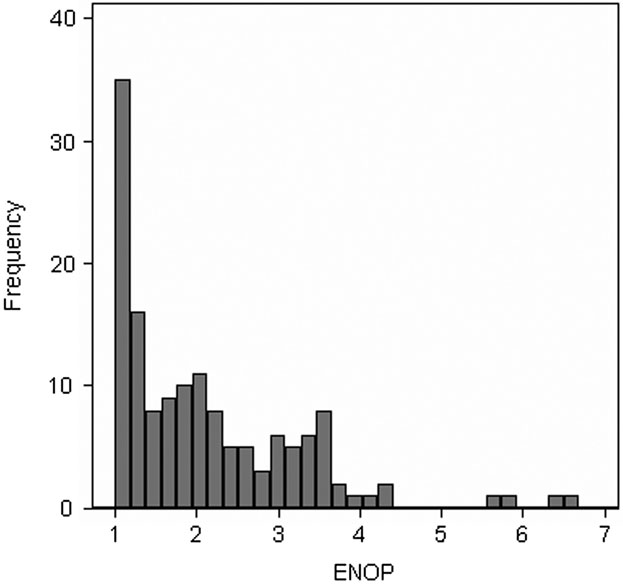
Figure 1 shows the distribution of this variable in my data from 145 elections in seventeen advanced parliamentary democracies. This will be fully described in the next section. The histogram clearly demonstrates that there is a wide variety in the level of opposition fragmentation in the world’s democracies. It varies from 1 to 6.7 with the mean being 2.1 and the standard deviation 1.1.Footnote 20
The distribution of the ENOP variable Note: Calculated from 145 elections in 17 parliamentary democracies, 1965–97.

Let us look at an illustrative example. In Japan, in the summer of 2003, the second largest opposition party, the Liberal Party, decided to join the largest opposition, the Democratic Party, to form a unified opposition party that could compete against the ruling Liberal Democratic Party (LDP) in the upcoming general election. This merger reduced the ENOP value from 2.48 to 1.82. The enlarged 137-seat Democratic Party became, arguably, the only credible opposition party since the remaining opposition parties were small left-wing parties: the Communists (20 seats) and the Social Democrats (18 seats). In the general election in November 2003, the Democratic Party seats greatly increased to 177 while the LDP seats reduced from 247 to 237. The fact that the Communists and the Social Democrats suffered a major defeat and their seats reduced to just 9 and 6, respectively, suggests that the Democrats were seen by voters as ‘the opposition’ and attracted a great number of votes as the focal point for voters who were against the incumbent LDP.
As discussed earlier, in the literature on economic voting, scholars have examined the impact of how clearly policy responsibilities are attributable to governing parties, yet the impact of opposition fragmentation has been overlooked in most of them. The studies by Anderson and Bengtsson are rare exceptions that include this factor – labelled as ‘the clarity of available alternatives’ by Anderson and ‘the availability of obvious alternatives’ by Bengtsson – in their analyses.Footnote 21
However, perhaps because opposition fragmentation is not their central concern, this concept is not well elaborated by Anderson and Bengtsson; in particular, the way in which both authors operationalize opposition fragmentation is problematic. In their empirical analyses, they both quantify the concept of opposition fragmentation by using the effective number of parties (ENP) in the legislature, which means that their variable reflects the degree of party fragmentation in the whole legislature but not the opposition fragmentation, even though their arguments are about ‘available alternatives’ and ‘obvious alternatives’.
The ENP and the ENOP would certainly be related to some extent,Footnote 22 yet these two indices represent two distinct concepts: the former for the number and sizes of all parties and the latter for the number and sizes of opposition parties. Political systems with the same degree of opposition fragmentation can have quite different values of ENP depending on the number of ruling parties. Hence, even if one finds that economic voting does not take place when ENP is high, it is not known whether there are many governing parties, there are many opposition parties, or both, and which factor is causing the absence of economic voting.
More specifically, both Anderson and Bengtsson demonstrate that economic performance influences the government’s electoral performance when ENP is small, but the economic effects are weaker or non-existent when ENP is large. They argue that a large ENP value means ‘available alternatives’ are not clear, which attenuates the economic effects. However, since the ENP variable they use measures the number of parties in the whole legislature, including both governing parties and opposition parties, a large ENP value may simply indicate that there are many ruling parties. Thus, we cannot rule out the possibility that their finding an absence of economic voting in high ENP situations is because there are many parties in government (it has been known that coalition cabinets decrease clarity of responsibility), not because there are many parties in opposition.
It is, therefore, theoretically and empirically problematic to use the ENP variable to quantify the availability of alternatives. Although it is understandable that one wants to use ENP as a proxy of opposition fragmentation, since ENP is a widely used and easily available variable, the ENOP variable should be used whenever the enquiry relates to the impact of opposition party systems. This study is the first to analyse the effects of opposition fragmentation on electoral competition in democracies systematically.
In summary, I expect that the degree of opposition fragmentation is an important part of the political context that modifies the intensity of anti-incumbent economic voting. Specifically, a high ENOP value (fragmented opposition) will suppress the negative impact of poor economic performance on the incumbent’s electoral performance, and a low ENOP value (unified opposition) will amplify it. I agree with the recent literature that the clarity of responsibility is important; hence, the effects of the economy will be strongest when the opposition is united and the clarity of responsibility is high. In the following sections, I will present the empirical analysis that tests my hypothesis.
Research design
The units of analysis are parliamentary elections in the world’s industrialized parliamentary democracies. The observation period is between 1965 and 1997, which was determined by the data availability. The countries included in the analysis are Australia, Austria, Belgium, Canada, Denmark, Finland, France, Germany, Greece, Ireland, Italy, Japan, the Netherlands, New Zealand, Norway, Sweden and the United Kingdom.Footnote 23
The dependent variable is the percentage point change in the governing party’s (or parties’) vote share from the previous election. The details about this variable are described in the Appendix. The main independent variable in this analysis is economic performance, which is represented by the unemployment rate. Unemployment is generally found to have the strongest impact on voting behaviour of all the economic variables; and Powell and Whitten also find this variable the most significant.Footnote 24 My hypothesis is tested by examining the interactive effects of economic performance and opposition fragmentation. As described earlier, opposition fragmentation is measured by the ENOP variable. The multiplicative interaction term between the unemployment rate and ENOP is included in the model to learn how the two variables interactively affect the dependent variable.
The percentage of the vote won by the governing party (or parties) at the previous election is included in the model as a control variable, as is common in the literature. A negative coefficient is to be expected for this variable, because if the governing parties received a large share of votes in the previous election, they have a large ‘base’ of votes to lose in the next election.Footnote 25 This variable also controls for any effects of the overall size of the opposition, since it is the same as 100 minus the total vote share of opposition parties in the previous election. The idea is that not only the fragmentation of the opposition but also the absolute size of the opposition camp may influence voters’ perception of the availability of an alternative to the incumbent.
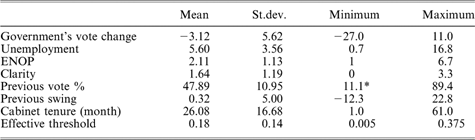
Three more control variables are included in the analysis. The first is the change in the ruling parties’ vote shares from time t−2 to time t−1. This ‘previous swing’ variable is common in the literature, and it controls for the size of the electoral swing that brought the ruling parties into office. The second is the length of time the incumbent cabinet existed when the election was held. According to the ‘cost of ruling’ logic discussed earlier, the longer a government stays in office, the more voters it may alienate. Similarly, a government that has been in office for a short time may not be held responsible for policy outcomes. The third variable is the effective threshold of the electoral system of the country,Footnote 26 and this variable controls for the effects of electoral systems. The exclusion of these three control variables does not change the results of the analysis. Table 1 reports descriptive statistics of the variables included in the analysis.
Descriptive Statistics of the Variables

*11.1 per cent of votes as the government’s previous vote share may seem too small. Yet, this is not a mistake. The cabinet of Sweden before the 1979 election was a one-party minority cabinet by the Liberal People’s party, which received 11.1 per cent of votes in the previous election and obtained thirty-nine of 349 seats in the parliament.
In my first set of analyses, the countries are classified into two groups according to the ‘clarity of responsibility’, as was done by Powell and Whitten.Footnote 27 I borrowed Powell and Whitten’s dichotomous classification of the countries, which is based on their additive scoring of five features of the political systems that clarify or blur the responsibility of economic performance, namely, whether parties are internally cohesive, whether opposition parties share committee chairs, how strong the bicameral opposition is, whether minority governments are frequently formed, and whether coalition cabinets are frequently formed. Australia, Austria, Canada, Greece, France, Ireland, Japan, New Zealand, Sweden and the United Kingdom are the ‘high clarity’ group, while Belgium, Denmark, Finland, Germany, Italy, the Netherlands and Norway are the ‘low clarity’ group. Later in this article, I will present an analysis using a pooled sample.
Since the degree to which the electoral outcomes are predictable should differ across countries, it is likely that each country has its own level of error variance, which violates the Gauss–Markov assumptions. To solve this problem, panel heteroscedasticity corrected standard errors were calculated and reported in the following sections.Footnote 28
In order to check the robustness of the findings, I performed the following three types of additional analyses for each model presented below. First, I repeated the estimation omitting one country at a time from the sample observations. The basic results remained unchanged for all models when any country was excluded. Secondly, I employed the DFBETA method to ascertain that no outlying observations have too much influence on the estimated results.Footnote 29 The values of DFBETAs show the impacts of individual observations on a regression coefficient. Bollen and Jackman consider that DFBETA values larger than 1 or smaller than -1 deserve special attention, and one such case was found in Models 2 and 4, in which the 1969 election in Germany has a large impact on the coefficient on the previous vote percentage variable. Since it is a control variable that is not of substantive interest by itself, we can safely say that the principal results presented below are not strongly influenced by any individual observations. Thirdly, I tried estimating all models with the Prais–Winsten method to correct for potential serial correlation. The substantive results did not change, and the ρ value was close to zero. Hence, the Prais–Winsten correction is not used in the final results presented below.Footnote 30
Results from separate samples
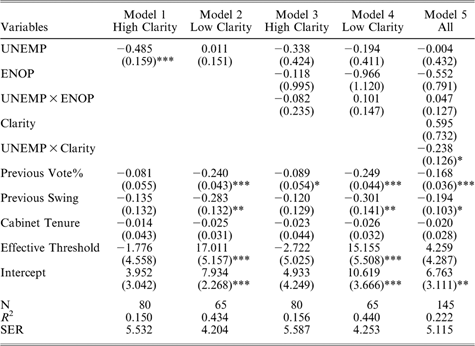
The first four models in Table 2 show the results of the regression analysis from separate samples of ‘High Clarity’ countries and ‘Low Clarity’ countries. Models 1 and 2 do not include the ENOP variable and the interaction term, and thus estimate the uninteracted effects of the unemployment rate on the electoral performance of governments. Consistent with Powell and Whitten’s findings, the unemployment variable (hereafter abbreviated as UNEMP) has a significant and negative impact on the dependent variable in the sample of high clarity countries (Model 1), but not in low clarity countries (Model 2).
Results of Regression Analysis

Note: Standard errors in parentheses.
*Significant at 10%; ** significant at 5%; *** significant at 1%.
In Models 3 and 4, ENOP and the interaction term (UNEMP × ENOP) are included. Since the table shows that UNEMP, ENOP and UNEMP × ENOP are not statistically significant individually, it may at first seem that they do not make any significant impact on the dependent variable. Yet, since an interaction term is included in the model, the individual significance of the variables displayed in the table does not give us a comprehensive picture of how UNEMP and ENOP influence the dependent variable.Footnote 31 The coefficient and significance of UNEMP depend on the value of ENOP, and vice versa; hence, it is possible that UNEMP is significant when ENOP is at a certain level but insignificant when ENOP is at another level, which is indeed the case in Model 3, as follows.
For example, the coefficients on UNEMP and UNEMP × ENOP are −0.339 and −0.082, respectively, in Model 3. In this case, the slope coefficient on UNEMP is:

The standard error for UNEMP in Model 3 is calculated in the following way:Footnote 32

where 0.180 is the variance of the coefficient on UNEMP, 0.055 is the variance of the coefficient on the interaction term, and −0.093 is the covariance between these two coefficients. These two expressions clearly show that the impact of unemployment rates varies with the level of opposition fragmentation, and how it varies can be examined with graphs.
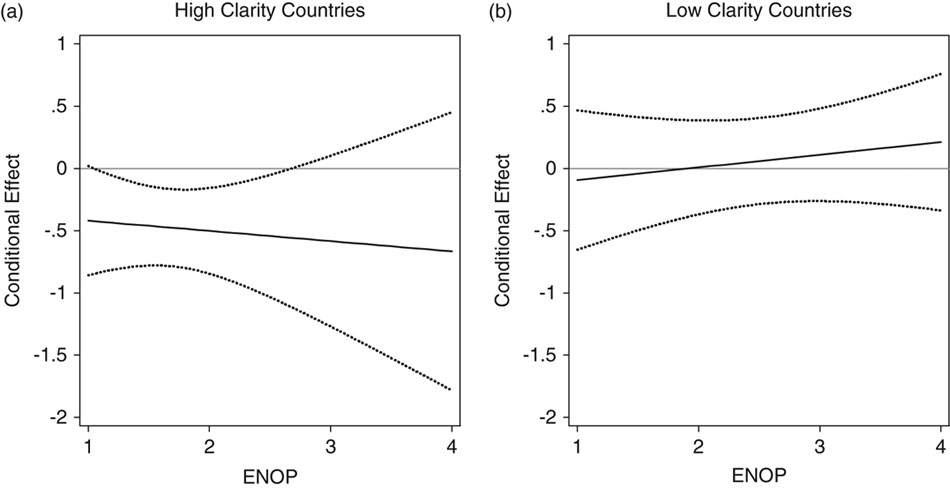
The two graphs in Figure 2 show how the marginal effects and significance of UNEMP change with different levels of ENOP. The left panel is for the high clarity countries (Model 3), and the right panel for low clarity countries (Model 4). The solid lines represent the coefficient on UNEMP, and the dotted curves show the 95 per cent confidence intervals. Hence, where the zero line does not fall within the confidence interval, UNEMP is statistically significant.
Conditional effects of unemployment (separate samples) Note: The solid lines represent the coefficient on the UNEMP variable. The dotted curves show the 95 per cent confidence intervals.

The left panel of Figure 2 shows that the coefficient on UNEMP changes only slightly with the level of opposition fragmentation but that the significance of UNEMP varies greatly. When ENOP is roughly between 1 and 2.5 (relatively unified opposition), unemployment rates have a significant and negative impact on the vote change of incumbent parties. When the opposition is more fragmented, the UNEMP variable loses statistical significance. As for the low clarity countries, the right panel of Figure 2 tells us that UNEMP is insignificant in the entire region. In other words, unemployment rates do not matter when clarity is low, regardless of the value of ENOP. These results strongly support my hypothesis.
Results from the pooled sample
In the above analysis, the sample cases were divided into two groups based on the dichotomous classification of the clarity of responsibility. Yet, since the original ‘clarity’ variable by Powell and Whitten is not a dichotomous but a continuous variable, we can probably analyse the sample observations without dividing them into two groups.
The last column of Table 2 shows the result of the regression analysis of the pooled sample. All 145 cases are included in this model. Two interaction terms – UNEMP × ENOP and UNEMP × Clarity – are included in the model, and thus the coefficient and the standard error of UNEMP depend on two variables: ENOP and Clarity.Footnote 33
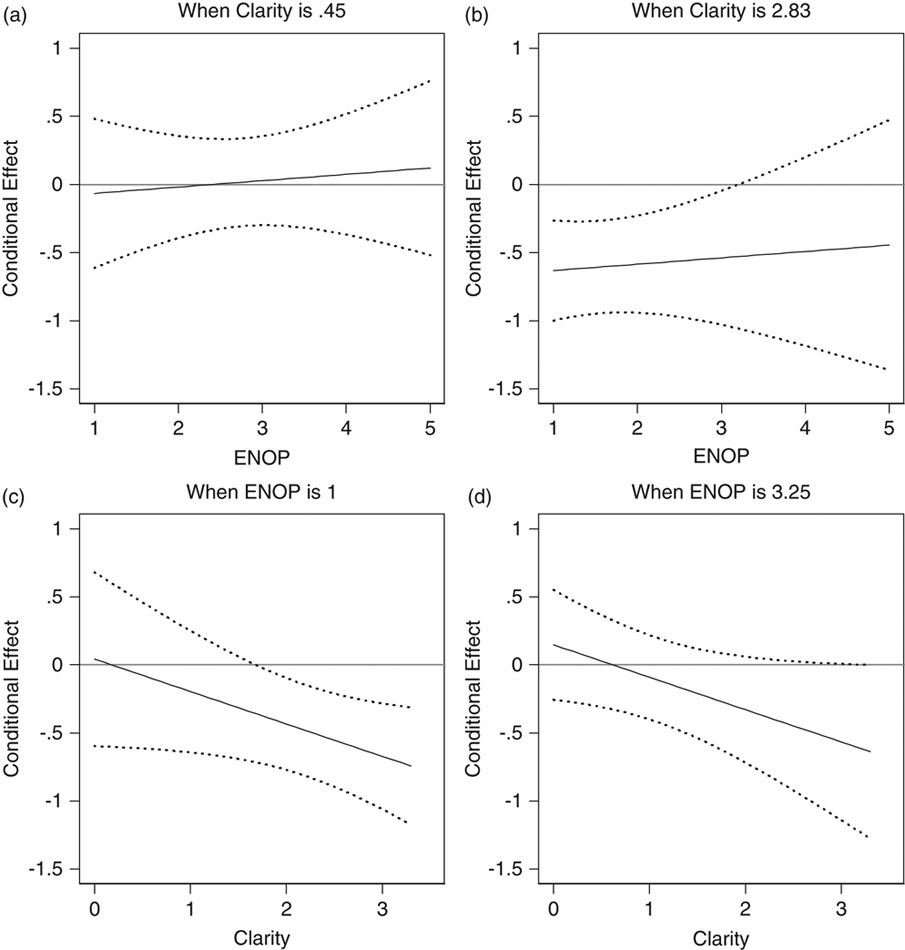
Four graphs in Figure 3 help us evaluate the impact of UNEMP, which varies with two variables. What I did was to hold one variable at one standard deviation higher and lower than its mean and have the x-axis represent the other variable. The y-axis shows the effect of UNEMP as was the case in Figure 2. In Graphs A and B, Clarity is held at low and high values, respectively, while ENOP varies along the x-axis. In Graphs C and D, by contrast, ENOP is kept constant at low and high levels, and the x-axis shows Clarity.Footnote 34
Conditional effects of unemployment (pooled sample) Note: The solid lines represent the coefficient on the UNEMP variable. The dotted curves show the 95 per cent confidence intervals.

Graph A shows how ENOP changes the impact of UNEMP when Clarity is low (more precisely, one standard deviation lower than its mean). UNEMP is insignificant regardless of the level of ENOP, which means that unemployment rates do not affect the government’s electoral fortunes. Conversely, Graph B demonstrates that in high Clarity situations, UNEMP has a significantly negative effect on the government’s vote change if ENOP is lower than about 3.
In Graph C, we can see how the effect of UNEMP changes with Clarity when ENOP is small (unified opposition). The graph indicates that UNEMP negatively affects the dependent variable significantly if Clarity is higher than about 1.5, but UNEMP is insignificant if Clarity is lower than that. However, in Graph D, UNEMP is insignificant in the entire region, except when Clarity is 3.3 or higher (incidentally, 3.3 is the highest value of Clarity in the data). UNEMP does not generally matter if opposition is fragmented, and only exceptionally high Clarity levels can make it matter.
Let us see an illustrative example. Going into the 1987 general election, the unemployment rate in Ireland was 16.8 per cent. With a relatively unified opposition (ENOP = 1.39) and high clarity of responsibility (Clarity Index = 2.6), the model predicts that every 1 per cent increase of unemployment deprives the government of 0.56 per cent of votes, and it is statistically significant (the 95 per cent confidence interval is between 0.25 and 0.87). That is, 16.8 per cent of unemployment meant 9.4 per cent of vote loss for the government (in reality, the government lost 15.1 per cent of votes). The impact of unemployment, however, would become statistically insignificant if ENOP was larger than 3.2 even though the clarity of responsibility was high. Also, if Ireland was a low clarity country (the Clarity Index being 1.5 or lower), the unemployment rate would not have a significant impact even with the ENOP value of 1.39.
The analysis presented above provides strong and consistent support for my hypothesis. Both high clarity of responsibility and less fragmented opposition are necessary for significant anti-incumbent economic voting to take place. Although the opposition party system has been a neglected concept in the literature, it appears as important a factor as clarity of responsibility in determining the electoral fortunes of governing parties.
Conclusion
The analyses presented in this article have shown that when the clarity of responsibility is high and the degree of opposition fragmentation is low (New Zealand before the electoral reform would be a representative example), unemployment rates have especially strong effects on the electoral fortunes of the incumbent parties. I argued that a unified opposition camp can attract those voters who are dissatisfied with the government by showing a clear alternative choice at the ballot box. Conversely, a fragmented opposition does not induce as much vote transfer even when the government is not popular.
The literature on economic voting is vast. Yet, as I have quoted from Powell and Whitten earlier, scholars have had difficulties in demonstrating consistent cross-national evidence of economic voting. Thus, despite the long history, this line of inquiry is still in a developmental stage, and more variables to account for cross-national variation are waiting to be discovered. I believe opposition fragmentation is one such major variable.
The desire to continue in government provides governing parties with a strong incentive to try to do what the citizens want, which is the mechanism by which democracies stay accountable to the people. The findings from this study suggest that how well this mechanism works will depend partly on the characteristics of opposition parties. Specifically, a government that is confronted by a unified opposition will face a more realistic chance of losing power in the next election than a government surrounded by many opposition parties. Indeed, Japan and Italy, where a single party stayed in power for an exceptionally long time in the period after the Second World War, are also countries where the opposition camps were highly fragmented. Hence, the degree of opposition fragmentation will be an important characteristic of democracies that may influence the longevity of governing parties and also the accountability of governments.
How democracies function is one of the most fundamental questions in political science, and it has been explained for the most part from the institutional systems perspective (concerning electoral systems, presidential vs. parliamentary systems, legislative procedures, and federal vs. unitary systems) and types of governments (such as partisanship, coalition vs. one-party cabinets, and majority vs. minority cabinets). However, little attention has been paid to the role of opposition parties in democratic systems. This study has demonstrated that the characteristics of the opposition make a significant difference in the workings of democratic political systems, suggesting the need for more research on opposition parties, because they are an indispensable component in understanding the mechanism of democratic governance.
Appendix: Notes on the calculation of vote changes
Mergers and splits of parties complicate the calculation of the changes in parties’ vote percentages. When two or more parties merge together or form an electoral alliance, the vote change in the next election is calculated by subtracting the sum of the vote shares of the old parties in the previous election from the new party’s current vote share. For example, in the 1985 election in Sweden, the Centre Party and the Christian Democrats formed an electoral alliance and received 12.4 per cent of the total votes. In the previous election in 1982, the Centre Party and the Christian Democrats had obtained 15.5 per cent and 1.9 per cent of votes, respectively. Hence, the alliance’s vote change in 1985 is calculated by subtracting the sum of 15.5 and 1.9 from 12.4, that is, −5.
In cases of splits, the vote changes of the parties that have experienced a split since the previous election are evaluated against the vote shares of the pre-split party in the previous election, which are then reduced according to the proportion of the legislators who have left the party. For example, five members of the Freedom Party in Austria, which obtained thirty-three seats and 16.6 per cent of the votes in the 1990 election, left the party in 1993 and founded the Liberal Forum. In other words, a party with thirty-three seats split into two parties with twenty-eight and five seats, respectively. Then, in the next election in 1994, the Freedom Party’s vote share was 22.5 per cent and the Liberal Forum received 6.0 per cent. Their vote changes are calculated as shown in Table A1.
Calculation of Vote Change in the Event of a Split

In a few cases, I was unable to obtain the exact numbers of the legislators who split the parties. In such cases, I have tentatively used the vote shares of the elections after the split to adjust the vote levels of the elections before the split. In the above example, instead of (28/33) and (5/33), {22.5/(22.5+6.0)} and {6.0/(22.5+6.0)} would have been used if the information on the number of legislators at the split had not been available.