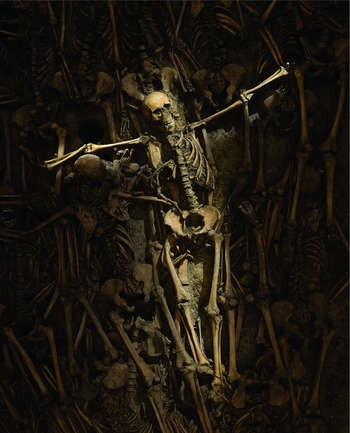
Tilted for us to see them straight on, 45 human skeletons were stacked in tight rows, with two more, arms out-stretched, on top of them (Figure 1). Below lay artillery and musket shot set out with equal neatness. Owing, perhaps, to such clinical arrangement, or to the unfamiliar angle, or perhaps to the sturdy frame marked ‘lützen, 6. november 1632’, or else to the gallery's classical formality, the full horror only registered later, after seeing many more bones, much finely crafted weaponry and armour, and pictures and plans of fights both modern and ancient. It was the first display in Krieg: eine archäologische Spurensuche (‘War: an archaeological search for traces’), an exhibition at the Prehistory Museum in Halle shown from November 2015 to May 2016.
In your face: part of the mass grave at Lützen (photograph by Juraj Lipták, shown with permission from the Landesamt für Denkmalplege und Archäologie Sachsen-Anhalt).

The Battle of Lützen was a turning point in the Thirty Years’ War, as Sweden halted the Catholic advance on Saxony; but King Gustav Adolf was killed. The bones were lifted in a block from the field where the grave was found in 2011. In all, there were some 125 skeletons. Bar one coin, nothing but bones was recovered (Meller & Schefzik Reference Meller and Schefzik2015b: 402): the bodies must have been stripped. We were shown analyses of the bones. The king's bullet-torn tunic was displayed along with swords and armour, camp kit, records of the time, paintings of the scene and portraits of the generals. There was a documentary film about the battle and we were shown video sequences of experimental musketry. There were displays on other incidents too, including sherds and a cannon ball from the terrible destruction of Magdeburg. Also shown was Dresden's copy of the treaty at Osnabrück, bearing the signature of Queen Christina, the king's heir, which helped to end the war.
The Halle Museum's permanent collection of prehistoric archaeology is one of Europe's best, and in the quality of its presentation, perhaps the very best. Exhibits include the Nebra Disc, the finds from the Early Bronze Age ‘royal’ grave at Leubingen and the Neolithic family buried at Eulau. It was surprising, then, to find a display here on Lützen; but the rest of the exhibition, in a second gallery, was devoted to prehistory from the Palaeolithic to the Late Bronze Age.
The argument was loosely evolutionist. It started with a short film and territorial analysis of conflict among the chimpanzees studied by the Boesch team and with analyses of hominid injuries at Maba (Guandong), Sima de los Huesos (Atapuerca), Krapina, Sungir and Shanidar. Among other Mesolithic evidence shown were the skeletons from the Cave of the Children (Liguria), one with a lancehead among the ribs; from Montfort St Lizier (southern France), with a blade stuck in a vertebra; and from Skateholm I (Scania), with signs of scalping; and the burial from Teviéc (Brittany) was assembled replete with its covering antlers and a digital scan of the injuries. Next came a map of Neolithic diffusion from the Levant, and clips of Robert Gardner's film of battle, injuries and death among the Dani in New Guinea. The Mesolithic bow and fragmentary club from Holmegård were shown along with nine Neolithic clubs. Below an array of maceheads, typological displays of bronze weaponry implied military organisation. Accompanying maps suggested specific tactics—or ideas—by demonstrating that most shields are from the British Isles and most halberds are from four far-flung regions, especially Ireland. Symbolism was addressed explicitly with Neolithic and Bronze Age blades of gold from Romania and the Balkans, five Nuragic statuettes (Sardinia), one of the horned helmets from Viksø (Denmark), and the stele from Arco, in the Italian Alps, showing daggers and halberds. Aerial photographs and diagrams illustrated the fortifications at Eisleben, Bischofswiese and Crickley Hill; and there were photographs to suggest precedents for mass burial from Wassenaar, Sund (Norway) and perhaps at Tormarton (England). There was one of the Eulau burials and the Beaker warrior from Apfelstädt. A distinct section was devoted to the Late Bronze Age running fight in the Tollense Valley, with analysis of the combatants’ ages and injuries and their weapons (including ‘Baseball Bat’ and ‘Croquet Mallet’; see Jantzen et al. Reference Jantzen, Brinker, Orschiedt, Heinemeier, Piek, Hauenstein, Krüger, Lidke, Lübke, Lampe, Lorenz, Schult and Terberger2011). Alongside the main display of prehistoric finds were two supplementary displays: about discoveries from Spain, Italy and Germany, including ‘massacre among the first farming cultures’ at Talheim; and then Bronze Age finds from Egypt, with a copy of the great relief of the Battle of Kadesh from Abu Simbel, the life-size model of a battle chariot, an account of the Battle of Megiddo, a Stätzling-type sword blade from Bubastis, perhaps of the Sea People, and pictures, for good measure, of Naram-Sin's Victory Stele and the Standard of Ur from Mesopotamia.
Assembled from no less than 38 collections in Germany and 23 elsewhere in Europe, Krieg was a feat of systematic curatorship as well as masterful and imaginative design. The exhibits throughout were clearly mounted, spaced and lit. Economical labels and pithy wall texts were supplemented by reproductions of scenes in the prehistoric rock art of Spain, Scandinavia and South Africa and by striking paintings made for the exhibition, including an impression of the burying at Lützen. There was no catalogue but a small book corresponded to the exhibition's topics in order; and a very big, lavish one provides scholarly notes on ancient warfare and weaponry, mass graves, ethology and ethnography and on the Thirty Years’ War in central Germany (Meller & Schefzik Reference Meller and Schefzik2015a & b).
Compelling in itself, and perhaps particularly stimulating for historians as they turn to material culture—if not to physical anthropology too—the display on Lützen was used as a source of analogy for alerting archaeologists to aspects of the prehistoric evidence for warfare (Carman Reference Carman2013: 40, 98). Krieg’s argument was, however, left all but implicit. An inconspicuous opening panel asked ‘What is war?’ and sketched a couple of general answers. The prevailing suggestion was that it arises, in the first place, from competition over resources and depends, in the second, on organisation or leadership. Recently discovered evidence of a Late Stone Age massacre in Kenya has been ascribed to competition over land for foraging (Lahr et al. Reference Lahr, Rivera, Power, Mounier, Copsey, Crivellaro, Edung, Maillo Fernandez, Kiarie, Lawrence, Leakey, Mbua, Miller, Muigai, Mukhongo, Van Baelen, Wood, Schwenninger, Grün, Achyuthan, Wilshaw and Foley2016). The exhibition could have assessed the likelihood of Palaeolithic or Bronze Age competition more clearly or specified the resources at stake during the Mesolithic and the nature of Neolithic chieftainship. As for fighting, while there were hints about the importance of terrain, there was scope for more attention to district geography. For Lützen is one of those sites that has witnessed battle more than once (the second time was in 1813).
Had Krieg covered the Iron Age, when more people seem to have taken part, issues about who fought would have loomed more boldly. Considering murmurs about renewed European war even while the exhibition was prepared and displayed, would it have been apt to address recruitment? The issue was implied in the surprising comparison with Egypt and Mesopotamia, showing rows of soldiers. Reviewing the European archaeology in the accompanying book, Harald Meller and Anthony Harding do affirm that soldiering was probably a recognised role in the Bronze Age (Meller & Schefzik Reference Meller and Schefzik2015b: 242–56). Data on health, diet and biography from Lützen's bones show how, by analogy, and preservation permitting, profiles of prehistoric fighters could be obtained (Meller & Schefzik Reference Meller and Schefzik2015b: 405–20). Perhaps, for example, now that injuries on 64 skeletons from along the Tollense have been recorded, the collection could be studied for biography and social identity too (Meller & Schefzik Reference Meller and Schefzik2015b: 350): what can we deduce about why those men fought?
The curators’ decision to leave the prehistoric finds unshrouded by more discussion was effective, however. As Uzzell (Reference Uzzell and Uzzell1989: 46) has urged, museums should show both our “finest achievements” and “shameful events of our past”: some “[i]nterpretation. . .has to be shocking”. Most of us must have left Krieg both sombre and thoughtful.
Acknowledgements
Julia Kruse, at the museum, courteously arranged for my visit and provided the figure. I benefited from discussion with Susan Pollock and Chris Scarre.