1. Introduction
The beginning of the Cambrian period was characterized by unprecedented ecological transformations and biodiversification rates that took place as a series of evolutionary events in the Ediacaran and Cambrian periods (e.g. Erwin & Valentine, Reference Erwin and Valentine2013). Among others, these events are mirrored in the origin and further development of skeletal eumetazoans and ethologically (organism–sediment interaction style) diverse endobenthos (Mángano & Buatois, Reference Buatois2017; Wood et al. Reference Wood, Liu, Bowyer, Wilby, Dunn, Kenchington, Cuthill, Mitchell and Penny2019) and in global changes in ocean-water phosphorus, carbon and oxygen cycling (e.g. Hantsoo et al. Reference Hantsoo, Kaufman, Cui, Plummer and Narbonne2018; Lenton & Daines, Reference Lenton and Daines2018). Theoretically, the combination of these factors should cause the Precambrian–Cambrian boundary to be the easiest to localize in sedimentary successions. In contrast, the considerable facies dependence of available bio- and chemostratigraphic tools causes both the localization of this boundary and the correlation of lithologically contrasting sections to be highly speculative in practice (Rozanov et al. Reference Rozanov, Semikhatov, Sokolov, Fedonkin and Khomentovskii1997; Landing et al. Reference Landing, Geyer, Brasier and Bowring2013; Babcock et al. Reference Babcock, Peng, Zhu, Xiao and Ahlberg2014).
Trace fossils (Brasier et al. Reference Brasier, Cowie and Taylor1994; MacNaughton & Narbonne, Reference MacNaughton and Narbonne1999; Jensen, Reference Jensen2003) and, partially, acantomorphic acritarchs (Moczydłowska, Reference Moczydłowska1991, Reference Moczydłowska1998; Yao et al. Reference Yao, Xiao, Yin, Li and Yuan2005) serve well for the stratigraphy of marine siliciclastic Ediacaran–Cambrian successions. However, the resolution of the latter is directly linked to specific taphonomic conditions (i.e. preservation in siltstones and mudstones). For carbonate-dominated successions in which the evolution of Ediacaran and early Cambrian endobenthic communities can barely be reconstructed because of ecological and taphonomic biases (Buatois, Reference Buatois2017), an informal group of small skeletal fossils (SSFs) (e.g. Khomentovsky & Karlova, Reference Khomentovsky and Karlova1993, Reference Khomentovsky and Karlova2002, Reference Khomentovsky and Karlova2005; Kouchinsky et al. Reference Kouchinsky, Bengtson, Runnegar, Skovsted, Steiner and Vendrasco2012; Yang et al. Reference Yang, Steiner, Li and Keupp2014) and carbonate carbon isotope variations (Zhu et al. Reference Zhu, Babcock and Peng2006, Reference Zhu, Yang, Yuan, Li, Zhang, Zhao, Ahn and Miao2018; Maloof et al. Reference Maloof, Porter, Moore, Dudás, Bowring, Higgins, Fike and Eddy2010; Landing et al. Reference Landing, Geyer, Brasier and Bowring2013; Li et al. Reference Li, Ling, Shields-Zhou, Chen, Cremonese, Och, Thirlwall and Manning2013) are used. However, correlations of the data that show the first appearance of specific ichnotaxa (Treptichnus pedum), SSF assemblage zones (Anabarites trisulcatus – Protohertzina anabarica) and negative δ13С BACE (basal Cambrian carbon isotope excursion) values near the base of the Fortunian Stage remain subjects of strong debate (Rozanov et al. Reference Rozanov, Semikhatov, Sokolov, Fedonkin and Khomentovskii1997; Peng et al. Reference Peng, Babcock, Cooper, Gradstein, Ogg, Schmitz and Ogg2012; Landing et al. Reference Landing, Geyer, Brasier and Bowring2013; Babcock et al. Reference Babcock, Peng, Zhu, Xiao and Ahlberg2014).
The Siberian Platform is one of the regions where this problem may be illustrated in detail. Highly diverse in lithology, the Ediacaran–Cambrian transitional strata of the Siberian Platform consist of intertidal and shelf successions that accumulated during eustatic sea-level rise (e.g. Peng et al. Reference Peng, Babcock, Cooper, Gradstein, Ogg, Schmitz and Ogg2012) on underlying rocks of different ages (from Mesoproterozoic to late Ediacaran) (e.g. Sukhov et al. Reference Sukhov, Shabanov, Pegel, Saraev, Filippov, Korovnikov, Sundukov, Fedorov, Varlamov, Efimov, Kontorovich and Kontorovich2016). Composed primarily of epicontinental shallow-marine carbonates (Khomentovsky et al. Reference Khomentovsky, Shenfil’, Yakshin and Butakov1972; Astashkin et al. Reference Astashkin, Pegel, Shabanov, Sukhov, Sundukov, Repina, Rozanov and Zhuravlev1991), the Ediacaran–Cambrian transitional strata of this region host diverse assemblages of small skeletal fauna (e.g. Rozanov et al. Reference Rozanov, Missarzhevsky, Volkova, Voronova, Krylov, Keller, Korolyuk, Lendzion, Michniak, Pyhova and Sidorov1969; Khomentovsky & Karlova, Reference Khomentovsky and Karlova1993, Reference Khomentovsky and Karlova2002, Reference Khomentovsky and Karlova2005) and a representative carbon isotope record (e.g. Kaufman et al. Reference Kaufman, Knoll, Semikhatov, Grotzinger, Jacobsen and Adams1996; Pelechaty et al. Reference Pelechaty, Grotzinger, Kashirtsev and Zhernovsky1996; Kouchinsky et al. Reference Kouchinsky, Bengtson, Pavlov, Runnegar, Torssander, Young and Ziegler2007; Kochnev et al. Reference Kochnev, Pokrovsky, Kuznetsov and Marusin2018). However, because marine siliciclastic and mixed carbonate-siliciclastic sections mostly occur to the NE of the Siberian Platform (Yudoma–Olenek facies region; Rozanov, Reference Rozanov1992), the correlation of the carbonate successions of the central and western facies regions with worldwide Ediacaran–Cambrian sections is complicated.
Outside the Yudoma–Olenek facies region, mixed carbonate-siliciclastic successions of Ediacaran–Cambrian age are present along the southwestern margin of the Siberian Platform: the Yenisei Ridge and Cis–Sayans uplifts (Biryusa and Irkutsk). The latter two are also known as the ‘Prisayan’ uplifts (e.g. Priyatkina et al. Reference Priyatkina, Collins, Khudoley, Letnikova and Huang2018). All of these palaeobasins share similar sedimentological regimes in the upper Ediacaran and lower Cambrian strata: red-coloured continental and shallow-marine siliciclastic deposits that gradually change into lagoonal salt-bearing carbonates, ubiquitous within the southwestern Siberian Platform in the lower Cambrian strata (Khomentovsky et al. Reference Khomentovsky, Shenfil’, Yakshin and Butakov1972; Melnikov et al. Reference Melnikov, Yakshin, Shishkin, Efimov, Karlova, Kilina, Konstantinova, Kochnev, Kraevskiy, Melnikov, Nagovitsyn, Postnikov, Ryabkova, Terleev and Khabarov2005; Sukhov et al. Reference Sukhov, Shabanov, Pegel, Saraev, Filippov, Korovnikov, Sundukov, Fedorov, Varlamov, Efimov, Kontorovich and Kontorovich2016; Sovetov, Reference Sovetov2018). However, the limited occurrences of open-marine deposits between the continental and lagoonal facies within the intervals limit the application of biostratigraphic and chemostratigraphic methods. Hence, previous studies (Khomentovsky et al. Reference Khomentovsky, Faizulin and Karlova1998 a; Kochnev & Karlova, Reference Kochnev and Karlova2010; Pokrovsky et al. Reference Pokrovsky, Bujakaite and Kokin2012; Sovetov, Reference Sovetov2018) have suggested the localization of the lower Fortunian boundary at the southwestern margin of the Siberian Platform based only on a regional correlation.
We report the first palaeontological data (e.g. trace fossils and SSFs), carbonate carbon and oxygen isotope compositions, and U–Pb detrital zircon ages of the Moty Group (Irkutsk Cis–Sayans Uplift; southwestern Siberian Platform). With no bio- or chemostratigraphic data available until now, traditional correlations of the Moty Group with the Ediacaran–Cambrian transitional interval by previous researchers were supported only by its stratigraphic position between the Cryogenian–Ediacaran and Tommotian (Cambrian Stage 2) strata and by regional correlations (Khomentovsky et al. Reference Khomentovsky, Shenfil’, Yakshin and Butakov1972; Sukhov et al. Reference Sukhov, Shabanov, Pegel, Saraev, Filippov, Korovnikov, Sundukov, Fedorov, Varlamov, Efimov, Kontorovich and Kontorovich2016; Sovetov, Reference Sovetov2018). This interval consists of a mixed carbonate-siliciclastic succession that accumulated in continental and shallow-marine settings. Our data not only calibrate the age of the Moty Group, but also contribute to the chronology of the remarkable changes in sedimentation regimes that occurred along the southwestern margin of the Siberian Platform (in modern coordinates) during late Ediacaran and early Cambrian time.
2. Stratigraphy
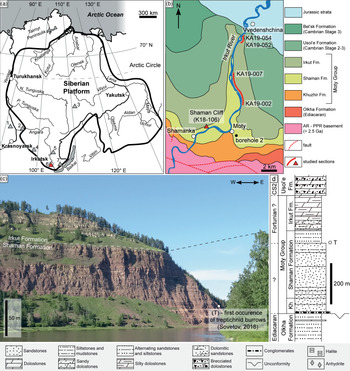
In the Irkutsk Cis–Sayans Uplift (Fig. 1a, b), the Ediacaran–Cambrian transitional strata form a 700-m-thick carbonate-siliciclastic succession, which exhibits a gradual transition from mostly red-coloured coarse-grained sandstones and conglomerates to red-coloured cross-bedded medium- and coarse-grained sandstones and, higher in the section, a transition to fine crystalline dolostones, which are occasionally sand- and silt-enriched (Khomentovsky et al. Reference Khomentovsky, Shenfil’, Yakshin and Butakov1972).
Ediacaran–Cambrian transitional interval of the Irkutsk Cis–Sayans Uplift. (a) Sketch map of the Siberian Platform with the study area (red triangle) shown in detail in (b) and adjacent areas mentioned in the text: 1, eastern Fore-Yenisei Basin; 2, southern Yenisei Ridge; 3, central Siberian Platform; 4, Biryusa Cis–Sayans Uplift; 5, Irkutsk Amphitheatre; 6, Irkutsk Cis–Sayans Uplift; and 7, southwestern Cis–Baikal Region. (b) Simplified geological map with the studied sections of the upper Shaman, Irkut and lower Usol’e formations. (c) Boundary between the Shaman and Irkut formations (white dashed line) in the Shaman Cliff section (KA18-106). (d) Composite section of the Moty Group with previous age estimates (Krasnov et al. Reference Krasnov, Savitsky, Tesakov and Khomentovsky1983; Sovetov, Reference Sovetov2018). CS2 – Cambrian Stage 2; Kh – Khuzhir Formation; T – the lowest occurrence of sedimentary structures, documented and assigned to Treptichnus pedum by Sovetov (Reference Sovetov2018).

Although there is still no consensus on the stratigraphic subdivisions of this succession (Pisarchik, Reference Pisarchik1963; Khomentovsky et al. Reference Khomentovsky, Shenfil’, Yakshin and Butakov1972; Krasnov et al. Reference Krasnov, Savitsky, Tesakov and Khomentovsky1983; Sovetov, Reference Sovetov2018), all interpretations disagree only on the nomenclature of the units rather than on the stratigraphic volumes or lithologies. We therefore use the version that was officially ratified by the USSR Interdepartmental Stratigraphic Committee (Krasnov et al. Reference Krasnov, Savitsky, Tesakov and Khomentovsky1983): this succession includes the Moty Group, which includes the Khuzhir, Shaman and Irkut formations. The Moty Group unconformably overlaps the carbonate-siliciclastic Olkha Formation of early Ediacaran age, as is suggested by a regional correlation (Shenfil’, Reference Shenfil’1991; Sovetov, Reference Sovetov2018), and is capped by the salt-bearing carbonate Usol’e Formation of Tommotian age (Sukhov et al. Reference Sukhov, Shabanov, Pegel, Saraev, Filippov, Korovnikov, Sundukov, Fedorov, Varlamov, Efimov, Kontorovich and Kontorovich2016) (Fig. 1d). This unit of the Russian General Stratigraphic Chart sensu lato corresponds to Cambrian Stage 2 (Grazhdankin et al. Reference Grazhdankin, Marusin, Izokh, Karlova, Kochnev, Markov, Nagovitsin, Sarsembaev, Peek, Cui and Kaufman2020).
The Khuzhir Formation (35–76 m thick) is not exposed in the Irkutsk Cis–Sayans Uplift and is known only from the core of Borehole 2 (Khomentovsky et al. Reference Khomentovsky, Shenfil’, Yakshin and Butakov1972) (Fig. 1b). This formation includes granule- and pebble-sized conglomerates in the basal part and the greenish-grey and reddish-brown middle- and coarse-grained sandstones above (Fig. 1d).
The Shaman Formation (320–380 m thick) conformably overlies the Khuzhir Formation. The Shaman Formation is composed primarily of red- and grey-coloured cross-bedded coarse-grained sandstones. The uppermost 30 m exhibits a gradual change of lithology to interbedded reddish-grey fine-grained sandstones and dark-red siltstones and mudstones. Early studies (Khomentovsky et al. Reference Khomentovsky, Shenfil’, Yakshin and Butakov1972) documented individual 5-cm-thick interbeds of yellowish-grey dolostones in the uppermost Shaman Formation.
The dolostone-dominated Irkut Formation (130–250 m thick) overlies the Shaman Formation with a gradual transition. The lowermost 50 m of the Irkut Formation consists of interbedded wavy- and cross-bedded pinkish-grey medium- and fine-grained sandstones, red siltstones and grey sandy dolostones. The Irkut Formation is composed mostly of grey dolostones and silty dolostones with a silt content that increases towards the top of the formation (Fig. 1d).
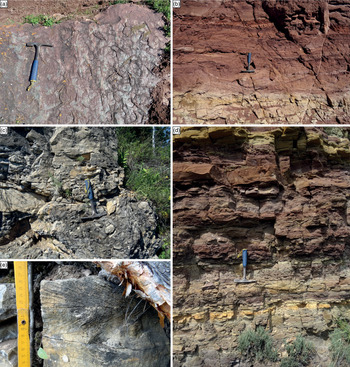
In the Irkutsk Cis–Sayan Uplift, arguably the most well-exposed outcrop of the upper part of Shaman Formation and lower part of Irkut Formation, is located on the left bank of the Irkut River (37 km upstream from its mouth) on the Shaman Cliff (section K18-106, 52° 05′ 05″ N, 103° 51′ 25″ E; Fig. 1b). The upper 110 m of the red-coloured Shaman Formation forms a very steep cliff that hinders its detailed lithological study and sampling potential (Fig. 1c). These strata are composed of planar-laminated granule-sized conglomerates and middle- to coarse-grained sandstones with tabular and trough cross-bedding (Fig. 2b). The bedding surfaces commonly show wave and current ripple marks and large desiccation cracks (Fig. 2a). The uppermost 45 m of the Shaman Formation consists of reddish-grey trough cross-bedded and planar-laminated medium-grained sandstones interbedded with reddish- and yellowish-grey siltstones and mudstones.
Lithology of the upper Shaman and lower Irkut formations. (a) Sand-filled desiccation cracks and large symmetrical ripple marks on the top of coarse-grained sandstones (upper Shaman Formation, c. 100 m below the top). (b) Red trough cross-bedded coarse-grained sandstones (upper Shaman Formation, c. 100 m below the top). (c) Interbed of collapse breccias in dolostones of the lower Irkut Formation (12 m above the base). (d) Alternating reddish-grey and yellowish-grey dolomitic siltstones and mudstones and dolomitic sandstones with planar laminations and wavy and trough cross-bedding with thin interbeds of yellowish-grey sandy dolostones (lower Irkut Formation, 26 m above the base). (e) Dolomitic sandstones with herringbone cross-stratification (lower Irkut Formation, 30 m above the base). Length of the hammer: 28 cm.

In the Shaman Cliff, there is a 1-m-thick bed of light-grey coarse-grained quartz sandstone at the very base of the Irkut Formation. This layer is overlain by a poorly exposed interval (11 m) with pinkish-grey and grey middle- to-fine-grained sandstones, siltstones, mudstones and silty dolostones, which are documented in small individual outcrops (Fig. 1c). The overlying 45 m of this unit is composed of yellowish-grey and grey massive and finely laminated dolostones interbedded with pinkish-grey and grey sandy dolostones and dolomitic sandstones and siltstones (Fig. 2d). The sandstones exhibit planar laminations and small-scale (up to 5 cm thick) hummocky, trough and herringbone cross-bedding (Fig. 2d, e), and often carry symmetric and asymmetric ripple marks. The lower part of this interval includes a single 1-m-thick bed of brecciated dolostone (Fig. 2c). Downstream along the Irkut River, the upper Irkut Formation crops out as a series of natural exposures on its right bank (KA19-002–KA19-007: 52° 06′ 20″ N, 103° 55′ 00″ E to 52° 09′ 00″ N, 103° 54′ 05″ E; KA19-052, 52° 11′ 05″ N, 103° 55′ 15″ E) up to the brecciated cavernous dolostones of the overlying Usol’e Formation (KA19-054: 52° 11′ 20″ N, 103° 55′ 35″ E; Fig. 1b). In these sections, the Irkut Formation is composed of interbedded massive dolostones and finely laminated silty dolostones with a gradual increase in the silt content upwards. The uppermost 50 m of the Irkut Formation is only sporadically exposed in several isolated outcrops.
As noted by previous authors (e.g. Khomentovsky et al. Reference Khomentovsky, Shenfil’, Yakshin and Butakov1972; Sukhov et al. Reference Sukhov, Shabanov, Pegel, Saraev, Filippov, Korovnikov, Sundukov, Fedorov, Varlamov, Efimov, Kontorovich and Kontorovich2016), the base of the salt-bearing Usol’e Formation is marked by the first occurrence and further development of cavernous brecciated dolostones above the silty dolostones of the Irkut Formation. However, our field observations reveal that this change in lithology is gradual.
Considering the lithologies and regional correlations of the Moty Group with its stratigraphic analogues in the southern Yenisei Ridge (e.g. Redkolesnaya and Ostrovnoy Formations) and Biryusa Cis–Sayans Uplift (e.g. Ust’–Tagul Formation) (Fig. 3), the Moty Group represents a transgressive sequence with a gradual change from alluvial to deltaic depositional systems (lower Shaman Formation) to shallow-marine environments (e.g. upper Shaman and Irkut formations) and a parallel decrease in siliciclastic influx into the basin (Sovetov, Reference Sovetov1977, Reference Sovetov2018). At the same time, the typical shallow-marine sedimentary structures in the Irkut Formation (trough and herringbone cross-bedding, and wave ripple marks) and the following rapid change into the evaporitic, salt-bearing facies of the Usol’e Formation (Sukhov et al. Reference Sukhov, Shabanov, Pegel, Saraev, Filippov, Korovnikov, Sundukov, Fedorov, Varlamov, Efimov, Kontorovich and Kontorovich2016) suggest accumulation of the Irkut Formation in intertidal and shoreface zones.
Ediacaran–Cambrian transitional strata of the southwestern Siberian Platform and eastern Fore–Yenisei Basin (Fig. 1a) and their age constraints. The horizontal dashed line marks the base of salt-bearing carbonate formations, which are commonly used as the regional marker horizon in stratigraphic schemes (e.g. Krasnov et al. Reference Krasnov, Savitsky, Tesakov and Khomentovsky1983). Ak – Ayankan; As – Aisa; Bk – Byuk; Kc – Kochergat; Kh – Khuzhir; Kt – Katanga; Ms – Moshakovka; Os – Ostrovnoy. Lithologies correspond to the key in Figure 1.

With no robust bio- or chemostratigraphic data available, the Ediacaran–Cambrian age of the Moty Group has long been estimated based only on regional correlation data (Khomentovsky et al. Reference Khomentovsky, Shenfil’, Yakshin and Butakov1972; Shenfil’, Reference Shenfil’1991; Sukhov et al. Reference Sukhov, Shabanov, Pegel, Saraev, Filippov, Korovnikov, Sundukov, Fedorov, Varlamov, Efimov, Kontorovich and Kontorovich2016) (Fig. 3). In 2018, JK Sovetov reported the first occurrence of Treptichnus pedum 60 m below the top of the Shaman Formation (Sovetov, Reference Sovetov2018, fig. 3а; Fig. 1c, d). The correlation of the upper Shaman and Irkut formations with the middle Ust’–Tagul Formation (Biryusa Cis–Sayans Uplift), which exhibit generally similar lithologies and bear T. pedum (Kochnev & Karlova, Reference Kochnev and Karlova2010; Sovetov & Jensen, Reference Sovetov and Jensen2010), provided evidence for associating these units with the Cambrian Fortunian Stage (Sovetov, Reference Sovetov2018). The youngest detrital zircon U–Pb ages of 886 ± 6 Ma from the Ust’–Tagul Formation and 586 ± 20 Ma and 589 ± 33 Ma from the Redkolesnaya Formation of the southern Yenisei Ridge (Priyatkina et al. Reference Priyatkina, Collins, Khudoley, Letnikova and Huang2018) provide some information regarding the age of the Moty Group. In this publication, the authors also note unspecified ‘~542-534 Ma fossils’ from the Redkolesnaya Formation by referring to Liu et al. (Reference Liu, Brasier, Bogolepova, Raevskaya and Gubanov2013). However, when considering all known reports of fossil occurrences from this unit (Chechel’, Reference Chechel’1976; Liu et al. Reference Liu, Brasier, Bogolepova, Raevskaya and Gubanov2013), only discoidal Cyclomedusa are present, which is typical for the late Ediacaran Period.
Considering the data from the southwestern Cis–Baikal Region, the U–Pb ages of 554 ± 12 Ma for the seven youngest concordant detrital zircon grains from the Ushakovka Formation (Gladkochub et al. Reference Gladkochub, Stanevich, Mazukabzov, Donskaya, Pisarevsky, Nicoll, Motova and Kornilova2013) suggest a late Ediacaran age for this unit and its stratigraphic analogue in the Irkutsk Cis–Sayans Uplift – lower Moty Group (Khuzhir and lower Shaman formations) (Sovetov, Reference Sovetov2018). As noted by Gladkochub et al. (Reference Gladkochub, Stanevich, Mazukabzov, Donskaya, Pisarevsky, Nicoll, Motova and Kornilova2013), the Ushakovka sandstones also contain individual Cambrian detrital zircons (534 ± 14 and 534 ± 16 Ma). We agree with the authors that the scarcity of Cambrian zircons (only two grains were registered) rejects their use as an indicator of the maximum depositional age estimate.
The Fortunian age (541–529 Ma) of the upper Moty Group can also be indirectly inferred by correlation of the overlying Usol’e Formation with the Cambrian Stage 2 (Tommotian Stage; Krasnov et al. Reference Krasnov, Savitsky, Tesakov and Khomentovsky1983; Sukhov et al. Reference Sukhov, Shabanov, Pegel, Saraev, Filippov, Korovnikov, Sundukov, Fedorov, Varlamov, Efimov, Kontorovich and Kontorovich2016). This age is based on a comparison of carbon isotope data from the Ediacaran–Cambrian strata of the Irkutsk Amphitheatre (Vinogradov et al. Reference Vinogradov, Belenitskaya, Bujakaite, Kuleshov, Minaeva and Pokrovskii2006) with the Tommotian stratotype (Aldan River; Brasier et al. Reference Brasier, Khomentovsky and Corfield1993). This assumption is also supported by the skeletal fossil occurrence in the basal Tommotian Nochoroicyathus sunnaginicus Assemblage Zone in the Usol’e Formation of the eastern Fore–Yenisei sedimentary basin (Averinskaya-150 borehole; Khomentovsky & Karlova, Reference Khomentovsky and Karlova2005) and in its analogue in the central Siberian Platform (Bilir Formation; Sukhov et al. Reference Sukhov, Shabanov, Pegel, Saraev, Filippov, Korovnikov, Sundukov, Fedorov, Varlamov, Efimov, Kontorovich and Kontorovich2016) (Fig. 3). The underlying strata (e.g. Tetere and Yuryakh formations) host skeletal fossils of the uppermost Fortunian Purella antiqua Assemblage Zone (Khomentovsky et al. Reference Khomentovsky, Fedorov and Karlova1998b ; Grazhdankin et al. Reference Grazhdankin, Kontorovich, Kontorovich, Saraev, Filippov, Efimov, Karlova, Kochnev, Nagovitsin, Terleev and Fedyanin2015). However, recent bio- and chemostratigraphic data from the Ediacaran–Cambrian transitional interval of the central Siberian Platform suggest that, at least in some sections, the lower Cambrian Stage 2 boundary is located as low as 100 m below the Usol’e–Bilir Formation (Kochnev et al. Reference Kochnev, Pokrovsky, Kuznetsov and Marusin2018).
3. Materials and methods
As noted in the previous section, the upper Shaman Formation is exposed as a 110-m-high cliff in the Shaman Cliff section (Fig. 1c). Its lithological study and sampling are therefore not possible without specialized rock-climbing equipment, except for the lowermost few metres accessible from below. The uppermost 11 m of the Shaman Formation were logged and sampled in the outcrops exposed downstream along the Irkut River between Moty and Vvedenshchina villages (KA19-002–KA19-054 in Fig. 1b). Our study focuses mostly on the Irkut Formation and the lowermost 27 m of the Usol’e Formation, which are documented in the upper part of the Shaman Cliff (lower 45 m of the Irkut Formation) and in the exposures along the Irkut River (see Section 2 for coordinates; Fig. 1b). Precise section logging was accompanied by sampling for further SSF extractions (25 samples) and carbon and oxygen isotope studies (59 samples from the Irkut Formation and six from the Usol’e Formation). For carbon and oxygen isotope analyses, those intervals with lesser degrees of diagenetic alteration were preferentially collected, which determined the overall sampling density (online Supplementary Table S1, available at http://journals.cambridge.org/geo). The macroscopic sampling criteria included a micritic composition or minimal recrystallization of the carbonates, the presence of laminations or their relics, and a lack of structural heterogeneity (inclusions or evidence of dissolution). All the SSFs further discussed are stored at the Trofimuk Institute of Petroleum Geology and Geophysics of SB RAS (IPGG SB RAS), Novosibirsk.
All images of macroscopic objects (e.g. sedimentary structures and slabs with ichnofossils) presented here were obtained with a digital camera during fieldwork in the Irkutsk Cis–Sayans Uplift in 2017 and 2019. Initial ichnotaxonomic identification of the trace fossils was performed during the fieldwork and was further updated with the morphometric parameters derived by examining the images and collected specimens, which are stored at the Geological Institute of RAS (GIN RAS), Moscow.
Small skeletal fossils were extracted from the dolostone samples in IPGG SB RAS by applying a technique of gentle rock-dissolution in 2% buffered acetic acid (see Marusin et al. Reference Marusin, Kochnev, Karlova and Nagovitsin2019 for details of the method). The dry residual materials were studied under a Carl Zeiss Stemi 2000 (6.5–50× magnification) stereomicroscope for fossil extractions. Scanning electron microscopy (SEM) of the small skeletal fossils was performed with a Tescan MIRA 3, and the samples were stored at the Analytical Center for Multielemental and Isotope Research (IGM SB RAS, Novosibirsk). Prior to analysis, the fossils were mounted on aluminium stubs and were coated with chrome and carbon.
Carbon (δ13C) and oxygen (δ18O) analyses of the carbonates were carried out at the GIN RAS (Moscow) using a Finnigan Delta-V (Thermo Electron Corp.) mass spectrometer equipped with a Gas Bench-II line. Prior to the analyses, powder was drilled from the most lithologically homogenous zones of the samples. Depending on the carbonate amount, 0.5–1.5 mg of the powder was dissolved in orthophosphoric acid at 50°C. The δ13C and δ18O values are given in per mille (‰) units relative to the international V-PDB (Vienna Pee Dee Belemnite) and V-SMOW (Vienna Standard Mean Ocean Water) standards, respectively. The analytical accuracies of the carbon and oxygen isotope measurements are within ±0.1‰ and ±0.2‰, respectively, and were controlled by external standards and calibrated by the NBS-19 international standard (Friedman et al. Reference Friedman, O’Neil and Cebula1982). To evaluate diagenetic alteration, we applied δ18O values and paired correlations of δ13C and δ18O (Kaufman & Knoll, Reference Kaufman and Knoll1995). Oxygen isotope values below 20‰ V-SMOW (or < −10‰ V-PDB) and/or direct correlation of δ13C and δ18O indicated considerable post-sedimentary alteration. Such samples from the Moty Group (11 samples) were therefore excluded from further discussion (online Supplementary Table S1).
The field study did not include specific sampling of any material for extraction and U–Pb dating of detrital zircons. The detrital zircon grains were extracted from a slab of sandy dolostones (sample K18-106) collected 28 m above the base of the Irkut Formation in the Shaman Cliff. The sample consists of a 1-cm-thick slab (1.5 kg total weight) with numerous trace fossils in positive hyporelief. The sample was originally collected as a palaeontological sample, but also revealed abundant detrital zircons in thin sections. The sample was crushed to c. 1-cm-sized clasts and disintegrated in 1 N hydrochloric acid at room temperature. The residual materials were levigated and sifted with a 50 µm sieve under water flow. The dried material was separated with a low-viscosity aqueous sodium heteropolyoxotungstate heavy liquid (HSP-W, density 2.85 ± 0.05 g cm–3) to extract the heavy mineral fractions. After a magnetic separation procedure, 186 zircon grains were handpicked from the non-magnetic fraction under a binocular microscope. They were mounted in epoxy resin and polished. For each grain, 5–6 optical slices were made with plane-polarized light under a stereo binocular microscope to localize areas (at least 25 µm in diameter) with no visible inclusions, cracks or metamict zones for analysis. Images of the high-relief objects were obtained by stacking the individual optical slices with Helicon Focus software. Immediately before analysis, the epoxy mount with zircons was washed in an ultrasonic bath filled with 5% nitric acid, rinsed with distilled water, and dried at room temperature.
Laser ablation (LA) -inductively coupled plasma mass spectrometry (ICP-MS) analyses of detrital zircon grains (dZr) were performed at the GIN RAS using an Element2 (Thermo Scientific) ICP-MS coupled with a NWR-213 (Electro Scientific) laser ablation system (Nikishin et al. Reference Nikishin, Romanyuk, Moskovsky, Kuznetsov, Kolesnikova, Dubensky, Sheshukov and Lyapunov2020) and configured to a spot size 25 µm in diameter. Helium gas was used as the laser ablation carrier with a further admixture of argon. Precise filtration and gas blending were applied to reduce gas noise and increase the stability of the analytical signal. The zircon standard GJ-1 (Jackson et al. Reference Jackson, Pearson, Griffin and Belousova2004; Elhlou et al. Reference Elhlou, Belousova, Griffin, Pearson and Riley2006), which was provided by the ARC National Key Center for Geochemical Evolution and Metallogeny of Continents (GEMOC), Macquarie University (Sydney, Australia), with a 206Pb/238U age of 601.9 ± 0.4 Ma (Horstwood et al. Reference Horstwood, Košler, Gehrels, Jackson, McLean, Paton, Pearson, Sircombe, Sylvester, Vermeesch, Bowring, Condon and Schoene2016), was used as the primary standard for data reduction. The zircon standards 91500 (Wiedenbeck et al. Reference Wiedenbeck, Allé, Corfu, Griffin, Meier, Oberli, von Quadt, Roddick and Spiegel1995, Reference Wiedenbeck, Hanchar, Peck, Sylvester, Valley, Whitehouse, Kronz, Morishita, Nasdala, Fiebig, Franchi, Girard, Greenwood, Hinton, Kita, Mason, Norman, Ogasawara, Piccoli, Rhede, Satoh, Schulz-Dobrick, Skår, Spicuzza, Terada, Tindle, Togashi, Vennemann, Xie and Zheng2004; Yuan et al. Reference Yuan, Gao, Dai, Zong, Günther, Fontaine, Liu and Diwu2008) and Plesovice (Sláma et al. Reference Sláma, Košler, Condon, Crowley, Gerdes, Hanchar, Horstwood, Morris, Nasdala, Norberg, Schaltegger, Schoene, Tubrett and Whitehouse2008) were measured as secondary standards for accuracy evaluations. These two standards provided weighted 206Pb/238U concordia ages (2σ) of 1068 ± 6 Ma (91500; n = 15) and 338 ± 2 Ma (Plesovice; n = 14), which were positively correlated with the verified CA-ID-TIMS 206Pb/238U ages of 1063.5 ± 0.4 Ma and 337.2 ± 0.1 Ma, respectively (Horstwood et al. Reference Horstwood, Košler, Gehrels, Jackson, McLean, Paton, Pearson, Sircombe, Sylvester, Vermeesch, Bowring, Condon and Schoene2016). The primary analytical data were processed through GLITTER (Griffin et al. Reference Griffin, Powell, Pearson, O’Reilly and Sylvester2008), ISOPLOT (Ludwig et al. Reference Ludwig2012) and AgePick (Gehrels, Reference Gehrels, Busby and Azor2012) software, and applied the methods and constants given in Romanyuk et al. (Reference Romanyuk, Kuznetsov, Belousova, Gorozhanin and Gorozhanina2018). The 207Pb/235U ratios were calculated from the 206Pb/238U and 207Pb/206Pb ratios assuming that 238U/235U = 137.88. In online Supplementary Table S2 (available at http://journals.cambridge.org/geo), all errors were within a 2σ interval. Relative probability density (RPD) diagrams of the ages of the analysed samples were plotted using 206Pb/238U for grains younger than 1.2 Ga and 207Pb/206Pb for those older than 1.2 Ga (e.g. Gehrels et al. Reference Gehrels, Valencia and Ruiz2008). In the studied samples, we sorted out grains that exceeded the cut-off criteria of discordance (D) of –5 ≤ D ≤ 10: D1 (207Pb/235U versus 206Pb/238U) for the grains younger than 1.2 Ga and D2 (207Pb/206Pb versus 206Pb/238U) for the grains older than 1.2 Ga (e.g. Nemchin & Cawood, Reference Nemchin and Cawood2005). To evaluate the maximum depositional ages, we applied a conservative estimate (Dickinson & Gehrels, Reference Dickinson and Gehrels2009) based on a concordia age from a group of the youngest grains (n = 5) with |D1and2| < 5 (online Supplementary Table S2).
4. Results
4.a. Trace fossils
Trace fossils first occur in the studied sections of the Moty Group at 28 m above the base of the Irkut Formation and in the overlying 20 m of this unit. These fossils are associated exclusively with interbeds of grey sandy dolostones and pinkish-grey dolomitic sandstones, and appear there in positive hyporelief or negative epirelief; they are rarely seen in full relief. In the overlying strata, trace fossils were not documented.
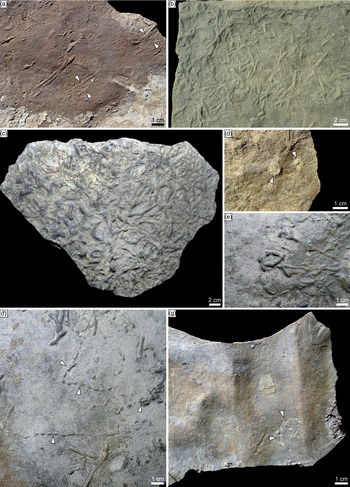
Horizontal burrows dominate in the ichnoassemblage of the Irkut Formation. Most of those are composed of morphologically simple subhorizontal, straight and gently curved Palaeophycus tubularis (4–8 mm in diameter) with no surface ornamentation, and are filled with sediment that is similar to the host rock (Fig. 4b, c). On some bedding surfaces, Palaeophycus demonstrate high densities and commonly overlap each other. The sporadic occurrence of dichotomous Y- and T-shaped branching in these burrows suggests that a producer may have used them several times. However, the lack of complex branching patterns and associated vertical shafts in the studied material does not support interpretation of any of these trace fossils as network burrows (e.g. Thalassinoides).
Trace fossils from the lower Irkut Formation. (a) Parallel scratches Monomorphichnus isp. (white arrows) in positive hyporelief on the bedding surface of reddish-grey dolomitic sandstones. Numerous (b) low- and (c) high-relief subhorizontal Palaeophycus tubularis in positive hyporelief in grey sandy dolostones. (d) Bedding-parallel sections of subvertical cylindrical Skolithos in yellowish-grey sandy dolostones. (e) Positive hyporelief Treptichnus pedum in grey sandy dolostones. (f) Aligned series of short low-relief projections in positive hyporelief (white arrows), which are assigned to Treptichnus isp. in grey sandy dolostones. (g) Series of vertical probes Treptichnus isp. in negative epirelief (white arrows) and parallel symmetrical wave ripple marks on the top of grey sandy dolostones.

Horizontal probing burrows, which were assigned to Treptichnus pedum (up to 3 mm in diameter), first occur 28 m above the base of the Irkut Formation and are common in the ichnoassemblage. These fossils mostly occur in positive hyporelief (Fig. 4e) but are also documented in negative epirelief on bedding surfaces with symmetrical wave ripple marks (Fig. 4g). In some cases, they are found together with aligned series of isolated elliptical and circular segments of similar diameter (Fig. 4f), and exhibit similar morphology to those documented earlier from the upper Shaman Formation (Sovetov, Reference Sovetov2018, fig. 3a). Although such a morphology is typical for treptichnids, the lack of ichnospecific features (e.g. short segments joining each other from the same side at low angles near the centre) challenges the original identification of these structures from the Shaman Formation as Treptichnus pedum (Sovetov, Reference Sovetov2018). We therefore assigned these burrows from the Shaman and Irkut formations to Treptichnus isp.
The bedding planes occasionally carry series of thin parallel ridges in positive hyporelief (Fig. 4a). These structures may be tool marks. However, paired parallel occurrences and the equal or close depths of these structures are typical morphological elements of arthropod-produced scratches Monomorphichnus isp., which have been widely documented in the Fortunian and younger strata (e.g. Mángano & Buatois, Reference Mángano and Buatois2014). The lower Irkut Formation hosts only sporadic and poorly preserved vertical burrows. They appear only as isolated, low-relief, circular structures (5–7 mm in diameter) on bedding planes, and are filled with sediment that is lighter than the host rock (Fig. 4d). Although no vertical shafts were documented on the bedding-normal surfaces, these structures share a similar morphology with the bedding-parallel sections of the simple cylindrical subvertical burrows of Skolithos (e.g. Walter et al. Reference Walter, Elphinstone and Heys1989, fig. 15D; Jensen, Reference Jensen1997, fig. 5A); we therefore provisionally assigned these structures to Skolithos isp. However, further detailed study is necessary to verify this interpretation.
SEM images of inner-mould fragments of conical shells assigned to Cambrotubulus sp. from the lower Irkut Formation (c. 30 m above the base): specimens (a) KM17-2/19-1, (b) KM17-2/19-3 and (c) KM17-2/19-4.

Field observations and laboratory studies of the sampled material revealed that the horizontal and rare vertical burrows had a minimal impact on the sedimentary structures. Bioturbation affected only thin (1–2 cm) intervals of the layers.
4.b. Small skeletal fossils
The Moty Group and lower Usol’e Formation are poorly characterized by small skeletal fossils. After dissolution of all of the specifically sampled material, individual skeletal fossils were documented only in two samples of dolomitic sandstones that were collected at 29.2 m and 31 m above the base of the Irkut Formation. These fossils consist of poorly preserved fragments (up to 700 µm long and up to 200 µm in diameter) of straight and gently curved conical inner moulds with circular cross-sections (Fig. 5). The moulds are smooth, carry no relics of mineralized shells and are composed of micritic dolostone. These fragments do not exhibit any specific morphology (e.g. cone-in-cone structures or triradial symmetry) and therefore correspond to simple tubular Cambrotubulus, which are abundant in the terminal Ediacaran and Fortunian strata (e.g. Nagovitsin et al. Reference Nagovitsin, Rogov, Marusin, Karlova, Kolesnikov, Bykova and Grazhdankin2015).
4.c. Carbonate carbon and oxygen isotope systems
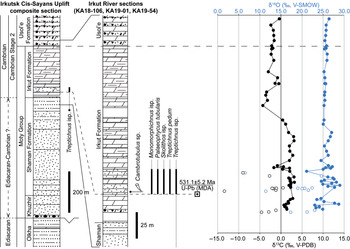
The carbon and oxygen isotope data derived from 11 samples from three intervals in the lower Irkut Formation exhibit significant diagenetic alteration, as is seen in the correlations between the δ13C and δ18O values (online Supplementary Table S1). Although high Pearson correlation coefficients (R of 0.99 for the samples from 30.3 to 33.5 m above the formation base) are not representative for such small numbers of samples in each group, the correlated carbon and oxygen isotope values for each of these three groups dramatically increased the overall C–O correlations (ranging from 0.34 to 0.69; online Supplementary Table S1). Only by excluding all three groups, the R coefficient reaches 0.13 and does not exceed the critical correlation value of R = 0.21 (Fisher & Yates, Reference Fisher and Yates1974). When considered separately from the other criteria, the covariations of the carbon and oxygen isotope values do not necessarily reflect diagenetic alteration of the studied material. However, all samples from the lower Irkut Formation with high correlation coefficients (Fig. 6) consist of sandy dolostones and dolomitic sandstones and include those with very low δ18O values (below 20‰ V-SMOW), which indicates post-sedimentary alteration (online Supplementary Table S1). We therefore excluded these data from further discussion (Fig. 6).
Age constraints of the Ediacaran–Cambrian transitional interval of the Irkutsk Cis–Sayans Uplift, as shown by distribution of trace fossils, small skeletal fossils, carbonate carbon and oxygen isotope variations (online Supplementary Table S1) and U–Pb detrital zircon ages (concordia age; weighted mean, 530.6 ± 5.3 Ma) (Fig. 7). MDA – maximum depositional age. Lithologies correspond to the key in Figure 1.

Dolostones in the lower 100 m of the Irkut Formation demonstrate strongly positive δ13C values from 0.5‰ to 3.1‰ from a single interval in the middle, where the carbon isotope ratios oscillate between –1.7‰ and 2.1‰ (Fig. 6). This interval technically splits the positive δ13C plateau in the lower Irkut Formation into two individual excursions. However, since it includes only several layers (5.5 m in total) and the carbon isotope values oscillate irregularly there, we assume that this minor isotope shift was caused by local conditions rather than mirroring the global short-period changes in seawater isotope compositions. In the same part of the section, the oxygen isotope values vary irregularly between 23‰ and 28.7‰ with a single short decrease down to 21.1‰ at 49.5 m above the base. In contrast, the upper Irkut (c. 70 m) and lower Usol’e (26.5 m) formations show negative δ13C values from –4.3‰ to –0.4‰ and stable δ18O values remaining at 25.2‰ to 26.4‰. The lack of any sharp shifts in the carbon and oxygen isotope compositions at the Irkut–Usol’e transitional interval indirectly supports an earlier suggestion regarding the absence of any measurable depositional hiatus between these two formations (Fig. 6).
4.d. Detrital zircon geochronology
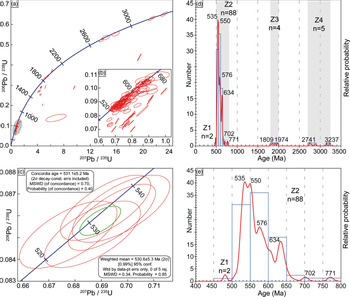
In the studied sample K18-106 (28 m above the base of the Irkut Formation), U–Pb ages were derived for 149 detrital zircon grains (online Supplementary Table S2). These ages are based on three ratios (206Pb/238U, 207Pb/206Pb and 207Pb/235U) that were measured and calculated for each grain. The integrated results are shown on the concordia diagram (Fig. 7a–c). Applying the discordance criteria mentioned in Section 3 resulted in the exclusion of 50 grains from further consideration. Hence, the histograms and age spectra (Fig. 7d, e) are based on 99 grains that were suitable for interpretation. Application of even more stringent parameters |D1 or 2| < 5 notably affects only the quantity of zircon selection (49 dZr versus the 99 grains we used), but does not significantly change the age estimates.
Plots of LA-ICP-MS U–Pb dating of detrital zircon grains from sample K18-106 (lower Irkut Formation, 28 m above the base; online Supplementary Table S2). (a) Concordia diagram for all 149 U–Pb analyses. (b) Detailed portion of the concordia plot between 480 and 680 Ma, marked with grey in (a). (c) Portion of the concordia plot (a) between 520 and 540 Ma with 1σ ellipses of the five youngest concordant zircon grains (Fig. 8), used for the MDA estimate (both concordia and weighted mean ages are given). The U–Pb concordia age of 531.1 ± 5.2 Ma (2σ) of these grains is shown by the green ellipse. (d) Age spectrum and RPD diagram for detrital zircons from sample K18-106. (e) Detailed portion of the age spectrum and RPD diagram (d) for the Z1 and Z2 zircon groups. MDA – maximum depositional age.

Among the concordant grains, all U–Pb ages lie between 481 ± 10 Ma (D1 = 7.5%) and 3237 ± 26 Ma (D2 = 0.1%) (online Supplementary Table S2). All ages fall into four groups (Fig. 7d). The largest group (Z2) of late Neoproterozoic – early Cambrian age includes 88 dZr: 86 grains with ages ranging from 663 ± 24 Ma (D1 = 2.6%) to 522 ± 12 Ma (D1 = 3.1%), and 2 grains with ages of 702 ± 16 Ma (D1 = 3.0%) and 771 ± 16 Ma (D = 0.5%). These zircons represent 89% of the total sample population and therefore form a ‘dominant’ group (Andersen, Reference Andersen2005). Within this group, the zircon ages consist of four minor peaks seen on the RPD diagram (Fig. 7e) with maxima at 535 Ma (28 dZr), 550 Ma (28 dZr), 576 Ma (17 dZr) and 634 Ma (11 dZr). All of the other age groups (e.g. Z1, Z3 and Z4) are scant (‘accessory’, in the usage of Andersen, Reference Andersen2005), and each of them consists of no more than 5% of the total grain quantity. The Z1 group consists of only two grains (2% of the total dZr) with close but statistically irrelevant ages of 481 ± 10 Ma (D1 = 7.5%) and 509 ± 12 Ma (D1 = 6.1%). Four zircons (4% of the total dZr) with late Palaeoproterozoic ages between 1974 ± 14 Ma (D2 = –3.2%) and 1809 ± 18 Ma (D2 = –2.0%) comprise age group Z3. Age group Z4 includes five zircons (5% of the total dZr) with Archaean ages between 3237 ± 13 Ma (D2 = 0.1%) and 2741 ± 14 Ma (D2 = 1.1%). The Z1, Z3 and Z4 groups do not form statistically significant peaks in the RPD diagram (Fig. 7d).
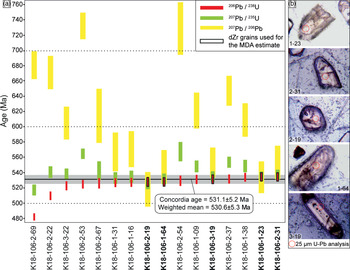
Since the youngest detrital zircon grains (group Z1) have statistically irrelevant ages (481 Ma and 509 Ma) and contradict the geological configuration in the region, they should not be applied to estimate a maximum depositional age of the host rocks. Among the studied dZr, we used five grains that were younger than 535 Ma (Fig. 8b) for which all three age estimates were concordant within a 1σ error (Fig. 8a) and |D1and2| < 5 to constrain the MDA (maximum depositional age) of the host strata. The calculated concordia and weighted mean 206Pb/238U ages for these grains are very close: 531.1 ± 5.2 Ma (MSWD, 0.70; probability, 0.40) and 530.6 ± 5.3 Ma (MSWD, 0.34; probability, 0.85) (Fig. 7c).
(a) Correlation of 206Pb/238U, 207Pb/235U and 207Pb/206Pb age estimates for the youngest detrital zircons from sample K18-106. (b) Stacked series of optical plane-polarized images of the five youngest concordant detrital zircons used for the MDA estimate (Fig. 7c). MDA – maximum depositional age.

5. Discussion
5.a. Age of the Moty Group
The documented small skeletal fossils provide a low degree of certainty regarding the age of the Moty Group of the Irkutsk Cis–Sayans Uplift. Morphologically primitive tubular Cambrotubulus, which are abundant in the Fortunian and are typical of the basal Cambrian Siberian Anabarites trisulcatus SSF zone, first appear in the terminal Ediacaran strata (Khomentovsky & Karlova, Reference Khomentovsky and Karlova1993; Nagovitsin et al. Reference Nagovitsin, Rogov, Marusin, Karlova, Kolesnikov, Bykova and Grazhdankin2015; Zhu et al. Reference Zhu, Zhuravlev, Wood, Zhao and Sukhov2017).
The dolostones of the lower Irkut Formation include abundant horizontal burrows, including those putatively produced by priapulids (Treptichnus) and arthropods (Monomorphichnus), and only scarce simple vertical shafts (Skolithos). Only thin intervals of the trace fossil-bearing beds are bioturbated, whereas most of the bed volume reveals undisrupted original sedimentary structures. The ichnotaxonomic composition and stratigraphic distribution of the trace fossils in the upper Irkut Formation are consistent with Fortunian ichnoassemblages (Mángano & Buatois, Reference Mángano and Buatois2014, Reference Buatois2017). The later stages of the behavioural evolution of endobenthos (younger than c. 530 Ma) reveal the development of complex burrowing principles (e.g. spreiten burrows), wide distributions of vertical shafts, and associated prominent increases in bioturbation depths and densities (Mángano & Buatois, Reference Mángano and Buatois2014; McIlroy & Brasier, Reference McIlroy, Brasier, Brasier, McIlroy and McLoughlin2016; Gougeon et al. Reference Gougeon, Mángano, Buatois, Narbonne and Laing2018), which are undocumented in the Moty Group.
The lack or scarcity of trace fossils similar to those documented in the lower Irkut Formation in the underlying strata is putatively attributed to environmental conditions and sedimentary regimes that were unfavourable for Terreneuvian endobenthos: mud and mixed flat and alluvial–deltaic settings. This assumption is supported by a facies-distribution analysis of Treptichnus pedum in the lower Fortunian strata (Buatois et al. Reference Buatois, Almond and Germs2013; Buatois, Reference Buatois2017) and by statistical analyses of the colonization rates of continental and marine environments by burrowing bilaterians (Buatois et al. Reference Buatois, Gingras, MacEachern, Mángano, Zonneveld, Pemberton, Netto and Martin2005, Reference Buatois, Mángano, Minter, Zhou, Wisshak, Wilson and Olea2020; Minter et al. Reference Minter, Buatois, Mángano, MacNaughton, Davies, Gibling, Mángano and Buatois2016, Reference Minter, Buatois, Mángano, Davies, Gibling, MacNaughton and Labandeira2017). The delayed colonization of the shoreface environments by burrowing organisms, as opposed to offshore environments, also explains the moderate bioturbation and lack of typical Cambrian Stage 2 complex tunnels and spreiten burrows in the lower Irkut Formation when considering the U–Pb concordia age of 531.1 ± 5.2 Ma (weighted mean, 530.6 ± 5.3 Ma) of detrital zircons from the host strata. We presume that the absence of trace fossils in the dolostones of the upper Irkut and lower Usol’e formations was caused by a minimal lithological contrast of the host strata (as well as burrow–host sediment contrasts) and a lack of sand-sized siliciclastic material, which prevented preservation of ichnofabrics and individual burrows during diagenetic recrystallization of the host carbonate sediments.
As noted in Section 2, a previous study of the Moty Group (Sovetov, Reference Sovetov2018) suggested a Fortunian age for the upper Shaman Formation and overlying strata based on a similar ichnoassemblage composition of this unit and in the Ust’–Tagul Formation of the Biryusa Cis–Sayans Uplift. The latter does exhibit a typical Fortunian assemblage (Sovetov & Jensen, Reference Sovetov and Jensen2010; Sovetov, Reference Sovetov2018, fig. 3b). However, the structures from the upper Shaman Formation, which were previously interpreted as Treptichnus pedum, cannot be undisputedly assigned to this ichnospecies (see Section 4a). Since the oldest treptichnids are known from the terminal Ediacaran (Jensen et al. Reference Jensen, Saylor, Gehling and Germs2000; Mángano & Buatois, Reference Mángano and Buatois2014), the Treptichnus isp. from the upper Shaman Formation do not necessitate a Fortunian age for the host and overlying strata.
The Ediacaran–Cambrian transitional interval is characterized by considerable δ13C variations in carbonates between negative (exceeding –6‰) and positive values (up to 7‰) (e.g. Maloof et al. Reference Maloof, Porter, Moore, Dudás, Bowring, Higgins, Fike and Eddy2010; Peng et al. Reference Peng, Babcock, Cooper, Gradstein, Ogg, Schmitz and Ogg2012; Smith et al. Reference Smith, Macdonald, Petach, Bold and Schrag2016). Considering the carbon isotope data separately, the recorded shift from mainly positive δ13C values (up to 3.1‰) in the lower Irkut Formation to negative values (reaching –4.3‰) in its upper part and in the lower Usol’e Formation matches the analogues throughout the entire terminal Ediacaran and Terreneuvian carbon isotope record. The composite carbon isotope curve reveals similar transitions, such as: the late Ediacaran positive carbon isotope plateau (EPIP) (Grotzinger et al. Reference Grotzinger, Bowring, Saylor and Kaufman1995; Boggiani et al. Reference Boggiani, Gaucher, Sial, Babinski, Simon, Riccomini, Ferreira and Fairchild2010; Zhu et al. Reference Zhu, Zhuravlev, Wood, Zhao and Sukhov2017; Linnemann et al. Reference Linnemann, Ovtcharova, Schaltegger, Gärtner, Hauntmann, Geyer, Vickers-Rich, Rich, Plessen, Hofmann, Zieger, Krause, Kreisfeld and Smith2019) and basal Cambrian negative δ13C excursion (BACE) (Zhu et al. Reference Zhu, Babcock and Peng2006; Bowring et al. Reference Bowring, Grotzinger, Condon, Ramezani, Newall and Allen2007; Landing et al. Reference Landing, Geyer, Brasier and Bowring2013); any of the positive (2p-3p-4p; Maloof et al. Reference Maloof, Porter, Moore, Dudás, Bowring, Higgins, Fike and Eddy2010) to negative peaks in the Fortunian; and the transition from the prominent basal Cambrian Stage 2 positive carbon isotope excursion to the following negative values (SHICE or Shiyantou carbon isotope excursion) (Peng et al. Reference Peng, Babcock, Cooper, Gradstein, Ogg, Schmitz and Ogg2012; Wood et al. Reference Wood, Liu, Bowyer, Wilby, Dunn, Kenchington, Cuthill, Mitchell and Penny2019). The overall morphology of these carbon isotope anomalies (short peaks versus extensive plateaus) depends highly on sedimentation rates and depositional histories of every particular section on which the composite curve is based. Hence, the shapes of these excursions themselves do not provide evidence that corresponds to the carbon isotope record of the Moty Group.
The U–Pb ages obtained for the five youngest detrital zircon grains from the lower Irkut Formation suggest that the host rocks are younger than 530 Ma (Fig. 6). In this case, the positive δ13C values correspond to the basal Cambrian Stage 2 excursion. In the composite curve, this excursion (c. 529–525 Ma) is named ZHUCE (Zhujiaqing carbon isotope excursion) since it was originally recorded in the Dahai Member of the Zhujiaqing Formation (Yunnan Province, South China) (e.g. Zhu et al. Reference Zhu, Babcock and Peng2006; Peng et al. Reference Peng, Babcock, Cooper, Gradstein, Ogg, Schmitz and Ogg2012). In some sections (e.g. Morocco, northwestern Siberian Platform and Mongolia), however, the lower Cambrian Stage 2 strata are characterized by two distinct positive excursions (in stratigraphic order, 5p and 6p) (Kouchinsky et al. Reference Kouchinsky, Bengtson, Pavlov, Runnegar, Torssander, Young and Ziegler2007; Maloof et al. Reference Maloof, Porter, Moore, Dudás, Bowring, Higgins, Fike and Eddy2010, Smith et al. Reference Smith, Macdonald, Petach, Bold and Schrag2016). Any correlation between these two and ZHUCE is controversial (e.g. Marusin et al. Reference Marusin, Kochnev, Karlova and Nagovitsin2019 for discussion). First, the South China sections do not exhibit any evidence of a second positive excursion above the base of the Cambrian Stage 2 before a shift to negative values (e.g. Li et al. Reference Li, Ling, Shields-Zhou, Chen, Cremonese, Och, Thirlwall and Manning2013). Second, some age estimates of ZHUCE excursion localize it at c. 527–526 Ma (Tsukui et al. Reference Tsukui, Isozaki, Zhu, Ramezani, Sato, Zhang and Bowring2017), whereas the first Cambrian Stage 2 index skeletal fossils (Aldanella attleborensis and Watsonella crosbyi) occur in rocks with positive δ13C values but as early as 530 Ma (Grazhdankin et al. Reference Grazhdankin, Marusin, Izokh, Karlova, Kochnev, Markov, Nagovitsin, Sarsembaev, Peek, Cui and Kaufman2020). The data from the Irkutsk Cis–Sayans Uplift do not provide undisputed evidence regarding which of the lower Cambrian Stage 2 excursions (5p, 6p, ZHUCE) corresponds to the excursion in the lower Irkut Formation. However, the positive-to-negative δ13C shift in the middle Irkut Formation that follows a negative plateau (Fig. 6) most likely corresponds to a similar change near the top of ZHUCE in South China and 6p in Siberia, Mongolia and Morocco (Maloof et al. Reference Maloof, Porter, Moore, Dudás, Bowring, Higgins, Fike and Eddy2010).
The integrated palaeontological, carbon isotope and geochronological data provide solid evidence for accumulation of the Irkut Formation no earlier than c. 530 Ma. Our data provide no evidence for the age of the underlying alluvial to deltaic siliciclastic Shaman and Khuzhir formations. The lower Cambrian boundary commonly lies near or corresponds to an unconformity or sequence boundary (the so-called ‘Great Unconformity’; e.g. Peters & Gaines, Reference Peters and Gaines2012), which precedes the accumulation of marine deposits during the ‘Lower Cambrian transgression’. The unconformity at the base of the Khuzhir Formation (Fig. 1b, d) is therefore one of the levels, and the Cambrian boundary may correspond to the unconformity in the Irkutsk Cis–Sayans Uplift. However, recent detailed evaluations of the stratigraphic completeness of key Ediacaran–Cambrian successions show significant diachronism of the unconformity (in many cases, the boundary occurs within continuous transgressive or highstand successions), which resulted from the interplay of eustasy and local tectonics for each particular basin (Shahkarami et al. Reference Shahkarami, Buatois, Mángano, Hagadorn and Almond2020). Alternatively, the Cambrian boundary may be somewhere in the Shaman Formation. This assumption is indirectly supported by data from boreholes in the Irkutsk Amphitheatre, where deposits underlying the Usol’e Formation reach at least 300 m in thickness and are known as the Moty Formation (Vinogradov et al. Reference Vinogradov, Belenitskaya, Bujakaite, Kuleshov, Minaeva and Pokrovskii2006). These deposits share similar lithological trends with the Irkutsk Cis–Sayans Uplift section. The lower parts of the sections (e.g. lower–middle Moty Formation in the Irkutsk Amphitheatre and the Shaman Formation in the Irkutsk Cis–Sayans Uplift) are transgressive, whereas the upper parts (upper Moty – lower Usol’e, and upper Irkut – lower Usol’e transitions) are regressive. The lithological disparity of this unit and the siliciclastic Shaman Formation of the Irkutsk Cis–Sayans Uplift putatively mirror the spatiotemporal distributions of facies as a result of changes in sedimentary regime, and are coherent with global trends in early Cambrian facies distributions for the Siberian Platform according to Rozanov (Reference Rozanov1992) and Sukhov et al. (Reference Sukhov, Shabanov, Pegel, Saraev, Filippov, Korovnikov, Sundukov, Fedorov, Varlamov, Efimov, Kontorovich and Kontorovich2016). These authors correlated negative δ13C values (reaching –6‰) in the carbonate middle Moty Formation (250–300 m) with the BACE excursion (Vinogradov et al. Reference Vinogradov, Belenitskaya, Bujakaite, Kuleshov, Minaeva and Pokrovskii2006). However, with no additional data currently available (e.g. biostratigraphic data and/or detrital zircon ages), the documented negative excursion alternatively corresponds to any of those in the Fortunian carbon isotope record (e.g. Kouchinsky et al. Reference Kouchinsky, Bengtson, Pavlov, Runnegar, Torssander, Young and Ziegler2007; Maloof et al. Reference Maloof, Porter, Moore, Dudás, Bowring, Higgins, Fike and Eddy2010).
Both of these alternatives are speculative because the Shaman and Khuzhir formations consist of alluvial to deltaic successions and therefore present minimal potential for further bio- and chemostratigraphic studies. Detrital zircon geochronology becomes the only tool that can potentially shed light on the location of the Ediacaran–Cambrian boundary within the Moty Group. In its present state, the lower Cambrian boundary may correspond to any level between the Olkha and Irkut formations, and is not mirrored in the palaeontological and carbon isotope records.
5.b. Tectonic settings of the southwestern Siberian Platform during late Ediacaran and Terreneuvian time
Although the lithology of the upper Ediacaran and lower Cambrian strata varies among the regions of the Siberian Platform (e.g. carbonates in the central area and SW with mixed carbonate-siliciclastic sequences in the NE and alongside the SW margin) (Sukhov et al. Reference Sukhov, Shabanov, Pegel, Saraev, Filippov, Korovnikov, Sundukov, Fedorov, Varlamov, Efimov, Kontorovich and Kontorovich2016), all sequences reflect accumulation during eustatic sea-level rise (e.g. Peng et al. Reference Peng, Babcock, Cooper, Gradstein, Ogg, Schmitz and Ogg2012). Changes in lithology from the central to northeastern Siberian Platform mirror the transition from subtidal–intertidal and/or lagoonal environments to the open-marine settings of the passive margin (e.g. Rozanov, Reference Rozanov1992; Khomentovsky & Karlova, Reference Khomentovsky and Karlova1993; Pelechaty et al. Reference Pelechaty, Grotzinger, Kashirtsev and Zhernovsky1996), although evidence of local rifting and related magmatism is documented for the Olenek and Kharaulakh regions of the northeastern Siberian Platform (Pelechaty et al. Reference Pelechaty, Grotzinger, Kashirtsev and Zhernovsky1996; Grazhdankin et al. Reference Grazhdankin, Marusin, Izokh, Karlova, Kochnev, Markov, Nagovitsin, Sarsembaev, Peek, Cui and Kaufman2020).
In contrast, the accumulation of thick Ediacaran–Cambrian carbonate-siliciclastic successions along the southwestern margin of the platform (southern Yenisei Ridge, Biryusa Cis–Sayans Uplift, Irkutsk Cis–Sayans Uplift and Cis–Baikal region) reflects filling of the accommodation space of the foreland basin during sea-level rise (Sovetov, Reference Sovetov2002, Reference Sovetov2018). This foreland basin was formed during early Ediacaran time by multistage accretion of terranes and island arcs at the southwestern margin of the Siberian Platform (e.g. Vernikovsky et al. Reference Vernikovsky, Kazansky, Matushkin, Metelkin and Sovetov2009; Gladkochub et al. Reference Gladkochub, Stanevich, Mazukabzov, Donskaya, Pisarevsky, Nicoll, Motova and Kornilova2013; Letnikova et al. Reference Letnikova, Kuznetsov, Vishnevskaya, Veshcheva, Proshenkin and Geng2013; Priyatkina et al. Reference Priyatkina, Collins, Khudoley, Letnikova and Huang2018). It was suggested previously that these terranes are (from west to east) the Predivinsk (Vernikovsky et al. Reference Vernikovsky, Kazansky, Matushkin, Metelkin and Sovetov2009), Kan/Arzybey, Tuva–Mongolia, Shaman and Baikal–Muya blocks (Gladkochub et al. Reference Gladkochub, Donskaya, Stanevich, Pisarevsky, Zhang, Motova, Mazukabzov and Li2019). Distinct (or even dominant) Neoproterozoic age clusters of detrital zircons from the Ediacaran–Cambrian sandstones of the southern Yenisei Ridge (Redkolesnaya Formation; Priyatkina et al. Reference Priyatkina, Collins, Khudoley, Letnikova and Huang2018), Biryusa Cis–Sayans Uplift (Ust’–Tagul Formation; Priyatkina et al. Reference Priyatkina, Collins, Khudoley, Letnikova and Huang2018) and Cis–Baikal region (Ushakovka Formation; Gladkochub et al. Reference Gladkochub, Stanevich, Mazukabzov, Donskaya, Pisarevsky, Nicoll, Motova and Kornilova2013) suggest that these terranes and island arcs, along with the Siberian Platform, were the main sources of clastic material that accumulated in the foreland basin. The generally NE-directed palaeocurrents that were reconstructed for these formations indicate that the source rocks were mostly on the southwestern and southern periphery of the palaeobasin and outside the platform (Sovetov, Reference Sovetov2002; Priyatkina et al. Reference Priyatkina, Collins, Khudoley, Letnikova and Huang2018). The dominant ‘non-Siberian’ Neoproterozoic detrital zircon grains (Z1 group) and only accessory Palaeoproterozoic zircons from the Siberian Platform (Z2–Z4 groups) in the Irkut Formation of the Irkut Cis–Sayans Uplift (Fig. 7d) support this suggestion. The accretion of different blocks on the southwestern and southern margins of the platform is mirrored in variations in the compositions of the siliciclastic rocks filling the foreland basin, and is suggested as the main cause of the variations in the accommodation space, the sedimentation rates and hence the thickness of the upper Ediacaran and lower Cambrian siliciclastic strata (350 m, southern Yenisei Ridge; 150 m, Biryusa Cis–Sayans Uplift; 450 m, Irkutsk Cis–Sayans Uplift; and c. 1 km, southwestern Cis–Baikal Region) among the discussed sections (Fig. 3; Sovetov, Reference Sovetov2018; Gladkochub et al. Reference Gladkochub, Donskaya, Stanevich, Pisarevsky, Zhang, Motova, Mazukabzov and Li2019). However, since at least c. 530 Ma, all of these sections exhibit more or less similar compositions (shallow-marine carbonates) and reveal no evidence of active tectonics (Sovetov, Reference Sovetov2002; Vernikovsky et al. Reference Vernikovsky, Kazansky, Matushkin, Metelkin and Sovetov2009; Sukhov et al. Reference Sukhov, Shabanov, Pegel, Saraev, Filippov, Korovnikov, Sundukov, Fedorov, Varlamov, Efimov, Kontorovich and Kontorovich2016). Hence, the transition from mostly siliciclastic Ediacaran–Cambrian strata to shallow-marine Cambrian carbonates that is observed in all sections along the southwestern margin of the Siberian Platform mirrors the final stages of filling of the foreland basin and the further development of shallow epicontinental marine settings (Sovetov, Reference Sovetov2002, Reference Sovetov2018).
As was briefly discussed in Section 2, regional correlation commonly plays the major role in age calibrations of the terminal Ediacaran and lower Cambrian transitional strata of the southwestern Siberian Platform. However, scarce palaeontological and unequivocal carbon isotope records often mean that this approach is substantiated only by lithology and facies distributions. Among the units discussed, the salt-bearing carbonate Usol’e Formation clearly illustrates this dilemma. In the ratified correlation schemes and most regional studies (e.g. Krasnov et al. Reference Krasnov, Savitsky, Tesakov and Khomentovsky1983; Shenfil’, Reference Shenfil’1991; Sukhov et al. Reference Sukhov, Shabanov, Pegel, Saraev, Filippov, Korovnikov, Sundukov, Fedorov, Varlamov, Efimov, Kontorovich and Kontorovich2016), this formation is ubiquitously correlated with the Tommotian Stage of the General Stratigraphic Scale of Russia (sensu stricto, upper part of the Cambrian Stage 2) across the entire southwestern Siberian Platform (> 1×10⁶ km2). The brecciated dolostones and salt beds, which are treated as regional markers of the basal Usol’e Formation, sporadically occur as thin interbeds within the underlying shallow-marine carbonates, as is seen in the studied section (Fig. 2c) and, moving northwards, in the Tetere–Usol’e transitional interval of the Angara–Nepa region (Melnikov et al. Reference Melnikov, Yakshin, Shishkin, Efimov, Karlova, Kilina, Konstantinova, Kochnev, Kraevskiy, Melnikov, Nagovitsyn, Postnikov, Ryabkova, Terleev and Khabarov2005). The similar compositions of the underlying deposits therefore cause precise identification of the lower boundary of the Usol’e Formation to be highly controversial.
Our data support some earlier studies (Kochnev et al. Reference Kochnev, Pokrovsky, Kuznetsov and Marusin2018; Marusin et al. Reference Marusin, Kochnev, Karlova and Nagovitsin2019) demonstrating that, in at least some regions of the central and southwestern Siberian Platform (Turukhansk–Irkutsk–Olekma facies region), the beginning of Cambrian Stage 2 corresponds to the accumulation of shallow-marine carbonates with no evidence of increased salinity. The salt-bearing lagoonal carbonates, which are ubiquitous within this facies region (Usol’e Formation in the southwestern sections, Bilir Formation in the central sections, and Kostino Formation in the northwestern sections) and have traditionally been regarded as the regional stratigraphic marker (e.g. Krasnov et al. Reference Krasnov, Savitsky, Tesakov and Khomentovsky1983; Sukhov et al. Reference Sukhov, Shabanov, Pegel, Saraev, Filippov, Korovnikov, Sundukov, Fedorov, Varlamov, Efimov, Kontorovich and Kontorovich2016), have a highly diachronous lower boundary, which reflects transgressive–regressive trends and the general palaeorelief of the Siberian Platform during early Cambrian time (i.e. shallowing towards the central part of the platform).
The integrated palaeontological, chemostratigraphic and geochronological study of the Moty Group of the Irkutsk Cis–Sayans Uplift and the summary of age estimates presented for the Ediacaran–Cambrian sections of adjacent areas demonstrate that straightforward lithological correlations potentially cause dramatic misinterpretations of the ages and depositional histories of the strata. Considering the complicated tectonic history of the region and the specific lithological composition of these sections, which are quite unfavourable biostratigraphic methods and limit the application of carbon isotope chemostratigraphy, a combination of geochemical, geochronological and palaeontological methods may be necessary to yield precise age estimates and provide a robust framework for the correlation and further reconstruction of basin evolution.
6. Conclusions
The first appearance of the Cambrian boundary index-ichnotaxon Treptichnus pedum at 28 m above the base of the Irkut Formation, shallow bioturbation and overall composition of the associated ichnoassemblage suggest at least a Fortunian age (younger than 541 Ma) for the host strata.
The positive δ13C excursions in the lower Irkut Formation and U–Pb concordia age of 531.1 ± 5.2 Ma (weighted mean, 530.6 ± 5.3 Ma) obtained from the five youngest detrital grains from the same strata reveal that this unit corresponds to Cambrian Stage 2.
Within the Irkutsk Cis–Sayans Uplift, the base of the Cambrian System putatively corresponds to the unconformity at the base of the Khuzhir Formation or lies somewhere within the alluvial to deltaic Khuzhir and Shaman formations, and is not mirrored in the palaeontological and isotope record. The lack of typical Fortunian trace fossils in the siliciclastic Shaman Formation supports the suggestions that the alluvial-deltaic and intertidal marine settings remained barely occupied by burrowing bilaterians before c. 530 Ma.
Supplementary material
To view supplementary material for this article, please visit https://doi.org/10.1017/S0016756820001132
Acknowledgements
This research was supported by the Russian Foundation for Basic Research (grant nos 17-05-00852 and 20-35-70016 to VM for fieldwork and biostratigraphy; grant no. 19-05-00794 to NK for fieldwork; grant no. 19-05-00427 to BP for fieldwork and chemostratigraphy; and grant no. 17-05-00021 to AS for fieldwork) and the Russian Government (grant no. 2019-220-07-9711 NK, AS and SR for geochronology). We thank Dmitriy P. Gladkochub and Zinaida L. Motova (Institute of the Earth’s Crust SB RAS, Irkutsk) for their help with the organization of fieldwork in the Irkutsk Cis–Sayans Uplift area. The insightful comments from Andrey K. Khudoley (Saint-Petersburg State University) and Nadezhda A. Kanygina (Geological Institute of RAS, Moscow) are warmly appreciated. We thank the editor Peter Clift and two anonymous reviewers for their valuable comments and recommendations, which improved the manuscript considerably.
Declaration of interest
None.