There is a country in Europe … whose foreign policy is to let other nations alone …. Any attempt it makes to exert influence over them, even by persuasion, is rather in the service of others, than itself: to mediate in the quarrels which break out between foreign states, to arrest obstinate civil wars, to reconcile belligerents, to intercede for mild treatment of the vanquished, or finally, to procure the abandonment of some national crime and scandal to humanity such as the slave trade.
John Stuart Mill, “A Few Words on Non-Intervention”
States can be invaded and wars justly begun to assist secessionist movements (once they have demonstrated their representative character) to balance the prior interventions of other powers, and to rescue people threatened with massacres … because [these actions] uphold the values of individual life and communal liberty of which sovereignty itself is merely an expression.
Michael Walzer, Just and Unjust Wars
Nonintervention has been a particularly important and occasionally disturbing principle for liberal scholars, such as John Stuart Mill and Michael Walzer, who share a commitment to basic and universal human rights.Footnote 1 On the one hand, liberals have provided some of the strongest reasons to abide by a strict form of the nonintervention doctrine. It was only with the security of national borders that peoples could work out the capacity to govern themselves as free citizens. On the other hand, those very same principles of universal human dignity when applied in different contexts have provided justifications for overriding or disregarding the principle of nonintervention.
In explaining this dual logic I present an interpretive summary of Mill's famous argument against and for intervention, presented in his “A Few Words on Non-Intervention” (1859), that illustrates what makes Mill's “few words” both so attractive and alarming to us. We should be drawn to Mill's arguments because he is among the first to address the conundrums of modern intervention. The modern conscience tries simultaneously to adhere to three contradictory principles: first, the cosmopolitan, humanitarian commitment to assistance, irrespective of international borders; second, respect for the significance of communitarian, national self-determination; and, third, accommodation to the reality of international anarchy, which puts a premium on self-help national security. I stress, more than has been conventional, the consequentialist character of the ethics of both nonintervention and intervention. It makes a difference whether we think that an intervention will do more good than harm, and some of the factors that determine the outcome are matters of strategy and institutional choice. I also engage in a one-sided debate with Mill as I explore the significance of the many historical examples he employs to support his argument. Do they really support his conclusions? Could they, given what he knew or should have known? Given what we now think we know? My conclusion is that, persuasive as the moral logic of his argument for liberal intervention sometimes is, the actual histories of the cases he cites actually tend to favor a bias toward nonintervention—that is, against overriding or disregarding nonintervention. That said, enough of his argument survives to warrant a firm rejection of strict noninterventionism.Footnote 2
Principles of nonintervention and intervention have been justified in various ways. In international law, “intervention” is not any interference but, according to Lassa Oppenheim, the influential late-nineteenth-century international legal scholar, it is “dictatorial interference” in the political independence and territorial integrity of a sovereign state. No single treaty has codified principles underlying this prohibition, and customary international law, while condemning intervention, contains numerous but contested exceptions.Footnote 3 Relevant principles in the just war tradition have been proposed by scholars, by politicians, and by citizens who have sought to provide good reasons why one should abide by these conventional principles of classic international law and good reasons why one should, on some occasions, breach them.Footnote 4
Mill made one of the most persuasive (though far from the first) contributions to this ongoing debate. And Michael Walzer has modernized, limited, and deepened three of Mill's most important arguments. Comparing Mill's “Non-Intervention” and Walzer's Just and Unjust Wars (1977) links two classic statements on just wars of intervention. Both are rooted in the liberal tradition that values freedom and equality and holds that those values should enter into foreign policy. Liberals tend to reject the moral skepticism of the realists that prioritizes the quest for power as the essential aim of statecraft.Footnote 5 But liberals also differ among themselves. Liberals supporting intervention fall into various camps. Some—strong cosmopolitans—hold that the rights of cosmopolitan freedom are valuable everywhere for all people. Any violation of these rights should be resisted whenever and wherever such violation occurs, provided that we can do so proportionally, without causing more harm than we seek to avoid.Footnote 6 But other liberals—and here we include Mill and Walzer, both often labeled as communitarians—limit the cases that justify intervention. Significantly, Mill argues for much more intervention than Walzer accepts. Both, however, start with nonintervention as the default position.
UNDERLYING PRINCIPLES
John Stuart Mill developed the core of a modern understanding of human dignity as “autonomy” and its implications for hard political choices. He saw humans as fundamentally equal, sentient beings capable of experiencing pleasure and pain. Our natural sympathy should thus lead us to choose acts and rules that maximize pleasure and minimize pain for the greatest number. But—an important qualification—he wanted to constrain this maximization of utility by prioritizing both the freedom to lead unrestricted lives (as long as those life plans did not harm the freedom of others) and the realization that not all pleasures and pains were equal. Some pleasures were higher, some lower. Some expressed human creativity, others did not. Poetry was better than “pushpin.”Footnote 7
Michael Walzer starts from a less foundational premise when he discusses rights and duties, one that looks at the practices of political communities and encompasses a wide set of varying spheres in which “complex equality” principles of justice apply differently to different goods.Footnote 8 Nonetheless, resting his arguments on consent, he arrives at liberal principles of basic human rights that shape both domestic and international policy.
Politically, both Mill and Walzer defend two ideal principles. The first is maximum equal liberty, allowing each adult to develop his or her own potentiality on the view that each individual is the best judge of what is and is not in his or her interest, so long, however, as no one interferes with the equal liberty of others. When public regulation is necessary, the second principle, representative government, should govern. To maximize effective consent and the utility of collective decisions it would be best to give decisive weight to the preferences of the majority, as represented by knowledgeable politicians.Footnote 9
Internationally, one might think that these principles would give rise to a commitment to an international version of the U.S. Constitution's “Guarantee Clause” (Article 4, Section 4), in which each state is guaranteed (that is, required to have) a republican representative form of government, and the Fourteenth Amendment, in which all states are required to provide equal protection of the laws to all persons. But neither for Mill nor for Walzer is this so. Instead, they argue against that kind of a global guarantee, drawing thereby an important line between domestic and international justice.
Arguments against intervention have taken the form of both direct principles and indirect (or procedural) considerations. Like many liberals, Mill dismissed without much attention some realist arguments in favor of intervention to promote “territory or revenue” in order to enhance national power, prestige, or profits. However prevalent those motives have been in history, they lack moral significance, as, Mill noted, do justifications associated with some liberal or socialist arguments that favor intervening to promote an idea or ideology.Footnote 10 War and intervention, according to Mill, has to be justified by morally relevant reasons of self-defense or beneficence.
The most important direct consideration for liberals was that nonintervention reflected and protected human dignity. Nonintervention allowed citizens to determine their own way of life without outside interference. If democratic rights and liberal freedoms were to mean something, they had to be worked out among those who shared them and were making them through their own participation. Immanuel Kant's “Perpetual Peace” (1795) had earlier made a strong case for respecting the right of nonintervention because it afforded a polity the necessary territorial space and political independence in which free and equal citizens could work out what their own way of life would be.Footnote 11 For Mill, intervention avowedly to help others actually undermines the authenticity of domestic struggles for liberty. First, a free government achieved by means of intervention would not be authentic or self-determining but determined by others, and not one that local citizens had themselves defined through their own deliberations and actions. “But the evil [of intervention],” Mill declares, “is, that if they have not sufficient love of liberty to be able to wrest it from merely domestic oppressors, the liberty which is bestowed on them by other hands than their own, will have nothing real, …”Footnote 12
Mill provides a second powerful direct argument for nonintervention, one focusing on likely consequences, when he explains in his famous 1859 essay that it would be a great mistake to export freedom to a foreign people that was not in a position to win it on its own. In addition to not being “real,” forcibly imported freedom would have “nothing permanent” to it.Footnote 13 A people given freedom by a foreign intervention would not, he argued, be able to hold on to it. Connecting permanence to reality, he notes that it is only by winning and holding on to freedom through local effort that one acquires a true sense of its value. Moreover, it is only by winning the “arduous struggle” for freedom that one acquires the political capacities to defend it adequately against threats of foreign invasion or domestic suppression, whether by force or subtle manipulation.Footnote 14 The struggle made self-determination a reality and sustainable by mobilizing citizens into what could become a national army capable of guarding the frontiers and into a citizenry willing to tax themselves to sustain a state.
If, on the other hand, liberal government were to be introduced into a foreign society, in the “knapsack” (so to speak) of a conquering liberal army, the local liberals placed in power would find themselves immediately in a difficult situation. Not having been able to win political power on their own, they would have few domestic supporters and many nonliberal domestic enemies. They then would wind up doing one of three things:
1 Begin to rule as did previous governments—that is, by repressing their opposition and acting to “speedily put an end to all popular institutions.”Footnote 15 The intervention would have done no good; it simply would have created another oppressive government.
2 Simply collapse in an ensuing civil war. Intervention, therefore, would have produced not freedom and progress, but a civil war with all its attendant violence.
3 Become dependent on interveners who would continually have to send in foreign support. Rather than having established a free government, one that reflected the participation of the citizens of the state, the intervention would have created a puppet government, one reflecting the wills and interests of the intervening state.
A third argument against intervention points to the difficulties of transparency or uncertainty. Historically, it has proven difficult to identify authentic “freedom fighters.” Particular national regimes of liberty and oppression are difficult for foreigners to “unpack.” They often reflect complicated historical compromises—contracts of a Burkean sort among the dead, the living, and the yet to be born. Michael Walzer acknowledges, as did Mill, that sovereignty and the legitimacy of intervention ultimately depend upon the consent of those intervened against (or as Mill says, are subject to “their own spontaneous election”Footnote 16). If the people welcome an intervention, then, Walzer adds, “it would be odd to accuse them [the interveners] of any crime at all.”Footnote 17 But we cannot make those judgments reliably in advance, either because our information is incomplete or because the case is complicated by competing reasonable claims to justice. We should assume, Walzer suggests, that foreigners will be resisted, that nationals will protect their state from foreign aggression. For even if the state is unjust, it is their state, not ours. We have no standing to decide what their state should be. We do not happen to be engaged full-time, as they are, in the national historical project of creating it. Not every injustice that justifies a domestic revolution justifies a foreign intervention.
Fourth, the necessarily “dirty hands” of violent means often become “dangerous hands” in international interventions.Footnote 18 International history is rife with interventions justified by high-sounding principles—ending the slave trade or suttee or introducing law and order and civilized behavior—turning into self-serving, imperialist “rescues” in which the intervener stays to profit and control. Requiring that the intervener govern its actions according to the interests of the intervened, looking for something more than a unilateral decision, and respecting the multilateral processes of international law—these are important procedural considerations in weighing the justice of an intervention.
Fifth, almost all commentators in the just war tradition posit that just interventions may not violate the principles of proportionality and last resort. Villages should not be destroyed in order to be saved, and negotiation should be tried before forcible means are adopted.
Indirect reasons for nonintervention have also been important constraints. Interventions foster militarism, expend resources needed for other national and international goals, and violate international law. International laws embody the value of coordination and consensual legitimacy, for rules—almost any rules—have a value in themselves by helping to avoid unintended clashes with severe consequences to human life. International laws, moreover, are painstakingly achieved compromises among diverse moralities. The mere process of achieving consent makes them legitimate. They were agreed upon and pacta sunt servanda.Footnote 19
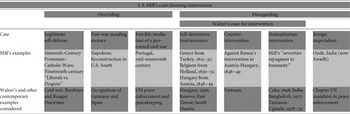
Despite their commitment to nonintervention, both Mill and Walzer identify exceptional circumstances that justify intervention. Mill identifies seven; Walzer, three. Some cases involve reasons to override the nonintervention principle; others, to disregard the principle. In the first, the principles in favor of nonintervention still hold, but other considerations seem more important. In the second, the presuppositions underlying the principles do not apply to the particular case.
EXCEPTIONS THAT OVERRIDE
Mill argued that there are three good reasons to override what should be the usual prohibition against intervention. In these arguments the considerations against intervention are present, but other more important values, “considerations paramount,” as Mill says, trump them.Footnote 20
First, Mill noted, “We must except, of course, any case in which such assistance is a measure of legitimate self-defense.”Footnote 21 Acknowledging the primacy of self-help in an anarchic international system, just war philosophers and international lawyers typically raise the difficult cases of intervention to enforce the rights of nationals or rescue them from unjust imprisonment (for example, the Don Pacifico Affair in the nineteenth century; more recently, the 1976 rescue of the Israeli airliner at Entebbe), or preemptive or preventive interventions designed to remove a looming threat before an attack takes place. But Mill, in the “Few Words” essay, focuses on a less familiar case: international civil war. In an international-system–wide war that is also an internationalized civil war, such as that waged between Protestantism and Catholicism in the sixteenth century, or liberalism and despotism in Mill's era, nonintervention can neglect vital transnational sources of national security. “If … this country [Great Britain], on account of its freedom, should find itself menaced with attack by a coalition of Continental despots, it ought to consider the popular party in every nation of the Continent as its natural ally: the Liberals should be to it, what the Protestants of Europe were to the Government of Queen Elizabeth.”Footnote 22 In the extreme case, if other governments are aligning with their ideological fellows overseas, irrespective of collective national interests or interstate borders, then not intervening in support of yours is dangerous.
Cases for Intervention: Mill and Walzer

This kind of logic led Sir Nicholas Throckmorton, the ambassador of Elizabeth I to France, to advocate intervention in support of fellow Protestants by warning: “Now when the general design is to exterminate all nations dissenting with them in religion … what will become of us, when the like professors [co-religionists] with us shall be destroyed in Flanders and France.”Footnote 23 It also resonates in twentieth-century cold war logic, and neatly matches the rhetoric of the Brezhnev Doctrine and the Reagan Doctrine. The latter pledged, “We must not break faith with those who are risking their lives … on every continent from Afghanistan to Nicaragua … to defy Soviet aggression and secure rights which have been ours since birth. Support for freedom fighters is self-defense.” Reagan thus adds “rollback” to the original “containment” of the Truman Doctrine.Footnote 24
In practice, the early cold war witnessed covert actions by the United States in Albania and China, and Soviet efforts to control local communist parties in Europe and elsewhere. Reagan and Brezhnev practiced their doctrines in Nicaragua and Czechoslovakia, respectively.Footnote 25 But the exceptions to cold war interventionism were at least as important. These included the West's support for Tito's Yugoslavia and the East's support for Third World nationalists, such as India's Nehru and Egypt's Nasser, not to speak of the effective combination of East-West détente with the “triangulation” effort devised by the Nixon administration to exploit the Chinese split from the Soviets in the 1970s.
Even during the polarizing religious wars of the sixteenth and seventeenth centuries, we should recall the lesson that Queen Elizabeth learned from the disastrous 1562–63 armed expedition to “Newhaven” (today Le Havre, in Normandy, France). In 1559 she had successfully intervened to roll back the Catholic threat in Scotland by sending troops to assist the more powerful faction of Scottish Protestant lords who were struggling against a regime sustained by French forces. When her more radical advisers pressed her to do the same in France, she reluctantly agreed to intervene in support of the French Protestant nobles in Normandy, only to see them defect to a better deal with their own monarch.Footnote 26 She thus learned to limit intervention to matters and territories of vital necessity (Scotland and preserving the independence of the Low Countries), and to armed action only with the support of strong local allies. She also developed a policy of alternately aligning with Spain and France, and successfully played them against each other.Footnote 27 A half century later Cardinal Richelieu wisely aligned with the Protestant principalities that would support France against the Holy Roman Empire and Catholic Spain, which were its greatest threats.
Thus, consistent as the logic of ideology-based intervention in internationalized civil war is, probing the actual examples suggests that Mill should want to adopt a bias toward more essential conceptions of “legitimate self-defense.” These kinds of interventions should be limited to vital national security and to cases where strong overseas allies can reduce the costs.
Second, Mill argues that following a successful defensive war against an aggressive despot, the liberal victor, rather than halting his armed forces at the restored border, can intervene to remove a “perpetual” or at least standing “menace” to peace, whether a person or a regime.Footnote 28 Mill's implicit reference was the sending of Napoleon to Elba, off the Italian coast, and later, after Waterloo and as if to prove the point, to St. Helena, far in the South Atlantic. Reconstruction in the U.S. South might also be seen to draw inspiration from these considerations. Indeed, in that case Mill later explicitly noted the need not just to remove Jefferson Davis from office but to “break altogether the power of the slaveholding caste” so that they did not “remain masters of the State legislatures [where] they will be able effectually to nullify a great part of the result which have been so dearly bought by the blood of the Free States.”Footnote 29
In modern times the relevant reference is “de-Nazification” in Germany following World War II and the breaking up of the imperial principle, the militarist faction, and the zaibatsu in Japan. The Allies clearly had a right to end German and Japanese aggression and drive their armies back to their borders. But could they reform Germany and Japan? And, if they could, what, asks Walzer, should the victors and vanquished pay to guarantee reliable security?Footnote 30 When should the victors relinquish the goals of unconditional surrender and pacific reconstruction in order to avoid further death among the vanquished, as well as the (soon to be) victors, that a campaign for total conquest will inevitably cost?
Walzer sharpens this dilemma, without (to my mind) fully resolving it. Should a negotiated arrangement have been struck with Nazi Germany, had it been willing to surrender to the Western Allies? The special nature of the evil of Nazism makes it apparent that this was not a deal Walzer would have wanted made, even to save the lives of many Allied soldiers and noncombatant Germans that the invasion of the German homeland consumed. Walzer does not address directly the Millian argument that an aggressive leader or regime could be removed by outside forces. He would have preferred a German revolution that toppled Nazism, with which the Allies could then have made peace. But he also argues that the Nazi leaders should have been tried and punished, and that, lacking a German revolution, the occupation of Germany was necessary to achieve this. For Walzer, the Nuremberg trials should have been an act of “collective abhorrence” for their crimes, rather than an act to prevent future aggression.Footnote 31 But that might have limited the occupation of Germany solely to conducting the trials.
An even harder case is Japan. Walzer argues that Japan's government should have been accommodated and that therefore Hiroshima and Nagasaki were two bombs too many (especially coming on top of the also unjustified firebombing of Tokyo and other Japanese cities, which violated jus in bello restrictions on attacking noncombatants). Unfortunately, Walzer's preference for a negotiated settlement would have required compromise from both the Japanese and the Americans. The United States failed to introduce flexibility into the meaning of the Potsdam terms early enough. But whereas Walzer sees the two bombs as too many, in fact they were barely adequate for their purpose, if their purpose was the surrender of Japan on terms likely to make a lasting peace. Ultimately, the victors conceded the emperor, but they demanded the authority to reconstruct Japan. It is not at all clear that the War Cabinet would have accepted this deal without the shock of the two bombs, and it has been argued that the threat of even more atomic bombs helped turn the tide toward a negotiated surrender.Footnote 32
Leaving Japan in the hands of the same militarists who launched the conquest of Asia would indeed have been unwise. Clearly, negotiation should have been tried earlier. But were there also other, less unjust, means of coercing the Japanese War Cabinet into a sufficiently complete surrender that would have permitted political reconstruction? Would a demonstration detonation have worked? What about a protracted naval blockade that prohibited Japan access to any goods other than food and medicine necessary for survival? Neither of these looked promising at the time (the looming competition with the Soviet Union also colored U.S. estimations of how to end the war); but in retrospect both seem to have been worth further exploration.
Mill's third exception, and one pertinent for today's debates on multilateral mediation and peacekeeping, Footnote 33 covers a “protracted civil war, in which the contending parties are so equally balanced that there is no probability of a speedy issue; or if there is, the victorious side cannot hope to keep down the vanquished but by severities repugnant to humanity, and injurious to the permanent welfare of the country.”Footnote 34 Here, Mill argues that some civil wars become so protracted and so seemingly irresolvable by local struggle that a common sense of humanity and sympathy for the suffering of the noncombatant population calls for an outside intervention to halt the fighting in order to see if some negotiated solution might be achieved under the aegis of foreign arms. Specifically, he cites the at least partial success of outsiders in calling a halt to and helping settle the Greek rebellion against the Ottoman Empire and the protracted mid-nineteenth-century Portuguese civil war.
In such circumstances outsiders can call for separation or reconciliation. In some cases, two peoples contending a single territory have been forced to separate and partition it. Greece was thus separated from Turkey. In 1830, Belgium was separated from Holland following the forceful mediation of two liberal statesmen, one British, one French—Palmerston and Guizot.Footnote 35 In others, two factions struggling to control and reform a single state, each in order to fulfill their own visions, have been forced to reconcile and share the territory.
Impartial mediation imposed power-sharing reconciliation without separation—the “equitable terms of compromise” insisted upon by Mill—on the Portuguese factions. This produced two generations of peace among the contesting factions under the rules of King Pedro (1853–61) and King Luis (1861–69). H. V. Livermore, one of the leading historians of Portugal, described the political scene in the first half of the century during the reign of Queen Maria as follows: “There were now three main currents of opinion in Portugal: absolutist, moderate and radical. Each had its constitutional and institutional preferences: the absolutists stood for no written constitution and the traditional cortes, summoned and not elected; the Chartist moderates for an octroye charter and a parliament of two houses; the Septembrist radicals for the constitution of 1822 and a cortes of a single chamber.”Footnote 36 Britain intervened in 1827 with a naval force, but only (Prime Minister Canning claimed) for the sake of “nonintervention,” in order to deter a right-wing intervention supported from Spain.
The intervention that Mill appears to have had in mind took place in 1846. Portuguese politics by then had split between the last two groups of liberals, the Chartists and the Septembrists—one “moderate” and pro-monarchical, the other “radical” and pro-constitutionalist. In the 1830s, Britain supported Queen Maria and her monarchist ministers. When the Septembrist constitutionalists took up arms, Palmerston (then foreign secretary) was cross-pressured between his ideological preference for the constitutionalists and Britain's established relationship with the monarchists. When France and Spain also agitated for intervention (on various sides), Palmerston sent Colonel Wylde as a special envoy to exercise what Palmerston called “a perspective of force” that involved pressuring them both and eventually led to a joint Anglo-Spanish armed force that cornered the recalcitrant Septembrists in Oporto. Palmerston required the queen to restore the constitution and civil liberties and deal with the constitutionalist rebels indulgently, and the rebels to lay down their arms.Footnote 37 It looked “ill at the commencement,” Mill commented, but “it could be justified by the event … a really healing measure.”Footnote 38
Nonetheless, it would be wrong to credit the 1846 intervention with either so much of, or so unequivocal, a benefit. The intervention may have been necessary, but it was far from sufficient to launch Portugal on a path of genuine peacebuilding. The decisive impetus for “healing measures” was less the compromise of 1846 than the (unpredictable) reform led by the wise and industrious King Pedro, who (a child in 1846) succeeded his mother in 1853. During his short reign (he died of cholera in 1861), Pedro helped construct a political center that served as the foundation for more extensive administrative reforms and the launching pad for an ambitious program of road and rail construction that began the economic modernization of the countryside.Footnote 39 Still, beneficent as that outcome was, England remained a constant presence, promoting the interests of British merchants in Portugal, bullying the Portuguese overseas when Britain's trade and colonial interests required interference, and, overall, limiting the effective sovereignty of Portugal. Better forcible mediations thus seem to require peacebuilding follow-through, focused on development and sovereignty.
EXCEPTIONS THAT DISREGARD
While some external considerations thus call for overriding nonintervention, there are other injustices that justify disregarding the prohibition against intervention. Sometimes the national self-determination that nonintervention is designed to protect is so clearly undermined by the domestic oppression and suffering that the principle should simply be disregarded. In these circumstances, the local government in effect loses its claim to rule as the representative of a singular national authority. The reasons for nonintervention, Mill then claims, should be disregarded because they operate in “an opposite way,”“the reasons themselves do not exist,” and intervention “does not disturb the balance of forces on which the permanent maintenance of freedom in a country depends.”Footnote 40
Building on Mill's essay, Walzer now reengages the Millian argument and discusses three cases where an intervention serves the underlying purposes that nonintervention was designed to uphold.Footnote 41 The first is when too many nations contest one piece of territory. When an imperial government opposes the independence of a subordinate nation or when there are two distinct peoples, one attempting to crush the other, then national self-determination cannot be a reason to shun intervention. What is missing is the “one” nation. Here foreigners can intervene to help the liberation of the oppressed people, once that people has demonstrated through its own “arduous struggle” that it truly is another nation. In such cases Mill adopts the principle of decolonialization, allowing a people to form its own state and shape its own destiny. One model of this might be the American Revolution against Britain; another in Mill's time was the 1848–49 Hungarian rebellion against Austria.Footnote 42 In another Hungarian case that Walzer considers, Hungary's 1956 rebellion against the Soviet empire, he warns that proportionality considerations also must be taken into account and that they rightly deterred effective assistance that might have escalated to World War Three.Footnote 43 Statespersons have long been hard-pressed to identify reliably when a people is truly a people and to recognize consistently what steps are needed to prove a nation's fitness for independence and justify foreign assistance. The many anticolonial movements in Africa and Asia and the secession of East Timor from Indonesia and Kosovo from Serbia seem to fit well into this category, but each also illustrates how much considerations of proportionality and necessity enter into the judgment of whether the particular secession warrants international support.
The second instance in which the principle against intervention should be disregarded is counter-intervention in a civil war. Generally, a civil war should be left to the combatants. When conflicting factions of one people are struggling to define what sort of society and government should rule, only that struggle should decide the outcomes, not foreigners. But when an external power intervenes on behalf of one of the participants in a civil war, then another foreign power can, in Mill's words, “re-dress the balance”—that is, counter-intervene to balance the first intervention. This second intervention serves the purposes of self-determination, which the first intervention sought to undermine. Even if, Mill argued, the Hungarian rebellion was not clearly a national rebellion against “a foreign yoke,” it was certainly the case that Russia should not have intervened to assist Austria in its suppression. By doing so, Russia gave others a right to counter-intervene: if “Russia gave assistance to the wrong side, England would aid the right.”Footnote 44 Following Mill, Walzer explores the Hungarian case and then extends the discussion into the Vietnam interventions of the 1960s (the Americans and North Vietnamese in South Vietnam). Here he bolsters Mill's conclusions on the importance of ensuring that foreign intervention or counter-intervention does not overwhelm the local struggle, the only legitimate determinant of who should govern.Footnote 45
Third, one can intervene for humanitarian purposes—to halt what appears to be a gross violation of the rights to survival of a population. When we see a pattern of massacres, the development of a campaign of genocide, the institutionalization of slavery—violations that are so horrendous that in the classical phrase repeated by Walzer they “shock the moral conscience of mankind”—one has good ground to question whether there is any national connection between the population and the state that is so brutally oppressing it. In discussing protracted civil wars in his “Non-Intervention” essay, Mill has already given “severities repugnant to humanity” as closely related humanitarian reasons to forcibly mediate a civil war. And humanitarian motives also arise in the next case for intervention, against the uncivilized “barbarians.” But, lacking the advantages of a twentieth-century perspective, Mill does not directly consider the case of an established, civilized government turning to massacre its own subjects or appear to understand how barbaric the thoroughly civilized can be.
Walzer, adding to Mill, argues that humanitarian intervention is different from intervening in a civil war, which also involves much suffering, for here the government may be in altogether too much control. But Walzer makes a good case that a disregarding logic should apply. Outsiders can intervene, but the intervener should have a morally defensible motive and share the purpose of ending the slaughter and establishing a self-determining people. Furthermore, interveners should act only as a “last resort,” after exploring peaceful resolution. They should then act only when it is clear that they will save more lives than the intervention itself will almost inevitably wind up costing, and even then with minimum necessary force. Humanitarian motives have often been exploited, as Walzer shows they were in the U.S. intervention in Cuba in 1898. But even though often abused, those motives can apply in a reasonable case. Such was the Indian invasion of East Pakistan in 1971, designed in part to save the people of what became Bangladesh from the massacre that was being inflicted upon them by their own government (in West Pakistan). Despite India's mixed motives, this was a case of legitimate humanitarian intervention.Footnote 46 In more recent times, intervention in Rwanda in 1994 could have been justified in these terms.
Today, Mill's most controversial case of disregard would be benign colonialism. His principles of nonintervention only hold among “civilized” nations. “Uncivilized” peoples, among whom Mill dumps most of Africa and Asia, are not fit for the principle of nonintervention.Footnote 47 Like “Oude” (now Awadh, in India), which he references, they suffer four debilitating infirmities—despotism, anarchy, amoral presentism, and familism—that make them incapable of self-determination. The people are imposed upon by a “despot … so oppressive and extortionate as to devastate the country.” Despotism long endured has produced anarchy characterized by “such a state of nerveless imbecility that everyone subject to their will, who had not the means of defending himself by his own armed followers, was the prey of anybody who had a band of ruffians in his pay.”Footnote 48 The people as a result deteriorate into amoral presentism in which present gratification overwhelms the future and no contracts can be relied upon. Moral duties extend no further than the family; national or civic identity is altogether absent.
No civilized government, Mill adds, can maintain a stable relationship with these uncivilized societies. “In the first place, the rules of ordinary morality imply reciprocity. But barbarians will not reciprocate.” And, second, these “nations have not got beyond the period during which it is likely to be for their benefit that they should be conquered and held in subjection by foreigners.”Footnote 49 In these circumstances, Mill claims, the best that can happen for the population is a benign colonialism, such as he recommended during the annexation of Awadh in 1857. Normal interstate relations cannot be maintained in such an anarchic and lawless environment. The most a well-intentioned foreigner owes these peoples is paternal care and education.
It is important to note that Mill advocates neither exploitation nor racialist domination. Indeed, as Mark Tunick has to my mind persuasively argued, the imperialism Mill recommends is in many respects “tolerant,” neither totalitarian nor racist.Footnote 50 Instead, it is grounded in the principles of human dignity that also ground his view of just relations among “civilized” states. Significantly, Mill applies the same reasoning to once primitive northern Europeans who benefited from the imperial rule imposed by civilized Romans. Unlike the paternalism of his father, James Mill, and other imperial liberals, Mill's educative imperialism does not require conversion to Christianity, nor does it call for the adoption of English culture—only the cultivation of the ethos of the rule of law and the material sciences that are needed for economic progress. The duties of paternal care, moreover, are real, precluding oppression and exploitation and requiring care and education designed to one day outfit the colonized people for independent national existence.
Nonetheless, the argument also rests on what appear to be wildly distorted readings of the history and culture of Africa and Asia. Ancient cultures embodying a deep sense of social obligation made nonsense of presentism and familism.Footnote 51 But anarchy, corruption, and despotic oppression did afflict many of the peoples in these regions. Two current experts, Rudrangshu Mukherjee and T. R. Metcalf, agree with Mill's indictment of the nawabs (rulers) of Awadh, who “abandoned the attempt to govern … and amused themselves with wine, women and poetry.”Footnote 52 Sources contemporary to Mill, including the Treaty of 1837, negotiated but never ratified between Awadh and Britain, warned that if “gross and systematic oppression, anarchy and misrule” continued, the nawab's land would be seized.Footnote 53
More significantly, while Mill's treatment does convey Britain's responsibility for some of the misrule and consequent responsibility (in Mill's judgment) to redress it, Mill does not seem able to parcel out the responsibilities of the shared causation he does acknowledge, including the responsibility not to contribute to the weakening that later justifies imperial rule.Footnote 54 Awadh's condition was very much a product of the irresponsible dependent condition to which the nawabs had been reduced by the Treaty of 1801. That treaty established the British protectorate, for which Awadh paid a heavy subsidy to the East India Company and guaranteed unfettered access for British merchants to Awadh's markets. The nawabs soon found themselves without local authority (usurped by the British resident ambassador), incapable of fostering native industry, and responsible for seventy-six lacs of rupees ($3.8 million in 1856 dollars) in annual tribute to Britain. If Awadh's misrule was partly occasioned by the harms inflicted by British rule, Britain may have had the obligation to correct it that Mill notes, but it also had an obligation not to (partly) cause it in the first place and use the misrule as a justification for annexation.Footnote 55
Mill thus admits that the anarchy of Awadh was partly “morally accountable” to British rule, and that this was known to be the case “by men who knew it well.”Footnote 56 But what he does not mention is that he was the responsible official under the Court of Directors of the East India Company charged with the oversight of the company's relations with the Indian princely states including Awadh. Indeed, Awadh was his first (beginning in 1828) and continuing assignment in the London headquarters of the East India Company.Footnote 57
Shorn of its cultural “Orientalism,” Mill's argument for trusteeship addresses one serious gap in strategies of humanitarian assistance: the devastations that cannot be readily redressed by a quick in-and-out intervention designed to liberate an oppressed people from the clutches of foreign oppression or a domestic genocide.Footnote 58 Nonetheless, interveners have a special obligation to consider how one can prevent benign trusteeship from becoming malign imperialism, particularly when one recalls the flowery words and humanitarian intentions that accompanied the conquests of Asia and Africa. Just how far are the humanitarian Anti-Slavery Campaign and the Aborigine Rights Protection Society from the exploitation of King Leopold's Congo and Joseph Conrad's Heart of Darkness?
CONCLUSION
John Stuart Mill sketched a powerful moral geography of when and when not to intervene, advancing seven circumstances that would favor overriding or disregarding nonintervention. Michael Walzer limited the circumstances to three, which he deepened and developed. Their arguments for ethical intervention are ones that no international moralist who subscribes to principles of beneficence, self-determination, and national security can neglect.
Compared to Walzer, who supports intervention in very limited circumstances, Mill makes a reasonable case that nonintervention should be overridden both to prevent the recurrence of aggressive war and to end protracted civil wars. Moreover, from a twenty-first-century perspective, we can add that the interdependencies of globalization seem to make these two reasons even more persuasive than they were in the nineteenth century, if only because we both see and experience the effects of ever more lethal wars. But the more extensive list of examples Mill invokes reveals more complexity than he recounts, and in each case that complexity argues against the interventionist conclusions he reaches. Internationalized civil wars tend to display less ideological consistency than would justify ideological solidarity. Reconstructive occupations raise material and moral costs that may not be worth incurring for a marginal gain in long-run security. Successful coercive mediation in protracted civil wars depends both on the local balance of forces and well-designed peace-building operations. National liberations, counter-interventions, and humanitarian interventions also raise problems and require clearer doctrines than we now have. The case for imperial annexation is made problematic because local anarchy is rooted in ills inflicted as much by previous informal interference as by local “barbarism.”
In short, interventionist arguments should go beyond the three paradigmatic cases Walzer explores in Just and Unjust Wars. But while they can draw on Mill's “Non-Intervention,” they need to offer a more convincing set of criteria for when such interventions are likely to do more good than harm.