Introduction
Dementia is a major global challenge to health care system. Neurodegeneration due to Alzheimer’s disease (AD), which is underlying the majority of dementia, is characterized by cognitive decline and behavioral and psychological symptoms of dementia (BPSD) that impairs the function related to activities of daily living (ADLs) (Livingston et al., Reference Livingston2017). The quality of life (QoL) of persons with AD (PWAD) gradually deteriorates with the progression of multiple symptoms (Roehr et al., Reference Roehr2017). Meanwhile, their family caregivers face challenges associated with a range of caregiving tasks, leading to an increased caregiver burden (Smith et al., Reference Smith, George and Ferriera2018).
Many pharmacological and non-pharmacological interventions have been undertaken that target maximizing cognition, reducing BPSD and improving PWAD QoL (Birks and Harvey, Reference Birks and Harvey2018; Howard et al., Reference Howard2012; McShane et al., Reference McShane2019; Wang et al., Reference Wang, Albayrak and van der Cammen2019). During the intervention process, validated and broadly used scales are recommended to comprehensively monitor changes in AD-relevant impairments (Black et al., Reference Black2009; Robert et al., Reference Robert, Ferris, Gauthier, Ihl, Winblad and Tennigkeit2010), such as the Alzheimer’s Disease Assessment Scale-Cognitive subscale (ADAS-Cog) (Mohs and Cohen, Reference Mohs and Cohen1988) for cognitive impairment, the Disability Activity of Dementia (DAD) (Gelinas et al., Reference Gelinas, Gauthier, McIntyre and Gauthier1999) for function/ADLs, the Neuropsychiatric Inventory (NPI) (Cummings et al., Reference Cummings, Mega, Gray, Rosenberg-Thompson, Carusi and Gornbein1994) for BPSD, and the Clinician Interview-Based Impression of Change-Plus (Reisberg and Ferris, Reference Reisberg and Ferris1994) for global impression. Caregiver’s outcomes, such as burden and moods, have also been included in efficacy evaluations in many supportive interventions for the dyads (McShane et al., Reference McShane2019; Rausch et al., Reference Rausch, Caljouw and van der Ploeg2017). In the settings of daily clinical practice, however, the application of an entire set of scales to assess the overall condition of PWAD and caregiver burden are time-consuming and may inconvenience and burden the dyads. Some technological interventions designed for supporting PWAD and their caregivers, such as using assistive technology (Oksnebjerg et al., Reference Oksnebjerg, Janbek, Woods and Waldemar2020), also suggested a need for brief and efficient outcome measures. Thus, an efficient and validated multi-domain instrument is urged to measure AD-relevant symptoms during the course of AD and to evaluate intervention efficacy in these settings.
Over the past few years, several multi-domain instruments have been developed, including the Dementia Severity Scale (Harvey et al., Reference Harvey2005), the Healthy Aging Brain Care Monitor (Monahan et al., Reference Monahan2012), the ADL, BPSD and cognition function Dementia Scale (ABC-DS) (Mori et al., Reference Mori2018) and the Relevant Outcomes Scales for Alzheimer’s disease (ROSA) (Holthoff et al., Reference Holthoff2011). All these instruments are informant-based and designed to measure the core symptoms of dementia or AD. For example, the 47-item Dementia Severity Scale measures dementia patients’ impairments associated with ADL, instrumental ADL and communication and their behaviors related to memory disorder, disorganized thinking and agitation (Harvey et al., Reference Harvey2005). Of the instruments, the ROSA, the 31-item Healthy Aging Brain Care Monitor and the ABC-DS were also designed to assess patient response to treatment (Holthoff et al., Reference Holthoff2011; Monahan et al., Reference Monahan2012; Mori et al., Reference Mori2018), but only the ROSA was developed via a medication trial among PWAD. The responsiveness of the ROSA to change was examined via calculating the responsiveness index and Cohen’s d effect size after a 12-week treatment with memantine (Holthoff et al., Reference Holthoff2011). In addition, both the 16-item ROSA and the 13-item ABC-DS focused on a quick assessment (within 15 minutes) in clinical practice through interviewing the PWAD’ caregiver, but only the former comprised two items assessing caregiver burden and PWAD QoL. Caregiver burden and PWAD QoL are important outcomes in studies on the dyads (Jia et al., Reference Jia2020; Livingston et al., Reference Livingston2017). In addition, compared to the other multi-domain instruments, only the ROSA has been validated in multiple countries (including Germany, Austria and Spain) and published in multilingual versions (Holthoff et al., Reference Holthoff2011; Pardo et al., Reference Pardo, Alcalde, Garcia, Magro and Estudio2017).
China has the largest population of people with dementia (Jia et al., Reference Jia2020): however, a lack of the Chinese version of a multi-domain instrument able to quickly monitor the symptoms of the PWAD, comprehensively assess the dyad’s conditions and accurately evaluate intervention efficacy in care settings remains. Thus, this study aims to explore the application of the ROSA in a target population in China. The study examined the psychometric properties of the Chinese version of the ROSA, including internal consistency reliability, test–retest reliability, construct validity, known-group validity, criterion validity and convergent validity, as well as responsiveness to pharmacological treatment.
Methods
Ethical approval
Ethical approval to conduct this study was obtained from the Lundbeck Company and the hospitals. Permission to adapt the ROSA and to use the standard instruments had been obtained from the original authors.
Design and participants
A single-arm, open-label, multi-center study was conducted in two tertiary general hospitals (Shanghai Huashan Hospital and Shanghai Tenth People’s Hospital) in Shanghai from December 2015 to September 2019. PWAD were recruited when they visited the neurologists at outpatient departments of neurology at the hospitals, accompanied by their principal family caregivers. The inclusion criteria of the PWAD were: (1) local residents living in communities of Shanghai, (2) diagnosed with AD by neurologists according to DSM-5 or criteria established by NINCDS-ADRDA for probable AD, (3) meeting the needs to being memantine therapy based on their medical condition, (4) not taking cholinesterase inhibitors unless the dosage of cholinesterase inhibitors had been stable for at least 2 months prior to the study, and (5) not taking memantine, anticonvulsants or other N methyl D aspartate blockers within 6 months of the study. Exclusion criteria were as follows: (1) suffering from severe physical and/or mental disorders other than AD, (2) having any history of severe drug allergy, (3) having participated in any other clinical study within 2 months before the study, (4) female PWAD who were not menopausal, or (5) any other diseases that may affect the safety of the assessment. The caregivers were also recruited with the following inclusion criteria: (1) living with the eligible PWAD and (2) involved in the health care decision-making and carried out most of the caregiving tasks for the PWAD. The exclusion criteria included: (1) were under 18 years of age; (2) also provided major care for other relatives; or (3) were suffering from severe mental and/or physical disorders that hinder the accomplishment of caregiving tasks.
Procedures
The neurologists approached the eligible dyads at outpatient departments and introduced them this study. The dyads or caregivers who tended to participate in the study were referred to the researchers. The researchers introduced them to the possible adverse events, and written informed consent was obtained from the PWAD and/or caregivers prior to the study. A total of 336 PWAD and their caregivers met the above criteria and were administered a survey package including the CROSA by trained raters (JNQ and QY). The survey package included all the standard instruments in mandarin. The raters had received trainings of neuropsychological assessment and the CROSA assessment prior to the study. All caregivers of PWAD completed the CROSA, but some did not complete the whole survey package due to the health conditions of the PWAD or the caregivers’ other commitments. After the baseline assessment, PWAD were treated with memantine at an initial dosage of 5 mg daily that was increased by 5 mg weekly to a final daily dose of 20 mg. Memantine hydrochloride was provided free of charge by Lundbeck company. A total of 229 PWAD completed the 12-week treatment, and their caregivers were also assessed with the CROSA by the same raters. 107 PWAD and/or caregivers withdrew the study. The reasons for their withdrawals included: consent withdrawal (n = 43) and other commitments of the caregivers (n = 36); lost to follow-up (n = 19) of the dyads; and adverse event (n = 7) and hospital admission for other physical conditions (n = 2) among the PWAD. The comparison of baseline demographic characteristics and measures between the completed and withdrawal samples is shown in Table S1 (published as supplementary material online attached to the electronic version of this paper).
Measures
Socio-demographic data of the dyads were collected from the caregivers, including age, gender, educational level, employment status and relationships of the dyads. The stage (mild, moderate or severe) of dementia was obtained from their medical records.
Persons with AD
The Chinese version of Relevant Outcome Scale for Alzheimer’s disease (CROSA) was translated from the original English version by two bilingual neurologists. Cultural adaption and back-translation were also performed, and no item was removed during this step. The original version of ROSA (Holthoff et al., Reference Holthoff2011) exhibited a two-factor structure through exploratory factor analysis. Factor 1 comprised three domains (cognition, communication and function) and two items measuring PWAD QoL (Item 15) and caregiver burden (Item 16). The domain of cognition measured the remote (Items 1) and recent (Items 2) memory and complex ADLs (Items 3). The domain of communication measured language expression (Items 4) and communication (Items 5) abilities and social competence (Item 6). The domain of function measured basic ADLs (Item 12), attention (Item 13) and independence (Item 14). Factor 2 (domain of behavior) measured levels of common BPSD, including irritability/aggression (Item 7), restless (Item 8), delusion (Item 9), anxiety (Item 10) and agitation (Item 11). The response format of the CROSA was consistent with the original version, and the assessments were based on the interview with the informants (Holthoff et al., Reference Holthoff2011). For Items 1 to 14, each item was assessed with the aid of three daily scenarios describing the corresponding capacity/behavior of three stages (mild, moderate or severe) of AD. Each item of the CROSA was rated from 0 to 10. The total score of the CROSA was calculated via summing the score of the 16 items, with a higher score indicating a better health condition. The internal consistency (Cronbach’s alpha: 0.93), the intraclass correlation coefficients (ICC) for test–retest reliability (0.93) and inter-rater reliability (0.91) of the ROSA were all satisfactory. Moderate to high correlations with the validated scales (including ADAS-Cog, DAD, NPI and the Severe Impairment Battery) showed good Criterion validity (Holthoff et al., Reference Holthoff2011).
The cognitive function was measured with the Chinese versions of Mini-Mental State Examination (MMSE) (Katzman et al., Reference Katzman1988) and ADAS-Cog (Wang et al., Reference Wang, Yu, Li, Chen, Li and He2004). The scores of MMSE were obtained from the PWADs’ medical records, which were assessed by the neuropsychologists within 2 weeks. The ADAS-Cog measures four cognitive domains of AD, including memory, language, praxis and attention. The total score ranges from 0 to 75, with a higher score indicating worse cognition (Wang et al., Reference Wang, Yu, Li, Chen, Li and He2004). The Chinese version of the ADAS-Cog had satisfactory inter-rater reliability (above 0.75) and good construct validity. The total score could classify mild and moderate AD with a specificity of 70% to 73% and a sensitivity of 78% to 82%, respectively (Wang et al., Reference Wang, Yu, Li, Chen, Li and He2004).
The ADLs were reported by the caregivers using the Chinese version of the DAD (Mok et al., Reference Mok, Siu, Chan, Yeung, Pan and Li2005). The DAD comprises 47 items assessing PWAD basic ADLs (22 items) and instrumental ADLs (25 items) during the previous 2 weeks. The total score of the DAD was rated as a percentage ranging from 0% to 100%, with a higher score indicating better function. The Chinese version of the DAD demonstrated high internal consistency (Cronbach’s alpha: 0.91), test–retest (ICC: 0.99) and inter-rater reliability (ICC: 0.98) and satisfactory construct validity (Mok et al., Reference Mok, Siu, Chan, Yeung, Pan and Li2005).
The neuropsychiatric symptoms of the PWAD were reported by the caregivers using the Chinese version of the Neuropsychiatric Inventory Questionnaire (NPI-Q), which measures 12 neuropsychiatric symptoms including delusions, hallucinations, agitation, depression, anxiety, euphoria, apathy, disinhibition, irritability, aberrant motor behaviors, night-time disturbances and appetite/eating disturbances (Wong et al., Reference Wong2014). The severity of the neuropsychiatric symptoms is measured as 1 (mild), 2 (moderate) or 3 (severe). The total score is represented by the sum of the 12 items ranging from 0 to 36. The Chinese version of the NPI-Q had an acceptable internal consistency (Cronbach’s alpha: 0.756) and excellent test–retest reliability (ICC: 0.990) (Wong et al., Reference Wong2014).
Caregivers
Caregiver burden was measured by the 22-item Chinese version of the Zarit Caregiver Burden Interview (ZBI) (Lu et al., Reference Lu, Wang, Yang and Feng2009). The scale comprises two domains (role strain and personal strain) of caregiver burden. The items are measured on a 5-point Likert-type scale from 0 (never) to 4 (everyday). The Chinese version of the ZBI demonstrated good internal consistency (Cronbach’s alpha: 0.875), and confirmatory factor analysis confirmed the 5-factor model (Lu et al., Reference Lu, Wang, Yang and Feng2009).
Caregiver self-efficacy was assessed by the Chinese version of the 27-item Self-Efficacy Questionnaire for Chinese Family Caregivers (SEQCFC) (Zhang et al., Reference Zhang, Edwards, Yates, Ruth and Guo2013). The scale comprises five subscales measuring self-efficacy for gathering information, obtaining support, responding to behavior disturbances, managing daily routine care and distress associated with caregiving. Each item rates the level of caregiver confidence as percentage from 0% (“cannot do at all”) to 100% (“certainly can do”), with higher scores indicating stronger self-efficacy. The total score of the scale or each subscale is the average score of the subscales or item responses. The internal consistency and 4-week test–retest reliability of the SEQCFC were 0.94 and 0.74, respectively (Zhang et al. Reference Zhang, Edwards, Yates, Ruth and Guo2013). The results of factor analysis and convergent validity were also satisfactory.
Data analysis
The data were analyzed using IBM SPSS v20.0 and AMOS v22.0. Preliminary data analyses were conducted, including demographic characteristics and calculating the means and standard deviations or medians and interquartile ranges of the variables. The floor and ceiling effects of each item, each domain and entire scale were also examined.
The internal consistency was examined by calculating the Cronbach’s coefficient alphas of the scale and each domain of the CROSA. Good internal consistency was defined as a Cronbach’s alpha > 0.8 for an entire scale and > 0.6 for each domain (Sijtsma, Reference Sijtsma2009). Test–retest reliability was examined by calculating the correlation coefficients and ICC between the baseline and post-test scores. Test–retest reliability has been suggested to be conducted within 2 weeks (David et al., Reference David, Geoffrey and John2015). In this study, considering the burden of the dyads, we included the samples who maintained the same stage after the 12-week treatment.
Confirmatory factor analysis (CFA) was then conducted to examine the construct validity of the CROSA. A two-factor model was performed to determine whether the factor structure of the original study fit the present data. The multivariate normality distribution was inspected to determine if a bootstrap maximum likelihood estimation with 2000 samples should be used (Byrne, Reference Byrne2016). The following criteria of the indices for goodness-of-fit were inspected to evaluate the model as a entirety (Byrne, Reference Byrne2016; Hu and Bentler, Reference Hu and Bentler1999): (1) chi-square/degrees of freedom (χ 2 /DF) < 3; (2) comparative fit index, incremental index of fit and Tucker–Lewis index > 0.9 is adequate, or >0.95 preferably; and (3) the value of the root mean square error of approximation (RMSEA) <0.08 represents adequate, or <0.05 preferably.
Known-group validity was next examined via comparing the total score of the CROSA among the three stage groups or three MMSE score groups (total score of MMSE: mild state, ≥ 18; moderate state, 10 to 17; and severe state, 0–9). One-way ANOVA was performed for group comparisons, and eta squared (η 2 ) was calculated (with a large effect of 0.14, medium effect of 0.06, and small effect of 0.01). Tukey’s HSD post-hoc test was used for pairwise comparisons.
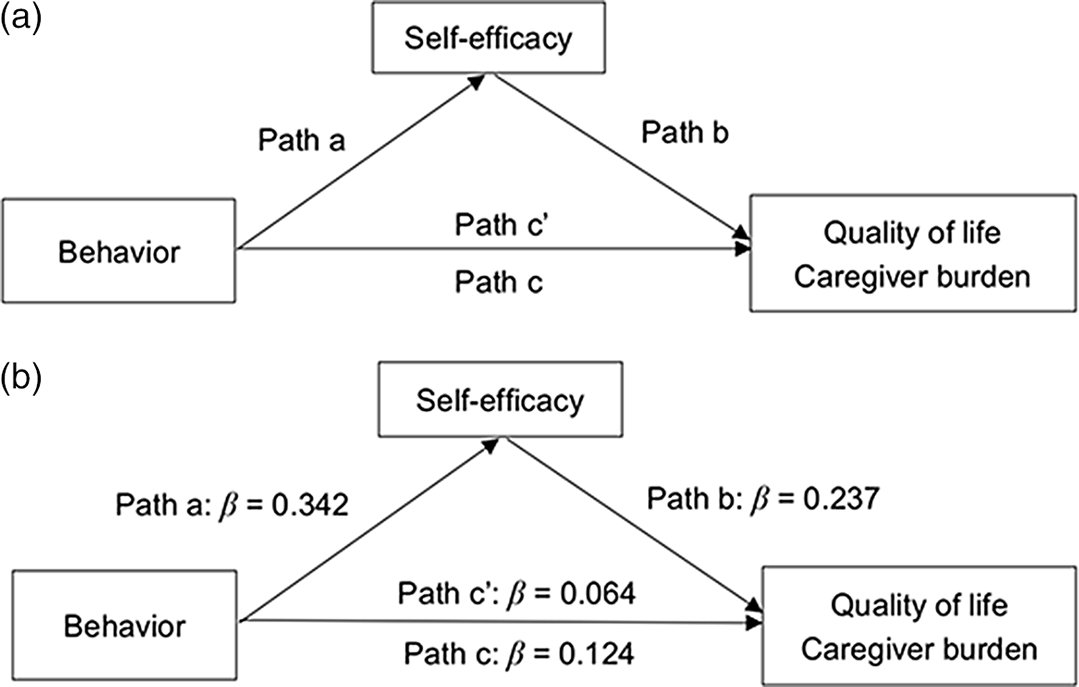
Criterion validity was also tested via examining the correlation coefficients of the total score, domain scores and caregiver burden item of the CROSA with the validated instruments (including MMSE, ADAS-Cog, NPI-Q, DAD and ZBI). The convergent validity testing included examining the correlation between the QoL item of the CROSA and the above instruments and testing a hypothesized mediation model (Figure 1a) derived from the relevant caregiver literature (Zhang et al., Reference Zhang, Guo, Edwards, Yates and Li2014b). The hypothesis was that caregiver self-efficacy had a mediating effect on the relationship between PWAD behavior (the predictor measured with Items 7 to 11 of the CROSA) and the total score of PWAD QoL and caregiver burden (the outcomes measured with Items 15 and 16 of the CROSA). Pearson and Spearman correlation coefficients were calculated for the variables with normal distribution and non-normal distribution, respectively. The correlation coefficients between 0.10 to 0.29, 0.30 to 0.40 and 0.50 to 1 represent a small, medium and large correlation, respectively (Cohen, Reference Cohen1988). The total score of the PWAD QoL and caregiver burden regressed with PWAD impairments including behavior and other impairments (measured by Items 1 to 6 and Items 12 to 14 of the CROSA, respectively), see Figure 1a, Path c. The total score of caregiver self-efficacy (measured by SEQCFC) regressed upon PWAD impairments (Figure 1a, Path a). The total score of PWAD QoL and caregiver burden regressed on the caregiver self-efficacy (Figure 1a, Path b). Hierarchical multiple regression was performed to test the mediation effect. A mediation effect was found in which a reduced effect of the independent variables on the outcome variable occurred when the mediator entered the equation (Figure 1a, Path c’) (Preacher and Hayes, Reference Preacher and Hayes2008). A Sobel test was performed to examine the significance of the mediation effect. Prior to the above-mentioned regression analyses, normality, linearity and homoscedasticity were inspected, as well as the assumption of absence of multicollinearity. Blom’s formula was used to transform the variables with non-normal distribution before performing the regressions.
(a) Hypothesized mediating effects on the relationships between PWAD behavior and the total score of PWAD quality of life and caregiver burden; (b) Output model: fully mediating effects of caregiver self-efficacy on the relationship between PWAD behavior and the total score of PWAD quality of life and caregiver burden.

In the last step, the responsiveness of the CROSA was examined via calculating the standardized effect size (ES) and standardized response mean (SRM) after 12 weeks of treatment with memantine. The ES and SRM were calculated among the groups in which the stage of AD was maintained, improved or deteriorated. The ES is defined as the ratio of the mean change score and the standard deviation of the baseline scores, and the SRM is the mean change score divided by the standard deviation of the change scores (Husted et al., Reference Husted, Cook, Farewell and Gladman2000). The positive and negative values of the ES and SRM indicate deterioration and improvement, respectively. Values of 0.2 or less, 0.5 and 0.8 or greater represent small, moderate and larger responsiveness, respectively (Cohen, Reference Cohen1988).
Results
Description and evaluation of the dyads
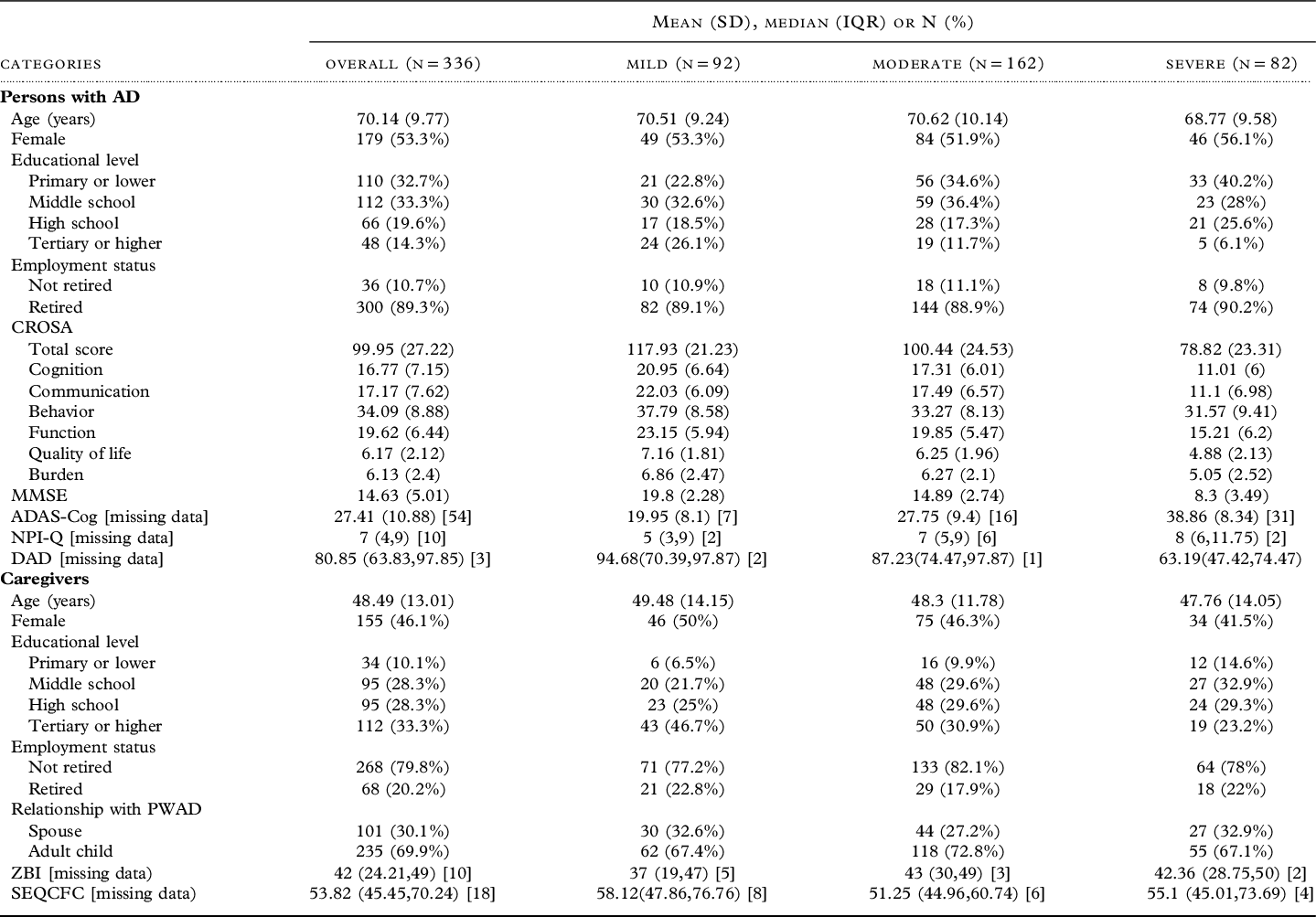
Table 1 lists the demographics and evaluation of the dyads. Of the dyads, 27 PWADs (8%) and 6 caregivers (1.8%) had not received any formal education.
Demographic characteristics and dyad measures

Note: IQR, interquartile range; PWAD, persons with AD; CROSA, the Chinese version of relevant outcome scale for Alzheimer’s disease; MMSE, Mini-Mental State Examination; ADAS-Cog, Alzheimer’s Disease Assessment Scale-Cognitive subscale; NPI-Q, Neuropsychiatric Inventory Questionnaire; DAD, Disability Activity of Dementia; ZBI, Zarit Caregiver Burden Interview; SEQCFC, Self-Efficacy Questionnaire for Chinese Family Caregivers.
Floor and ceiling effects
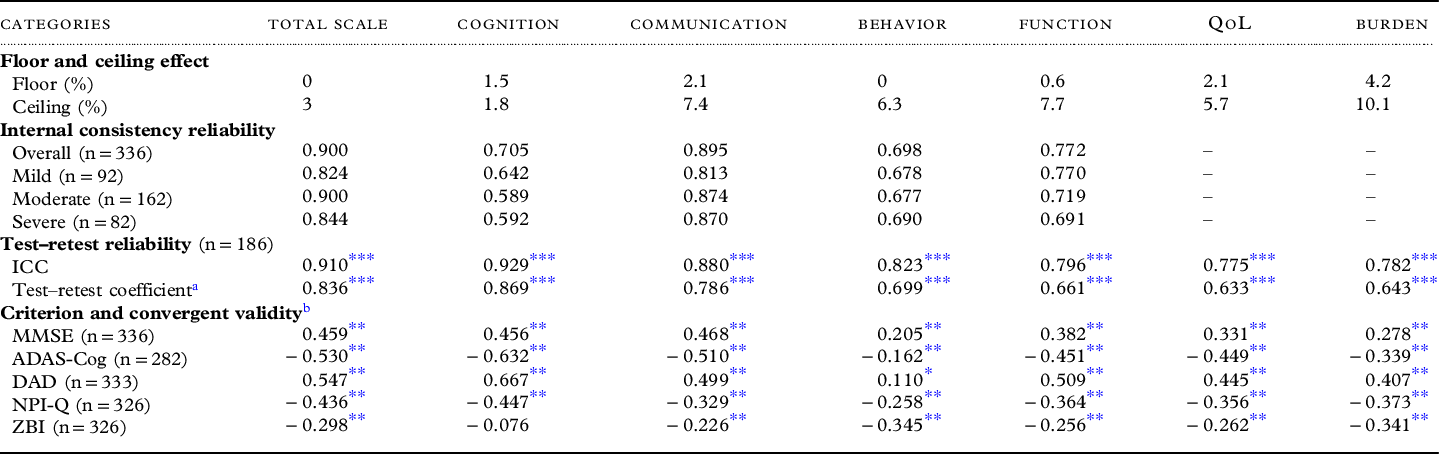
The results of the ceiling and floor effect testing for the total scale ranged from 0% to 6.5% among the overall sample and of the three stages of AD (Table 2). The results of the ceiling and floor effect examination at item-level showed that only Item 11 showed a moderate ceiling effect (34.2%) (See Table S2 published as supplementary material online attached to the electronic version of this paper).
Summary of the psychometric property testing sections of the CROSA

Note: QoL, quality of life of PWAD; ICC, intraclass correlation coefficient; MMSE, Mini-Mental State Examination; ADAS-Cog, Alzheimer’s Disease Assessment Scale-Cognitive subscale; NPI-Q, Neuropsychiatric Inventory Questionnaire; DAD, Disability Activity of Dementia; ZBI, Zarit Caregiver Burden Interview
a Test–retest coefficient is the Pearson’s correlation coefficient.
b Correlation coefficients of MMSE and ADAS-Cog are Pearson’s correlation coefficients, and that of DAD, NPI-Q and ZBI are Spearman’s correlation coefficients.
*P < 0.05, **P < 0.01, ***P < 0.001
Reliability of the CROSA
The results of reliabilities of the CROSA are presented in Table 2. The Cronbach’s alphas for total scale and most domains of the CROSA met the criteria for good internal consistency. The Cronbach’s alphas were slightly below 0.600 for the domain of cognition among the patients with moderate (Cronbach’s alpha: 0.589) and severe (Cronbach’s alpha: 0.592) stages of AD. 186 patients whose stages of AD were unchanged after 12 weeks were included in the test–retest reliability testing. The correlation coefficients for the total score of the CROSA determined by Pearson correlation coefficient (0.836, P < 0.001) and ICC (0.910, P < 0.001) were all above the threshold of 0.7.
Construct validity of the CROSA
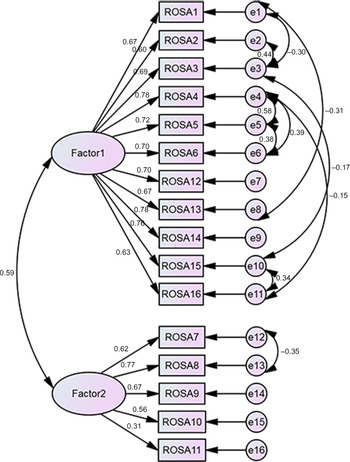
The result of the CFA illustrated an adequate model fit between the observed data with the two-factor model. Bootstrap maximum likelihood estimation with 2000 samples was used because of the non-normal multivariate distribution. The indices for goodness-of-fit were as follows: RMSEA = 0.079, comparative fit index = 0.928, incremental index of fit = 0.929, Tucker–Lewis index = 0.907, χ 2 /DF = 3.112, χ 2 (DF = 93) = 289.426, P < 0.001. The model was improved by correlating the relationship between error terms following modification indices. Standardized parameter estimates are presented in Figure 2. The CFA analysis illustrated a strong to moderate association for item-factor relationships (0.56 < λ < 0.78) except for Item 11, which showed a relatively weak association (λ = 0.31). According to the relationship between latent variables, factor 1 and factor 2 showed a moderate correlation, with a parameter estimate of 0.59.
The two-factor model of the CROSA with correlated error terms.

Known-group validity of the CROSA
For the results of known-group validity testing, the omnibus F test showed significant differences [Stage groups: F (2, 333) = 60.775, P < 0.001, η 2 = 0.267; MMSE score groups: F (2, 333) = 26.987, P < 0.001, η 2 = 0.139] for the total score of the CROSA among the three stages [Mean (SD): mild stage, 117.93 (21.23); moderate stage, 100.44 (24.53); severe stage, 78.82 (23.31)] or the three MMSE score groups [Mean (SD): mild state, 111.11 (23.51); moderate state, 97.15 (25.45); severe state, 82.05 (28.83)], all with large effect sizes. Significant differences (P < 0.001) were found among the three stages [Mean differences (Std Err): mild stage Vs moderate stage, 17.50 (3.05); mild stage Vs severe stage, 39.11 (3.55); moderate stage Vs severe stage, 21.61 (3.17)] and among the three MMSE score groups [Mean differences (Std Err): mild state Vs moderate state, 13.96 (3.04); mild state Vs severe state, 29.05 (4.09); moderate state Vs severe state, 15.09 (3.98)] for post-hoc comparisons of the total score of the CROSA.
Criterion validity and convergent validity of the CROSA
Significant correlations of the total score of the CROSA were found with total scores of the MMSE (r = 0.459, P < 0.01), the ADAS-Cog (r = −0.530, P < 0.01), the DAD (r = 0.547, P < 0.01), the NPI-Q (r = −0.436, P < 0.01) and the ZBI (r = −0.298, P < 0.01), with the strength of correlations ranging from large to moderate (Table 2). Significant correlations of each domain of the CROSA were found with the above validated scale, except for the domain of cognition with the ZBI (P = 0.174).
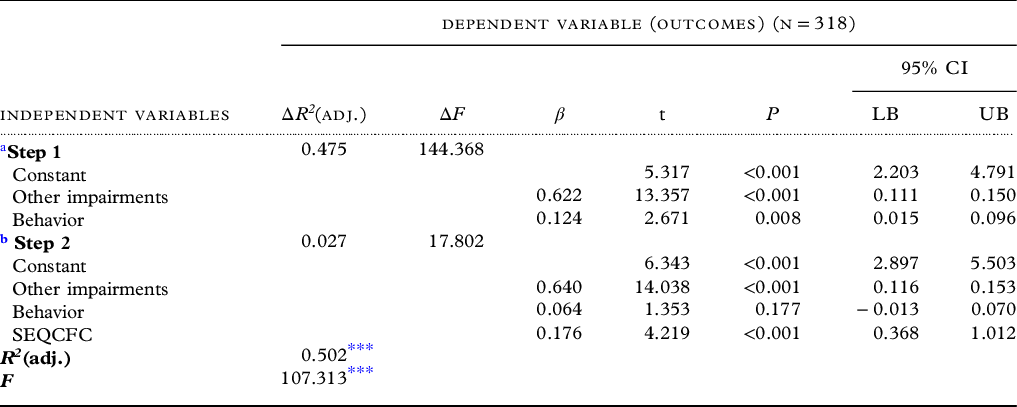
The results of the standard multiple regression analyses confirmed path a and path b in the hypothesized mediation models (Figure 1b): PWAD behavior was the predictor of caregiving self-efficacy after adjusting for other impairments [F (2, 315) = 16.245, P < 0.001; behavior: β = 0.342, P < 0.001; other impairments: β = −0.101, P = 0.103] (Figure 1b, path a); and caregiving self-efficacy [F (1, 316) = 18.766, P < 0.001; β = 0.237, P < 0.001] was significantly regressed on the total score of the PWAD QoL and caregiver burden (Figure 1b, path b). Table 3 presents the results of the hierarchical multiple regression analysis. The total scores of PWAD behavior and other impairments entered the equation as the first group of independent variables, and caregiving self-efficacy entered as the second group of independent variables. The results indicated a significant influence on the total score of PWAD QoL and caregiver burden [F (3, 314) = 107.313, P < 0.001]. After the SEQCFC entering into the equation, the β value of the domain of behavior decreased from 0.124 (P = 0.008) to 0.064 (P = 0.177), indicating a full mediation effect of caregiving self-efficacy between PWAD behavior and the total score of PWAD QoL and caregiver burden. The Sobel test indicated a significant full mediation effect of the hypothesis (test statistic = 3.358, P < 0.001).
Hierarchical multiple regression of other impairments and behavior on outcomes (path c & c’)

Note: β, standardized coefficients; R 2 (adj.), adjusted R 2 ; LB, lower bound; UB, upper bound; SEQCFC, Self-Efficacy Questionnaire for Chinese Family Caregivers.
Outcomes were measured by CROSA item 15 to 16, other impairments were measured by CROSA item 1 to 6 and 12 to 14, behavior was measured by CROSA item 7 to11.
The total score of SEQCFC was transformed using Blom’s formula prior to the regressions.
a path c;
b path c’.
*** P < 0.001.
Responsiveness analysis
The ES and SRM values of the maintenance (ES = 0.01, SRM = 0.03, n = 186) and improvement groups (ES = −0.06, SRM = −0.13, n = 18) were small to negligible. Only the deterioration group (n = 25) showed moderate responsiveness, with an ES and SRM of 0.2 and 0.3, respectively.
Discussion
Neurodegeneration leads to progressive memory loss (Lane et al., Reference Lane, Hardy and Schott2018). As the disease progresses, cognitive decline gradually impairs PWAD’s communication, attention, basic and complex ADLs with the presence of BPSD (Lane et al., Reference Lane, Hardy and Schott2018; Saari et al., Reference Saari, Hallikainen, Hintsa and Koivisto2020), resulting in poor QoL (Roehr et al., Reference Roehr2017). Increasing dependency and changes in behavior can also exacerbate caregiver burden (Smith et al., Reference Smith, George and Ferriera2018; Vaingankar et al., Reference Vaingankar2016). Consistent with the original version, the contents of the CROSA focused on changes in PWAD symptoms and outcomes during the course of AD. The psychometric properties of the CROSA were first examined through the current pharmacological trial in Shanghai, China. The convenience and community sampling strategies were used to guarantee sample representativeness of this study.
From the findings of our study, no significant ceiling and floor effect was found in the total score of the scale, and the ceiling and floor effects at the item level were generally acceptable. Only Item 11, which assessed PWAD rejection of care, showed a moderate ceiling effect among the entire sample (34.2%, n = 336) and each stage sample (mild stage: 33.7%, n = 92; moderate stage: 34.6%, n = 162; severe stage: 34.1%, n = 82). Rejection of care could be found among 17% to 54% of PWAD (Ishii et al., Reference Ishii, Streim and Saliba2012; Volicer et al., Reference Volicer, Bass and Luther2007), and premorbid personality (such as non-agreeableness), psychological symptoms, medical conditions, physical stimuli or care processes are the reported factors that trigger this behavior (Ishii et al., Reference Ishii, Streim and Saliba2012). Because PWAD with severe physical and/or mental disorders other than AD or with any history of severe drug allergy were excluded from our study, we inferred that the ceiling effect of Item 11 may be attributed to these exclusions.
The results of internal consistency reliability and test–retest reliability of the CROSA were satisfactory. The Cronbach’s alpha for the scale among the entire sample (0.900) was similar to those of the original (Holthoff et al., Reference Holthoff2011) and Spanish versions (Pardo et al., Reference Pardo, Alcalde, Garcia, Magro and Estudio2017), and the Cronbach’s alpha was also satisfactory for the scale among each stage. The Cronbach’s alphas were good or acceptable for each domain among the entire sample and each stage. The result of the test–retest reliability testing was encouraging, demonstrating good longitudinal stability and reproducibility of the CROSA among the PWAD that maintained their stage after the 12-week treatment.
The construct validity of the CROSA was established via the CFA. The observed data generally supported the two-factor model of the original version of the ROSA (Holthoff et al., Reference Holthoff2011). The association of each item with the corresponding factor also fit the model conceptually, except for Item 11. A relatively weak association was found between Item 11(λ = 0.31) and factor 2, which may be partly attributed to exclusion criteria as mentioned above. Thus, we retained this item as it measured a common BPSD, which has been the target point of interventions (Kales et al., Reference Kales, Lyketsos, Miller and Ballard2019).
For the known-group validity testing, the findings indicated that the total score of the CROSA could distinguish PWAD stage or overall cognition state. Moderate to large correlations between the total score of the CROSA and the validated scales (including MMSE, ADAS-Cog, NPI-Q, DAD and ZBI) showed satisfied criterion validity of the scale. The multi-domain trait of the CROSA was further confirmed based on the correlation coefficients between the total score of each domain of the CROSA and the corresponding validated scales. Both the ADAS-Cog and the domains of cognition and communication of the CROSA focused on PWAD functions of memory, language, praxis and attention. Higher correlation coefficients were found between the ADAS-Cog and the two domains compared to those with the other domains of the CROSA. Similarly, higher correlation coefficients were found between the DAD and the domains (cognition and function) comprising the items measuring basic and complex ADLs. BPSD has been repeatedly noted as the most important factor increasing caregiver burden (Smith et al., Reference Smith, George and Ferriera2018; Vaingankar et al., Reference Vaingankar2016). The high correlations of the ZBI with the domain of behavior and the item measuring caregiver burden observed in our study are consistent with previous literature (Vaingankar et al., Reference Vaingankar2016). Interestingly, although the NPI-Q was significantly correlated to all domains of the CROSA, the value of its correlation coefficient with the domains of behavior was the lowest among compared to the other domains of the CROSA. The NPI-Q comprises 12 symptoms of 4 neuropsychiatric sub-syndromes, namely hyperactivity, affective disorders, psychosis and apathy (Aalten et al., Reference Aalten2007), while the behavior domain of the CROSA focuses on five symptoms related to three sub-syndromes – hyperactivity, psychosis and affective disorder. The scenarios that described the NPI-Q items and the two behavior domains of the CROSA also revealed differences, which could be associated with this relative weak correlation.
The findings of the convergent validity testing were satisfactory. A worse PWAD QoL was associated with more severe symptoms such as cognitive dysfunction and BPSD (Nijsten et al., Reference Nijsten, Leontjevas, Smalbrugge, Koopmans and Gerritsen2019; Roehr et al., Reference Roehr2017; Ydstebo et al., Reference Ydstebo, Bergh, Selbaek, Benth, Bronnick and Vossius2018). Moderate to large correlations between the QoL item and the MMSE, ADAS-Cog, DAD or NPI-Q scores are consistent with previous literature (Nijsten et al., Reference Nijsten, Leontjevas, Smalbrugge, Koopmans and Gerritsen2019; Roehr et al., Reference Roehr2017; Ydstebo et al., Reference Ydstebo, Bergh, Selbaek, Benth, Bronnick and Vossius2018). The hypothesized mediation model was also confirmed, that is, the BPSD as measured with the behavior domain of the CROSA played an important role in care management, with a direct impact on the dyads’ outcomes (as measured with Items 15−16 of the CROSA) and an indirect impact via a mediation effect of caregiver self-efficacy. These results are also consistent with prior literature related to PWAD caregivers (Zhang et al., Reference Zhang, Edwards, Yates, Li and Guo2014a, Reference Zhang, Guo, Edwards, Yates and Li2014b). The CROSA therefore can also be applied to studies on caregiver support (Zhang et al., Reference Zhang2020).
Limitations
Our study also presented some limitations. First, the responsiveness analysis found negligible or small values of ES and SRM in the maintenance, improvement and deterioration groups. Nearly half of the PWAD in this study were at the moderate stage, which is often the longest stage during the course of AD. For the PWAD at this stage, their symptoms changed relatively slowly, possibly rendering the small effect sizes in the maintenance and improvement groups. Further responsiveness examination studies are needed with a longer period of intervention. Secondly, the test–retest reliability was examined among the maintenance samples who accepted a 12-week treatment with memantine. The 12-week interval was a bit long for examining the test–retest reliability, which could have led to a biased result. Further studies could be conducted to examine this index. Thirdly, we used the NPI-Q to examine the criteria validity of the behavior domain of the CROSA. The findings of the criterion validity testing implicated that the NPI could be more appropriately used for further criteria validity examination compared to the NPI-Q.
Conclusions
Overall, the psychometric properties of the CROSA were generally acceptable. The multi-domain trait exhibited by the scale implicated its promising application in research on dyads in various care settings in China. Future multi-centered, pharmacological or non-pharmacological interventions for PWAD as well as caregiver support programs are needed to further evaluate the psychometric properties of the CROSA.
Conflict of interest
None.
Source of funding
This work was supported by the National Natural Science Foundationof China (grant number: 81571364). An unrestricted grant was also given from Lundbeck China, but the company was not involved in the elaboration of the study protocol, data analysis, data interpretation, or writing of the manuscript.
Description of authors’ roles
All authors contributed to the design, implementation and writing of this study.
Acknowledgements
All authors appreciate the support they received from the designated hospitals, the participants in this study and the student volunteers from Tongji University. All authors deeply appreciate valuable comments from pee reviewers.
Supplementary material
To view supplementary material for this article, please visit https://doi.org/10.1017/S1041610221000247