Obsessive-compulsive disorder (OCD) is a severe and disabling psychiatric condition among children and adolescents with prevalence estimates ranging from 0.17% to 4% (Costello et al., Reference Costello, Angold, Burns, Stangl, Tweed, Erkanli and Worthman1996; Flament et al., Reference Flament, Whitaker, Rapoport, Davies, Berg, Kalikow and Shaffer1988; Heyman et al., Reference Heyman, Fombonne, Simmons, Ford, Meltzer and Goodman2003; Valleni-Basile et al., Reference Valleni-Basile, Garrison, Jackson, Waller, McKeown, Addy and Cuffe1994; Zohar, Reference Zohar1999). The phenomenology of childhood and adolescence OCD is understood to be broadly similar to that of an adult. Obsessions are defined by the DSM-IV (American Psychiatric Association, 2000) as intrusive and repetitive thoughts, images, or impulses. They are associated with significant negative affect, most commonly anxiety, although children may also report feelings of guilt, sadness or anger.
The most common obsessions in children include contamination, aggression (harm or death), symmetry and exactness (just right), while in adolescence, religious and sexual obsessions are also common (Franklin et al., Reference Franklin, Kozak, Cashman, Coles, Rheingold and Foa1998; Geller et al., Reference Geller, Biederman, Faraone, Agranat, Cradock, Hagermoser and Coffey2001).
Compulsions are defined as purposeful, repetitive behaviors or rituals performed in an effort to relieve the distress or negative affect associated with the obsessions (American Psychiatric Association, 2000). Compulsions themselves can be highly distressing and frustrating in the child’s family, school and social life, with a high degree of familial conflict and frustration (Cooper, Reference Cooper1996).
In terms of common compulsive behaviors in young people, we can mention washing, checking, ordering, touching, repeating, and reassurance seeking (Franklin et al., Reference Franklin, Kozak, Cashman, Coles, Rheingold and Foa1998; Wever & Rey, Reference Wever and Rey1997). However, compulsions can also include covert behaviors, such as reviewing or canceling thoughts, silent prayers or counting (Franklin et al., Reference Franklin, Kozak, Cashman, Coles, Rheingold and Foa1998).
In spite of adult symptoms, childhood symptoms tend to vary greatly, with many young people having all of the common obsessions and compulsions at some point, and seldom display a single compulsion (Hanna, Reference Hanna1995; Mataix-Cols et al., Reference Mataix-Cols, Rauch, Baer, Eisen, Shera, Goodman and Jenike2002; Wever & Rey, Reference Wever and Rey1997).
The mean age of onset in juvenile OCD is more typically reported to be around 10.4 years, in a range of 6.9–12.5 years (Stewart et al., Reference Stewart, Geller, Jenike, Pauls, Shaw, Mullin and Faraone2004). Studies of adult OCD have suggested that the age of onset may be bimodal, with the first peak occurring in puberty (30% – 70% of adults recall the presence of symptoms in adolescence), and the second in early adulthood (mean age of 21 years Pauls, Alsobrook, Goodman, Rasmussen, & Leckman, Reference Pauls, Alsobrook, Goodman, Rasmussen and Leckman1995; Rasmussen & Eisen, Reference Rasmussen and Eisen1992). These observations would suggest that adolescence could be a period in which genetic and environmental etiological factors in OCD change in a relatively short period of time (Van Grootheest et al., Reference Van Grootheest, Bartels, Van Beijsterveldt, Cath, Beekman, Hudziak and Boomsma2008).
Epidemiological studies of obsessive-compulsive disorders report equal gender distributions in adolescent and adult samples (Flament et al., Reference Flament, Whitaker, Rapoport, Davies, Berg, Kalikow and Shaffer1988; Rasmussen & Eisen, Reference Rasmussen and Eisen1992), while in the clinical adult sample equal gender distribution can be seen, and in the clinical juvenile sample a dominance of males to females is reported (61% – 69%; Geller et al., Reference Geller, Biederman, Faraone, Agranat, Cradock, Hagermoser and Coffey2001; Hanna, Reference Hanna1995; Mancebo et al., Reference Mancebo, Garcia, Pinto, Freeman, Przeworski, Stout and Rasmussen2008; Swedo, Rapoport, Leonard, Lenane, & Cheslow, Reference Swedo, Rapoport, Leonard, Lenane and Cheslow1989).
Although many studies have addressed the phenomenology and epidemiology of OCD in adult populations, less attention has been given to childhood and adolescence OCD. In comparison, other mental disorders (such as depression and schizophrenia) have received more attention in this regard. Furthermore, as clinical experience asserts, OCD in all age-groups, and especially in younger sufferers, is under-recognized because they are known to be secretive about their disorder (Jenike, Reference Jenike1989), and the pathological nature of their symptoms is not always recognized (Scahill et al., Reference Scahill, Riddle, McSwiggin-Hardin, Ort, King, Goodman and Leckman1997). On the other hand, when afflicted young patients are asked specific questions about obsessive-compulsive symptoms (OCS), they identify their symptoms very reliably without significant interference in their daily life. Hence, the epidemiological study of OCS among adolescents has the benefit of early detection and treatment to modify the degree of chronic impairment in the future.
In an attempt to provide detailed information about the prevalence of obsessive- compulsive behaviors among adolescents, Flament et al. (Reference Flament, Whitaker, Rapoport, Davies, Berg, Kalikow and Shaffer1988) provided some of the most reliable data. They carried out a large longitudinal epidemiological study on over 5,000 students by applying LOI-CV as a screening instrument, and they found out that almost 2% of adolescents have obsessive preoccupations or behaviors. Afterwards, several studies were performed to identify obsessive-compulsive preoccupations among adolescents. Thomsen’s study applying LOI-CV on a population of 1,032 Danish adolescents aged 11–17 years, in 1993, found that 4% of non-referred Danish adolescents had a total interference score reflecting probable clinical or subclinical OCD; however, an interview did not follow their study. In 2001, Maggini et al. (Reference Maggini, Ampollini, Gariboldi, Cella, Peqlizza and Marchesi2001), after doing an epidemiological survey in more than 2,800 high school students in Italy, found that 4.1% of their subjects showed OCS which interfered with their daily life (an interference score of 25 or more in LOI-CV), while 3.0% of students showed OCS without interfering in their normal life. According to another study done in Poland (Bryńska & Wolańczyk, Reference Bryńska and Wolańczyk2005) on more than 3,000 students between 13 and 14 years of age, 5.5% of the population suffered from obsessive-compulsive behaviors.
The comorbidity of OCD with other mental disorders, rather than anxiety disorders, has been well-documented in clinical and community samples of adolescents (Flament et al., Reference Flament, Whitaker, Rapoport, Davies, Berg, Kalikow and Shaffer1988; Geller et al., Reference Geller, Biederman, Faraone, Agranat, Cradock, Hagermoser and Coffey2001; Geller et al., Reference Geller, Biederman, Stewart, Mullin, Martin, Spencer and Faraone2003; Hanna, Reference Hanna1995; Swedo et al., Reference Swedo, Rapoport, Leonard, Lenane and Cheslow1989). However, little is known about the association between OCS and other anxiety symptoms, such as generalized anxiety, separation anxiety, panic, social phobia and school phobia, especially when these symptoms are not assessed with the same self-report instrument. Accordingly, we attempt to contribute to this area with the present study.
Studying the association between OCS and depressive symptoms is another focus of this study. There is plenty of research (Brady & Kendall, Reference Brady and Kendall1992; Seligman & Ollendick, Reference Seligman and Ollendick1998) indicating that there is a considerable overlap between anxiety and depressive symptoms in the young that is measured by commonly used self-report questionnaires. Depression and OCS normally accompany each other in many cases. An overwhelming need to perform rituals and the inability to get rid of obsessive thoughts can eventually lead to isolation, hopelessness and depressive symptoms (Grados, Labuda, Riddle, & Walkup, Reference Grados, Labuda, Riddle and Walkup1997). Assessing the comorbid anxiety and depression symptoms among adolescents with high OCS can improve knowledge of etiological bases of symptoms and apply different treatment strategies that facilitate overcoming the negative consequence of comorbid symptoms in one’s daily life in school, home and society.
Since the prevalence of OCS among adolescents varies across studies, further research in community samples is needed to complete our knowledge on the phenomenology, prevalence and distribution of obsessive-compulsive behaviors. In this regard, our main research aims are: a) to estimate the prevalence of OCS in a community sample of adolescents in the municipality of Rubi (Barcelona), b) to explore the association of OCS with anxiety symptoms severity, such as separation anxiety, generalized anxiety, social/school phobia and panic/somatic symptoms, and c) to assess the association of OCS with depressive symptom severity.
Method
Sample
The sample was obtained from the census of 2009 in the eighth and ninth grades in nine public and private schools in Rubi (N = 1,324), a city near Barcelona. Rubi was selected for two main reasons: First, Rubi is a city with almost 73,000 inhabitants according to the latest report of the Spanish Instituto Nacional de Estadística (INE; 2010). There are 11,593 (16%) foreigners, of which 2,071 are younger than 16 years old. Thus, it could be a representative region with a middle socio-economic class and, second, the interest of the administration of the educational system to collaborate with us in examining emotional problems, including depression and all anxiety symptoms in all schools of this city.
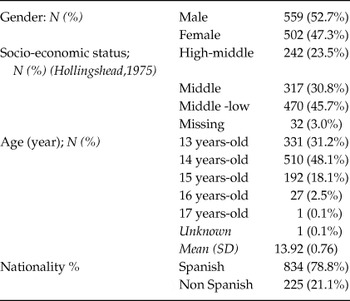
On the day of assessment at the schools, 218 students were absent. Forty-three students were not authorized by their parents and two students did not show any interest in participating in this research. Due to the difficulties in understanding the language, six students could not answer the questionnaires. Therefore, the final sample included 1,061 adolescents, 497girls (47.3%) and 554 boys (52.2%). The participation ratio was 80%. The age of the participants ranged between 13 to 17 years old. Almost 70% of the participants belong to middle and lower-middle socio-economic classes according to Hollingshead (Reference Hollingshead1975). Table 1 shows the socio-demographic features of the participants.
Description of the sample

Procedure
The research was approved by the Ethics Committee in Human Experimentation and by the Research Committee of the authors’ institution. The collaboration of all of the secondary schools located in Rubi, Barcelona, was requested. All of the schools accepted to participate in this study. Data collection was between 4 February and 15 June 2010. Signed consent was required from parents and oral consent by adolescents. The time necessary for completing the questionnaires was about 50 minutes. During the assessment with the self-report questionnaires, two researchers were present in the classroom to answer possible questions about items. Once each student completed the questionnaires, researchers carefully checked the items to avoid missing data. In this research, all questionnaires were performed in Spanish.
Instruments
Leyton Obsessional Inventory-Child Version (LOI-CV; Berg, Rapoport, & Flament, Reference Berg, Rapoport and Flament1986)
This is a 20-item self-report questionnaire that assesses the presence or absence (yes versus no) of a number of obsessive concerns and behaviors and the degree of interference of each behavior in personal functioning. LOI-CV explores general obsessive thoughts and rituals including repeating, checking, counting, indecisiveness, dirt-contamination fears, lucky numbers, and school-related habits. This instrument comprises two subscales. The first records the presence or absence of common obsessions and compulsions that are related to symptoms. Each response is scored 1 for the presence and 0 for the absence of the symptom; thus, this subscale yields a maximum score of 20. The second subscale records the degree of interference of the symptoms in the daily life of the subject. Each symptom is scored on a 4-point scale of 0–1–2–3, ranging from 0 – “this habit does not interfere with my life” to 3 – “I waste a lot of my time because of this habit”. The maximum score in this subscale is 60. A response for the degree of interference is required only for the items endorsed on the symptoms subscale (Roussos et al., Reference Roussos, Francis, Koumoula, Richardson, Kabakos, Kiriakidou and Karamolegou2003).
LOI-CV is described in the literature as a reliable instrument with high sensitivity and specificity for the screening of OCD (Flament et al., Reference Flament, Whitaker, Rapoport, Davies, Berg, Kalikow and Shaffer1988). In the study of Bamber, Tamplin, Park, Kyte, and Goodyer (Reference Bamber, Tamplin, Park, Kyte and Goodyer2002), internal reliability was high for the total scale (α = .86). LOI- CV showed an acceptable internal consistency (α = .79) in the most recent study conducted among 50 American children and adolescents with OCD (Storch et al., Reference Storch, Park, Lewin, Morgan, Jones and Murphy2011), but it was not significantly correlated with any other measures of OCD symptom frequency or severity, OCD- related impairment and global symptom severity in a pediatric OCD sample. In our study, internal consistency was also good (α = .75 for the “symptom presence score” and α = .87 for the “interference score”). Choosing this instrument as a widely used questionnaire for assessing obsessive-compulsive preoccupations let us compare our results with previous studies.
Children’s Depression Inventory (CDI; Kovacs, Reference Kovacs1992)
This is one of the most widely used self-report questionnaires to assess the severity of depressive symptoms in 7 to 17 year-old adolescents and children. It includes 27 items whose scores ranged between 0 and 2 (total score was in the range 0 to 54). It can also be used as a screening tool, to assess treatment results, or to detect changes in depressive symptoms over time (Canals, Marti-Henneberg, Fernández-Ballart, & Domènech, Reference Canals, Marti-Henneberg, Fernández-Ballart and Domènech1995). The clinical cut-off of 17 for the total-CDI score is considered to have the best sensitive ty and specificity in the Spanish general population (Canals et al., Reference Canals, Marti-Henneberg, Fernández-Ballart and Domènech1995). In this study, internal consistency was very good (α = .83).
Screen for Child Anxiety Related Emotional Disorders (SCARED; Birmaher, et al., Reference Birmaher, Khetarpal, Brent, Cully, Balach, Kaufman and Neer1997)
It is a new questionnaire developed to measure children’s and adolescents’ anxiety. It includes 41 items grouped into five subscales that assess anxiety disorders symptoms according to DSM-IV criteria: panic/somatic (e.g., “When frightened, my heart beats fast”), generalized anxiety (e.g., “I am a worrier”), separation anxiety (e.g., “I don’t like being away from my family”), social phobia (e.g., “I don’t like to be with unfamiliar people”), and school phobia (e.g., “I am scared to go to school”). Adolescents are asked to rate the frequency which they experience using an ordered scale (0 almost never, 1 sometimes, and 2 often). A cut-off of 25 on the SCARED resulted in the optimal sensitivity (71%) and specificity (67%) in a clinical American sample (Birmaher et al., Reference Birmaher, Khetarpal, Brent, Cully, Balach, Kaufman and Neer1997). SCARED possesses adequate internal consistency and test-retest stability (Birmaher et al., Reference Birmaher, Khetarpal, Brent, Cully, Balach, Kaufman and Neer1997; Spence, Reference Spence1998). It also possesses adequate discriminating validity to differentiate between children with and without specific anxiety disorders (Birmaher et al., Reference Birmaher, Khetarpal, Brent, Cully, Balach, Kaufman and Neer1997; Muris, Merckelbach, Mayer, & Prins, Reference Muris, Merckelbach, Mayer and Prins2000; Spence, Reference Spence1998).
The Spanish version of the SCARED used in our study had previously been validated and translated into Spanish by Domènech and Martínez (Reference Domènech and Martinez2008) in an adolescent community sample. This Spanish version showed good psychometric properties with Cronbach’s alpha values between .68 and .83 and test-retest reliability equal to 0.72. In this study the internal consistency was very good (α = .85 for SCARED total score).
Socio-demographic questionnaire
The subjects completed a socio-demographic questionnaire designed by the authors, which asked adolescents about gender, date and place of birth, ethnic background, marital status of their parents, educational level of their parents and their employment status. In addition, we included indicators of the Hollingshead scale (Hollingshead, Reference Hollingshead1975) for evaluating the socio-economic status (SES) of their parents.
Statistical Analysis
Statistical analysis was carried out with PASW17 (SPSS Software). According to the indication of Flament et al. (Reference Flament, Whitaker, Rapoport, Davies, Berg, Kalikow and Shaffer1988), two distinct groups of subjects were defined as ‘positive’ in the screening. The first group, labeled ‘high interference’ (vs. low interference), differentiated between adolescents with scores equal to or higher than 25 in the interference score. The second group, called ‘high symptom presence’, included adolescents with scores equal to or above 15 in the yes-no items and an interference score lower than 10. In fact, choosing Flament’s indication, with the adequate reported sensibility (75%) and specificity (84%), allows us to compare our study with other research in this area.
After creating the groups in this study, the prevalence of adolescents with a high interference score and high symptom presence score was estimated.
The prevalence of adolescents with a high interference scores (interference score equal to 3) and the prevalence of all LOI-CV items was also estimated. The prevalence classified by gender was assessed through logistic regressions adjusted by participants’ ages.
Linear regression adjusted by children’s gender, age, and SCARED total score were used to explore the association between LOI-CV (for variables, “symptom presence score” and “interference score”) and CDI total score. This procedure also tested the association between LOI-CV and SCARED total score (considering total score and the five subscales). This analysis was adjusted by the covariates gender, age and the level of depressive symptoms severity (CDI total score).
Association between gender and LOI-CV scores was assessed by logistic regression (for binary classifications in LOI) and linear regression (for quantitative scores in LOI). All of these regressions were adjusted by participants’ ages and the CDI total score.
Results
The association between LOI high scores, LOI total, and gender
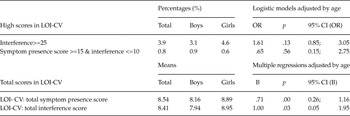
In this study, forty-one subjects [3.9%, 95% CI: 2.73% to 5.07%] showed an interference score of 25 or more (high-interference group). Eight students [0.8%, 95% CI: 0.45% to 1.75%] were included in the high-symptom presence group. They showed a symptom presence score of 15 or more and interference score of 10 or less. Table 2 includes the association between gender and high LOI scores and total scores. Considering the binary classifications for LOI (high interference score and high-symptom presence score), logistic regression adjusted by adolescents’ ages did not show any significant difference between boys and girls, neither in the high interference [p = .13; OR = 1.61, 95% CI: 0.85 to 3.05] nor in the high-symptom presence groups [p = .56; OR = 0.65, CI: 0.15 to 2.75]. Nevertheless, multiple regression adjusted by adolescents ages showed that girls scored significantly higher than did boys on both the total- symptom presence score [p = .002; B = 0.71, 95% CI: 0.26 to 1.16] and interference score [p = .039; B = 1.00, 95% CI: 0.05 to1.95]
Association between gender and LOI-high scores and total scores

The association between gender and LOI-CV high scores and total score
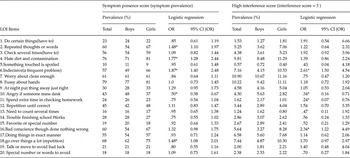
Table 3 includes LOI-CV symptoms and high-interference prevalence in both gender groups. The most frequent symptoms (more than 60% frequency) among students were fussy about hands, hate dirt and contamination, go over things a lot (repetition), worry about being clean enough, repeated thoughts or words and bad conscience though having done nothing wrong. The most interfering symptoms were worrying about being clean enough, fussy about hands, hating dirt and contamination and going over things a lot (repetition). Four items (‘repeated thoughts or words’, ‘hate dirt and contamination’, ‘indecisiveness’ and ‘go over things a lot’) were significantly more frequent in females than they were in males, while only one item (‘to get angry if someone messes the desk’) was more frequent in males than it was in females. Males showed significantly higher interference scores than did females on the items ‘angry if someone messes desk’ and ‘spend extra time in checking homework’, and females showed significantly more interference on the items ‘indecisiveness’ and ‘bad conscience though having done nothing wrong’.
The percentage of LOI-CV “symptom presence score” and “high interference” (interference score =3) in 1,061 adolescents

OR coefficients adjusted by subject’s age. *Significant OR (.05 level).
The association between LOI, CDI and SCARED
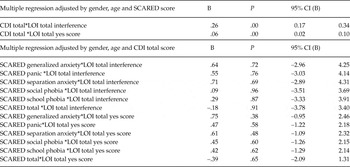
Table 4 includes the association between LOI-CV, CDI, and SCARED. Linear regressions adjusted by adolescents’ gender, age and SCARED total score showed that the association between the LOI interference score and the LOI total-symptom presence score and the Children´s Depression Inventory(CDI) was significant and positive. As summarized in Table 4, participants with the highest scores in the depression scale were also those with the highest scores in LOI.
Association between LOI-CV, CDI and SCARED total and its five subscales

Logistic regression adjusted by adolescents’ gender, age and CDI total.
However, after adjusting for a subject’s gender, age and CDI total score, linear regressions did not show any significant association between the LOI total interference score and SCARED, neither for total score, nor for any of the SCARED subscales. The same result was found for the association between the LOI total-symptom presence score and SCARED total and its five subscales.
Discussion
Following the indication of Flament et al. (Reference Flament, Whitaker, Rapoport, Davies, Berg, Kalikow and Shaffer1988) and Berg, Whitaker, Davies, Flament, & Rapoport (Reference Berg, Whitaker, Davies, Flament and Rapoport1988) the interference score of LOI-CV represents the best indicator of obsessive-compulsive psychopathology. They suggest that the symptom -presence score reflects a normal concern and general worries among adolescents, but items with high interference may be more clinically predictive and may reflect the proportion of adolescents with subclinical and clinical OCD. In our study, about 3.9% of the population showed a significant interference of obsessive symptomatology in daily activities. This percentage is comparable to what is reported by Thomsen (Reference Thomsen1993) in Denmark and Maggini et al. (Reference Maggini, Ampollini, Gariboldi, Cella, Peqlizza and Marchesi2001) in Italy (Table 5). Our finding is about twice more than what was found by Flament et al. (Reference Flament, Whitaker, Rapoport, Davies, Berg, Kalikow and Shaffer1988). These discrepancies might reflect differences between European countries and The United States of America (USA), although there seem to be no dissimilarities in the prevalence of OCD in the general population between the USA and Europe (Rasmussen & Eisen, Reference Rasmussen and Eisen1992). The dissimilarity that can be seen between our study and the Polish study can be related to differences between Eastern and Western European nations in anxiety and depression symptoms (Boyd, Gullone, Kostanski, Ollendick, & Shek, Reference Boyd, Gullone, Kostanski, Ollendick and Shek2000), as adolescents from countries such as Bulgaria, Poland and Russia report higher levels of anxiety and depression symptoms.
Comparison of high symptom presence score and high interference score among studies performed with LOI-CV on adolescent population

In the present study, the rate of the high-symptom presence score was 0.8%, which is comparable with the findings of Flament et al. (Reference Flament, Whitaker, Rapoport, Davies, Berg, Kalikow and Shaffer1988) and the Polish study but lower than findings in Italy and Denmark. This discrepancy can refer to a different strategy of applying the same questionnaire. Like Flament’s study and the study done in Poland, our questionnaires were not done confidentially because in our study, LOI was used as a screening instrument. On the other hand, a high-symptom presence score is the sign of ego-syntonic OCS and can be considered as a sign of obsessive personality disorder (OCPD) or more severe and nearly psychotic OCD (Insel & Akiskal, Reference Insel and Akiskal1986). Hence, the low prevalence of a high-symptom presence score in a community sample seems reasonable.
Table 5 includes the comparison between the high-symptom presence score and interference score among studies in which the LOI-CV was applied to an adolescent population.
In this study, the most frequently reported symptoms (a frequency of more than 60%) were concerns of contamination (fussy about hands, hate dirt and contamination, worry about being clean enough), repetition (go over things a lot, repeated thought or word) and bad conscience though having done nothing wrong. This outcome was expected because the obsessive-compulsive phenomenon related to the dirt phobia is widely reported in different studies and is culturally accepted (Bryńska & Wolańczyk, Reference Bryńska and Wolańczyk2005; Flament et al., Reference Flament, Whitaker, Rapoport, Davies, Berg, Kalikow and Shaffer1988; Maggini et al., Reference Maggini, Ampollini, Gariboldi, Cella, Peqlizza and Marchesi2001; Okasha et al., Reference Okasha, Ragheb, Attia, Seif El Dawla, Okasha and Ismail2001; Roussos et al., Reference Roussos, Francis, Koumoula, Richardson, Kabakos, Kiriakidou and Karamolegou2003; Thomsen, Reference Thomsen1993). In addition, repetitions that can reflect a lack of sureness or doubt are a characteristic of adolescents and have been widely reported across studies exploring childhood OCD (Bryńska & Wolańczyk, Reference Bryńska and Wolańczyk2005; Roussos et al., Reference Roussos, Francis, Koumoula, Richardson, Kabakos, Kiriakidou and Karamolegou2003).
The most interfering items in this study were concerns of contamination (‘fussy about hands’, ‘hate dirt and contamination’, ‘worry about being clean enough’) and repetition (‘go over things a lot’). Although almost 10% of adolescents in our study suffered from dirt phobias, which have high interference with daily life, these behaviors can only be diagnosed as pathological on the basis of the time they consume, their intensity and impact upon functioning and the distress they cause. Such clarification can only be achieved through interview, while LOI-CV identifies only the interference aspect.
In our study, females showed significantly more symptoms and higher interference scores than did males. This finding can reflect sex stereotypes or a higher level of anxiety in girls (Lewinsohn, Gotlib, Lewinsohn, Seeley, & Allen, Reference Lewinsohn, Gotlib, Lewinsohn, Seeley and Allen1998). This finding can also be compared with those of Berg et al. (Reference Berg, Whitaker, Davies, Flament and Rapoport1988); Brynska and Wolańczyk (Reference Bryńska and Wolańczyk2005); Maggini et al. (Reference Maggini, Ampollini, Gariboldi, Cella, Peqlizza and Marchesi2001) and while it is in contrast with the findings in the Danish population, in which no difference was found in the symptom presence score and interference score between gender groups. A totally different finding was reported by ZhanJiang, BingWu, and JiSheng (Reference ZhanJiang, BingWu and JiSheng2003), who studied 3,185 Chinese students. They found no gender-based difference in the total-symptom presence score, but rather a predominance of males in the total interference score. In a study of 2,552 Greek adolescents (Roussos et al., Reference Roussos, Francis, Koumoula, Richardson, Kabakos, Kiriakidou and Karamolegou2003), females reported more symptoms in LOI-CV. However, in the interference score, boys tended to score higher than did girls, generally, in items related to worrying about cleanliness and a lack of control. In the present study, females significantly showed four symptoms more than did males: ‘repeated thoughts or words’, ‘hate dirt and contamination’, ‘indecisiveness’ and ‘go over things a lot’, while the only item that was more frequent in males was to get angry if someone messes the desk.
In the interference score, males showed significantly higher rates than did females in two items: ‘spend extra time in checking homework’ and ‘angry if someone messes desk’. Interestingly, among Italian and Greek boys Item 9 (angry if someone messes desk) was reported as an item with higher interference. This can reflect the need of boys to have control over their possessions, including their desk. Item 11 (checking homework several times) is also rated as being more interfering among boys. According to Roussos et al. (Reference Roussos, Francis, Koumoula, Richardson, Kabakos, Kiriakidou and Karamolegou2003), this item can be considered more distressing rather than interfering among boys. They believe that adolescents tend to rate interference on the basis of the level of distress and embarrassment that the symptom causes rather than on the interference itself. However, in our study, just 26% of boys, as compared to 25% of girls, showed this symptom, and for boys checking homework can be a more distressing responsibility.
In our study, two items were more interfering among females, when compared with males: ‘a bad conscience though having done nothing wrong’ and ‘indecisiveness’. This finding can refer to a high level of anxiety among girls.
At least nine items on LOI-CV were expressed by 50% or more of the participants. More than 70% of respondents showed Items 4 (‘hate dirt and contamination’) and 8 (‘fussy about hands’).
In our study, there was a tendency toward a higher interference score for symptoms with higher prevalence. In six items out of nine with prevalence of more than 50%, the interference score was also high. The majority of participants in this study showed multiple obsessional symptoms, many more than would be expected, given the population prevalence of OCD. This finding can be related to the methodological bias (questionnaire) or to the fact that intrusive thoughts commonly occur in 77%–85% of children in non-clinical samples (Allsopp & Williams, Reference Allsopp and Williams1996; Crye, Laskey, & Cartwright-Hatton, Reference Crye, Laskey and Cartwright-Hatton2010). Alternatively, it has been suggested that some obsessional symptoms may be developmentally appropriate and may dissipate with age (Berg et al., Reference Berg, Whitaker, Davies, Flament and Rapoport1988; Evans et al., Reference Evans, Leckman, Carter, Reznick, Henshaw, King and Pauls1997). Our findings support this idea because, although most subjects showed multiple obsessional symptoms, only 3.9% met cut-off criteria for probable OCD. This suggests that even if obsessiveness and OCD form a single continuum, not all types of obsessiveness are associated with OCD. Moreover, there may also be qualitative factors that predispose some individuals to OCD but not others.
Hypothetically, it is difficult to find a true cause for the etiology of OCD. Possible suspected causal influences reported for OCD include: birth abnormalities, intelligence, heritability, parental mental health, socio-economic status and an abnormally high anxiety response to intrusive thoughts (Douglass, Moffitt, Dar, McGee, & Silva, Reference Douglass, Moffitt, Dar, McGee and Silva1995). Nevertheless, recent studies emphasize more on additive genetic effects and non-shared environmental factors (Taylor, Reference Taylor2011). Keeping in mind that symptom patterns alone are unlikely to be sufficient predictors of clinically significant psychiatric illness, further assessment of impairment and distress or other complicating factors is necessary.
The association between OCS and anxiety symptoms severity
After controlling for interfering variables like gender, age, and depression, linear regression did not show any significant correlation between anxiety symptoms severity and obsessive-compulsive behaviors. Thus, it can be concluded that people with OCS did not show more anxiety symptoms like panic, separation anxiety, generalized anxiety, social and school phobias. Although we have only studied obsessive-compulsive symptoms, not disorder, our findings are in line with previous studies like Ferdinand, Dieleman, Ormel, and Verhulst (Reference Ferdinand, Dieleman, Ormel and Verhulst2007), which focused on OCS. Accordingly, a question that is worth exploring is whether OCD should be classified as one of the putative obsessive-compulsive related disorders or as one of the anxiety disorders.
The association between OCS and depressive symptom severity
The association between depression and obsessive-compulsive behavior was significant, even after controlling for gender, age and anxiety symptoms severity.
Depressive disorders tend to be the most common comorbid diagnoses in OCD. For example, in the NIMH sample of 70 children, only 18 (26%) had OCD as their only diagnosis, while 35% received a comorbid diagnosis of depression (Swedo et al., Reference Swedo, Rapoport, Leonard, Lenane and Cheslow1989). The proportion has been estimated to be almost two-thirds of all cases in some studies (Pediatric OCD Treatment Study [POTS] Team, 2004; Pigott, L’Heureux, Dubbert, Bernstein, & Murphy, Reference Pigott, L’Heureux, Dubbert, Bernstein and Murphy1994). However, a detailed multivariate analysis of a large epidemiological sample suggested the proportion of 17% (Andrews, Slade, & Issakidis, Reference Andrews, Slade and Issakidis2002).
The data suggest that there is a strong association between OCS and depressive symptoms although future research should examine the temporal order of OCS and depressive symptoms.
The ascertainment of obsessions and compulsions in community samples is particularly difficult because most participants are not familiar with this rare phenomenon, and normal behaviors could be mistakenly considered as being psychiatric symptoms (Breslau, Reference Breslau1987).
As pointed out by Flament et al. (Reference Flament, Whitaker, Rapoport, Davies, Berg, Kalikow and Shaffer1988), LOI-CV yields not only in a few false-negative cases but also in a large number of false-positive cases. For this reason, our results must be taken with caution due to the possibility of an overestimation. Nevertheless, in the present study, the risk of pathologically considering some normal cognitions and behaviors was diminished because of the clarifications that two researchers gave to the participants.
Another limitation of this study was about the Spanish validation of LOI-CV and SCARED. Currently, the two questionnaires have been validated in large Spanish samples, but results have not been published yet.