1. Introduction
The much remarked “non-commutativity” of probability kinematics (Domotor Reference Domotor1980, Skyrms Reference Skyrms1986, van Fraassen Reference van Fraassen1989, Döring Reference Döring1999, Lange Reference Lange2000) has evoked varying degrees of concern. In this paper it is shown that when identical learning is properly represented, namely, by identical Bayes factors rather than identical posterior probabilities, then sequential probability-kinematical revisions behave just as they should.
Our analysis, which unifies and extends results in Field 1978, Diaconis and Zabell 1982, and Jeffrey 1988, is based on a variant of Field's reformulation of probability kinematics, divested of its (inessential) physicalist gloss. In Section 2 a brief review of probability kinematics is presented. In Section 3 we extend Field's Theorem to countable partitions, showing that the uniformity of Bayes factors in the representation of identical learning is sufficient for the commutativity of probability kinematics. In Section 4 it is shown that under mild restrictions such uniformity is also necessary for commutativity. In Section 5 we discuss the methodological and philosophical implications of these theorems.
The notational conventions of this paper are as follows: If q is a revision of the probability measure p and A and B are events, the Bayes factor βq,p(A: B) is the ratio

of new-to-old odds, and the probability factor (or relevance quotient) πq,p(A) is the ratio

of new-to-old probabilities. When q comes from p by conditionlization on the event E, then (1.1) is simply the likelihood ratio p(E|A)/ p(E|B). More generally,

a simple, but useful, identity.
2. Probability Kinematics
Let (Ω,A,p) be a probability space, and suppose that E = { Ei} is a countable family of pairwise disjoint events, with p(Ei) > 0 for all i. A probability measure q is said to come from p by probability kinematics on E (Jeffrey Reference Jeffrey1965, Reference Jeffrey1983) if there exists a sequence (ei) of positive real numbers summing to one, such that

If E = {E}, then q(A) = p(A|E) and so probability kinematics is a generalization of ordinary conditionalization.
Formula (2.1) is clearly equivalent to the conjunction of the conditions


So (2.1) defines the appropriate revision of p in the light of new evidence when the total evidence, old as well as new, Footnote 2 prompts us to revise the probabilities of the events Ei as specified by (2.2), but we learn nothing new about the relevance of any Ei to other events. Condition (2.3), which captures the latter state of affairs, is called the rigidity (or sufficiency) condition.
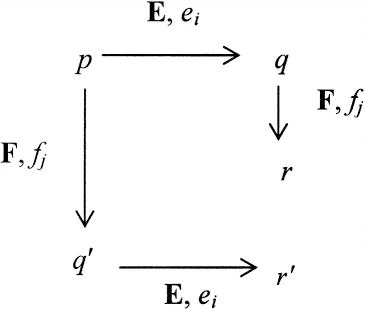
Having revised p to q by the probability-kinematical formula (2.1) above, let us consider a subsequent revision of q to r by the formula

where F = { Fj} is a countable family of pairwise disjoint events such that q(Fj) > 0 for all j, and (fj) is a sequence of positive real numbers summing to one. Now imagine reversing the order of the foregoing, first revising p to, say, q′ by the formula

and then revising q′ to, say, r′ by the formula

Symbolically, Unless E = { E} and F = { F} , in which case r′(A) = r(A) = p(A| EF), it may well be the case that r′ ≠ r. The possibility of such “non-commutativity” has been the source of much confusion and unjustified concern. In the next two sections we lay the foundations for clarifying this issue with two theorems, delineating their methodological and philosophical implications in Section 5.
(2.7)

3. Field's Theorem
A proper analysis of the commutativity issue requires consideration of the more general probability-kinematical revision schema

where the sequence (r′(Ei)) may differ from (q(Ei)), and the sequence (q′(Fj)) from (r(Fj)). Field (Reference Field1978) was the first to identify conditions sufficient to ensure that r′ = r in this setting, in the special case where E and F are finite. In fact, Field's result holds for all countable families E and F, but requires a different proof.

-
Theorem 3.1. Given the probability revision schema (3.1), if the Bayes factor identities
(3.2)and (3.3)hold, then r′ = r.
-
Proof. It follows from (2.1) and (2.2) that for all A, A′ ∊ A
(3.4)Dividing the numerator and denominator of the right-hand side of (3.4) by q(E 1)/ p(E 1), and setting A′ = Ω then yields the formula(3.5)whereWith$B\stackrel{\prime }{i}$:= βr′,q′ (Ei : E 1), bj := βr,q (Fj : F 1), and $b\stackrel{\prime }{j}$ := βq′,p (Fj : F 1), it follows from (3.5), along with analogous formulas for r,q′ , and r′, that (3.7)and(3.8)Since (3.2) implies (indeed, is equivalent to) B′i = Bi and (3.3) implies (indeed, is equivalent to) b′j = bj it follows that r′ = r. □ -
Remark 3.1. Field's proof of Theorem 3.1, with E and F finite and E = { E 1,…, Em}, involved reformulating (2.1) as
(3.9)where Gi is the geometric mean(3.10) -
Remark 3.2. By (1.3), the Bayes factor identities (3.2) and (3.3) are equivalent, respectively, to the probability factor proportionalities
Footnote 4 -
Remark 3.3. Jeffrey (Reference Jeffrey, Skyrms and Harper1988) showed that if E and F are finite and r and r′ are defined by (3.1), then the probability factor identities
imply that r′ = r. In light of the above remark, Jeffrey's result is a corollary of Theorem 3.1.In the special case of schema (3.1) represented by (2.7), Bayes factor and probability factor identities are equivalent to each other, as well as to an especially salient pair of conditions known as Jeffrey-independence conditions, namely,
-
Theorem 3.2. If in (3.1) it is the case that (r′(Ei))=(q(Ei)), then the conditions (3.2), (3.13), and (3.15) are equivalent. If it is the case that (q′(Fj)) = (r(Fj)) then the conditions (3.3), (3.14), and (3.16) are equivalent.
-
Proof. Straightforward algebraic verification. □
-
Remark 3.4. Diaconis and Zabell (Reference Diaconis and Zabell1982), who coined the term “Jeffrey independence,” proved in the context of (2.7), with E and F finite, that conditions (3.15) and (3.16) imply that r = r′. In view of Theorem 3.2, this result is also a corollary of Theorem 3.1. Note that the p-independence of E and F (i.e., p(EiFj) = p(Ei)p(Fj), for all i, j) entails Jeffrey independence.
-
Remark 3.5. Formula (3.7), and consequently Theorem 3.1, can be generalized to arbitrary finite sequences of probability-kinematical revisions. We leave the details as an exercise for interested readers.


4. A Partial Converse Of Field's Theorem
The Bayes factor identities (3.2) and (3.3) are not in general necessary for r′ and r in the revision schema (3.1) to coincide. For example, if F = E = { Ei} and r(Ei) = r′(Ei) for all i, then r′ = r, no matter what values are assigned to q(Ei) and q′ (Ei). However, Field's Theorem does admit of a partial converse.
To motivate the statement of conditions under which (3.2) and (3.3) are necessary for commutativity, it is useful to reiterate the conditions under which the probabilities in schema (3.1) are well-defined. In order to implement the formulas for q, q′, r, and r′, we must have, respectively, p(Ei)>0, p(Fj)>0, q(Fj)>0, and q′(Ei) > 0, for all i and j, or, equivalently, that


The identities (3.2) and (3.3) turn out to be necessary for commutativity under a mild strengthening of the well-definedness conditions (4.1) and (4.2).
-
Theorem 4.1. Let r and r′ be defined by the probability revision schema (3.1), and suppose that
(4.3)(4.4)If r′ = r, then the Bayes factor identities (3.2) and (3.3) hold. -
Proof. Since q comes from p by probability kinematics on E, the rigidity condition (2.3) implies that
Similarlyand soGiven arbitrary i1 and i2, let j be such that (4.3) holds. It then follows inter alia from the relevant rigidity conditions that r(
$E_{i_{2}}$Fj) > 0 and r′($E_{i_{2}}$Fj) > 0. Setting i = i1, i2 in (4.9) and solving for q($E_{i_{1}}$) and q($E_{i_{2}}$) then yields the formula (4.11)Similarly, (4.10) yields the formula(4.12)Hence if r′ = r, then the Bayes factor identity (3.2) holds.Given arbitrary j1 and j2, let i be such that (4.4) holds. It then follows from (4.9) and (4.10) by an argument similar to the above that
(4.13)(4.14)Hence if r′ = r, then the Bayes factor identity (3.3) holds. □ -
Remark 4.1. Note that when F = E, conditions (4.3) and (4.4) fail to hold, thus allowing the possibility (illustrated in the example cited at the beginning of this section) that r′ = r even though (3.2) and (3.3) fail to hold. On the other hand, (4.3) and (4.4) always hold when E and F are qualitatively independent (for all i, j, EiEj ≠ ⊘) and p is strictly coherent (p(A)> 0 for all nonempty events A).
-
Remark 4.2. As noted in Remark 3.4, if in the probability revision schema (3.1), (r′(Ei)) = (q(Ei)) and (q′(Fj)) = (r(Fj)), then the Jeffrey independence conditions (3.15) and (3.16) imply that r′ = r. Interestingly, given (4.3) and (4.4), if for some i, r′(Ei) ≠ q(Ei) or for some j, q′(Fj) ≠ r(Fj), then Jeffrey independence not only fails to ensure that r′ = r, but actually ensures that r′ ≠ r. This follows from Theorem 4.1 and the easily verified fact that (3.15) and (3.16), along with (3.2) and (3.3), imply that (r′(Ei)) = (q(Ei)) and (q′(Fj)) = (r(Fj)). In particular, the p-independence of E and F, since it implies both (4.3) and (4.4) and (as noted in Remark 3.4 above) Jeffrey independence, also ensures that r′ ≠ r unless (r′(Ei)) = (q(Ei)) and (q′(Fj)) = (r(Fj)).
-
Remark 4.3. Diaconis and Zabell (Reference Diaconis and Zabell1982) proved for E and F finite that in the special case of (3.1) represented by (2.7) Jeffrey independence is necessary for r′ = r. In view of Theorem 3.2, this result is a corollary of Theorem 4.1.


5. Sequential Probability Kinematics: All Is Cool
That r′ may fail to coincide with r in the probability-kinematical revision schema (2.7) has been cause for concern among several commentators (see Lange Reference Lange2000 for some sample quotations). Their concern appears to be based on implicit acceptance of two principles relating to the general revision schema (3.1), reproduced below:

-
I. If what is learned from the experience prompting the revisions of p to q, and of q′ to r′ is the same, and if what is learned from the experience prompting the revisions of q to r, and of p to q′, is the same, then it ought to be the case that r′ = r.
-
II. Identical learning underlying the revisions of p to q and of q′ to r′ ought to be reflected in the posterior probability identities
and identical learning underlying the revisions of q to r and of p to q′ in the identities


The first of these principles is unexceptionable. To paraphrase van Fraassen (Reference van Fraassen1989), two persons who undergo identical learning experiences on the same day, but in a different order, ought to agree in the evening if they had exactly the same opinions in the morning. But the second principle is mistaken, losing sight of the fact that posterior probabilities assigned to events in the families E and F are based on the total evidence, old as well as new, and thus incorporate elements of the relevant priors.Footnote 6
What we need is a numerical representation of what is learned from new evidence alone, with prior probabilities factored out. It is a staple of Bayesianism that ratios of new-to-old odds furnish the correct representation of the desired type (Good Reference Good1950, Reference Good1983).Footnote 7 Accordingly, Principle II needs to be modified by replacing (5.1) and (5.2), respectively, by the Bayes factor identities (3.2) and (3.3). So modified, Principle II is both sufficient (Theorem 3.1), and in a substantial number of cases, necessary (Theorem 4.1) for the satisfaction of Principle I.
-
Remark 5.1. Field (Reference Field1978) came close to our modification of Principle II, but made sensory stimulus, eo ipso, the source of Bayes factors, with identical stimuli prompting probability revisions by identical Bayes factors. A counterexample of Garber's (Reference Garber1980) shows this physicalist view to be untenable: Imagine that you glance briefly in dim light at an object known to be blue or green, resulting in your becoming slightly more confident than you were before that the object is blue. Repeated glances producing the identical sensory stimulus will then result in your approaching certainty that the object is blue. Our formulation, in which identical learning gives rise to identical Bayes factors, is immune to Garber's counterexample. We learn nothing new from repeated glances and so all Bayes factors beyond the first are equal to one.Footnote 8
-
Remark 5.2. If F = E in the probability revision schema (2.7), then r′ = q and r = q′, and so it is always the case that r′ ≠ r, except in the uninteresting case in which q′ = q. Lange (Reference Lange2000) has furnished a lucid example suggesting that this never involves a violation of Principle I since the relevant revisions are not based on identical learning.Footnote 9 Note that this claim follows from the principle that identical learning ought to be reflected in identical Bayes factors: Since q′ ≠ q, either q′ ≠ p or q ≠ p. In the former case, the identity βr′,q′
$\left(E_{i_{1}}\thinspace{:}\thinspace E_{i_{2}}\right)$
= βq,p $\left(E_{i_{1}}\thinspace{:}\thinspace E_{i_{2}}\right)$
cannot hold for all i1, i2, since r′ = q. In the latter, the identity βr,q $\left(E_{i_{1}}\thinspace{:}\thinspace E_{i_{2}}\right)$
= βq′,p $\left(E_{i_{1}}\thinspace{:}\thinspace E_{i_{2}}\right)$
cannot hold for all i1, i2, since r = q′. -
Remark 5.3. Note that in Theorem 3.1 the probabilities p, q, q′, r, and r′ are assumed to be well-defined and in place at the outset. Then r′ = r if the Bayes factor identities (3.2) and (3.3) hold. Suppose that only p, q, and q′ were in place at the outset. Does (3.2) then furnish a recipe for constructing a probability r′ that would be the appropriate revision of q′ if in the probabilistic state q′ one were to learn precisely what prompted the revision of p to q? And does (3.3) function analogously in the construction of a probability r? Only if, in the first instance,
(5.3)and in the second,(5.4)(See footnote Footnote Footnote 10)since a probability r′ satisfies (3.2) if and only if(5.5)and a probability r satisfies (3.3) if and only if(5.6)But this raises an intriguing question, with which we conclude this paper. If (5.3), and hence (5.4), fails to hold, as may be the case,Footnote 11 does this mean that the learning prompting the revision of p to q (respectively, p to q′) cannot identically occur in the probabilistic state q′ (respectively, q)?