Introduction
Oocyte donation (OD) is a routinely offered assisted reproductive technology (ART) treatment. Donors go through controlled ovarian stimulation (COS) and, subsequently, the oocytes collected were used in the fertility treatment of usually unrelated people. It can only be offered in countries where governmental regulations permit and this had resulted in the initiation of reproductive tourism in certain countries. The number of patient groups requiring OD is increasing, partly due to societal changes and the improvements in ART technology (Argyle et al. Reference Argyle, Harper and Davies2016). Advanced maternal age, low response to ovarian stimulation (Kawwass et al. Reference Kawwass, Monsour, Crawford, Kissin, Session, Kulkarni and Jamieson2013), poor oocyte quality, recurrent pregnancy loss and premature ovarian failure are the main indications for OD. Less commonly, couples with a heritable nuclear or mitochondrial genetic disease can opt for OD, however preimplantation genetic diagnosis (PGD) can be offered to prevent the transmission of most genetic mutations in these patient groups (Kavic and Sauer, Reference Kavic and Sauer2001; Donnez and Dolmans, Reference Donnez and Dolmans2013).
The number of patients requiring OD is predicted to be higher than the number of suitable donors. Oocyte donors are young and usually show a good response to COS. If the number of oocytes collected is high, they can be shared between different couples in an attempt to alleviate the demand. Recruiting the same donor multiple times is another way of overcoming limited donor number. However, there are various concerns about the use of supra-physiological hormones on women for multiple COS cycles. The aim of this study was to investigate the effects of multiple COS in oocyte donors as assessed by the ovarian response in repeated cycles as well as the developmental potential of the embryos as assessed by implantation rates.
Materials and Methods
Study design
In total, 65 donors underwent 133 in vitro fertilisation (IVF) cycles within the donation programme. Oocytes obtained from these 133 cycles were used for 406 patients. The age of the donor at the time of donation, the number of (mature vs immature) oocytes that were collected, the number of oocytes inseminated per patient, the successful fertilization, embryo development and the implantation rates were evaluated. Donors were grouped according to the number of COS cycles that they underwent. Donors with less than three stimulation cycles were grouped as A, while donors with three or more stimulation cycles were grouped as B. Furthermore, donors were grouped according to the number of oocytes obtained per cycle. Donors with 15 or less oocytes obtained were grouped as C, while donors with 16 or more oocytes obtained were grouped as D.
Donor’s screening and COS
This study included donors between the ages of 18–30 years, with no familial history of congenital malformations or hereditary diseases. The donors were also tested for standard infectious diseases, including HIV, hepatitis B and C, syphilis and Chlamydia. The donors were also evaluated for common haemoglobinopathies and a karyotype analysis was performed. Donors were counselled and a signed informed consent was obtained from each donor.
Donor stimulation was carried out using the standard antagonist protocol. Briefly, stimulation was performed using human gonadotropins and recombinant follicle stimulating hormone. An ultrasound check was performed on day 5 of stimulation. Gonadotropin releasing hormone (GnRH) antagonist was administered on day 6. When two follicles reached approximately 18 mm in size, ovulation was triggered with a GnRH agonist. Trans-vaginal oocyte retrieval was scheduled after 36 h of ovulation trigger.
Embryo grading
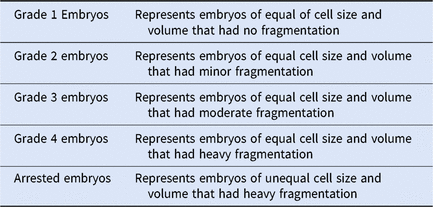
All embryos obtained on day 3 after fertilization were graded (Table 1) according to the guidelines of the European Society of Human Reproductive Embryology (ALPHA Scientists in Reproductive Medicine and ESHRE Special Interest Group Embryology, 2011).
Day 3 embryo grading criteria according to ESHRE guidelines

Statistical analysis
The obtained data were analysed using the SPSS 20th edition software. To determine the effect of repeated COS on the number of oocytes collected, quality of oocytes obtained, fertilization rate, quality of pre-implanted embryos and implantation rates were investigated. Mann–Whitney non-parametric test with confidence intervals of 95% and odds ratio were used to compare variables between different groups. P-values less than 0.05 were reported to be statistically significant.
Results
In this study, there was a statistically significant difference in the total number of oocytes collected, quality of oocytes obtained, fertilization rates, embryo qualities on day 3 (G1–G3) and implantation rates between donors in groups A and B (Tables S1–S3). Oocyte donors who underwent three or more stimulation cycles had statistically greater numbers of oocytes collected in all repeated donation cycles compared with oocyte donors who underwent two or less cycles. Statistically lower numbers of immature oocytes (MI) were collected in group A compared with group B. In contrast, oocyte donors in group B had statistically higher numbers of mature oocytes (MII) with higher rates of fertilization and better embryo development compared with donors in group A. Furthermore, higher implantation rates were obtained from group B oocytes compared with group A oocytes; P < 0.05. However, there was no statistical difference in the ratios of embryos with bad qualities of grade 4 and arrested embryos in both groups (P = 0.444 for grade 4, P = 0.227 for arrested embryos, respectively).
Donors were further evaluated according to the number of oocytes collected per stimulation cycle. Donors with 15 or less oocytes (group C) had statistically lower numbers of immature oocytes collected than donors with 16 or more oocytes (group D, Table S4). Conversely, statistically higher number of mature oocytes, higher fertilization rates and better Embryo qualities were obtained in group D relative to group C. Furthermore, the implantation rates were significantly higher for oocytes obtained from group D donors compared with group C. Conversely, there was no significant difference in the numbers of grade 4 and arrested embryos between donors in groups C and D (P = 0.061 for grade 4; P = 0.982 for arrested embryos, respectively).
Discussion
This study was designed to measure the effect of repeated COS cycles in donors by assessing the numbers of oocytes collected, oocyte qualities, fertilization rates, embryonic developmental capacities and implantation rates. To date, there have been a scarce number of studies investigating the effect of repeated COS on oocyte qualities and the developmental capacities of preimplantation stage embryos.
The results of this study indicated that, as the number of COS cycles increased in the oocyte donors, especially after two COS cycles, more immature oocytes were collected. However, as the numbers of COS cycles that the donors underwent increased, with a minimum of three cycles, statistically higher numbers of mature oocytes with better fertilization and better embryo qualities were obtained. Previously published studies supported these findings, as such the total numbers of both mature and immature oocytes were increased in the second cycle of COS in women with normal ovarian reserve (Eppsteiner et al. Reference Eppsteiner, Sparks, Liu and Van Voorhis2014, Ni et al. Reference Ni, He, Li, Chen, Hua, Chen and Quan2015). Additionally, the numbers of immature oocytes obtained following one and two COS cycles did not differ (Ni et al., Reference Ni, He, Li, Chen, Hua, Chen and Quan2015). This study also showed that the embryos obtained from these donors yielded higher implantation rates and was also supported by previous studies showing higher embryo formation and clinical pregnancy rates in patients with multiple COS cycles (Ni et al. Reference Ni, He, Li, Chen, Hua, Chen and Quan2015). The live birth rates in relation to the number of COS cycles were also associated with the women’s age; these women with low ovarian reserve and under 40 years of age benefitted from five or six COS cycles (Smith et al., Reference Smith, Tilling, Nelson and Lawlor2015).
Further analysis showed that donors with a maximum of 15 oocytes obtained had statistically lower immature oocytes retrieved compared with donors with the minimum of 16 oocytes obtained. However, higher numbers of mature oocytes with higher fertilization and better embryo qualities were retrieved from donors with a minimum of 16 oocytes.
Caligara et al. (Reference Caligara, Navarro, Vargas, Simón, Pellicer and Remohí2001) reported that each oocyte donor had a fixed quota ratio of recruited follicles preselected by the ovaries that, as a result of high gonadotropin administration during repeated COS, were excluded from atresia (Caligara et al. Reference Caligara, Navarro, Vargas, Simón, Pellicer and Remohí2001). According to the suggestion by Gougeon (Reference Gougeon1986), higher doses of gonadotropin during repeated COS provided a mechanism in which recruited ovarian follicles escape atresia (Gougeon Reference Gougeon1986). This finding may support our result, as the quality of oocytes obtained and their developmental capacities were not affected by the numbers of stimulation cycles these donors underwent, and had a great implication on the clinical application of repeated COS.
Although, studies on COS are very scarce, the results of this study suggested that repeated stimulation cycles do not have any adverse effects on ovarian response in terms of the numbers of oocytes collected, oocytes quality, fertilization rates, preimplanted embryo qualities and implantation rates. Therefore, we concluded that donors could go through repeated COS cycles without any negative effect on ovarian response to exogenous gonadotropins, however the side effects on the donor’s health should be evaluated for future purposes.
Financial support
This research received no specific grant from any funding agency, commercial or not-for-profit sectors.
Ethical approval
Ethical approval was granted for this project by the Near East University (YDU/2018/59–605), Cyprus.
Declaration of interest statement
No potential conflict of interest was reported by the authors.
Author contributions
Lizzy T. Paul was involved in the data analysis and statistical investigation. She also participated in the writing of the manuscript. Okan Atilan performed the embryology part of the research. Pinar Tulay designed the project, evaluated the data and wrote the manuscript.
Supplementary material
To view supplementary material for this article, please visit https://doi.org/10.1017/S0967199419000418