I. INTRODUCTION
Transition metal nanoparticles (TM NPs) as catalysts have been widely applied in catalysis and other fields in the past few decades because of their excellent physicochemical properties. Reference Raula, Rashid, Lai, Roy and Mandal1–Reference van Speybroeck, Gani and Meier3 However, bare TM NPs tend to coalescence and aggregation in the process of usage because of their high surface energy and high activity, which is a huge limitation in practical application. Reference Lin, Qiao, Wang, Yan and Huang4–Reference Zhao, Deng, He, Liu, Li, Zhao and Tang6 So finding a functionalized support or precursor on which TM NPs lie while retaining its physical and chemical characteristics has become a critical challenge.
Metal-organic frameworks (MOFs) have attracted increasing attention in diversified fields due to their designable frameworks and tuneable pore structures. Reference Chughtai, Ahmad, Younus, Laypkov and Verpoort7,Reference Stock and Biswas8 In recent years, MOFs have always been used as ideal precursors for directly producing porous carbon materials by thermal cracking in controllable atmosphere, Reference Aijaz, Fujiwara and Xu9–Reference Chen, Wang, Wu, Xiong, Xu, Yu and Jiang11 which is quite effective for heterogeneous catalysis. Reference Bai, Yao and Li12–Reference Zhong, Liu, Bai, Liao and Li14 Nitrogen-doped carbon materials obtained by choosing containing nitrogen MOFs (ZIFs) as precursors and functionalized support often exhibit excellent performance for various applications. Reference Bai, Shen, Zhu, Li, Xi and Chen15–Reference Su, Xiao, Zhao, Yao, Shao, Li and Yang17 Moreover, the perfect compatibility of organic skeleton with a variety of metal ions makes it possible to synthesis of homogeneous multimetallic MOFs. Reference Aguirre-Díaz, Gándara, Iglesias, Snejko, Gutiérrez-puebla and Monge18–Reference Naeem, Ribes, White, Haque, Holt and Wilton-Ely21
Among most TM NPs, Co NPs have shown the outstanding catalytic activity due to their high activity and magnetic response. Reference Yan, Zhao, Li, Wang, Zhong and Chen5,Reference Liao, Zhang, Wang, Wen, Jia, Zhong, Bai, Tang, Que and Zhang22,Reference Shi, Jiao, Sun, Chen, Chen, Zhu, Zhou, Zhou, Li and Li23 Moreover, the incorporation of multiple metals into a single system comparing to a single metal has more advantageous for most applications since the synergistic effect. Reference Liu, Liu, Liu, Wang, Hu, Jing, Liu, Yu and Zhang24 Recently, lots of attention have been paid on developing cobalt-based bimetallic catalysts for various applications. For example, Li et al. doped Zn2+ in Co3O4 and examined the promotion effect of ZnO on cobalt oxides as a water oxidation catalyst. The results showed that the Co/Zn ratio affected the Co oxidation state and ZnCo x O y composite structure to a great extent. Therefore the ZnCo x O y compounds could generate higher The turnover frequency (TOF) in water oxidation. Reference Rong, Zhao, Su, Yao, Li, Yang and Li25 Huang et al. reported that Zn0.3Co2.7S4 derived from homogenous bimetallic MOFs had been used as a catalyst in the hydrogen evolution reaction and showed excellent electrochemical hydrogen evolution reaction (HER) activity. Reference Huang, Song, Li, Tahir, Wang, Pan, Wang, Zhang and Zou26 Song Bai et al. have synthesized the Ni x Co100−x -RGO nanocomposites by a coreduction process, exhibiting enhanced catalytic activities toward the reduction of 4-nitrophenol (4-NP) by NaBH4. Reference Bai, Shen, Zhu, Li, Xi and Chen15 Lin Hu et al. have fabricated FeCo nanocrystals with nitrogen-doped graphene shells with a highly efficient catalytic activity and magnetically separable capability in the reduction of 4-NP. Reference Hu, Zhang, Wei, Zhang and Chen16 However, the catalytic activity for the reduction of 4-NP is still needed to be improved and it is rare reported that the 4-NP reduction was conduced by zinc and cobalt-based bimetallic catalysts.
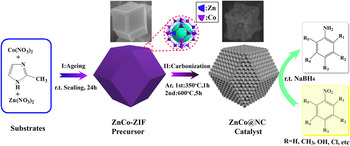
Herein, we synthesized porous rhombic dodecahedral Zn0.3Co2.7@NC composed of uniformly dispersed zinc and cobalt metal NPs in the nitrogen doping carbon skeleton by thermal annealing of the precursor of zinc-cobalt zeolitic imidazolate framework (Zn0.3Co2.7-ZIF). The resulting Zn0.3Co2.7@NC catalyst showed an excellent catalytic activity for the reduction of 4-NP to 4-aminophenol (4-AP). The whole reaction of catalyst from preparation to application is showed in Fig. 1. Moreover, our catalyst has shown excellent catalytic performances in the reduction of other nitro compounds and it is expected to be used in other catalysis processes due to its highly efficient catalytic activity.
The whole reaction of catalyst from preparation to application.

II. EXPERIMENTAL
A. Materials
Co(NO3)2·6H2O, Zn(NO3)2·6H2O, NaBH4, methanol, ethanol, 4-NP, 2-nitrophenol (2-NP), 2,4-dinitrophenol, 3-nitroaniline, p-nitrotoluene, p-nitrochlorobenzene, p-nitroacetophenone, p-nitrophenylacetonitrile, p-nitrobenzaldehyde, 5-nitroindole, and 6-nitrobenzimidazole were purchased from KeLong Chemical Reagent Company (Chengdu, China). 2-methylimidazole (2-mIM) was purchased from Aladdin, Ltd. (Shanghai, China). All chemicals used in this study were of analytical grade and used without further purification. High-purity water (18.25 MΩ cm) supplied by a UP Water Purification System was used in all the experiments.
B. Instruments and characterization
X-ray diffraction (XRD) was performed on a Bruker D8 Advance powder X-ray diffractometer using Cu Kα radiation (Bruker, Kalsruhe, Germany). Thermogravimetric analysis (TGA) was performed on a Shimadzu DTG-50 (Shimadzu Corp., Tokyo, Japan) thermal analyzer from room temperature to 800 °C at a heating rate of 10 °C/min. Scanning electron microscopy (SEM) and energy dispersive spectrometry (EDS) were conducted on Hitachi SU8010 (Hitachi Corp., Tokyo, Japan). Meanwhile, transmission electron microscope (TEM) investigation was performed using a Titan G260-300 (FEI Company, Hillsboro, Oregon). The Brunauer–Emmett–Teller (BET) surface area and porous structure were measured using a Novae surface area apparatus (Quantachrome Instruments, Boynton Beach, Florida) from the nitrogen adsorption and desorption isotherms at 77 K. Atomic absorption spectroscopy (AAS) was analyzed using a 200 Series AA, (Agilent Technologies). X-ray photoelectron spectroscopy (XPS) was conducted using an ESCALAB 250Xi spectrometer (Thermo Fisher Scientific, Waltham, Massachusetts). The changes in absorbance were recorded at UV-visible spectrophotometer (UV-2550, Shimadzu Corp).
C. Preparation of the precursor Zn0.3Co2.7-ZIF nanocrystals
The preparation of rhombic dodecahedral ZIFs nanocrystals was based on previous literature with modifications. Reference Huang, Song, Li, Tahir, Wang, Pan, Wang, Zhang and Zou26,Reference Li, Zeng, Jiang and Ai27 Typically, Co(NO3)2·6H2O (2.7 mmol, 0.786 g) and Zn(NO3)2·6H2O (0.3 mmol, 0.089 g) (the total molar amount of (Zn + Co) was fixed to be 3 mmol) were dissolved in 30 mL of methanol to form a red solution. 2-methylimidazole (24 mmol, 1.97 g) was dissolved in 20 mL of methanol to form another clear solution. The former solution was poured into the latter solution and magnetically stirred for 10 min. After mixing, the solution was sealed up at room temperature for 24 h. The resulting purple precipitates were collected by centrifuging, washed with ethanol at least three times, and finally dried in vacuum at 70 °C overnight. The resulting product is abbreviated as Zn0.3Co2.7-ZIF.
D. Preparation of porous catalyst Zn0.3Co2.7@NC
The precursor Zn0.3Co2.7-ZIF powders were carbonized in a furnace in argon from room temperature to 350 °C with a slow heating rate of 5 °C/min and maintained at 350 °C for 1 h. Then it was heated up to 600 °C at the same heating rate and carbonized for 5 h under an argon atmosphere. The sample was slowly cooled to room temperature, and a black Zn0.3Co2.7@NC sample was obtained and named Zn0.3Co2.7@NC.
E. Evaluation of catalytic activity of Zn0.3Co2.7@NC
The catalytic activity of Zn0.3Co2.7@NC was evaluated by a model reaction of the reduction of 4-NP to 4-AP in the presence of NaBH4 in aqueous solutions and the reduction process was monitored by using a Shimadzu UV-2550 spectrophotometer. The stock solution of 1.00 mg/mL aqueous suspension of Zn0.3Co2.7@NC was prepared and was dispersed by ultrasound before use. In the experimental process, 3.0 mL of 0.1 mmol/L 4-NP aqueous solution was shifted to the 4 mL quartz cell, then 10 mg (0.26 mmol) of NaBH4 was added, and finally 60 μl (the concentration of catalyst in the cell is 0.02 mg/mL) catalyst was added to the above solution; the whole process was recorded by an ultraviolet spectrometer at 1 min intervals.
Other catalysts were evaluated in the same process.
III. RESULTS AND DISCUSSIONS
A. Characterization of precursor Zn0.3Co2.7-ZIF
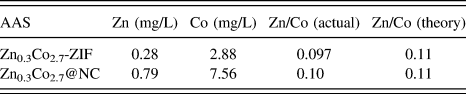
The chemical composition of Zn0.3Co2.7-ZIF was analyzed by element mapping (Fig. S1), AAS (Table I) and EDS. The EDS spectrum and element content of Zn0.3Co2.7-ZIF are shown in Fig. S2, demonstrating that Zn0.3Co2.7-ZIF is mainly composed of C, N, O, Co, and Zn elements and the mass contents are 62.65, 20.83, 12.05, 4.53, and 0.33%, respectively; the O may come from the oxidation of the metal elements in air during the catalyst preparation and storage process. Reference Rakap and Özkar28,Reference Rakap and Özkar29 The ratio of Zn/Co of Zn0.3Co2.7-ZIF was determined by AAS and the results in Table SII show that the Zn/Co molar ratio within the bimetallic ZIFs is 0.3/2.7 which is consistent with the ratio of corresponding reactants.
AAS of Zn0.3Co2.7-ZIF and Zn0.3Co2.7@NC.

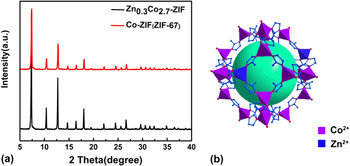
To examine the successful synthesis of Zn0.3Co2.7-ZIF, the XRD was conducted [Fig. 2(a)]. It shows that Zn0.3Co2.7-ZIF has similar diffraction peaks at the same positions of Co-ZIF(ZIF-67). Reference Li, Gao, Ai and Jiang30 Theoretically, Zn2+ can be homogeneously introduced in the Co-ZIF framework by substituting Co2+ sites [Fig. 2(b)] Reference Huang, Song, Li, Tahir, Wang, Pan, Wang, Zhang and Zou26 because of their similar ionic radius and electro-negativity (Tables II and III). Reference Chen, Wang, Wu, Xiong, Xu, Yu and Jiang11,Reference Wu, Qian, Zhou, Wei, Lou and Ajayan31 The combination of crystal structure and the XRD patterns of Zn0.3Co2.7-ZIF indicated that the reaction of a 2-methylimidazole ligand with Zn2+ and Co2+ could result in bimetallic ZIFs as a pure phase rather than a mixture of two homometallic ZIFs. So we could conclude that Zn0.3Co2.7-ZIF was synthesized successfully and both Zn and Co elements are found to be indeed incorporated in the rhombic dodecahedron.
(a) XRD patterns of Zn0.3Co2.7-ZIF and Co-ZIF. (b) Crystal structure of bimetallic Zn0.3Co2.7-ZIF.

Ionic radius of various elements.

Electronegativity of various elements.

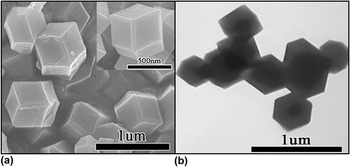
To gain insight into the detailed morphology, we carried on the SEM and TEM tests of Zn0.3Co2.7-ZIF. Figure 3(a) shows a general SEM image of Zn0.3Co2.7-ZIF, showing a regular rhombic dodecahedral shape of the well-scattered product. The close observation [inside Fig. 3(a)] suggests that the pore size of the particle is about 400 nm with a smooth surface and regular shape. Figure 3(b) also shows a TEM image of Zn0.3Co2.7-ZIF, showing the regular rhombic dodecahedron.
(a) SEM of Zn0.3Co2.7-ZIF. (b) TEM of Zn0.3Co2.7-ZIF.

B. Characterization of catalyst Zn0.3Co2.7@NC
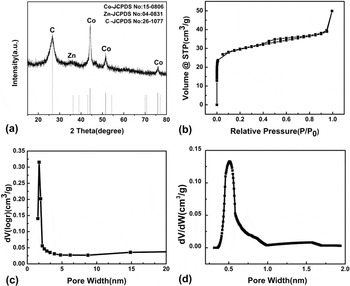
Porous catalyst Zn0.3Co2.7@NC comes from the carbonation of the precursor Zn0.3Co2.7-ZIF in a furnace under argon atmosphere. The (TG) curve of as-prepared homogenous bimetallic Zn0.3Co2.7-ZIF is demonstrated in Fig. S3, revealing that there was large mass loss obviously at 550–600 °C, and there was little mass loss after 600 °C, displaying that the carbonation of Zn0.3Co2.7-ZIF was completed before 600 °C. So we set the carbonizing temperature at 600 °C. The chemical composition of Zn0.3Co2.7@NC were analyzed by element mapping (Fig. S4), where both Zn and Co elements are found to be indeed combined in the rhombic dodecahedron. Meanwhile, EDS spectrum and element content of Zn0.3Co2.7@NC are shown in Fig. S5, demonstrating that Zn0.3Co2.7@NC is mainly composed of C, N, O, Co, and Zn elements and the mass contents are 48.36, 13.69, 8.50, 27.11, and 2.34%, respectively; the O may come from the oxidation of the metal elements in air during the catalyst preparation and storage process. Reference Rakap and Özkar28,Reference Rakap and Özkar29 Fig. 4(a) shows a typical XRD pattern of Zn0.3Co2.7@NC. There are three prominent diffraction peaks located at 2θ of 44.3°, 51.6°, and 75.9°, which can be well indexed to metallic Co (Joint Committee on Powder Diffraction Standards [JCPDS] file no. 15-0806). The broadened peaks indicate the small sizes of Co particles. There is a prominent diffraction peak located at 2θ of 36.3°, which can be well indexed to metallic Zn (JCPDS file no. 04-0831). In addition to these peaks, a relatively strong and broad peak centered at 2θ of 26.5° can be ascribed to graphitic carbon (JCPDS file no. 26-1077). This information indicated the successful formation of Zn0.3Co2.7@NC. The AAS was conducted to further verify the ratio of Zn/Co and the results were listed in Table SII. It proposes that the Zn/Co molar ratio within Zn0.3Co2.7@NC is consistent with that of corresponding reactants. The porosity of Zn0.3Co2.7@NC was confirmed by N2 adsorption–desorption isotherms shown in Fig. 4(b), showing that N2 adsorption quantity has first increased dramatically at the relative pressure range of 0–0.1, then appearing a hysteresis of adsorptive stripping line at the relative pressure of 0.1–0.95 and afterward the adsorption quantity has risen sharply at the relative pressure of 0.95–1, suggesting that Zn0.3Co2.7@NC possesses a micro-porous structure. Reference Peng, Li, Tan, Cai, Shi, Li, Mhaisalkar, Srinivasan, Ramakrishna and Yan32,Reference Xiao, Liu, Li, Zhang, Zhao, Fang and Jia33 The Barrett–Joyner–Halenda (BJH) mesopore size distribution [Fig. 4(c)] shows that the pore size of Zn0.3Co2.7@NC is mainly distributed at 1.7 nm. The Horvath–Kawazoe(HK) size distribution [Fig. 4(d)] shows that there is a pore size distribution of Zn0.3Co2.7@NC ranged from 0.3 to 2 nm. At the same time, the experimental data from the BET experiment revealed that the average pore size is 1.79 nm, the pore volume is 0.272 cm3/g in the relative pressure P/P0 = 0.99, and the surface area is 303.01 m2/g. Furthermore, under the same intensity and particle thickness, the porous structural feature of Zn0.3Co2.7@NC can be drawn out from these results. Such hierarchical porosity and pore size of Zn0.3Co2.7@NC are of great importance for the catalysis application. Numerous nanopores are distributed homogeneously throughout the whole rhombic dodecahedron, allowing the efficient diffusion, transportation, and transfer of reactants to the catalytic active sites.
(a) XRD pattern of Zn0.3Co2.7@NC. (b) N2 adsorption–desorption isotherms of Zn0.3Co2.7@NC. (c) The BJH mesoporous size distribution of Zn0.3Co2.7@NC. (d) The HK mesoporous size distribution of Zn0.3Co2.7@NC.

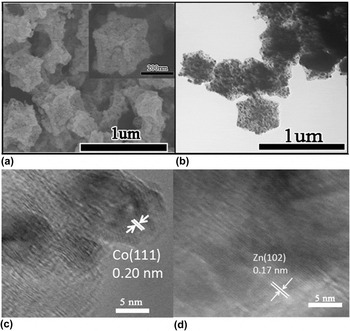
The SEM, TEM, and high-resolution transmission electron microscopy (HRTEM) tests for Zn0.3Co2.7@NC were carried out. Figure 5(a) shows a general SEM image of Zn0.3Co2.7@NC, revealing that the basic skeleton maintains unaltered with slight deformation after carbonation. The particle size is about 250 nm with remarkable dimensional shrinkage but maintaining rhombic dodecahedral shape. This may be caused from the mass loss of organic components in the process of carbonation. The TEM image [Fig. 5(b)] shows the numerous small particles of zinc and cobalt metals (black region) which are uniformly distributed in the nitrogen doping carbon framework (gray region). These Co and Zn NPs are easily accessible by reactants and performed as an active center for the catalytic reaction. The HRTEM image [Fig. 5(c)] demonstrated that metallic Co NPs in Zn0.3Co2.7@NC are highly crystalline, exhibiting the distinct lattice fringes with a spacing of 0.20 nm, consistent with the (111) lattice plane of the metallic Co. The HRTEM image [Fig. 5(d)] demonstrated that metallic Zn NPs in Zn0.3Co2.7@NC are highly crystalline, exhibiting the distinct lattice fringes with a spacing of 0.17 nm, consistent with the (102) lattice plane of metallic Zn.
(a) SEM of Zn0.3Co2.7@NC. (b) TEM of Zn0.3Co2.7@NC. HRTEM images of Zn0.3Co2.7@NC with the Co NPs (c) and Zn NPs (d).

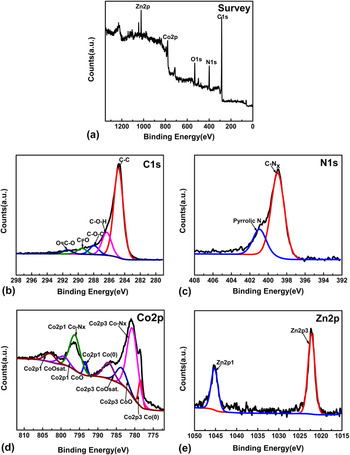
XPS was used to test elemental composition and electronic structure of Zn0.3Co2.7@NC. Figure 6 shows the XPS survey spectrum and high resolution XPS spectra of Zn0.3Co2.7@NC. The XPS survey spectrum [Fig. 6(a)] indicates that Zn0.3Co2.7@NC is mainly composed of C, N, O, Zn and Co elements. The C 1s XPS spectrum are fitted to five individual peaks as shown in Fig. 6(b), which are C–C (284.8 eV), C–O–H (286.1 eV), C–O (286.5 eV), C = O (288.9 eV), and O = C–O (289.4 eV). Reference Kong, Mao, Lin, Wei, Bu and Feng34 Fig. 6(c) shows the high resolution N 1s XPS spectrum, which can be deconvoluted into two peaks corresponding to C–N x (399.0 eV) and pyrrolic-N (400.5 eV), respectively. Reference Wei, Hu, Wu, Liang, Leong, Kong, Zhang, Zhao, Simon and Wang35,Reference Zhang, Hao, Yang and Tang36 Fig. 6(d) shows the high resolution Co 2p XPS spectrum, in which can be seen that these peaks at the low binding energies of 778.5 and 793.3 eV correspond to Co 2p 3/2 and Co 2p 1/2 of metallic Co(0). Reference Kong, Mao, Lin, Wei, Bu and Feng34,Reference Wei, Hu, Wu, Liang, Leong, Kong, Zhang, Zhao, Simon and Wang35 These peaks at the blinding energies of 780.8 and 796.4 eV correspond to Co 2p 3/2 and Co 2p 1/2 of Co–N x . Reference Wei, Hu, Wu, Liang, Leong, Kong, Zhang, Zhao, Simon and Wang35 Additionally, these binding energies of Co 2p 3/2 and Co 2p 1/2 are observed at 783.9 eV and 799.6 eV, respectively, which are the characteristic of surface CoO species. Reference Chen, Wang, Wu, Xiong, Xu, Yu and Jiang11,Reference Wu, Qian, Zhou, Wei, Lou and Ajayan31 The shakeup satellite peaks at approximately 5 eV above their main peaks can be a further evidence of surface CoO species. The detectable CoO species can be ascribed to the surface Co combined with oxygen of atmosphere during the catalyst preparation and storage process, Reference Rakap and Özkar28,Reference Rakap and Özkar29 which is similar to the other cobalt-based catalysts. Reference Lü, Wang, Li, Lin, Jiang, Xie, Kuang and Zheng37,Reference Torad, Hu, Ishihara, Sukegawa, Belik, Imura, Ariga, Sakka and Yamauchi38 As shown in Fig. 6(e), the binding energy of Zn 2p 1/2 at 1045.3 eV corresponds to the metallic Zn(0) species, while the binding energy of Zn 2p 3/2 at 1022.1 eV corresponds to the characteristic of surface ZnO species same as CoO. Reference Khemasiri, Chananonnawathorn, Klamchuen, Jessadaluk, Pankiew, Vuttivong, Eiamchai, Horprathum, Pornthreeraphat, Kasamechonchung, Tantisantisom, Boonkoom, Songsiririthigul, Nakajima and Nukeaw39,Reference Jiang, Georgiev, Jayatissa, Collins, Chen and McCullen40
XPS spectra of Zn0.3Co2.7@NC: (a) survey, (b) C 1s, (c) N 1s, (d) Co 2p, and (e) Zn 2p.

C. Evaluation of catalytic activity of Zn0.3Co2.7@NC
The evaluation of catalytic activity of Zn0.3Co2.7@NC was conducted by the typical reaction of the conversion of 4-NP to 4-AP in the presence of NaBH4. Figure 7(a) shows the image of the whole reaction, 4-NP turned into 4-nitrophenolate in the presence of NaBH4. When adding catalyst Zn0.3Co2.7@NC, 4-nitrophenolate is reduced to 4-AP along with the solution color change from yellow to dark yellow to clear. Accordingly, the maximum absorption peak of 317 nm for 4-NP shifted to 400 nm for 4-nitrophenolate [Fig. 7(b)]. When the reduction of 4-NP started, the absorption peak intensity at 400 nm immediately decreases accompanying with the appearance of a new absorption peak for 4-AP at 300 nm. Therefore, time-dependent UV–vis absorption spectroscopy can feasibly monitor the progress of this reduction conversion. Figure 7(b) also shows the catalytic activity of the catalyst by measuring the change of the maximum absorbance at 400 nm. It can be seen that the absorption peak intensity of 4-nitrophenolate ion at 400 nm fell sharply. The reaction was completed in about 5 min, suggesting the excellent catalytic activity of Zn0.3Co2.7@NC in the reduction of 4-NP. The excellent catalytic activity of Zn0.3Co2.7@NC for 4-NP reduction may be due to the presence of active sites of nitrogen doping carbon, which is similar to the recent observations on the other nitrogen-doped carbon for the catalytic reduction reaction. Reference Kong, Sun, Chen, Chen and Chen41,Reference Yang, Zhang, Ma, Zhao and Zhang42 Considering that the amount of NaBH4 is excess, the 4-NP reduction can be thought as a pseudo-first-order reaction, whose kinetics rule can be expressed as ln (C t /C 0) = −kt (k: apparent first-order rate constant (min−1), t: reaction time, and C t and C 0: concentrations of 4-NP at time t and 0). Figure 7(c) shows the normalized dynamic figure of the different concentration of Zn0.3Co2.7@NC on the reduction of 4-NP by the plots of ln (C/C 0) versus reaction time t. These rates of reaction k are, respectively, 0, 0.381, 0.683, and 0.787 min−1 when these concentrations of Zn0.3Co2.7@NC are correspondingly 0, 0.01, 0.02, and 0.03 mg/mL. Therefore, we can conclude that when the concentration of Zn0.3Co2.7@NC is 0 mg/mL (only NaBH4), the reduction reaction cannot proceed even with a large excess NaBH4 and also get that the reaction can be accelerated with the catalyst. To evaluate the recyclability of the catalyst, the successive cycles of the catalytic reduction were carried out with Zn0.3Co2.7@NC. As shown in Fig. 7(d), the catalyst was reused 6 times, and in the successive cycles there were a certain drop of conversion. This may be mainly induced by the loss of the catalyst since the mass of the catalyst is in microscale and the recovery of catalyst is not easy in the process of recycle.
(a) The reaction flow chart of the whole catalytic reaction. (b) Spectrogram of the reduction reaction for the conversion of 4-NP to 4-AP catalyzed by Zn0.3Co2.7@NC in the presence of NaBH4 in the aqueous solution (T = 25 °C, V
4-NP = 3 mL,
 ${V_{{\rm{Z}}{{\rm{n}}_{0.3}}{\rm{C}}{{\rm{o}}_{2.7}}@{\rm{NC}}}} = 60\;\mu {\rm{L}}$
,
 ${m_{{\rm{NaB}}{{\rm{H}}_4}}} = 10\;{\rm{mg}}$
). (c) The normalized dynamic figure of the different concentration of Zn0.3Co2.7@NC on the reduction of 4-NP. (d) Reusability test of Zn0.3Co2.7@NC for the catalytic reduction of 4-NP.

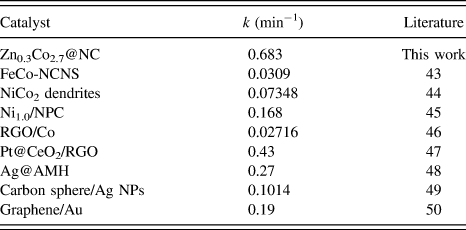
To examine the excellent catalytic activity of synthetic Zn0.3Co2.7@NC, a comparison of catalytic performances with those in the literature was conducted and the comparison results were listed in Table IV, which indicates that the catalytic activity of Zn0.3Co2.7@NC is superior to those of the catalysts reported in the literature.
Comparison of catalytic performance of Zn0.3Co2.7@NC with the catalysts reported.

To further examine the catalytic activity of Zn0.3Co2.7@NC for other nitro compounds, 10 nitroarenes were selected for the reduction reaction and the results are showed in Table V. (The experimental details are shown on Figure S6–S15 in the Supplementary Material.) The results revealed that the reduction reaction could almost be completed in 3–4 min, such as p-nitrotoluene, p-nitrochlorobenzene, p-nitrobenzaldehyde, etc., except the reduction of 2,4-dinitrophenol which was completed in 5 min. Nevertheless the reduction of 3-nitroaniline does not take place, perhaps –NH2 at the meta-position prevents the reduction of the nitro-group. These results demonstrated again that the catalyst Zn0.3Co2.7@NC has the excellent catalytic activity for aromatic nitro compounds; therefore it could be applied to the catalytic reduction of more nitro compounds.
Catalytic reduction of 10 nitroarenes catalyzed by Zn0.3Co2.7@NC in the presence of NaBH4 in the aqueous solution (T = 25 °C, V
nitroarenes = 3 mL,
 ${V_{{\rm{Z}}{{\rm{n}}_{0.3}}{\rm{C}}{{\rm{o}}_{2.7}}@{\rm{NC}}}} = 60\;\mu {\rm{L}}$
,
 ${m_{{\rm{NaB}}{{\rm{H}}_4}}} = 10\;{\rm{mg}}$
).

IV. CONCLUSION
In summary, porous catalyst Zn0.3Co2.7@NC was synthesized by carbonizing the precursor Zn0.3Co2.7-ZIF at 600 °C and used as a novel catalyst for the reduction of 4-NP to 4-AP. The XRD, AAS, SEM, TEM, and XPS were used to characterize and the results confirmed the formation of Zn0.3Co2.7@NC. Catalytic evaluation results revealed that Zn0.3Co2.7@NC has an excellent catalytic performance and can complete the reduction of 4-NP to 4-AP only in 5 min with nearly 100% conversion. The apparent rate constant was estimated to be 0.683 min−1. In addition, it also exhibits excellent catalytic performance in the reduction of other nitro compounds, and the reduction was completed within 5 min. Therefore, it is expected to get more extensive application in the catalysis field.
Supplementary Material
To view supplementary material for this article, please visit https://doi.org/10.1557/jmr.2017.148
ACKNOWLEDGMENTS
Financial support from the National Natural Science Foundation of China (Nos. 21162027 and 21261022) is gratefully acknowledged.