1. INTRODUCTION
Maintaining smooth and collision-free traffic movements in port fairways is one of the top-priority concerns in many seaports. However, navigational collisions account for a substantial portion of the major types of shipping incidents in port waters. Many studies (Goossens and Glansdorp, Reference Goossens and Glansdorp1998; Akten, Reference Akten2004; Darbra and Casal, Reference Darbra and Casal2004; Liu, Liang et al., Reference Liu and Liang2006; Liu, Pedersen et al., Reference Liu and Pedersen2006; Yip, Reference Yip2008) have reported that collisions are over-represented in port water incidents. Collisions are also identified as one of the most severe types of incidents (IMO, 1998), thus making them a major safety concern for many seaports.
The risk of collisions in port waters is likely to increase with the gradual increase in size and density of shipping experienced over the past decades. The world fleet is increasing in number (see Soares and Teixeira, Reference Soares and Teixeira2001), which could result in increased traffic movements within port waters, consequently increasing the risk of collision. The number of traffic movements on a busy fairway in port waters can be as high as 2000 per day (Yip, Reference Yip2008) and the number is expected to increase with the continuing growth of traffic. Such a high number of movements may result in more collisions and near-misses. More importantly, navigational traffic is increasing in size (Faulkner, Reference Faulkner2003) resulting in a higher number of large ships in port waters. The larger ships have reduced manoeuvrability and thus face a consequent increase in the risk of collision (Akten, Reference Akten2004), especially in port waters where navigation room is restricted by land obstacles.
To address this safety concern, some recent studies have focused on examining trends and causes of collisions (Goossens and Glansdorp, Reference Goossens and Glansdorp1998; Akten, Reference Akten2004; Darbra and Casal, Reference Darbra and Casal2004; Liu, Liang et al., Reference Liu and Liang2006), whereas some (Darbra and Casal, Reference Darbra and Casal2004; Yip, Reference Yip2008) have addressed the issues related to consequences of collisions (i.e., injuries and fatalities). Despite these studies, there is still a lack of knowledge regarding the influencing factors of collision risk in port waters. In particular, it is not well understood how the geometric, traffic and regulatory control characteristics of waterways influence the probability of collisions. Understanding those effects is important for the development of targeted countermeasures to improve safety, as well as for setting up guidelines for safe navigation. Roeleven et al. (Reference Roeleven and Kok1995) modelled collision risk by using historical collision data in order to identify the influencing factors related to waterway geometry. While this study provided a good understanding of the geometric factors, it ignored the factors related to traffic and regulatory control characteristics. To model the risk in a comprehensive manner, it is necessary to consider all the possible geometric, traffic and regulatory control characteristics together. This is because navigation in a waterway is not affected by its geometry only; it is also influenced by the traffic conditions and the navigational aids in the waterway.
To identify the influencing factors that lead to collision risks in port waterways in a comprehensive manner it is necessary to develop modelling techniques. Apart from considering a rigorous set of influencing factors, it is also necessary to derive the model in such a way that it does not rely on historical collision data. Reliance on collision data is often considered as reactive and unethical because this approach of modelling requires a sufficiently large number of collisions to take place first, before any preventive or corrective measures are taken. It is also difficult to derive statistically sound inferences from analysis of collision data because, for a particular waterway, the number of collision counts is low. This low sample problem may also restrict safety analysts from using robust statistical methods (e.g., regression techniques). To overcome the limitations associated with using collision data, the Navigational Traffic Conflict Technique (NTCT) has been proposed by Debnath and Chin (Reference Debnath and Chin2010) which utilizes traffic conflicts as an alternative to collision data for measuring the risk of collision in a waterway. The most appealing aspect of the NTCT is having a larger database of observations within a shorter period of time as navigational traffic conflicts occur considerably more frequently than collisions. The NTCT also overcomes the ethical issue of waiting for collisions to take place before the problem is addressed. Using traffic conflicts could be useful in deriving the risk model as it will permit the use of a regression technique.
This paper develops a technique for modelling collision risks in port waterways in order to examine the relationships between the risks and the geometric, traffic and regulatory control characteristics of waterways. A binomial logistic model (BLM) with considerations for hierarchical data structure is formulated that accounts for the correlations in the risks of a particular fairway at different time periods. The model is calibrated and validated by using traffic conflicts data of the fairways in Singapore port waters. In Section 2, the methodology of the study is described consisting of the formulation of the BLM, considerations for hierarchical data structure and assessment of the model. Section 3 describes the data set used for calibration of the model. Estimation results and significant explanatory variables are discussed in Section 4 and finally conclusions are provided in Section 5.
2. METHODOLOGY
Risk of collision in a waterway can be expressed as the probability of a serious conflict in a vessel encounter (see Debnath and Chin, Reference Debnath and Chin2010). An encounter is defined as an interaction involving a pair of vessels where one is within the ship domain of the other. A serious conflict corresponds to an encounter that may pose risk of a certain collision, i.e., collision cannot be avoided by taking any kind of evasive action. In this research, the serious conflicts are defined by using a set of threshold values, which were developed by Debnath and Chin (Reference Debnath and Chin2010). The threshold values were defined by utilizing a risk scale that represents different risk levels, which were described by the level of actions necessary to avoid a collision. According to this scale, the High Risk level refers to the situation where immediate actions are needed to avoid a collision, whereas the Very High Risk level refers to the situation where collision cannot be avoided by taking any actions. A serious conflict coincides with the boundary of the two levels. Thus, the threshold values were developed as the value of collision risk at the transition of the risk levels. Since BLMs are appropriate to use when the response variable is a dichotomy or a proportion, they can be used to model the probability of a serious conflict in waterways. In this study, the response variable (i.e., the probabilities) is proportional in nature.
2.1. Model Formulation
An encounter e at time t in waterway w can have two possible forms: serious conflict (Y ewt=1) and non-serious conflict (Y ewt=0). Since the probability that a serious conflict will occur, p ewt=Pr(Y ewt=1), is restricted within the range [0, 1], the probability is transformed into the logarithm of the odds, log(p ewt/(1−p ewt)) to obtain a range from −∞ (p ewt=0) to ∞ (p ewt=1). By treating the logit transformation as a link function, p ewt is then expressed as:
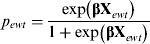
where Xewt is a vector of explanatory variables and β is the vector of unknown parameters that explain the effects of the explanatory variables.
The BLM can also be applied to model a proportional response variable. Suppose, in a waterway w at time period t, y wt is the number of serious conflicts and n wt is the total number of encounters where y wt follows a binomial distribution, f(y wt; nwt, pewt). The expected number of serious conflicts in waterway w at time period t is:

The proportional response variable, y wt/n wt, is then equivalent to p ewt as:

2.2. Considerations for Hierarchical Data
In the presence of within-panel correlation in the response variable, models that do not appropriately consider the hierarchical data structure may yield biased results. The correlation of the observations within a panel violates the assumption in an Ordinary Regression Model (ORM), such as the BLM, that all observations across all panels are independent. When this assumption is violated, the ORM underestimates the standard errors of the regression coefficients, which results in obtaining falsely significant results (Allison, Reference Allison1999). A hierarchical model, on the other hand, takes into consideration the correlated structure of observations in estimation of the standard errors.
Risk of collision is usually modelled separately for different time periods, because navigation is affected by the environment in day and night periods (Chin and Debnath, Reference Chin and Debnath2009; Debnath and Chin, Reference Debnath and Chin2009a; Debnath and Chin, Reference Debnath and Chin2010). For a particular waterway, the risks at day and night are likely to be correlated because of the fixed characteristics of the waterway over the time periods (e.g., geometric and regulatory control characteristics). These within-waterway correlations need to be carefully modelled to obtain unbiased results.
2.2.1. Binomial Logistic Model with Modified Sandwich Variance Matrix
To account for the within-waterway correlations, the BLM with a modified sandwich variance matrix can be employed. Instead of using an ordinary BLM, this approach computes the standard errors by correctly specifying the hierarchical data structure. The key idea is that since an ordinary BLM underestimates standard errors in a correlated data structure, this approach computes the standard errors by treating the correlations and keeps the other computations similar to an ordinary BLM.
In this approach, a BLM uses a modified sandwich variance matrix to find the maximum likelihood estimates while treating the correlated data structure (see Hardin and Hilbe, Reference Hardin and Hilbe2007 for details). The matrix has a score factor,  , sandwiched between two copies of the Hessian matrix, which is usually used in estimating parameters of an ordinary BLM, as:

where if each panel w (waterway) contains T w observations (time periods), xwt refers to the row of the matrix X associated with the t th observation for subject w,  is the scale parameter, η is the linear predictor=βX, and μ wt is the expected number of serious conflicts in waterway w at time period t (=n wtpewt), the score factor is given as:

The Hessian matrix is expressed as:
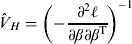
where  is the log likelihood function of the model.
In the maximum likelihood estimation method, the regression coefficients of the BLM are estimated by maximizing the log likelihood function, and the sandwich variance matrix is used to estimate the standard errors and confidence intervals of the coefficients.
2.3. Model Assessment
An important step in model assessment is to identify the subset of explanatory variables that yields the most parsimonious model. This is accomplished by using the Akaike Information Criteria (AIC) developed by Akaike (Reference Akaike1973) which is defined as AIC=−2LL(c)+2k, where LL(c) is the log-likelihood value of the candidate model at convergence and k is the number of parameters to be estimated. Starting with a saturated model that includes the full set of explanatory variables, a backward elimination procedure is employed to obtain the most parsimonious model by minimizing the value of AIC. The insignificant variables are omitted one after another starting with the most insignificant one.
In modelling a discrete response variable, it is important to assess if the model is over-dispersed, i.e., the variance of the response variable is greater than the nominal variance. Existence of over-dispersion can be identified by observing the value of the dispersion statistics, ψ=(−2ɸ(LL(c)−LL(F)))/(N−k), where LL(F) is the log-likelihood of a fully-specified model, N is the total number of observations and k is the number of parameters to be estimated. A value of ψ greater than 1·0 indicates the existence of over-dispersion. As suggested by Hardin and Hilbe (Reference Hardin and Hilbe2007), a small amount of over-dispersion is of little concern. However, if ψ greater than 2·0, then an adjustment to the standard errors is necessary.
The z-test is used in order to examine the significance of explanatory variables included in the model, and several goodness-of-fit (gof) measures found in Long and Freese (Reference Long and Freese2006) are used to evaluate if the model has sufficient explanatory and predictive power. The likelihood ratio statistics, G 2=2[LL(β)−LL(0)], is used to examine the overall gof of the model, where LL(β) and LL(0) are the log-likelihoods of the best-fitted model and the null model respectively. The adjusted log-likelihood ratio index, ρ adj2=1−((LL(β)−k)/LL(0)), is also used to measure the predictive power of the model.
In order to interpret the effects of explanatory variables, the exponential of the regression coefficients, i.e., exp(β) is calculated to obtain the Odds Ratio (O.R.). This provides a basic interpretation for the magnitude of β: if O.R. is less than 1·0, a unit increase in an explanatory variable will reduce the odds of a serious conflict by a multiplicative effect of exp(β) and vice versa. In case of categorical variables, exp(β a−βb) can be calculated which represents the O.R. between two categories, a and b for comparison purpose.
3. DATASET FOR ANALYSIS
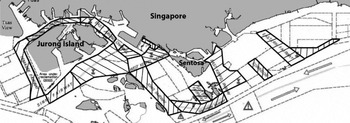
To illustrate the modelling technique, a total of 15 fairway sections in Singapore port waters are considered. From operational definitions of fairways (MPA, 2006), the study area is divided into 15 approximately homogeneous sections. A map showing the fairway sections is presented in Figure 1. The response variable of the model is the collision risks in the fairway sections for day and night conditions, which are measured by the NTCT (see Debnath and Chin, Reference Debnath and Chin2010 for details). The explanatory variables include the geometric, traffic and regulatory control characteristics of the fairway sections and a time indicator. These data are collected from various sources, such as navigational charts, tables and the Singapore port traffic database.
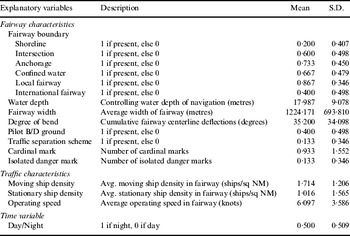
A total of 20 explanatory variables, which are hypothesized to relate to risk of collision in a fairway, are considered in the model. A correlation matrix of the variables is examined to identify and avoid multi-colinearity. Description of the selected variables, together with their means and standard deviations (S.D.), are presented in Table 1.
Since risk of collision in a fairway is likely to be influenced by traffic in its boundary waters, it is necessary to consider the boundary effects. The waters around a fairway are described by six types of boundaries: shoreline, intersection, anchorage, confined water, local fairway and international fairway. Confined waters comprise the port terminal berth areas and the low depth waters with scattered land obstacles. The fairways inside port waters are referred to as local fairway, while those outside port waters are referred to as international fairways. The others are defined according to their standard definitions. The boundary waters are defined as binary variables in the model based on their presence.
Geometric characteristics of fairways include the water depth of navigation, average navigable width, the degree of bend (described by the sum of all angular deflection from a straight line extended from the straight fairway section prior to a bend), the presence of pilot boarding/disembarkation ground and whether a traffic separation scheme (TSS) is enforced. Pilot boarding/disembarkation grounds are defined as the waters used by pilots to board or disembark an ocean-going vessel. Presence of TSS is defined if traffic streams in a fairway are separated by some spatial margin.
Characteristics of navigational aids (e.g., navigational buoys/lights) in fairways are represented by cardinal marks and isolated danger marks, as specified in the IALA Maritime Buoyage System (IALA, 1980). A cardinal mark indicates the side of deepest water around the mark. An isolated danger mark is used to indicate the danger of a small area which has navigable water all around it. The variables are described as the number of marks present in the fairways.
Traffic characteristics of the fairways are obtained from the vessel traffic information system database of Singapore port. These include traffic densities, and operating speeds of the fairways. Traffic density is described as the average number of moving vessels per square nautical mile and the average number of stationary vessels per square nautical mile, while operating speed represents the average speed of the vessels navigating in the fairways. The average values are obtained for both the day and night situations. Furthermore, to account for the effects of differences in navigational characteristics at day and night a binary variable representing the two time periods is considered.
Fairways in Singapore port waters (fairway sections marked by hatching lines).

Summary of explanatory variables.

4. RESULTS AND DISCUSSION
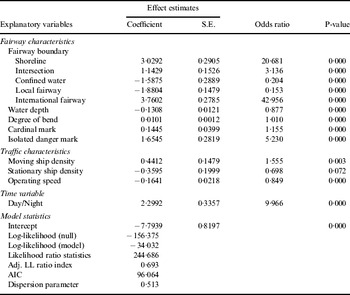
The parameters of the BLM were derived using the maximum likelihood estimation method. Estimates of the BLM along with the fitness statistics are presented in Table 2. The resulting BLM yields the value of AIC as 96·1 and dispersion statistics as 0·51, which indicate that adjustments to the standard errors are not necessary. The likelihood ratio statistics (244·7, p<0·001) is well above the critical value for significance at 95% level of significance, which implies that the model has reasonably good fit. The adjusted log-likelihood ratio index (0·69) also indicates that the model has sufficient explanatory and predictive power. The significant explanatory variables that are strongly associated with collision risk are discussed in the subsequent paragraphs.
Estimation results of the BLM.

The risk of collision is found to be significantly associated with presence of shoreline at fairway boundary (beta=3·03, p<0·001). The odds of a serious conflict are 19·7 times higher if the fairway is attached to shoreline. Pilots may have less flexibility in taking evasive actions in this type of fairway as navigating closer to a shoreline will increase the risk of grounding. To compensate for the grounding risk, pilots have a tendency to navigate near the centre of the fairway which could increase the risk of head-on collisions. Risk of collision could be higher due to the reduced flexibility in manoeuvring.
An intersection attached to fairways shows significant positive effect (beta=1·14, p<0·001) on collision risk with 214% higher odds of a serious conflict. The number of vessel movements is usually high in these waters as vessels from different fairways approach towards the intersection for crossing purposes. Risk of collision could rise due to the cross traffic interactions and the high number of vessel movements, which could also result in more conflicts.
The risk of collision is found to be decreased (beta=−1·59, p<0·001) in fairways bounded by confined water with corresponding 4·9 times higher odds of a non-serious conflict. Confined water characterizes low density and slow speed vessel movements in the berth areas, and only small vessels (e.g., pilot boats, speed boats) operate in the low depth waters. For these reasons, risks in attached fairways could be lower.
Risk of collision significantly increases if an international fairway is present at fairway boundary (beta=3·76, p<0·001). Results show that the odds of a serious conflict are about 42 times higher if a fairway is bounded by an international fairway. Pilot boarding/disembarkation grounds are usually located near the international fairways. These grounds are used by pilots to go aboard, or to disembark from, vessels calling at or leaving port. The boarding and disembarkation process is a critical safety event in navigation (SOLAS, 1974) and it often requires vessels to slacken speeds to make the process safer. This speed reduction could impede the through traffic in international fairways and, possibly, result in more conflicts. In addition, interactions of pilot boats with the existing traffic may pose an additional risk of collision.
The presence of a local fairway shows significant negative effect on collision risk (beta=−1·88, p<0·001) with a corresponding decrease of 84·7% in the odds of a serious conflict. Two local fairway sections can be attached if there is no intersection between them, i.e., the fairway sections differ only in their geometric and/or regulatory control characteristics (e.g., width, presence of TSS). While the presence of an intersection increases collision risks in fairways, its absence will reduce the risks as no cross traffic interactions take place in such waters.
The navigable water depth is found to have a negative association (beta=−0·13, p<0·001) with collision risk. This result is expected because pilots do not need to worry about under keel clearance, squat effects, or monitoring an echo-sounder while navigating in deeper waters, which may allow taking risk mitigating actions at an early stage. Debnath and Chin (Reference Debnath and Chin2009a) have also reported that perceived risk decreases if water depth is higher.
An increasing degree of deflection is found to positively influence (beta=0·01, p<0·001) collision risk. This finding is consistent with that of Roeleven et al. (Reference Roeleven and Kok1995) who reported that decreasing bend radius (i.e., increasing degree of deflection) gives rise to the probability of collision. Debnath and Chin (Reference Debnath and Chin2009a) have also reported that pilots perceive higher risks in fairways having sharper bends. This is generally expected as vessels need more navigation room for course alteration around sharper bends (Sarioz, Kukner et al., Reference Sarioz and Kukner2000) and traffic interactions are more complicated at bends, compared to straight sections. Furthermore, rear and forward views could be restricted prior to and during course alternation at bends due to the presence of land obstacles, which could impede the process of taking timely evasive actions. Interestingly results show that the odds of a serious conflict increase by 1% for a unit increment in degree of deflection. While this may be obvious, increasing sight distance by managing land obstacles could improve safety at bends.
The number of cardinal marks is found to have a positive association with collision risk (beta=0·14, p<0·001), correspondingly increasing the odds of a serious conflict by 16%. A cardinal mark is used to indicate the deepest water side (i.e., safe side to pass a danger) around the mark. It is also used to mark the locations featuring a bend, an intersection or a bifurcation (MPA, 2006) where the risk of collision is usually high. This might be a reason for observing the positive association between the number of cardinal marks and risk.
The number of isolated danger marks is found to have significant association with collision risk (beta=1·65, p<0·001). Presence of an isolated danger mark increases the odds of a serious conflict by 423% in fairways. These marks are used to indicate a small dangerous area surrounded by navigable waters. Therefore, presence of the marks can disrupt the smooth flow of traffic in a fairway as pilots need to navigate away from the danger areas, while at the same time taking evasive actions to mitigate collision risks if other vessels are present in close proximity.
The risk of collision in a fairway increases with increased density of moving ships (beta=0·44, p=0·003). Results show that the odds of a serious conflict increase by 55·5% for a unit increment in the density. This result is expected because increased density implies greater interaction between vessels and possibly results in more multi-vessel conflicts. Risk of collision will therefore increase because of greater exposure.
Operating speed shows significant negative association with collision risk. An increase of 1 knot reduces the odds of a serious conflict by 15·1% (beta=−0·16, p<0·001). The result can be explained by the fact that in order to take evasive actions, pilots may slacken speed while being involved in an encounter, producing significant collision risk. Therefore, the average operating speed in a fairway will be smaller if high numbers of encounters (i.e., higher risk) take place in that fairway. For this reason, the negative association was observed.
Risk of collision is found to be higher at night (beta=2·30, p<0·001) with 9 times higher odds of a serious conflict than during the day. This could be because during the day the speeds, distances between vessels and even any change of courses can be judged more readily than at the night. At night, pilots need to rely entirely on navigational aids (e.g., radar, navigational lights), which makes the risk perception and mitigation process difficult as pilots are less able to verify the situation visually. Furthermore, visibility deteriorates at night which could hinder the watch-keeping process and lead to navigational confusion. The effectiveness of navigational lights can also be reduced at night due to bright background lights on shore and from nearby islands (Akten, Reference Akten2004; Liu, Liang et al., Reference Liu and Liang2006). A number of studies (Chin and Debnath, Reference Chin and Debnath2009; Debnath and Chin, Reference Debnath and Chin2009a; Debnath and Chin, Reference Debnath and Chin2009b) have also reported that pilots perceive higher collision risk at night.
5. CONCLUSIONS
A BLM with considerations for hierarchical data structure was formulated to investigate how collision risks are associated with the geometric, traffic, and regulatory control characteristics of port waterways. This model helps account for the correlations in risks at different time periods in a waterway. In addition, it uses traffic conflicts as an alternative to collision data, thus retaining the proactive nature of the NTCT. The modelling technique was illustrated for the fairways in Singapore port waters.
Estimation results imply that for predicting collision risk in a waterway, the developed modelling technique can be employed effectively. The likelihood ratio statistics of the model was found well above the critical value for significance at 95% implying that the model has reasonably good fit. The adjusted log-likelihood ratio index also indicates sufficient explanatory and predictive power of the model.
Several statistically significant relationships between the risk and waterway characteristics are identified. Results showed higher risks at the fairways bounded by the shoreline, at intersections of fairways, and at international fairways. Higher risks were also found at the fairways with higher degree of bend, lower depth of water, higher numbers of cardinal and isolated danger marks, higher density of moving ships and lower operating speed. Night conditions were also found to be associated with higher risks. The fairways with confined water and local fairways at their boundaries were found to exhibit less risk.
The developed model has potential for fast, reliable and proactive safety evaluation in port waterways. For assessing safety after changes in the characteristics of waterways, the model can be employed effectively to predict risks of collision in the waterways. While the model is calibrated for the Singapore port fairways in this study, the modelling technique can be easily applied for fairways in other ports. The technique has the advantage of being employed within a short period of time as it relies on traffic conflicts and only needs several hours of traffic movement data.
ACKNOWLEDGEMENTS
The authors gratefully thank the Maritime and Port Authority of Singapore and PSA Marine (Pte) Ltd for their support and providing data. Views of this article do not necessarily reflect the opinion of the organizations.