Introduction
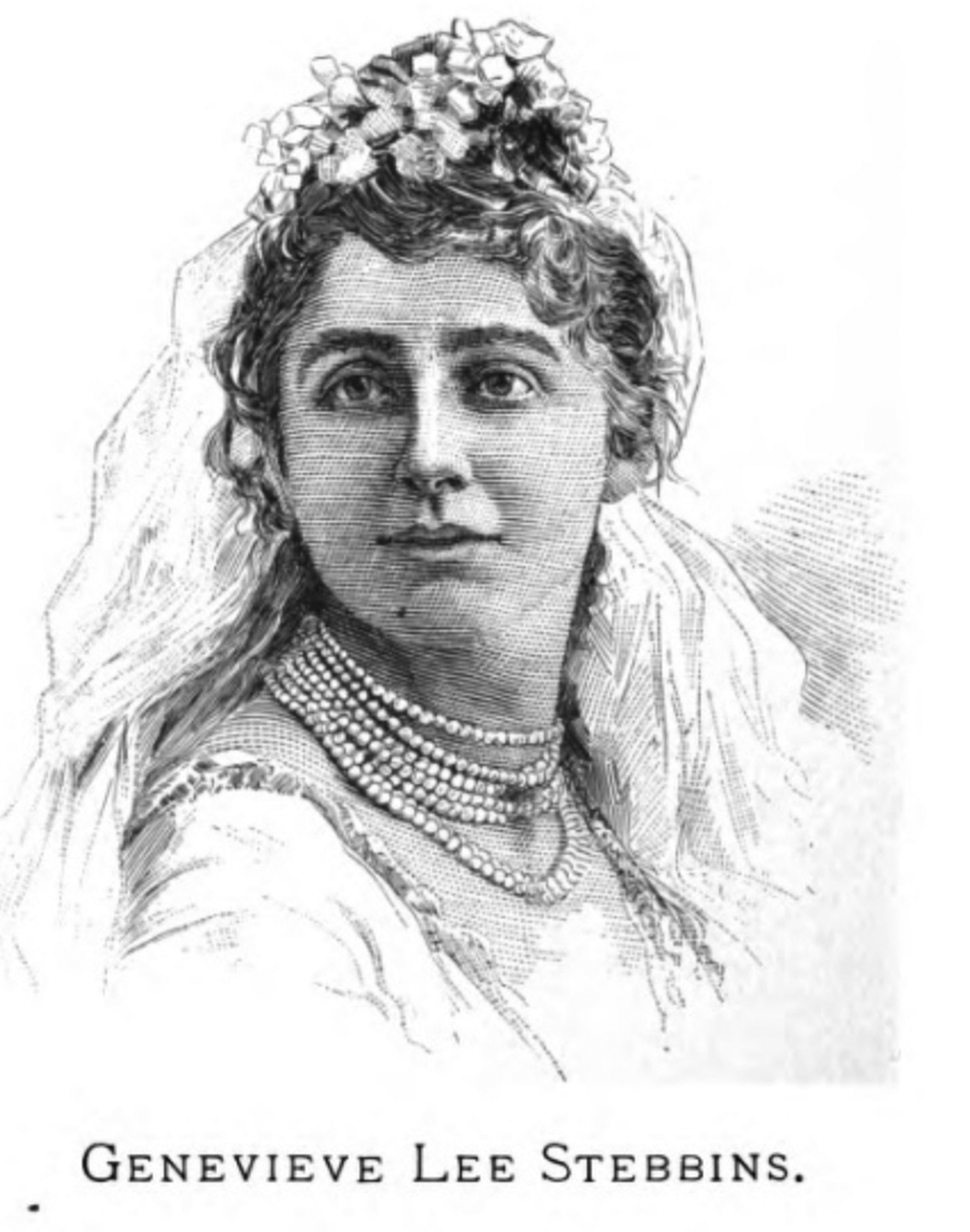
During the 1880s, New York City's dance theater entertainment was of a limited variety. Depending on a script's narrative, theater and opera productions presented European folk dances, court dances, and chorus dancers interpreting visions of spirits, mystical dancing fairies, or ecstatic dancing gypsies. Variety shows had stage dancers exhibiting high kicking, quick step combinations, and moderately risqué skirt dances. In the latter part of the decade, something considerably different appeared on the stage when Genevieve Lee Stebbins (1857–1934) pioneered “new” dance as a solo art form in “legitimate” theaters. Regrettably, Stebbins remains a forgotten figure within American dance history.
This article explores how Stebbins created a foundation from which a new “serious” dance aesthetic emerged. Decades before the term “modern dance” was in use, journalists referred to Stebbins's solo performances as new dance (meaning original), expressive, aesthetic, interpretive, or classical dancing (meaning inspired by classic myths), pantomimic dance, mythic drama, or dance drama. Stebbins not only created original work, but also presented stylized European folk or social dances demonstrated in the “evolution of dancing, showing its place in physical culture,” including the “Scotch Highlanders dance, an Alpine rustic dance, a French and Spanish minuet” (Ruyter Reference Ruyter1999, 125). At Madison Square Garden for the Dress Reform Congress, Stebbins additionally danced the “old English country dance and the English gypsy's fire worshiping dance” (“Woman's Slavery to Fashion” 1894, 8).Footnote 1 These dances provided a broad repertoire of steps and techniques for Stebbins to utilize in her compositions.
Stebbins also evolved the art of “statue posing” within the realm of dance. In addition to her dance innovations, from the late 1870s through the early 1900s, Stebbins was a renowned Broadway actress, an established elocutionist,Footnote 2 prolific author, leading American Delsartist, and a respected educator. Within her foundational analysis of American Delsartism dance historian Nancy Lee Chalfa Ruyter placed Stebbins as the sole Delsarte educator responsible for a new genre of solo dance (Ruyter Reference Ruyter1999). Ruyter initially argued Stebbins's aim was not to “create a revolutionary new dance” (Reference Ruyter1973, 24), although later asserted that Stebbins “was unique in taking the dance in a new direction” by creating original dance compositions that either stood alone or carried forward a narrative of a dramatic work (Reference Ruyter and Foster1996, 74). Ruyter contended Stebbins “never would have characterized herself as a dancer” (Reference Ruyter1999, 124) but also assessed that in Stebbins's ideals and in her “approach to movement as an expressive medium, and in her performances, [she] introduced much of what would be credited by future generations to the invention of Isadora Duncan and Ruth St. Denis” (127).
Although this is a significant observation, original research focusing on who Stebbins was, or what her performances entailed, has been limitedFootnote 3 and how she might have influenced Duncan and St. Denis has been only briefly noticed.Footnote 4 This may be, in part, attributed to a lack of evident sources, seeing as unlike for other American dance pioneers, there is no public archive dedicated to Stebbins. However, with the recent digitization of historical newspapers, books, and professional periodicals, new information from primary sources that were previously difficult to acquire are now accessible, allowing for Stebbins's impact as a dancer to be more readily examined. To establish Stebbins's significance within the tradition of American modern dance, this article will explore Stebbins's biography and artistic work before either St. Denis or Duncan began their careers. I will draw from my compilation of over six hundred historical newspaper and journal articles related to Stebbins's career to provide a synthesized chronicle of her cultured background and unique dance compositions. Stebbins has been misrepresented in American dance history, most notably in Preston (Reference Preston2011) and Shawn (Reference Shawn1963), therefore this article will also clarify prior inaccurate assessments of her work.
An Overview of Stebbins's Solo Dances
Beginning in 1887 after a decade-long successful acting career, Stebbins began performing solo dances utilizing dramatic movement and expressive gestures to portray idols such as the Goddess Isis, Miriam the Prophetess, Jephthah's Daughter, and Esther of Shushan. Stebbins danced in costumes designed especially for her, in three or four acts with musical accompaniment (Ruyter Reference Ruyter1999, 125). Her solos personified iconic women derived from her extensive studies in classical art and literature, Christian theology, Greco-Roman mystery religions, and Egyptian and Greek mythology. The New York Times offered this perspective, saying Stebbins's “great idea is to bring out the art idea of grace and motion as exhibited in the old sculptures and in the ancient church, which was the theater where joy, lamentation, and all emotions were expressed in the dance” (“Lecture to Actresses” 1893, 6).
Stebbins lectured on classic art, elocution, pantomime, the history of dramatic expression, the evolution of dancing, and physical culture (N. A. 1893, 444). She was known for creating, interpreting, and performing “ancient” Egyptian and Greek dances in a contemporary manner. According to Stebbins, Greek dances were often referred to as pantomimes (dance dramas), seeing as they utilized movement and emotional expression in a symbolic manner. Stebbins declared, “If my readers would prefix the word pantomime to all the foregoing regarding dancing, they will obtain a pretty accurate idea of its importance as an expressive art during the untold eras of antiquity.… As an art factor, pantomimic folk-dance cannot be overrated … transmitted from generation to generation as mysteries and religious festivals—the marvelous structure of Greek drama evolved” (Reference Stebbins1894b, 317).
One such pantomimic choreography created by Stebbins, Dance of Day (Reference Stebbins1892), was inspired by her conception of Grecian mystery rites dedicated to the Egyptian Goddess Isis. Her dance evolved in three scenes: (1) Chaos, the Birth of Nature; (2) Life and Death; (3) Resurrection and Immortality. The New York Times reviewed her performance, saying she was met by an “accustomed large assemblage, occupying all the available space in the theatre” to watch Stebbins illustrate in “graceful pantomime and pretty dance [her] own idea of the symbolism of Isis” (“Amusements: Three Matinees” 1892, 4). Stebbins “executed her statue poses of Greek mythological characters” (4) then illustrated the evolution of dancing and closed the matinee with The Myth of Isis. The orchestra was under the direction of Percy Gaunt (composer of Broadway fame).
In 1892, one notable audience member at the Madison Square Theatre who saw Stebbins dance as the Goddess Isis was the then thirteen-year-old Ruth St. Denis (Ruyter Reference Ruyter1999, 126; Shelton Reference Shelton1981, 15). Forty-seven years later, in her autobiography, St. Denis stated that Stebbins's performance inspired her future as a dance artist:
Not until I saw my first vision of the creative dance in the person of Genevieve Stebbins did I begin to have any idealism in relation to dance. Mother and I were given tickets for one of her recitals, and this occasion saw the real birth of my art life. The image of her white Grecian figure became so indelibly printed in my mind that everything I subsequently did stemmed from this revelation. … To me at this early age nothing so beautiful had entered my life. The curtain rose on a dark greenish background (this was of course, long before Isadora's famous blue curtains) and there stood an exquisite woman in a costume made of soft ivory material that fell in gracious lines to her feet, her figure beautifully proportioned.… She did the dance called the Dance of the Day. It was most effective and lovely, and represented an imagination reaching out for a vision of dance as yet undreamed of in her generation. ([1939], 16–17)
Eighteen years later, St. Denis created an “Isis” dance titled Egypta, inspired, she claimed, by an image of Isis she saw in a poster on the street advertising cigarettes ([Reference St. Denis1939], 51; Shawn Reference Shawn1920, 3). St. Denis used “suggestive gesture and movement, [to voice] the life of man and the passing of the soul” (“Ancient Egyptian Rites Seen in Dance” 1910, 13), indicating a repetition of the thematic role of Isis who guides the dead to the afterlife from Stebbins's original work. According to St. Denis's biographer Suzanne Shelton, the “same themes” from Stebbins's Isis dance “reappeared” in Egypta, including two scenes titled “‘Dance of Day’ and ‘The Mystery of Isis.’” Shelton concluded that “Stebbins, or in broader terms ‘Delsarte,’ was the basis for St. Denis’ dance technique and, by inheritance, that of her successors” (1981, 15). Shelton additionally contended the dance ritual that opened Egypta was based on Stebbins's Eastern Temple Drill (116).Footnote 5
Stebbins's interest in esoteric philosophy, metaphysics, and pagan spirituality notably led her to translate An Egyptian Initiation of Iambichus, a Neo-Platonist of the 4th Century (Reference Stebbins and Stebbins1901), which depicted Greco-Roman initiation practices (theurgy or divine rituals) derived from the Goddess Isis mystery tradition of ancient Egypt. In an echo of Stebbins, author Caroline Caffin stated the “impulse of dance-drama is the expression of emotions, the earliest of which seems to be [found in] religious mystic cults, which reached high development of symbolism and beauty of ceremony in the mysteries of Isis, that originated in Egypt and spread to Greece and Italy” (Reference Caffin and Caffin1912, 22).
In 1911, before he became a dancer, Ted Shawn saw St. Denis perform Egypta. Shawn later argued, “With the advent of Ruth St. Denis and Isadora Duncan, a whole new approach to movement had come into the dance world—that at all times dance should express something … or have dramatic, emotional, narrative content” (1954, 1963, 10). Shawn stated Stebbins had “preceded Isadora Duncan in the wearing of ‘Greek’ costume, of appearing barefoot (or with soft sandals).… But she was not a dancer, not even a theatre performer, but a lecturer and teacher only” (1963: 80–81). Shawn instead claimed that Isadora Duncan was the “first to introduce Greek dancing” (Reference Shawn1920, 88). However, abundant evidence about Stebbins's career negates Shawn's characterization of her work. She clearly did more than lecture in Greek costume. Details of Stebbins's dances offer contradicting evidence for his claims.
Preceding Duncan, Stebbins “executed a Greek dance studied from the friezes” (“Amusements: A Night Off” 1889, 4). Stebbins was described not only as a dancer but as a genius, “roughly defined as having ideas others do not have” (Wilbor Reference Wilbor1891, 30), and she was admired to the extent that there were often few vacant seats in the theater (“Entertained by Miss Stebbins” 1892, 9). Above all, she “danced as the Greeks danced—[and] more pretty girls and fashionably-attired women than the Madison Square Theatre was ever intended on any one occasion to accommodate, held their breath in a transport of delight” to watch her performance (N. A. 1893, 445). As described in the article “Poetry in Motion,” in 1895 at Carnegie Recital Hall, Stebbins not only danced a Greek temple dance, but her students joined her in a panathenaic procession (a Greek parade celebrating the Goddess Athene) “bearing flowers, wreaths, and votive offerings” (Reference Stebbins1895, 1). Students performed Stebbins's temple choreography in “rhythmic motions” after which Stebbins as the priestess of Athens joined and “whirled about rapidly several times in the gyrations of the Greek religious dance proper” (1).
Comparatively, when Duncan arrived in New York City in 1898 as a novice who had not yet established her own professional work, she gave expositions of “ancient Greek terpsichorean diversions” (reminiscent of Stebbins's signature style) for “church entertainments, teas, and affairs of that kind” (“Afternoon Tea Chatter” 1903, 36). If Duncan was informed of theater activities in New York City, it seems likely she would have been aware of Stebbins's reputation, as she was widely acclaimed in the press. It is not known if Duncan ever saw Stebbins dance; however, she could have utilized movement exercises as described in Stebbins's publications for creative inspiration. Dance historian Deborah Jowitt observed that Duncan owned a book that was most likely Stebbins's (1989, 80). Although Duncan “acknowledged no antecedents or peers” (Acocella, Reference Acocella2013, xvi), Jowitt argued there were “enough similarities between Mrs. Stebbins ideas and the ones Duncan later expressed” and between Stebbins's choreography and “exercises later taught in Duncan's schools” (1989, 80) to suggest that Isadora (and her sister Elizabeth) incorporated Stebbins's work.
Evidence of Stebbins's popular performances supports assessments about her possible influence on Isadora Duncan and delivers meaningful corrections to more recent scholarship. Most notably, it corrects Carrie Preston's argument in Modernism's Mythic Pose that Duncan's “dancing alone in legitimate theaters was unprecedented” (2011, 145). Preston made this claim despite having had acknowledged that Stebbins did dance (2011, 81; citing Ruyter Reference Ruyter1999, 125). Stebbins performed as a soloist in numerous established theaters before Duncan began to legitimately establish her own work. As one example, Stebbins was invited by Daniel Frohman (one of New York's top theatrical enterprisers) to give a solo performance at the Berkeley Lyceum Theater (23 West Forty-Fourth Street) just after the theater opened (following the premier of Henrik Ibsen's play Ghosts). Stebbins's solo was based on the biblical character “Miriam, the Prophetess,” the sister of Moses who led the Israelites in a dance of liberation after being exiled from Egypt (Exodus 15:20). Stebbins was greeted by enthusiastic women in the audience who “held their breath; the aigrettes on their bonnets fairly glistened with excitement; they half rose from their chairs to watch the changing visions more closely” (“Classic Statue” 1894, 10). Her innovative performance is described in the following article, quoted at length, as it conveys the essence of Stebbins's ecstatic dance. Stebbins began her dance draped in a “blood red” silk scarf. Here and in following articles, the words “dance” and “pantomime” were used interchangeably:
The experiment was unique, almost daring, and the audience, having nothing to compare it and thus form some opinion as to its excellence, and no leader to sweep them into enthusiasm, seemed hardly able to decide whether applause or censure was more appropriate.… The mystic rights of the temple worship are gone through, and Miriam gives a strange, slow dance many times, around the altar …
The next scene, which opens act 2, was the gem of the pantomime. Miriam, in
white, with blue silk drapery, the full insignia of her noble office of prophetess, enters with swinging censer, from which clouds of incense rise.… The dance accompanying this scene is a marvel of grace and beauty. [She] bends and sways and bends again in a very ecstasy of religious fervor. The closing scene is Miriam's dance by the Red Sea when she “took a timbrel in her hand, and all the women went out after her with timbrels and with dances.” Miriam is a picture in white and gold, from the cap of gold and jewels to the golden sandals. Her dance with the cymbals is one of the utmost abandon and joy. (Wilbor Reference Wilbor1894, 69; quoted in part in Ruyter Reference Ruyter1999, 125)
When Stebbins took her solo dance to Boston, it was announced that her entertainment was to be an “Interpretive and Pantomimic Dance,” titled Miriam, that would be of special interest to
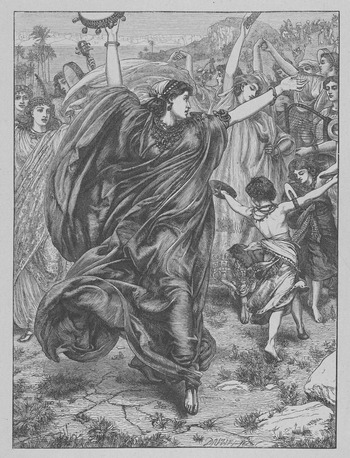
There are few extant photos of Stebbins, therefore this image serves to give a sense of her ecstatic solo. This 1864 illustration of Miriam is by Sir Edward John Poynter published in the 1881 edition of Dalziel's Bible Gallery: Illustrations from the Old Testament, Camden Press (London) Scribner and Welford. Courtesy of The Met Museum, Public Domain Open Access ArtWork.

all those who appreciate the beauties of trained and artistic motion, and to most spectators will be a revelation of the possibilities of an art but little understood and appreciated.… It is both from an artistic and educational point of view that the association is interested in this entertainment. It demonstrates that dancing may be made by an artist to illustrate the whole range of human emotion. (“Terpsichorean Drama” 1894, 4)
Stebbins was invited by the Boston Society of Art to perform at the “housewarming” of the newly renovated Copley Hall (which later hosted visual art exhibits such as Claude Monet and John Singer). The hall had recently been transformed into artist workspaces and an exhibition venue. She was supported by a large committee of high-society patronesses, including Mrs. Julia Ward Howe (Stebbins's relative and president of the Association for the Advancement of Women);Footnote 6 Mrs. Augustus Hemenway (philanthropist); Mrs. Clara Erskine Clement Waters (author of books on women in the fine arts); Sarah Whitman (Radcliffe library cofounder and stained glass artist whose work is in Memorial Hall, Harvard, and the Isabella Stewart Gardner Museum entrance); and Mrs. Montgomery Sears (photographer and patron of the arts). One would imagine with this network of support that Stebbins's performance was greatly anticipated in Boston. A review revealed the following:
Mrs. Stebbins explained that she had made an exhaustive study of ancient rituals, history and everything bearing upon the matter, and her representation was in the nature of a “sketch” of what research had revealed. She said that the sympathy and imagination of the audience would have to assist materially in full appreciation of her effort, as it was in pantomime and carried out alone. … The dance was a graceful, rhythmic measure, and intended to be an exact reproduction of the forms represented on the friezes and in the statues and relics of ancient Egypt. … The close was the dance of victory and triumph, and was highly interesting and beautiful, as displaying the grace of motion made possible by cultivation. (“Miriam Seen Again” 1894)
The name of “Miriam” traveled with an article, “About the New Dances,” noting there were “no ceremonies or religious rites of any antiquity in which there was not dancing. Israelites danced before the golden calf,” and the Bible “contains numerous references of dancing, Miriam placed herself at the head of the women of Israel and led the maidens in their dance” (1894, 13). Following in Stebbins's footsteps, dancer Loie Fuller created her own Miriam's Dance in 1911, and Ruth St. Denis performed as Miriam in Ted Shawn's choreography Miriam, Sister of Moses in 1919 (Shawn Reference Shawn1920, 83–85).
Genevieve Lee Stebbins's Cultured Foundations
Stebbins's ability to create intelligent and original solo dance work was informed by her educational background, professional theater experiences, and cultured upbringing. As a child, Stebbins was a natural entertainer. A family friend, author Bret Harte, described Stebbins as a youth, saying, “It was the delight of the little Genevieve to pose, to fling into statuary her childish frame, to tell romances in dumb show [short, pantomimic comic scenes], to sing songs without words or sound; that so vivid and widespread was the interest she excited that she was in constant demand as a show-child for youthful private theatricals, children's dances and other pastimes of the wealth” (L. A. C.Footnote 7 Reference Wilbor1887, 289). Stebbins was born in San Francisco, California to JS and HS(S). Ruyter suggested Stebbins's aunt might have “functioned as a mother” (Reference Ruyter1999, 46) after Stebbins's mother died when she was two. A source confirms Stebbins was indeed raised by Henrietta's sister, Louise Amelia Knapp Smith Clappe (1819–1906) (Lawrence Reference Lawrence1922, xxx). It is not known how involved Stebbins's father was in her life, although he apparently left her money from his sizable personal estate and real estate holdings (Edwards Reference Edwards1999, 124), and she seems to have been financially secure from the outset.
Unknown illustrator. L.A.C. 1887, 288.

Louise Clappe came from a family of academics, was a graduate of Amherst Academy in Massachusetts, and a pioneering Californian author and educator.Footnote 8 Clappe wrote volumes on art history and created synopsis study guides (aide memoires). She taught at the Denman Grammar School in San Francisco, where Stebbins was given a formal classical education, studying such subjects as Latin and Greek, classics of Western civilization, philosophy, history, math, astronomy, grammar, logic, and rhetorical debate. Both Clappe and Stebbins were fluent in French. Stebbins was listed in the “Roll of Honor” (1869, 3), and at a school exhibition she “displayed her oratorical powers to excellent advantage” (“Denman School” 1869, 3) before graduating in 1871 (“Local Intelligence” 1871, 3). Clappe and Stebbins lived in the family home of John Swett, former California State Superintendent of Public Instruction and principal of the Denman Grammar School. Clappe gave evening classes in the home salon on literature, metaphysics, and art history (Lawrence Reference Lawrence1922, preface). Scholarly notabilities were known to have visited the home, such as Julia Ward Howe, Louis Agassiz, and Ralph Waldo Emerson. According to Mary Lawrence, a pupil and later friend of Clappe, Howe and Clappe had a “close kinship” (1922, xxvii). This vibrant intellectual background provided a fertile foundation from which Stebbins's creative work later blossomed.
Before Stebbins began to establish herself as a solo dance artist, she gained significant stage experience as an actress. Her talent as a dramatic artist informed her later dance creations. Ruyter provided biographical details about Stebbins career (Reference Ruyter1999, 45–55) and noted that Stebbins began her performance career in 1875, at age eighteen, when she traveled to New York City to pursue acting (46). Stebbins obtained a position with one of New York's leading managers, Albert Palmer, at the Union Square Theatre (1871–1885), one of a handful of New York theaters with an in-house stock company. It is possible professional introductions were made for Stebbins by her relative Geneviève Ward (1837–1922), who had previously starred in a production at the Union Square Theatre and was established in the New York theater world.
Broadway's earliest theater district was in the Union Square area (known then as the Rialto) with playhouses, hotels, fine dining, and shopping catering to theater patrons. The Union Square Theatre was located on the south side of Union Square, between Broadway and Fourth Avenue, adjoining the Union Square Hotel. In the Union Square Theatre company, Stebbins was “under the tutelage of that great mistress of stage technique, Rose Eytinge” (L. A. C. Reference Wilbor1887, 289), one of New York's leading ladies and reportedly the highest paid actress in the nation. Stebbins was cast as leading juvenile actress in director Steele MacKaye's rewrite of the French play Rose Michel, with Rose Eytinge as the lead during the 1875–1876 season “after many months of ardent and engrossing study” (289). Soon after, Stebbins accepted an engagement with Dion Boucicault (one of New York's popular playwrights) and later was cast by Eytinge to “play the leading part as Violet in Our Boys” (“School of Expression” 1902, 106). Stebbins's home state reported “one of ‘our girls’ made her debut this last season” (“Whiffs of Gossip” 1876). The show toured to Baltimore and Washington, DC, and later played at the New Broadway Theater in New York City (“Dramatic Diary” 1877, 618). News travelled with the statement “since the success of Geneviève Ward … a new actress has come forward called Genevieve Stebbins” (New Orleans Republican 1877, 4).
As a young yet accomplished actress, between 1876 and 1878 Stebbins began studying the expressive theories of the French orator and singer François Delsarte (1811–1871) with Steele MacKaye (1842–1894), the only American to have directly studied with Delsarte in Paris. Delsarte did not have a school with graduates trained in an established curriculum, rather, in his Parisian home salon, he lectured and coached vocalists, orators, actors, and preachers in his complex analysis of bodily rhetoric. In the field of oratory, the terms “elocution” or “rhetoric” denoted the study of emotions communicated not only vocally but also bodily, through physical posture, stance, gesture, and facial expression.
In the 1870s, MacKaye gave lecture demonstrations around New England popularizing “Delsarte.” In March 1878, at MacKaye's behest, Stebbins was accepted as both a student of oratory and demonstrator of “Delsarte Expression” at the Boston University School of Oratory (Ruyter Reference Ruyter1999, 47). Lewis Monroe, head of the school, wrote MacKaye about accepting her, saying, “She will exemplify some of the movements in which you have trained her before the class.”Footnote 9 Stebbins taught as “MacKaye's representative” with nearly every well-known graduate under her instruction, “and to her many of them are indebted for their entire knowledge of Delsarte” (“School of Expression” 1902, 106), seeing as MacKaye apparently taught “in a very off-hand way.”Footnote 10 Mary Thompson (head teacher of oratory) wrote, “Until Miss Stebbins came among us, we knew but little of what could be done in the way of illustrating these fascinating theories” (Reference Thompson1894, 272).
After the Boston University School of Oratory closed in 1879, Stebbins joined Mary Thompson in creating a School of Expression on 1244 Broadway in Union Square, New York City. MacKaye officially designated Stebbins as a Delsarte educator in a letter written September 22, 1879,Footnote 11 and at this time, Stebbins was recognized as the only “Delsarte” teacher “except Mr. MacKaye, in America” (“Boston Society” 1879, 12). This acknowledgement calls into question Ruyter's assessment that Stebbins had not yet established herself as a leader, saying, “At this early date Henrietta Crane [Hovey], Steele MacKaye, and William Alger were the only three recognized American Delsartean specialists” (Reference Ruyter1999, 33).
As an educator, Stebbins additionally became a member of the newly organized Madison Square Theatre Company with Steele MacKaye as the director. The theater was on Twenty-Fourth Street near Broadway and Fifth Avenue at Madison Square Park. In the Gilded Age, the Madison Square area was the social center for the elite, an entertainment district, and the first public space in New York City to be lit up by electric lights. The area became known as the “Great White Way,” as the lights glow could be seen across the city at night. The Madison Square Theatre adjoined the Fifth Avenue Hotel, New York's foremost hotel for five decades. Madison Square Garden was on the northeast corner of the park (between 1879 and 1925), and this area south to Union Square was Broadway's theater district until the early 1900s, when Times Square developments took over.
In 1879 Stebbins performed lead opposite MacKaye, as husband and wife, in his play Aftermath; or, Won at Last, for the opening of the Madison Square Theatre. Stebbins adopted the stage name Agnes Loring at this time, possibly because MacKaye was attempting to launch her as a “Delsartean” actor, and his ideas were experimental. Regardless, it was known that “Agnes Loring (Stebbins) was the cousin of Geneviève Ward” (“Dramatic Notes” 1879, 5). According to critics, MacKaye acted “the leading part with repressive earnestness and subtle intensity of analysis and [was] brilliantly supported by Agnes Loring” (Vidette 1879, 3). A number of reviews summarized by L. A. C. more fully described Stebbins's performance:
The Tribune wrote: the acting of the debutant is such as commands recognition for distinct intellectual purpose, acute sensibility, quick sense of the significance and value of dramatic situations, ample capacity for the expression of hysterical emotions, with remarkable self-control and command of the resources of posture, movement, gesture and facial as well as vocal expression. The efficiency in these latter particulars, indeed, was marked by that gracefulness which is the result, not merely of careful and protracted training, but of spontaneous identification with the spirit of a dramatic character. From a widely different point of view, but to the same purpose, the organ of the profession of that day, the Dramatic News, wrote: The surprise of the evening was to be found in the debutant. There is no exaggeration in saying that this is the very best first performance that we have ever seen. Nothing could be more admirable than her emotional scenes, while in her quiet by-play there was a fineness and delicacy which showed a coming woman on the American stage. The Sun, Herald, Star, Graphic, Telegram, Express and many others, all evincing an unanimity most unusual when the subject is a debut and hitherto unheard of when an unknown party essays a leading role. (L. A. C. Reference Wilbor1887, 290–291)
After a month's run of Aftermath; or, Won at Last at the Madison Square Theatre, the show was taken on the road to Hooley's Opera House in Chicago, where MacKaye was critiqued for being a “little wild in posture and facial expression at times,” and Miss Loring [Stebbins] was described as being “a graceful, pleasing little actress, but just a little inclined to sing her part. [Yet]she plays with a charm that secures her favor” (“Hooleys” 1879, 8). The company soon after performed Iron Will in Pennsylvania and then Washington, DC, at the famous Ford's Theater, where they were expected to be warmly received (“Amusements & etc.” 1879, 8).
Iron Will would be renamed Hazel Kirke after the company returned to New York. MacKaye and Stebbins soon had a falling out, and she was not cast in Hazel Kirke as had been promised, after which she sued MacKaye for breach of contract, a remarkable undertaking for a young actress. It was reported Stebbins paid for lessons with MacKaye who promised to write a “play for her with which he would open the new theater, if she would raise the money for him” through her social connections. Stebbins stated, “I shall sue Mr. MacKaye for $3,000 which he owes me” ($60,000 in today's dollar) (“Howard's Letter” 1880, 5). It is also thought Stebbins might have been MacKaye's financial backer. An article in a New York theater journal claimed Stebbins “founded the original Madison Square Theatre, contributing about $18,000 [$420,000 today] toward it through Steele MacKaye, Esq. She is not ashamed of any act of hers except the foolish way in which she allowed him to blind her and build his fortunes upon her error in trusting him” (“Stage Whispers” 1884). I have not yet found what happened with their court case.
MacKaye was later pushed out of his job, and theater management brought him to court for other problems (“Hazel Kirke” 1882, 8). Stebbins, however, remained in good standing with the theater's new director, Albert Palmer (from the Union Square Theatre), and she returned to perform over the next decade. After their separation as colleagues, some of MacKaye's students became loyal to him as the sole heir of Delsarte.
In January 1880, the New York Times proclaimed, “Miss Stebbins, by the way, is remarkably proficient in the Delsartean system of gesture, a system which, in our judgment, is far less useful to the actor than to the elocutionist” (1880, 5). This is a notable comment, seeing as MacKaye had been utilizing Delsarte's expressive concepts as an acting technique. On February 29, Stebbins performed with the orchestra at Chickering Hall, reciting the drama Struensee with “great intelligence, grace and dramatic force” (“Music and Drama” 1880, 7). She also played Shakespearean roles under Helena Modjeska's management (“School of Expression” 1902, 107).
Between 1881 and 1882, Stebbins traveled to Europe on a “grand tour” of London, Florence, Rome, and Paris. It was custom for Americans from high society (who could afford such an experiential cultural education) to take such a journey. Travelling abroad as a culture tourist included visiting museums and galleries, going to the theater and opera, taking classes, visiting libraries, and attending fashionable social events. Years later, Stebbins began to choreograph Greek and Egyptian dances derived from her museum studies at the Louvre and elsewhere of “carved works of ancient art vase, Bas-relief, alto-relief, and the free figure, in vase, frieze, pillar and temple” (Stebbins [1898] Reference Stebbins1913, foreword). Louise Clappe may have accompanied Stebbins abroad, as she had moved in 1878 to New York City, where she was known for her lectures on art and literature (Smith-Baranzini Reference Smith-Baranzini1999, 238). Clappe reportedly travelled to Europe to “visit the art galleries, a treat that had been her lifelong heart's desire” (Lawrence Reference Lawrence1922, preface) as the guest of Cyrus Fields (known for laying the first telegraph cable across the ocean) (“Mrs. Louise Clappe” 1906, 13).
In Paris, Stebbins privately studied for a year with François Regnier, a master theater teacher from the Paris Conservatory of Dramatic Art. He wrote a lovely recommendation letter stating she undoubtedly possessed genius and “fue sacré” (sacred fire or divine inspiration/spark) (June 13, 1882, translated in Stebbins [1888, 1890] Reference Stebbins1891, 109). Regnier recognized Stebbins as a dedicated artist with true dramatic talent and predicted she would find the greatest success. Upon returning to New York City, Stebbins began teaching “Delsarte Expression” to high-society women and in numerous elite girls’ academies. She also performed in Lights O’ London in an unprecedented run at the Union Square Theatre, and then went on tour with the Shook and Collier (Union Square producers) Central Theater Company (Berg Reference Berg1884, 326).
In 1885 Stebbins authored the Delsarte System of Expression, the first American publication of its kind. It rapidly gained national and international attention and such a demand for the book, that over the next twenty years six additional editions were published. Delsarte did not even leave a pedagogical “system” behind, rather his theories were categorized within conceptual “laws or principles” related to how the body expresses emotion. His laws were brief descriptive formulas of theory, preserved in complex charts and diagrams, or fragments of notes on scraps of paper. A student of Delsarte's, Alfred Giraudet, stated Delsarte's concepts “weren't taught as complete lessons” nor were they organized to the extent that they could be taught in a replicable manner (Reference Stebbins1885, 10). French dance historian Annie Suquet stated in the introduction to the French edition of Ted Shawn's Delsarte book Chaque Petit Mouvement, “An approach to using gesture, [Delsarte's] system was not based on an actual teaching method” (Shawn Reference Shawn2005, 25). Fourteen years after Delsarte's death, Stebbins's manual expounded upon his “laws” by creating practical educational exercises derived from personal explorations, her studies with MacKaye, and comparable training in theater and elocution.Footnote 12
Until Stebbins's first publication, there was confusion about the much discussed “Delsarte” work, and after her tome there was a veritable explosion of Delsarte publications. Edgar Werner contended the Delsarte System of Expression was an “epoch-making treatise” that “revolutionized the teaching of personal expression” and came to be “studied by every progressive teacher of elocution, oratory, and acting, not only in this country but also in other parts of the English-speaking world.… Stebbins is the greatest living Delsartian” (Reference Werner1899, 84–85). Building on her training with MacKaye, in Stebbins's examination of Delsarte's “laws of expression,” she evolved a system of applicable knowledge in his name. Stebbins saw Delsarte's theories as a starting point to elaborate a practical system of unique lessons followed by innovating her own physical culture system, as seen in her later publications (1888, 1892, 1895, 1898). Unfortunately, her publications, to this day, have not been viewed entirely as her pedagogy. Her work was ultimately subsumed under the umbrella term “Delsarte” in what became a nationwide phenomenon of teachers and practitioners. Resentment grew in MacKaye's inner circle when she came to surpass him nationally as a recognized Delsarte educator, resulting in attempts to dismiss her leadership role.
Stebbins created a pedagogical expressive system in honor of Delsarte, and this subtle, yet significant, difference has meant that her contributions have been misunderstood and thereafter wrongly credited to Delsarte. For example, Ted Shawn argued that the renaissance of modern dance was based on Delsarte's laws and principles ([1954, 1963]) without explicitly crediting Stebbins for having been the first American author to have articulated Delsarte's theories for the general public. Shawn acknowledged in the appendix that Stebbins's Delsarte publication ([1885] Reference Stebbins1902) revealed a “woman of genuine erudition and with a cultured mind and real intelligence. She reveals much of what has developed in America under the name of and in honor of Delsarte;” however, he said her other publications “are of much less value to us today” ([1954, 1963] 96). Oddly, it is these works that contain her physical culture system, expressive movement exercises, and choreographed sequences (“drills”) found in her dance performances. Consequently, Shawn's hagiographic account of Delsarte contributed to Stebbins being overlooked within the historical narrative of American modern dance history.
Solo Dance on the Legitimate Stage
In 1887, building on a decade as an established actress, educator, and the popularity of the Delsarte System of Expression, Stebbins began solo performances under the title “Delsarte matinees” at the Madison Square Theatre in New York City in collaboration with her colleague Mary Thompson who gave oratorical presentations and exquisite “bird-songs.” The term “Delsarte” was used to advertise the shows, although work presented was of their own creation. The New York Times reviewed one of Stebbins's performances, saying she “attracted an audience that filled the Madison-Square Theatre to overflowing yesterday. Every seat in the house was occupied long before the entertainment began.… Stebbins has had Delsarte matinees at the Madison Square for three winters now, and they always draw crowds, perhaps because a large portion of the public is interested in the system of Delsarte, but probably simply because [she] gives a ‘good show’” (“Amusements: A Night Off” 1889, 4).
The following year it was noted Stebbins's performance was more of an “exhibition of her own grace and ingenuity than as proof of the value of any particular system of art culture” (meaning attributing Delsarte), and her Greek dance “was a charming example of plastic grace” (“Amusements: The Delsarte Matinee” 1890, 4). Her subsequent shows at the Madison Square Theatre and at the Broad Street theatre in Pennsylvania were a great success, with the program including dancing the minuet, and Greek and Spanish dances.
In 1890 Stebbins performed in Brooklyn at the Polytechnic Institute College, invited by the Seidl Society, a women's association founded by socialite Laura Langford in honor of conductor Anton Seidl. Stebbins gave a lecture demonstration for the five or six hundred women present, wearing “a flowing gown of pink and white, high at the throat, with flowing angel sleeves, and loose enough to permit perfect freedom of movement” (“Graceful Poses” 1890, 1). She spoke on aesthetic physical culture and performed a sequence of poses representing ancient deities. She also demonstrated a series of effortless falls, “sinking to the floor forward, backward, sidewise and recovery to erect poise” with great composure (1) in what could be likened to fall and recovery exercises.
Stebbins developed her dance solos by drawing from 1890 her capabilities as an actress, her skills as a character dancer, in addition to her expertise within the art form of “statue posing,” a popular nineteenth-century European and American salon entertainment (known also as pose plastique).Footnote 13 To appreciate statue posing required an educated understanding of classical art, classics of literature, and biblical references, seeing as a “poser” typically presented a still picture of an iconic character an audience was expected to recognize in a form of “high art” charades. Group pose presentations, known as “illustrated histories” were also popular as an educational exercise in schools, drawing rooms, or church entertainments (Stocking Reference Stocking1879). Similarly, group poses known as “tableaux vivants” were common in theater or ballet productions to visually depict a “paused” moment in time of heightened dramatic action.
In contrast to motionless statue posing, Stebbins used expressive movement to embody iconic characters as living, breathing, and dynamic beings. She pushed the spectrum of the art and she did so as a soloist on a professional stage. Stebbins described her work as “magnetic, i.e., slow, rhythmic, and as unaffected as the subtle evolutions of a serpent … with every gradation of motion … one beautiful flow of physical transformation” (1902, 459). Her poses were distinct yet flowed in action. Stebbins argued statue posing was not an “external imitation of a Greek marble. It is a creative work of intellectual love. It is a spiritual aspiration toward a superior and definite type of beauty, in which lives and moves a human soul” (Reference Stebbins1894a, 257). Stebbins's inspired portrayal of classic statues came from envisioning that ancient sculptures had a “deep indwelling vitality which rayed forth from the marble form [their beings] spoke to my very soul … the frozen lips seemed to whisper: Body and soul are in one reality, for the body becomes the soul's revealment and expression” (Stebbins, Reference Stebbinsn.d.). Stebbins evolved the art of statue posing within the realm of dance, yet her innovations have been misunderstood in recent scholarship.
In Modernism's Mythic Pose (2011) Carrie Preston explored historical traditions of statue posing and maintained that she was the first to demonstrate that Duncan was the modernizer of “established traditions of solo performance” who had “adapted Delsartean movement principles and ideas of the body and soul for the concert hall of what she called ‘high religious art’” (145). Preston insisted that Delsarte's techniques included “bodily poses, based on mythological and religious types” (64, 74) and claimed that Delsarte, and his son and daughter, taught statue posing (66). However, these arguments misrepresent a number of crucial facts. First, although François Delsarte was thought to have studied statues as one manner of understanding poise, gesture, and expression (Ruyter Reference Ruyter1999, 116; Stebbins Reference Stebbins1902, 370–71, 445–446), neither he nor any of his children or direct students taught statue posing. Second, it was Stebbins's performances of iconic mythological and religious characters that were understood to represent “Delsarte's” aesthetics. Franck Waille, a French scholar on Delsarte, asserted Stebbins's statue posing was developed in the context of American Delsartism and not on actual teachings of Delsarte. He maintained her practical work simply served to demonstrate his theories of aesthetic expression (Reference Waille2011). Indeed, Stebbins stated, “As far as I am concerned [statue posing] was entirely original with me as one of the possibilities—the natural evolution, in fact, of Delsarte's principles” (Reference Stebbins1894c, 62).
In fact, when Delsarte's daughter, Marie Géraldy, came to America in 1892, she made no mention of statue posing nor did she perform any (“Delsarte Begins” 1892, 9; “Acting for the Actors” 1892, 3; “Mme. Marie Delsarte” 1892, 13). Preston based her assertion that the Delsarte family taught statue posing upon a statement made by a student and intimate friend of Steele MacKaye, William Alger, who claimed he had studied posing with Delsarte's son Gustave (Preston Reference Preston2011, n. 31, 274; Alger Reference Alger1894, 4). However, Alger did not teach or perform statue posing nor did MacKaye. Alger made this statement at a time when there was public controversy over what was “original” to Delsarte, MacKaye, or Stebbins, and it seems he made the claim in order to negate Stebbins's innovations.
Preston described Delsarte and MacKaye as demonstrating “emotive poses” (2011, 65). These were otherwise known as “facial gamuts,” a changing array of facial expressions performed in rapid succession that were exceedingly difficult to imitate. “Attitudes” or “poses” in the American Delsarte work taught distinct “expressions of thought and emotion” and were similar to pantomime exercises. In contrast, Stebbins's described her “artistic statue posing” performances as interpreting divine goddesses with “absolute calm and repose of the immortal soul” (Reference Stebbins1902, 444) while at the same time expressing bodily a “state of arrested action” with “some idea behind the external form” (423).Footnote 14
After facing backlash from Alger about the origins of statue posing, Stebbins maintained, “I never received the faintest hint regarding statue posing, nor of the slow, dissolving motion from one form to another from Mr. MacKaye; nor was it mentioned to me during my investigations in Paris” (Reference Stebbins1894c, 62). Ted Shawn wrote that Stebbins's statue posing performances “evidently were done as a recognition of something that was not really true original Delsarte” but was more a result of what was in vogue in her day ([1954, 1963], app.).Footnote 15 Ruyter argued, “Whether or not she invented this format, it was her hallmark” (1996, 78).
Contrary to Preston's assertion that Duncan evolved the art of statue posing, it was Stebbins who specifically pushed the art form of statue posing into a moving array of evolving pictures resembling a dance. Stebbins was described as presenting a fluidly moving vision with ongoing action, described as being a “slow, rhythmic motion of every portion of the body until it stands before you as the most perfect representation of art. Every movement is beautiful. Every gradation of motion from the root and stem to the branch and blossom of the picture is discernible, and yet, so subtle is the magnetic motion, that, like the prismatic glories of the rainbow, it is impossible to tell where one line ends or the next one begins” (N. A. 1893, 444).
Stebbins's “artistic” posing was described as being so “unique in that they are not series of tableaux, or a collection of poses each one starting from a base position, as it were. Instead, they melt into one another as the views of a stereopticon” (a slide projector known also as a “magic lantern” in which two images dissolve into one another to create a three-dimensional image) (Wilbor Reference Wilbor1891, 31).
Stebbins brought an unprecedented new style of physical expression to the stage. Dance historian Deborah Jowitt remarked, “Delsarte had given a public framework in which to consider new forms of dance. Isadora stretched that framework” (Reference Jowitt1989, 81). However, it is important to clarify more specifically that Stebbins created the actual framework for new dance, seeing as Delsarte did not work with dancers. With that said, Jowitt found a description of Duncan dancing in 1898 that sounded “almost as if she were doing the kind of narrative ‘plastique's’ Genevieve Stebbins had performed: Dressed in a simple white frock, Miss Duncan took up a series of graceful poses, but passed from one to another so rapidly that the succession of postures resolved itself into a dance” (82). Elizabeth Kendell noted Duncan “became a salon soloist in the order of Mrs. Genevieve Stebbins” (Reference Kendell1984, 63). Remarkably, even as late as the 2010 book Ancient Dancers in the Modern World (Macintosh Reference Macintosh2010), there is only one mention of Stebbins, whereas Isadora Duncan is acknowledged over one hundred times, underscoring a continued eclipse of Stebbins's career.
Both St. Denis and Duncan professed to draw inspiration for their choreography from studies of ancient statues, and Greek and Egyptian dance, while claiming originality, much like Stebbins had previously asserted. Stebbins's performance of Greek sculptural poses was said to “dissolve and reappear before our eyes” (Ruyter Reference Ruyter1979, 23). Similarly, Ruth St. Denis's dance piece Radha was described as having a “slow, rhythmic succession of graduated movements that never jerk to extremes but rather melt into each other by easy transition … every part of the body cooperates with every other part, and one posture dissolves into another almost imperceptibly” (“Bringing Temple Dances” 1906, 44). In this article, St. Denis spoke of “Delsarte” as being the foundation for expressive dance, without crediting Stebbins. St. Denis's biographer, Suzanne Shelton, determined that Stebbins was actually “more than a source of dance ideas” but a significant role model. Indeed, Stebbins's version of “spirituality and spectacle became a blueprint for her own career” (Shelton Reference Shelton1981, 15). Shelton argued that although Stebbins has been “forgotten by dance historians today, she deserves credit as a forerunner of modern dance in America” (14).
Although she may be forgotten today, Stebbins had a dedicated following of excited, mainly female, admirers in her audiences. One wonders why so many women were interested in Stebbins's work. Stebbins taught many high-society women and in reputable girls’ schools, so perhaps they were intrigued to see a respected educator perform something “new.” Stebbins was described as being an “unusually graceful woman, endowed with great personal charm. It is not wholly the name of Delsarte, therefore, that always attracts a great crowd” (“Amusements: Three Matinees” 1892, 4). For one of her shows, the New York World relayed how the theater was packed “to the roof with pretty, enthusiastic women, like a conservatory ripe with blooming plants, or an art gallery during some triumphant loan collection epoch; at least, such were the opinions of the forty-seven males, who by actual count, were present in the densely-crowded house” (N. A. 1893, 445). Additionally, the New York Sun reported a “startling congregation of femininity filled the Madison Square Theater from front row through standing room to top gallery yesterday afternoon. Almost every person, man or women paid $1 [approx. $30 today], with no guarantee of a seat to see Mrs. Stebbins” (445). It was noted that it was “all the greater compliment to an artist when [s]he can, unaided, attract an audience as cultured as the one assembled at Mrs. Stebbins's matinee” (Wilbor Reference Wilbor1894, 69).
Stebbins was admired by the Professional Woman's League who watched her “dancing with all the abandon that popular imagination ascribes to all the daughters of Spain,” followed by a minuet danced with slow grace, and the dance of a “vestal virgin” in a temple ceremonial, bowing low to the earth with her hands raised in supplication in “solemn beauty and grace.” Stebbins wore a “long, clinging Grecian garb of white and shimmering pink, with its open sleeves fastened across her arms by clasps of gold.” Stebbins also gave an “exhaustive and scholarly exposition” on emotional and physical expression. Following the show, members “crowded about her with congratulations” (“Dancing and Talk” 1893, 11). Stebbins was undoubtedly a respected artist recognized for her dances and educational lectures.
With the growing recognition of her performances, popular publications, and reputation as an educator, Stebbins parted ways in 1893 with her coworker, Mary Thompson, to found and become the principal of the New York School of Expression in three studios at Carnegie Hall (Ruyter Reference Ruyter1999, 51). Building on fifteen years as an educator, her school was Carnegie Hall's first educational institution to offer a diploma, described in The Teachers World as ranking amongst the highest. Her school provided postgraduate training in elocution (literature, text analysis, vocal culture, dramatic readings, “Delsarte expression,” and oratorical gesture), and physical culture (physiology, Swedish and Aesthetic gymnastics, Stebbins's Harmonic Gymnastics system, and her choreography taught as “drills”).Footnote 16
While teaching, Stebbins continued to perform. With all her fame, she met with some controversy at the renowned Chautauqua Institute in upstate New York, where reportedly “Mrs. Genevieve Stebbins, preceptress of the New York School of Expression, gave readings and statue poses this evening in the Amphitheatre. Mrs. Stebbins had expected the other evening to give dances typical of different nations [social or character dances], but the management did not deem it consistent with the Chautauqua idea” (“Dances Barred” 1894, 8). Many had travelled from afar just to see Stebbins's “evolution of dancing” by the “highest authority on the art” and were disappointed that her program had to be altered (“Chautauqua Gossip” 1894, 2). Nevertheless, Stebbins posed as the twelve Greek Niobads, which “revealed a body more pliable to the behests of the mind than a leaf to a summer wind” and performed her pantomime of Athena, Marguerite, and Miriam, which was “a revelation for the audience” (“A Finished Artistic Performance” 1894, 4). At Chautauqua there were Methodist restrictions against dancing as a social activity, therefore denying Stebbins's presentation of the “evolution of dance” was in alliance with its policies. Regardless, her entertainment “made a hit, the audiences being the largest of the season” (“Genevieve Stebbins's Recital” 1894, 388).
Stebbins's students began to perform with her in graduation ceremonies at Carnegie Recital Hall in 1895, with Stebbins giving an address on “Psycho-Physical Culture” followed by Greek dances and a dance studied from the Egyptian hieroglyphics executed by her pupils. Choreographed “drills” of the school were presented, one being a “flower drill” executed with “flowers and wreaths, the other an Amazon drill, in which the young women in ample classic draperies, posed in a succession of attitudes of really quite amazing power and grace. At the close of this particular chapter of the exercises there was prolonged and enthusiastic applause” (“Poetry in Motion” 1895, 1).
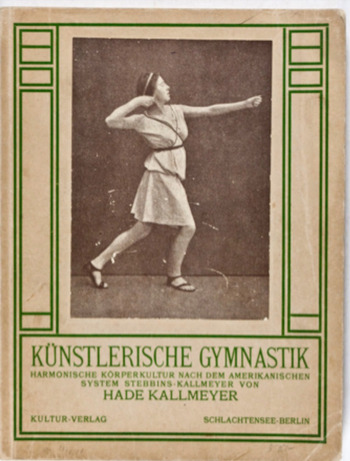
Still image from the Amazon drill movement series by Stebbins's German student Hade Kallmeyer (Kallmeyer Reference Kallmeyer1910).

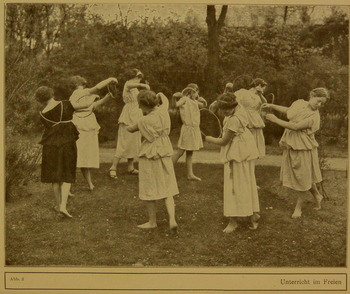
Photo of one of Stebbins's movement drills. (Seminar für Harmonische Gymnastik Kallmeyer 1912: 10).

Students accompanied Stebbins again in an 1896 performance for the Brooklyn Institute of Arts and Sciences, where she gave a reading on the origins and uses of ancient pantomime dance. Stebbins's students performed a “dance of river nymphs” in addition to the Mist Maidens altar dance before Stebbins's portrayal of Pallas Athene (Greek Goddess of Wisdom). The program closed with Stebbins's “illustrations of the sacred dances of antiquity,” including Miriam's dance of triumph (“Women Posed and Danced” 1896, 6). The show was described as a “novel and pleasing entertainment” (“Ancient Dances” 1896, 11). Soon after, Stebbins was invited to perform a solo at the climax of the epic operetta Cinderella at the Metropolitan Opera House (“Three Thousand Sunday School Girls” 1897, 6).
It is clear that at the apex of her career Stebbins was widely admired. She was celebrated in the press with nationally syndicated newspaper articles reporting on her activities. According to all available evidence, Stebbins introduced and developed “new” dances that were unique in the Gilded Age. As an extraordinary lecturer and performer, Stebbins educated audiences about the potential of physical expression as an aesthetic art. She was a visionary who demonstrated as a soloist that dance could illustrate a range of emotions, ecstatic action, and a dramatic narrative. Stebbins's work legitimated dance as a serious art form and respectable performance practice in America. In so doing, she paved the way for later dancers to be received with appreciation yet in time was erased from the annals of American dance history.