Introduction
In the pig-breeding industry, infection is a major cause of loss of productivity and can only be partially controlled by use of antibiotics and biosecurity measures. This problem has been further complicated by recent European legislation, which prohibits the use of anti-microbial growth promoters. Hence, it would be desirable to develop a method for selecting animals with increased resistance towards a wide range of infectious diseases. However, this has proved problematic because disease resistance, especially towards a wide range of infections, is difficult to monitor as it is often not feasible, or even possible, to detect every pathogen that has significant impact within a herd. In particular, sub-clinical infections cannot always be detected on the basis of clinical signs or serology tests (Spurlock, Reference Spurlock1997; Loeffen et al., Reference Loeffen, Kamp, Stockhofe-Zurwieden, van-Neiuwsadt, Bongers, Hunneman, Elbers, Baars, Nell and van Zijderveld1999).
In order to select animals for improved health or increased resistance towards infectious disease, an alternative approach would be to utilise measures of immune responses as a method of measuring responses towards a wide range of infectious diseases. This method is sometimes referred to as ‘generalised immunity’. For measures of the immune response or immune traits to be useful as markers for resistance towards infectious disease, these markers should be heritable and, ideally, correlate with parameters related to disease resistance, such as performance or health, etc. They should also be easy to measure and reproducible without requiring any challenge of the animal; these criteria are fulfilled by peripheral blood mononuclear leucocyte (PBML) subsets. Studies by Edfors-Lilja et al. (Reference Edfors-Lilja, Wattrang, Magnussen and Fossum1994) and Henryon et al. (Reference Henryon, Heegaard, Nielsen, Berg and Juul-Madsen2006a) have already reported moderate heritabilities for total and differential numbers of peripheral blood leucocytes, with respect to traits such as numbers of neutrophils, eosinophils, monocytes and lymphocytes. We have a particular interest in PBML subsets as potential markers for resistance towards infectious disease, which include CD4+ cells, CD8α+ cells, γδ+ T cells, B cells, monocytes and natural killer (NK) cells, which in pigs express the cell marker CD11R1+ (Haverson et al., Reference Haverson, Bailey, Stokes, Simon, LeFlufy, Banfield, Chen, Hollemweguer and Ledbetter2001). This is because our past work has demonstrated that amongst apparently healthy pigs from a farm of intermediate health status, the proportions of specific PBML subsets, B cells, monocytes and CD11R1+ cells were negatively correlated with performance (Clapperton et al., Reference Clapperton, Bishop, Cameron and Glass2005a). Also from the same pigs, we compared two divergent lines selected for lean growth under restricted feeding (LGR) and observed that high LGR line pigs had higher numbers of total white blood cells (WBC), CD8α+ cells and CD11R1+ cells than low LGR line pigs (Clapperton et al., Reference Clapperton, Bishop and Glass2006). Overall, these findings would suggest that specific PBML subsets correlate with performance, and can be influenced by genotype.
There are no reported heritability estimates for these particular PBML subsets in pigs, although these traits have been shown to be heritable in humans (Evans et al., Reference Evans, Frazer and Martin1999; Hall et al., Reference Hall, Ahmadi, Norman, Snieder, MacGregor, Vaughan, Spector and Lanchbury2000; Ahmadi et al., Reference Ahmadi, Hall, Norman, Vaughan, Snieder, Spector and Lanchbury2001) and in other species (Wonigeit et al., Reference Wonigeit, Washington and Hundrieser1998; Chen and Harrison, Reference Chen and Harrison2002; Cheeseman et al., Reference Cheeseman, Kaiser and Lamont2004).
In the pig-breeding industry, boars are generally selected for performance under a high health status environment whilst the subsequent progeny are often reared under lower health status conditions. One major challenge is to be able to select AI boars that produce progeny that can perform equally well within either a high or a lower health status environment. Therefore, if immune traits are to be used as selection markers for ‘generalised immunity’, then it is desirable that these markers are both heritable and correlate with health parameters, e.g. performance, under both high and lower health status environments. In our previous studies, we only measured immune traits in pigs from a single farm, and thus could not ascertain whether changes in health status would affect the results. Furthermore, our data were insufficient to estimate heritabilities or genetic correlations between traits, and thus explore opportunities for genetically improving or altering these immune measures. In this paper, our aims are to determine whether pig PBML subsets are both heritable and genetically correlated with performance. Also, we wish to use our data to determine whether there is any trend in our results associated with broadly defined farm health status. The PBML subsets tested were CD4+ cells, CD8α+ cells, γδ+ T cells, B cells, CD11R1+ cells and monocytes.
Material and methods
Populations studied and performance trait measurements
All measurements were performed on Large White pigs sampled from six farms labelled A to F. Three of these farms (A to C) were classed as high health status, i.e. free of all major swine pathogens and classified as specific pathogen-free (SPF), and the remaining three farms (D to F) were not SPF and hence classed as lower health status. Farms D to F were free of all major swine pathogens, except for the following organisms: Farm D was positive for enzootic pneumonia, Farm E was positive for Pasteurella multocida, Actinobacillus pleuropneumoniae, Leptospira bratislava, and also, Salmonella typhimurium phage type 104 was detected in faecal samples. Farm F was positive for PMWS (porcine multi-wasting syndrome). These six farms were grouped into four sources, where a source represented either the Roslin Institute farm (E) or one of the three pig-breeding companies (cited in the Acknowledgements), which contributed animals to the study.
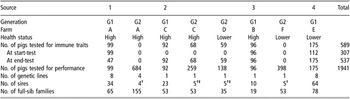
Details of numbers of pigs tested per farm along with the number of sires and full-sibs families (i.e. litters) are shown in Table 1. Data from the commercial sources were split into two generations, G1 and G2. From G1, a small number of sires were selected by the companies on performance attributes and used to produce progeny (G2). For G1 and G2, immune traits were measured in a selection of animals chosen at random, whilst performance was measured in all G2 offspring from the selected G1 boars. The project had initially been designed to enable us to contrast immune and performance traits between farms of high and lower health status; however, it can be seen in Table 1 that genetic links between high and lower health status farms were achieved only in sources 2 and 3.
Numbers of pigs tested, sires, lines and families per farm

For each source, G2 progeny were derived from G1 boars. Performance was measured in all pigs tested for immune traits.
†All sires were measured for immune traits when they were growing pigs.
‡These were the same sires.
The average age of animals at the start of test and end of test was 89 and 148 days, respectively. Animals were blood sampled, a 12 ml sample collected via the external jugular vein into a tube containing EDTA anti-coagulant, at the start and the end of test, and sampling was staggered so that pigs were tested in weekly groups of 20 to 30 pigs. With the exception of farm E, sampling for each farm at each time point took place over a period of 4 to 6 weeks. Daily weight gain (g/day) was measured from the start to the end of test and was available for blood-sampled animals as well as for their non-sampled littermates.
Immune measurements
Total and differential WBC were performed immediately after blood collection, as described by Clapperton et al. (Reference Clapperton, Bishop, Cameron and Glass2005a). Using previously described methods (Clapperton et al., Reference Clapperton, Bishop, Cameron and Glass2005a), peripheral blood mononuclear leucocytes were isolated from whole blood by density centrifugation and the numbers of cell subpopulations were enumerated using flow cytometry. Briefly, single- and dual-colour analyses of cell subpopulations were determined using primary monoclonal antibodies (mABs) recognising the cell surface markers CD4 (MIL-17), CD8α (MIL-12) (Saalmuller et al., Reference Saalmuller, Kuebart, Hollemweguer, Chen, Neilsen, Zuckermanm and Haverson2001), gamma delta (γδ) T cell receptor (TCR) (PPT16) (Davis et al., Reference Davis, Haverson, Saalmuller, Yang, Lunney, Hamilton and Pescovitz2001), the immunoglobulin light chain on B cells (K139 E1) (Denham et al., Reference Denham, Zwart, Whitall, Pampusch, Corteyn, Bianchi, Murtaugh, Parkhouse, Tlaksova, Sinkora, Sinkora and Rehakova1998), CD11R1+ on NK cells (Haverson et al., Reference Haverson, Bailey, Stokes, Simon, LeFlufy, Banfield, Chen, Hollemweguer and Ledbetter2001) (MIL-4) and SIRPα on monocytes (74-22-15) (Thacker et al., Reference Thacker, Summerfield, McCullough, Dominguez, Alonso, Lunney, Sinkora and Haverson2001), together with secondary antibodies goat anti-mouse (GAM) IgG1-fluorescein isothiocyanate (FITC), GAM IgG2a-phycoerythrin (PE) and GAM IgG2b-fluoresecein isothiocyanate. Data acquisition and analysis were carried out using a FACScan and CELLQuest software (Becton Dickinson, Oxford, UK). The PPT16 cell line supernatant was provided by Huaizhi Yang, Institute for Animal Health, Pirbright, Surrey, UK. The other antibodies were provided by the following companies: Serotec, Oxford, UK, for MIL-4, MIL-12, MIL-17 and K139 E1; Southern Biotechnology Associates Inc., Birmingham, AL, USA, for 74-22-15 and GAM IgG2b; Oxford Biotechnology Ltd., Kidlington, Oxfordshire, UK, for GAM IgG1 and IgG2a.
Data analysis
Preliminary analyses of the data were performed using the GENSTAT package (Lawes Agricultural Trust, 1983) to determine significant fixed effects and to test the distributional assumptions for the traits. A single performance trait was available and consistent across all farms, this being daily live weight gain. The immune traits were total WBC count, and the PBML subsets categorised into CD4+ cells, CD8α+ cells, γδ+ T cells, CD11R1+ cells (which were further subdivided into CD11R1+ CD8α+ and CD11R1+ CD8α− cells), B cells and monocytes. The WBC PBML subsets were enumerated at both the start and the end of test, although not all animals were measured at both time points. The PBML subsets were expressed both as a proportion of total PBML and as total estimated numbers of each subset.
Significant fixed effects for most traits included farm, weekly batch of pigs nested within farm, line nested within farm, sex and age at measurement (fitted as a covariate). Pigs from sources 1 and 4 were subdivided into lines, and line effects from source 4 (i.e. Roslin Institute farm E) were previously presented by Clapperton et al. (Reference Clapperton, Bishop and Glass2006). Many of the traits were right skewed and required log-transformation prior to analysis. These included all end-test measures except for γδ cells, CD8α+ and B cells at start test, and all the PBML subset numbers.
Genetic parameters, and their standard errors, were estimated using the ASREML package (Gilmour et al., Reference Gilmour, Cullis, Welham and Thompson2004), fitting an animal model including all known pedigree relationships. In total, 1941 animals were included in the dataset and the pedigree; however, many more animals had performance than immune trait data (see Table 1). Fixed effects described above were fitted to each trait in the ASREML analysis. Random effects fitted were the residual term plus the direct genetic effect. Litter was fitted as an additional random effect; however, as assessed by the likelihood ratio test, it was never significant and was subsequently dropped from all analyses. Univariate analyses were performed for each trait described above using all available data for each trait (see Table 1). Furthermore, the dataset was subdivided into high and lower health status farms and the univariate analyses repeated for the immune measures. Using the whole dataset, bivariate analyses were performed to estimate correlations between performance and immune traits, and between the immune traits at the start and the end of test.
Results
Summary of data
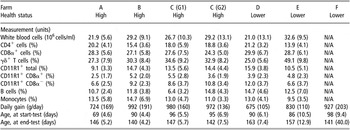
Mean values for immune and performance traits at the end of test for each farm are shown in Table 2. Similar values were also obtained at the start of test (data not shown). Although there was considerable variability between farms in the immune traits, there was no obvious relationship between farm health status and immune traits, in terms of either mean values or variability. Performance tended to be lower on the lower health status farms; however, the effects of health status, farm husbandry system and animal genotype are confounded.
Summary of immune and performance traits at end-test for each farm

Data are expressed as mean (s.d.).
Heritability estimates
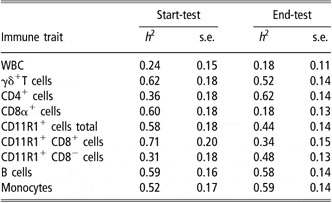
Estimated heritabilities for WBC and proportions of PBML subsets at the start- and end-tests are shown in Table 3. All PBML subsets tested were moderately to highly heritable at both time points, except for CD8α+ cells. There was also a large disparity in heritability estimates for this PBML subset between the two time points. For WBC, heritability estimates were generally somewhat lower than those for the PBML subset proportions. The heritability for daily gain was 0.47 (s.e. 0.07).
Heritability (h 2) estimates of total white blood cell numbers (WBC) (×106 cells/ml) and the proportions of peripheral blood mononuclear leucocyte subsets (%) of ca. 500 Large White pigs from three high health status and two lower health status farms at start- and end-test (live weights ~30 and ~90 kg, respectively)

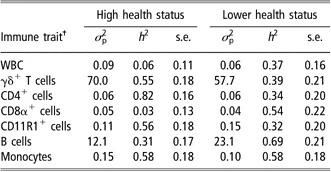
Results for heritability estimates for WBC and proportions of PBML subsets at end-test, separated according to farm health status, are shown in Table 4, although these results must be interpreted with caution as pig genotype and farm health status were confounded. Heritability estimates for individual measurements appeared to vary according to farm health status, especially for PBML subsets, CD4+ cells, CD8α+ cells and B cells; however, the standard errors of the estimates were always large. The average heritability calculated from all PBML subsets was 0.475 and 0.477 for high and lower health status environments, respectively. For WBC, the heritability estimate was higher for lower health status farms than for higher health status farms (0.05 < P < 0.1).
Heritability (h 2) estimates of total white blood cell numbers (WBC) (×106 cells/ml) and proportions of peripheral blood mononuclear leucocyte subsets (%) of ca. 500 Large White pigs from three high health status and two lower health status farms at end-test (live weight ~90 kg), divided according to farm health status

†All traits log-transformed prior to analysis except γδ+ T cells and B cells.
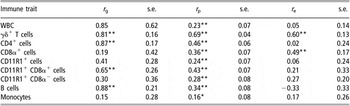
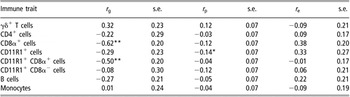
Correlations between the start- and end-tests for WBC numbers or PBML proportions are shown in Table 5. The phenotypic correlations between the two time points, which under the assumption of equal variances across time may be interpreted as the across-time repeatabilities, were generally lower than the genetic correlations, but were positive and significantly greater than zero for all cell types tested. Genetic correlations were positive albeit with large standard errors.
Genetic (r g), phenotypic (r p) and environmental (r e) correlations between start-test and end-test for total white blood cell numbers (WBC) (×106 cells/ml) or proportions of peripheral blood mononuclear leucocyte subsets

*P < 0.05; **P < 0.01.
Data represent 1941 pigs from three high health status and three lower health status farms.
Genetic and phenotypic correlations with daily gain
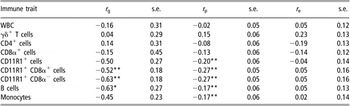
Genetic, phenotypic and environmental correlations of daily gain with WBC or PBML subset numbers measured at the end test are shown in Table 6a. In this table and in subsequent analyses presented, the genetic correlations were nearly always stronger than the phenotypic correlations. WBC numbers were uncorrelated with daily gain; however, significant correlations were observed between PBML numbers and daily gain. Most of these correlations were negative, indicating that improved performance is associated with decreased values for these traits. In particular, there were strong and significant negative genetic correlations between the numbers of B cells or CD11R1+ cells and daily gain. CD11R1+ cells comprise CD8α+ and CD8α− subsets, and these subsets were negatively correlated, both genetically and phenotypically, with daily gain.
Genetic (r g), phenotypic (r p) and environmental (r e) correlations between total white blood cell numbers (WBC) (×106 cells/ml), or numbers of peripheral blood mononuclear leucocyte subsets measured at end-test and daily gain (g/day)

*P < 0.05; **P < 0.01.
Data represent 1941 pigs from three high health status and three lower health status farms.
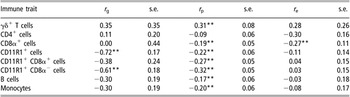
Genetic, phenotypic and environmental correlations between daily gain and the proportions of PBML subsets, as opposed to numbers, measured at the end-test are shown in Table 6b. There were significant negative genetic correlations between daily gain and the proportions of CD11R1+ CD8α− cells or total CD11R1+ cells. There were also significant negative phenotypic correlations for daily gain with the proportions of CD8α+ cells, total CD11R1+ cells, CD11R1+ CD8α+ cells, CD11R1+ CD8α− cells, B cells or monocytes, and these correlations were similar to those seen for PBML subset numbers. The γδ+ cell proportions were positively correlated with daily gain.
Genetic (r g), phenotypic (r p) and environmental (r e) correlations between proportions of peripheral blood mononuclear leucocyte subsets measured at end-test and daily gain (g/day)

*P < 0.05; **P < 0.01.
Data represent 1941 pigs from three high health status and three lower health status farms.
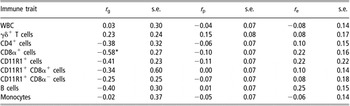
Genetic, phenotypic and environmental correlations of daily gain with WBC or PBML subset numbers measured at start-test are shown in Table 7a. Once again, WBC was uncorrelated with daily gain. Overall, genetic and phenotypic correlations between PBML subsets and daily gain tended to be weaker at start-test compared to end-test, and they are accompanied by large standard errors. However, there were strong negative genetic correlations between numbers of CD8α+ cells and daily gain.
Genetic (r g), phenotypic (r p) and environmental (r e) correlations between total white blood cell numbers (WBC) (×106 cells/ml), or numbers of peripheral blood mononuclear leucocyte subsets measured at start-test and daily gain (g/day)

*P < 0.05; **P < 0.01.
Data represent ca. 1941 pigs from three high health status and three lower health status farms.
Genetic, phenotypic and environmental correlations between daily gain and proportions of PBML subsets measured at start-test are shown in Table 7b. With the exception of the correlations with CD8α+ cells and CD11R1+ CD8α+ cells, these correlations are weaker than those seen at end-test. Once again, however, significant correlations with daily gain were invariably negative.
Genetic (r g), phenotypic (r p) and environmental (r e) correlations between proportions of peripheral blood mononuclear leucocyte subsets measured at start-test and daily gain (g/day)

*P < 0.05; **P < 0.01.
Data represent 1941 pigs from three high health status and three lower health status farms.
Notably, the two PBML subsets for which low genetic correlations across time were seen, viz. CD8α+ cells and monocytes (Table 5), were those for which correlations with daily gain differed markedly with time. CD8α+ cells were only correlated with daily gain at start-test, whereas monocytes were correlated with daily gain at end-test.
Discussion
This paper has presented several results that are of potential importance for breeding pigs with improved performance or health. Firstly, all the immune traits investigated, with the possible exception of CD8α+ cells, were moderately to highly heritable. Secondly, for the PBML subsets tested, changes in farm health status did not have a consistent effect upon heritabilities, although the conclusion must be tempered by the large standard errors and the confounding of farm and genotype. Thirdly, for specific PBML subsets, particularly CD11R1+ cells (which have NK cell characteristics (Haverson et al., Reference Haverson, Bailey, Stokes, Simon, LeFlufy, Banfield, Chen, Hollemweguer and Ledbetter2001)) and especially the CD11R1+ CD8α+ subpopulation, there were strong negative genetic correlations with performance, accompanied by phenotypic correlations in the same direction.
These results, particularly the genetic correlations with growth rate, provide optimism that immune traits may be used to breed pigs for enhanced performance and health, under circumstances where performance is used as a proxy for health. Moderate to high heritabilities towards a wide range of immune measures have previously been reported in pigs (Mallard et al., Reference Mallard, Wilkie and Kennedy1989 and 1998; Joling et al., Reference Joling, Mok, de Vries Relingh, Wever, Cornelis, Oskam and Henken1993; Edfors-Lilja et al., Reference Edfors-Lilja, Wattrang, Magnussen and Fossum1994 and Reference Edfors-Lilja, Wattrang, Marklund, Moller, Andersson-Eklund, Andersson and Fossum1998; Henryon et al., Reference Henryon, Heegaard, Nielsen, Berg and Juul-Madsen2006a). However, showing relationships between immune traits and disease resistance has been more difficult. This is partly due to the fact that although genetic variation in disease resistance under intensive production conditions has been demonstrated (e.g. Lyons et al., Reference Lyons, Freeman and Kuck1991; Henryon et al., Reference Henryon, Berg, Jensen and Andersen2001; Snowder et al., Reference Snowder, Van Vleck, Cundiff and Bennett2006), heritabilities under such conditions are often relatively low, particularly when the ‘disease’ represents a general category of infections or syndromes rather than a specific identifiable disease. In a comprehensive study, Henryon et al. (2006b) were unable to demonstrate consistent genetic correlations between various immune parameters and the incidence of a range of infectious diseases within a herd of Duroc and Landrace pigs. However, it is notable that the only overlap in immune traits between our study and that of Henryon et al. (2006b) was WBC count, and we did not find any relationships between WBC and performance. It was partly due to the difficulties of recording and demonstrating genetic variation in the incidence of sporadic disease under intensive conditions that we chose performance as a proxy for health.
The choice of immune traits in studies such as this is potentially contentious, and different studies have invariably focussed on different measures. Other workers (Eurell et al., Reference Eurell, Bane, Hall and Schaeffer1992; Grellner et al., Reference Grellner, Fangman, Carroll and Wiedmeyer2002; Galina-Pantoja et al., Reference Galina-Pantoja, Mellencamp, Bastiaansen, Cabrera, Solano-Aguilar and Lunney2006) have also reported negative phenotypic relationships between immune traits such as PBML subsets, acute phase proteins (APP) v. weight gain. However, an alternative approach by Mallard et al. (1998) used an immune index comprised of both antibody- and cell-mediated immune responses as a tool for selecting pigs for increased weight gain. In order to find markers that reflect resistance towards a wide range of infectious diseases, we chose the immune traits used in this study because they are repeatable, easy to measure compared to other labour-intensive assays for cell function and relatively stable across time (Clapperton et al., Reference Clapperton, Bishop, Cameron and Glass2005a). Also, since levels of these traits were shown to phenotypically negatively correlate with performance (Clapperton et al., Reference Clapperton, Bishop, Cameron and Glass2005a) and to be influenced by pig genotype (Clapperton et al., Reference Clapperton, Bishop and Glass2006), this suggests that these markers may both be heritable and genetically correlate with animal health status. The focus on traits that are largely representative of the innate immune system was also deliberate, as this is more likely to confer appropriate responses to a wide variety of diseases than measures of acquired or adaptive immunity. However, whether our measures are indicative of baseline immune levels as argued by Henryon et al. (2006b) is debatable, particularly as the infection status of our pigs at the time of measurement is unknown.
This is the first report to measure the heritability of individual PBML subsets in pigs. Our results correspond with similar studies performed for human PBML subsets, which reported moderate to high heritabilities for B cells, NK cells, CD4+ T cells and CD8α+ T cells (h 2 ranging from 0.46 to 0.7). For other species, e.g. mice, chicken and rats, there is also substantial evidence that PBML subset levels are under genetic control (Roberts et al., Reference Roberts, Foote, Alexander, Scott, Robb and Metcalf1997; Wonigeit et al., Reference Wonigeit, Washington and Hundrieser1998; Duarte and Penta-Goncalves, Reference Duarte and Penta-Goncalves2001; Chen and Harrison, Reference Chen and Harrison2002; de Haan et al., Reference de Haan, Bystrykh, Weersing, Dontje, Geiger, Ivanova, Lemischka, Vellenga and Van Zant2002; Morrison et al., Reference Morrison, Qian, Jerabek, Thiel, Park, Ford, Kiel, Schork, Weissman and Clarke2002; Myrick et al., Reference Myrick, DiGuisto, DeWolfe, Bowen, Kappler, Marrack and Wakeland2002). Given the consistency of significant heritabilities for various PBML subsets across species, it would seem likely that such genetic variation would have biological consequences to the host, most likely in the balance between effectively responding to infectious agents and inducing serious pathological sequelae. Understanding the genetic factors underlying variation in PBML subsets could lead to new methods to both enhance disease resistance and reduce susceptibility to autoimmune or other undesirable reactions.
Whilst moderate to high heritabilities have been reported for human CD8α+ cells (h 2 = 0.5 to 0.7) (Hall et al., Reference Hall, Ahmadi, Norman, Snieder, MacGregor, Vaughan, Spector and Lanchbury2000, Reference Hall, Norman, Thiel, Tiwari, Peiffer, Vaughan, Prescott, Leppert, Schork and Lanchbury2002; Ahmadi et al., Reference Ahmadi, Hall, Norman, Vaughan, Snieder, Spector and Lanchbury2001), the heritability for porcine CD8α+ cells in our study was variable, being high at start-test (h 2 = 0.6) but relatively low at end-test (h 2 = 0.18). One possible explanation for this disparity in the end-test result is that in humans CD8α+ cells mainly represent one major cell type, classical CD8α+ T cells, whilst in pigs CD8α+ cells comprise various T and non-T cell types, CD8α+ NK cells, CD4+ CD8α+ cells and CD8α+ γδ+ T cells (Yang and Parkhouse, Reference Yang and Parkhouse1996). Some of these cell types, e.g. CD4+ CD8α+ cells, are only released in response to infection and therefore levels of these cell types may depend more on type of exposure to environmental pathogens than on genetic factors (Ober et al., Reference Ober, Summerfield, Mattlinger, Wiesmuller, Jung, Pfaff, Saalmuller and Rzhia1998; Zuckermann, Reference Zuckermann1999). Nonetheless, genetic variation in levels of double-positive T cells has been reported in both monkeys (Lee et al., Reference Lee, Nam, Terao and Yoshikawa2003) and chickens (Luhtala et al., Reference Luhtala, Lassila, Toivanen and Vaino1997).
For WBC, the heritability was 0.18 and 0.24 at start- and end-test, respectively. Whilst these values are lower than those reported by Edfors-Lilja et al. (Reference Edfors-Lilja, Wattrang, Magnussen and Fossum1994) (h 2 = 0.44), they are similar to the estimate quoted by Henryon et al. (Reference Henryon, Heegaard, Nielsen, Berg and Juul-Madsen2006a) (h 2 = 0.25). The genetic correlation between start- and end-test was high, indicating that either measurement time would suffice if selection were to be performance on WBC, despite the low phenotypic correlations between these time points. In general, for the PBML subsets, genetic correlations between start- and end-test were high, with the exception of CD8α+ cells and monocytes. This low genetic correlation between time points is also manifested in inconsistent relationships between these subsets and growth rate, across time. CD8α+ cells showed significant genetic relationships at start-test, and monocytes at end-test.
For immune traits to be valuable as predictors of performance under various infectious challenges, understanding their behaviour in different health environments is also required. Our definition of health status is based on the presence of major swine diseases that consistently affect both animal welfare and performance (Poppe et al., Reference Poppe, Smart, Khakhria, Johnson, Spika and Prescott1998; Pallarés et al., Reference Pallarés, Gómez, Ramis, Seva and Muñoz2000; Regula et al., Reference Regula, Lichtensteiger, Mateus-Pinilla, Scherba, Miller and Weigel2000; Segalés et al., Reference Segalés, Rosell and Domingo2004), although the use of APP as potential indicators of health status is currently under investigation (Parra et al., Reference Parra, Fuentes, Tecles, Martínez-Subiela, Martínez, Muñoz and Cerón2006; Tecles et al., Reference Tecles, Fuentes, Martínez-Subiela, Parra, Muñoz and Cerón2007). In general, the traits we measured were consistent between high and lower health status farms, with two notable exceptions, levels of WBC and CD8α+ cells. Under high health status conditions, these two traits were not heritable, but under lower health status there was a significant genetic component to the observed between-animal variation. Although we could not examine the infectious disease challenges between the high and lower health status farms, it seems likely that the pigs from the latter farms were subject to more sub-clinical infections than those from the high health status farms. If so, this would suggest that the genetic component to the levels of WBC and CD8α+ cells may more reflect the host’s ability to mount a response rather than simply reflecting a baseline level.
Correlations between immune and performance traits are potentially valuable from a breeding perspective. Although more cell types were significantly correlated with performance at the phenotypic level, the genetic correlations were generally stronger than the phenotypic correlations, and significant correlations were mainly observed at the end-test. Additionally, in the main, similar patterns were seen for both numbers and proportions of the PBML subsets. Some patterns do stand out. Firstly, large or significant correlations between cell type and performance were almost always negative. Secondly, only some of the traits showed significant correlations with performance even though most of them were heritable and correlated across time. In particular, WBC, γδ T cells and CD4 cells were notable in that none of them had any significant genetic, phenotypic or environmental relationship with performance. In contrast, CD11R1+ cells were the subset most consistently associated with performance at both the genetic and phenotypic levels, the latter confirming our earlier results with fewer pigs (Clapperton et al., Reference Clapperton, Bishop, Cameron and Glass2005a). Galina-Pantoja et al. (Reference Galina-Pantoja, Mellencamp, Bastiaansen, Cabrera, Solano-Aguilar and Lunney2006) also corroborated our findings as they also found that NK cell levels were negatively phenotypically related to future daily gain, using immune measures at birth, weaning and at 9 weeks age. These workers enumerated the NK cells by measuring the proportion of CD2+CD16+ subsets. Along with NK cells, PBML that expressed CD16 (monocyte and NK cell marker) and CD8α were also negatively correlated with future weight gain but only at certain time points. However, NK cells were consistently negatively correlated with future weight gain at each time point. All pigs used in the study of Galina-Pantoja et al. (Reference Galina-Pantoja, Mellencamp, Bastiaansen, Cabrera, Solano-Aguilar and Lunney2006) were derived from a single lower health status farm; similar outcomes were seen in their study and ours, despite differences in both health status and timing of the immune measurements between the two studies. Importantly, the heritability of levels of CD11R1+ cells was consistent between start- and end-tests as well as between different health status farms. It should be emphasised that this trait can be measured without the need for a deliberate challenge and thus could represent an animal’s potential to resist disease. Taken together, these characteristics suggest that this trait in particular would be a strong candidate for selective breeding of pigs for enhanced performance under commercial conditions.
CD11R1+ mononuclear cells in pigs express markers and function consistent with NK activity (Haverson et al., Reference Haverson, Bailey, Stokes, Simon, LeFlufy, Banfield, Chen, Hollemweguer and Ledbetter2001; Denyer et al., Reference Denyer, Wileman, Stirling, Zuber and Takamatsu2006). In addition, we have described a novel CD11R1+ population that does not express CD8α, which is larger and more granular than the CD11R1+ cells positive for CD8α (Clapperton et al., Reference Clapperton, Bishop, Cameron and Glass2005a). Although at the end-test both populations are negatively associated with performance, strikingly only the CD8α+ population is correlated genetically at the start-test, suggesting that these two populations may also differ functionally.
Although our results suggest that selecting animals for lower proportions or numbers of CD11R1+ cells would lead to higher-performing progeny, it would be advisable to proceed with such selection with some care, as other potential correlated responses are unknown. Health monitoring would be advisable, as there is a risk that using an immune trait as a selection marker for improved performance could lead to adverse correlated changes in other immune responses, which may be detrimental to the host. For example, there was an increased incidence of arthritis in response to Mycoplasma hyorhinis infection in Yorkshire pigs selected for both ‘high’ immune response accompanied by increased weight gain compared to contemporaneous pigs selected for both ‘low’ immune response accompanied by decreased weight gain (Jayagopala Reddy et al., Reference Jayagopala Reddy, Wilkie, Borgs and Mallard2000). In another study, selecting mice for a high antibody response was associated with either an enhanced or reduced ability to respond to an infection depending on the type of pathogen involved (Gheorgiou et al., Reference Gheorgiou, Mouton, Lecoeur, Lagranderie, Mevel and Biozzi1985; Pedrini et al., Reference Pedrini, Acorci, Pinto, Silveira and Oliveira2005). Selection responses should be monitored to ensure that such effects do not arise.
NK cells are part of the innate immune system and function as both immune surveillance monitors and as effector cells against invading pathogens and developing tumours (Lodoen and Lanier, Reference Lodoen and Lanier2006). NK cells are activated by engaging highly polymorphic sets of receptors and carry out their effector functions by producing cytokines, particularly interferon-γ, and by lysing cells infected with pathogens. NK cells can also help to regulate the adaptive immune responses by producing interferon gamma, which can promote the maturation of dendritic cells and generate a T helper type 1 (Th1) response. There is also evidence that NK cells can kill dendritic cells that fail to become fully activated (O’Connor et al., Reference O’Connor, Hart and Gardiner2005). The strong negative association of NK cell levels with performance might indicate that they are the major players in the initial stages of response to a broad range of pathogens, and the genes underlying variation in their numbers in peripheral blood are strong candidates for selecting animals with highly efficient generalised immunity. The relationship between NK cells and performance could be causal, with higher NK cell numbers leading to the production of more cachexic cytokines, for example. Alternatively, the presence of elevated NK cell levels may indicate a greater propensity to sub-clinical infections, which would lead to reduced performance. If so, other factors may lead to animals differing in their susceptibility or response to infection, and the NK cell levels are diagnosing the outcomes. The latter hypothesis would explain why the NK cell levels are particularly strongly associated with performance at end-test compared to start-test. As previously discussed, all pigs in this study were apparently healthy, but it is certainly possible that sub-clinical infections, which were, by their nature, undetectable, could account for this relationship. An alternative way of diagnosing infection status is to measure APP that are released in response to infection, and elevated APP levels have been associated with both clinical infections and, in apparently healthy pigs, sub-clinical infections (Petersen et al., Reference Petersen, Ersboll, Jensen and Nielsen2002). We have previously demonstrated negative phenotypic correlations between APP and performance (Clapperton et al., Reference Clapperton, Bishop, Cameron and Glass2005b). Therefore, we are currently generating data to investigate genetic relationships of APP levels with performance, in an attempt to further address this issue.
To conclude, we have shown that various PBML subsets (CD4+ cells, CD11R1+ cells, γδ+ T cells, B cells, monocytes) are moderately to highly heritable. In addition, several of the PBML subsets are negatively genetically correlated with performance. These results potentially pave the way to use these immune traits to assist in the selection of pigs that are both healthier and more productive. Identifying the genes and mechanisms underlying our results is the subject of further research.
Acknowledgements
This project was funded through LINK SLP, by the Generalised Immunity Pig Consortium (Rattlerow Farms Pig Breeding and Development, J.S.R. Genetics, Genus (formerly Sygen) and the Meat and Livestock Commission), the Department of Environment, Food and Rural Affairs (Defra), and the Biotechnology and Biological Science Research Council (BBSRC). We wish to thank staff at farms belonging to each of the breeding companies as well as Dryden Farm, Roslin Institute (Edinburgh), who provided care for animals and collected on-farm data.