Implications
Insulin is a key mediator of the interactions between nutrition and reproduction. Higher insulin levels during the late luteal phase are crucial to enhance ovulation rate, number of embryos and embryo and placental weights. Therefore, the use of carbohydrates, as the predominant energy source, can be an effective tool to increase insulin levels during the premating period in gilts and seems beneficial to improve gilt subsequent reproductive performance.
Introduction
The relationship between nutrition and reproduction has been studied for many years in the female pig, and several lines of evidence suggest that reproductive function may be impaired without adequate nutrition (Armstrong and Britt, Reference Armstrong and Britt1987; van den Brand et al., Reference van den Brand, Dieleman, Soede and Kemp2000a). Insulin acts as an important metabolic signal to the brain in response to the change in food intake and body composition (Schwartz et al., Reference Schwartz, Figlewicz, Baskin, Woods and Porte1992). Previous studies showed that insulin administration during the follicular phase increased ovulation rate (Cox et al., Reference Cox, Stuart, Althen, Bennett and Miller1987) and decreased follicular atresia (Matamoros et al., Reference Matamoros, Cox and Moore1991) in cyclic gilts. In addition, exogenous insulin treatment during the late luteal phase of the estrous cycle could counteract the deleterious effects of feed restriction on reproductive function (Almeida et al., Reference Almeida, Mao, Novak, Cosgrove and Foxcroft2001). In sows, Tokach et al. (Reference Tokach, Pettigrew, Dial, Wheaton, Crooker and Johnston1992) and Koketsu et al. (Reference Koketsu, Dial, Pettigrew, Marsh and King1996) demonstrated that circulating concentrations of insulin and glucose were correlated with luteinizing hormone (LH) pulsatility.
It has been shown that dietary energy source may affect the concentration of reproductive hormones. Feeding multiparous sows a carbohydrate-rich diet as opposed to a fat-rich diet during and after lactation increased the size of the preovulatory LH peak and postovulatory progesterone concentrations (Kemp et al., Reference Kemp, Soede, Helmond and Bosch1995). Recently, van den Brand et al. (Reference van den Brand, van Enckevort, van der Hoeven and Kemp2009) evaluated the effects of dextrose and lactose supplementation during and after lactation in multiparous sows and observed a potential increase in litter size, and a reduction in the variation of within litter birth weight.
Considering that gilts are an important component of the breeding herd, it is essential to improve fertility in these animals, and nutrition is certainly a key factor to be manipulated. In this sense, using cyclic gilts as experimental models, it was reported that feed restriction during the luteal phase has a negative effect on follicle development and ovulation rate (Hazeleger et al., Reference Hazeleger, Soede and Kemp2005), and subsequent embryo survival in early pregnancy (Almeida et al., Reference Almeida, Kirkwood, Aherne and Foxcroft2000). It was also shown that nutrient restriction during lactation results in excessive mobilization of maternal body reserves, leading to reduced ovulation rate and embryo survival (Zak et al., Reference Zak, Cosgrove, Aherne and Foxcroft1997; van den Brand et al., Reference van den Brand, Soede and Kemp2000b; Vinsky et al., Reference Vinsky, Novak, Dixon, Dyck and Foxcroft2006). During the luteal phase in gilts, the extent of follicle development is comparable to that of sows in late lactation: follicle development is limited to small antral stages (Chen et al., Reference Chen, Stott, Athorn, Bouwman and Langendijk2012). However, in relation to metabolic state, the lactating sow and the cyclic gilt experimental models may not be strictly comparable, as increased catabolism (lactating sow) or reduced anabolism (cyclic gilts) may induce different metabolic responses (Zak et al., Reference Zak, Cosgrove, Aherne and Foxcroft1997; Almeida et al., Reference Almeida, Mao, Novak, Cosgrove and Foxcroft2001).
Knowing that insulin may be a possible mediator of nutrition–reproduction interactions, the increase of insulin levels during the luteal phase would be crucial to follicle development, follicle quality and ovulation rate and would consequently improve embryo survival in early pregnancy. In this sense, studies conducted in lactating sows reported that dextrose containing feed increased insulin and IGF-1 levels (van den Brand et al., Reference van den Brand, Prunier, Soede and Kemp2001) and follicle size (van den Brand et al., 2000a; Wientjes et al., Reference Wientjes, Soede, van den Brand and Kemp2012b). In addition, comparable effects have been recently demonstrated by Quesnel et al. (Reference Quesnel, Etienne and Père2007) in sows with a high and prolonged insulin response after a glucose tolerance test, which showed more and better developed follicles. Although energy source and insulin have been broadly investigated in primiparous and multiparous sows, studies concerning the effects of dietary-induced plasma insulin manipulation during the estrous cycle in gilts, specifically in late luteal and follicular phases comprising follicular recruitment and selection, are limited. Given the existing metabolic differences between sows and gilts, and the economical importance of replacement gilts in the breeding herd, this investigation becomes crucial and will give new insights on nutritional management of cyclic gilts before breeding. Therefore, the objective of the present study was to investigate whether different dietary energy sources, starch or soybean oil, provided during the early and final phases of follicular growth would differentially affect the reproductive performance of gilts.
Material and methods
Animals
Sixty-four littermate gilts (Landrace×Large White) were identified at weaning, and by the time of the first selection their age ranged from 130 to 139 days and the average body weight was 79.3±2.5 kg. Until that period, they were fed ad libitum two different diets: a weaner diet until ∼25 kg body weight and a grower diet, which was fed until the beginning of the experimental period. All procedures involving the animals in this experiment were approved by the Ethics Committee in Animal Experimentation (CETEA/UFMG).
Pretreatment of gilts
All 64 gilts were allocated in pens (four gilts per pen), weighed every 2 weeks, and had their backfat thickness and lean depth measured at P2 (Pig-Log® 105, SKF-Technology, Herlev, Denmark). The data collected throughout this period were used for the final selection of the experimental groups, as the first target of this study was to have groups of growth-matched littermate gilts with an age of 150 days and around 95 kg when first stimulated with sexually mature boars.
Starting 3 weeks after their allocation, when all gilts had turned 150 days of age, they were directly exposed to sexually mature boars (six gilts: one boar), twice a day (0800 and 1630 h) for 10 min, until the last gilt had displayed pubertal estrus. To synchronize second estrus of the females within a littermate group, from day 14 of their first estrous cycle, each gilt received the oral progestagen altrenogest (20 mg/day, Regumate®, Intervet, São Paulo, Brazil) until the last littermate in heat received at least 5 days of altrenogest treatment. In order to have a better estimation of the individual daily feed intake of the gilts and to minimize their stress during the experimental treatments, they were transferred to crates around 40 days before the beginning of the experimental period. Throughout this adaptation period, 54 cyclic gilts were randomly selected and standardized as to genetic background (Large White×Landrace), litter of origin, weight gain, backfat, number of cycles and health status. Gilts presenting lameness problems were culled from the study. After altrenogest withdrawal, gilts were fed to appetite twice daily (0700 and 1400 h), and daily feed weighbacks were carried out to estimate ‘unrestricted’ feed intake at this stage. They were tested for estrus twice a day (0800 and 1630 h) with sexually mature boars until the onset of second heat. Ninety-six percent of gilts came in heat within 6 days after altrenogest withdrawal.
Experimental treatments
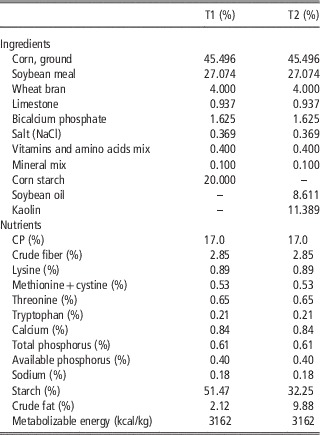
The 52 littermates gilts that remained in the study were randomly fed either a carbohydrate-rich (T1) or a lipid-rich (T2) diet. The dietary compositions of the rations used in the experiment are shown in Table 1. Defining day 0 (zero) as the 1st day of the second standing heat, the experimental diets were given, as follows:
-
1. T1 (n=26): gilts fed ad libitum a diet with an energy source based on carbohydrates (20% corn starch) from day 8 until the next standing heat;
-
2. T2 (n=26): gilts fed ad libitum a diet with an energy source based on lipids (8.6% soybean oil) from day 8 until the next standing heat. The amount of soybean oil included in the diet provided the exact amount of energy provided by the corn starch included in T1, and the total amount of the whole diet was completed with an inert substance (kaolin).
Dietary composition as formulated of the experimental diets (as fed)

The diets were isocaloric, isoproteic and isolysinic, and were nutritionally balanced in terms of other amino acids, vitamins and minerals according to NRC (1998) requirements (Table 1). Animals were fed twice a day (0930 and 1630 h), and the ad libitum feed intake was monitored to ensure that the daily metabolizable energy intake of both treatments was similar. The experimental diets were supposed to provide similar amounts of dietary energy, but from different sources.
Blood sampling
An indwelling jugular catheter was non-surgically implanted (Britt et al., Reference Britt, Esbenshade and Ziecik1991) at day 4 of the cycle in a subgroup of 20 gilts (T1 n=10; T2 n=10). Five-mililitre blood samples were withdrawn at 1 h before the morning feeding, 30 min, 1, 2, 3 and 4 h after the morning feeding on days 14 and 21 for analysis of glucose and insulin. Blood samples were collected into heparinized tubes, centrifuged at 1500×g for 15 min, and plasma stored at −20°C until analysis.
Artificial insemination and time of ovulation
Starting day 18 of the cycle, gilts were checked for estrus using the back pressure test during periods of fence line contact with mature boars twice daily (0800 and 1630 h) and were artificially inseminated 12 and 24 h after the first observed standing estrus with pooled semen (3×10⁹ spermatozoa/dose) from the same group of boars specifically designated for this experiment. Immediately after first mating, their feed intake was reduced to 1.8 kg and were fed a regular gestation diet nutritionally balanced in terms of amino acids, vitamins and minerals to meet NRC (1998) recommended nutritional requirements until slaughter. Time of ovulation was monitored by transcutaneous ultrasonography (50-S Tringa, Pie Medical®, Maastrichit, Holland), using a 5.0 MHz multiple angle transducer to scan for the presence of preovulatory follicles. Gilts were scanned at 6h intervals, starting 24h after onset of standing estrus, until ovulation has been completed. Time of ovulation was defined as the time of the first scanning when no presumptive ovulatory follicles were seen minus 3 h. Three-ml blood samples were taken at 6 h interval, starting ovulation detection until 18 h after ovulation for progesterone assay.
Reproductive tract recovery
All gilts were slaughtered at a local abattoir on day 28.6±0.5 of pregnancy. Reproductive tracts were recovered; the ovaries and the uterus were weighed. Ovulation rate was estimated by counting the number of corpora lutea on each ovary. To collect data on placental and embryonic development, the wall of the uterine horns was cut longitudinally along the antimesometrial side, starting at the utero-cervical junction. Before removing any embryos from the uterus, allantoic fluid volume was determined by draining this fluid into measuring cylinders. The length and width of the allantochorionic placenta, excluding the necrotic tips of the chorion, were measured in utero under minimal stretch and used to calculate placental area. After that, each placenta was removed, weighed and the empty uterus was also weighed. The number of viable embryos, crown–rump length (size) and the weight of each embryo were recorded. To provide an objective measure of abnormal development, embryos were classified as being non-viable on the basis of a crown–rump length two standard deviations less than the mean from all embryos recovered from that gilt (Jindal et al., Reference Jindal, Cosgrove, Aherne and Foxcroft1996). Embryo survival rate was expressed as the percentage of corpora lutea represented by viable embryos recovered.
Glucose, insulin and progesterone assays
For determination of blood glucose, blood samples were transferred into specific tubes containing sodium fluoride immediately after collection, and a colorimetric kit (Bioclin®, Belo Horizonte, Brazil). Sodium fluoride inhibits glucose uptake by red blood cells, ensuring a more accurate blood glucose measurement. Moreover, plasma insulin concentrations were determined using a DPC Coat-A-Count kit (Diagnostic Product Corporation, Los Angeles, California, USA, catalog number TIN1333) previously validated for use with porcine plasma (Kemp et al., Reference Kemp, Soede, Helmond and Bosch1995). The intra- and inter-assay CV were 7.0% and 12.8%, respectively, and the sensitivity of the assay was 9.8 µIU/ml. Plasma progesterone concentrations were determined using a DPC Coat-A-Count kit (Diagnostic Product Corporation) previously validated for use with porcine plasma (Mao and Foxcroft, Reference Mao and Foxcroft1998). The sensitivity of the assay, defined as 97% of total binding, was 0.098 ng/ml. The intra- and inter-assay CV were 9.3% and 12.3%, respectively.
Statistical analysis
The data were analyzed as a randomized complete block design, with two treatments in 27 blocks, each block consisting of a group of two littermates. Treatment effects on estrus duration, time of ovulation, feed intake, body weight and backfat at day 28 of pregnancy, ovulation rate, ovarian weight, uterine weight, uterine length, embryo weight, embryo number, embryo size, embryo survival rate, placental weight, placental area and allantoic fluid volume were analyzed using the GLM procedure of the Statistical Analysis System (SAS, 2001). Embryonic survival data were arcsine transformed before analysis.
As glucose, insulin and progesterone concentrations did not present a normal distribution, the data were log transformed before analysis and were analyzed by repeated measures analysis of variance, using the repeated measures GLM procedure of SAS (2001). The complete model included treatment, block and time as the main effects, gilt was the experimental unit and gilt within treatment by block interaction was used as the error term. Least square means were compared using the Student’s t-test with P<0.05 being considered significant and levels of P<0.10 referred to as tendencies.
Important association between progesterone concentration and ovulation rate was examined across treatment groups using correlation analysis (INSIGHT procedure of SAS).
Results
Body weight, backfat and feed intake
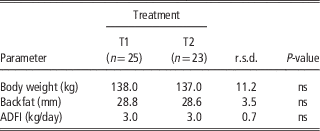
Average daily feed intake, body weight and backfat (P2) at the end of the experimental treatments are summarized in Table 2. All gilts included in the statistical analysis had 100% feed intake, which was estimated after Regumate withdrawal, at the time of sampling (days 14 and 21), except four females (three in the T2 and one in the T1 group), which presented a reduction >10% of the average feed intake of the experimental groups for over 2 days. The data from these animals were excluded from the study. Furthermore, the dietary energy sources did not affect average daily feed intake, body weight and backfat on day 28 of pregnancy. However, a significant litter effect was observed for backfat among gilts (P=0.017) at day 28 of pregnancy, which indicates the important contribution of the genetic background of this variable.
Effects of a carbohydrate-rich (T1) or a lipid-rich (T2) diet, fed ad libitum from day 8 of the oestrous cycle until the next standing heat, on ADFI, body weight and backfat at P2 of gilts on day 28 of pregnancy

ADFI=average daily feed intake; r.s.d.=residual standard deviation; ns=not significant.
Data are the LSMeans.
T1=20% corn starch.
T2=8.6% soybean oil.
Reproductive characteristics
Estrous cycle length (20.2±0.2 v. 20.6±0.2 days, respectively for T1 and T2), estrus duration (49.6±2.3 v. 45.1±2.2 h, respectively, for T1 and T2), and time of ovulation after onset of estrus (40.5±2.1 v. 37.1±2.0 h, respectively, for T1 and T2) were not affected by previous nutritional treatments. A total of nine gilts (T1: three; T2: six) were not pregnant at slaughter but pregnancy rate was similar between both experimental groups (T1: 92%; T2: 84.6%; P>0.05).
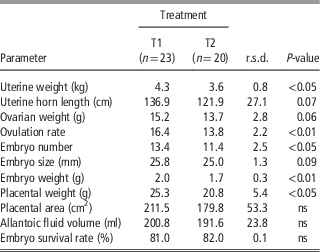
Moreover, the reproductive parameters analyzed at day 28 of pregnancy showed that gilts, which received the corn starch-rich diet showed higher uterine weight, ovulation rate, embryo number and weight and placental weight (P<0.05; Table 3). On the other hand, embryo survival rate, placental area and allantoic fluid volume were not affected by the experimental treatments. In T1 gilts embryo size, and ovarian weight tended to be higher (P<0.1; Table 3). A litter effect was observed for uterine horn length (P=0.025), which stresses the importance of the use of littermates when designing experiments of this kind, and the ability to adjust for this family effect in the statistical analysis by using a randomized complete block design, fitting litter as a block to account for the differences due to family.
Effects of a carbohydrate-rich (T1) or a lipid-rich (T2) diet, fed ad libitum from day 8 of the estrous cycle until the next standing heat, on reproductive characteristics of gilts at day 28 of pregnancy

r.s.d.=residual standard deviation; ns=not significant.
Data are the LSMeans.
T1=20% corn starch.
T2=8.6% soybean oil.
Endocrine parameters
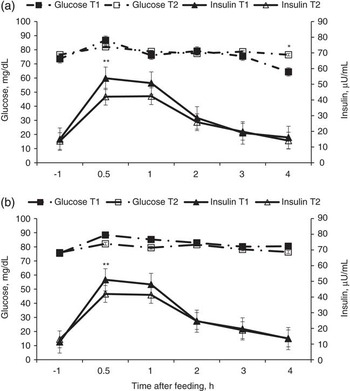
The samples collected on days 14 and 21 of the estrous cycle showed that blood glucose concentration reached its maximum 30 min after the morning feeding and both treatment groups had similar concentrations in the preprandial period and the first 3 h after feeding (Figure 1a and b). However, T1 gilts showed lower blood glucose concentrations 4 h after the morning feeding only on day 14 (P<0.05).
Pre- and postprandial blood glucose and plasma insulin concentrations on days 14 (a) and 21 (b) of the estrous cycle in gilts, fed either corn starch (T1) or vegetable oil-rich (T2) diets during the late luteal phase of the cycle. *T1 gilts presented a lower blood glucose concentration 4 h after feeding on day 14 of the cycle (P<0.05; a); **T1 gilts presented higher insulin levels 30 min after feeding on days 14 and 21 (P<0.05; a and b).

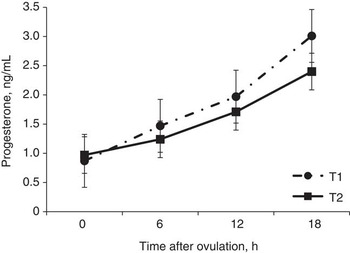
Plasma insulin concentrations increased after the morning feeding on days 14 and 21 of the estrous cycle in both treatment groups. However, the insulin peak after feeding was higher in T1 gilts compared with their T2 littermates at both sampling days (P<0.05; Figure 1a and b). This treatment effect on insulin peak concentration had a short duration, as it was not statistically different 1 h later, even though the concentrations in T1 gilts were still numerically higher. The difference between pre- and postprandial insulin was not affected by the interaction between day and treatment. Additionally, there was no overall effect of the interaction between day and treatment in preprandial and mean postprandial insulin concentrations. Regarding the pattern of progesterone rise after ovulation, it was not affected by the different energy sources used, as shown in Figure 2. Additionally, a positive correlation between progesterone concentrations 18 h after ovulation and ovulation rate was observed (r=0.75; P<0.01), providing strong evidence of the influence of corpora lutea number on the pattern of progesterone secreted after ovulation.
Plasma progesterone rise (LSM±s.e.m.) from ovulation until 18 h after ovulation in gilts, fed either corn starch- (T1) or vegetable oil-rich (T2) diets during the late luteal phase of the cycle. There were no treatment effects at the time points measured (P>0.05).

Discussion
The present study showed for the first time the effects of dietary-induced insulin enhancement during the late luteal and follicular phases on subsequent fertility of cyclic gilts. Previous studies have investigated similar effects in lactating primiparous and multiparous sows (van den Brand et al., Reference van den Brand, Prunier, Soede and Kemp2001, Reference van den Brand, van Enckevort, van der Hoeven and Kemp2009; Wientjes et al., Reference Wientjes, Soede, Aarsse, Laurenssen, Koopmanschap, van den Brand and Kemp2012a). However, the metabolic state of lactating sows and cyclic gilts may not be comparable, as the former are catabolic and the latter, anabolic, which may induce different metabolic responses. Hence, the study of insulin effects during follicular development in cyclic gilts may raise new concepts on premating nutritional management.
Studies have shown that the pattern of insulin secretion may be modulated by feed frequency or diet composition, as reported by Wientjes et al., (Reference Wientjes, Soede, Aarsse, Laurenssen, Koopmanschap, van den Brand and Kemp2012a and Reference Wientjes, Soede, van den Brand and Kempb). The insulin profiles showed herein demonstrate that insulin levels were comparable in the pre- and postprandial periods in both experimental groups, even though the carbohydrate-rich diet resulted in a significant higher insulin peak on days 14 and 21 of the cycle, which occurred 30 min after the morning feeding. Although T1 females still showed higher insulin concentration 1 h after feeding, this treatment difference was not statistically different, and was not accompanied by a significant decrease in blood glucose levels analyzed at the same time point. As all gilts included in the analysis had similar feed intake and allowance, the pattern of insulin secretion cannot be related to differences in feed intake, but to energy source.
Furthermore, the carbohydrate-rich diet also resulted in greater ovulation rate, number of viable embryos, embryo weight, placental weight and uterine weight at day 28 of pregnancy. To our understanding, insulin may be a potential mediator of these treatment effects. As mentioned previously, higher insulin levels are positively associated to LH pulsatility in sows (van den Brand et al., Reference van den Brand, Prunier, Soede and Kemp2001), as it might affect the GnRH pulse generator. For instance, van den Brand et al. (2000a) and Ziecik et al. (Reference Ziecik, Kapelanski, Zaleska and Riopérez2002) reported that dextrose containing feed increased insulin and IGF-1 levels (van den Brand et al., Reference van den Brand, Prunier, Soede and Kemp2001) and follicle size (van den Brand et al., 2000a; Wientjes et al., Reference Wientjes, Soede, van den Brand and Kemp2012b). Comparable effects were recently demonstrated by Quesnel et al. (Reference Quesnel, Etienne and Père2007), as they showed that sows with a high and prolonged insulin response after a glucose tolerance test had more and better developed follicles. Our results also showed insulin effects on the ovary, improving follicle growth and subsequent ovulation rate. In contrast, the recent study of Wientjes et al. (Reference Wientjes, Soede, Laurenssen, Koopmanschap, van den Brand and Kemp2013) reported that insulin-stimulating diets fed to hyper-prolific multiparous sows during the weaning-to-estus interval did not improve follicle development and uniformity of fetuses and placentas, which emphasizes the metabolic differences between the cyclic gilt and the lactating and weaned sows experimental models.
Heavier embryos and placenta at day 28 of pregnancy reported in the T1 gilts suggest beneficial effects of insulin not only over follicle recruitment but also on follicle quality. Better developed follicles would give raise to better quality oocytes, and in turn, viable embryos (Pope et al., Reference Pope, Xie, Broermann and Nephew1990) that will survive the gestation period. In fact, the placenta is a determinant factor of embryo/fetal weight, as placental weight is positively correlated to embryo/fetal weight, that is, heavier placentae will maintain heavier embryos/fetuses (Town et al., Reference Town, Putman, Turchinsky, Dixon and Foxcroft2004). In turn, heavier piglets at term will present greater vitality, improving their chances to survive until weaning (Milligan et al., Reference Milligan, Fraser and Kramer2002; Alvarenga et al., Reference Alvarenga, Chiarini-Garcia, Cardeal, Moreira, Foxcroft, Fontes and Almeida2013).
Notwithstanding the positive insulin effects on ovulation rate, embryo weight and placental weight, embryo survival to day 28 of pregnancy was not affected by previous nutritional treatments. Plasma progesterone concentrations measured from time of ovulation until 18 h after ovulation were also comparable in both experimental groups. Similar progesterone profiles were reported by van den Brand et al. (Reference van den Brand, Soede and Kemp2000b) in primiparous lactating sows, where different energy sources did not affect progesterone secretion between 24 and 250 h after the LH surge, and embryo survival rate was also not affected, even though it was shown a marked strong insulin response by the starch diet (van den Brand et al., Reference van den Brand, Dieleman, Soede and Kemp2000a). Interestingly, progesterone concentration at 18 h after ovulation was strongly correlated to ovulation rate (r=0.75; P=0.001). This finding suggests that the number of corpora lutea is essential for adequate progesterone secretion after ovulation and further embryo survival in gilts. In this regard, Mao et al. (Reference Mao, Treacy, Almeida, Novak, Dixon and Foxcroft2001) reported that insulin treatment increased progesterone production and release by luteal tissue in vitro, through the increase of StAR protein, P450scc and 3β-HSD mRNA expression. In fact, the study of Almeida et al. (Reference Almeida, Mao, Novak, Cosgrove and Foxcroft2001) showed a more rapid raise in progesterone after ovulation in feed-restricted gilts treated with exogenous insulin, suggesting that insulin treatment affected the luteinizing process, and hence the production of progesterone in the immediate postovulatory period. Further evidence has been recently reported by Wientjes et al. (Reference Wientjes, Soede, van den Brand and Kemp2012c) in sows, by demonstrating that an increased total luteal weight, as a result of either a higher ovulation rate or larger individual corpora lutea or both, seems to be beneficial for progesterone production and secretion. Therefore, premating insulin-stimulating diets may improve embryo survival, and the beneficial effects of premating insulin-stimulating diets on embryo survival may be driven by progesterone levels, as reported by Wientjes et al. (Reference Wientjes, Soede, van den Brand and Kemp2012c), as plasma progesterone levels during early pregnancy are related to embryo survival (Jindal et al., Reference Jindal, Cosgrove, Aherne and Foxcroft1996, Reference Jindal, Cosgrove and Foxcroft1997; Almeida et al., Reference Almeida, Kirkwood, Aherne and Foxcroft2000). On the other hand, the present results indicate that dietary-induced insulin enhancement during the late luteal phase does not seem to mediate effects on embryonic survival to day 28 of pregnancy, as the development of day 28 conceptuses is related to the extent of embryonic loss during the first 4 weeks of pregnancy (Lutter et al., Reference Lutter, Huhn, Huhn, Kaltofen, Lampe and Schneider1981).
Taken together, the present results suggest that the use of carbohydrates, as the predominant energy source, can be an effective tool to increase insulin levels during the premating period in gilts and improve subsequent fertility. Beneficial effects on survival and development of fetuses may occur at later stages of gestation and merit further investigation.
Acknowledgments
The authors acknowledge the staff of Granja Chuá for their dedication in maintenance and care of the experimental animals.