


1. Introduction and main results
In this paper, we are concerned with the existence and non-existence of positive solutions to the following nonlinear eigenvalue problem involving the fractional $(p,\,q)$ -Laplace operator with zero Dirichlet boundary condition:

where $0 < s_2 < s_1 < 1 < q < p < \infty$ , $\alpha,\, \beta \in \mathbb {R}$
 are two parameters and $\Omega \subset \mathbb {R}^d$
 is a bounded open set. In general, the fractional $r$
 -Laplacian $(-\Delta )^{s}_r$
 ($s \in (0,\,1)$
 and $r \in (1,\, \infty )$
 ) is defined as

where P.V. stands for the principle value.
The local counterpart of (EV; α, β) is the following Dirichlet eigenvalue problem for the $(p,\,q)$ -Laplace operator:

The study of $(p,\,q)$ -Laplace operators are well known for their applications in physics, chemical reactions, reaction-diffusion equations e.t.c. for details, see [Reference Cherfils and Il’yasov15, Reference Derrick18, Reference Fife20] and the references therein. Some authors considered the eigenvalue problems for the $(p,\,q)$
 -Laplace operator. In this direction, for $\alpha =\beta$
 , Motreanu–Tanaka in [Reference Motreanu and Tanaka29] obtained the existence and non-existence of positive solutions of (1.1). For $\alpha \neq \beta$
 , in [Reference Bobkov and Tanaka8] Bobkov–Tanaka extended this result by providing a certain region in the $(\alpha,\,\beta )$
 -plane that allocates the sets of existence and non-existence of positive solutions of (1.1). Moreover, they constructed a threshold curve in the first quadrant of the $(\alpha,\,\beta )$
 -plane, which separates these two sets. Later, in [Reference Bobkov and Tanaka9], the same authors plotted a different curve for the existence of ground states and the multiplicity of the positive solutions for (1.1). It is essential that in which region the positive solution of (1.1) exists or does not exist, and the behaviour of the threshold curve depends on whether $\phi _{p},\, \phi _{q}$
 are linearly independent, where $\phi _{p} \text { and } \phi _{q}$
 are the first Dirichlet eigenfunctions of the operators $-\Delta _p$
 and $-\Delta _q$
 respectively. For other results related to the positive solutions of eigenvalue problems involving $(p,\,q)$
 -Laplace operator, we refer to [Reference Bai, Papageorgiou and Zeng6, Reference Bobkov and Tanaka10, Reference Tanaka33] and the references therein.
In the nonlocal case, parallelly, many authors studied the nonlinear equations driven by the sum of fractional $p$ -Laplace and fractional $q$
 -Laplace operators with the critical exponent. For example, see [Reference Ambrosio2, Reference Ambrosio and Isernia4, Reference Bhakta and Mukherjee7, Reference Giacomoni, Kumar and Sreenadh24, Reference Goel, Kumar and Sreenadh25] where the weak solution’s existence, regularity, multiplicity, positivity and other qualitative properties are investigated. The study of (EV; α, β) is motivated by the Dancer–Fučik (DF) spectrum of the fractional $r$
 -Laplace operator. The DF spectrum of the operator $(-\Delta )^{s}_r$
 is the set of all points $(\alpha,\,\beta )\in \mathbb {R}^2$
 such that the following problem

admits a nontrivial weak solution, where $u^{\pm } = \max \{\pm u,\, 0 \}$ is the positive and negative part of $u$
 . For $r=2$
 , in [Reference Goyal and Sreenadh26], Goyal–Sreenadh considered (1.2) and proved the existence of a first nontrivial curve in the DF spectrum. They also showed that the curve is Lipschitz continuous, strictly decreasing, and studied its asymptotic behaviour. For $r \neq 2$
 , in [Reference Perera, Squassina and Yang31], the authors constructed an unbounded sequence of decreasing curves in the DF spectrum. Nevertheless, the study of the spectrum for the fractional $(p,\,q)$
 -Laplace operator is not well explored. In [Reference Nguyen and Vo30], for $\alpha =\beta$
 , Nguyen-Vo studied the following weighted eigenvalue problem with zero Dirichlet boundary condition:

where $0< s_2< s_1< 1< q \le p< \infty$ , the weights $m_p,\, m_q$
 are bounded in $\Omega$
 and satisfy $m_p^+,\, m_q^+ \not \equiv 0$
 . Depending on the values of $\alpha$
 , the authors obtained the existence and non-existence of positive solutions of (1.3).
The primary aim of this paper can be summarized into the following two aspects:
(a) We provide a comprehensive analysis of the sets in the $(\alpha,\, \beta )$
 -plane that determine the existence and non-existence of positive solutions for the equation (EV; α, β). Following the local case approach, we construct a continuous threshold curve denoted as $\mathcal {C}$ that effectively separates the regions where positive solutions exist from those where they do not. In some specific regions of the $(\alpha,\, \beta )$-plane, we employ the sub-super solutions technique to establish the existence of positive solutions. To apply this technique, we utilize the crucial result stated in theorem 4.1, which proves that every nonnegative solution of (EV; α, β) is globally bounded.
(b) The existence and non-existence of positive solutions to (EV; α, β) depend on the following statement:
(LI)\begin{equation} \phi_{s_1,p} \neq c \phi_{s_2,q} \text{ for any } c \in {\mathbb{R}}, \end{equation}where $\phi _{s_1,p} \text { and } \phi _{s_2,q}$
are the first eigenfunctions of the operators $(-\Delta )_p^{s_1}$ and $(-\Delta )_q^{s_2}$ corresponding to the first eigenvalues $\lambda _{s_1,p}^1$ and $\lambda _{s_2,q}^1$ respectively in $\Omega$ under zero Dirichlet boundary condition. While this linear independence condition for the operators $-\Delta _p$ and $-\Delta _q$ was conjectured in [Reference Bobkov and Tanaka8] and later proved in [Reference Bobkov and Tanaka9], its validity remains unknown for any $s_1,\, s_2 \in (0,\,1)$. Nevertheless, several authors have assumed the condition (LI) in various contexts (e.g., [Reference Giacomoni, Gouasmia and Mokrane23, Reference Nguyen and Vo30]). We establish the validity of (LI) under certain assumptions on $s_1$ and $s_2$, as demonstrated in theorem 1.9.


Recall that, for $0< s<1\leq r<\infty$ , the fractional Sobolev space is defined as

with the so-called fractional Sobolev norm ${\lVert }{u}{\rVert }_{s,r,\Omega } :=(\|u\|_{L^r(\Omega )}^r + [u]_{s,r,\Omega }^r)^\frac {1}{r},\,$ where

is called the Gagliardo seminorm. For $r \in (1,\,\infty )$ , $W^{s,r}(\Omega )$
 is a reflexive Banach space with respect to the fractional Sobolev norm ${\lVert }{\cdot }{\rVert }_{s,r,\Omega }$
 . Now we consider the following closed subspace of $W^{s,r}(\mathbb {R}^d)$
 :

endowed with the seminorm $[\cdot ]_{s,r,\mathbb {R}^d}$ , which is an equivalent norm in $W_0^{s,r}(\Omega )$
 ([Reference Brasco, Lindgren and Parini12, Lemma 2.4]). For details of the fractional Sobolev spaces and their related embedding results, we refer to [Reference Brasco, Lindgren and Parini12, Reference Brasco and Parini14, Reference Di Nezza, Palatucci and Valdinoci19] and the references therein. For $s_1 > s_2$
 and $p > q \geq 1$
 , the continuous embedding ${W_0^{s_1,p}(\Omega )} \hookrightarrow {W_0^{s_2,q}(\Omega )}$
 (see [Reference Antil and Warma5, Proposition 2.2]) allows us to introduce the notion of weak solution for (EV; α, β) in the following sense:
Definition 1.1 A function $u\in {W_0^{s_1,p}(\Omega )}$ is called a weak solution of (EV; α, β) if the following identity holds for all $\phi \in {W_0^{s_1,p}(\Omega )}$
 :

In our first theorem, we prove the existence of a positive solution for (EV; α, β) if any of $\alpha$ and $\beta$
 is larger than the first Dirichlet eigenvalue of the fractional $p$
 -Laplacian and fractional $q$
 -Laplacian respectively. We also show that this range of $\alpha,\, \beta$
 is necessary for the existence of a positive solution when (LI) does not hold.
Theorem 1.2 Let $0 < s_2 < s_1 < 1 < q < p < \infty$ . Assume that

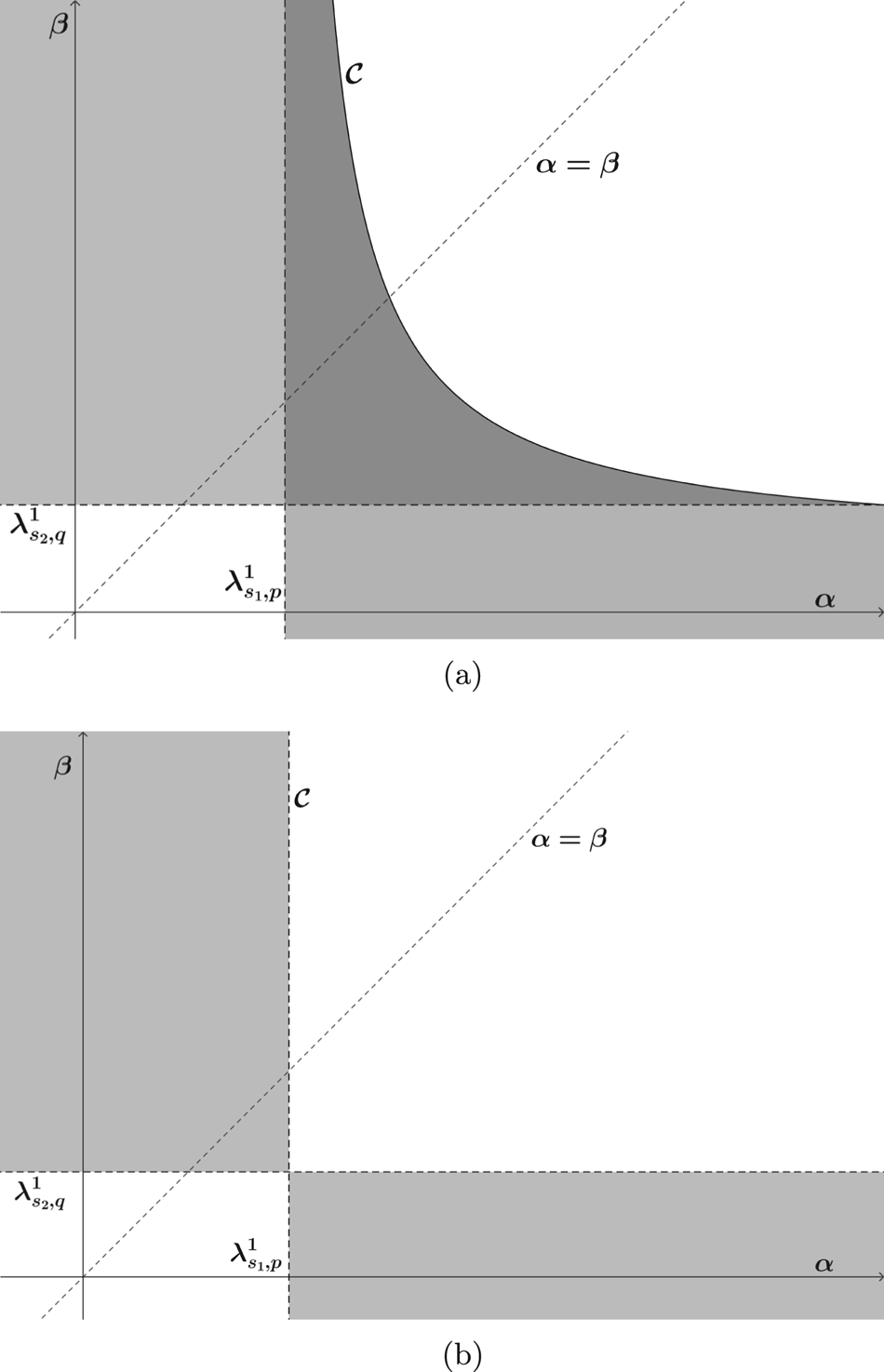
The following hold (see Fig. 1):
(i) (Sufficient condition): Let $\alpha,\, \beta$
satisfy (1.4). In the case, when $\alpha = \lambda _{s_1,p}^1$ and $\beta = \lambda _{s_2,q}^1$, we assume that (LI) violates. Then (EV; α, β) admits a positive solution.(ii) (Necessary condition): Let (LI) violates and (EV; α, β) admits a positive solution. Then $\alpha,\, \beta$
satisfy (1.4).


Shaded region denotes existence, and unshaded region denotes non-existence of positive solutions. (a) The case (LI) holds (with $\alpha ^*_{s_1,p} < \infty$ ), (b) The case (LI) does not hold.

Remark 1.3
(i) The above theorem asserts that (EV; $\lambda _{s_1,p}^1,\,\lambda _{s_2,q}^1$
) admits a positive solution if and only if (LI) violates. Indeed, (EV; $\lambda _{s_1,p}^1,\,\lambda _{s_2,q}^1$) admits a non-trivial solution only when (LI) violates (see proposition 6.1).(ii) If (LI) violates, then theorem 1.2 gives a complete description of the set of existence and non-existence of positive solutions of (EV; α, β). In particular, theorem 1.2 generalizes the result of [Reference Nguyen and Vo30, Theorem 1.1] for $\alpha \neq \beta$
.


It is observed that for $\alpha,\,\beta \in \mathbb {R}$ , the problem (EV; α, β) is equivalent to the problem (EV; $\beta + \theta,\, \beta$
 ), where $\theta = \alpha -\beta.$
 Using this terminology we define the following curve:
Definition 1.4 Threshold curve
For brevity, denote $\beta = \lambda$ . For each $\theta \in \mathbb {R}$
 consider the following quantity:

If such $\lambda$ does not exist, we then set $\lambda ^*(\theta ) = -\infty.$
 The threshold curve corresponding to (EV; α, β) is defined as $\mathcal {C} := \{(\lambda ^*(\theta ) + \theta,\, \lambda ^*(\theta )): \theta \in {\mathbb {R}}\}$
 . Also, we define the following quantities:

Clearly, $\theta ^* \leq \theta ^*_+$ and $\theta ^* = \theta ^*_+$
 if and only if (LI) violates (from (iv) of proposition 2.1).
In the following proposition, we discuss some qualitative properties of $\mathcal {C}$ and see that $\mathcal {C}$
 carries similar behaviours as in the local case [Reference Bobkov and Tanaka8, Proposition 3 and Figure 2].
Proposition 1.5 Let $0 < s_2 < s_1 < 1 < q < p < \infty$ . Then the following hold:
(i) $\lambda ^*(\theta ) < \infty$
for all $\theta \in \mathbb {R}$.(ii) $\lambda ^*(\theta ^*) + \theta ^* > \lambda ^1_{s_1,p}$
and $\lambda ^*(\theta ^*) > \lambda ^1_{s_2,q}$ if and only if (LI) holds.(iii) $\lambda ^*(\theta ) + \theta \geq \lambda ^1_{s_1,p}$
and $\lambda ^*(\theta ) \geq \lambda ^1_{s_2,q}$ for all $\theta \in \mathbb {R}.$(iv) $\lambda ^*(\theta )$
is decreasing and $\lambda ^*(\theta ) + \theta$ is increasing on $\mathbb {R}.$(v) If $\alpha ^*_{s_1,p}$
is finite, then $\lambda ^*(\theta ) = \lambda ^1_{s_2,q}$ for all $\theta \geq \theta ^*_+.$(vi) $\lambda ^*$
is continuous on $\mathbb {R}.$


According to (iii) of the above proposition, $\mathcal {C} \subset ([\lambda _{s_1,p}^1,\, \infty ) \times [\lambda _{s_2,q}^1,\, \infty ))$ . Further, if $\alpha ^*_{s_1,p} = \infty$
 , from the property (iii), we observe that $\mathcal {C}$
 always lies above the line $\beta = \lambda _{s_2,q}^1$
 . From now onwards, we assume that $\alpha ^*_{s_1, p} < \infty$
 . In the following theorem, we demonstrate that $\mathcal {C}$
 separates the sets of existence and non-existence of positive solutions in the region $([\lambda _{s_1,p}^1,\, \infty ) \times [\lambda _{s_2,q}^1,\, \infty ))$
 (see Fig. 1).
Theorem 1.6 Let $0 < s_2 < s_1 < 1 < q < p < \infty$ . Let $\alpha \ge \lambda _{s_1,p}^1$
 and $\beta \ge \lambda _{s_2,q}^1$
 . Assume that (LI) holds.
(i) If $\beta \in (\lambda _{s_2,q}^1,\, \lambda ^*(\theta ))$
, then (EV; α, β) admits a positive solution.(ii) If $\alpha > \lambda _{s_1,p}^1$
and $\beta < \lambda ^*(\theta )$, then (EV; α, β) admits a positive solution.(iii) If $\beta > \lambda ^*(\theta )$
, then there does not exist any positive solution for (EV; α, β).


Now we state the existence and non-existence of positive solutions on the curve $\mathcal {C}$ (see Fig. 1).
Theorem 1.7 Let $0 < s_2 < s_1 < 1 < q < p < \infty$ .
(i) If $\theta < \theta ^*_+$
, then (EV; $\lambda ^*(\theta ) + \theta,\, \lambda ^*(\theta )$) admits a positive solution.(ii) If $\theta > \theta ^*_+$
, then there does not exist any positive solution for (EV; $\lambda ^*(\theta ) + \theta,\, \lambda ^*(\theta )$).


The above theorem does not consider the borderline case $\theta = \theta _+^*$ . In this case, we have a partial result in remark 6.9, which says that (EV; $\lambda ^*(\theta )+\theta,\,\lambda ^*(\theta )$
 ) does not admit any ground state solution.
Remark 1.8 The relations among $s_1,\, s_2,\, p,\, q$ are taken without loss of any generality. All the preceding results in this paper hold for the remaining cases by choosing the appropriate solution space as given below:
(i) For $s_1 < s_2$
and $p < q$ (symmetric), we choose the solution space as ${W_0^{s_2,q}(\Omega )}$.(ii) For $s_2 < s_1$
and $p< q$ (cross), we choose the solution space as ${W_0^{s_1,p}(\Omega )} \cap {W_0^{s_2,q}(\Omega )}$ endowed with the norm $[\cdot ]_{s_1,p,\mathbb {R}^d}+[\cdot ]_{s_2,q,\mathbb {R}^d}$.(iii) For $s_1 = s_2=s$
and $p \neq q$, we choose the solution space as $W^{s,p}_0(\Omega ) \cap W^{s,q}_0(\Omega )$ endowed with the norm $[\cdot ]_{s,p,\mathbb {R}^d}+[\cdot ]_{s,q,\mathbb {R}^d}$.


The next theorem verifies the linear independency of the first Dirichlet eigenfunctions of the fractional $p$ -Laplacian and the fractional $q$
 -Laplacian.
Theorem 1.9 Let $1< q< p<\infty$ and $s_1,\, s_2 \in (0,\,1)$
 satisfy the following condition:

Then the set $\{\phi _{s_1, p} ,\, \phi _{s_2, q}\}$ is linearly independent.
Remark 1.10 Theorem 1.9 holds if we take the other relations among $s_1,\, s_2,\, p,\, q$ listed below:
(i) For $1< p< q<\infty$
and $\frac {s_2 {q^{\prime }}}{{p^{\prime }}} < s_1 < s_2$ (interchanging the roles of $s_1,\, s_2,\, p,\, q$).(ii) For $1 < q< p<\infty$
and $s_1=s_2$.


The rest of the paper is organized as follows. Section 2 briefly discusses the first Dirichlet eigenpair of fractional $r$ -Laplace operator, recalls the discrete Picone’s inequalities, and proves some technical results. In § 3, we prove the validity of (LI). This section contains the proof of theorem 1.9. In § 4, we establish the regularity of the solution for (EV; α, β) and state a version of the strong maximum principle related to (EV; α, β). Section 5 studies various frameworks of energy functionals associated with (EV; α, β). Finally, § 6 studies the existence and non-existence of positive solutions for (EV; α, β). In this section, we prove theorem 1.2–1.7 and proposition 1.5.
2. Preliminaries
In this section, we recall some qualitative properties of the first nonlocal eigenvalue and its corresponding eigenfunction. Afterwards, we recall the discrete Picone’s identities. We list the following notations to be used in this paper:
Notation:
• $B_R(x)\subset \mathbb {R}^d$
denotes an open ball of radius $R>0$ centred at $x.$• For a set $E\subset \mathbb {R}^d$
, $|E|$ denotes the Lebesgue measure of $E$.• We denote ${\rm d}\mu _1:= {\mid }{x-y}{\mid }^{-(d+s_1p)} {\rm d}x {\rm d}y$
and ${\rm d}\mu _2:= {\mid }{x-y}{\mid }^{-(d+s_2q)} {\rm d}x {\rm d}y$.• For $r \in (1,\, \infty )$
, the conjugate of $r$ is denoted as $r^{\prime }:=\frac {r}{r-1}$.• For $0 < s < 1 < r < \infty$
, we denote $[\cdot ]_{s,r,\mathbb {R}^d}$ as $[\cdot ]_{s,r}$, and ${\lVert }{\cdot }{\rVert }_{L^r(\Omega )}$ as ${\lVert }{\cdot }{\rVert }_r$.• For $k \in \mathbb {N}$
, we denote $u_k(x) := u(x) + \frac {1}{k}$ where $x \in \mathbb {R}^d$.• For $\gamma \in (0,\,1)$
, the Hölder seminorm $[f]_{C^{0, \gamma }(\Omega )} := \underset {x,\,y \in \Omega,\, x \neq y}{\sup } \displaystyle \frac {{\mid }{f(x)- f(y)}{\mid }}{{\mid }{x-y}{\mid }^{\gamma }}$.• For $sr < d$
(where $0 < s < 1 < r < \infty$), the fractional critical exponent $\displaystyle r^*_s := \frac {rd}{d-sr}$.• For each $n \in \mathbb {N}$
, we denote the positive and negative parts $(f_n)^{\pm }$ by $f_n^{\pm } := \max \{\pm f_n,\, 0\}$.• Eigenvalue of (2.1), $\lambda _{s,r}(\Omega )$
is denoted as $\lambda _{s,r}$.• We denote the eigenfunction of (2.1) corresponding to the first eigenvalue $\lambda ^1_{s, r}$
as $\phi _{s,r}$.• For $r \in (1,\, \infty )$
, $x_0 \in \Omega$ and $R>0$, the nonlocal tail of $f \in W^{s,r}_0(\Omega )$ is defined as
\begin{align*} \mathrm{Tail}_r(f;x_0,R) := \left(R^{sr}\int_{\mathbb{R}^d\setminus B_R(x_0)}\frac{|f(x)|^{r-1}}{|x-x_0|^{d+sr}}\,{\rm d}x\right)^{\frac{1}{r-1}}. \end{align*}
• $C$
is denoted as a generic positive constant.





2.1 First eigenvalue of fractional $r$-Laplacian

For a bounded open set $\Omega \subset \mathbb {R}^d$ and $0 < s < 1 < r < \infty$
 , we consider the following nonlinear eigenvalue problem:

We say $\lambda _{s,r}$ is an eigenvalue of (2.1), if there exists non-zero $u \in {W_0^{s,r}(\Omega )}$
 satisfying the following identity for all $\phi \in {W_0^{s,r}(\Omega )}$
 :

In this case, $u$ is called an eigenfunction corresponding to $\lambda _{s,r}$
 , and we denote $( \lambda _{s,r},\, u )$
 as an eigenpair. In the following proposition, we collect some qualitative properties of the first eigenpair of (2.1).
Proposition 2.1 For $r \in (1,\, \infty )$ and $s \in (0,\,1)$
 , consider the following quantity:

Then the following hold:
(i) $\lambda ^1_{s,r}$
is the first positive eigenvalue of (2.1).(ii) Every eigenfunction corresponding to $\lambda ^1_{s,r}$
has a constant sign in $\Omega$.(iii) If $v$
is an eigenfunction of (2.1) corresponding to an eigenvalue $\lambda _{s,r}>0$ such that $v>0$ a.e. in $\Omega$, then $\lambda _{s,r}=\lambda ^1_{s,r}$.(iv) Any two eigenfunctions corresponding to $\lambda ^1_{s,r}$
are constant multiple of each other.(v) Any eigenfunction of (2.1) corresponding to an eigenvalue $\lambda _{s,r}$
is in $L^{\sigma }(\mathbb {R}^d)$ for every $\sigma \in [1,\, \infty ]$. Moreover, if $\Omega$ is of class $C^{1,1}$, then the eigenfunction lies in $C^{0, \gamma }(\overline {\Omega })$ for some $\gamma \in (0,\,s]$.


Proof. For proof of (i) and (iii), we refer to [Reference Franzina and Palatucci21, Lemma 2.1 and Theorem 4.1]. For (ii), see [Reference Brasco and Parini14, Proposition 2.6]. Then the proof of (iv) follows using [Reference Franzina and Palatucci21, Theorem 4.2].
(v) Let $u$ be an eigenfunction of (2.1) corresponding to $\lambda _{s,r}$
 . By [Reference Brasco, Lindgren and Parini12, Theorem 3.3], $u \in L^{\infty }( \Omega )$
 and hence $u \in L^{\infty }( \mathbb {R}^d )$
 . Further, since $u\in W^{s,r}(\mathbb {R}^d) \cap L^\infty (\mathbb {R}^d)$
 , the interpolation argument yields $u \in L^{\sigma }(\mathbb {R}^d)$
 for every $\sigma \geq r$
 . Also for $\sigma \in [1,\, r)$
 , applying Hölder’s inequality with the conjugate pair $(\frac {r}{\sigma },\, \frac {r - \sigma }{\sigma })$
 ,

Thus, $u \in L^{\sigma }(\mathbb {R}^d)$ for every $\sigma \in [1,\, \infty ]$
 . Furthermore, since $u \in L^{\infty }(\mathbb {R}^d)$
 we apply [Reference Iannizzotto, Mosconi and Squassina27, Theorem 1.1] to get $u \in C^{0, \gamma }(\overline {\Omega })$
 for some $\gamma \in (0,\,s]$
 .
2.2 Some important results
In this subsection, we state some elementary inequalities, recall Picone’s inequalities for nonlocal operators and collect some test functions in $W^{s,r}_{0}(\Omega )$ .
Lemma 2.2 Let $a,\, b \in {\mathbb {R}}$ , and $\gamma \in {\mathbb {R}}^+$
 . The following hold:
(i) If $\gamma >1$
, then
\begin{align*} & {\mid}{a-b}{\mid}^{\gamma-2}(a-b)(a^+{-} b^+) \ge {\mid}{a^+{-} b^+}{\mid}^{\gamma}; \\ & {\mid}{a - b}{\mid}^{\gamma-2}(a-b)(b^{-} - a^{-}) \ge {\mid}{a^{-} - b^{-}}{\mid}^{\gamma}, \end{align*}where $a^{\pm } = \max \{\pm a,\,0\}$
.(ii) If $\gamma \ge 2$
, then ${\mid }{a-b}{\mid }^{\gamma -2}(a-b) \le C ( {\mid }{a}{\mid }^{\gamma -2}a - {\mid }{b}{\mid }^{\gamma -2}b )$ for some $C = C(\gamma )>0$.(iii) ${\mid }{{\mid }{a}{\mid }^{\gamma } - {\mid }{b}{\mid }^{\gamma }}{\mid } \le \gamma ( {\mid }{a}{\mid }^{\gamma -1} + {\mid }{b}{\mid }^{\gamma -1} ) {\mid }{a-b}{\mid }$
.


Proof. Proof of (i) follows from [Reference Brasco and Parini14, Lemma A.2]. Proof of (ii) follows from [Reference Iannizzotto, Mosconi and Squassina28, (2.2) of Page 5]. Proof of (iii) follows using the fundamental theorem of calculus.
We recall several versions of the discrete Picone’s inequality that are useful in proving our results.
Lemma 2.3 Discrete Picone’s inequality
Let $r_1 ,\, r_2 \in (1 ,\, \infty )$ with $r_2 \leq r_1$
 and let $f,\, g: \mathbb {R}^d \to \mathbb {R}$
 be two measurable functions with $f > 0,\, \; g \ge 0$
 . Then the following hold:
(i) For $x,\, y \in \mathbb {R}^d$
,
\begin{align*} & |f(x)-f(y)|^{r_1-2}(f(x)-f(y)) \left(\displaystyle\frac{g(x)^{r_2}}{f(x)^{r_2-1}} - \frac{g(y)^{r_2}}{f(y)^{r_2-1}} \right)\\ & \quad \le {\mid}{g(x)-g(y)}{\mid}^{r_2} {\mid}{f(x)-f(y)}{\mid}^{r_1-r_2}. \end{align*}
(ii) For $x,\,y \in \mathbb {R}^d$
,
\begin{align*} & |f(x)-f(y)|^{r_2-2}(f(x)-f(y)) \left(\frac{ g(x)^{r_1}}{f(x)^{r_1-1}}-\frac{ g(y)^{r_1}}{f(y)^{r_1-1}} \right) \\ & \quad \le |g(x)-g(y)|^{r_2-2}(g(x)-g(y)) \left(\frac{g(x)^{r_1-r_2+1}}{f(x)^{r_1-r_2}} - \frac{g(y)^{r_1 - r_2 + 1}}{f(y)^{r_1 - r_2}} \right). \end{align*}
(iii) Let $\alpha,\, \beta \ge 1$
. Then for $x,\,y \in \mathbb {R}^d$,
\begin{align*} & |f(x)-f(y)|^{r_1-2}(f(x)-f(y))\\ & \qquad \times \left(\frac{ g(x)^{r_1}}{\alpha f(x)^{r_1-1} + \beta f(x)^{r_2-1}}-\frac{g(y)^{r_1}}{\alpha f(y)^{r_1-1}+\beta f(y)^{r_2-1}} \right) \\ & \quad \le {\mid}{g(x) -g(y)}{\mid}^{r_1}. \end{align*}
(iv) Let $\alpha,\, \beta \ge 1$
. Then for $x,\,y \in \mathbb {R}^d$,
\begin{align*} & |f(x)-f(y)|^{r_2-2}(f(x)-f(y))\\ & \qquad \times \left(\frac{ g(x)^{r_1}}{\alpha f(x)^{r_1-1} + \beta f(x)^{r_2-1}}-\frac{g(y)^{r_1}}{\alpha f(y)^{r_1-1}+\beta f(y)^{r_2-1}} \right) \\ & \quad \le {\mid}{f(x)^{\frac{r_1}{r_2}}-f(y)^{\frac{r_1}{r_2}}}{\mid}^{r_2}. \end{align*}


Moreover, the equality holds in the above inequalities if and only if $f=cg$ a.e. in $\mathbb {R}^d$
 for some $c \in {\mathbb {R}}$
 .
Proof. For the proof of (i), see [Reference Brasco and Franzina11, Proposition 4.2]. Proof of (ii), (iii), and (iv) follows from [Reference Giacomoni, Gouasmia and Mokrane23, Theorem 2.3 and Remark 2.6].
The following lemma verifies that certain functions are in the fractional Sobolev space, which we require in the subsequent sections.
Lemma 2.4 Let $s \in (0,\,1)$ and $r_1,\, r_2 \in (1,\, \infty )$
 . Let $u\in W^{s,r_1}_{0}(\Omega )$
 be a non-negative function. For $v \in W^{s,r_1}_{0}(\Omega ) \cap L^{\infty }(\Omega )$
 , the following functions

lie in $W^{s,r_1}_{0}(\Omega )$ .
Proof. We only prove that $\phi _k \in W^{s,r_1}_{0}(\Omega )$ . For other functions, the proof follows using similar arguments. Clearly, $\phi _k$
 is in $L^{r_1}(\Omega )$
 and $\phi _k=0$
 in $\Omega ^c$
 , for every $k.$
 Next, claim that $[\phi _k]_{s,r_1} < \infty$
 . In order to show this, for $x,\,y \in \mathbb {R}^d$
 , we calculate

Using (iii) of lemma 2.2, we get

Now using $u_k^{-1} \le k$ and $v \in L^{\infty }(\Omega )$
 , there exists $C=C(r_1,\,r_2,\,k,\,{\lVert }{v}{\rVert }_{\infty })$
 such that

Therefore, $\phi _k \in W^{s,r_1}_{0}(\Omega )$ follows as $[v]_{s,r_1},\,[u]_{s,r_1}<\infty.$
 This completes the proof.
3. Linear independence of the first eigenfunctions
This section is devoted to proving the linear independency of the first Dirichlet eigenfunctions of the fractional $p$ -Laplacian and the fractional $q$
 -Laplacian. Throughout the section, we assume that $\Omega \subset \mathbb {R}^d$
 is a bounded open set of class $C^{1,1}$
 . For brevity, we denote the first eigenpair of (2.1) by $(\lambda ^1_{s,r},\,u)$
 . From proposition 2.1, $u>0$
 in $\Omega$
 , $u=0$
 in $\mathbb {R}^d\setminus \Omega$
 and $u \in C(\overline {\Omega })$
 . Therefore, $u$
 attains its maximum in ${\Omega }$
 . Due to the translation invariance of the fractional $r$
 -Laplacian, we assume that $\Omega$
 contains the origin and the maximum point for $u$
 is the origin. Now for $\tau >0$
 , we consider $\Omega _\tau := \{z \in \mathbb {R}^d : \tau z \in \Omega \}$
 and define $u_{\tau } : \mathbb {R}^d \rightarrow {\mathbb {R}}$
 as follows:

The following result demonstrates a property of the above function, which plays an essential role in proving (LI).
Lemma 3.1 (Blow-up lemma)
Let $r \in (1,\, \infty )$ and $s \in (0,\,1)$
 . If $\tau _n \to 0$
 , as $n \to \infty$
 , then there exists a subsequence denoted by $(\tau _n)$
 such that $u_{\tau _n} \to \tilde {u}$
 in $C_{\text {loc}}(\mathbb {R}^d)$
 as $n \to \infty$
 . Moreover, $\tilde {u} \in W^{s,r}_{\text {loc}}(\mathbb {R}^d)\cap C(\mathbb {R}^d)$
 is non-negative, and satisfies the following equation weakly:

and $\tilde {u}(0) = 0.$
Proof. Note that for any $\tau > 0$ , $u_\tau \geq 0$
 , since $u(0)$
 is the maximum value for $u$
 in $\overline {\Omega }$
 . Using the fact that $(\lambda ^1_{s,r},\, u(\tau x))$
 is the first eigenpair for fractional $r$
 -Laplacian on $\Omega _\tau$
 , we obtain that the following equation holds weakly:

For each $\tau >0$ , using proposition 2.1 and [Reference Brasco and Parini14, Theorem 3.13], we get $u_{\tau } \in {C}(\Omega _{\tau })$
 . Now we divide our proof into two steps. In the first step, we show that $u_{\tau _n}\to \tilde {u}$
 in $C_{\text {loc}}(\mathbb {R}^d)$
 as $n\to \infty$
 . In the second step, we prove $\tilde {u}$
 is a weak solution to (3.1).
Step 1: Take a ball $B_R(0)$ such that $\overline {B_{4R}(0)}\subset \Omega _\tau$
 . We choose $\sigma _1>0$
 as follows

By the nonlocal Harnack inequality (see [Reference Giacomoni, Kumar and Sreenadh24, Theorem 2.2]), there exists $C=C(d,\,s,\,r)$ such that

In (3.3) the last equality follows from the fact $\min _{\substack {B_{2R}(0)}}u_\tau =0$ , because origin is the maximum point of $u$
 in $\Omega$
 . Further, for $r\geq 2$
 we immediately get $(r-1) \sigma _1 > 1$
 , and for $1< r<2$
 we choose

to get $(r-1)\sigma _1>1$ . Then proposition 2.1-(v) and (3.3) yield

where $C=C(d,\, s,\, r,\, \lambda ^1_{s,r},\,{\lVert }{u}{\rVert }_{L^{(r-1)\sigma _1}(\mathbb {R}^d)})$ . Next, we define the following exponent

Then, applying the regularity estimate [Reference Brasco, Lindgren and Schikorra13, Theorem 1.4] when $r \ge 2$ and [Reference Garain and Lindgren22, Theorem 1.2] when $1< r < 2$
 , for the problem (3.2) we get the following Hölder regularity estimate of the weak solution $u_{\tau }$
 for any $s<\delta <\Theta (d,\,s,\,r,\,\sigma _1)$
 :

where $C=C(d,\,s,\,r)$ . We now estimate the last two terms $I_1,\,I_2$
 of (3.6) as follows: Estimate of $I_2$
 : Choose $a>0$
 such that $a >\gamma r-1$
 . Then, by the change of variable we have

where we see that $r - \frac {1}{\gamma } < \frac {a}{\gamma }$ .
Estimate of $I_1$ : Note that

where the last equality follows from the non-negativity of $u_\tau$ . To estimate $\mathrm {Tail}_r(u_{\tau }^+;0,\,R)$
 , let $R_1 = 4R$
 and $\ell :=\max _{\substack {B_{R}(0)}}u_\tau$
 . Take $\phi \in C_c^\infty (B_{R})$
 satisfying $0\leq \phi \leq 1$
 , $\phi =1$
 in $B_{\frac {R}{2}}$
 and ${\mid }{\nabla \phi }{\mid }\leq \frac {8}{R}$
 . We use the test function $\eta :=(u_\tau -2\ell )\phi ^p$
 in the weak formulation of $u_\tau$
 and then proceed similarly as in [Reference T. Kuusi and Palatucci32, Lemma 4.2]) to get a constant $C=C(d,\,s,\,r)$
 such that

where in the above estimates we used the fact $|u-2\ell |\leq 3\ell$ in $B_{R}$
 . This implies that

Now, plugging the estimates (3.4), (3.7), (3.8), (3.9) into (3.6), we thus obtain

where $C=C(d,\,s,\,r,\,\lambda ^1_{s,r},\, {\lVert }{u}{\rVert }_{L^{ (r-1) \sigma _1}(\mathbb {R}^d)})$ and $\epsilon :=\frac {1}{r-1}(\frac {1+a-r\gamma }{\gamma }) > 0$
 . Let $K \subset \mathbb {R}^d$
 be any compact set. Observe that $\Omega _{\tau }$
 becoming $\mathbb {R}^d$
 when $\tau$
 is sufficiently small. Thus, we can choose $R>1$
 and $0<\tau _0<<1$
 such that $K \subset B_{\frac {R}{8}}(0) \subset \Omega _{\tau }$
 for all $\tau \in (0,\, \tau _0)$
 . Therefore, we use (3.4) and (3.10) to obtain the following uniform estimate for all $\tau \in (0,\,\tau _0)$
 :

where $C$ is independent of both $\tau$
 and $K$
 . Next, for a sequence $(\tau _n)$
 converging to zero, we consider the corresponding sequence of functions $(u_{\tau _n})$
 . Using (3.11) we can show that $(u_{\tau _n})$
 is equicontinuous and uniformly bounded in $K$
 . Therefore, applying the Arzela–Ascoli theorem, up to a subsequence, $u_{\tau _n}\to \tilde {u}\text { in }C(K)$
 . Thus we have

Step 2: Recalling the weak formulation of (3.2) for $\tau >0$ be any,

Let $v\in C_c^\infty (\mathbb {R}^d)$ and let $\text {supp}(v) := K$
 . Since $\Omega _{\tau _n}$
 is becoming $\mathbb {R}^d$
 , as $\tau _n\to 0$
 , there exists $n_0 \in \mathbb {N}$
 such that $K \subset \Omega _{\tau _n}$
 for all $n\geq n_0.$
 Hence, from (3.13) for every $n \ge n_0$
 , we write

We pass the limit as $n\to \infty$ in the R.H.S of (3.14), to get

where the last equality in (3.15) follows using the dominated convergence theorem. Again, applying the dominated convergence theorem, we have

Now, we establish

To show (3.16), for any fixed $k \in \mathbb {N}$ we first prove that

It is easy to see from (3.12) that $F_n(x,\,y)\xrightarrow {n\to \infty }F(x,\,y)$ pointwise. Now for $x,\,y\in B_k(0)$
 , and using the uniform boundedness of $(u_{\tau _n})$
 (see (3.11)), we have

where the constant $C$ does not depend on $n$
 . By Fubini’s theorem, we get for any fixed $k\in \mathbb {N}$


Thus, applying the dominated convergence theorem, we conclude $F_n \xrightarrow {n\to \infty } F$ in $L^1(B_k(0)\times B_k(0))$
 . Also, it is easy to verify that for any fixed $n\in \mathbb {N}$


Again, from the Fatou’s lemma, (3.14), and (3.15) we get

Next, for $n,\, k \in \mathbb {N}$ , we consider the double sequence of functions $(F_{n,k})$
 defined as

We claim that

Again, using (3.12), $F_{n,k}(x,\,y)\xrightarrow {n,\,k\to \infty }F(x,\,y)$ pointwise a.e. in $\mathbb {R}^d$
 . Further, for $x,\,y\in \mathbb {R}^d$
 , using the uniform estimate (3.11) we have

where the constant $C$ is independent of both $n$
 and $k.$
 Moreover, from the fact that $\delta > \frac {sr-1}{r-1}$
 ,

if we choose $\delta < \frac {sr}{r-1}$ . Thus, (3.17) follows by again using the dominated convergence theorem. Hence, by the standard result for interchanging double limits, we obtain (3.16). Therefore, taking the limit as $n\to \infty$
 in the L.H.S of (3.14) and using (3.16) we obtain

Thus, using (3.14), (3.15), and (3.18) we get

Moreover, we also have $\tilde {u}\in W^{s,r}_{\text {loc}}(\mathbb {R}^d)\cap C(\mathbb {R}^d)$ provided $s<\delta$
 . Hence, $\tilde {u}$
 is a weak solution of (3.1). Again, since $u_{\tau _n}\geq 0$
 , $u_{\tau _n}(0)=0$
 , from (3.12) we arrive at $\tilde {u}\geq 0$
 with $\tilde {u}(0)=0.$
 This completes the proof of the lemma.
Proof of theorem 1.9.
For simplicity of notation, we denote $u_0 = \phi _{s_1,p}$ and $v_0 = \phi _{s_2, q}$
 . We argue by contradiction. Suppose $u_0 = cv_0$
 for some non-zero $c \in {\mathbb {R}}$
 . Without loss of any generality, we can assume that $u_0=v_0.$
 By proposition 2.1, $u_0$
 is uniformly bounded, $u_0>0$
 in $\Omega$
 and is in $C( \overline { \Omega })$
 . This guarantees that $u_0$
 has a global extremum point. Since the operator $(-\Delta )_p^{s_1}$
 is translation invariant, we can assume that the origin is such a point. Now for $\tau >0$
 , define

where $\Omega _\tau :=\{x\in \mathbb {R}^d:\tau x\in \Omega \}$ . Then by Blow-up lemma 3.1, there exists a sequence $\tau _n\to 0$
 such that $u_{\tau _n}\to \tilde {u}$
 in $C_{\text {loc}}(\mathbb {R}^d)$
 , where $\tilde {u}$
 is a non-negative solution of

and $\tilde {u}(0)=0.$ Again, by the change of variable we deduce

This implies that for each $\tau >0$ , $u_\tau$
 given by (3.19) satisfies the following equation weakly

Using $\frac {s_1{p^{\prime }}}{{q^{\prime }}}< s_2$ we again proceed as in Blow-up lemma 3.1, to obtain that $\tilde {u} \ge 0$
 is also a weak solution of the following equation:

Therefore, by the strong maximum principle [Reference Del P. and Quaas17, Theorem 1.4], we conclude $\tilde {u}=0$ a.e. in $\mathbb {R}^d,$
 which gives a contradiction to (3.20) as $u_0(0)>0$
 . Thus, the set $\{u_0,\,v_0\}$
 is linearly independent.
4. $L^\infty$ bound and maximum principle

In this section, under the presence of multiple exponents $(s_1,\,p),\,(s_2,\,q)$ and parameters $(\alpha,\,\beta )$
 , we first prove that every nonnegative weak solution of (EV; α, β) is bounded in $\mathbb {R}^d$
 . Afterwards, we state a strong maximum principle.
Theorem 4.1 (Global $L^\infty$ bound)

Let $0< s_2< s_1<1< q< p<\infty$ and let $\Omega \subset \mathbb {R}^d$
 be a bounded open set. Assume that $u\in {W_0^{s_1,p}(\Omega )}$
 is a nonnegative solution of (EV; α, β). Then $u\in L^{\infty }(\mathbb {R}^d)$
 .
Proof. $\boldsymbol {d>s_1p\,}$ : Let $M\geq 0$
 , define $u_M=\min \{u,\,M\}$
 . Clearly $u_M$
 is non-negative and is in $L^{\infty }(\Omega )$
 . Since $u\in {W_0^{s_1,p}(\Omega )}$
 , then $u_M\in {W_0^{s_1,p}(\Omega )}.$
 Fixed $\sigma \geq 1$
 , define $\phi =u_M^{\sigma }$
 . Then, $\phi \in {W_0^{s_1,p}(\Omega )}.$
 Thus taking $\phi$
 as a test function in the weak formulation of $u$
 , we have

Now, using [Reference Brasco, Lindgren and Parini12, Lemma C.2] we estimate

where in the last inequality we use ${W_0^{s_1,p}(\Omega )} \hookrightarrow L^{p^*_{s_1}}(\mathbb {R}^d)$ . Since $s_2q < d$
 , using ${W_0^{s_2,q}(\Omega )} \hookrightarrow L^{q^*_{s_2}}(\mathbb {R}^d)$
 we estimate $I_2$
 as

Plugging the estimates of $I_1$ and $I_2$
 into (4.1) we obtain

Letting $M\to \infty$ in above, the monotone convergence theorem yields

Claim For $\sigma _1 := p^*_{s_1} - p +1$ , $u^{\sigma _1 + p -1} \in L^{\frac {p^*_{s_1}}{p}}(\mathbb {R}^d)$
 .
By taking $\sigma = \sigma _1$ , we obtain from (4.2) that

Notice that $q+ \sigma _1 -1 = q + p^*_{s_1} -p < p^*_{s_1}$ (as $p>q$
 ). Set $a_1:=\frac {p^*_{s_1}}{q+ \sigma _1 -1}$
 . By applying the Hölder’s inequality with conjugate pair $(a_1,\, a_1')$
 we estimate the second integral of (4.3) as

For $R>1$ , consider the set $A:= \{ x \in \Omega : u(x) \le R \}$
 and $A^c=\Omega \setminus A$
 . We estimate the first integral of the R.H.S of (4.3) as follows:

We choose $R>1$ so that

Therefore, combining (4.3), (4.4), and (4.5) we obtain

Thus, $u^{\sigma _1 + p -1} \in L^{\frac {p^*_{s_1}}{p}}(\mathbb {R}^d)$ for $\sigma _1 := p^*_{s_1} - p +1$
 . Set $a_2:= \frac {p^*_{s_1}+\sigma - 1}{p+\sigma - 1}$
 and $a_3 := \frac {p^*_{s_1}+\sigma - 1}{q+\sigma - 1}$
 . Using the Young’s inequality with the conjugate pairs $(a_2,\,a_2')$
 and $(a_3,\,a_3')$
 we write

Hence the R.H.S of (4.2) can be estimated as

Now using the facts $\sigma \ge 1$ and $\sigma +p -1 \le \sigma p$
 , we obtain from (4.2) that

where $C= C(\alpha,\, \beta,\, \Omega,\, d,\,s_1,\,p)>0$ . Set $\vartheta =\sigma +p-1$
 . Then the above inequality can be written as

We consider the sequences $(\vartheta _j)$ defined as follows

Observe that $p^*_{s_1}-p+ \vartheta _{j+1} = \frac {p^*_{s_1}}{p} \vartheta _{j}$ , and $\vartheta _{j+1} = p + (\frac {p^*_{s_1}}{p})^j(\vartheta _1 - p)$
 . Since $p^*_{s_1} >p$
 , we get $\vartheta _{j} \rightarrow \infty$
 , as $j \rightarrow \infty$
 . From (4.6), we then write

Set $D_j := (1+ \int _{\mathbb {R}^d} u(x)^{\frac {p^*_{s_1}}{p}\vartheta _{j}} \, {\rm d}x )^{\frac {p}{p^*_{s_1}(\vartheta _{j}-p)}}.$ We iterate (4.7) to get

where $D_1 = (1+ \int _{\mathbb {R}^d} u(x)^{\frac {p^*_{s_1}}{p}p^*_{s_1}} \, {\rm d}x )^{\frac {p}{p^*_{s_1}(p^*_{s_1}-p)}}$ which is finite by using the claim, and

Combining (4.8) and (4.9) we have

Moreover,

Therefore, taking the limit as $j \rightarrow \infty$ in (4.10), we conclude that $u \in L^{\infty }(\mathbb {R}^d)$
 .
$\boldsymbol {d=s_1p\,}$ : We proceed similarly as in the previous case by replacing the following fractional Sobolev inequality (whenever required):

where

Following similar arguments as given in the case $d>s_1p$ , we infer

Then by considering the following sequences $(\vartheta _j)$ defined as:

we obtain $u \in L^{\infty }(\mathbb {R}^d)$ .
$\boldsymbol {d< s_1p\,}$ : By the fractional Morrey’s inequality ([Reference Brasco, Lindgren and Parini12, Proposition 2.9]), we see that functions in ${W_0^{s_1,p}(\Omega )}$
 are Hölder continuous and hence bounded. This completes the proof.
We use the following version of the strong maximum principle for the positive solution of (EV; α, β).
Proposition 4.2 (Strong Maximum Principle)
Let $\Omega \subset \mathbb {R}^d$ be a bounded open set and $0< s_2< s_1<1< q< p< \infty$
 . Let $u \in {W_0^{s_1,p}(\Omega )}\cap L^\infty (\mathbb {R}^d)$
 be a non-negative supersolution of (EV; α, β). Then either $u>0$
 a.e. in $\Omega$
 or $u \equiv 0$
 a.e. in $\mathbb {R}^d$
 .
Proof. $\boldsymbol {\alpha,\, \beta \ge 0}$ : Since $u$
 is a non-negative supersolution of (EV; α, β), we obtain

for every $v \in {W_0^{s_1,p}(\Omega )}$ with $v \ge 0$
 . Now we can use [Reference Ambrosio3, (2) of Theorem 1.1] (by taking $c(x)=0$
 ) with modifications (due to the presence of multiple parameters $s_1,\,s_2$
 ) to conclude either $u>0$
 a.e. in $\Omega$
 or $u \equiv 0$
 a.e. in $\mathbb {R}^d$
 .
$\boldsymbol {\alpha,\, \beta \le 0}$ or $\boldsymbol {\alpha \beta \leq 0}$
 : Let $x_0 \in \Omega$
 and $R>0$
 be such that $B_R(x_0) \subset \Omega$
 . Since $u$
 is a non-negative supersolution of (EV; α, β), then we proceed as in [Reference Ambrosio3, Lemma 2.1], for any $R_1 > 0$
 satisfying $B_{R_1} = B_{R_1}(x_0) \subset B_{\frac {R}{2}}(x_0)$
 , and obtain the following logarithmic estimate

where $\delta \in (0,\,1)$ and $C= C(d,\,s_1,\,p,\,s_2,\,q)>0$
 . Now the result follows using (4.12) and the arguments given in [Reference Ambrosio3, Lemma 2.3].
5. Variational framework
To obtain the existence part of theorem 1.2–1.7, in this section, we study several properties of energy functionals associated with (EV; α, β). In view of remark 1.8, we assume $s_2 < s_1$ and $q < p$
 in the rest of the paper. We consider the following functional on ${W_0^{s_1,p}(\Omega )}$
 :

Now we define

where $\left < \cdot \right >$ denotes the duality action. Using the Hölder’s inequality, it follows that ${\lVert }{A_p(u)}{\rVert } \le [u]_{s_1, p}^{p-1}$
 and ${\lVert }{B_q(u)}{\rVert } \le [u]_{s_2, q}^{q-1}$
 . One can verify that $I_+ \in C^1({W_0^{s_1,p}(\Omega )},\, {\mathbb {R}})$
 and

Remark 5.1 If $u \in {W_0^{s_1,p}(\Omega )}$ is a critical point of $I_+$
 , i.e., $\big < I_+'(u),\, \phi \big > =0$
 for all $\phi \in {W_0^{s_1,p}(\Omega )}$
 , then $u$
 is a solution of (EV; α, β). Moreover, for $\phi =-u^{-}$
 , using (i) of lemma 2.2 we see

The above inequality yields $u^{-} = c$ a.e. in $\mathbb {R}^d$
 for some $c\in \mathbb {R}$
 . Moreover, since $u^{-}\in {W_0^{s_1,p}(\Omega )}$
 , we get $c=0$
 . Thus every critical point of $I_+$
 is a nonnegative solution of (EV; α, β).
Now we discuss the coercivity and weak lower semicontinuity of $I_+$ .
Proposition 5.2 Let $\alpha < \lambda _{s_1,p}^1$ and $\beta >0$
 . Then the functional $I_+$
 is weakly sequentially lower semicontinuous, coercive, and bounded below on ${W_0^{s_1,p}(\Omega )}$
 .
Proof. Let $u_n \rightharpoonup u$ in ${W_0^{s_1,p}(\Omega )}$
 . Then using the compactness of the embeddings ${W_0^{s_1,p}(\Omega )} \hookrightarrow L^p(\Omega )$
 , ${W_0^{s_2,q}(\Omega )} \hookrightarrow L^{q}(\Omega )$
 , and the weak lower semicontinuity of the seminorm, we get

Now we prove the coercivity of $I_+$ . Suppose $\alpha \le 0$
 . Then using ${W_0^{s_1,p}(\Omega )} \hookrightarrow L^q(\Omega )$
 ,

If $\alpha > 0$ , then there exists $a \in (0,\,1)$
 such that $\alpha = a \lambda _{s_1,p}^1$
 . In this case, using ${W_0^{s_1,p}(\Omega )} \hookrightarrow L^q(\Omega )$
 , we get

for every $u \in {W_0^{s_1,p}(\Omega )} \setminus \{0\}$ . From the definition of $\lambda _{s_1,p}^1$
 , we have $[u]_{s_1,p}^p \ge \lambda _{s_1,p}^1 {\lVert }{u}{\rVert }_p^p \ge \lambda _{s_1,p}^1 {\lVert }{u^+}{\rVert }_p^p$
 . Therefore, (5.1) yields

In view of (5.1), observe that (5.3) holds for every $\alpha < \lambda _{s_1,p}^1$ . For any $\epsilon >0$
 , applying Young’s inequality with the conjugate pair $(\frac {p}{q},\, \frac {p}{p-q})$
 we obtain

Hence from (5.1) we have the following estimate for every $u \in {W_0^{s_1,p}(\Omega )} \setminus \{ 0\}$ :

We choose $\epsilon >0$ so that $C \beta \epsilon < \frac {1-a}{2}$
 . Therefore, from the above estimate, we get

Thus the functional $I_+$ is coercive on ${W_0^{s_1,p}(\Omega )}$
 . Next, we prove that $I_+$
 is bounded below. Set $M>0$
 such that $M^{p-q} \ge p(1+C \beta q^{-1})$
 . Then using (5.1), we get

Further, if $[u]_{s_1,p} \le M$ , then $I_+(u) \ge - \frac { M^q C \beta }{q}$
 . Thus, $I_+$
 is bounded below on ${W_0^{s_1,p}(\Omega )}$
 .
In the following proposition, we verify that $I_+$ satisfies the Palais–Smale (P.S.) condition on ${W_0^{s_1,p}(\Omega )}$
 .
Proposition 5.3 Let $\alpha \neq \lambda ^1_{s_1,p}$ . Let $(u_n)$
 be a sequence in ${W_0^{s_1,p}(\Omega )}$
 such that $I_+(u_n) \rightarrow c$
 for some $c \in {\mathbb {R}}$
 and $I_+'(u_n) \rightarrow 0$
 in $({W_0^{s_1,p}(\Omega )})^*$
 . Then $(u_n)$
 possesses a convergent subsequence in ${W_0^{s_1,p}(\Omega )}$
 .
Proof. First, we show that the sequence $(u_n)$ is bounded in ${W_0^{s_1,p}(\Omega )}$
 . On a contrary, assume that $[u_n]_{s_1,p} \rightarrow \infty$
 , as $n \rightarrow \infty$
 . Using (i) of lemma 2.2, note that

Hence $[u_n^-]_{s_1, p} \rightarrow 0$ , as $n \rightarrow \infty$
 . Set $w_n=u_n [u_n]_{s_1,p}^{-1}$
 . Up to a subsequence, $w_n \rightharpoonup w$
 in ${W_0^{s_1,p}(\Omega )}$
 and by the compactness of ${W_0^{s_1,p}(\Omega )} \hookrightarrow L^p(\Omega )$
 , $w_n \rightarrow w$
 in $L^p(\Omega )$
 . Further, $[w_n^-]_{s_1,p} = [u_n^-]_{s_1,p} [u_n]_{s_1,p}^{-1} \rightarrow 0$
 , as $n \rightarrow \infty$
 . Therefore, $w_n^- \rightarrow 0$
 in ${W_0^{s_1,p}(\Omega )}$
 and hence in $L^p(\Omega )$
 . This implies that $w_n^+ \rightarrow w$
 in $L^p(\Omega )$
 , which yields $w \ge 0$
 a.e. in $\Omega$
 . We show that $w$
 is an eigenfunction of the fractional $p$
 -Laplacian corresponding to $\alpha$
 . For any $\phi \in {W_0^{s_1,p}(\Omega )}$
 , we write

where $\epsilon _n \rightarrow 0$ as $n \rightarrow \infty$
 . From the above inequality, we obtain

Using the Hölder’s inequality with the conjugate pair $(q,\, q')$ , the Poincaré inequality ${\lVert }{\phi }{\rVert }_q \le C(\Omega ) [\phi ]_{s_1,p}$
 , and the boundedness of $(w_n)$
 in ${W_0^{s_2,q}(\Omega )}$
 we have

We choose $\phi =w_n-w$ in (5.5), and take the limit as $n \rightarrow \infty$
 to get $\left < A_p(w_n),\, w_n-w\right > \rightarrow 0.$
 Further, since $A_p$
 is a continuous functional on ${W_0^{s_1,p}(\Omega )}$
 , we also have $\left < A_p(w),\, w_n-w\right > \rightarrow 0$
 . Further, using the definition of $A_p$


Therefore, $[w_n]_{s_1,p} \rightarrow [w]_{s_1,p}$ , and hence the uniform convexity of ${W_0^{s_1,p}(\Omega )}$
 ensures that $w_n \rightarrow w$
 in ${W_0^{s_1,p}(\Omega )}$
 . Further, since $[w]_{s_1,p}=1$
 we also have $w \neq 0$
 in $\Omega$
 . Now using (5.5), we obtain

Thus $w$ is a nonnegative weak solution to the problem

Now by the strong maximum principle for fractional $p$ -Laplacian [Reference Brasco and Parini14, Proposition 2.6], we conclude that $w>0$
 a.e. in $\Omega$
 . Therefore, the uniqueness of $\lambda ^1_{s_1,p}$
 (proposition 2.1) yields $\alpha = \lambda ^1_{s_1,p}$
 , resulting in a contradiction. Thus, the sequence $(u_n)$
 is bounded in ${W_0^{s_1,p}(\Omega )}$
 . By the reflexivity, up to a subsequence, $u_n \rightharpoonup \tilde {u}$
 in ${W_0^{s_1,p}(\Omega )}$
 . By taking $\phi =u_n-\tilde {u}$
 in (5.4) and using the compact embeddings of ${W_0^{s_1,p}(\Omega )} \hookrightarrow L^{\gamma }(\Omega )$
 with $\gamma \in [1,\,p]$
 , we get $\left < A_p(u_n),\, u_n-\tilde {u} \right > + \left < B_q(u_n),\, u_n - \tilde {u} \right > \rightarrow 0$
 . Therefore, $\left < A_p(u_n)- A_p(\tilde {u}),\, u_n-\tilde {u} \right > + \left < B_q(u_n)- B_q(\tilde {u}),\, u_n - \tilde {u} \right > \rightarrow 0$
 , which implies $\left < A_p(u_n)- A_p(\tilde {u}),\, u_n-\tilde {u} \right >\to 0$
 . Thus, $[u_n]_{s_1,p} \rightarrow [\tilde {u}]_{s_1,p}$
 (by using (5.6)), and from the uniform convexity, $u_n \rightarrow \tilde {u}$
 in ${W_0^{s_1,p}(\Omega )}$
 , as required.
The following lemma discusses the mountain pass geometry of $I_+$ for certain ranges of $\alpha$
 and $\beta$
 .
Lemma 5.4 Let $\alpha > \lambda ^1_{s_1,p}$ and $\beta \le \alpha$
 . For $\rho >0$
 , let

The following hold:
(i) There exist $\delta = \delta (\rho )>0$
, and $\alpha _1 =\alpha _1(\rho )>0$ such that if $\alpha \in (0,\, \alpha _1)$, then $I_+(u) \ge \delta$ for every $u\in \mathbb {S}_{\rho }$.(ii) There exists $v \in {W_0^{s_1,p}(\Omega )}$
with $[v]_{s_1,p} > \rho$ such that $I_+(v)<0$.


Proof. (i) Let $\rho >0$ and $u \in \mathbb {S}_{\rho }$
 . Then using ${W_0^{s_1,p}(\Omega )} \hookrightarrow L^\gamma (\Omega )$
 for $\gamma \in [1,\,p]$
 ,

where $A(\rho )=\frac {\rho ^{p-q}}{p} - C \alpha \frac {\rho ^{p-q}}{p} - C\frac {\alpha }{q}$ . Choose $0 < \alpha _1 < \frac {\rho ^{p-q}}{p} ( C\frac {\rho ^{p-q}}{p} + \frac {C}{q} )^{-1}$
 and $\delta = \rho ^{q} A(\rho )$
 with $\alpha \in (0,\, \alpha _1)$
 . Therefore, from (5.8), $I_+(u) \ge \delta$
 for all $\alpha \in (0,\, \alpha _1)$
 . (ii) Note that

Since $p > q$ and $\alpha > \lambda ^1_{s_1,p}$
 , we obtain $I_+(t\phi _{s_1,p}) \rightarrow -\infty$
 , as $t \rightarrow \infty$
 . Hence there exists $t_1 > \rho [\phi _{s_1,p}]_{s_1,p}^{-1}$
 such that $I_+(t\phi _{s_1,p})<0$
 for all $t \ge t_1$
 . Thus, $v=t\phi _{s_1,p}$
 with $t>t_1$
 is the required function.
5.1 Nehari manifold
This subsection briefly discusses the Nehari manifold associated with (EV; α, β) and some of its properties.
Definition 5.5 Nehari Manifold
We define the Nehari manifold associated with (EV; α, β) as

Note that every nonnegative solution of (EV; α, β) lies in $\mathcal {N}_{\alpha, \beta }$ . Now we provide a sufficient condition for which every critical point in ${\mathcal {N}}_{\alpha, \beta }$
 becomes a nonnegative solution of (EV; α, β). We consider the following functionals on ${W_0^{s_1,p}(\Omega )}$
 :

Clearly, $H_{\alpha },\, G_{\beta } \in C^1({W_0^{s_1,p}(\Omega )},\, {\mathbb {R}})$ , and the identity $\left < I_+'(u),\, u\right > = H_{\alpha }(u) + G_{\beta }(u)$
 holds.
Proposition 5.6 Let $u \in {W_0^{s_1,p}(\Omega )}$ . Assume that either $H_{\alpha }(u) \neq 0$
 or $G_{\beta }(u) \neq 0$
 . If $u$
 is a critical point in ${\mathcal {N}}_{\alpha, \beta }$
 , then $u$
 is a critical point of $I_+$
 .
Proof. The proof follows using the arguments given in [Reference Bobkov and Tanaka8, Lemma 2].
Next, we state a condition for the existence of a critical point in ${\mathcal {N}}_{\alpha, \beta }$ . Let $H_{\alpha }(u),\,G_{\beta }(u) \neq 0$
 for some $u \in {W_0^{s_1,p}(\Omega )}$
 . Define

Notice that, for $t \in {\mathbb {R}}$ , $\left < I'(t u),\, tu \right > = t (t^{p-1}H_{\alpha }(u) + t^{q-1}G_{\beta }(u))$
 . In particular, $t_{\alpha,\beta }u \in {\mathcal {N}}_{\alpha, \beta }$
 .
Proposition 5.7 Let $u \in {W_0^{s_1,p}(\Omega )}$ . The following hold:
(i) If $G_{\beta }(u)<0< H_{\alpha }(u)$
, then $I_+(t_{\alpha,\beta }u)= \underset {t \in {\mathbb {R}}^+}{\min } I_+(tu)$, and $I_+(t_{\alpha,\beta }u)<0$. Moreover, $t_{\alpha,\beta }$ is unique.(ii) If $H_{\alpha }(u) < 0 < G_{\beta }(u)$
, then $I_+(t_{\alpha,\beta }u)= \underset {t \in {\mathbb {R}}^+}{\max } \, I_+(tu)$, and $I_+(t_{\alpha,\beta }u)>0$. Moreover, $t_{\alpha,\beta }$ is unique.


Proof. The proof follows using the same arguments presented in [Reference Bobkov and Tanaka8, Proposition 6].
Remark 5.8
(i) Let $u \in {\mathcal {N}}_{\alpha, \beta }$
. Then $H_{\alpha }(u) + G_{\beta }(u) =0$, and hence
\[ I_+(u)= \frac{p-q}{pq}G_{\beta}(u)= \frac{q-p}{pq} H_{\alpha}(u). \]From the above identity, it is clear that if $I_+(u) \neq 0$
, then either $G_{\beta }(u)<0< H_{\alpha }(u)$ or $H_{\alpha }(u) < 0 < G_{\beta }(u)$.(ii) If $u \in {\mathcal {N}}_{\alpha,\beta }$
, and $H_{\alpha },\, G_{\beta }$ satisfy the assumptions given in the above proposition, then from (i) and proposition 5.7, $t_{\alpha,\beta } = 1$ is the unique minimum or maximum point on ${\mathbb {R}}^+$.


Remark 5.9 Using proposition 2.1 and ${\lVert }{u^+}{\rVert }_{\gamma } \le {\lVert }{u}{\rVert }_{\gamma }$ , we get
(i) if $\alpha < \lambda _{s_1,p}^1$
, then $H_{\alpha }(u) > [u]_{s_1,p}^p - \lambda _{s_1,p}^1 {\lVert }{u^+}{\rVert }^p_p \ge [u]_{s_1,p}^p - \lambda _{s_1,p}^1 {\lVert }{u}{\rVert }^p_p \ge 0$ for $u \in {W_0^{s_1,p}(\Omega )} \setminus \{0\}$,(ii) if $\beta < \lambda _{s_2,q}^1$
, then $G_{\beta }(u) > [u]_{s_1,p}^p - \lambda _{s_2,q}^1 {\lVert }{u^+}{\rVert }^q_q \ge [u]_{s_2,q}^q - \lambda _{s_2,q}^1 {\lVert }{u}{\rVert }^q_q \ge 0$ for $u \in {W_0^{s_1,p}(\Omega )} \setminus \{0\}$.


5.2 Method of sub and super solutions
We consider the following energy functional on ${W_0^{s_1,p}(\Omega )}$ :

Notice that $I \in C^1({W_0^{s_1,p}(\Omega )},\, {\mathbb {R}})$ , and

In this subsection, using sub and super solutions techniques, we discuss the existence of critical points for $I$ . We say $\overline {u} \in {W_0^{s_1,p}(\Omega )}$
 is a supersolution of (EV; α, β), if

A function $\underline {u} \in {W_0^{s_1,p}(\Omega )}$ is called a subsolution of (EV; α, β) if the reverse inequality holds in (5.9).
Definition 5.10 Truncation function
Let $\underline {u},\, \overline {u} \in L^{\infty }(\Omega )$ be such that $\underline {u} \le \overline {u}$
 a.e. in $\Omega$
 . For $t \in {\mathbb {R}}$
 , we define the truncation function corresponds to $f(t)= \alpha {\mid }{t}{\mid }^{p-2}t + \beta {\mid }{t}{\mid }^{q-2}t$
 as follows:

By definition, $\tilde {f}(\cdot,\, t)$ is continuous on ${\mathbb {R}}$
 . Further, using $\underline {u},\, \overline {u} \in L^{\infty }(\Omega )$
 it is easy to see that $\tilde {f} \in L^{\infty }(\Omega \times {\mathbb {R}})$
 . Now we consider the following functional associated with $\tilde {f}(\cdot,\, u(x))$
 :

where $\tilde {F}( x,\, u(x)) := \int _0^{u(x)} \tilde {f} (x,\, \tau ) \, {\rm d}\tau$ . Note that, for $u(x) \in (\underline {u}(x),\, \overline {u}(x))$
 , $\tilde {I}$
 coincides with the energy functional $I$
 . Further, $\tilde {I} \in C^1({W_0^{s_1,p}(\Omega )},\, {\mathbb {R}})$
 , and

In the following proposition, we prove some properties of $\tilde {I}$ that ensure the existence of critical points for $\tilde {I}$
 .
Proposition 5.11 Let $\underline {u},\, \overline {u} \in L^{\infty }(\Omega )$ be such that $\underline {u} \le \overline {u}$
 a.e. on $\Omega$
 . Then $\tilde {I}$
 is bounded below, coercive and weak lower semicontinuous on ${W_0^{s_1,p}(\Omega )}$
 .
Proof. Since $\underline {u},\, \overline {u} \in L^{\infty }(\Omega )$ , there exists $C>0$
 such that ${\mid }{\tilde {f}(x,\,t)}{\mid } \le C$
 , and ${\mid }{\tilde {F}(x,\,t)}{\mid } \le C|t|$
 , for all $x\in \Omega,\, t \in {\mathbb {R}}$
 . Hence for $u \in {W_0^{s_1,p}(\Omega )}$


Now using similar arguments as in proposition 5.2, it follows that $\tilde {I}$ is coercive and bounded below on ${W_0^{s_1,p}(\Omega )}$
 . Next, for a sequence $u_n \rightharpoonup u$
 in ${W_0^{s_1,p}(\Omega )}$
 ,

We claim that $\int _{\Omega } \tilde {F}(x,\,u_n(x)) \, {\rm d}x \rightarrow \int _{\Omega } \tilde {F}(x,\,u(x)) \, {\rm d}x$ . By the compact embeddings of ${W_0^{s_1,p}(\Omega )} \hookrightarrow L^p(\Omega )$
 , we have $u_n \rightarrow u$
 in $L^p(\Omega )$
 and hence $u_n \rightarrow u$
 in $L^1(\Omega )$
 . Further, using $\tilde {f} \in L^{\infty }(\Omega \times {\mathbb {R}} )$
 ,

and the claim follows. Therefore, in view of (5.11), $\tilde {I}$ is weak lower semicontinuous on ${W_0^{s_1,p}(\Omega )}$
 .
In the following proposition, we prove that every critical point of $\tilde {I}$ lies between sub and super solutions.
Proposition 5.12 Let $\underline {u},\, \overline {u} \in L^{\infty }(\Omega )$ be such that $\underline {u} \le \overline {u}$
 a.e. in $\mathbb {R}^d$
 . If $u \in {W_0^{s_1,p}(\Omega )}$
 is a critical point of $\tilde {I}$
 , then $\underline {u} \le u \le \overline {u}$
 a.e. in $\mathbb {R}^d$
 .
Proof. From the definition of sub and super solutions, it is clear that $\underline {u} = u = \overline {u} =0$ in $\mathbb {R}^d \setminus \Omega$
 , since each function lies in ${W_0^{s_1,p}(\Omega )}$
 . Now we show that $\underline {u} \le u \le \overline {u}$
 a.e. in $\Omega$
 . Our proof is by the method of contradiction. On the contrary, assume that $u \ge \overline {u}$
 on $A \subset \Omega$
 with $|A| >0$
 . We choose $(u - \overline {u})^+ \in {W_0^{s_1,p}(\Omega )}$
 as a test function. Using $\overline {u}$
 is a supersolution of (EV; α, β) and $u$
 is a critical point of $\tilde {I}$
 , together with (5.10) we get

The above inequalities yield

From the definition of $A_p$ ,

Now we consider the following cases:
$\boldsymbol {2 \le q < p}$ : Without loss of generality, we assume that $u(x) -\overline {u}(x) \ge u(y)- \overline {u}(y)$
 . Otherwise, exchange the roll of $x$
 and $y$
 . Applying (ii) and (i) of lemma 2.2, we then obtain

Similarly, we can show that $\big < B_q(u)-B_q(\overline {u}),\, (u-\overline {u})^+ \big > \ge C(q)[(u-\overline {u})^+]^q_{s_2,q}$ . Therefore, from (5.12), $[(u-\overline {u})^+]_{s_1,p} = 0$
 . By Poincarè inequality, ${\lVert }{(u-\overline {u})^+}{\rVert }_p \le C[(u-\overline {u})^+]_{s_1,p}= 0$
 , which is a contradiction.
$\boldsymbol {q < 2 \le p}$ : In this case, using [Reference Iannizzotto, Mosconi and Squassina28, Lemma 2.4] (for $B_q$
 ) we obtain,

Hence, we get a contradiction using (5.12). For $q < p < 2$ , again using [Reference Iannizzotto, Mosconi and Squassina28, Lemma 2.4], we similarly get a contradiction. Thus $u \le \overline {u}$
 a.e. in $\mathbb {R}^d$
 . Now suppose $u \le \underline {u}$
 in $A \subset \Omega$
 with $|A| > 0$
 , then taking $(u-\underline {u})^- \in {W_0^{s_1,p}(\Omega )}$
 as a test function, we also get a contradiction for all possible choices of $p$
 and $q$
 . Therefore, $\underline {u} \le u \le \overline {u}$
 a.e. in $\mathbb {R}^d$
 .
6. Existence and non-existence of positive solutions
Depending on the ranges of $\alpha,\, \beta$ , this section is devoted to proving the existence and non-existence of positive solutions for (EV; α, β). This section’s terminology ‘solution’ is meant to be nontrivial unless otherwise specified. First, we consider the region where $\alpha,\, \beta$
 do not exceed $\lambda _{s_1,p}^1,\, \lambda _{s_2,q}^1$
 respectively.
Proposition 6.1 It holds
(i) Let $(\alpha,\,\beta ) \in ((-\infty,\, \lambda _{s_1,p}^1) \times (-\infty,\, \lambda _{s_2,q}^1)) \cup ( \{\lambda _{s_1,p}^1\} \times (-\infty,\, \lambda _{s_2,q}^1) ) \cup ( (-\infty, \lambda _{s_1,p}^1) \times \{\lambda _{s_2,q}^1\} )$
. Then (EV; α, β) does not admit a solution.(ii) Let $\alpha = \lambda _{s_1,p}^1$
and $\beta = \lambda _{s_2,q}^1$. Then (EV; α, β) admits a solution if and only if (LI) violates.


Proof. (i) Let $\alpha < \lambda _{s_1,p}^1$ and $\beta < \lambda _{s_2,q}^1$
 . Suppose $u \in {W_0^{s_1,p}(\Omega )} \setminus \{0\}$
 is a solution of (EV; α, β). Then using the definition of $\lambda _{s_1,p}^1$
 and $\lambda _{s_2,q}^1$
 (proposition 2.1), we get

A contradiction. Therefore, (EV; α, β) does not admit a solution. For other cases, contradiction similarly follows using (6.1). (ii) For $\alpha = \lambda _{s_1,p}^1$ and $\beta = \lambda _{s_2,q}^1$
 , if $u \in {W_0^{s_1,p}(\Omega )} \setminus \{0\}$
 is a solution of (EV; α, β), then the equality occurs in (6.1). As a consequence, $u$
 becomes an eigenfunction corresponding to both $\lambda _{s_1,p}^1$
 and $\lambda _{s_2,q}^1$
 , i.e., (LI) violates. Conversely, suppose (LI) does not hold. For $\alpha \le \lambda _{s_1,p}^1$
 and $\beta \le \lambda _{s_2,q}^1$
 , using remark 5.9 we have $I_+(u) \ge 0$
 for any $u \in {W_0^{s_1,p}(\Omega )} \setminus \{0\}$
 . Thus $0$
 is the global minimizing point for $I_+$
 . Further, since $\phi _{s_1,p} = c\phi _{s_2,q}$
 for some nonzero $c \in {\mathbb {R}}$
 , by setting $\tilde {u}=c_1\phi _{s_1,p} = c_2\phi _{s_2,q}$
 (where $c_1,\, c_2 \neq 0$
 ) we see that $I_+(\tilde {u})=0$
 . Therefore, $\tilde {u} \neq 0$
 is a solution of (EV; α, β).
Before going to the proof of theorem 1.2, we recall a result from [Reference Nguyen and Vo30], where for $d>s_1p$ the authors provided the existence of a positive solution of (1.3). However, we stress that the same conclusion can be drawn for ${\rm d}\leq s_1p$
 . For $0< s<1\le r< \infty$
 and $m_r \in L^{\infty }(\Omega )$
 with $m_r^+ \not \equiv 0$
 , we denote

as the first Dirichlet eigenvalue of the weighted eigenvalue problem of the fractional $r$ -Laplace operator (see [Reference Del P. and Quaas16]).
Theorem 6.2 [Reference Nguyen and Vo30, Theorem 1.1]
Let $\Omega \subset \mathbb {R}^d$ be a bounded open set, $0< s_2< s_1< 1< q \le p< \infty$
 , and $m_p,\, m_q \in L^{\infty }(\Omega )$
 with $m_p^+,\, m_q^+ \not \equiv 0$
 . Let $\lambda _{s_1,p}^1(\Omega,\,m_p),\, \lambda _{s_2,q}^1(\Omega,\,m_q)$
 be respectively the first Dirichlet eigenvalue of weighted eigenvalue problems for fractional $p$
 -Laplace and fractional $q$
 -Laplace operators with weights $m_p,\, m_q$
 . Suppose, $\lambda _{s_1,p}^1(\Omega,\, m_p) \neq \lambda _{s_2,q}^1(\Omega,\, m_q)$
 . Then for

the problem (1.3) admits a positive solution.
Proof of theorem 1.2. (i) $\boldsymbol {\alpha > \lambda _{s_1,p}^1,\,\beta < \lambda _{s_2,q}^1\,}$ : Let $\beta > 0$
 . Then using $\alpha > \lambda _{s_1,p}^1$
 and $\beta < \lambda _{s_2,q}^1$
 , we get

Hence $\beta > \min \{ \lambda _{s_1,p}^1 (\Omega,\, \frac {\alpha }{\beta }),\, \lambda _{s_2,q}^1(\Omega,\,1) \}$ and using theorem 6.2 with $m_p = \frac {\alpha }{\beta }$
 and $m_q=1$
 we obtain that (EV; α, β) admits a positive solution. Let $\beta \le 0$
 . Then using proposition 5.3 and lemma 5.4, $I_+$
 satisfies all the conditions of the Mountain pass theorem (see [Reference Ambrosetti and Rabinowitz1, Theorem 2.1]). Therefore, by the Mountain pass theorem and remark 5.1, (EV; α, β) admits a nonnegative and nontrivial solution $u \in {W_0^{s_1,p}(\Omega )}$
 . Further, from the strong maximum principle (proposition 4.3), $u >0$
 a.e. in $\Omega$
 .
$\boldsymbol {\alpha < \lambda _{s_1,p}^1,\,\beta > \lambda _{s_2,q}^1\,}$ : Let $\alpha >0$
 . Then using $\alpha < \lambda _{s_1,p}^1$
 and $\beta > \lambda _{s_2,q}^1$
 , we get $\lambda _{s_2,q}^1(\Omega,\, \frac {\beta }{\alpha })< \alpha < \lambda _{s_1,p}^1(\Omega,\,1)$
 . Therefore, theorem 6.2 with $m_p=1$
 and $m_q=\frac {\beta }{\alpha }$
 yields a positive solution for (EV; α, β). If $\alpha \le 0$
 , then from proposition 5.2, we get the existence of a global minimizer $\tilde {u}$
 of $I_+$
 , and hence using remark 5.1, $\tilde {u}$
 is a nonnegative solution of (EV; α, β). Next, we show that $\tilde {u} \neq 0$
 in $\Omega$
 . Observe that, for $t>0$
 , $G_{\beta }(t\phi _{s_2,q}) = t^q G_{\beta }(\phi _{s_2,q})<0$
 , and using remark 5.9, $H_{\alpha }(t\phi _{s_2,q}) = t^p H_{\alpha }(\phi _{s_2,q})>0$
 . Now, if $0< t << 1$
 , then $I_+(t\phi _{s_2,q})<0$
 , which implies that $I_+(\tilde {u})<0$
 and $\tilde {u} \neq 0$
 . Therefore, by the strong maximum principle (proposition 4.3), $\tilde {u}>0$
 a.e. in $\Omega$
 .
$\boldsymbol {\alpha = \lambda _{s_1,p}^1,\,\beta = \lambda _{s_2,q}^1\,}$ : Let (LI) violates. Then using (ii) of proposition 6.1, we see that (EV; α, β) admits a nonnegative solution $u \in {W_0^{s_1,p}(\Omega )}$
 . Further, using the strong maximum principle (proposition 4.3), $u>0$
 a.e. in $\Omega$
 .
(ii) Suppose, there exists nonzero $c \in {\mathbb {R}}$ such that $\phi _{s_1,p}=c\phi _{s_2,q}$
 . We also assume that (EV; α, β) admits a solution $u >0$
 a.e. in $\Omega$
 . Using the Picone’s inequality ((i) of lemma 2.3) and proposition 2.1, we get

Since for $x,\,y \in \mathbb {R}^d$ , $u_k(x)-u_k(y)=u(x)-u(y)$
 the above inequality yields

We again use the Picone’s inequality ((ii) of lemma 2.3) to obtain

Since $\phi _{s_1,p} \in L^{\infty }(\Omega )$ ((v) of proposition 2.1), using lemma 2.4, $u_k^{q-p}\phi _{s_1,p}^{p-q+1} \in {W_0^{s_1,p}(\Omega )}$
 . Therefore, we have the following identity:

Set $f_k := u_k^{q-p}\phi _{s_1,p}^p$ and $f:=u^{q-p}\phi _{s_1,p}^p$
 . It is easy to see that $f_k$
 is increasing and $f_k \in L^1(\Omega )$
 . Moreover, for $\gamma \le p$
 , using $u_k(x)^{\gamma -p} \rightarrow u(x)^{\gamma -p}$
 a.e. in $\Omega$
 , we get $f_k(x) \rightarrow f(x)$
 a.e. in $\Omega$
 . Therefore, the monotone convergence theorem yields $f \in L^1(\Omega )$
 , and $\int _{\Omega } f_k(x) \, {\rm d}x \rightarrow \int _{\Omega } f(x) \, {\rm d}x$
 , as $k \rightarrow \infty$
 . Hence from (6.3) and (6.4), we obtain

Now since $u$ is a solution of (EV; α, β), taking $u_k^{1-p}\phi _{s_1,p}^{p} \in {W_0^{s_1,p}(\Omega )}$
 (by (v) of proposition 2.1, and lemma 2.4) as a test function,

Furthermore, for $\gamma \in (1,\,p]$ , the Hölder’s inequality with the conjugate pair $(\gamma,\,\gamma ')$
 yields,

Moreover, $\frac {u^{\gamma -1}}{u_k^{p-1}} \phi _{s_1,p}^p \rightarrow u^{\gamma -p} \phi _{s_1,p}^p$ a.e. in $\Omega$
 , and the sequence $(u_k^{1-p})$
 is increasing. Hence, again applying the monotone convergence theorem

Therefore, (6.2), (6.5) and (6.6) yield

The above inequality infer that, $(\alpha,\, \beta ) \in ((\lambda _{s_1,p}^1,\, \infty ) \times (-\infty,\, \lambda _{s_2,q}^1)) \cup ((-\infty,\, \lambda _{s_1,p}^1) \times (\lambda _{s_2,q}^1,\,\infty )) \cup ( \{\lambda _{s_1,p}^1\} \times \{\lambda _{s_2,q}^1\} )$ . This completes our proof.
Now we proceed to prove the existence and non-existence of positive solution for (EV; α, β) on the line $\beta = \lambda _{s_2,q}^1$ . Recall the following quantity:

Notice that, $\alpha ^*_{s_1,p} \ge \lambda _{s_1,p}^1$ and if (LI) holds, then $\alpha ^*_{s_1,p} > \lambda _{s_1,p}^1$
 . In the rest of this section, we assume that the condition (LI) holds. The following lemma states that if $\alpha$
 is smaller than $\alpha ^*_{s_1,p}$
 , then $H_{\alpha }$
 and $G_{\beta }$
 possess a different sign on ${\mathcal {N}}_{\alpha, \beta }$
 .
Lemma 6.3 Let $\beta = \lambda _{s_2,q}^1$ and $\alpha < \alpha ^*_{s_1,p}$
 . Then $H_{\alpha }(u) < 0< G_{\beta }(u)$
 for every $u \in {\mathcal {N}}_{\alpha, \beta }$
 .
Proof. Notice that, $G_{\beta }(u) = [u]^q_{s_2,q} - \lambda _{s_2,q}^1 {\lVert }{u^+}{\rVert }_q^q \ge [u]^q_{s_2,q} - \lambda _{s_2,q}^1 {\lVert }{u}{\rVert }_q^q \ge 0$ for $u \in {W_0^{s_1,p}(\Omega )} \setminus \{0\}$
 . Let $u \in {\mathcal {N}}_{\alpha, \beta }$
 . If $G_{\beta }(u) = 0$
 , then we get

By the simplicity of $\lambda _{s_2,q}^1$ ((iv) of proposition 2.1), $u=c\phi _{s_2,q}$
 for some $c \in {\mathbb {R}}$
 . Hence

On the other hand, since $u \in {\mathcal {N}}_{\alpha, \beta }$ , $H_{\alpha }(u) = - G_{\beta }(u) = 0$
 , a contradiction. Therefore, we must have $G_{\beta }(u) >0$
 . Further, since $u \in {\mathcal {N}}_{\alpha, \beta }$
 , we obtain $H_{\alpha }(u)<0< G_{\beta }(u)$
 .
Now we are ready to prove the existence and non-existence of positive solution for $\beta = \lambda _{s_2,q}^1$ .
Proposition 6.4 For $\beta = \lambda _{s_2,q}^1$ the following hold:


Proof. (i) We show that $d := \min \{I_+(u): u \in {\mathcal {N}}_{\alpha, \beta }\}$ is attained. Let $(u_n)$
 be the minimizing sequence in ${\mathcal {N}}_{\alpha,\beta }$
 , i.e., $\big < I_+'(u_n),\,u_n\big >=0$
 for all $n \in \mathbb {N}$
 and $I_+(u_n) \rightarrow d$
 as $n \rightarrow \infty$
 . From lemma 6.3, $H_{\alpha }(u_n) < 0 < G_{\beta }(u_n)$
 . Step 1: This step proves the boundedness of $(u_n)$
 in ${W_0^{s_1,p}(\Omega )}$
 . On a contrary, suppose $[u_n]_{s_1,p} \rightarrow \infty$
 , as $n \rightarrow \infty$
 . Set $w_n = u_n [u_n]_{s_1,p}^{-1}$
 . By the reflexivity, $w_n \rightharpoonup w$
 in ${W_0^{s_1,p}(\Omega )}$
 and $w_n \rightarrow w$
 in $L^p(\Omega )$
 . Since $H_{\alpha }(u_n) < 0$
 , we have ${\lVert }{w_n}{\rVert }_p^p = {\lVert }{u_n}{\rVert }_p^p [u_n]^{-p}_{s_1,p} > \frac {1}{\alpha }$
 . This gives ${\lVert }{w}{\rVert }_p^p \ge \frac {1}{\alpha }$
 , and hence $w \neq 0$
 . Now using (i) of remark 5.8,

Using (6.8) we obtain

Therefore, $w = c\phi _{s_2,q}$ for some $c \in {\mathbb {R}}$
 . Further, using (i) of remark 5.8, and (6.8),

The above inequality yields $\alpha ^*_{s_1,p} \le \alpha$ , a contradiction. Therefore, $(u_n)$
 must be bounded in ${W_0^{s_1,p}(\Omega )}$
 . Step 2: By the reflexivity, $u_n \rightharpoonup \tilde {u}$
 in ${W_0^{s_1,p}(\Omega )}$
 . In this step, we show $(u_n)$
 converges to $\tilde {u}$
 in ${W_0^{s_1,p}(\Omega )}$
 . On a contrary, suppose $[u_n]_{s_1,p} \not \rightarrow [\tilde {u}]_{s_1,p}$
 . If $\lim _{n \rightarrow \infty } [u_n]_{s_1,p} < [\tilde {u}]_{s_1,p}$
 , then $\mathop {\operatorname {\underline {lim}}}_{n \rightarrow \infty } [u_n]_{s_1,p} < [\tilde {u}]_{s_1,p}$
 contradicts the weak lower semicontinuity of $[\cdot ]_{s_1,p}$
 . Henceforth, assume that $[\tilde {u}]_{s_1,p} < \lim _{n \rightarrow \infty } [u_n]_{s_1,p}$
 . Using this inequality we get $[\tilde {u}]_{s_1,p} < \mathop {\operatorname {\underline {lim}}}_{n \rightarrow \infty } [u_n]_{s_1,p}$
 and $H_{\alpha }(\tilde {u}) < \mathop {\operatorname {\underline {lim}}}_{n \rightarrow \infty } H_{\alpha }(u_n) \le 0$
 . This implies that $\tilde {u}$
 is nonzero. Now, $G_{\beta }(\tilde {u}) \ge 0$
 , and if $G_{\beta }(\tilde {u})=0$
 , then $\tilde {u}=c\phi _{s_2,q}$
 for some $c \in {\mathbb {R}}$
 . Hence $H_{\alpha }(\phi _{s_2,q}) <0$
 which implies that $\alpha > \alpha ^*_{s_1,p}$
 , a contradiction. Therefore, $H_{\alpha }(\tilde {u}) < 0 < G_{\beta }(\tilde {u})$
 . Now applying proposition 5.7 there exists a unique $t_{\alpha,\beta } \in {\mathbb {R}}^+$
 such that $t_{\alpha,\beta }\tilde {u} \in {\mathcal {N}}_{\alpha, \beta }$
 and $0< I_+(t_{\alpha,\beta } \tilde {u})= \max _{t \in {\mathbb {R}}^+} \, I_+(t\tilde {u})$
 . Moreover, from (ii) of remark 5.8, $I_+(u_n)= \max _{t \in {\mathbb {R}}^+} \, I_+(tu_n)$
 . Therefore,

a contradiction. Thus, $[u_n]_{s_1,p} \rightarrow [\tilde {u}]_{s_1,p}$ in ${\mathbb {R}}^+$
 . Hence from the uniform convexity of ${W_0^{s_1,p}(\Omega )}$
 , $u_n \rightarrow \tilde {u}$
 in ${W_0^{s_1,p}(\Omega )}$
 . Step 3: In this step we prove that $\tilde {u}$
 is a positive solution of (EV; α, β). Since $u_n \rightarrow \tilde {u}$
 in ${W_0^{s_1,p}(\Omega )}$
 , we obtain $d = I_+(\tilde {u})$
 and $\big < I_+'(\tilde {u}),\, \tilde {u} \big >=0$
 . Using the continuity of $H_{\alpha }$
 and $G_{\beta }$
 , $H_{\alpha }(\tilde {u}) \le 0 \le G_{\beta }(\tilde {u})$
 . Next, we show $\tilde {u}$
 is nonzero. Set $w_n = u_n [u_n]_{s_1,p}^{-1}$
 . Then $w_n \rightharpoonup w$
 in ${W_0^{s_1,p}(\Omega )}$
 . Since $H_{\alpha }(u_n)<0$
 , from the same arguments as in previous steps, $w \neq 0$
 and $G_{\beta }(w)>0$
 . Next, suppose $[u_n]_{s_1,p} \rightarrow 0$
 as $n \rightarrow \infty$
 . Using $G_{\beta }(w_n) \ge 0$
 we get

A contradiction, as $w \in L^p(\Omega )$ . Thus $\inf _{n \in \mathbb {N}} [u_n]_{s_1,p} >0$
 and $\alpha {\lVert }{\tilde {u}}{\rVert }_p^p \ge \lim _{n \rightarrow \infty } [u_n]_{s_1,p}^p >0$
 , which implies that $\tilde {u}$
 is nonzero in $\Omega$
 , and hence $\tilde {u} \in {\mathcal {N}}_{\alpha, \beta }$
 . Moreover, from lemma 6.3, $H_{\alpha }(\tilde {u}) < 0 < G_{\beta }(\tilde {u})$
 . Now, using proposition 5.6 and remark 5.1, we conclude $\tilde {u}$
 is a nonnegative solution of (EV; α, β). Furthermore, by proposition 4.3, $\tilde {u}>0$
 a.e. in $\Omega$
 .
(ii) Our proof uses the method of contradiction. Let $u \in {W_0^{s_1,p}(\Omega )}$ and $u>0$
 a.e. in $\Omega$
 . From (v) of proposition 2.1 and Lemma 2.4, $u_k^{q-p}\phi _{s_2,q}^{p-q+1},\, u_k^{1-p}\phi _{s_2,q}^p \in {W_0^{s_1,p}(\Omega )}$
 . Applying the discrete Picone’s inequality ((ii) of lemma 2.3),

The monotone convergence theorem yields $u^{q-p}\phi _{s_2,q}^p \in L^1(\Omega )$ and $\int _{\Omega } u_k^{q-p}\phi _{s_2,q}^p \rightarrow \int _{\Omega } u^{q-p}\phi _{s_2,q}^p$
 , as $k \rightarrow \infty$
 . Next, we again use the Picone’s inequality ((i) of lemma 2.3), to get

If $u$ is a solution of (EV; α, β), then taking $u_k^{1-p}\phi _{s_2,q}^p$
 as a test function we write

Further, applying the monotone convergence theorem

Therefore, from (6.9), (6.10), and (6.11), we conclude

The above inequality yields $\alpha \le \alpha ^*_{s_1,p}$ , which is a contradiction. Thus there does not exist any positive solution for $\alpha > \alpha ^*_{s_1,p}$
 .
Remark 6.5 Let $\alpha = \alpha ^*_{s_1,p}$ and $\beta = \lambda _{s_2,q}^1$
 . We assume that (LI) holds. Then observe that $I_+(u) = \frac {p-q}{pq} G_{\beta }(u) \ge 0$
 for every $u \in {\mathcal {N}}_{\alpha,\beta }$
 , and $H_{\alpha }(\phi _{s_2,q})=G_{\beta }(\phi _{s_2,q})=0$
 . Therefore, for any $t \neq 0$
 , we get $t \phi _{s_2,q} \in {\mathcal {N}}_{\alpha, \beta }$
 and $d=I_+(t \phi _{s_2,q}) = 0$
 . On the other hand, suppose $\phi _{s_2,q}$
 is a solution of

Then $\phi _{s_2,q}$ has to change it’s sign in $\Omega$
 (since $\alpha ^*_{s_1,p} > \lambda _{s_1,p}^1$
 ), a contradiction. Thus $\phi _{s_2,q}$
 does not satisfy (6.12) and hence $\phi _{s_2,q}$
 is not a solution of (EV; α, β). Thus, in this case, there does not exist any solution of (EV; α, β) which minimizes $d$
 .
For $\alpha \ge \lambda _{s_1,p}^1$ and $\beta \ge \lambda _{s_2,q}^1$
 , analogously as in [Reference Bobkov and Tanaka9] we consider the following quantity:

Since $u \in {W_0^{s_1,p}(\Omega )} \subset {W_0^{s_2,q}(\Omega )}$ , the quantity $\beta ^{\star }(\alpha ) < \infty$
 .
Proposition 6.6 Let $\alpha \ge \lambda _{s_1,p}^1$ and $\beta \ge \lambda _{s_2,q}^1$
 . Assume that (LI) holds. Then $\beta ^{\star }(\alpha )$
 is attained. Further, if $\alpha < \alpha ^*_{s_1,p}$
 , then $\beta ^{\star }(\alpha ) > \lambda _{s_2,q}^1$
 .
Proof. Due to the homogeneity,

Let $(u_n)$ be a minimizing sequence for $\beta ^{\star }(\alpha )$
 in $\mathcal {M}$
 . Suppose $[u_n]_{s_1,p} \rightarrow \infty$
 . Then $H_{\alpha }(u_n) \le 0$
 implies $\alpha ^{\frac {1}{p}} {\lVert }{u_n}{\rVert }_p \ge [u_n]_{s_1,p} \rightarrow \infty$
 . Set $w_n=u_n {\lVert }{u_n}{\rVert }_p^{-1}$
 . Then $[w_n]_{s_1,p} = [u_n]_{s_1,p} {\lVert }{u_n}{\rVert }_p^{-1} \le \alpha ^{\frac {1}{p}}$
 , and $w_n \rightharpoonup w$
 in ${W_0^{s_1,p}(\Omega )}$
 . Using ${\lVert }{u_n}{\rVert }_q=1$
 , we get ${\lVert }{w_n}{\rVert }_q \rightarrow 0$
 in ${\mathbb {R}}^+$
 . On the other hand, ${\lVert }{w_n}{\rVert }_p=1$
 . Now the compact embeddings of ${W_0^{s_1,p}(\Omega )} \hookrightarrow L^{\gamma }(\Omega ); \gamma \in [1,\,p]$
 yield:

Clearly, $(a)$ and $(b)$
 contradict each other. Therefore, the sequence $(u_n)$
 is bounded in ${W_0^{s_1,p}(\Omega )}$
 . By the reflexivity, $u_n \rightharpoonup \tilde {u}$
 in ${W_0^{s_1,p}(\Omega )}$
 . Further, $\tilde {u} \in \mathcal {M}$
 follows from the compact embedding of ${W_0^{s_1,p}(\Omega )}$
 and weak lower semicontinuity of $H_{\alpha }$
 . Therefore,

Thus $\beta ^{\star }(\alpha )$ is attained. Clearly, $\beta ^{\star }(\alpha ) \ge \lambda _{s_2,q}^1$
 . If $\beta ^{\star }(\alpha ) = \lambda _{s_2,q}^1$
 , then by the simplicity of $\lambda _{s_2,q}^1$
 ((iv) of proposition 2.1), $\tilde {u} =c\phi _{s_2,q}$
 for some $c\in {\mathbb {R}}$
 . Further, since $\alpha < \alpha ^*_{s_1,p}$
 , we get $H_{\alpha }(\tilde {u})= CH_{\alpha }(\phi _{s_2,q})>0$
 , a contradiction to $\tilde {u} \in \mathcal {M}$
 . Thus $\beta ^{\star }(\alpha ) > \lambda _{s_2,q}^1$
 .
Now we prove the existence of a positive solution for (EV; α, β) when $\alpha,\, \beta$ are larger than $\lambda _{s_1,p}^1,\, \lambda _{s_2,q}^1$
 respectively.
Proposition 6.7 Let $\lambda _{s_1,p}^1 \le \alpha < \alpha ^*_{s_1,p}$ and $\lambda _{s_2,q}^1 < \beta < \beta ^{\star }(\alpha )$
 . Assume that (LI) holds. Then (EV; α, β) admits a positive solution.
Proof. We adapt the arguments as given in [Reference Bobkov and Tanaka9, Theorem 2.5]. As before, we will show that $d := \min \{I_+(u): u \in {\mathcal {N}}_{\alpha, \beta }\}$ is attained. Since $\beta > \lambda _{s_2,q}^1$
 and $\alpha <\alpha ^*_{s_1,p}$
 , we have $G_{\beta }(\phi _{s_2,q})<0< H_{\alpha }(\phi _{s_2,q})$
 . Then by proposition 5.7, there exists a unique $t_{\alpha,\beta } \in {\mathbb {R}}^+$
 such that $0>I_+(t_{\alpha,\beta }\phi _{s_2,q})=\min _{t \in {\mathbb {R}}^+} I_+(t\phi _{s_2,q})$
 . We also have $t_{\alpha,\beta }\phi _{s_2,q} \in {\mathcal {N}}_{\alpha,\beta }$
 . Therefore, $d<0$
 . Let $(u_n)$
 be the minimizing sequence in ${\mathcal {N}}_{\alpha,\beta }$
 for $d$
 . Then there exists $n_0 \in \mathbb {N}$
 such that $I_+(u_n)<0$
 for $n \ge n_0$
 . Since $u_n \in {\mathcal {N}}_{\alpha,\beta }$
 , using (i) of remark 5.8, $G_{\beta }(u_n)< 0 < H_{\alpha }(u_n)$
 for $n \ge n_0$
 . Step 1: In this step, we show that $(u_n)$
 is a bounded sequence in ${W_0^{s_1,p}(\Omega )}$
 . As before, to prove this we argue by contradiction. Suppose $[u_n]_{s_1,p} \rightarrow \infty$
 , as $n \rightarrow \infty$
 , and set $w_n = u_n [u_n]_{s_1,p}^{-1}$
 . Then $w_n \rightharpoonup w$
 in ${W_0^{s_1,p}(\Omega )}$
 . Hence

which implies that $w \neq 0$ . Therefore, from the definition, $\beta ^{\star }(\alpha ) \le [w]_{s_2,q}^q {\lVert }{w}{\rVert }_q^{-q}$
 . Using this inequality along with $\beta < \beta ^{\star }(\alpha )$
 , we get $G_{\beta }(w) >0$
 . On the other hand, $G_{\beta }(w) \le \mathop {\operatorname {\underline {lim}}}_{n \rightarrow \infty } G_{\beta }(w_n) \le 0$
 , a contradiction. Step 2: Let $u_n \rightharpoonup \tilde {u}$
 in ${W_0^{s_1,p}(\Omega )}$
 . This step shows that $\tilde {u}$
 is a positive solution of (EV; α, β). First, we claim ${H_{\alpha }(\tilde {u})>0}$
 . On a contrary, assume $H_{\alpha }(\tilde {u}) \le 0$
 . Since $I_+(\tilde {u}) \le \mathop {\operatorname {\underline {lim}}}_{n \rightarrow \infty } I_+(u_n) \le d <0$
 , we get $\tilde {u}\neq 0.$
 Hence $\beta ^{\star }(\alpha ) \le [\tilde {u}]_{s_2,q}^q {\lVert }{\tilde {u}}{\rVert }_q^{-q}$
 and $\beta < \beta ^{\star }(\alpha )$
 imply $G_{\beta }(\tilde {u}) > 0$
 . On the other hand, $G_{\beta }(\tilde {u}) \le \mathop {\operatorname {\underline {lim}}}_{n \rightarrow \infty } G_{\beta }(u_n) \le 0$
 , a contradiction. Therefore, $H_{\alpha }(\tilde {u})>0$
 . Further, $H_{\alpha }(\tilde {u})+ G_{\beta }(\tilde {u}) = I_+(\tilde {u}) \le \mathop {\operatorname {\underline {lim}}}_{n \rightarrow \infty } I_+(u_n) \le 0$
 yields $G_{\beta }(\tilde {u})<0$
 . Now we can use proposition 5.7, to get a unique $t_{\alpha,\beta } \in {\mathbb {R}}^+$
 that minimizes $I_+(t \tilde {u})$
 over ${\mathbb {R}}^+$
 , and $t_{\alpha,\beta } \tilde {u} \in {\mathcal {N}}_{\alpha,\beta }$
 . Hence

Thus, $I_+(t_{\alpha,\beta } \tilde {u})=I_+(\tilde {u})=d$ and from the uniqueness of $t_{\alpha, \beta }$
 , we get $\tilde {u} \in {\mathcal {N}}_{\alpha,\beta }$
 . Therefore, by proposition 5.6 and remark 5.1, $\tilde {u}$
 is a nonnegative solution of (EV; α, β). Further, using proposition 4.3, $\tilde {u}>0$
 a.e. in $\Omega$
 .
Remark 6.8 Suppose (LI) holds. We consider

Then for each $\epsilon \in (0,\, \epsilon _1)$ , using proposition 6.7 we can conclude that (EV; $\lambda _{s_1,p}^1+ \epsilon,\,\lambda _{s_2,q}^1 + \epsilon$
 ) admits a positive solution.
Recall that, $\lambda ^*(\theta )$ (where $\theta \in \mathbb {R}$
 ) is defined as

Next, we prove some properties of the curve $\mathcal {C}:= \{(\lambda ^*(\theta ) + \theta,\, \lambda ^*(\theta )): \theta \in {\mathbb {R}}\}$ .
Proof of proposition 1.5. Proofs of (iii), (iv), and (vi) directly follow from [Reference Bobkov and Tanaka8, Proposition 3] with needful changes. So, we prove the remaining parts of the proposition. (i) Suppose $u\in {W_0^{s_1,p}(\Omega )}$ is a positive solution of (EV; $\lambda +\theta,\,\lambda$
 ) for some $\lambda \in \mathbb {R}.$
 For $v\in C_c^\infty(\Omega )$
 with $v\geq 0$
 , and for $k\in \mathbb {N}$
 , define $\phi _{k}:= \frac {v^p}{u_{k}^{p-1}+u_{k}^{q-1}}$
 . By lemma 2.4, $\phi _{k}\in {W_0^{s_1,p}(\Omega )}.$
 Using the discrete Picone’s inequalities ((iii) and (iv) of lemma 2.3), we obtain

Summing the above inequalities and by weak formulation of $u$ (where we use $\phi _{k}$
 as a test function)

Further, using the monotone convergence theorem

This implies that

Since $v\in C_c^\infty(\Omega )$ , the R.H.S. of (6.13) is a positive constant independent of $\lambda$
 and $u$
 . Hence, from (6.13) we conclude that $\lambda ^*(\theta )<\infty.$

(ii) Sufficient condition: Suppose the property (LI) holds. By remark 6.8, we see that (EV; $\lambda ^1_{s_1,p}+\epsilon,\,\lambda ^1_{s_2,q}+\epsilon$ ) admits a positive solution for $\epsilon >0$
 small enough. From the definition of $\theta ^*$
 , we have $(\lambda ^1_{s_1,p}+\epsilon,\,\lambda ^1_{s_2,q}+\epsilon )=(\lambda ^1_{s_2,q}+\epsilon +\theta ^*,\,\lambda ^1_{s_2,q}+\epsilon )$
 . Hence from the definition of $\lambda ^*(\theta ^*)$
 , $\lambda ^*(\theta ^*)\geq \lambda ^1_{s_2,q}+\epsilon$
 , and $\lambda ^*(\theta ^*)+\theta ^*\geq \lambda ^1_{s_1,p}+\epsilon$
 .
Necessary condition: On a contrary assume that (LI) violates. This gives $\phi _{s_1,p}$ is an eigenfunction of $(-\Delta )^{s_2}_q$
 . Let $u$
 be a positive solution of (EV; α, β) for some $\alpha,\,\beta \in \mathbb {R}.$
 For $k\in \mathbb {N}$
 , set

From lemma 2.4, $v_k,\, w_k \in {W_0^{s_1,p}(\Omega )}$ . Using the discrete Picone’s inequalities ((i) and (ii) of lemma 2.3) and proposition 2.1, we obtain

and

where the last equality holds since $(\phi _{s_1,p},\, \lambda ^{1}_{s_2,q})$ is an eigenpair. Summing (6.14), (6.15) and using $u$
 is a solution of (EV; α, β) with the test function $v_k$
 we obtain

Therefore, by the monotone convergence theorem

a contradiction if $\alpha >\lambda ^{1}_{s_1,p}$ and $\beta >\lambda ^{1}_{s_2,q}$
 hold simultaneously. Thus if (LI) is violated, then there does not exist any $\beta > \lambda _{s_2,q}^1$
 so that (EV; $\beta +\theta ^*,\,\beta$
 ) admits a positive solution.
(v) The proof consists of the following two cases.
Case 1: If (LI) does not hold, then $\theta ^*=\theta ^*_+$ and also, $\lambda ^*(\theta ^*)\leq \lambda ^1_{s_2,q}$
 (by (ii)). Hence using the decreasing property (iv) of $\lambda ^*(\theta )$
 , we get $\lambda ^*(\theta )\leq \lambda ^1_{s_2,q}$
 for all $\theta \geq \theta ^*_+.$
 Therefore, the result follows in this case by using (iii).
Case 2: Let (LI) holds. We argue by contradiction. Suppose, there exists $\theta _0\geq \theta ^*_+$ such that $\lambda ^*(\theta _0)>\lambda ^1_{s_2,q}$
 . By increasing property (iv) together with (ii), we get $\lambda ^*(\theta _0)+\theta _0\geq \lambda ^*(\theta ^*)+\theta ^*>\lambda ^1_{s_1,p}$
 . By the definition of $\lambda ^*(\theta _0)$
 , for any $\delta _0>0$
 there exists $\delta \in [0,\,\delta _0)$
 such that (EV; $\lambda ^*(\theta _0)+\theta _0-\delta,\,\lambda ^*(\theta _0)-\delta$
 ) admits a positive solution and we let $u$
 be such solution. We choose $\delta _0>0$
 sufficiently small such that the following hold:

Now, by the weak formulation of $u$ and using discrete Picone’s inequalities as in (6.14) and (6.15) (where we replace $\phi _{s_2,q}$
 by $\phi _{s_1,p}$
 in the test function $v_k$
 )

Letting $k \rightarrow \infty$ and applying the monotone convergence theorem in the above, we obtain

Again, since $\delta <\delta _0$ , we obtain from (6.16) that


and this implies $\theta _0<\frac {[\phi _{s_2,q}]^p_{s_1,p}}{{\lVert }{\phi _{s_2,q}}{\rVert }^p_p}-\lambda ^1_{s_2,q}=\theta ^*_+,$ a contradiction to $\theta _0\geq \theta ^*_+.$
 This completes the proof.
Proof of theorem 1.6. (i) Suppose $\beta \in (\lambda _{s_2,q}^1,\, \lambda ^*(\theta ))$ . From the definition of $\lambda ^*$
 , there exists $\mu \in (\beta,\, \lambda ^*(\theta ))$
 such that (EV; $\mu +\theta,\,\mu$
 ) has a positive solution $\overline {u} \in {W_0^{s_1,p}(\Omega )}$
 and from theorem 4.1, $\overline {u} \in L^{\infty }(\mathbb {R}^d)$
 . Further, since $\mu > \beta$
 , $\overline {u}$
 is a supersolution for (EV; $\beta +\theta,\,\beta$
 ). Moreover, $0$
 is a subsolution for (EV; $\beta +\theta,\,\beta$
 ). Therefore, using proposition 5.11, $\tilde {I}$
 admits a global minimizer $\tilde {u}$
 in ${W_0^{s_1,p}(\Omega )}$
 , and then using proposition 5.12 we infer that $\tilde {u} \in L^{\infty }(\mathbb {R}^d)$
 is a solution of (EV; α, β), satisfying $0 \le \tilde {u}(x) \le \overline {u}(x)$
 a.e. in $\mathbb {R}^d$
 . Next, we show that $\tilde {u}$
 is nonzero. Choose $t>0$
 so that $t\phi _{s_2,q}<\overline {u}$
 a.e. in $\Omega$
 . Also $t\phi _{s_2,q} \ge 0$
 a.e. in $\Omega$
 . From (5.10), we then get $\tilde {I}(t\phi _{s_2,q})= \frac {t^p}{p} G_{\alpha }(\phi _{s_2,q}) + \frac {t^q}{q} G_{\beta }(\phi _{s_2,q}),$
 where $G_{\beta }(\phi _{s_2,q})<0$
 since $\beta >\lambda _{s_2,q}^1$
 . Moreover, using $q< p$
 , we can choose $t$
 sufficiently small such that $\tilde {I}(t\phi _{s_2,q})<0$
 . Therefore, since $\tilde {u}$
 is the global minimizer for $\tilde {I}$
 in ${W_0^{s_1,p}(\Omega )}$
 , we must have $\tilde {I}(\tilde {u})<0$
 , and hence $\tilde {u} \neq 0$
 in $\Omega$
 . Now, applying the strong maximum principle (proposition 4.3), $\tilde {u}>0$
 a.e. in $\Omega$
 .
(ii) If $\beta > \lambda _{s_2,q}^1$ , then using the previous arguments existence result holds. Now we assume $\beta = \lambda _{s_2,q}^1$
 . Since $\lambda _{s_2,q}^1 < \lambda ^*(\alpha -\beta )$
 and $\lambda ^*(\theta )$
 (where $\theta = \alpha -\beta$
 ) is decreasing ((iv) of proposition 1.5), we have $\theta < \theta ^*_+$
 (from (v) of proposition 1.5). From the definition of $\theta ^*_+$
 , it is easy to observe that $\theta < \theta ^*_+$
 is equivalent to $\alpha < \alpha ^*_{s_1,p}$
 . Therefore, for $\beta = \lambda _{s_2,q}^1$
 and $\alpha \in (\lambda _{s_1,p}^1,\, \alpha ^*_{s_1,p})$
 using proposition 6.4 we conclude that (EV; α, β) admits a positive solution.
(iii) If $\beta > \lambda ^*(\alpha -\beta )$ , then from the definition of $\lambda ^*$
 we see that (EV; α, β) does not admit any positive solution.
Proof of theorem 1.7. (i) Let $\theta < \theta ^*_+$ . From proposition 1.5, $\beta := \lambda ^*(\theta ) > \lambda _{s_2,q}^1$
 , and $\alpha := \lambda ^*(\theta )+\theta > \lambda _{s_1,p}^1$
 . From the definition of $\lambda ^*$
 , there exists a sequence $(\beta _n) \subset (\lambda _{s_2,q}^1,\, \lambda ^*(\theta ))$
 , such that $\beta _n \rightarrow \beta$
 and (EV; $\beta _n+\theta,\,\beta _n$
 ) admit a sequence of positive solutions $(u_n)$
 (by (i) of theorem 1.6). Now, using the similar set of arguments as given in proposition 5.3, we get $u_n \rightarrow \tilde {u}$
 in ${W_0^{s_1,p}(\Omega )}$
 . Thus, from the continuity of $I'$
 , $\tilde {u}$
 is a nonnegative solution of (EV; α, β). Next, we show $\tilde {u} \neq 0$
 . On a contrary, assume that $\tilde {u}=0$
 . For each $n,\, k \in \mathbb {N}$
 , set $u_{n,k}(x)=u_n(x) + \frac {1}{k}$
 . From lemma 2.4, $u_{n,k}^{1-q}\phi _{s_2,q}^{q} \in {W_0^{s_1,p}(\Omega )}$
 . Therefore, since $u_n$
 is a solution of (EV; α, β)

Using the monotone convergence theorem, $\int _{\Omega } u_n^{p-1} \phi _{s_2,q}^q u_{n,k}^{1-q} \rightarrow \int _{\Omega } u_n^{p-q} \phi _{s_2,q}^q$ and $\int _{\Omega } u_n^{q-1} \phi _{s_2,q}^q u_{n,k}^{1-q} \rightarrow \int _{\Omega } \phi _{s_2,q}^q$
 as $k \rightarrow \infty$
 . Next, from (i) of lemma 2.3 and using $u_{n,k}(x) - u_{n,k}(y) = u_n(x) - u_n(y)$
 , we get

Further, by the Hölder inequality with the conjugate exponent $(\frac {p}{p-q},\, \frac {p}{q})$ we estimate the following inequalities:

Therefore, since $u_n \rightarrow 0$ in ${W_0^{s_1,p}(\Omega )}$
 , from (6.19) and (6.20) we obtain

The above inequality yields $\beta \le \lambda _{s_2,q}^1$ , a contradiction to $\beta > \lambda _{s_2,q}^1$
 . Therefore, $\tilde {u} \neq 0$
 and from the strong maximum principle (proposition 4.3), $\tilde {u} >0$
 a.e. in $\Omega$
 .
(ii) If $\theta > \theta ^*_+$ , then from (v) of proposition 1.5, the problem (EV; $\lambda ^*(\theta )+\theta,\,\lambda ^*(\theta )$
 ) is equivalent to the problem (EV; α, β) where $\beta = \lambda _{s_2,q}^1$
 and $\alpha = \lambda _{s_2,q}^1 + \theta > \lambda _{s_2,q}^1 + \theta ^*_+ > \alpha _{s_1,p}^*$
 . Therefore, by (ii) of proposition 6.4, (EV; α, β) does not admit any positive solution.
Remark 6.9 Let $\theta = \theta ^*_+$ and (LI) holds. Then using (v) of proposition 1.5 and remark 6.5 we see that (EV; $\lambda ^*(\theta )+\theta,\,\lambda ^*(\theta )$
 ) does not admit any solution which minimizes $d := \min \{I_+(u): u \in {\mathcal {N}}_{\alpha, \beta }\}$
 .
Remark 6.10 In this remark, we represent $\lambda ^*(\theta )$ as a variational characterization. Let $\Omega \subset \mathbb {R}^d$
 be a bounded open set with $C^{1,1}$
 boundary $\partial \Omega$
 . We consider the following quantity:

where $C(\overline {\Omega })_+ = \{u \in C(\overline {\Omega }) : u \ge 0\}$ and $\text {int}(C(\overline {\Omega })_+) = \{u \in C(\overline {\Omega })_+ : u > 0\}$
 . From theorem 1.6, we see that for certain ranges of $\lambda$
 , (EV; $\lambda +\theta,\,\lambda$
 ) admits a positive solution $u$
 . Further, combining theorem 4.1 and [Reference Giacomoni, Kumar and Sreenadh24, Corollary 2.1], it is evident that the solution $u$
 is in $C(\overline {\Omega })$
 . Thus, $\text {int}(C(\overline {\Omega })_+)$
 is nonempty and $\Lambda ^*(\theta )$
 is well defined. Now, using the same arguments as given in [Reference Bobkov and Tanaka8, Proposition 5] we conclude that $\lambda ^*(\theta ) = \Lambda ^*(\theta )$
 for every $\theta \in {\mathbb {R}}$
 .
Acknowledgements
The authors thank Prof. Vladimir Bobkov for his valuable suggestions and comments, which improved the article. N. Biswas is supported by the Department of Atomic Energy, Government of India, under project no. 12-R $\& $ D-TFR-5.01-0520. F. Sk is supported by the Alexander von Humboldt foundation.