


Introduction
Therapist factors have been recognized in the literature as being important for the outcome of psychological treatments (Beutler et al., Reference Beutler, Mailk, Harwood, Talebi, Noble, Wong and Lambert2004). A commonly cited review estimated that therapeutic relationship and therapist factors explain almost as much as a third of the outcome in psychotherapy; according to the review, this is twice as much as can be explained by specific therapeutic technique (Lambert and Barley, Reference Lambert, Barley and Norcross2002). There has been controversy regarding how to define the therapist factor; it can refer to a broad spectrum of characteristics and/or behaviours, such as therapist demographics and characteristics (gender, religion, age, personality, maturity), meta-talk in session, therapeutic alliance in the form of the therapeutic bond, and the tasks and goals involved in psychotherapy (Bordin, Reference Bordin1979). Moreover, therapist factors may interact with treatment techniques, making it difficult to distinguish specific factors from therapist factors in psychotherapy research (Baldwin et al., Reference Baldwin, Murray, Shadish, Pals, Holland and Abramowitz2011). In particular, this may be the case in cognitive behaviour therapy (CBT), where it is common to discuss the role of competence and adherence (Trepka, Rees, Shapiro, Hardy and Barkham, Reference Trepka, Rees, Shapiro, Hardy and Barkham2004; Waller, Reference Waller2009) but less common to discuss non-specific factors. According to one estimate, about 5% of the outcome variability in clinical trials of psychotherapy can be attributed to the therapist factor (Wampold and Brown, Reference Wampold and Brown2005). Although controversy exists concerning the importance of therapist factors, a growing amount of evidence can be found in support of this notion (Wampold, Reference Wampold2001).
Internet-delivered CBT (iCBT) has been found to be an effective treatment for a range of psychiatric conditions and health problems, such as major depression, social phobia, panic disorder, tinnitus and insomnia (Andersson, Reference Andersson2009; Andrews, Cuijpers, Craske, McEvoy and Titov, Reference Andrews, Cuijpers, Craske, McEvoy and Titov2010; Barak, Hen, Boniel-Nissim and Shapira, Reference Barak, Hen, Boniel-Nissim and Shapira2008). Not all Internet-delivered interventions are therapist-assisted, and the type of therapist input in iCBT varies greatly, from a very minimal approach in which the patient contacts the therapist when needed, to more extensive contacts over chat, telephone and/or e-mail (Barak, Klein and Proudfoot, Reference Barak, Klein and Proudfoot2009). The importance of having contact with a therapist during Internet-delivered treatment has been shown in meta-analyses (Andersson and Cuijpers, Reference Andersson and Cuijpers2009; Spek et al., Reference Spek, Cuijpers, Nyklicek, Riper, Keyzer and Pop2007), although in a recent controlled study on iCBT for social phobia, the group that did not have any therapist contact during the treatment phase did as well as the two guided treatment groups (Berger et al., Reference Berger, Caspar, Richardson, Kneubühler, Sutter and Andersson2011). This was also found in a previous controlled trial on social phobia (Furmark et al., Reference Furmark, Carlbring, Hedman, Sonnenstein, Clevberger and Bohman2009); however, these trials included contact with study coordinators, and in iCBT studies in which no contact at all is included, dropout rates tend to be large (Christensen, Griffiths, Groves and Korten, Reference Christensen, Griffiths, Groves and Korten2006; Farvolden, Denisoff, Selby, Bagby and Rudy, Reference Farvolden, Denisoff, Selby, Bagby and Rudy2005). The frequency of the therapist contact has also been studied, and results show that a higher frequency of contact has a positive effect on treatment outcome (Palmqvist, Carlbring and Andersson, Reference Palmqvist, Carlbring and Andersson2007). Another issue concerns treatment completion, which is often much lower than intended in the treatment protocol. For example, by adding weekly telephone calls, adherence and module completion increased in a study in panic disorder (Carlbring et al., Reference Carlbring, Bohman, Brunt, Buhrman, Westling and Ekselius2006), but in a controlled trial on iCBT for headache, telephone calls did not make a difference (Andersson, Lundström and Ström, Reference Andersson, Lundström and Ström2003). Furthermore, it is as yet unclear whether the therapist in iCBT actually needs to be a trained therapist, as a group of patients with generalized anxiety disorder (GAD) who received technician-assisted iCBT had an outcome as good as those who received support from a clinician (Robinson et al., Reference Robinson, Titov, Andrews, McIntyre, Schwencke and Solley2010). This has also been shown the case for depressed patients (Robinson et al., Reference Robinson, Titov, Andrews, McIntyre, Schwencke and Solley2010) and social phobia (Titov et al., Reference Titov, Andrews, Schwencke, Solley, Johnston and Robinson2009). Research shows that a therapist-patient alliance appears to form in online settings (Knaevelsrud and Maercker, Reference Knaevelsrud and Maercker2007). A trial on depression showed that it did not seem to matter which therapist provided the treatment, as no differences in clinical outcome could be found between patients that received treatment from specific therapists (Almlöv, Carlbring, Berger, Cuijpers and Andersson, Reference Almlöv, Carlbring, Berger, Cuijpers and Andersson2009), and this finding was replicated in a study on therapist effects in iCBT for anxiety disorders (Almlöv et al., Reference Almlöv, Carlbring, Källqvist, Paxling, Cuijpers and Andersson2011). Even if it makes less difference who guides iCBT, it may still be important what the therapist actually does. Despite a growing interest in therapist factors in iCBT, little is known about specific therapist behaviours and whether they have an impact on the treatment outcome. In fact, therapist input has mostly been described in terms of minutes devoted to each client (Marks, Cavanagh and Gega, Reference Marks, Cavanagh and Gega2007), and little attention has been paid to the actual content. In this study we investigated the actual content of the therapist contact in iCBT for GAD. The aims of this exploratory study were to identify therapist behaviours as conceptualized via quantitative text analyses and to investigate whether therapist behaviours in iCBT are interrelated to one another and/or related with adherence to the programme and/or outcome.
Method
Participants and treatment content
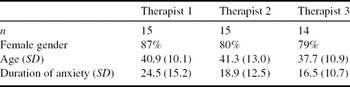
The sample of therapist behaviours was derived from the correspondence provided by three therapists delivering iCBT to 44 participants diagnosed with GAD in a randomized controlled trial (Paxling et al., Reference Paxling, Almlöv, Dahlin, Carlbring, Breitholtz and Eriksson2011). Therapists were all males in their 30s who were in their last term of the clinical psychology programme (5-year MSc level). Demographics of patients treated by the three therapists are presented in Table 1.
Demographic data for participants treated by the three therapists

The treatment consisted of eight online text modules that communicated CBT strategies to the participants in order to reduce the problems they experienced with excessive worrying (Paxling et al., Reference Paxling, Almlöv, Dahlin, Carlbring, Breitholtz and Eriksson2011). The modules were intended to be completed on a weekly basis by the participants and included applied relaxation, worry exposure, problem solving, cognitive restructuring and other common treatment ingredients in the treatment of GAD (Sanderson and Rygh, Reference Sanderson and Rygh2004). Each module contained homework assignments, and at the end of each week the patient sent an e-mail to the therapist containing answers to questions about their progress in the programme and registration forms detailing their work in the programme, as well as any of their own questions to their therapists on potential problems that had occurred during the week. The therapists sent back an e-mail with feedback on the homework and answers to questions and topics that the patient had raised. Sometimes communications took place more often than once a week, at the participant's own initiative. The therapists were given weekly clinical supervision by an experienced psychotherapist with previous experience in treatment of and research on generalized anxiety disorder. No specific therapist manual was used by the therapists, and their instruction was to foster adherence to the programme as much as possible, answer questions about the programme, and give recommendations on how the patients might use the taught techniques to their full advantage. For more details regarding the treatment trial see Paxling et al., 2011. The protocol was approved by the local ethics committee.
Coding of therapist behaviour
Therapist e-mails to the patients were first analyzed via a preliminary content analysis (Sittig, Reference Sittig2003). Initially, four e-mail correspondances were studied and five independent factors were derived from this small sample. Two coders conducted this preliminary derivation of factors that were subsequently discussed with the other investigators. Three additional coding entities were extrapolated after subsequent coding of another five e-mail correspondances. A consensus decision was made following discussion of the clinical relevance of the derived categories, The total sample of e-mails exchanged between therapist and patients was more than 1000, but e-mails from patients to therapists were not examined in this study, hence it is not possible to make any inferences about the immediate function of the therapist e-mails. The main reasons for not including patient behaviour were that we did not aim to analyze the interaction between therapist and patients and that we regarded patient behaviour as a separate question with large heterogeneity (some patients wrote long e-mails and some very short). The coding procedure resulted in eight coding categories that could be quantified in 490 e-mails written from therapists to patient. This study examined the topography of the therapists’ e-mail correspondence in order to explore whether any patterns of therapist behaviour were stable and linked to others therapist behaviour patterns visible in the material. When all e-mails had been coded for the eight specified behaviour types, a frequency matrix was constructed. E-mails containing more than one behaviour from the same category were represented twice or more in the data set if and only if the behaviours occurred in separate paragraphs. If behaviour entities were considered as repeated statements, they were conjoined into one unit of therapist behaviour. Behaviours were rated on a dichotomous scale on which a behaviour was either present (1) or not present (0).
Interrater reliability of the codings was tested by randomly selecting e-mails for 10 patients for whom all data were coded by two independent raters. The interrater reliability based on the coding instructions (see Table 1 for description) was very high, often reaching perfect agreement (r = .99). The only exception for which we did not find a significant correlation between the raters was for the variable psychoeducation (r = .61, p = .06).
Statistical analyses
Correlations between frequencies of the derived categories were computed via Spearman's rho in order to better understand the dispersion of the data set and to safeguard against any violations of statistical assumptions. The relationship between therapist behaviours and treatment outcome was measured by Penn State Worry Questionnaire (PSWQ) (Meyer, Miller, Metzger and Borkovec, Reference Meyer, Miller, Metzger and Borkovec1990).
Results
Categories, reliability and intercorrelations
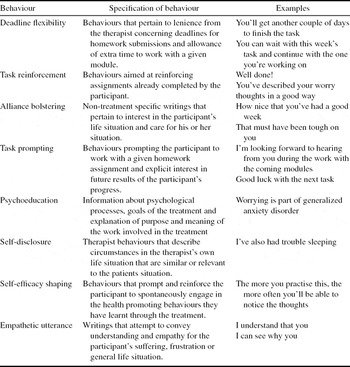
The eight therapist behaviours that were coded in the therapist e-mails were Deadline flexibility, Task reinforcement, Alliance bolstering, Task prompting, Psychoeducation, Self-disclosure, Self-efficacy shaping, and Empathetic utterance. These behaviours are outlined and defined in Table 2. The total frequency of behaviours coded was 1595. The most common was task reinforcement, with 640 markings (40%). Then followed self-efficacy shaping with 541 markings (34%), task reinforcement with 191 markings (12%), alliance bolstering with 93 markings (5%), psychoeducation with 48 markings (3%), empathetic utterance with 53 markings (3%), deadline flexibility with 25 markings (2%), and self-disclosure with 4 markings (0.2%).
List of content analysis derived therapist behaviours in the study

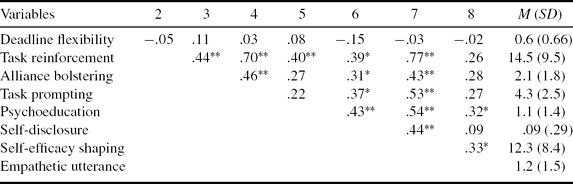
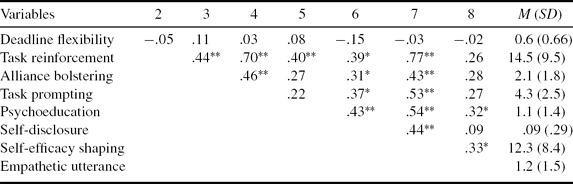
Correlational analyses between the observed therapist behaviours show that deadline flexibility did not correlate with the other examined therapist behaviours. Behaviours categorized as empathetic utterances correlated weakly with self-efficacy shaping (r = .33). The behaviours task reinforcement, alliance bolstering, psychoeducation, self-disclosure and self-efficacy shaping were pairwise moderately correlated with each other (r = .37 to .77). Task prompting was correlated to task reinforcement, alliance bolstering, self-disclosure and self-efficacy shaping (r = .37 to .70) but not to the other behaviours. Correlations are presented in Table 3.
Correlations (Spearman's r) between therapist online behaviours and mean number per patient (including SD)
* = p < .05, ** = p < .01
Therapist online behaviour and outcome
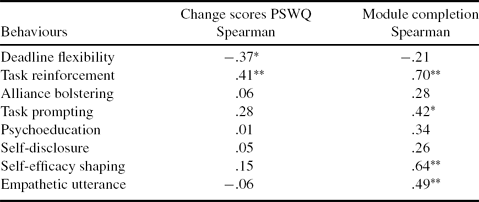
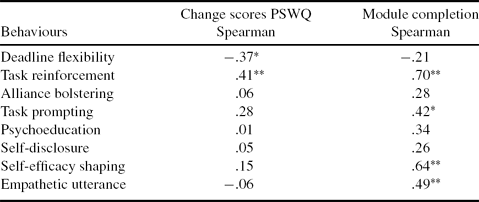
Correlations between module completion and therapist behaviours are presented in Table 4. Statistically significant correlations were found between module completion and task reinforcement, task prompting, self-efficacy shaping, and empathetic utterance. Two therapist behaviours were significantly associated with treatment outcome as measured by change scores on PSWQ: deadline flexibility (r = –.37), and task reinforcement (r = .41). Correlations for all factors are presented in Table 4.
Correlations (Spearman's r) between therapist behaviours and module completion and change scores on PSWQ
* = p < .05, ** = p < .01
Discussion
In this study we coded e-mails sent by therapists in guided iCBT for GAD. A majority of the e-mails concerned task reinforcement and self-efficacy shaping, which basically can be regarded as positive reinforcement for progress and independence in relation to the treatment content and application of the treatment ingredients in real life. The results suggest that different types of therapist behaviours can be identified in iCBT and that many of these behaviours are significantly correlated to each other. Different types of therapist behaviours also had an impact on module completion. Perhaps most interesting is the observation that deadline flexibility was negatively associated with treatment outcome, which implies that we have identified a factor that may be detrimental to outcome (Barlow, Reference Barlow2010), or at least a marker of slow progress. On the other hand, task reinforcement correlated with a positive outcome, and in relation to the psychotherapy literature in general, the correlations observed were not small (r = –.37 and r = .41). For example, the association between homework adherence and outcome (Kazantzis, Deane and Ronan, Reference Kazantzis, Deane and Ronan2000) and between the therapeutic alliance and outcome (Martin, Garske and Davis, Reference Martin, Garske and Davis2000) are in the same region, and interestingly, therapist adherence and competence were recently found to correlate weakly with outcome (Webb, DeRubeis and Barber, Reference Webb, DeRubeis and Barber2010).
The results of this study indicate that distinct therapist behaviours do exist in online therapy. These behaviours are sometimes correlated, but not to the extent that they are inseparable units but rather as an array of responses and antecedents directed at the patient. Bolstering the therapeutic alliance was significantly correlated with every other therapist behaviour except deadline flexibility, which suggests that focusing on the therapeutic alliance was one of the more commonly used therapist behaviours in the study. This is in line with a few studies in which therapeutic alliance has been studied in iCBT (D'Arcy, Reynolds, Stiles and Grohol, Reference D'Arcy, Reynolds, Stiles and Grohol2006; Knaevelsrud and Maercker, Reference Knaevelsrud and Maercker2006).
It appears in this study that flexibility in terms of lenience regarding deadlines could be associated with poor completion rates of the assigned text units as well as poorer treatment outcome. This type of therapist behaviour might, however, be an inevitable result of situations in which the patient simply does not adhere to the treatment protocol. Other behaviours that are directed at the practical aspects of working through an Internet-delivered CBT programme are positively correlated with completion of the programme, but task reinforcement was the only identified therapist behaviour that had a significant impact on treatment outcome as measured by the PSWQ. Since the therapists’ main focus was to guide the patients through a highly structured self-help programme, it is complicated to compare these results with traditional face-to-face CBT or Internet-delivered treatments that only consist of correspondence between therapist and patient, or even real-time online conversations (Kessler et al., Reference Kessler, Lewis, Kaur, Wiles, King and Weich2009).
The role and function of the therapist in iCBT is not clearly defined within the field, perhaps due to treatment programmes being very different from one another. In one trial (Titov et al., Reference Titov, Andrews, Davies, McIntyre, Robinson and Solley2010), patients were guided through the treatment by either a clinician or a technician, and it is possible that the support given by the clinician consists of a different set of therapist behaviours compared to the support given by the technician, even though no significant differences was found between the outcome for the different kinds of support provided.
The study has several limitations, which will now be addressed. First, the therapist e-mails were analyzed out of context, as the behaviour of the participants was not analyzed. It is thus possible that the identified therapist behaviours are merely responses to the content of the patient e-mails. However, since all the patients underwent the same highly structured treatment programme, it is very probable that their weekly reports had considerable overlap in terms of content, and that the therapist behaviours were not only responses to the patients e-mails. Second, since all the patients shared the same diagnosis, GAD, it is possible that the therapist behaviours identified are specific for the treatment of worry and anxiety and that the therapists would have behaved differently in the treatment of another condition (e.g. depression). Third, the therapists studied in this trial were also involved in the treatment study including development of the self-help programme, and it is possible that therapists with no prior knowledge of the self-help programme would act differently when guiding patients through the treatment. Fourth, the content analyzed in this trial came from only three therapists, and it is not known whether these therapists’ behaviour in the trial can be generalized.
To our knowledge, this is the first study in which the actual content of therapist e-mails in iCBT has been analyzed and correlated with adherence and treatment outcome. A larger sample size would be of great interest in future research, both in terms of therapists and patients. Since all therapists were in their final year of the same educational programme to become psychologists, and all patients had the same illness, future research in which different kinds of therapists/coaches and different kinds of psychological illnesses are included would be of great interest. In this study the e-mail support was given in addition to a highly structured self-help programme, but very little is known about the impact of e-mail support given in addition to traditional face-to-face therapy. Perhaps a relatively small investment in giving extra support in terms of task reinforcement and self-efficacy shaping – delivered via e-mail, for example – as an addition to face-to-face therapy would have an impact on adherence.



Comments
No Comments have been published for this article.