Introduction
Rates and causes of cognitive decline in the elderly are highly variable, stimulating interest in the identification of new predictors, notably those that may indicate intervention strategies. It has been suggested that the aging brain may be more vulnerable to the effects of stress, and that this may in turn influence cognitive functioning. A growing body of evidence has shown that overactivation of the hypothalamic–pituitary–adrenal (HPA) axis, a major component of the stress response system, may lead to hippocampal impairment and hence decrements in cognitive performance (Wolf, Reference Wolf2003; Lupien et al. Reference Lupien, Maheu, Tu, Fiocco and Schramek2007). Several cross-sectional studies in elderly subjects have demonstrated a link between elevated glucocorticoid levels and declarative memory (Lupien et al. Reference Lupien, Lecours, Lussier, Schwartz, Nair and Meaney1994, Reference Lupien, Gaudreau, Tchiteya, Maheu, Sharma, Nair, Hauger, McEwen and Meaney1997; Wright et al. Reference Wright, Kunz-Ebrecht, Iliffe, Foese and Steptoe2005; O'Hara et al. Reference O'Hara, Schroder, Mahadevan, Schatzberg, Lindley, Fox, Weiner, Kraemer, Noda, Lin, Gray and Hallmayer2007), and also non-declarative memory and executive functioning not dependent on hippocampal integrity (MacLullich et al. Reference MacLullich, Deary, Starr, Ferguson, Wardlaw and Seckl2005; Li et al. Reference Li, Cherrier, Tsuang, Petrie, Colasurdo, Craft, Schellenberg, Peskind, Raskind and Wilkinson2006; Lee et al. Reference Lee, Glass, McAtee, Wand, Bandeen-Roche, Bolla and Schwartz2007). However, the causal relationship between stress and possible hippocampal damage remains unclear because of the small number of prospective studies. Karlamangla et al. (Reference Karlamangla, Singer, Chodosh, McEwen and Seeman2005) found an association with decline in global cognitive function but did not examine specific cognitive domains. Two other large studies suggested that cortisol levels may predict verbal recall in women after a 2-year follow-up (Seeman et al. Reference Seeman, McEwen, Singer, Albert and Rowe1997; Greendale et al. Reference Greendale, Kritz-Silverstein, Seeman and Barrett-Connor2000). A further study reported an association between higher cortisol levels and poorer declarative verbal memory in elderly men and women, but no significant associations were observed between changes in cortisol levels and changes in test scores after a 1.5-year follow-up (Carlson & Sherwin, Reference Carlson and Sherwin1999). A small longitudinal study with a 3-year follow-up, not stratified by gender, reported a significant relationship with delayed recall and executive functioning (Li et al. Reference Li, Cherrier, Tsuang, Petrie, Colasurdo, Craft, Schellenberg, Peskind, Raskind and Wilkinson2006). Some of these inconsistent results are largely attributable to methodological inadequacies, notably small sample size, inadequate cognitive assessment (principally limited to verbal memory), failure to take into account other possible causes of cognitive decline, and environmental differences (laboratory-induced stress provokes acute cortisol elevation as opposed to the accumulation of repeated and prolonged stress during the natural life course). Some studies have also failed to consider gender differences, although these have been reported in relation to both stress response and the association between cortisol levels and cognitive decline or neural activity (Seeman et al. Reference Seeman, McEwen, Singer, Albert and Rowe1997; Sauro et al. Reference Sauro, Jorgensen and Pedlow2003; Otte et al. Reference Otte, Hart, Neylan, Marmar, Yaffe and Mohr2005; Wang et al. Reference Wang, Korczykowski, Rao, Fan, Pluta, Gur, McEwen and Detre2007). Sex-specific associations between polymorphisms of the glucocorticoid receptor gene and HPA axis response to stress and also glucocorticoid sensitivity have been reported (Kumsta et al. Reference Kumsta, Entringer, Koper, van Rossum, Hellhammer and Wust2007). Finally, although an interactive effect with the apolipoprotein E (ApoE) ε4 allele has been described (Lee et al. Reference Lee, Glass, Wand, McAtee, Bandeen-Roche, Bolla and Schwartz2008), this has not been included in prospective models.
The present study examined the cross-sectional and longitudinal relationship between cortisol parameters and cognitive functioning in a population-based cohort. This study took into account gender differences, and also the impact of naturally occurring acute stress due to environmental context and psychosocial challenge, by evaluating cortisol during a day of clinical examinations at the hospital. Cortisol readings were also taken on a quiet day at home, considered to reflect a measure of accumulated lifetime stressors in the absence of acute stress. This study controlled for sociodemographic factors, such as age and education level, and other clinical factors such as psychopathology, and genetic vulnerability, which may independently contribute to cognitive decline.
Method
Participants
The subjects (aged between 65 and 90 years) were selected by random sampling from the electoral rolls of the Montpellier district as part of the Enquête de Santé Psychologique – Risques, Incidence et Traitement (ESPRIT) study of late-life neuropsychiatric disorders (Ritchie et al. Reference Ritchie, Artero, Beluche, Ancelin, Mann, Dupuy, Malafosse and Boulenger2004). The subjects were recruited between 1999 and 2002 and followed up twice at 2-year intervals. The study protocol was approved by the Ethical Committee of the University-Hospital of Bicêtre (France) and written informed consent was obtained from each participant.
Participants were asked to attend a half-day examination by a neurologist and a center interviewer (nurse or psychologist) at the Gui de Chauliac Neurology Hospital (Montpellier, France). Examinations of the subjects included a standardized neuropsychiatric examination based on ICD-10 criteria (WHO, 1992), a cognitive examination, and a general health interview including demographic characteristics and covering present state of health, medical history and blood sampling. The analyses were conducted on a sample of 201 subjects for whom complete salivary cortisol samples had been collected under stressful and quiet conditions and who had a typical eucortisolemic pattern, excluding the subjects with an atypical cortisol baseline pattern (i.e. with flat pattern or abnormal time peak) as described previously (Chaudieu et al. Reference Chaudieu, Beluche, Norton, Boulenger, Ritchie and Ancelin2008). They were also free of dementia and not being treated with medication likely to modify cortisol levels (glucocorticoids, hormonal replacement therapy and benzodiazepines). From this sample, four subjects with major depression or taking antidepressants were further excluded, leaving 197 subjects in the present study. Compared to the ESPRIT subjects not included in the present analysis (n=2070), the subjects included in the cortisol sample were less frequently women (p<0.0001) and had lower depressive symptomatology (p<0.0001) and higher body mass index (p=0.02) (data not shown). We also observed better performance [median (IQR)] in the cortisol sample on the Isaacs Set Test (IST; Isaacs & Kennie, Reference Isaacs and Kennie1973) for men [47 (41–57) v. 45 (39–53), p=0.02] and also on the Benton Visual Retention Test (Benton, Reference Benton1965) for men [12 (11–14) v. 12 (11–13), p=0.008] and women [12 (11–13) v. 12 (10–13), p=0.05].
Diagnosis of dementia and psychiatric symptomatology
A standardized clinical protocol based on DSM-IV criteria (APA, 1994) administered by a neurologist was used to diagnose prevalent cases of dementia. A standardized validated psychiatric examination, the Mini International Neuropsychiatric Interview (MINI, French version 5.00; Lecrubier et al. Reference Lecrubier, Sheehan, Weiller, Amorim, Bonara, Sheehan, Janavs and Dunbar1997), was used to detect anxiety disorders and major depression (APA, 1994). Depressive symptomatology was assessed using the Center for Epidemiologic Studies Depression Scale (CES-D; Radloff, Reference Radloff1977).
Cognitive measures
Three measures of cognitive functioning were undertaken: verbal and non-verbal recall and frontal executive functioning. The IST (Isaacs & Kennie, Reference Isaacs and Kennie1973) provided a measure of verbal fluency or semantic access, which is sensitive to changes in both frontal and temporal areas. Participants were asked to generate as many words as possible within a given semantic category (animals, colors, fruits, cities) and their total score was the sum of the number of words generated in each category within 30 s. The Benton Visual Retention Test (Benton, Reference Benton1965) was used to assess visual memory. The Trail Making Test, Part B (TMTB; Reitan, Reference Reitan1965) was used as a measure of frontal executive functioning; however, having been introduced after recruitment, baseline scores were not available for some subjects. The Mini Mental State Examination (MMSE; Folstein et al. Reference Folstein, Folstein and McHugh1975) was used as a global measure of cognitive function. Cognitive evaluation was performed at the hospital in the morning following the first cortisol sampling as part of a general medical examination. All of the cognitive tests were administered at the hospital at baseline, and during the first and second follow-up, except for TMTB, which was only given at baseline and the second follow-up. The National Adult Reading Test (NART; Blair & Spreen, Reference Blair and Spreen1989) was used as a marker of IQ.
Collection of salivary cortisol
HPA activity was evaluated by salivary cortisol, which is considered to be a reliable measure (Hellhammer et al. Reference Hellhammer, Kirschbaum, Belkien, Hingtgen, Hellhammer and Huppman1987) and highly correlated with free cortisol levels in plasma (the only fraction of this hormone that is biologically active) (Kirschbaum & Hellhammer, Reference Kirschbaum and Hellhammer1994). The two measures are equally sensitive to stress reactivity; however, salivary measures were preferred for this elderly sample as they eliminate the stress associated with blood sampling and are less complicated for the elderly than urinary cortisol assays, which require 24-h urine collection. They also provide a dynamic evaluation over the day.
Saliva was collected with a cotton dental roll retained in the mouth for 1 min, then stored at −20°C before analysis. Subjects were instructed not to drink, eat or smoke for at least 30 min before saliva collection. As cortisol levels increase shortly after awakening (Van Cauter et al. Reference Van Cauter, Leproult and Kupfer1996), subjects were asked to start the protocol at least 1 h after awakening (mean time 1 h 30±50 min). Subjects started this protocol at the hospital before cognitive testing and subsequently twice more with a 7-h interval, recording the exact time (the last sampling being collected before midnight to eliminate early cortisol increase occurring during the nocturnal phase). Three samples were also taken at the same times on the following day at home (considered as a quiet day), to evaluate the effect of environmental context. As in other naturalistic studies, subjects were allowed to collect samples at a time when it would not interfere with activities rather than at a fixed time of the day. Mean±s.d. values for sampling were 8 h 40±20 min, 15 h 40±40 min and 21 h 40±35 min.
Laboratory methods
Cortisol levels were determined from saliva collection by direct radioimmunoassay (Diagnostic Systems Laboratories, USA). Venous blood samples were taken from subjects on arrival at the hospital before cognitive testing. ApoE genotyping was performed as described previously (Dufouil et al. Reference Dufouil, Richard, Fievet, Dartigues, Ritchie, Tzourio, Amouyel and Alperovitch2005).
Statistical analysis
As the distribution of raw cortisol is typically skewed and the diurnal profile may be approximated by an exponential curve, raw values were log-transformed. The slope of the regression of the three cortisol values on the sampling times corresponds to the diurnal rhythm of cortisol secretion. Given the non-fixed time sampling protocol and the need for comparisons for a given time, morning cortisol concentrations were standardized by extrapolating values from the equation of the regression line for each subject (Chaudieu et al. Reference Chaudieu, Beluche, Norton, Boulenger, Ritchie and Ancelin2008). As linearity was not found for most cortisol parameters, variables were categorized according to tertiles, the reference group being the tertile corresponding to subjects with lower cortisol or those with a steeper cortisol regression slope. Group comparisons at baseline were carried out using Student's t test and ANOVA for categorical explanatory variables. Logistic regression analyses adjusted for age and educational level and stratified by gender were used to determine whether cortisol parameters were associated with odds of low cognitive performance or cognitive decline. Hence, odds ratios (ORs) corresponded to the risk of being in the lowest cognitive performance group (for cross-sectional analysis) or the group with the greatest cognitive decline (for longitudinal analysis) associated with having moderately high or high morning cortisol level (LnC8h) or moderately flat or flat cortisol slope. Low cognitive performance was defined as being in the lowest tertile of the baseline cognitive score for the IST (range 24–42), the Benton test (1–11) and the MMSE (20–27), and in the highest tertile for TMTB (79–251). Cognitive decline was defined as being in the highest tertile of the difference between either follow-up visit after 2 or 4 years, except for TMTB for which the lowest tertile of the difference was considered. Compared to baseline, this corresponded to a decrease of between 0 and 69 points on the IST, between 1 and 13 points on the Benton, and between 0 and 6 points on the MMSE and an increase of time between 3 and 107 s for TMTB. p values <0.05 were considered to be statistically significant. Data were analyzed using SAS version 9.1 (SAS Institute Inc., USA).
Results
Participant characteristics and salivary cortisol
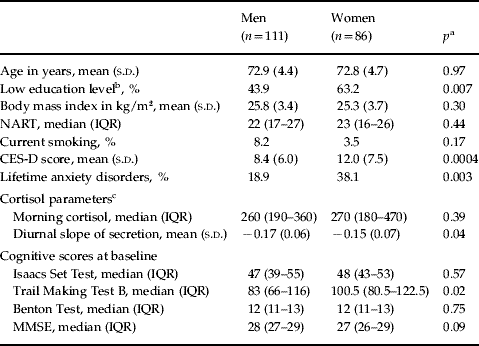
Women had lower education, higher rate of lifetime anxiety disorders, higher CES-D score, lower performance on TMTB, and flatter slope of cortisol secretion (Table 1). Compared to subjects who were lost to follow-up (n=35), the 162 subjects with follow-up cognitive assessment were younger (p=0.04) and reported fewer lifetime psychiatric disorders (p=0.04) and had slightly higher performance on the Benton task (p=0.03) (data not shown).
General characteristics of baseline population and gender differences

s.d., Standard deviation; NART, National Adult Reading Test; IQR, interquartile range; CES-D, Center for Epidemiologic Studies Depression Scale; MMSE, Mini Mental State Examination.
a Two-tailed χ2 tests were used to compare categorical characteristics, t tests for quantitative variables with normal distribution, and the Mann–Whitney–Wilcoxon test for cognitive scores and cortisol concentrations.
b Corresponding to ⩽9 years of schooling.
c Corresponding to the cortisol concentrations expressed as ng/dl and measured in the hospital environment.
Cortisol secretion and cognitive performance at baseline
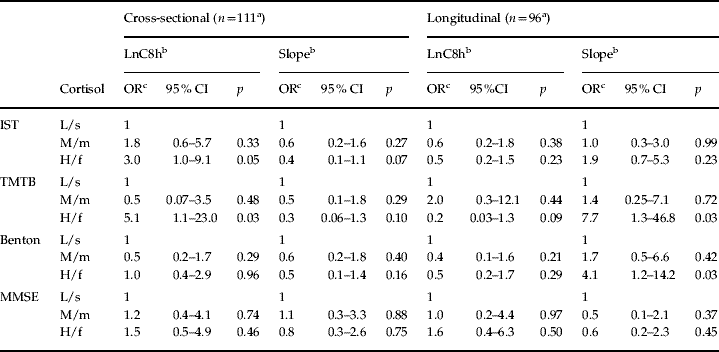
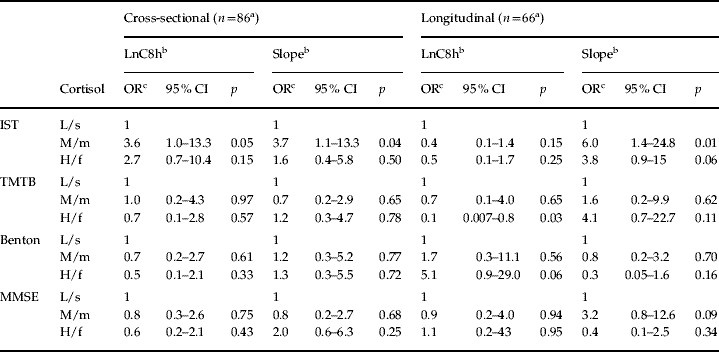
We first investigated whether cortisol parameters in the hospital environment were associated with low performance on at least one baseline cognitive score. In men, higher morning cortisol level was associated with greater risk of low cognitive performance on the IST, after adjustment for age and education level (OR 3.0, p=0.05), and on TMTB (OR 5.1, p=0.03) (Table 2). In women, poor performance on the IST was associated with moderately high morning cortisol levels (OR 3.6, p=0.05 for the intermediate cortisol group) and also with a moderately flat cortisol slope (OR 3.7, p=0.04) (Table 3). In men or women, no significant associations were found for the Benton test and the MMSE.
Association between morning cortisol level or diurnal rhythm and cognitive performances in men

IST, Isaacs Set Test; TMTB, Trail Making Test, Part B; MMSE, Mini Mental State Examination; OR, odds ratio; CI, confidence interval; L, low; M, moderate; H, high; s, steep; m, moderately flat; f, flat.
a For TMTB, 69 men were included in the cross-sectional analyses, of whom 48 had longitudinal assessment.
b Corresponds to the Ln of morning cortisol concentration expressed as ng/dL and slope measured in the hospital environment. For cortisol parameters, the tertile ranges were ⩽5.3 (L), 5.3–5.8 (M) and >5.8 (H) for LnC8h; and ⩽−0.19 (s), −0.19 to −0.14 (m) and >−0.14 (f) for slope.
c OR (adjusted for age and education level) corresponded to the risk of being in the lowest cognitive performance group (cross-sectional analysis) or the group with the greatest cognitive decline (longitudinal analysis) associated with having moderately high or high morning cortisol level (LnC8h) or moderately flat or flat cortisol slope. The reference (OR 1) was the tertile corresponding to the lowest LnC8h (L) or the steepest slope (s).
Association between morning cortisol level or diurnal rhythm and cognitive performances in women

IST, Isaacs Set Test; TMTB, Trail Making Test, Part B; MMSE, Mini Mental State Examination; OR, odds ratio; CI, confidence interval; L, low; M, moderate; H, high; s, steep; m, moderately flat; f, flat.
a For TMTB, 61 women were included in the cross-sectional analyses, of whom 41 had longitudinal assessment.
b Corresponds to the Ln of morning cortisol concentration expressed as ng/dL and slope measured in the hospital environment. The tertile ranges were ⩽5.3 (L), 5.3–6.0 (M) and >6.0 (H) for LnC8h; and ⩽−0.17 (s); −0.17 to −0.12 (m) and >−0.12 (f) for slope.
c OR (adjusted for age and education level) corresponded to the risk of being in the lowest cognitive performance group (cross-sectional analysis) or the group with the greatest cognitive decline (longitudinal analysis) associated with having moderately high or high morning cortisol level (LnC8h) or moderately flat or flat cortisol slope. The reference (OR 1) was the tertile corresponding to the lowest LnC8h (L) or the steepest slope (s).
Cortisol secretion and cognitive decline over 2 or 4 years
Longitudinal changes in cognitive performance as a function of baseline cortisol parameters were then examined. In men, an association was observed between cortisol slope and decline on TMTB for the tertile corresponding to the flattest cortisol slopes (OR 7.7, p=0.03) compared to the tertile of the steepest slopes (Table 2). For the decline on the Benton test, the association was also significant for subjects with the flattest cortisol slope (OR 4.1, p=0.03).
In women, an association was observed between cognitive decline on the IST and both groups of moderately flat (OR 6.0, p=0.01) and flattest cortisol slopes (OR 3.8, p=0.06) compared to the steepest cortisol slope group (Table 3). An inverse association was also observed for decline on TMTB, at the highest morning cortisol level (OR 0.1, p=0.03); however, subject numbers were small and 95% confidence intervals (CIs) large. A marginal association was also observed for the risk of decline on the Benton test at the highest morning cortisol levels (OR 5.1, p=0.06). Similar results were obtained after adjustment for the ApoE genotype and other confounders such as anxiety disorders or current depressive symptomatology (data not shown).
Is the cortisol effect related to environmental context?
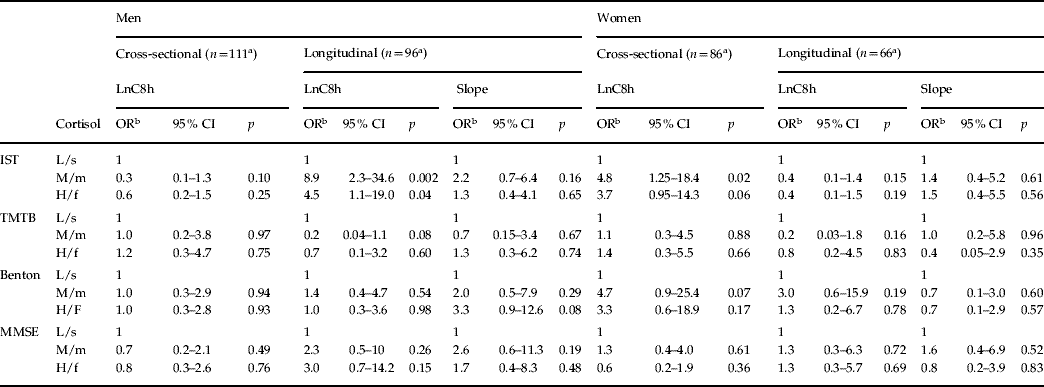
We then examined whether the associations found to be significant under stressful conditions at the hospital were also observed when cortisol was taken on a quiet day at home. Cortisol levels taken on a quiet day were found to have the same association with low performance on the IST in women (OR 4.8, 95% CI 1.3–18.4, p=0.02, for moderately high morning cortisol concentration and a marginally significant association was also observed for higher morning cortisol, OR 3.7, 95% CI 1.0–14.3, p=0.06) (Table 4). A comparable tendency, although not significant, was also observed for the Benton test with regard to the low performance in women (OR 4.7, 95% CI 0.9–25.4, p=0.07, for morning cortisol) and decline in men (OR 3.3, 95% CI 0.9–12.6, p=0.08, for slope). Moderately high morning cortisol (OR 8.9, 95% CI 2.3–34.6, p=0.002) or high morning cortisol (OR 4.5, 95% CI 1.1–19.0, p=0.04) was found to be associated with decline on the IST in men. Alternatively, we could not observe significant associations with TMTB in men or women.
Association between morning cortisol level or diurnal rhythm and cognitive performances under quiet conditions

IST, Isaacs Set Test; TMTB, Trail Making Test, Part B; MMSE, Mini Mental State Examination; OR, odds ratio; CI, confidence interval; L, low; M, moderate; H, high; s, steep; m, moderately flat; f, flat.
a For TMTB, 69 men and 61 women were included in the cross-sectional analyses, of whom 48 men and 41 women had longitudinal assessment.
b OR adjusted (adjusted for age and education level) corresponded to the risk of being in the lowest cognitive performance group (cross-sectional analysis) or the group with the greatest cognitive decline (longitudinal analysis) associated with having moderately high or high morning cortisol level (LnC8h) or moderately flat or flat cortisol slope. The reference (OR 1) was the tertile corresponding to the lowest LnC8h (L) or the steepest slope (s).
Discussion
HPA axis response and cognitive functioning
Our results suggest that alterations in HPA axis response are associated with specific alterations in memory and executive function in non-depressed elderly persons but not with significant alteration in global cognitive function. Our data are consistent with some previous studies that primarily found associations of elevated cortisol with deficits in language and verbal memory (Lupien et al. Reference Lupien, Lecours, Lussier, Schwartz, Nair and Meaney1994, Reference Lupien, Gaudreau, Tchiteya, Maheu, Sharma, Nair, Hauger, McEwen and Meaney1997; Seeman et al. Reference Seeman, McEwen, Singer, Albert and Rowe1997; Carlson & Sherwin, Reference Carlson and Sherwin1999; Greendale et al. Reference Greendale, Kritz-Silverstein, Seeman and Barrett-Connor2000; Wright et al. Reference Wright, Kunz-Ebrecht, Iliffe, Foese and Steptoe2005; O'Hara et al. Reference O'Hara, Schroder, Mahadevan, Schatzberg, Lindley, Fox, Weiner, Kraemer, Noda, Lin, Gray and Hallmayer2007). We have also found an association with executive function and visual memory. The impact on different cognitive tests is not surprising, given that glucocorticoid receptors are widely distributed throughout the brain, especially the hippocampus and other brain regions related to stress and cognition, such as the frontal lobes (Lupien et al. Reference Lupien, Maheu, Tu, Fiocco and Schramek2007).
Few longitudinal studies have evaluated the predictive role of cortisol on cognitive decline, separately in elderly men and women. Baseline blood morning cortisol was shown to be a significant predictor of poor verbal fluency in post-menopausal women after a 2-year follow-up, but not visual reproduction or TMTB (Greendale et al. Reference Greendale, Kritz-Silverstein, Seeman and Barrett-Connor2000). Seeman et al. (Reference Seeman, McEwen, Singer, Albert and Rowe1997) observed an association between high basal overnight cortisol excretion, and also increased cortisol excretion over a 2.5-year follow-up and a decline in delayed verbal recall (but not abstraction or spatial performances) in women but not in men. No gender differences were observed in changes in noon cortisol levels associated with cognitive decline over 1.5 years using a large neurocognitive battery, although some gender differences were observed cross-sectionally (Carlson & Sherwin, Reference Carlson and Sherwin1999). Too few subjects and methodological limitations (notably gender differences in the order of sampling and cognitive testing) limit the validity of these findings. Our results confirm the association between HPA axis response in post-menopausal women and decline in verbal but not visuospatial performance (Seeman et al. Reference Seeman, McEwen, Singer, Albert and Rowe1997; Greendale et al. Reference Greendale, Kritz-Silverstein, Seeman and Barrett-Connor2000). The association with decline in visual memory in women and both visual memory and visuospatial performance in men have not been reported previously.
Predictive role of cortisol parameters on cognitive dysfunction
Some longitudinal studies have evaluated the predictive value of cortisol levels on cognitive decline using blood ‘point’ levels at inclusion (Kalmijn et al. Reference Kalmijn, Launer, Stolk, de Jong, Pols, Hofman, Breteler and Lamberts1998; Greendale et al. Reference Greendale, Kritz-Silverstein, Seeman and Barrett-Connor2000), or overnight urinary cortisol measured once at inclusion (Karlamangla et al. Reference Karlamangla, Singer, Chodosh, McEwen and Seeman2005) or twice at 3-year intervals (Seeman et al. Reference Seeman, McEwen, Singer, Albert and Rowe1997). Apart from Kalmijn et al. (Reference Kalmijn, Launer, Stolk, de Jong, Pols, Hofman, Breteler and Lamberts1998), who found no association with MMSE scores, the other studies showed an association with decline in global cognitive function (Karlamangla et al. Reference Karlamangla, Singer, Chodosh, McEwen and Seeman2005) or verbal performance (Seeman et al. Reference Seeman, McEwen, Singer, Albert and Rowe1997; Greendale et al. Reference Greendale, Kritz-Silverstein, Seeman and Barrett-Connor2000). These cortisol parameters, however, provide a fairly static picture of steady-state HPA functioning. Li et al. (Reference Li, Cherrier, Tsuang, Petrie, Colasurdo, Craft, Schellenberg, Peskind, Raskind and Wilkinson2006) used a more dynamic dimension, evaluating both cognitive function and salivary cortisol levels (at 8, 15 and 23 h) annually for 3 years. The subjects with initial higher evening cortisol level, or with less negative slope of the change in evening cortisol during the 3 years, showed higher decline in delayed paragraph recall. These data are limited, however, by the small number of subjects and the lack of adjustment or gender stratification in analyses.
We measured the dynamics of diurnal cortisol secretion, just before and several hours after exposure to the stressful situation of the clinical examination. We observed that high morning cortisol level was associated with low cognitive performance principally in cross-sectional analysis, that is when cognitive evaluation was performed just after cortisol sampling. A flat cortisol slope was more predictive of cognitive decline in our longitudinal analysis. The cortisol slope corresponds to the rate of cortisol elimination up to 14 h following the stressful situation; the flatter the slope, the longer the exposition to high endogenous cortisol levels and the slower the return to basal state, the higher the risk of cognitive decline in some domains. This may be due to protracted occupancy time and increased activation of glucocorticoid receptors. The normally beneficial neurological effects exerted by phasic activation of glucocorticoid receptors have been reported to become detrimental when glucocorticoid receptors are chronically activated (De Kloet et al. Reference De Kloet, Vreugdenhil, Oitzl and Joels1998).
Only one cross-sectional study reported a significant association of diurnal cortisol slope, and also waking cortisol, with impairment in delayed verbal recall in elderly persons (O'Hara et al. Reference O'Hara, Schroder, Mahadevan, Schatzberg, Lindley, Fox, Weiner, Kraemer, Noda, Lin, Gray and Hallmayer2007). Flatter cortisol slope has also been found to be associated with impairment in verbal memory in young adults with or without psychotic and non-psychotic depression (Gomez et al. Reference Gomez, Fleming, Keller, Flores, Kenna, DeBattista, Solvason and Schatzberg2006) and also for breast cancer mortality, where it is a better long-term predictor than high morning cortisol or area under the curve (Sephton et al. Reference Sephton, Sapolsky, Kraemer and Spiegel2000). The predictive value of cortisol slope on cognitive decline in the elderly has not been evaluated before, although it is considered to be an important measure of stress responsiveness (O'Hara et al. Reference O'Hara, Schroder, Mahadevan, Schatzberg, Lindley, Fox, Weiner, Kraemer, Noda, Lin, Gray and Hallmayer2007).
Is cognitive dysfunction associated with chronic or acute cortisol elevation?
Although older adults have been reported to be more reactive to the environment in which their memory is tested than younger subjects (Lupien et al. Reference Lupien, Maheu, Tu, Fiocco and Schramek2007), few studies have attempted to differentiate the specific effects of acute stress-induced cortisol elevations on cognitive functioning in the elderly. Previous evaluations of cortisol levels have been restricted to short periods in laboratory environments, before and after stress exposure. However, pretest evaluation is not necessarily representative of basal cortisol levels because a laboratory environment may cause acute elevations in cortisol, notably due to novelty or anticipatory effects, and thus be detrimental to declarative memory (Lupien et al. Reference Lupien, Gaudreau, Tchiteya, Maheu, Sharma, Nair, Hauger, McEwen and Meaney1997). Two other cross-sectional studies reported an inverse association between cortisol levels and declarative memory performances independently of subjective rating of stress and/or acute stress effect (Wright et al. Reference Wright, Kunz-Ebrecht, Iliffe, Foese and Steptoe2005; Lee et al. Reference Lee, Glass, McAtee, Wand, Bandeen-Roche, Bolla and Schwartz2007).
We observed a comparable pattern when cortisol was evaluated on a stressful day at hospital and a quiet day at home, for the verbal recall and visual retention tests in women and men, but not for the more complex frontal executive task, which may be more sensitive to stress. Under both conditions, we controlled for factors likely to affect cortisol levels (e.g. eating, drinking, smoking, or physical exertion). Our results may thus suggest that abnormal endogenous levels or chronic elevations of cortisol levels, which may result from cumulative life stress, may be predictive of cognitive alteration in visual and verbal memory. On the contrary, alteration in visuospatial performance in men seems to be more related to acute elevation in cortisol levels in response to environmental stress. Gender differences in the response to moderate stress have been observed in a functional magnetic resonance imaging (fMRI) study in young adults. In men, stress was associated with asymmetric prefrontal activity and with cortisol variation, whereas in women, stress was associated with limbic activation and less correlated with cortisol (Wang et al. Reference Wang, Korczykowski, Rao, Fan, Pluta, Gur, McEwen and Detre2007). However, as we observed the same association at the hospital between altered HPA axis response and impaired performance on TMTB in cross-sectional as in longitudinal analysis, this suggests that an abnormal response to a stressful situation could also be predictive of cognitive decline in men.
Limitations and strengths
Exclusion of institutionalized persons and selective attrition in follow-up could have led to an underestimation of the harmful effects of cortisol elevation on cognitive functioning. Bias could also have been introduced through the selection of participants, those not included being more likely to have dementia, to be women, and with lower baseline cognitive scores. We also considered subjects lying within non-pathological ranges of cortisol parameters (Kirschbaum & Hellhammer, Reference Kirschbaum and Hellhammer1989). Thus, people with the strongest potential associations may have been selectively excluded so that associations between cortisol parameters and cognitive outcomes were underestimated. Although the size of our sample is greater than that of several other longitudinal studies on specific cognitive functions (Lupien et al. Reference Lupien, Lecours, Lussier, Schwartz, Nair and Meaney1994, Reference Lupien, de Leon, de Santi, Convit, Tarshish, Nair, Thakur, McEwen, Hauger and Meaney1998; Carlson & Sherwin, Reference Carlson and Sherwin1999; Li et al. Reference Li, Cherrier, Tsuang, Petrie, Colasurdo, Craft, Schellenberg, Peskind, Raskind and Wilkinson2006), but not all (e.g. Seeman et al. Reference Seeman, McEwen, Singer, Albert and Rowe1997; Greendale et al. Reference Greendale, Kritz-Silverstein, Seeman and Barrett-Connor2000), some of our results could have been limited because of lack of power, notably for TMTB in women. In addition, multiple analyses have been performed that may have induced some chance associations, and although some results are consistent with previous studies, our findings need to be replicated with a larger sample for definite conclusions to be drawn. The strengths of this study are the dynamic assessment of diurnal cortisol levels and the evaluation of gender differences and effect of environmental conditions, in addition to controlling for sociodemographic, genetic and psychopathologic status, which may independently contribute to cognitive decline. However, although we tried to control for a range of confounding factors, we cannot exclude the fact that other uncontrolled factors may be intervening variables.
Implications of the study
Although we observed associations in both cross-sectional and longitudinal analyses, we cannot necessarily deduce causality. Our findings, however, support the hypothesis that cortisol excess is one of the mechanisms underlying cognitive dysfunction in the elderly. They are consistent with the idea that exposure to chronically elevated glucocorticoid levels may have a detrimental effect on hippocampal and prefrontal functioning, and could thus compromise performance on a variety of cognitive domains. Given that dysregulation in the HPA axis could be a result of exposure to chronic stress, it is plausible that decrements in cognitive function with aging may be due, at least in part, to long-term exposure to hazards in the psychosocial environment, although other early-life or genetic contributions to variations in HPA axis function across the life course could also be involved (Meaney et al. Reference Meaney, Szyf and Seckl2007). Our findings might also have clinical implications, especially regarding the need for active and early identification of symptoms. Slow rhythm of diurnal cortisol secretion seems to constitute a sensitive indicator of alterations in HPA function and may be a putative marker of cognitive decline. If decrements in cognitive performance associated with elevated cortisol levels do not represent irreversible effects as already suggested (Seeman et al. Reference Seeman, McEwen, Singer, Albert and Rowe1997; Wolf, Reference Wolf2003; Sandeep et al. Reference Sandeep, Yau, MacLullich, Noble, Deary, Walker and Seckl2004; Lupien et al. Reference Lupien, Fiocco, Wan, Maheu, Lord, Schramek and Tu2005), interventions that block this pathway may provide new therapeutic options to protect against cortisol-mediated neurological compromise and hence reduce cognitive decline (Sandeep et al. Reference Sandeep, Yau, MacLullich, Noble, Deary, Walker and Seckl2004). Whether this cognitive decline represents the earliest stages of Alzheimer's disease or some other progressive neurodegenerative disorder will require longer follow-up to examine further the relationship between HPA axis changes and time of onset of dementia.
Acknowledgements
We thank Dr N. Bressot and C. Bordedebat for skilled assistance in salivary cortisol evaluation. The ESPRIT Project has been financed by the Regional Government of Languedoc-Roussillon (France), the Agence Nationale de la Recherche (ANR, Project 07 LVIE 004), and an unconditional grant from Novartis (France).
Declaration of Interest
None.