Reflex-mediated syncope has been estimated to occur in up to 15% of children. Reference Lewis and Dhala1,Reference Friedman and Alexander2 Therapy ranges from fluid and salt optimisation, to pharmacological therapy, to the implantation of a permanent pacemaker. In adults, there have been conflicting results as to the utility of pacing. Reference Brignole, Deharo and Menozzi3–Reference Varosy, Chen, Miller, Noseworthy, Slotwiner and Thiruganasambandamoorthy5 The literature on pacing for syncope in paediatric patients is limited, consisting of a small number of case series. Reference Kelly, Porter, McGoon, Espinosa, Osborn and Hayes6–Reference Di Pino, Calabro, Gitto, Bianca and Oreto8 Although the majority of individuals can be treated with lifestyle and pharmacological interventions, cases of significant asystole from transient sinus pauses or atrioventricular block may require pacing. We describe a single-centre experience in the use of pacemakers to treat reflex-mediated syncope in children and young adults.
Materials and methods
A retrospective chart review of all patients undergoing pacemaker implantation due to frequent pre-syncope or syncope between January 1978 and December 2018 was conducted. The study was approved by the Institutional Review Board at Boston Children’s Hospital. Patients with congenital heart disease, primary cardiomyopathy/channelopathy or primary conduction disease were excluded from this study, as were patients with an underlying seizure disorder, prior electrophysiology study and ablation, or less than 3 months of follow-up. Patient demographics were collected, including age at presentation, diagnostic studies including electrocardiograms, 24-hour ambulatory monitors, event monitors and tilt table results. Sinus pauses (>3 seconds) or atrioventricular block were noted, as well as the duration of the associated asystole (when documented). Pharmacological management of syncope, if initiated, was recorded. Procedural information, including age and weight at pacemaker implantation, type of pacemaker (single or dual chamber) and complications were also noted. The most recent cardiology follow-up was noted and patient symptoms were noted, including the primary outcome of improvement or resolution of pre-syncope/syncope.
Continuous variables are categorised as median (range) while categorical variables are categorised as number (percentage). Patients were further classified based on indication (sinus pauses or atrioventricular block) noted prior to pacemaker implantation. Risk factors for complications were assessed. Categorical variables were compared using Fisher’s Exact Test. Continuous variables were compared using the Wilcoxon rank sum test. Comparisons were made by era, dividing the cohort into “early” (pre-2000), “middle” (2000–2009) and “late” (2010–2018) eras. Fisher’s exact testing was used to compare categorical data and one-way analysis of variance testing was used to compare continuous data among the three eras.
Results
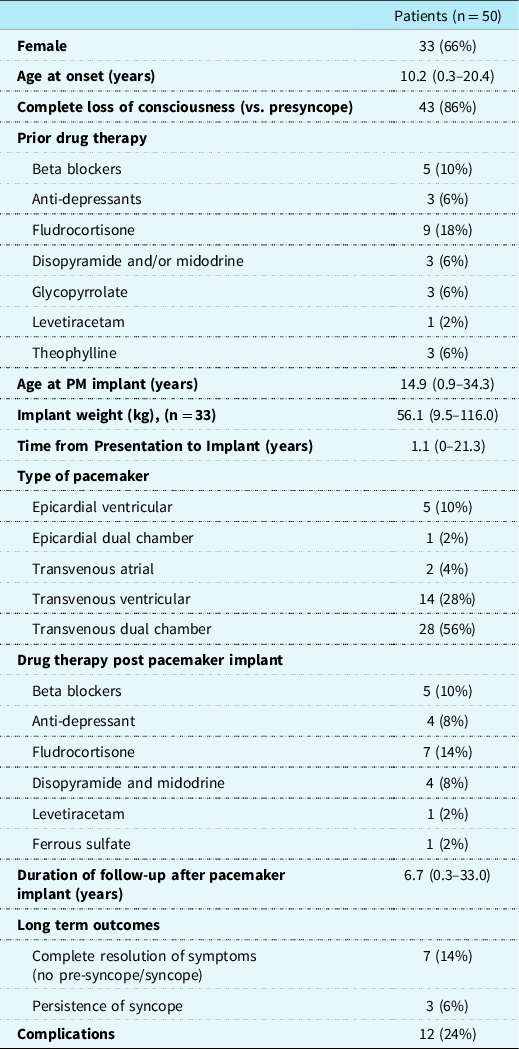
Over the 40-year study period, there were 11,114 patients evaluated by the Department of Cardiology for syncope. Fifty patients with structurally normal hearts had pacemakers implanted (0.4%). Patient characteristics are summarised in Table 1. The median age at presentation was 10.2 years, with a majority being female (66%).
Patient and device characteristics

Variables listed as number (percent) or median (range)
Diagnosis and indications for pacing
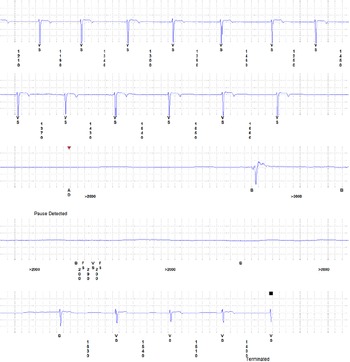
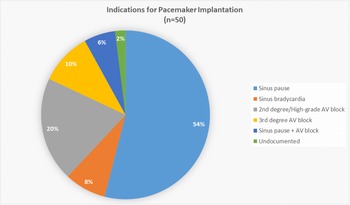
The method of diagnosis was available in 47 patients. One patient with breath-holding spells had pauses noted, but it was unclear whether the mechanism was sinus arrest or atrioventricular block from the available records. Pauses were noted in 10 patients with event monitors, 9 implanted loop recorders (all implanted after 1999), 9 on telemetry while in the hospital, 6 24-hour ambulatory monitors, 1 during an exercise test, and 1 on electro-encephalographic monitoring. Median duration of the pauses was 9 seconds (range 3–88 seconds), with a representative example noted in Figure 1. Eight patients in this cohort had tilt tests done. Positive tilt tests were noted in six patients, four with sinus bradycardia to the 30s and two with sinus pauses greater than 3 seconds. Two patients with negative tilt tests were noted to have significant pauses on subsequent monitoring. Thirteen (26%) had tonic–clonic motions associated with their syncope; all of these patients had sinus pauses. Figure 2 summarises the indications for pacemaker implantation in this cohort. Significant sinus bradycardia or pauses were the predominant reasons for pacemaker implant (n = 27, 54%) in the overall cohort, followed by intermittent high-grade atrioventricular block (n = 15, 30%). Three (6%) patients had both sinus pauses and atrioventricular block documented. Frequency of symptoms, either presyncope or syncope, were available in 29 patients – daily symptoms were present in 13 patients, weekly in 11, monthly in 3, quarterly in 1 and sporadic in 1. In the patient with sporadic symptoms, they first presented with a loss of consciousness while driving, resulting in a significant automobile accident. Overall, asystole from sinus pauses or atrioventricular block was documented in 43 (91%) patients prior to pacemaker implant.
Representative example of a prolonged sinus pause noted on an implanted loop monitor.

Underlying rhythm abnormalities leading to pacemaker implantation in this cohort of patients.

Medical therapy
A median of 1.1 years passed between presentation to pacemaker implantation. Between presentation to pacemaker implant, a variety of medications were attempted with limited efficacy. Glycopyrrolate, theophylline, anti-depressants or levetiracetam were used more frequently in the younger cohort of patients, compared with beta-blockers, fludrocortisone, midodrine and disopyramide in the older patients.
Device characteristics
The majority of patients had transvenous devices (88%). Dual-chamber devices were placed in 58%. Two patients with sinus pauses had atrial pacemakers only. The remainder of the devices were ventricular pacemakers (38%). All patients with dual-chamber devices were programmed DDI or DDD with atrioventricular delays programmed over 180 ms. Of the ventricular pacemakers, 9 were programmed VVI, with the other 10 programmed VVI with hysteresis programmed on (<40 bpm in 8 patients). In terms of percent pacing, this ranged from 0.1 to 24%, with 15 patients having pacing of 1% or less. In eight patients, the percent pacing was not recorded.
Outcomes
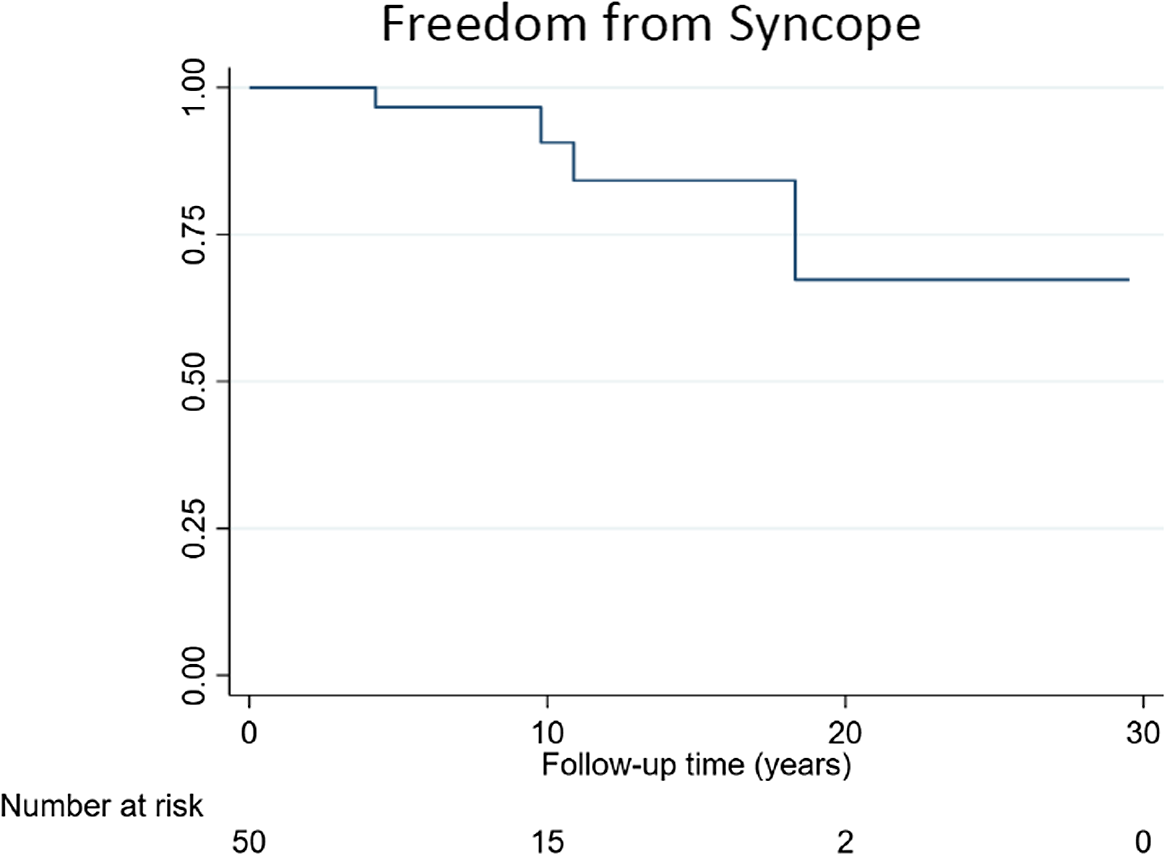
Median follow-up was 6.7 years (0.4–33 years). Post-pacemaker implantation, 4 (8%) patients, implanted at ages 11–19 years, continued to have syncope associated with sinus pauses or atrioventricular block. The remaining patients (92%) had no further syncope, with 7 (14%) reporting complete resolution of their symptoms, with no further dizziness or syncope. Of these latter patients, five subsequently had their devices explanted or turned off. Figure 3 shows the freedom from syncope adjusted for time and length of follow-up after pacemaker implantation. The remaining patients reported improvement in their symptoms, with a decrease in the frequency of their pre-syncopal episodes and no further syncope
Kaplan-Meier curve showing freedom from syncope after pacemaker implantation over time.

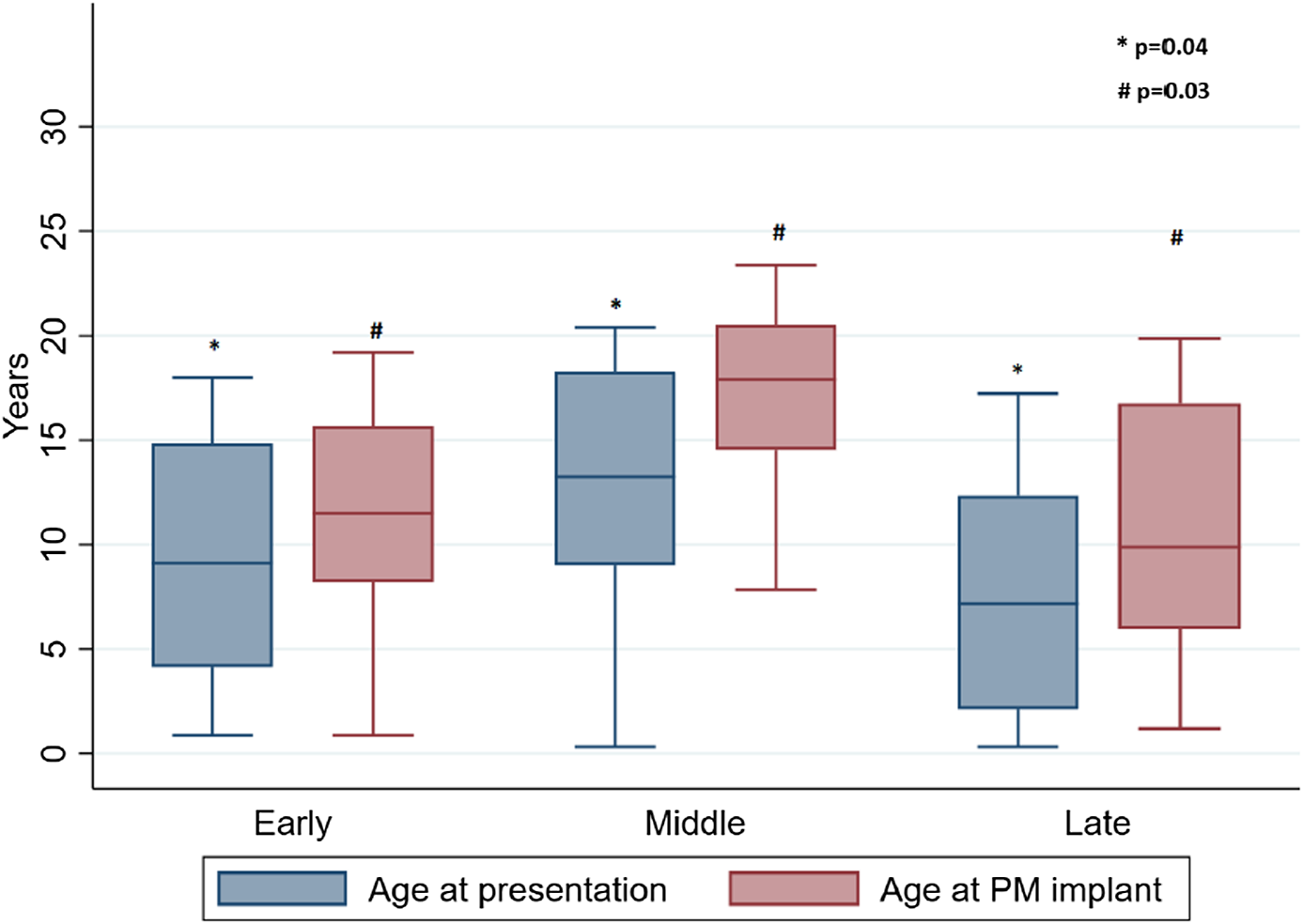
Comparison of patient age at presentation and age at pacemaker implantation over the early (1978–1999), middle (2000–2009) and late (2010–2018) eras.

Complications
Twelve (24%) patients had complications associated with their devices. Four major complications (8%) included two periprocedural complications and two infections. The former involved a moderate pericardial effusion treated medically with ibuprofen after placement of an epicardial ventricular pacemaker in a 7-month-old for sinus pauses, and a tear in the septal leaflet of the tricuspid valve during placement of a transvenous ventricular lead resulting in mild tricuspid valve regurgitation in a 19-year-old with sinus pauses. Two patients had infection of their devices 9 months and 5 years after implant, resulting in pacemaker removal. Eight patients had lead malfunctions. Two patients had their malfunctioning leads abandoned and new leads placed (lead ages 3 years and 15 years). Six patients underwent extractions, with one patient undergoing two extractions, with a median lead age of 8 years (range 0.17–16 years). There were no complications from the extractions. Finally, there was a 12-month-old who had intermittent diaphragmatic stimulation from their epicardial ventricular lead that improved by decreasing the pacing output. When comparing those with and without complications, there were no risk factors noted, including median age at implant (14.9 vs. 13.3 years, p = 0.9), epicardial device (2/12 vs. 4/38, p = 0.6) and dual chamber device (6/12 vs 22/38, p = 0.7).
Comparison of eras
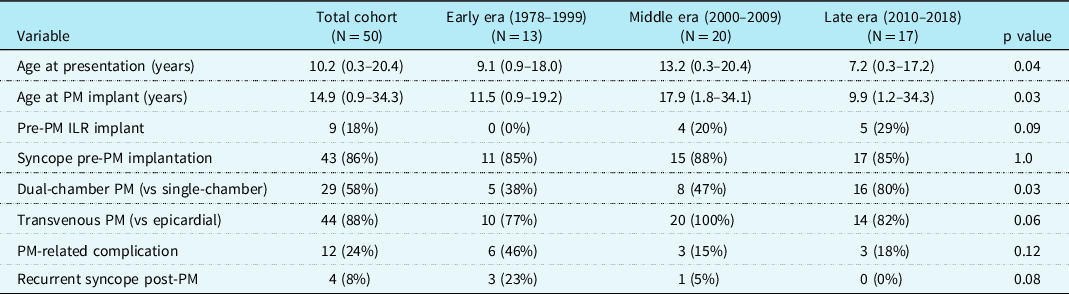
Table 2 summarises the differences in patient and device characteristics by era. Patients presented at a later age between 2000 and 2009, resulting in an older median age at pacemaker implantation (Fig 3). The use of implantable loop recorders grew overtime, although did not reach statistical significance. The use of epicardial devices became less common, while the use of dual-chamber pacemakers grew. Recurrent syncope was more prevalent in the earlier eras after pacemaker implantation, and although it did not reach statistical significance, there was a higher proportion of complications in the early era compared to the middle and late eras.
Comparison patient and device characteristics over the early, middle and late eras

Variables listed as number (percent) or median (range).
ILR: implantable loop recorder; PM: pacemaker
Discussion
Implantation of a permanent pacemaker can be an effective therapy for reflex-mediated syncope in the paediatric and young adult population. In this retrospective cohort of patients, 92% of patients had no further syncope after a pacemaker was placed. The majority of patients (91%) had documented asystole from sinus pauses or atrioventricular block prior to pacemaker placement, with only six patients having pacemakers placed due to positive tilt tests. Major complication rates in this cohort of patients were high (8%).
The literature on pacing for adults with syncope has mixed results. A systematic review Reference Varosy, Chen, Miller, Noseworthy, Slotwiner and Thiruganasambandamoorthy9 highlighted the fact that unblinded studies often show a therapeutic benefit from implanting pacemakers in this patient population, but when looking at blinded studies, there was no significant change in syncopal events, pointing towards an expectation bias from patients and their medical providers. An exception to this is the double-blinded ISSUE-3 trial Reference Brignole, Menozzi and Moya4 that showed the pacemaker implantation can be useful in patients in whom asystole is documented prior to placing a device (with 75% having no further syncopal events). This may explain the higher response rate to pacing in our patient population, with over 90% having asystole documented prior to placement of a device.
Implanting permanent devices in children and young adults comes with technical challenges and long-term repercussions, as highlighted by the 8% major complication rate in our study. Unfortunately, the response to medical therapy for syncope is limited in this select cohort of patients. Drug therapy was attempted in 16 of 40 (40%) patients in our study, with no significant impact on the patient’s syncopal events, consistent with what has been previously documented in the literature. Glycopyrrolate, theophylline, anti-depressants and levetiracetam are more commonly used in the younger, breath-holding cohort. Given the asystole associated with severe breath-holding spells in infants and young children, the vagolytic effect of glycopyrrolate or stimulant effect of theophylline have been trialed, but are often ineffective in preventing episodes, and have significant side-effects such as thickened secretions, nausea and feeding intolerance. Reference Carano, Bo, Zanetti, Tchana, Barbato and Agnetti10 The use of selective serotonin-receptor inhibitors and levetiracetam are more novel, but proof of their efficacy is limited. Reference Vyas, Swaminathan, Zimmerman and Olshansky11–Reference Walsh, Knilans, Anderson and Czosek13 In older patients, the use of beta-blockers, vasopressors and mineralocorticoids have been well studied, but their efficacy may be limited, with conflicting results as to whether they have long-term benefits in preventing loss of consciousness episodes. Reference Vyas, Swaminathan, Zimmerman and Olshansky11,Reference Izcovich, Gonzalez Malla, Manzotti, Catalano and Guyatt14–Reference Sheldon, Raj and Rose17
Prior studies have shown the effectiveness of pacing infants and young children with significant breath-holding spells. Reference Kelly, Porter, McGoon, Espinosa, Osborn and Hayes6,Reference Sartori, Nosadini and Leoni18 Transvenous devices for these patients appear to be more common in the literature (63%) compared to our cohort, which is understandable given the more invasive nature of epicardial systems and higher predilection for lead fracture. Reference Fortescue, Berul, Cecchin, Walsh, Triedman and Alexander19,Reference Takeuchi and Tomizawa20 The predominant concern for transvenous leads is the risk of venous occlusion in up to 25% in young patients, Reference Fortescue, Berul, Cecchin, Walsh, Triedman and Alexander19 which may be less of a concern for breath-holding patients as their spells tend to resolve over time and the need for long-term lead management is less likely.
Changes in practice patterns were noted over the 40-year study period. Patients tended to be older at the time of presentation, and thus at pacemaker implantation, during the middle era. It is unclear why that would be the case, although it may reflect changes in patient selection. Epicardial pacemakers were more common in the early era, as were pacemaker complications. Providers may have moved away from recommending pacemakers, opting to place devices in those who were older and presented later in life. With advancements in implantation tools and devices in the later era, as well as the growing use of implanted loop recorders to document significant pauses, providers once again began recommending device implantation in younger patients deemed to be at risk for recurrent syncope. Epicardial devices grew concurrently with this trend. Dual-chamber devices also grew over time, again as the comfort level increased in recommending devices for patients with significant pauses, aiming to optimise their symptoms and quality of life with atrioventricular sequential pacing. Reference Lamas, Lee and Sweeney21,Reference Stone, Bhakta and Lutgen22 Finally, complication rates decreased over time but remained elevated in the range of 15–20% in the recent eras. In the future, the use of leadless pacemakers may grow in the adolescent and young adult cohort, decreasing the risk of infection and lead malfunction in this cohort of patients. However, this should be balanced against the potential quality of life improvement that may come from a more traditional dual chamber system.
The results of this study should be interpreted with an understanding of its limitations. This is a retrospective study, with some patients missing important data such as their method of diagnosis or duration of asystole. Follow-up was also limited in some patients, which may have resulted in missed episodes of syncope. Moreover, after pacemaker implantation, only data on improvement of symptoms was readily available; decision making on why programming or medication changes that were performed were difficult to obtain. This study is not blinded and is open to the expectation bias and placebo effect noted in prior studies. The lack of a control group also makes it difficult to determine whether the symptomatic improvement of our cohort was due solely to the pacemaker, or natural history of syncope in this patient population. However, given the relative rarity of pacemaker use in this population, reserved primarily for patients with documented pauses, it would be difficult to find an appropriate control group. Patients with reflex-mediated syncope without documented pauses may not provide an accurate comparison. Nonetheless, the findings of this study are consistent with that of the ISSUE-3 trial in adults, and stresses the importance of documenting asystole in children before implanting a permanent pacemaker.
In conclusion, pacemaker implantation for reflex-mediated syncope in the paediatric population is rarely indicated. However, those with severe episodes of syncope can be treated effectively with pacing as demonstrated in this retrospective cohort, in which there was temporally related symptom improvement with pacemaker implantation. Complication rates are relatively high in this young population, and as such, permanent pacemakers should be reserved only for patients in which asystole from sinus pauses or atrioventricular block have been well documented.
Acknowledgements
Thank you to Kimberlee Gauvreau, ScD, for her assistance with the completion and verification of the statistical analysis.
Financial support
This research received no specific grant from any funding agency, commercial or not-for-profit sectors.
Conflicts of interest
None.