Introduction
Carabid beetles (Coleoptera: Carabidae) represent a large and diverse group of generalist predators, with more than 40 000 described species (Capinera Reference Capinera2008). Their diversity and abundance depend mainly on food resources, habitat type/structure, and farming practices (Symondson et al. Reference Symondson, Glen, Wiltshire, Langdon and Liddell1996; Kromp Reference Kromp1999; Menalled et al. Reference Menalled, Lee and Landis1999). Carabids are ubiquitous in arable lands and can significantly reduce populations of crop pests (Kromp Reference Kromp1999; Menalled et al. Reference Menalled, Lee and Landis1999; Symondson et al. Reference Symondson, Sunderland and Greenstone2002; Lang Reference Lang2003). For instance, their role as biological control agents of cereal aphids has been documented in grain fields in Europe, where control of aphid populations occurs mainly early in the season (reviewed by Kromp Reference Kromp1999). Some carabid species can be particularly voracious, consuming aphids that fall off plants or climbing onto the plant to catch their prey (Chiverton Reference Chiverton1988; Winder Reference Winder1990; Losey and Denno Reference Losey and Denno1998). Most carabids are ground dwelling and forage nocturnally; their contribution as biological control agents is often considered complementary to that of diurnal foliar predators (Losey and Denno Reference Losey and Denno1998, Reference Losey and Denno1999; Grez et al. Reference Grez, Rivera and Zaziezo2007).
Since its invasion of North America in 2000, the soybean aphid, Aphis glycines Matsamura (Homoptera: Aphididae), has become the most important pest species in soybean fields (Ragsdale et al. Reference Ragsdale, Landis, Brodeur, Heimpel and Desneux2011). Large populations of A. glycines can reduce soybean yield and generate additional economic and environmental costs through insecticide applications (Ragsdale et al. Reference Ragsdale, Hodgson, McCornack, Koch, Venette and Potter2006). Much work has been done on the identity and impact of natural enemies of this invasive pest throughout infested regions (Brown et al. Reference Brown, Sharkey and Johnson2003; Fox et al. Reference Fox, Landis, Cardoso and Difonzo2004; Rutledge et al. Reference Rutledge, O'Neil, Fox and Landis2004, Rutledge and O'Neil Reference Rutledge and O'Neil2005; Costamagna and Landis Reference Costamagna and Landis2006). In Québec, Canada, the community of generalist foliar predators, both indigenous and naturalised, is dominated by four species of Coccinellidae (Coleoptera) (Mignault et al. Reference Mignault, Roy and Brodeur2006) and exerts top-down control of A. glycines populations (Rhainds et al. Reference Rhainds, Roy, Daigle and Brodeur2007). Assemblages of ground arthropod predators, mostly carabid beetles in association with A. glycines populations, were studied in soybean fields in Illinois (United States of America) (Rutledge et al. Reference Rutledge, O'Neil, Fox and Landis2004) and New York (United States of America) (Hajek et al. Reference Hajek, Hannam, Nielsen, Bell and Liebherr2007). According to Hajek et al. (Reference Hajek, Hannam, Nielsen, Bell and Liebherr2007), carabid beetles likely contribute to a reduction in soybean aphid populations since negative correlations between carabid and aphid densities are found.
The objectives of this study were (1) to characterise the species diversity and the summer seasonal activity-density of carabid beetles associated with soybean fields infested by A. glycines in Québec and (2) to investigate how time (sampling date), space (field location), and food resource (A. glycines density) influence carabid assemblages.
Methods
Field survey
The study was conducted in commercial soybean fields in Québec (Canada) in 2004 and 2005. Carabids were sampled in six fields from 14 June to 7 September (13 weeks) in 2004 and in seven fields from 30 June to 24 August (5 weeks) in 2005. Fields in 2004 were in Nicolet-Sud, St-Augustin-de-Dermaures, Maskinongé, Hérouxville, St-Mathias-sur-Richelieu, and St-Denis-sur-Richelieu. Another sampling site, St-Constant, was added in 2005. Fields differed in their planting dates (from early May to early June) and followed commercial agricultural practices. In both years, carabid sampling started prior to the arrival of A. glycines to soybean fields.
Carabid beetles were sampled using pitfall traps (12 per field). Traps consisted of a plastic container with a top diameter of 10 cm and a depth of 7 cm buried in the soil such that the top of the trap was at ground level. Four traps were placed on three rows 10 m away from each other and 10 m away from field margins. Traps on a same row were separated by 10 m from each other. Rows were aligned perpendicular to the proximate road. In 2004, traps were filled with a solution of ethylene glycol and water (1:1) rather than with alcohol because the content of the traps was collected once a week and alcohol would have evaporated. Because overcrowding occurred in traps in 2004, sampling in 2005 was conducted once every 2 weeks and traps were left open only for 24 hours. These traps were filled with 70% alcohol. Samples were returned to the laboratory and Carabidae adults were identified to species using the key in Larochelle (Reference Larochelle1976). Identifications were confirmed by the Laboratoire de Diagnostic en Phytoprotection (Ministère de l'Agriculture des Pêcheries et de l'Alimentation du Québec, Québec, Canada). Specimens have been deposited at the Collection d'insectes du Québec, Sainte-Foy (Québec), Canada. The abundance of each species used in statistical analyses (multivariate analysis of variance [MANOVA]) was calculated as the number of individuals per trap over 24 hours for each week sampled.
Aphis glycines populations were estimated in parallel with carabid sampling throughout the season. All aphids on five plants were counted at 10 stations; stations were separated by approximately 100 m along a zigzag transect in the same field but not within the carabid sampling zone to avoid disturbance (Roy and Mignault Reference Roy and Mignault2003). Aphid density was calculated as the mean number of A. glycines per plant (±SE) per week of sampling. Aphids were identified using Mignault and Roy (Reference Mignault and Roy2003).
Statistical analyses
Total carabid abundance was calculated for each field sampled in 2004 and 2005 and species richness was calculated for pooled data (all fields combined) for each year. We used rarefaction curves to evaluate species richness per field in both years. Individual-based rarefaction analysis provides an estimate of community richness by showing the accumulation of expected species richness as a function of individuals sampled (Gotelli and Colwell Reference Gotelli and Colwell2001). This method can be used to compare sampling sites with different sampling efforts and is complementary to traditional diversity indexes, which can provide inconsistent results (Buddle et al. Reference Buddle, Beguin, Bolduc, Mercado, Sackett and Selby2005). In our study, we relied on rarefaction curves to determine if we collected enough samples to characterise carabid assemblages in soybean fields. Total abundance of each carabid species over the weeks of sampling in both years were used to calculate expected species richness values with EcoSim 7.72 (on a base of 1000 permutations) (Gotelli and Entsminger Reference Gotelli and Entsminger2009).
For all further analyses, we used data from only 11 weeks of sampling in 2004 because two fields (St-Mathias-sur-Richelieu and St-Denis-sur-Richelieu) were sampled during 11 weeks from 21 June to 2 September 2004. We also selected the nine dominant carabid species in both 2004 and 2005. Data used for analysis were the standardised abundance calculated as the number of individuals per trap over 24 hours for each sampling period.
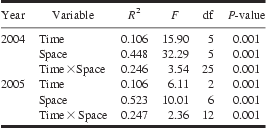
MANOVA without replication (Model 3) was used to test for the influence of space (field sampled) and time (sampling date) as well as their interactions on carabid assemblages. We used the space–time interaction (STI) function in the principal coordinates of neighbour matrices package (http://sites.google.com/site/miqueldecaceres/software) before conducting further multivariate analyses (Legendre et al. Reference Legendre, De Cáceres and Borcard2010) to test STI. Because data from 2004 to 2005 were not compared with each other, we performed distinct multivariate analyses by pooling numbers of carabid individuals from the six fields sampled during each of the 11 sampling weeks in 2004 and from the seven fields sampled during 5 weeks in 2005. Prior to the analyses, species data were transformed with the Hellinger distance adapted for the analysis of community composition (Legendre and Gallagher Reference Legendre and Gallagher2001). To visualise the interaction between time and space variables within a year, data were analysed by K-means partitioning (Legendre et al. Reference Legendre, De Cáceres and Borcard2010) using the cascade KM function of the vegan package (Oksanen et al. Reference Oksanen, Kindt, Legendre and O'Hara2007) in the R statistical language. K-means partitioning is used to identify interactions between time and space among sampling sites. We used the simple structure index rather than Calinski index, to identify the best number of clusters with a minimum of variance (Legendre et al. Reference Legendre, De Cáceres and Borcard2010): the index was maximal for six groups in 2004 and for four groups in 2005. The spatiotemporal representations of the partitioning only include the nine most abundant carabid species in both years (see Table 1 for species).
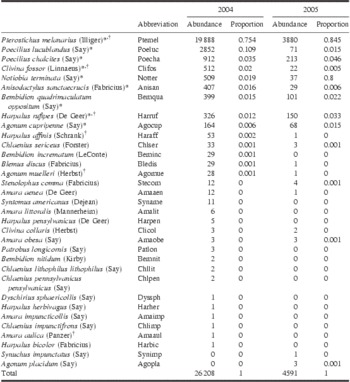
List of carabid beetle species and number of individuals collected in soybean fields in 2004 and 2005 in Québec, Canada.

*Indicates dominant species used for multivariate and partial canonical redundancy analysis.
†Indicates species not native to North America.
We conducted a partial canonical redundancy analysis (RDA) to examine the relative contribution of the time variable (sampling date) for the nine most abundant species for each year. Species with more than four individuals collected over the 2005 season were considered as dominant. We removed the confounding effects of the space variable and the STI since they were significant factors in the MANOVA analysis for both years (see Table 2). Finally, to obtain the relative contribution of each variable to carabid species activity-density, we partitioned the explained variation by including time, space, and A. glycines density for each year (Peres-Neto et al. Reference Peres-Neto, Legendre, Dray and Borcard2006) with the varparts function of the vegan package (Oksanen et al. Reference Oksanen, Kindt, Legendre and O'Hara2007) in the R statistical language.
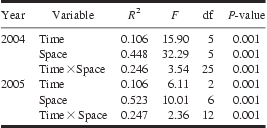
Multivariate analysis of variance results on the effect of time (sampling date), space (field), and the time × space interaction on activity-density of the nine most abundant carabid beetles.
Results
Carabid species diversity and abundance
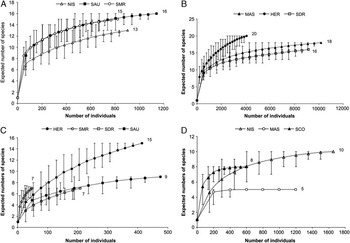
We collected 26 208 adult carabid specimens in 2004 from 31 different species and 4591 specimens in 2005 from 19 species (Table 1). Out of the combined total of 33 species from 15 genera, six species are non-native: Pterostichus melanarius (Illiger), Clivina fossor (Linnaeus), Harpalus rufipes (De Geer), Harpalus affinis (Schrank), Agonum muelleri (Herbst), and Amara aulica (Panzer). Pterostichus melanarius numerically dominated the carabid assemblage in soybean, making up 75.8% and 84.5% of the total individuals in 2004 and 2005, respectively (Table 1). Rarefaction curves in 2004 reached asymptotes in the six fields, indicating that our sampling effort was sufficient to characterise the entire carabid assemblage (Fig. 1A and 1B). In contrast, rarefaction curves in 2005 suggest that too few individuals were collected to adequately describe carabid community composition in three fields (SMR, SDR, and HER; Fig. 1C). Then, we observed a large variation in species richness among fields within and between years. The total species richness was consistently greater in 2004 (31 species) than in 2005 (19 species).
Rarefaction curves for the soybean fields sampled for carabid species diversity in 2004 and 2005. Curves result from plotting the expected number of species as a function of the number of individuals for fields in 2004 having fewer (A) and more (B) than 1200 individuals sampled and in fields in 2005 having fewer (C) and more (D) than 500 individuals sampled duals sampled. Field locations: NIS = Nicolet Sud, SAU = St-Augustin-de-Desmaures, MAS = Maskinongé, HER = Hérouxville, SMR = St-Mathias-sur-Richelieu, SDR = St-Denis-sur-Richelieu, SCO = St-Constant.

Carabid assemblage composition in relation to time, space, and A. glycines density
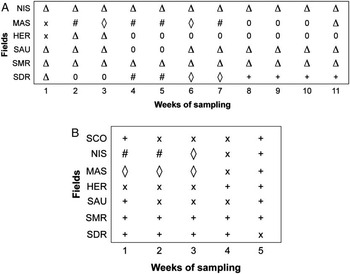
The MANOVA revealed that variation in carabid activity-density is influenced by time and space factors and that both interact (Table 2), hence, sites of sampling varied each other independently. To illustrate this interaction pattern, the K-means partitioning in Fig. 2A and 2B show the variation in carabid activity-density (nine most abundant species) between fields and sampling dates for both years. In 2004, some fields (NIS, HER, SAU, and SMR) were relatively consistent in their number of specimens collected throughout the sampling period (dominance of Δ and 0), but other fields (MAS and SDR) showed large variations (community changes in five different groups) (Fig. 2A). In 2005, fields SCO, HER, SAU, SDR, and SMR only showed variations between two levels of abundance (dominance of X and +), whereas NIS, and MAS showed large variations throughout the summer season (from 3 to 4 groups) (Fig. 2B).
Spatiotemporal representation showing the K-means partitioning of the six fields sampled (A) in 2004 and (B) seven fields in 2005 as a function of sample week into six groups of observations.

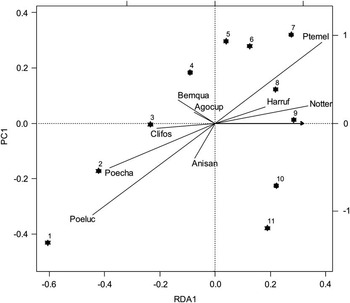
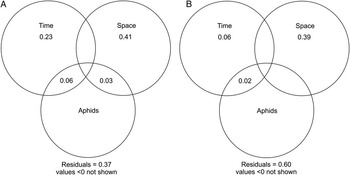
The effect of the time variable on carabid activity-density was significant in 2004 (RDA; F = 17.403, P = 0.001) but not in 2005 (F = 2.81, P = 0.115). The sampling period explained 16.22% of the carabid activity-density variation observed in 2004. Six carabid species (Poecilius lucublandus, Poecilius chalcites, Anisodactylus sanctaecrucis, C. fossor, Agonum cupripenne, and Bembidion quadrimaculatum oppositum) appear in the fields early in the summer season while the three others (P. melanarius, Notiobia terminata, and H. rufipes) became common later in the mid-summer season (RDA; Fig. 3). In 2004, carabid activity-density was strongly influenced by space (0.41) and time (0.23), but not by aphid density (0) (Fig. 4A). In 2005, carabid activity-density was also strongly influenced by space (0.39), but not by time (0.06) or aphid density (0) (Fig. 4B).
Redundancy analysis (RDA) biplot depicting relationships between the nine dominant carabid species (black vector) and the time variable (black arrow) (RDA result: F = 17.403, P = 0.001, R 2 = 16.22%). Numbers represent the sample week for a given field. See Table 1 for carabid species abbreviations.

Variation partitioning diagrams representing the contribution of time, space, and A. glycines density to the activity-density of the nine dominant carabid species in (A) 2004 and (B) 2005.

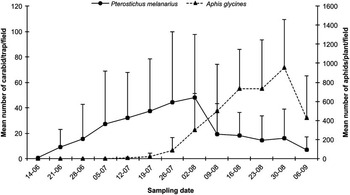
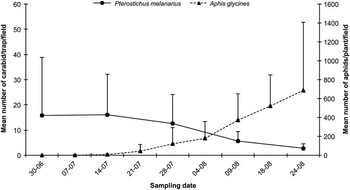
Figs. 5 and 6 show summer seasonal variations in A. glycines density in 2004 and 2005 in relation to the activity-density of the nine most common carabid species with a focus on P. melanarius. Patterns of activity-density response were similar for the nine carabid species and P. melanarius, as expected from the dominance of P. melanarius in carabid assemblages. Population activity-density patterns differed greatly between carabids/P. melanarius and A. glycines, with predators reaching their maximal activity-density in late July, just when aphid populations started to increase (Figs. 5 and 6). In 2004, aphid populations were maximal in mid-August, when carabid populations had decreased to half their maximum activity-density (Fig. 5).
Mean activity-density of carabids (nine dominant species), Pterosticus melanarius, and density of Aphis glycines in soybean fields in 2004 (bars represent standard deviation). Mean carabid numbers are per trap per field for each sampling period. Mean numbers of aphids are per plant per field for each sampling period.

Mean activity-density of carabids (nine dominant species), Pterosticus melanarius, and density of Aphis glycines in soybean fields in 2005 (bars represent standard deviation). Mean carabid numbers are per trap per field for each sampling period. Mean numbers of aphids are per plant per field for each sampling period.

Discussion
Carabid assemblage in Québec soybean fields
The diversity of carabid species observed in Québec soybean fields is similar to those previously reported in Michigan (United States of America) (Rutledge et al. Reference Rutledge, O'Neil, Fox and Landis2004) and New York (United States of America) (Hajek et al. Reference Hajek, Hannam, Nielsen, Bell and Liebherr2007). In 2004, we collected from 13 to 20 different species per field for a total of 31 species, with a clear dominance of P. melanarius in all fields. In comparison, Rutledge et al. (Reference Rutledge, O'Neil, Fox and Landis2004) observed between 21 and 29 species per field and year in Michigan, with Agonum placidum (Say) or Clivina impressifrons LeConte being the most common. In New York, Hajek et al. (Reference Hajek, Hannam, Nielsen, Bell and Liebherr2007) collected from 11 to 35 species per field, with A. muelleri (Herbst) being the dominant species. Differences in sampling methods between studies may account for a bias in the dominant species observed. Work et al. (Reference Work, Buddle, Korinus and Spence2002) showed that pitfall traps of small diameter preferentially trap smaller species. Rutledge et al. (Reference Rutledge, O'Neil, Fox and Landis2004) used pitfall traps of 8.5 cm in diameter, which are likely to have preferentially trapped smaller species such as C. impressifrons (5.9–7.0 mm) and A. placidum (6.9–8.8 mm). The large pitfall traps used by Hajek et al. (Reference Hajek, Hannam, Nielsen, Bell and Liebherr2007) (11.5 cm) and in our study (10 cm) are better designed to catch bigger individuals such as A. muelleri (7.0–9.5 mm) and P. melanarius (12–20 mm). Characteristics of the crops and farming practices might also contribute to explain why P. melanarius is dominant in our fields over other carabid species. Crop rotation, organic or conventional farming, type of field margins, and tillage can influence carabid richness and abundance (Rochefort et al. Reference Rochefort, Shetlar and Brodeur2006; Menalled et al. Reference Menalled, Smith, Dauer and Fox2007; Bourassa et al. Reference Bourassa, Cárcamo, Larney and Spence2008; O'Rourke Reference O'Rourke, Liebman and Rice2008; Davis et al. Reference Davis, Currie, French and Buschman2009). Pterostichus melanarius has been shown to be more abundant in conventional farming than other carabid species (Kromp Reference Kromp1990).
A careful evaluation of carabid diversity requires exhaustive sampling and post-hoc verification through the use of rarefaction curves. Observed carabid richness and abundance in 2005 were lower than in 2004, and rarefaction curves revealed that the carabid assemblage in 2005 was only partially sampled in some fields (three out of seven). Pitfall traps remained open all week for 13 weeks in 2004, with samples collected once a week, but only for 24 hours during each of the 5 weeks in 2005. Some studies have tried to determine the minimum sampling effort necessary to obtain a reliable description of carabid diversity within an ecosystem. For example, trapping conducted for 10 days in both early and late season is sufficient to capture the most common ground beetle species in coniferous forest (Niemelä et al. Reference Niemelä, Halme and Haila1990). A large number of pitfall traps (from 25 to 50 per 15 000 m2) is required to provide a good estimate of carabid diversity in agroforests (Vennila and Rajagopal Reference Vennila and Rajagopal1999). In agricultural crops, carabid species with different overwintering strategies colonise fields at different times during the season (Kromp Reference Kromp1999). As observed in soybean fields, species overwintering as adults, such as P. lucublandus or P. chalcites, are collected early in the summer season compared with species with a larval overwintering strategy, such as P. melanarius or H. rufipes (Fig. 4). Our analysis suggests that sampling ground beetles throughout the soybean growing season is necessary to provide a realistic picture of carabid biodiversity and summer seasonal activity-density.
In soybean fields in Québec, the carabid assemblage is dominated by exotic species. The six non-native species colonising soybean fields have all been introduced from Europe and represented 79% and 88% of the total number of carabid beetles captured in 2004 and 2005, respectively. Pterostichus melanarius accounts for more than 95% of the exotic individuals captured during our study. A similar pattern of exotic species dominance was observed in turfgrass lawns of Québec, with H. rufipes (De Geer), a European Palaearctic species, being the most common species (Rochefort et al. Reference Rochefort, Shetlar and Brodeur2006). Carabid assemblages observed in soybean fields in other regions of North America also include exotic species but to a lesser extent: 16.7% in New York state (Hajek et al. Reference Hajek, Hannam, Nielsen, Bell and Liebherr2007) and 10.3% in Michigan (Rutledge et al. Reference Rutledge, O'Neil, Fox and Landis2004).
In Canada, P. melanarius dominates carabid assemblages in numerous habitats: meadows in Alberta (Cárcamo et al. Reference Cárcamo, Niemalä and Spence1995), woodlands in Ontario (Pearce et al. Reference Pearce, Schuuman, Venier and McKee2002), and raspberry fields and vineyards in Québec (Levesque and Levesque Reference Levesque and Levesque1994; Goulet et al. Reference Goulet, Lesage, Bostanian, Vincent and Lasnier2004). The flight ability of P. melanarius, its flexibility in habitat use and its association to human modified habitats could explain its important colonisation of disturbed as well as undisturbed habitats (Niemelä and Spence Reference Niemelä and Spence1991). The competition with native carabid species is also put forward to explain the widespread of P. melanarius (Hokkanen and Holopainen Reference Hokkanen and Holopainen1986; Spence and Spence Reference Spence and Spence1988, Niemelä et al. Reference Niemelä, Spence and Cárcamo1997), whereas others favour the hypothesis of the biological community unsaturated permitting the exploitation of abundant resources or the occupation of niche free from native species by P. melanarius (Niemelä and Spence Reference Niemelä and Spence1991). Because conventional farming practices such as tillage and pesticide applications are less detrimental to P. melanarius than other carabid species (Kromp Reference Kromp1990; Hatten et al. Reference Hatten, Bosque-Pérez, Johnson-Maynard and Eigenbrode2007), these factors may have also favoured the colonisation and exploitation of soybean fields by P. melanarius.
Influence of temporal, spatial, and food resource variables on carabid assemblages
The significant STI in 2004 and 2005 revealed that soybean fields differed greatly between each other in their carabids activity-density response. Also, our analysis revealed that carabid assemblages are more influenced by space (field sampled) and time (sampling date) than by the presence and density of A. glycines. Farming practices, habitat structure, and the presence of refuge strips and corridors are examples of field characteristics that have an impact on diversity, abundance, and Carabidae activity in crops (Carmona and Landis Reference Carmona and Landis1999; Östman et al. Reference Östman, Ekbom, Bengtsson and Weibull2001; Weibull and Östman Reference Weibull and Östman2003; Weibull et al. Reference Weibull, Östman and Granqvist2003; Purtauf et al. Reference Purtauf, Dauber and Wolters2005).
The life history traits of carabid species explain much of the influence of the time variable on their activity-density. Adult carabids colonise fields at different periods depending on their overwintering strategies and breeding period. Those that overwinter as adults (called spring breeders) are often the first species observed in the field whereas species that overwinter as larvae (called summer/autumn breeders) are usually more abundant later in the season (Kromp Reference Kromp1999). Among the nine dominant species we collected, P. lucublandus, P. chalcites, C. fossor, A. sanctaecrucis, A. cupripenne, and B. quadrimaculatum oppositum overwinter as adults (Lindroth Reference Lindroth1992) and, accordingly, have an early activity-density peak, i.e., from mid-June to mid-July. In contrast, the three other species, P. melanarius, H. rufipes, and N. terminata, overwinter as larvae (Lindroth Reference Lindroth1992) and are more abundant later in the summer season, i.e., from late July to mid-August.
There was no correlation between carabid activity-density and aphid density in soybean fields in either 2004 or 2005, as shown by the variation partitioning analysis. Carabid beetles are generalist predators, feeding on many invertebrate preys (Larochelle Reference Larochelle1990). For example, the strongly generalist predator P. melanarius feeds on aphids (Winder et al. Reference Winder, Alexander, Holland, Symondson, Perry and Woolley2005) as well as on slugs (Symondson et al. Reference Symondson, Glen, Erickson, Liddell and Langdon2000) and earthworms (King et al. Reference King, Vaughan, Bell, Bohan and Symondson2010); its fitness is enhanced when it develops on a mixed diet of prey (Harwood et al. Reference Harwood, Phillips, Lello, Sunderland, Glen and Bruford2009). Because of low prey specificity, carabids probably do not have a strong response to variations in prey density (Symondson et al. Reference Symondson, Sunderland and Greenstone2002). To clarify the potential of P. melanarius to prey on A. glycines and its role in reducing aphid population early in the season, experiments using molecular gut content analysis (as in King et al. Reference King, Vaughan, Bell, Bohan and Symondson2010) have been conducted.
Aphis glycines is a relatively new – first discovered in Québec in 2001 – and abundant food source for ground beetles. It has rapidly become the principal pest of soybeans within the agroecosystem (Ragsdale et al. Reference Ragsdale, Landis, Brodeur, Heimpel and Desneux2011). Although we observed no summer seasonal response in carabid population activity-density related to A. glycines density, this exotic aphid may have favoured populations of generalist predators over the years. This hypothesis has recently been put forward by Heimpel et al. (Reference Heimpel, Frelich, Landis, Hopper, Hoelmer and Sezen2010), who argued that the arrival of A. glycines in North America has likely contributed to an increase in the abundance of the aphid's natural enemies, namely exotic species such as Harmonia axyridis (Pallas) (Coleoptera: Coccinellidae) and the carabid beetle A. muelleri. Detailed population studies conducted over several years are needed to explore how A. glycines may impact the short-term and long-term population dynamics and community structure of carabid beetles.
Carabid beetles are abundant early in the soybean growth period and have the potential to slow the growth of A. glycines populations before the arrival of other aphidophagous predators, as suggested by Sunderland and Vickerman (Reference Sunderland and Vickerman1980). Our data showed that carabid populations reached an activity-density peak a few days before the colonisation of soybean fields by A. glycines. The presence of resident predators that buffer aphid populations could occur in conditions of high predator/prey ratio, as has been observed with the carabid Bembidion spp. (Holopainen and Helenius Reference Holopainen and Helenius1992) and the anthocorid bug Orius insidiosus (Say) (Hemiptera: Anthocoridae) (Harwood et al. Reference Harwood, Desneux, Yoo, Rowley, Greenstone and Obrycki2007). Although Sunderland and Vickerman (Reference Sunderland and Vickerman1980) suggested that P. melanarius has a low potential for reducing increases in aphid populations because of its low density during the early phase of aphid population growth, the pattern is different in Québec soybean fields because P. melanarius is abundant during the increasing phase (Fig. 5). This period is characterised by a high predator/prey ratio for P. melanarius/A. glycines, thus conditions are suitable for P. melanarius to act as a buffer to aphid populations. This scenario remains to be tested experimentally, for example, by using exclusion cages with low aphid density that mimics the situation occurring when A. glycines colonises crops.
Acknowledgements
The authors would like to thank Émilie Lemaire, Julie Mainguy, and Véronique Janelle for their help in the field. We thank Mario Fréchette for confirming the identifications of several specimens and Miquel De Cáceres and Pierre Legendre for statistical advice. We are grateful to Franz Vanoosthuyse for his help in producing figures. This work was supported by the Canada Research Chair in Biocontrol.