Genetic improvements and breast meat abnormalities
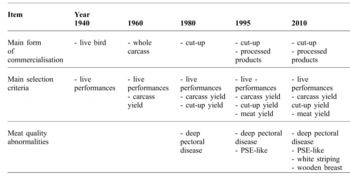
Selection criteria of broiler chickens has been adapted through the decades according to the evolution of the market demand for chicken meat and increased population growth (Table 1). As one example, before World War II poultry were marketed as live birds, and thus meat-type chickens were basically selected based on the characteristics of live birds. After this period, poultry started to be sold in the form of prepared carcasses in small markets and grocery stores in towns and cities, leading to an economic interest in selecting animals according to carcass yield. About 40 years ago, market demand towards cut-up portions increased and birds were selected according to main carcass part yields, such as breast and legs. Finally, during the last two decades, the increasing demand for further-processed products, coupled with a preference for breast meat in Western countries, has shifted selection towards birds with high breast development (Fletcher, Reference FLETCHER2004).
Relationships between the evolution of marketing forms, selection criteria of chicken broilers and appearance of breast meat abnormalities.

Reasons for the increasing demand of chicken breast meat are attributed to its healthy nutritional profile, sensory properties that make breast meat very flexible for any type of home-cooking style as well as for manufacturing processed products. Additionally, mild flavour and the high tenderness of breast meat allow imparting a wide range of desired flavour profiles and textures of processed meat products that meet market needs by targeting different groups of consumers. Finally, breast meat is very suitable for quick and easy home-cooking, which is very important in modern societies where people tend to spend increasingly less time on preparation of meals at home (Petracci et al., Reference PETRACCI, BIANCHI, MUDALAL and CAVANI2013a). As a consequence, the poultry industry has been pushed to increase breast yield and to produce heavier birds for further processing (Brewer et al., Reference BREWER, KUTTAPPAN, EMMERT, MEULLENET and OWENS2012). However, it also has to deal with meat quality issues that were not serious or significant when most poultry was sold as whole birds (Barbut et al., Reference BARBUT, SOSNICKI, LONERGAN, KNAPP, CIOBANU, GATCLIFFE, HUFF-LONERGAN and WILSON2008).
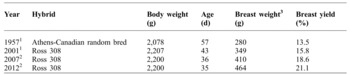
Consequently, the substantial genetic progress made in the last 50 years has resulted in reduction of the growing time by about one-half (to 40 days or less) to obtain a market weight bird (about 2 kg) (Havenstein et al., Reference HAVENSTEIN, FERKET and QURESHI2003a; Aviagen, 2007; 2012). Moreover, in the last 10 years breast meat yield has increased by 5%, and currently exceeds one fifth of the weight of the bird (Aviagen, 2012) (Table 2).
Progress in breast weight and yield in commercial broiler hybrids from 1957 to 2012.

1Havenstein et al. (Reference HAVENSTEIN, FERKET and QURESHI2003b); 2Aviagen (2007; 2012); 3breast muscles without bone and skin.
This substantial improvement has been achieved by increasing the growth rate of breast muscles by inducing hypertrophy in existing fibres, and, to a lesser extent, by hyperplasia because the total number of fibres is generally fixed after hatching. On the another hand, selected modern hybrids show a higher density of fast-twitch fibres that are characterised by a higher diameter and a lower rate of protein degradation compared with unselected birds (Mahon, Reference MAHON1999; Schreurs, Reference SCHREURS2000; Picard et al., Reference PICARD, LEFAUCHEUR, BERRI and DUCLOS2002; Scheuermann et al., Reference SCHEUERMANN, BILGILI, TUZUN and MULVANEY2004; Branciari et al., Reference BRANCIARI, MUGNAI, MAMMOLI, MIRAGLIA, RANUCCI, DAL BOSCO and CASTELLINI2009). Indeed, an increase in fibre size is associated with lower capillarisation that may lead, under certain conditions, to an inadequate supply of oxygen and nutrients to muscle cells. In addition, it may be associated with inadequate elimination of metabolic intermediate products that can compromise fibre functionality and result in homeostatic dysregulation. In particular, an increase in the concentration of calcium may activate some proteolytic and lipolytic enzymes leading to membrane dysfunction and increased plasma concentration of enzymes such as creatine kinase and lactate dehydrogenase (Mitchell, Reference MITCHELL1999; Sandercock and Mitchell, Reference SANDERCOCK and MITCHELL2003; MacRae et al., Reference MACRAE, MAHON, GILPIN, SANDERCOCK and MITCHELL2006).
As a consequence, selection towards increased growth rate and breast-yield over the last 30 years has increased the incidence of breast meat abnormalities such as deep pectoral myopathy (DPM) and pale-soft-and-exudative (PSE)-like meat, and more recently white-striping and wooden-breast (Table 2). DPM was firstly recognised in chicken breeders, but it also appeared in fast-growing birds about 30 years ago (Siller, Reference SILLER1985). Despite the efforts exerted by poultry breeders and producers to reduce its occurrence, DPM remains a significant quality issue in poultry processing plants. Pectoralis minor muscles affected by DPM are trimmed during processing causing downgrading of breast meat and subsequent economic loss for the poultry industry, while the quality of the remainder of the breast is not affected and acceptable for human consumption (Kijowski et al., Reference KIJOWSKI, KUPIŃSKA, STANGIERSKI, TOMASZEWSKA-GRAS and SZABLEWSKI2014). On the other hand, the occurrence of the PSE-like condition in poultry had been mentioned some decades ago (Solomon et al., Reference SOLOMON, VAN LAACK and EASTRIDGE1998; Mitchell, Reference MITCHELL1999). Similarly to DPM, despite advances in knowledge, there is still a significant proportion of breast meat with PSE-like characteristics. The PSE-like condition not only impairs appearance, but reduces the ability of meat to hold and bind water during processing and storage (Duclos et al., Reference DUCLOS, BERRI and LE BIHAN-DUVAL2007; Barbut et al., Reference BARBUT, SOSNICKI, LONERGAN, KNAPP, CIOBANU, GATCLIFFE, HUFF-LONERGAN and WILSON2008; Petracci and Cavani, Reference PETRACCI and CAVANI2012). These abnormalities have been intensively studied by several researchers, and their aetiology are well known. Hence, to a certain extent the poultry industry can manage the adverse impact of these abnormalities during production and processing. Recently, new muscle abnormalities such as ‘white striping’ and ‘wooden’ meat have emerged. This review briefly discusses the most recent studies that describe the adverse impacts of the PSE-like condition on the quality of breast meat and provides details on the implications of such problems on the meat poultry industry.
Breast muscle abnormalities with relevance to meat quality
pse-like conditions
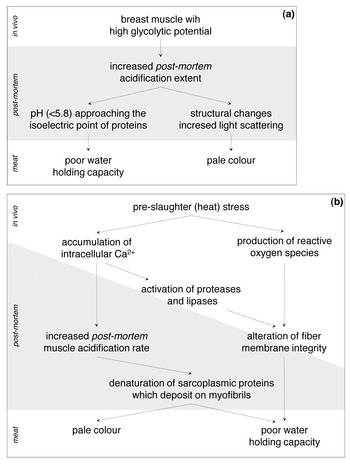
PSE-like breast meat is usually downgraded in retail marketing due to the presence of drip and differences in colour. Separating PSE-like meat from normal meat is relatively difficult since the identification of colour-related problems are problematic (Fletcher, Reference FLETCHER2002). The causes of PSE meat in broilers have been well clarified over the last 20 years (Solomon et al., Reference SOLOMON, VAN LAACK and EASTRIDGE1998; Mitchell, Reference MITCHELL1999; Barbut et al., Reference BARBUT, SOSNICKI, LONERGAN, KNAPP, CIOBANU, GATCLIFFE, HUFF-LONERGAN and WILSON2008; Petracci et al., Reference PETRACCI, BIANCHI and CAVANI2009). Under normal conditions, breast muscles have a pH> 7 before slaughter, while the pH decreases to 5.8−5.9 after 6 hours post-mortem. However, there are two types of anomalous onset of PSE: i) fast-acidifying meat, in which the pH drops below 6 within 1 hour post-mortem, similar to what occurs in PSE pork meat (Figure 1b) or ii) the rate of acidification is more or less the same, but the final pH is lower than normal (<5.8), an abnormality termed as ‘acid meat’ (Figure 1a). In both cases, meat is a paler colour and has reduced water holding capacity. Le-Bihan et al. (2008) demonstrated that there was little genetic relationship between the pH measured immediately after the death of birds and at the end of the post-mortem acidification process. This seems to indicate that the two mechanisms are likely to be independent.
Mechanisms of appearance of PSE-like breast meat in broilers. a) Acid meat; b) Fast acidifying meat.

Fast growing or heavier birds have been shown to be more susceptible to heat stress because of their reduced thermoregulatory capacity compared with their genetic predecessors (Sandercock et al., Reference SANDERCOCK, HUNTER, MITCHELL and HOCKING2006). Therefore, exposure of birds to high temperatures during preslaughter phases may exacerbate negative effects (Petracci et al., Reference PETRACCI, BIANCHI and CAVANI2010). Sandercock et al. (Reference SANDERCOCK, BARKER, MITCHELL and HOCKING2009) suggested that genetic selection for increased growth rate and breast yield altered cation regulation in the muscle cells of modern chicken hybrids. Increased intracellular calcium and free radical production in muscle can alter membrane integrity and increase the rate of muscle acidification during post-mortem times at high temperature (Sandercock et al., Reference SANDERCOCK, HUNTER, NUTE, MITCHELL and HOCKING2001; Reference SANDERCOCK, BARKER, MITCHELL and HOCKING2009). These conditions may induce denaturation of sarcoplasmic proteins and alter membrane integrity that reduce the water holding ability and result in a lighter colour of meat (Van Laack et al., Reference VAN LAACK, LIU, SMITH and LOVEDAY2000) (Figure 1b).
However, PSE meat can originate from birds with a high glycolytic potential (acid meat) (Figure 1a) (Berri et al., Reference BERRI, DEBUT, SANTE ́-LHOUTELLIER, ARNOULD, BOUTTEN, SELLIER, BAÉZA, JEHL, JEGO, DUCLOS and LE BIHAN-DUVAL2005). After slaughter, the high glycogen content causes a lower ultimate pH that is close to the isoelectric point of myofibrillar proteins. At the isoelectric point, meat has a low ability to retain liquids and is a paler colour (Barbut, Reference BARBUT2002). At a genetic level, the correlation between breast muscle glycolytic potential and ultimate pH is close to -1 (Le Bihan-Duval et al., Reference LE BIHAN-DUVAL, DEBUT, BERRI, SELLIER, SANTÉ-L'HOUTELLIER, JÉGO and BEAUMONT2008; Alnahhas et al., Reference ALNAHHAS, BERRI, BOULAY, BAÉZA, JÉGO, BAUMARD, CHABAULT and LE BIHAN-DUVAL2014). In addition, it has been demonstrated that selecting broilers for higher breast meat yield leads to higher ultimate pH (Jlali et al., Reference JLALI, GIGAUD, MÉTAYER-COUSTARD, SELLIER, TESSERAUD, LE BIHAN-DUVAL and BERRI2012; Alnahhas et al., Reference ALNAHHAS, BERRI, BOULAY, BAÉZA, JÉGO, BAUMARD, CHABAULT and LE BIHAN-DUVAL2014). These studies indicated that it is possible to select birds for high breast yield and decrease the incidence of PSE-like meat, without compromising quality traits. However, it should not be forgotten that increasing the ultimate pH may induce the occurrence of dark-firm and dry (DFD) meat with possible detrimental effects on microbial and sensory traits (Barbut et al., Reference BARBUT, SOSNICKI, LONERGAN, KNAPP, CIOBANU, GATCLIFFE, HUFF-LONERGAN and WILSON2008).
It has been demonstrated that diet can affect the glycolytic potential of breast muscles and the pH of meat. Guardia et al. (Reference GUARDIA, LESSIRE, CORNIAUX, METAYER-COUSTARD, MERCERAND, TESSERAUD, BOUVAREL and BERRI2014) studied the impact of inclusion of different dietary levels of lysine and other amino acids on the pH of breast meat and found that lower pH values were observed in broilers fed lysine-deficient diets containing a high amount of other amino acids. Previous studies have demonstrated that lysine supplementation above recommendations promoted protein synthesis and increased breast muscle yield in chickens (Berri et al., Reference BERRI, BESNARD and RELANDEAU2008). This may limit the use of other amino acids for energy purposes, including storage as muscle glycogen, especially when the amounts of other essential amino acids are low.
white-striping and wooden-breast abnormalities
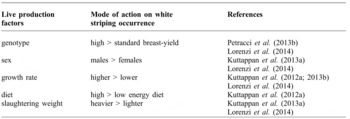
White striping is described as a manifestation of striations parallel to muscle fibres on the ventral surface of broiler breast fillets (Kuttappan et al., Reference KUTTAPPAN, BREWER, CLARK, MCKEE, MEULLENET, EMMERT and OWENS2009). The aetiological causes of white striping are poorly known, although it has been already established that several farming factors may be involved (Table 3).
Influence of live broiler production factors on the occurrence of white striping in breast meat.

More recently, ‘wooden’ breast meat has been observed, whereby the muscles are hard, out bulging, pale and often accompanied with white striping (Sihvo et al., Reference SIHVO, IMMONEN and PUOLANNE2014). Observations showed that histopathological changes in white striped and wooden breast muscles had similar features (Kuttappan et al., Reference KUTTAPPAN, SHIVA PRASAD, SHAW, VALENTINE, BM HARGIS, MCKEE and OWENS2013b; Sihvo et al., Reference SIHVO, IMMONEN and PUOLANNE2014; Ferreira et al., Reference FERREIRA, CASAGRANDE, VIEIRA, DRIEMEIER and KINDLEIN2014), and thus they may have a common aetiology. Histological observations on white-striped meat indicated an increase in degenerative and atrophic fibres associated with loss of cross striations, variation in fibre size, floccular/vacuolar degeneration and lysis of fibres, mild mineralisation, occasional regeneration (nuclear rowing and multinucleated cells), mononuclear cell infiltration, lipidosis and interstitial inflammation and fibrosis (Kuttappan et al., Reference KUTTAPPAN, SHIVA PRASAD, SHAW, VALENTINE, BM HARGIS, MCKEE and OWENS2013b). Similar features were found by Ferreira et al. (Reference FERREIRA, CASAGRANDE, VIEIRA, DRIEMEIER and KINDLEIN2014), although proliferation of connective tissue was not evident in birds slaughtered at earlier ages. The histological changes in wooden breast meat showed different levels of polyphasic myodegeneration with regeneration accompanied by accumulation of interstitial connective tissue (fibrosis) that is quite similar to what has been observed for white striping (Sihvo et al., Reference SIHVO, IMMONEN and PUOLANNE2014). It should be noted that similar lesions have been observed in leg muscles and backs of the carcass (Zimermann et al., Reference ZIMERMANN, FALLAVENA, SALLE, MORAES, SONCINI, BARRETA and NASCIMENTO2012; Kuttappan et al., Reference KUTTAPPAN, SHIVA PRASAD, SHAW, VALENTINE, BM HARGIS, MCKEE and OWENS2013b).
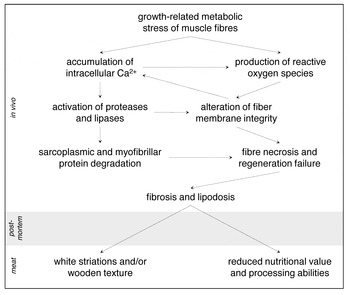
Haematologic and serologic profiles of white-striped meat show the absence of systemic infection or inflammation, although increased levels of creatine kinase indicate muscle damage (Kuttappan et al., Reference KUTTAPPAN, HUFF, HUFF, HARGIS, APPLE, COON and OWENS2013c). It can be assumed that the faster growth rate, especially of breast muscle, leads to unsustainable pressure on muscle metabolism which prompts the beginning of degenerative features that are similar to muscular dystrophies such as Duchenne. Additionally, it can be assumed that increased free radical production and accumulation of intracellular calcium may promote alteration of fibre membrane integrity and degradation of proteins due to activation of proteases and lipases. This can lead to fibre necrosis that overtakes the regenerative capacity of muscle (Figure 2). Indeed, even though white striping has some similarities to nutritional muscular dystrophy, which is related to vitamin E deficiency, it was found that dietary inclusion of different vitamin E levels had no or little effect on the incidence of white striping (Kuttappan et al., Reference KUTTAPPAN, GOODGAME, BRADLEY, MAUROMOUSTAKOS, HARGIS, WALDROUP and OWENS2012b; Guetchom et al., Reference GUETCHOM, VENNE, CHÉNIER and CHORFI2012).
Possible origins of emerging abnormalities (white-striping and wooden breast) of breast meat in broilers.

It has recently been reported that the presence of white striations is associated with modification of meat composition. Indeed, white-striped fillets exhibit a higher percentage of moisture, intramuscular fat and collagen, and lower contents of protein and ash, in comparison with normal fillets (Petracci et al., Reference PETRACCI, MUDALAL, BABINI and CAVANI2014). In addition, there is a substantial decline in the content and solubility of myofibrillar and sarcoplasmic proteins in white striped breast meat (Mudalal et al., Reference MUDALAL, BABINI, CAVANI and PETRACCI2014).
Consequences of breast muscle abnormalities on meat quality
nutritional value
One of the main reasons driving the success of poultry meat is the perceived healthy nutritional profile compared with pork and beef meat. Indeed, poultry meat, and in particular breast meat, fits the modern consumer demand for low fat, sodium and cholesterol (Cavani et al., Reference CAVANI, PETRACCI, TROCINO and XICCATO2009). It has recently been observed that chicken meat retains the same nutritional features found in the past (Wang et al., Reference WANG, LEHANE, GHEBREMESKI and CRAWFORD2010). Whilst PSE has minimal effects on the proximate composition of meat (Qiao et al., Reference QIAO, FLETCHER, NORTHCUTT and SMITH2002), white striping changes the composition of breast meat and may change nutritional value. Kuttappan et al. (Reference KUTTAPPAN, BREWER, APPLE, WALDROUP and OWENS2012a) found that white-striped fillets had a higher fat content and lower protein content compared with normal fillets. Petracci et al. (Reference PETRACCI, MUDALAL, BABINI and CAVANI2014) showed that severe white-striped fillets had a higher total energy content than normal fillets, while the contribution of energy from fat was increased about three-fold. Moreover, breast meat affected by white striping shows an increase in the collagen to total protein ratio, which means that the nutritional value is reduced due to the low digestibility of collagen and deficiency of some essential amino acids (Petracci et al., Reference PETRACCI, MUDALAL, BABINI and CAVANI2014; Mudalal et al., Reference MUDALAL, BABINI, CAVANI and PETRACCI2014).
Both moderate and severe white striping are associated with changes in the composition and hence reduced nutritional quality of breast meat. In general, breast meat affected by severe white striping is usually used for manufacturing further processed products (e.g. sausages or nuggets) where the chemical composition can be modified during formulation. Fillets with moderate white striped are marketed for fresh retailing, even though cut-up products may have different nutritional characteristics compared with those reported on the label and with consumer expectations towards poultry meat (e.g. low calories and fat). This means that the cut-up breasts (whole or sliced) can have somewhat different nutritional characteristics compared with those reported on the label and with consumer expectations towards poultry meat (Petracci et al., Reference PETRACCI, MUDALAL, BABINI and CAVANI2014).
technological and sensory properties
It is well known that PSE is associated with a lower water holding capacity (WHC) and poorer sensory traits of chicken breast meat. WHC is attributed to partial protein denaturation due to the combination of acidic conditions and high muscle temperature in early post-mortem muscle (Figure 1b). Moreover, a reversible loss of the ability to hold water can be explained by the fact the protein isoelectric point is approached when the pH is lower than 5.8 (Figure 1a) (Petracci et al., Reference PETRACCI, BETTI, BIANCHI and CAVANI2004; Duclos et al., Reference DUCLOS, BERRI and LE BIHAN-DUVAL2007; Barbut et al., Reference BARBUT, SOSNICKI, LONERGAN, KNAPP, CIOBANU, GATCLIFFE, HUFF-LONERGAN and WILSON2008). This latter effect can be partially resolved when PSE-like meats are used as raw materials in manufacturing further processed products because the pH can be increased by the inclusion of alkaline agents such as phosphates, bicarbonates and citrates (Petracci et al., Reference PETRACCI, BIANCHI, MUDALAL and CAVANI2013a).
The presence of a certain proportion of PSE-like meat can be accepted by poultry plants, especially during the hot season. However, white striping (Kuttappan et al., Reference KUTTAPPAN, LEE, ERF, MEULLENET, MCKEE and OWENS2012c) and wooden breast abnormalities impair the visual appearance of breast meat and a consequent reduction of consumer acceptability. Therefore, the poultry industry usually downgrades white striped and wooden breast fillets, especially in severe cases, and allocates them for further processing. In addition, it has been found that these abnormalities are associated with a strong impairment of the technological properties of breast meat (Petracci et al., Reference PETRACCI, MUDALAL, BONFIGLIO and CAVANI2013b; Mudalal et al., Reference MUDALAL, LORENZI, SOGLIA, CAVANI and PETRACCI2015). In this context, it has been reported that white-striped meat has a dramatically lower water-holding/binding capacity (marinade uptake, cooking loss, and yield) and a softer texture than normal meat (Petracci et al., Reference PETRACCI, MUDALAL, BONFIGLIO and CAVANI2013b). Similar features were recently observed in wooden breast fillets (Mudalal et al., Reference MUDALAL, LORENZI, SOGLIA, CAVANI and PETRACCI2015). From preliminary observations, it appears that wooden breast has an even greater effect on the WHC of meat in comparison with white striped meat (Mudalal et al., Reference MUDALAL, LORENZI, SOGLIA, CAVANI and PETRACCI2015). The causes of lower WHC for both types of muscle abnormalities are still not fully understood, but the occurrence of muscle degeneration in both breast meat abnormalities resulted in substantial reduction of muscular contractile and sarcoplasmic proteins (Mudalal et al., Reference MUDALAL, BABINI, CAVANI and PETRACCI2014). In this context, a recent study evaluated the impact of inclusion of different levels of wooden breast on the quality traits of processed meat products (Puolanne and Ruusunen, Reference PUOLANNE and RUUSUNEN2014). Notwithstanding, this aspect still needs further investigation.
Based on the available data, it can be concluded that these emerging abnormalities not only affect the appearance of fresh product, but also have poor technological properties. Therefore, the effectiveness of further processing strategies to alleviate the extent of these problems is restricted to PSE meat.
microbial shelf-life
If high ultimate pH has a positive effect on the water holding capacity and processing characteristics, microbiological stability may be compromised when the ultimate pH exceeds 6 (Barbut et al., Reference BARBUT, SOSNICKI, LONERGAN, KNAPP, CIOBANU, GATCLIFFE, HUFF-LONERGAN and WILSON2008). It is well-known that microbial growth depends strongly on the pH of meat. In particular, breast meat characterised by high pH (>6.0) is more likely to become contaminated with microbial growth and can trigger different types of spoilage microorganisms that impair taste, flavour and appearance (Mallia et al., Reference MALLIA, BARBUT, VAILLANCOURT, MARTIN and MCEWEN2000a; Reference MALLIA, HUNTER, VAILLANCOURT, IRWIN, MUCKLE, MARTIN and MCEWEN2000b). Therefore, selection programs to improve meat quality must keep the pH level within the upper threshold value to maximise the benefits of PSE-like prevention and minimise the potential for decreased shelf-life, as previously suggested in the pig sector (Barbut et al., Reference BARBUT, SOSNICKI, LONERGAN, KNAPP, CIOBANU, GATCLIFFE, HUFF-LONERGAN and WILSON2008). There are no published studies on microbial shelf-life of white-striped and wooden breast fillets, although both are known to be linked to ultimate meat pH and may reduce shelf life due to contamination (Petracci et al., Reference PETRACCI, MUDALAL, BONFIGLIO and CAVANI2013b; Mudalal et al., Reference MUDALAL, LORENZI, SOGLIA, CAVANI and PETRACCI2015).
Conclusions
The ever-increasing genetic pressure to improve growth rates and breast yields of broiler chickens has led to a high incidence of several abnormalities in breast muscles during the last 20 years (Petracci et al., Reference PETRACCI, BIANCHI and CAVANI2009; Kijowski et al., Reference KIJOWSKI, KUPIŃSKA, STANGIERSKI, TOMASZEWSKA-GRAS and SZABLEWSKI2014; Lorenzi et al., Reference LORENZI, MUDALAL, CAVANI and PETRACCI2014). However, until a few years ago, economic losses due to meat downgrading was largely counterbalanced by gains in the increasingly high growth rates of birds and greater breast meat yields. Nowadays, the occurrence of emerging breast meat abnormalities, such as white striping and wooden breast, is associated with higher percentages of downgrading that are no longer sustainable for the poultry industry. In addition, there is also a decrease in the nutritional, sensory and technology quality of meat that may negatively impact current consumer attitudes towards poultry meat. As a consequence, should the industry consider a step back in the increase in growth rates and breast development in order to reduce the extent of the problem? The answer to this question may differ depending on the geographical market. The most vulnerable markets are those where production systems are more efficient and have higher growth rates, birds are slaughtered at higher slaughter weights/ages and the majority of poultry products are sold as whole carcasses and pieces. In such developed poultry markets, increasing the occurrence of myopathies may negatively affect consumer attitudes toward perceived animal welfare. Greater specialisation of broiler chicken hybrids following the particularities of the producing areas may be the answer. Meanwhile, the poultry industry can mitigate the negative effects of abnormalities on meat quality by modulating the growth rate of birds through farming strategies and by incorporating downgraded meat into processed products.