Introduction
The Kwangsian Orogeny, which is thought to be a Caledonian tectonic orogeny occurring in the South China Block (including Guangxi and eastern Yunnan) (Ting, Reference Ting1929), caused erosion of exposed pre-Devonian strata and deeply influenced subsequent deposition of the widespread earliest Devonian (or Lochkovian) terrestrial siliciclastic rocks over the southern part of the South China Block. From the Pragian onwards, an epicontinental sea flooded the southern margin of the South China Block, resulting in deposition of carbonate-siliciclastic rocks in the shallow shelf zone, which is marked by mudstone and siltstone intercalated with thin-bedded limestone and argillaceous limestone. According to Lu and Chen (Reference Lu and Chen2016), the onset of a widespread carbonate succession occurred in the South China Block during the early Emsian (during the excavatus Zone).
The rarity of Lochkovian and Pragian conodont material from siliciclastic rocks in the South China Block impedes documentation of a well-established conodont biostratigraphy. Pragian conodonts were reported only by Wang and Wang (Reference Wang and Wang1978), Lu et al. (Reference Lu, Qie and Chen2016, Reference Lu, Qie, Yu and Chen2017), and Wang et al. (Reference Wang, Chen and Kuang2016) from the Nahkaoling Formation in central Guangxi, whereas Lochkovian conodonts in the South China Block have never been reported. As a result, an unequivocal determination of the ages of some related lithological units is impossible, which further hampers accurate regional and global biostratigraphical correlations. Moreover, it is also difficult to accurately date the ending time of the Kwangsian Orogeny, because the previous work using the fossil plants from Lower Devonian siliciclastic rocks can date the fossil horizons to only a stage level of precision (Xu et al., Reference Xu, Wang, Tang, Fu and Wang2019), instead of the bio-zone or sub-stage level of precision based on conodont biostratigraphy. During this research, we studied Early Devonian conodonts from the Nahkaoling Formation at Lingli, central Guangxi, to demonstrate the age of the lower limit of the Nahkaoling Formation based on conodont biostratigraphy, and to discuss the ending time of the Kwangsian Orogeny in the South China Block.
Geological setting
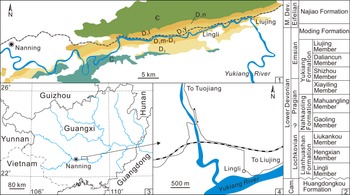
The Lower Devonian, which is widely distributed and well exposed in the Nanning-Liujing district (Wang and Rong, Reference Wang and Rong1986) along the Yukiang River between Nanning and Liujing (Fig. 1.1), is subdivided into five lithological units in ascending order (Fig. 1.2): the Lianhuashan Formation, Nahkaoling Formation (= Nagaoling or Nakaoling Formation), Yukiang Formation (= Yujiang Formation), Moding Formation, and the lower part of the Najiao Formation (Wang et al., Reference Wang, Yu and Fang1964; Kuang et al., Reference Kuang, Zhao and Tao1989; Zhong et al., Reference Zhong, Wu, Yin, Liang, Yao and Peng1992). Consisting of red sandstone, siltstone, and mudstone intercalated with several beds of dolostone in the middle part, the Lianhaushan Formation represents nearshore or delta deposition after the Kwangsian Orogeny and was once correlated with upper Lochkovian by Wang (Reference Wang1996) based on the study of ostracodes. The Nahkaoling Formation conformably overlies the Lianhuashan Formation. It comprises a lower member (the Gaoling Member) characterized by alternating mudstone and limestone in its upper part and an upper member (the Mahuangling Member) of mudstone and siltstone. Interpreted to be deposited in a littoral to neritic sea, the Nahkaoling Formation witnessed the first flourish of benthic and pelagic faunas. Based on extensive investigations of the abundant fossils such as brachiopods (Hou, Reference Hou1959; Hou and Xian, Reference Hou and Xian1975; Bai et al., Reference Bai, Jin and Ning1982; Kuang et al., Reference Kuang, Zhao and Tao1989; Qiao et al., Reference Qiao, Chen and Shen2021), corals (Bai et al., Reference Bai, Jin and Ning1982; Kuang et al., Reference Kuang, Zhao and Tao1989), bivalves (Zhang et al., Reference Zhang, Yan, Cao and Zhao1988, Reference Zhang, Yao, Yao, Tu, Yan, Wang, Duan and Tang2015; Kuang et al., Reference Kuang, Zhao and Tao1989), tentaculitids (Ruan et al., Reference Ruan, Wang, Wang, Rong, Mu, Kuang, Yin and Su1979; Xian et al., Reference Xian, Wang, Zhou, Xiong and Zhou1980; Kuang et al., Reference Kuang, Zhao and Tao1989; Wei et al., Reference Wei, Zong and Gong2019), ostracodes (Kuang et al., Reference Kuang, Zhao and Tao1989; Wang, Reference Wang1996), fish (Pan and Wang, Reference Pan and Wang1978; S.F. Liu, Reference Liu1982; Y.H. Liu, Reference Liu1985; Kuang et al., Reference Kuang, Zhao and Tao1989; Wang, Reference Wang1992), spores (Gao, Reference Gao1978), chitinozoans (Hou, Reference Hou1978), and conodonts (Wang and Wang, Reference Wang and Wang1978; Kuang et al., Reference Kuang, Zhao and Tao1989; Lu et al., Reference Lu, Qie and Chen2016, Reference Lu, Qie, Yu and Chen2017; Wang et al., Reference Wang, Chen and Kuang2016), the Nahkaoling Formation in the Nanning-Liujing district was dated as Pragian (Ruan et al., Reference Ruan, Wang, Wang, Rong, Mu, Kuang, Yin and Su1979; Wang et al., Reference Wang, Ruan, Mu, Wang, Rong, Yin, Kuang and Su1979; Lu et al., Reference Lu, Qie and Chen2016, Reference Lu, Qie, Yu and Chen2017), perhaps even early Pragian (Wang et al., Reference Wang, Chen and Kuang2016). The Yukiang Formation, which conformably overlies the Nahkaoling Formation, is represented by mudstone and siltstone intercalated with thin beds of limestone in the lower half and by limestone in the upper half. According to Lu et al. (Reference Lu, Qie and Chen2016, Reference Lu, Qie, Yu and Chen2017, Reference Lu, Valenzuela-Ríos, Liao and Kuang2018, Reference Lu, Valenzuela-Ríos, Liao and Wang2019), the Yukiang Formation is upper Pragian to lower Emsian in age.
(1) Geologic map showing the exposed Paleozoic strata in the Nanning-Liujing district along the Yukiang River. Є: Cambrian; D1l: Lianhuashan Formation; D1n: Nahkaoling (Nagaoling) Formation; D1y: Yukiang (Yujiang) Formation; D1m-D2: Lower Devonian Moding Formation and the Middle Devonian; D3: Upper Devonian; C: Carboniferous. (2) Stratigraphic sequence of the Lower Devonian in the Nanning-Liujing district. Cam.: Cambrian; M. Dev.: Middle Devonian. (3) Location of the study area, with a rectangle showing the investigated Nanning-Liujing district in central Guangxi. (4) Location of the Lingli section, with the dashed line indicating the investigated interval of the Nahkaoling Formation exposed along the country road.

The Lingli section (108°44′50″E, 22°52′1″N) is situated ~45 km east of Nanning (Fig. 1.3) and ~2 km northwest of Lingli (Fig. 1.4), a small town on the north bank of the Yukiang River. The Lianhuashan and Nahkaoling formations are continuously and well exposed along the country road heading north from Lingli to Tuojiang village. Consisting of 8.3 m of thin-bedded mudstone, the basal part of the Nahkaoling Formation is conformably underlain by purple-red mudstone and siltstone belonging to the upper part of the Lianhuashan Formation. The investigated interval of the lower part of the Nahkaoling Formation is ~35.37 m thick and composed of mudstone alternating with thin- to medium-bedded limestone and argillaceous limestone (Fig. 2). This interval belongs to the Gaoling Member. The strata overlying the investigated interval consist of thin-bedded mudstone and siltstone belonging to the Mahuangling Member of the Nahkaoling Formation.
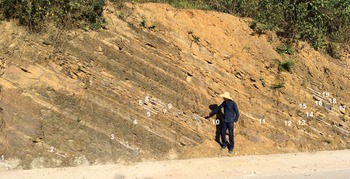
Exposure of the lower part (from sample 20LL-1 to sample 20LL-19) of the Nahkaoling Formation, which was measured and sampled in 2020 but was partially destroyed by road construction in 2021, at the Lingli section. The white lines indicate the bases of the sampled limestone beds.

Materials and methods
Forty-seven samples, each weighing 0.90–4.01 kg, were collected from the Lingli section (Fig. 3). Limestone samples were crushed mechanically into small pieces (~2–5 cm diameter) and dissolved in dilute acetic acid (5–10%). The insoluble residues were then washed, air-dried, and finally concentrated by heavy-liquid separation using sodium polytungstate. Specimens coated with gold were photographed using a Scanning Electron Microscope (SEM) in the Nanjing Institute of Geology and Palaeontology, Chinese Academy of Sciences.
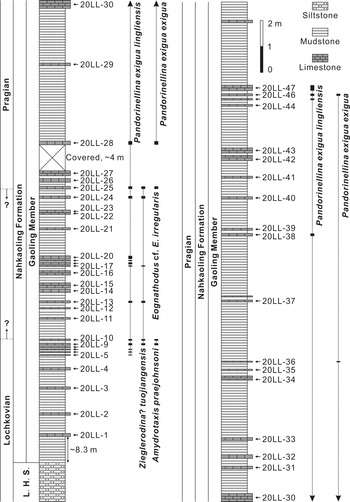
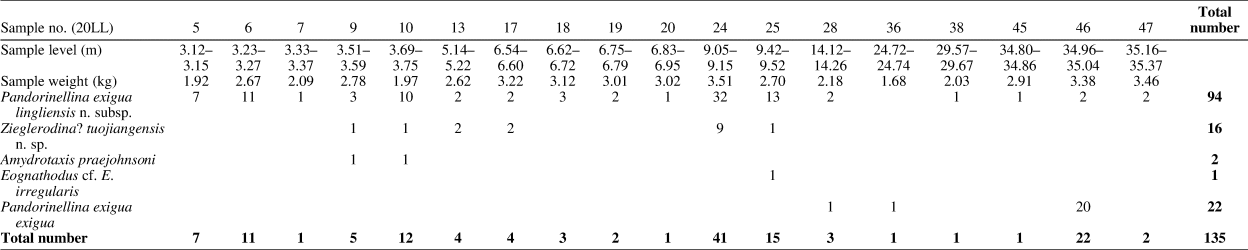
Distribution of conodonts in the Gaoling Member of the Nahkaoling Formation at the Lingli section, central Guangxi. Due to the lack of index fossils for the base of the Pragian, the precise level of the Lochkovian-Pragian boundary at the Lingli section is temporarily unknown and probably lies in the interval between sample 20LL-10 and sample 20LL-25. L. H. S.: Lianhuashan Formation.

Repository and institutional abbreviation
All specimens described and illustrated herein are deposited in the collections of the Nanjing Institute of Geology and Palaeontology (NIGP), Chinese Academy of Sciences.
Systematic paleontology
The section on systematic paleontology is authored by Jian-Feng Lu.
Order Ozarkodinida Dzik, Reference Dzik1976
Family Spathognathodontidae Hass, Reference Hass1959
Genus Amydrotaxis Klapper and Murphy, Reference Klapper and Murphy1980
Type species
Spathognathodus johnsoni Klapper, Reference Klapper1969.
Amydrotaxis praejohnsoni Murphy and Springer, Reference Murphy and Springer1989
Figure 4.1–4.6
- Reference Klapper1969
Spathognathodus johnsoni Klapper, p. 18, pl. 5, figs. 11–13.
- Reference Klapper and Murphy1980
Amydrotaxis johnsoni (Klapper) alpha morphotype; Klapper and Murphy, p. 498, fig. 2, no. 1–3, 5–14, 16, fig. 3, no. 1–20.
- Reference Klapper and Johnson1980
Ozarkodina johnsoni (Klapper) alpha morphotype; Klapper and Johnson, p. 450, pl. 1, figs. 5, 6, 17.
- Reference Klapper and Johnson1980
Ozarkodina johnsoni (Klapper) gamma morphotype; Klapper and Johnson, p. 450.
- Reference Murphy and Matti1983
Amydrotaxis johnsoni (Klapper) alpha morphotype; Murphy and Matti, p. 34.
- Reference Mawson1986
Amydrotaxis johnsoni (Klapper) alpha morphotype; Mawson, p. 50, pl. 8, figs. 1–23.
- Reference Murphy and Springer1989
Amydrotaxis praejohnsoni Murphy and Springer, p. 349, fig. 2.1–2.41.
- Reference Murphy2016
Amydrotaxis praejohnsoni; Murphy, p. 14, pl. 4, figs. 4–8.
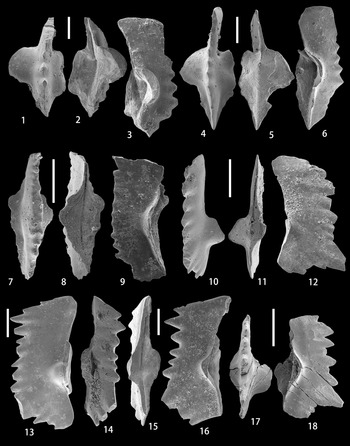
(1–6) Amydrotaxis praejohnsoni Murphy and Springer, Reference Murphy and Springer1989; (1–3) upper, lower, and lateral views of NIGP 180672, sample 20LL-9; (4–6) upper, lower, and lateral views of NIGP 180673, sample 20LL-10. (7–9) Eognathodus cf. E. irregularis Druce, Reference Druce1971, upper, lower, and lateral views of NIGP 180674, sample 20LL-25. (10–18) Zieglerodina? tuojiangensis Lu n. sp.; (10–12) upper, lower, and lateral views of NIGP 180675, sample 20LL-9, paratype; (13) lateral view of NIGP 180676, sample 20LL-13, paratype; (14–16) upper, lower, and lateral views of NIGP 180677, sample 20LL-24, holotype; (17, 18) upper and lateral views of NIGP 180678, sample 20LL-24, paratype, a juvenile specimen. Scale bar is 200 μm across.

Holotype
Specimen 8765 iv/11 (Murphy and Springer, Reference Murphy and Springer1989, pl. 2, fig. 2.33, 2.34) in University of California, Riverside type collection.
Occurrences
Restricted to the middle Lochkovian, or from the lower Lochkovian to middle Lochkovian, contingent upon varying definitions for the base of the middle Lochkovian; reported in western North America, eastern Australia, and South China.
Description
The carminiscaphate Pa element is slightly deflected inward anteriorly and posteriorly. The free blade takes one-third of the whole element, and a strikingly asymmetrical platform is developed in the posterior two-thirds. In the middle third of the element, the inner platform consists of two weakly developed and smooth lobes that are separated by a weak sinus in the margin and more or less equal in length. Therefore, the lateral margin of the inner lobes tends to be parallel to the blade in the middle third. On the opposite side, a smooth and tongue-shaped outer lobe, strongly projecting laterally at a right angle to the blade, is almost twice as wide as the inner lobes. It meets the free blade at the same position as the inner anterior lobe but terminates posteriorly at a more anterior position than the inner posterior lobe. Posterior of the inner posterior and outer lobes, the platform narrows toward the posterior tip and is delimited from the posterior part by a more or less marked indentation in both the inner and outer margins. The broken free blade in the anterior third of the element is followed in the middle third by four well-differentiated denticles that are uniform in height. There is a steep decline in height in the posterior third, where only one to two lower denticles are developed. The lower margin of the element is in a concave arc, with the anterior and posterior ends being the lowest. In lateral view, the inner lobes are characterized by a lateral profile that slopes gradually to the lower margin. On the lower side, the large and moderately excavated basal cavity is L-shaped. It narrows gradually toward the posterior end and extends anteriorly beneath the free blade as a narrow groove.
Materials
Two specimens, from samples 20LL-9 (1) and 20LL-10 (1).
Remarks
As suggested by Murphy and Springer (Reference Murphy and Springer1989), the Pa element of Amydrotaxis praejohnsoni differs from the Pa element of A. johnsoni (Klapper, Reference Klapper1969) in having a sloping or angulate transverse profile through the smaller lobe of the platform. In contrast, the upper surface of the smaller lobe in the Pa element of A. johnsoni drops abruptly at the lobe margin downward to the lower margin, thus forming a shouldered transverse profile. In the holotype of the Pa element of A. praejohnsoni, the smaller platform has a straight margin, whereas in some of illustrated specimens it is composed of two lobes separated by a weak sinus in the margin (Murphy and Springer, Reference Murphy and Springer1989, pl. 2, figs. 15, 17). The Pa element of Amydrotaxis praejohnsoni is strikingly close to that of A. druceana (Pickett, Reference Pickett1980) in the configuration of the basal cavity and the lateral profile of the inner platform. Initially named Spathognathodus philipi Druce, Reference Druce1971 (S. philipi Druce, Reference Druce1971, is a junior homonym of S. exigua philipi Klapper, Reference Klapper1969, and thus invalid according to the ICZN, 1999), the Pa element of A. druceana is characterized by strongly fused denticles in the median third of the blade, the tips of which are completely fused to form a long ridge in the holotype and in two of the three paratypes. Moreover, as suggested by Murphy and Springer (Reference Murphy and Springer1989), in contrast to the margin of the smaller platform lobe in the Pa element of A. praejohnsoni, which is parallel to the blade or tapers posteriorly, the margin of the smaller lobe generally tapers toward the anterior end of the element in the Pa element of A. druceana. Specimens illustrated as the Pa element of A. druceana by Farrell (Reference Farrell2003, pl. 4, figs. 13–21) closely resemble the Pa element of A. praejohnsoni in possessing discrete denticles in the middle third of the blade, but mainly differ by their smaller inner lobe tapering towards the anterior end of the platform.
Genus Eognathodus Philip, Reference Philip1965
Type species
Eognathodus sulcatus Philip, Reference Philip1965.
Eognathodus cf. E. irregularis Druce, Reference Druce1971
Figure 4.7–4.9
Occurrences
Lower Pragian; reported from South China.
Description
The carminiscaphate Pa element is straight, with a broken anterior blade consisting of three remnant denticles that are rounded in cross-section. In the middle part of the element, a narrow and flat platform is developed; the sulcus is completely absent. This narrow platform does not extend to the posterior end of the element but is followed posteriorly by a short and chevron-shaped transverse ridge and then a denticle that has an elliptical cross-section with its long axis perpendicular to the element. There are three denticles with a rounded cross-section in the posteriormost part of the element. On the lower side, the symmetrical and moderately large basal cavity narrows gradually toward the posterior end of the element and extends anteriorly as a narrow groove. In lateral view, the upper margin of the middle part of the element is flat, with a smooth and straight platform margin on one side and a waved platform margin showing blunt and rounded tips of denticles on the other side. The posterior blade is arched downward.
Materials
One specimen, from samples 20LL-25.
Remarks
According to Druce (Reference Druce1971, text-fig. 2) and Pickett (Reference Pickett1980, figs. 7D–F), the holotype of the Pa element of Eognathodus irregularis Druce, Reference Druce1971, is characterized by having denticles in the middle third of the element, which are elliptical in cross-section with their axes at right angles with the element. Later, Murphy (Reference Murphy2005, p. 199) suggested that in the early Pragian the Pa element of E. irregularis has various morphs but is mainly characterized by a medium- to large-sized basal cavity, irregular denticles or tubercles, and the absence of a sulcus. The present specimen differs greatly from the holotype of the Pa element of E. irregularis in the development of a narrow and flat platform in the middle part of the element. Other specimens similar to the present one were illustrated by Murphy (Reference Murphy2005, fig. 6.15, 6.17) as E. irregularis. However, the present specimen has a much narrower basal cavity, which is different from those two specimens whose basal cavity has a rounded and wide outline.
Genus Zieglerodina Murphy, Valenzuela-Ríos, and Carls, Reference Murphy, Valenzuela-Ríos and Carls2004
Type species
Spathognathodus remscheidensis Ziegler, Reference Ziegler1960.
Zieglerodina? tuojiangensis Lu new species
Figure 4.10–4.18
Holotype
Specimen NIGP 180677 (Fig. 4.14–4.16) in the collections of the Nanjing Institute of Geology and Palaeontology (NIGP), Chinese Academy of Sciences.
Paratypes
Specimens NIGP 180675 (Fig. 4.10–4.12), NIGP 180676 (Fig. 4.13), NIGP 180678 (Fig. 4.17, 4.18), and 12 other unfigured specimens.
Diagnosis
A species provisionally assigned to Zieglerodina with a Pa element that has a prominently high, broad, and posteriorly inclined cusp in the posterior part of the blade. The cusp is preceded anteriorly by 4–8 irregularly shaped and discrete denticles and succeeded posteriorly by 2–4 lower denticles. The shallow basal cavity is situated posterior of the mid-length of the blade.
Occurrences
From the lower or middle Lochkovian to lower Pragian; reported from South China.
Description
The blade of the carminate Pa element is normally straight. Two small, slightly or distinctly asymmetrical, and tongue-shaped lobes are confined to the posterior part of the blade. A distinctly high and large cusp is situated in the posterior third of the blade and is inclined posteriorly. Anterior of the cusp are 4–8 irregular and discrete denticles, which may be erect or posteriorly inclined. In most of the studied specimens, the second denticle at the anterior end is a bit larger or higher than the adjacent ones. Posterior of the cusp are 2–4 lower denticles, whose heights drop rapidly from the high cusp, thus forming a steep upper margin posterior of the cusp. The lower margin is more or less straight in small specimens but tends to be concave in larger ones. On the lower side, the shallow and posteriorly situated basal cavity extends anteriorly and posteriorly as a narrow groove reaching the end.
Etymology
Named after Tuojiang village, which is close to the Lingli section.
Materials
Sixteen specimens, from samples 20LL-9 (1), 20LL-10 (1), 20LL-13 (2), 20LL-17 (2), 20LL-24 (9), and 20LL-25 (1).
Remarks
Murphy et al. (Reference Murphy, Valenzuela-Ríos and Carls2004) classified the Pridoli and Lochkovian Spathognathodontidae by the restriction of Ozarkodina Branson and Mehl, Reference Branson and Mehl1933, to forms similar to its type species and by the establishment of new genera Wurmiella Murphy, Valenzuela-Ríos, and Carls, Reference Murphy, Valenzuela-Ríos and Carls2004, Zieglerodina Murphy, Valenzuela-Ríos, and Carls, Reference Murphy, Valenzuela-Ríos and Carls2004, and ‘New Genus W’ Murphy, Valenzuela-Ríos, and Carls, Reference Murphy, Valenzuela-Ríos and Carls2004 (the genus W, however, has not been accepted according to ICZN, 1999, rules, as noted by Corriga and Corradini, Reference Corriga and Corradini2009; Corradini and Corriga, Reference Corradini and Corriga2010; Corriga et al., Reference Corriga, Corradini and Walliser2014, Reference Corriga, Corradini, Schönlaub and Pondrelli2016). According to Murphy et al. (Reference Murphy, Valenzuela-Ríos and Carls2004), Ozarkodina has a Pa element characterized by a high cockscomb in the anterior part and a small basal cavity with its anterior margin in the anterior half of the blade; the Pa element of Wurmiella has denticles on the anterior and posterior processes without obvious size variation; whereas in the Pa element of ‘New Genus W’, the lobes are commonly ornamented by a ridge or denticle. The Pa element of Cuspigrandiosa Murphy, Reference Murphy2016, is characterized by short or rudimentary small denticles behind the cusp that increase in size posteriorly. In contrast, Zieglerodina is probably the most suitable genus to accommodate this new species described herein, because the Pa element of Zieglerodina is characterized by small, subcircular lobes without ornament, unequal denticles, an enlarged cusp, and a posterior position of basal cavity, all of which can be seen in the described new species. Zieglerodina? tuojiangensis Lu n. sp. is readily distinguishable from other species of this genus by its high, broad, and posteriorly inclined cusp, long anterior blade, and distinctly short posterior blade whose height decreases greatly from the high cusp. Zieglerodina? tuojiangensis Lu n. sp. probably belongs to a new genus, whose other elements of the apparatus need further investigation.
Genus Pandorinellina Müller and Müller, Reference Müller and Müller1957
Type species
Pandorina insita Stauffer, Reference Stauffer1940.
Pandorinellina exigua lingliensis Lu new subspecies
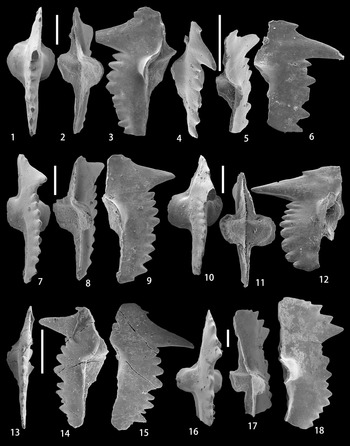
Figure 5.1–5.15
Holotype
Specimen NIGP 180681 (Fig. 5.7–5.9) in the collections of the Nanjing Institute of Geology and Palaeontology (NIGP), Chinese Academy of Sciences.
(1–15) Pandorinellina exigua lingliensis Lu n. subsp.; (1–3) upper, lower, and lateral views of NIGP 180679, sample 20LL-5, paratype; (4–6) upper, lower, and lateral views of NIGP 180680, sample 20LL-5, paratype, a juvenile specimen; (7–9) upper, lower, and lateral views of NIGP 180681, sample 20LL-6, holotype; (10–12) upper, lower, and lateral views of NIGP 180682, sample 20LL-17, paratype; (13–15) upper, lower-lateral, and lateral views of NIGP 180683, sample 20LL-25, paratype, a juvenile specimen. (16–18) Pandorinellina exigua exigua (Philip, Reference Philip1966), upper, lower, and lateral views of NIGP 180684, sample 20LL-28. Scale bar is 200 μm across.

Paratypes
Specimens NIGP 180679 (Fig. 5.1–5.3), NIGP 180680 (Fig. 5.4–5.6), NIGP 180682 (Fig. 5.10–5.12), NIGP 180683 (Fig. 5.13–5.15), and 89 other unfigured specimens.
Diagnosis
A subspecies of Pandorinellina exigua having a Pa element with an extremely enlarged and high denticle in the anterior third of the blade. The basal cavity has two slightly asymmetrical lobes that are clearly delimited posteriorly from a progressively tapering groove that reaches the posterior end. The lower margin anterior of the basal cavity expansion is normally straight to slightly convex, whereas that posterior of the basal cavity expansion is in a concave arc.
Occurrences
From the lower or middle Lochkovian into Pragian; reported from South China.
Description
The blade of the carminate Pa element is straight or slightly deflected anteriorly or posteriorly. Two rounded, tongue-shaped, and slightly asymmetrical lobes are confined to the middle part of the blade. The anterior margin of the two lobes is located at the posterior end of the anterior third of the blade. The anterior third of the blade, which is prominently offset to the right side, is usually occupied by only one extremely high and enlarged denticle. In some specimens, one or two very small denticles may be developed anterior of this prominent denticle. The posterior edge of the prominent denticle drops vertically to a position just in front of the convex arc of the posterior two-thirds of the blade. Denticles on the posterior arc are commonly irregular in size and much lower; no distinctly high denticle exists even in the middle third of the blade above the basal cavity. The lower margin of the anterior third of the blade is straight to slightly convex, with the anterior end of the blade being higher than the anterior end of the basal cavity expansion. In the posterior two-thirds, the lower margin is in a concave arc. Therefore, the lowest point of the lower margin is situated at the anterior end of the basal cavity expansion right below the junction of the anterior third of the blade and the posterior arc. On the lower side, the basal cavity is shallow. It is narrowly expanded beneath the anterior and posterior blade and reaches the ends. In larger specimens, the anterior and posterior grooves are much wider than the corresponding structures in the smaller specimens.
Etymology
Named after the Lingli town.
Materials
Ninety-five specimens, from samples 20LL-5 (7), 20LL-6 (11), 20LL-7 (1), 20LL-9 (3), 20LL-10 (10), 20LL-13 (2), 20LL-17 (2), 20LL-18 (3), 20LL-19 (2), 20LL-20 (1), 20LL-24 (32), 20LL-25 (13), 20LL-28 (2), 20LL-38 (1), 20LL-45 (1), 20LL-46 (2), and 20LL-47 (2).
Remarks
Although specimens of the Sa element have not been obtained, the new taxon is assigned to the genus Pandorinellina and treated as a new subspecies of P. exigua (Philip, Reference Philip1966) due to the close similarity of its Pa element to those of P. exigua exigua (Philip, Reference Philip1966) and P. exigua philipi (Klapper, Reference Klapper1969) in having a similar high anterior third of the blade, an identical convex arc in the posterior two-thirds, and the same configuration of the lower margin. However, the Pa element of P. exigua lingliensis Lu n. subsp. possesses one extremely high and enlarged denticle occupying the whole anterior third of the blade. In this respect, it readily differs from the Pa elements of P. exigua exigua and P. exigua philipi, both of which have at least three much smaller and lower denticles in the anterior third of the blade (Fig. 5.3, 5.9, 5.12 vs. Fig. 5.18). In addition, the adult Pa element of P. exigua lingliensis Lu n. subsp. has inner and outer lobes clearly delimited posteriorly from a gradually tapering groove that is narrowly expanded beneath the entire portion of the anterior and posterior blades. In contrast, the inner lobe of the Pa element of P. exigua exigua is not clearly delimited posteriorly from the groove, whereas in the holotype of the Pa element of P. exigua philipi the cavity is not expanded beneath the posterior blade but replaced by a much narrower groove. The Pa element of Pandorinellina? boucoti (Klapper, Reference Klapper1969) is also highly distinguishable by possessing only one high and broad denticle in the anterior third of the blade. However, in the Pa element of P.? boucoti the lower margin in the anterior third of the blade is flat, resulting in the anterior end of the blade being lower than or at the same level as the anterior end of the basal cavity expansion, whereas in the Pa element of P. exigua lingliensis Lu n. subsp., the anterior end of the blade is higher than the anterior end of the basal cavity expansion. Moreover, the Pa element of P.? boucoti has distinctly asymmetrical lobes, on the larger one of which a single, high node may be developed.
Conodont biostratigraphy
Only 18 of the 47 samples yielded conodont elements (Table 1, Fig. 3). The conodont fauna from the Gaoling Member of the Nahkaoling Formation is dominated by Pandorinellina exigua lingliensis Lu n. subsp., which is recorded in sample 20LL-5 and ranges upwards into the highest sample 20LL-47. Zieglerodina? tuojiangensis Lu n. sp. ranges from sample 20LL-9 to sample 20LL-25. Both new taxa are endemic forms restricted to South China. Although globally reported, P. exigua exigua has a rather long stratigraphic range, and thus is also of less biostratigraphical significance. Based on the stratigraphic ranges of Amydrotaxis praejohnsoni and Eognathodus cf. E. irregularis, the interval from the base of the Nahkaoling Formation to the level of sample 20LL-10 belongs to the Lochkovian, whereas the interval from sample 20LL-25 to sample 20LL-47 belongs to the Pragian (Fig. 3).
Occurrence of conodont taxa from the Gaoling Member of the Nahkaoling Formation at the Lingli section.

At the Lingli section, Amydrotaxis praejohnsoni first occurs in sample 20LL-9, which is ~11.51 m above the lithological boundary between the Lianhuashan Formation and the Nahkaoling Formation, and ranges upwards into sample 20LL-10, which is 0.1 m above sample 20LL-9. Previously, the lowest occurrence of A. praejohnsoni (= Ozarkodina sp. C Klapper, Reference Klapper, Murphy, Berry and Sandberg1977) was used by Klapper (Reference Klapper, Murphy, Berry and Sandberg1977, p. 40) to define the lower boundary of the third Lochkovian conodont zone in central Nevada, the O. n. sp. D Zone (= delta Zone of Klapper and Johnson, Reference Klapper and Johnson1980). However, this species has a restricted geographical distribution and was only reported in western North America (Klapper, Reference Klapper1969; Klapper and Johnson, Reference Klapper and Johnson1980; Klapper and Murphy, Reference Klapper and Murphy1980; Murphy and Matti, Reference Murphy and Matti1983; Murphy and Springer, Reference Murphy and Springer1989; Murphy, Reference Murphy2016) and eastern Australia (Mawson, Reference Mawson1986). Accordingly, great difficulty was encountered in the global application of the central Nevada delta Zone to the Lochkovian in other regions. Subsequently, the delta Zone was subdivided into numerous zones by different conodont researchers (Valenzuela-Ríos, Reference Valenzuela-Ríos1994a, Reference Valenzuela-Ríosb; Valenzuela-Ríos and Murphy, Reference Valenzuela-Ríos, Murphy, Klapper, Murphy and Talent1997; Murphy and Valenzuela-Ríos, Reference Murphy and Valenzuela-Ríos1999; Corradini and Corriga, Reference Corradini and Corriga2012; Slavík et al., Reference Slavík, Carls, Hladil and Koptíková2012; Valenzuela-Ríos et al., Reference Valenzuela-Ríos, Slavík, Liao, Calvo, Hušková and Chadimová2015) based on studies in the Spanish Central Pyrenees, the Prague Synform, the Carnic Alps, and Sardinia. However, Amydrotaxis has not been reported so far in Europe, as pointed out by Valenzuela-Ríos et al. (Reference Valenzuela-Ríos, Slavík, Liao, Calvo, Hušková and Chadimová2015), except for the unfigured Amydrotaxis sp. reported by Corriga et al. (Reference Corriga, Corradini and Ferretti2009, fig. 3) from Sardinia.
Valenzuela-Ríos and Murphy (Reference Valenzuela-Ríos, Murphy, Klapper, Murphy and Talent1997) subdivided the Lochkovian into the lower, middle, and upper parts: the bases of the middle and upper Lochkovian were suggested to be defined by the first occurrences of Ancyrodelloides omus Murphy and Matti, Reference Murphy and Matti1983 α morphotype (= Lanea omoalpha Murphy and Valenzuela-Ríos, Reference Murphy and Valenzuela-Ríos1999) and Criteriognathus pandora (= Masaraella pandora) Murphy, Matti, and Walliser, Reference Murphy, Matti and Walliser1981 β morphotype, respectively. Slavík (Reference Slavík2011), Slavík et al. (Reference Slavík, Carls, Hladil and Koptíková2012), and Corradini and Corriga (Reference Corradini and Corriga2012) shifted the position of the base of the middle Lochkovian to the entry of Ancyrodelloides carlsi (Boersma, Reference Boersma1973) (= Lanea carlsi Boersma, Reference Boersma1973) because they demonstrated that L. omoalpha has a much longer range than previously supposed, even extending downwards into the lower Lochkovian in the Carnic Alps and Bohemia. However, due to the fact that A. carlsi only works as a good marker for the basal middle Lochkovian in Europe and cannot be applied in North America, Murphy and Valenzuela-Ríos (Reference Murphy and Valenzuela-Ríos2017) proposed that A. transitans (Bischoff and Sannemann, Reference Bischoff and Sannemann1958) is a better marker for the base of the middle Lochkovian on a global scale. This suggestion was subsequently supported by Corriga and Corradini (Reference Corriga and Corradini2019). Apparently, the definition of the base of the middle Lochkovian has been the subject of numerous studies and remains controversial. As shown by Murphy and Valenzuela-Ríos (Reference Murphy and Valenzuela-Ríos1999, text-fig. 1), A. praejohnsoni ranges from the omoalpha-transitans Zone into the trigonicus-pandora β Zone. In other words, the occurrence of A. praejohnsoni is restricted to the middle Lochkovian no matter whether the base of the middle Lochkovian is marked by L. omoalpha or by A. carlsi; however, the range of A. praejohnsoni extends downwards into the lower Lochkovian if A. transitans is proposed to mark the base of the middle Lochkovian. Therefore, the interval from sample 20LL-9 to sample 20LL-10 belongs to the middle Lochkovian or even lower Lochkovian, contingent upon different definitions for the base of the middle Lochkovian. This is the first time that A. praejohnsoni has been reported from China, and the first time that Lochkovian conodonts have been recorded from the South China Block. Amydrotaxis praejohnsoni plays an important role in global biostratigraphical correlation, especially when other contemporaneous taxa of great biostratigraphical significance cannot be obtained.
Eognathodus cf. E. irregularis only occurs in sample 20LL-25 at the Lingli section. As noted previously, the Pa element of this taxon closely resembles that of E. irregularis in the presence of irregular denticles on the blade and the absence of a sulcus. However, it differs from the holotype of the Pa element of E. irregularis in having a narrow and flat platform in the middle part of the blade; it also differs from two specimens of the Pa element of E. irregularis illustrated by Murphy (Reference Murphy2005, fig. 6.15, 6.17) in having a much narrower basal cavity. As suggested by Murphy (Reference Murphy2005, p. 199), various morphs of the Pa element of E. irregularis in the early Pragian are characterized by a medium- to large-sized basal cavity, irregular denticles or tubercles, and the absence of a sulcus. Accordingly, the occurrence of E. cf. E. irregularis in sample 20LL-25 indicates that this level is assignable to the lower Pragian and may be very close to the Lochkovian-Pragian boundary. The precise determination of this boundary needs further investigation.
Discussion
First named and identified by Ting (Reference Ting1929, p. 157) as a Caledonian tectonic orogeny in South China, the Kwangsian Movement (= Guangxi Movement) is evinced by a widespread disconformity or distinct angular unconformity between the Devonian and the underlying strata. Chen et al. (Reference Chen, Zhang, Fan, Chen and Li2010, Reference Chen, Zhang, Fan, Tang and Sun2012, Reference Chen, Fan, Chen, Tang and Hou2014) determined that the duration of the Kwangsian Orogeny extended from the Late Ordovician to the Silurian-Devonian transition. However, the precise time of the Kwangsian Orogeny termination on the South China Block remains unknown. Recently, after having investigated the major hiatus in middle Paleozoic rocks at 126 sections in South China, Wang et al. (Reference Wang, Rong, Tang, Huang, Zhang, Xu, Liu, Jiang and Wang2021) pointed out, based on the studies of fossil plants from the siliciclastic rocks in northern Guangxi, that the Kwangsian Orogeny ended in the late Lochkovian, and that the starting time of the deposition of the post-orogeny strata shows a stepwise delay northeastward. This diachrony results from the gradually strengthened transgression northeastwards after the Kwangsian Orogeny from the Early Devonian to the Late Devonian in the South China Block (Xu et al., Reference Xu, Wang, Tang, Fu and Wang2019).
As noted previously, the interval from sample 20LL-9 to sample 20LL-10 in the lower part of the Nahkaoling Formation at the Lingli section belongs to the middle Lochkovian or even lower Lochkovian, contingent upon varying definitions for the base of the middle Lochkovian. Therefore, the age of the Lianhuashan Formation cannot be younger than middle Lochkovian. At the Lingli section, the basal part of the Lianhuashan Formation is marked by a conglomerate bed ~0.1 m thick and unconformably overlies the Cambrian Huangdongkou Formation. Additionally, at the Liujing section, which is located ~14 km east of the Lingli section, an angular unconformity between the underlying Huangdongkou Formation and the overlying Lianhuashan Formation is also observed. The thickness of the basal conglomerate bed of the Lianhuashan Formation at the Liujing section is 0.3 m (Kuang et al., Reference Kuang, Zhao and Tao1989, p. 14). The Lianhuashan Formation, mainly consisting of purple-red thick quartzitic sandstones and siltstones with a basal conglomerate bed, represents rapid deposits in shallow water after the Kwangsian Orogeny. The corroborated age of the Lianhuashan Formation at the Lingli section in central Guangxi indicates that the Kwangsian Orogeny ended before the late Lochkovian, which is an earlier date than indicated by fossil plants from the siliciclastic rocks deposited after the Kwangsian Orogeny.
After the Kwangsian Orogeny, the northeastwards marine transgression resulted in a stepwise delay in the onset of deposition of the post-orogeny strata northeastwards in the South China Block. Therefore, the post-orogeny transgression flooded the southernmost areas of the South China Block first, including southern Guangxi and, more importantly, northeastern Vietnam. A more precise temporal calibration of the termination of the Kwangsian Orogeny relies on detailed investigations on the Lochkovian and Pragian biostratigraphy in northeastern Vietnam where deposition after the Kwangsian Orogeny took place first. Northeastern Vietnam, especially the East Bac Bon Zone of the Bac Bo Region, was part of Cathaysian Land (a southeastern component of the South China Block) during the Devonian (Thanh and Hoe, Reference Thanh, Hoe, McMillan, Embry and Glass1988; Thanh et al., Reference Thanh, Phương, Janvier, Hùng, Cúc and Dương2013). In the East Bac Bon Zone, the Lower Devonian is subdivided in ascending order into the Si Ka Formation, Bac Bun Formation, Mia Le Formation, and the lower part of the Ban Pap Formation. The Si Ka, Bac Bun, and Mia Le formations show a close similarity in lithology and fossil composition to the Lianhuashan, Nahkaoling, and Yukiang formations, respectively, in Guangxi (Thanh et al., Reference Thanh, Phương, Janvier, Hùng, Cúc and Dương2013). More importantly, the Si Ka Formation, the basal part of which is marked by the conglomerate beds locally up to 5–10 m thick, unconformably overlies the Lower Ordovician Lutxia Formation. The presence of a conglomerate bed and distinct unconformity parallel the present findings in the South China Block and agree with what was emphasized by Thanh et al. (Reference Thanh, Phương, Janvier, Hùng, Cúc and Dương2013, p. 184), specifically that the red coarse clastic continental or subcontinental deposits of the Si Ka Formation indicate the influence of the Kwangsian Orogeny. In order to investigate the ending time of the Kwangsian Orogeny in northeastern Vietnam, the conodont biostratigraphy of the overlying Bac Bon Formation, a lithological unit represented by the interfingering of limestone and siliciclastic deposits, needs to be studied in the future.
Conclusions
An early or middle Lochkovian to early Pragian conodont fauna is reported from the Gaoling Member of the Nahkaoling Formation at the Lingli section, central Guangxi. These are the first Lochkovian conodonts reported from the South China Block. A new species, Zieglerodina? tuojiangensis Lu n. sp., and a new subspecies, Pandorinellina exigua lingliensis Lu n. subsp., are described herein.
The lower boundary of the Nahkaoling Formation, which previously was correlated roughly with the base of the Pragian, is dated more accurately to be approximately the middle Lochkovian or even much older. This suggests that the age of the upper boundary of the underlying Lianhuashan Formation in central Guangxi is not younger than the middle Lochkovian, meaning that the Kwangsian Orogeny ended before the late Lochkovian. This date is earlier than the previously estimated late Lochkovian end for the Kwangsian Orogeny based on the studies of fossil plants from siliciclastic rocks deposited after the Kwangsian Orogeny (Wang et al., Reference Wang, Rong, Tang, Huang, Zhang, Xu, Liu, Jiang and Wang2021).
Amydrotaxis praejohnsoni, which previously had been reported only from North America and eastern Australia, is reported for the first time from the South China Block. This species plays an important role in middle Lochkovian intercontinental biostratigraphical correlation when other biostratigraphically important taxa, which have a wide distribution in the peri-Gondwana (e.g., Spanish Central Pyrenees, Prague Synform, Sardinia, and Carnic Alps), have not yet been recorded.
Acknowledgments
We thank S.X. Zhang (Associate Editor), M.A. Murphy (California), S. Gouwy (Calgary) and C. Corradini (Trieste) for providing important and useful comments that greatly improved the manuscript. T.H. Gao is acknowledged for critically reading and meticulously polishing the manuscript. Sincere thanks also go to H.Y. Zhang for his assistance in processing limestone samples in the laboratory. This work is supported by the Youth Innovation Promotion Association Chinese Academy of Sciences, the National Natural Science Foundation of China (41702009), and the Strategic Priority Research Program (B) of the Chinese Academy of Sciences (XDB26000000).
Declaration of competing interests
The authors declare none.