INTRODUCTION
Blastocystis, an intestinal protozoan, has a worldwide distribution and is often the most commonly reported human intestinal protozoan in children and adults in developing countries (Stenzel and Boreham, Reference Stenzel and Boreham1996; Tan, Reference Tan2008). Infection with Blastocystis is believed to be associated with gastrointestinal symptoms including acute or chronic diarrhoea, which is sometimes self-limited, and tenesmus, pruritus, anorexia, nausea, vomiting, fever and eosinophilia (Leder et al. Reference Leder, Hellard, Sinclair, Fairley and Wolfe2005; Sohail and Fischer, Reference Sohail and Fischer2005). Several forms of Blastocystis are observed in in vitro culture (i.e. vacuolar, avacuolar, multivacuolar, granular, amoeboid, and cyst), the vacuolar form being mostly recognized through microscopy. The fecal-oral route is considered the main mode of transmission of Blastocystis in day-care centres, institutions and among residents of small communities (Stenzel and Boreham, Reference Stenzel and Boreham1996). Many reports have shown that poor hygiene, consumption of contaminated food or water and close contact with animals are significant risk factors of Blastocystis infection (Nimir, Reference Nimri1993; Tan, Reference Tan2004; Yoshikawa et al. Reference Yoshikawa, Wu, Pandey, Pandey, Sherchand, Yanagi and Kanbara2009; Baldursson and Karanis, Reference Baldursson and Karanis2011).
In Malaysia, there is increasing concern about Blastocystis infection as previous studies have shown that Blastocystis is prevalent among urban and rural people and in water of rivers from recreational areas (Noor Azian et al. Reference Noor Azian, San, Gan, Yusri, Nurulsyamzawaty, Zuhaizam, Maslawaty, Norparina and Vythilingam2007; Ithoi et al. Reference Ithoi, Azman, Mak, Wan Yusoff and Rohela2011). However, data on the predictors of infection is largely lacking. Therefore, this study was carried out to determine the prevalence of Blastocystis and to investigate its association with the socio-economic characteristics of schoolchildren in a rural community in the Pahang State, Malaysia.
MATERIALS AND METHODS
Study areas and subjects
This cross-sectional study was conducted between April and August 2010 among rural schoolchildren aged 6–13 years in Lipis (located about 230 Km northeast of Kuala Lumpur) and Raub (located about 190 Km northeast of Kuala Lumpur) districts of Pahang state, Malaysia. In Lipis (longitude 102.03°E, latitude 4.11°N), 2 primary schools were involved in this study; the National School of Gahai (for Malay, with a total enrolment of 96 pupils) and the National School of Kuala Koyan (for Aborigines, with a total enrolment of 160 pupils). Similarly, 2 primary schools in Raub (longitude 101.52°E, latitude 3.48°N) were involved, these being the National School of Lubuk Kulit (for Malay, with a total enrolment of 100 pupils) and the National School of Satak (for Aborigines with a total enrolment of 363 pupils). Each school is located approximately at the centre of the villages.
The villages of Malay and the aboriginal population are close to each other and almost all houses had an electricity supply. Houses of aboriginal people are made of wood or bamboo in which environmental sanitation, as well as personal hygiene, are poor. On the other hand, the housing conditions of Malay people are better; the traditional Malay houses are timber houses raised on stilts with wooden or bamboo walls. However, there are many houses built of bricks and concrete in the Malay villages. As in other parts of Malaysia, the climate is equatorial with hot-humid conditions and rainfall throughout the year. The vegetation is the thick rain forest type and there are few water streams in the area.
All schoolchildren attending these schools during the survey visits were invited to participate in this study. We observed a higher absenteeism rate among aboriginal compared to Malay schoolchildren in which more than one third of the schoolchildren were absent. Although, a sample size of 247 children was estimated to give the study at least 95% power at 5% level of significance, we invited all children in these schools to participate (universal sampling). Hence, a total of 300 (70% of those present during the visits 300/429) primary schoolchildren (150 males and 150 females) aged 6–12 years have agreed to participate in this study.
Questionnaire
A pre-tested questionnaire was used for the collection of demographic and socio-economic data, environmental factors, and history of gastrointestinal symptoms (Al-Mekhlafi et al. Reference Al-Mekhlafi, Surin, Atiya, Ariffin, Mahdy and Abdullah2008). The children and their parents were interviewed by a well-trained assistant, in their home settings, to fill in the questionnaire.
Detection of Blastocystis
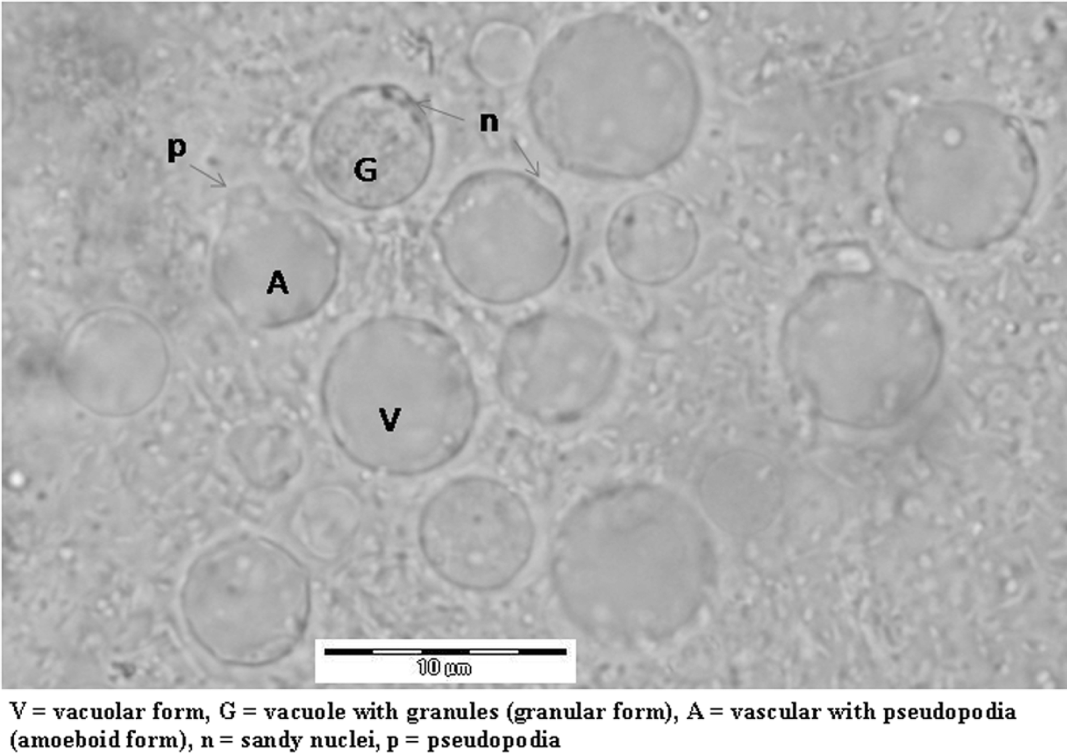
Fresh faecal samples were collected into wide-mouth, screw-capped containers and then transported to the Laboratory, Department of Parasitology, University of Malaya, Kuala Lumpur. Approximately 50 mg of feces were inoculated into a 15-ml screw-capped tube containing 5·0 ml of complete Jones’ medium (Ithoi, Reference Ithoi1999). All inoculated tubes were tightly closed, placed in a rack and incubated at 37°C. The medium in each of these tubes was replaced with the new complete Jones' medium every alternate day starting from day 2 of cultivation. This was carried out by discarding about 4·0 ml of the medium at the top level (without disturbing the pellet) and replaced by 4·0 ml of new complete Jones' medium. The presence of Blastocystis was observed daily for 14 days of cultivation, by placing 1 drop of cultured sediment onto a glass slide, covered with a cover-slip and viewed (X100 and X400 objectives) under light microscopy (Olympus BX51). Various sizes of Blastocystis cells (2–15 μm) were seen as vacuolar (most common), granular (many especially in old stool culture tubes), amoeboid (vacuolar or granular with pseudopodia) and cyst forms. Some of these morphologies are shown in Fig. 1. The number of positive tubes for Blastocystis was then recorded.
Various forms of Blastocystis cells (X400) from culture of stool samples.

Statistical analysis
Data analysis was performed using the Statistical Package for Social Sciences for Windows SPSS (version 13, September 2004). A proportion was used to present the prevalence of infections and other categorical variables. The Chi-square test was used to test for associations between independent variables and Blastocystis infection. A multiple logistic regression model was performed to identify the significant predictors of infection. P<0·05 was considered statistically significant.
Ethical issues
Prior to the stool collection, the objectives of this study were explained to the headmasters, teachers and children, and informed verbal consent was obtained. The protocol of this study was approved by the Medical Ethics Committee of the University of Malaya Medical Centre, Kuala Lumpur.
RESULTS
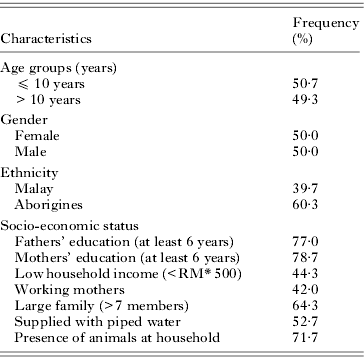
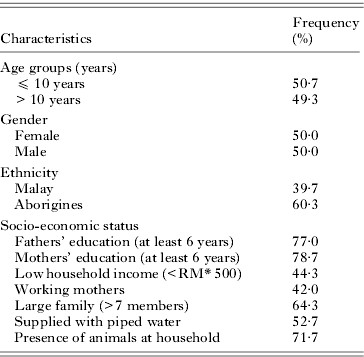
A total of 300 primary schoolchildren (150 males and 150 females, aged 6–12 years, median age=9 years, Interquartile Range=9–11 years) participated in this study. General characteristics of the subjects, including the demographic and socio-economic profiles, are shown in Table 1. In comparison, household income and the percentage of fathers who have at least 6 years of formal education are significantly higher among Malay compared to aboriginal people. On the other hand, the percentage of working aboriginal mothers (mostly farmers or rubber tapper) was significantly higher than in Malay people (P<0·05). However, there was no significant difference in the percentage of mothers with at least 6 years of formal education between both populations. The majority of aboriginal worked as farmers, and almost half of the Malay were either government employees or have their own business.
General characteristics of schoolchildren participating in this study (n=300)
| Characteristics | Frequency (%) |
| Age groups (years) | |
| ⩽ 10 years | 50·7 |
| > 10 years | 49·3 |
| Gender | |
| Female | 50·0 |
| Male | 50·0 |
| Ethnicity | |
| Malay | 39·7 |
| Aborigines | 60·3 |
| Socio-economic status | |
| Fathers’ education (at least 6 years) | 77·0 |
| Mothers’ education (at least 6 years) | 78·7 |
| Low household income (<RM* 500) | 44·3 |
| Working mothers | 42·0 |
| Large family (>7 members) | 64·3 |
| Supplied with piped water | 52·7 |
| Presence of animals at household | 71·7 |
* RM, Malaysian ringgits (US$1.00=RM3.00).
Prevalence and distribution of Blastocystis infection
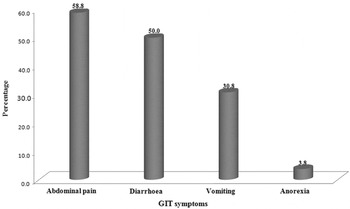
The overall prevalence of Blastocystis was 25·7% (77/300), it was more frequent in males than females though this difference was not statistically significant (x2=2·950; P=0·086). Similarly, there was no significant difference in the rate of infection according to age (χ 2=0·031; P=0·860). Moreover, the prevalence of Blastocystis was higher among the aboriginal children than the Malay but the difference was also not statistically significant (29·3% compared to 20·2%; x2=3·126; P=0·077). With regards to the symptoms, the prevalence of Blastocystis was significantly higher among the participants who had gastrointestinal symptoms as compared to asymptomatic participants (34·7% compared to 22·7%; x2=4·246; P=0·039), with abdominal pain and diarrhoea as the most common symptoms (Fig. 2). Stool specimens were also screened for the presence of other intestinal parasitic infections, and the children were found to be infected with Trichuris trichiura (47·0%), Ascaris lumbricoides (20·7%), hookworm (1·7%), Giardia duodenalis (15·3%) and Entamoeba histolytica/dispar (4·3%). Except giardiasis, there was no significant association between these infections and the gastrointestinal symptoms (P >0·05). Regarding co-infections, only 2·3% of the children had both Blastocystis and G. duodenalis, while 5·3% had Blastocystis with Ascaris and/or Trichuris. However, about half (49·4%; 38/77) of the Blastocystis infections were single infections, and were also found to be associated significantly with the gastrointestinal symptoms (x2=4·861; P=0·027).
Distribution of gastrointestinal symptoms among Blastocystis-infected schoolchildren.

Predictors of Blastocystis infection
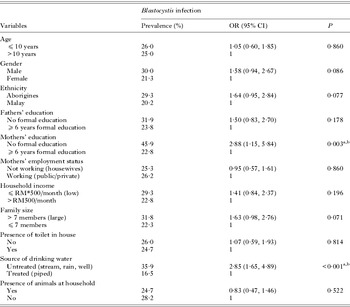
Variables that may be associated with the prevalence of Blastocystis infection were analysed using univariate and multivariate analyses, and the results are presented in Table 2. The results of univariate analysis showed that the absence of a piped water supply (x2=14·844; P<0·001) and the low level of mothers’ education (x2=9·097; P<0·01) were significantly associated with the prevalence of infection. On the other hand, other variables including age, sex, race, family size, family monthly income, parental employment status and the presence of animals at the household showed no significant association with the prevalence of Blastocystis infection. Logistic regression analysis confirmed that the absence of a piped water supply and the low level of mothers’ education were the significant predictors for the occurrence of Blastocystis infection. Schoolchildren who do not have a tap water facility were more than 3 times as likely to be infected (OR=3·13; 95% CI=1·78, 5·46; P<0·001). Likewise, children of mothers with a low level of education were more likely to be infected with Blastocystis as compared to those of mothers with at least 6 years of formal education (OR=3·41; 95% CI=1·62, 7·18; P<0·01).
Univariate and multivariate analyses of potential predictors associated with Blastocystis infection among rural schoolchildren in Pahang, Malaysia (n=300)

| Variables | Blastocystis infection | ||
| Prevalence (%) | OR (95% CI) | P | |
| Age | |||
| ⩽10 years | 26·0 | 1·05 (0·60, 1·85) | 0·860 |
| >10 years | 25·0 | 1 | |
| Gender | |||
| Male | 30·0 | 1·58 (0·94, 2·67) | 0·086 |
| Female | 21·3 | 1 | |
| Ethnicity | |||
| Aborigines | 29·3 | 1·64 (0·95, 2·84) | 0·077 |
| Malay | 20·2 | 1 | |
| Fathers' education | |||
| No formal education | 31·9 | 1·50 (0·83, 2·70) | 0·178 |
| ⩾6 years formal education | 23·8 | 1 | |
| Mothers’ education | |||
| No formal education | 45·9 | 2·88 (1·15, 5·84) | 0·003a, b |
| ⩾6 years formal education | 22·8 | 1 | |
| Mothers' employment status | |||
| Not working (housewives) | 25·3 | 0·95 (0·57, 1·61) | 0·860 |
| Working (public/private) | 26·2 | 1 | |
| Household income | |||
| ⩽RM*500/month (low) | 29·3 | 1·41 (0·84, 2·37) | 0·196 |
| >RM500/month | 22·8 | 1 | |
| Family size | |||
| > 7 members (large) | 31·8 | 1·63 (0·98, 2·76) | 0·071 |
| ⩽7 members | 22·3 | 1 | |
| Presence of toilet in house | |||
| No | 26·0 | 1·07 (0·59, 1·93) | 0·814 |
| Yes | 24·7 | 1 | |
| Source of drinking water | |||
| Untreated (stream, rain, well) | 35·9 | 2·85 (1·65, 4·89) | <0·001a, b |
| Treated (piped) | 16·5 | 1 | |
| Presence of animals at household | |||
| Yes | 24·7 | 0·83 (0·47, 1·46) | 0·522 |
| No | 28·2 | 1 | |
a Significant association, P<0·05.
b Confirmed as significant predictors by logistic regression analysis.
* RM, Malaysian ringgits.
DISCUSSION
In the present study, the infection rate of Blastocystis was 25·6%, which is within the range of prevalence rate of previous local reports. Several Malaysian researchers noted that the infection rate of this protozoan was between 1·1% and 4·4% in children with diarrhoea (Sinniah and Rajeswari, Reference Sinniah and Rajeswari1994; Menon et al. Reference Menon, Abdullah, Mahamud and Singh1999). Recently, an epidemiological survey showed a prevalence of 52·3% in Aborigines living in Pos Senderut, Pahang (Noor Azian et al. Reference Noor Azian, San, Gan, Yusri, Nurulsyamzawaty, Zuhaizam, Maslawaty, Norparina and Vythilingam2007). Pos Senderut is a remote aboriginal settlement located deep in the jungle with no road access, electricity, piped water and sanitation facilities and this could explain the higher prevalence of Blastocystis and other intestinal parasites. Comparing our findings with studies from other countries showed that the prevalence reported by the present study was similar to those reported among children in Iran (28·2%) and Colombia (22·4%) (Daryani et al. Reference Daryani, Barmaki, Ettehad, Sharif, Nemati and Ziaei2006; Boeke et al. Reference Boeke, Mora-Plazas, Forero and Villamor2010). However, it is higher than that among school-aged children from Thailand and India (Yaicharoen et al. Reference Yaicharoen, Ngrenngarmlert, Wongjindanon, Sripochang and Kiatfuengfoo2006; Rayan et al. Reference Rayan, Verghese and McDonnell2010). By contrast, considerably higher prevalence rates of 48·7% and 40·7% were reported among Philippians and Argentinean children, respectively (Baldo et al. Reference Baldo, Belizario, De Leon, Kong and Chung2004; Gamboa et al. Reference Gamboa, Navone, Orden, Torres, Castro and Oyhenart2011). Our findings showed no significant difference in the prevalence of Blastocystis infection according to age and gender of the participants, and this is consistent with the results of previous reports (Noor Azian et al. Reference Noor Azian, San, Gan, Yusri, Nurulsyamzawaty, Zuhaizam, Maslawaty, Norparina and Vythilingam2007; Leelayoova et al. Reference Leelayoova, Siripattanapipong, Thathaisong, Naaglor, Taamasri, Piyaraj and Mungthin2008; Cook et al. Reference Cook, Swanson, Eggett and Booth2009).
Our findings also showed that the prevalence of infection was higher among aboriginal schoolchildren than their Malay peers and this could be attributed to the poor living conditions and socio-behavioural factors. The Aborigines were previously living in isolated huts without electricity, toilet and water supply, located near to the stream in the forest. They were then re-settled along the water streams and their houses were equipped with electricity and a toilet. Some of the houses have a piped water supply. Nevertheless, the Aborigines preferred defecating at the site of the stream, and used water from streams for most of their daily activities (swimming, cooking, drinking, bathing and washing). This practice of defecating near the streams by the residents (especially children) in Lipis district, Pahang has been noted by other workers (Al-Mekhlafi et al. Reference Al-Mekhlafi, Surin, Atiya, Ariffin, Mahdy and Abdullah2008). Household animals such as dogs, cats and chickens roamed freely in and out of the houses and water streams, which could also contribute to the contamination of water sources. The occurrence of Blastocystis in water from wells and from the rain is not known but Blastocystis, Cryptosporidium and Giardia contaminated surface water from Malaysia due to the exposure with infected feces from local communities (human and animals) that live surrounding the streams have been reported (Azman et al. Reference Azman, Init and Wan Yusoff2009; Ithoi et al. Reference Ithoi, Azman, Mak, Wan Yusoff and Rohela2011). Blastocystis is transmitted by the fecal-oral route among family members, patients and staff of day-care centres, and residents of small communities that lack access to proper sanitation (Stenzel and Boreham, Reference Stenzel and Boreham1996). As evidence of zoonotic transmission, several molecular studies have identified Blastocystis in a wide range of animals and have reported that most of the Blastocystis isolates from humans and animals including monkeys, chickens, cattle, rats and pigs are genetically identical (Yoshikawa et al. Reference Yoshikawa, Wu, Nagano and Takahashi2003, Reference Yoshikawa, Abe and Wu2004, Reference Yoshikawa, Wu, Pandey, Pandey, Sherchand, Yanagi and Kanbara2009).
As the first report from Malaysia, our study indicates that children who have no access to a piped water supply are more prone to get Blastocystis infection, and this provides further evidence for waterborne transmission of Blastocystis. Few studies have implicated contaminated water as a source of Blastocystis infections (Taamasri et al. Reference Taamasri, Mungthin, Rangsin, Tongupprakarn, Areekul and Leelayoova2000; Li et al. 2007; Leelayoova et al. Reference Leelayoova, Siripattanapipong, Thathaisong, Naaglor, Taamasri, Piyaraj and Mungthin2008; Eroglu and Koltas, Reference Eroglu and Koltas2010; Baldursson and Karanis, Reference Baldursson and Karanis2011). This is not surprising since the transmissible form of the parasite is the water-resistant cyst (Tan, Reference Tan2004). Blastocystis cysts were reportedly able to survive in water for up to 19 days at a normal temperature, but are fragile at extremes of heat and cold, and in common disinfectants (Zaman et al. Reference Zaman, Howe and Ng1995; Moe et al. Reference Moe, Singh, Howe, Ho, Tan, Ng, Chen and Yap1996). During the visits to the villages, we observed that almost half of the households among both communities (the Aborigine and Malay) used water from the streams, wells and rain with or without further treatment by filtration or boiling. River water can be highly exposed to contamination with infected feces from wild/domestic animals and humans living around the river (Azman et al. Reference Azman, Init and Wan Yusoff2009; Ithoi et al. Reference Ithoi, Azman, Mak, Wan Yusoff and Rohela2011). Therefore, drinking unboiled surface water from streams is strongly believed to be the main risk factor for Blastocystis infection, as shown in this study.
Leelayoova et al. (Reference Leelayoova, Siripattanapipong, Thathaisong, Naaglor, Taamasri, Piyaraj and Mungthin2008) described the possibility of waterborne transmission of Blastocystis by identifying the same genotype of Blastocystis in fecal specimens collected from schoolchildren and in the drinking water provided in schools. A study conducted in China, revealed a high infection rate (32·6%) and found that the consumption of raw water plants and drinking unboiled water were predictors for Blastocystis infection (Li et al. 2007). Moreover, in a study among pre-school children from Jordan, the prevalence rate of Blastocystis infection was 25% and contaminated water was implicated as a major source of infection (Nimri, Reference Nimri1993). In a worldwide review on waterborne outbreaks of parasitic protozoan infections, Karanis et al. (Reference Karanis, Kourenti and Smith2007) documented 325 outbreaks since the 1950s and revealed that the majority of outbreaks were reported in the USA and Europe with Giardia and Cryptosporidium being the predominant protozoa followed by Entamoeba, Blastocystis, Cyclospora, Toxoplasma, Microsporidia and free-living amoebas. Indicating a dramatic increase in the number of waterborne outbreaks caused by those protozoa, Baldursson and Karanis (Reference Baldursson and Karanis2011) showed that 199 outbreaks have been reported between 2004 and 2010 with 40·2% and 30·6% of the outbreaks occurring in New Zeeland and North America, respectively.
Another significant finding that was associated with the risk of Blastocystis infection was the low level of maternal education. Children of mothers with less than 6 years of formal education were almost 3 times more likely to be infected with Blastocystis. It is well documented that education of the family, particularly the mothers, has an important role in preventing intestinal parasitic infections among children (Okyay et al. Reference Okyay, Ertug, Gultekin, Onen and Beser2004). Daryani et al. (Reference Daryani, Barmaki, Ettehad, Sharif, Nemati and Ziaei2006) reported that prevalence of Blastocystis in children of working mothers was less than those of non-working mothers. They assumed that a higher educational level in employed mothers played an important role in hygienic education of their children. In contrast, other studies found no association between the mother's educational level and the rate of Blastocystis infection (Leelayoova et al. Reference Leelayoova, Siripattanapipong, Thathaisong, Naaglor, Taamasri, Piyaraj and Mungthin2008; Boeke et al. Reference Boeke, Mora-Plazas, Forero and Villamor2010).
Subsequently, infection of Blastocystis, as either single or multiple infections, was found to be significantly associated with gastrointestinal symptoms among these schoolchildren with abdominal pain (58·8%) and diarrhoea (50·0%) being the common symptoms. To date, the pathogenic role of Blastocystis is still controversial (Tan et al. Reference Tan, Mirza, Teo, Wu and Macary2010). Numerous clinical and epidemiological studies concluded that Blastocystis is a commensal organism and probably is not responsible for clinical symptoms when detected (Sun et al. Reference Sun, Katz, Tanenbaum and Schenone1989). On the other hand, many studies have also shown the association of some gastrointestinal symptoms with the infection, and have suggested a positive correlation between the parasite density and symptoms (Qadri et al. Reference Qadri, al-Okaili and al-Dayel1989; Galantowicz et al. Reference Galantowicz, Illueca, Levy, Rayburn and Weinstock1993; Nimri and Batchoun, Reference Nimri and Batchoun1994; Kaya et al. Reference Kaya, Cetin, Aridogan, Arikan and Demirci2007). In a large-scaled study aimed at determining the prevalence and clinical importance of Blastocystis among 12 136 patients in Saudi Arabia, 17·5% of the patients were infected and almost half of them were symptomatic with abdominal pain being the most common symptom (87·9%) followed by constipation (32·2%) and diarrhoea (23·4%) (Qadri et al. Reference Qadri, al-Okaili and al-Dayel1989). In another study conducted among hospitalized Turkish patients without any other co-infecting pathogens, higher rates of symptoms were present among Blastocystis-infected children, abdominal pain was present in 76·9%, diarrhoea in 50% and distention in 32·6%, indicating an association between parasite density and pathology (Kaya et al. Reference Kaya, Cetin, Aridogan, Arikan and Demirci2007). Moreover, several studies found a higher incidence of Blastocystis infection among immunocompromised individuals, including AIDS patients and individuals with cancer (Horiki et al. Reference Horiki, Kaneda, Maruyama, Fujita and Tachibana1999; Tasova et al. Reference Tasova, Sahin, Koltas and Paydas2000; Kurniawan et al. Reference Kurniawan, Karyadi, Dwintasari, Sari, Yunihastuti, Djauzi and Smith2009). Besides that, extraintestinal manifestations were reported as invasive Blastocystis infections in 2 recent studies and a debate over the issue that Blastocystis is an opportunistic pathogen has began (Hu et al. 2008; Janarthanan et al. Reference Janarthanan, Khoury and Antaki2011).
In conclusion, this study revealed that Blastocystis infection exists among primary schoolchildren in rural Peninsular Malaysia. Water supply and maternal education were the main determinants of the infection. Hence, improvement of sanitary facilities and quality of drinking water, public education and health promotion should be considered to prevent and control this infection.
ACKNOWLEDGEMENTS
The authors would like to thank all children and their parents for their participation in this study. Thanks are due to headmasters and teachers of the respective schools at which specimens were collected, for their kind help and cooperation.
FINANCIAL SUPPORT
This study was supported by a research grant from University of Malaya (No. RG187/10HTM and PS230/2010B), Kuala Lumpur, Malaysia.