I. INTRODUCTION
Exchange bias (EB) effect is usually exhibited in ferromagnetic/antiferromagnetic systems. Reference Berkowitz and Takano1,Reference Das, Patra, Majumdar and Giri2 It is one of the important phenomena associated with exchange anisotropy. The typical characteristic is horizontal shift of hysteresis loops after the material is cooled with an external field from a higher temperature. EB effect was firstly discovered in passivated Co–CoO nanoparticles by Meiklejohn and Bean about 50 years ago. Reference Meiklejohn and Bean3 Afterward, it has been intensively investigated in theoretical and experimental aspects due to the extensive applications in the field of advanced technology, for example, data storage as spintronic devices, magnetic recording media and so on. Reference Dieny, Speriosu, Parkin, Gurney, Wilhoit and Mauri4,Reference Kools5 EB effect can be essentially influenced by the initial temperature and the applied magnetic field during the field cooling process. Thus, training effect is another meaningful characteristic accompanied with EB effect and it reveals a strong dependence on thermal and magnetic histories of EB effect. Reference Zheng, Wen, Fung and Zhang6 The consecutive hysteresis loop measurement after field cooling presents a decrease in EB field (H EB) with ordinal measurement cycles. Reference Guo, Liu, Meng, Liu, Gong, Han and Zhang7 In general, the understanding of training effect can help to study EB effect, and on other side, the study of training effect may require the exact of EB effect.
During the past decades, reports on EB effect were mainly focused on multilayer film system. Reference Nogués and Schuller8 Some particle systems have been studied recently because of the ferromagnetic–antiferromagnetic exchange interactions, which can be useful to break the superparamagnetic limit in nanoparticles. Reference Skumryev, Stoyanov, Zhang, Hadjipanayis, Givord and Nogués9,Reference Mishra, Dubenko, Griffis, Ali and Marasinghe10 In addition, a series of composites containing transition metal particles and their native oxides, for example Ni–NiO, Reference Yi, Ding, Zhao and Liu11 have also been emphasized. Nevertheless, the system of transition metal oxides and the corresponding ferrimagnetic spinel is less investigated. NiCr2O4 is a spinel ferrimagnetic material with applications in various devices. Detailed magnetic studies of polycrystalline NiCr2O4 have been reported just in a few papers. Reference Ptak, Maczka, Gagor, Pikul, Macalik and Hanuza12,Reference Suchomel, Shoemaker, Ribaud, Kemei and Seshadri13 The corresponding transition metal oxide Cr2O3 has an antiferromagnetic order at 307 K and there is also rarely reports to study the magnetic effect. Reference Mcguire, Scott and Grannis14 From the above discussion, we speculate that the composite with ferrimagnetic NiCr2O4 and antiferromagnetic Cr2O3 may exhibit some meaningful magnetic effect.
In our research, we have firstly synthesized the NiCr2O4/Cr2O3 system through co-precipitation method. On this basis, we study the EB effect and training effect with different measurement conditions. EB effect is detected at low temperature and it decreases with increasing temperature. It also increases to saturation when enough high cooling field is applied. During the increasing of temperature and cooling field, EB field (H EB) has a similar tendency with the shift of remnant magnetization (M shift). In addition, training effect is explained by two forms of training mechanism during cycle procedure.
II. EXPERIMENTAL PROCEDURE
In this synthesis, NiCr2O4/Cr2O3 (1:4) composite was prepared by the chemical co-precipitation method. As described in previous literature, Reference Tian, Yuan, Yin, Liu, He, Duan, Li and Wang15 high-pure nickel nitrate [Ni(NO3)2·6H2O], chromic nitrate [Cr(NO3)3·9H2O] and ammonium bicarbonate [NH4HCO3] were used as the staring raw materials. Stoichiometric amounts of nickel nitrate and chromic nitrate were dissolved in distilled water at first. Subsequently, ammonium bicarbonate solution with appropriate content was slowly added to the upper mixture solution under constant stirring. During this process, the solution was gradually changed to suspension. After that, the obtained suspension was washed repeatedly using diluted water. Then, the suspension was dried in air at 120 °C to form precursor powders. Finally, after ground adequately for 1 h, the powders were sintered in air for 3 h with 900 °C, obtaining the NiCr2O4/Cr2O3 composite.
X-ray diffraction (XRD) pattern of the composite was collected on a Philips Panalytical X'Pert diffractometer (PANalytical, Almelo, Netherlands) equipped with a Cu Kα radiation source. The morphology and stoichiometry were verified by scanning electron microscope (SEM) and energy dispersive spectrometer (EDS) through a JSM-5610LV (JEOL, Tokyo, Japan). Magnetic measurements were carried out using a commercial Physical Property Measurement System (Quantum Design, San Diego, California).
III. RESULTS AND DISCUSSION
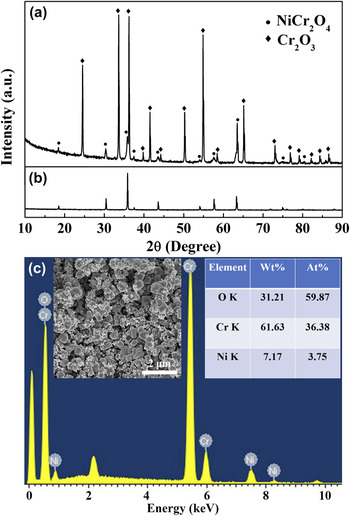
Figure 1(a) shows the XRD pattern of NiCr2O4/Cr2O3 composite. Two sets of diffraction pattern corresponding to NiCr2O4 (cycle) and Cr2O3 (diamond) can be indexed without other impurity. EDS data in Fig. 1(c) and the right inset table confirm the stoichiometry with 1:4. Considering the phase formation temperature of NiCr2O4 is higher than that of Cr2O3, we speculate that Ni cations react with part of Cr cations to form NiCr2O4 phase leaving the other Cr cations develop to Cr2O3 phase. In other words, with the special chemical synthesis method and thermal treatment, Ni cations doped in Cr cations separate the phases into ferrimagnetic NiCr2O4 and antiferromagnetic Cr2O3 phases by a local arrangement of the Ni and Cr cations. To confirm this, the XRD pattern of pure NiCr2O4 synthesized by the same method is shown in Fig. 1(b). In addition, the micrograph shown in the left inset of Fig. 1(c) displays the morphology of NiCr2O4/Cr2O3 composite. As analyzed and calculated, NiCr2O4 particles with grain size of about 50 nm are embedded in Cr2O3 of about 250 nm. It can further confirm that the NiCr2O4 phase is separated out from the Cr2O3 phase. They also prove that the ferrimagnetic NiCr2O4 and antiferromagnetic Cr2O3 can be coexistent in the system synthesized by the co-precipitation method.
(a) XRD pattern of the NiCr2O4/Cr2O3 system. (b) XRD pattern of the pure NiCr2O4 phase. (c) EDS spectrum of NiCr2O4/Cr2O3 system. The left inset is the SEM micrograph and the right inset is the proportion values of elements.

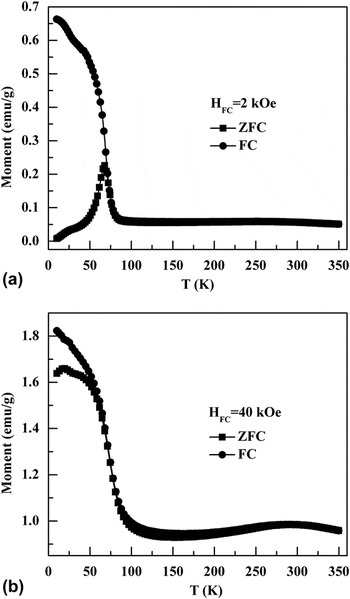
The temperature dependent magnetization under different magnetic field with zero-field-cooled (ZFC) and field-cooled (FC) processes are plotted in Fig. 2. From Fig. 2(a), we can find that magnetization curves have a steep increase near 75 K accompanied with a clear peak in ZFC around 68 K associated with the ferrimagnetic transition and a subtle anomaly in FC at 30 K marked with the spiral magnetic order. It is very qualitatively similar to the previous data about NiCr2O4. Reference Ptak, Maczka, Gagor, Pikul, Macalik and Hanuza12,Reference Suchomel, Shoemaker, Ribaud, Kemei and Seshadri13 The magnetization curves with high applied field of 40 kOe showed in Fig. 2(b) exhibit a broad cusp near 305 K corresponding to the antiferromagnetic orders of Cr2O3. In addition, as temperature decreases below the temperature about 65 K, the ZFC curve does not follow the same path as the FC curve. The irreversibility between ZFC and FC curves reveals that there are some frozen moments in the sample. Since NiCr2O4 can be separated from Cr2O3, an intermediate structural disorder layer including anisotropy can be formed because of the chemical roughness and the intermixing at the interfaces. Thus, some uncompensated spins at the interfaces are also frozen along the field cooling direction after FC process. With increasing magnetic field, the spiral magnetic order temperature shifts appreciably toward to lower temperature side Reference Tadic, Savic, Jaglicic, Vojisavljevic, Radojkovic, Prsic and Nikolic16 and the peak involving ferrimagnetic transition is gradually flat, which is probably due to the modification of the interface spins. As discussed above, the interface between NiCr2O4 and Cr2O3 forms into structure disordered layer. The intermediate layer with limited thickness modifies the establishment of long range ordering unlike the original domain in ferrimagnetic and antiferromagnetic phase. The modification results in the asymmetric atomic arrangement and breaks the exchange bonds of magnetic cations. More important, this structural modification can produce competing or pinning interactions between the randomly oriented spins and then the interactions further generate some novel magnetic effects.
Temperature dependence of magnetization with ZFC and FC processes at (a) H FC = 2 kOe and (b) H FC = 40 kOe.

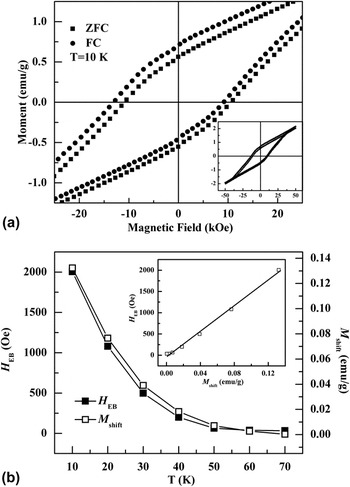
Magnetic hysteresis loops have been measured after ZFC and FC processes at 10 K. During ZFC process, the sample was cooled from 350 to 10 K without applied field and for FC process the sample was cooled with a 30 kOe field. After that, hysteresis loops were measured between ±50 kOe. In Fig. 3(a), ZFC magnetic hysteresis loop shows a strict central symmetry at zero field but FC magnetic hysteresis loop exhibits a shift of the loop. Inset of Fig. 3(a) is the whole loops of ZFC and FC processes. We can find that the loops are not saturated evidently even though at high field. However, the system can be considered effectively saturated if the ascending and descending branches of the loop coincide for high fields. We define the field as H irr, above which the loop is closed. In the inset, it shows that the magnetization is reversible in high fields and the loops is closed at H irr, which is about 35 kOe. Ascending and descending branches also have the coincident tendency above the H irr. In other words, the maximum of measuring field is high enough to make hysteresis loop saturate effectively. In addition, ferrimagnetic NiCr2O4 is commonly easier to get saturation than antiferromagnetic Cr2O3. It is reasonable that the NiCr2O4/Cr2O3 system is effectively saturated at higher field than NiCr2O4. Therefore, those can give the true signature of the observed EB effect, rejecting the minor loop effect. In our system, a negative H EB ≈ 2037 Oe and a positive M shift ≈ 0.129 emu/g can be found. Here, H EB is defined as H EB = (H C1 − H C2)/2, where H C1 and H C2 are the absolute values of left and right coercive fields in the hysteresis loop, respectively. M shift is calculated by the mathematical formulae, M shift = (M + − M −)/2, in which M + and M − are the absolute values of positive and negative remanent magnetization. Meanwhile, a coercivity enhancement ∆H C ∼ 355 Oe is also observed and H C is defined as H C = (H C1 + H C2)/2. Spin disorder at the interface can reduce the antiferromagnetic anisotropy and further influence the coupling strength. With field cooling, interfacial uncompensated spins including frozen and rotatable with different coupling strength can be existed. Reference Gruyters and Schmitz17,Reference Qiu, Yang, Zhou, Chantrell, O’Grady, Nowak, Du, Bai and Sun18 During magnetic reversal, the rotatable antiferromagnetic spins can couple with the adjacent ferrimagnetic moments and follow the ferrimagnetic spin rotation, which can explain the enhancement of H C. As a pinning center, the frozen antiferromagnetic spins can pin the adjacent ferrimagnetic moment leading to the appearance of H EB. In addition, M shift is another good evidence proving the existence of net uncompensated spins. Some uncompensated spins are pinned along the external field direction and could not rotate following the applied field, which give rises to the appearance of M shift in FC hysteresis loop. Certainly, the value of M shift is depend on the number of pinned spins. Temperature dependence of H EB and M shift is shown in Fig. 3(b). For each measurement, the sample was cooled down from 350 K to the measuring temperature with a 30 kOe field and then the magnetization loops were obtained. As a result, with temperature increasing, H EB and M shift decrease and the values finally tend to zero at 70 K, which is consistent with the irreversible temperature in Fig. 2. Besides, H EB has a similar temperature dependence behavior to M shift. It indicates that they have close correlation and the similar origination. Not only resulting in the generation of M shift, the interfacial frozen uncompensated spins can also act as the pinning layer, execute a microscopic torque on ferrimagnetic spins and then bring about the appearance of H EB. In the inset of Fig. 3(b), nearly linear relationship between M shift and H EB can be noted. It directly reveals the equivalence of the parameters and the value of H EB is determined by the quantity of uncompensated pinned spins on the interfacial layer. The decreasing tendency does not present any anomaly, which can also exclude the influence of spiral magnetic order on EB effect.
(a) The ZFC and FC hysteresis loops measured at 10 K cooled from 350 K without applied field and a 30 kOe field, respectively. Inset is the whole loops of ZFC and FC processes. (b) Temperature dependence of H EB and M shift after field cooling in 30 kOe from 350 K and the inset shows the variations in H EB with M shift.

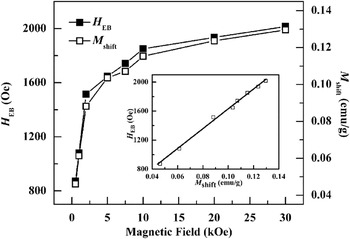
In addition, cooling field dependence of H EB and M shift is exhibited in Fig. 4. The sample was cooled down from 350 to 10 K with different field (0.5 kOe ≤ H FC ≤ 30 kOe). After reaching 10 K, magnetization loops were measured between ±50 kOe. When cooling field increases from 0.5 to 10 kOe, there is an abrupt increase of H EB and M shift. After the initial increase, both of them nearly reach the saturation values. The beginning increase in cooling field just like a stronger applied force induces a growing number of pinned spins along the field direction and also induces the increase in M shift and H EB. When cooling field is going on increasing from 10 to 30 kOe, it is high enough to make more pinned spins along the applied field direction and the number of pinned spins varies little with the field. That implies that H EB and M shift obtain the saturated values, and so does the EB effect. From the inset of Fig. 4, the uniform field dependence of H EB and M shift also represents their close relationship and similar origination, which proves the critical role of frozen uncompensated spins in EB effect. Moreover, the EB effect has also been found in single NiCr2O4 phase. Reference Barman, Bora and Ravi19,Reference Singh, Chakraborty, Srikanth, Chandra, Mitra and Kumar20 Compared with the EB effect of polycrystalline NiCr2O4 and the nanoparticle phase, the values of H EB and H C in NiCr2O4/Cr2O3 system are evidently improved. The improvement should be related to the different mechanisms inducing the appearance of EB effect.
The cooling field dependence of H EB and M shift, and the inset is the dependence of H EB on M shift.

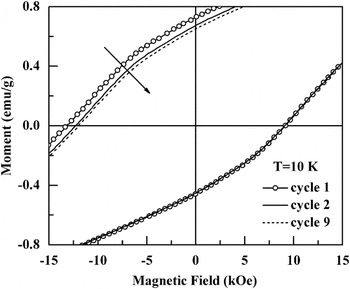
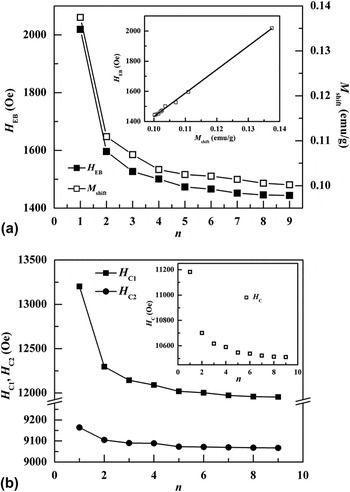
One of the interesting characteristics of EB is training effect, which is manifested as the evolution of magnetic hysteresis loop when the system is field-cycled several times successively at a specific temperature. Typically, a gradual decrease of H EB and M shift with increasing number (n) of subsequent loop cycling can be observed. For the training effect measurements, the sample was first cooled from 350 to 10 K under H = 30 kOe. Subsequently, the magnetic hysteresis loops were measured and cycled 9 times, consecutively. As plotted in Fig. 5, training effect is evident in NiCr2O4/Cr2O3 system. The first cycle loop shows a prominent EB effect presenting an asymmetric magnetization reversal characteristic. After that, the subsequent magnetization cycles tend to symmetric gradually. The central part of first, second, and ninth loops are shown in Fig. 5. During the training procedure, both H EB and M shift decrease with the field cycling accompanied with a dramatic decrease in H C1 and M + in comparison with the variation of H C2 and M −. The systematic decrease of H EB (including H C1 and H C2) and M shift with n is shown in Fig. 6. Figure 6(a) proves the decrease tendency of H EB and M shift. The inset of Fig. 6(a) displaying the linear relationship between H EB and M shift is consistent with the inset of Figs. 3(b) and 4. The pinned uncompensated spins at ferrimagnetic/antiferromagnetic interfaces still play a crucial role during training effect. When field cycles are applied continuously, some pinned uncompensated spins try to alter their direction repeatedly along the external field, which results in the depinning at the interfaces between ferrimagnetic and antiferromagnetic phase. Thus, the number of pinned uncompensated spins is gradually decreasing under continuous cycle magnetization and it gives rise to the decrease of M shift. In addition, the decrease tendency of interfacial coupling interaction leads to the decrease in H EB. Therefore, Both H EB and M shift are closely connected with the decreasing fraction of pinned uncompensated spins. As shown in Fig. 6(b), it is not difficult to find that the training effect of H EB is mainly due to the decrease of H C1 dependent on n, while H C2 just has the uniform tendency with far less evident dependent on n. Furthermore, in spite of the reduction of H EB, H C also has a shrink with field cycling as plotted in the inset of Fig. 6(b). The different dependence on n of H C1 and H C2 indicates the different mechanism of magnetization reversal during the left and right branches hysteresis. It is in good agree with the NiO–Fe heterostructure, where coherent rotation is observed at H C2 while wall propagation and domain nucleation dominate in the vicinity of H C1. Reference Hochstrat, Binek and Kleemann21
The first, second and ninth hysteresis loops at 10 K after field cooling from 350 K with 30 kOe.

(a) Field cycle dependence of H EB and M shift at 10 K, and the inset presents the variations of H EB with M shift. (b) Field cycle dependence of H C1 and H C2 at 10 K, and the inset is the cycle number dependence of H C.

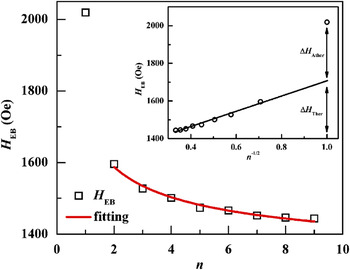
Figure 7 shows the dependence of H EB on n and the best fitting (solid line) with n ≥ 2. H EB of the second hysteresis loop (∼1600 Oe) is decreased about 20% compared with that of the first loop (∼2037 Oe) while the subsequent loops show a more gradual continuous decrease. The distinct character difference of H EB between n = 1 and n ≥ 2 is a signal that training effect in our system is considered to two different explanation. For n = 1, magnetization reversal asymmetry may exist, which is correlated with the antiferromagnetic magnetic symmetry due to the onset of biaxial anisotropy. As can be seen in the report by Hoffman, Reference Hoffmann22 the symmetry of anisotropy in antiferromagnet is crucial for understanding of training effect in EB system. Multiple antiferromagnetic easy anisotropy axes can exist and initially stabilize the noncollinear arrangement of antiferromagnetic spins, which then relaxes into a collinear arrangement after the first magnetization reversal. However, the subsequent field cycles should arise from the conventional mechanism based on the thermally driven depinning of uncompensated spins. The instability of EB system results in a reduction of pinning upon repeated field cycling, which is due to the irreversible changes in the magnetic microstructure of antiferromagnet. Reference Paccard, Schlenker, Massenet, Montmory and Yelon23 To unveil the detailed mechanism, thermal activation and athermal contribution are used to distinct the first and subsequent loops in training effect, recently. The existence of the two types in interfacial domain states after FC has been reported by Chan et al. Reference Chan, Parker, Crowell and Leighton24 So, we can explain our training effect through the two types.
Field cycle dependence of H EB (open square) and the corresponding best fit (solid line) to the data for n ≥ 2. The inset is H EB versus n −1/2 for NiCr2O4/Cr2O3 system.

For many cases, training effect has been found to obey the empirical n
−1/2 law. The relationship between H
EB and n observed in experimentally is usually expressed by:
 $H_{{\rm{EB}}}^n - H_{{\rm{EB}}}^\infty = {\kappa \mathord{\left{\vphantom {\kappa {\sqrt n }}} \right\kern-\nulldelimiterspace} {\sqrt n }}$
/, where
 $H_{{\rm{EB}}}^\infty$
is H
EB in the limit of infinite loops and κ is an experimental constant about material dependent decay.
Reference Chan, Parker, Crowell and Leighton24
As can be seen, the fitting curve in Fig. 7 is in good agree with our experimental data with n ≥ 2 but fails with n = 1. The fitting parameters are
 $H_{{\rm{EB}}}^\infty = 1299\,{\rm{Oe}}$
and κ = 406. According to the thermal activation theory,
Reference Dias, Menéndez, Liu, Haesendonck, Vantomme, Temst, Schmidt, Giulian and Geshev25
thermal fluctuations can reduce the stability of antiferromagnetic anisotropy energy and the interfacial exchange energy. As a driving force, ferrimagnetic magnetization reversal can overcome high interfacial pinning energy. Consequently, the reversal of ferrimagnetic moment influences the interfacial ferrimagnetic/antiferromagnetic coupling and leads to the loss of interfacial exchange energy during training cycles. The reduction of interfacial coupling energy is reflected by the decrease of H
EB due to the depinning of frozen antiferromagnetic spins. Nevertheless, athermal effect can come from the spin-flop-like coupling and the initial spin configuration cannot be restored. Straight line fitting of H
EB versus n
−1/2 in the inset of Fig. 7 further presents a clear illustration to separate the two effects into athermal and thermal training effect shown as “∆H
Ather” and “∆H
Ther,” respectively. Antiferromagnetic phase at the interfaces breaks the adjacent ferrimagnetic phase into small size domains which interact with frozen and rotatable uncompensated spins. The first loop is athermal accompanied with the strong magnetization reversal asymmetry. The subsequent loops have a more gradual loop number dependence and we interpret this contribution as a conventional mechanism due to thermally activated depinning.
IV. CONCLUSIONS
In summary, we have investigated the EB and training effect of NiCr2O4/Cr2O3 system synthesized by a chemical co-precipitation method. With field cooling from 350 to 10 K, magnetic hysteresis loop shows the H EB ∼ 2037 Oe and M shift ∼ 0.129 emu/g with a coercivity enhancement ∆H C ∼ 355 Oe. The EB effect disappears near 70 K. This result is attributed to the frozen uncompensated spins and the exchange interaction at the NiCr2O4/Cr2O3 interfaces. During training process, H EB drops abruptly between the first and second magnetic cycles followed by a more gradual continuous change in the subsequent cycles. As suggested, two types of training theories should be existed. One is athermal effect in the first cycle and the other is thermal contribution with the subsequent cycles.
ACKNOWLEDGMENTS
This work is supported by the National Natural Science Foundation of China (Grant Nos. 11174092 and 11474111). We would like to thank the staff of Analysis Center of HUST for their assistance in various measurements.