Much of the luster had worn off of his dream of a Great Society by the time former Peace Corps and War on Poverty director Sargent Shriver sat down in late 1968 to pen the introduction to Warriors for the Poor, a little book that the New York Times critic John Leonard acerbically dismissed as a “prose Valentine to VISTA [Volunteers in Service to America].”Footnote 1 Although it might have seemed like a cheap shot at Washington's recently exiled liberal glitterati – especially coming on the heels of their annus horribilis – Leonard's assessment had the advantage of being spot-on. Despite the credibility lent by the imprimatur of a trade press, the slim volume, including eight pages of photographs, extolled the achievements of the five thousand Americans who had served as VISTA volunteers. Published in the early months of 1969, not long after Richard Nixon had begun the task of extricating the US government from his predecessor's War on Poverty, the book possesses a valedictory quality. From its dedication page – ”To Those Who Volunteered” – to its final sentences, in which the authors concluded that “VISTA has proved to be a unique experiment in American voluntarism,” Warriors for the Poor seemed more like a commemoration of battles once fought than a call to take up arms anew.Footnote 2
Perhaps at last chastened by the backlash against the Johnson administration on the left and an increasingly vocal chorus of critics of “big government” on the right, Shriver, a seemingly inexhaustible optimist, wrote in a reflective mood. While the VISTA program still existed and would, in fact, live on to become one of the most durable legacies of the Johnson years, it seemed from Shriver's words that its history was being written in these pages. “It was bound to happen,” he wrote of VISTA's founding.
After the first surge of Peace Corps volunteers served and came back, America's idealists began asking, “If we're going to serve the poor abroad, why not also serve them at home?” The question made sense. The poor, the hungry, the naked, the half-dead: they could be found in Columbia, South Carolina as well as Colombia, South America. They were in Indiana as well as India. They lived as much on the Rio Grande in Texas as the Rio Grande of Brazil.
Shriver concluded, “In 1964, VISTA was created to meet the demands of those Americans who saw poverty not just across the ocean, but also across the tracks.”Footnote 3 The images that dominated the middle of the book introduced readers to some of these intrepid warriors as they faced the hostile forces of hopelessness and alienation.
Having exhausted whatever promotional impact they might have been meant to elicit, these pictures do much more than just record the experiences of a few volunteers during the heady days of the War on Poverty. They show us how a community of influential liberals in the postwar United States imagined poverty as a social problem.Footnote 4 Using the same visual tropes to illustrate the activities of VISTA at home and the Peace Corps abroad, postwar liberals who worked in and around the federal government drew a picture of an explicitly global social problem that transcended particular geographical, historical, political, or social specificities.Footnote 5 More than just a story of an apparently failed propaganda campaign to sell Johnson's “Great Society,” then, this article provides meaningful insight into the process by which the idea of a global social problem first took shape, an idea that has become conventional in the way we think and talk about poverty today.Footnote 6
In the middle of the twentieth century, the notion of a social problem that transcended national borders was just coming into being.Footnote 7 Responding to two simultaneous transformations – one originating in the domain of geopolitics and the other in the realm of social thought – the American state took responsibility for solving the social problems of people around the globe in the years after 1945.Footnote 8 The geopolitical breakthrough was occasioned by the American project to build a new world order out of the rubble of war. Less than a decade after the end of World War II, the global Cold War made the needs of millions of people in distant parts of the world politically relevant to American policymakers, who saw, in their fulfillment, the potential for victory against communism's siren song of social revolution. The intellectual transformation was constituted by a rapid and significant innovation in ideas about the relationship between poverty and modernity.Footnote 9 Influenced by scholarly trends that had begun to percolate in the American social sciences in the 1930s, a newly authoritative generation of academics began to revisit ideas about the process of social and cultural change – or, in the parlance of their time, “development.”
The convergence of these geopolitical and intellectual currents in the late 1950s lent greater urgency to the task of fighting poverty. But this convergence did more than provide an impetus for foreign aid and development programs. It recalibrated elite thinking about social problems at home, precipitating a “rediscovery” of poverty in the United States by experts and political figures who attributed persistent deprivation to an absence of “modernization” or a presence of what they called “underdevelopment.”Footnote 10 Of particular explanatory appeal to influential liberal policymakers in the era of postwar economic growth, these ideas enabled the United States government to declare what one official explicitly called a “global war on poverty.”Footnote 11
In the arsenal that the United States government built for that war, the Peace Corps and VISTA programs were two highly touted weapons.Footnote 12 Harkening back to the “volunteer tradition” in American civic life, the Peace Corps and its domestic counterpart were straightforward manifestations of relatively vast and complex foreign aid and social welfare programs.Footnote 13 One did not need an advanced degree in sociology or economics to understand or evaluate the spirit of friendly help embodied in the figure of the volunteer – one reason, perhaps, why they figured so prominently in Great Society promotional campaigns. Moreover, volunteer programs appealed to many in Washington because they bridged the distance between an impersonal welfare state and individuals, fueled by their own initiative and willingness to serve. While not the only antipoverty policies deployed by the state, volunteer programs – and education and training programs more generally – were well suited to a time of general affluence and socioeconomic mobility. So-called structural approaches to poverty, such as a New Deal-style jobs program, were nonstarters in Washington.Footnote 14 While harnessing the idle manpower of the poor towards socially useful tasks was too radical for serious consideration, however, recruiting unemployed college graduates spoke to the rhetoric of active citizenship and civil society in which John F. Kennedy's “New Frontier” so shrewdly trafficked.Footnote 15
In no small part because the success of both programs relied on public participation, educating Americans about these initiatives – and the problems they were meant to solve – was the greatest challenge facing the architects of the “international Great Society.”Footnote 16 To promote the Peace Corps and VISTA, planners relied on a variety of media forms, including film and still photography. These served as vehicles for representing the purpose of these new programs. As I argue, however, these representations became more than just publicity or recruitment tools; they became a means by which mid-century liberals in the United States government reinvented poverty as a global social problem.
Literary critics, historians, and scholars of visual culture have explored the role that representation – in film, fiction, journalism, and photographs – has played in constructing social problems in the nineteenth and twentieth centuries.Footnote 17 In the pages that follow, I explore the means by which these representational strategies evolved in the second half of the twentieth century to significantly expand the scope of the problem to be solved.Footnote 18 The images of poverty that the Peace Corps and VISTA produced, I assert, sought to make everyday Americans feel the weight of responsibility for solving a social problem that plagued not just their own towns and cities, but every corner of the globe – from, in Shriver's words, “across the ocean to across the tracks.”Footnote 19
To that end, I am concerned in this essay with two questions: first, how did the influential liberals within the American state illustrate the social problem of “global poverty,” and second, how did they attempt to encourage the public to solve that problem? I argue, in the first section, that liberal elites defined poverty anew, because of changing geopolitical conditions and the influence of social-science theories about modernization and development; they articulated it as a global problem. While the global conception of poverty was not the only definition of the problem circulating during this period, it did emerge as one of the most salient for liberal policymakers. In the second part of the essay, I explore the strategies that liberals in the US government deployed to represent this new condition of “global poverty” and mobilize citizen-soldiers to solve it at home and abroad. Reading still and moving images produced under the auspices of the Peace Corps and VISTA programs, I argue that the visual vocabulary of poverty produced by the state changed in the 1960s, explicitly erasing the geographical specificity of the problem, identifying a universal solution, and significantly expanding the scope of America's humanitarian responsibilities.
INVENTING GLOBAL POVERTY
The first transformation that enabled the creation of global poverty was a strategic one. By the 1950s, the idea that poverty anywhere was a source of vulnerability for the postwar order that the US sought to build had become conventional wisdom. From an emerging consensus about the role that economic dislocation had played in the rise of European fascism to persistent concerns about the consequences of decolonization in the Third World, poverty became a geopolitical problem for the United States. Mass deprivation posed an even more acute threat to American national security as the ideological conflict between the US and the Soviet Union went from a simmer to a boil.Footnote 20 Liberal Democrats, in particular, feared that deprivation invited radicalism. In 1947, as anxiety about the Soviet challenge to America's global leadership grew, President Harry Truman couched aid to Greece and Turkey as a blow against the poverty that fed communism. “The seeds of totalitarian regimes are nurtured by misery and want,” he explained. “They spread and grow in the evil soil of poverty and strife.”Footnote 21 Two years later, Truman made eradicating poverty in the decolonizing world a major objective of US foreign policy. “More than half the people of the world are living in conditions approaching misery,” he told the Congress. “Their poverty is a handicap and a threat both to them and to more prosperous areas.”Footnote 22 From that point forward, poverty fighting became an American mission.Footnote 23
Challenged by a Soviet leadership that increasingly linked Western imperialism and liberal capitalism with the impoverishment of the global South, America's cold warriors sought to drown the seeds of communist revolution in the Third World in a shower of “mutual security aid” and “technical assistance” throughout the 1950s.Footnote 24 Upon securing the presidency, John F. Kennedy pledged the United States to the task of helping “peoples in the huts and villages of half the globe struggling to break the bonds of mass misery,” and proclaimed the 1960s the “Decade of Development.”Footnote 25 Kennedy further articulated foreign aid and development as a burden uniquely borne by the United States.
There is no escaping our obligations: our moral obligations as a wise leader and good neighbor in the interdependent community of free nations – our economic obligations as the wealthiest people in a world of largely poor people, as a nation no longer dependent upon the loans from abroad that once helped us develop our own economy – and our political obligations as the single largest counter to the adversaries of freedom.
On this basis, he proposed a major reorganization of foreign aid and development programs, pronouncing a renewed struggle against world poverty as a primary goal of his presidency.Footnote 26
Just as the persistence of poverty abroad had become a test of the United States' global leadership, holes in the social fabric at home began to jeopardize the international credibility of American democracy and liberal capitalism. The truculence of Jim Crow contradicted the vaunted American creed of equality and opportunity for all – a contradiction that the Soviets were quick to exploit.Footnote 27 Aggravating perceptions of the United States as an increasingly unequal society, a spate of well-publicized studies came out describing an “epidemic” of juvenile delinquency, systemic unemployment in “depressed areas” left behind by automation, and mounting unrest in “dark ghettos” that lived in the shadows of America's great cities.Footnote 28 For the world's richest nation, these portents of a social crisis at home posed real liabilities. Even the temperate Dwight Eisenhower asserted, without equivocation, that “we can, we must banish poverty” at home.Footnote 29 Four years later, Lyndon Johnson described his own domestic antipoverty program as an advertisement for “our system of responsible capitalism.”Footnote 30 Facing an enemy who accused them of exploiting the many to enrich the few, America's cold warriors could not risk turning a blind eye to poverty in their own backyard any more than they could ignore it abroad.
The second transformation that enabled the invention of “global poverty” was the appearance in American intellectual life of a broad theory of social change that identified poverty as the symptom of a transitional phase in a universal process of human “development” rather than an ever-present human condition. Tectonic shifts in American social thought – particularly the humanist movement away from biology and towards culture as an explanation for human difference – provided the conceptual fodder for the vogue of development.Footnote 31 The development paradigm's many practitioners, housed at elite centers of knowledge production, offered this corpus of ideas about how to promote social, economic, and political change as an explanation for the unique historical experience of the United States, but also as a replicable model for other societies. They emphasized America's status as a “post-colonial” state and described its late nineteenth-century shift from an agricultural to an industrial economy. Modernization theorists placed particular emphasis on, in Rostow's words, the necessary “stages of growth” by which “developing” societies could produce economic growth; promote social mobility; and, eventually, enjoy mass consumption, leisure, and participatory democracy.Footnote 32 In this way, modernization theory, and the development discourse more broadly, represented an assertion by American liberals of their country's own triumph over the persistent social and economic inequality of the nineteenth century, and a promise to poor people around the world that the United States would help them realize a similar standard of living in the present and immediate future. As such, it fit the political conditions of the Cold War to a tee.Footnote 33
In the 1950s and 1960s, “development” became the dominant lens through which social scientists and policymakers came to understand poverty. Sanguine about the possibilities of their moment in history, adherents to this body of thought argued that poverty was not an inescapable product of modern life or a marker of “savagery,” as many of the leading voices of a previous generation of liberals had suggested.Footnote 34 Instead, mid-century liberals believed that it marked the incompleteness of a universal process of modernization. Rather than always being “with us,” then, poverty was an eradicable condition of “underdevelopment.” Applied to regions and countries, the term invoked rurality and the prevalence of subsistence economies, prompting Harry Truman's Point Four program to pursue the mechanization of agriculture and the establishment of heavy industry in “underdeveloped” countries.Footnote 35 By the late 1950s, influenced by the behavioral turn in the social sciences, the diagnosis had shifted from states and economies to individual groups and personalities.Footnote 36 “Underdevelopment” acquired a distinctly psychological cast. Sociologist Daniel Lerner and social psychologists Alex Inkeles and David McClelland, among many others, wrote about the personality types that could be found in poor, “traditional” societies, contrasting their attitudes with those possessed by high “achieving” people in “developed” societies.Footnote 37 The “modern” man or woman was “mobile,” open-minded, assertive, ambitious, and engaged. The “underdeveloped” personality was passive, apathetic, and “hopeless.”Footnote 38 In the words of Oscar Lewis, one of the most influential social scientists of the time, whose theory of the “culture of poverty” was used widely by policymakers, the poor possessed a psychology of “living with problems rather than solving them.”Footnote 39 By the late 1950s, then, “underdevelopment” had become synonymous with poverty and had migrated from regions and economies to the minds of the poor. The notion of the “poverty of the spirit” took on new relevance.
Enacting a reverse migration, the concept of “underdevelopment” transcended the borders of the Third World, coming home to the First by the early 1960s. Beyond lending ideational coherence to the imperative to fight poverty as part of the American mission abroad, the vocabulary of development provided a generation of liberal reformers with new conceptual tools with which to define and address domestic poverty.Footnote 40 Activist-intellectuals, including journalists Michael Harrington and Dwight MacDonald, and economists John Kenneth Galbraith and Robert Heilbroner, began to describe poverty at home as rooted in “underdevelopment.”Footnote 41 Poverty in the United States only occurred in places where liberal modernization had stalled; where some external force – like racial discrimination – had intruded on the process of development. Acknowledging that the “pockets” of poverty at home were not the same in scale as the “mass poverty” of the Third World, these activists nonetheless articulated the problems as nearly identical in character. Identifying poverty as a problem of “underdevelopment” enabled reformers to imagine it as a global social problem that American know-how could solve wherever it persisted. The Peace Corps and its domestic counterpart, VISTA, were two particularly high-profile manifestations of this phenomenon.
Upon its establishment by executive order in 1961, the Peace Corps became the public face of the Kennedy administration's program of foreign-aid reform.Footnote 42 The first order of business for the new President was replacing the patchwork of offices and agencies that had evolved in the decade since Harry Truman made development an American responsibility. As his predecessors had done before him, Kennedy committed to large-scale modernization programs that focussed on building industrial capacity throughout the Third World, as well as providing continued military assistance to allies in the Cold War.Footnote 43 To achieve these goals, Kennedy and his staff created the Agency for International Development. But the President believed that a truly comprehensive development strategy – one that could achieve the “takeoff” that Kennedy adviser and modernization theorist extraordinaire W. W. Rostow popularized – had to take the human element into account. Training a corps of “development diplomats” who possessed firsthand knowledge of the practical realities of modernization – and who could devise and implement community development strategies – became a major component of the administration's foreign aid program.Footnote 44 Reviving a proposal that had been floating around Congress for some fifteen years, Kennedy established the Peace Corps. The idea, which Kennedy famously offered up first to a late-night congregation of college students at a campaign stop, appealed to young Americans, many of whom cast their first votes for the senator from Massachusetts. It seemed to capture the youthful spirit of the campaign and of the 1960s. Over the next one thousand days, the Peace Corps became the incarnation of Kennedy's challenge to young Americans to ask what they could do for their country, and, indeed, the world. His assassination only reinforced the program's symbolic resonance.
Owing to the early popularity of its foreign counterpart, a domestic peace corps proposal attracted the enthusiastic support of a few very influential members of the Kennedy administration. Robert F. Kennedy, whose Justice Department staff had made fighting juvenile delinquency and urban poverty a priority, and his sister, Eunice Kennedy Shriver, were among the most persistent advocates for the creation of a National Service Corps.Footnote 45 President Kennedy supported the program but it proved harder to establish a conduit by which young, mostly college-educated Americans with activist tendencies could get into Congressional districts than it had to send them to foreign countries. For these reasons, Kennedy was reticent about creating such a program by fiat, as he had done with the overseas Peace Corps.Footnote 46
While the initial proposal, made in the spring of 1963, fell just short of winning Congressional approval, the slain President's siblings made certain that it was revived after Lyndon Johnson declared “unconditional war on poverty” in 1964.Footnote 47 Stakeholders in and out of the federal government placed a broad array of “cutting-edge” programs under the aegis of the Economic Opportunity Act (EOA). These programs would remain separate from Social Security, Medicare/Medicaid (signed into law a year after the EOA by Lyndon Johnson), and Aid to Families with Dependent Children. Unlike social safety net programs, the War on Poverty emphasized education and training over income transfers. The programs that made up the War on Poverty included the Job Corps, a retraining program for unemployed youth; Head Start, an early childhood education program; and the Community Action Program (CAP), which supported the creation of local community organizations to advocate for the poor.Footnote 48 VISTA earned its place in the poverty war by promising to serve as a source of administrative manpower for the other programs, providing volunteers to serve Head Start and Job Corps and to help communities staff the CAPs, doing “community development” at home.Footnote 49 It proved to be a political advantage too. Just as the Peace Corps volunteer became the human embodiment of a broad variety of innovations in foreign aid, VISTA became the caring face that the state put on efforts to address the problem of poverty at home.
The Johnson Administration and its army of experts built the machinery for the War on Poverty at home from the same material as they had for the ongoing war on poverty abroad. The Peace Corps and its domestic counterpart, VISTA, illustrate these programmatic and conceptual connections. Both deployed the strategy of community development to provoke change among the poor.Footnote 50 Sargent Shriver and his fellow war planners saw community development as an instrument uniquely capable of surgical precision – the insertion of “modern,” middle-class volunteers into poor communities could provide the kind of psychological boost that the poor needed to break the “vicious cycle” of poverty. Evidence for these fundamental similarities is not only found in the textual record of the War on Poverty and international development programs of the era. They were also depicted in the images with which policymakers sold the programs to the public and recruited volunteers to serve as “warriors for the poor.”
REPRESENTING “GLOBAL POVERTY”
Representing poverty has been closely associated with the political project of modern liberalism since the mid-nineteenth century.Footnote 51 The rise of mass culture and the growth of the industrial city created an anxious readership curious about how the “other half” lived.Footnote 52 Thus stories of “slum life” and its toll on human morality often dominated the emerging genre of earnest “social-problem” novels, as well as more sensational “adventure stories” by popular authors such as Jack London and Edgar Rice Burroughs.Footnote 53 More than just passing entertainments, however, journalistic accounts, novels, photographs, and eventually films became tools through which reform-minded experts and government officials could communicate with their middle-class counterparts, provoking public support for political action to mitigate the conditions of poverty. In an era of mass media, representing a social problem defined it for a literate public who could channel their emotional response through some form of mediated intervention – an intervention often specified within the representation itself. In this way, the concerned citizen could become, through reading a book or viewing a photograph, part of the solution to the problem that troubled them.Footnote 54 Thus Progressive Era activists pressured voters to enact tenement reform in the industrial city by publicizing images of the poor crowded in smoky, dimly lit rooms.Footnote 55 Likewise, New Dealers produced a tableau vivant of Depression-ravaged America, illustrating the vast need for government assistance.Footnote 56 What these images shared was an implicit relationship between the problem and the solution. Viewers who sympathized with (or even feared) the poor in the Progressive Era were cued to champion the cause of reform in the domain of local and national politics. Viewers who were shocked by the depths of the Great Depression were urged to defend the New Deal state's short- and long-term policy interventions against its political opponents.Footnote 57
In the 1960s, the messages implicit in liberal modes of representing poverty changed in two ways. First, the photographs removed the poor – and, by extension, poverty – from a specific spatial context, depicting a generalized “culture of poverty” instead. Place had played a central role in earlier representations of poverty. Although Jacob Riis may have depicted lower Manhattan's bootblacks as exotic foreigners, his How the Other Half Lives (1890) was very much a New York story, about the people who lived in the shadows of Gilded Age Gotham. Riis made New York a character in his renderings because he knew that he could use the poor's very physical proximity to the beau monde to galvanize the city's most politically influential citizens into action.Footnote 58 Expanding the spatial context from city to nation, the photographers who worked for the Historical Section of Franklin Roosevelt's Resettlement Administration documented the toll of poverty on the faces of small-town America to reveal the threat that massive economic dislocation posed to the nation's ideal of yeoman democracy. Even when the images focussed on the stoic visages of the American character – Migrant Mother among the most famous – they were set against the backdrop of Depression-ravaged landscapes like the Dust Bowl. Works Progress Administration photographers Arthur Rothstein, Walker Evans, John Vachon, and Russell Lee, among others, captured Depression life in cities and towns across the country, replete with dusty roads, dilapidated buildings, neglected landmarks, and empty factories.Footnote 59 Focussing the viewer's attention on the places in which these photographs were taken, the New Deal state conveyed the vast and immediate need for its aid, as well as the comprehensiveness of its administrative reach.Footnote 60 Postwar images articulated a far more expansive definition of the problem. Poverty, through this lens, was not a by-product of any particular kind of political, economic, or social arrangement. Indeed, these images flattened the causes of poverty; they were the same in nonindustrial societies as they were in industrial ones. Poverty was depicted as a universal psychological condition.
Second, mid-century representations of poverty illustrated a very different remedy to the problem than earlier images had. In a pointed departure from the Progressive and New Deal eras, the visual vocabulary of the global war on poverty placed the “solution” to the problem within the frame of the image. Specifically, by inserting volunteers into the picture, these texts did double duty. Submerging elite politics and the involvement of the state, the images implied the existence of a problem that could only be solved through the direct, personal involvement of the middle-class Americans they featured. In the process, the images illustrated exactly what it meant to be a “modern,” middle-class American. Volunteers were depicted as empathetic, worldly, open-minded, energetic, unprejudiced, and eminently adaptable. Moreover, the very visible fact of their volunteering a year of their time meant that, for the people in the pictures (often in their twenties), employment, though important, was not necessary for daily survival, a comment on the possibilities that the “affluent society” opened up for human activity. No longer mediated through an institution, the work of solving the problem of poverty was being done, the images suggested, by people just like the viewer or the viewer's college-aged children; people who, implicitly, had the luxury of a little bit of time to spare for the welfare of their fellow human beings. Never before had the “helper” – indeed, the meaning of “helping” – occupied such a prominent place in the imagery of a social problem. By inserting the volunteer into the picture, the mid-century American state made its own role as a welfare provider invisible, removing itself from the landscape of social problem-solving and contracting the work out to ordinary citizens.
In addition to the representations themselves changing, the modes of producing and distributing those representations evolved as well. More than engendering public enthusiasm for reform campaigns or government programs, the images of the global war on poverty had to educate the public about the problem as well as personally recruit them to help solve it. The task before mid-century liberal planners was complicated by the fact that the “enemy” that volunteers were being asked to fight was an abstract one, a social problem rather than a villainous tyrant or a nefarious ideology. The persuasive strategies that had fueled total war two decades earlier and that were being used in the Cold War were insufficient to the task at hand because the enemy – poverty – was so hard to illustrate.Footnote 61 With no swastikas or jackbooted armies to reference, the state had to devise a new visual vocabulary to galvanize the public. Relying on images of the poor, as their Progressive Era counterparts had done, risked demonizing the victims of the problem, rather than the problem itself. The volunteer, in the act of helping, became a safe focal point for antipoverty propaganda. As such, the bulk of public affairs work in both the Peace Corps and the Office of Economic Opportunity (OEO) – for the duration of the 1960s, not just when the programs became embattled by political opposition on the right and left in the second half of the decade – concentrated on capturing the volunteer at work and reaching out to former and active volunteers to serve as informal spokespeople for the programs.Footnote 62
The twin goals of educating and enlisting the public resulted in multifaceted PR campaigns that were partly informative and partly propagandistic.Footnote 63 For straightforward publicity material – including the now iconic “Toughest Job You'll Ever Love” poster campaign – the Peace Corps and the OEO relied upon the Advertising Council, a consortium of high-power Madison Avenue advertising agencies that lent creative talent out for public-service campaigns.Footnote 64 Sargent Shriver himself, renowned for his comfort with the limelight, personal charisma, and penchant for micromanagement, took on much of the daily responsibility for press relations for the Peace Corps and the OEO. The more comprehensive tasks of developing volunteer-relations strategies, promoting the volunteer experience, and narrativizing VISTA and Peace Corps service was left to public-affairs staff. Shriver appointed trusted assistants to develop comprehensive strategies to promote the programs. At the Peace Corps, Shriver's lieutenant, the politically savvy Bill Moyers, ran Public Affairs, an office whose responsibilities included volunteer recruitment as well as public relations.Footnote 65 At the OEO, Herbert Kramer, former vice president of public relations at Travelers Insurance Company and Ad Council consultant, took the reins. Both offices worked to, in Kramer's words, disseminate “to the public the knowledge of poverty … and the mechanisms for fighting poverty.”Footnote 66
Among the most important tasks delegated to these offices was the production and collection of audiovisual material that could be used in agency publications and broadcast to the public at recruitment events. Trying to reach a generation of savvy media consumers who had learned about the world through the splashy color photography of Life and National Geographic magazines and whose leisure time was increasingly spent watching films and television, meant producing a storehouse of visually appealing, emotionally compelling audiovisual material. The United States Information Agency (USIA), an Eisenhower-era creation that directed official US government propaganda and public diplomacy programs, had an in-house motion-picture division that produced and distributed films about the United States and its foreign and domestic policies.Footnote 67 But, early in the development of the Peace Corps, Shriver and his assistants came to the conclusion that public partnerships with the USIA, even if they were restricted to educational programs, might tarnish the Peace Corps reputation abroad, giving foreign governments a reason to suspect the organization of motives other than friendly helping.Footnote 68 That attitude carried over to VISTA, which, as a domestic agency, had little reason to delegate the production of publicity materials out to a foreign-policy agency. Both the Peace Corps and VISTA developed in-house audiovisual departments. Although some of these filmmakers had produced documentaries for the USIA, they were not employees of the agency.Footnote 69
Artifacts of a lesser-known “living room war,” the thousands of photographs taken for the Office of Economic Opportunity and the Peace Corps in the 1960s are of sundry provenance. Some were attributed to staff photographers who gained some notoriety in the period, like Roland Schwerman and Paul Conklin. Others are of anonymous authorship. Unlike the now near-heroic tales of Roy Strycker and the Historical Section of the Works Progress Administration, the process by which these images were created and selected for distribution was not deemed relevant to their contemporary audiences by policymakers. There is very little evidence available for how photographers and images were chosen. What we do know is that the Peace Corps and VISTA both kept large photographic files, collections of stock images that could be and were used in a variety of recruitment and promotional literature from the birth of both organizations. In 1965, Hill & Wang published hundreds of these file images in a handsome hardbound volume, The Peace Corps: A Pictorial History.Footnote 70 Edited by a longtime Washington photographer, with an introduction by Sargent Shriver, the book offered a picture of the corps's activities around the world. In the same year, the OEO released A Nation Aroused. Also published in hardcover, the annual report featured dozens of photographs and evocative captions, and was followed up, two years later, with another splashy volume, The Quiet Revolution.Footnote 71 William Morrow & Company published Warriors for the Poor in late 1968.
Taken as a whole, the photographs in these volumes illustrate “global poverty.” They do this, first, by virtually erasing any distinctions between the poor at home and the poor abroad. The lens focussed on the dilapidated dwellings in which the poor lived, but save to occasionally mark the distinction between urban and rural settings, it did not situate them in any specific geographical context. The placement and composition of the photographs also guarded against individuation. Occasionally, as many as four images – all black-and-white – appeared on the same page, with captions including little or no geographical data. Instead, the books indicated the scope of both the OEO and Peace Corps programs. The Pictorial History graphically asserts the Peace Corps's global presence. The endsheets featured a world map marking the hundreds of places where volunteers were serving in “the Peace Corps around the World,” amalgamating twenty-eight different countries into a global site of American intervention. The OEO images were organized not by region but by program – with separate chapters on the Job Corps, VISTA, and the Community Action Program. This organization amplified the comprehensiveness of the War on Poverty but downplayed the different regional or local challenges that might face the programs. All that the viewer could know for sure is that where there was poverty, American volunteers were being sent to fight it.
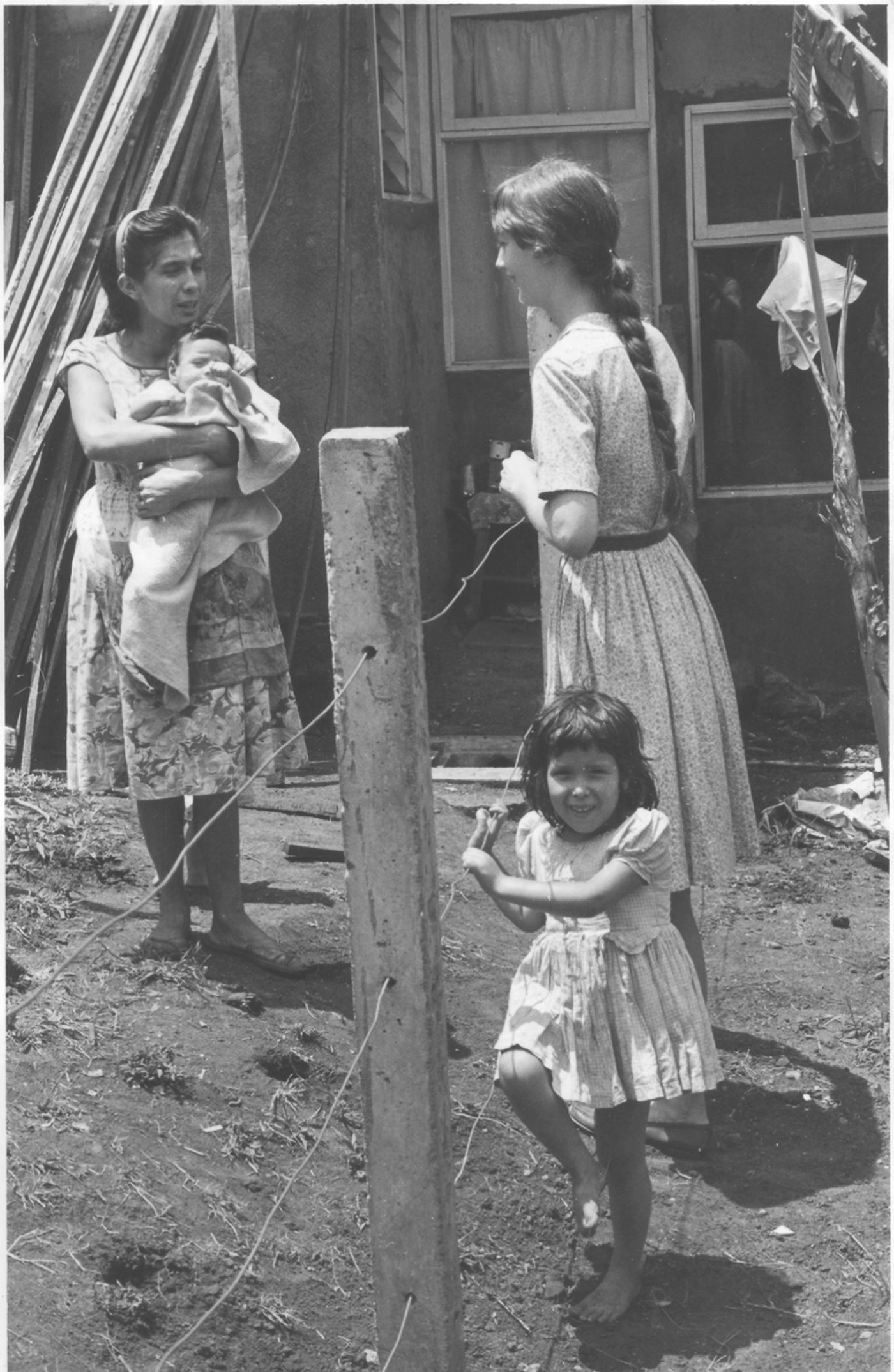
The images also defined global poverty by depicting the relationship between the problem (the “underdevelopment” of the poor) and the solution (the intervention of the volunteer) as identical the world over. Volunteers appeared in almost all of the photographs. A common visual trope juxtaposed the volunteer, who was often bathed in light, and the object of his or her interest, a person who is sometimes only implied in the image (Figure 1).Footnote 72 The distance between the poor and the volunteer – an ambassador from the affluent society – was often made explicit, as the fence separating the volunteer and subject in Figure 2 illustrates. Yet the photographs also often implied the possibilities of “development” in the future by placing children in liminal spaces, on the volunteer's side of the divide between underdevelopment and its antithesis, for example (also Figure 2).Footnote 73 The volunteers were often situated above the poor, bending down to offer a warm handshake, a cup of tea, or looking up to point, faces alight with excitement, towards something outside the frame (Figures 3 and 4).Footnote 74 As such, the volunteer's willingness and capacity to help the poor feel both important and hopeful was always the theme of the photographs.
VISTA volunteers are shown entering the dark spaces in which the “invisible poor” live. Here, an image from the Office of Opportunity's Second Annual Report.

Volunteers reach across the divide that separates poor and affluent. This is a Peace Corps training program in Taos, New Mexico.
Volunteers show the poor a world of new possibility: “Oakland, California children who had never traveled beyond their own blocks visit a neighborhood fire station with Marcie Croom, a twenty-four year old VISTA Volunteer.”
Volunteers turn empathy into problem-solving. “VISTA Dorothy Williams visits an aged resident of Dorsett Town, North Carolina. During her year there she ended the practice of dumping garbage into the river that runs through the community by helping the townspeople to organize their own weekly trash collection.”
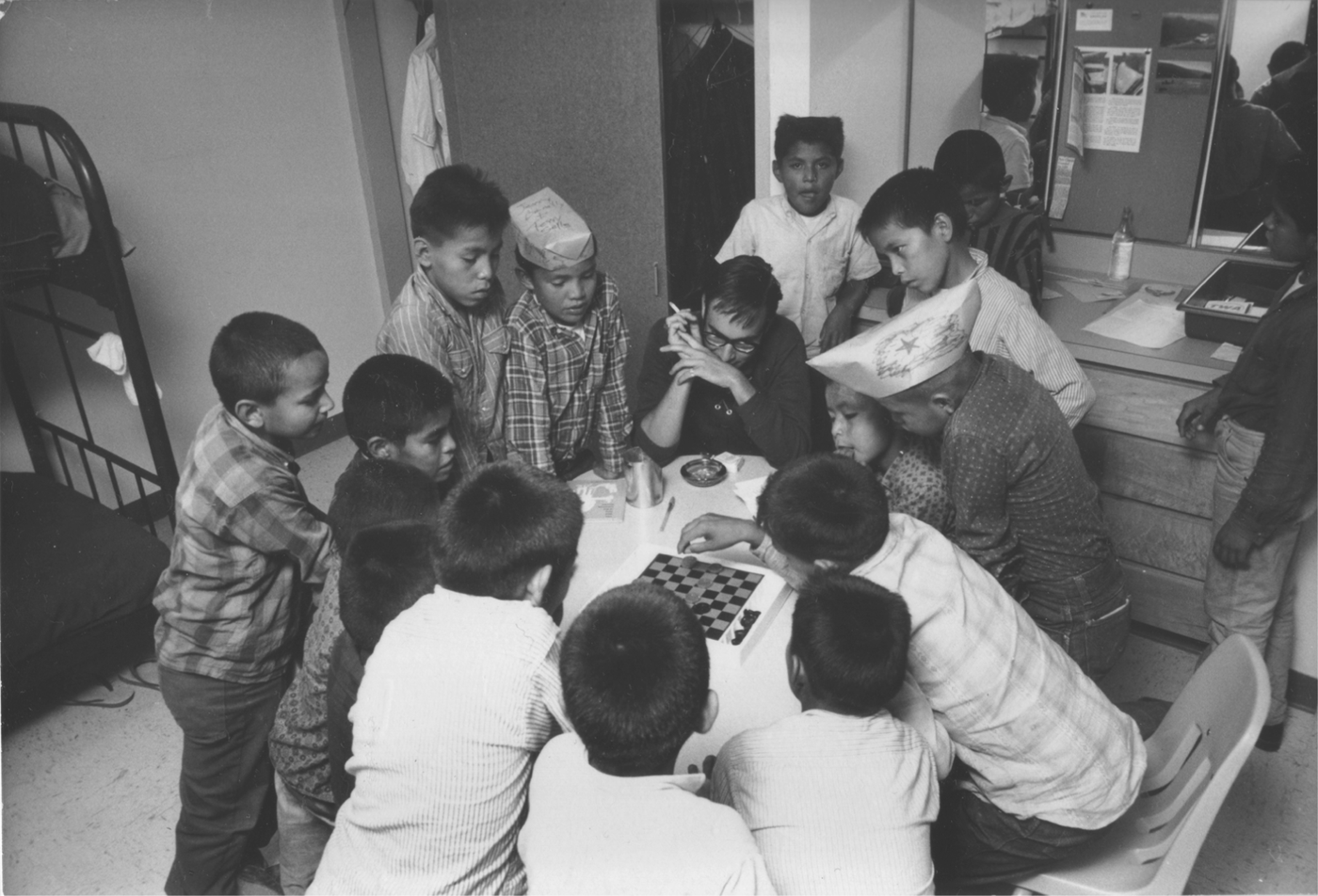
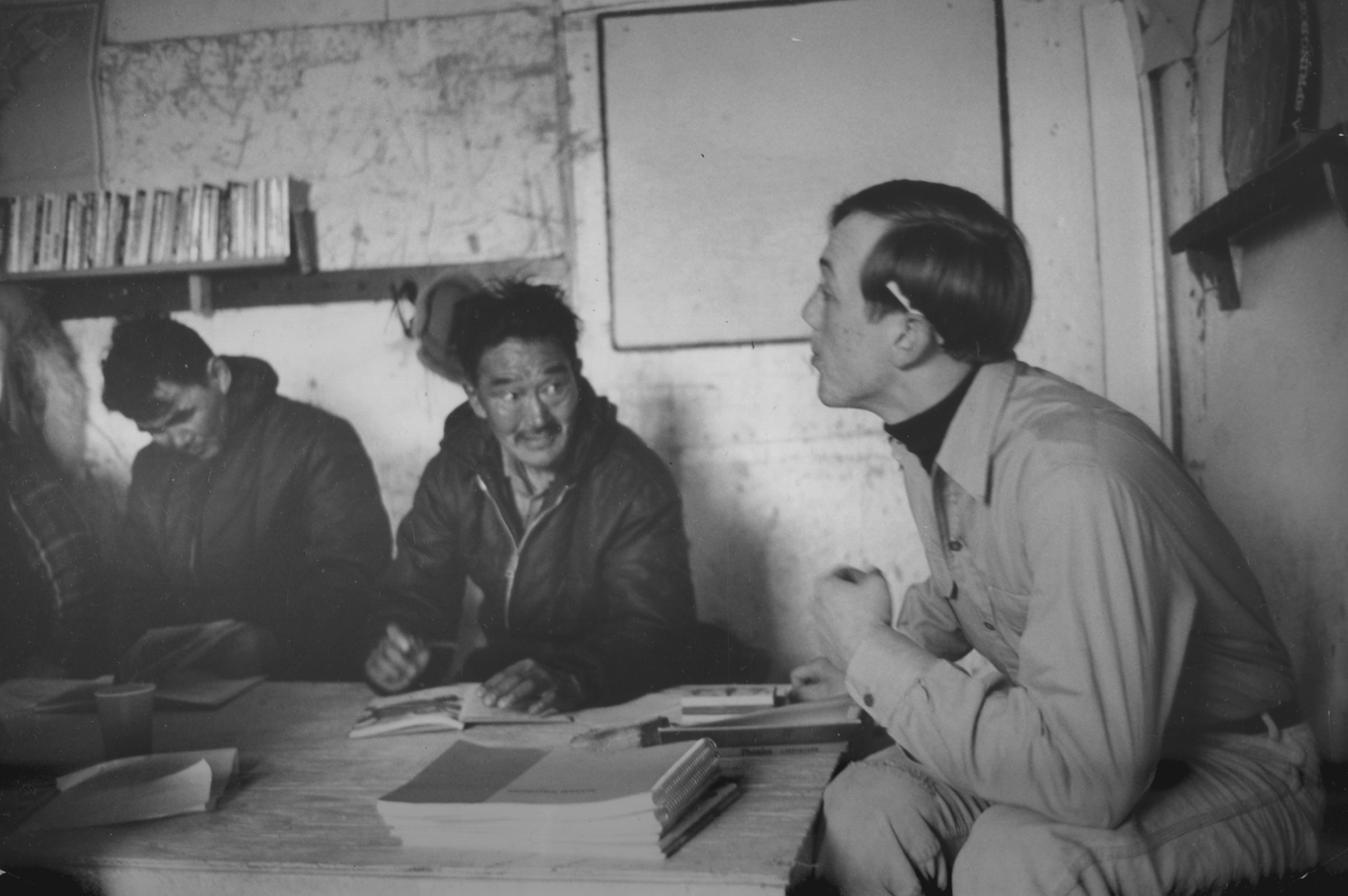
Further, images of the poor and the volunteers displayed a pedagogic motif. The photographs documented moments of teaching and modeling – both activities central to community development strategy that undergirded Peace Corps and VISTA activities. In addition to conventional classroom scenes in which volunteers are teaching children (Figure 5), many of the images featured young volunteers communicating technical know-how to adults living in poverty (Figures 6, 7, and 8).Footnote 75 The captions often imply the existence of assistance that the poor do not know quite how to access, while also making it clear that the poor saw the volunteers as vehicles to access some kind of assistance or guidance. The caption to the photo of an elderly black man showing volunteers a chicken is “Deep in the countryside, Volunteers Marion Ford (Paris, Tex.), left, and Bernard Isaacson (Brooklyn, NY) look over a farmer's sick chicken. They had to admit they were stumped and said they would get an expert from the agriculture extension office to come out the next day” (Figure 9).Footnote 76 The poor man knows enough to bring his problem to the young volunteers, but not to the extension office. Although the volunteers did not have the knowledge to cure the chicken on the spot, they were able to serve as liaisons between the farmer and the state.
VISTAs teach children the skills required to live in the modern world. Here, an Arizona volunteer runs a chess club for Navajo children.
A volunteer in Alaska engages in community development to help the Inuit fishermen of his town.
Here a volunteer in Pakistan teaches locals about when to harvest wheat. “Willie Douglass explains the techniques of examining the ripe grain to test its quality.”
A VISTA goes out into a New Mexico cornfield to talk to migrant workers about their labor.
Volunteers help a local farmer get much-needed information about his livestock in the Dominican Republic.
The photographs implied other stark differences between the “underdeveloped” poor and the volunteers. Unlike the poor, who remained unchanged in appearance and comportment throughout the images, “modern” people in democratic societies were shown to have choices. They could “try on” different identities. Pushing this further, in several of the images volunteers are captured experimenting with “traditional” modes of dress. In Figures 10 and 11, the male volunteers (one identified as a teacher; the other as an anthropologist) were barefoot and shirtless, wearing sarongs around their waists. Their wives accompanied the men – a visual cue that asserted the normative American everyman-ness of the male subjects. Both men wore glasses, evidence of their access to scientific medicine and adequate medical care. Bill Cull, the anthropologist, was seen providing medical assistance to a native (Figure 10).Footnote 77 The photo caption made no mention of his dress, but viewers could see that it was “traditional” because the patient wears the same. In Figure 11, we meet David Danielson and his wife, Judy. Their daughter, Robin, was the “first Peace Corps baby.”Footnote 78 In passing, the caption mentioned that David was “wearing a Nigerian wrapper.” Despite his garb, David's wristwatch, the VW bus in the background, and the focus on his nuclear (yet cosmopolitan) family – wearing their own “American” clothes – conveyed his essential modern, middle-class identity. These scenes bring to mind similar icons of the period: the culturally adept “Lawrence of Arabia” (David Lean's epic film was released in 1962) or “Greystoke” in Tarzan (a television version was aired by NBC from 1966 to 1968); both “civilized” white men who could master all cultures. While they were discouraged in their training from “going native,” the volunteers' adventures on the borders of their modern American identities in these images reinforced the difference between them and their subjects, who could not escape the prison of their poverty by merely putting on a pair of Sansabelts.Footnote 79
Volunteer (and anthropologist) Bill Cull “time-travels” by wearing the traditional clothing of the Indonesian village to which he and his wife have been sent.
The first “Peace Corps baby,” in conventional American dress, and her father, David, in a “Nigerian wrapper.”
If these photographs outlined the problem of “global poverty,” the hundreds of films commissioned by the OEO and the Peace Corps narrated the process of fighting that problem. Following the example of the Peace Corps's public-affairs operation, OEO planners successfully garnered celebrity endorsements and made films and television spots to spur recruitment and promote name recognition.Footnote 80 Like the Peace Corps films, VISTA spots ranged from informative shorts about specific issues to hour-long documentaries often produced in partnership with major news organizations. The longer films often told a story from the perspective of one or two volunteers. As in the photographs, the films presented viewers with more than a visual representation of poverty; they depicted the volunteer as the vivid embodiment of that problem's solution. Highlighting conceptual and programmatic linkages between the OEO programs and the Peace Corps (one, about VISTA, was titled “The Peace Corps that Never Left Home”), these films advertised America's global war on poverty.
While many garnered healthy television audiences, none of these films attracted as much public attention as A Year towards Tomorrow (1966). Hewing close to documentary style, the twenty-nine-minute featurette depicted the struggles of VISTA volunteers dispatched to a Navajo Reservation in Arizona and to the “Black Bottom” district of Atlanta, identified only as a “black, tenement neighborhood.”Footnote 81 Three young and photogenic former volunteers who purportedly relived their actual experiences in the field played the protagonists and the picture opened with a brief caption declaring that “the events in this film actually happened and have been re-enacted by the VISTAS themselves.” The film had originally been intended for use as a recruitment tool on university campuses. But A Year towards Tomorrow, produced independently but with funding from the Office of Economic Opportunity, was a particularly high-profile affair from the start.Footnote 82 Directed by Edmond A. Levy, a well-regarded documentary filmmaker whose portfolio included films for the USIA, and produced by Diana Michaelis, whose CV included stints as deputy director of mass communications at UNESCO and as the engine behind Eleanor Roosevelt's popular public television series Prospects for Mankind, the film was shot in technicolor with a budget of nearly $50,000.Footnote 83 Hollywood heartthrob Paul Newman dramatically narrated the story and associated himself with publicity for the film. Owing in no small part to Newman's red-hot career, the film continued to attract viewers in the year and a half after its release – a period in which the famously handsome superstar appeared in four major films, including his Oscar®-nominated turn in Cool Hand Luke (1967). Under the wing of Johnson administration veteran Jack Valenti, newly appointed head of the Motion Picture Association of America, A Year towards Tomorrow was distributed as a bonus short to be shown before a variety of features, from the comedy Eight on the Lam, to the controversial British drama The War Game, to cutting-edge art-house films like Buñuel's The Exterminating Angel and Rappeneau's La vie du chateau.Footnote 84 It was also broadcast on evening television in major markets throughout the year. All of this publicity culminated in the film winning the 1968 Academy Award® for best documentary.
From the first, the film's title introduced viewers to a vision of poverty as underdevelopment, suggesting that by spending a year in VISTA, volunteers were integrating the poor into a shared American “tomorrow” of abundance and opportunity.Footnote 85 As the music swells, a car comes into view, driving down the highway across a desert. Inside the car are two young women, sitting in the back seat, looking curiously out of the windows at the scenery. They seem to be wandering into foreign territory. The narrator introduces us to Karen, a college graduate who studied elementary education, and Laurie, a student in art history who is taking time off to serve as a volunteer. A taciturn Native American man drives them. The scene shifts to the dusty streets of what appears to be an urban neighborhood where another car dodges the obstacles of unsupervised children and the empty paint drums with which they are playing. Eric, the VISTA, pulls up to a ramshackle building, where he is greeted by “Brother,” an African American teenager. Tellingly, these scenes both involve travel – modern, middle-class Americans journeying to the “invisible land” of poverty, a place that causes them to feel trepidation but which they are palpably committed to conquering.
Just as in the photographs, “poverty” becomes a spatial abstraction – a place where “underdeveloped” people live and “modern” people go. We are told that Karen and Laurie are on a reservation in Arizona and that Eric is in an Atlanta neighborhood, but, beyond these initial identifiers, there are no visual references to help us get our geographical bearings. Indeed, in both cases, the surroundings seem to be outside 1960s America. Although Eric is sent to an American city, our vista never extends beyond the ramshackle houses or dusty streets of the neighborhood. In Arizona, we see Karen and Laurie move across wide swaths of empty space. We could just as easily be on the great steppe of Asia as in the Arizona desert. The only recognizable part of Atlanta we ever see is the runway of a local airport, reviving the theme of travel and transportation as a precondition for bringing the poor and the middle-class into the same space. The viewer can distinguish the urban from the rural scene in the film, certainly, but cannot, beyond that distinction, make any sense of where they really are geographically.
Reinforcing the sharp distinctions between living in poverty and living in affluence, the first obstacles the VISTAs have to overcome are their own middle-class sensibilities. As Newman explains, the volunteers must “live where the poor live and in the same manner,” instead of “on comfortable incomes in comfortable homes.”Footnote 86 We watch them inspecting their dilapidated accommodations with a kind of curious wonder. It appears as if they have almost travelled back in time (a theme that syndicated columnist Robert Spivack noted when he described the “Indians” in the film as people who “still live in the nineteenth century.”Footnote 87) Within moments of their arrival, the volunteers have moved beyond their initial dismay and have begun to enthusiastically tidy their gloomy billets. Although Newman tells us that their training prepares the VISTAs for many of the issues they'll face in trying to help the poor, the film repeatedly shows moments in which the volunteers encounter and overcome personal challenges, like the state of their surroundings.Footnote 88 Their training, we are told, prepares volunteers for the “changes which must occur within themselves before they can change others.”Footnote 89 In addition to demonstrating emotional flexibility, the volunteers are depicted as persistent, even entrepreneurial, problem-solvers. Beyond accommodating themselves to living “in poverty,” the volunteers learn new skills quickly. When Karen and Laurie first arrive in Lukachukai, they are confronted by the necessity of chopping firewood to heat their hogan. The two women, dressed neatly in bouclé suits and sensible flats, pick up a nearby axe and struggle to chop wood. After a few minutes of practice, however (and to the jollies of nearby Navajo children), Karen begins swinging the axe like a seasoned pro. Unlike the poor, Karen and Laurie don't need to be taught how to do things like this; they just learn.
“Building trust” is one of the central preoccupations of the volunteers because, according to the logic of development, doing so is essential to their long-term success in changing the community. After settling in, they explore their communities and assess the problems of their new neighbors. Eric, Laurie, and Karen go from house to house, “generating confidence” among the people they meet. In both settings, the well-intentioned volunteers are confronted with suspicion and apathy by adults. Thus the characterizations of the poor (whose names we never learn) and their “helpers” (about whose individual identities we learn quite a lot) draw a very similar picture to those in the photographs. “The poor” – as the narrator describes them – are “locked” into poverty and out of modern life. This is drawn as a psychological condition – the poor often refuse to make eye contact with the volunteers, staring off into the distance, unwilling to respond to questions that are put to them directly. “They are reluctant to give up their accustomed ways,” Newman explains. In both stories, however, children are open to the VISTAs, following them around with wonderment. Children play a significant role in the experiences of all three volunteers, serving as much more willing participants in volunteer efforts to “make change” than their adult counterparts.
In keeping with the community development strategies that the Peace Corps and VISTA had emphasized in volunteer training, Karen, Laurie, and Eric engage in something akin to anthropological fieldwork. We see them observing the poor, often from afar. Laurie, wandering through the desert, stops to watch a Navajo woman feed commodity wheat from the government to her pigs instead of her family. Eric rambles down the streets of the neighborhood, quietly taking note of how many unemployed men and truant children are milling about. This information directs the volunteer's interventions. Laurie offers to teach the Navajo woman how to cook the wheat so that it “tastes good.” Eric approaches the foreman of a construction site about giving a job to one of the adults. Despite the fact that they are just “regular” Americans, the volunteers possess the know-how and the ability to both diagnose and treat the ills of the poor.
The poor are depicted as being unable to access the very benefits of modern life that might ease their economic circumstances. They are particularly incapable of obtaining help provided by the state because of the obsolescence of their emotional and psychological equipment. They can identify their own immediate problems but struggle to imagine and pursue possible solutions. From the Navajo woman who initially refuses to eat the commodity wheat, to the African American mother who cannot figure out how to get her child's birth certificate in order to get him back into school, the poor are incapable of negotiating the services that the modern world provides. In addition to these encounters with the state, the poor are shown to be ill-equipped to engage in private transactions.Footnote 90 The volunteers advocate for them. And, although we see several groups of poor people congregating, we do not see them organizing until the VISTAs have provided them with the basic tools to do so. Unlike the poor, the volunteers interact with bureaucracies and employ state resources to solve problems with ingenuity and tenacity. Karen establishes a school at which she is teacher, principal, and bus driver all in one. Eric works with a hospital administrator to track down a child's birth certificate. He also obtains the resources to convert an empty apartment into a recreational center, acquiring a library of books for the children, courtesy of a local foundation that he was able to find and to which he understood how to appeal.
At the midpoint of the film, the VISTAs each face setbacks that are attributed, to some extent, to their own “do-gooderism” and to impatience with the pace of change. Laurie and Karen find themselves frustrated by their inability to get through to the people they have come to serve, failing to make wheat a staple of the native diet and to get a sick man to a hospital. Eric alienates his pal, Brother, by pushing him to change his attitudes too quickly and failing to understand the young man's apprehension about going back to school. “You dumb white son of a bitch! I don't need your help!” Brother yells at Eric. Undeterred, Eric organizes a Tenant's Association Meeting for the community members (the kind of project, it is worth noting, that the Community Action Program funded). But instead of cooperating with one another, the attendees wind up in a shouting match. Eric, after yet another attempt to organize community resources on his own, discovers the limitations of his abilities to change others.
What rescues the volunteers from their own frustration and feelings of futility is empathy, depicted in the film as a testament to their emotional health. Impatient with the pace of change, they vent their frustration onto inanimate objects – never people. Facing all of those closed doors in her mission to teach the Navajo to eat wheat, Laurie becomes so angry that she storms back to her hut and takes the axe to a defenseless log. Later that evening, Laurie tells Karen that it seems like she has been working on this challenge “forever” because, “after all, cooking is just one of the things they need to learn.” But, Karen gently reminds her, “A month isn't forever.” Then Karen asks, “How would you like it if a Chinese lady came into your house, and in very broken English, in front of your whole family, told you that you didn't know how to cook?” Laurie laughs. “I'd throw her out and put her into cultural shock!” Laurie approaches the problem with renewed sensitivity. The film shows us, then, that the volunteers are capable of understanding the poor even while the glacial pace of change strains their emotional resources.
By deploying their skills and emotional sensitivity, the volunteers do achieve measured success. We leave Eric to the strains of a prayer being spoken by the community organization's secretary calling a meeting to order. Laurie, Karen, and several Navajo children all ride horses bareback through the brush and, literally, into the sunset in New Mexico. The film concludes with Newman telling us that the story of VISTA is one in which the volunteer “becomes accepted, then needed by the people he serves.” The volunteer's final objective, the narrator concludes, “is to become unnecessary and let the community take over completely.”
An implicit result, Newman suggests, is that the volunteer has been changed by the experience too. We learn that modern, middle-class people possess the ability not only to identify with people who are very different from them but also to learn from them. By the end of the film, Karen and Laurie have abandoned their suits and updos for free-flowing skirts and long braids. They are becoming locals, demonstrating a kind of proto-multiculturalism. Eric, too, is learning from his neighbors. In several scenes, he talks about the ills of racism and jests with the neighborhood kids, playing at “jive.” In one such sequence, Eric teaches a catchy rhyme to group of children who have deferred to him to make a policy for their new library. “Just ‘cuz you're big and just ‘cuz you're white,” he has the kids repeat after him, “don't mean yo’ right.” But beyond believing in antiracism, Eric comes to truly understand racism's damaging effects because of Brother's resistance to his help. In the volunteers, then, we see the perfect picture of worldly, open-minded, empathetic young people fighting bravely on the frontiers of poverty, racism, and ignorance. In the concluding scenes of the film, we are told that “VISTAs work with those who have painfully learned to expect very little of the world. But, at times, volunteers can supply the missing element, which can liberate talent and redeem lost opportunity. That element is hope.”
Viewers who might share those aspirations were asked to join Karen, Laurie, and Eric as they devoted a year towards building a better tomorrow. Screened on continuous loop at VISTA recruiting events around the country in 1967 and 1968, the film's stirring call to service could be transformed into immediate action.Footnote 91 Beyond its explicit use at recruitment events, however, the film's wider distribution reveals an effort to reach the kind of middle-class, modern personalities it depicts, to teach them about the depth of misery in the “Other America,” and impel their engagement. Distributed to cinemas showing an array of critically acclaimed films and broadcast on network and educational television during prime time, the OEO promoted the film to a broad cross-section of media consumers, from viewers who might be home on a Saturday night watching a documentary about the settling of the American West to film aficionados who were out to catch the latest surrealist flick from Paris. To this audience, the film, like Progressive and New Deal-era representations of poverty before it, might have served to primarily awaken awareness and provoke empathy. One college-aged reviewer testified to its emotional power, reporting for the Georgetown University Hoya that A Year towards Tomorrow “brings to, for the most part, ostensibly oblivious modern day Americans, a poignant, powerful, and moving message which cannot and must not be ignored.” The story, he continued, “has the rare attribute of being able … to bring forth the essentially human element of its topic.” In summary, he wrote, “the film makes us feel, hear, and taste the acrid penury of underprivileged Americans.”Footnote 92
But the film might have also made viewers feel the responsibility of the United States – through the representations of three “average” American kids – to serve as a benevolent force for social welfare in the world. Robert Spivack, writing in his nationally syndicated column, placed the stories of Karen, Laurie, and Eric in this broader context, responding to the mounting criticism of American foreign and domestic policy by those on the global left and his frustration at a liberal establishment that seemed increasingly powerless to counter that criticism. “If the old liberals,” Spivack wrote, “cannot take life's realities, or feel unable to cope with the problems posed by Vietnamese or Chinese totalitarianism, there are new and younger people still full of life and hope, who do not feel so beaten down,” he wrote. The images of the three young volunteers, he continued, reveal “the other America that Jean Paul Sartre and Bertrand Russell and all those associated with their so-called ‘war crimes’ tribunal do not talk about.” Spivack concluded, “This brilliant movie … ought to be seen … if only to remind us that we are not as our enemies portray us.”Footnote 93 In this rather candid review, Spivack articulated what I argue was the implicit message of the global war on poverty's many efforts to gain popular support: that the images of three Americans, helping the poor in their own proverbial backyard, were deeply intertwined with the international Great Society that mid-century liberals sought to make real abroad. Poverty at home had global consequences; poverty abroad had domestic consequences. While evidence to fully interpret audience reception of the idea of a global social problem remains elusive, the idea that the wars against “underdevelopment” abroad and poverty at home were connected seems not to have been lost on the film's audience. Poverty's warriors could fight across the ocean or across the tracks, in Shriver's words, but to preserve America's place in the world, they had to fight somewhere.
Though much in America changed during the years between the Peace Corps' founding in 1962 and the sunset of Lyndon Johnson's Great Society in 1969, the images of the volunteer fighting poverty at home and abroad remained consistent. The photographs that first began circulating in the early 1960s look very much like those that OEO offered to William Crook and Ross Thomas for their 1968 book Warriors For the Poor. The focus, for all that time, was still on the volunteer and their often unspecified location. Wherever it was, it was some place where the poor lived and struggled. Despite political controversy and the general mood of embattlement and retreat in liberal Washington, then, the images of volunteer service on the front lines of the global war on poverty remained constant. The “Toughest Job You'll Ever Love” was still the Peace Corps slogan; “If you're Not Part of the Solution, You're Part of the Problem” remained VISTA's memorable tag line.Footnote 94 In both cases, the programs were speaking directly to potential recruits, conveying the challenge and the obligation before them to bridge the gap between the poor and the inhabitants of a still-affluent society.
When Richard Nixon took office in January of 1969, the door seemed to be closing on the global war on poverty. Applications for both the Peace Corps and VISTA had declined. There were murmurs of dissatisfaction with both programs in Congress. And the new administration, while remaining rhetorically committed to the long-term goals of poverty reduction at home and abroad, began a major reorganization of social programs, foreign and domestic. Although many of the pieces of Lyndon Johnson's global war on poverty went to the chopping block in this period, VISTA and the Peace Corps were spared. In fact, citing the importance of volunteerism to American civic life, Nixon and his OEO director, Donald Rumsfeld, merged the Peace Corps and VISTA (along with other volunteer programs) into one administrative unit called ACTION, effectively preserving both as symbols of an approach to social problem-solving that transcended party politics.Footnote 95 Fighting poverty with volunteer programs had become, simply, “American.” Over the two decades that followed, policymakers in the White House and Congress dismantled much of the Johnson administration's international Great Society. And, yet, despite growing cynicism about “nation-building” at home and abroad, declining federal budgets and rising unemployment, and a sustained ideological barrage against “liberal” social programs by the ascendant conservative movement, the Peace Corps and VISTA endured.
Through decades of backlash against Great Society liberalism, the American public and their representatives in Washington kept faith with the Peace Corps and VISTA idea: that to the extent that the problem of poverty at home and abroad was remediable, the involvement of middle-class helpers was a viable and effective solution. Progressive and New Deal representations of poverty as an entrenched problem that demanded organized reform have faded from view, but the picture of the young, middle-class American, bridging cultural barriers to serve the poor – from “India to Indiana,” in Shriver's words – remains familiar to us. It still moves young people to send in applications to the Peace Corps and AmeriCorps VISTA. Whether the entrenched inequalities that create and reinforce poverty around the world are ever resolved, the vision of “global poverty” as a social problem and the liberal, almost always American, citizen as its solution, a vision drawn by the images and words of influential mid-century liberals, may, it now seems, always be with us.