During the 1970s and the 1980s, commentaries abounded in the Egyptian press on the downfall of music, the end of high culture, and the death of taste. Writers cited select developments in the cultural arena to support consistently dire assessments. State-controlled radio, once the major producer of “refined” songs, was releasing fewer and fewer musical numbers, while a number of state-sanctioned performers passed away.Footnote 1 To make matters worse, Egypt lost one of its premier sites for creating and consuming high national culture. Cairo's Opera House, built by Khedive Ismaʿil in 1869, was reduced to embers in 1971. The venue's doors did not open again until 1988. Finally, the very style of songs was evolving. Long ballads, once in vogue, increasingly lost ground to shorter tunes. Egypt's soundscape, in short, was changing and many writers did not approve of the new direction in which it was heading. It was in this transitory climate that audiotapes carrying contentious content, most notably popular (sha ʿ bi) music, became public enemy number one for a wide range of critics who held the everyday technology accountable for poisoning public taste.
Artists, scholars, and censors, journalists, politicians, and physicians, all attacked cassette recordings in Egypt, where the mass medium, they maintained, played an integral role in molding the taste of countless citizens. At first glance, audiotapes deemed to be “trivial” (tafih), “absurd” (sakhif) or, most often, “vulgar” (habit), on account of their “unrefined” material, troubled critics on several fronts, starting with the technology's immense circulation. Cassettes carrying “cheap words” easily spread from Siwa to the Sinai. Moreover, like its reach, the audience of audiotapes was enormous. The sounds transmitted by tapes were intelligible to millions of citizens, regardless of their educational background. Lastly, the technology's affordability expanded its already sizeable influence. The low cost of cassettes enabled many listeners to purchase them with relative ease. At the same time, all of these concerns were overshadowed by two, more central anxieties.
First, from the perspective of many local observers, audiocassettes empowered anyone to become an artist, resulting in the diffusion of suspect voices that degraded the ears, morals, and taste of Egyptians. The individuals popularized by cassettes, critics maintained, did not deserve to be heard. Rather than enriching listeners, their presence polluted Egypt's soundscape and led to complete disarray in the domain of cultural production. Secondly, cassettes permitted an unprecedented number of ordinary Egyptians, empowered by Anwar al-Sadat's economic opening (infitah), to become cultural producers. Blue-collar workers, among others with little to no background in the arts, opened cassette labels that allegedly inundated listeners with “crass” recordings. Driven to profit at all costs, these “unqualified” individuals, the narrative goes, commercialized Egyptian culture and corrupted their compatriots’ aesthetic judgement. To unpack these debates, I will carefully mine two contemporary Egyptian magazines, Ruz al-Yusuf and Akhir Sa ʿ a. By reading these state-controlled periodicals against the grain, I will offer a cultural history of Egypt's economic opening that sheds new light on the crossroads of class, culture, and politics.
I begin by investigating the commotion generated by “vulgar” tapes in public forums, where local commentators blamed working-class Egyptians for destroying public taste. Next, I shift to the greater cultural context in which these debates unfolded by scrutinizing how state officials strove to fashion “cultured” citizens at a time when tapes complicated their control over cultural production. In the second half of the article, I survey some of the content on cassettes. Starting with a popular (sha ʿ bi) singer synonymous with “tasteless” tapes, I explore the career of Ahmad ʿAdawiya before addressing the efforts of Sawt al-Qahira, a state-controlled label, to elevate the taste of all Egyptians through “refined” cassettes. I conclude by addressing the fluidity of vulgarity as a historical concept. In elucidating Egypt's “vulgar soundscape,” I argue that audiotapes inspired significant anxiety by decentralizing state-controlled Egyptian media long before the advent of al-Jazeera and the Internet. As will become clear, this anxiety did not simply concern aesthetic sensibilities, but entailed a struggle over what constituted Egyptian culture and who had the right to create it. The result is a counter history of cultural production in modern Egypt that expands prevailing discussions of sound, popular culture, and mass media in Middle East studies.
Historians of the Middle East have long overlooked the acoustic as a site of serious engagement. In a recent article, Ziad Fahmy calls attention to the “soundproof, devocalized narratives of the past” produced by historians of the Arab world.Footnote 2 Elaborating on this critique, Andrea Stanton and Carole Woodall have questioned how sound may feature more prominently in Middle East studies.Footnote 3 To be certain, Middle East studies is not a noiseless enterprise. Anthropologists, musicologists, and religious studies experts have exhibited a greater interest in sound than historians, especially in relation to Islam. Since the turn of the 21st century, discussions of “audible Islam” have assumed multiple forms. Scholars such as Charles Hirschkind have illuminated the productive power of Islamic sermons in the cultivation of religious sensibilities and the performance of public piety as well as the ways by which new technologies transmit ethics-laden messages.Footnote 4 Whether embracing the idea of a “Muslim public sphere,” a “Muslim cultural sphere,” an “Islamic counterpublic,” or another faith-centric framework, writers have regularly adopted Islam as an overarching reference that demarcates the boundaries of their scholarship and, ultimately, limits the scope of their contributions to the study of the Middle East and its acoustic terrains.Footnote 5 Although enjoying a disproportionate amount of attention from academics, “Islamic sounds,” in the case of Egypt's cassette culture, constituted only a small percentage of the content available to listeners. Audiotapes, therefore, present a valuable opportunity to further unpack Egypt's soundscape and to break new ground for an “acoustic turn” in Middle East historiography.
In addition to listening beyond Islamic sounds, this article offers an alternative history of Egyptian cultural production by highlighting “artists” many critics refuse to recognize as such. In the case of the Middle East, state-sanctioned musicians have inspired a number of studies that evidence a clear preoccupation with performers deemed important by ruling regimes. Collectively, this literature offers valuable insights into the fashioning of national icons, the formation of music industries, and the relationships between entertainers and political elites.Footnote 6 The limited breadth of this scholarship, however, leads one to wonder about voices who were not routinely praised but were nevertheless popular. In the spirit of broadening the perimeters of this work, I will bring into the historical fold artists and producers who do not have museums, monuments, or an enduring presence in state-controlled media in Egypt. More specifically, I will navigate a constellation of voices to contextualize a few isolated studies of singers who unsettled Egypt's intelligentsia.Footnote 7 To this end, I will build upon Walter Armbrust's work on vulgarity in Egyptian culture by detailing who censured tapes, why they did so, and how state entities strove to forge “cultured” Egyptians.Footnote 8 Accordingly, if Armbrust charts the changing messages of cultural objects, I will unpack the politics of creating culture during a particular historical period.
Lastly, scholars of the Middle East have shed no shortage of ink on social media and its significance in relation to the mass uprisings that shook the region a few years ago. A quick survey of recent publications reveals that online platforms have supplanted al-Jazeera as the subject of choice for many media studies.Footnote 9 Although offering key insights into activism, authoritarianism, and contemporary politics, these works unanimously lend the impression that only the most recent media matter in Middle East studies. This notion is not restricted to accounts of the “Arab Spring.” Analyses of Israel's military culture, Iran's Green Revolution, and virtual Muslim communities, similarly foreground social media, while explorations of reality shows, Ramadan programs, and religious broadcasts spotlight satellite television.Footnote 10 This article stretches the temporal horizons of Middle Eastern media studies by targeting the role of cassettes in the making of Egyptian culture. In using tapes as a historical lens, it bridges close readings of cultural products by anthropologists and broader accounts of mass media by historians. Attuned to content and context, this article starts to re-imagine the recent history of Egyptian culture through the social life of a single technology.
Imposter Artists, Unqualified Producers, and the Commercialization of Culture
In the summer of 1980, Akhir Sa ʿ a, an illustrated magazine, published a letter purportedly from a citizen residing in the northeastern province of Ismaʿiliyya. The author of the angry missive, Ibrahim Ahmad ʿAli, directed readers to a disturbing phenomenon he witnessed on a regular basis. Audiotapes carrying “meaningless words” were assailing the ears, minds, and taste of listeners around the clock. The vulgar recordings, ʿAli asserted, offended all Egyptians, while those behind them were nothing more than “art imposter clowns” whose productions should be silenced and who “pocketed a pretty penny” from leaving listeners in a state of “unconsciousness.”Footnote 11 Although it is difficult to determine if ordinary people felt compelled to pen letters like ʿAli's message, or if those working for state-controlled periodicals assumed false identities to level their critiques, it is clear that cassettes Egyptians found to be “vulgar” elicited strong reactions. At the center of these critiques were two important figures—the “imposter artist” and the “unqualified producer”—who profited from the alleged corruption of public taste and commercialized Egyptian culture.
Audiocassettes, in the opinion of many critics, facilitated the spread of “vulgar” sounds by making it possible for anyone to be an “artist” regardless of his or her training. In enabling any citizen to become a cultural producer, as opposed to a mere cultural consumer, cassettes, they claimed, lowered artistic standards and tarnished public taste. Consider, for instance, one writer's journey into the world of “trivial” recordings. During the summer of 1981, Osama al-Mansa recounts, a village girl strolled into a cassette store in downtown Cairo. There, she swayed and sang “naïve” (sadhij) words as the young man accompanying her strummed a few harsh chords on the oud. Although the performance was horrendous, the singer nevertheless received a five-year contract. Soon, her crass cassettes, like those of countless other unknown “artists,” would be available to the masses, whose “artistic standards and taste,” the journalist warns, would inevitably suffer from the terrible tapes.Footnote 12
The anonymous voice ridiculed by the reporter was not extraordinary. In fact, she was one among many Egyptians who joined the ranks of artists courtesy of cassettes. As one Arab singer confessed in the 1980s, “I expected to hear refined songs in Egypt but I found something else entirely. I was struck by the astonishing number of singers and songs that constantly arose.” “Everyone who enjoys his voice sings,” she elaborated, “and issues a collection of new songs every two months.”Footnote 13 By empowering “everyone” to become a performer, cassette technology, critics repeatedly claimed, bred only “chaos” and elevated voices that did not deserve to be broadcast.
In the Egyptian press, commentators went to considerable lengths to distinguish between cassette stars and past entertainers. Artists predating audiotapes appeared to be masters of their craft, “refined” musicians who carefully rehearsed lyrics that conveyed an important message. The voices popularized by many cassettes, on the other hand, were mere pretenders, “uncultured” amateurs who created countless tracks without meaning. As one citizen, who may well have been an editor, explained in a letter to Akhir Sa ʿ a, prior to the proliferation of cassette recorders, artists meticulously chose the words to their songs and the scores to which they were set. As a result of this diligence, their works penetrated listeners “like an X-ray” and left a lingering impression. In the age of audiotapes, conversely, singers acted “like traders who [sold] undesirable goods alongside indispensable ones.”Footnote 14 Cassette “artists,” in short, were not artists at all.
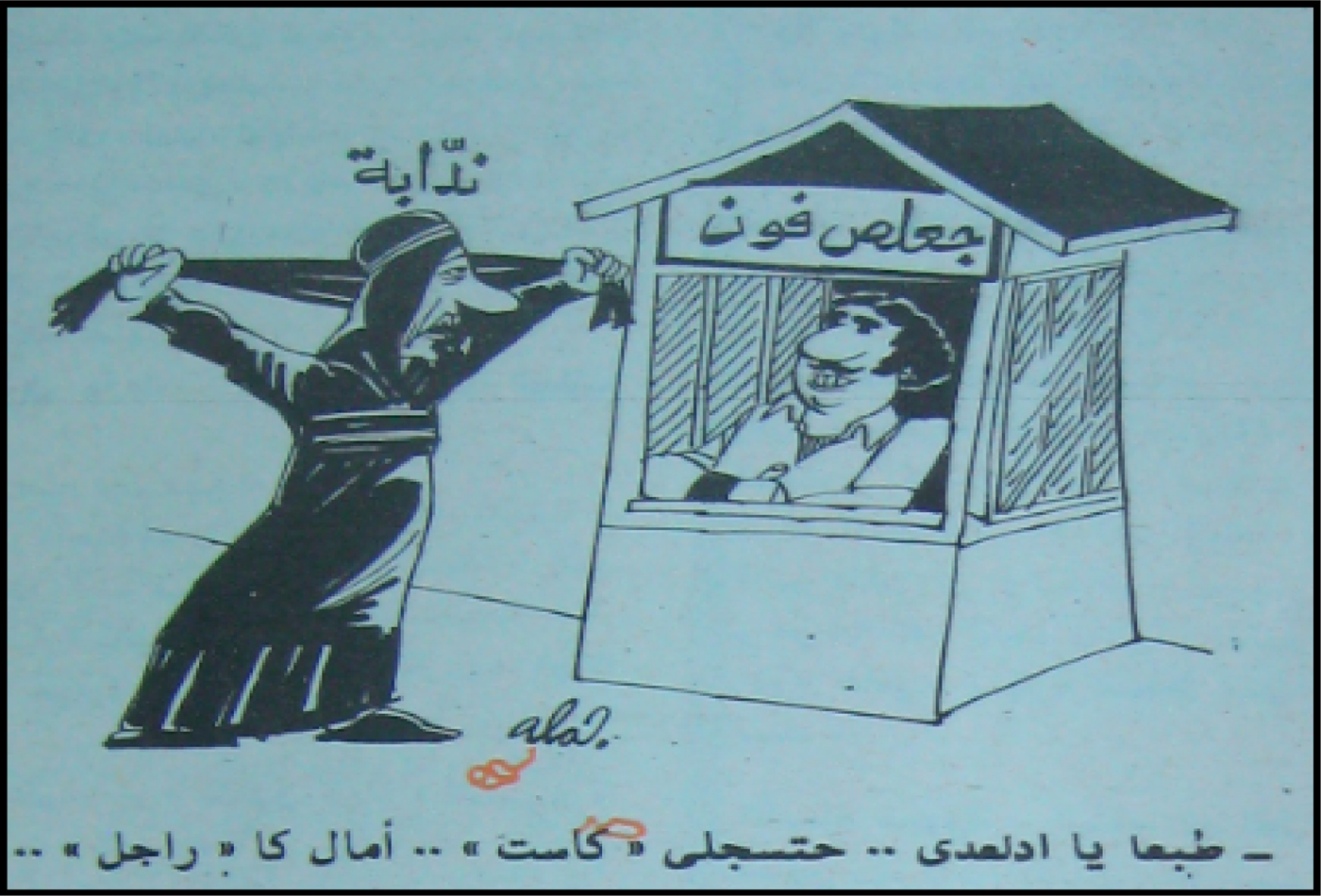
The belief that the voices appearing on audiotapes were unfit to be broadcast is perhaps no more evident than in a sketch accompanying an editorial on audiotapes and the alleged demise of taste in Egypt. In the drawing, a professional female mourner approaches a representative of “Fatsophone,” a recording label based in a kiosk (Figure 1). The employee asks her if she would like “to record a cassette.” Mistaking the word “cassette” (kasit) for “as a woman” (ka-sit), the confused client asks, “or as a man?”Footnote 15 For its contemporary audience, the drawing's meaning would have been immediately intelligible. The crass, lower-class customer, who makes a living by making noise, stands for all of the cassette “artists” branded and berated as “vulgar” by critics. At the same time, the illustration reminds readers that the voices relayed on tapes were not solely responsible for the perceived deterioration of taste in Egypt. “Culturally illiterate” producers, like the cartoon's “Fatsophone” delegate, ensured that contentious content reached Egyptian ears.
A professional female mourner records a cassette.

As audiotapes gained ground in Egypt, the number of cassette companies rose at an astonishing rate. According to one estimate, there existed twenty well-known labels prior to 1975. By 1987, this number had skyrocketed to 365 ventures, only to climb again to around 500 businesses three years later. Egyptians with little to no experience in the recording industry or in creating cultural productions of any kind ran a large number of these entities. To begin to grasp the vast number of amateur enterprises operating in Egypt, which likely even exceeded the aforementioned figures, one need only consider how by 1990 thirty cassette companies reportedly blanketed a single square in Cairo alone.Footnote 16 But who exactly founded and managed these labels? According to critics, working-class citizens, ranging from electricians to carpenters, used the money they earned from al-Sadat's economic opening to become cassette producers. Often based in a single apartment or a sidewalk kiosk, these ordinary Egyptians, commentators charged, pursued profits at the cost of public taste and recklessly bombarded listeners with cassette recordings that led to the death of singing, the commodification of Egyptian culture, and the contamination of Egypt's soundscape.Footnote 17
Discussions of suspect tapes in the press often censured lower-to-middle-class citizens for fancying themselves as cultural producers. One journalist, for instance, attributed the proliferation of cassettes that corrupted taste to “street peddlers,” “repeat offenders,” and skilled workers who launched recording labels with the cash they acquired from the infitah.Footnote 18 A fellow reporter singled out plumbers, butchers, and cigarette sellers for creating works of art that were highly profitable, “incompatible with public taste,” and a greater danger to citizens than cocaine.Footnote 19 Still others occasionally faulted their nonelite compatriots for wielding their newfound financial influence to corrupt established artists. A professor of psychiatry and neurology at a leading medical school in Cairo argued that “trivial” tapes resulted from sweeping social changes in the 1970s and the 1980s that empowered a new parasitical class of “uneducated” Egyptians. “Seduced by money,” the doctor bewailed, “famous writers and composers drifted, and took to writing and composing for a class intruding on art without any study or mere familiarity.”Footnote 20 In the course of attacking working-class Egyptians for producing audiocassettes, local critics portrayed themselves as “educated” and “refined” in relation to their “ignorant” and “crass” compatriots. At the same time, those driving these discussions did not simply differentiate themselves from those they condemned. More importantly, they argued that ordinary people had no business making Egyptian culture.
To be certain, commentaries on cassette tapes in the popular Egyptian press did not simply concern public taste, popular music, and the reported dangers it posed. Class, culture, and politics proved central to these debates, which reflected broader criticisms of the infitah and contributed to the anxieties it inspired. On the one hand, attacks on contentious cassette recordings clearly channel contemporary critiques directed at Egypt's expanding culture of consumption, the proliferation of private companies, and the rise of newly empowered citizens who profited from al-Sadat's capitalist policies and strove to strengthen their financial standing. These historical developments have been well documented by Tarek Osman, Kirk Beattie, and Mohamed Hassanein Heikal, among others, who have detailed the economic and social impact of the infitah.Footnote 21 The cultural politics of the infitah, however, extend beyond the scope of these studies.
These politics are on full display in debates over audiotapes, which begin to illuminate the cultural history of Egypt's economic opening by presenting the connections critics forged between the infitah, its alleged ills, and cultural production. At the same time, these materials not only reflect the concerns sparked by the infitah but also fuel them. Egyptian culture, much like Egyptian society, is undergoing a major crisis in these texts, which place no shortage of the blame on those who benefited from al-Sadat's economic initiative. Those who prospered from the infitah, however, are not solely responsible for this “crisis.” Critics also condemned ordinary citizens, who did not necessarily profit from the infitah, but nevertheless played a pivotal part in the perceived pollution of both public taste and Egyptian culture by harnessing cassettes to become cultural producers.
The cultural arena introduced in discussions of audiotapes noticeably departs from its counterparts in several histories of Egyptian culture. In A.J. Racy's analysis of records, Joel Gordon's work on films, and Virginia Danielson's account of Umm Kulthum, for example, revered artists and leading institutions dominate the creation of Egyptian culture.Footnote 22 Critically, in the sources presented so far in this article, both elite and ordinary Egyptians, based in small apartments, prominent recording labels, and everywhere in between, engage in the making of Egyptian culture by way of cassette technology, which enabled an unprecedented number of people to become cultural producers. This shift, no doubt, disturbed many public figures, who strove to police an increasingly robust acoustic culture. Here, the work performed by “vulgarity” gains greater clarity.
By branding a cassette as “vulgar,” critics were arguably condemning the “unrefined” nature of its creators as much as, if not more so than, its content. Thus, while a tape's lyrics may well have been “obscene,” “crass,” or “of the masses,” all meanings entailed in “vulgar,” commentators wielded this adjective, first and foremost, to reassert their authority over cultural production. After all, what was at stake was not only what comprised Egyptian culture but who had the right to create it. To better understand this struggle over Egyptian culture, let us now turn to the greater cultural milieu cassettes inhabited and the state-controlled channels of cultural production they challenged.
“Vulgar” Audiotapes in the Age of State Culture
One of Egypt's ministers of culture, Ahmad Haykal (r. 1985–87), once exclaimed, “Art without obligation is like a river without banks; in the end it leads to drowning.” According to this politician, those responsible for submerging Egyptians with purposeless, “vulgar” art committed two sins. They shirked their obligation to protect the values, morals, and taste of their compatriots and preyed upon Egypt's “climate of freedom” and al-Sadat's economic opening “to introduce cheap laughter they called art.” For Haykal, “vulgar” plays, films, and cassettes were appalling because they failed to fulfill one of culture's primary objectives: crafting model citizens. Indeed, such works ran counter to the very definition of “culture” he espoused. “Culture is not an amusement,” Haykal once asserted, “culture is not an empty diversion. Culture is not a mockery. Culture is not only art. Culture, rather, is refined art.”Footnote 23 To be certain, Haykal was one among many Egyptians who censured select artworks. To better understand why some cassettes provoked the scorn of many observers, it is necessary to situate audiotapes in relation to the wider cultural terrain they occupied. Only by documenting the state's efforts to fashion “cultured” citizens will the attacks on, and significance of, contentious cassette recordings gain greater clarity.
Throughout the mid-to-late 20th century, “public culture” (al-thaqafa al-jamahiriyya) was more than an idea in Egypt; it was a state-engineered program charged with erasing “cultural illiteracy.” The Public Culture initiative came into existence in 1966 at the hands of Tharwat ʿUkasha, who established several new sites linking culture and the state during his eight-year tenure as minister of culture (r. 1958–62, 1966–70).Footnote 24 The first director of Public Culture, Saʿd Kamil, was a prominent member of the Egyptian intellectual left. Once appointed, he wasted little time in selecting elite men and women to relocate from Cairo to direct Culture Palaces, to set up Culture Houses and Clubs, and to oversee Culture Caravans across Egypt.Footnote 25 The objectives of these apparatuses were two-fold. They strove to educate and elevate the taste of ordinary Egyptians and to build stronger ties between the capital and its peripheries. The foundation of both aims was a shared national culture, manufactured, distributed, and sanctioned by the government.
The success of the Public Culture program is subject to debate, but what cannot be disputed is the centrality of music to its mission. State officials working for the venture established numerous ensembles, while musical plays, recitals, and competitions took place in government establishments where guests encountered select records and cassettes in “listening clubs.” According to one publication, Public Culture held more than 6,000 musical events between 1971 and 1980 that catered to an estimated 3,000,000 people.Footnote 26 Published by a state entity, these statistics should be viewed with a grain of salt. But it is beyond doubt that music was an indispensable instrument in the state's attempts to fashion “enlightened” Egyptians. Not all music, however, contributed to these efforts. Songs considered “tasteless” by those on the government's payroll had no role to play in creating “cultured” citizens. Refined art, exclusively, advanced this task, which “vulgar” audiotapes only jeopardized. In its mission to forge “cultured” Egyptians, Public Culture was not alone. A second mechanism lent welcomed support.
State-controlled Egyptian radio placed a premium on molding model citizens. To ensure that only the “right” sounds reached the public's ears, radio officials relied on a system of checks and balances. Two screening committees formed the foundation of this infrastructure. The first, known as the Text Assembly (Lajnat al-Nusus), decided whether the radio should record numbers still being developed. If its members approved of a tune, the song entered production. A second panel, the Listening Assembly (Lajnat al-Istimaʿ), determined if recorded songs should be broadcast. If the body's artists, broadcasters, and sound engineers endorsed a ballad, it was left to the discretion of stations to play it. Programs did not promote everything that came their way.
During the period under investigation, the selectivity of some leading channels was public knowledge. In 1975, delegates from four different stations openly admitted to classifying singers and allotting them airtime in accordance with their rank. Al-Sharq al-Awsat, for instance, considered Umm Kulthum, Muhammad ʿAbd al-Wahhab, and ʿAbd al-Halim Hafiz to be “first-tier” musicians and played their songs once a day, while “second-tier” artists like Farid al-Atrash, Nagat, Faiza Ahmad, Warda, and Shadia, surfaced four times a week, and “third-tier” performers such as Sabah, Suʿad Muhammad, and Maha Sabri, appeared on the air every now and again.Footnote 27 Singers branded as “vulgar” by radio employees generally fell outside of these ranks entirely. Unlike tapes, which sounded countless voices, radio popularized a smaller pool of elite artists.
Radio administrators took pride in the selectivity their system inspired and the high artistic standards it allegedly upheld. And when the medium's criteria for choosing tracks became too loose, representatives vowed to tighten them. In 1983, for example, the Listening Assembly revisited its rules for approving songs. Going forward, one magazine noted, its members would only permit numbers they hailed as a “contribution” to “the world of singing.”Footnote 28 From the perspective of officials, those capable of making such a “contribution” were limited.
According to Ibrahim al-Musbah, who oversaw musical works for the Radio and Television Union in the early 1980s, only ten poets out of 5,000 writers could create proper songs.Footnote 29 Those not fortunate enough to earn the approval of al-Musbah and other cultural elites were forced to find other ways to be heard. The radio's exclusivity was essential, its gatekeepers claimed, because the technology was responsible for refining the taste of all listeners across the country. In this sense, officials viewed the medium as “a school without walls for all people” and pledged not to harm “public morals and dignity” or to broadcast “vulgar” words.Footnote 30 “Crass” audiotapes obstructed the efforts of radio personnel to fashion “cultured” Egyptians and the platform's guardians did not hesitate to censure “vulgar songs that spread in brisk cassette markets” in the press.Footnote 31 In its campaign to counter “vulgar” cassettes, to elevate the taste of all citizens, and, most importantly, to dictate who created Egyptian culture, radio found an ally in a third state entity: the censor.
Censorship was both a private and a public affair in Egypt. While decisions on what movies to cut, songs to amend, or plays to trim may have been made behind closed doors, the outcomes of backroom deliberations often surfaced on the pages of the popular press. Weekly magazines frequently noted works of art state censors deemed unfit for public consumption due to their title, plotline, political content, or the danger they purportedly posed to public morals. The power exhibited by censors on paper, however, belied the difficulties they faced in practice in silencing certain cultural products. Years before the advent of satellite television and the World Wide Web, audiotapes arguably posed the single greatest obstacle to those tasked with securing the perimeters of public culture. A rare look inside the Office of Art Censorship (Jihaz al-Raqaba ʿala al-Musanifat al-Fanniyya) on Qasr al-ʿAyni Street in downtown Cairo offers a useful starting point for addressing the challenges cassettes presented to officials charged with “purifying” public taste.
In an insightful interview in Ruz al-Yusuf, one of the most vocal critics of “vulgar” cassettes, the director of Art Censorship ʿAbd al-Fatah Rashid illuminated the inner workings of his office in the late 1970s. The objectives of Rashid's unit were three-fold. It strove to make sure artistic works were tasteful, complied with public morals, and adhered to political, social, and religious norms. The enforcement of these guidelines, however, was not always possible, especially in the case of cassettes. When asked about “vulgar” tapes, Rashid blamed “private sector” producers who deceived censors by submitting one text for review only to record another upon receiving their approval. Unlike the first set of lyrics, the second included additional phrases the producer believed would “serve him financially.”Footnote 32 If censors discovered the revised recording, Rashid claimed, they seized it and imposed a E£50 fine on its creator. Perhaps sensing this response was inadequate, the director elaborated that he was working to implement a stricter protocol whereby censors would examine every work twice—before and after it was recorded—prior to issuing a ruling. Certain impediments, though, hindered this plan. Rashid's team consisted of a mere fifteen censors who toiled away over seven tape recorders. To make matters worse, his office was inundated with audiotapes. In addition to reviewing commercial cassettes, his staff was responsible for screening every personal tape that crossed Egypt's national borders.
If the director of Art Censorship sounded defensive in his conversation with Ruz al-Yusuf, it is likely because several Egyptian critics attributed the proliferation of contentious cassettes to the shortcomings of state censors like Rashid. At times, the voices behind these attacks opted for anonymity. One commentator, going simply by the name of “an artist,” repeatedly chastized censors in Ruz al-Yusuf. In January of 1979, the mystery writer, who may well have been a state-sanctioned musician suffering from waning sales, slammed censors for partaking in the pollution of public taste by permitting companies to produce “vulgar” cassettes.Footnote 33 Six months later, he harangued state censors, once again, for signing off on tapes with sexually suggestive lyrics.Footnote 34 Judging by a third rebuke from the same alias nearly a year later, censors, it would seem, continued to struggle with cassettes. “Cassette tapes brimming with triviality,” the “artist” railed, in familiar fashion, “are increasing and are being sold brazenly in commercial shops and on the sidewalk.”Footnote 35
Others, meanwhile, elected to wave their anonymity when slamming censors. In a letter to the editors of Akhir Sa ʿ a, a certain Fathi Mansur questioned the absence of censorship at a time when “singing and art had become a job for those without one” and “vulgar” songs continued to spread on cassettes at an alarming rate. No tape, he asserted, should circulate without the approval of censors, who needed to punish those behind “foul tapes” that facilitated the “decline of public taste.”Footnote 36 The origin of Fathi's message, a small village in the northern province of Daqahliyya, suggests that suspect cassettes extended well beyond Egypt's urban centers; “tasteless” tapes, it would seem, were a nation-wide problem that demanded the attention and the action of Egyptian gatekeepers. In conversation with these writers and in an effort to reign in certain tapes, a wide array of Egyptians proposed different ways to strengthen censorship and to save public taste.
For some politicians, the answer to “vulgar” cassettes rested upon amending existing laws. In February of 1980, the first undersecretary for the Ministry of Culture, Saʿd al-Din Wahba, instructed officials to revise censorship legislation.Footnote 37 He argued that it was necessary to revisit the now antiquated legal measures because significant changes had since transpired in the domain of technology. Among the more momentous developments cited by Wahba were audiotapes. For others, the solution to “vulgar” cassettes lay in altering the very infrastructure of state censorship.
The same month Wahba formed his committee, Muharram Fuʾad, a well-known singer, posited that stricter censorship could improve Egyptian music. To aid the efforts of censors in cracking down on “often illegal” cassette companies and the “vulgar” recordings they released, Fuʾad proposed the establishment of a “cassette room.”Footnote 38 According to the artist's vision, the Office of Art Censorship, the Musicians Association, and the Ministry of Industry would work together to create the room, while a music advisor would accompany artists in the space. As a result of this plan, which notably stood to benefit Fuʾad and his state-controlled label (Sawt al-Qahira) by reducing the stiff competition they faced in attracting listeners, cassette production would fall more squarely within the purview of the state and elite cultural brokers.
As the number of cassette companies continued to skyrocket in Egypt, state entities, like the “Specialized National Councils” (al-Majalis al-Qawmiyya al-Mutakhassisa), joined artists and politicians in the battle against “vulgar” tapes. In April of 1983, following a detailed study on the danger particular cassettes posed to public taste, the Councils called for a novel unit within the Ministry of Culture to assess the “purity” of cassette productions before they reached the public.Footnote 39 Two months later, the Councils declared an all-out “war on the cassette.” In an article covering the bombastic announcement, a familiar voice compared “vulgar” cassette recordings to the Mongol ruler Hulagu Khan. What did the two have in common? In the opinion of al-Mansa, both shared a longing for “the obliteration of civilization's signposts.”Footnote 40 According to the critic, there existed two types of people: those who listened to cassettes unaware of their danger, a group he likened to “drug addicts,” and cultured listeners, who were aware of their harm and tried to warn others. Unsurprisingly, the Egyptians interviewed in al-Mansa's article fell firmly in the second camp.
In the years to come, the worries commentators expressed regarding the ability of censors to silence cassettes they considered to be “vulgar” proved to have been well founded. By the end of the 1980s, plans to eradicate “trivial” tapes in Egypt were faltering. Cassette labels continued to amend recordings before they reached consumers and after censors sanctioned them.Footnote 41 Likewise, censors failed to report the names of cassette singers to the Musicians Association for its members to confirm whether they belonged to the body—a prerequisite for performing on tapes.Footnote 42 Sensing the weakness of state monitors, several Egyptians covertly and openly defied the rejections issued by censors on the grounds of vulgarity. As one journalist tellingly pleaded at the start of 1990, censors were in trouble in Egypt and desperately needed support in patrolling “floods of cassettes in thousands of kiosks and stores,” lest “the security wall collapse between [Egyptians] and the deluge of vulgar art and moral decline.”Footnote 43 In the opinion of many critics, by the time these remarks made their way to newsstands, the wall had already crumbled.
In covering the efforts of state officials to fashion “cultured” citizens, attacks on select cassettes come into greater view. Tapes carrying popular music and other content condemned by critics easily circulated outside of state establishments, from the Radio and Television Union to the Office of Art Censorship. By offering any citizen a means to record their voice and to reach a mass audience, audiotape technology decentralized state-controlled Egyptian media long before the advent of al-Jazeera and the Internet, and enabled an unprecedented number of people to create Egyptian culture at a time when public figures strove to dictate the shape it assumed. To be certain, cultural gatekeepers did not simply surrender to “tasteless” tapes. On the contrary, they suggested no shortage of solutions. Of all these responses none was more visible than Sawt al-Qahira, a state-controlled label that strove to elevate the taste of all Egyptians. But prior to exploring this entity's efforts to forge “cultured” listeners, it is first necessary to examine the career of one artist who embodied “vulgar” cassettes: Ahmad ʿAdawiya. By exploring ʿAdawiya and Sawt al-Qahira, side-by-side, it will become clear that audiotapes actually transmitted a vast variety of voices in Egypt.
The “Low” and the “High”: Ahmad ʿAdawiya and Sawt al-Qahira
In 1978, an Egyptian student by the name of Siyanat Hamdi wrote a doctoral thesis on the decline of Egyptian music. The project's scope was panoramic in nature, covering singing in Egypt from its inception to the present day. Part and parcel of this history were “vulgar” songs, such as Ahmad ʿAdawiya's “Everything on Everything” (Kullu ʿala Kullu), and what permitted such “inferior” numbers to spread and the “weak” voices behind them to become well-known. In an article covering the student's research in Ruz al-Yusuf, one writer asked readers how Egyptians could “escape from ʿAdawiya's school” prior to directing them to Hamdi's work.Footnote 44 If ʿAbd al-Halim was “the nightingale,” and Umm Kulthum was “the voice of Egypt,” ʿAdawiya was nothing more than “noise” that Hamdi, the reporter, and many other commentators could do without.
Few figures in Egypt's modern history are more synonymous with “vulgar” cassettes than Ahmad ʿAdawiya, one of the pioneers of popular (sha ʿ bi) music, a contentious genre regularly disparaged by critics. Born Ahmad Muhammad Mursi on 26 June 1945, ʿAdawiya grew up listening to al-Atrash, ʿAbd al-Wahhab, and ʿAbd al-Halim.Footnote 45 Little is known about his early life, but according to one account, ʿAdawiya's father traded livestock for a living and relocated his family to Cairo when the entertainer was still an adolescent.Footnote 46 It was in Egypt's capital where a young ʿAdawiya began to pursue music seriously. Unlike some of his peers, who enrolled in prestigious conservatories to perfect their skills, he honed his craft on Muhammad ʿAli Street, a historic avenue renowned for its musicians. There, he played both the nay (reed flute) and the riqq (tambourine) with a musical troupe and followed in the footsteps of several other artists who learned how to become performers on the street. Fame and fortune, however, would have to wait until he met Sharifa Fadil, a singer and actress of some acclaim, who facilitated his introduction to Maʾmun al-Shinnawi, a leading lyricist.Footnote 47 In 1973, ʿAdawiya recorded his first major hit, al-Sah al-Dah Ambu, on a cassette for Sawt al-Hubb, where al-Shinnawi served as an artistic advisor. The tape was an unprecedented success, selling an estimated 1,000,000 copies.Footnote 48 The first of many hits ʿAdawiya would release on cassettes, the recording transformed him into a household name and placed him at the center of debates on audiotapes and the death of taste.
From the beginning of his career, ʿAdawiya attracted the ire of critics. Respected musicians ridiculed him and those belonging to his “backward” generation. Muhammad ʿAbd al-Mutalab, a pioneer of the “popular song,” attacked ʿAdawiya on multiple occasions. When asked about the quality of songs in the mid-1970s, a time when ʿAdawiya and audiotapes were gaining momentum, he once responded bitterly, “[t]hey are machinations! A cheap trade whose manufacturers try to outdo one another in proving their ability and their superiority in corrupting the taste of the next generation.”Footnote 49 Other artists, meanwhile, denounced ʿAdawiya outside of the press. In one incident, Muharram Fuʾad entered a casino in Alexandria known for playing ʿAdawiya's tapes and, upon hearing his numbers, demanded “foreign music” be broadcast instead. The building's owner proceeded to play one of Fuʾad's songs and when it did not please those present forced him to leave the premises.Footnote 50 There is then the case of ʿAbd al-Hamid Kishk, a preacher who slammed ʿAdawiya in one of his sermons. According to Kishk, ʿAdawiya's al-Sah al-Dah Ambu was as “tasteless” as it was “meaningless.”Footnote 51 Distancing himself from the singer's “vulgar” tracks and his use of colloquial Arabic, the shaykh implored Egyptian youth in classical Arabic to study high poetry. Combined with attacks on ʿAdawiya as a foul side effect of Egypt's defeat in the 1967 war and al-Sadat's economic opening that reportedly empowered the “culturally illiterate,” all of these commentaries cast the singer, his success, and his cassettes in a resolutely negative light.
Not all Egyptian public figures, however, embraced a black-and-white view when it came to the cassette star. Najib Mahfuz was among those who adopted a more nuanced stance. At times, the Nobel laureate criticized ʿAdawiya's music for its “triviality” and “crudeness,” two qualities, he claimed, that resulted in his productions being the “furthest thing from elegance,” while in other moments the author recognized his “strong, sorrow-infused voice” and recalled several of ʿAdawiya's songs with ease, only to wish their lyrics were more meaningful.Footnote 52 ʿAbd al-Wahhab, similarly, did not despise ʿAdawiya, but did insist that his music would lose its resonance. In an interview with Akhir Sa ʿ a in 1976, he stated that ʿAdawiya's popularity was of little concern to him “because in every country in the world there are all sorts of artistic colors and forms.” What bothered ʿAbd al-Wahhab at the time in Egypt was not ʿAdawiya's presence but the absence of “noble beautiful art,” which, he believed, was “what remains in the end.”Footnote 53 Unlike the permanence enjoyed by refined music, ʿAdawiya's songs, he implied, were a passing phenomenon. Despite the reportedly “fleeting” and “crass” nature of ʿAdawiya's tracks, some of Egypt's leading artists nevertheless gravitated toward him. Among these figures was none other than ʿAbd al-Wahhab.
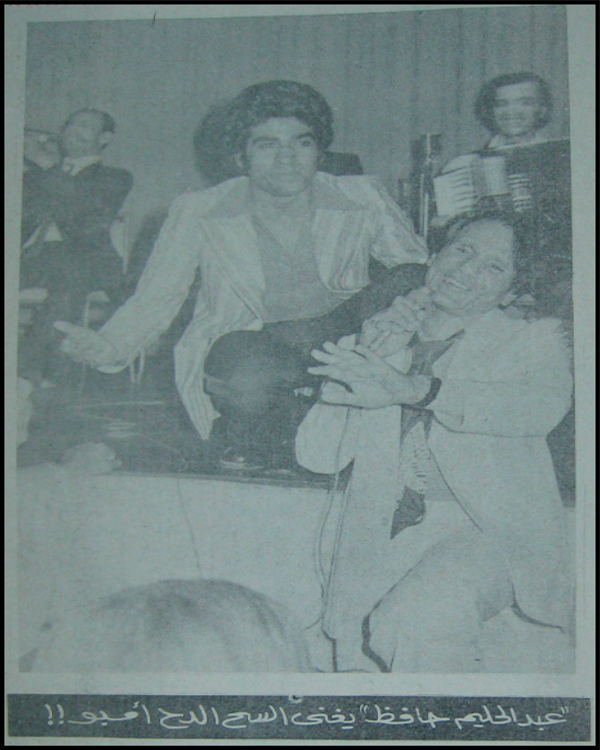
The same year ʿAbd al-Wahhab refrained from castigating ʿAdawiya in Akhir Sa ʿ a, he tried to poach the entertainer as the co-owner of Sawt al-Fann, a major recording label. ʿAbd al-Wahhab's partner, ʿAbd al-Halim, approached ʿAdawiya in London, where he was performing at the Omar Khayyam Hotel. There, he offered ʿAdawiya a five-year recording deal. Shortly thereafter, ʿAdawiya's label, eager to retain him, countered ʿAbd al-Halim's terms by raising its star's salary to E£500 per song in addition to a cut of the price of his recordings.Footnote 54 Less than two weeks after news of Sawt al-Fann’s proposal broke, Ruz al-Yusuf printed a picture of ʿAbd al-Halim gleefully singing al-Sah al-Dah Ambu alongside ʿAdawiya at a party.Footnote 55 The photo caused a stir (Figure 2). Arabic periodicals reprinted it and writers claimed the scene evidenced ʿAbd al-Halim's approval of ʿAdawiya's “vulgar” art. In response to this charge, ʿAbd al-Halim reportedly denied the incident ever took place.Footnote 56 Whereas the Sawt al-Fann kingpins may have preferred to keep their dealings with ʿAdawiya out of the public eye, other artists did not mind supporting the singer in a more open manner. ʿAdawiya's tapes, after all, were wildly popular.
“ʿAbd al-Halim Hafiz sings al-Sah al-Dah Ambu!!” Source: “ʿAbd al-Halim Hafiz Yughanni al-Sah al-Dah Ambu!!,” Ruz al-Yusuf, no. 2488 (16 February 1976): 47.
Throughout ʿAdawiya's career, some of the biggest names in Egyptian music wrote compositions for him, a reality that undermines any clear-cut division drawn by critics between “cassette stars” and “esteemed artists.” In the 1970s, Mahmud al-Sharif, Muhammad al-Muji, Kamal al-Tawil, Munir Murad, and Sayyid Mikkawi, all worked with the sha ʿ bi sensation. Egyptian lyricists, likewise, were well aware of ʿAdawiya's selling power. One need only consider how one writer penned a song for Muharram Fuʾad only to give the same text to ʿAdawiya before Fuʾad could perform it because any tape ʿAdawiya released sold “40,000 copies.”Footnote 57 Even Egyptian celebrities who did not work directly with ʿAdawiya appreciated his music. Actor, writer, and singer Isʿad Yunis stated that his songs neither could nor should be censored. Not only was it “impossible to pull a sorry tape from a taxi to put a Beethoven tape in its place,” she claimed, but songs like ʿAdawiya's provided a useful brain break for scholars and others who could not be expected to tune into artists like French Pianist Richard Clayderman “around the clock.”Footnote 58 At the same time, commentators did not accept every defense of ʿAdawiya. When ʿAdil Imam, an Egyptian actor who appeared in multiple films critics found to be “vulgar,” claimed that local intellectuals did not approve of ʿAdawiya's songs because they were “withdrawn from the people,” one reporter sharply reprimanded him.Footnote 59 Being one with the people, the writer rebuked, “does not mean smoking hookah or swaying to the melody of ‘Get Well Soon Umm Hassan,’” one of ʿAdawiya's popular tracks.Footnote 60 Regardless of the divergent opinions Egyptians expressed towards ʿAdawiya, there was one thing everyone agreed upon. Audiocassettes were integral to his career.
Throughout the mid-to-late 20th century, Egyptians encountered ʿAdawiya's tapes in several different settings, ranging from cafes to taxis to hair salons. As one writer observed early on, ʿAdawiya's voice emerged from “Cairo's side streets and alleyways to take the ears of the middle class by storm and to impose its songs upon it by way of cassette tapes for no apparent reason!”Footnote 61 Notably, one place where ʿAdawiya's tracks did not resonate was state-controlled radio. Contrary to the claims of some scholars, ʿAdawiya and other up-and-coming artists did not simply turn to cassettes in the 1970s “as a practical solution for low-cost distribution and promotion.”Footnote 62 Although the affordability of both processes was a plus, ʿAdawiya and his peers harnessed audiotapes, first and foremost, because Egyptian radio refused to broadcast what its officials deemed to be “vulgar” material. Forced to find another way to be heard, ʿAdawiya used tapes as a tool to reach a mass audience and to make his name known outside of weddings and Cairo's backstreets. In overcoming the radio's ban by way of tapes, ʿAdawiya confirmed what one writer called “the success of the illegitimate” and contributed to the perceived demise of taste.Footnote 63
Two of ʿAdawiya's most popular songs, both of which surfaced at the start of the infitah in the mid-1970s, shed further light on his cassettes and the attacks they inspired. The first track, “A Little Bit Up, A Little Bit Down” (Haba Fuq wa-Haba Taht), revolves around a man and a woman who resides above him (Appendix 1). ʿAdawiya plays the part of the guy, who glances up at the “gorgeous” girl only to have his flirtatious gestures go unrequited. “Oh people upstairs,” the singer pleads, “go on and look at who is below, or is the up not aware of who is down anymore?” The emotional refrain, which clearly captures the man's frustrations with the beauty above, also signals a key divide between the duo's respective classes, a rift many listeners would have readily identified with the infitah. This division, reportedly, was not lost upon ʿAdawiya.
Appendix 1: A Little Bit Up, A Little Bit Down (1974) Footnote 64
According to one article, the singer confirmed that “A Little Bit Up, A Little Bit Down” was a “sincere” commentary on class disparities resulting from Egypt's economic opening.Footnote 65 This theme, to be certain, appears in more than one of ʿAdawiya's early hits. In “Everything on Everything” (Kullu ʿala Kullu), a second song, ʿAdawiya again engages someone who is better off than himself. Whether this wealthier individual is a man or a woman is open to interpretation, but what is beyond any doubt is the singer's exasperation in a chaotic world.Footnote 66 “What does he think we are,” ʿAdawiya asks throughout the tune, “are we not good enough for him?” While both of the aforementioned songs may be read in relation to the infitah, they arguably proved to be popular not for their potential political import but for their embrace of familiar scenes, common obstacles, and colloquial Egyptian Arabic. How popular were these songs? The titles of each track turned into contemporary catch phrases, freely cited by many citizens aware of ʿAdawiya's tapes.
Critics, of course, did not accept ʿAdawiya's interpretation of his art or those who endorsed it. On the contrary, commentators regularly rebuked those who found “meaning” in ʿAdawiya's reportedly “meaningless” songs. One article on audiotapes and the decline of taste, for instance, acknowledged those “who confirm that Ahmad ʿAdawiya is the new Sayyid Darwish,” one of Egypt's most revered musicians, and publish such errant viewpoints in the press. Other individuals, the same editorial elaborates, insist that ʿAdawiya's recordings are insightful and contend that “Haba Fuq wa-Haba Taht” is “a revolutionary song, progressive, and socialist, demanding the rich ‘who are up’ to bring about social justice and ‘to look at who is below.’” Among those to allegedly promote these opinions were some of the biggest composers and lyricists in Egypt, and as a result of their declarations, the reporters rail, “Ahmad ʿAdawiya has become a political leader more famous than Ahmad ʿUrabi,” an iconic revolutionary from a century prior.Footnote 67 At a time when singing in Egypt was “crazy,” the journalists implored public figures to be “intelligent” when writing about ʿAdawiya and his “vulgar” tracks. In this regard, the article's authors were not alone. From the perspective of many critics, ʿAdawiya was a foul outcome of the infitah, not one of the phenomenon's most astute observers. Notwithstanding these attacks, which reduced ʿAdawiya's songs to “nonsense,” his voice continued to circulate widely on tapes that entertained and enraged.
Statistics recording the sales of ʿAdawiya's tapes are exceedingly difficult to locate, but it appears the singer outpaced many of his compatriots who benefited from state-controlled radio broadcasts and access to national stages. Annual figures published for 1976 accredit the performer with the top-selling cassette in all of Egypt. Throughout the year, one of his tapes, ʿAdawiya fi Lundun (ʿAdawiya in London), reportedly sold 36,000 units, not to mention countless more pirated copies, while ʿAbd al-Halim's final recording, Qari ’ at al-Fangan (The Coffee Cup Fortune Teller), came in a distant second with 18,000 sales. In addition to upstaging his fellow artists, ʿAdawiya also surpassed Egypt's leading Qurʾan reciter, Muhammad al-Tablawi, who sold 20,000 cassettes, by a significant margin.Footnote 68 But why were ʿAdawiya's tapes so popular in the first place?
According to contemporary commentators, the proliferation of ʿAdawiya's cassettes was a matter of timing, audience, and content. The performer, they maintained, emerged with a “strange new voice” when several of Egypt's most beloved artists passed away. Stepping into the immense void these stars left behind, ʿAdawiya, the story goes, gained traction with a “new class” of Egyptians consisting mainly of skilled workers and merchants (the same group of citizens whom critics accused of profiting from al-Sadat's infitah and contributing to the “decline” of public taste). For these individuals, ʿAdawiya epitomized “their long lost wish” by singing about daily problems, to which they could relate, in the vernacular they understood.Footnote 69 Cassette technology, in turn, permitted this class to play songs, like ʿAdawiya's numbers, that were banned from state-controlled radio. Ultimately, by utilizing cassettes, ʿAdawiya blazed a new course for anyone aspiring to be an artist outside of state-controlled Egyptian radio and provided no shortage of material for irate listeners. Yet audiotapes, contrary to the arguments of many voices in the popular press, did not simply transmit content critics found to be “trivial.” Cassettes also carried sounds that many people deemed “refined” and believed were central to the production of “cultured” citizens.
If critics held private sector companies, run by “unqualified” individuals, responsible for the production of “vulgar” tapes and the corruption of public taste, they lauded Sawt al-Qahira as a means to elevate the taste of all citizens through “refined” cassettes. In one emblematic narrative of the company's history, the Egyptian Ministry of Information warmly introduces Sawt al-Qahira as “a civilizational beacon radiating the finest forms of art and creative media.” Chief among the enterprise's objectives, we are told, was to “refine public taste, to elevate one's being, and to alleviate one's existence.” To these ends, the label's representatives endeavored to expose Egyptians to a select range of state-sanctioned voices in order to “counter their wallowing in waves of triviality, to enrich their sense of being, to refine their sense of art, and to elevate their level of music,” all things writers censuring select cassettes regularly demanded.Footnote 70 In line with the missions of other state-controlled entities, Sawt al-Qahira, in short, aspired to fashion a more “cultured” listener that spurned the reportedly “tasteless” noises generated by its competitors.
To guarantee the high quality of its productions, Sawt al-Qahira employed artistic committees to evaluate the material on its albums, which, for at least three decades, found a home, first and foremost, on audiocassettes. Beginning in 1973, the state-controlled enterprise manufactured its first set of cassettes, numbering 7,561 tapes in total. The relatively small assortment accompanied its far larger record releases for the year, which exceeded 655,000 discs. The company's cassettes originated from a factory in Alexandria. Four years into the plant's operations, a decree from the Ministry of Information altered the label's name from Sawt al-Qahira Record Company to Sawt al-Qahira for Audio and Visuals. The new title signaled a changing expertise. In 1981, citing a waning demand on behalf of consumers, Sawt al-Qahira ceased to manufacture records. The very next year, in 1982, the label increased its production of cassettes from slightly over 737,000 to more than 1,000,000 for the first time in its history.Footnote 71 Throughout the 1980s and the 1990s, Sawt al-Qahira’s production of cassettes fell below seven figures on only two occasions and exceeded 2,000,000 tapes annually a dozen separate years.
Cassette catalogues from Sawt al-Qahira shed light on the company's productions and the wide range of recordings available to Egyptians. Inside the commercial documents, the label's inventory shows that cassettes did not simply challenge high, state-sanctioned culture, but were also integral to its circulation. One such text, a small orange booklet titled “Musical Evenings,” begins to bring these points into relief.Footnote 72 Over the course of forty-five pages, Sawt al-Qahira advertizes recordings it created between 1975 and 1988. In perusing the offerings, one is immediately struck by the presence of certain sounds and the absence of others. Classical music (e.g., symphonies), traditional Arab culture (e.g., folklore), state-sponsored stars (e.g., Muhammad ʿAbd al-Wahhab), and past greats (e.g., Sayyid Darwish) occupy the majority of the catalogue's entries, while sha ʿ bi singers fail to grace a single page despite their tremendous popularity at the time. Notably, nearly one out of every five albums for sale showcases the Ministry of Culture's Arabic Music Troupe, a professional ensemble led by ʿAbd al-Halim Nawira, a trained composer and instrumentalist who also assisted state-controlled Egyptian radio as a music inspector. The cassettes on display, it is safe to say, would have elated those who loudly attacked other tapes.
In a second, more comprehensive catalogue, published in 2004, Sawt al-Qahira’s efforts to create and cater to “cultured” listeners gain even greater clarity. The detailed volume introduces more than 1,000 recordings from the 1970s through the 1990s.Footnote 73 One of the paragons of permissible music in Egypt, Umm Kulthum, eclipses the first twenty pages of the text. In the sections that follow, the company's belief in cassettes as a formative medium becomes even more apparent. Some tapes introduce listeners to new languages, while others assist them in “correctly” remembering past events, such as ʿAbd al-Nasir's nationalization of the Suez Canal and al-Sadat's trip to Israel. Still other cassettes target particular demographics. One tape from 1993, for example, aims to shape even the youngest of listeners through musical numbers tackling specific topics. In addition to teaching basic vocabulary (e.g., dog, zoo, tree), the recording also covers significant notions, including God, order, and admiration for the father, and essential values such as generosity, cleanliness, and cooperation. Based on all of these acoustic offerings, cassettes, from the perspective of Sawt al-Qahira and its supporters, clearly had a crucial role to play in enlightening and elevating the taste of all Egyptians, from day laborers to those still in diapers.
A third and final catalogue introduces one other facet of the company's cassette division and its attempts to craft sound citizens that bear mentioning. Beginning in the mid-1970s, Sawt al-Qahira started to produce cassettes carrying religious content. One company booklet, which I acquired at a Cairene outlet, reveals the presence of twenty-six different shaykhs on tapes between 1975 and 1989.Footnote 74 During this timeframe, Egyptians could choose from no less than 800 different Islamic recordings, ranging from recitation (tilawa) to interpretation (tafsir), from the company's collections. In the catalogue, the label classifies its religious productions by the Qurʾanic chapter(s) they contain and the numbers of verses they cover. The majority of the entries are “master” editions, while a select number are “from the mosque,” a term likely indicating a live recording of a scholar reciting or remarking on the Qurʾan before an audience. As was the case with its other cassettes, the company's Islamic recordings similarly enabled select voices—in this case, those sanctioned by religious and political gatekeepers—to reach a wider audience and, occasionally, to profit from their work. Equally important, the resulting tapes boosted the company's efforts to combat cassettes critics found to be “vulgar” by bolstering Egypt's “ethical soundscape.”Footnote 75
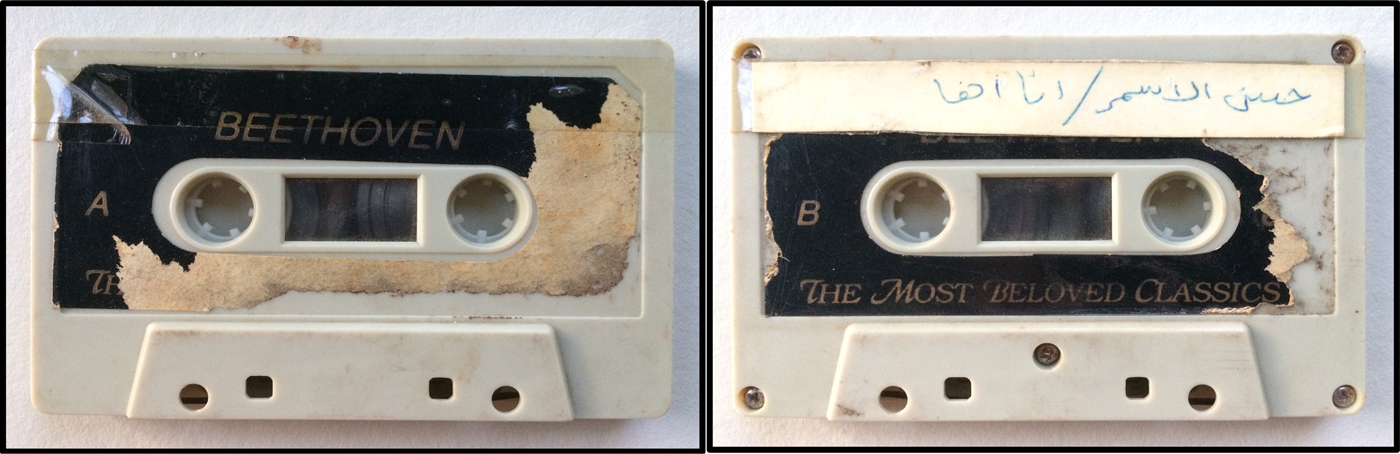
Contrary to the claims of many Egyptian observers, cassettes clearly channeled more than contentious sounds in the mid-to-late 20th century. Audiotapes, in fact, were vital to the material and social life of all voices from the 1970s to the 1990s, and beyond. At times challenging the commercial and cultural dominance of state-sanctioned icons, tapes also solidified the stardom of the very same artists. That is to say, cassettes simultaneously broadcast Umm Kulthum and Ahmad ʿAdawiya, ʿAbd al-Halim Hafiz and Michael Jackson, Anwar al-Sadat and Shaykh Kishk, and anyone with access to a tape recorder. As one writer observed during a sojourn to Egypt, spanning only a few months, in the mid-1980s, car stereos, portable Walkmans, and boom boxes played everything from classical music to Qurʾanic recitation to Western pop to leading Egyptian singers in private vehicles, public buses, shops, hotels, and social clubs from Alexandria to Aswan.Footnote 76 This wide array of sounds is no more evident than in the case of one cassette I came across in Cairo. The tape features Beethoven, on one side, and Hasan al-Asmar, on the other (Figure 3). What was once a recording of an esteemed European composer has become a platform for an Egyptian popular singer, who, like ʿAdawiya, was berated by public figures for his allegedly “vulgar” lyrics. Thus, while cassettes certainly infuriated many individuals who strove to dictate who created Egyptian culture and what shape it assumed, they were far from the exclusive property of provocative voices.
Beethoven and Hasan al-Asmar surface on a single cassette. Source: Author's archive.

Conclusion: Egypt's “Vulgar Soundscape”
Audiotapes were part and parcel of broader historical debates on “vulgar” media in modern Egypt in the mid-to-late 20th century, and while audiocassette technology dominated many of these discussions, it was not, as Walter Armbrust has shown, at the center of every critique.Footnote 77 Records, radio, and television also attracted the ire of commentators, albeit perhaps to a lesser extent due to their greater centralization.Footnote 78 Writers, likewise, faulted actors for “using expressions and movements that tear public taste to pieces” in theatrical productions, and voiced their disgust with both “vulgar” movies that bombarded viewers with gratuitous sex scenes in the cinema and “dangerous” videotapes that corrupted citizens’ morals further afield.Footnote 79 Together, all of these diverse, yet equally undesirable noises, contributed to the vitality of Egypt's “vulgar soundscape.”
Although multiple mass mediums played a part in generating passionate debates over the perceived “demise” of public taste and the alleged “end” of high culture in Egypt, audiotapes, arguably, inflamed these discussions to a greater degree. In addition to the technology's immense mobility, mass audience, and low price point, cassettes, as I have argued in this article, permitted citizens from all different backgrounds to play a part in the making of Egyptian culture in ways other devices did not. By enabling essentially anyone to become a cultural producer, regardless of their age, gender, education, class, location, or financial standing, audiocassettes radically expanded the perimeters of cultural production and infinitely enriched Egypt's soundscape.
In the process of elucidating the impact of audiocassettes and their users on the creation of Egyptian culture, this article raises a number of broader questions. What was the impact of other “forgotten” media technologies and how may these untold stories invite us to re-envision the making of modern nation-states? How did the transition from cultural consumers to cultural producers play out in other historical contexts and what new insights may these cases offer into the intersections of class, culture, and politics? Lastly, what may cultural histories of phenomena perceived to be primarily economic, political, or social in nature, such as the infitah, add to our understanding of the modern Middle East? All of these inquiries, no doubt, merit further research.
Having elucidated one untold chapter in the history of modern Egypt and Egyptian culture in this article, let us conclude by addressing the fluidity of “vulgarity” as a historical concept. Cultural categories, like “high” and “low,” “crass” and “refined,” are not immune to change. The adjectives assigned to any given art form at one point in time may very well not apply to it at another juncture. The ability of objects to travel between labels reminds us of the permeability of these concepts and the fact that they, like the items they describe, are products of a particular moment. With respect to Egypt, the fluidity of “vulgarity” is no more evident than in the case of one voice at the center of this article, Ahmad ʿAdawiya, who, in recent years, is beginning to emerge in a new light. In this regard, one episode proves particularly instructive.
During an outing at the start of 2016 on al-Bursa al-Gadida Street in Cairo, I came across several of ʿAdawiya's cassette recordings behind sliding glass doors shielding the voices of religious authorities and state-sanctioned artists who embodied “high” Egyptian culture. The place in which these audiotapes arose was none other than a Sawt al-Qahira outlet. In the case of the recordings on display, a second Egyptian label, Good News 4 Music, reissued ʿAdawiya's tapes at the turn of the 21st century after acquiring the rights to reproduce Sawt al-Hubb’s catalogue. Sawt al-Qahira, in turn, showcased the rereleased cassettes in its downtown branch. What was once an example of “vulgar” noise par excellence, in the opinion of many local critics, now lined the shelves of a company whose stakeholders strove decades earlier to elevate the taste of all Egyptians and to counter the very tapes it now sold. What could explain this puzzling occurrence?
One of the reasons behind this development was evident for all to hear around the corner from Sawt al-Qahira. On Shawarbi Street, a small kiosk, not unlike the ones that sold ʿAdawiya's cassettes during the street's heyday, supplied passersby with the latest hits of a new musical genre known as mahraganat (festivals) on their flash drives. Less than a decade in the making, mahraganat draws inspiration from the sha ʿ bi music pioneered by ʿAdawiya. Its artists sing about everyday issues and their voices emerged from urban, working-class neighborhoods to resound in taxis, cafes, and luxury hotels after the 2011 uprisings. As was the case with ʿAdawiya, mahraganat artists have garnered their fair share of criticism for creating “trivial” art. Radio stations, including the Sawt al-Qahira–supervised “Nagham FM,” have marginalized their productions to protect “public taste,” while the Musicians Syndicate has refused to grant its performers licenses on account of their “vulgar” lyrics.Footnote 80 The alleged “tastelessness” of this new genre, arguably, has prompted a number of Egyptians to rethink ʿAdawiya's cassettes.
This reappraisal, however, remains fraught with complexity. While the mahraganat music blaring in places like Shawarbi may well have paved the way for one of Sawt al-Qahira’s branches to stock ʿAdawiya's tapes, it did not stir the company to market his cassettes at a second, more visible, venue. ʿAdawiya was nowhere to be found in Sawt al-Qahira’s tent at the 2016 Cairo International Book Fair, where visitors were free to buy and browse thousands of its cassette recordings. Among the artists available in the label's booth were the same state-sanctioned icons ʿAdawiya accompanied at a distance from the fairgrounds in the venture's more central shop. Though certainly a part of Egypt's history, ʿAdawiya's tapes, it seems, were still too “vulgar” for some settings where Egyptian culture was staged, celebrated, and consumed.
At the end of an interview in 2014 with Mufid Fawzi, an Egyptian broadcaster for Dream TV, ʿAdawiya was asked to choose a title to describe himself. Fawzi presented his guest with three possibilities: “Singer of the Egyptian Street” (mughani al-hara al-misriyya), “ʿAdawiya is A-OK” (ʿAdawiya zay al-ful), and “I am History” (ana tarikh). Without a second's hesitation, the entertainer selected the final option.Footnote 81 In reality, ʿAdawiya and countless other Egyptians accused of producing and performing “vulgar” art remain to be written into Egypt's historical record. In offering an alternative history of Egypt's soundscape, economic opening, and cultural production in the mid-to-late 20th century, this article has taken a step in this direction. If the significance of so-called “meaningless” sounds, though, is to be truly understood, much work remains to be done.