


1. Introduction
Given an abelian variety  $A$ over the rational function field
 $K=k(t)$ of a finite field
 $k$, we prove the following results:
(1) the abelian variety
 $A$ is isogenous to the product of a constant abelian variety over $K$ and an abelian variety over $K$ whose Néron model over $\mathbb {P}^{1}_k$ has an ample Hodge bundle;
(2) finite generation of the abelian group
$A(K^{\rm per})$ if $A$ has semi-abelian reduction over $\mathbb {P}^{1}_k$, as part of the ‘full’ Mordell–Lang conjecture for $A$ over $K$;(3) finiteness of the abelian group
$\unicode{x0428}(A)[F^{\infty }]$, the subgroup of elements of the Tate–Shafarevich group $\unicode{x0428}(A)$ annihilated by iterations of the relative Frobenius homomorphisms, if $A$ has semi-abelian reduction over $\mathbb {P}^{1}_k$;(4) the Tate conjecture for all projective and smooth surfaces
$X$ over finite fields with $H^{1}(X,{\mathcal {O}}_X)=0$ implies the Tate conjecture for all projective and smooth surfaces over finite fields.


Result (1) is the main theorem of this paper, which implies the other results listed above. Results (2) and (3) are inspired by the paper [Reference RösslerRos15] of Damian Rössler; our proof of result (1) uses a quotient construction which is independently introduced by Damian Rössler in his more recent paper [Reference RösslerRos20].
1.1 Positivity of Hodge bundle
Let  $S$ be a projective and smooth curve over a field
 $k$, and
 $K=k(S)$ be the function field of
 $S$. Let
 $A$ be an abelian variety over
 $K$, and
 ${\mathcal {A}}$ be the Néron model of
 $A$ over
 $S$ (cf. [Reference Bosch, Lütkebohmert and RaynaudBLR90, § 1.2, Definition 1]). The Hodge bundle of
 $A$ over
 $K$ (or more precisely, of
 ${\mathcal {A}}$ over
 $S$) is defined to be the locally free
 ${\mathcal {O}}_S$-module
 \[ \bar{\Omega}_{A} =\bar{\Omega}_{{\mathcal{A}}/S} = e^{*}\Omega_{{\mathcal{A}}/S}^{1}, \]
where  $\Omega _{{\mathcal {A}}/S}^{1}$ the relative differential sheaf, and
 $e:S\to {\mathcal {A}}$ denotes the identity section of
 ${\mathcal {A}}$.
The height  $h(A)$ of
 $A$, defined to be
 $\deg (\bar {\Omega }_{A})$, has significant applications in Diophantine geometry. In fact, it was used by Parshin and Zarhin to treat the Mordell conjecture over function fields and the Tate conjecture for abelian varieties over function fields. The number field analogue, called the Faltings height, was introduced by Faltings and plays a major role in his proof of these conjectures over number fields.
By the results of Moret-Bailly, we have  $h(A)\geq 0$, or equivalently the determinant line bundle
 $\det (\bar {\Omega }_{A})$ is nef over
 $S$. Moreover, the equality
 $h(A)= 0$ holds if and only if
 ${\mathcal {A}}$ is isotrivial over
 $S$; see Theorem 2.6 of the current paper. However, as we show, the positivity of the whole vector bundle
 $\bar {\Omega }_{A}$ is more delicate (especially in positive characteristics). The goal of this paper is to study this positivity, and gives some arithmetic applications of it. We follow Hartshorne's notion of ample vector bundles and nef vector bundles, as in [Reference HartshorneHar66] and [Reference LazarsfeldLaz04, Chapter 6]. Namely, a vector bundle
 ${\mathcal {E}}$ over a scheme is ample (respectively, nef) if the tautological bundle
 ${\mathcal {O}}(1)$ over the projective space bundle
 $\mathbb {P}({\mathcal {E}})$ is an ample (respectively, nef) line bundle.
If  $k$ has characteristic zero, it is well known that
 $\bar {\Omega }_{A}$ is nef over
 $S$. This is a consequence of an analytic result of Griffiths; see also Bost [Reference BostBos04, Corollary 2.7] for an algebraic proof of this fact.
If  $k$ has a positive characteristic,
 $\bar {\Omega }_{A}$ can easily fail to be nef, as shown by the example of Moret-Bailly [Reference Moret-BaillyMor81, Proposition 3.1]. The example is obtained as the quotient of
 $(E_1\times _k E_2)_K$ by a local subgroup scheme over
 $K$, where
 $E_1$ and
 $E_2$ are supersingular elliptic curves over
 $k$. The quotient abelian surface has a proper Néron model over
 $S$.
To ensure the ampleness or nefness of the Hodge bundle, one needs to impose some strong conditions. In this direction, Rössler [Reference RösslerRos15, Theorem 1.2] proved that  $\bar {\Omega }_{A}$ is nef if
 $A$ is an ordinary abelian variety over
 $K$, and that
 $\bar {\Omega }_{A}$ is ample if, moreover, there is a place of
 $K$ at which
 $A$ has good reduction with
 $p$-rank
 $0$.
In another direction, we look for positivity by varying the abelian variety in its isogeny class. The main theorem of this paper is as follows.
Theorem 1.1 Denote  $K= k(t)$ for a finite field
 $k$, and let
 $A$ be an abelian variety over
 $K$. Then there is an isogeny
 $A\to B\times _{K} C_{K}$ over
 $K$, where
 $C$ is an abelian variety over
 $k$, and
 $B$ is an abelian variety over
 $K$ whose Hodge bundle is ample over
 $\mathbb {P}_{k}^{1}$.
To understand the theorem, we can take advantage of the simplicity of the theory of vector bundles on the projective line. By the Birkhoff–Grothendieck theorem (cf. [Reference Huybrechts and LehnHL97, Theorem 1.3.1]), any nonzero vector bundle  ${\mathcal {E}}$ on
 $S=\mathbb {P}^{1}_k$ (for any base field
 $k$) can be decomposed as
 \[ {\mathcal{E}}\simeq{\mathcal{O}}(d_1) \oplus {\mathcal{O}}(d_2) \oplus \cdots \oplus {\mathcal{O}}(d_r), \]
with uniquely determined integers  $d_1\geq d_2 \geq \cdots \geq d_r$. Under this decomposition,
 ${\mathcal {E}}$ is ample if and only if
 $d_r>0$;
 ${\mathcal {E}}$ is nef if and only if
 $d_r\geq 0$.
Let us return to Theorem 1.1. It explains that by passing to isogenous abelian varieties, the Hodge bundle becomes nef, and the non-ample part of the nef Hodge bundle actually comes from a constant abelian variety.
In § 3.3, we discuss the possibility of generalizing Theorem 1.1 to more general  $K/k$. First, we conjecture that the theorem holds for
 $K=k(t)$ with
 $k$ being any field of positive characteristic. At least, in this case, our proof implies that
 $A$ has a purely inseparable isogeny to an abelian variety over
 $K$ with a nef Hodge bundle; see Proposition 2.5. Second, we construct an abelian variety of
 $p$-rank 0 that proves that the theorem fails if
 $K/k$ is an arbitrary global function field.
1.2 Purely inseparable points
For a field  $K$ of characteristic
 $p>0$, the perfect closure of
 $K$ is the union
 \[ K^{\rm per}=\mathop{\bigcup}\limits_n K^{1/p^{n}} \]
in the algebraic closure of  $K$. The first consequence of our main theorem is the following result.
Theorem 1.2 Denote  $K= k(t)$ for a finite field
 $k$. Let
 $A$ be an abelian variety over
 $K$ with everywhere semi-abelian reduction over
 $\mathbb {P}^{1}_k$. Then
 $A(K^{\rm per})$ is a finitely generated abelian group.
By the Lang–Néron theorem, which is the function field analogue of the Mordell–Weil theorem, the theorem is equivalent to the equality  $A(K^{\rm per})=A(K^{1/p^{n}})$ for sufficiently large
 $n$.
For a general global function field  $K$, the theorem is proved by Ghioca [Reference GhiocaGhi10] for non-isotrivial elliptic curves, and by Rössler [Reference RösslerRos15, Theorem 1.1] assuming that the Hodge bundle
 $\bar {\Omega }_{A}$ is ample. By Rössler's result, Theorem 1.2 is a consequence of Theorem 1.1. In fact, it suffices to note the fact that any
 $k$-morphism from
 $\mathbb {P}^{1}_k$ to an abelian variety
 $C$ over
 $k$ is constant, i.e. its image is a single
 $k$-point of
 $C$.
Finally, we remark that Theorem 1.2 is related to the so-called full Mordell–Lang conjecture in positive characteristic. Recall that the Mordell–Lang conjecture, which concerns rational points of subvarieties of abelian varieties, was proved by Faltings over number fields. A positive characteristic analogue was obtained by Hrushovski. However, including consideration of the  $p$-part, the full Mordell–Lang conjecture in positive characteristics, formulated by Abramovich and Voloch, requires an extra result like Theorem 1.2. We refer to [Reference ScanlonSca05, Reference Ghioca and MoosaGM06] for more details. We also refer to Rössler [Reference RösslerRos20] for some more recent works on this subject.
1.3 Partial finiteness of Tate–Shafarevich group
Let  $A$ be an abelian variety over a global function field
 $K$ of characteristic
 $p$. Recall that the Tate–Shafarevich group of
 $A$ is defined by
 \[\unicode{x0428}(A) =\ker \Big(H^{1}(K, A)\longrightarrow \prod_{v} H^{1}(K_v, A)\Big), \]
where the product is over all places  $v$ of
 $K$. The prestigious Tate–Shafarevich conjecture asserts that
 $\unicode{x0428}(A)$ is finite. By the works of Artin and Tate [Reference TateTat95], Milne [Reference MilneMil75], Schneider [Reference SchneiderSch82], Bauer [Reference BauerBau92], and Kato and Trihan [Reference Kato and TrihanKT03], the Birch and Swinnerton-Dyer (BSD) conjecture for
 $A$ is equivalent to the finiteness of
 $\unicode{x0428}(A)[\ell ^{\infty }]$ for some prime
 $\ell$ (which is allowed to be
 $p$).
Denote by  $F^{n}: A\to A^{(p^{n})}$ the relative
 $p^{n}$-Frobenius morphism over
 $K$. Define
 \[ \unicode{x0428}(A)[F^{n}]= \ker(\unicode{x0428}(F^{n}): \unicode{x0428}(A)\to \unicode{x0428}(A^{(p^{n})})) \]
and
 \[\unicode{x0428}(A)[F^{\infty}]=\mathop{\bigcup}\limits_{n\geq 1} \unicode{x0428}(A)[F^{n}]. \]
Both are subgroups of  $\unicode{x0428}(A)$. Note that
 $F^{n}:A\to A^{(p^{n})}$ is a factor of the multiplication
 $[p^{n}]:A\to A$, so
 $\unicode{x0428}(A)[F^{\infty }]$ is a subgroup of
 $\unicode{x0428}(A)[p^{\infty }]$. These definitions generalize to the function field
 $K$ of a curve over any field
 $k$ of characteristic
 $p>0$.
Theorem 1.3 Let  $S$ be a projective and smooth curve over a perfect field
 $k$ of characteristic
 $p>0$, and
 $K$ be the function field of
 $S$. Let
 $A$ be an abelian variety over
 $K$. Then the following are true.
(1) If
$S=\mathbb {P}_k^{1}$, the abelian variety $A$ has everywhere good reduction over $S$, and the Hodge bundle of $A$ is nef over $S$, then $\unicode{x0428}(A)[F^{\infty }]=0$.(2) If
$A$ has everywhere semi-abelian reduction over $S$ and the Hodge bundle of $A$ is ample over $S$, then $\unicode{x0428}(A)[F^{\infty }]=\unicode{x0428}(A)[F^{n_0}]$ for some positive integer $n_0$.


Similar to Theorem 1.2, the proof of Theorem 1.3 is also inspired by that of Rössler [Reference RösslerRos15, Theorem 1.1]. One consequence of Theorems 1.1 and 1.3 is the following result.
Corollary 1.4 Let  $S$ be a projective and smooth curve over a finite field
 $k$ of characteristic
 $p>0$, and
 $K$ be the function field of
 $S$. Let
 $A$ be an abelian variety over
 $K$. Then
 $\unicode{x0428}(A)[F^{\infty }]$ is finite in each of the following cases:
(1)
$A$ is an elliptic curve over $K$;(2)
$S=\mathbb {P}_k^{1}$ and $A$ has everywhere semi-abelian reduction over $\mathbb {P}^{1}_k$;(3)
$A$ is an ordinary abelian variety over $K$, and there is a place of $K$ at which $A$ has good reduction with $p$-rank $0$.


In case (1), after a finite base change,  $A$ has semi-abelian reduction, and the line bundle
 $\bar {\Omega }_A$ is ample unless
 $A$ is isotrivial. In case (2), by Theorem 1.1, it is reduced to two finiteness results corresponding to the two cases of Theorem 1.3 exactly. In case (3), after a finite base change,
 $A$ has semi-abelian reduction, and the line bundle
 $\bar {\Omega }_A$ is ample by Rössler [Reference RösslerRos15, Theorem 1.2]. A detailed proof of the corollary will be given in § 3.2.
We remark that case (2) of the corollary naturally arises when taking the Jacobian variety of the generic fiber of a Lefschetz fibration of a projective and smooth surface over  $k$. This standard construction was initiated by Artin and Tate [Reference TateTat95] to treat the equivalence between the Tate conjecture (for the surface) and the BSD conjecture (for the Jacobian variety). We refer to Theorem 4.3 for a quick review of the equivalence.
Toward the BSD conjecture, we come to the question of how far  $\unicode{x0428}(A)[F^{\infty }]$ is from the whole group
 $\unicode{x0428}(A)[p^{\infty }]$. This is a very difficult question in general. However, if
 $A$ is an abelian variety of
 $p$-rank 0, then we actually have
 $\unicode{x0428}(A)[F^{\infty }]=\unicode{x0428}(A)[p^{\infty }]$; see Proposition 3.10.
1.4 Variation of the Tate conjecture
One version of the prestigious Tate conjecture for divisors is as follows.
Conjecture 1.5 (Conjecture  $T^{1}(X)$)
Let  $X$ be a projective and smooth variety over a finite field
 $k$ of characteristic
 $p$. Then for any prime
 $\ell \neq p$, the cycle class map
 \[ \mathrm{Pic}(X)\otimes_\mathbb{Z} \mathbb{Q}_\ell \longrightarrow H^{2}(X_{\bar k}, \mathbb{Q}_\ell(1))^{{\mathrm{Gal}}(\bar k/k)} \]
is surjective.
The Tate conjecture is confirmed in many cases. It is proved by Tate [Reference TateTat66] for arbitrary products of curves and abelian varieties. If  $X$ is a K3 surface and
 $p>2$, the conjecture is proved by the works of Nygaard [Reference NygaardNyg83], Nygaard and Ogus [Reference Nygaard and OgusNO85], Artin and Swinnerton-Dyer [Reference Artin and Swinnerton-DyerAS73], Maulik [Reference MaulikMau14], Charles [Reference CharlesCha13], and Madapusi Pera [Reference Madapusi PeraMad15]. Moreover, by the recent work of Morrow [Reference MorrowMor19], conjecture
 $T^{1}(X)$ for all projective and smooth surfaces
 $X$ over
 $k$ implies conjecture
 $T^{1}(X)$ for all projective and smooth varieties
 $X$ over
 $k$.
In this section, we have the following reduction of the Tate conjecture.
Theorem 1.6 Let  $k$ be a fixed finite field. Conjecture
 $T^{1}(X)$ for all projective and smooth surfaces
 $X$ over
 $k$ satisfying
 $H^{1}(X,{\mathcal {O}}_X)=0$ implies conjecture
 $T^{1}(X)$ for all projective and smooth surfaces
 $X$ over
 $k$.
For a projective and smooth surface  $X$ over a field
 $k$ of any characteristic, the condition
 $H^{1}(X,{\mathcal {O}}_X)=0$ implies the following properties:
(1)
$H^{1}(X_{\bar k}, \mathbb {Q}_\ell )=0$;(2) the identity component
$\underline {\mathrm {Pic}}^{0}_{X/k}$ of the Picard functor $\underline {\mathrm {Pic}}_{X/k}$ is trivial;(3) the cycle class map
$\mathrm {Pic}(X)\otimes _\mathbb {Z} \mathbb {Q}_\ell \to H^{2}(X_{\bar k}, \mathbb {Q}_\ell (1))$ is injective.


In fact, property (2) holds because  $H^{1}(X,{\mathcal {O}}_X)$ is the tangent space of
 $\underline {\mathrm {Pic}}_{X/k}$. Property (3) holds because the kernel of the cycle class map is
 $\underline {\mathrm {Pic}}^{0}_{X/k}(k)\otimes _\mathbb {Z} \mathbb {Q}_\ell$. Property (1) holds because
 $X$ has the same first Betti number as
 $\underline {\mathrm {Pic}}^{0}_{X/k}$.
1.5 Idea of the proofs
Here we explain our proofs of the theorems.
Positivity of Hodge bundle
Theorem 1.1 is the main theorem, and its proof takes up the whole of § 2. The proof consists of three major steps.
The first step is to construct an infinite chain of abelian varieties. Namely, if the Hodge bundle  $\bar {\Omega }_A=\bar {\Omega }_{{\mathcal {A}}/S}$ of
 $A$ is not ample, then the dual
 ${\mathrm {Lie}}({\mathcal {A}}/S)$ has a nonzero maximal nef subbundle
 ${\mathrm {Lie}}({\mathcal {A}}/S)_{\mathrm {nef}}$. We prove that it is always a
 $p$-Lie algebra. Applying the Lie theory of finite and flat group schemes developed in [Reference Demazure and GrothendieckSGA3], we can lift
 ${\mathrm {Lie}}({\mathcal {A}}/S)_{\mathrm {nef}}$ to a finite and flat subgroup scheme
 ${\mathcal {A}}[F]_{\mathrm {nef}}$ of
 ${\mathcal {A}}$ of height one. Then we form the quotient
 ${\mathcal {A}}_1'={\mathcal {A}}/{\mathcal {A}}[F]_{\mathrm {nef}}$, and let
 ${\mathcal {A}}_1$ be the Néron model of the generic fiber of
 ${\mathcal {A}}_1'$. If the Hodge bundle of
 ${\mathcal {A}}_1$ is still not ample, repeat the construction to get
 ${\mathcal {A}}_2'$ and
 ${\mathcal {A}}_2$. Keep repeating the process, we obtain an infinite sequence
 \[ {\mathcal{A}},\ {\mathcal{A}}_1',\ {\mathcal{A}}_1,\ {\mathcal{A}}_2',\ {\mathcal{A}}_2,\ {\mathcal{A}}_3',\ {\mathcal{A}}_3,\ \ldots. \]
The second step is to use heights to force the sequence to be stationary in some sense. In fact, the height of the sequence is decreasing, which is a key property proved by the construction. As mentioned previously, the heights are non-negative integers, so the sequence of the heights is eventually constant. This implies, in particular, that there is  $n_0$ such that for any
 $n\geq n_0$,
 ${\mathrm {Lie}}({\mathcal {A}}_n/S)_{\mathrm {nef}}$ is the base change of a
 $p$-Lie algebra from the base
 $k$, and
 ${\mathcal {A}}_n[F]_{\mathrm {nef}}$ is eventually the base change of a group scheme from the base
 $k$. We say such group schemes over
 $S$ are of constant type. As a consequence, the kernels of
 ${\mathcal {A}}_{n_0}\to {\mathcal {A}}_n$ as
 $n$ varies give a direct systems of group schemes over
 $S$ of constant type. With some argument, we can convert this direct system into a
 $p$-divisible subgroup
 ${\mathcal {H}}_\infty$ of
 ${\mathcal {A}}_{n_0}[p^{\infty }]$ of constant type. For simplicity of notation, we assume
 ${\mathcal {A}}_{n_0}$ is just
 ${\mathcal {A}}$ in the following.
The third step is to ‘lift’ the  $p$-divisible subgroup
 ${\mathcal {H}}_\infty$ of
 ${\mathcal {A}}[p^{\infty }]$ to an abelian subscheme of
 ${\mathcal {A}}$ of constant type. By passing to a finite extension of
 $k$, we can find a point
 $s\in S(k)$ such that the fiber
 $C={\mathcal {A}}_s$ is an abelian variety over
 $k$. As
 ${\mathcal {H}}_\infty$ is of constant type, it is also a
 $p$-divisible subgroup of
 $C_S[p^{\infty }]$. It follows that
 ${\mathcal {A}}$ and
 $C_S$ ‘share’ the same
 $p$-divisible subgroup
 ${\mathcal {H}}_{\infty }$. This would eventually imply that
 $A$ has a non-trivial
 $(K/k)$-trace by some fundamental theorems. In fact,
 $C[p^{\infty }]$ is semisimple (up to isogeny) as the
 $p$-adic version of Tate's isogeny theorem and, thus,
 ${\mathcal {H}}_{\infty ,K}$ is a direct summand of
 $C[p^{\infty }]$ up to isogeny. This implies that
 ${\mathrm {Hom}}(C_K[p^{\infty }], A[p^{\infty }])\neq 0$. By a theorem of de Jong [Reference de JongJon98], this implies that
 ${\mathrm {Hom}}(C_K, A)\neq 0$. Then
 $A$ has a non-trivial
 $(K/k)$-trace. The proof is finished by applying the same process to the quotient of
 $A$ by the image of the
 $(K/k)$-trace map.
Note that the proof is in a spirit similar to that of [Reference BostBos04, Theorem 2.6 and Corollary 2.7], but the current situation is more difficult due to the fact that in characteristic  $p>0$, integrating a
 $p$-Lie algebra only gives a radicial group scheme (of relative dimension
 $0$), instead of a smooth group scheme (of the expected relative dimension). The idea above is to form a
 $p$-divisible group by integrating infinitely many times, and algebraize it by the theorems of Tate and de Jong.
Partial finiteness
Theorem 1.2 is an easy consequence of Theorem 1.1 and Rössler [Reference RösslerRos15, Theorem 1.1], as mentioned above. Theorem 1.3 will be proved in § 3. The proof is inspired by that of Rössler [Reference RösslerRos15, Theorem 1.1], which is, in turn, derived from an idea of Kim [Reference KimKim97].
To illustrate the idea, we first assume that  $A$ is an elliptic curve with semi-abelian reduction over
 $S$. Take an element
 $X\in \unicode{x0428}(A)[F^{\infty }]$, viewed as an
 $A$-torsor over
 $K$. Take a closed point
 $P\in X$ which is purely inseparable over
 $K$. It exists because
 $X$ is annihilated by a power of the relative Frobenius. Denote by
 $p^{n}$ the degree of the structure map
 $\psi _K: P\to \operatorname {Spec} K$. Assume that
 $n\geq 1$. It suffices to bound
 $n$ in terms of
 $A$.
Consider the canonical composition
 \[ \psi_K^{*} \bar{\Omega}_{A}\longrightarrow \Omega_{X/K}^{1}|_P \longrightarrow \Omega_{P/K}^{1} \longrightarrow \Omega_{P/k}^{1}. \]
The first map is induced by the torsor isomorphism  $X\times _KP\to A\times _KP$, and it is an isomorphism. The second map is surjective. The third map is bijective because
 $P$ is purely inseparable of degree
 $p^{n}$ over
 $K$. We are going to extend the maps to integral models.
Denote by  ${\mathcal {P}}$ the unique projective and smooth curve over
 $k$ with generic point
 $P$, and let
 $\psi :{\mathcal {P}}\to S$ be the natural map derived from
 $\psi _K$. Abstractly
 ${\mathcal {P}}$ is isomorphic to
 $S$ because
 $\psi$ is purely inseparable. By considering the minimal regular projective models of
 $X$ and
 $A$ over
 $S$, one can prove that the above composition extends to a morphism
 \[ \psi^{*} \bar{\Omega}_{{\mathcal{A}}/S} \longrightarrow \Omega_{{\mathcal{P}}/k}^{1}(E). \]
Here  ${\mathcal {A}}$ is the Néron model of
 $A$ over
 $S$,
 $E$ is the reduced structure of
 $\psi ^{-1}(E_0)$, and
 $E_0$ is the set of closed points of
 $S$ at which
 $A$ has bad reduction. The morphism is a nonzero morphism of line bundles over
 ${\mathcal {P}}$, so it is necessarily injective. The degrees on
 ${\mathcal {P}}$ give
 \[ p^{n}\cdot \deg(\bar{\Omega}_{{\mathcal{A}}/S})=\deg(\psi^{*} \bar{\Omega}_{{\mathcal{A}}/S}) \leq \deg(\Omega_{{\mathcal{P}}/k}^{1}(E))=\deg(E_0)+2g-2. \]
Here  $g$ is the genus of
 $S$. If
 $\deg (\bar {\Omega }_{{\mathcal {A}}/S})> 0$, then
 $n$ is bounded. It proves the theorem in this case.
The proof for general dimensions is based on the above strategy with two new ingredients. First, there is no minimal regular model for  $A$. The solution is to use the compactification of Faltings and Chai [Reference Faltings and ChaiFC90]. This is the major technical part of the proof. Second, the Hodge bundle is a vector bundle, and we require the ampleness of the whole vector bundle.
Variation of theTate conjecture
Theorem 1.6 will be proved in § 4. One key idea is to repeatedly apply the Artin–Tate theorem, which asserts that for a reasonable fibered surface  $\pi :X\to S$, the Tate conjecture
 $T^{1}(X)$ is equivalent to the BSD conjecture for the Jacobian variety
 $J$ of the generic fiber of
 $\pi$. By this, we can switch between projective and smooth surfaces over finite fields and abelian varieties over global function fields.
As we can see from § 4.2, the major part of the proof consists of four steps. We describe them briefly in the following.
Step 1: Make a fibration. Take a Lefschetz pencil over  $X$, whose existence (over a finite base field) is proved by Nguyen [Reference NguyenNgu05]. By blowing-up
 $X$, we get a Lefschetz fibration
 $\pi :X'\to S$ with
 $S=\mathbb {P}^{1}_k$. Denote by
 $J$ the Jacobian variety of the generic fiber of
 $\pi :X'\to S$, which is an abelian variety over
 $K=k(t)$ with everywhere semi-abelian reduction over
 $S$. In particular,
 $T^{1}(X)$ is equivalent to
 $T^{1}(X')$, and
 $T^{1}(X')$ is equivalent to
 $\textit{BSD}(J)$.
Step 2: Make the Hodge bundle positive. Apply Theorem 1.1 to  $J$. Then
 $J$ is isogenous to
 $A\times _{K} C_{K}$, where
 $C$ is an abelian variety over
 $k$, and
 $A$ is an abelian variety over
 $K$ with an ample Hodge bundle over
 $S$. It is easy to check that
 $\textit{BSD}(C_K)$ holds unconditionally. Therefore,
 $\textit{BSD}(J)$ is equivalent to
 $\textit{BSD}(A)$.
Step 3: Take a projective regular model. We need nice projective integral models of abelian varieties over global function fields. This is solved by the powerful theory of Mumford [Reference MumfordMum72] and Faltings and Chai [Reference Faltings and ChaiFC90] with some refinement by Künnemann [Reference KünnemannKun98]. As a result, there is a projective, flat, and regular integral model  $\psi :{\mathcal {P}}\to S$ of
 $A^{\vee }\to \operatorname {Spec} K$ with a canonical isomorphism
 $R^{1}\psi _* {\mathcal {O}}_{\mathcal {P}}\to \bar {\Omega }_A^{\vee }$. This forces
 $H^{0}(S, R^{1}\psi _* {\mathcal {O}}_{\mathcal {P}})=0$ by the ampleness of
 $\bar {\Omega }_A$. By the Leray spectral sequence, we have
 $H^{1}({\mathcal {P}}, {\mathcal {O}}_{\mathcal {P}})=0$. This is the very reason why the positivity of the Hodge bundle is related to the vanishing of
 $H^{1}$.
Step 4: Take a surface in the regular model. By successively applying the Bertini-type theorem of Poonen [Reference PoonenPoo04], we can find a projective and smooth  $k$-surface
 ${\mathcal {Y}}$ in
 ${\mathcal {P}}$ satisfying the following conditions:
(1)
$H^{1}({\mathcal {Y}}, {\mathcal {O}}_{\mathcal {Y}})=0$;(2) the canonical map
$H^{1}({\mathcal {P}}_\eta , {\mathcal {O}}_{{\mathcal {P}}_\eta })\to H^{1}({\mathcal {Y}}_\eta , {\mathcal {O}}_{{\mathcal {Y}}_\eta })$ is injective;(3) the generic fiber
${\mathcal {Y}}_\eta$ of ${\mathcal {Y}}\to S$ is smooth.


Here  $\eta =\operatorname {Spec} K$ denotes the generic point of
 $S$. Denote by
 $B$ the Jacobian variety of
 ${\mathcal {Y}}_\eta$ over
 $\eta$. Consider the homomorphism
 $A\to B$ induced by the natural homomorphism
 $\underline {\mathrm {Pic}}_{{\mathcal {P}}_\eta /\eta }\to \underline {\mathrm {Pic}}_{{\mathcal {Y}}_\eta /\eta }$. The kernel of
 $A\to B$ is finite by condition (2). It follows that
 $\textit{BSD}(A)$ is implied by
 $\textit{BSD}(B)$. By the Artin–Tate theorem again,
 $\textit{BSD}(B)$ is equivalent to
 $T^{1}({\mathcal {Y}})$. Note that
 $H^{1}({\mathcal {Y}}, {\mathcal {O}}_{\mathcal {Y}})=0$. This finishes the proof of Theorem 1.6.
1.6 Notation and terminology
For any field  $k$, denote by
 $k^{s}$ (respectively,
 $\bar k$) the algebraic closure (respectively, separable closure).
By a variety over a field, we mean a scheme that is geometrically integral, separated and of finite type over the field. By a surface (respectively, curve), we mean a variety of dimension two (respectively, one).
We use the following basic notation:
•
$k$ denotes a field of characteristic $p$;•
$S$ usually denotes a projective, smooth, and geometrically integral curve over $k$, which is often $\mathbb {P}^{1}_k$;•
$K=k(S)$ usually denotes the function field of $S$, which is often $k(t)$;•
$\eta =\operatorname {Spec} K$ denotes the generic point of $S$.


Occasionally, we allow  $K$ and
 $S$ to be more general.
Frobenius morphisms
Let  $X$ be a scheme over
 $\mathbb {F}_p$. Denote by
 $F_X^{n}: X\to X$ the absolute Frobenius morphism whose induced map on the structure sheaves is given by
 $a\mapsto a^{p^{n}}$. To avoid confusion, we often write
 $F_X^{n}: X\to X$ as
 $F_X^{n}: X_n\to X$, so
 $X_n$ is just a notation for
 $X$. We also write
 $F^{n}=F_X^{n}$ if no confusion will result.
Let  $\pi :X\to S$ be a morphism of schemes over
 $\mathbb {F}_p$. Denote by
 \[ X^{(p^{n})} =X\times_SS=(X,\pi)\times_{S} (S, F_{S}^{n}), \]
the fiber product of  $\pi :X\to S$ with the absolute Frobenius morphism
 $F_{S}^{n}: S\to S$. Then
 $X^{(p^{n})}$ is viewed as a scheme over
 $S$ by the projection to the second factor, and the universal property of fiber products gives an
 $S$-morphism
 \[ F_{{/}S}^{n}=F_{X/S}^{n}: X\longrightarrow X^{(p^{n})}, \]
which is the relative  $p^{n}$-Frobenius morphism of
 $X$ over
 $S$. See the following diagram.

We sometimes also write  $F^{n}$ for
 $F_{X/S}^{n}$ if there is no confusion.
Relative Tate–Shafarevich group
Let  $K$ be a global function field, let
 $f:A\to B$ be a homomorphism of abelian varieties over
 $K$. Denote
 \[\unicode{x0428}(A)[f]= \ker(\unicode{x0428}(f): \unicode{x0428}(A)\to \unicode{x0428}(B)). \]
In the case of the relative Frobenius morphism,
 \[\unicode{x0428}(A)[F^{n}]= \ker(\unicode{x0428}(F^{n}): \unicode{x0428}(A)\to \unicode{x0428}(A^{(p^{n})})). \]
Denote
 \[ \unicode{x0428}(A)[F^{\infty}]=\mathop{\bigcup}\limits_{n\geq 1} \unicode{x0428}(A)[F^{n}] \]
as a subgroup of  $\unicode{x0428}(A)$.
In the setting of  $f:A\to B$, we also denote
 \[ A[f]=\ker(f:A\to B), \]
viewed as a group scheme over  $K$. It is often non-reduced in this paper.
Radicial morphisms
By [Reference Dieudonné and GrothendieckEGA, I, § 3.5], a morphism  $f:X\to Y$ of schemes is called radicial if one of the following equivalent conditions holds:
(1) the induced map
$X(L)\to Y(L)$ is injective for any field $L$;(2)
$f$ is universally injective; i.e. any base change of $f$ is injective on the underlying topological spaces;(3)
$f$ is injective on the underlying topological spaces, and for any $x\in X$, the induced extension $k(x)/k(f(x))$ of the residue fields is purely inseparable.


Such properties are stable under compositions, products, and base changes.
Vector bundles
By a vector bundle on a scheme, we mean a locally free sheaf of finite rank. By a line bundle on a scheme, we mean a locally free sheaf of rank one.
Cohomology
Most cohomologies in this paper are étale cohomology, if there are no specific explanations. We may move between different cohomology theories, and the situation will be explained from time to time.
2. Positivity of a Hodge bundle
The goal of this section is to prove Theorem 1.1. As sketched in § 1.5, the proof consists of three major steps. Each of these steps takes a subsection in §§ 2.2, 2.3, and 2.4. Before them, we introduce some basic results about group schemes of constant types in § 2.1.
2.1 Group schemes of constant type
Here we collect some basic results about group schemes to be used later.
 $p$-Lie algebras and group schemes. Here we recall the infinitesimal Lie theory of [Reference Demazure and GrothendieckSGA3, VII
 $_A$]. For simplicity, we only restrict to the commutative case here. Let
 $S$ be a noetherian scheme over
 $\mathbb {F}_p$. Recall that a commutative
 $p$-Lie algebra over
 $S$ is a coherent sheaf
 $\mathfrak {g}$ on
 $S$, endowed with an additive morphism
 \[ \mathfrak{g} \longrightarrow \mathfrak{g},\quad \delta\longmapsto \delta^{[p]} \]
which is  $p$-linear in the sense that
 \[ (a\delta)^{[p]}=a^{p}\delta^{[p]}, \quad a\in {\mathcal{O}}_S,\ \delta\in \mathfrak{g}. \]
The additive morphism is called the  $p$-th power map on
 $\mathfrak {g}$. We say that
 $\mathfrak {g}$ is locally free if it is locally free as an
 ${\mathcal {O}}_S$-module.
We can interpret the  $p$-th power map on
 $\mathfrak {g}$ as an
 ${\mathcal {O}}_S$-linear map as follows. Recall the absolute Frobenius morphism
 $F_S: S\to S$. The pull-back
 $F_S^{*}\mathfrak {g}$ is still a vector bundle on
 $S$. The additive map
 \[ F_S^{*}: \mathfrak{g}\longrightarrow F_S^{*}\mathfrak{g} \]
is  $p$-linear in that
 $F_S^{*}(a\delta )=a^{p}F_S^{*}\delta .$ It follows that we have a well-defined
 ${\mathcal {O}}_S$-linear map given by
 \[ F_S^{*}\mathfrak{g} \longrightarrow \mathfrak{g}, \quad F_S^{*}\delta \longmapsto \delta^{[p]}. \]
For a commutative group scheme  ${\mathcal {G}}$ over
 $S$, the
 ${\mathcal {O}}_S$-module
 ${\mathrm {Lie}}({\mathcal {G}}/S)$ of invariant derivations on
 ${\mathcal {G}}$ is a natural commutative
 $p$-Lie algebra over
 $S$. By [Reference Demazure and GrothendieckSGA3, VII
 $_A$, Theorems 7.2 and 7.4, Remark 7.5], the functor
 ${\mathcal {G}}\mapsto {\mathrm {Lie}}({\mathcal {G}}/S)$ is an equivalence between the following two categories:
(1) the category of finite and flat commutative group schemes of height one over
$S$;(2) the category of locally free commutative
$p$-Lie algebras over $S$.


Here a group scheme  ${\mathcal {G}}$ over
 $S$ is of height one if the relative Frobenius morphism
 $F_{{\mathcal {G}}/S}:{\mathcal {G}}\to {\mathcal {G}}^{(p)}$ is zero. Furthermore, if
 ${\mathcal {G}}$ is in the first category, then
 $\bar {\Omega }_{{\mathcal {G}}/S}=e^{*}\Omega _{{\mathcal {G}}/S}$ and
 ${\mathrm {Lie}}({\mathcal {G}}/S)$ are locally free and canonically dual to each other. Here
 $e:S\to {\mathcal {G}}$ is the identity section. See [Reference Demazure and GrothendieckSGA3, VII
 $_A$, Proposition 5.5.3].
For some treatments in special cases, see [Reference MumfordMum74, § 15] for the case that  $S$ is the spectrum of an algebraically closed field, and [Reference Conrad, Gabber and PrasadCGP10, § A.7] for the case that
 $S$ is affine.
Group schemes of constant type. The following results, except Lemma 2.1(1), also hold in characteristic zero. We restrict to positive characteristics for simplicity.
Let  $S$ be a scheme over a field
 $k$ of characteristic
 $p>0$. A group scheme (respectively, scheme, coherent sheaf,
 $p$-Lie algebra,
 $p$-divisible group)
 ${\mathcal {G}}$ over
 $S$ is called of constant type over
 $S$ if it is isomorphic to the base change (respectively, base change, pull-back, pull-back, base change)
 $G_S$ by
 $S\to \operatorname {Spec} k$ of some group scheme (respectively, scheme, coherent sheaf,
 $p$-Lie algebra,
 $p$-divisible group)
 $G$ over
 $k$. Note that a finite flat group scheme of height one over
 $S$ is of constant type if and only if its
 $p$-Lie algebra is of constant type.
It is also reasonable to use the term ‘constant’ instead of ‘of constant type’ in the above definition. However, a ‘constant group scheme’ usually means a group scheme associated to an abelian group in the literature, so we choose the current terminology to avoid confusion.
Lemma 2.1 Let  $S$ be a Noetherian scheme over a field
 $k$ of characteristic
 $p>0$ with
 $\Gamma (S,{\mathcal {O}}_S)=k$.
(1) Let
$\pi :{\mathcal {G}}\to S$ be a finite and flat commutative group scheme of height one over $S$. If the $p$-Lie algebra of ${\mathcal {G}}$ is of constant type as a coherent sheaf over $S$, then ${\mathcal {G}}$ is of constant type as a group scheme over $S$.(2) Let
$\pi :{\mathcal {G}}\to S$ be a finite and flat commutative group scheme over $S$. If $\pi _*{\mathcal {O}}_{\mathcal {G}}$ is of constant type as a coherent sheaf over $S$, then ${\mathcal {G}}$ is of constant type as a group scheme over $S$.(3) Let
$\pi _1:{\mathcal {G}}_1\to S$ and $\pi _2:{\mathcal {G}}_2\to S$ be finite and flat commutative group schemes of constant type over $S$. Then any $S$-homomorphism between ${\mathcal {G}}_1$ and ${\mathcal {G}}_2$ is of constant type, i.e. equal to the base change of a unique $k$-homomorphism between the corresponding group schemes over $k$.


Proof. We first prove part (1). Denote  $\mathfrak {g}={\mathrm {Lie}}({\mathcal {G}}/S)$ and
 $\mathfrak {g}_0=\Gamma (S, \mathfrak {g})$. By assumption, the canonical morphism
 \[ \mathfrak{g}_0 \otimes_k {\mathcal{O}}_S \longrightarrow \mathfrak{g} \]
is an isomorphism of  ${\mathcal {O}}_S$-modules. It suffices to prove that the
 $p$-th power map of
 $\mathfrak {g}$ comes from a
 $p$-th power map of
 $\mathfrak {g}_0$. Note that
 $\mathfrak {g}_0$ has a canonical
 $p$-th power map coming from global sections of
 $\mathfrak {g}$, but we do not need this fact.
Note that the  $p$-th power map of
 $\mathfrak {g}$ is equivalent to an
 ${\mathcal {O}}_S$-linear map
 $F_S^{*}\mathfrak {g} \to \mathfrak {g}$. It is an element of
 \begin{align*} {\mathrm{Hom}}_{{\mathcal{O}}_S}(F_S^{*}\mathfrak{g},\mathfrak{g}) &=\Gamma(S, F_S^{*}(\mathfrak{g}^{{\vee}})\otimes_{{\mathcal{O}}_S}\mathfrak{g}) \\ &=\Gamma(S, (F_k^{*}(\mathfrak{g}_0^{{\vee}})\otimes_k\mathfrak{g}_0)\otimes_k{{\mathcal{O}}_S}) =F_k^{*}(\mathfrak{g}_0^{{\vee}})\otimes_k\mathfrak{g}_0 ={\mathrm{Hom}}_{k}(F_k^{*}\mathfrak{g}_0,\mathfrak{g}_0). \end{align*}
In other words, it is the base change of a  $p$-th power map of
 $\mathfrak {g}_0$. This proves part (1).
The proof of part (2) is similar. In fact, denote  ${\mathcal {F}}=\pi _*{\mathcal {O}}_{\mathcal {G}}$ and
 ${\mathcal {F}}_0=\Gamma (S, \pi _*{\mathcal {O}}_{\mathcal {G}})$. The canonical morphism
 \[ {\mathcal{F}}_0 \otimes_k {\mathcal{O}}_S \longrightarrow {\mathcal{F}} \]
is an isomorphism of  ${\mathcal {O}}_S$-modules. Note that the structure of
 ${\mathcal {G}}$ as a group scheme over
 $S$ is equivalent to a structure of
 ${\mathcal {F}}$ as a Hopf
 ${\mathcal {O}}_S$-algebra. For these, the extra data on
 ${\mathcal {F}}$ consist of an identity map
 ${\mathcal {O}}_S\to {\mathcal {F}}$, a multiplication map
 ${\mathcal {F}}\otimes _{{\mathcal {O}}_S}{\mathcal {F}} \to {\mathcal {F}}$, a co-identity map
 ${\mathcal {F}}\to {\mathcal {O}}_S$, a co-multiplication map
 ${\mathcal {F}} \to {\mathcal {F}}\otimes _{{\mathcal {O}}_S}{\mathcal {F}}$, and an inverse map
 ${\mathcal {F}} \to {\mathcal {F}}$. There are many compatibility conditions on these maps. All these maps are
 ${\mathcal {O}}_S$-linear. We claim that all these maps are coming from similar maps on
 ${\mathcal {F}}_0$. For example, the co-multiplication map is an element of
 \begin{align*} {\mathrm{Hom}}_{{\mathcal{O}}_S}({\mathcal{F}}, {\mathcal{F}}\otimes_{{\mathcal{O}}_S}{\mathcal{F}}) &=\Gamma(S, {\mathcal{F}}^{{\vee}}\otimes_{{\mathcal{O}}_S}{\mathcal{F}}\otimes_{{\mathcal{O}}_S}{\mathcal{F}}) \\ &=\Gamma(S, ({\mathcal{F}}_0^{{\vee}}\otimes_k{\mathcal{F}}_0\otimes_k{\mathcal{F}}_0)\otimes_k{{\mathcal{O}}_S})\\ &={\mathcal{F}}_0^{{\vee}}\otimes_k{\mathcal{F}}_0\otimes_k{\mathcal{F}}_0 ={\mathrm{Hom}}_{k}({\mathcal{F}}_0, {\mathcal{F}}_0\otimes_k{\mathcal{F}}_0). \end{align*}
This makes  ${\mathcal {F}}_0$ a Hopf
 $k$-algebra, because the compatibility conditions hold by
 ${\mathcal {F}}_0=\Gamma (S,{\mathcal {F}})$. Finally, the Hopf algebra
 ${\mathcal {F}}$ is the base change of the Hopf algebra
 ${\mathcal {F}}_0$. Then the group scheme
 ${\mathcal {G}}$ is the base change of the group scheme corresponding to the Hopf algebra
 ${\mathcal {F}}_0$.
The proof of part (3) is similar by looking at  ${\mathrm {Hom}}_{{\mathcal {O}}_S}((\pi _2)_*{\mathcal {O}}_{{\mathcal {G}}_2},(\pi _1)_*{\mathcal {O}}_{{\mathcal {G}}_1})$ with compatibility conditions.
The following result will be used for several times.
Lemma 2.2 Denote  $S=\mathbb {P}_k^{1}$ for any field
 $k$ of characteristic
 $p>0$. Let
 \[ 0 \longrightarrow {\mathcal{G}}_1\longrightarrow {\mathcal{G}}\longrightarrow {\mathcal{G}}_2\longrightarrow 0 \]
be an exact sequence of finite and flat commutative group schemes over  $S$. If
 ${\mathcal {G}}_1$ and
 ${\mathcal {G}}_2$ are of constant type, then
 ${\mathcal {G}}$ is of constant type.
Proof. By Lemma 2.1(2), it suffices to prove that  $\pi _*{\mathcal {O}}_{{\mathcal {G}}}$ is of constant type as a coherent
 ${\mathcal {O}}_S$-module. Here
 $\pi :{\mathcal {G}}\to S$ is the structure morphism. We can assume that
 $k$ is algebraically closed. In fact, the property that the canonical map
 \[ \Gamma(S, \pi_*{\mathcal{O}}_{{\mathcal{G}}}) \otimes_k {\mathcal{O}}_S \longrightarrow \pi_*{\mathcal{O}}_{{\mathcal{G}}} \]
is an isomorphism can be descended from the algebraic closure of  $k$ to
 $k$.
Once  $k$ is algebraically closed, any finite group scheme over
 $k$ is a successive extension of group schemes in the following list:
 \[ \mathbb{Z}/\ell\mathbb{Z}, \quad \mathbb{Z}/p\mathbb{Z},\quad \mu_p,\quad \alpha_p. \]
Here  $\ell \neq p$ is any prime, and
 $\mathbb {Z}/\ell \mathbb {Z}$ is isomorphic to
 $\mu _\ell$.
For  $i=1,2$, write
 ${\mathcal {G}}_i=G_i\times _k S$ for a finite group scheme
 $G_i$ over
 $k$. By induction, we can assume that
 $G_1$ is one of the four group schemes over
 $k$ in the list. View
 ${\mathcal {G}}$ as a
 $G_1$-torsor over
 ${\mathcal {G}}_2$. Then
 ${\mathcal {G}}$ corresponds to a cohomology class in the fppf cohomology group
 $H^{1}_\mathrm {fppf}({\mathcal {G}}_2,G_1)$. We first claim that the natural map
 \[ H^{1}_\mathrm{fppf}(G_2, G_1) \longrightarrow H^{1}_\mathrm{fppf}({\mathcal{G}}_2,G_1) \]
is an isomorphism. If this holds, then  ${\mathcal {G}}$ is a trivial torsor, and thus isomorphic to
 $G_1\times _k{\mathcal {G}}_2$ as a
 ${\mathcal {G}}_2$-scheme. In particular, it is a scheme of constant type over
 $S$.
It remains to prove the claim that the natural map
 \[ H^{1}_\mathrm{fppf}(G_2, G_1) \longrightarrow H^{1}_\mathrm{fppf}({\mathcal{G}}_2,G_1) \]
is an isomorphism. Note the basic exact sequences
 \begin{gather*} 0\longrightarrow \alpha_p \longrightarrow \mathbb{G}_a \stackrel{F}{\longrightarrow} \mathbb{G}_a \longrightarrow 0,\\ 0\longrightarrow \mathbb{Z}/p\mathbb{Z} \longrightarrow \mathbb{G}_a \stackrel{1-F}{\longrightarrow} \mathbb{G}_a \longrightarrow 0,\\ 0\longrightarrow \mu_\ell \longrightarrow \mathbb{G}_m \stackrel{[\ell]}{\longrightarrow} \mathbb{G}_m \longrightarrow 0. \end{gather*}
In the last one,  $\ell =p$ is allowed. Then the claim is a consequence of explicit expressions on the relevant cohomology groups of
 $\mathbb {G}_a$ and
 $\mathbb {G}_m$ over
 ${\mathcal {G}}_2$ and
 $G_2$.
Now we compute the cohomology groups of  $\mathbb {G}_a$ and
 $\mathbb {G}_m$ over
 ${\mathcal {G}}_2$ and
 $G_2$. Write
 $R=\Gamma (G_2,{\mathcal {O}}_{G_2})$. We first have
 \[ H^{i}_\mathrm{fppf}({\mathcal{G}}_2, \mathbb{G}_a)=H^{i}_\mathrm{Zar}({\mathcal{G}}_2, {\mathcal{O}}_{{\mathcal{G}}_2}) =H^{i}_\mathrm{Zar}(S, R\times_k{\mathcal{O}}_S) =R\times_k H^{i}_\mathrm{Zar}(S, {\mathcal{O}}_S). \]
This gives
 \[ H^{0}_\mathrm{fppf}({\mathcal{G}}_2, \mathbb{G}_a)=R, \quad H^{1}_\mathrm{fppf}({\mathcal{G}}_2, \mathbb{G}_a)=0,\quad H^{0}_\mathrm{fppf}({\mathcal{G}}_2, \mathbb{G}_m) =R^{{\times}}. \]
To compute  $H^{1}_\mathrm {fppf}({\mathcal {G}}_2, \mathbb {G}_m)=H^{1}_\text {et}({\mathcal {G}}_2, \mathbb {G}_m)$, denote by
 $I=\ker (R\to R_{{\mathrm {red}}})$ the nilradical ideal of
 $R$, and by
 ${\mathcal {I}}=\ker ({\mathcal {O}}_{{\mathcal {G}}_2}\to {\mathcal {O}}_{({\mathcal {G}}_2)_{\mathrm {red}}})$ the nilradical ideal sheaf of
 ${\mathcal {G}}_2$. We have
 ${\mathcal {I}}= I\otimes _k {\mathcal {O}}_S$. There is an exact sequence of étale sheaves over
 ${\mathcal {G}}_2$ by
 \[ 0\longrightarrow 1+{\mathcal{I}} \longrightarrow \mathbb{G}_{m,{\mathcal{G}}_2} \longrightarrow \mathbb{G}_{m,({\mathcal{G}}_2)_{\mathrm{red}}} \longrightarrow 0. \]
Moreover,  $1+{\mathcal {I}}$ has a filtration
 \[ 1+{\mathcal{I}} \supset 1+{\mathcal{I}}^{2} \supset 1+{\mathcal{I}}^{3} \supset \cdots, \]
whose  $m$-th quotient admits an isomorphism given by
 \[ (1+{\mathcal{I}}^{m})/(1+{\mathcal{I}}^{m+1}) \longrightarrow {\mathcal{I}}^{m}/{\mathcal{I}}^{m+1},\quad 1+t\longmapsto t. \]
Those quotients are coherent sheaves over  ${\mathcal {G}}_2$. Then we have
 \begin{align*} H^{i}_\text{et} ({\mathcal{G}}_2, {\mathcal{I}}^{m}/{\mathcal{I}}^{m+1}) &=H^{i}_\mathrm{Zar} ({\mathcal{G}}_2, {\mathcal{I}}^{m}/{\mathcal{I}}^{m+1})\\ &=H^{i}_\mathrm{Zar} ({\mathcal{G}}_2, (I^{m}/I^{m+1})\otimes_k{\mathcal{O}}_S) =(I^{m}/I^{m+1})\otimes_k H^{i}_\mathrm{Zar}(S, {\mathcal{O}}_S). \end{align*}
This vanishes for  $i>0$. As a consequence,
 $H^{i}_\text {et} ({\mathcal {G}}_2, 1+{\mathcal {I}}) =0$ for
 $i>0$. Therefore,
 \[ H^{1}({\mathcal{G}}_2, \mathbb{G}_m) =H^{1}({\mathcal{G}}_2, \mathbb{G}_{m,({\mathcal{G}}_2)_{\mathrm{red}}}) =\mathrm{Pic}(({\mathcal{G}}_2)_{\mathrm{red}}) \simeq \mathbb{Z}^{r}, \]
where  $r$ is the number of connected components of
 ${\mathcal {G}}_2$. For the cohomology over
 $G_2$, similar computations give
 \[ H^{0}_\mathrm{fppf}(G_2, \mathbb{G}_a)=R, \quad H^{1}_\mathrm{fppf}(G_2, \mathbb{G}_a)=0,\quad H^{0}_\mathrm{fppf}(G_2, \mathbb{G}_m)=R^{{\times}},\quad H^{1}_\mathrm{fppf}(G_2, \mathbb{G}_m)=0. \]
By these, it is easy to verify the claim.
2.2 The quotient process
The key to the proof of Theorem 1.1 is a quotient process. This quotient process is also introduced by Rössler [Reference RösslerRos20].
Roughly speaking, if the Hodge bundle  $\bar {\Omega }_A$ of
 $A$ is not ample, then we take the maximal nef subbundle of
 ${\mathrm {Lie}}({\mathcal {A}}/S)=\bar {\Omega }_A^{\vee }$, ‘lift’ it to a local subgroup scheme of
 $A$, and take the quotient
 $A_1$ of
 $A$ by this subgroup scheme. If the Hodge bundle
 $\bar {\Omega }_{A_1}$ of
 $A_1$ is still not ample, then we perform the quotient process on
 $A_1$. Repeat this process. We obtain a sequence
 $A, A_1,A_2,\ldots$ of abelian varieties over
 $K$. The goal here is to introduce this quotient process. We start with some basic notions of vector bundles, Hodge bundles, and Lie algebras.
Vector bundles over a curve. Here we review some basic terminologies about stability and positivity of vector bundles over curves. We first introduce them for general curves, and then consider the case of the projective line. A basic reference is [Reference LazarsfeldLaz04, § 6.4].
Let  $S$ be a projective and smooth curve over a field
 $k$. Let
 ${\mathcal {E}}$ be a vector bundle over
 $S$, i.e. a locally free sheaf of finite rank. The slope of
 ${\mathcal {E}}$ is defined as
 \[ \mu({\mathcal{E}})=\frac{\deg({\mathcal{E}})}{{\mathrm{rank}}({\mathcal{E}})}=\frac{\deg(\det{\mathcal{E}})}{{\mathrm{rank}}({\mathcal{E}})}. \]
Let  ${\mathcal {F}}$ be a coherent subsheaf of
 ${\mathcal {E}}$, which is automatically a vector bundle on
 $S$. We say that
 ${\mathcal {F}}$ is saturated in
 ${\mathcal {E}}$ if the quotient
 ${\mathcal {E}}/{\mathcal {F}}$ is torsion-free. Then
 ${\mathcal {E}}/{\mathcal {F}}$ is also a vector bundle on
 $S$. (In the literature, a saturated subsheaf is also called a subbundle.) Denote by
 $\eta$ the generic point of
 $S$. The functor
 ${\mathcal {F}}\mapsto {\mathcal {F}}_\eta$ is an equivalence of categories from the category of saturated subsheaves of
 ${\mathcal {E}}$ to the category of linear subspaces of
 ${\mathcal {E}}_\eta$. The inverse of the functor is
 $F\mapsto F\cap {\mathcal {E}}$, an intersection taken in
 ${\mathcal {E}}_\eta$.
We say that  ${\mathcal {E}}$ is stable (respectively, semistable) if for any coherent subsheaf of
 ${\mathcal {F}}\subset {\mathcal {E}}$, one has
 $\mu ({\mathcal {F}})<\mu ({\mathcal {E}})$ (respectively,
 $\mu ({\mathcal {F}})\leq \mu ({\mathcal {E}})$).
The Harder–Narasimhan filtration of  ${\mathcal {E}}$ is the unique filtration
 \[ 0={\mathcal{E}}_0\subset {\mathcal{E}}_1\subset \cdots \subset {\mathcal{E}}_m={\mathcal{E}} \]
of saturated subsheaves of  ${\mathcal {E}}$ such that each quotient
 ${\mathcal {E}}_i/{\mathcal {E}}_{i-1}$ is semistable and
 \[ \mu({\mathcal{E}}_1/{\mathcal{E}}_0) > \mu({\mathcal{E}}_2/{\mathcal{E}}_1) > \cdots > \mu({\mathcal{E}}_m/{\mathcal{E}}_{m-1}). \]
The maximal slope and the minimal slope of  ${\mathcal {E}}$ are defined as
 \[ \mu_{{\max}}({\mathcal{E}})=\mu({\mathcal{E}}_1/{\mathcal{E}}_0), \quad \mu_{{\min}}({\mathcal{E}})=\mu({\mathcal{E}}_m/{\mathcal{E}}_{m-1}). \]
As in [Reference HartshorneHar66] and [Reference LazarsfeldLaz04, Chapter 6], the vector bundle  ${\mathcal {E}}$ over
 $S$ is said to be ample (respectively, nef) if the tautological bundle
 ${\mathcal {O}}(1)$ over the projective space bundle
 $\mathbb {P}({\mathcal {E}})$ is an ample (respectively, nef) line bundle.
If  $k$ has characteristic 0, then
 ${\mathcal {E}}$ is ample (respectively,
 $nef$) if and only if
 $\mu _{\rm min}({\mathcal {E}})>0$ (respectively,
 $\mu _{\rm min}({\mathcal {E}})\geq 0$). This is essentially Hartshorne [Reference HartshorneHar71, Theorem 2.4]; see also [Reference LazarsfeldLaz04, Theorem 6.4.15].
If  $k$ has characteristic
 $p>0$, this property fails but can be remedied as follows. Define
 \begin{gather*} \bar{\mu}_{{\max}}({\mathcal{E}})=\lim_{n\to \infty} p^{{-}n}\mu_{{\max}}((F^{n})^{*}{\mathcal{E}}),\\ \bar{\mu}_{{\min}}({\mathcal{E}})=\lim_{n\to \infty} p^{{-}n}\mu_{{\min}}((F^{n})^{*}{\mathcal{E}}). \end{gather*}
Here  $F^{n}: S\to S^{(p^{n})}$ is the relative Frobenius morphism. Note that
 $(F^{n})^{*}$ may not preserve the Harder–Narasimhan filtration, but the sequences in both limits are eventually constant by Langer [Reference LangerLan04, Theorem 2.7, p. 259].
We say that  ${\mathcal {E}}$ is strongly stable (respectively, strongly semistable) if for any coherent subsheaf of
 ${\mathcal {F}}\subset {\mathcal {E}}$, one has
 $\bar {\mu }({\mathcal {F}})<\bar {\mu }({\mathcal {E}})$ (respectively,
 $\bar {\mu }({\mathcal {F}})\leq \bar {\mu }({\mathcal {E}})$).
Finally, by Barton [Reference BartonBar71, Theorem 2.1], the vector bundle  ${\mathcal {E}}$ is ample (respectively, nef) if and only if
 $\bar {\mu }_{\rm min}({\mathcal {E}})>0$ (respectively,
 $\bar {\mu }_{\rm min}({\mathcal {E}})\geq 0$).
Vector bundles on  $\mathbb {P}^{1}$. Now we consider the above terminologies over
 $\mathbb {P}^{1}$, which turns out to be very concrete. By the Birkhoff–Grothendieck theorem (cf. [Reference Huybrechts and LehnHL97, Theorem 1.3.1]), any nonzero vector bundle
 ${\mathcal {E}}$ on
 $S=\mathbb {P}^{1}$ (over any base field
 $k$) can be decomposed as
 \[ {\mathcal{E}}\simeq {\mathcal{O}}(d_1) \oplus {\mathcal{O}}(d_2) \oplus \cdots \oplus {\mathcal{O}}(d_r), \]
with uniquely determined integers  $d_1\geq d_2 \geq \cdots \geq d_r.$
The slope of  ${\mathcal {E}}$ is defined as
 \[ \mu({\mathcal{E}})=\frac{\deg({\mathcal{E}})}{{\mathrm{rank}}({\mathcal{E}})} =\frac 1r (d_1+ \cdots + d_r). \]
We also have the maximal slope and the minimal slope
 \[ \mu_{{\max}}({\mathcal{E}})=d_1, \quad \mu_{{\min}}({\mathcal{E}})=d_r. \]
The bundle  ${\mathcal {E}}$ is semistable if
 $\mu _{\rm max}({\mathcal {E}})=\mu _{\rm min}({\mathcal {E}})$.
We easily see that  $\bar {\mu }_{\rm max}=\mu _{\rm max}$ and
 $\bar {\mu }_{\rm min}=\mu _{\rm min}$ if
 $k$ has a positive characteristic.
Under the decomposition,  ${\mathcal {E}}$ is ample if and only if
 $d_r>0$;
 ${\mathcal {E}}$ is nef if and only if
 $d_r\geq 0$. As we are mainly concerned with vector bundles on
 $\mathbb {P}^{1}$, these can serve as our definitions of ampleness and nefness.
For any nonzero vector bundle  ${\mathcal {E}}$ on
 $S=\mathbb {P}^{1}$, define the maximal nef subbundle (or just the nef part) of
 ${\mathcal {E}}$ to be
 \[ {\mathcal{E}}_{\mathrm{nef}}={\mathrm{Im}}(\Gamma(S,{\mathcal{E}})\otimes_k {\mathcal{O}}_S \to {\mathcal{E}}). \]
In terms of the above decomposition, we simply have
 \[ {\mathcal{E}}_{\mathrm{nef}}= \oplus_{d_i\geq 0}{\mathcal{O}}(d_i). \]
Note that  ${\mathcal {E}}_{\mathrm {nef}}=0$ if and only
 $\mu _{\rm max}({\mathcal {E}})<0$.
Hodge bundles. Let  ${\mathcal {G}}$ be a group scheme over a scheme
 $S$. The Hodge bundle of
 ${\mathcal {G}}$ over
 $S$ is the
 ${\mathcal {O}}_S$-module
 \[ \bar{\Omega}_{{\mathcal{G}}}=\bar{\Omega}_{{\mathcal{G}}/{\mathcal{S}}} = e^{*}\Omega_{{\mathcal{G}}/{\mathcal{S}}}^{1}, \]
where  $\Omega _{{\mathcal {G}}/{\mathcal {S}}}^{1}$ the relative differential sheaf, and
 $e:S\to {\mathcal {G}}$ denotes the identity section of
 ${\mathcal {G}}$.
Recall that if  ${\mathcal {G}}$ is a finite and flat commutative group scheme of height one over
 $S$, then
 $\bar {\Omega }_{{\mathcal {G}}}$ and
 ${\mathrm {Lie}}({\mathcal {G}}/S)$ are locally free and canonically dual to each other; see [Reference Demazure and GrothendieckSGA3, VII
 $_A$, Proposition 5.5.3].
The definition particularly applies to Néron models of abelian varieties. Let  $S$ be a connected Dedekind scheme, and
 $K$ be its function field. Let
 $A$ be an abelian variety over
 $K$. Then we write
 \[ \bar{\Omega}_A=\bar{\Omega}_{\mathcal{A}}=\bar{\Omega}_{{\mathcal{A}}/S}. \]
Here  ${\mathcal {A}}$ is the Néron model of
 $A$ over
 $S$.
For Hodge bundles of smooth integral models of abelian varieties, we have the following well-known interpretation as the sheaf of global differentials. We sketch the idea for lack of a complete reference.
Lemma 2.3 Let  $S$ be an integral scheme. Let
 $\pi :{\mathcal {A}}\to S$ be a smooth connected group scheme whose generic fiber is an abelian variety. There are canonical isomorphisms
 \[ \pi^{*}\bar{\Omega}_{{\mathcal{A}}/S}\longrightarrow \Omega_{{\mathcal{A}}/S}^{1}, \quad \bar{\Omega}_{{\mathcal{A}}/S}\longrightarrow \pi_*\Omega_{{\mathcal{A}}/S}^{1}. \]
Proof. The first isomorphism follows from [Reference Bosch, Lütkebohmert and RaynaudBLR90, § 4.2, Proposition 2]. For the second map, it is well-defined using the first isomorphism. To see that it is an isomorphism, it suffices to note the following three facts:
(1) it is an isomorphism at the generic point of
$S$;(2) both
$\bar {\Omega }_{{\mathcal {A}}/S}$ and $\pi _*\Omega _{{\mathcal {A}}/S}^{1}$ are torsion-free sheaves over $S$;(3) the map is a direct summand, where a projection
$\pi _*\Omega _{{\mathcal {A}}/S}^{1}\to \bar {\Omega }_{{\mathcal {A}}/S}$ is given by applying $\pi _*$ to the natural map $\Omega _{{\mathcal {A}}/S}^{1}\to e_*\bar {\Omega }_{{\mathcal {A}}/S}$.


Maximal nef subalgebra. The following result gives the notion of a maximal nef  $p$-Lie subalgebra of a locally free commutative
 $p$-Lie algebra. It is a special case of [Reference RösslerRos20, Lemma 4.4], which works for general projective and smooth curves
 $S$ in the stability setting.
Lemma 2.4 Let  $S=\mathbb {P}_k^{1}$ for a field
 $k$ of characteristic
 $p>0$. Let
 $\mathfrak {g}$ be a locally free commutative
 $p$-Lie algebra over
 $S$. Then the maximal nef subbundle
 $\mathfrak {g}_{\mathrm {nef}}$ of
 $\mathfrak {g}$ is closed under the
 $p$-th power map of the Lie algebra
 $\mathfrak {g}$.
Proof. Recall that the  $p$-th power map on
 $\mathfrak {g}$ corresponds to an
 ${\mathcal {O}}_S$-linear map
 $F_S^{*}\mathfrak {g} \to \mathfrak {g}$. Denote by
 ${\mathcal {N}}$ the image of
 $F_S^{*}(\mathfrak {g}_{\mathrm {nef}})$ under this map, which gives an
 ${\mathcal {O}}_S$-linear surjection
 $F_S^{*}(\mathfrak {g}_{\mathrm {nef}})\to {\mathcal {N}}$. By definition,
 $\mathfrak {g}_{\mathrm {nef}}$ is globally generated, so
 ${\mathcal {N}}$ is also globally generated. We have
 ${\mathcal {N}}\subset \mathfrak {g}_{\mathrm {nef}}$ by the maximality of
 $\mathfrak {g}_{\mathrm {nef}}$. Then we have a well-defined
 ${\mathcal {O}}_S$-linear map
 $F_S^{*}(\mathfrak {g}_{\mathrm {nef}})\to \mathfrak {g}_{\mathrm {nef}}$. This finishes the proof.
Quotient by subgroup scheme. Here we describe the quotient construction in the proof of Theorem 1.1.
Go back to the setting to Theorem 1.1. Namely,  $k$ is a finite field of characteristic
 $p$, and
 $A$ is an abelian variety over
 $K= k(t)$. The
 $p$-Lie algebra
 ${\mathrm {Lie}}({\mathcal {A}}/S)$ of the Néron model
 ${\mathcal {A}}$ of
 $A$ is a vector bundle over
 $S$, canonically dual to the Hodge bundle
 $\bar {\Omega }_{{\mathcal {A}}/S}$. We also have a natural identity
 \[ {\mathrm{Lie}}({\mathcal{A}}[F]/S)={\mathrm{Lie}}({\mathcal{A}}/S), \]
where  ${\mathcal {A}}[F]=\ker (F:{\mathcal {A}}\to {\mathcal {A}}^{(p)})$ is the kernel of the relative Frobenius morphism.
For the sake of Theorem 1.1, assume that  $\bar {\Omega }_{{\mathcal {A}}/S}$ is not ample, or equivalently
 $\mu _{\rm max}({\mathrm {Lie}}({\mathcal {A}}/S)) \geq 0$. Then the maximal nef subbundle
 ${\mathrm {Lie}}({\mathcal {A}}/S)_{\mathrm {nef}}$ of
 ${\mathrm {Lie}}({\mathcal {A}}/S)$ is a nonzero
 $p$-Lie subalgebra of
 ${\mathrm {Lie}}({\mathcal {A}}/S)$ by Lemma 2.4. By the correspondence between
 $p$-Lie algebras and group schemes,
 ${\mathrm {Lie}}({\mathcal {A}}/S)_{\mathrm {nef}}$ corresponds to a finite and flat group scheme
 ${\mathcal {A}}[F]_{\mathrm {nef}}$ of height one over
 $S$, which is a closed subgroup scheme of
 ${\mathcal {A}}[F]$ with
 $p$-Lie algebra isomorphic to
 ${\mathrm {Lie}}({\mathcal {A}}/S)_{\mathrm {nef}}$. Form the quotient
 \[ {\mathcal{A}}_1'={\mathcal{A}}/({\mathcal{A}}[F]_{\mathrm{nef}}), \]
which is a smooth group scheme of finite type over  $S$. We have a description of this quotient process in Theorem 2.8.
Denote by  $A_1$ and
 $A[F]_{\mathrm {nef}}$ the generic fibers of
 ${\mathcal {A}}_1$ and
 ${\mathcal {A}}[F]_{\mathrm {nef}}$. It follows that
 \[ A_1=A/(A[F]_{\mathrm{nef}}) \]
is an abelian variety over  $K$. In general,
 ${\mathcal {A}}_1'$ may fail to be the Néron model of
 $A_1$, or even fail to be an open subgroup scheme of the Néron model. Therefore, take
 ${\mathcal {A}}_1$ to be the Néron model of
 $A_1$ over
 $S$.
We see that there is a natural exact sequence
 \[ 0\longrightarrow {\mathrm{Lie}}({\mathcal{A}}/S)_{\mathrm{nef}} \longrightarrow {\mathrm{Lie}}({\mathcal{A}}/S) \longrightarrow {\mathrm{Lie}}({\mathcal{A}}_1'/S). \]
It follows that the nef part of  ${\mathrm {Lie}}({\mathcal {A}}/S)$ becomes zero in
 ${\mathrm {Lie}}({\mathcal {A}}_1'/S)$ and
 ${\mathrm {Lie}}({\mathcal {A}}_1/S)$. However,
 ${\mathrm {Lie}}({\mathcal {A}}_1/S)$ may obtain some new nef part. Thus, the quotient process does not solve Theorem 1.1 immediately. Our idea is that if
 ${\mathrm {Lie}}({\mathcal {A}}_1/S)_{\mathrm {nef}}\neq 0$, then we can further form the quotient
 \[ {\mathcal{A}}_2'={\mathcal{A}}_1/({\mathcal{A}}_1[F]_{\mathrm{nef}}) \]
and let  ${\mathcal {A}}_2$ be the Néron model of the generic fiber of
 ${\mathcal {A}}_2'$. Repeat the process, we obtain a sequence
 \[ {\mathcal{A}}={\mathcal{A}}_0, \ {\mathcal{A}}_1', \ {\mathcal{A}}_1,\ {\mathcal{A}}_2',\ {\mathcal{A}}_2, \ {\mathcal{A}}_3',\ {\mathcal{A}}_3,\ \ldots \]
of smooth group schemes of finite type over  $S$, whose generic fibers are abelian varieties isogenous to
 $A$.
To get more information from the sequence, the key is to consider the height of the above sequence. We see that the height sequence is decreasing. As each term is a non-negative integer, the height sequence is eventually constant, and thus  ${\mathrm {Lie}}({\mathcal {A}}_n/S)_{\mathrm {nef}}$ is eventually a direct sum of the trivial bundle
 ${\mathcal {O}}_S$.
An intermediate result that the quotient process will give us is as follows. The proof is given in the next subsection.
Proposition 2.5 Denote  $K= k(t)$ and
 $S=\mathbb {P}_k^{1}$ for a field
 $k$ of characteristic
 $p>0$. Let
 $A$ be an abelian variety over
 $K$. Then there is an abelian variety
 $B$ over
 $K$, with a purely inseparable isogeny
 $A\to B$, satisfying one of the following two conditions.
(1) The Hodge bundle
$\bar {\Omega }_{B}$ is ample.(2) The Hodge bundle
$\bar {\Omega }_{B}$ is nef. Moreover, there is an infinite sequence $\{{\mathcal {G}}_n\}_{n\geq 1}$ of closed subgroup schemes of the Néron model ${\mathcal {B}}$ of $B$ satisfying the following conditions:
(a) for any
$n\geq 1$, ${\mathcal {G}}_n$ is a finite and radicial group scheme of constant type over $S$;(b) for any
$n\geq 1$, ${\mathcal {G}}_n$ is a closed subgroup scheme of ${\mathcal {G}}_{n+1}$;(c) the order of
${\mathcal {G}}_n$ over $S$ goes to infinity.


The proposition is philosophically very similar to [Reference RösslerRos20, Proposition 2.6]. These two results are proved independently, but their proofs use similar ideas. For example, the ‘maximal nef subalgebra’ appears in [Reference RösslerRos20, Lemma 4.8], the ‘quotient process’ is used in the proof of [Reference RösslerRos20, Proposition 2.6] in pp. 1145–1146 of the paper, and the ‘control by height’, to be introduced in the following by us, is also used in the proof.
2.3 Control by heights
In this subsection, we prove Proposition 2.5. The main tool is the height of a group scheme over a projective curve.
Heights of smooth group schemes
Let  $S$ be a projective and smooth curve over a field
 $k$, and let
 $K$ be the function field of
 $S$. Let
 ${\mathcal {G}}$ be a smooth group scheme of finite type over
 $S$. The height of
 ${\mathcal {G}}$ is defined to be
 \[ h({\mathcal{G}})=\deg(\bar{\Omega}_{{\mathcal{G}}/S}) =\deg(\det\bar{\Omega}_{{\mathcal{G}}/S}). \]
Here the Hodge bundle  $\bar {\Omega }_{{\mathcal {G}}/S}$ is the pull-back of the relative differential sheaf
 $\Omega _{{\mathcal {G}}/S}^{1}$ to the identity section of
 ${\mathcal {G}}$ as before.
Let  $A$ be an abelian variety over
 $K$, and let
 ${\mathcal {A}}$ be the Néron model of
 $A$ over
 $S$. The height of
 $A$ is defined to be
 \[ h(A)=\deg(\bar{\Omega}_{A})=\deg(\bar{\Omega}_{{\mathcal{A}}/S}) =\deg(\det\bar{\Omega}_{{\mathcal{A}}/S}). \]
If  $k$ is finite, this definition was originally used by Parshin and Zarhin to prove the Tate conjecture of abelian varieties over global function fields. A number field analogue, introduced by Faltings [Reference FaltingsFal83] and called the Faltings height, was a key ingredient in his proof of the Mordell conjecture.
Theorem 2.6 Let  $S$ be the projective and smooth curve over a field
 $k$. Let
 ${\mathcal {G}}$ be a smooth group scheme of finite type over
 $S$ whose generic fiber
 $A$ is an abelian variety. Then
 $h({\mathcal {G}})\geq h(A)\geq 0$. Moreover, the following hold:
(1)
$h({\mathcal {G}})= h(A)$ if and only if ${\mathcal {G}}$ is an open subgroup of the Néron model of $A$ over $S$;(2)
$h({\mathcal {G}})=0$ if and only if ${\mathcal {G}}$ is isotrivial over $S$, i.e. for some finite étale morphism $S'\to S$, the base change ${\mathcal {G}}\times _SS'$ is constant over $S'$.


Proof. We first treat the inequality  $h({\mathcal {G}})\geq h(A)$. Denote by
 ${\mathcal {A}}$ the Néron model of
 $A$ over
 $S$. By the Néron mapping property, there is a homomorphism
 $\tau :{\mathcal {G}}\to {\mathcal {A}}$ which is the identity map on the generic fiber. It induces morphisms
 $\bar {\Omega }_{{\mathcal {A}}/S}\to \bar {\Omega }_{{\mathcal {G}}/S}$ and
 $\det (\bar {\Omega }_{{\mathcal {A}}/S})\to \det (\bar {\Omega }_{{\mathcal {G}}/S})$ of locally free
 ${\mathcal {O}}_S$-modules. The morphisms are isomorphisms at the generic point of
 $S$, and thus are injective over
 $S$. Taking degrees, we have
 $h({\mathcal {A}})\leq h({\mathcal {G}})$.
If  $h({\mathcal {A}})= h({\mathcal {G}})$, then
 $\det (\bar {\Omega }_{{\mathcal {A}}/S})\to \det (\bar {\Omega }_{{\mathcal {G}}/S})$ is an isomorphism, and thus
 $\bar {\Omega }_{{\mathcal {A}}/S}\to \bar {\Omega }_{{\mathcal {G}}/S}$ is also an isomorphism. By Lemma 2.3, the natural map
 $\tau ^{*}\Omega _{{\mathcal {A}}/S}\to \Omega _{{\mathcal {G}}/S}$ is also an isomorphism. Consequently,
 $\tau :{\mathcal {G}}\to {\mathcal {A}}$ is étale. Then it is an open immersion because it is an isomorphism between the generic fibers.
Part (2) is essentially due to Moret-Bailly. We first check  $h(A)\geq 0$. If
 ${\mathcal {A}}$ is semi-abelian, then
 $h(A)\geq 0$ by [Reference Moret-BaillyMor85, IX, Theorem 2.1] or [Reference Faltings and ChaiFC90, § V.2, Proposition 2.2]. In general, by the semistable reduction theorem, there is a finite extension
 $K'$ of
 $K=k(S)$ such that
 $A_{K'}$ has everywhere semi-abelian reduction over the normalization
 $S'$ of
 $S$ in
 $K'$. It follows that
 $h({\mathcal {A}}_{S'})\geq h(A_{K'})\geq 0$, and thus
 $h({\mathcal {A}})\geq 0$.
If  $h({\mathcal {G}})=0$, the above arguments already imply that
 ${\mathcal {G}}$ is an open subgroup scheme of the Néron model of
 $A$, and
 $A$ has everywhere semi-abelian reduction. Now the result follows from [Reference Moret-BaillyMor85, XI, Theorem 4.5] or [Reference Faltings and ChaiFC90, § V.2, Proposition 2.2]. This finishes the proof.
Remark 2.7 If  $k$ is finite, then there is a Northcott property for the height of abelian varieties, as an analogue of [Reference Faltings and ChaiFC90, Chapter V, Proposition 4.6] over global function fields. This is the crucial property which makes the height a powerful tool in diophantine geometry, but we do not use this property here.
Height under purely inseparable isogenies
Here we prove a formula on the change of height under purely inseparable isogenies of smooth group schemes. We start with the following result about a general quotient process.
Theorem 2.8 Let  ${\mathcal {G}}$ be a smooth group scheme of finite type over a Dedekind scheme
 $S$, and let
 ${\mathcal {H}}$ be a closed subgroup scheme of
 ${\mathcal {G}}$ which is flat over
 $S$. Then the fppf quotient
 ${\mathcal {G}}'={\mathcal {G}}/{\mathcal {H}}$ is a smooth group scheme of finite type over
 $S$, and the quotient morphism
 ${\mathcal {G}}\to {\mathcal {G}}'$ is faithfully flat.
Proof. The essential part follows from [Reference AnantharamanAna73, Theorem 4.C], which implies that the quotient  ${\mathcal {G}}'$ is a group scheme over
 $S$. It is easy to check that
 ${\mathcal {G}}'$ is flat over
 $S$. In fact, because
 ${\mathcal {G}}$ is flat over
 $S$, the sheaf
 ${\mathcal {O}}_G$ contains no
 ${\mathcal {O}}_S$-torsion. As
 ${\mathcal {G}}\to {\mathcal {G}}'$ is an epimorphism,
 ${\mathcal {O}}_{G'}$ injects into
 ${\mathcal {O}}_G$, and thus contains no
 ${\mathcal {O}}_S$-torsion either. Then
 ${\mathcal {G}}'$ is flat over
 $S$. To check that
 ${\mathcal {G}}'$ is smooth over
 $S$, it suffices to check that for any geometric point
 $s$ of
 $S$, the fiber
 ${\mathcal {G}}'_s$ is smooth. As
 ${\mathcal {G}}_s$ is reduced and
 ${\mathcal {G}}_s\to {\mathcal {G}}'_s$ is an epimorphism,
 ${\mathcal {G}}'_s$ is reduced. Then
 ${\mathcal {G}}'_s$ is smooth because it is a reduced group scheme over an algebraically closed field. This checks that
 ${\mathcal {G}}'$ is smooth over
 $S$. Moreover,
 ${\mathcal {G}}_s\to {\mathcal {G}}'_s$ is flat as
 ${\mathcal {G}}_s$ is an
 ${\mathcal {H}}_s$-torsor over
 ${\mathcal {G}}_s'$. It follows that
 ${\mathcal {G}}\to {\mathcal {G}}'$ is flat by [Reference Dieudonné and GrothendieckEGA, IV-3, Theorem 11.3.10]. This finishes the proof.
Now we introduce a theorem to track the change of heights of abelian varieties under the quotient process. The result is similar to [Reference RösslerRos20, Lemma 4.12].
Theorem 2.9 Let  $S$ be a Dedekind scheme over
 $\mathbb {F}_p$ for a prime
 $p$. Let
 ${\mathcal {A}}$ be a smooth group scheme of finite type over
 $S$. Let
 ${\mathcal {G}}$ be a closed subgroup scheme of
 ${\mathcal {A}}[F]$ which is flat over
 $S$, and denote by
 ${\mathcal {B}}={\mathcal {A}}/{\mathcal {G}}$ the quotient group scheme over
 $S$. Then the following hold.
(1) There is a canonical exact sequence
of coherent sheaves over\[ 0 \longrightarrow {\mathrm{Lie}}({\mathcal{G}}/S)\longrightarrow {\mathrm{Lie}}({\mathcal{A}}/S)\longrightarrow {\mathrm{Lie}}({\mathcal{B}}/S) \longrightarrow F_S^{*}{\mathrm{Lie}}({\mathcal{G}}/S)\longrightarrow 0 \]$S$. Here $F_S:S\to S$ is the absolute Frobenius morphism.(2) If
$S$ is a projective and smooth curve over a field $k$ of characteristic $p>0$, then
\begin{align*} h({\mathcal{B}})=h({\mathcal{A}})-(p-1)\deg({\mathrm{Lie}}({\mathcal{G}}/S)).\\ \end{align*}


Proof. Part (2) is a direct consequence of part (1) by  $\bar {\Omega }_{{\mathcal {A}}/S}={\mathrm {Lie}}({\mathcal {A}}/S)^{\vee }$. The major problem is to prove part (1). Consider the following commutative diagram.

Both rows are exact. The relative Frobenius  $F:{\mathcal {G}}\to {\mathcal {G}}^{(p)}$ is zero as
 ${\mathcal {G}}$ has height one. By the snake lemma, we have an exact sequence
 \[ 0\longrightarrow {\mathcal{G}} \longrightarrow {\mathcal{A}}[F] \longrightarrow {\mathcal{B}}[F] \longrightarrow {\mathcal{G}}^{(p)} \longrightarrow 0. \]
The Lie algebra of this sequence is exactly the sequence of the theorem.
It suffices to check the general fact that the Lie functor from the category of finite and flat commutative group schemes of height one over  $S$ to the category of
 $p$-Lie algebras is exact. In fact, if
 \[ 0\longrightarrow{\mathcal{H}}_1 \longrightarrow {\mathcal{H}} \longrightarrow {\mathcal{H}}_2 \longrightarrow 0 \]
is an exact sequence in the first category, then we first get a complex
 \[ 0 \longrightarrow {\mathrm{Lie}}({\mathcal{H}}_1/S)\longrightarrow {\mathrm{Lie}}({\mathcal{H}}/S) {\longrightarrow} {\mathrm{Lie}}({\mathcal{H}}_2/S)\longrightarrow 0 \]
of locally free sheaves over  $S$. By the canonical duality between the Lie algebra and the Hodge bundle, the Lie functor commutes with base change. For any point
 $s\in S$, consider the fiber of the complex of Lie algebras above
 $s$. It is exact by counting dimensions, because
 $\dim {\mathrm {Lie}}({\mathcal {H}}_s/s)$ equals the order of
 ${\mathcal {H}}_s$ and the order is additive under short exact sequences. This shows that the complex is fiber-wise exact. Then the complex is exact. This finishes the proof.
Stationary height
Now we prove Proposition 2.5. Let  ${\mathcal {A}}={\mathcal {A}}_0$ be as in the proposition. By the quotient process, we obtain a sequence
 \[ {\mathcal{A}}_0,\ {\mathcal{A}}_1',\ {\mathcal{A}}_1,\ {\mathcal{A}}_2',\ {\mathcal{A}}_2,\ \ldots \]
of abelian varieties over  $K$. Here for any
 $n\geq 0$,
 \[ {\mathcal{A}}_{n+1}'={\mathcal{A}}_n/{\mathcal{A}}_n[F]_{\mathrm{nef}} \]
and  ${\mathcal {A}}_{n+1}$ is the Néron model of the generic fiber of
 ${\mathcal {A}}_{n+1}'$. We know that
 ${\mathcal {A}}_n'$ is a smooth group scheme of finite type over
 $S$ by Theorem 2.8.
By Theorem 2.6,  $h({\mathcal {A}}_n)\leq h({\mathcal {A}}_n')$. By Theorem 2.9(2),
 \[ h({\mathcal{A}}_{n+1}')=h({\mathcal{A}}_n)-(p-1)\deg({\mathrm{Lie}}({\mathcal{A}}_n/S)_{\mathrm{nef}}) \leq h({\mathcal{A}}_n). \]
It follows that the sequence
 \[ h({\mathcal{A}}_0),\ h({\mathcal{A}}_1'),\ h({\mathcal{A}}_1),\ h({\mathcal{A}}_2'),\ h({\mathcal{A}}_2),\ \ldots \]
is decreasing. Note that each term of the sequence is a non-negative integer by Theorem 2.6. Therefore, there is an integer  $n_0\geq 0$ such that
 \[ h({\mathcal{A}}_{n}')=h({\mathcal{A}}_{n})=h({\mathcal{A}}_{n_0}), \quad \forall\ n\geq n_0. \]
It follows that for any  $n\geq n_0$,
 ${\mathcal {A}}_{n}'$ is an open subgroup scheme of
 ${\mathcal {A}}_{n}$ and
 \[ \deg({\mathrm{Lie}}({\mathcal{A}}_n/S)_{\mathrm{nef}})=\deg({\mathrm{Lie}}({\mathcal{A}}_n'/S)_{\mathrm{nef}})=0. \]
As a consequence, for any  $n\geq n_0$,
 ${\mathrm {Lie}}({\mathcal {A}}_n/S)_{\mathrm {nef}}$ is a direct sum of copies of the trivial bundle
 ${\mathcal {O}}_S$, and
 $\bar {\Omega }_{{\mathcal {A}}_n/S}={\mathrm {Lie}}({\mathcal {A}}_n/S)^{\vee }$ is nef. Moreover,
 $\bar {\Omega }_{{\mathcal {A}}_n/S}$ is ample if and only if
 ${\mathcal {A}}_n\to {\mathcal {A}}_{n+1}$ is an isomorphism.
For Proposition 2.5, if none of  $\bar {\Omega }_{{\mathcal {A}}_n/S}$ is ample, take
 ${\mathcal {B}}={\mathcal {A}}_{n_0}$. The group scheme
 $\ker ({\mathcal {A}}_{n_0}\to {\mathcal {A}}_n)$ has a degree going to infinity. It is of constant type over
 $S$, as an easy consequence of Lemmas 2.1(1) and 2.2. This proves Proposition 2.5.
2.4 Lifting $p$-divisible groups

In this subsection, we prove Theorem 1.1. Note that we have already proved Proposition 2.5. To finish the proof, it suffices to prove the following result.
Proposition 2.10 Denote  $K= k(t)$ and
 $S=\mathbb {P}_k^{1}$ for a finite field
 $k$ of characteristic
 $p$. Let
 ${\mathcal {A}}$ be a smooth group scheme of finite type over
 $S$ whose generic fiber
 $A$ is an abelian variety over
 $K$. Assume that there is an infinite sequence
 $\{{\mathcal {G}}_n\}_{n\geq 1}$ of closed subgroup schemes of
 ${\mathcal {A}}$ satisfying the following conditions:
(a) for any
$n\geq 1$, ${\mathcal {G}}_n$ is a finite group scheme of constant type over $S$;(b) for any
$n\geq 1$, ${\mathcal {G}}_n$ is a subgroup scheme of ${\mathcal {G}}_{n+1}$;(c) the order of
${\mathcal {G}}_n$ over $S$ is a power of $p$ and goes to infinity.


Then the  $(K/k)$-trace of
 $A$ is non-trivial.
We refer to Conrad [Reference ConradCon06] for Chow's theory of  $(K/k)$-traces. Before proving Proposition 2.10, let us see how Propositions 2.5 and 2.10 imply Theorem 1.1. Let
 $A$ be as in Theorem 1.1. Apply Proposition 2.5 to
 $A$, which gives an abelian variety
 $B$ over
 $K$ with a purely inseparable isogeny
 $A\to B$. If
 $B$ satisfies Proposition 2.5(1), the result already holds. If
 $B$ satisfies Proposition 2.5(2), apply Proposition 2.10 to the Néron model
 ${\mathcal {B}}$ of
 $B$. Then
 $B$ has a non-trivial
 $(K/k)$-trace, and thus
 $A$ also has a non-trivial
 $(K/k)$-trace
 $A_0$, which is an abelian variety over
 $k$ with a homomorphism
 $A_{0,K}\to A$. By [Reference ConradCon06, Theorem 6.4], the homomorphism
 $A_{0,K}\to A$ is an isogeny to its image
 $A'$. Note that
 $A$ is isogenous to
 $A_{0,K}\times _K (A/A')$. Apply the same process to the abelian variety
 $A/A'$ over
 $K$. Note that the dimension of
 $A/A'$ is strictly smaller than that of
 $A$. The process eventually terminates. This proves Theorem 1.1.
The $p$-divisible group

To prove Proposition 2.10, the first step is to change the direct system  $\{{\mathcal {G}}_n\}_n$ to a nonzero
 $p$-divisible group. For the basics of
 $p$-divisible groups, we refer to Tate [Reference TateTat67].
Let  $S$ be any scheme. A direct system
 $\{G_n\}_{n\geq 1}$ of flat group schemes over
 $S$ is called an increasing system if the transition homomorphisms are closed immersions. A subsystem of the increasing system
 $\{G_n\}_{n\geq 1}$ is an increasing system
 $\{H_n\}_{n\geq 1}$ over
 $S$ endowed with an injection
 $\varinjlim H_n \to \varinjlim G_n$ as fppf sheaves over
 $S$.
There is a description of subsystem in terms of group schemes without going to the limit sheaves. In fact, an injection  $\varinjlim H_n \to \varinjlim G_n$ as fppf sheaves over
 $S$ is equivalent to a sequence
 $\{\phi _n:H_n\to G_{\tau (n)}\}_{n\geq 1}$ of injections, compatible with the transition maps
 $H_n\to H_{n+1}$ and
 $G_{\tau (n)}\to G_{\tau (n+1)}$ for each
 $n\geq 1$, where
 $\{\tau (n)\}_{n\geq 1}$ is an increasing sequence of positive integers. For each
 $n\geq 1$, to find
 $\tau (n)$, it suffices to note that the identity map
 $i_n:H_n\to H_n$ is an element of
 $H_n(H_n)\subset H_\infty (H_n) \subset G_\infty (H_n)$, and thus it is contained in some
 $G_{\tau (n)}(H_n)$. This gives a morphism
 $H_n\to G_{\tau (n)}$.
We have the following basic result.
Lemma 2.11 Let  $k$ be any field of characteristic
 $p>0$. Let
 $\{G_n\}_{n\geq 1}$ be an increasing system of finite commutative group schemes of
 $p$-power order over
 $k$. Assume that the order of
 $G_n$ goes to infinity as
 $n\to \infty$, but the order of
 $G_n[p]$ is bounded as
 $n\to \infty$. Then
 $\{G_n\}_{n\geq 1}$ has a subsystem
 $\{H_n\}_{n\geq 1}$ which is a nonzero
 $p$-divisible group over
 $k$.
Proof. The idea can be easily illustrated in terms of abelian groups. Assume for the moment that  $\{G_n\}_{n\geq 1}$ is an increasing system of abelian groups satisfying similar conditions. Let
 $G_\infty$ be the direct limit of
 $\{G_n\}_{n\geq 1}$. By definition,
 $G_\infty$ is an infinite torsion group whose element has
 $p$-power orders, but
 $G_\infty [p]$ is finite. A structure theorem asserts that
 $G_\infty \simeq (\mathbb {Q}_p/\mathbb {Z}_p)^{r}\oplus F$ for some positive integer
 $r$ and some finite group
 $F$. Then
 $H_\infty =(\mathbb {Q}_p/\mathbb {Z}_p)^{r}$ is the subgroup of
 $G_\infty$ that gives us a
 $p$-divisible group. This subgroup consists of exactly the infinitely divisible elements of
 $G_\infty$, and thus can be extracted as
 $H_\infty =\cap _{a\geq 1} p^{a}G_\infty$. Then
 $H_m=H_\infty [p^{m}]=\cap _{a\geq 1} (p^{a}G_\infty )[p^{m}]$ for any
 $m\geq 1$.
Go back to the group schemes  $G_n$ in the lemma. By assumption, the order of
 $G_n[p]$ is bounded by some integer
 $p^{r}$. For any
 $m$, the order of
 $G_n[p^{m}]$ is bounded by
 $p^{mr}$, which can be checked by induction using the exact sequence
 \[ 0\longrightarrow G_n[p]\longrightarrow G_n[p^{m+1}]\stackrel{[p]}{\longrightarrow} G_n[p^{m}]. \]
As the order of  $G_n$ goes to infinity, the exact exponent of
 $G_n$, which is the smallest positive integer
 $N_n$ such that the multiplication
 $[N_n]:G_n\to G_n$ is the zero map, also goes to infinity.
Now we construct the  $p$-divisible group. Denote
 $G_\infty =\varinjlim G_n$ as an fppf sheaf over
 $\operatorname {Spec}(k)$. Denote
 $H_\infty =\cap _{a\geq 1} p^{a}G_\infty$ as a subsheaf of
 $G_\infty$. Denote
 $H_m=H_\infty [p^{m}]$ as a subsheaf of
 $H_\infty$ for any
 $m\geq 1$. We claim that the system
 $\{H_m\}_{m\geq 1}$, where the transition maps are injections as subsheaves of
 $H_\infty$, is a nonzero
 $p$-divisible group over
 $k$.
First, every  $H_m$ is representable by a finite group scheme over
 $k$. In fact,
 $H_m$ is the intersection of the decreasing sequence
 $\{(p^{a}G_\infty )[p^{m}]\}_{a\geq 1}$. As the order of
 $\{G_n[p^{m}]\}_n$ is bounded, the increasing sequence
 $\{(p^{a}G_n)[p^{m}]\}_n$ of finite group schemes is eventually stationary. This stationary term is exactly
 $(p^{a}G_\infty )[p^{m}]$. The sequence
 $\{(p^{a}G_\infty )[p^{m}]\}_{a\geq 1}$ of finite group schemes is decreasing, and thus eventually stationary. This stationary term is exactly
 $H_m$.
Second,  $H_1\neq 0$. Otherwise,
 $(p^{a}G_\infty )[p]=0$ for some
 $a\geq 1$. Then
 $p^{a}G_\infty =0$ and, thus,
 $p^{a}G_n=0$ for all
 $n$. This contradicts the fact that the exponent of
 $G_n$ goes to infinity. Thus,
 $H_1\neq 0$.
By definition, the map  $[p^{m}]:H_\infty \to H_\infty$ is surjective with kernel
 $H_m$. It follows that the morphism
 $[p^{m}]:H_{m+1}\to H_{m+1}$ has kernel
 $H_m$ and image
 $H_1$. This implies that
 $\{H_m\}_{m\geq 1}$ is a
 $p$-divisible group. This finishes the proof.
Remark 2.12 If  $k$ is perfect, one can prove the lemma by Dieudonné modules. In fact, take the covariant Dieudonné module of the sequence
 $\{G_n\}_{n\geq 1}$, apply the above construction of abelian groups to the Dieudonné modules, and transfer the result back to obtain a
 $p$-divisible group by the equivalence between finite group schemes and Dieudonné modules.
Algebraicity
Now we prove Proposition 2.10. Recall that we have an increasing system  $\{{\mathcal {G}}_n\}_n$ of finite and flat closed subgroup schemes of
 ${\mathcal {A}}$ of constant type. The transition maps are necessarily of constant type by Lemma 2.1(3). Thus,
 $\{{\mathcal {G}}_n\}_n$ is the base change of an increasing system
 $\{G_n\}_n$ of finite group schemes over
 $k$. By Lemma 2.11, the system
 $\{G_n\}_n$ has a subsystem
 $H_\infty =\{H_n\}_n$, which is a nonzero
 $p$-divisible group over
 $k$. Denote by
 ${\mathcal {H}}_\infty =\{{\mathcal {H}}_n\}_n$ the base change of
 $\{H_n\}_n$ to
 $S$, which is a
 $p$-divisible group over
 $S$, and also a subsystem of
 $\{{\mathcal {G}}_n\}_n$. Then
 ${\mathcal {H}}_\infty =\{{\mathcal {H}}_n\}_n$ is a subsystem of
 ${\mathcal {A}}[p^{\infty }]=\{{\mathcal {A}}[p^{n}]\}_n$. We are going to ‘lift’
 ${\mathcal {H}}_\infty =\{{\mathcal {H}}_n\}_n$ to an abelian scheme over
 $S$ of constant type.
By [Reference ConradCon06, Theorem 6.6], the  $(K/k)$-trace of
 $A_{K}$ is nonzero if and only if the
 $(Kk'/k')$-trace of
 $A_{K'}$ is nonzero for any extension
 $k'/k$. Therefore, in the proposition, we can replace
 $k$ by any finite extension. In particular, we can assume that there is a point
 $s\in S(k)$ such that
 ${\mathcal {A}}$ has good reduction at
 $s$. The fiber
 $C={\mathcal {A}}_s$ is an abelian variety over
 $k$, and the
 $p$-divisible group
 $C[p^{\infty }]$ has a
 $p$-divisible subgroup
 ${\mathcal {H}}_{\infty ,s}$, which is canonically isomorphic to
 $H_\infty$. We prove that
 ${\mathrm {Hom}}(C_K,A)\neq 0$ from the fact that they share the same
 $p$-divisible subgroup
 $H_{\infty ,K}$.
To proceed, we need two fundamental theorems on  $p$-divisible groups of abelian varieties over finitely generated fields.
Theorem 2.13 Let  $K$ be a finitely generated field over a finite field
 $\mathbb {F}_p$. Let
 $A$ and
 $B$ be abelian varieties over
 $K$. Then the canonical map
 \[ {\mathrm{Hom}}(A,B)\otimes_\mathbb{Z}\mathbb{Z}_p \longrightarrow {\mathrm{Hom}}(A[p^{\infty}], B[p^{\infty}]) \]
is an isomorphism.
Theorem 2.14 Let  $A$ be an abelian variety over a finite field
 $k$ of characteristic
 $p>0$. Then the
 $p$-divisible group
 $A[p^{\infty }]$ is semisimple, i.e. isogenous to a direct sum of simple
 $p$-divisible groups over
 $k$.
The more classical  $\ell$-adic analogues of theorems are the Tate conjectures and the semisimplicity conjecture proved by Tate and Zarhin. For the current
 $p$-adic version, Theorem 2.13 for a finite field
 $K$ and Theorem 2.14 can be proved by an easy modification of the
 $\ell$-adic argument of Tate [Reference TateTat66]. For general
 $K$, Theorem 2.13 is proved by de Jong [Reference de JongJon98]. For convenience readers, we sketch a proof of Theorem 2.14 later.
Return to the proof of Proposition 2.10. By Theorem 2.14, the injection  $H_{\infty }\to C[p^{\infty }]$ implies the existence of a surjection
 $C[p^{\infty }]\to H_{\infty }$. Take a base change to
 $K$ and compose with
 $H_{\infty ,K}\to A[p^{\infty }]$. We have a nonzero element of
 ${\mathrm {Hom}}(C_K[p^{\infty }], A[p^{\infty }])$. By Theorem 2.13, we have
 ${\mathrm {Hom}}(C_K,A)\neq 0$. This proves the proposition.
Now we sketch a proof of Theorem 2.14. We refer to [Reference MilneMil16, IV, Theorem 2.5] for a modern treatment of the  $\ell$-adic version, which we modify to the current
 $p$-adic version.
Proof of Theorem 2.14 The key is still the fact that there are only finitely abelian varieties (up to isomorphism) of a fixed dimension over a fixed finite field. This essentially follows from Zarhin's trick. See [Reference MilneMil16, I, Corollary 3.13] for example.
Let  $G$ be a
 $p$-divisible subgroup of
 $A[p^{\infty }]$, and we are going to prove that
 $G$ has a complement in
 $A[p^{\infty }]$ up to isogeny. Denote
 $A_n=A/G[p^{n}]$, and denote by
 $f_n:A\to A_n$ the quotient map. By the finiteness, there is an abelian variety
 $B$ over
 $k$ and an infinite set
 $\Sigma$ of positive integers such that
 $A_n$ is isomorphic to
 $B$ for any
 $n\in \Sigma$. By the isomorphism, we obtain an isogeny
 $f_n:A\to B$ with
 $\ker (f_n)=G[p^{n}]$ for any
 $n\in \Sigma$.
By compactness, replacing  $\Sigma$ by an infinite subset if necessary, we can assume that
 $f_n$ converges to
 $f\in {\mathrm {Hom}}(A,B)\otimes _\mathbb {Z}\mathbb {Z}_p$ for
 $n\in \Sigma$. By definition, the kernel of
 $f[p^{\infty }]:A[p^{\infty }]\to B[p^{\infty }]$ is exactly
 $G$. This result corresponds to [Reference MilneMil16, IV, Lemma 2.4].
The rest of the proof is similar to [Reference MilneMil16, IV, Theorem 2.5(a)]. In fact, composed with an isogeny  $B\to A$, the element
 $f$ gives an element
 $g\in {\mathrm {End}}(A)\otimes _\mathbb {Z} \mathbb {Z}_p$. The algebra
 $R={\mathrm {End}}(A)\otimes _\mathbb {Z}\mathbb {Q}_p$ is semisimple over
 $\mathbb {Q}_p$, so the left ideal
 $Rg$ is generated by an idempotent
 $e\in R$. Then
 $\ker (e[p^{\infty }])$ is isogenous to
 $G$. Now we have a decomposition
 \[ A[p^{\infty}] = \ker(e[p^{\infty}]) \oplus \ker((1-e)[p^{\infty}]), \]
which is understood up to isogeny. This finishes the proof.
Alternative proof
In the following, we sketch an alternative proof of a weaker result of Proposition 2.10, which is kindly suggested by an anonymous referee.
The weaker result is obtained from Proposition 2.10 by adding the extra assumptions that  $A$ is simple over
 $K$ and that
 ${\mathcal {A}}$ is semi-abelian over
 $S$. The weaker result implies Theorem 1.1 under the extra assumption that
 $A$ has semi-abelian reduction over
 $S$, but this is sufficient for the applications to the other theorems listed in the introduction.
Denote by  $G_n=({\mathcal {G}}_n)_K$ the generic fiber over
 $K$ in the following.
First, the sequence  $h(A/G_n)$ is constant by Theorem 2.9. Then the Northcott's theorem described in Remark 2.7 implies that
 $A/G_n$ is isomorphic to an abelian scheme
 $A'$ over
 $K$ for infinitely many
 $n$. Assume that this holds for all
 $n\geq 1$ by taking a subsequence. Denote
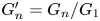 $G_n'=G_n/G_1$. Then
 $A'/G_n'$ is isomorphic to
 $A'$ for all
 $n$.
Replacing  $(A,G_n)$ by
 $(A',G_n')$, we can assume that
 $A/G_n$ is isomorphic to
 $A$ for all
 $n$.
Second, we claim that the result holds if the order of  $({\mathcal {G}}_n)_{\mathrm {red}}$ is not bounded as
 $n\to \infty$. In fact, because
 $k$ is perfect, the reduced structure of a group scheme over
 $k$ is again a group scheme; see [Reference MilneMil17, p. 157, Theorem 10.25]. As
 ${\mathcal {G}}_n$ is of constant type, we have a closed subgroup scheme
 $({\mathcal {G}}_n)_{\mathrm {red}}$ of
 ${\mathcal {G}}_n$, which is the maximal étale subgroup scheme of
 ${\mathcal {G}}_n$ over
 $S$. If the order of
 $({\mathcal {G}}_n)_{\mathrm {red}}$ is not bounded, then there are infinitely many
 $K\bar k$-points of
 $A$. This implies the
 $(K/k)$-trace of
 $A$ is non-trivial by the Lang–Néron theorem (cf. [Reference ConradCon06, Theorem 2.1]).
Third, if the order of  $({\mathcal {G}}_n^{\vee })_{\mathrm {red}}$ is not bounded as
 $n\to \infty$, then the result also holds. In fact, it suffices to note that
 $G_n^{\vee }$ is a closed subgroup scheme of
 $A^{\vee }$. Apply the above argument to
 $A^{\vee }$.
By these two steps, we can assume that both the orders of  $({\mathcal {G}}_n)_{\mathrm {red}}$ and
 $({\mathcal {G}}_n^{\vee })_{\mathrm {red}}$ are bounded. Then we can further assume that both
 $({\mathcal {G}}_n)_{\mathrm {red}}$ and
 $({\mathcal {G}}_n^{\vee })_{\mathrm {red}}$ are trivial by taking subgroup schemes. In other words,
 ${\mathcal {G}}_n$ is of local–local type in the sense that both
 ${\mathcal {G}}_n$ and
 ${\mathcal {G}}_n^{\vee }$ are supported at the identity sections.
Fourth, we prove that  ${\mathcal {A}}$ is an abelian scheme over
 $S$. Otherwise, let
 $s\in S$ be a closed point such that
 ${\mathcal {A}}_s$ is not proper over
 $s$. By assumption,
 ${\mathcal {A}}$ is semi-abelian over
 $S$, so
 ${\mathcal {A}}_s$ contains a non-trivial maximal torus
 $T$ over
 $k(s)$. Denote by
 $\phi :A\to A$ an endomorphism with kernel
 $G_n$, and assume that
 $G_n$ is non-trivial. As
 $G_n$ is of local–local type, the induced endomorphism
 $\phi _{T}:T\to T$ is injective, and thus an isomorphism. Denote by
 $P(t)$ the characteristic polynomial of
 $\phi |_T$ over the character group
 ${\mathrm {Hom}}_{\bar k(s)}(T,\mathbb {G}_m),$ which is a free
 $\mathbb {Z}$-module of finite rank. Then
 $P(0)=\pm 1$ and
 $P(\phi |_T)=0$. Consider the endomorphism
 $P(\phi ):{\mathcal {A}}\to {\mathcal {A}}$. Take a prime
 $\ell \neq p$. There is a canonical injection
 $T[\ell ^{n}](\bar k(s))\to A[\ell ^{n}](K^{s})$. The image of this injection is annihilated by
 $P(\phi )$. Thus,
 $P(\phi ):A\to A$ annihilates infinitely many points of
 $A(K^{s})$. By assumption,
 $A$ is simple and, thus,
 $P(\phi )=0$. By
 $P(0)=\pm 1$, we see that
 $\phi$ is invertible. This is a contradiction, because
 $\ker (\phi )$ is non-trivial.
The above step is the core of the argument, which appears in the proof of [Reference RösslerRos20, Theorem 2.10].
Fifth,  $A$ has a non-trivial
 $(K/k)$-trace. Take a prime
 $\ell \neq p$ as above. The scheme
 ${\mathcal {A}}[\ell ^{n}]$ is étale over
 $S$, because
 ${\mathcal {A}}$ is an abelian scheme over
 $S$. Since
 $S_{\bar {k}}=\mathbb {P}^{1}_{\bar {k}}$ has no non-trivial finite étale coverings,
 ${\mathcal {A}}[\ell ^{n}]_{\bar {k}}$ is a disjoint union of finitely many
 $\mathbb {P}^{1}_{\bar {k}}$. Each copy of
 $\mathbb {P}^{1}_{\bar {k}}$ gives a
 $K\bar {k}$-point of
 $A$. There are infinitely many such points by varying
 $n$. This implies the
 $(K/k)$-trace of
 $A$ is non-trivial by the Lang–Néron theorem again.
3. Purely inseparable points on torsors
The goal of this section is to prove Theorem 1.3. In § 3.1, we review some basic results on torsors. In § 3.2, we prove Theorem 1.3. In § 3.3, we discuss the possibility of generalizing Theorem 1.1 to more general base field  $K$.
3.1 Preliminary results on torsors
Néron model of locally trivial torsor
Let  $S$ be a Dedekind scheme and
 $K$ be its function field. Let
 $X$ be a smooth and separated scheme of finite type over
 $K$. Recall from [Reference Bosch, Lütkebohmert and RaynaudBLR90, § 1.2, Definition 1] that a Néron model
 ${\mathcal {X}}$ of
 $X$ is a smooth and separated
 $S$-scheme of finite type with a
 $K$-isomorphism
 $X\to {\mathcal {X}}_K$ satisfying the Néron mapping property that, for any smooth
 $S$-scheme
 ${\mathcal {Y}}$ and any
 $K$-morphism
 ${\mathcal {Y}}_K\to X$, there is a unique
 $S$-morphism
 ${\mathcal {Y}}\to {\mathcal {X}}$ extending the morphism
 ${\mathcal {Y}}_K\to X$. It is immediate that a Néron model is unique if it exists.
The main goal of [Reference Bosch, Lütkebohmert and RaynaudBLR90] is a complete and modern proof of the statement that any abelian variety over  $K$ admits a Néron model. Implicitly, the book contains the following result for locally trivial torsors of abelian varieties.
Theorem 3.1 Let  $A$ be an abelian variety over
 $K$ and
 $X$ be an
 $A$-torsor over
 $K$. Assume that
 $X$ is trivial over the completion
 $K_v$ of
 $K$ with respect to the discrete valuation induced by any closed point
 $v\in S$. Then
 $X$ (respectively,
 $A$) admits a unique Néron model
 ${\mathcal {X}}$ (respectively,
 ${\mathcal {A}}$) over
 $S$. Moreover, the torsor structure
 $A\times _KX\to X$ extends uniquely to an
 $S$-morphism
 ${\mathcal {A}}\times _S{\mathcal {X}}\to {\mathcal {X}}$, which makes
 ${\mathcal {X}}$ an
 ${\mathcal {A}}$-torsor.
Proof. We sketch a proof for the  ${\mathcal {X}}$-part in the following.
(1) The local Néron model exists. Namely, for any closed point  $v\in S$, the Néron model
 ${\mathcal {X}}_{O_{S,v}}$ of
 $X$ over the local ring
 $O_{S,v}$ exists. Moreover,
 ${\mathcal {X}}_{O_{S,v}}$ is a natural
 ${\mathcal {A}}_{O_{S,v}}$-torsor over
 $O_{S,v}$. It is a consequence of [Reference Bosch, Lütkebohmert and RaynaudBLR90, § 6.5, Remark 5] by taking
 $R=O_{S,v}$ and
 $R'$ to be the completion of
 $O_{S,v}$.
(2) The global Néron model  ${\mathcal {X}}$ over
 $S$ exists by patching the local ones. This follows from [Reference Bosch, Lütkebohmert and RaynaudBLR90, § 1.4, Proposition 1].
(3) The torsor structure extends to  $({\mathcal {A}}, {\mathcal {X}})$. By the Néron mapping property, the torsor structure map
 $A\times _KX\to X$ extends uniquely to a morphism
 ${\mathcal {A}} \times _S {\mathcal {X}} \to {\mathcal {X}}$. To see the later gives a torsor structure, we need to verify that the induced map
 ${\mathcal {A}} \times _S {\mathcal {X}} \to {\mathcal {X}} \times _S {\mathcal {X}}$ is an isomorphism. This is true because it is true over
 $O_{S,v}$ for every
 $v$.
We can also define Hodge bundles of Néron models of torsors. In fact, in the setting of Theorem 3.1, define the Hodge bundle associated to  $X$ to be
 \[ \bar{\Omega}_{X} =\bar{\Omega}_{{\mathcal{X}}/S} =\pi'_*\Omega_{{\mathcal{X}}/S}^{1}. \]
Here  $\pi ':{\mathcal {X}}\to S$ is the structure morphism. If
 $X=A$, this agrees with the definition of Hodge bundles of abelian varieties in § 2.2 by viewing
 $A$ as an abelian variety by Lemma 2.3.
Similar to Lemma 2.3, the natural morphism
 \[ \pi'^{*}\bar{\Omega}_{{\mathcal{X}}/S}\longrightarrow \Omega_{{\mathcal{X}}/S}^{1} \]
is an isomorphism. In fact, take a faithfully flat base change  $S'\to S$ trivializing
 ${\mathcal {X}}$. Then the map becomes an isomorphism after the base change, and it is an isomorphism before the base change by the flat descent.
The following result asserts that  $\bar {\Omega }_{X}$ is a vector bundle on
 $S$ which has very similar numerical property as
 $\bar {\Omega }_{A}$.
Lemma 3.2 Let  $\psi :S'\to S$ be a morphism such that the
 $S$-torsor
 ${\mathcal {X}}$ is trivial over
 $S'$. Then there is a natural isomorphism
 \[ \psi^{*}\bar{\Omega}_{{\mathcal{X}}/S} \longrightarrow \psi^{*}\bar{\Omega}_{{\mathcal{A}}/S} \]
of  ${\mathcal {O}}_{S'}$-modules, depending on the choice of an
 $S$-morphism
 $S'\to {\mathcal {X}}$.
Proof. Take the base change  $\psi :S'\to S$ which trivializes
 ${\mathcal {X}}$. Denote
 \[ {\mathcal{X}}'={\mathcal{X}}\times_SS', \quad {\mathcal{A}}'={\mathcal{A}}\times_SS'. \]
The base change gives a canonical section  $S'\hookrightarrow {\mathcal {X}}'$ lifting
 $S'\to {\mathcal {X}}$. Using this section, we can view the
 ${\mathcal {A}}'$-torsor
 ${\mathcal {X}}'$ as a group scheme over
 $S'$. It follows that
 \[ \psi^{*}\bar{\Omega}_{{\mathcal{X}}/S} = (\Omega_{{\mathcal{X}}/S}^{1}) |_{S'} \simeq (\Omega_{{\mathcal{X}}'/S'}^{1}) |_{S'} \simeq (\Omega_{{\mathcal{A}}'/S'}^{1}) |_{S'} \simeq \psi^{*}\bar{\Omega}_{{\mathcal{A}}/S}. \]
The result follows.
Functoriality and base change
We first present a basic result on the relative Frobenius morphism of abelian varieties. Let  $A$ be an abelian variety over a field
 $K$ of characteristic
 $p$. Consider the following two maps.
(1) (Functoriality map) The map
induced by the relative Frobenius morphism\[ H^{1}(F^{n}):H^{1}(K, A)\longrightarrow H^{1}(K, A^{(p^{n})}) \]$F^{n}:A\to A^{(p^{n})}$ via functoriality. It sends an $A$-torsor $X$ to the $A^{(p^{n})}$-torsor $X/(A[F^{n}])$, where $A[F^{n}]$ is the kernel of $F^{n}:A\to A^{(p^{n})}$.(2) (Base change map) The map
induced by the morphism\[ (F_{K}^{n})^{*}:H^{1}(K, A)\longrightarrow H^{1}(K, A^{(p^{n})}) \]$F_{K}^{n}: \operatorname {Spec} K\to \operatorname {Spec} K$ of schemes, where $A^{(p^{n})}$ is viewed as the pull-back of the étale sheaf $A$ via $F_{K}^{n}$. It sends an $A$-torsor $X$ to the $A^{(p^{n})}$-torsor $X^{(p^{n})}=X\times _K (K,F_K^{n})$.


Lemma 3.3 The above maps  $H^{1}(F^{n})$ and
 $(F_{K}^{n})^{*}$ are equal.
Proof. We first present a geometric interpretation, which can be turned to a rigorous proof. Recall the relative Frobenius morphism  $X\to X^{(p^{n})}$. The action of
 $A$ on
 $X$ induces an action of
 $A[F^{n}]$ on
 $X$. The quotient map of the latter action is exactly
 $X\to X^{(p^{n})}$.
We can also prove the result in terms of cocycles for Galois cohomology. In fact, for any torsor  $X\in H^{1}(K, A)$, take a point
 $P\in X(K^{\rm sep})$. By definition,
 $X$ is represented by the cocycle
 \[ {\mathrm{Gal}}(K^{\rm sep}/K)\longrightarrow A(K^{\rm sep}), \quad \sigma\longmapsto P^{\sigma}-P. \]
Then  $F^{n}(P)$ is a point in
 $X^{(p^{n})}$. This point gives a cocycle representing
 $X^{(p^{n})}$ by
 \[ \sigma\longmapsto F^{n}(P)^{\sigma}-F^{n}(P)=F^{n}(P^{\sigma}-P) \in A^{(p^{n})}(K^{\rm sep}), \]
which is exactly the image of  $H^{1}(F^{n})$. This proves that the maps are equal.
3.2 Purely inseparable points
In this subsection, we prove Theorem 1.3 and Corollary 1.4. For convenience, we duplicate Theorem 1.3 in the following.
Theorem 3.4 (Theorem 1.3)
Let  $S$ be a projective and smooth curve over a perfect field
 $k$ of characteristic
 $p>0$, and
 $K$ be the function field of
 $S$. Let
 $A$ be an abelian variety over
 $K$. Then the following are true.
(1) If
$S=\mathbb {P}_k^{1}$, $A$ has everywhere good reduction over $S$, and the Hodge bundle of $A$ is nef over $S$, then $\unicode{x0428}(A)[F^{\infty }]=0$.(2) If
$A$ has everywhere semi-abelian reduction over $S$ and the Hodge bundle of $A$ is ample over $S$, then $\unicode{x0428}(A)[F^{\infty }]=\unicode{x0428}(A)[F^{n_0}]$ for some positive integer $n_0$.


The corollary
Now we deduce Corollary 1.4 from Theorems 1.1 and 1.3, which is duplicated below.
Corollary 3.5 (Corollary 1.4)
Let  $S$ be a projective and smooth curve over a finite field
 $k$, and
 $K$ be the function field of
 $S$. Let
 $A$ be an abelian variety over
 $K$. Then
 $\unicode{x0428}(A)[F^{\infty }]$ is finite in each of the following cases:
(1)
$A$ is an elliptic curve over $K$;(2)
$S=\mathbb {P}_k^{1}$ and $A$ has everywhere semi-abelian reduction over $\mathbb {P}^{1}_k$;(3)
$A$ is an ordinary abelian variety over $K$, and there is a place of $K$ at which $A$ has good reduction with $p$-rank $0$.


We first prove part (1). Let  $K'$ be a finite Galois extension of
 $K$. By the inflation–restriction exact sequence, we see that the kernel of
 $\unicode{x0428}(A)\to \unicode{x0428}(A_{K'})$ is annihilated by
 $[K':K]$. This kernel is actually finite by Milne [Reference MilneMil70]. Consequently, we can replace
 $K$ by any finite Galois extension, and we can particularly assume that
 $A$ has everywhere semi-abelian reduction over
 $S$. Note that
 $\bar {\Omega }_A$ is a line bundle over
 $S$. The height
 $h(A)=\deg (\bar {\Omega }_A)\geq 0$, where the equality holds only if
 $A$ is isotrivial. This is a classical fact for elliptic curves, but we also refer to [Reference Faltings and ChaiFC90, § V.2, Propostion 2.2] (and Theorem 2.6 below) for the case of abelian varieties. If
 $h(A)\geq 0$, we can apply Theorem 1.3 to finish the proof. If
 $h(A)= 0$, then
 $A$ is isotrivial, and we can assume that
 $A$ is constant by a finite extension. Then the whole
 $\unicode{x0428}(A)$ is finite by Milne [Reference MilneMil68].
For part (3), by the above argument, we can assume that  $A$ has everywhere semi-abelian reduction over
 $S$. Then the Hodge bundle
 $\bar {\Omega }_{A}$ is ample by Rössler [Reference RösslerRos15, Theorem 1.2].
Now we prove part (2). Let  $A$ be as in Corollary 1.4. The goal is to prove that
 $\unicode{x0428}(A)[F^{\infty }]$ is finite. By Theorem 1.1, there is an isogeny
 $f:A\to A'$ with
 $A'=B\times _{K} C_{K}$, where
 $C$ is an abelian variety over
 $k$, and
 $B$ is an abelian variety over
 $K$ with an ample Hodge bundle over
 $\mathbb {P}_{k}^{1}$.
By Theorem 1.3,  $\unicode{x0428}(C_K)[F^{\infty }]=0$ and
 $\unicode{x0428}(B)[F^{\infty }]$ has a finite exponent. Then
 $\unicode{x0428}(A')[F^{\infty }]$ is annihilated by
 $p^{n_0}$ for some
 $n_0$. Taking Galois cohomology on the exact sequence
 \[ 0\longrightarrow \ker(f)[K^{s}] \longrightarrow A(K^{s}) \longrightarrow A'(K^{s}) \longrightarrow 0, \]
we see that the kernel of  $\unicode{x0428}(A)[F^{\infty }]\to \unicode{x0428}(A')[F^{\infty }]$ is annihilated by
 $\deg (f)$. Thus,
 $\unicode{x0428}(A)[F^{\infty }]$ is annihilated by
 $p^{n_0}\deg (f)$. It is finite by Milne [Reference MilneMil70] again. This proves Corollary 1.4.
Map of differentials
In the following, we prove Theorem 1.3. Our proof is inspired by an idea of Rössler [Reference RösslerRos15], which in turn comes from an idea of Kim [Reference KimKim97]. We refer back to § 1.5 for a quick idea of our proof.
We first introduce some common notation for parts (1) and (2). Fix an element  $X\in \unicode{x0428}(A)[F^{\infty }]$. Then
 $X\in \unicode{x0428}(A)[F^{n}]$ for some
 $n\geq 1$. We need to bound
 $n$ to some extent. Denote
 $K_n=K^{\frac {1}{p^{n}}}$, viewed as an extension of
 $K$. By Lemma 3.3, the base change
 $X_{K_n}$ is a trivial
 $A_{K_n}$-torsor. Therefore, the set
 $X(K_n)$ is non-empty.
Take a point of  $X(K_n)$, which gives a closed point
 $P$ of
 $X$. Denote by
 ${\mathcal {X}}$ the Néron model of
 $X$ over
 $S$. Let
 ${\mathcal {P}}_0$ be the Zariski closure of
 $P$ in
 ${\mathcal {X}}$. Let
 ${\mathcal {P}}$ be the normalization of
 ${\mathcal {P}}_0$. By definition,
 ${\mathcal {P}}$ and
 ${\mathcal {P}}_0$ are integral curves over
 $k$, endowed with quasi-finite morphisms to
 $S$.
If  $X$ is non-trivial in
 $\unicode{x0428}(A)$, then
 $P$ is not a rational point over
 $K$. It follows that the morphism
 $\psi :{\mathcal {P}}\to S$ is a non-trivial purely inseparable quasi-finite morphism over
 $k$. We are going to bound the degree of this morphism.
Start with the canonical surjection
 \[ \tau_0: (\Omega_{{\mathcal{X}}/S}^{1}) |_{{\mathcal{P}}_0} \longrightarrow \Omega_{{\mathcal{P}}_0/S}^{1}. \]
As  ${\mathcal {P}}_0$ is purely inseparable over
 $S$, we have a canonical isomorphism
 \[ \Omega_{{\mathcal{P}}_0/k}^{1}\longrightarrow \Omega_{{\mathcal{P}}_0/S}^{1}. \]
Then we rewrite  $\tau _0$ as
 \[ \tau_0: (\Omega_{{\mathcal{X}}/S}^{1}) |_{{\mathcal{P}}_0} \longrightarrow \Omega_{{\mathcal{P}}_0/k}^{1}. \]
By pull-back to the normalization  ${\mathcal {P}}\to {\mathcal {P}}_0$, we obtain a nonzero morphism
 \[ \tau: (\Omega_{{\mathcal{X}}/S}^{1}) |_{{\mathcal{P}}} \longrightarrow \Omega_{{\mathcal{P}}/k}^{1}. \]
Here the restrictions to  ${\mathcal {P}}$ really mean pull-backs, because
 ${\mathcal {P}}\to {\mathcal {X}}$ may not be an immersion but a quasi-finite morphism.
Denote by  $\psi :{\mathcal {P}}\to S$ the natural morphism. By Lemma 3.2, we have a canonical isomorphism
 \[ (\Omega_{{\mathcal{X}}/S}^{1}) |_{{\mathcal{P}}} \longrightarrow \psi^{*}\bar{\Omega}_{{\mathcal{A}}/S}. \]
Therefore, the nonzero map  $\tau$ becomes
 \[ \tau: \psi^{*}\bar{\Omega}_{{\mathcal{A}}/S} \longrightarrow \Omega_{{\mathcal{P}}/k}^{1}. \]
It is a morphism of vector bundles on  ${\mathcal {P}}$.
Proof of part (1)
With the above map  $\tau$, it is very easy to prove part (1).
In fact, by the assumption in part (1),  ${\mathcal {A}}$ is an abelian scheme over
 $S$, so
 ${\mathcal {X}}$ is proper and smooth over
 $S$. Then
 ${\mathcal {P}}_0$ and
 ${\mathcal {P}}$ are proper curves over
 $k$. In particular,
 ${\mathcal {P}}$ is a proper and regular curve over (the perfect field)
 $k$ with a finite, flat, and radicial morphism
 $\psi$ to
 $S=\mathbb {P}_k^{1}$. Thus,
 ${\mathcal {P}}$ is isomorphic to
 $\mathbb {P}_k^{1}$, under which
 $\psi$ becomes a relative Frobenius morphism.
The nonzero map  $\tau$ gives
 \[ \mu_{{\min}}\big(\psi^{*}\bar{\Omega}_{{\mathcal{A}}/S}\big) \leq \deg\big(\Omega_{{\mathcal{P}}/k}^{1}\big)={-}2. \]
By assumption,  $\bar {\Omega }_{{\mathcal {A}}/S}$ is nef, so the left-hand side is non-negative. This is a contradiction, which is originally caused by the assumption that
 $X$ is non-trivial. Part (1) is proved.
Proof of part (2)
For part (2) of Theorem 1.3, we do not have the assumption that  ${\mathcal {A}}\to S$ is proper, and thus we lose the properness of
 ${\mathcal {P}}_0$ and its normalization
 ${\mathcal {P}}$. To resolve the problem, we use a result of Rössler [Reference RösslerRos15] to ‘compactify’
 $\tau$, which is, in turn, a consequence of the degeneration theory of Faltings and Chai [Reference Faltings and ChaiFC90].
Resume the above notation. We still have a nonzero map
 \[ \tau: \psi^{*}\bar{\Omega}_{{\mathcal{A}}/S} \longrightarrow \Omega_{{\mathcal{P}}/k}^{1}. \]
Here  ${\mathcal {P}}$ is still a smooth curve over
 $k$. Denote by
 ${\mathcal {P}}^{c}$ the unique smooth compactification of
 ${\mathcal {P}}$ over
 $k$. We obtain a finite, flat, and radicial morphism
 $\psi ^{c}: {\mathcal {P}}^{c}\to S$. This is still a relative Frobenius morphism.
Denote by  $E_0$ the reduced closed subscheme of
 $S$ consisting of
 $v\in S$ such that
 ${\mathcal {A}}$ is not proper above
 $v$. Denote by
 $E$ the reduced structure of the preimage of
 $E_0$ under the map
 ${\mathcal {P}}^{c}\to S$. We have the following extension.
Proposition 3.6 The map  $\tau :\psi ^{*}\bar {\Omega }_{{\mathcal {A}}/S} \longrightarrow \Omega _{{\mathcal {P}}/k}^{1}$ extends uniquely to a nonzero map
 \[ \tau^{c}: (\psi^{c})^{*}\bar{\Omega}_{{\mathcal{A}}/S} \longrightarrow \Omega_{{\mathcal{P}}^{c}/k}^{1}(E). \]
It is easy to see how the proposition finishes proving part (2) of Theorem 1.3. As  $S$ is not assumed to be
 $\mathbb {P}^{1}$, we need to use
 $\bar {\mu }_{\rm min}$ replacing
 $\mu _{\rm min}$ for the ampleness. See the beginning of § 2.2 for a quick review of the terminology.
The proof is still similar to [Reference RösslerRos15]. In fact, the existence of the map  $\tau ^{c}$ gives
 \[ \bar{\mu}_{{\min}}\big((\psi^{c})^{*}\bar{\Omega}_{{\mathcal{A}}/S}\big) \leq \deg\big(\Omega_{{\mathcal{P}}^{c}/k}^{1}(E)\big). \]
This is just
 \[ \deg(\psi^{c})\cdot \bar{\mu}_{{\min}}(\bar{\Omega}_{{\mathcal{A}}/S}) \leq 2g-2+\deg(E_0)-2. \]
Here  $g$ is the genus of
 $S$. Note that
 $\deg (\psi ^{c})=[K(P):K]$. It follows that
 $K(P)$ is contained in
 $K_{n_0}$, where
 $n_0$ is the largest integer satisfying
 \[ p^{n_0}\cdot \bar{\mu}_{{\min}}(\bar{\Omega}_{{\mathcal{A}}/S}) \leq 2g-2+\deg(E_0)-2. \]
By Barton [Reference BartonBar71, Theorem 2.1],  $\bar {\mu }_{\rm min}(\bar {\Omega }_{{\mathcal {A}}/S})>0$ since
 $\bar {\Omega }_{{\mathcal {A}}/S}$ is ample. This gives an upper bound of
 $n_0$. This gives part (2) of the theorem.
Proof of the extension
Now we prove Proposition 3.6. The uniqueness is trivial. For the existence, note that the map can be extended as
 \[ (\psi^{c})^{*}\bar{\Omega}_{{\mathcal{A}}/S} \longrightarrow \Omega_{{\mathcal{P}}^{c}/k}^{1}(mE) \]
for sufficiently large integers  $m$. The multiplicity
 $m$ represents the order of poles allowed along
 $E$, and the case
 $m=1$ is exactly the case of log-differentials. Our proof takes a lot of steps of reductions.
To control the poles, it suffices to verify the result locally, i.e. we can replace  $S$ by its completion at a point in
 $E$, and replace everything else in the maps by its corresponding base change. To avoid overwhelming notation, we still use the original notation, but note that we are in the local situation. As a consequence (of assuming this local situation),
 $X$ is a trivial torsor, so we assume that
 $X=A$ and
 ${\mathcal {X}}={\mathcal {A}}$. As we have the trivial torsor, our situation is very similar to the situation of Rössler [Reference RösslerRos15].
Lemma 3.7 (Rössler) Assume further that  $A$ has a principal polarization and
 $A(\bar K)[n]\subset A(K)$ for some
 $n>2$ coprime to
 $p$. Then the map
 $\gamma$ extends to a map
 \[ \gamma^{c}: (\psi^{c})^{*}\bar{\Omega}_{{\mathcal{A}}} \longrightarrow \Omega_{{\mathcal{P}}^{c}/k}^{1}(E). \]
Proof. This is essentially [Reference RösslerRos15, Lemma 2.1], except that we are in the local case, but it does not make any essential difference in the proof. The extension is obtained by applying the compactification result of [Reference Faltings and ChaiFC90]. For the convenience of readers, we sketch the proof here.
Denote  $U=S-E_0$. Then
 ${\mathcal {A}}$ is proper over
 $U$. As
 $S$ is the spectrum of a complete discrete valuation ring by our assumption, the essential case is that
 $E_0$ is the closed point of
 $S$ and
 $U$ is the generic point of
 $S$. The key is that the abelian scheme
 $\pi _U:{\mathcal {A}}_U\to U$ has a compactification over
 $S$, which consists of a regular integral scheme
 ${\mathcal {V}}$ containing
 ${\mathcal {A}}_U$ as an open subscheme and a proper morphism
 $\bar {\pi }:{\mathcal {V}}\to S$ extending
 $\pi _U:{\mathcal {A}}_U\to U$. The complement
 $D={\mathcal {V}}-{\mathcal {A}}_U$ is a divisor with normal crossings with respect to
 $k$. Moreover, the log-differential sheaf
 \[ \Omega_{{\mathcal{V}}/S}^{1}(\log D/E_0):=\Omega_{{\mathcal{V}}/k}^{1}(\log D)/\bar{\pi}^{*} \Omega_{S/k}^{1}(\log E_0) \]
is locally free on  ${\mathcal {V}}$ and satisfies
 \[ \Omega_{{\mathcal{V}}/S}^{1}(\log D/E_0)=\bar{\pi}^{*} \bar{\Omega}_{{\mathcal{A}}}, \quad \bar{\pi}_*\Omega_{{\mathcal{V}}/S}^{1}(\log D/E_0)=\bar{\Omega}_{{\mathcal{A}}}. \]
This result is a consequence of [Reference Faltings and ChaiFC90, Chapter VI, Theorem 1.1], which actually constructs a compactification  $\bar A_{g,N}$ of the moduli space
 $A_{g,N}$ of principally polarized abelian varieties of dimensions
 $g$ with full
 $N$-level structures and its universal abelian variety. The pull-back of the compactification of the universal abelian variety via the map
 $S\to \bar A_{g,N}$ (representing the family
 ${\mathcal {A}}\to S$) gives the compactification
 ${\mathcal {V}}$ in our notation.
With the compactification, take  ${\mathcal {R}}$ to be the closure of
 $P$ in
 ${\mathcal {V}}$. There is a natural finite map
 $\delta :{\mathcal {P}}^{c}\to {\mathcal {R}}$, which is just the normalization of
 ${\mathcal {R}}$. Then, we have well-defined maps
 \[ \delta^{*}(\Omega_{{\mathcal{V}}/S}^{1}|_{\mathcal{R}}) \longrightarrow \delta^{*}\Omega_{{\mathcal{R}}/k}^{1} \longrightarrow \Omega_{{\mathcal{P}}^{c}/k}^{1}. \]
Note that the pull-back of a log-differential is still a log-differential. The log-version of the above composition give a map
 \[ \delta^{*}(\Omega_{{\mathcal{V}}/S}^{1}(\log D/E_0)|_{\mathcal{R}}) \longrightarrow \Omega_{{\mathcal{P}}^{c}/k}^{1}(\log E). \]
By the above property of  $\Omega _{{\mathcal {V}}/S}^{1}(\log D/E_0)$, it becomes
 \[ (\psi^{c})^{*}\bar{\Omega}_{{\mathcal{A}}} \longrightarrow \Omega_{{\mathcal{P}}^{c}/k}^{1}(\log E). \]
This is exactly the extension we want.
Polarization and level structure
We return to the proof of Proposition 3.6. It remains to add a polarization and a level structure to  $A$.
We first take care of the polarization. By Zarhin's trick,  $A^{*}=(A\times A^{t})^{4}$ has a principal polarization (cf. [Reference ZarhinZar77] or [Reference Moret-BaillyMor85, IX, Lemma 1.1]). Write
 $A^{*}=A\times A^{3}\times (A^{t})^{4}$. Extend the closed point
 $P\in A$ to be the point
 $P^{*}=(P, 0^{3}, 0^{4})$ in
 $A^{*}$. Note that
 $\bar {\Omega }_{A^{*}}=\bar {\Omega }_{A}\oplus (\bar {\Omega }_{A})^{3}\oplus (\bar {\Omega }_{A^{t}})^{4}$, and that
 $A^{*}$ has the same set of places of bad reduction as
 $A$. The solution of the analogous problem for the version
 $(A^{*}, P^{*})$ implies that of
 $(A, P)$. Hence, we can assume that
 $A$ is principally polarized.
In order to get a level structure, we need a descent argument. Let  $S'\to S$ be a finite, flat, and tamely ramified Galois morphism. Take this morphism to do a base change, and denote by
 $(S', {\mathcal {P}}', \psi ')$ the base changes of
 $(S, {\mathcal {P}}, \psi )$. Denote by
 $E'$ the reduced structure of the preimage of
 $E$ in
 ${\mathcal {P}}'^{c}$, which is just a point in the local setting. Suppose that we have a well-defined extension over
 $S'$ of the corresponding map
 $\gamma '$, which should take the form
 \[ \gamma'^{c}: (\psi'^{c})^{*}\bar{\Omega}_{{\mathcal{A}}} \longrightarrow \Omega_{{\mathcal{P}}'^{c}/k}^{1}(E'). \]
Note that the pull-back of  $\Omega _{{\mathcal {P}}^{c}/k}^{1}(E)$ to
 ${\mathcal {P}}'^{c}$ is exactly
 $\Omega _{{\mathcal {P}}'^{c}/k}^{1}(E')$ by considering the ramification index. Taking the Galois invariants on both sides of
 $\gamma '^{c}$, we get exactly the desired map
 $\gamma ^{c}$ on
 ${\mathcal {P}}^{c}$.
Finally, we can put a level structure on  $A$. Take a prime
 $\ell \nmid (2p)$. Let
 $K'=K(A[\ell ])$ be the field of definition of all
 $\ell$-torsions of
 $A$. Let
 $S'$ be the integral closure of
 $S$ in
 $K'$. We are going to take the base change
 $S'\to S$. The only thing left to check is that
 $K'$ is tamely ramified over
 $K$. This is a well-known result proved by Grothendieck under the conditions that
 $p\neq \ell$ and
 $A$ has semi-abelian reduction. In fact, the wild inertia group
 $I^{\rm w}\subset {\mathrm {Gal}}(K^{\rm sep}/K)$ is a pro-
 $p$ group. By [Reference Deligne and KatzSGA7, Exp. IX, Proposition 3.5.2], the action of
 $I^{\rm w}$ on the Tate module
 $T_\ell (A)$ is trivial. In other words, any point of
 $A(K^{\rm sep})[\ell ^{\infty }]$ is defined over the maximal tamely ramified extension of
 $K$. This finishes the proof of Proposition 3.6.
3.3 More general base fields
This subsection consists of some discussions about whether Theorem 1.1 and other related results hold for more general base fields  $K/k$. The results are as follows.
(1) If
$K=k(t)$ and $k$ is any field of positive characteristic, we conjecture that the theorem still holds. We reduce it to a question about $p$-divisible groups.(2) If
$K/k$ is a general global function field, we come up with counterexamples of the theorem using abelian varieties of $p$-rank 0.


Case of $K=k(t)$ with general $k$


Our proof of Theorem 1.1 relies on the assumption that  $k$ is a finite field. Now we speculate a little to see what is needed to generalize the proof to
 $K=k(t)$ for a general field
 $k$ of characteristic
 $p>0$.
Suppose  $k$ is any field of characteristic
 $p>0$ in Theorem 1.1. At the beginning, apply the Lefschetz principle to
 $A/K/k$, so we can assume that
 $k$ is finitely generated over
 $\mathbb {F}_p$. The arguments in §§ 2.1, 2.2, and 2.3 work well for general
 $k$ (and, thus, for finitely generated
 $k$). To finish the proof, we hope that Proposition 2.10 holds for any finitely generated field
 $k$ of characteristic
 $p$. The same argument still gives a nonzero
 $p$-divisible group
 $H_{\infty }$ over
 $k$, such that
 \[ {\mathrm{Hom}}_k(H_{\infty}, C[p^{\infty}])\neq 0,\quad {\mathrm{Hom}}_K(H_{\infty,K}, A[p^{\infty}])\neq 0. \]
Here  $C={\mathcal {A}}_s$ is an abelian variety over
 $k$ as before. Therefore, the proof will be complete if we have a positive answer to the following question.
Question 3.8 Let  $K$ be a finitely generated field over a finite field
 $\mathbb {F}_p$. Let
 $A$ and
 $B$ be abelian varieties over
 $K$. Assume that there is a nonzero
 $p$-divisible group
 $H$ over
 $K$ such that
 \[ {\mathrm{Hom}}_K(H, A[p^{\infty}])\neq 0,\quad {\mathrm{Hom}}_K(H, B[p^{\infty}])\neq 0. \]
Do we always have
 \[ {\mathrm{Hom}}_K(A,B)\neq 0? \]
If  $k$ is a finite field, the problem is solved by Theorems 2.14 and 2.13. However, Theorem 2.14 fails for finitely generated fields
 $k$. In fact, one can check that, for an ordinary elliptic curve
 $A$ over a global function field
 $K$ with a place of multiplicative reduction, the local-étale exact sequence
 \[ 0\longrightarrow A[p^{\infty}]^{0}\longrightarrow A[p^{\infty}]\longrightarrow A[p^{\infty}]^{\rm et}\longrightarrow 0 \]
does not split up to isogeny.
Case of global function field $K$

For an abelian variety  $A$ over a field
 $K$ of characteristic
 $p>0$, the integer
 $r=\dim _{\mathbb {F}_p} (A(\bar K)[p])$ is called the
 $p$-rank of
 $A$. It is known that
 $0\leq r\leq \dim (A)$, and we are concerned with the case
 $r=0$. The goal here is the following result.
Theorem 3.9 Let  $S$ be a projective and smooth curve over a finite field
 $k$ of characteristic
 $p>0$, and
 $K$ be the function field of
 $S$. Let
 $A$ be an abelian over
 $K$ with
 $p$-rank 0, trivial
 $(K/k)$-trace, and semi-abelian reduction over
 $S$. Then, the Hodge bundle of
 $A$ is not ample over
 $S$.
As the property of having  $p$-rank 0, trivial
 $(K/k)$-trace, and semi-abelian reduction is preserved under isogeny, we see that
 $A/K$ does not satisfy Theorem 1.1.
An interesting fact is that abelian varieties with  $p$-rank 0 over a global function field (or the fraction field of a DVR containing
 $\mathbb {F}_p$) always have potentially good reduction. This fact can be seen in the proof of [Reference OortOor74, Theorem 1.1(a)]. Thus, the ‘semi-abelian reduction’ in the theorem is actually ‘good reduction’.
Before proving the theorem, let us note that there are ‘plenty of’  $A/K$ satisfying the conditions of the theorem. In fact, denote by
 $A_{g,N}$ the moduli space of principally polarized abelian varieties over
 $\mathbb {F}_p$ with a level-
 $N$ structure. Here
 $N\geq 3$ is not divisible by
 $p$. It is well-known that
 $\dim (A_{g,N})=g(g+1)/2$. Denote by
 $V_{g,N}$ the subset of points of
 $A_{g,N}$ representing abelian varieties of
 $p$-rank 0. It is known that
 $V_{g,N}$ is a projective and geometrically irreducible closed subscheme of
 $A_{g,N}$ with codimension
 $g$. This is a combination of [Reference OortOor74, Theorem 1.1], [Reference KoblitzKob75, IV, Theorem 7], [Reference ChaiCha05, Remark 4.7], and [Reference OortOor03, Theorem 1.5]. Take any two
 $\bar {\mathbb {F}}_p$-points of
 $V_{g,N}$ representing non-isogenous abelian varieties. This can be achieved by taking two points of different Newton polygons, whose existence is guaranteed by the dimension formula of Newton polygon stratum in [Reference OortOor00, Theorem 3.2]. Take any closed curve in
 $V_{g,N}$ connecting these two points. This curve is actually defined over a finite field
 $k$. Take the function field
 $K$ of the curve over
 $k$, and the universal abelian variety of
 $A_{g,N}$ induces an abelian variety
 $A$ over
 $K$. If
 $A$ has non-trivial
 $(K/k)$-trace, we can replace it by its quotient by the trace part. Then
 $A/K$ is an example of the theorem.
Now we prove Theorem 3.9. Assume that  $(k,S,K,A)$ satisfies the condition of the theorem, but fails the conclusion of the theorem. Namely,
 $A$ is an abelian over
 $K$ with
 $p$-rank 0, trivial
 $(K/k)$-trace, semi-abelian reduction, and ample Hodge bundle over
 $S$. We obtain a contradiction. By the Lang–Néron theorem (cf. [Reference ConradCon06, Theorem 2.1]), the abelian group
 $A(K)$ is finitely generated. Replacing
 $K$ by a finite extension if necessary, we can assume that
 $A(K)$ has a positive rank. The key is to apply Rössler [Reference RösslerRos15, Theorem 1.1], which is the prototype of Theorem 1.2. We see that
 $A(K^{\rm per})=A(K^{1/p^{n}})$ for sufficiently large
 $n$. Replacing
 $K$ by such a
 $K^{1/p^{n}}$ if necessary, we can assume that
 $A(K^{\rm per})=A(K)$. Now we claim that the map
 $[p]:A(K)\to A(K)$ is surjective. In fact, for any point
 $P\in A(K)$, consider the inverse image
 $[p]^{-1}P$ in
 $A$, viewed as a zero-dimensional closed subscheme of
 $A$. As
 $A$ has
 $p$-rank 0, the morphism
 $[p]:A\to A$ is purely inseparable, and thus the induced map
 $[p]^{-1}P\to P$ is radicial. Consequently, the reduced structure
 $Q$ of
 $[p]^{-1}P$ is purely inseparable over
 $P$. Then
 $Q$ corresponds to a point of
 $A(K^{\rm per})$. By the result above, we have
 $Q\in A(K)$, which is a preimage of
 $P$ under
 $[p]:A(K)\to A(K)$. This proves that
 $[p]:A(K)\to A(K)$ is surjective. Then we have a contradiction as we have assumed that
 $A(K)$ has a positive rank.
Tate–Shafarevich group of abelian varieties of $p$-rank 0

For abelian varieties of  $p$-rank 0, we have the following interesting result.
Proposition 3.10 Let  $K$ be a field of characteristic
 $p>0$, and let
 $A$ be an abelian variety of
 $p$-rank 0 over
 $K$. Then
 $H^{1}(K,A)[F^{\infty }]=H^{1}(K,A)[p^{\infty }]$. Therefore, if
 $K$ is a global function field, then
 $\unicode{x0428}(A)[F^{\infty }]=\unicode{x0428}(A)[p^{\infty }]$.
As mentioned in the introduction,  $H^{1}(K,A)[F^{n}]\subset H^{1}(K,A)[p^{n}]$, because
 $F^{n}:A\to A^{(p^{n})}$ is a factor of
 $[p^{n}]:A\to A$. This gives
 $H^{1}(K,A)[F^{\infty }]\subset H^{1}(K,A)[p^{\infty }]$. The other direction of the inclusion is a consequence of the following result.
Lemma 3.11 Let  $K$ be a field of characteristic
 $p>0$, and let
 $A$ be an abelian variety of
 $p$-rank 0 over
 $K$. Then for any positive integer
 $n$, there is a positive integer
 $m$ such that
 $F^{m}:A\to A^{(p^{m})}$ factorizes through
 $[p^{n}]:A\to A$.
Proof. View  $[p^{n}]:A\to A$ as the quotient map of
 $A$ by
 $A[p^{n}]$. It suffices to find
 $m$ such that
 $F^{m}:A\to A^{(p^{m})}$ annihilates
 $A[p^{n}]$ or, equivalently, the restriction
 $(F^{m})|_{A[p^{n}]}:A[p^{n}]\to A^{(p^{m})}[p^{n}]$ is the zero map. Note that
 $A^{(p^{m})}[p^{n}]\simeq (A[p^{n}])^{(p^{m})}$. Then
 $(F^{m})|_{A[p^{n}]}:A[p^{n}]\to A^{(p^{m})}[p^{n}]$ is just the relative Frobenius morphism
 $F^{m}:G\to G^{(p^{m})}$. Here we denote
 $G=A[p^{n}]$.
As  $A$ has
 $p$-rank 0, the group scheme
 $G$ is non-reduced and supported at the identity point. Denote
 $G=\operatorname {Spec}(R)$, and denote by
 $I$ the defining ideal of the identity section. By the identity section, we have a splitting
 $R=K+I$ as vector spaces over
 $K$. Let
 $m$ be an integer such that
 $I^{p^{m}}=0$. We check that
 $F^{m}:G\to G^{(p^{m})}$ is zero.
To avoid confusion, write  $K\to K'$ for the absolute Frobenius map of
 $K$, so
 $F^{m}:G\to G^{(p^{m})}$ is viewed as a morphism over
 $\operatorname {Spec}(K')$. Then
 $G^{(p^{m})}=\operatorname {Spec}(R\otimes _K K')$ and the morphism
 $F^{m}:G\to G^{(p^{m})}$ corresponds to the homomorphism
 \[ f:R\otimes_K K' \to R,\quad x\otimes a\longmapsto ax^{p^{m}}. \]
This gives  $f(I\otimes _K K')=0$. Then
 $f$ factorizes through the quotient map
 $R\otimes _K K'\to K'$. In terms of schemes,
 $F^{m}:G\to G^{(p^{m})}$ factorizes through the identity point
 $\operatorname {Spec}(K')\to G^{(p^{m})}$, and thus it is zero.
4. Variation of the Tate conjecture
The goal of this section is to prove Theorem 1.6. The idea of the proof is sketched in § 1.5. In § 4.1, we introduce some preliminary results to be used later. In § 4.2, we prove Theorem 1.6.
4.1 Preliminary results
The goal of this subsection is to review some basics of the BSD conjecture, and introduce its equivalence with the Tate conjecture as in the work of Artin–Tate. We also introduce a result about projective regular models of abelian varieties as a consequence of the works of Mumford, Faltings and Chai, and Kunnëmann.
The BSD conjecture
The prestigious BSD conjecture over global fields is as follows.
Conjecture 4.1 (BSD conjecture:  $\textit{BSD}(A)$)
Let  $A$ be an abelian variety over a global field
 $K$. Then
 \[ {\mathrm{ord}}_{s=1}L(A,s)={\mathrm{rank}}\, A(K). \]
Recall that the global L-function
 \[ L(A,s)=\prod_v L_v(A,s) \]
is the product over all non-archimedean places  $v$ of
 $K$, where the local L-function
 \[ L_v(A,s)=\det(1-q_v^{{-}s}\mathrm{Frob}(v)|V_\ell(A)^{I_v})^{{-}1}. \]
Here  $q_v$ is the order of the residue field of
 $v$,
 $\mathrm {Frob}(v)$ is a Frobenius element of
 $v$ in
 ${\mathrm {Gal}}(K^{s}/K)$,
 $I_v$ is the inertia subgroup of
 $v$ in
 ${\mathrm {Gal}}(K^{s}/K)$,
 $\ell$ is any prime number different from the residue characteristic of
 $v$, and
 $V_\ell (A)$ is the
 $\ell$-adic Tate module of
 $A$.
In this paper, we are only interested in the case that  $K$ is a global function field. In this case,
 $L(A,s)$ is known to be a rational function of
 $q^{-s}$, where
 $q$ is the order of the largest finite field contained in
 $K$; see [Reference MilneMil80, VI, Example 13.6(a)] for example. The abelian group
 $A(K)$ is finitely generated by the Lang–Néron theorem, as in [Reference ConradCon06, Theorem 2.1]. Moreover, in this case, we always know
 \[ {\mathrm{ord}}_{s=1}L(A,s)\geq {\mathrm{rank}}\, A(K) \]
by the works [Reference TateTat95, Reference BauerBau92], as a consequence of the comparison with the Tate conjecture which is reviewed in the following.
We need the following results, which can be checked by treating both sides of the BSD conjecture.
Lemma 4.2
(1) Let
$A$ and $B$ be isogenous abelian varieties over a global function field. Then the BSD conjecture holds for $A$ if and only if the BSD conjecture holds for $B$.(2) Let
$A$ and $B$ be any abelian varieties over a global function field. Then the BSD conjecture holds for $A\times B$ if and only if the BSD conjecture holds for both $A$ and $B$.


Tate conjecture versus BSD conjecture
The bridge between the Tate conjecture and the BSD conjecture is via fibrations of surfaces. Recall that the Tate conjecture  $T^{1}(X)$ (cf. Conjecture 1.5) for a projective and smooth surface
 $X$ over a finite field
 $k$ asserts that for any prime
 $\ell \neq p$, the cycle class map
 \[ \mathrm{Pic}(X)\otimes_\mathbb{Z} \mathbb{Q}_p \longrightarrow H^{2}(X_{\bar k}, \mathbb{Q}_\ell(1))^{{\mathrm{Gal}}(\bar k/k)} \]
is surjective.
By a fibered surface over a field  $k$, we mean a projective and flat morphism
 $\pi :X\to S$, where
 $S$ is a projective and smooth curve over
 $k$ and
 $X$ is a projective and smooth surface over
 $k$, such that the generic fiber of
 $X\to S$ is smooth.
Then we have the following beautiful result of Artin and Tate.
Theorem 4.3 (Artin–Tate) Let  $\pi :X\to S$ be a fibered surface over a finite field
 $k$. Denote by
 $J$ the Jacobian variety of the generic fiber of
 $\pi$. Then
 $T^{1}(X)$ is equivalent to
 $\textit{BSD}(J)$.
This equivalence is part of [Reference TateTat95, § 4, (d)], which actually treats equivalence of the refined forms of the conjectures; see also [Reference UlmerUlm14] for a nice exposition of the theorem. For further results related to this equivalence, including results about the Tate–Shafarevich group and the Brauer group, we refer to [Reference TateTat95, Reference MilneMil75, Reference BauerBau92, Reference SchneiderSch82, Reference Kato and TrihanKT03].
For a projective and smooth surface  $X$, to convert it into a fibered surface, one usually needs to blow-up
 $X$ along a smooth center. The following result asserts that this process does not change the Tate conjecture.
Lemma 4.4 Let  $X'\to X$ be a birational morphism of projective and smooth surfaces over a finite field. Then
 $T^{1}(X)$ is equivalent to
 $T^{1}(X')$.
This can be checked by directly describing the change of both sides of the conjectures.
With a little extra work (cf. [Reference Trihan and YasudaTY14, Theorem 5.5]), the above results imply that  $T^{1}(X)$ for all projective and smooth surfaces
 $X$ over finite fields is equivalent to
 $\textit{BSD}(A)$ for all abelian varieties
 $A$ over global function fields.
Projective regular integral models of abelian varieties
The following result asserts that we have well-behaved regular projective models of abelian varieties with semi-abelian reduction.
Theorem 4.5 Let  $S$ be a connected Dedekind scheme with generic point
 $\eta$, and let
 $A$ be an abelian variety over
 $\eta$ with semi-abelian reduction over
 $S$. Then there is a projective, flat, and regular integral model
 $\psi :{\mathcal {P}}\to S$ of
 $A$ over
 $S$ such that there is a canonical
 ${\mathcal {O}}_S$-linear isomorphism
 \[ R^{1}\psi_* {\mathcal{O}}_{\mathcal{P}} \longrightarrow {\mathrm{Lie}}({\mathcal{A}}^{{\vee}}/S). \]
Here  ${\mathcal {A}}^{\vee }$ is the Néron model over
 $S$ of the dual abelian variety
 $A^{\vee }$ of
 $A$.
Proof. This follows from the theory of degeneration of abelian varieties of Mumford [Reference MumfordMum72] and Faltings and Chai [Reference Faltings and ChaiFC90]. In particular, by the exposition of Künnemann [Reference KünnemannKun98], the degeneration theory gives an explicit compactification of a semi-abelian scheme from a reasonable rational polyhedral cone decomposition. For the purpose of our theorem, choose  ${\mathcal {P}}$ to be the integral model constructed in [Reference KünnemannKun98, Theorem 4.2]. We claim that it automatically satisfies the property of the cohomology. Note that we have a canonical isomorphism
 $H^{1}(A, {\mathcal {O}}_A)\to {\mathrm {Lie}}(A^{\vee }/\eta )$, as expressions of the tangent space of the Picard functor
 $\underline {\mathrm {Pic}}_{A/\eta }$. Then it remains to prove that this isomorphism extends to the integral version over
 $S$. This essentially follows from the special case
 $(s,a,b)=(1,1,0)$ of [Reference Faltings and ChaiFC90, Chapter VI, Theorem 1.1(iv)], which is proved in § VI.2 of [Reference Faltings and ChaiFC90]. We can check literally that their proof works in our case. Alternatively, we introduce a different approach in the following.
First, the truth of our isomorphism does not depend on the choice of the rational polyhedral cone decomposition, as mentioned at the beginning of page 209 in [Reference Faltings and ChaiFC90]. Second, the isomorphism  $R^{1}\bar {f}_* {\mathcal {O}}_{\bar {Y}} \to {\mathrm {Lie}}(G/\bar {X})$ of [Reference Faltings and ChaiFC90, Chapter VI, Theorem 1.1(iv)] is compatible with base change by any morphism
 $Z\to \bar {X}$. In other words, the map
 $\bar {f}$ is cohomologically flat in dimension one. In fact, by the semi-continuity theorem, this holds if
 $h^{1}(Y_s, {\mathcal {O}}_{Y_s})$ is constant in
 $s\in \bar {X}$, which can be seen from their proof. Once we have the cohomological flatness, our result holds if
 $A$ is principally polarized. In fact, take a level structure by extending
 $S$ if necessary, and then we have a map
 $S\to \bar {X}$ by the moduli property. Then the pull-back of
 $R^{1}\bar f_* {\mathcal {O}}_{\bar {Y}} \to {\mathrm {Lie}}(G/\bar {X})$ to
 $S$ gives the isomorphism we need. Finally, if
 $A$ does not have a principal polarization, we can apply Zarhin's trick as in our treatment of Proposition 3.6.
4.2 Variation of the Tate conjecture
Now we prove Theorem 1.6. Let  $X$ be a projective and smooth surface over
 $k$. We convert
 $T^{1}(X)$ into
 $T^{1}({\mathcal {Y}})$ for some projective and smooth surface
 ${\mathcal {Y}}$ over
 $k$ with
 $H^{1}({\mathcal {Y}}, {\mathcal {O}}_{\mathcal {Y}})=0$.
Step 1: Make a fibration
By Nguyen [Reference NguyenNgu05], there is a Lefschetz pencil in  $X$ over the finite field
 $k$. This is a version over finite field of the existence of Lefschetz pencils in [Reference Deligne and KatzSGA7, Exp. XVII, § 3]. Blowing-up
 $X$ along the base locus of the Lefschetz pencil, we get a birational morphism
 $X'\to X$ and a fibered surface
 $\pi :X'\to S$ with
 $S=\mathbb {P}^{1}_k$. Here
 $X'$ is smooth over
 $k$ as the base locus is reduced. Denote by
 $J$ the Jacobian variety of the generic fiber of
 $\pi :X'\to S$, which is an abelian variety over
 $K=k(t)$.
As  $\pi$ is semistable,
 $J$ has semi-abelian reduction over
 $S=\mathbb {P}_k^{1}$. In fact, by [Reference Bosch, Lütkebohmert and RaynaudBLR90, § 9.5, Theorem 4(b)], the Picard functor
 $\underline {\mathrm {Pic}}_{X'/S}^{0}$ is isomorphic to the relative identity component of the Néron model of
 $J$. By [Reference Bosch, Lütkebohmert and RaynaudBLR90, § 9.2, Proposition 10],
 $\underline {\mathrm {Pic}}_{X'_s/s}^{0}$ is semi-abelian for any closed point
 $s\in S$.
By Lemma 4.4,  $T^{1}(X)$ is equivalent to
 $T^{1}(X')$. By Theorem 4.3,
 $T^{1}(X')$ is equivalent to
 $\textit{BSD}(J)$.
Step 2: Make the Hodge bundle positive
We prove that  $\textit{BSD}(J)$ is equivalent to
 $\textit{BSD}(A)$ for an abelian variety
 $A$ over
 $K$ with everywhere semi-abelian reduction and with an ample Hodge bundle over
 $S$.
Apply Theorem 1.1 to  $J$. Then
 $J$ is isogenous to
 $A\times _{K} C_{K}$, where
 $C$ is an abelian variety over
 $k$, and
 $A$ is an abelian variety over
 $K$ with an ample Hodge bundle over
 $S$. Note that
 $A$ also has semi-abelian reduction by [Reference Bosch, Lütkebohmert and RaynaudBLR90, § 7.3, Corollary 7]. By Lemma 4.2,
 $\textit{BSD}(J)$ is equivalent to the simultaneous truth of
 $\textit{BSD}(A)$ and
 $\textit{BSD}(C_K)$.
By [Reference MilneMil68],  $\textit{BSD}(C_K)$ holds unconditionally. Alternatively, in the current case of
 $K=k(t)$, it is easy to prove that both sides of the BSD conjecture is zero. For the Mordell–Weil rank, we have
 \[ C_K(K)={\mathrm{Hom}}_S(S,C_S)={\mathrm{Hom}}_k(S,C)=C(k) \]
is finite. For the L-function, one can also have an explicit expression in terms of the eigenvalues of the Frobenius acting on the Tate module of  $C$.
Therefore,  $\textit{BSD}(J)$ is equivalent to
 $\textit{BSD}(A)$.
Step 3: Take projective regular model
Let  $\psi :{\mathcal {P}}\to S$ be a projective, flat, and regular integral model of
 $A^{\vee }$ over
 $S$ as in Theorem 4.5. In particular, we have a canonical isomorphism
 \[ R^{1}\psi_* {\mathcal{O}}_{\mathcal{P}}\longrightarrow {\mathrm{Lie}}({\mathcal{A}}/S). \]
Here  ${\mathcal {A}}$ is the Néron model of
 $A$ over
 $S$. Then the dual of
 $R^{1}\psi _* {\mathcal {O}}_{\mathcal {P}}$ is isomorphic to the Hodge bundle of
 $A$, which is ample by construction.
By the Leray spectral sequence for  $\psi :{\mathcal {P}}\to S$, we have an exact sequence
 \[ 0\longrightarrow H^{1}(S, {\mathcal{O}}_S) \longrightarrow H^{1}({\mathcal{P}}, {\mathcal{O}}_{\mathcal{P}}) \longrightarrow H^{0}(S, R^{1}\psi_* {\mathcal{O}}_{\mathcal{P}})\longrightarrow 0. \]
The term  $H^{0}(S, R^{1}\psi _* {\mathcal {O}}_{\mathcal {P}})$ vanishes by the ampleness of the dual of
 $R^{1}\psi _* {\mathcal {O}}_{\mathcal {P}}$. Therefore, we end up with
 $H^{1}({\mathcal {P}}, {\mathcal {O}}_{\mathcal {P}})=0.$
Step 4: Take a surface in the regular model
Note that  ${\mathcal {P}}$ is a projective and smooth variety over
 $k$ with
 $H^{1}({\mathcal {P}}, {\mathcal {O}}_{\mathcal {P}})=0$. We claim that there is a projective and smooth
 $k$-surface
 ${\mathcal {Y}}$ in
 ${\mathcal {P}}$ satisfying the following conditions:
(1)
$H^{1}({\mathcal {Y}}, {\mathcal {O}}_{\mathcal {Y}})=0$;(2) the canonical map
$H^{1}({\mathcal {P}}_\eta , {\mathcal {O}}_{{\mathcal {P}}_\eta })\to H^{1}({\mathcal {Y}}_\eta , {\mathcal {O}}_{{\mathcal {Y}}_\eta })$ is injective;(3) the generic fiber
${\mathcal {Y}}_\eta$ of ${\mathcal {Y}}\to S$ is smooth.


Here  $\eta$ is the generic point of
 $S$.
This is a consequence of the Bertini-type theorem of Poonen [Reference PoonenPoo04]. By induction on the codimension of  ${\mathcal {Y}}$ in
 ${\mathcal {P}}$, it suffices to prove that there is a smooth hyperplane section
 ${\mathcal {Y}}$ of
 ${\mathcal {P}}$ satisfying condition (3), because conditions (1) and (2) are automatic. For example, condition (1) follows from the vanishing of
 $H^{2}({\mathcal {P}},{\mathcal {O}}(-{\mathcal {Y}}))$, which holds if
 ${\mathcal {Y}}$ is sufficiently ample. To achieve condition (3), it suffices to make the closed fiber
 ${\mathcal {Y}}_s$ smooth over
 $s$ for some closed point
 $s\in S$ such that
 ${\mathcal {P}}_s$ is smooth. Take a very ample line bundle
 ${\mathcal {L}}$ over
 ${\mathcal {P}}$ such that
 $H^{0}({\mathcal {P}},{\mathcal {L}})\to H^{0}({\mathcal {P}}_s,{\mathcal {L}}_s)$ is surjective. The complete linear series of
 ${\mathcal {L}}$ defines a closed immersion
 ${\mathcal {P}}\to \mathbb {P}_k^{N}$. Denote
 $\Sigma _d=H^{0}(\mathbb {P}_k^{N}, {\mathcal {O}}_{\mathbb {P}_k^{N}}(d))$, and denote by
 $\Sigma$ the disjoint union of
 $\Sigma _d$ for all
 $d\geq 1$. Denote
 $m=\dim {\mathcal {P}}$. By Poonen [Reference PoonenPoo04, Theorem 1.1], we have the following results.
(a) The density of
$f\in \Sigma$ such that ${\mathrm {div}}(f)\cap {\mathcal {P}}$ is smooth over $k$ is $\zeta _{{\mathcal {P}}}(m+1)^{-1}$.(b) The density of
$f\in \Sigma$ such that ${\mathrm {div}}(f)\cap {\mathcal {P}}_s$ is smooth over $s$ is $\zeta _{{\mathcal {P}}_s}(m)^{-1}$.


We claim that  $\zeta _{{\mathcal {P}}_s}(m)$ goes to 1 as
 $[k(s):s]$ goes to infinity. In fact, this is easily seen by the Riemann hypothesis proved by Weil. As a consequence, we can choose
 $s\in S$ such that
 $\zeta _{{\mathcal {P}}}(m+1)^{-1}+\zeta _{{\mathcal {P}}_s}(m)^{-1}>1$. Consequently, we can find
 $f\in \Sigma$ simultaneously satisfying results (a) and (b). Then
 ${\mathcal {Y}}={\mathrm {div}}(f)\cap {\mathcal {P}}$ satisfies condition (3). This proves the existence of
 ${\mathcal {Y}}$.
Let  ${\mathcal {Y}}$ be a surface in
 ${\mathcal {P}}$ with the above properties. Denote by
 $B$ the Jacobian variety of
 ${\mathcal {Y}}_\eta$ over
 $\eta$. Consider the homomorphism
 $A\to B$ induced by the natural homomorphism
 $\underline {\mathrm {Pic}}_{{\mathcal {P}}_\eta /\eta }\to \underline {\mathrm {Pic}}_{{\mathcal {Y}}_\eta /\eta }$. The induced map between the Lie algebras is exactly the injection in condition (2). Therefore, the kernel of
 $A\to B$ is finite. It follows that
 $A$ is a direct factor of
 $B$ up to isogeny. By Lemma 4.2,
 $\textit{BSD}(A)$ is implied by
 $\textit{BSD}(B)$. By Theorem 4.3,
 $\textit{BSD}(B)$ is equivalent to
 $T^{1}({\mathcal {Y}})$.
In summary,  $T^{1}(X)$ is implied by
 $T^{1}({\mathcal {Y}})$. By construction,
 ${\mathcal {Y}}$ is a projective and smooth surface over
 $k$ with
 $H^{1}({\mathcal {Y}}, {\mathcal {O}}_{\mathcal {Y}})=0$. This finishes the proof of Theorem 1.6.
Acknowledgements
The author is indebted to Brian Conrad for verifying some proofs in an early version of the paper. The author would also like to thank Klaus Künnemann, Yifeng Liu, Bjorn Poonen, Damian Rössler, Yichao Tian, Jilong Tong, Liang Xiao, and Shou-Wu Zhang for important communications.
The author would like to express his gratitude to the anonymous referees. One referee raised the problem of proving the main theorem for more general function fields instead of the function field of the projective line. This stimulated the author to rethink the problem and finally come up with the counterexample of abelian varieties of  $p$-rank 0. Another referee provided an alternative proof of our key result (Proposition 2.10), which avoids using the generalization of Tate's isogeny theorem and semisimplicity theorem.
Part of the paper was written when the author visited China in the winter of 2017, and a revision of the paper was written when the author visited the Institute for Advanced Study at Tsinghua University in the spring of 2019. The author would like to thank the hospitality of Beijing International Center for Mathematical Research, the Institute for Advanced Study at Tsinghua University, the Morningside Center of Mathematics, and Wuhan University.
During the preparation of this paper, the author was supported by two grants (DMS-1601943, RTG/DMS-1646385) from the National Science Foundation of the USA.



