Introduction
While report of atypical sensory experience dates back to the earliest descriptions of Autism Spectrum Disorder (ASD; Kanner, Reference Kanner1943), sensory dysfunction has been acknowledged only recently as a core diagnostic feature of ASD (American Psychiatric Association, 2013). This change was largely in response to the mounting evidence that sensory disturbance has at least a 70% prevalence in ASD (Adamson, Hare, & Graham, Reference Adamson, Hare and Graham2006; Greenspan & Wieder, Reference Greenspan and Wieder1997; Mayes & Calhoun, Reference Mayes and Calhoun1999; Tomchek & Dunn, Reference Tomchek and Dunn2007). This sensory dysfunction, which persists into adulthood (Tavassoli, Miller, Schoen, Nielsen, & Baron-Cohen, Reference Tavassoli, Miller, Schoen, Nielsen and Baron-Cohen2014), can manifest as hypo- or hyper-responsivity in any of the sensory domains or as deficits in multimodal integration (Ben-Sasson et al., Reference Ben-Sasson, Hen, Fluss, Cermak, Engel-Yeger and Gal2009; Khalfa et al., Reference Khalfa, Bruneau, Rogé, Georgieff, Veuillet, Adrien and Collet2004; Marco, Hinkley, Hill, & Nagarajan, Reference Marco, Hinkley, Hill and Nagarajan2011; Rogers & Ozonoff, Reference Rogers and Ozonoff2005), with emerging evidence of heritability (Uljarević, Prior, & Leekam, Reference Uljarević, Prior and Leekam2014). Furthermore, the relationship between severities of sensory dysfunction and autism symptomatology, family stress, and impairment is increasingly recognized (Adamson et al., Reference Adamson, Hare and Graham2006; Ben-Sasson, Soto, Martinez-Pedraza, & Carter, Reference Ben-Sasson, Soto, Martinez-Pedraza and Carter2013; Brock, Freuler, Baranek, Watson, & Poe, Reference Brock, Freuler, Baranek, Watson and Poe2012; Rogers, Hepburn, & Wehner, Reference Rogers, Hepburn and Wehner2003). Moreover, while sensory dysfunction in ASD is diffusely impacted across modalities, recent evidence suggests that auditory and tactile processing may be among the most severely impacted (Fernandez-Andres, Pastor-Cerezuela, Sanz-Cervera, & Tarraga-Mingues, Reference Fernandez-Andres, Pastor-Cerezuela, Sanz-Cervera and Tarraga-Mingues2015).
Auditory Processing
Given that communication deficits are a diagnostic feature, considerable work has been dedicated to understanding auditory processing abnormalities in ASD (Hitoglou, Ververi, Antoniadis, & Zafeiriou, Reference Hitoglou, Ververi, Antoniadis and Zafeiriou2010). For example, increased prevalence of atypical language laterality in ASD has been reported in functional Magnetic Resonance Imaging (Knaus et al., Reference Knaus, Silver, Kennedy, Lindgren, Dominick, Siegel and Tager-Flusberg2010; Nielsen et al., Reference Nielsen, Zielinski, Fletcher, Alexander, Lange, Bigler and Anderson2014) and magnetoencephalography (Flagg, Cardy, Roberts, & Roberts, Reference Flagg, Cardy, Roberts and Roberts2005) studies, along with inconsistent findings in earlier dichotic listening research using ear advantage to estimate hemispheric language dominance (Arnold & Schwartz, Reference Arnold and Schwartz1983; McCann, Reference McCann1981). Others have examined specific auditory processes in ASD, resulting in evidence of auditory filtering deficits via both parent-reported (Tomchek, Huebner, & Dunn, Reference Tomchek, Huebner and Dunn2014) and performance-based measures (Alcántara, Weisblatt, Moore, & Bolton, Reference Alcántara, Weisblatt, Moore and Bolton2004; DePape, Hall, Tillmann, & Trainor, Reference DePape, Hall, Tillmann and Trainor2012), as well as both impaired (Kargas, López, Reddy, & Morris, Reference Kargas, López, Reddy and Morris2015) and superior pitch perception (Bonnel et al., Reference Bonnel, Mottron, Peretz, Trudel, Gallun and Bonnel2003; Heaton, Reference Heaton2003, Reference Heaton2005; O’Riordan & Passetti, Reference O’Riordan and Passetti2006). Cortical auditory processing abnormalities also have been identified, including absent signals, anomalous oscillatory profiles, reduced mismatch signals, impaired rapid processing, and delayed processing components (Cardy, Flagg, Roberts, Brian, & Roberts, Reference Cardy, Flagg, Roberts, Brian and Roberts2005; Edgar et al., Reference Edgar, Khan, Blaskey, Chow, Rey, Gaetz and Roberts2015; Gage, Siegel, Callen, & Roberts, Reference Gage, Siegel, Callen and Roberts2003; Gage, Siegel, & Roberts, Reference Gage, Siegel and Roberts2003; Gandal et al., Reference Gandal, Edgar, Ehrlichman, Mehta, Roberts and Siegel2010; Järvinen-Pasley & Heaton, Reference Järvinen-Pasley and Heaton2007; Oram Cardy, Flagg, Roberts, & Roberts, Reference Oram Cardy, Flagg, Roberts and Roberts2005, Reference Oram Cardy, Flagg, Roberts and Roberts2008; Roberts et al., Reference Roberts, Khan, Rey, Monroe, Cannon, Woldoff and Edgar2010, Reference Roberts, Cannon, Tavabi, Blaskey, Khan, Monroe and Edgar2011; Rojas et al., Reference Rojas, Teale, Maharajh, Kronberg, Youngpeter, Wilson and Hepburn2011; Schmidt, Rey, Oram Cardy, & Roberts, Reference Schmidt, Rey, Oram Cardy and Roberts2009; Tecchio et al., Reference Tecchio, Benassi, Zappasodi, Gialloreti, Palermo, Seri and Rossini2003; Tomchek & Dunn, Reference Tomchek and Dunn2007; Wilson, Rojas, Reite, Teale, & Rogers, Reference Wilson, Rojas, Reite, Teale and Rogers2007). Thus, there is considerable evidence of abnormalities in auditory processing, which have been demonstrated behaviorally in dichotic listening, pitch perception, and auditory filtering tasks, with emerging evidence suggesting that auditory dysfunction is associated with social-perceptual deficits in ASD (Lerner, McPartland, & Morris, Reference Lerner, McPartland and Morris2013).
Tactile Processing
Research investigating tactile processing in ASD has largely focused on detection of vibrostimulation. Findings have been mixed, with some findings suggesting raised detection thresholds (Puts, Wodka, Tommerdahl, Mostofsky, & Edden, Reference Puts, Wodka, Tommerdahl, Mostofsky and Edden2014), some reporting reduced thresholds (Blakemore et al., Reference Blakemore, Tavassoli, Calò, Thomas, Catmur, Frith and Haggard2006; Cascio et al., Reference Cascio, McGlone, Folger, Tannan, Baranek, Pelphrey and Essick2008), and others failing to identify significant differences in tactile detection for individuals with ASD (Güçlü, Tanidir, Mukaddes, & Unal, Reference Güçlü, Tanidir, Mukaddes and Unal2007). These inconsistencies may be attributable to differences in stimuli, participant characteristics, and stimulus location. In studies examining static tactile detection using variably sized filaments to exert differential pressure, differences were not identified between ASD and control groups (Cascio et al., Reference Cascio, McGlone, Folger, Tannan, Baranek, Pelphrey and Essick2008; O’Riordan & Passetti, Reference O’Riordan and Passetti2006). Finally, some evidence suggests that while groups may not differ in thermal detection, individuals with ASD may experience increased thermal pain (Cascio et al., Reference Cascio, McGlone, Folger, Tannan, Baranek, Pelphrey and Essick2008).
While the weight of the evidence indicates increased rates of tactile dysfunction in ASD, the extant literature is far from comprehensive. Research examining tactile sensitivity, form discrimination, and proprioception in children with ASD is lacking despite usage of these measures in other pediatric populations, such as children with cerebral palsy (Auld, Boyd, Moseley, & Johnston, Reference Auld, Boyd, Moseley and Johnston2011), and despite demonstrable deficits on such tasks in neuropsychiatric populations such as schizophrenia and obsessive compulsive disorder (Tumkaya, Karadag, & Oguzhanoglu, Reference Tumkaya, Karadag and Oguzhanoglu2012).
Sensory Processing and ASD Symptomatology
Taken together, there is a substantive body of research demonstrating abnormalities in auditory and tactile processing in individuals on the autism spectrum; however, our understanding of their specificity to autism remains limited by study designs focused on differences between discrete groups of children with ASD and typically developing peers. As our previous magnetoencephalography investigation of somatosensory response suggests, cortical sensory dysfunction appears more tightly related to tactile behavioral group differences than a clinical label of ASD (Marco et al., Reference Marco, Khatibi, Hill, Siegel, Arroyo, Dowling and Nagarajan2012). Thus, understanding sensory dysfunction will require looking beyond differences in diagnostic groups confounded by multiple neurobiological, cognitive, and behavioral differences to focus on brain activity associated with sensory behavior.
To date, however, a direct comparison of sensory processing behavior is lacking between children with ASD and those with sensory processing dysfunction (SPD) who do not meet ASD criteria. Our previous neuroimaging work, however, suggests that there are robust differences in white matter connectivity in children with SPD, some deficits which are similar to children with ASD and some which diverge (Chang et al., Reference Chang, Owen, Desai, Hill, Arnett, Harris and Mukherjee2014; Owen et al., Reference Owen, Marco, Desai, Fourie, Harris, Hill and Mukherjee2013). Thus, the present study included typically developing children (TDC), children diagnosed with ASD, and children with SPD who do not meet criteria for ASD. Concurrent examination of these three groups provides an opportunity to identify aspects of sensory dysfunction that are concurrent with the social communication deficits pathognomonic to ASD, as well as to better understand children with SPD who, despite historical underrepresentation in the empirical literature, nevertheless present with significant functional impairment (Ben-Sasson et al., Reference Ben-Sasson, Soto, Martinez-Pedraza and Carter2013; Carter, Ben-Sasson, & Briggs-Gowan, Reference Carter, Ben-Sasson and Briggs-Gowan2011; Gourley, Wind, Henninger, & Chinitz, Reference Gourley, Wind, Henninger and Chinitz2013).
Based on our previous work demonstrating overlap between children with SPD and ASD with respect to decreased structural connectivity in parieto-occipital tracts (Chang et al., Reference Chang, Owen, Desai, Hill, Arnett, Harris and Mukherjee2014), we hypothesized that the ASD and SPD groups would demonstrate shared deficits relative to TDC participants on measures of tactile processing. In contrast, for temporal tracts, only the ASD group from this prior study showed reduced structural connectivity, suggesting that the ASD and SPD groups may diverge in their temporal lobe functioning. Thus, for the present study, we also predicted that ASD participants would be more affected than participants in the SPD or TDC groups on measures of auditory processing. To our knowledge, this is the first study to concurrently examine differences in these three groups across a range of performance-based measures of sensory processing.
Methods
Participants
Participants were recruited from the UCSF Autism and Neurodevelopmental Program (ANP) participant registry and website, UCSF clinics, and local online parent groups. Informed consent was obtained from participants and parents or legal guardians, with assent of all participants under age 12 in accordance with the UCSF Institutional Review Board protocol.
A total of 54 boys (ages 8–12 years) were assigned to the ASD (n=20), SPD (n=15), or TDC (n=19) groups. All participants were on a stable dose of medication for at least 6 weeks before testing. For the TDC group, one participant regularly used an antihistamine and a leukotriene inhibitor for seasonal allergies as well as melatonin for sleep. In the SPD group, one participant was prescribed lisdexamfetamine, sertraline, and divalproex for inattention and challenging behavior and two others were taking stimulants (amphetamine/dextroamphetamine and transcutaneous methylphenidate) for inattention. In the ASD group, one participant was receiving a chelation agent (DMSA) and another was taking escitalopram for anxiety.
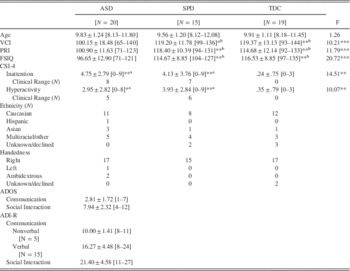
Exclusion criteria were brain malformation or injury, movement disorder, bipolar disorder, psychotic disorder, hearing impairment, or Perceptual Reasoning Index (PRI) score <70 on the Wechsler Intelligence Scale for Children-Fourth Edition (WISC-IV; Wechsler, Reference Wechsler2003). The Social Communication Questionnaire (SCQ; Rutter, Bailey, & Lord, Reference Rutter, Bailey and Lord2003) was administered for all participants. Those scoring above threshold ≥15) or who had a prior clinical diagnosis of ASD were evaluated with the Autism Diagnostic Inventory-Revised (ADI-R; Lord, Rutter, & Le Couteur, Reference Lord, Rutter and Le Couteur1994) and the Autism Diagnostic Observation Schedule (ADOS; Lord et al., Reference Lord, Rutter, Goode, Heemsbergen, Jordan, Mawhood and Schopler1989). Participants in the ASD group met diagnostic cutoffs on both of these measures and met DSM-IV-TR criteria for Autistic Disorder, confirmed by a pediatric neurologist (EJM). Participants assigned to the SPD group had previously been diagnosed with SPD by a community occupational therapist. Inclusion criteria for this group were SCQ <15 and a score in the “Definite Difference” range (<2% probability) in one or more of the sensory domains of the Sensory Profile (Dunn, Reference Dunn1999), including, auditory, visual, oral/olfactory, tactile, vestibular, or multisensory processing. Notably, 75% of the ASD group also met these criteria for sensory dysfunction based on their Sensory Profile scores. Two participants who did not meet criteria for ASD on the ADOS and ADI-R were excluded from the SPD group due to SCQ scores ≥15. Participant characteristics are presented in Table 1.
Group characteristics (M±SD [range])

*p<.01.
**p<.001.
a Significantly different from TDC group.
b Significantly different from ASD group.
Measures
Diagnostic assessment
The SCQ (Rutter et al., Reference Rutter, Bailey and Lord2003), ADI-R (Lord et al., Reference Lord, Rutter and Le Couteur1994), and ADOS (Lord et al., Reference Lord, Rutter, Goode, Heemsbergen, Jordan, Mawhood and Schopler1989) were administered for diagnostic classification of ASD. The ADOS consists of semi-structured activities designed to elicit behaviors characteristic of ASD. The ADI-R is a parent interview regarding information relevant to the diagnosis of autism. The SCQ is a parent report questionnaire with abbreviated content derived from the ADI-R. Diagnostic classifications for these measures are based on raw score cutoffs. The diagnostic reliability and validity of the ADI-R and ADOS have been established (Lord et al., Reference Lord, Rutter, Goode, Heemsbergen, Jordan, Mawhood and Schopler1989, Reference Lord, Rutter and Le Couteur1994). Assessment of classification accuracy of the ADOS compared to consensus clinical diagnosis indicates that the ADOS effectively differentiates autism from non-spectrum disorders with reported specificities of .93–1.0 (Lord et al., Reference Lord, Risi, Lambrecht, Cook, Leventhal, DiLavore and Rutter2000). The SCQ’s sensitivity has been reported to be .92 with a specificity of .62 in classification of ASD compared to clinical diagnosis (Witwer & LeCavalier, Reference Witwer and LeCavalier2007).
The Sensory Profile (Dunn, Reference Dunn1999) is a parent-report questionnaire which characterizes sensory experiences, behavior, and their functional impact. The domain scores were collectively used for differentiation of SPD and TDC groups. Higher scores indicate greater sensory dysfunction.
Intellectual ability
Because communication impairments are a diagnostic feature of ASD, and because our tasks drew largely upon nonverbal as opposed to verbal intellectual abilities, the PRI rather than the Verbal Comprehension Index or Full Scale IQ of the WISC-IV (Wechsler, Reference Wechsler2003) was used as a study exclusion measure and covariate. The PRI has been shown to be a valid and reliable measure of nonverbal IQ with internal consistency reliability coefficients ranging from .91 to .93 and stability coefficients ranging from .81 to .87 (Sattler & Dumont, Reference Sattler and Dumont2004).
Attention-deficit/hyperactivity symptoms
Parent ratings of symptoms of inattention and hyperactivity were also assessed on the Childhood Symptom Inventory-Fourth Edition (CSI-4; Gadow & Sprafkin, Reference Gadow and Sprafkin1997). The CSI-4 is a 97-item questionnaire that requires caregivers to rate the frequency of symptoms/behaviors relevant to a DSM-IV diagnosis of attention-deficit/hyperactivity disorder (ADHD). Raw scores for symptoms of inattention and hyperactivity were totaled and compared to clinically significant cutoff values. Higher scores represent greater symptom severity.
Auditory processing
The Acoustic Index of the Differential Screening Test for Processing (DSTP) was used to assess auditory processing (Richard & Ferre, Reference Richard and Ferre2006). This index is calculated from totaling correct items in: (1) dichotic listening, an index of interhemispheric auditory processing, in which the participant hears and repeats different numbers simultaneously presented through headphones to each ear; (2) temporal patterning, which assesses pitch perception through ability to correctly report the order of high and low tones presented in a sequence; and (3) auditory discrimination, which assesses auditory filtering by requiring the participant to repeat nonsense syllables presented in background noise.
Tactile processing
A battery was compiled to assess tactile detection, sensitivity, form discrimination, and proprioception. The Touch-Test Sensory Evaluators (“Touch Test Sensory Evaluators,” n.d.) measure tactile detection as the least force required to detect touch on the left index finger of a supine hand resting on a stable surface of a participant with closed eyes. In each trial, a monofilament classified in terms of force (.07–300 g) and diameter (2.83–6.65 mm) was manually applied to the index or middle finger at 90 degrees with sufficient force to bend the filament for 1.5 s. This process was repeated 3 times for each finger in sporadic order, beginning with the smallest filament and subsequently with increased diameter filaments. Tactile detection was quantified as the smallest filament size (mm) required for detection on at least two repetitions for each finger.
The Two Point Discriminator task (“Touch Test Two Point Discriminator,” n.d.) was used to assess tactile sensitivity, again on a fully supinated hand with eyes closed. Starting with a distance of 5 mm between prongs placed along the length of the left index finger, the participants reported whether they perceived one or two points, with one- and two-point stimulations presented in a standardized, sporadic order. Tactile sensitivity was quantified as the smallest distance (mm) between two separate points in which an accurate response was provided for three consecutive stimulations.
Tactile form discrimination was assessed using the Van Boven Domes task (“Von Boven Domes,” n.d.), for which a series of plastic domes with gratings spaced at 3.0, 2.0, 1.5, 1.2, 1.0, 0.75, 0.5, and 0.35 mm are pressed against the left index fingertip for one second with 100grf force. Beginning with the 3.0 mm ridge, participants stated whether the ridge was aligned “along” or “across” the finger. Each trial consisted of 10 standardized, sporadically-ordered vertical or horizontal orientations. Grating spacing was progressively lowered at each trial until three errors were made and testing discontinued. Form discrimination was quantified by the lowest grating size (mm) trial passed.
Finally, the graphesthesia subtest of The Sensory Integration Praxis Tests (Ayres, Reference Ayres1989) measured tactile proprioception by asking participants to recreate seven designs (neither numbers nor letters) drawn on the dorsum of each hand with closed eyes. Drawings were scored 0–2 for accuracy and totaled for each hand as measures of left- and right-handed tactile proprioception.
Data analytic plan
To standardize the scale magnitude across all measures of sensory processing, all scores were z-transformed according to the mean of the combined study sample before being subject to further analysis. Independent samples t tests were performed to examine group differences in age and PRI. Analyses of covariance (ANCOVAs) covarying PRI were conducted to determine if groups differed in auditory processing, tactile form discrimination, or bilateral proprioception. Post hoc independent samples t tests were conducted for any measure in which ANCOVA results achieved statistical significance to determine which groups significantly differed.
Tactile sensitivity scores were identical for all but two participants and thus were not subject to further analyses. The distribution of tactile detection scores also was binary; however, there was adequate representation of each score to allow for nonparametric analysis of group differences. Therefore, z-tests of independent proportions were performed to determine if groups differed in prevalence of higher thresholds (weaker tactile detection). Finally, Pearson correlation analyses were performed post hoc to evaluate the association between auditory processing and parent-rated communication ability derived from the SCQ.
Results
Independent samples t tests indicated no group differences in age; however, the ASD group scored significantly lower than both other groups in nonverbal intelligence (Table 1). Given this discrepancy, PRI was covaried in subsequent analyses of group differences on measures of sensory processing. Groups were also compared on parent reported symptom ratings for ADHD on the CSI-4. This measure was administered to all but two control participants due to examiner error. Indeed, significant differences were found for both the domains of inattention, with F(2,49)=14.51, p<.001, partial η2=.37, and hyperactivity, with F(2,49)=10.07, p<.001, partial η2=.29. Specifically, while the ASD and SPD groups did not significantly differ from each other, they both showed significantly greater symptoms of inattention and hyperactivity compared to TDC participants (p<.01). When compared against clinical cutoffs, eight participants in the ASD group and seven in the SPD group exceeded cutoff scores on the inattention scale. For the hyperactivity scale, five ASD and six SPD participants exceeded cutoffs. Finally, for the ADHD combined scale, nine ASD and 2 SPD participants exceeded cutoffs. Participants in the TDC group did not exceed cutoffs on any ADHD scales.
Auditory Processing
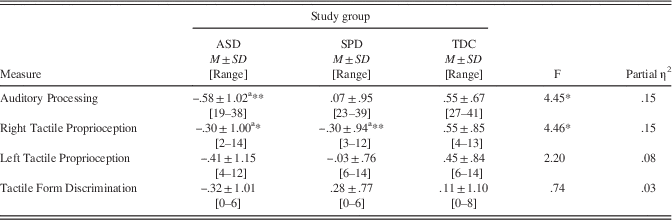
Consistent with parent report, significant group differences were identified in auditory processing after controlling for PRI, F(2,50)=4.45, p<.05, partial η2=.15. In contrast to parent report, however, paired comparisons indicated that only the ASD group performed significantly worse than the TDC group. Notably, the performance of the SPD group did not significantly differ from the others.
Tactile Processing
Performance-based tactile processing produced mixed results. ANCOVAs identified significant group differences in right-handed tactile proprioception after controlling for PIQ, F(2,50)=4.46, p<.05, partial η2=.15. Post hoc paired comparisons indicated that while the ASD and SPD groups showed deficits relative to TDC participants, they did not significantly differ from each other. Inspection of individual performance did not suggest that results were impacted by handedness. No significant effects were detected for tactile form discrimination or left-handed proprioception. Results of ANCOVAs performed on these standardized scores are reported in Table 2, along with raw score ranges presented in brackets.
Raw score ranges and ANCOVA results for standardized scores on measures of sensory processing

Note. ASD and SPD groups did not significantly differ from each other on any measures of sensory processing.
a Significantly different from TDC group.
*p<.05.
**p<.01.
Regarding tactile sensitivity, all participants were able to discriminate one from two points at 2 mm distance with the exception of two participants (1 in each of the ASD and SPD groups) whose sensitivity threshold was 3 mm. Given this inadequate variance this measure was not subject to further analysis. As reported above, tactile detection performance, which did not differ between index and middle finger applications, also was binary with thresholds of 2.83 mm or 3.61 mm filaments. Scores were more evenly distributed for these results, however, allowing for z-tests of independent proportions to be performed to determine if proportions of higher thresholds differed between groups. Results indicated that the SPD group demonstrated a higher prevalence of weaker tactile detection (60%) than both the ASD (35%; z=3.02; p<.01) and TDC groups (26.3%; z=4.46; p<.001), with no differences between the ASD and TDC groups (z=1.23; p<.05).
Because high rates of ADHD symptomatology were reported in both of the clinical groups, these analyses were repeated excluding the participants who exceeded cutoff scores in the inattention or hyperactivity domains of the CSI-4. Results of these analyses were largely unchanged. Specifically, no significant group differences were detected on measures of tactile form discrimination or left-handed proprioception. Significant differences were identified in right-handed proprioception, F(2,30)=3.64, p<.05, partial η2=.20, with impaired performance in the SPD group compared to TDC participants (p<.05). The ASD group did not significantly differ in performance from the TDC or SPD groups, although this may reflect reduced power to detect more modest effects. These results are consistent with Z-tests of independent proportions which indicated that the SPD group demonstrated a significantly higher frequency (85.7%) of weaker tactile sensitivity than either the ASD (40%; z=2.11; p<.05) or TDC (29.4%; z=3.08; p<.01) groups. The ASD group did not significantly differ from the TDC group in their proportion of weaker tactile sensitivity.
In contrast, it was the ASD group who performed most poorly on the auditory processing task, with ANCOVA results approaching significance, F(2,30)=3.32, p=.05, partial η2=.18, and paired comparisons indicating that the ASD group was impaired relative to both the TDC and SPD groups (p<.05). These results are consistent with the aforementioned analyses in which a general pattern of greater deficits in auditory processing was detected for the ASD group while tactile processing was most impacted for the SPD group. This pattern was robust to the exclusion of participants with high ADHD symptomatology, suggesting that these sensory deficits are not an artifact of comorbidity with ADHD.
Post Hoc Analyses
Given that auditory processing was the only sensory domain in which the ASD group alone was impaired, and given prior evidence of an association between auditory processing abnormalities and language impairment in ASD (Oram Cardy et al., Reference Oram Cardy, Flagg, Roberts and Roberts2008; Roberts et al., Reference Roberts, Cannon, Tavabi, Blaskey, Khan, Monroe and Edgar2011; Schmidt et al., Reference Schmidt, Rey, Oram Cardy and Roberts2009), post hoc correlation analyses were performed between scores on the auditory processing task and a total score for SCQ items pertaining to verbal communication (items 2, 3, 4, 5, 6, 20, 21, 22, 23, 24, 25, 34, and 35.). Auditory processing was significantly associated with SCQ communication ratings for the ASD group (r=−.46; p<.05), but this association did not achieve statistical significance for the SPD (r=−.20; p>.05) or TDC groups (r=.14; p>.05). However, Fisher z transformations of these correlation coefficients were not significantly different from one another (ASD vs. TDC z=−1.849; p=.0644; SPD vs. TDC z=−.908; p=.364; ASD vs. SPD z=.789; p=.430). Therefore, to examine whether auditory processing and communication were significantly related across groups more broadly, average within-group correlations were computed by taking the average of the Fisher’s z transformed correlation coefficients and then performing a back-transformation to r. The average within group correlation was weak (r=−.19; p=.08) for the entire sample and for the combined SPD and TDC groups (r=−.03; p=.43); however, the association between auditory processing and communication was stronger when correlation coefficients between the ASD and SPD groups were averaged (r=−.34; p=.045). These associations are illustrated in Figure 1.
Scatterplot of auditory processing and SCQ communication ratings. Higher scores indicate better auditory processing and greater communication impairments on the SCQ.

Discussion
This study was the first to concurrently examine differences in performance-based measures of auditory and tactile processing in children with ASD, SPD, and typically developing peers. We identified areas of both shared deficits as well as divergence between children with ASD and SPD. This is not surprising, as 75% of our ASD participants met selection criteria for the SPD group on the Sensory Profile, consistent with prior research demonstrating at least 70% prevalence of sensory dysfunction in ASD (Adamson et al., Reference Adamson, Hare and Graham2006; Greenspan & Wieder, Reference Greenspan and Wieder1997; Mayes & Calhoun, Reference Mayes and Calhoun1999; Tomchek & Dunn, Reference Tomchek and Dunn2007). Likewise, several participants in the ASD and SPD groups were rated as having clinically significant symptoms of inattention and/or hyperactivity. It is not surprising to detect elevated symptoms of ADHD in participants with ASD, particularly since ASD diagnoses were based on DSM-IV-TR criteria, in which a separate diagnosis of ADHD is not rendered in the context of a Pervasive Developmental Disorder. This finding is also within expectation for the SPD group, as symptoms of sensory dysfunction are often associated with hyperactivity and/or problems with attention/concentration (Dunn, Reference Dunn1999). Of interest, the pattern of results was unchanged when analyses were repeated on a subsample of participants who were all below cutoff values for inattention and hyperactivity on the CSI-4. This suggests that sensory dysfunction is dissociable from ADHD pathology and highlights the need to develop operationalized criteria for the classification of sensory processing disturbance in children who are not on the autism spectrum but may nevertheless require access to services and treatment.
In an effort to directly assess auditory and tactile functioning for the dual purpose of gaining phenotypic information on our participants and ascertaining adequacy of measures for clinical use, we examined auditory and tactile processing performance on measures that have been applied in both clinical and research settings. Based on our previous neuroimaging findings (Marco et al., Reference Marco, Khatibi, Hill, Siegel, Arroyo, Dowling and Nagarajan2012), we proposed that children with ASD and SPD would show shared impairment on tactile measures, but that the ASD group would be more substantially affected in auditory processing. Indeed, only the ASD group demonstrated significant deficits in auditory processing, consistent with established literature documenting auditory processing differences in ASD (Bonnel et al., Reference Bonnel, Mottron, Peretz, Trudel, Gallun and Bonnel2003; Cardy et al., Reference Cardy, Flagg, Roberts, Brian and Roberts2005; Edgar et al., Reference Edgar, Khan, Blaskey, Chow, Rey, Gaetz and Roberts2015; Gage, Siegel, Callen, et al., Reference Gage, Siegel, Callen and Roberts2003; Gage, Siegel, & Roberts, Reference Gage, Siegel and Roberts2003; Gandal et al., Reference Gandal, Edgar, Ehrlichman, Mehta, Roberts and Siegel2010; Heaton, Reference Heaton2005; Järvinen-Pasley & Heaton, Reference Järvinen-Pasley and Heaton2007; Kargas et al., Reference Kargas, López, Reddy and Morris2015; Khalfa et al., Reference Khalfa, Bruneau, Rogé, Georgieff, Veuillet, Adrien and Collet2004; O’Riordan & Passetti, Reference O’Riordan and Passetti2006; Oram Cardy et al., Reference Oram Cardy, Flagg, Roberts and Roberts2005, Reference Oram Cardy, Flagg, Roberts and Roberts2008; Roberts et al., Reference Roberts, Khan, Rey, Monroe, Cannon, Woldoff and Edgar2010, Reference Roberts, Cannon, Tavabi, Blaskey, Khan, Monroe and Edgar2011; Rojas et al., Reference Rojas, Teale, Maharajh, Kronberg, Youngpeter, Wilson and Hepburn2011; Schmidt et al., Reference Schmidt, Rey, Oram Cardy and Roberts2009; Tecchio et al., Reference Tecchio, Benassi, Zappasodi, Gialloreti, Palermo, Seri and Rossini2003; Tomchek & Dunn, Reference Tomchek and Dunn2007; Wilson et al., Reference Wilson, Rojas, Reite, Teale and Rogers2007).
Results also indicated that auditory processing performance was positively associated with parent-reported communication skills on the SCQ both within the ASD group and when associations between ASD and SPD groups were averaged. These findings may suggest that auditory processing abilities may be more broadly associated with communication skills in children for whom these domains of functioning are impacted. These findings are demonstrative of the theoretical framework of the Research Domain Criteria initiative to identify alternative classification methods based on continuous dimensions of traits, behavior, and neurobiology to better understand mechanisms of psychopathology. Given the early emergence of ASD symptomatology, it will be particularly important to consider the neurodevelopmental context of these sensory processing mechanisms if we are to understand how these traits evolve over the course of development and the impact they have on other developing processes (Casey, Oliveri, & Insel, Reference Casey, Oliveri and Insel2014).
With regard to tactile processing, the ASD and SPD groups showed no difference in mean scores from the TDC group in tactile sensitivity or form discrimination; however, there were significantly more participants with a slightly higher tactile detection threshold in the SPD group compared to the ASD and TDC groups, who did not differ in this respect. This is consistent with previous research in which adults with autism did not significantly differ from controls on a similar tactile detection task (Cascio et al., Reference Cascio, McGlone, Folger, Tannan, Baranek, Pelphrey and Essick2008; O’Riordan & Passetti, Reference O’Riordan and Passetti2006), although the stimuli used in this prior study were applied to the forearm and thenar palm as opposed to the index finger application in the present study. The increased prevalence of slightly weaker tactile detection in the present study suggests that this small difference in tactile detection may be associated with clinically meaningful functional impairment. If so, then more sensitive assessments of tactile detection will be needed to accurately estimate abilities and allow for comparison to a normal distribution of scores. Because standardized measures of tactile processing with pediatric normative data are currently lacking, results suggest that these “bedside” neurologic measures have utility as screening tools for potential tactile dysfunction, although the information they provide on the degree of impairment may be limited to extremes of performance, and thus may miss more subtle, but potentially meaningful forms of tactile dysfunction.
Certainly, an intriguing finding is the shared deficits in tactile proprioception in both the ASD and SPD groups measured by right-handed graphesthesia. While no differences were detected for the left hand, the TDC group outperformed participants in both the ASD and SPD groups on right-handed proprioception (associated with the left cerebral hemisphere). These findings are consistent with our prior work demonstrating reduced and delayed cortical somatosensory response in ASD, with the strongest effect in the left somatosensory cortex (Marco et al., Reference Marco, Khatibi, Hill, Siegel, Arroyo, Dowling and Nagarajan2012). This can be further examined in the context of our prior structural neuroimaging work identifying decreased white matter connectivity in occipital and parietal tracts for boys with SPD and ASD relative to controls, with the most salient cognitive association between the left hemisphere connection and a working memory task (Chang et al., Reference Chang, Owen, Desai, Hill, Arnett, Harris and Mukherjee2014). It is possible that our proprioception task also involved greater use of working memory by requiring participants to identify and draw unfamiliar designs rather than recognizable forms such as letters or numbers. These findings suggest further research is necessary to develop measures of tactile proprioception that are both sensitive and minimally confounded with other cognitive processes. Findings also suggest that further research is warranted to determine if there is an important variation in left versus right hemisphere parietal/occipital processing for affected children.
The present study compared two groups with sensory dysfunction, only one of whom met criteria for a diagnosis of ASD. While these groups were largely indistinguishable on several study measures, review of the tasks in which performance was inconsistent between these groups may further our understanding of the relation between sensory dysfunction and ASD symptomatology. Specifically, only the ASD group was impaired on the auditory processing task, while the SPD group demonstrated a significantly higher rate of the increased tactile detection threshold. Both groups were impaired relative to the TDC group in right-handed tactile proprioception. This pattern of findings may suggest that while diffuse sensory dysfunction may be prevalent in children who do and do not meet criteria for ASD, the presence of prominent auditory processing deficits may be specifically associated with the development of autism symptomatology (Figure 1). This hypothesis is consistent with findings from our previous work, in which reduced structural connectivity in parietal-occipital tracts was identified in both children with ASD and those with SPD, while temporal tracts were compromised only in the ASD group. Furthermore, in the present study, a significant relationship was identified between performance on the auditory processing task and parent rating of communication problems associated with ASD. This finding is consistent with previous literature identifying auditory processing deficits in language-impaired individuals with ASD (Cardy et al., Reference Cardy, Flagg, Roberts, Brian and Roberts2005; Edgar et al., Reference Edgar, Khan, Blaskey, Chow, Rey, Gaetz and Roberts2015; Roberts et al., Reference Roberts, Cannon, Tavabi, Blaskey, Khan, Monroe and Edgar2011; Schmidt et al., Reference Schmidt, Rey, Oram Cardy and Roberts2009). Furthermore, the association between auditory processing and communication was largely driven by the ASD group, for whom auditory processing was most impaired. Of interest, however, this relationship was also found when the associations between auditory processing and communication were averaged for the ASD and SPD groups (Figure 1). These results suggest that an association may exist between auditory sensory dysfunction and communication skills regardless of diagnostic classification and that when auditory processing is substantially impaired there may be a greater likelihood of clinically significant communication symptoms associated with ASD.
Limitations and Future Directions
Several limitations must be acknowledged for the present study. First, the sample was composed of only male participants, the majority of whom were Caucasian (57%). The predominance of Caucasian participants was not intended but rather was reflective of the population demographics of the study location (San Francisco County population demographics indicate 54.3% of residents are Caucasian according to the United States Census Bureau, 2013). In contrast, recruitment for this study did target male participants in an effort to limit heterogeneity and add to the power of the study. The decision to initially target male participants was based on the greater prevalence of ASD in males compared to females. Thus, generalizability of these results may be limited for females or children from other racial backgrounds. Likewise, participants in the TDC and SPD groups had above average mean IQ scores and the ASD group had a mean IQ score in the average range. These scores for all three groups in the present study sample are likely higher than those for the broader populations they are intended to represent. Thus these results may only generalize to those with higher intellectual abilities in these populations.
Second, only tactile proprioception was measured bilaterally, and impairments were restricted to the right hand. This may have limited our ability to detect impairment in on the other tactile measures since only the left hand was assessed. Finally, while the ASD and SPD groups were distinguished by scores on gold standard clinician-rated diagnostic measures for ASD, the SPD and TDC groups were distinguished by only parent-reported sensory processing. While this measure is among the most widely recognized and well-regarded assessments of sensory dysfunction currently available, the limitations of informant questionnaire formats for classification of sensory processing is that they inherently confound behavior that is directly related to sensory processing with behavior that is related to the emotional reaction to sensation. While both facets of behavior are relevant to the study of sensory processing, the conflation of the two limits our ability to arrive at conclusions regarding the etiology of sensory dysfunction. A standardized performance-based assessment of disordered sensory processing is lacking, largely due to the historically limited acknowledgement of sensory dysfunction as an impairing condition in children. As awareness of sensory dysfunction and its impact on development spreads, the need for consensus on the classification of clinically significant sensory dysfunction is becoming increasingly apparent to facilitate both identification and access to treatment. Future studies are needed to examine sensory processing in a more comprehensive format, including diverse stimuli targeting different aspects of sensory processing (e.g., detection, discrimination, timing, perceived comfort, etc.) in all sensory domains.
Conclusions
Results of this study suggest that there are differences in performance-based measures of sensory processing for individuals with ASD as well as those with parent-reported sensory dysfunction who do not meet criteria for ASD. Auditory processing was the only domain in which impairment was limited to ASD, suggesting that auditory processing deficits may be an area of sensory dysfunction that is more impacted in individuals on the autism spectrum. Although causal direction cannot be inferred, these findings may indicate that sensory dysfunction can adversely impact development of social and communication skills in children regardless of diagnostic classification. Future research is needed to understand these relationships across different domains of sensory functioning and other functional domains impacted by ASD. Should sensory dysfunction be identified as a risk factor for deficits in social and communication skills, these findings have implications for development of prevention and treatment efforts. Such interventions could be far reaching considering that basic sensory processing can be assessed beginning very early in life, before higher-level cognitive functions develop. Thus, individuals with and without an ASD label may benefit from targeted early intervention.
Acknowledgments
This work was funded by grants to EJM from the Wallace Research Foundation, the Gates Family Foundation and the Holcombe Kawaja Family Foundation and from the NIMH (EJM, K23 grant number MH083890). The authors have no conflicts of interest to report.