Introduction
Mental and behavioural disorders account for 12.5 per cent of the global burden of disease. At any one time, about 10 per cent of the world population suffers from a mental illness, and more than 25 per cent are affected by mental and behavioural disorders at some point in their lives (World Health Organisation (WHO) 2001). Notwithstanding the methodological limitations of the measure ‘Disability Adjusted Life Years’ (DALYs), by 2020 it is expected that mental and behavioural disorders will contribute about 15 per cent of the total DALYs lost through disease and injuries (WHO 2001). The most common mental and behavioural disorders are unipolar depression (32%), alcohol-use disorders (11%), schizophrenia (8%), bipolar depression (7%), lead-caused mental retardation (5%) and Alzheimer's and other dementias (5.5%) (WHO 2002). Although Alzheimer's and other dementias (hereafter referred to as dementia) comprise a small proportion of overall DALY, they constitute over 11 per cent of the aggregate years lived with disability among people aged 60 or more years. This percentage is more than the DALYs for stroke (9.5%), musculoskeletal disorders (8.9%), cardiovascular disease (5%) and all forms of cancer (2.4%) (Ferri et al. Reference Ferri, Prince, Brayne, Brodaty, Fratiglioni, Ganguli, Hall, Hasegawa, Hendrie, Huang, Jorm, Mathers, Menezes, Rimmer and Scazufca2005). With improvements in public health and an increase in the age of mortality, the number of people with dementia is projected to triple in the coming decades, from 24.3 million in 2001, to 81.1 million by 2040. The areas that will experience the greatest increase will be South Asia and the Western Pacific, specifically India and China, where the numbers are expected to grow by from 314 to 336 per cent (Ferri et al. Reference Ferri, Prince, Brayne, Brodaty, Fratiglioni, Ganguli, Hall, Hasegawa, Hendrie, Huang, Jorm, Mathers, Menezes, Rimmer and Scazufca2005). The World Health Organisation has nominated ‘Non-communicable diseases and mental health’ as one of its core programmes in India (WHO-India 2007).
In India, estimates over the past decade of the prevalence of dementia among people aged 65 or more years have ranged from 13.6 per 1,000 in Ballabgarh (Chandra et al. Reference Chandra, Ganguli, Pandav, Johnston, Belle and DeKosky1998), through 18 per 1,000 in Mumbai (Vas et al. Reference Vas, Pinto, Panikker, Noronha, Deshpande, Kulkarni and Sachdeva2001), and 27 per 1,000 in Chennai (Rajkumar and Kumar Reference Kumar1996), to 33.6 per 1,000 in Kochi (Shaji, Bose and Verghese Reference Shaji, Bose and Verghese2005). Similar disparities are found for other major mental disorders in India. Gururaj and colleagues (Reference Gururaj, Girish and Issac2005, Reference Gururaj, Issac and Agarwal2004) suggested that these differences arise from methodological differences, such as inconsistent sampling of urban, rural and tribal populations, different recruitment strategies (door-to-door or hospital-based surveys), different case identification methods (by lay persons, health professionals or psychiatrists), the use of various screening instruments and questionnaires, variable case confirmation methods (different standards for best practice), and finally different statistical procedures. Additionally, it should be remembered that the estimates are compiled in a cultural context that sees old age as concomitant with an inevitable decline in cognitive ability (Patel and Prince Reference Patel and Prince2001; Shaji et al. Reference Shaji, Smitha, Lal and Prince2003a).
In India, the roots of the diagnosis and treatment of mental illness can be traced back to the early days of British colonial rule during the late 18th century (Mills Reference Mills2006). Despite the recommendations of the Bhore Committee in 1946, there was no revision of mental-health care legislation from independence in 1947 until the 1980s. In 1982, the Ministry for Health and Family Welfare introduced a National Mental Health Programme, and the Government of India replaced existing legislation in 1987. The 10th Five-Year Plan for 2002–07 allocated 19 billion rupees (Rs.) (approximately £240 million) towards mental-health care – a more than sixfold increase from the Ninth Five-Year Plan (Government of India 1997, 2002). Although a considerable amount, this was only two per cent of the country's health budget (WHO 2005). The disproportionate allocation of funding for mental-health care is a global phenomenon. The World Health Organisation (2005) found that around 30 per cent of all countries, most of them in Africa, the Mediterranean and Western Pacific regions, did not have a mental health budget, and that 50 per cent of South-East Asian countries spent less than one per cent of their total health budget on mental-health care. Even in resource-rich countries like the United States, the United Kingdom and Australia, small percentages of the total health budget are spent on mental health (approximately 6, 10 and 9% respectively) (WHO 2005).
In India, health expenditure is directed primarily to the control of vector-borne diseases such as malaria, dengue and filaria (Rs. 137 billion), the control of AIDS, other sexually-transmitted diseases and blood-safety measures (Rs. 127 billion). Vector-borne diseases and HIV/AIDS are among the leading causes of mortality in India, but in terms of DALYs, neuropsychiatric disorders ranked second in 2002 – more than HIV/AIDS and other sexually-transmitted diseases combined (WHO 2004). Consequently, there is a need for stronger policy and planning to respond to the effects of mental and behavioural disorders. Given the changing age structure, dementia needs to be specifically addressed rather than subsumed among all neuro-degenerative disorders. Over the last decade, psychiatrists and epidemiologists have begun to estimate the consequences that dementia may have on the Indian population and to argue the need for service planning (Ferri et al. Reference Ferri, Chisholm, Van Ommeren and Prince2004, Reference Ferri, Prince, Brayne, Brodaty, Fratiglioni, Ganguli, Hall, Hasegawa, Hendrie, Huang, Jorm, Mathers, Menezes, Rimmer and Scazufca2005; Gururaj, Girish and Issac Reference Gururaj, Girish and Issac2005; Knapp et al. Reference Knapp, Funk, Curran, Prince, Grigg and McDaid2006; McCabe Reference McCabe2006; Prince and Trebilco Reference Prince, Trebilco, Draper, Melding and Brodaty2005; Varghese and Patel Reference Varghese, Patel and Agarwal2004). Currently there is no specific policy on dementia care in India. Rather, statements about the types of care and about family and state responsibilities are scattered through various legislative instruments.
This paper examines current policies for dementia care in India with a focus on the Mental Health Act 1987, the National Mental Health Programme (NMHP), the National Policy on Older Persons, and the Senior Citizens' Act 2007. Through critiques of these various government documents, it will be shown that the invisibility of dementia in public policy translates into the absence of adequate treatment and management practices. Such a dynamic marginalises dementia patients and their carers, and places the burden of care on families. Little is known about how families interpret the experiences of care-giving, manage the associated stigma, and access support. There is a dearth of qualitative data in India on cultural constructions of dementia, on the multiple meanings associated with ageing, on senility and madness, and on the behaviours and practices that result from these meanings.
The Mental Health Act 1987
The genesis of the Mental Health Act 1987 was in the recommendations of the Bhore Committee of 1946. Under the chairmanship of Sir Joseph Bhore, the Health Survey and Development Committee was constituted in 1943 to formulate a development plan for the health services in newly independent India. The Committee reviewed trends in Britain, Australia, New Zealand, Canada, the USSR and the USA, and made comprehensive recommendations for the remodelling of existing health services (Bhore Reference Bhore1946). These included the integration of preventive and curative services at all administrative levels, the adoption of target ratios for health services delivery (e.g. doctors to patients, and beds to patients), and the development of a strong basic primary health-care infrastructure with the capacity to make referrals to district and tertiary hospitals. The Committee also advocated changes in the medical curriculum, such as to introduce three months' training in preventive and social medicine to create socially informed and committed physicians.
With particular reference to mental-health care, the Bhore Committee recommended new legislation to replace the Indian Lunacy Act 1912, building new mental hospitals, and creating training facilities for mental-health professionals. While the 1912 Act was not redrafted for another four decades, around 20 additional mental hospitals were established across the country. By the turn of the century, there were about 40 mental hospitals with 20,000 beds (Weiss et al. Reference Weiss, Isaac, Parkar, Chowdhury and Raguram2001). How the lack of legislative change influenced the management of clinical practice in these hospitals will be dealt with later. It is sufficient, at this point, to say that the facilities and services were until the 1990s at best dated.
The Mental Health Act 1987 replaced the Indian Lunacy Act 1912, and the central Government of India (1990) issued administrative orders to govern the implementation of the Act which came into force in 1993. The State governments were to develop their own procedures for implementation. The Act was designed ‘to consolidate and amend the law relating to the treatment and care of mentally ill persons, [and] to make better provision with respect to their property and affairs’ (Government of India 1987). The Act has 10 chapters and was a significant improvement on earlier legislation. Formerly pejorative terms like ‘nursing home asylum’, ‘lunatic’, and ‘criminal lunatic’ were replaced with the more sensitive terms ‘psychiatric hospital’, ‘mentally ill person’ and ‘mentally ill prisoner’ (Rastogi Reference Rastogi2005). Admission and discharge procedures were simplified, with provisions for outpatient care. There were explicit clauses on the protection of human rights, that required people with a mental illness to be treated with dignity, and that prohibited research on patients without their or a guardian's consent. The state government was responsible for the costs of patients in psychiatric hospitals or psychiatric nursing homes. All psychiatric hospitals were required to have a license that was to be renewed every five years, with penalties including imprisonment for those who failed to comply. Central and state mental-health authorities were to monitor these hospitals and other mental-health care agencies. They were also charged with advising and assisting either the central or state governments (depending on which authority they were a part of) on all matters relating to mental-health care. Also, children, people with addictions, and those with a criminal conviction were to be accommodated separately and not together, as had previously been the case (Government of India 1987).
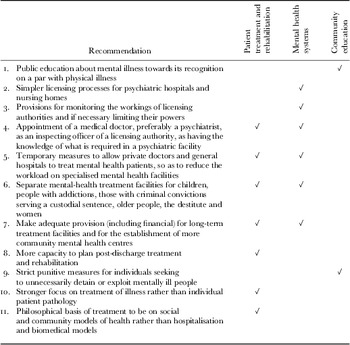
Although the Act made several positive changes, it was not without faults. The strongest criticisms were about the continued reliance on hospital-based psychiatric care, which countered the recommendations of the WHO (Brundtland Reference Brundtland2000). Numerous Indian mental-health experts have advocated the integration of mental-health care with primary-health care and general hospitals (Goel et al. Reference Goel, Agarwal, Ichhpujani, Shrivastava and Agarwal2004; Gururaj, Girish and Issac Reference Gururaj, Girish and Issac2005; Rastogi Reference Rastogi2005; Shah, Murthy and Suh Reference Shah, Murthy and Suh2002). Rastogi (Reference Rastogi2005) undertook a critical analysis of the Act and made 11 recommendations for its reform that fall into three main categories: improvements in patient treatment and rehabilitation; improved mental-health care systems; and improved community education (see Table 1).
Rastogi's suggestions for reforming the Indian Mental Health Act 1987

Source: Adapted from Rastogi (Reference Rastogi2005).
The 1987 Act has had, however, little impact on the ground. During the 40 years between the Bhore Committee's recommendations and the new legislation, outdated and entrenched practices continued. The Indian media, social activists, lawyers and concerned citizens campaigned for hospital reforms and lodged public interest litigation in the courts (Weiss et al. Reference Weiss, Isaac, Parkar, Chowdhury and Raguram2001). This resulted in the Supreme Court of India ordering that a detailed inquiry into the state of mental hospitals be undertaken by the National Human Rights Commission (1999; see also Channabasavanna and Murthy Reference Channabasavanna, Murthy and Agarwal2004). The Commission investigated 37 mental hospitals that accommodated over 18,000 people. It found their infrastructure to be poor and obsolete, that there was a lack of safe drinking water and washing facilities, and that in some male wards, patients were required to defecate and urinate into open drains. The poor quality of food, the lack of clean linen, and insufficient natural light reproduced the custodial atmospheres of the lunatic asylums of the British Raj, an image that was further reinforced by staff attitudes. The Commission found that most staff were untrained and that many of those working ‘on the floor’ adopted prison-warder personas. Many hospitals did not have psychiatrists on their permanent staff. The debilitating effects of prolonged hospitalisation in such settings and the high levels of mental illness and social maladjustment among the patients were not only a human rights violation but also presented Indian mental-health experts with a major problem: how to rehabilitate into the community the long-stay patients who made up more than 50 per cent of all psychiatric hospital patients (Goel et al. Reference Goel, Agarwal, Ichhpujani, Shrivastava and Agarwal2004).
The National Mental Health Programme, 1982–2003
The revised National Mental Health Programme (NMHP) of 2003 aimed to close the mental hospitals, in which long-stay patients were confined, by streamlining and modernising the existing mental hospitals and by promoting general hospital psychiatry (Agarwal et al. Reference Agarwal, Ichhpujani, Shrivastava, Goel and Agarwal2004). The NMHP also proposed to strengthen central and state mental-health care agencies so that they could develop and implement mental health programmes, determine priorities, and promote collaborations and linkages with other government programmes. Research and training were to be increased, and District Mental Health Programmes were to be redesigned around zonal medical colleges (Agarwal et al. Reference Agarwal, Ichhpujani, Shrivastava, Goel and Agarwal2004). Rs.19 billion was allocated to the NMHP, a significant increase in funding from the preceding allocation of Rs.280 million in the Ninth Five-Year Plan (Government of India 2002). Prior to 2003, the NMHP, albeit based on the sound premise of integrating mental-health with general health services and particularly primary care, was long overdue for reform. It had been launched in 1982 as part of the National Health Programme and was administered by the Ministry for Health and Family Welfare (Murthy Reference Murthy and Agarwal2004). For over 20 years, the NMHP had had three primary objectives: to ensure the availability and accessibility of minimum mental-health care, particularly amongst the vulnerable and under-privileged; to encourage the incorporation of mental-health care in general health-care provision and social development; and lastly, to promote community participation in mental-health service development and to stimulate self-help in communities (Gandevia Reference Gandevia, Mane and Gandevia1993; WHO 2005).
The NMHP's theoretical orientation was a community-oriented approach to the development of mental-health care that envisaged services expanding from a central point, such as a district hospital, to the peripheries or broader community by means of outpatient clinics and mobile teams (Murthy Reference Murthy and Agarwal2004). This was to be done through District Mental Health Programmes, which were to be the cornerstones of the NMHP and to extend mental-health services using existing health-care personnel and infrastructures. This decentralised approach to mental-health service delivery sought to deploy staff trained in the essentials of mental-health care in 593 districts across India. The plan included the establishment of mental-health teams to continue training health personnel in referral, record keeping and monitoring or audit of services and programmes. Essential psychiatric drugs, including the anti-psychotics (Risperidone), anti-depressants (Fluoxetine) and tranquilisers (Diazepam), were to be provided at every health-care facility, and all relevant health, welfare and other stakeholders were to be involved in mental-health care (Standing Committee on Health and Family Welfare, Parliament of India 2004).
The NMHP was in essence a sound model for mental-health care despite its two major theoretical shortcomings: the emphasis on curative rather than preventative or promotional aspects of mental-health care, and the lack of recognition of the importance of families as a resource (Murthy Reference Murthy and Agarwal2004). There were high expectations at its inception. Section 11.31 of the Seventh Five-Year Plan (1985–90), for example, not only reiterated the aims of the NMHP but began by summarising the government's expectations:
Organised and planned mental-health care activities are vital for obviating the ill-effects of major socio-economic changes. A beginning in this direction is proposed in the Seventh Plan by according priority to strengthening the existing psychiatry departments, promotion of community psychiatry by provision of drugs and services through the primary health-care system, and the organisation of training programmes (Government of India 1985: unpaginated web document).
The NMHP was thus a means of countermanding the effects of rapid social change by promoting mental-health care in the community, increasing the number of trained staff, and bolstering existing resources in psychiatric departments at universities, medical colleges and hospitals. It was ambitious and in many respects quite visionary, but the outcomes were lacklustre. The NMHP was grossly under-funded during its first 15 years, which resulted in very limited implementation. Attention was directed largely towards the District Mental Health Programmes (DMHPs) while other components, such as workforce development and changes in the undergraduate medical curriculum, were ignored – which adversely affected the DMHPs because there were too few appropriately trained staff.
Goel and colleagues (Reference Goel, Agarwal, Ichhpujani, Shrivastava and Agarwal2004) evaluated the NMHP and the Mental Health Act 1987 and came to the disappointing conclusion that few changes had actually occurred. Using data gathered in early 2002, 20 years after the programme began, they found that only 25 of the 593 districts had implemented a DMHP, and that a mere 10 states and union territories had framed rules for the 1987 Act's implementation. Thirteen states and union territories had not formulated any mental-health administrative orders, and another seven did not know the status of their statutory instruments (Goel et al. Reference Goel, Agarwal, Ichhpujani, Shrivastava and Agarwal2004). The high expectations that characterised the origins of the Mental Health Act and the NMHP had not come to fruition.
It is important to note, however, that even though there were failings at the national level, mental-health services have been provided since the 1960s by non-governmental organisations (NGOs). Clinical care, drug treatment, counselling services, community awareness and outreach programmes, research collaborations, training, support and advocacy have and continue to be provided by numerous NGOs across the country. Their initiatives in forming partnerships and piloting innovative programmes have been documented (Patel and Varghese Reference Patel, Varghese and Agarwal2004). So too have their limitations: many grapple with the challenges of scarce funding, high staff turnover, site-specific operations, poor accountability, and scarce evaluation data. Moreover, NGOs working in the fields of mental-health care have very limited operations in rural and impoverished areas, and are not equipped to meet the needs of their populations. The responsibility and capacity to act rests formally with the public-health sector, but for many years mental health has been significantly under-funded (Patel and Varghese Reference Patel, Varghese and Agarwal2004).
With a funding boost of Rs.19 billion in late 2003, the NMHP was revised and re-launched. The new plan was to redesign the District Mental Health Programmes around a medical college or similar nodal institution, to increase the base of mental-health professionals, modernise mental-health institutions, strengthen state and central mental-health authorities, and increase investment in mental-health research and training (Agarwal et al. Reference Agarwal, Ichhpujani, Shrivastava, Goel and Agarwal2004). Included in the redesign of the DMHPs was the gradual integration of school mental-health programmes and dementia-care services (Goel et al. Reference Goel, Agarwal, Ichhpujani, Shrivastava and Agarwal2004). The 11th Five-Year Plan (2007–11), recently launched, has gone one step further, allocating Rs.95 million specifically for health care for older people. The money is to be spent on providing comprehensive preventative, curative and rehabilitation services for older people, on training professionals in geriatrics, and on geriatrics and gerontology research. In addition, a National Institute for Ageing is to be established and all health and ageing initiatives are to be co-ordinated with other national health programmes (Government of India 2007). The pace at which these initiatives will be implemented is unknown and it is too early to evaluate their impacts. Certainly their effects will take some time to filter down to the community, which continues to experience the ramifications of 20 years of under-funding and unresponsive dementia-care services.
Implications for dementia care
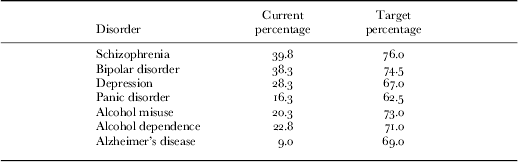
The effects of the legislation and the NMHP on dementia care have been very damaging, even though there have not been direct connections between dementia care, the Mental Health Act 1987 and the NMHP. The failure to make adequate provision for specific dementia treatments and services reflects the invisibility of the disease in public policy, which has had profound implications for the families of those who contract a dementia. The fundamental problem has been that the availability, accessibility and affordability of mental-health services are limited. Although under the NMHP essential psychiatric drugs were to be provided in all health facilities, the coverage for mental illnesses, especially Alzheimer's disease, remained (and remains) very poor (Table 2). The current coverage is estimated to be less than nine per cent, compared to a target of 69 per cent (Ferri et al. Reference Ferri, Chisholm, Van Ommeren and Prince2004). None of the four drugs – Donepezil, Rivastgmine, Galantamine and Memantine – which have been shown to be effective for people in the early to mid stages of dementia (Cummings Reference Cummings2004a, Reference Cummings2004b) are available on the list of essential medicines for India (Directorate General of Health Services 2003). Consequently the financial burden of caring for a person with dementia (or with other mental or neuro-degenerative conditions) has become a significant issue for families: the cost of medications must be met privately, as must the informal costs of care-giving and travelling time, and the reduced income through days lost from work, which has been estimated to be three times the amount of formal health-care costs (Chisholm et al. Reference Chisholm, Sekar, Kumar, Saeed, James, Mubbashar and Murthy2000).
Actual and target coverage of medication for patients with mental disorders, India 2003
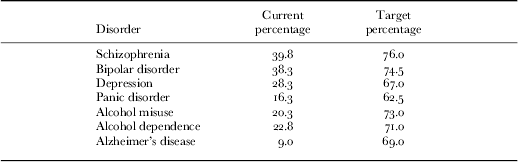
Source: Adapted from Ferri et al. (Reference Ferri, Chisholm, Van Ommeren and Prince2004: 225).
Despite the recommendations for change that date back to the Bhore Committee in 1946, medical knowledge and training for dementia care are still limited. Most general practitioners in India are not trained to diagnose dementia. Undergraduate medical courses are inadequate and even postgraduate modules in medicine and allied health teach little about psychiatric conditions (Goel et al. Reference Goel, Agarwal, Ichhpujani, Shrivastava and Agarwal2004). The trained mental health workforce is insufficient: of the 593 districts across India, 52 per cent do not have any psychiatric facilities and there is a massive shortage of psychiatrists (77%), psychologists (97%) and psychiatric social workers (90%) (Goel et al. Reference Goel, Agarwal, Ichhpujani, Shrivastava and Agarwal2004; Gururaj, Girish and Issac Reference Gururaj, Girish and Issac2005). This is despite the fact that between 20 and 45 per cent of all presentations at general and primary health-care settings are for common mental disorders, with most patients being poor women aged between 35 and 44 years (Patel et al. Reference Patel, Pereira, Coutinho, Fernandes, Fernandes and Mann1998, Reference Patel, Araya, de Lima, Ludermir and Todd1999, Reference Patel, Kirkwood, Pednekar, Weiss and Mabey2006).
The widespread under-diagnosis of dementia is influenced by other factors, particularly the public acceptance of dementia as a normal part of old age. Cohen's (Reference Cohen1998) work in Varanasi and north India, Shaji and colleagues' (Reference Shaji, Smitha, Lal and Prince2003) study in Kerala, southern India, and Patel and Prince's (Reference Patel and Prince2001) work in Goa (west India) all found that, although the symptoms of dementia were widely recognised, they were perceived as a normal part of ageing and not an organic brain syndrome. The symptoms are referred to in Hindi as sathiyana [gone sixtyish] (Cohen Reference Cohen1995b), Chinnan [childishness] in Malayalam (Shaji et al. Reference Shaji, Smitha, Lal and Prince2003), and nerva frakese [tired brain] in Konkani (Patel and Prince Reference Patel and Prince2001). These powerfully descriptive terms inform the moral discourses around elder care and kinship that are embedded in Indian society. Moreover, even the existing limited public health services are under-utilised. The reasons include professional barriers (non-diagnosis or misdiagnosis, inability to treat), systemic barriers (poor infrastructure, inadequate supply of drugs, too few trained staff, and the use of culturally-inappropriate treatment models), and patient barriers that are either self-imposed or generated within the family or by its circumstances (stigma, distance from clinics, inconveniences of long-term treatment, and the low incentive because no cure is available) (Gururaj, Girish and Issac Reference Gururaj, Girish and Issac2005; Thara, Padmavati and Srinivasan Reference Thara, Padmavati and Srinivasan2004).
Given that few NGOs work in the field of dementia care in India, many families are unable to obtain adequate care even from this sector. A notable exception is the Alzheimer's and Related Disorders Society of India (ARDSI), which aims to provide information and services for people with dementia and their families. ARDSI offers a range of services and attempts to fill the gaps in public health care, and so provides day-care facilities, domiciliary care, geriatric-care training, care-givers' meetings, guidance and counselling. It also distributes medications to disadvantaged groups, runs awareness-raising campaigns, and organises free referrals to and consultations with neurologists and psychiatrists for its members. The latter are particularly valuable given the shortages of appropriately trained clinicians. However, as the organisation is non-profit-making and dependent on external funding and a large contingent of volunteers, it cannot provide all its services right across the country nor ensure their continuity – challenges which are endemic to NGOs across the world (ARDSI 2006).
Care, culture and knowledge
Medical care in India is largely privately purchased and families spend substantial amounts on consultations with local general practitioners or traditional health practitioners (neither of whom are trained to diagnose and treat mental illnesses). The use of traditional health practitioners throws light on the cultural construction of dementia. In India, biomedical knowledge about mental illness is but one of many competing knowledge systems that influence how unpredictable memory and aberrant behaviour is managed in families. It is crucial to understand these alternative knowledge systems and the discourses that structure the various epistemologies, not least to achieve appropriate and coherent health-care management. Given the shortage of mental-health professionals, if traditional health practitioners were trained to recognise the symptoms of mental illness, they could become vital mediators through which appropriate referrals could be made and families could receive guidance and support (Weiss et al. Reference Weiss, Isaac, Parkar, Chowdhury and Raguram2001).
Few traditional health practitioners have formal medical qualifications, but they are ubiquitous in Indian communities and much consulted. Weiss and colleagues (Reference Weiss, Isaac, Parkar, Chowdhury and Raguram2001) surveyed health-care arrangements on a small island of about 154,000 people, and found eight allopathic doctors, 512 assorted medical practitioners, 40 magico-religious healers and more than 50 alternative health practitioners (homeopathic, ayurvedic, astrology) and religious leaders (imams and maulvis). Many of these practitioners were extensively involved in treating mental-health issues – some with significant success. A study based on observations and clinical assessments of 31 mentally-ill people who attended a healing temple in Muthuswamy, south India, found that after a mean stay of six weeks, there was a nearly 20 per cent reduction in the psychiatric disorder scores (Raguram et al. Reference Raguram, Venkateswaran, Ramakrishna and Weiss2002). Such improvements were likened to the effects of psychotropic drugs.
Neither one study nor 31 people validate the effectiveness of traditional forms of treatment for mental health in India, but they illustrate the ways in which beliefs about bodies, brains and society are infused with socio-cultural and religious as well as medical meanings. Such meanings may conflict with medical prescriptions and hold more sway over patients and families, behaviour and practices. To dismiss such alternative constructs of health as the work of charlatans, fakirs, mercenaries and illiterates is also to ignore the powerful politico-moral discourses about vitality, senility and madness that underpin them (Cohen Reference Cohen and Bates1995a, Reference Cohen1998). Cohen made the important point:
To call things dementia, a clinical term, presumes a focus on the pathology of the individual. To call things Alzheimer's, a pathophysiologic term, presumes a focus on a particular set of cellular and subcellular processes resulting in a certain neuroanatomical picture. Calling things senility leaves open the hierarchy of relations between the varieties of material and social processes at stake in understanding loss, voice, and the body in time (1998: xv).
By focusing on the hierarchy of relations or, more simply, on how cultural meanings are associated with old age, bodies and notions of care are imbued in legislative, psychiatric and biomedical knowledge systems in India (whether consciously or unconsciously), a picture begins to emerge of policy-makers' normative views about dementia care. The NMHP has always aimed for a community-based model of mental-health care, while the Mental Health Act focused on the institutional setting – both have been chronically under-funded until very recently. The consequences have been that care has been ‘privatised’ and that families shoulder the financial and other burdens. This familial responsibility is arguably the end result of inadequate implementation and monitoring of mental-health care legislation and policy, and it is also the starting point for policies on care for older people.
The ‘crises’ of ageing
Older people in India have become a focal point for a set of anxieties about the consequences of the ‘crisis of ageing’ and its interactions with the caring responsibility of the family. High birth rates during the middle decades of the 20th century, the rising average age of deaths, and recently reduced fertility have produced rapid growth in the number of older people (Prakash Reference Prakash1999). According to Indian census data, the number of people aged 60 or more years rose from 55.3 million in 1991 to 71 million in 2001, and projections suggest that the number will double by 2026 to 173 million (Census of India 2001).
How to manage systemically the health, social, housing and financial needs of older people is a major challenge for the Indian government, particularly in light of accelerating social changes during the last 20 years. Traditionally, elder care, like other forms of care, was organised through extended family households. Parents, their children, and grandchildren all lived in the same house, theoretically (if not always literally) sharing property and income. The familial structure was patriarchal – men controlled social and economic matters, women managed household and other general affairs – and filial piety and inter-generational reciprocity were strongly reinforced (Bhat and Dhruvarajan Reference Bhat and Dhruvarajan2001; Prakash Reference Prakash1999). Migration, urbanisation, consumerism and the changing role of women in contemporary Indian society have raised questions about family dynamics and, by extension, about the changing nature of elder care. Migration, whether from rural to urban areas or from India to overseas, has tended to shift the balance of familial structures from the joint-extended to nuclear arrangements. Urbanisation, growing consumerism and the adoption of ‘western lifestyles’ have combined to foster the perception that older people are not as secure or revered in their families as in previous generations (Dharmalingam Reference Dharmalingam1994; Jamuna Reference Jamuna2003; Kumar Reference Kumar1996; Mahajan Reference Mahajan2006). Most importantly, women's roles in India have changed from home-based primary carer to full-time paid worker, even after marriage. As a result, women are less available and willing to provide care, and families overall are less likely to be able to meet the medical, social, financial and psychological needs of their older members (Patel and Prince Reference Patel and Prince2001).
In this context of rapid social and attitudinal change, meanings of dementia become culturally embedded in a discourse in which ‘senility’ is constructed not only as a consequence of old age but also as marking an ‘increasing crisis’ of the family in modernity. Cohen's (Reference Chandra, Ganguli, Pandav, Johnston, Belle and DeKosky1998: 17) comprehensive review of Indian gerontology noted that when the ‘universal’ biomedical accounts of dementia are interpreted through India's cultural and moral filters, dementia is not just plaques and tangles in brains but also a ‘senile pathology [that] was located in family dynamics and cultural crisis’. Modernity in all its forms – migration, industrialisation, urbanisation and westernisation – creates ‘bad’ fractured families in which a lack of respect for elders translates into greater numbers of senile old people. The only way to prevent senility in this paradigm is through the continued respect and reverence for older people which requires the preservation of the traditional family (Cohen Reference Cohen1998). Elder care thus becomes an intensely private familial duty that is publicly prescribed by the government as a means of ‘preventing’ senility or dementia in old people.
Policies on ageing in India
The Indian ‘National Policy on Older Persons’ and the Senior Citizen's Act 2007 are the two most visible current government documents on elder care in India. Both clearly outline the rights and responsibilities of the state and families in caring for older people. The policy and the Act are closely aligned, with the Ministry of Social Justice and Empowerment being responsible for their implementation. In 2006, the Senior Citizen's Bill, proposing increased welfare, maintenance and protection of older people, was put forward as a private member's measure in the Rajya Sabha [Upper House of the Indian Parliament] (2007) by Shrimati Sushma Swaraj MP.Footnote 1
The National Policy on Older Persons places the burden of care for frail older people on families and encourages secondary support from non-governmental organisations. Great emphasis is given within the policy document to limit the government's contribution to ‘assistance’. In the prelude to the principal areas of intervention and action, the policy states, ‘it is neither feasible nor desirable for the State alone to attain the objectives of the National Policy. Individuals, families, communities and institutions of civil society have to join hands as partners’ (Government of India 1999: 6). Partnering, in the language of the policy, translates into a series of strategies to strengthen traditional family care. Some examples include tax relief to children who live with their elderly parents; the promotion of inter-generational relations and the dispelling of ageist imagery by the media and in school curricula; and greater interaction between schools and older people in the community (Government of India 1999; McCabe Reference McCabe2006). Elder-specific health services are called for, and pensions and housing are pledged to low-income earners, and those still in the workforce or capable of obtaining their own housing are encouraged to save for their retirement (Shah, Murthy and Suh Reference Shah, Murthy and Suh2002).
The Senior Citizen's Act 2007, recently ratified by the President of India, supplements this by requiring the government to establish age-care facilities and provide financial, medical and other assistance to senior citizens. (Government of India 2007). The foundations of the Act were in the growing national anxiety about family relationships. Sushma Swaraj has summarised its rationale and objectives: ‘Senior citizens are being ignored by their near and dear ones [and] are left to fend for themselves and compelled to lead a lonely and disappointed life’ (Government of India 2006: 4). The Act makes explicit the social prescriptions around appropriate elder care, the stigma that families incur if they are seen to be abandoning or neglecting elderly parents or grandparents, and measures to punish those who abandon their elders. It also mandates the compulsory maintenance of older people by their family members with punitive measures including fines to recover maintenance allowances for the older person, and legal costs plus a maximum prison sentence of one month for ‘children or relatives so ordered [who] fail, without sufficient cause to comply with the order’ (Government of India 2007: 3).
The National Policy on Older Persons (NPOP) in similar vein includes a reminder about the religious and civil laws determining elder care in the Hindu Adoptions and Maintenance Act 1956. In the event that this civil law is insufficient to ensure compliance, the policy document also states that criminal proceedings indicated as ‘the right of parents without any means to be supported by their children having sufficient means has been recognised by Section 125 of the Criminal Procedure Code’ (Government of India 1999: 8). The combined effects of the policy and the Senior Citizen's Act 2007, both the responsibility of the same Ministry, firmly locate the burden of care in private families. In the moral language of dementia care, families are first blamed for causing senility among their elders, then given the responsibility of caring for the very people whom they have made demented, and lastly charged with the task of ‘curing’ dementia by rejecting modernity and returning to more traditional family structures. The rights of elderly citizens have been lost in these chastisements and stipulations. Demented by their families, they are then to be cared for by the very makers of their madness. Care work as a result occurs in private, isolated settings, and is impelled by harsh punitive measures and a lack of government-backed community infrastructure and carer support. A telling example in Goa has been described by Prince and Trebilco (Reference Prince, Trebilco, Draper, Melding and Brodaty2005). They found that psychiatry interns were specifically advised not to admit dementia patients in case their families refused to take them home, and that dementia patients were also denied admission into Christian age-care homes because of their condition. In short, irrespective of how difficult, tiresome, expensive or emotionally draining caring for a person with dementia may be, no alternative is sanctioned.
The burden of ‘bad’ families
Varghese and Patel (Reference Patel, Varghese and Agarwal2004: 246) made the point that care-giver strain is often ignored in debates about dementia care in India, and that instead, a ‘near mythical strength’ is accorded to the abilities of families to cope. Yet the debilitating effects of caring for a person with dementia have been repeatedly shown across the developed world (Annerstedt et al. Reference Annerstedt, Elmstahl, Ingvad and Samuelsson2000; Braekhus et al. Reference Braekhus, Oksengard, Engedal and Laake1998; Hux et al. Reference Hux, O'Brien, Iskedjian, Goeree, Gagnon and Gauthier1998; Meller Reference Meller2001). In India there has been some research on dementia care, but the voices of carers are largely absent from the literature and the public debate (Emmatty, Bhatti and Mukalel Reference Emmatty, Bhatti and Mukalel2006; McCabe Reference McCabe2006; Patel and Prince Reference Patel and Prince2001; Prince and Trebilco Reference Prince, Trebilco, Draper, Melding and Brodaty2005; Shaji et al. Reference Shaji, Smitha, Lal and Prince2003; The 10/66 Dementia Research Group 2004; Varghese and Patel Reference Patel, Varghese and Agarwal2004). Instead, knowledge of carers' experiences is paraphrased, empiricised, anecdotally reported, or based on statements from non-governmental organizations. The only exception is Cohen's (Reference Cohen1998) detailed urban ethnography in northern and eastern India during the late 1980s and early 1990s.
In a recent qualitative study, Shaji and colleagues (Reference Shaji, Smitha, Lal and Prince2003) interviewed 17 carers in rural Kerala about their care arrangements, attitudes towards caring and sources of strain. They found that most carers were women, many being daughters-in-law who also looked after young children, and many were educated and had either reduced their hours of paid work or stopped altogether. When coupled with increased medical expenses and a reduced income, this increased the strain on the family budget. The experience of providing intimate care, particularly in regard to personal hygiene and incontinence, had distressed these women. They experienced strain in association with the constant personal cleaning, the permanent smell, the revulsion of other family members to their living conditions, and a general lack of support. The women were tired, depressed and isolated, with many reporting serious physical and psychological problems. They managed their situations in self-destructive ways that often began with anti-depressant medication and escalated to either self-harm or violence and abuse towards the dementia sufferer. Some of the women were also exposed to aggression and violence from the dementia sufferer but rationalised this abuse and believed that they had done something to deserve it (Shaji et al. Reference Shaji, Smitha, Lal and Prince2003). In another study, carers for people with dementia were found to be twice as likely to have a common mental disorder when compared to carers or co-residents of people with depression (Varghese and Patel Reference Varghese, Patel and Agarwal2004). The negative health impacts on carers that these studies have revealed underscore the need to understand more fully the impact of dementia-care on carers. Given the central role of women in maintaining Indian families' health and wellbeing, and therefore the importance of women's health to society, there could be a harmful ripple effect on other sections of the population. There is a need to understand the local idioms of dementia, the personal experience of care-giving, the functioning of stigma in the minutiae of daily life, and the social and cultural barriers in accessing support.
Conclusions
Noting the absence of a specific national policy on dementia care in India, this paper has traced the implications for such care in statements and legislation on mental-health care for older people. Dementia is a neuropsychiatric condition that is particularly associated with advanced age, and so arrangements for the care of dementia sufferers straddle health-care and aged-care policies, but in India are absent from both. By analysing the Mental Health Act 1989 and the National Mental Health Programme, it has been demonstrated that the invisibility of dementia-care in public policy has translated into under-funding and inadequate services, trained personnel and medication coverage, which are compounded by under-diagnosis and the under-utilisation of existing services. How these practices will change in the redesigned National Mental Health Programme, which envisages dementia-care services being gradually integrated into district services, remains to be seen. Whether unintentional or a deliberate strategy of policy makers, the outcome of the paucity of mental-health services has been the privatisation of care, with families shouldering the financial and other burdens.
The starting point for policies around aged care by contrast has been to nominate the family and the home as the site for care. Any understanding of the scale of the care needed is overwhelmed by the ‘moral panic’ about the perceived breakdown of the extended family system of providing care and its interpretation as a threat to Indian culture. Dementia has become a marker of the perils of modernity – migration, westernisation, urbanisation and the changing role of women – which can only be overcome by a return to traditional family values. Elder care is then seen as a way of enacting resistance to modernity. If families are reluctant to embrace this paradigm, then, as the National Policy on Older Persons and the Senior Citizen's Act 2007 stipulate, punitive measures will enforce it. Irrespective of the costs of care or of the health consequences of care-giving, families must care. They are legislatively, culturally and morally compelled to do so and have no alternative.
Yet little is known about how families negotiate the injunction or how they manage the day-to-day business of caring in societies – in India or other developing countries. There is a dearth of qualitative data and more research is needed to understand the meanings of dementia, modernities and care. Epidemiology informs us about rates of incidence and prevalence, demography produces warnings of challenges to come, and economists estimate treatment costs and give their opinions about what can and cannot be provided. Policy-makers will determine what the government's responsibilities are and the private-sector providers will aim to redress (and sometimes capitalise) on the gaps, but more research is needed on the forms, meanings and consequences of care.
It is necessary to build more complex montages of ageing and dementing in different socio-cultural contexts. India, like many other low and middle-income countries, is undergoing an age-structure transition. By 2050, one-in-five of the population will be aged over 60 years, and over 70 per cent of older people will reside in developing countries (WHO 2000). Planning and responding to the needs of an ageing population requires a multi-sectoral response in which health care is but one component. Underpinning a country's response to the rising need for care are the latent meanings that each society and culture associates with ageing and care. Anthropological studies are required to uncover these meanings, partly to reconcile policy assumptions and principles with practice and actual needs, and also to illuminate how concepts such as age, (in)visibility, memory, reason and personhood condition service priorities and change.
Acknowledgements
A special thanks to Professor Lenore Manderson, to the editor, Tony Warnes, and an anonymous reviewer for helpful and incisive comments on earlier drafts.